How to Shrink or Stretch a Hoodie Safely
A hoodie that is slightly too loose or tight can sometimes be adjusted at home, but the result depends on its fiber content, fabric construction, decoration, and previous laundering. Cotton-rich fleece usually responds more readily than polyester-rich fleece. Ribbing, zippers, prints, embroidery, and elastic components may respond differently from the body fabric, so aggressive heat or pulling can turn a small fit problem into permanent distortion.
For individual owners, the safest goal is a modest change—not converting an XL hoodie into a medium or stretching a fitted hoodie by two full sizes. For teams, schools, apparel brands, and merchandise buyers, the better solution is to approve the correct garment measurements and dimensional stability before bulk production. This guide explains both perspectives.
Quick Answer: Check the care label and fiber content first. To shrink a washable cotton-rich hoodie, measure it, wash only as warm as the label permits, then tumble dry on low or medium heat in short intervals, checking the size between intervals. To stretch a washable cotton-rich hoodie, dampen it with lukewarm water, blot out excess moisture, reshape it gently and evenly on a flat towel, and let it dry flat. Do not use boiling water, maximum dryer heat, forceful pulling, or these methods on “dry clean only” garments. Polyester-rich, wool, heavily printed, and stretch-fiber hoodies require extra caution.
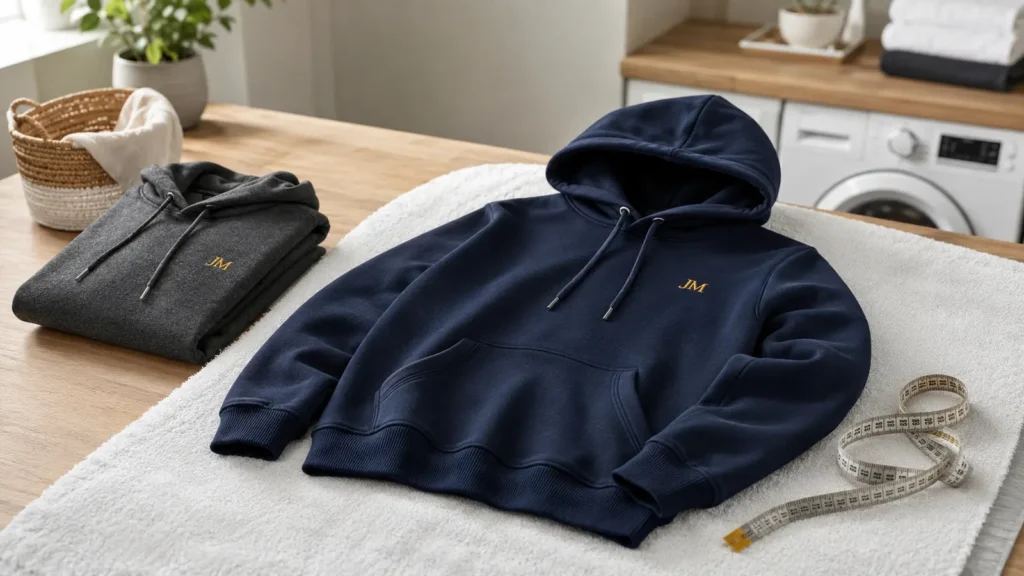
Measure first and make only one controlled change at a time.
Start With the Care Label, Fiber Content, and Measurements
The care label is the first decision point, not a formality. In the United States, the Federal Trade Commission’s Care Labeling Rule requires covered apparel manufacturers and importers to provide at least one satisfactory care method and relevant warnings. The label normally addresses washing, drying, bleaching, and ironing conditions. Following it is therefore safer than relying on a generic internet method. See the FTC’s current Care Labeling Rule guidance.
Before trying to change the fit:
- Read the complete care label, including drying and ironing restrictions.
- Confirm the fiber percentages on the content label.
- Note whether the hoodie is already preshrunk or garment washed.
- Inspect screen prints, heat transfers, embroidery, patches, zippers, drawcords, and elastic.
- Measure the garment on a flat surface.
- Decide exactly where the change is needed: body width, body length, sleeve length, hem, or hood.
- Photograph or record the starting measurements.
Measure the chest width from underarm to underarm, the body length from the high shoulder point to the hem, and the sleeve from a consistent shoulder or center-back reference. Do not compare a stretched measurement with a relaxed measurement. Smooth the garment without pulling it.
If the hoodie fits poorly in several areas, alteration or replacement is usually more predictable than home resizing. Shrinking rarely preserves every proportion, and stretching one area can pull seams or pockets out of alignment.
How Different Hoodie Fabrics Respond
“Fleece” describes a fabric structure and finish, not a single fiber. Two hoodies that look similar can behave very differently because one is 100% cotton and the other is a cotton-polyester blend.
| Hoodie material | Likely response to controlled shrinking | Likely response to damp reshaping | Main risks | Practical recommendation |
|---|---|---|---|---|
| 100% cotton fleece or French terry | Most responsive, especially if not preshrunk | Can often be eased slightly while damp | Uneven shrinkage, shorter sleeves, fading, rougher hand | Use conservative warmth and check frequently |
| Cotton-rich blend | May shrink modestly; polyester limits the change | May gain a small amount of width or length | Body and rib may react differently | Adjust gradually; do not expect a full size change |
| 50/50 cotton-polyester | Usually more dimensionally stable than pure cotton | Limited and sometimes temporary | Heat can affect print and surface; shape may rebound | Prefer tailoring or correct size replacement |
| Polyester-rich fleece | Little predictable shrinkage | Limited reshaping | High heat can glaze, distort, or damage fibers and decoration | Avoid using heat as a sizing tool |
| Cotton with elastane/spandex | Unpredictable because the elastic component controls recovery | May stretch temporarily | Heat can reduce elastic recovery | Follow the label; avoid high heat |
| Wool or wool blend | Can felt and shrink irreversibly with heat and agitation | May be reshaped gently when wet if the label permits | Felting, matting, severe distortion | Use wool-specific care or a professional cleaner |
| Rayon/viscose blend | Can change dimensions substantially when wet | Weak when wet and easily distorted | Permanent stretching, shrinkage, seam stress | Do not improvise; follow the label exactly |
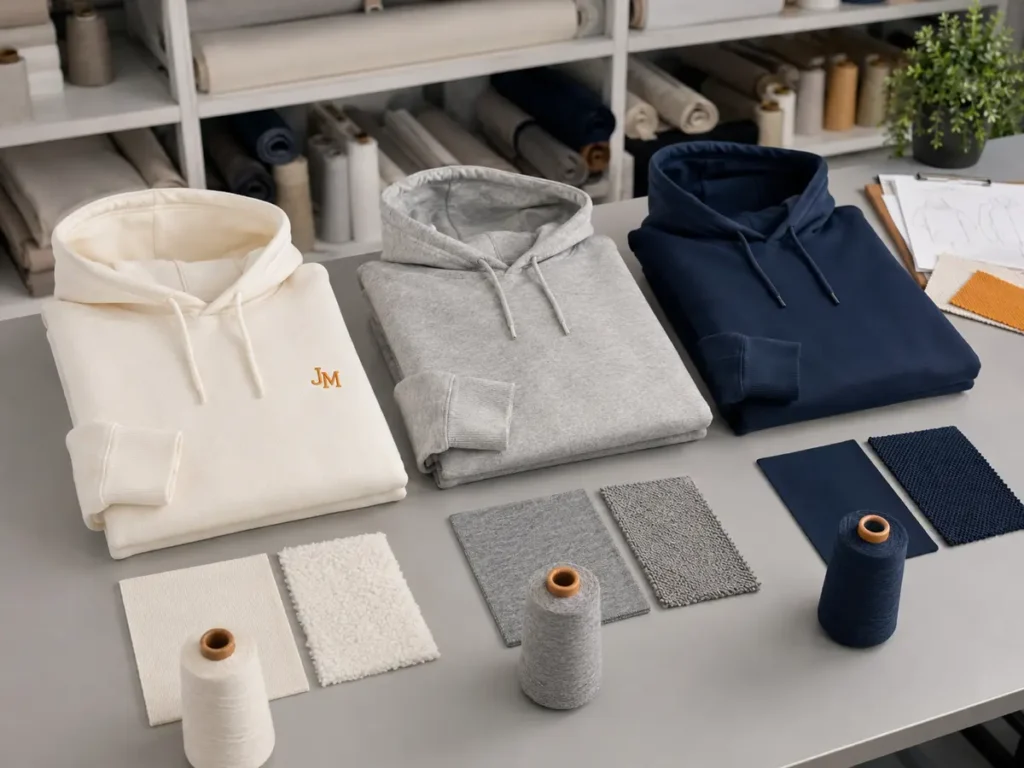
Fiber percentages and fabric construction determine whether size adjustment is realistic.
Heat and agitation are major causes of cotton shrinkage, while high dryer heat and overdrying increase the risk. Whirlpool’s consumer guidance likewise recommends gentler washing and lower drying heat when the goal is to preserve cotton dimensions. That same relationship can be used cautiously when a small reduction is desired, but it should not be treated as a precise sizing system. Review Whirlpool’s explanation of cotton shrinkage.
How to Shrink a Cotton-Rich Hoodie Safely
No home method can guarantee an exact percentage of shrinkage. The following process is designed to reduce risk by using measurement, limited heat, and repeated checks.
Step 1: Confirm that heat is permitted
Do not continue if the label says “dry clean only,” “do not tumble dry,” or gives a low temperature that conflicts with your plan. If the hoodie contains wool, rayon, leather trim, adhesive-backed decoration, or a high elastane percentage, use a professional alteration or replace the size.
Turn a printed or embroidered hoodie inside out. Close zippers and fasteners so they do not distort the front opening or catch on other items. Remove detachable accessories.
Step 2: Record the target and starting size
Write down the flat measurements and the change you need. A target such as “reduce chest width by about 1 cm” is safer than “make it smaller.” If the desired change is several centimeters in every direction, the method is unlikely to produce a balanced fit.
Step 3: Wash conservatively
Wash the hoodie alone or with similar soft items. Use the warmest water and cycle allowed by the label, not the hottest setting available on the machine. A gentle or normal cycle is usually more controllable than heavy agitation.
If the label permits only cold washing, respect that limit. Deliberately overriding it may cause color loss, decoration failure, or excessive dimensional change. Do not pour boiling water over the garment or simmer it in a pot; those popular shortcuts give poor control and can damage trims and finishes.
Step 4: Use short dryer intervals
Transfer the hoodie to the dryer and select low or medium heat only if permitted by the care label. Dry for a short interval, remove the hoodie while it is still slightly damp, lay it flat, allow it to cool briefly, and remeasure.
Repeat only if more reduction is needed. Stop before the hoodie is bone dry. Overdrying can continue to reduce dimensions, set wrinkles, roughen the surface, and stress printed decoration. The correct interval varies by machine, garment weight, and load, so measurement is more reliable than a universal minute count.
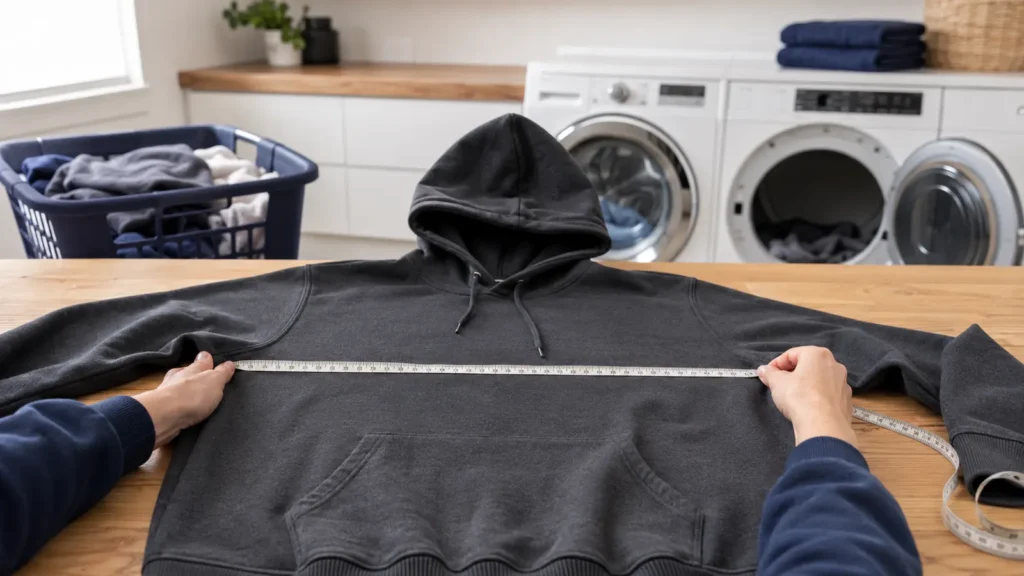
Short cycles and repeat measurements provide more control than maximum heat.
Step 5: Finish flat
Once the hoodie is close to the target, smooth it into a balanced shape and finish drying flat or according to the label. Align the shoulder seams, sleeves, pocket, and side seams. Do not hang a heavy damp hoodie by the shoulders, because its own weight may lengthen the body or distort the shoulder line.
Can you shrink only one part of a hoodie?
Targeted shrinkage is unreliable. Wetting one section and heating it with a hair dryer or iron can create a visible boundary, uneven color, surface shine, or localized print damage. Rib cuffs and hems also contain different yarns and structures from the body, so they may not shrink at the same rate.
If sleeves are too long but the body fits, cuff alteration is more predictable. If the body is too wide but the shoulders fit, a tailor may be able to reshape the side seams. When decoration crosses a seam, ask whether it limits alteration.
How to Stretch a Hoodie Safely
Stretching works best as damp reshaping. It can recover some dimension lost through laundering or ease a tight area slightly, but the result may be temporary. Polyester and elastic blends tend to recover toward their original shape.
Step 1: Check whether wet handling is safe
Follow the care label. Do not soak a “dry clean only” hoodie or one with leather, suede, delicate bonded trim, unstable dye, or decoration that should not remain wet. Spot-test colorfastness on an inconspicuous area if there is any concern.
Step 2: Dampen the garment evenly
Fill a clean basin with lukewarm water and submerge the hoodie until it is evenly wet. Plain water is the most conservative starting point. Some household guidance suggests adding a small amount of hair conditioner to help relax certain fibers; Whirlpool describes this approach for some shrunken clothing. If you use it, choose a mild product, use very little, confirm the label allows soaking, and rinse thoroughly to avoid residue. See Whirlpool’s garment shrinkage guidance.
Do not use hot water when stretching. Heat may encourage further shrinkage in natural fibers and may affect dyes or decoration.
Step 3: Remove water without wringing
Lift the hoodie with both hands so the wet weight does not pull one section. Press out water gently; do not twist or wring. Place it on a clean towel, roll the towel around it, and press to absorb moisture.
Step 4: Reshape on a flat surface
Lay the damp hoodie on a second dry towel. Align the center front, shoulder seams, side seams, sleeves, rib hem, and pocket. Measure the current dimension.
Use both hands to apply small, even pulls over a broad area. Work in increments, alternating from one side to the other. To add body width, ease outward across the torso without pulling the pocket corners. To add length, hold near the shoulders and smooth toward the hem without stretching the neckline. For sleeves, support the armhole and work gradually toward the cuff.
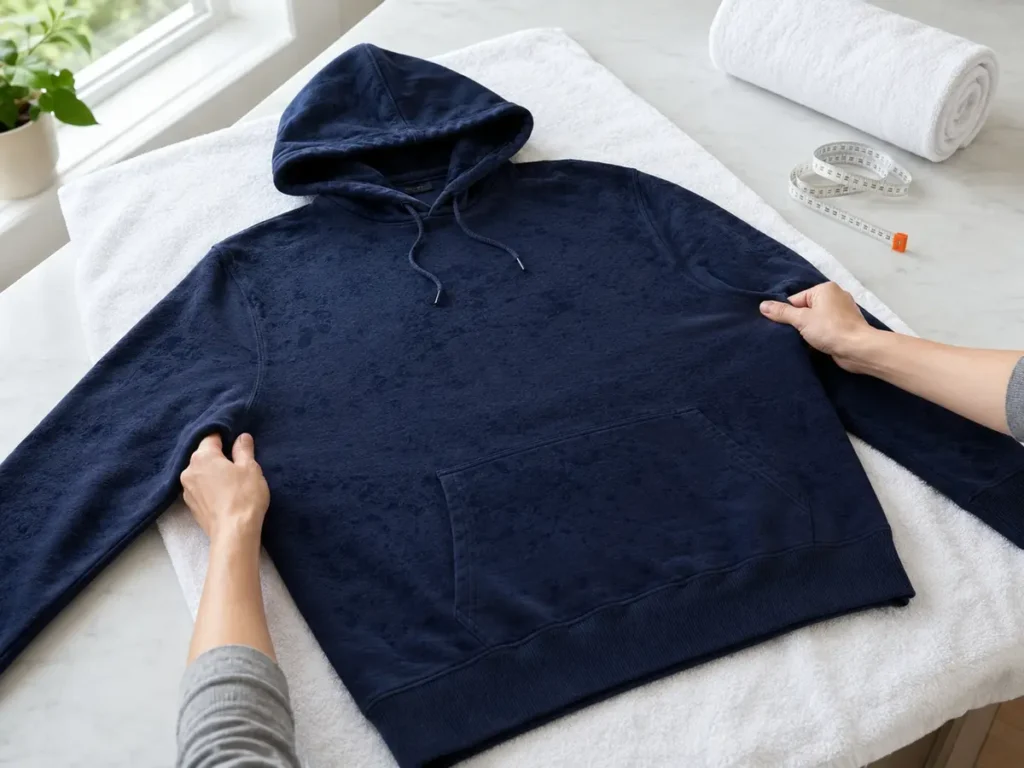
Support the garment and distribute tension across the fabric instead of pulling one seam.
Step 5: Dry flat and recheck
Leave the hoodie flat in the desired shape, away from direct heat and strong sunlight. Replace a saturated towel if necessary. Check the measurements while the garment is still damp and again when dry.
For wool garments that are washable, flat drying and gentle reshaping are especially important. The Woolmark Company recommends laying wool knitwear on a towel and gently shaping it during flat drying. See Woolmark’s flat-drying guidance. A wool hoodie with felting, bonded trim, or uncertain care should go to a textile-care professional instead.
Where Stretching Commonly Goes Wrong
| Mistake | What can happen | Safer alternative |
|---|---|---|
| Pulling only at the hem | Wavy hem, elongated pocket, distorted side seams | Distribute tension across the torso and remeasure |
| Hanging the hoodie while wet | Shoulder bumps and excess body length | Support it fully and dry flat |
| Wringing after soaking | Twisted seams and uneven surface | Press in a towel |
| Using weights or clips | Point distortion, clip marks, stressed stitching | Use gentle hand shaping over a broad area |
| Stretching the neckline | Poor recovery and an open neck shape | Stabilize the neck and work below the shoulder line |
| Applying steam directly to decoration | Adhesive or print damage | Avoid direct heat; follow decoration-specific care |
| Trying to gain a full size | Unbalanced proportions and temporary results | Replace, alter, or order the correct size |
Protect Prints, Embroidery, Ribbing, and Zippers
The hoodie body is only one part of the system. Decoration and components often determine the safe temperature and handling method.
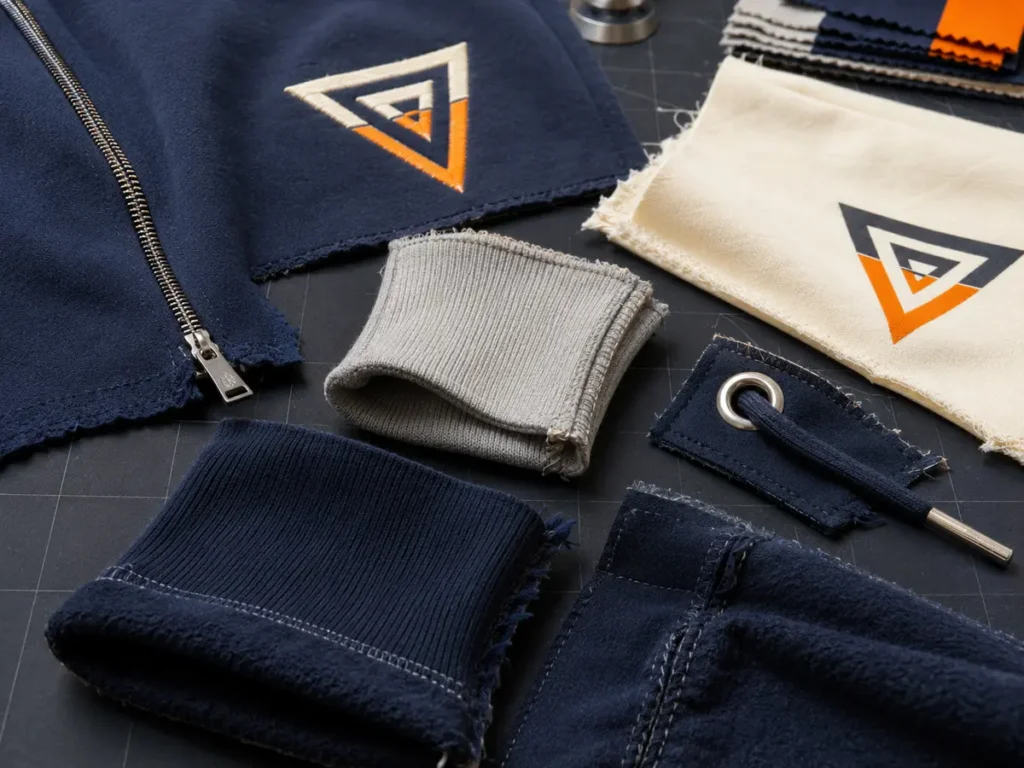
Decoration and trims can tolerate less heat or tension than the main fleece.
Screen printing and heat transfer
Turn the garment inside out and avoid high heat. A cured print may still crack when the surrounding fabric shrinks or stretches. Heat-transfer films and adhesive-backed graphics can lift, wrinkle, or become glossy. Never place a hot iron directly on the graphic unless the care instructions explicitly permit it.
Embroidery and patches
Embroidery is dimensionally stable compared with many fleece fabrics. If the body fabric changes, puckering may appear around a dense design. Large patches can also restrict local movement. Do not pull directly across the decorated area.
Rib cuffs and hems
Rib knit often contains elastane or uses a different cotton-polyester ratio. Excessive heat can reduce elastic recovery; aggressive stretching can create a permanently flared cuff. Adjust the body while leaving the rib relaxed whenever possible.
Zippers
A zipper tape may not shrink with the surrounding cotton fleece. Excessive body shrinkage can make a front zipper ripple. Close the zipper before washing, but do not force a distorted zipper after drying.
Drawcords and metal hardware
Drawcords can retract into the channel or shrink differently from the hood. Tie the ends loosely or secure them according to the garment’s care instructions. Metal tips can become hot in a dryer, so use conservative heat.
Is the Size Change Permanent?
Controlled cotton shrinkage may be partly or largely permanent because laundering and heat can relax manufacturing tensions in the fabric. However, the garment may not continue shrinking at the same rate in every wash. The amount depends on the original fabric, finishing, preshrinking process, knitting tension, and laundering conditions.
Damp stretching is usually less permanent. A cotton-rich hoodie may retain some recovered dimension, but repeated washing and drying can move it toward its previous size. Polyester and elastane increase shape recovery, which is useful for normal wear but limits intentional stretching.
This is why retailers and bulk buyers should not describe a home method as a guaranteed sizing correction. Care instructions should protect the approved fit, not ask the end user to create it.
What This Means for Custom Hoodie Buyers
For a custom team or private-label order, post-purchase shrinking or stretching is a warning sign. The production goal should be consistent finished measurements after the intended care cycle.
International textile standards provide a structured basis for dimensional-change testing. ISO 6330:2021 specifies domestic washing and drying procedures used for textile testing. ISO 5077:2007, confirmed as current in 2022, covers determination of dimensional change after washing and drying. ISO 3759:2011 addresses preparation, marking, and measurement of textile specimens and garments for dimensional-change tests.
These standards do not create one universal acceptable shrinkage limit for every hoodie. The buyer and supplier still need to agree on the fabric, test method, measurement points, cycles, tolerances, and acceptance criteria.
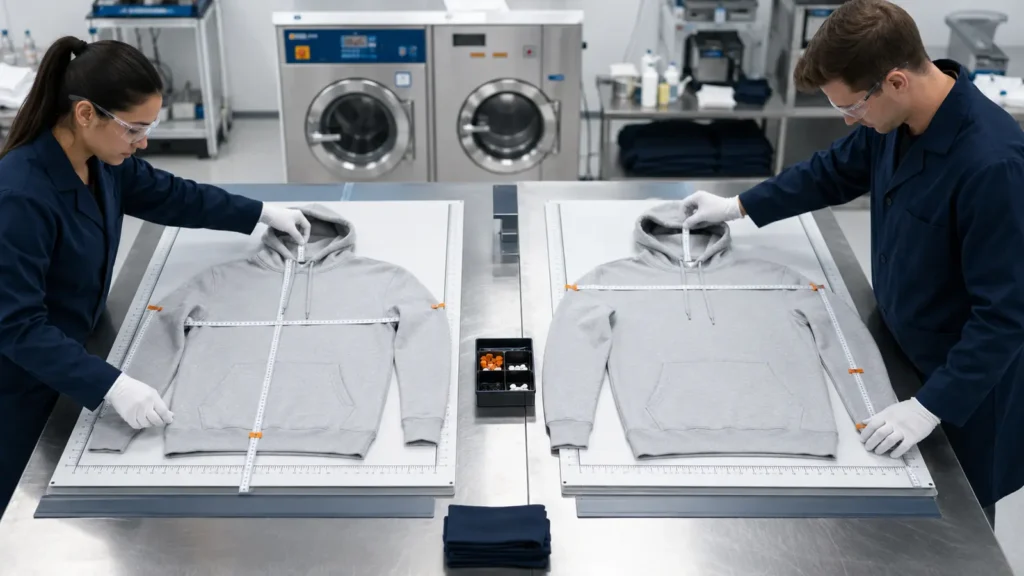
Bulk buyers should define how garments are washed, measured, and accepted.
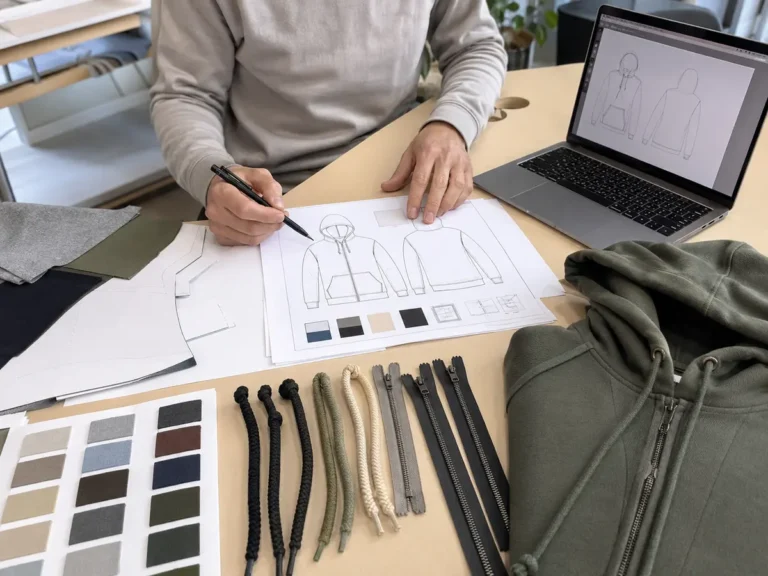
Add dimensional stability to the tech pack
A useful custom hoodie specification should identify:
- Fiber content and allowed tolerance
- Fabric construction, such as brushed fleece or French terry
- Fabric weight in GSM
- Whether the fabric or finished garment is preshrunk or garment washed
- Finished garment measurement chart
- Points of measurement and measurement method
- Allowed garment measurement tolerance
- Agreed laundering and drying procedure
- Number of test cycles
- Allowed dimensional change after testing
- Colorfastness and appearance requirements
- Decoration method and artwork size
- Placement tolerance for logos, labels, and patches
- Rib composition and recovery expectations
- Care-label wording and symbols for the destination market
Do not accept a vague promise such as “the fabric will not shrink.” Ask for a measurable test condition and a numerical acceptance limit appropriate to your product and market. Any figure should be confirmed through the selected fabric and garment sample, not copied from a different program.
Approve both fit and washed performance
The preproduction sample should be checked before and after the agreed care test. Record chest width, body length, shoulder, sleeve, hem, hood, pocket, and zipper appearance where applicable. Photograph the same garment on the same surface before and after testing.
| Approval stage | Buyer and supplier action | Evidence to retain |
|---|---|---|
| Fabric selection | Confirm composition, weight, surface, stretch, color, and finish | Swatch approval and specification |
| Size set or fitting sample | Check grading and fit across key sizes | Signed measurement chart and fit comments |
| Decoration sample | Confirm artwork size, position, hand feel, and heat sensitivity | Physical sample and approved artwork |
| Wash test | Apply the agreed wash and dry procedure | Before-and-after measurements and photos |
| Preproduction sample | Confirm all revisions together | Sealed approval sample |
| Bulk inspection | Compare production with approved tolerances | Inspection report and defect records |
| Repeat order | Reconfirm material and color consistency | Approved reference and updated lot record |
Control the variables that affect dimensional change
Fiber percentage alone is not enough. Yarn type, knit density, fleece finishing, compaction, dyeing, garment washing, rib construction, seam tension, and dryer exposure all influence the result. A heavyweight 80/20 cotton-polyester fleece from one mill may perform differently from another fabric with the same headline composition.
For repeat orders, ask whether the same fabric source and finishing route will be used. If a substitute is proposed, require a new swatch, measurements, decoration trial, and wash test before bulk production.
A Practical Custom Hoodie Quality-Control Plan
Quality control should connect the customer’s care experience to production evidence.
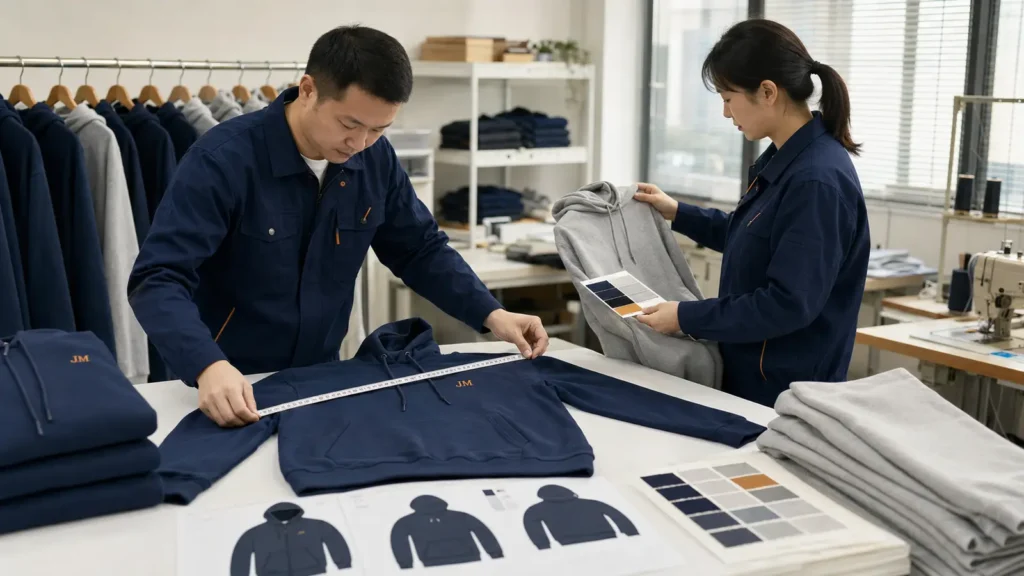
Sample approval should cover measurements, decoration, components, and post-wash appearance.
- Incoming fabric check: verify the approved color, hand feel, weight, width, surface, and obvious defects.
- Cut-panel control: monitor shade grouping, grain direction, nap direction, and panel matching.
- Inline sewing check: review seam construction, stitch consistency, pocket symmetry, zipper alignment, hood shape, and rib attachment.
- Decoration check: confirm artwork version, dimensions, color, location, adhesion or stitch quality, and appearance on the real fabric.
- Finished measurement check: measure garments flat using the approved points and tolerances.
- Care and wash verification: test selected samples using the agreed procedure; remeasure after conditioning.
- Final inspection: examine workmanship, assortment, labels, packaging, carton marks, and quantity.
- Reference retention: keep an approved sample, fabric reference, color standard, and inspection records for repeat orders.
The sampling level, test frequency, and acceptance criteria should match the order size, product risk, buyer requirements, and destination market. A dense heat transfer, unusual fabric, contrast panel, or zipper hoodie may justify more testing than a basic pullover.
What to Send for a Custom Hoodie Quotation
A clear request reduces revisions and gives the supplier enough information to propose an appropriate fabric and sampling plan. Send:
- Buyer type and intended use
- Pullover or zip hoodie style
- Adult, youth, unisex, women’s, or custom fit
- Size range and target market
- Estimated quantity per color and size
- Preferred fiber composition and fabric weight
- Brushed fleece or French terry preference
- Color references or Pantone targets
- Logo files and decoration method
- Artwork dimensions and placements
- Private labels, hangtags, and packaging
- Measurement chart or reference sample
- Care-performance expectations
- Required testing or inspection
- Target delivery date and destination
If you do not yet have a complete tech pack, send a reference image, target use, quantity, logo, size range, and preferred price position. A capable supplier can then identify the missing decisions before sampling.
Planning a custom hoodie order? Share your quantity, size range, fabric preference, colors, logo files, packaging, and target delivery date with JIUMU. Request a sample and define the wash-test conditions before approving bulk production. Explore JIUMU custom hoodies or request a quotation.
Why JIUMU for Custom Hoodies and Teamwear
JIUMU is a Guangdong-based B2B supplier established in 2010, serving buyers in the United States, Canada, the United Kingdom, and Europe. Its custom apparel capabilities include OEM and ODM development, fabric sourcing, Pantone color matching, embroidery, screen printing, heat transfer, patches, private labels, hangtags, packaging customization, digital mockups, physical samples, quality control, and export support.
The typical MOQ is 50 pieces, subject to the hoodie structure and customization. For teams and organizations that need coordinated apparel, JIUMU can also support related custom team uniforms, custom team jackets, and custom team jerseys.

Consistent sizing and care performance matter across every garment in a team order.
JIUMU does not recommend treating consumer shrinking or stretching as a substitute for sample approval. The practical sourcing route is to define the fabric, measurement chart, decoration, care method, and acceptance criteria before bulk production.
Frequently Asked Questions
Final Recommendation
To shrink or stretch a hoodie safely, work within the care label, understand the fiber content, measure before and after, and make one small adjustment at a time. Cotton-rich fleece offers the most room for controlled change. Polyester-rich, elastic, wool, rayon, heavily decorated, and zip hoodies require more caution. Stop if the fabric, print, seams, or ribbing begin to distort.
For B2B buyers, solve size and care performance before the order reaches the wearer. Approve garment measurements, test the selected fabric and decoration under an agreed laundering procedure, retain evidence, and use the approved sample as the reference for bulk production and repeat orders.
Sources and Further Reading
- Federal Trade Commission: Clothes Captioning—Complying with the Care Labeling Rule
- Federal Trade Commission: Care Labeling Rule text
- ISO 6330:2021—Domestic washing and drying procedures for textile testing
- ISO 5077:2007—Determination of dimensional change in washing and drying
- ISO 3759:2011—Preparation, marking and measuring for dimensional-change tests
- Woolmark: How to dry a wool sweater
- Whirlpool: Does cotton shrink?
- Whirlpool: How to prevent clothes from shrinking
About JIUMU
JIUMU is a Guangdong-based B2B supplier of custom teamwear, logo apparel, hats, uniforms, bags, and branded merchandise. The team supports OEM/ODM development, decoration, labels, packaging, samples, quality control, and export coordination.