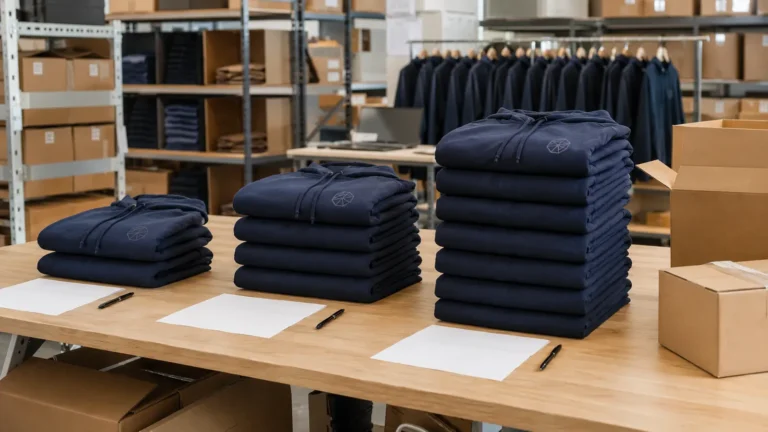
Best Workwear Hoodies for Construction and Outdoor Crews
The best workwear hoodie is not simply the heaviest sweatshirt in a catalog. For a construction company, utility contractor, landscaping business, property-maintenance team or outdoor event crew, the right hoodie must fit the job, climate, uniform system and purchasing plan.
A cold-weather framing crew may need a heavyweight fleece that layers under a shell. A mobile service team may prefer a full-zip hoodie that can be opened between tasks. Workers near vehicles may need a separately verified high-visibility garment. A company ordering for several branches may care most about size consistency, logo placement and repeat-order color control.
This guide covers product types, fabrics, fit, construction, visibility, branding, cost drivers, samples, quality control and accurate quoting.

Quick Answer
For most construction and outdoor crews, the best all-purpose workwear hoodie is a mid-to-heavyweight cotton-polyester fleece with a durable face, brushed interior, reinforced high-stress seams, secure pockets, rib cuffs and a fit that allows a base layer without becoming loose around equipment. Choose a pullover for simplicity and warmth, a full zip for ventilation, or a shell-faced hoodie for light wind and drizzle.
However, a standard branded hoodie should not automatically be treated as personal protective equipment. If visibility, flame resistance, electrical protection, chemical protection or another hazard is involved, start with the employer’s risk assessment and require documentation for the applicable garment and market. Logo decoration must not reduce protective material coverage or interfere with labels and performance.
Why Workwear Hoodie Selection Matters
A crew hoodie sits at the intersection of comfort, appearance and operational use. If it is too light, workers may add uncoordinated layers. If it is too bulky, it can restrict movement or fit poorly under outerwear. If the fabric pills quickly, a uniform program looks tired long before the garment fails. If the size set is based on fashion fit rather than working movement, employees may stop wearing it.
The selection process should therefore begin with five questions:
- What work will the wearer perform?
- What temperature, wind and precipitation are typical?
- Will the hoodie be a midlayer, outer layer or both?
- Does the workplace risk assessment require certified protective clothing?
- How must the company logo, employee role and branch identity appear?
The answers determine the garment. They also prevent an attractive mockup from becoming an unsuitable work uniform.
Workwear Hoodie Types Compared
The following categories cover most construction and outdoor crew programs.
| Hoodie type | Best for | Main advantages | Points to specify |
|---|---|---|---|
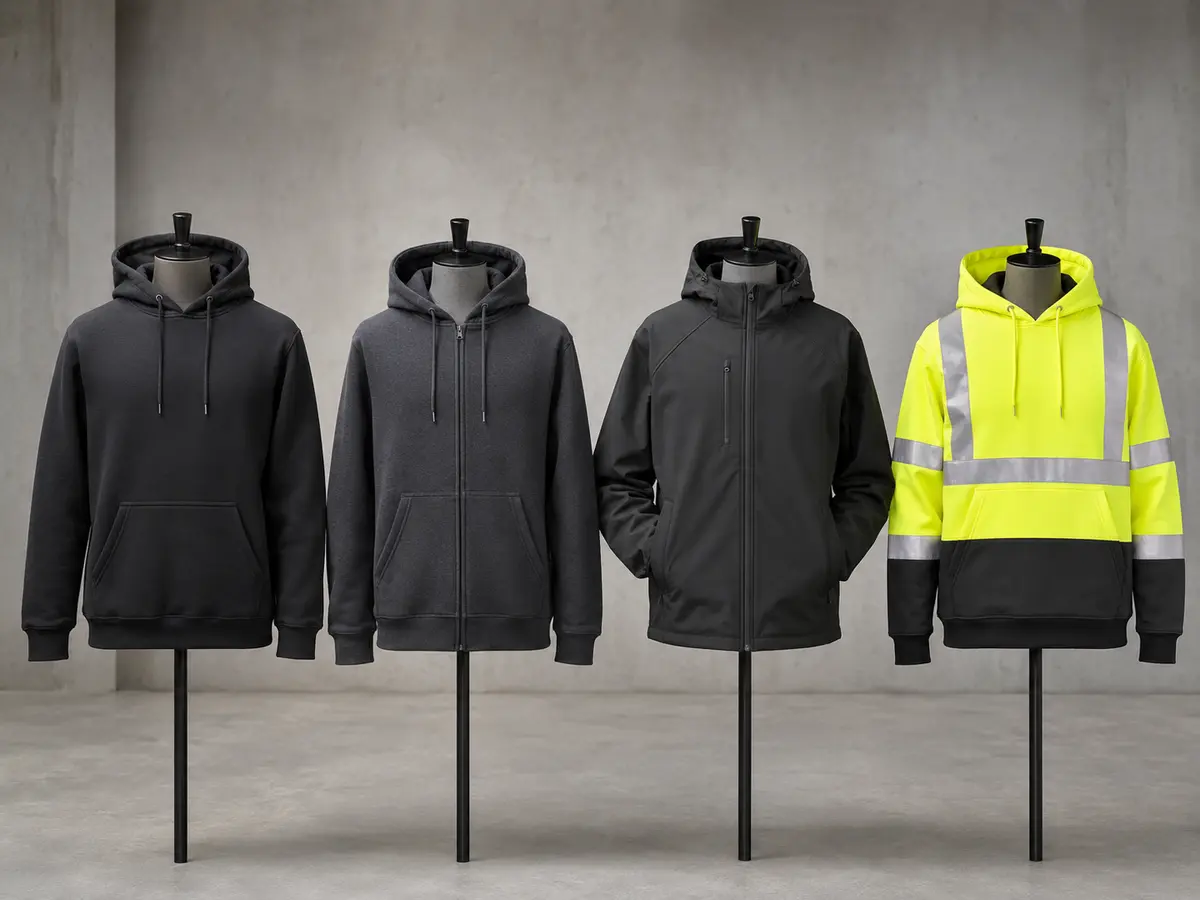
| Heavyweight pullover fleece | General construction, warehouses, cool dry weather | Warm, simple, fewer hardware components | Fabric weight, pocket reinforcement, hood shape, cuff recovery |
| Full-zip fleece hoodie | Mobile technicians, supervisors, variable temperatures | Easy ventilation and removal; works well as a layer | Zipper gauge, zipper brand or performance requirement, pocket security |
| Performance-knit hoodie | Active landscaping, mild weather, indoor-outdoor transitions | Lower bulk, faster moisture movement than heavy cotton fleece | Fabric composition, snag resistance, opacity, odor-control claims if any |
| Shell-faced or bonded hoodie | Windy sites and light weather exposure | Smoother exterior, better wind resistance, easier surface cleaning | Bonded layers, breathability target, water-repellency test and care limits |
| High-visibility hoodie | Traffic-adjacent or low-visibility tasks where the risk assessment permits this format | Combines warmth with conspicuity | Exact standard, garment class/type, reflective layout, certification documents |
| Job-specific protective hoodie | Flame, arc, heat or other identified hazards | Designed around a defined protective function | Applicable standard, test reports, labeling, traceability and decoration restrictions |
Heavyweight Pullover Hoodies
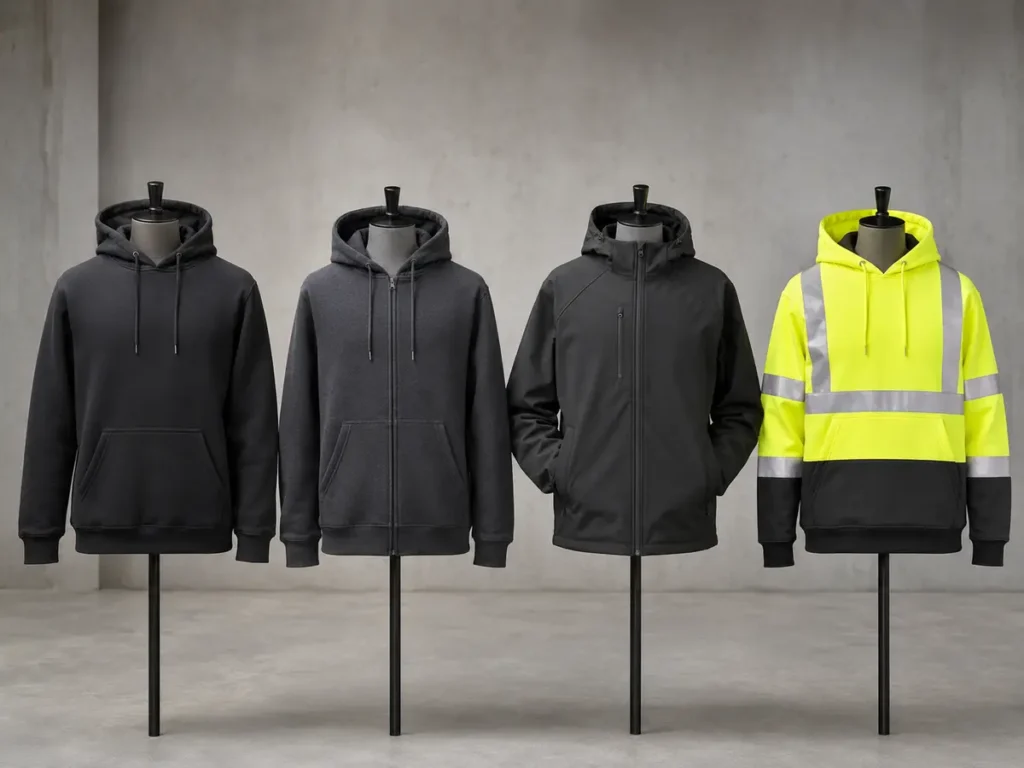
The pullover is the dependable default for crews that work in cool, mostly dry conditions. With no full front zipper, it has fewer components to fail and a large front area for a logo or department mark. A kangaroo pocket offers hand warmth, but the two pocket openings should be reinforced because they receive frequent pulling.
Specify whether drawcords are allowed. Some employers avoid loose cords in settings with snag or entanglement risks. A drawcord-free hood, short internal cord system or alternative hood adjustment may be more suitable, depending on the work.
Full-Zip Work Hoodies
A full zip is practical for drivers, installers and supervisors who move between heated vehicles, indoor spaces and outdoor work. It allows faster temperature adjustment than a pullover. The tradeoff is greater dependence on zipper quality and front-panel alignment.
For bulk orders, approve the zipper color, puller shape, bottom stop, pocket style and embroidery position relative to the center opening. Check that the zipper operates smoothly over the full size range, not only on the medium sample.
Performance and Hybrid Hoodies
Performance-knit hoodies reduce bulk for high-movement tasks. Hybrid designs combine fleece through the body with woven overlays at the shoulders, elbows or pocket edges. These can be useful where backpacks, harness-adjacent equipment or repeated surface contact creates wear.
Do not assume that a synthetic fabric is automatically breathable, moisture-wicking or snag-resistant. Convert each marketing term into a material specification or test method. A supplier should be able to identify the fiber content, fabric construction, weight and any finish applied.
Weather-Resistant Hoodies
A shell-faced or bonded hoodie can handle wind and short light showers better than ordinary brushed fleece. It is not necessarily waterproof. “Water-resistant,” “water-repellent” and “waterproof” describe different performance levels and should not be used interchangeably.
If weather performance matters, state the expected use and request the relevant test result, test method and wash durability. For sustained rain, a certified or properly specified waterproof outer shell may still be required over the hoodie.
Choose Fabric by Work Pattern, Not by Name
Fabric is the largest driver of comfort, appearance and decoration behavior. Buyers should define at least fiber composition, construction, weight, surface character, interior finish and color.
| Fabric option | Typical character | Strengths for crews | Procurement cautions |
|---|---|---|---|
| Cotton-rich fleece | Soft face and familiar sweatshirt feel | Comfortable, good print surface, strong casual uniform appeal | Can absorb moisture; shrinkage and colorfastness must be controlled |
| Cotton-polyester fleece | Balanced hand feel and dimensional stability | Practical all-purpose choice, broad decoration compatibility | Blend ratio alone does not prove durability |
| Polyester fleece | Lower moisture absorption and quick drying | Useful for damp climates and active crews | Pilling, static and heat sensitivity need evaluation |
| French terry | Looped interior without deep brushing | Less bulky for shoulder seasons and active work | Usually less insulating than brushed fleece |
| Bonded knit or softshell construction | Multiple layers combined for weather management | Smoother exterior, wind resistance, structured look | Bond strength, breathability and care performance need confirmation |
| Performance interlock or double knit | Smooth, athletic character | Mobility and lower bulk | May snag or show abrasion depending on yarn and structure |
Understanding Fabric Weight
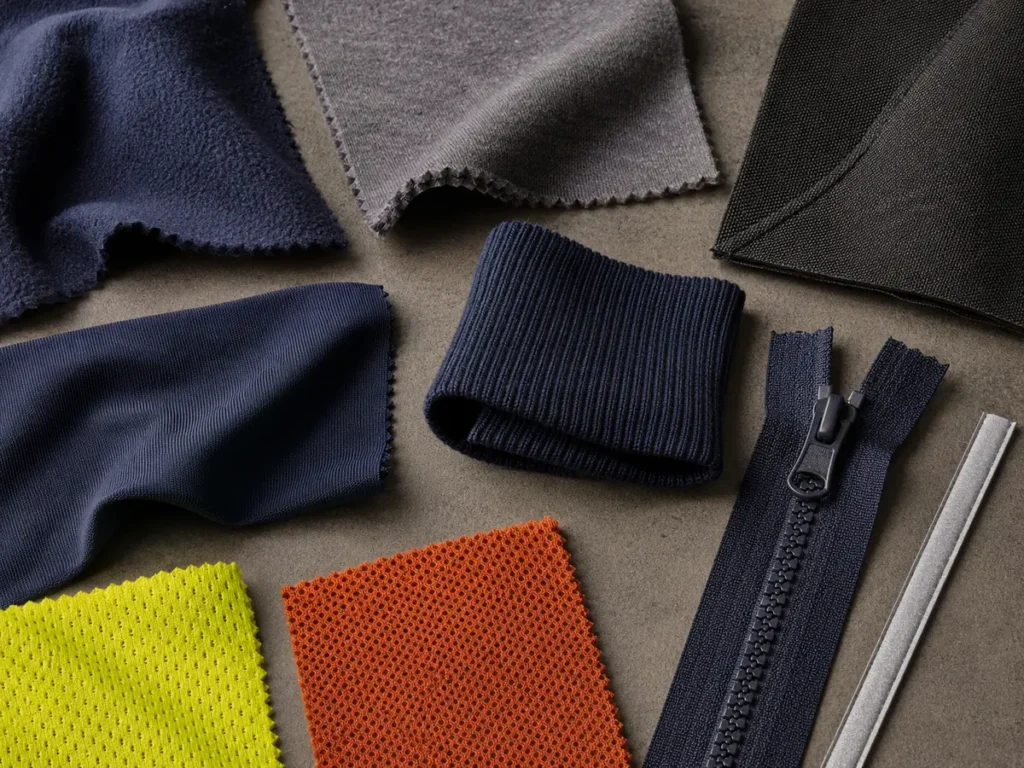
Fabric weight is commonly stated in grams per square meter, or GSM. It helps compare fabrics, but it is not a complete warmth rating. A dense 320 GSM fabric can feel different from a lofty 320 GSM fleece because yarn size, knitting density, brushing and air trapped in the structure all affect insulation and hand feel.
Lightweight hoodies suit mild weather and active tasks; midweight options are versatile for layering; heavyweight fleece adds insulation but also bulk and drying time. Do not specify GSM in isolation. Pair it with an approved swatch and physical sample, then record the composition, surface, interior finish and color reference.
Brushed Fleece Versus French Terry
Brushed fleece traps more air and feels warmer against the body. It is a strong choice for winter crewwear, but the brushing level should be controlled because excessive loose fibers can shed or change after washing.
French terry has loops on the interior and usually feels less bulky. It works well in spring and autumn, for active landscaping crews, or as a layer under a work jacket. Buyers should compare actual samples rather than assuming one name guarantees a fixed weight or quality level.
Shrinkage, Pilling and Colorfastness
Shrinkage can change fit, pilling makes a uniform look prematurely worn, and poor colorfastness causes fading or dye transfer. Agree on test methods and acceptable results before production. Ask whether evidence covers the finished decorated garment, because laundering can affect fabric, embroidery backing, print film, reflective trim and labels differently.
Fit, Layering and Size Coverage
Workwear fit should support movement and layering without adding loose material near tools or machinery. A fashion sample photographed on one model cannot confirm this.
OSHA’s construction PPE rule requires employers to ensure required PPE properly fits each affected employee. The revised language took effect on January 13, 2025. Although an ordinary hoodie may not itself be PPE, the principle is valuable for any crew uniform: a size range must work for the people and tasks involved, and it must not interfere with required PPE. See OSHA’s construction PPE overview and 29 CFR 1926.95.
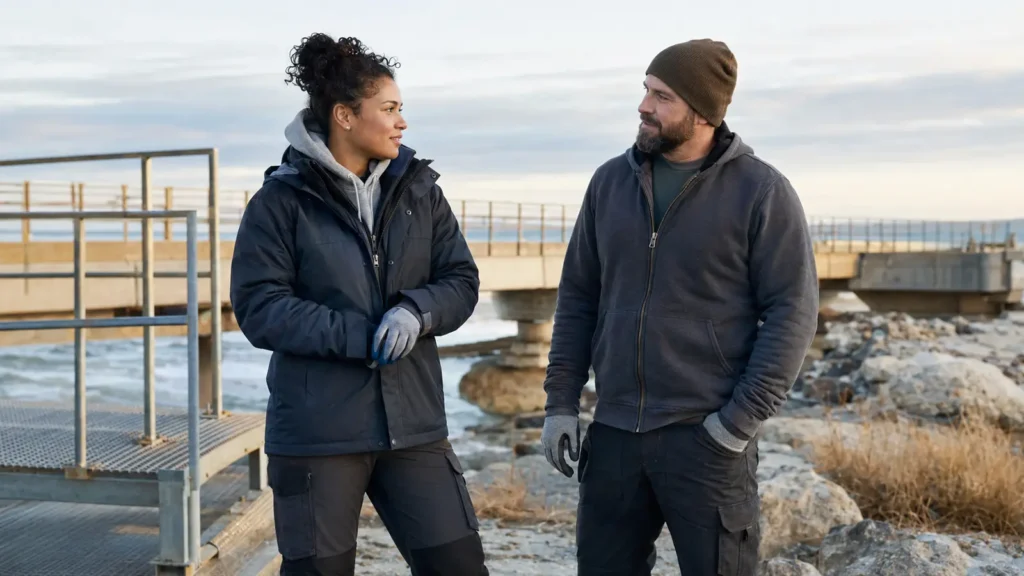
Decide the Intended Layer Position
Tell the supplier whether the hoodie will be:
- worn over a T-shirt only;
- worn over a thermal base layer;
- worn under a waterproof jacket;
- used with a safety vest or high-visibility outer layer; or
- worn around fall-arrest, respiratory, hearing or head protection.
A bulky hood can conflict with an outer jacket collar. A tight sleeve can compress a base layer. A long hem may bunch under a harness. These are system questions, not styling details.
For cold conditions, OSHA recommends loose-fitting layers, including a moisture-managing inner layer, an insulating middle layer and an outer layer that protects against wind and rain while allowing ventilation. A hoodie can serve as the middle layer, but it does not replace a complete cold-stress plan. See OSHA’s Cold Stress Guide.
Build a Useful Size Set
Request a graded chart covering half chest, body length, shoulder, sleeve, bicep, cuff, hem and hood dimensions. A mixed workforce may need more than one fit block, extended sizes or height adjustments. Test representative wearers while reaching, bending, kneeling, driving and working with gloves, then record approved comments before finalizing the size set.
Construction Details That Improve Service Life
Durability comes from a system of fabric, pattern, seams, trims and workmanship. A heavy fabric with weak pocket openings is not a durable hoodie.
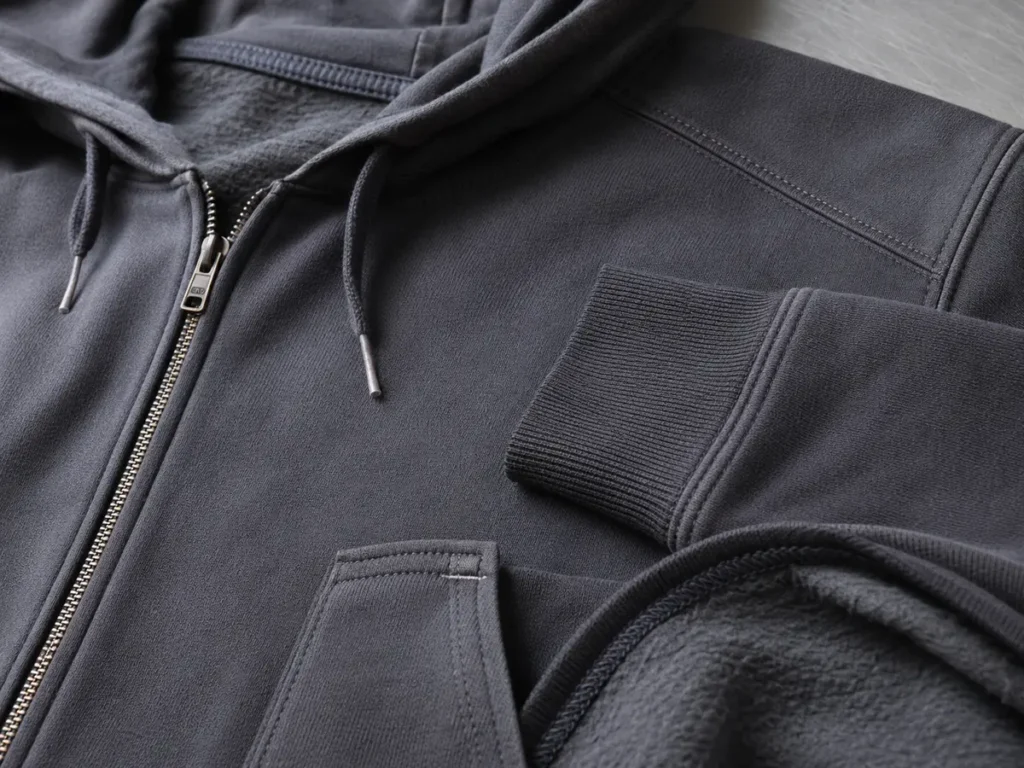
Reinforce High-Stress Areas
Review the shoulder and armhole seams, underarm, pocket openings, zipper base and hood-to-neck seam. Depending on the design, reinforcement may include coverstitching, double-needle topstitching, bartacks, tape or an additional fabric layer.
More stitching is not automatically better. Needle size, thread, seam type and stitch density must suit the fabric. Excessive needle penetration can weaken some laminated or performance materials.
Specify Cuffs and Hem Recovery
Rib cuffs and hems repeatedly stretch over gloves, tools and body movement. Ask for rib composition and recovery, not only color. A poor rib may relax after a few washes even when the body fabric remains sound.
For outdoor crews, a slightly extended back hem can improve coverage when bending. Keep it compatible with tool belts and outer layers.
Evaluate Pockets as Equipment
The classic kangaroo pocket is warm but open. Mobile crews may prefer zipped or internal pockets for keys and access cards. Ask workers what they actually carry, but do not treat a hoodie as a substitute for purpose-built tool storage.
Control Zippers and Other Trims
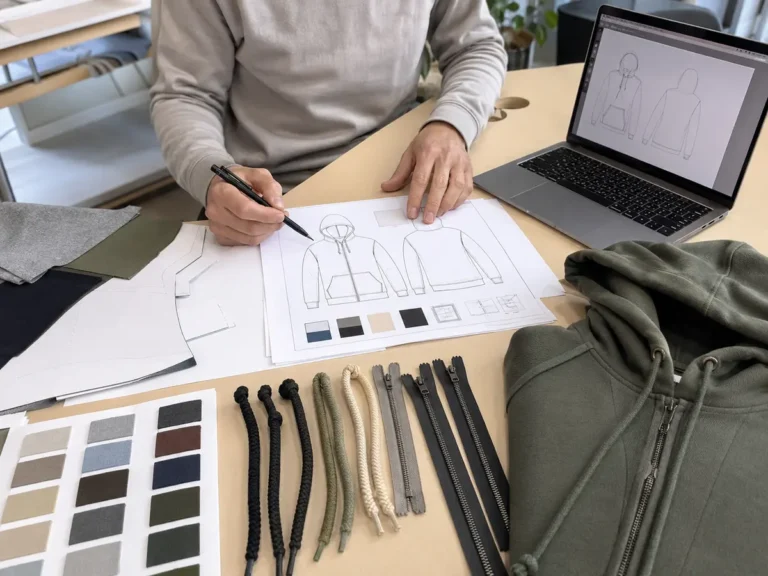
For full-zip styles, define the zipper material, size, color and performance expectation. Metal, molded plastic and coil zippers each produce a different feel. Check the puller with gloves and confirm that decoration machinery will not damage nearby components.
If corrosion, metal detection, electrical exposure or food-site rules apply, tell the supplier before design.
Visibility and Protective-Clothing Requirements
This is the most important boundary in the buying process: a fluorescent color or reflective strip does not by itself prove that a hoodie is compliant high-visibility safety apparel.
In the United States, OSHA states that high-visibility apparel is required to address struck-by hazards for employees exposed to public and construction traffic in highway and road work zones. ANSI/ISEA 107-2020 is the ISEA-listed American standard for high-visibility safety apparel. In Canada, CSA Z96:22 is the fourth edition of the high-visibility safety apparel standard. For international and European programs, ISO 20471:2013 remains current as of July 2026, with a replacement draft under development. The EU also regulates PPE placed on its market through Regulation (EU) 2016/425.
| Market or context | Reference to check | Buyer action |
|---|---|---|
| United States road and construction traffic exposure | OSHA requirements and ANSI/ISEA 107-2020 | Use the workplace hazard assessment to identify garment type/class; verify labels and supplier documentation |
| Canada | CSA Z96:22 plus provincial or employer requirements | Confirm class, level, design and documentation for the intended province and task |
| United Kingdom | Employer risk assessment and recognized high-visibility standard | Follow current HSE guidance; ensure the garment is suitable for actual day, night and weather conditions |
| European Union | Regulation (EU) 2016/425 and applicable harmonized standards | Confirm conformity assessment, technical documentation, labeling and market obligations |
| General outdoor uniform use without identified PPE function | Company specification and worksite rules | Do not advertise or label the hoodie as protective clothing without appropriate evidence |
Authoritative references include OSHA’s highway work-zone interpretation, ISEA’s ANSI/ISEA 107-2020 page, CSA Z96:22, ISO 20471:2013, the UK HSE high-visibility clothing guide and the current consolidated text of EU Regulation 2016/425.
Requirements can change and local rules may be stricter, so confirm them with a safety professional or competent authority.
Decoration on Protective Garments
Adding a large logo can reduce visible background or reflective area. Stitching can penetrate a protective layer. Heat application can alter a finish. A neck label can cover mandatory information.
Before decorating a garment intended as PPE:
- confirm the applicable standard and required classification;
- obtain the manufacturer’s decoration limitations;
- approve logo dimensions and positions against the certified design;
- retain required labels and traceability information; and
- verify whether the decorated garment needs additional assessment or testing.
The buyer must identify the workplace hazard and target-market requirement at the start of the project.
Custom Branding and Private-Label Options
The best branding method depends on logo detail, order quantity, fabric face, garment use and desired appearance.
| Method | Best use | Advantages | Watch points |
|---|---|---|---|
| Embroidery | Chest logos, names, durable corporate identity | Dimensional, professional, strong wash resistance when properly executed | Adds weight and backing; dense designs can distort fleece |
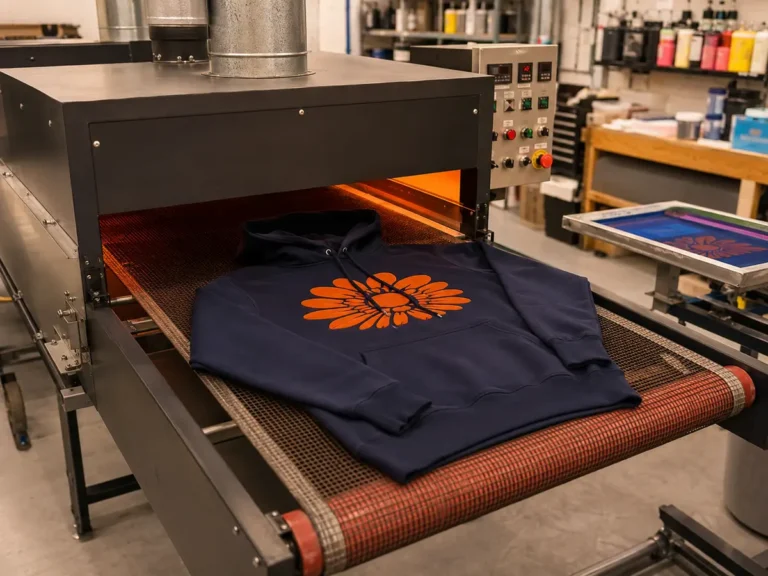
| Screen printing | Larger simple graphics and repeat bulk orders | Good coverage and efficient at scale | Ink system must match fabric and stretch; cure conditions matter |
| Heat transfer | Multicolor logos, names, smaller runs or variable data | Fine detail and flexible placement | Film feel, edge lifting and heat sensitivity require testing |
| Woven patch | Detailed badge-style marks | Crisp detail and repeatable shape | Edge finish and attachment method affect comfort |
| Rubber/PVC patch | Modern workwear or outdoor identity | Tactile, weather-oriented appearance | Added weight; verify flexibility and wash performance |
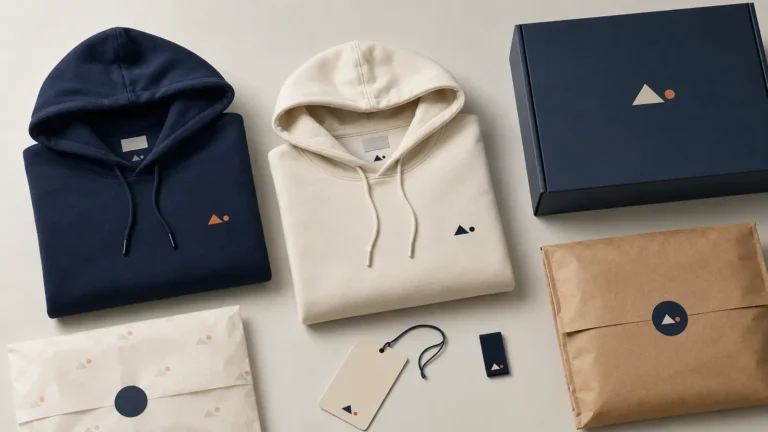
| Private labels and hangtags | Distributors, uniform dealers and brands | Creates a controlled resale or employee-issue program | Must not replace mandatory care, fiber or compliance labels |
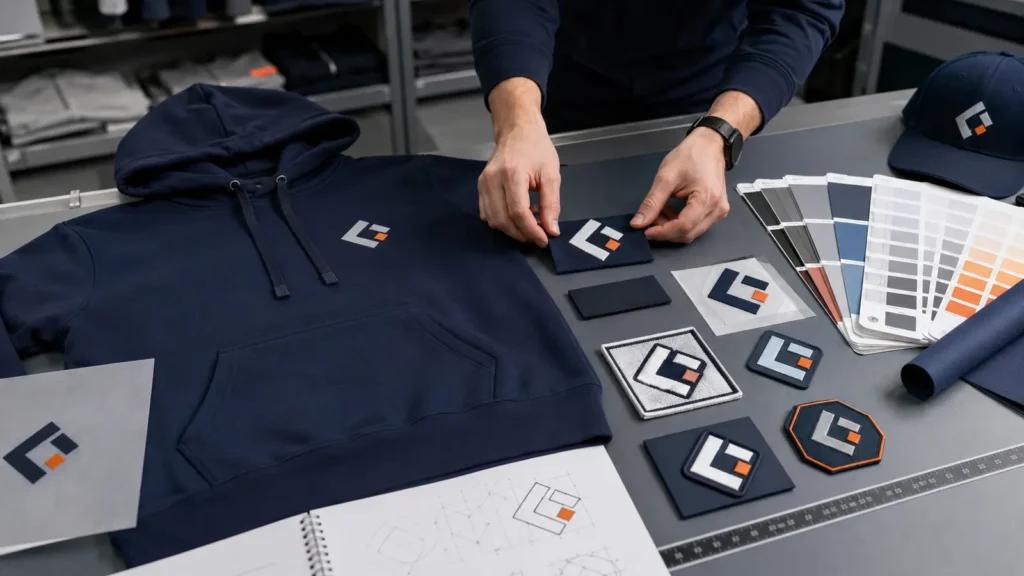
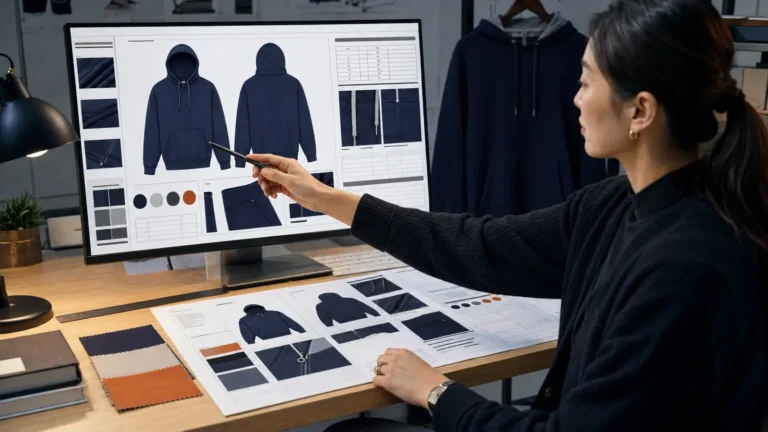
Approve actual decorated samples under realistic laundering. Digital mockups confirm placement and scale, but they do not show puckering, hand feel, color interaction or adhesive performance.
Planning a custom crew program? Send JIUMU:
- hoodie type and reference image;
- intended task and climate;
- quantity by color and size;
- preferred fabric composition and weight;
- logo artwork and decoration method;
- visibility or protective requirements;
- label and packaging needs; and
- target delivery date and destination.
Request a custom workwear hoodie quotation or explore JIUMU’s custom hoodies and custom team jackets.
What Drives Bulk-Order Cost?
Reliable quoting requires a complete specification. The main cost drivers are:
- fabric composition, construction, weight and finish;
- custom dyeing versus available colors;
- pullover, full-zip, bonded or hybrid construction;
- reflective material or other specialized components;
- number of logo positions and decoration method;
- embroidery stitch count or print coverage;
- custom labels, hangtags and individual packaging;
- size range and the proportion of extended sizes;
- testing, documentation and compliance work;
- sample rounds;
- total quantity per design and color; and
- shipping method, carton plan, destination and required delivery date.
A low unit price based on a vague request is not directly comparable with a quote based on tested fabric, controlled color and approved packaging. Ask each supplier to quote the same specification and identify exclusions.
JIUMU’s typical MOQ is 50 pieces, subject to product structure and customization. A complex high-visibility or protective-clothing project may require different minimums, component availability and documentation.
Sample Approval and Quality Control
The physical sample is the buyer’s most important decision point. It should become the reference for bulk production.
Recommended Sample Sequence
- Specification review: confirm use, construction, fabric, colors, logo, labels, packaging and compliance needs.
- Digital mockup: approve overall appearance and decoration placement.
- Fabric and trim approval: sign off composition, weight, hand feel, color, rib, zipper, reflective components and labels.
- Prototype or fit sample: evaluate fit, movement, pocket function and layering.
- Decorated pre-production sample: review the finished logo, measurements, workmanship and care behavior.
- Size-set approval when needed: confirm grading across small, core and extended sizes.
- Sealed sample: retain one approved reference for bulk comparison.
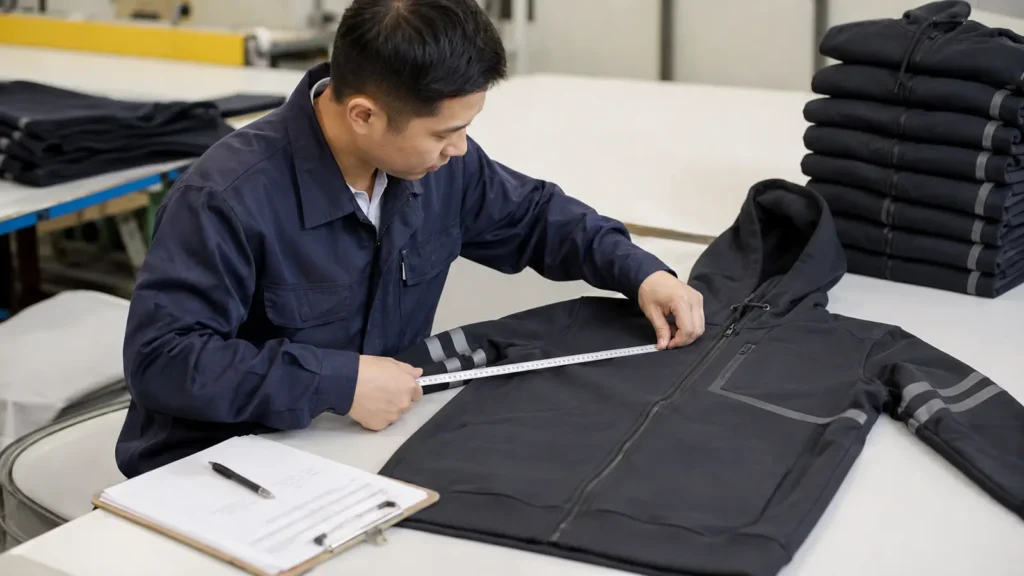
Bulk Inspection Checklist
Use a written inspection plan covering:
- fabric appearance, weight and color against the approved standard;
- finished measurements within agreed tolerances;
- symmetry and panel alignment;
- seam security, skipped stitches and loose threads;
- pocket strength and position;
- zipper operation;
- cuff and hem recovery;
- logo size, color, position and attachment;
- reflective layout where applicable;
- fiber, care, size, country-of-origin and required compliance labels;
- odor, stains, oil marks and contamination;
- folding, size stickers, polybags and carton markings; and
- quantity by SKU.
Inspection does not replace product testing. If performance claims matter, agree on laboratory or supplier test evidence and the exact sample-selection process.
How to Plan a Bulk Order
A controlled order can be organized into seven stages.
1. Define Crew Segments
Separate office, driving, active outdoor, traffic-adjacent and specialist-hazard roles.
2. Build the Core Specification
Choose the hoodie, fabric, fit, colors, pockets, trims, branding, labels and packaging.
3. Confirm the Compliance Path
If the garment has a protective purpose, name the target market, standard, type/class and required documents before sampling. Do not add this requirement after the design is complete.
4. Submit Accurate Artwork
Provide vector artwork, agreed color references and a placement diagram measured from stable garment points.
5. Approve Samples
Test fit on representative wearers. Wash the garment according to the proposed care label. Check logo, zipper, rib and surface appearance afterward.
6. Confirm the Purchase Order
The order should list every approved SKU, size breakdown, unit packaging, carton marking, delivery term and deadline. Reference the approved sample and revision number.
7. Inspect and Record
Inspect bulk production against the approved specification. Store the final tech pack, artwork, color references and inspection record for reorders.
Questions to Ask a Workwear Hoodie Supplier
Use these questions before placing a bulk order:
- What are the exact fiber content, knit construction and finished fabric weight?
- Is the fabric brushed fleece, French terry, double knit or bonded?
- What shrinkage, pilling and colorfastness test information is available?
- Which measurements define the fit, and what tolerances will apply?
- Can you provide a size set or extended-size sample?
- How are shoulder seams, pockets, cuffs and zipper bases reinforced?
- Which zipper, rib, thread and reflective components are proposed?
- Which decoration method is most suitable for this fabric and logo?
- Can the decorated sample be washed and reviewed before bulk approval?
- What documentation supports any high-visibility or protective claim?
- How will logos and reflective material be positioned without compromising requirements?
- What is the MOQ by style, color and logo?
- How will private labels, care labels, size labels and packaging be handled?
- What quality-control checkpoints occur before shipment?
- What information will be retained to support repeat orders?
Common Buying Mistakes
Choosing Only by GSM
Weight is useful, but construction, brushing, density and fiber all affect warmth and durability. Always approve a swatch and finished sample.
Calling Any Fluorescent Hoodie “Safety Wear”
Color alone does not prove visibility class or PPE conformity. Start with the hazard assessment and verify the correct standard and documentation.
Ignoring Decoration Effects
Embroidery can pucker fleece. Heat transfer can alter shell-faced fabric. Large logos may interfere with reflective coverage. Test the finished decorated garment.
Approving Only One Core Size
A good medium does not guarantee a good 3XL. Review grading and, for broad size programs, approve a size set.
Ordering Too Tight for Layers
The wearer trial should use the actual base layer, outerwear and required PPE. Extra fabric is not always the answer; balanced ease is.
Treating “Waterproof” as a Style Name
Require a defined test, result and wash durability before using performance language. Otherwise describe the construction accurately without an unsupported claim.
Forgetting Reorders
Record fabric code, color reference, trims, artwork files, measurement chart and label layout. Reorder consistency begins with documentation from the first order.
Why Source Custom Workwear Hoodies with JIUMU?
JIUMU is a Guangdong-based B2B supplier established in 2010, serving buyers in the United States, Canada, the United Kingdom and Europe. Its approved capabilities include OEM and ODM development, fabric sourcing, Pantone color matching, embroidery, screen printing, heat transfer, woven and rubber/PVC patches, private labels, hangtags, customized packaging, digital mockups, physical samples, bulk quality control and export support.
Buyers can coordinate the garment, logo method, labels and packaging through one specification, alongside custom team jackets, custom hats and custom team bags for a broader crew kit.
JIUMU does not assume that an ordinary custom hoodie meets a protective standard. Buyers should state any PPE, high-visibility, flame, electrical or weather-performance requirement at inquiry stage so the sourcing and documentation path can be evaluated.
Frequently Asked Questions
Final Recommendation
For a general construction or outdoor uniform program, begin with a mid-to-heavyweight cotton-polyester fleece in a pullover or full-zip design. Add reinforced pocket openings, stable rib, practical secure storage and a fit tested over the crew’s normal base layer. Use embroidery, screen printing, heat transfer or patches according to the fabric and logo—not according to appearance alone.
For traffic exposure, flame, arc, electrical, chemical or severe-weather risks, pause the ordinary apparel process. Define the hazard, jurisdiction and required standard first. Then source and decorate only within the documented limitations of the protective garment.
The best result is a hoodie specification that workers will wear, buyers can reorder, and safety teams can evaluate clearly.
About the Author
JIUMU Editorial Team creates practical sourcing guidance for B2B buyers of custom teamwear, workwear and branded apparel. Product capabilities and company facts are limited to JIUMU’s approved profile.