Best Print-on-Demand Hoodie Companies: What Buyers Should Compare
Print-on-demand hoodie companies let a brand list customized apparel without purchasing finished inventory in advance. When a customer orders, the provider prints or embroiders the garment, packs it and ships it. That model can reduce launch risk, but choosing a provider is not simply a matter of finding the lowest base price.
Professional buyers need to compare the exact hoodie blank, decoration method, production route, branding, store integration, claim process and landed cost. Different business models require different supply configurations.
This guide compares six established print-on-demand options—Printful, Printify, Gelato, Apliiq, Gooten and teelaunch—by buyer use case. It also explains when POD remains the right operating model and when a validated hoodie program may benefit from moving to planned bulk production.
Quick Answer: There is no universal best print-on-demand hoodie company. Printful is a practical shortlist candidate for integrated fulfillment and multiple decoration methods; Printify is useful when buyers want to compare different print providers; Gelato is relevant for geographically distributed demand; Apliiq is designed around apparel branding and private-label details; Gooten targets scalable order operations; and teelaunch offers a relatively direct POD workflow. The cheapest international shipping option cannot be identified from an advertised base rate alone. Compare the same hoodie SKU, decoration, destination country, delivery speed, package weight, taxes or duties, tracking, and expected claim or return cost. Before choosing, order samples of the exact SKU and production route, calculate landed cost, test integrations and claims, and document an approved quality standard.
When Should a Brand Move From POD to Bulk Hoodies?
POD is useful for testing demand and avoiding finished-goods inventory. Planned bulk production becomes more relevant when a brand needs custom fabric or construction, consistent color across repeat orders, private labels, controlled packaging, a lower landed cost at validated volume, or coordinated delivery to one destination. Compare total cost, inventory risk, quality control, branding freedom, lead time, and fulfillment responsibility before switching models.
Review custom bulk hoodie options and OEM vs ODM manufacturing, then request a hoodie manufacturing quotation with your forecast and specifications.
Why the POD Hoodie Supplier Decision Matters
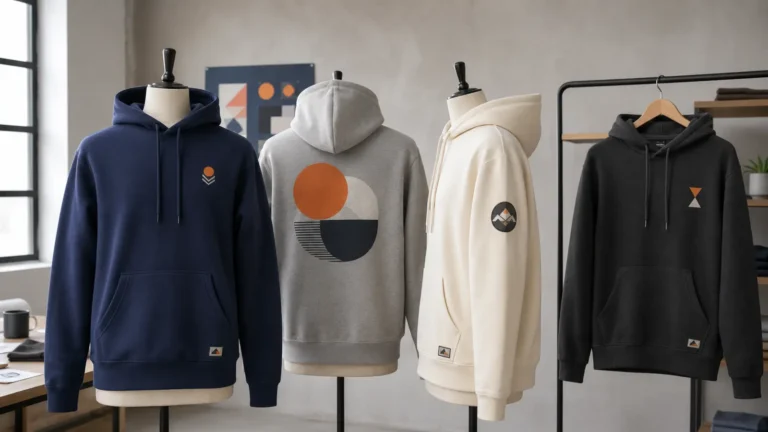
A hoodie is more specification-sensitive than a basic promotional T-shirt. Fabric weight influences warmth, drape and shipping cost. The cotton content and face yarn affect how a direct-to-garment print appears. Hood construction, rib recovery, pocket shape, drawcord hardware and internal finishing influence the customer’s impression before the artwork is considered.
The provider also becomes part of the customer experience. It controls production timing, packing, tracking transmission and the first response when a print is misaligned or a parcel is damaged. If the same listing is fulfilled by different facilities, buyers may receive garments with subtle differences in blank availability, print result or packaging.
For a business buyer, “best” therefore means the provider whose operating model matches the product promise. That match is more important than a headline catalog size or an introductory discount.
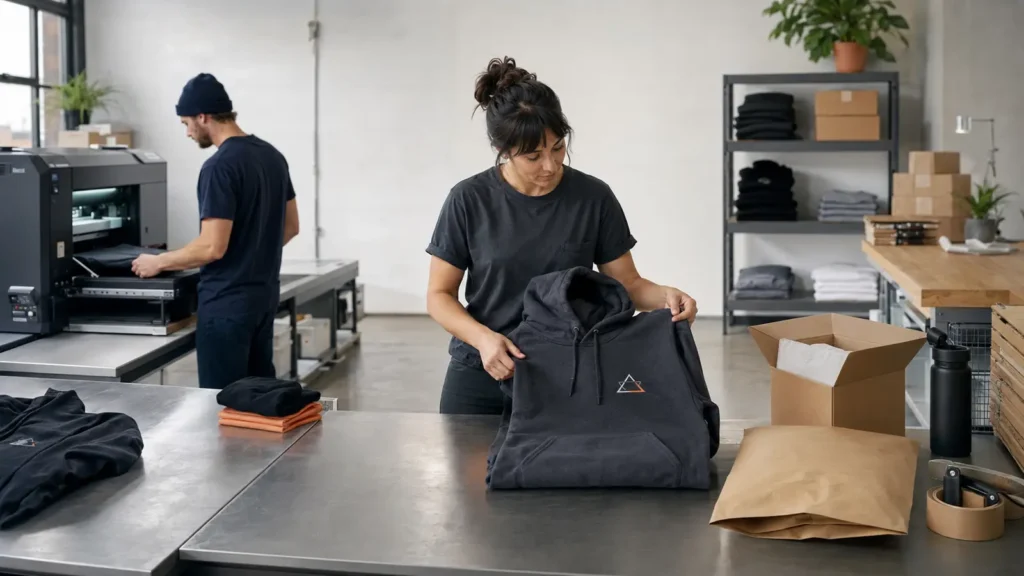
POD combines production, inspection, packing and shipping after an order is placed.
POD Hoodie Companies at a Glance
The following comparison is based on official provider information reviewed on July 31, 2026. It is a sourcing shortlist, not an independent performance ranking. Features can vary by country, product, production partner and subscription level.
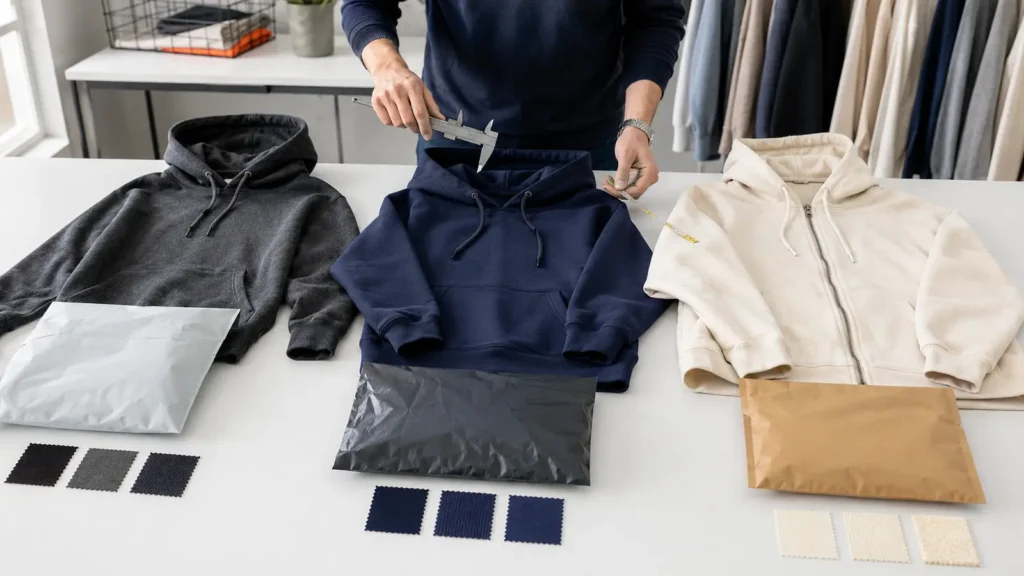
Every product-provider combination should be treated as a specific supply configuration.
| Provider | Distinctive operating model | Strongest buyer fit | Point to verify before launch |
|---|---|---|---|
| Printful | Integrated POD workflow with multiple decoration and branding options | Brands wanting a broad, relatively unified production and fulfillment system | Exact hoodie, decoration, branding and facility availability by destination |
| Printify | Network/marketplace with a choice of Print Providers for many products | Cost-conscious sellers that want provider and location choice | Treat every product-provider pairing as a separate supply configuration |
| Gelato | Orders routed through a distributed local-production network | International sellers with demand across several regions | Whether the same hoodie and decoration are available consistently in each market |
| Apliiq | Apparel-focused POD with private labels and garment branding | Streetwear and private-label brands | Added branding setup, trim inventory and compatibility for each blank |
| Gooten | Networked fulfillment and order orchestration | Established ecommerce operations and agencies | SKU coverage, service commitments, routing and account support requirements |
| teelaunch | Straightforward connected-store POD workflow | Sellers seeking a simpler catalog and fulfillment setup | Current integration, garment, print-method and destination coverage |
1. Printful: Integrated Fulfillment and Decoration Choice
Printful is often shortlisted by sellers who want product creation, store syncing, production and shipping in one system. Its official pages describe no-minimum ordering and automatic fulfillment. Relevant decoration options include DTG, DTFlex/DTF, embroidery and all-over print, although availability varies by hoodie.
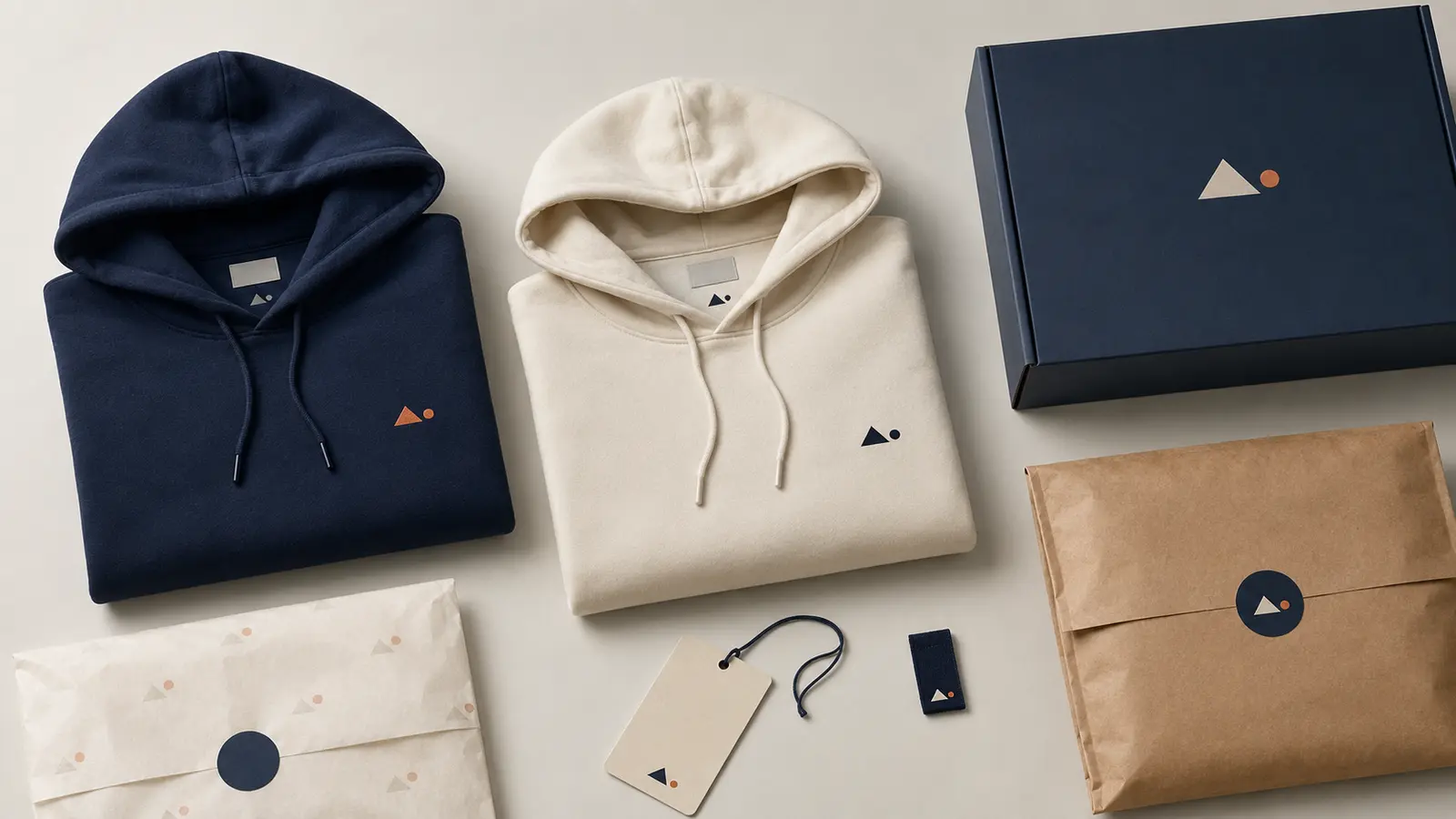
Printful also advertises branding through labels, pack-ins and packaging. This is important for buyers who want the parcel to feel more like their own brand, but the availability and cost of each branding option must be checked for the chosen product and fulfillment location.
Its integrations include widely used channels such as Shopify, Etsy and WooCommerce, with additional marketplaces, platforms and API options. That makes it suitable for a merchant who wants a comparatively mature connection between catalog, storefront and order status.
Best considered for: ecommerce brands that prefer an integrated workflow, want access to several decoration methods and are willing to pay attention to the exact catalog configuration rather than switching providers for the lowest visible price.
Watch for: a brand still needs to sample each important hoodie color and print method. A good DTG result on one cotton-faced blank does not prove that embroidery, an all-over product or a different blend will meet the same standard.
Official references: Printful custom sweatshirts, custom clothing and branding, and store integrations.
2. Printify: Provider Choice and Catalog Flexibility
Printify differs because many catalog products can be supplied by more than one Print Provider. Its official hoodie page encourages merchants to choose by factors such as price, location or delivery speed. This structure gives buyers more choice, but it also transfers more supplier-selection work to the merchant.
A Printify hoodie is not one universal supply chain. The same garment name from two providers may have different production locations, color availability, print areas, shipping rates and performance history. A merchant should lock the intended Print Provider during sample testing and document when order routing is permitted.
Printify supports major sales channels including Shopify, WooCommerce, Etsy, eBay US, Wix, Big Cartel, PrestaShop, BigCommerce, Squarespace, TikTok Shop US, Amazon US and an API, according to its current help documentation. It also offers branding features on eligible products and providers. For example, official help pages explain that inserts are limited to participating Print Providers and can affect routing; they are not supported with Express Delivery.
Best considered for: merchants who want to compare several provider options, optimize by region or cost, and actively manage supply configurations.
Watch for: automatic routing may improve availability or cost, but a route change can complicate consistency. Use test orders and define which substitutions are acceptable before a major campaign.
Official references: Printify custom hoodies, supported sales channels, and custom branding limitations.
3. Gelato: Distributed Production for International Demand
Gelato emphasizes local production through a network of print partners. At the time of review, its official site stated that the network included more than 140 print partners in 32 countries. Connected-store orders can be routed to a nearby production partner, and the company lists integrations including Shopify, Etsy, WooCommerce, TikTok Shop, Amazon, Wix, Squarespace, BigCommerce and API options, with country or beta restrictions for some channels.
This model can be attractive when a brand sells into North America and Europe and wants to reduce long cross-border routes. However, “produced locally” should not be interpreted as a guarantee that every hoodie SKU, size, color or decoration method is available everywhere.
International buyers should create a destination matrix. List the top countries, expected monthly units, required hoodie colors, print placement and promised delivery window. Then confirm which production route serves each region and order representative samples to those destinations.
Best considered for: global-facing stores with meaningful demand in multiple countries and a product assortment that can work within locally available catalog options.
Watch for: a distributed network can improve proximity while increasing the need for cross-location testing. The buyer should decide whether a near-equivalent garment is acceptable or whether one exact blank is central to the brand promise.
Official references: Gelato custom hoodies, global network information, and integration details.
4. Apliiq: Private-Label and Streetwear-Oriented Branding
Apliiq is apparel-focused and gives particular attention to branding components such as private labels, neck prints, woven labels and patches. Its official pages describe on-demand production, warehousing and bulk pathways, with Shopify and WooCommerce connections highlighted.
This positioning is relevant when the buyer wants more than artwork printed on a standard blank. Replacing or covering the manufacturer identity, adding a branded neck treatment and using distinctive trims can make the product feel closer to a label-owned garment.
Apliiq’s hoodie catalog includes standard and heavyweight options, and product pages may offer combinations of transfer, digital print, screen print and embroidery. Availability depends on the product. Some branding elements also require setup or a supply of labels that the provider stores and applies to future orders.
Best considered for: streetwear labels, creator brands and private-label startups that prioritize garment branding and are prepared to manage a more detailed product specification.
Watch for: calculate the full branding system, not only the hoodie and decoration. Include label creation, application, storage or subscription costs, packaging, shipping and the operational effect of any out-of-stock trim.
Official references: Apliiq services, private-label apparel, and relabeling on demand.
5. Gooten: Order Orchestration for Scaling Operations
Gooten describes automated production, shipping and smart order routing through a network. Its official hoodie pages and integration information cover connected-store fulfillment and API-based workflows. The company increasingly positions its technology toward established ecommerce operations, agencies and enterprise use cases.
Gooten also announced that its fulfillment network operates within the OrderMesh platform while the Gooten service remains available. For a larger buyer, that direction may be relevant when the selection process includes order routing, operational reporting, capacity and custom workflows—not only access to a hoodie blank.
The exact decoration method and garment specification still depend on the product. Buyers should ask for an onboarding review that covers their top SKUs, countries, peak order volume, personalization needs and service escalation path.
Best considered for: established merchants, agencies or multi-store operators that need scalable order handling and may benefit from operational support beyond a basic POD app.
Watch for: enterprise positioning does not remove the need for product-level testing. Confirm which service commitments apply to the buyer’s account and which product/facility combinations support them.
Official references: Gooten sweatshirts and hoodies, Gooten integrations, and Gooten and OrderMesh.
6. teelaunch: A Direct POD Starting Point
teelaunch describes a familiar POD sequence: the merchant uploads a design, a connected-store order is automatically transferred, and the provider prints, packs and ships the item. Its public catalog includes hoodies, and the company states that it works with production facilities in several countries.
The service can be worth testing when a merchant prefers a more focused workflow and does not require the broadest apparel-branding system. As with every provider in this guide, the current catalog, integration and destination coverage should be checked inside the seller account.
Best considered for: Shopify-oriented merchants and creators who want a comparatively direct route from product setup to fulfillment.
Watch for: confirm the exact hoodie styles, decoration areas, current production location and support process for the buyer’s primary markets. A simple setup is valuable only when the available product matches the brand’s quality and margin target.
Official references: teelaunch home and product catalog and POD workflow.
Compare the Hoodie Before Comparing the Platform
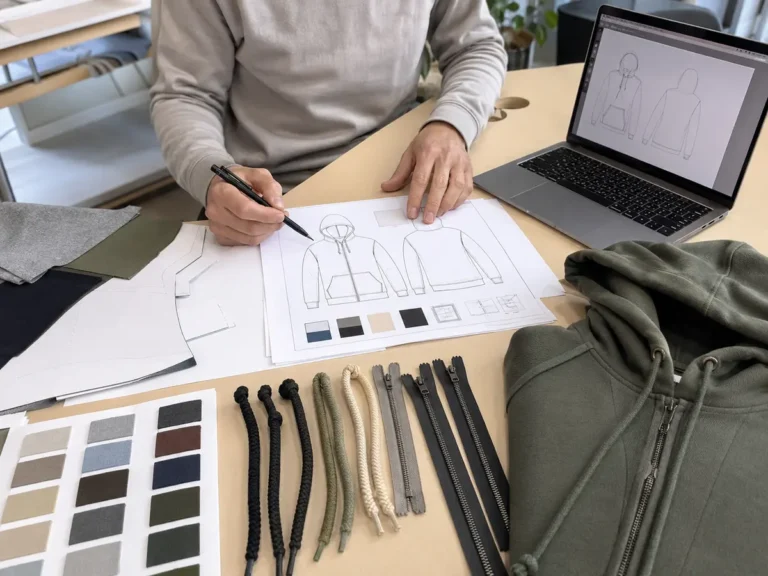
Platform features cannot rescue an unsuitable garment. Before evaluating software or shipping dashboards, define the hoodie specification that customers are expected to receive.
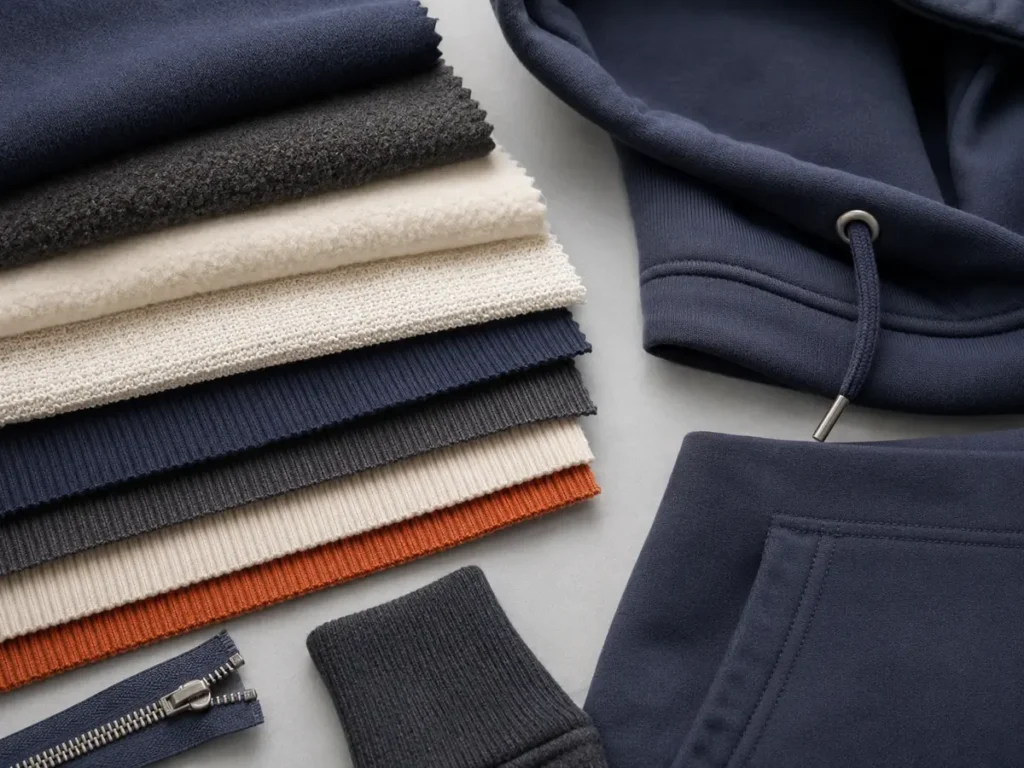
Fabric surface and construction details affect print results, fit, perceived value and shipping weight.
| Specification | What to record | Why it affects procurement |
|---|---|---|
| Style | Pullover, full zip, quarter zip, oversized, cropped or performance | Changes audience, printable area, zipper interference and selling price |
| Fabric composition | Cotton/polyester ratio, cotton face, recycled content when documented | Influences hand feel, print behavior, care and product claims |
| Fabric weight | oz/yd² or GSM when available | Affects warmth, structure, perceived value and shipping weight |
| Construction | Side seams, hood lining, rib, pocket, drawcord, eyelets and reinforcement | Determines fit stability and the details customers notice |
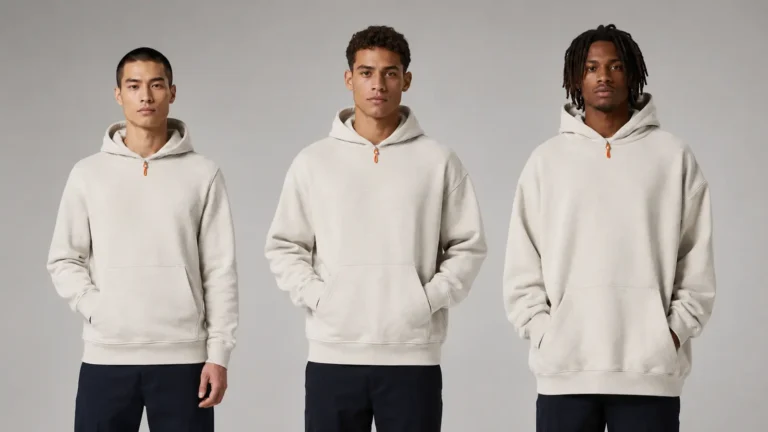
| Size range | Actual measurements by size and tolerance | Controls inclusivity, returns and size-chart accuracy |
| Color range | Core and seasonal colors, heather composition | Affects artwork contrast, underbase use and restock risk |
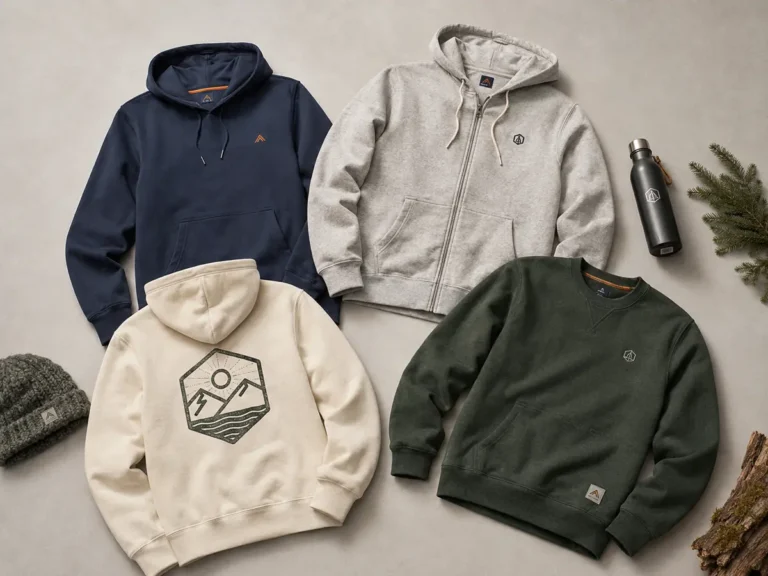
| Label setup | Manufacturer label, tear-away label, printed neck or sewn private label | Determines how fully the garment can represent the seller’s brand |
Avoid publishing a generic size chart copied from another hoodie. Measure the approved sample and map the provider’s current product data to the listing. If a blank changes, treat that as a product change, not a silent substitution.
Match the Decoration Method to the Artwork and Use Case
Most POD hoodie programs rely on one or more of the following methods. The buyer should select the method before finalizing artwork because file preparation and durability expectations differ.
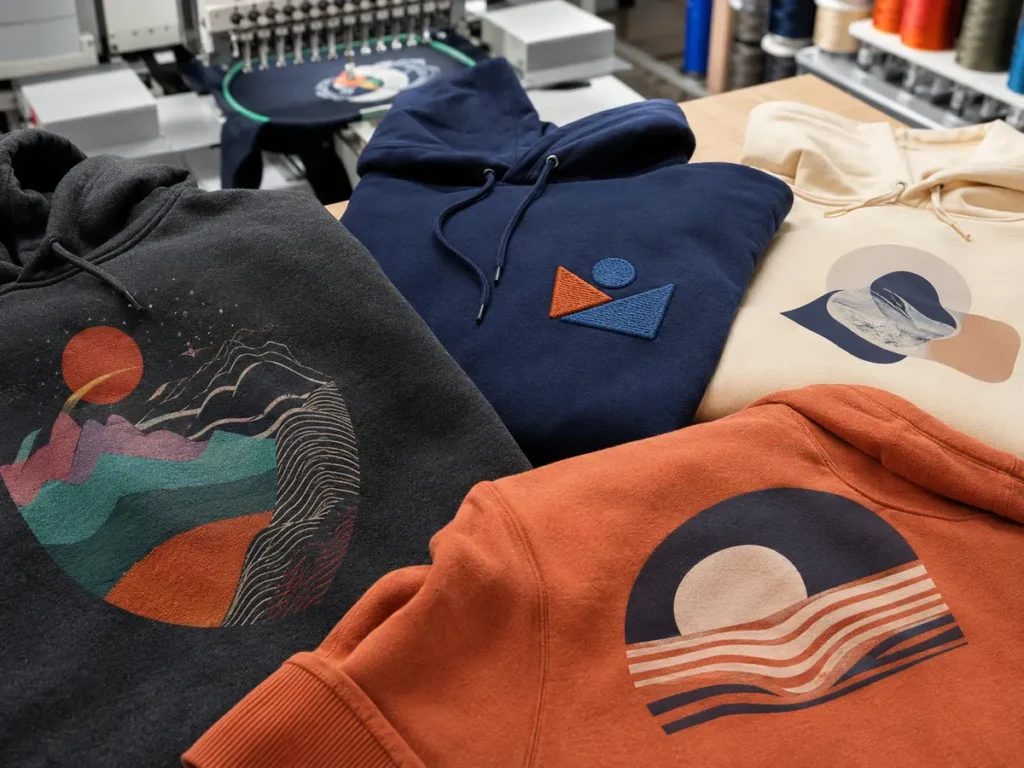
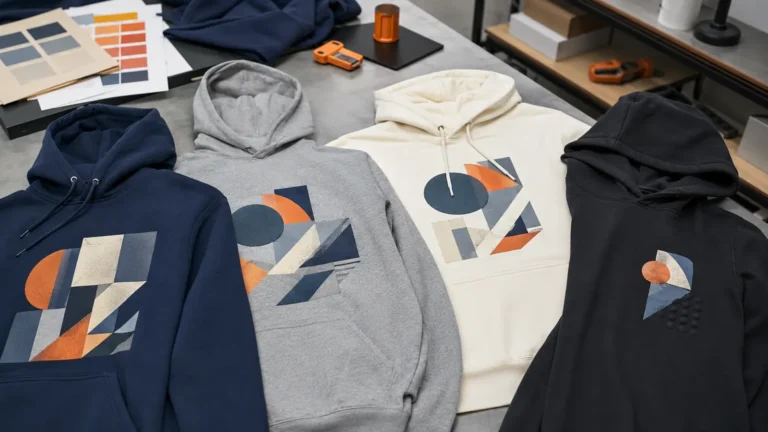
Artwork, fabric and order model determine whether printing, transfer, embroidery or screen printing is suitable.
Direct-to-Garment Printing
DTG is practical for full-color artwork and short runs. Results depend on the garment surface, pretreatment, ink behavior and curing. Cotton-faced fabrics commonly provide a more predictable print surface than rougher blends, but the exact blank must be tested. Dark garments normally require a white underbase, which can change hand feel and the appearance of transparent gradients.
Direct-to-Film or Transfer Printing
DTF and related transfer methods can reproduce detailed, colorful graphics on a range of fabrics. They create a distinct layer on the garment, so buyers should inspect edge quality, stretch, hand feel and washing behavior. The artwork should not contain extremely thin isolated elements that are difficult to transfer reliably.
Embroidery
Embroidery works well for compact logos, crests and text. It can support a more dimensional brand presentation, but dense stitch fields may stiffen fleece or distort a pocket area. Ask about digitization, thread colors, maximum stitch area, backing and placement tolerances.
Screen Printing
Screen printing is normally more economical in planned quantities than in true one-piece POD. It is a strong option for repeat graphics and durable team, school or promotional programs. Costs depend on color count, screens, placement and order quantity. Buyers comparing POD with bulk production should request a screen-print quotation once a design has stable demand.
All-Over or Sublimation-Based Products
All-over print hoodies are generally produced differently from a standard decorated blank. They may use polyester-rich fabric and cut-and-sew panels. Pattern continuity across seams and exact placement require realistic tolerances. Order a full-size-range sample set if the graphic depends on alignment.
Calculate Landed Cost, Not the Displayed Base Price
The displayed product price is only one element of the commercial decision. A useful per-order model is:
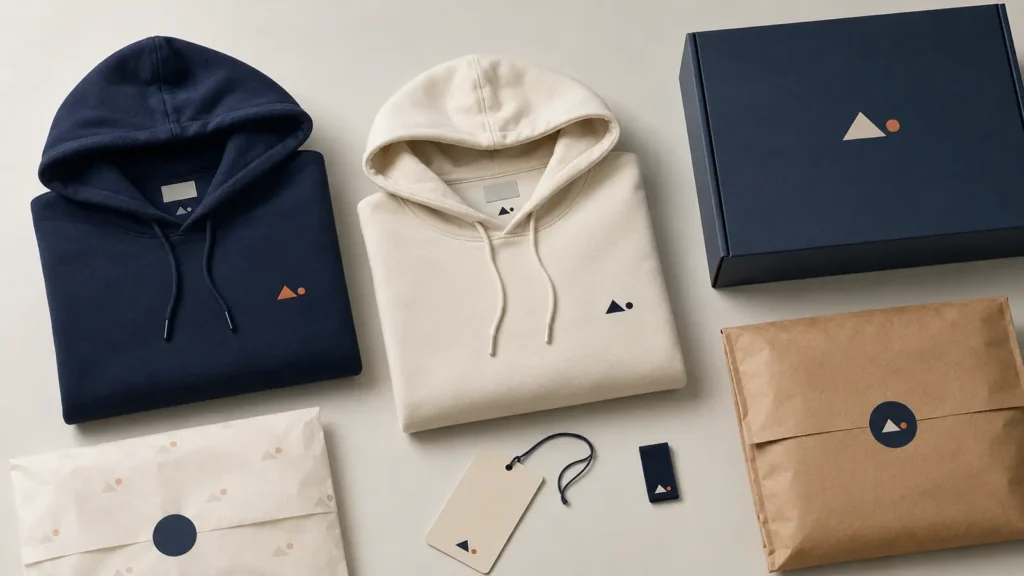
Branding costs can include labels, hangtags, inserts, packaging, application and storage.
Landed fulfillment cost = blank and decoration + additional print locations + branding + packaging + shipping + taxes/duties charged to the merchant + platform fees + expected claim/return allowance
Then compare that amount with net revenue after marketplace commissions, payment fees, discounts and advertising. Include a contribution margin target rather than setting retail price as an arbitrary multiple of the base cost.
Run at least three scenarios:
- A single domestic order for the most common size and color.
- A multi-item order or a shipment to the most important foreign market.
- A problem order that requires a reprint, refund or customer-service credit.
Do not build the model around a temporary discount. Confirm whether any subscription, volume tier, currency conversion or tax treatment changes the regular cost.
Test Fulfillment and Store Operations
A provider should be evaluated as a workflow, not a sample garment alone. Place test orders through the actual storefront so that the complete data path is exercised.
Check whether:
- Product variants publish correctly.
- Personalization data reaches production without manual re-entry.
- Taxes and shipping methods display as intended.
- The order moves to production only after the desired approval window.
- Tracking returns to the store and triggers the correct customer email.
- Branded inserts or labels remain attached to the intended route.
- An address change, cancellation or failed payment is handled correctly.
- Support can identify the production order and explain the claim procedure.
For a launch with several countries, repeat the test in the main destinations. A successful US order does not prove that the same product will route identically in Germany, Canada or the United Kingdom.
Planning a hoodie program beyond one-off POD? Share your expected quantity, size/color breakdown, fabric preference, artwork, labels, packaging and target delivery date with JIUMU. We can review whether a custom bulk route is appropriate for the specification. Explore custom hoodies or request a quotation.
Use a Structured Sample and Quality-Control Process
Order at least one pre-launch sample for every core combination of garment, decoration method and production route. If five colors use the same blank and method, the buyer may not need every size-color combination, but light, dark and heather fabrics should be represented.
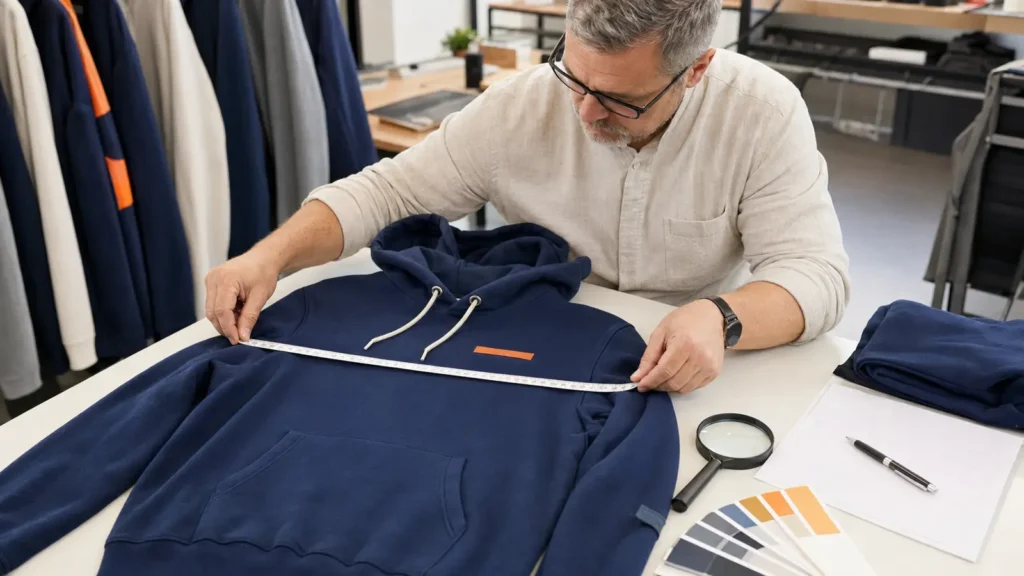
Approve the exact garment, decoration method and production route before launch.
Create an approval sheet with:
- Provider, facility or Print Provider when visible
- Product name, SKU, color and size
- Garment measurements and acceptable tolerance
- Fabric composition and weight stated by the catalog
- Artwork version, dimensions and placement
- Print color appearance under neutral light
- Embroidery stitch coverage and backing
- Seam, rib, pocket, zipper and drawcord inspection
- Label, insert and packing requirements
- Wash-test method and observations
- Approval date and reference photos
Do not use one sample forever. Reorder periodically, after a supplier route changes, before a high-volume campaign and whenever the provider replaces a blank or production method.
For defects, define objective categories: wrong item, incorrect size/color, damaged garment, missing print, visible misalignment beyond the approved tolerance, print contamination, embroidery failure or missing branding component. Keep parcel and garment photos so the claim can be submitted within the provider’s required window.
What Information Should Buyers Send for a Quote?
Whether requesting POD onboarding or custom bulk production, a clear request produces a more useful quotation. Send:
- Buyer type and sales channel
- Destination countries
- Forecast monthly volume and peak campaign volume
- Pullover or zip style
- Adult, youth or unisex size range
- Target fabric composition and weight
- Core colors and approximate quantities
- Artwork files and each placement
- Preferred DTG, DTF, embroidery, screen print or other method
- Private label, neck print, hangtag, insert and packaging needs
- Sample deadline, launch date and target delivery date
- Required tests, documentation or market-specific labeling
If the specification is not final, identify which variables the supplier may recommend. “Need premium hoodies” is not actionable; “need a structured 350–450 GSM pullover with a cotton-rich face, small chest embroidery and private neck label” is far more useful.
When Should a Brand Stay with POD?
POD remains valuable when demand is uncertain, designs change quickly, the catalog contains many low-volume graphics, buyers are geographically dispersed or the business cannot yet manage inventory. It also supports testing price points and creative concepts without committing to a large finished-goods run.
Stay with POD when the risk reduction is worth the higher unit cost and the available blanks accurately support the brand promise. A stable integration and acceptable customer experience can be more important than maximizing gross margin during early validation.
When Should a Brand Move to Bulk Custom Hoodies?
Bulk production deserves evaluation when one or more of the following becomes true:
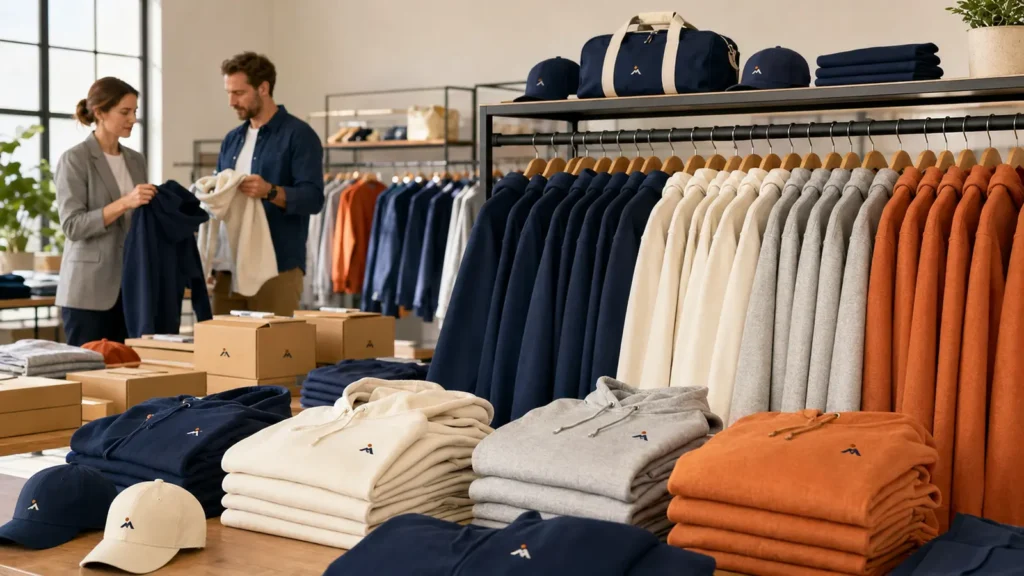
Validated core products may justify planned production for stronger specification, branding and repeat-order control.
A small group of designs produces repeat, predictable volume.- The POD unit cost prevents a sustainable margin.
- The brand needs a proprietary fit, fabric weight or color.
- Consistent private labels, hangtags and packaging are required.
- The same identity must extend across hoodies, jerseys, hats, jackets or bags.
- A school, team, distributor or corporate client needs a planned delivery.
- Screen printing, embroidery or patches become more economical in quantity.
- Inventory can be forecast, stored and replenished responsibly.
The decision should be based on total economics. Bulk production adds sampling, approval, production lead time, freight, storage and inventory risk. It can also create better control over garment construction, decoration and packaging. A hybrid model is common: keep long-tail designs on POD while moving proven core products to planned inventory.
How JIUMU Supports the Next Stage
JIUMU is a Guangdong-based B2B supplier established in 2010. It works with custom teamwear, logo apparel, hoodies, hats, uniforms, bags and branded merchandise for buyers in markets including the United States, Canada, the United Kingdom and Europe.
For qualified custom programs, JIUMU can support OEM/ODM development, fabric sourcing, Pantone color matching, embroidery, sublimation, screen printing, heat transfer, woven or rubber/PVC patches, private labels, hangtags, packaging customization, digital mockups, physical samples, quality control and export support.
The typical MOQ is 50 pieces, subject to product structure and customization. That means JIUMU is not a substitute for one-piece POD. It is a sourcing option when demand is validated and the buyer wants a more controlled specification or coordinated product line.
A practical transition begins with a reference sample or tech pack. The buyer confirms the fabric, fit, colors, logo method, labels, packing and quantity. JIUMU can then review feasibility, prepare a quotation and arrange sampling before bulk approval. Buyers planning a coordinated club or school program can also explore custom team uniforms.
Questions to Ask Every POD Hoodie Company
- Which exact hoodie SKU, color and facility will fulfill my main market?
- Can the same item be produced in my secondary markets?
- Which decoration methods and print areas are available for this SKU?
- What artwork files, resolution and color setup are required?
- Can I lock a provider or must I accept automatic routing?
- What happens if the selected blank or color is out of stock?
- Which labels, inserts or packaging features are supported on this route?
- How are production time and shipping time shown to the merchant?
- What evidence is required for a reprint or refund?
- How quickly must a claim be submitted?
- Can I order discounted samples, and are samples produced on the normal route?
- Which integrations, APIs and tracking events are available?
- How are taxes, duties and currency conversions handled?
- What changes at higher monthly volume?
- Can the provider support a transition to warehousing or bulk inventory?
Common POD Hoodie Buying Mistakes
Choosing only by base price. A cheaper blank may create a higher return rate, weaker perceived value or expensive shipping.
Testing artwork but not the garment. Buyers notice fit, fleece, rib and hood construction every time they wear the product.
Assuming one provider result applies globally. A network may use different facilities, products or routes by country.
Using a generic size chart. Measure approved samples and update the listing when the blank changes.
Ignoring branding limitations. Inserts, neck labels and custom packaging may be restricted to certain products or facilities.
Launching too many variants. Every color-size-design combination increases the chance of stock and listing errors. Start with a controlled core.
Skipping wash tests. Evaluate print, embroidery, shrinkage and twisting using a documented care procedure.
Moving to bulk too early. Better unit economics do not compensate for unsold inventory.
Staying with POD too long. Once demand is predictable, a custom or inventory-based route may improve margin and product control.
Frequently Asked Questions
Final Recommendation
Shortlist providers by operating model, then test the exact supply configuration. Printful, Printify, Gelato, Apliiq, Gooten and teelaunch can each be appropriate for a particular buyer, but none should be selected from a feature list alone. Order through the real storefront, ship to the real market and score the full experience from product setup to claim handling.
Use POD to validate demand and protect cash when volume is uncertain. When repeat sales justify custom fabric, fit, branding, packaging or coordinated teamwear, compare the POD economics with a controlled bulk program.
Sources and Review Note
Platform facts were reviewed from official provider pages on July 31, 2026. Product availability, prices, shipping, production locations, integrations and program terms can change. Buyers should confirm current information directly with each provider before purchasing or publishing delivery promises.
About JIUMU
Established in 2010 in Guangdong, JIUMU supports B2B custom teamwear, logo apparel, hoodies, hats, uniforms, bags and branded merchandise.