Full Button vs. Two-Button vs. V-Neck Custom Baseball Jerseys: Durability, Fit & Sourcing Guide (2026)
Specifying custom baseball jerseys starts with one decision that cascades through everything else: the cut. A full button-down, a two-button Henley pullover, and a sublimated V-neck or crewneck look similar in a flat-lay photo but behave very differently across a 40-game season. They take different decoration methods, carry different price points, and fail in different places when teams push them hard.
This guide compares all three cuts on construction, durability, fit, decoration compatibility, and B2B sourcing logistics — including MOQs, lead times, and the specification sheet you should send a factory before you place a team or brand order.
Quick Comparison Matrix
| Attribute | Full Button-Down | Two-Button Henley | V-Neck / Crewneck Pullover |
|---|---|---|---|
| Front opening | Full placket, 6–8 buttons | Short 2-button placket | No placket (pullover) |
| Typical fabric | Double-knit 165–200 gsm | Double-knit or mesh, 160–190 gsm | Lightweight mesh / interlock |
| Collar | Structured, self-fabric or two-ply | Ribbed or self-fabric | Ribbed V-neck or crewneck |
| Decoration | Twill, embroidery, print, sublimation | Sublimation + twill accents | Full sublimation (dominant) |
| Durability | Highest | High (with reinforced placket) | Moderate (collar is weak point) |
| Mobility / weight | Heaviest, most structured | Light and fast | Lightest |
| Fit | Boxier, classic | Athletic through chest | True athletic |
| Relative unit cost | Highest | Mid | Lowest |
| Best for | Game uniforms, varsity, retail | Travel ball, practice tops | Rec / youth, high-volume programs |
Section 1: Full Button-Down Baseball Jerseys: The Professional Standard
The full button-down jersey is the benchmark for game-day uniforms. It uses a traditional full-length front placket with six to eight buttons, a structured collar, and set-in or raglan sleeves. It is what most people picture when they hear “baseball jersey,” and it is the default choice for varsity programs, collegiate and semi-pro teams, and any brand building a heritage-style product line.
Construction and weight
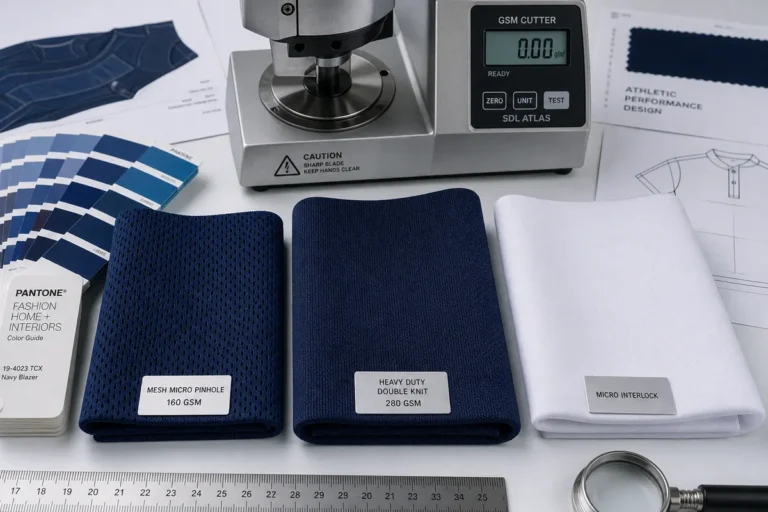
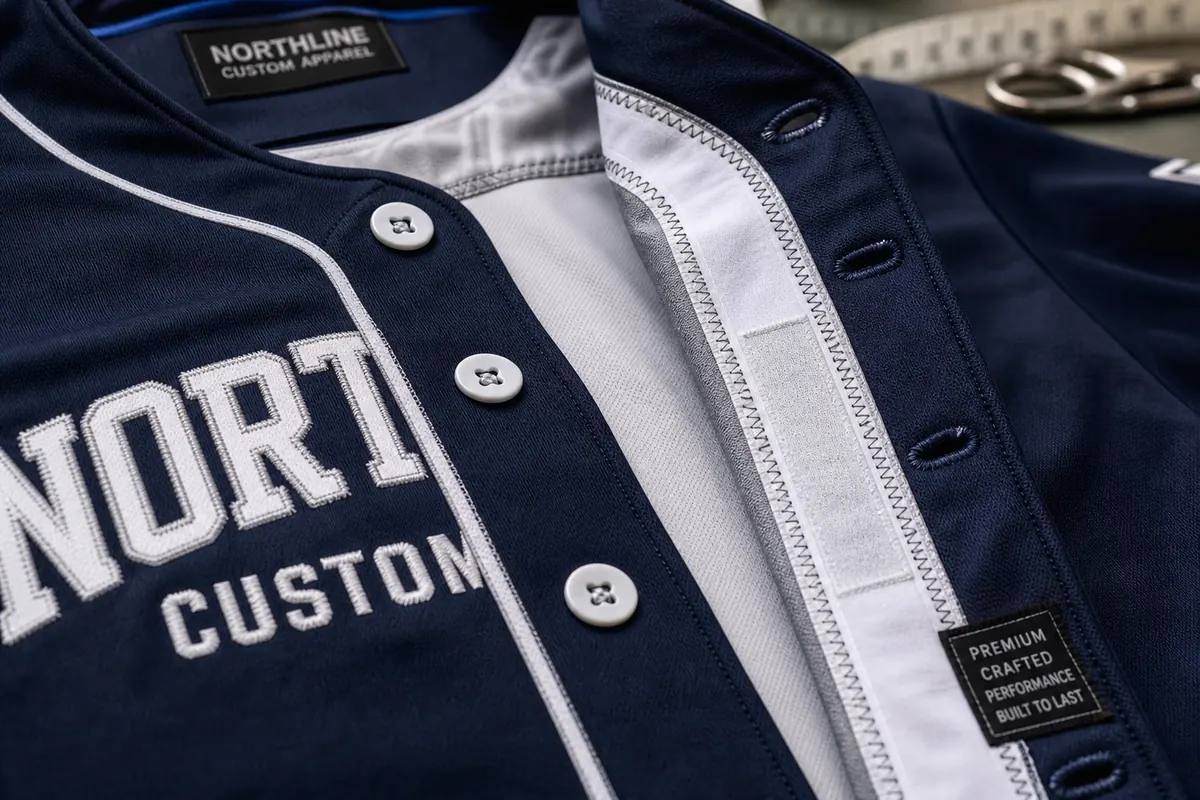
A game-grade button-down is typically built from 100% polyester double-knit in the 165–200 gsm range, or from a heavier twill/poly blend for a more premium hand feel. The placket is cut as a separate panel, folded, and double-stitched so the button line stays flat after repeated wear and laundering.
Durability
Because the placket is reinforced and the buttons are backed with a folded fabric layer, a well-made button-down resists the two most common failure points on a jersey: seam separation at the placket and button pull-through. A properly constructed button-down will typically outlast a lightweight pullover by two to three seasons of weekly play.
Fit and sizing
Button-downs run slightly boxier through the chest to keep the placket sitting flat. Order true to size for a classic look, or size up one for an oversized, untucked travel-ball look. Provide chest, waist, and length measurements to your factory so grading stays consistent across XS–4XL.
Decoration compatibility
Full button-downs accept every major decoration method: stitched tackle twill letters and numbers, embroidered logos, sewn-on felt patches, and screen print. Tackle twill is the premium standard because the stitched layers move with the double-knit body and will not crack.
Best for
- Varsity, collegiate, and semi-pro game uniforms
- Heritage and retro brand collections
- Teams that want maximum decoration flexibility
- Programs that prioritize longevity over the lowest unit cost
Section 2: Two-Button Henley Pullovers: The Versatile Travel Ball Workhorse
The two-button Henley (sometimes called a partial-button jersey) keeps the pullover silhouette but adds a short, functional placket with two buttons at the neck. It sits between the fully open button-down and the plain V-neck, giving players a jersey they can throw on in seconds without buttoning a full front.
Why travel ball loves it
Travel and club programs play double-headers, tournament weekends, and back-to-back games in heat. A two-button Henley is lighter, dries faster, and never gapes open at the chest the way a partially unbuttoned full placket can. Players pull it over their head and go.
Construction
Most Henleys use a short placket of four to five inches with a stabilized, fused or woven facing behind the buttons. Quality differences show up quickly here: cheap Henleys use a single-layer placket that curls after the first wash, while good ones use a lined placket that keeps the button line crisp.
Durability note
The two-button placket is the highest-stress area on this jersey because players grab and pull at it. Specify a bar-tacked or box-X reinforced button stitch and a placket with at least two rows of topstitching. With those two details, a Henley handles a full tournament season without the placket stretching out of shape.
Fit and decoration
Henleys are typically cut slightly more athletic through the chest than a button-down. Sublimation is the dominant decoration method because it prints the whole panel without adding weight; twill and embroidered accents can be layered on top for a premium tier.
Best for
- Travel ball, club, and rec-league programs
- Practice and batting-practice tops
- High-volume orders that need fast turnaround
- Brands selling a lightweight, modern-cut jersey
Section 3: V-Neck & Crewneck Sublimated Pullovers: Maximum Mobility on a Budget
The V-neck and crewneck pullover is the simplest and most cost-efficient cut. There is no placket at all: the jersey is a single sublimated or sewn panel that the player pulls on. That simplicity is also its strength — fewer seams, fewer buttons, and nothing to snag or break.
Where it wins
Because there is no placket to reinforce, a pullover can be built lighter and at a lower unit cost while still delivering full sublimation across the body, sleeves, and collar. For high-volume programs that replace uniforms every couple of seasons, or for brands hitting a sharp price point, the pullover is the rational choice.
Sublimation advantages
Full-dye sublimation prints unlimited colors, gradients, and photographic patterns with no per-color setup cost, and the print becomes part of the fabric, so it never peels or cracks. This is why V-neck and crewneck pullovers dominate budget and mid-tier custom baseball jersey programs.
Durability limits
A pullover has no placket to fail — but it also offers no button-line reinforcement, and a thin, unstabilized ribbed collar is the usual weak point. Choose a two-ply or self-fabric collar with a taped neck seam and reinforced shoulder seams to stop the neckline from stretching.
Fit
Pullovers run true to athletic sizing. V-necks read slightly slimmer; crewnecks read slightly more relaxed. Both are ideal for players who dislike buttons entirely and for warm-weather leagues.
Best for
- Rec leagues, youth programs, and high-volume orders
- Warm-weather and summer tournament play
- Brands targeting an aggressive price point
- Teams that want maximum color and pattern freedom via sublimation
Section 4: Placket Engineering, Collar Durability & Decoration Methods
Placket engineering
Three placket types dominate custom baseball manufacturing: the full-length placket (button-down), the short two-button placket (Henley), and no placket (pullover). The engineering that matters most is what happens behind the buttons. Good plackets are lined or fused, bar-tacked at the buttons, and topstitched with two or more rows of thread so the panel cannot curl or separate.
Collar construction and durability
The collar is where most jerseys age badly. Ranked from least to most durable: a thin single-layer ribbed collar, a double-layer ribbed collar, a self-fabric collar, and a two-ply woven collar with contrast trim. For a game-grade jersey, specify a self-fabric or two-ply collar with a taped neck seam.
Decoration methods compared
- Sublimation — dye bonds to fabric; unlimited colors with no peeling; best for full-pattern jerseys.
- Tackle twill — layered stitched letters and numbers; premium, moveable, game-grade feel.
- Embroidered patches — flexible for fine logo detail; adds weight but looks premium.
- Screen print — fast and low cost for one- or two-color graphics on pullovers.
The most durable and most premium jersey generally combines a sublimated base with stitched tackle twill numbers and an embroidered chest patch — unlimited color underneath plus the stitched texture buyers associate with pro-level uniforms.
Section 5: B2B Sourcing Specifications with JIUMU Gear
JIUMU Gear manufactures all three cuts to order, so you can mix full button-downs for game jerseys, two-button Henleys for practice, and pullovers for warm-weather play within a single program. Typical specifications:
| Specification | Standard option |
|---|---|
| Body fabric | 100% polyester double-knit, 165–200 gsm (mesh, interlock, or micro-poly options) |
| Placket | Full 6–8 button, short 2-button, or none (pullover) |
| Collar | Self-fabric, two-ply ribbed, or contrast-trim two-ply |
| Decoration | Full sublimation, tackle twill, embroidery, screen print, or hybrid |
| Sizes | Youth XS–XL and Adult XS–4XL (custom grading available) |
| MOQ | Low MOQs for catalog styles; per-project MOQ confirmed at quote |
| Lead time | Standard production window confirmed at quote; rush options available |
| Sampling | Pre-production sample available before the bulk run |
| Programs | OEM / ODM, private label, and white-label supported |
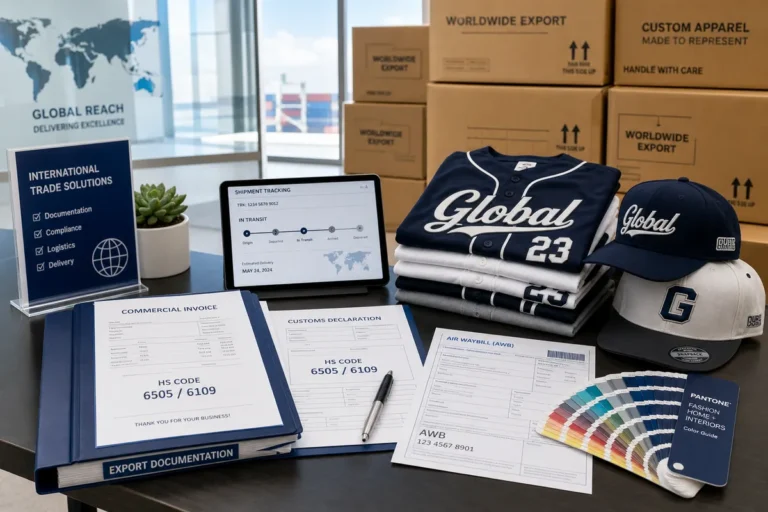
To get an accurate quote, send your factory a spec sheet that covers: cut style, fabric and weight, placket and collar type, decoration method per panel, size run and quantity, color references (Pantone), and your in-hands date. The more complete the spec, the fewer revision cycles you pay for.
Whatever cut you choose, the sourcing lesson is the same: define the placket, collar, and decoration method on paper before production, because those three details decide how the jersey looks and lasts after 40 games.
Frequently Asked Questions
Which custom baseball jersey cut is the most durable?
The full button-down is the most durable cut. Its reinforced, lined placket and structured collar resist the two failure points that end a jersey’s life — placket seam separation and button pull-through — better than a Henley or a plain pullover.
Is a two-button Henley a good choice for travel ball?
Yes. The two-button Henley is the travel-ball favorite because it is lighter and cooler than a full button-down, pulls on instantly between double-headers, and does not gape open at the chest. Insist on a lined placket and reinforced button stitching so the short placket holds its shape all season.
Can a V-neck or crewneck pullover be decorated with stitched letters and numbers?
Yes. A pullover is usually sublimated, but stitched tackle twill letters and numbers and embroidered patches can be added on top for a premium tier. The trade-off is added weight and cost versus an all-sublimated build.
What is the minimum order quantity and lead time for custom baseball jerseys?
MOQ depends on the cut, fabric, and decoration method and is confirmed at quote; JIUMU Gear supports low-MOQ catalog styles as well as larger OEM / ODM runs. Lead time is confirmed at quote based on decoration complexity, and pre-production samples are available before the bulk run.
Related Guides
- Custom Baseball Jerseys Manufacturing
- Complete Baseball Team Uniform Packages
- Custom Baseball Uniforms: Direct Factory vs. Local Decorators (2026 B2B Cost & Sourcing Guide)
- Custom Sportswear Fabrics: Moisture-Wicking Mesh vs. Double-Knit vs. Interlock
- How to Manage Multi-Product Team Roster Orders Without Sizing & Color Errors
- Custom Hat Decoration Methods: 3D Puff Embroidery vs. Patches vs. Screen Printing