Custom Sportswear Fabrics: Moisture-Wicking Mesh vs. Double-Knit vs. Interlock (2026 B2B Sourcing Guide)
Selecting the right performance fabric is the foundation of high-quality custom teamwear manufacturing. For sports apparel brands, athletic directors, and uniform dealers, fabric selection directly dictates garment breathability, player mobility, sublimation print clarity, abrasion resistance during sliding, and long-term wash durability.
In custom baseball and team sports apparel, three primary fabric constructions dominate the industry: Moisture-Wicking Birdseye Mesh, Heavyweight Double-Knit Polyester, and Smooth Micro-Interlock.
This technical sourcing guide compares their fabric weights (GSM), structural compositions, printing compatibility, and optimal garment applications.
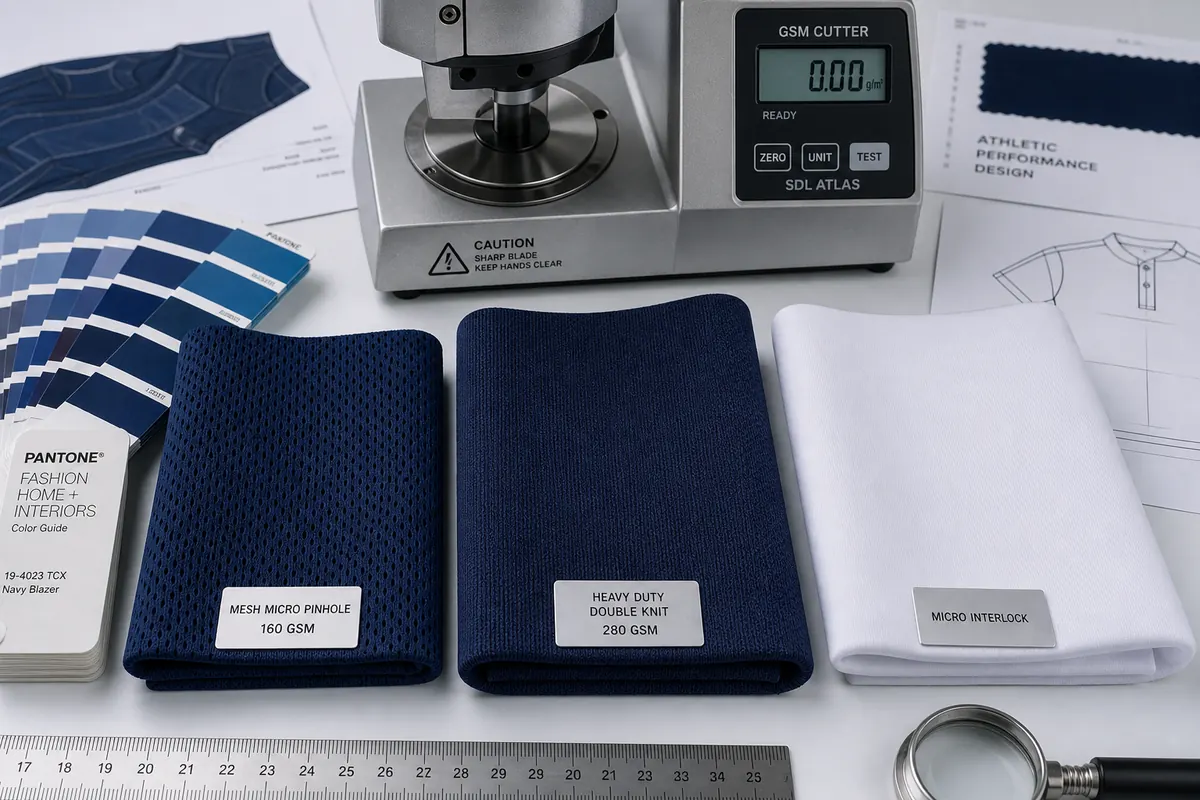
Quick Comparison Matrix: Performance Sportswear Fabrics
The matrix below summarizes the four constructions that cover nearly every custom teamwear program — fabric weight, fiber composition, breathability, abrasion resistance, garment application, and sublimation compatibility.
| Fabric Construction | Typical Weight (GSM) | Fiber Composition | Breathability | Abrasion Resistance | Best Garment Application | Sublimation Compatibility |
|---|---|---|---|---|---|---|
| Moisture-Wicking Mesh | 140 – 180 GSM | 100% Polyester | Maximum (Pinhole knit) | Moderate | Summer game jerseys, fan jerseys, training shirts | Exceptional (Sharp vibrant colors) |
| Heavyweight Double-Knit | 250 – 320 GSM | 100% Polyester (2-ply) | Moderate (Dense structure) | Maximum (Resists clay & grass tears) | Game pants, knickers, sliding shorts | Excellent (Solid & piped styles) |
| Micro-Interlock | 150 – 190 GSM | 100% Poly / Spandex blend | High (Smooth closed knit) | High (Snag-resistant surface) | Multi-sport jerseys, warm-up tops | Flawless (Ultra-fine gradient prints) |
| Brushed Performance Fleece | 240 – 300 GSM | 95% Poly / 5% Elastane | Moderate (Thermal insulation) | High | Team hoodies, dugout jackets, tracksuits | High (Vibrant outer shell) |
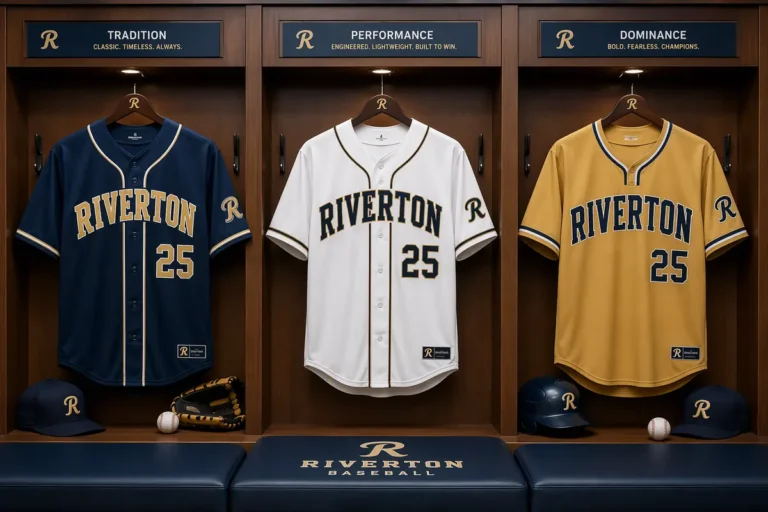
1. Moisture-Wicking Birdseye Mesh (140-180 GSM): The Gold Standard for Game Jerseys
Birdseye and micro-mesh fabrics are engineered with thousands of microscopic knit perforations. The structure works on capillary action: the hydrophobic polyester core pushes sweat away from the skin, the micro-porous mesh disperses it across the fabric surface, and ambient airflow evaporates it roughly 3x faster than cotton. That is why pinhole mesh dominates summer tournament jerseys and outdoor double-headers.
Mesh also delivers the best thermal regulation of any construction in the matrix. Because air moves freely through the open knit, players stay cooler across long innings and repeated substitutions.
For printing, mesh is the standout. Dye molecules bond directly into the polyester fibers during full-color sublimation under 200°C, so graphics never crack, peel, or fade after 100+ washes. Gradient panels, photographic artwork, and fine sponsor marks reproduce with sharp, vibrant color — the reason mesh is the default for all-over-print jerseys.
2. Heavyweight Double-Knit Polyester (250-320 GSM): Unmatched Pants Durability
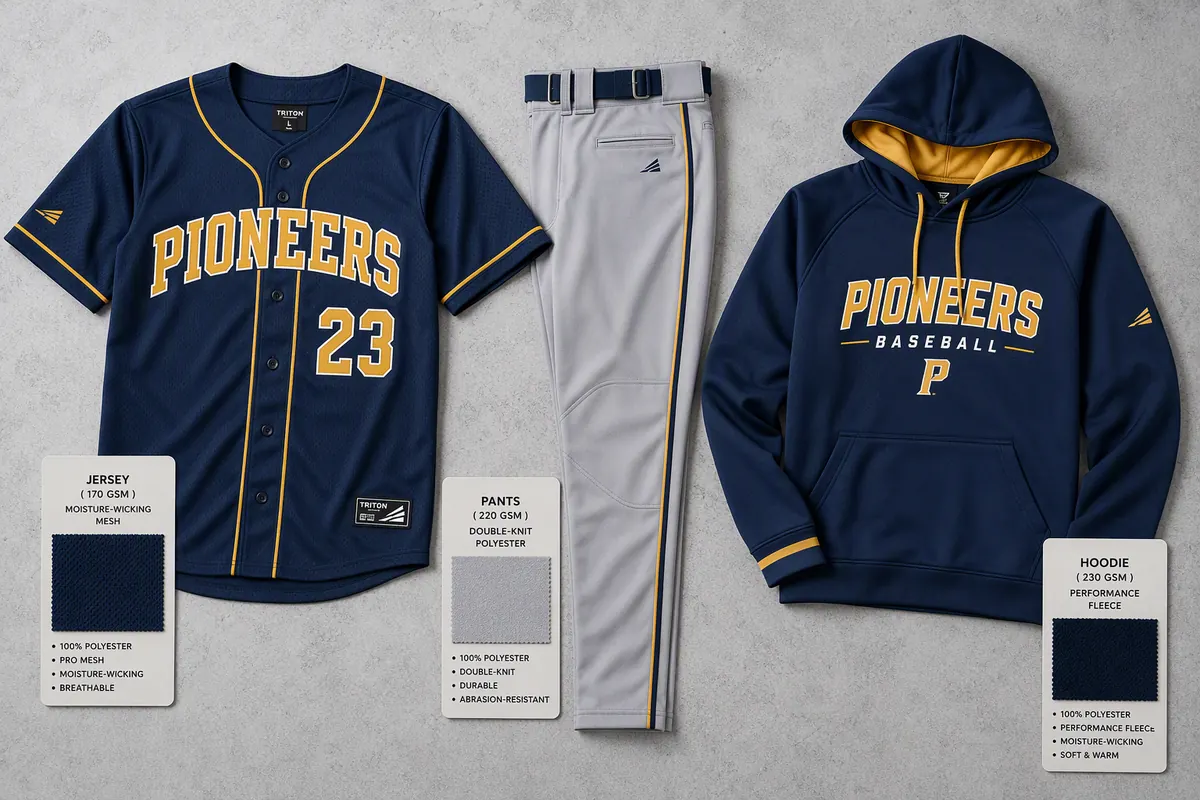
While mesh is ideal for tops, baseball pants require extreme mechanical strength to survive repeated dirt slides, grass friction, and knee abrasion. Double-knit polyester is produced by interlocking two sets of needles simultaneously, creating a thick, two-sided fabric with natural mechanical stretch.
- Sliding & rip resistance: the dense 280–300 GSM construction resists tearing when players slide into home plate or second base on clay, dirt, and turf.
- Reinforced knee compatibility: the stable two-ply structure accepts dual-layer reinforcement at high-wear zones without surface puckering.
- Structured athletic silhouette: holds a clean, professional drape that accommodates belt loops, brass zippers, and reinforced back pockets.
3. Micro-Interlock (150-190 GSM): Smooth Surface for High-Definition Graphics
Unlike mesh, which shows visible pinholes, micro-interlock has a completely flat, silky surface on both the face and reverse sides.
- Ultra-fine artwork reproduction: the flat surface prints fine typography, intricate crests, and subtle photographic gradients with pin-sharp clarity — ideal for ultra-fine gradient prints.
- Snag & Velcro resistance: the tight weave prevents snagging from batting-glove velcro and equipment-bag zippers.
- Multi-sport versatility: equally suited to reversible basketball uniforms, soccer kits, warm-up tops, and coaches’ polos.
4. How JIUMU Controls Fabric Quality and Color Consistency
At JIUMU Gear, fabric selection is backed by strict laboratory testing before any bulk cutting begins:
- Fabric weight verification: every dye lot is checked on a GSM electronic scale to confirm the specified gram weight.
- D65 lightbox dye lot matching: lab dips are reviewed under standard D65 lighting to hold Pantone accuracy within a <1.0 ΔE tolerance.
- Dimensional stability: fabrics are tested for shrinkage and held to <2.5% after washing, so garments keep their size and drape.
- Colorfastness: testing to AATCC 61 (laundering) and AATCC 107 (perspiration) protects color against sweat and repeated wash cycles.
Because fabric is dyed and printed in-house, JIUMU holds the 160 GSM jersey mesh, 280 GSM pant double-knit, and headwear twill to one Pantone standard across your entire team package.
Frequently Asked Questions (FAQ)
What is the recommended fabric weight (GSM) for custom baseball jerseys?
The industry benchmark for custom baseball jerseys is 140 to 180 GSM (grams per square meter). 140–160 GSM is ideal for lightweight youth and summer league jerseys, while 180 GSM offers a slightly more structured professional feel.
Why shouldn’t baseball pants be made from the same mesh fabric as jerseys?
Jersey mesh is engineered for ventilation, not abrasion resistance. Baseball pants need a dense 250–300 GSM double-knit polyester to withstand friction against clay, dirt, and artificial turf without ripping during sliding.
Can different fabric weaves achieve the exact same Pantone color?
Yes. Different weaves absorb dye differently, but an experienced OEM calibrates ink formulas and reviews lab dips under standard D65 lightboxes to match color across mesh, double-knit, and headwear twill. Where an exact match is impossible on a given substrate, it is flagged during sampling for approval before bulk production.
What is the MOQ for custom performance teamwear at JIUMU?
Our project MOQ starts at 50 pieces for custom apparel and jerseys, letting you combine custom fabrics, personalized player rosters, and mixed youth/adult sizes within a single order.
Related Guides & Product Resources
- Baseball Team Uniform Packages — jerseys, pants, and caps in one coordinated Pantone lock.
- Custom Baseball Jerseys — sublimated, mesh, and interlock jersey production.
- Custom Hats — on-field caps and headwear built to the same color standard.
- Custom Baseball Uniforms: Factory vs. Local Cost Guide
- Custom Hat Decoration Methods: Embroidery vs. Patches
- Multi-Product Team Roster Order Guide
Source Performance Custom Teamwear with JIUMU
Coordinate custom jerseys, pants, caps, and equipment bags with certified performance fabrics and factory-direct pricing. Share your project requirements to receive a customized fabric recommendation within 24 hours.