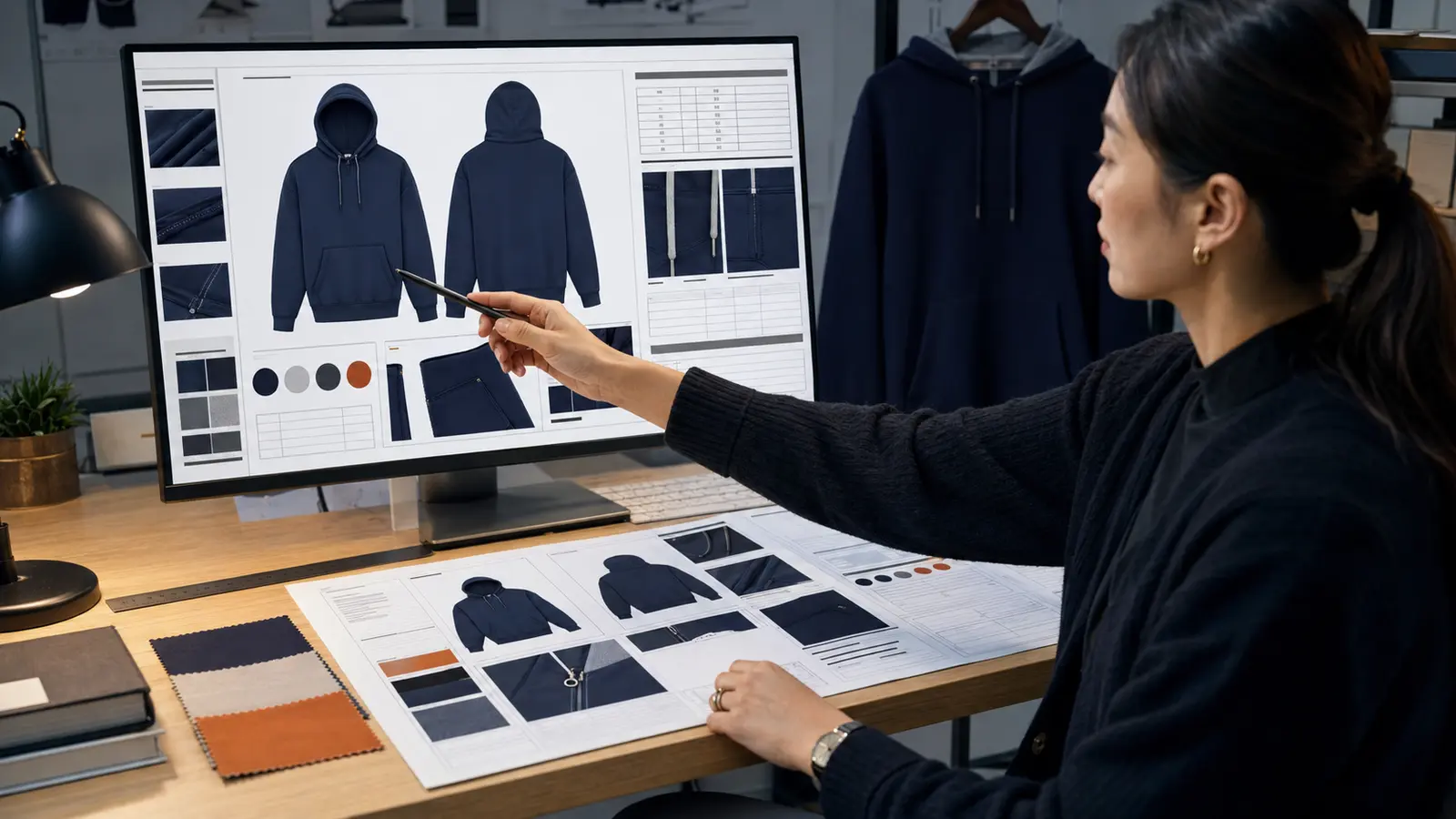
How to Design a Custom Hoodie: From Sketch to Production Tech Pack
Designing a custom hoodie for a team, school, apparel brand, distributor, or promotional program is not simply a matter of placing a logo on a blank garment. A production-ready hoodie is a system of connected decisions: silhouette, fit, fabric, color, trims, construction, decoration, labeling, packaging, sizing, and quality standards.
The sketch communicates the idea. The tech pack removes ambiguity so a supplier can quote, sample, grade, manufacture, and inspect it consistently. This guide is for professional buyers who need a specification that works through sampling, bulk production, and repeat orders.
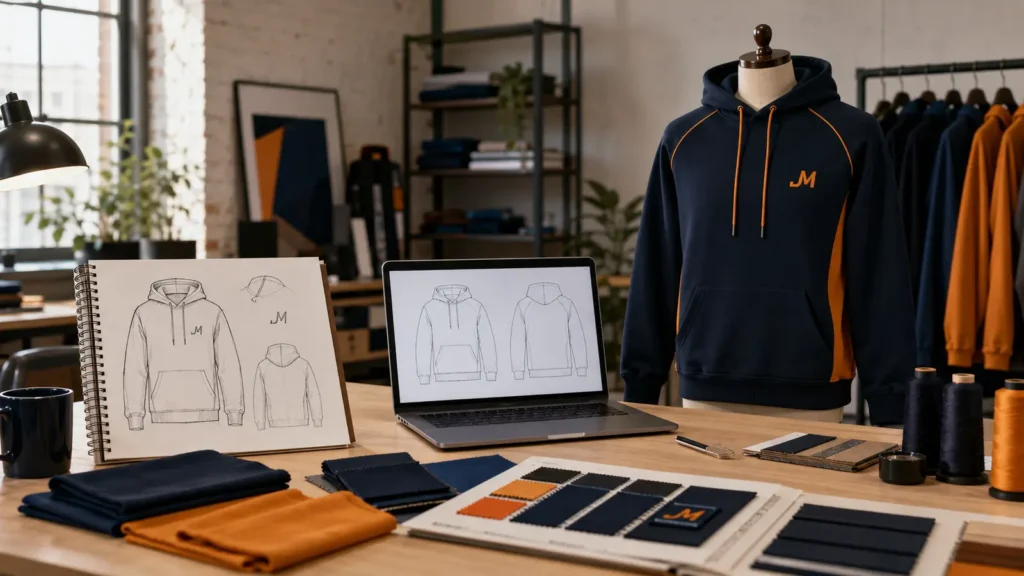
A custom hoodie becomes production-ready when the visual concept, materials, measurements, construction, branding, and approval criteria are documented together.
Quick Answer: To design a custom hoodie, first define the wearer, use case, silhouette, fit, target quantity, price position, and delivery destination. Then create front and back sketches, select the fabric and trims, specify colors and decoration, build a measurement chart, and document every decision in a tech pack. A useful hoodie tech pack normally includes technical flats, a bill of materials, colorways, points of measurement, graded size specifications, construction notes, artwork placement, labels, packaging, tolerances, sample comments, and a revision history. Approve the physical sample and all production details before authorizing bulk manufacturing.
Why a Good Hoodie Design Process Matters
A hoodie can look simple while containing dozens of decisions that affect cost, fit, durability, and production risk. A hood alone may be single or double layer, built with two or three panels, and finished with or without a drawcord. Each option changes pattern pieces, material use, sewing operations, and appearance.
When these decisions remain only in an email thread or a mood board, different people may interpret them differently. The designer may imagine an oversized streetwear silhouette while the buyer expects a standard unisex fit. The buyer may request “heavyweight cotton,” while the supplier needs a measurable composition, knit structure, weight range, finish, and approved hand feel. An embroidery mockup may show a logo centered visually, but production needs the actual dimensions and a repeatable measurement from seams or garment edges.
A strong process makes quotations comparable, reduces sample revisions, and gives production an approved tolerance and placement reference. The objective is one controlled source of truth.
The Custom Hoodie Design Workflow at a Glance
| Stage | Main decision | Required output | Approval question |
|---|---|---|---|
| 1. Product brief | Buyer, use case, price position, quantity, market | Written design brief | Are the commercial constraints clear? |
| 2. Concept sketch | Silhouette, proportion, key features | Front/back concept sketch | Does the direction fit the brand and wearer? |
| 3. Material selection | Fabric, rib, lining, trims | Swatches and preliminary BOM | Do weight, hand feel, performance, and cost align? |
| 4. Technical design | Seams, pocket, hood, closures, branding | Technical flats and detail callouts | Can the garment be interpreted without guessing? |
| 5. Fit specification | Base size, POMs, grade rules, tolerance | Measurement chart | Is the intended fit measurable and repeatable? |
| 6. Tech pack | All approved product data | Revision-controlled tech pack | Is the file complete enough to quote and sample? |
| 7. Sampling | Appearance, fit, construction, decoration | Sample plus comment sheet | Are all changes documented and closed? |
| 8. Pre-production | Final materials, colors, labels, packaging | Approved pre-production standard | Is bulk production authorized against a fixed reference? |
| 9. Bulk and QC | Conformity to the approved standard | Inspection records and shipment approval | Does production meet the agreed specification? |
Step 1: Write a Product Brief Before You Sketch
A product brief connects the creative concept to the order. It prevents the design team from developing features that conflict with the intended price, minimum quantity, wearer, or selling market.
Start with the following:
- Buyer and wearer: youth team, adult club, school staff, construction crew, event team, private-label consumer, or retail customer.
- Use case: warm-up apparel, everyday uniform, staff clothing, fan merchandise, work layer, promotional product, or fashion collection.
- Garment type: pullover, full zip, quarter zip, sleeveless, cropped, oversized, performance, or fleece-lined.
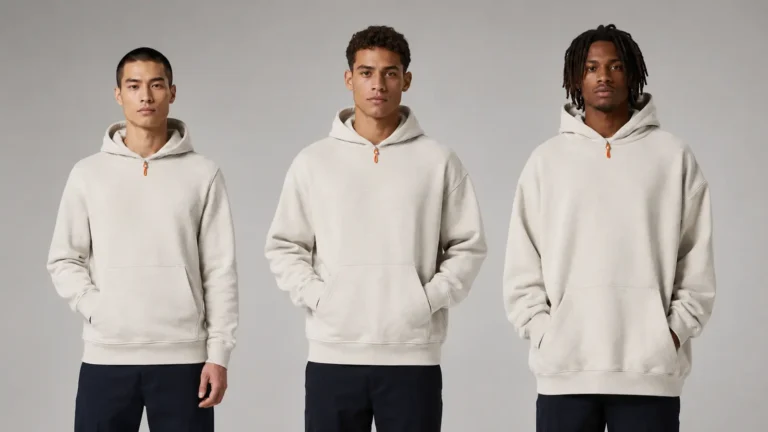
- Fit direction: standard unisex, athletic, relaxed, oversized, gender-specific, youth, or a custom block.
- Target quantity: include the expected size and color breakdown, not only the total.
- Price position: promotional, core teamwear, premium private label, or another clearly defined tier.
- Target market: country or region affects labeling, safety, sizing conventions, packaging, and importer responsibilities.
- Delivery target: specify the required in-hand date and allow time for artwork, sourcing, sampling, revisions, bulk production, and transport.
Add observable success criteria. “Premium” is not a specification; “dense brushed-back fleece, double-layer hood, stable rib, clean topstitching, and left-chest embroidery” gives the team something it can evaluate.
Step 2: Turn the Concept into a Clear Hoodie Sketch
The first sketch can be expressive. Its purpose is to establish the design language, not to provide every production instruction.
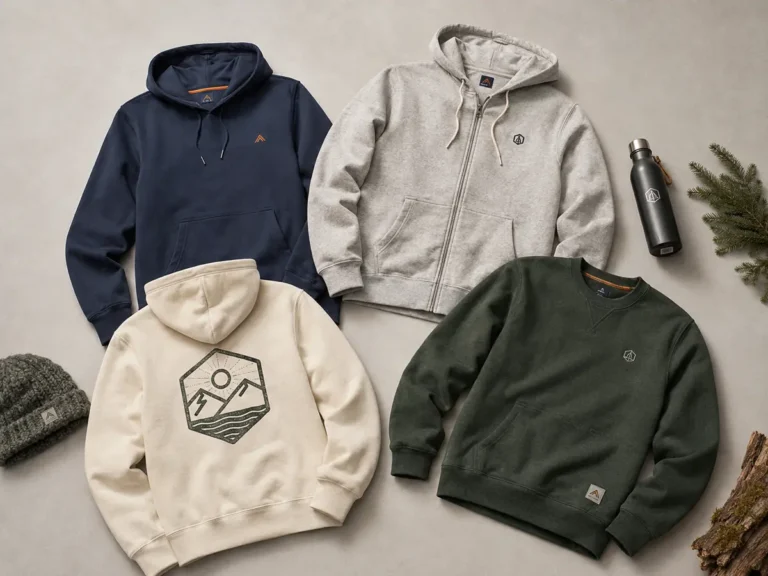
Show the overall silhouette, body length, shoulder shape, sleeve volume, hood proportion, pocket style, hem treatment, major panel lines, and intended color blocking. Include front and back views even when the back appears simple. If the design uses sleeve decoration, hood embroidery, back graphics, or woven labels, show those areas too.
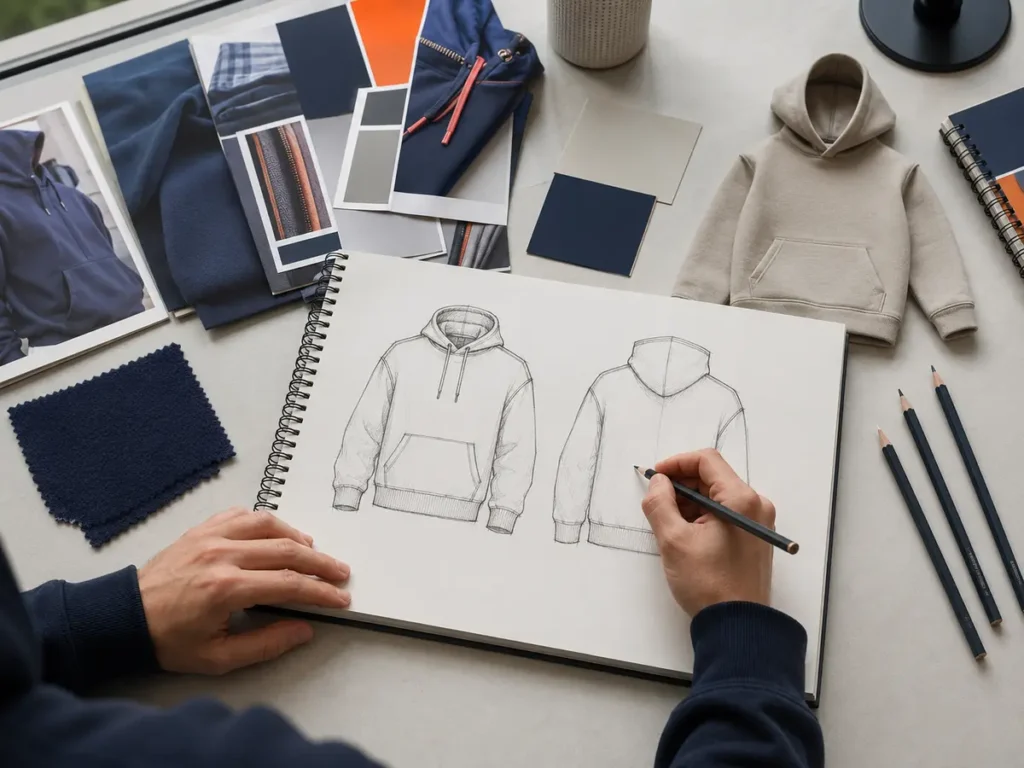
A concept sketch should communicate the silhouette and design hierarchy before the team invests time in technical details.
Choose the Hoodie Structure
The structure should match how the garment will be worn.
| Hoodie direction | Useful for | Key design decisions | Common production considerations |
|---|---|---|---|
| Classic pullover | Teams, schools, merchandise, promotions | Kangaroo pocket, hood depth, drawcord, rib | Simple closure; pocket and print placement must work together |
| Full zip | Staff, clubs, layering, travel | Zipper type, zipper tape, split pocket, chin guard | Center-front artwork is interrupted; zipper quality affects cost |
| Performance hoodie | Training, outdoor teams, active staff | Stretch, paneling, moisture management, thumbholes | Fabric recovery, seam type, and decoration compatibility matter |
| Oversized streetwear | Fashion labels, fan merchandise | Dropped shoulder, body width, sleeve volume, rib proportion | Higher material use; fit intent must be quantified |
| Youth hoodie | Schools, youth clubs, team programs | Proportion, sizing, drawcord strategy, label comfort | Product-safety rules and age/size range require specific review |
| Work or staff hoodie | Corporate programs, crews, uniform dealers | Durability, visibility, pocket function, repeat orders | Decoration consistency and easy replenishment may outweigh novelty |
Do not combine features simply because they look attractive in isolation. Dense embroidery can pucker lightweight fabric, and a thick drawcord may conflict with a youth product-safety strategy. Good design anticipates the manufacturing consequence.
Step 3: Define the Fit with Measurements, Not Adjectives
Words such as “regular,” “relaxed,” and “oversized” are useful directions, but they are not sufficient for production. Convert the fit into points of measurement, or POMs.
Choose a base size first. For each POM, state exactly where the measurement starts and ends, whether the garment is measured flat, and whether rib or curved edges are included. A diagram is more reliable than a label alone.
Typical hoodie POMs include:
- half chest width;
- body length from high point shoulder;
- shoulder width or across shoulder;
- sleeve length from shoulder or center back;
- armhole depth;
- bicep width;
- sleeve opening;
- hood height and hood width;
- neck opening;
- pocket width, height, and opening;
- bottom opening relaxed;
- cuff and bottom-rib height.
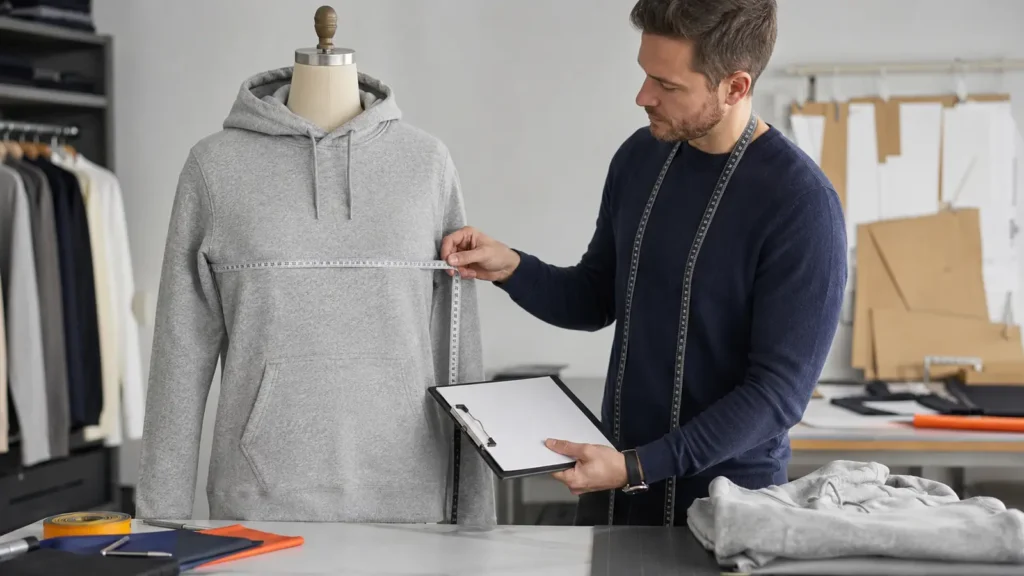
Each point of measurement needs one method that the buyer, pattern maker, sample room, and inspector can repeat.
Add Grade Rules and Tolerances
A single base-size measurement chart does not define a full size range. Grading explains how each POM changes between sizes. Chest width might change at one interval while hood dimensions, body length, or sleeve length change at another. Youth and adult ranges normally require separate logic rather than a simple proportional scale.
Tolerance defines acceptable production variation around the target. It is not a substitute for an accurate pattern. Set it according to the feature, material behavior, measurement method, and commercial requirement.
Before approval, confirm that each measurement method is shown visually, the before- or after-wash condition is stated, tolerances cover critical POMs, grading covers the full size range, and relevant sizes have been fitted on intended wearers.
Step 4: Select Fabric by Structure, Composition, Weight, and Finish
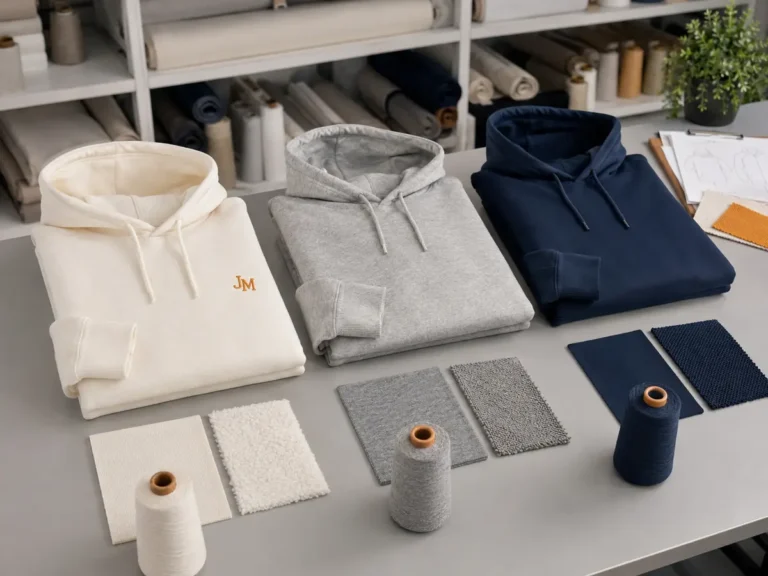
Fabric is often the largest influence on how a hoodie looks and feels. “Cotton hoodie” leaves too much unresolved. Specify at least the fiber composition, knit structure, target weight, finish, color, and approved hand-feel reference.
Common Hoodie Fabric Directions
| Fabric direction | Typical characteristics | Best suited to | Questions for the supplier |
|---|---|---|---|
| Brushed-back fleece | Soft raised interior, warmth, substantial volume | Teamwear, staff apparel, private label | Is the inside brushed before or after dyeing? How stable is the surface after washing? |
| French terry | Looped interior, less loft, versatile layering | Transitional weather, active lifestyle, retail | What are the loop structure, composition, weight, and shrinkage behavior? |
| Cotton-rich blend | Natural hand feel with potential stability from blended fiber | General custom hoodies and merchandise | What is the exact percentage of each fiber? Is composition verified for labeling? |
| Polyester-rich knit | Color consistency, quick drying, potential performance use | Training, sublimated panels, team programs | Is the face suitable for the intended decoration? What pilling or snag risks apply? |
| Stretch performance knit | Mobility and recovery | Athletic warm-ups and fitted styles | What stretch and recovery are required in each direction? |
| Sherpa or fleece lining | Added warmth and volume | Cold-weather collections | Is it full-body or selective lining? How does it change pattern allowance and weight? |
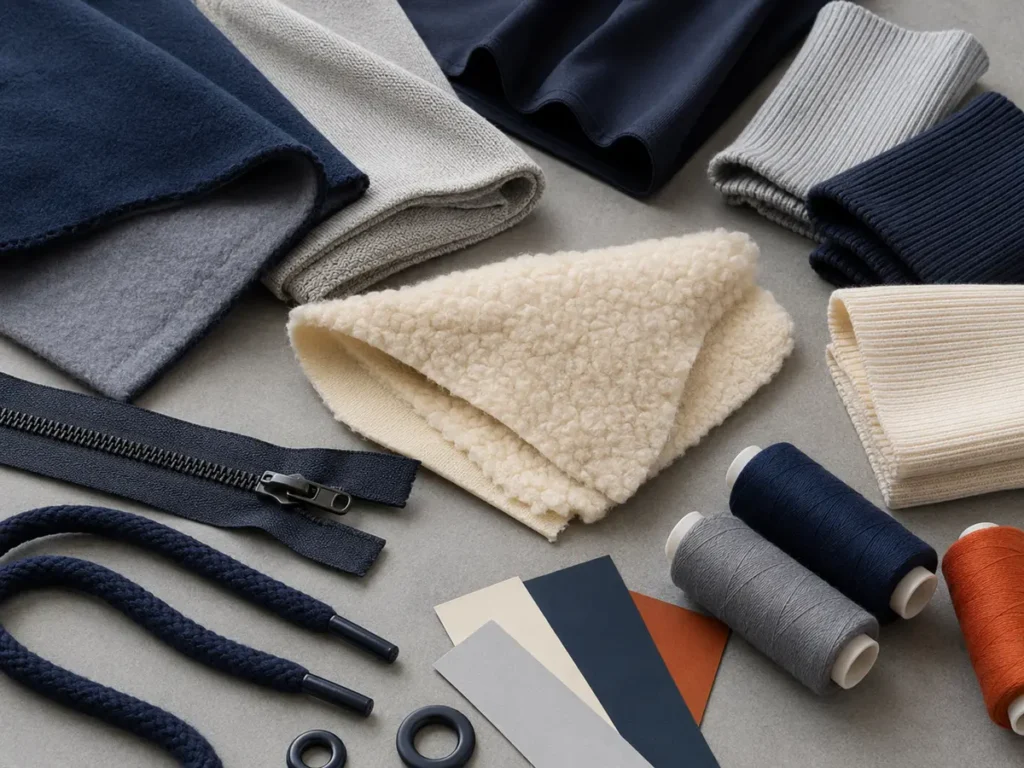
Approve the shell fabric, rib, lining, zipper, drawcord, thread, and color together; similar names do not guarantee matching behavior.
Fabric weight is commonly discussed in grams per square meter, but weight alone does not define quality. Fabrics with the same stated weight can differ in yarn, density, finish, recovery, and shrinkage. Approve a physical swatch when hand feel matters, and specify the rib’s composition, stretch, recovery, width, and shade.
Step 5: Specify Construction and Trims
Technical flats convert the concept sketch into clean front, back, and detail views. They should show seam placement, topstitching, panels, pocket construction, hood construction, rib, zipper, drawcord channel, eyelets, labels, and any reinforcements.
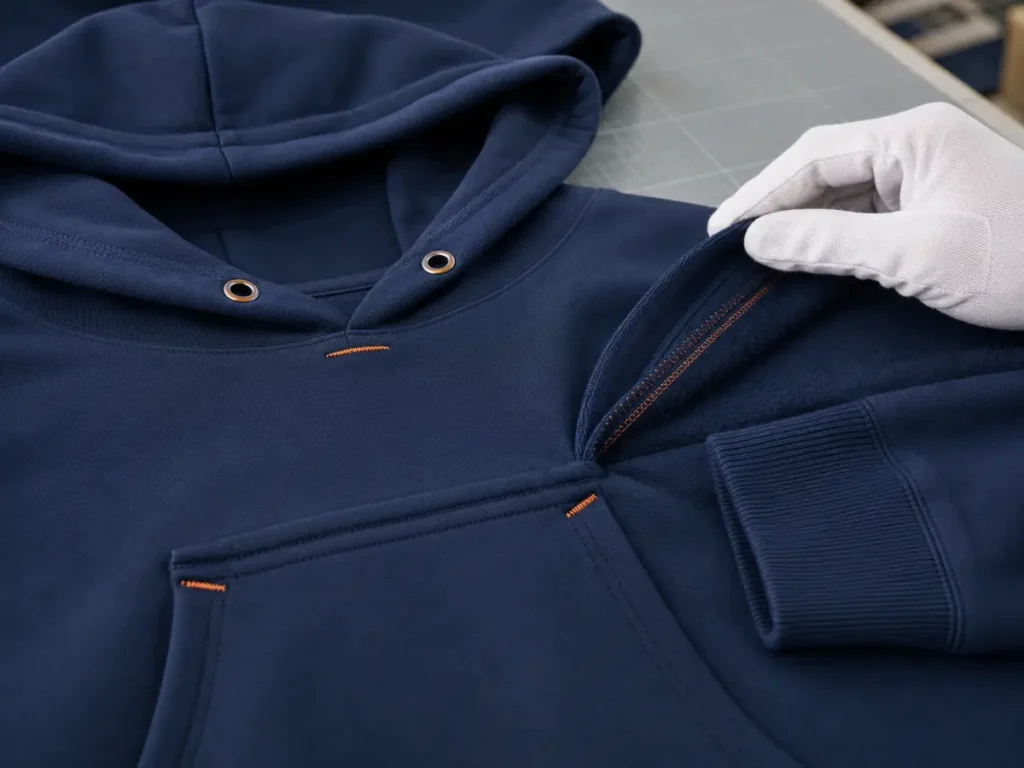
Construction notes should identify observable details such as seam type, stitch appearance, reinforcement, and trim finish.
Important decisions include hood panels and layers; neck finish; pocket type, placement, and reinforcement; seam and stitch appearance; cuff and hem rib; zipper type and finish; and drawcord material, size, color, end finish, and length.
If a specific component is essential, identify it precisely. If substitutions are allowed, define the approval process. “Similar quality” is subjective; an approved reference plus measurable criteria is more useful.
Step 6: Plan Colors, Logos, Labels, and Packaging
For every colorway, identify the body, sleeves, hood lining, rib, zipper tape, drawcord, eyelets, thread, artwork, labels, and packaging accents. Use a recognized color reference where possible, but approve the result on the actual material because color appearance changes with fiber, texture, finish, and lighting.
Decoration Methods
Choose decoration according to artwork, fabric, quantity, intended feel, and wash expectations.
- Embroidery: define artwork size, thread colors, position, backing, and acceptable puckering.
- Screen printing: specify ink or desired hand feel, colors, size, and placement.
- Heat transfer: confirm transfer type, fabric compatibility, application, and care.
- Sublimation: use on compatible polyester materials; it is not universal for cotton-rich fleece.
- Patches: specify material, dimensions, edge finish, attachment, color, and placement.
Artwork placement should be measured from stable garment reference points. “Left chest” is not enough. State the artwork width and height, its relationship to center front or a seam, and how placement changes across sizes if necessary.
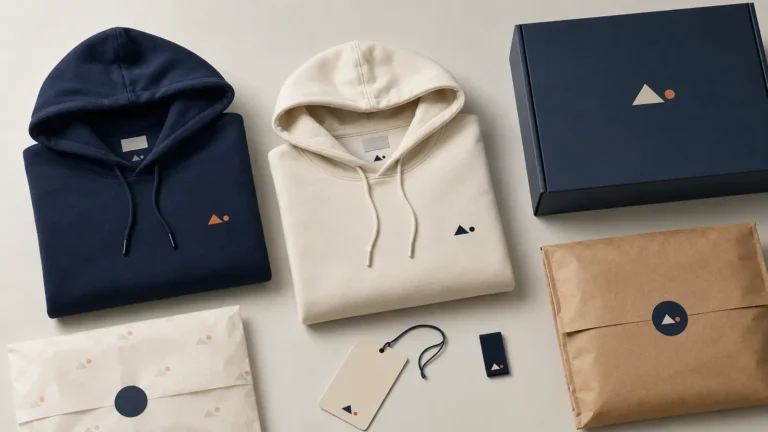
Private-label buyers should also define the main label, size label, care/content label, hangtag, barcode or sticker requirements, folding method, inner bag, carton marking, and assortment. Do not wait until the sample is complete to discuss these items; they affect sourcing and approval.
Step 7: Build the Custom Hoodie Tech Pack
A tech pack is the controlled production document that brings the product definition together. It should be easy for a merchandiser, pattern maker, sample room, printer or embroiderer, quality inspector, and buyer to read.
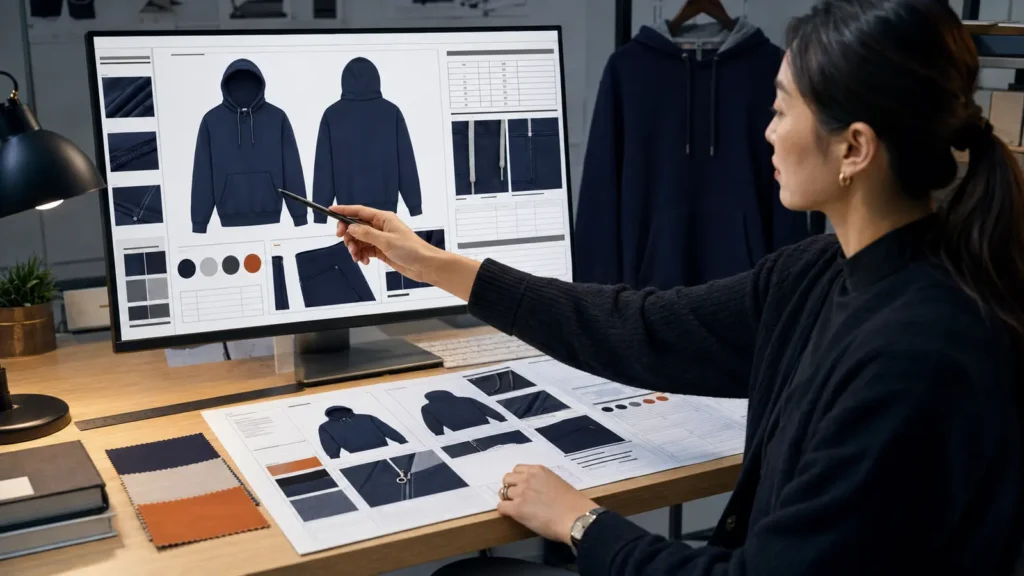
The tech pack links drawings, measurements, materials, artwork, labels, packaging, and revision status in one source of truth.
Essential Tech Pack Sections
| Section | What to include | Why it matters |
|---|---|---|
| Cover and control data | Style name/number, season or program, owner, date, revision, status | Prevents teams from working from an obsolete file |
| Technical flats | Front, back, side, inside, and enlarged details as needed | Shows product structure without artistic ambiguity |
| Bill of materials | Every fabric, trim, thread, label, artwork, and packaging component | Supports sourcing, costing, purchasing, and substitution control |
| Colorways | Color reference for every component and artwork | Keeps body, rib, trims, and branding coordinated |
| Construction | Seam, stitch, reinforcement, hood, pocket, rib, and zipper instructions | Guides sample and sewing operations |
| Measurement spec | POM codes, measurement method, base-size targets, tolerances | Makes fit measurable |
| Grade rules | Size-to-size increments or full graded chart | Defines the complete size range |
| Artwork | Vector file reference, dimensions, colors, position, technique | Makes decoration repeatable |
| Labels and packaging | Content, placement, dimensions, folding, bag, sticker, carton | Prevents late-stage packing and compliance gaps |
| Test or performance requirements | Only requirements that are defined and relevant to the market/use | Creates an approval standard rather than a vague expectation |
| Sample comments | Photo, issue, requested correction, target, status | Closes revisions systematically |
| Revision history | Date, revision number, author, exact change | Preserves traceability |
What Should Be in the Bill of Materials?
The bill of materials, or BOM, should describe each component with an item number, category, material specification, approved reference, colorway, placement, unit of measure, and substitution status. Separate the shell, hood lining, pocket bag, rib, zipper, drawcord, eyelets, thread, labels, artwork materials, hangtag, inner packaging, and carton requirements. Document colorway-specific trims explicitly.
Make the Tech Pack Easy to Revise
Use one file owner and a consistent naming system. Put the revision number and date on the relevant pages. When a change is approved, update the tech pack and record what changed; do not depend on a new email to override an old document.
A comment such as “make the hood better” creates another interpretation problem. A useful comment identifies the issue, requested action, target measurement or construction, and approval status. Include annotated sample photos when they improve clarity.
Step 8: Request a Quotation with Complete Inputs
For a meaningful custom hoodie quote, provide:
- tech pack or the best available sketch and reference images;
- hoodie type and fit direction;
- target quantity plus size/color breakdown;
- fabric composition, structure, target weight, and finish;
- rib, lining, zipper, drawcord, and trim requirements;
- artwork files, decoration methods, dimensions, colors, and placements;
- labels, hangtags, packaging, and barcode needs;
- target selling market;
- sample requirements;
- required in-hand date and delivery destination;
- special inspection, testing, documentation, or shipping requirements.
Turn your concept into a production brief: Share your hoodie sketch, reference images, target quantity, size range, colors, logo files, fabric direction, packaging needs, delivery destination, and target date with JIUMU. Request a custom quotation through the JIUMU contact page or explore custom hoodies.
Step 9: Sample in Controlled Stages
Sampling tests the product definition. It is not only a visual preview.
A development sequence may include a prototype, fit sample, color or material confirmation, size set, pre-production sample, and shipment sample. The appropriate sequence depends on complexity, material risk, size range, decoration, and buyer requirements.
At each stage, identify what the sample is intended to approve. A fit sample made in substitute fabric may be useful for pattern evaluation but unsuitable for final color or hand-feel approval. A decoration strike-off may confirm embroidery or print quality but not garment fit.
Use a Sample Comment Sheet
Record the sample type, date, governing tech-pack revision, size and color, measurements, material status, fit, workmanship, artwork, labels, packaging, required correction, owner, and next action. Mark each comment as approved, revise, rejected, or pending; close superseded comments to prevent contradictory instructions.
Step 10: Approve Pre-Production Details and Quality Checks
Bulk production should begin only after the parties agree which physical sample, material swatches, color standard, artwork, labels, packaging, and tech-pack revision form the approved reference.
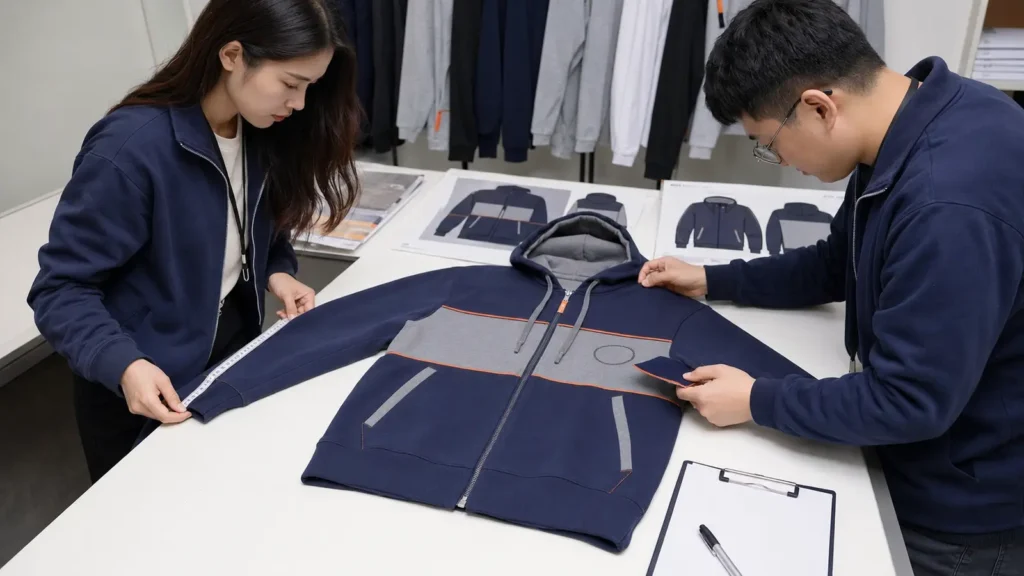
Pre-production approval should cover fit, materials, colors, construction, decoration, labels, packaging, and the governing tech-pack revision.
Practical Hoodie Quality-Control Checklist
- Measurements and fit: verify critical POMs, tolerance, balance, shoulder, sleeve, hood, pocket, symmetry, and size label.
- Fabric and color: compare shell, rib, lining, trims, and artwork with approved references; check shade and surface defects.
- Construction: inspect seam security, skipped stitches, puckering, topstitching, reinforcement, zipper, drawcord, pocket, and rib recovery.
- Decoration: verify method, dimensions, placement, colors, bonding, garment distortion, and label position.
- Packaging: confirm folding, individual packing, identification, assortment, carton quantity, and required marks.
Compliance Information to Capture in the Tech Pack
Use the tech pack to control market-specific label and safety information. The buyer or importer remains responsible for determining the requirements that apply.
For the United States, the Federal Trade Commission states that most textile products require labels identifying fiber content, country of origin, and the manufacturer or another responsible business. Its Care Labeling Rule also requires manufacturers and importers to attach appropriate care instructions to covered garments. Review the current FTC apparel-labeling guidance and Care Labeling Rule guidance for the intended product.
For products marketed in the European Union, textile products generally need fiber-composition labeling under Regulation (EU) No 1007/2011. The EU’s official business portal explains that the label must show fiber composition and be firmly attached for covered products. The EU textile-label guidance should be checked alongside any country-specific language and consumer requirements. The EU General Product Safety Regulation has applied since 13 December 2024; businesses selling into the EU should assess the duties that apply to their role and product using the official GPSR summary.
For Great Britain, current government guidance says textile labels must show fiber content, including relevant animal-origin materials; review the UK textile-labeling guidance for the destination and sales model.
Youth hoodies require additional attention. The U.S. Consumer Product Safety Commission identifies hood and neck drawstrings on children’s upper outerwear in sizes 2T to 12 or equivalent as a substantial product hazard and also limits certain waist and bottom drawstrings in sizes 2T to 16. Buyers developing youth products should review the CPSC drawstring guidance and obtain qualified compliance advice.
These links are starting points, not legal advice. Requirements can depend on construction, wearer age, claims, materials, channel, and country.
What Drives Custom Hoodie Cost?
Compare quotations against the same specification and include sampling, testing, packaging, freight, duties, and inventory risk.
Main product cost drivers include:
- fabric composition, knit structure, weight, finish, dye method, and order quantity;
- fabric width and pattern consumption, especially for oversized fits or large hoods;
- custom-dyed fabric or special color matching;
- number of panels, seams, pockets, linings, and sewing operations;
- zipper, eyelet, drawcord, rib, label, and trim quality;
- decoration method, artwork size, stitch count, number of colors, and placements;
- number of colorways and size distribution;
- custom labels, hangtags, packaging, barcodes, and assortments;
- sample rounds, required tests, inspection scope, and documentation;
- delivery method and destination.
To control cost, simplify features that do not support the use. One well-positioned embroidery may be more effective than several small decorations. A stock fabric in an approved color may suit a modest quantity better than custom dyeing. Discuss alternatives before the final sample.
Questions to Ask a Custom Hoodie Supplier
- What information is needed to confirm a reliable quotation?
- Which fabrics match the required structure, weight, hand feel, and use?
- Can you provide material references before sampling?
- Which components have minimums or custom-development charges?
- Which decoration methods suit the selected fabric and artwork?
- How will shade, artwork placement, and repeat-order color be controlled?
- Which sample stages are recommended, and what does each approve?
- How are sample comments, revisions, and substitutions controlled?
- Which measurements are critical, and how are tolerances verified?
- What remains the buyer or importer’s compliance responsibility?
Common Custom Hoodie Design Mistakes
Treating a Mockup as a Tech Pack
A mockup communicates color and logo direction but rarely defines materials, measurements, construction, tolerances, labels, packaging, or grading.
Choosing Fabric by GSM Alone
Weight does not describe composition, density, finish, recovery, shrinkage, or hand feel. Approve a complete specification and physical reference.
Copying a Retail Size Chart Without a Measurement Method
Body and finished-garment charts are different. Define what the numbers represent and how every POM is measured.
Sending Low-Resolution Logo Files
Production artwork should be scalable and color-controlled, with physical dimensions and placement specified.
Approving Changes Only in Messages
Put every approved change into the current tech pack and revision log.
Ignoring Labels and Packaging Until the End
Add labels, hangtags, barcodes, bags, assortments, and carton marks to the BOM early.
Using Adult Details on Youth Hoodies Without Safety Review
Define the age and size range early; youth products can have different rules and foreseeable-use risks.
Skipping the Pre-Production Approval Gate
Confirm final materials, colors, trims, artwork, and packaging before bulk authorization.
How JIUMU Supports Custom Hoodie Development
JIUMU is a Guangdong-based B2B supplier established in 2010, serving buyers in the United States, Canada, the United Kingdom, and Europe. The company supports custom teamwear, logo apparel, uniforms, bags, hats, and branded merchandise for schools, teams, sports clubs, distributors, uniform dealers, promotional buyers, retailers, and private-label brands.
For custom hoodies, JIUMU can support OEM and ODM product development, fabric sourcing, Pantone color matching, digital mockups, physical samples, embroidery, screen printing, heat transfer, sublimation where suitable, patch applications, private labels, hangtags, packaging customization, bulk production, quality control, and export support.
The typical MOQ is 50 pieces, subject to product structure and customization. A custom-dyed fabric, specialized trim, complex size range, or particular decoration may have different practical requirements, so the specification should be reviewed before the quotation is confirmed.
Explore JIUMU’s custom hoodies, coordinate the garment with custom team uniforms, or add complementary custom team jackets for a complete apparel program.
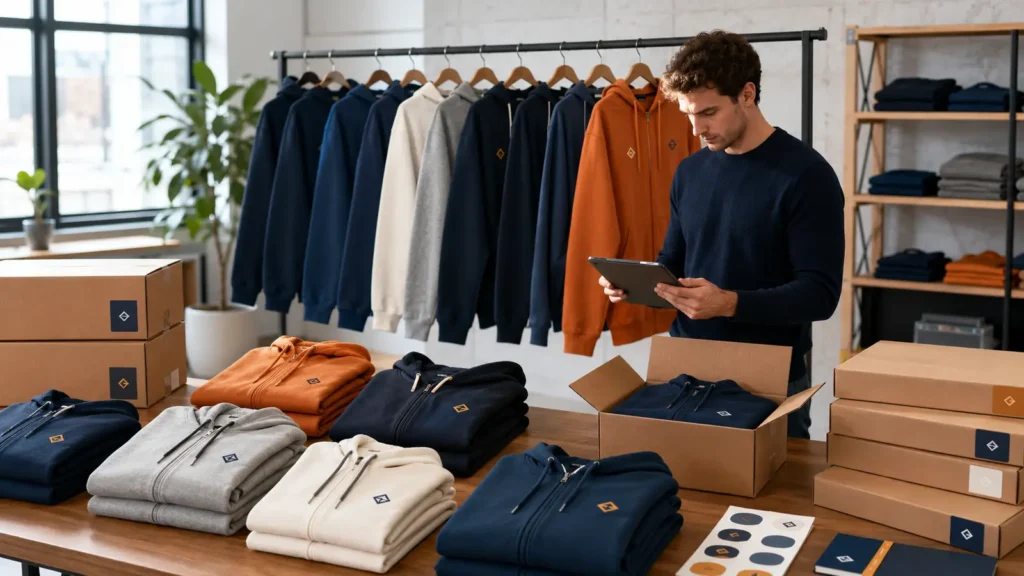
A controlled tech pack helps keep materials, colors, artwork, sizing, labels, and packaging consistent across a coordinated order.
Frequently Asked Questions
Final Recommendation
The most effective custom hoodie design process starts with commercial clarity and ends with a controlled approval standard. Define the wearer and use first. Translate the concept into front and back technical flats. Approve fabric and trims as physical materials, not only names. Quantify fit through POMs, grading, and tolerances. Put every decision into one revision-controlled tech pack. Then use samples to validate the document before bulk production.
A good tech pack does more than tell a supplier what to sew. It makes quotations comparable, sample comments actionable, approvals traceable, inspections repeatable, and future reorders easier to control.
About JIUMU
JIUMU supports B2B custom teamwear, logo apparel, uniforms, bags, hats, and branded merchandise development for teams, schools, clubs, distributors, uniform dealers, promotional buyers, and private-label brands.