Custom Hoodie Decoration Methods: Print, Embroidery and Patches
Choosing a hoodie is only half of a custom apparel project. The decoration method determines how the logo looks, how the surface feels, which details remain readable, how the garment should be washed, and how easily the same appearance can be repeated across a bulk order.
For schools, sports clubs, uniform dealers, promotional buyers, and private-label brands, the decision is rarely as simple as “print or embroidery.” Screen printing, direct-to-film transfer, direct-to-garment printing, heat-transfer vinyl, embroidery, woven patches, embroidered patches, rubber/PVC patches, and leather-style patches each solve a different problem.
This guide compares the main methods from a B2B purchasing perspective, including risks, quotation inputs, and sample approval.
Quick Answer: Use screen printing for repeatable bold graphics and larger quantities; DTF or another qualified heat transfer for colorful, detailed artwork and flexible quantities; DTG for soft, detailed prints on compatible garments; embroidery for compact logos that need a dimensional, established appearance; and patches when you want texture, a removable design element, or a distinctive brand finish. The right choice also depends on fabric composition, fleece surface, logo size, placement, color count, target hand feel, wash expectations, and order volume.
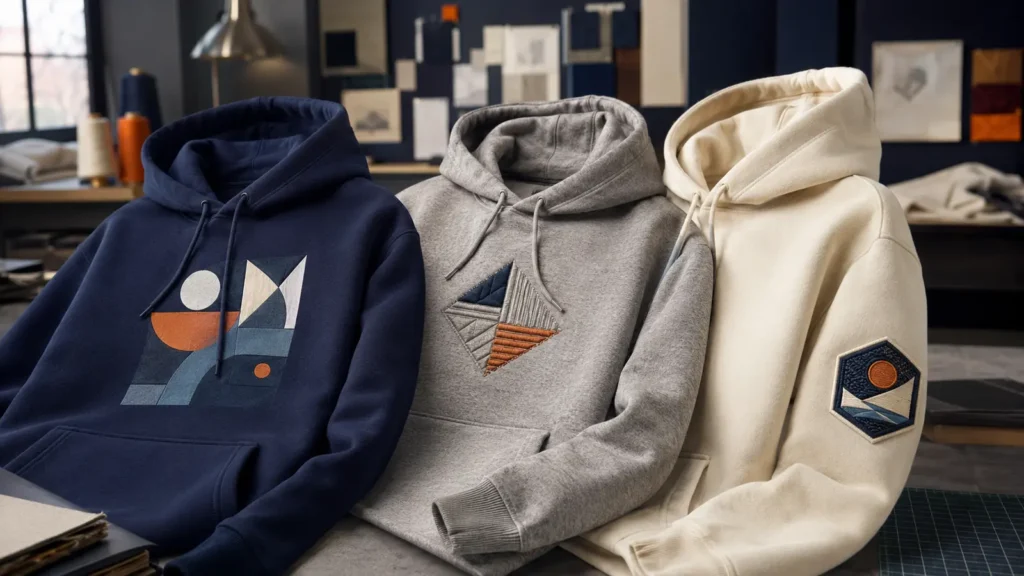
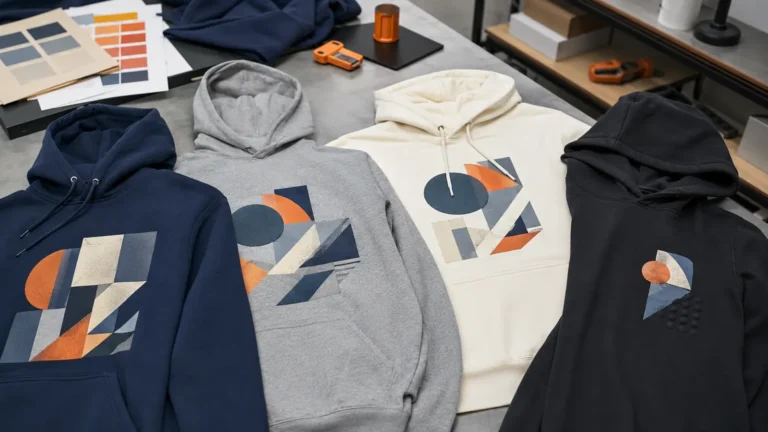
Custom hoodie decoration methods including print, embroidery and a sewn patch
Why the Decoration Decision Matters in Bulk Hoodie Orders
A decoration can look convincing in a digital mockup and still fail on the finished hoodie. Thin lettering may close up in embroidery. A large, dense stitched logo may make the chest feel stiff. A heat transfer may bridge across seams or pockets. A screen print may show fleece fibers if the ink system, screen setup, or curing process is not matched to the garment. A patch that looks refined on a cap may feel oversized on a hoodie sleeve.
The decision has four layers: visual result, garment compatibility, production logic, and use conditions. No method is universally the most durable, economical, or premium. Those claims only become meaningful after the artwork, substrate, test method, care procedure, and acceptance criteria are defined.
Custom Hoodie Decoration Methods Compared
The following table gives a practical starting point. Final suitability must be confirmed on the selected hoodie fabric and color.
| Method | Best suited to | Detail and color | Surface feel | Typical bulk-order logic | Main risks to control |
|---|---|---|---|---|---|
| Screen printing | Bold team marks, event graphics, large front or back art | Strong spot colors; gradients require appropriate separation | From soft to noticeable, depending on ink and deposit | Setup is distributed across quantity; efficient for repeat designs | Curing, dye migration, fibrillation, registration, opacity |
| DTF / film transfer | Full-color logos, short-to-medium programs, mixed artwork | Fine detail, gradients, many colors | A film-like layer; larger areas feel more noticeable | Low artwork setup relative to screen printing; application time remains per piece | Edge lifting, scorching, pressure inconsistency, blocked breathability |
| DTG printing | Detailed art on compatible cotton-rich or specially prepared garments | Photo-like detail and smooth gradients | Often relatively soft, especially where no heavy white underbase is needed | Useful for flexible runs; pretreatment and curing are critical | Fabric variability, pretreatment marks, color shift, wash result |
| Heat-transfer vinyl | Names, numbers, simple one- or two-color marks | Clean shapes; not ideal for photographic detail | Distinct film layer | Good for personalization and small variable runs | Layer thickness, lifting, seam interference, inconsistent pressure |
| Embroidery | Left-chest logos, sleeve marks, school or corporate identity | Strong edges at suitable scale; very fine details may need simplification | Raised thread texture; backing remains behind the design | Cost is influenced by stitch count, size, complexity, and handling | Puckering, excessive density, poor digitizing, rough backing |
| Embroidered patch | Crests, club emblems, traditional team identity | Dimensional; small detail is limited by thread | Raised patch plus border | Patch can be produced separately, then sewn or heat-applied | Border distortion, attachment security, stiffness |
| Woven patch | Small lettering, fine lines, retail or uniform branding | Finer detail than many embroidered patches | Flatter and smoother | Efficient when a consistent badge is used across products | Fraying, weak edge finish, low contrast, attachment inconsistency |
| Rubber/PVC patch | Outdoor-inspired, modern workwear, sports branding | Raised shapes and clean color blocks | Flexible or firm molded texture | Tooling and color setup favor repeat programs | Excess weight, edge lift, poor sewing channel, heat sensitivity |
| Leather-style patch | Heritage, lifestyle, private-label positioning | Best for simplified debossed or printed marks | Firm textured surface | Strong visual identity in focused placements | Care compatibility, cracking, color transfer, unsupported material claims |
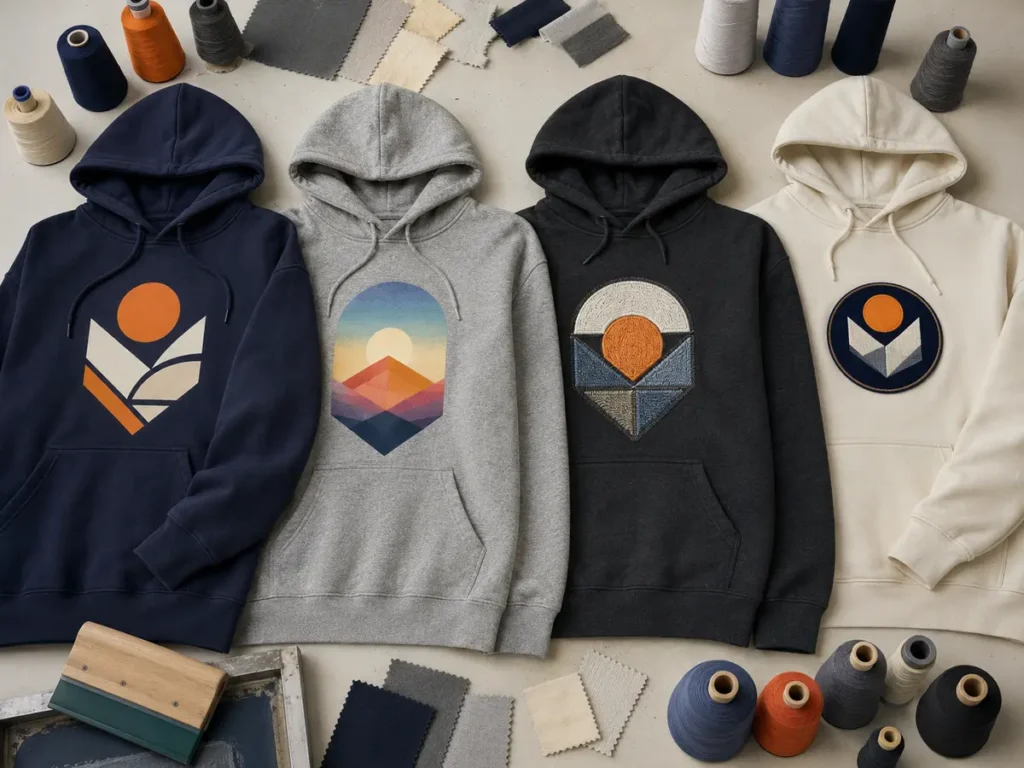
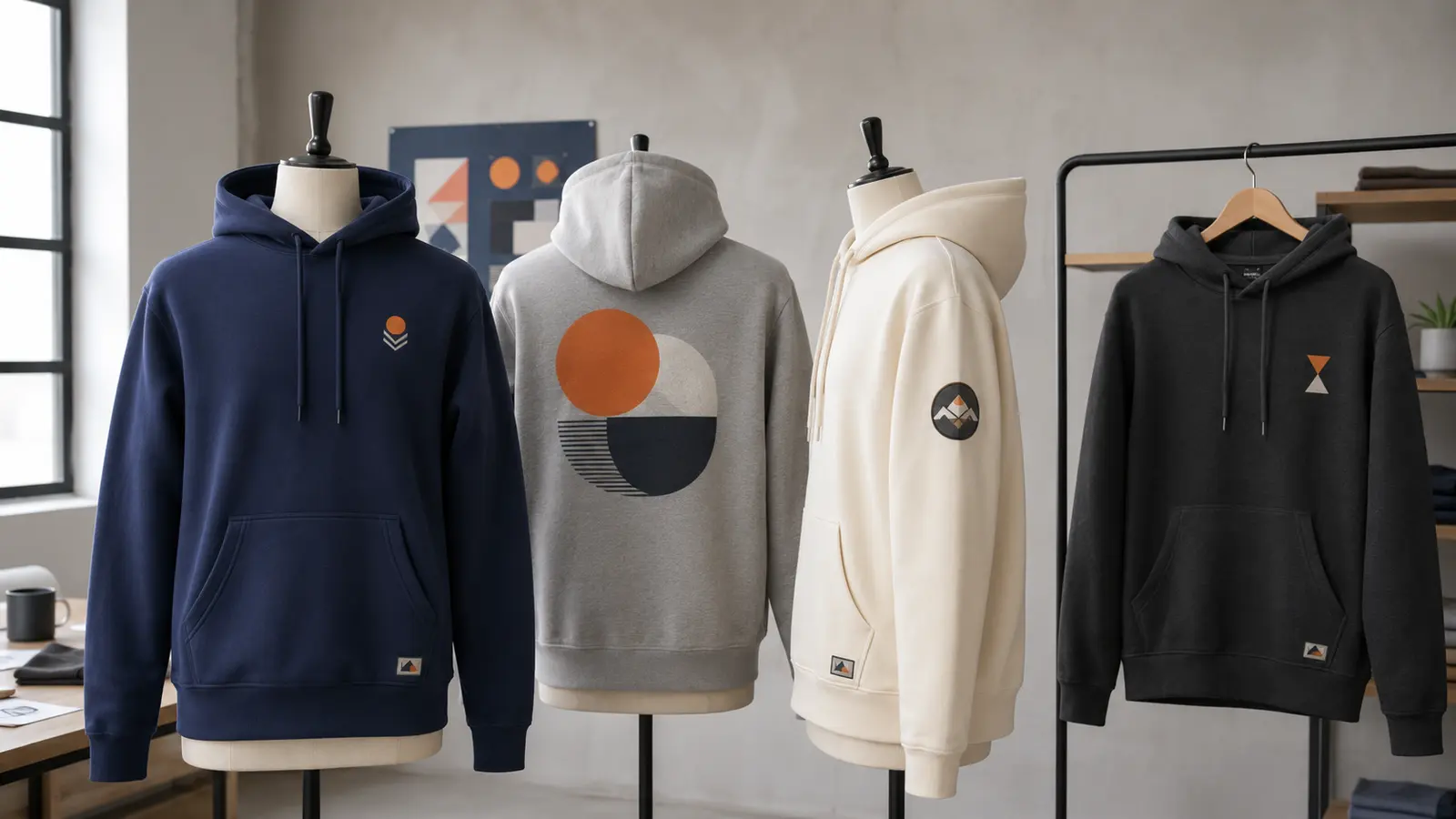
Four hoodies showing screen print, full-color transfer, embroidery and patch decoration
Printing Methods for Custom Hoodies
“Printed hoodie” can describe several processes with different cost structures and performance characteristics. A quotation should name the exact process rather than using “printing” as a catch-all term.
Screen Printing
Screen printing pushes ink through a prepared mesh stencil onto the garment. Each spot color normally requires its own screen and registration step. This makes the method particularly logical for bold graphics, limited color palettes, and repeat quantities.
For hoodies, the base fabric matters. A cotton-rich face may accept print differently from a polyester-rich performance fleece. Loose surface fibers can disrupt a smooth image. Dark garments may require an underbase. Polyester dyes can migrate when exposed to heat, altering light ink colors. The printer must select an ink system, mesh, underbase, flash sequence, and cure profile that work together.
Screen mesh also affects the result. Avient notes that higher mesh counts generally create a thinner ink deposit and better detail, and that ink requires a defined heat-and-time exposure for wash performance. Correct parameters must come from the selected ink system and production setup. Avient screen-printing technique guide and conveyor dryer profiling guide.
Choose screen printing when:
- the artwork uses bold shapes or controlled spot colors;
- the same design will be repeated across a meaningful quantity;
- the buyer wants a large front or back graphic;
- color matching and repeat-order records can be controlled;
- the supplier can test opacity, cure, migration, and wash behavior on the actual garment.
Ask the supplier to confirm: ink family, number of colors, underbase, print size, Pantone targets if applicable, placement tolerance, cure verification method, and whether the chosen fleece needs a migration blocker or fiber-control step.
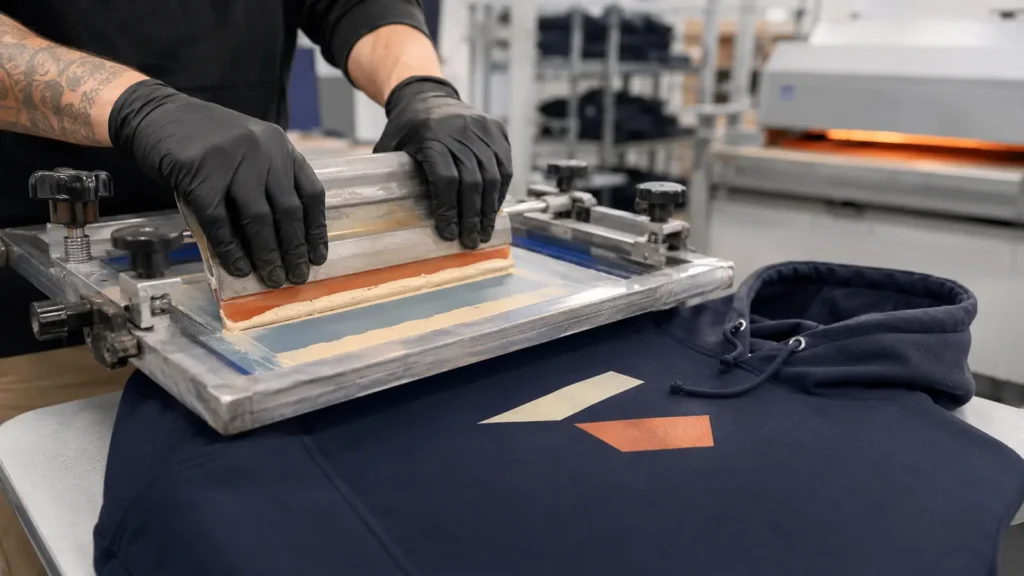
Screen printing an original two-color design onto a navy hoodie
DTF and Other Heat-Applied Transfers
Direct-to-film decoration prints a design onto film, applies an adhesive system, and transfers the image to the garment with heat and pressure. It is popular for detailed, multicolor artwork and flexible order programs because it avoids a separate screen for every spot color.
The important purchasing question is not whether DTF “lasts.” It is whether the transfer, hoodie, application recipe, and care instructions have been validated together. Time, temperature, and pressure influence adhesion. STAHLS’ application guidance emphasizes following the transfer material’s specified settings and achieving even pressure; seams, pockets, and other raised structures can interrupt pressure. STAHLS heat-press application guidance and pressure guidance.
A small chest logo can feel unobtrusive, while a dense full-front transfer creates a noticeable film layer. Negative space can reduce coverage, but the result should be approved.
Choose DTF or a qualified transfer when:
- the logo contains gradients, many colors, or fine lines;
- the order includes several small artwork variations;
- the program requires names, numbers, or event-specific graphics;
- screen setup is not logical for the quantity;
- the garment surface has been tested for application temperature and adhesion.
Control: transfer edge, white outline or “halo,” color accuracy, press marks, gloss variation, stretch behavior, seam clearance, and wash result.
Direct-to-Garment Printing
DTG deposits ink directly on the garment. It can reproduce gradients and complex art without separate screens. It is often associated with cotton-rich products, although equipment, ink, and pretreatment systems continue to evolve.
Specifications must be tied to the supplier’s DTG system. Epson recommends cotton and cotton/polyester blends for its maker-oriented DTG systems, while Brother and Epson document dedicated pretreatment controls for some polyester printing. “DTG works on every hoodie” is not a safe assumption. Epson DTG/DTF overview, Brother polyester guidance, and Epson polyester FAQ.
Approve the exact hoodie color and fabric, not only a white cotton test square. On dark garments, white underbase and pretreatment can change hand feel. Pretreatment application, drying, printing, and curing must be consistent.
Heat-Transfer Vinyl
Heat-transfer vinyl is cut from colored film and applied with a heat press. It remains useful for team names, player numbers, simple logos, reflective details, or small variable orders.
HTV is less suitable for tiny disconnected elements, complex gradients, or very large solid areas where the film may dominate the garment’s hand. Layered colors add thickness and application variables. The approval sample should show the smallest details, largest coverage area, and any placement near seams or the kangaroo pocket.
Embroidery on Hoodies
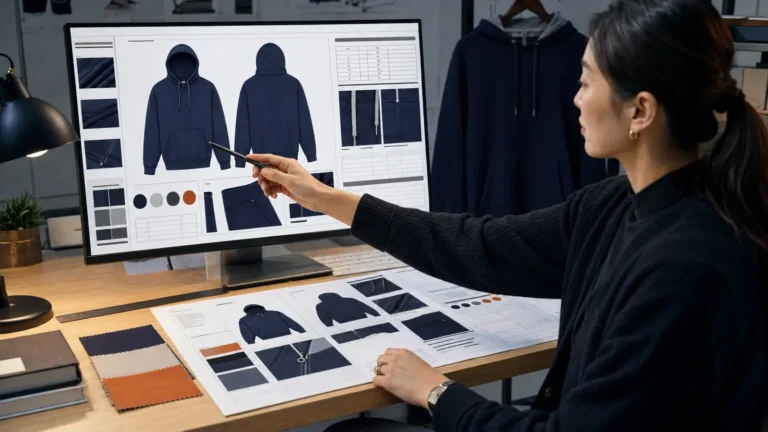
Embroidery converts artwork into a stitch file that controls stitch type, direction, sequence, density, underlay, color changes, and trims. The digitized file is production engineering, not merely a different image format.
Heavy hoodie fleece can support a strong embroidered mark, but knit construction and stretch still require stabilization. Madeira’s technical backing guidance identifies cut-away stabilizers as appropriate for unstable fabrics including knits, sweaters, and fleece; the stabilizer choice should reflect fabric and design density. Madeira backing guide.
What Makes Hoodie Embroidery Look Professional?
Good embroidery begins with artwork adapted to thread. The supplier may need to:
- enlarge or remove extremely small text;
- thicken narrow negative spaces;
- simplify gradients into color areas;
- choose satin stitches, fill stitches, running stitches, or appliqué strategically;
- adjust stitch angles and sequencing to manage distortion;
- use underlay and backing suited to the fleece;
- keep dense fills away from lightweight or highly stretchy areas;
- add topping where the nap could swallow small stitches.
Judge the result at normal distance for readability and close up for edge shape, gaps, tension, trims, puckering, backing, and the reverse side.
When Embroidery Is the Better Choice
Embroidery works well for compact chest or sleeve branding, school crests, uniforms, and tactile private-label marks. It is less appropriate for large photographic graphics. Cost is influenced by stitch count, colors, digitizing, placement access, backing, trimming, and quantity. A dense logo may be stiff and prone to puckering; controlled density can look and wear better.
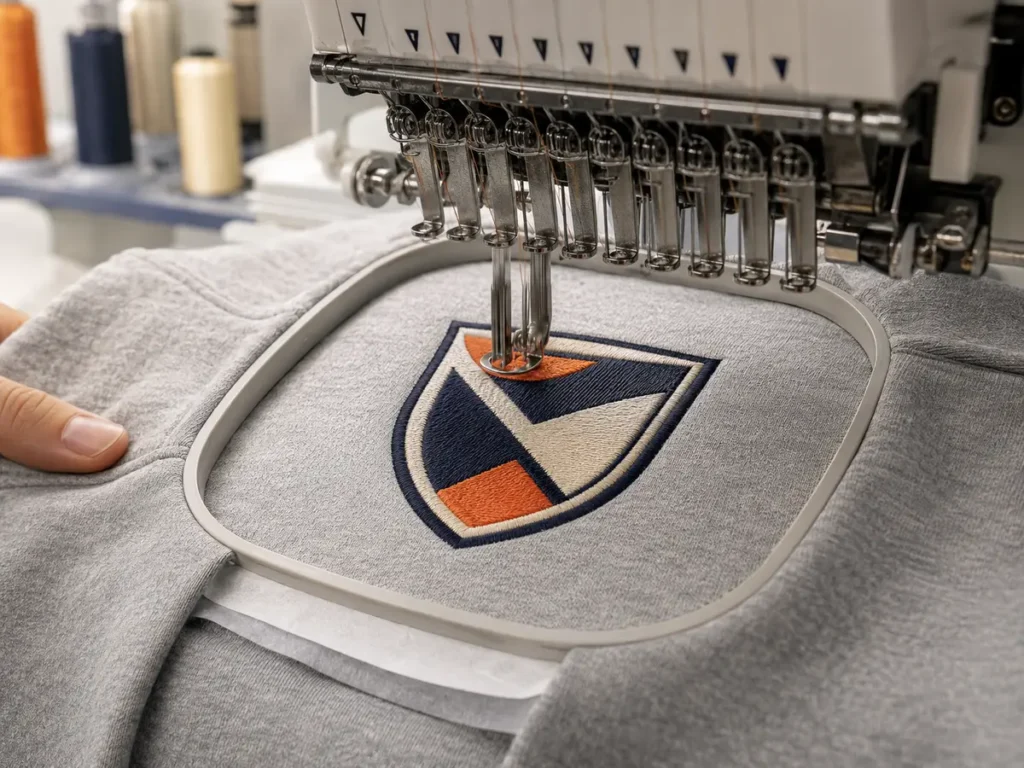
Multi-needle embroidery stitching an abstract crest onto hoodie fleece
Patch Options for Custom Hoodies
Patches can be produced separately and used across hoodies, jackets, bags, or caps when size and attachment suit each product.
Embroidered Patches
Embroidered patches use thread coverage over a base material. They offer familiar dimensional texture and work well for crests and bold emblems. Very small details can fill in, so artwork may require simplification. Border type, backing, base fabric, thread colors, and attachment method should be specified.
Woven Patches
Woven patches form the artwork by weaving fine threads rather than building a raised embroidered surface. They are flatter and can hold smaller details and lettering more clearly than many embroidered patches. They suit uniform branding, retail labels, and compact identity marks.
Rubber or PVC Patches
Rubber/PVC patches provide molded relief, clean color zones, and a modern outdoor or workwear appearance. Buyers should control thickness, flexibility, color, sewing channel, edge design, and attachment. A heavy patch placed on soft lightweight fleece may sag or feel unbalanced.
Leather-Style Patches
Leather-style patches can be genuine leather or synthetic alternatives. The quotation and product labeling should identify the material accurately rather than using “leather” loosely. Debossing, laser-like marking, printing, or embossing can create a restrained heritage look. Care compatibility matters because the patch and hoodie may react differently to heat, water, detergent, and drying.
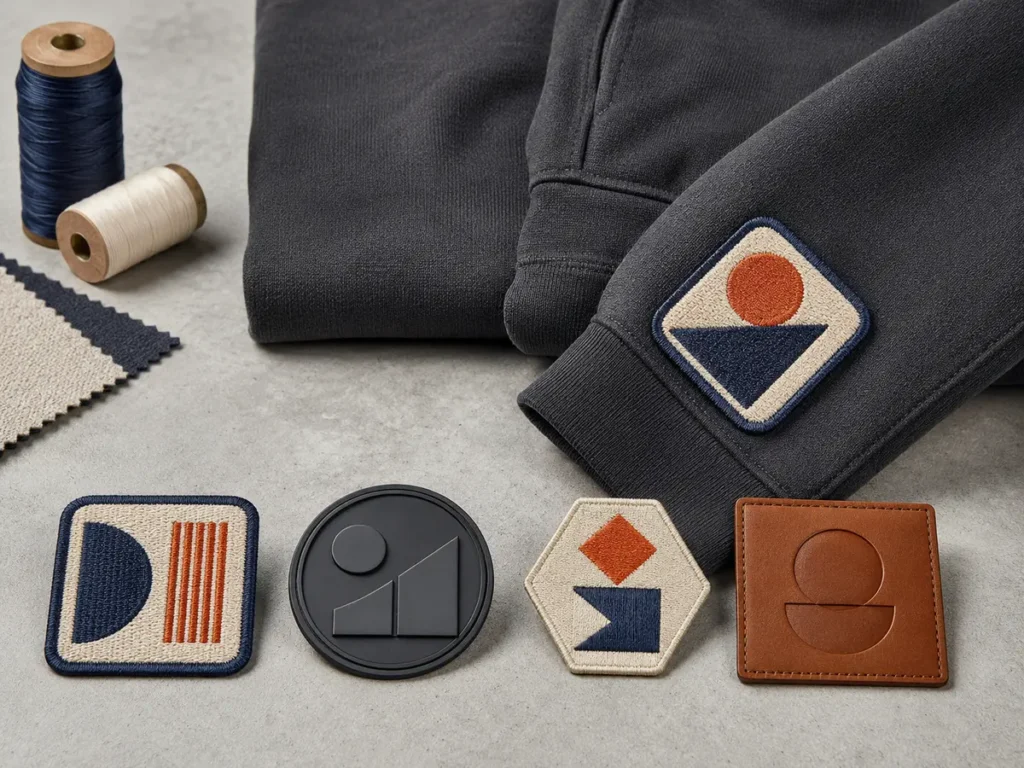
Embroidered, woven, rubber and leather-style patches for custom hoodies
Sew-On, Heat-Applied, Hook-and-Loop, or Hybrid Attachment?
| Attachment | Procurement advantage | Key limitation | Approval check |
|---|---|---|---|
| Sew-on | Mechanical attachment and visible control of edge stitching | Adds sewing operation and may show reverse stitching | Stitch path, thread color, corner security, puckering |
| Heat-applied | Clean reverse side and efficient application when validated | Adhesive must match fabric and care conditions | Edge lift, press mark, bond after laundering |
| Hook-and-loop | Patch can be removed or changed | Adds thickness and a visible base component | Shape match, edge comfort, repeated removal |
| Hybrid sew-and-heat | Heat can position the patch while sewing secures it | More process steps | Flatness, no adhesive bleed, complete perimeter stitch |
How Fabric and Hoodie Construction Affect Decoration
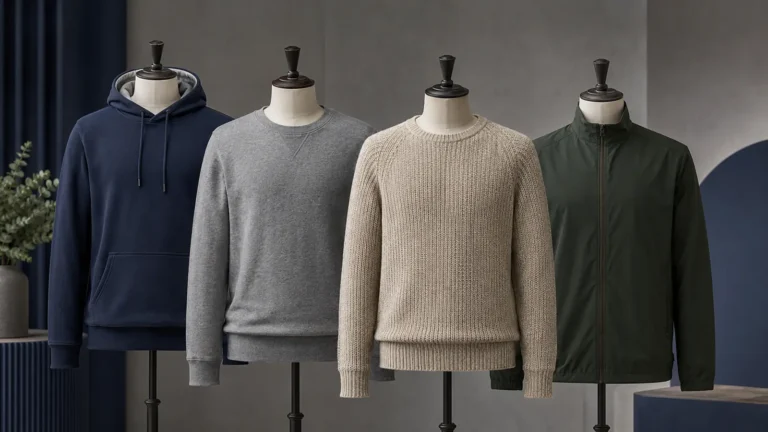
Two hoodies with the same fiber percentages can decorate differently because yarn, face smoothness, brushing, dye, finish, stretch, coating, weight, and color vary.
Cotton-Rich Fleece
A smooth cotton-rich face is often favorable for screen printing and DTG, while loose fibers reduce print smoothness. Embroidery still needs suitable backing.
Polyester-Rich and Performance Fleece
Polyester can introduce dye migration during heated decoration. A low-cure system, barrier underbase, or substrate-specific process may be needed. Never approve by fiber percentage alone.
Heather and Blended Fabrics
Heather and blended fabrics can vary during pretreatment, printing, or heat. Request the actual colorway.
Garment-Dyed, Washed, Coated, or Water-Resistant Hoodies
Special finishes can interfere with ink or adhesive bonding, and washed garments may vary in shade or dimension. Test the selected method.
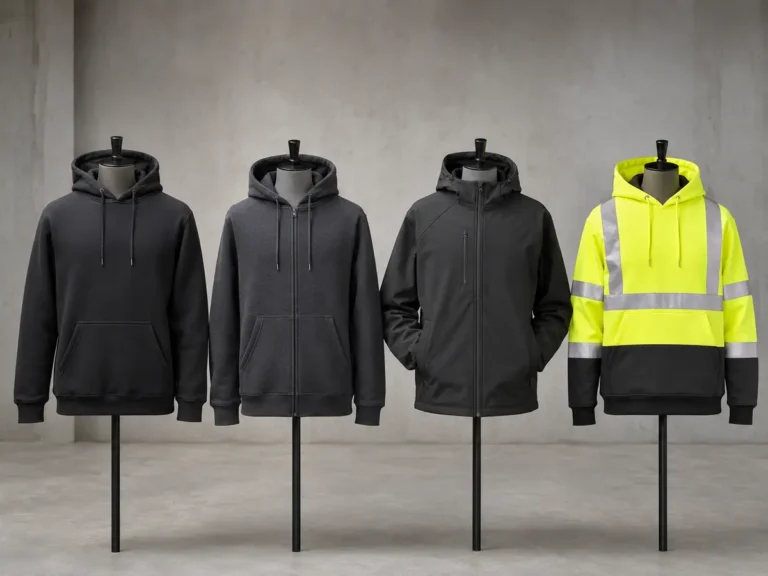
Seams, Pockets, Zippers, and Rib Panels
Raised structures disrupt flat printing and heat pressure. Embroidery frames need access and clearance. The print zone above a kangaroo pocket is different from a flat fabric panel. Zippers divide artwork and can make registration difficult. Approve a placement diagram with dimensions from stable garment reference points.
Match Decoration to Buyer Type and Use Case
| Buyer or program | Practical starting method | Why | Possible hybrid |
|---|---|---|---|
| School or sports club | Screen print for large team graphic; embroidery for crest | Repeat identity and clear team visibility | Printed back plus embroidered chest |
| Construction or outdoor crew | Screen print, embroidery, or rubber patch after fabric testing | Visibility and compact brand marks | Embroidered chest plus sleeve patch |
| Corporate merchandise | Embroidery or refined transfer | Controlled logo presentation | Chest embroidery plus small woven hem label |
| Streetwear or private label | Screen print, DTG/DTF, patches | Artwork and texture drive product identity | Large back print plus leather-style patch |
| Tournament or event | Screen print or DTF | Date-specific art and flexible color | Printed front plus personalized number |
| Uniform dealer or distributor | Repeatable screen, embroidery, or patch program | Specification records support reorders | Standard patch across several garments |
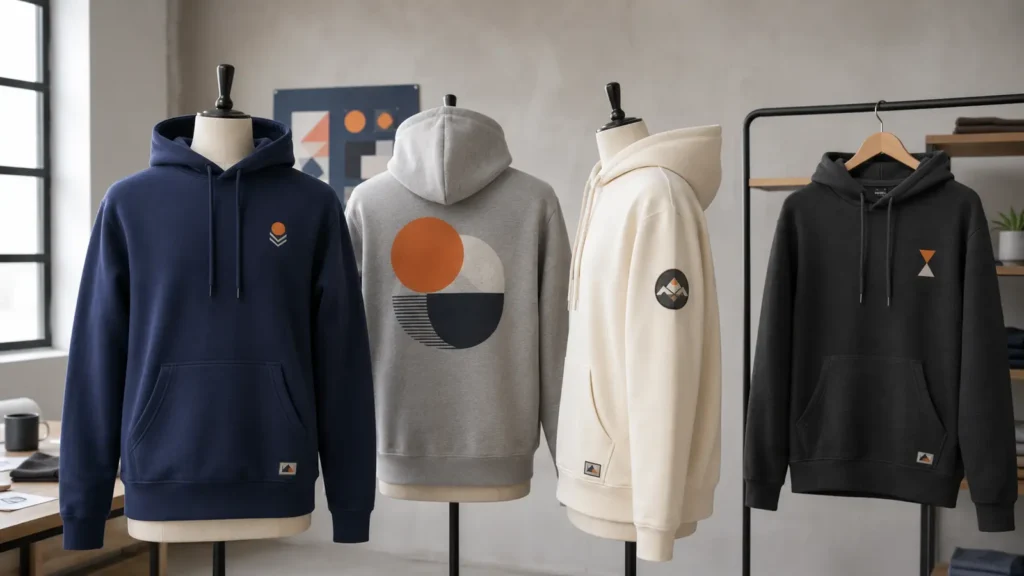
Custom hoodies showing chest embroidery, back print, sleeve patch and hem label placement
Hybrid Decoration: When One Method Is Not Enough
Combining methods can create a stronger hierarchy than making one decoration larger. A common strategy is a compact embroidered left-chest mark with a larger printed back graphic. A woven hem label can add private-label identity without competing with the main logo. A sleeve patch can identify a division, event, or sponsor.
Hybrid decoration also multiplies the approval points. The buyer should check whether all methods use the same brand colors, whether their gloss and texture work together, and whether the total decoration cost supports the selling price. Decoration locations must not interfere with each other during production.
Planning a bulk hoodie program? Send JIUMU your hoodie style, fabric preference, quantity by size and color, artwork files, decoration locations, packaging needs, destination country, and target delivery date. JIUMU can review screen printing, heat transfer, embroidery, and patch options and prepare a quotation based on the actual specification. Explore custom hoodies or request a quotation.
What Drives the Cost of Custom Hoodie Decoration?
A useful quotation separates the garment, decoration, labels, packaging, sampling, and freight.
Artwork and Setup
Screen printing may require separations and screens; embroidery needs digitizing; molded patches may need tooling; woven patches and transfers need production-ready files.
Decoration Size and Coverage
Size affects ink, film, stitch count, machine time, patch construction, and application.
Number of Colors and Variants
Additional screen-print colors add screens and registration. Embroidery color changes can add handling. DTF and DTG handle multicolor art differently, but white ink coverage and production settings still matter. Personalized names and numbers create variable data and sorting risk.
Hoodie Fabric and Construction
Polyester-rich, coated, high-stretch, garment-dyed, or heavily brushed garments may require special processes or testing. Zippers, seams, pockets, and small placements increase handling.
Quantity and Size Breakdown
Setup is distributed differently at 50, 500, or 5,000 pieces. Extended sizes and multiple hoodie colors can change garment cost and decoration setup.
Sampling, Testing, Packaging, and Freight
A physical pre-production sample, wash testing, individual polybags, hangtags, size stickers, carton requirements, inspection level, shipping method, and destination all affect the landed program cost. Request these items explicitly.
Sample Approval and Quality-Control Checklist
A digital mockup confirms intent, not production performance. Approve a physical sample for a new combination or risk-sensitive program.
Record the hoodie style, fiber content, color, size, artwork version, process, decoration colors, dimensions, placement, backing or patch base, attachment, care instruction, and date.
Visual and Measurement Checks
- Logo width and height match the approved tolerance.
- Placement is measured from agreed reference points.
- Print colors, thread colors, and patch colors match the approved standard under controlled light.
- Fine lines and negative spaces remain open.
- Print registration and edges are clean.
- Embroidery has no severe puckering, gaps, loops, broken thread, or excessive backing.
- Patch border, shape, and attachment are consistent.
- Decoration does not cross an unapproved seam, pocket, or zipper.
- The garment has no scorch, shine, press box, stain, needle damage, or adhesive residue.
Performance Checks
The test plan should reflect the end use and be agreed before production. AATCC lists TM61 for accelerated colorfastness to laundering and TM8 for colorfastness to crocking. These may be useful reference methods when professionally specified; buyers can also use an agreed home-laundering protocol for development screening. Do not state that a product “passes AATCC” without naming the method, edition, conditions, rating requirement, and test evidence. AATCC standard test methods.
For development screening, record wash temperature, detergent, cycle, drying, number of cycles, and evaluation criteria. A home test is not a substitute for accredited testing when a contract, regulation, or buyer program requires it.
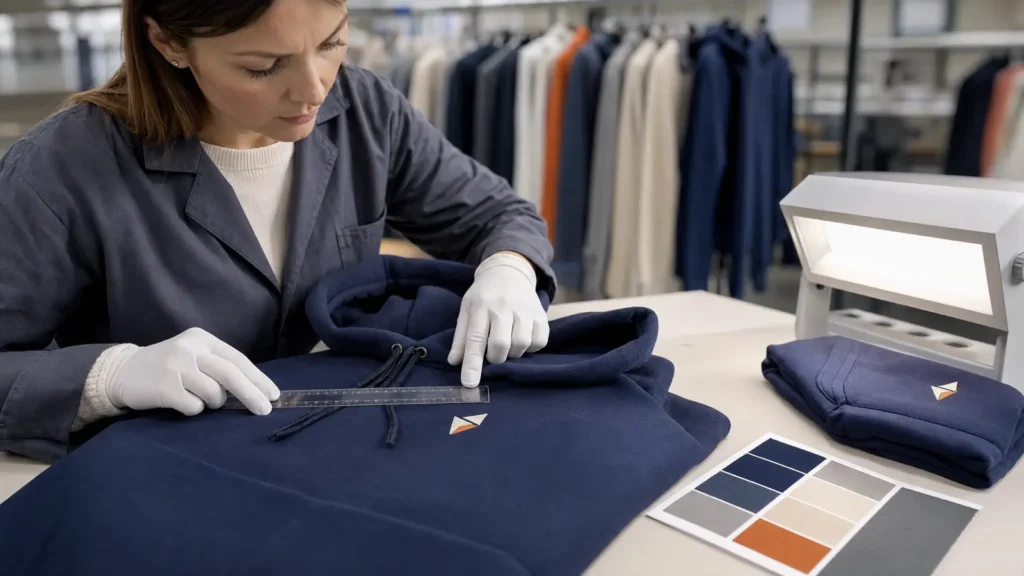
Inspector checking logo placement and finish on a custom hoodie
Labeling and Market Considerations
Decoration changes can affect care instructions. The party responsible for the finished garment should confirm that the care method is safe for the base hoodie and every added component.
In the United States, the Federal Trade Commission’s Care Labeling Rule requires manufacturers and importers covered by the rule to provide care instructions for textile wearing apparel. FTC guidance also explains that most textile and wool products need labels identifying fiber content, country of origin, and the responsible business under the applicable rules. FTC care-label guidance and FTC textile-label guidance.
For the European Union, Regulation (EU) No 1007/2011 governs textile-fiber names and related fiber-composition labeling. The European Commission notes that products containing at least 80% textile fibers by weight are covered and that the regulation does not itself cover size, country-of-origin, or wash/care labeling. Buyers should confirm all requirements for the destination market and selling model. European Commission textile-label overview and Regulation (EU) No 1007/2011.
If a buyer requests OEKO-TEX® STANDARD 100 or another material certification, request current scope documents and verify that the specific garment, ink, thread, patch, adhesive, and accessories are covered as required. OEKO-TEX describes STANDARD 100 as a label for textiles tested for harmful substances; it should not be claimed from a raw-material statement alone. OEKO-TEX® STANDARD 100.
Information to Send for an Accurate Quotation
Prepare one RFQ package with:
- buyer/company name and destination country;
- hoodie type: pullover or zip, intended use, target fabric, weight preference, and colors;
- estimated total quantity and breakdown by color and size;
- vector artwork where possible, plus a visual reference;
- exact decoration method if already selected—or desired appearance if advice is needed;
- logo dimensions and placement for front, back, sleeves, hood, or labels;
- Pantone, thread, or approved color references;
- personalization list for names or numbers;
- private label, hangtag, folding, polybag, barcode, and carton requirements;
- sample requirement and approval deadline;
- testing or inspection requirements;
- target delivery date and shipping destination.
If artwork is not production-ready, state which details may be simplified. Request separate approval for digitizing, color separation, patch artwork, and placement.
Questions to Ask a Custom Hoodie Supplier
- Which decoration process do you recommend for this exact hoodie, and why?
- Can you show the physical size and coverage on the selected garment size?
- How will the artwork change for embroidery or patch production?
- What ink, transfer, thread, backing, patch base, and attachment type will be used?
- How will you control color between samples, bulk production, and reorders?
- What are the placement and size tolerances?
- How do you verify screen-print cure or transfer application?
- What wash or adhesion evaluation is included?
- Will polyester dye migration, garment finish, or fleece texture create risk?
- What file, sample, or approval is required before bulk production?
- How are personalized garments sorted and checked?
- What is included in the quoted price and what is separate?
- How are defects handled before shipment?
- Which labeling and packaging items are the buyer’s responsibility?
Common Buying Mistakes
Selecting by Unit Price Alone
A low decoration price may exclude digitizing, screens, patch tooling, sample charges, labels, packaging, testing, or freight. Compare like-for-like specifications.
Approving Only a Digital Mockup
A mockup cannot show hand feel, thread density, edge lift, fabric show-through, press marks, or wash performance. Use a physical sample for risk-sensitive programs.
Sending a Small Raster Logo
Low-resolution artwork can create rough edges and ambiguous colors. Supply vector artwork or authorize professional redrawing. Embroidery and patches need process-specific artwork approval.
Ignoring Fabric Color and Composition
The same decoration can behave differently on navy polyester fleece and natural cotton-rich fleece. Test the actual garment color.
Making Embroidery Too Dense
More stitches do not guarantee a better result. Excess density can cause puckering, stiffness, thread breaks, and uncomfortable backing.
Using a Large Solid Transfer Without Considering Hand Feel
Large film coverage can feel warmer and less flexible. Ask whether the art can use negative space or another printing method.
Omitting Repeat-Order Records
Keep the approved artwork, stitch file version, screen or separation notes, Pantone references, thread codes, patch construction, placement measurements, garment style, and approved sample.
Why Work With JIUMU on Custom Hoodies?
JIUMU is a Guangdong-based B2B supplier established in 2010, serving buyers in the United States, Canada, the United Kingdom, and Europe. Its target programs include schools, sports teams, clubs, distributors, uniform dealers, promotional buyers, retailers, and private-label apparel brands.
Relevant capabilities include OEM and ODM development, screen printing, heat transfer, logo embroidery, woven and rubber/PVC and leather-style patches, fabric sourcing, Pantone color matching, private labels, hangtags, packaging customization, digital mockups, physical samples, quality control, and export support. The typical MOQ is 50 pieces, subject to the hoodie structure and customization.
That range is useful when a project needs more than one decoration method or when the buyer wants coordinated hoodies, custom team jackets, custom team uniforms, custom team jerseys, hats, or bags with consistent branding.
A buyer can instead describe the desired appearance, use, quantity, budget position, and care expectations. JIUMU can compare practical methods and identify where a sample is advisable.
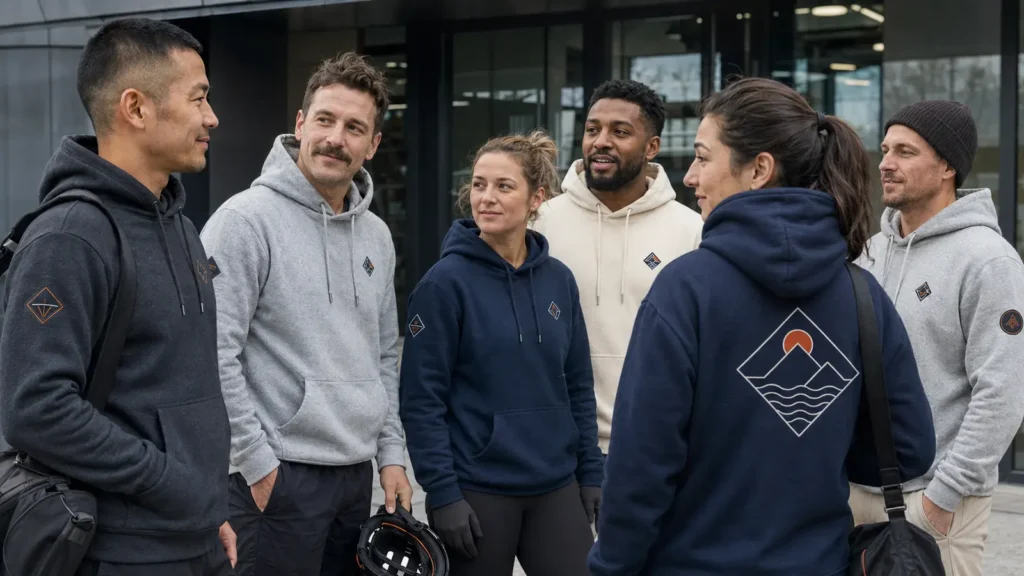
Adult sports club wearing coordinated custom decorated hoodies
Frequently Asked Questions
Final Recommendation
Start with the design objective, not the decoration name. Define what the buyer must see and feel, how the hoodie will be used, what quantity will be ordered, and what the product must look like after laundering. Then shortlist the methods that fit the fabric and production logic.
For bold repeated graphics, evaluate screen printing. For detailed multicolor art and flexible variants, evaluate DTF or another qualified transfer. For compatible cotton-rich garments and detailed imagery, consider DTG. For compact tactile identity, use embroidery. For a distinct badge or private-label feature, compare embroidered, woven, rubber/PVC, and leather-style patches. Use a hybrid only when each element has a clear role.
The final decision belongs on an approved physical sample with recorded artwork, dimensions, placement, color references, materials, application details, care instructions, and acceptance criteria.
Request a JIUMU custom hoodie quotation: Send your artwork or reference image, hoodie type, fabric and color preference, quantity by size, decoration locations, packaging needs, destination country, and target delivery date. Contact zhengdong@jiumugear.com or WhatsApp +86 18507502899, or use the JIUMU inquiry page.
About JIUMU
JIUMU supplies custom teamwear, logo apparel, hats, uniforms, bags, and branded merchandise for B2B buyers. Share your artwork, quantity, colors, decoration locations, packaging needs, destination, and target delivery date for a project-specific quotation.