Hoodie vs Sweatshirt vs Sweater vs Jacket: Key Differences
Choosing between a hoodie, sweatshirt, sweater and jacket sounds simple until a team, school, brand or distributor needs to order hundreds of coordinated garments. The names overlap in everyday speech, suppliers may use them differently, and two products with similar silhouettes can perform very differently after printing, embroidery, repeated washing or outdoor use.
For a B2B buyer, the useful question is not only, “What is this garment called?” It is, “Which construction, fabric, fit and decoration method will deliver the right result for our users, budget and brand?”
This guide explains the practical differences between hoodies, sweatshirts, sweaters and jackets. It also shows how to translate those differences into a clear quotation request, sample approval process and bulk-order specification.
Quick Answer: A hoodie is a casual knit top defined by its hood and is commonly made from sweatshirt fleece or French terry. A sweatshirt is a soft knit pullover or zip style, usually made from fleece or French terry, and may or may not have a hood; a hoodless crewneck is the clearest example. A sweater is made by knitting yarn into the garment or panels and is chosen for texture, drape and a more refined appearance. A jacket is primarily an outer layer, usually with a full front opening and more protective or structured features. For bulk customization, choose by use case and specification rather than product name alone.
Why the Difference Matters in B2B Apparel Sourcing
Product terminology affects:
- The expected fabric construction and weight
- Whether the garment is a first, middle or outer layer
- The available print and embroidery areas
- The type of neck label, size label and care label required
- Pattern development, grading and fit
- Cost, sampling and production complexity
- Packing and freight
A school may call every warm team top a “sweater” when it actually needs a crewneck sweatshirt. A streetwear label may request a “jacket” while its reference shows a heavyweight zip hoodie.
If the buyer and supplier interpret the same word differently, a mockup can still lead to the wrong fabric, closure or silhouette. Pair the product name with measurable specifications and reference images.
Hoodie vs Sweatshirt vs Sweater vs Jacket at a Glance
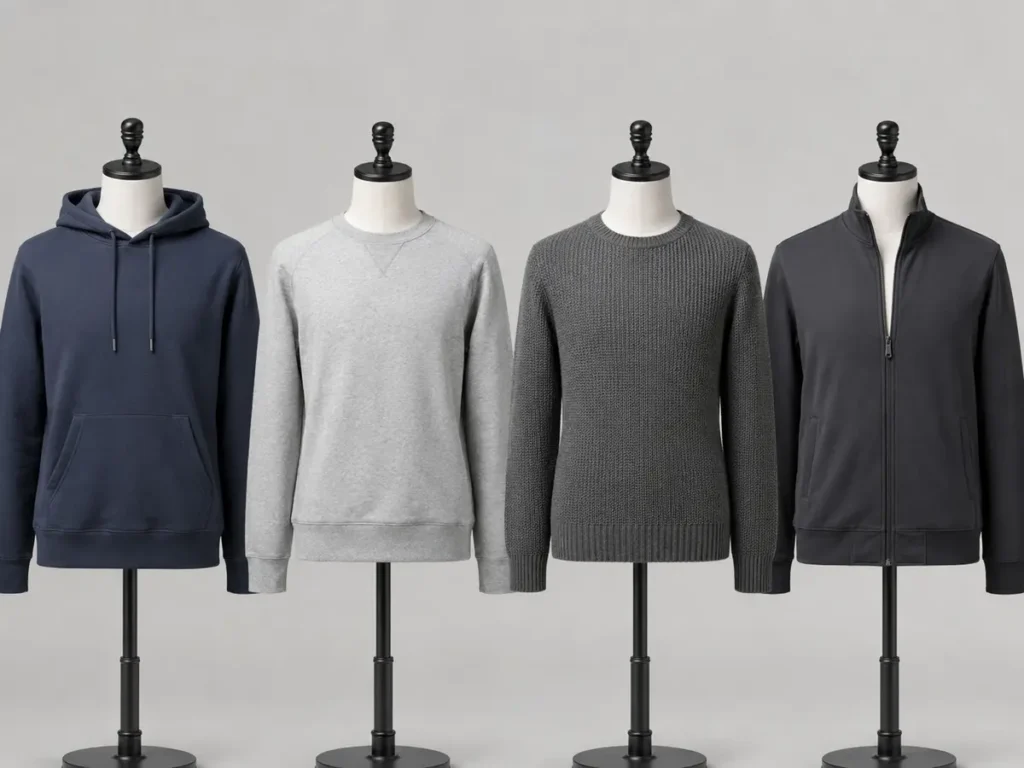
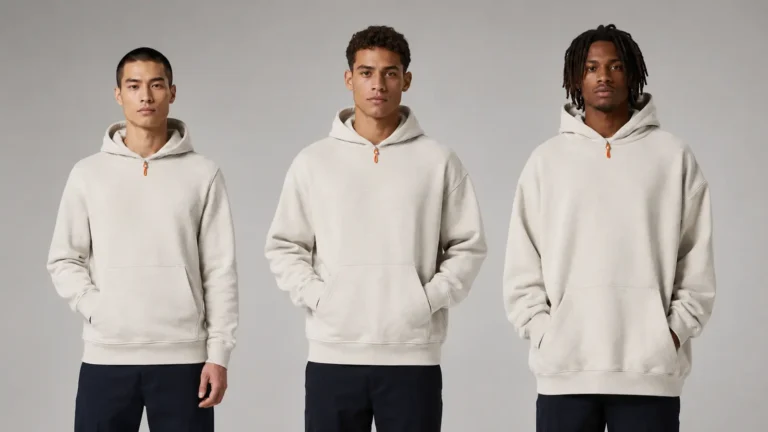
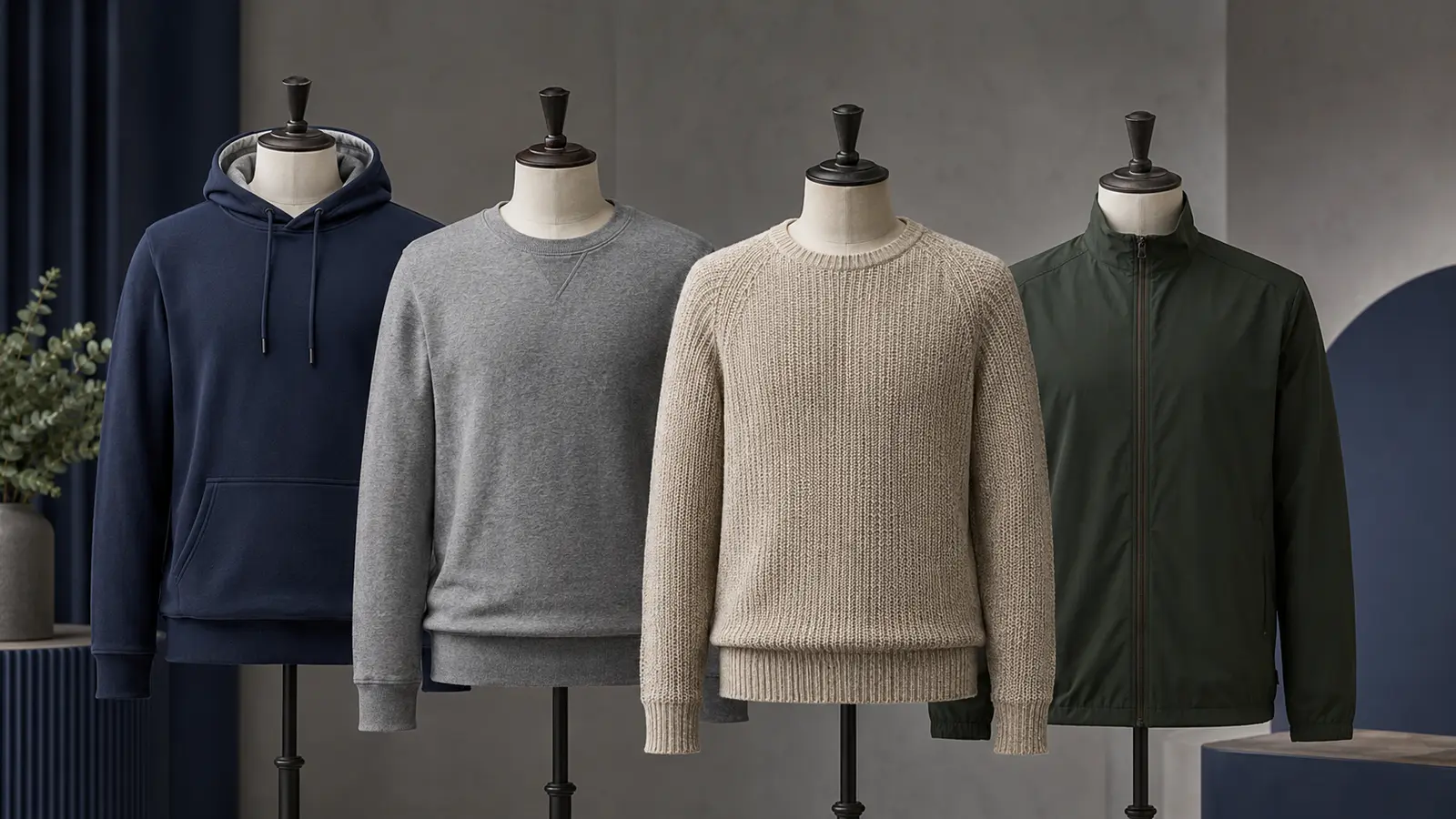
Matching scale makes differences in hood, neckline, texture and front opening easier to inspect.
| Criterion | Hoodie | Sweatshirt | Sweater | Jacket |
|---|---|---|---|---|
| Defining feature | Attached hood | Soft knit casual top; crewneck is common | Yarn-knitted body or panels | Outer-layer construction |
| Typical fabric | Brushed fleece, French terry, cotton/poly blend | Brushed fleece, French terry, cotton/poly blend | Wool, cotton, acrylic or blended yarn | Woven nylon/polyester, softshell, fleece, quilted or other outerwear fabrics |
| Common opening | Pullover or full zip | Pullover, quarter zip or full zip | Pullover, cardigan or quarter zip | Full zip, snaps or buttons |
| Typical warmth role | Mid-layer or casual outer layer | Mid-layer | Light to warm indoor/mid-layer | Outer layer; protection varies by design |
| Surface for printing | Usually good on smooth face fabric | Usually good on smooth face fabric | Limited; technique depends on knit texture | Varies widely by shell fabric and coating |
| Embroidery suitability | Good when stabilized and not excessively bulky | Good when stabilized | Possible, but knit distortion must be controlled | Often good, subject to shell, lining and seam position |
| B2B use | Teamwear, school apparel, merch, work crews | Uniform layers, spiritwear, promotional apparel | Corporate, retail and premium lifestyle collections | Team travel, staff outerwear, outdoor events, workwear |
| Key sourcing risk | Hood weight, drawcord rules, pocket alignment | Shrinkage, rib recovery, fleece quality | Pilling, gauge consistency, shape retention | Fabric performance claims, seam complexity, lining and hardware |
The table is a commercial overview, not a legal classification. U.S. Customs and Border Protection training notes that a full-opening sweatshirt may be classified as a jacket. Confirm classification for the exact garment and destination.
What Is a Hoodie?
A hoodie is a hooded upper-body garment. The hood is the feature that makes the category recognizable; the body may be a pullover or zip-front style. Most custom hoodies use sweatshirt-type fabrics, although knit sweaters, performance tops and jackets can also include hoods.
Common hoodie components include:
- A two-piece or three-piece hood
- A self-fabric, mesh or jersey hood lining
- Drawcords, eyelets and cord ends
- A kangaroo pocket or separate front pockets
- Rib-knit cuffs and waistband
- Pullover, half-zip or full-zip construction
- Set-in, raglan or drop-shoulder sleeves
Pullover Hoodie
The pullover hoodie has an uninterrupted front panel for screen printing, heat transfer, embroidery or appliqué. It is popular for schools, teams, streetwear and promotions.
Users must pull a pullover over the head, and it provides less ventilation control than a zip style. The hood and kangaroo pocket also affect print placement.
Zip Hoodie
A full-zip hoodie is easy to layer for coaches, travel teams and staff. The zipper divides the front decoration area, so logos often move to one chest, the back or sleeves.
Buyers should specify zipper type, tape color, puller finish, pocket design and whether the hood is lined. These details materially affect cost and appearance.
When a Hoodie Is the Best Choice
Choose a hoodie when the audience values casual warmth, recognizable teamwear styling and a large branding area. It is especially effective when the garment will be sold as merchandise or worn before and after games rather than during high-intensity play.
For youth programs, confirm destination-market drawcord requirements and develop the youth pattern and trim specification separately where required.
What Is a Sweatshirt?
A sweatshirt is generally a casual knit top made from fleece, French terry or a related fabric. The classic version is a long-sleeve crewneck pullover with rib cuffs, a rib waistband and no hood. In common retail language, “hoodie” is often treated as a subtype of sweatshirt.
Unlike a yarn-knitted sweater, a sweatshirt is normally cut and sewn from knitted fabric supplied in rolls. Its production workflow is therefore closer to a T-shirt than to a fully fashioned sweater.
Crewneck Sweatshirt
The crewneck is the most universal sweatshirt format. It layers over a T-shirt or uniform, accommodates front and back graphics, and avoids the extra cost and weight of a hood. It is suitable for school spiritwear, corporate uniforms, club apparel, promotional campaigns and private-label basics.
The chest is usually suitable for embroidery when stabilized correctly. A smooth outer face helps screen printing and heat transfer produce clean edges.
Quarter-Zip and Full-Zip Sweatshirts
Quarter-zip sweatshirts bridge casual and corporate styling. They provide ventilation and create a more refined neckline, but the zipper and collar reduce central decoration space. Full-zip sweatshirts overlap visually with zip hoodies and lightweight knit jackets.
State whether the design has a hood, the opening length, collar form, pockets, lining and intended wearing layer.
When a Sweatshirt Is the Best Choice
Choose a sweatshirt when you need a washable, decoration-friendly mid-layer without the visual bulk of a hood. It is often the most efficient option for large school, club, staff or event programs because the pattern can be simple and the branding areas are easy to standardize.
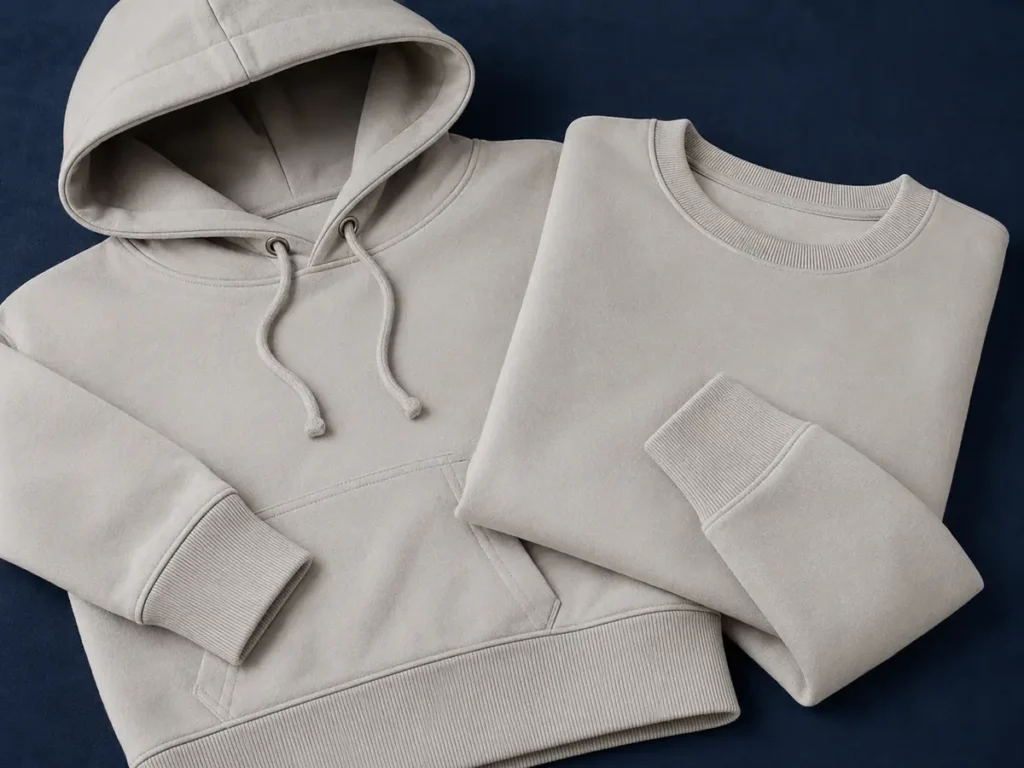
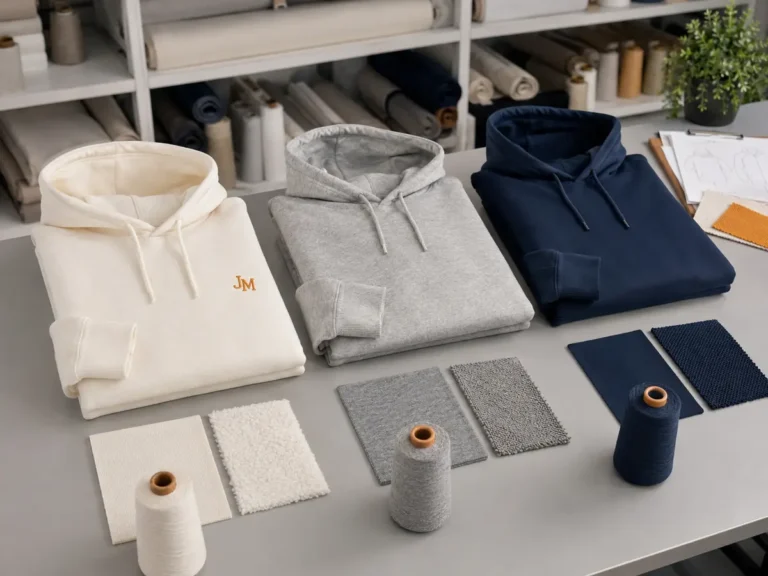
Small construction details influence comfort, durability, decoration placement and production cost.
What Is a Sweater?
A sweater is a knitted garment made from yarn. It may be a pullover, cardigan, vest, crewneck, V-neck, turtleneck or quarter-zip. Unlike a cut-and-sewn sweatshirt, a sweater’s appearance and performance depend heavily on yarn, knitting gauge, stitch structure, panel construction and finishing.
Common sweater fibers include:
- Wool and wool blends
- Cotton
- Acrylic
- Viscose or rayon blends
- Polyester and nylon blends
- Specialty yarn combinations
Wool is valued for warmth and moisture management, but fiber, yarn and finishing determine softness, care and durability. Woolmark advises following the garment’s specific care label.
Fully Fashioned vs Cut-and-Sew Knitwear
In fully fashioned construction, sweater panels are knitted close to their final shape and then linked or seamed. This method can create clean shaping and reduce cut waste, but it requires careful gauge and measurement control.
Some garments are cut from knitted yardage and sewn, with different edge finishing and production economics. Ask the supplier to identify the construction method.
When a Sweater Is the Best Choice
Choose a sweater for a refined, textured or premium-looking layer. It can suit corporate uniforms, school formalwear, golf and club collections, hospitality apparel, fashion retail and gift programs.
Sweaters are less forgiving for large printed graphics. Embroidery, knitted-in patterns, jacquard artwork, badges and subtle labels are often more compatible, but must be tested for distortion.
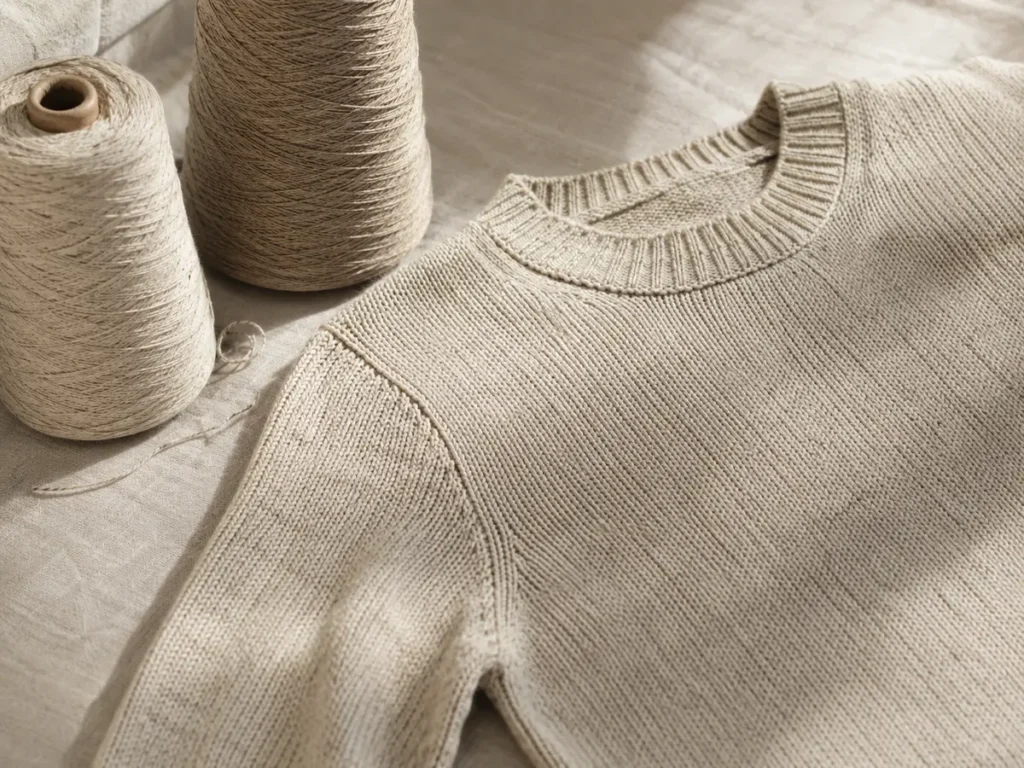
Sweater quality depends on yarn, gauge, stitch structure, measurements and finishing rather than GSM alone.
What Is a Jacket?
A jacket is primarily an outer-layer garment. It commonly has a full front opening and may include a collar or hood, pockets, lining, adjustable cuffs, elastic, drawcords, quilting or protective shell materials.
“Jacket” is a broad family. It can be:
- A lightweight woven coach jacket
- A polyester track jacket
- A softshell jacket
- A fleece jacket
- A varsity or bomber jacket
- A quilted insulated jacket
- A rain shell or wind-resistant shell
- A knit zip jacket
Not every jacket is waterproof, windproof or insulated. Such claims must be supported by the specified material, construction and testing.
When a Jacket Is the Best Choice
Choose a jacket when users need an outer layer, a structured uniform appearance, weather-oriented features or higher perceived value. Jackets work well for team travel, coaching staff, corporate uniforms, tournament organizers, outdoor events and branded merchandise collections.
Jackets are usually more complex than sweatshirts; shell, lining, insulation, zippers, seams and hardware require approval.
The Most Important Difference: Fabric Construction
The fastest way to distinguish these products is to look beyond silhouette and inspect the fabric.
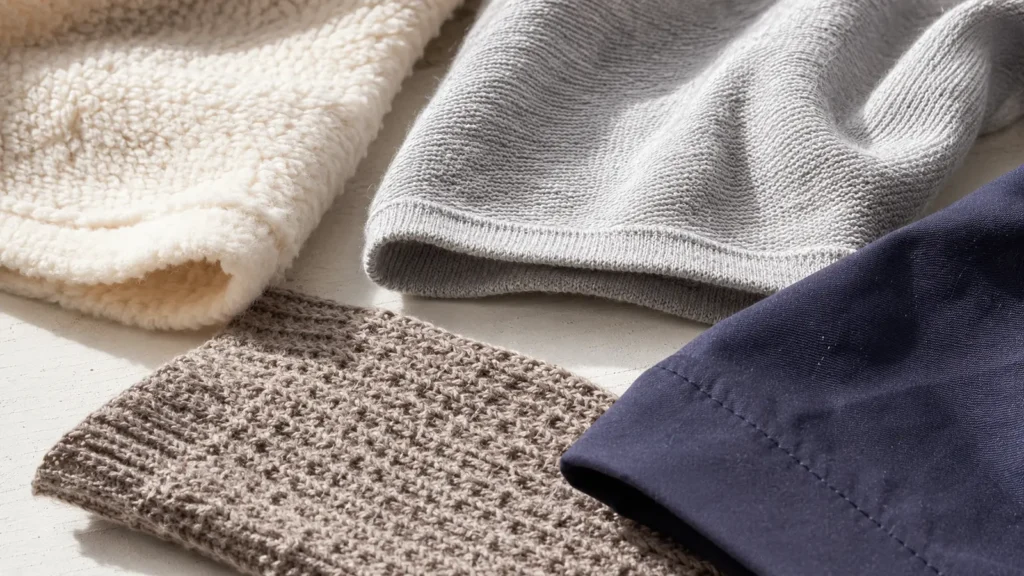
Fabric construction often separates sweatshirts and hoodies from sweaters and jackets more clearly than silhouette alone.
Sweatshirt Fleece
Sweatshirt fleece is usually a knitted fabric with a smooth outer face and a brushed inner surface. Brushing lifts fibers to create softness and trapped air. The result is familiar warmth and comfort, but brushing quality affects lint, pilling and hand feel.
A cotton/polyester blend can balance softness, dimensional stability and cost. Approve the actual fabric, not only the fiber percentages.
French Terry
French terry has a smooth face and visible loops on the technical back. CottonWorks describes it as an un-napped fleece and notes its usefulness for sweatshirts and layering garments. It generally feels less fluffy than brushed fleece and can work across more seasons.
French terry suits casualwear and training layers that need structure without a heavily brushed interior.
Sweater Knits
Sweater fabrics are built from yarn through selected stitches and gauge. The same fiber content can produce very different garments depending on yarn count, twist, stitch density and finishing. A dense fine-gauge cotton sweater may feel polished and stable; a chunky acrylic knit may be warmer-looking but more vulnerable to snagging.
For sweater sourcing, request yarn composition, gauge, stitch structure, finished measurements, garment weight and pilling expectations. GSM alone is insufficient.
Woven and Technical Jacket Fabrics
Many jackets use woven polyester or nylon because these fabrics can be light, strong and compatible with coatings or laminations. Others use softshell composites, polar fleece, quilted layers or knit track fabrics.
Specify performance in testable terms. If weather protection is important, agree on the test method, target, seam treatment and sampling procedure before production.
Practical Fabric-Weight Guidance
Fabric weight is commonly stated in grams per square meter, but higher GSM does not automatically mean better quality. Brushing, knit structure and finishing also matter.
The following bands are useful as an early sourcing conversation, not universal standards:
| Sourcing band | Hoodies and sweatshirts | Likely use | Buyer checks |
|---|---|---|---|
| Approximately 220–280 GSM | Lightweight | Indoor layers, mild climates, events | Opacity, recovery, print show-through |
| Approximately 280–350 GSM | Midweight | General teamwear, school and corporate use | Shrinkage, brushing, seam bulk |
| Approximately 350–450+ GSM | Heavyweight | Streetwear, cold-weather casual use | Hood weight, drying time, embroidery stability, freight |
| Sweaters | Use gauge, yarn and garment weight together | Corporate, retail, formal teamwear | Pilling, stretch, linking, measurements |
| Jackets | Evaluate complete material system | Outerwear and travel | Shell, lining, insulation, coating, seams and hardware |
Compare swatches and finished samples under the same care conditions; nominally identical 320 GSM fabrics can behave differently.
Warmth, Layering and Climate
Warmth is a system, not a category label. A heavyweight hoodie can feel warmer than an uninsulated wind jacket, while an insulated jacket can outperform both in cold conditions. A fine-gauge sweater may be comfortable indoors but unsuitable for wind.
Use these questions:
- Will the garment be worn indoors, outdoors or both?
- Is it a base, middle or outer layer?
- Does the user need ventilation during activity?
- Is protection from wind or light rain required?
- Will the garment be worn over a jersey, shirt or other uniform?
- How often will it be washed?
- Is compact packing important for travel teams?
Active teams may favor mobility, merchandise buyers may prioritize hand feel, and uniform programs may prioritize appearance after repeated laundering.
Fit and Pattern Differences
A hoodie often needs extra neckline and back-neck support for the hood. A sweatshirt can use a simpler neck rib. A sweater’s fit depends on knit stretch and linking. A jacket must allow for layers, hardware and, where present, lining or insulation.
Specify:
- Target wearer and size range
- Unisex, men’s, women’s or youth block
- Regular, athletic, relaxed or oversized fit
- Finished chest, body length and sleeve length
- Shoulder type and armhole shape
- Hem and cuff construction
- Intended under-layer
- Grade rules between sizes
Use a measurement chart and a physical sample on representative wearers. Verify critical small and large sizes because grading issues often appear at the range ends.
Which Garment Is Best for Custom Logos?
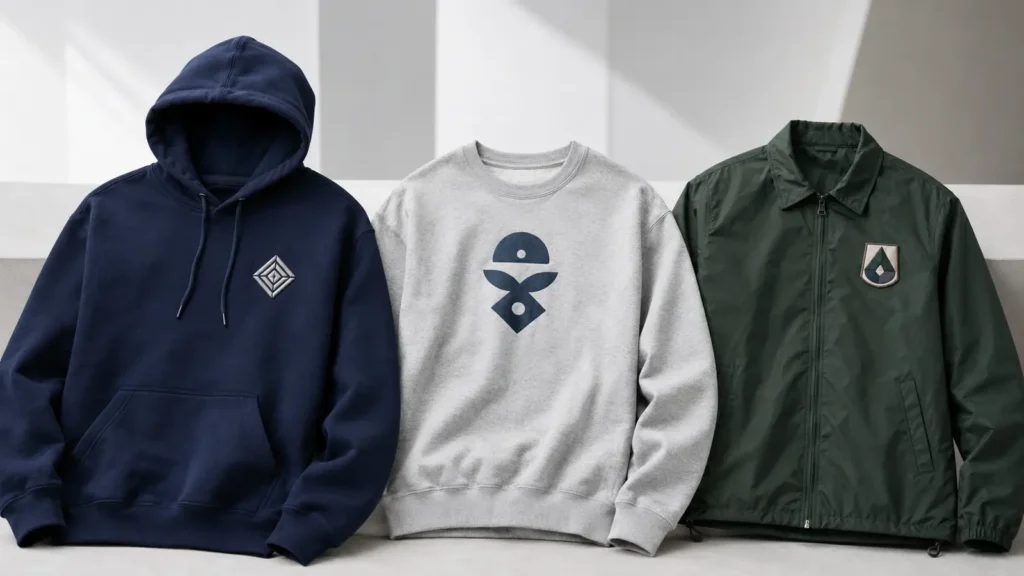
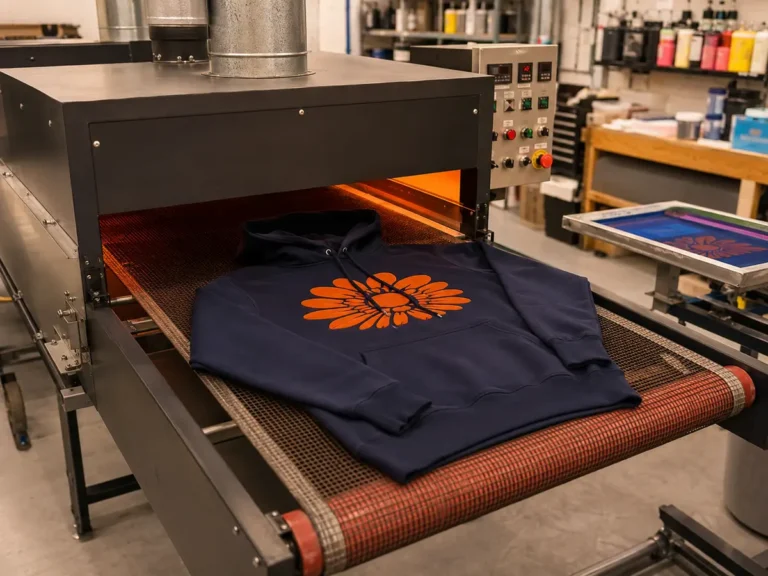
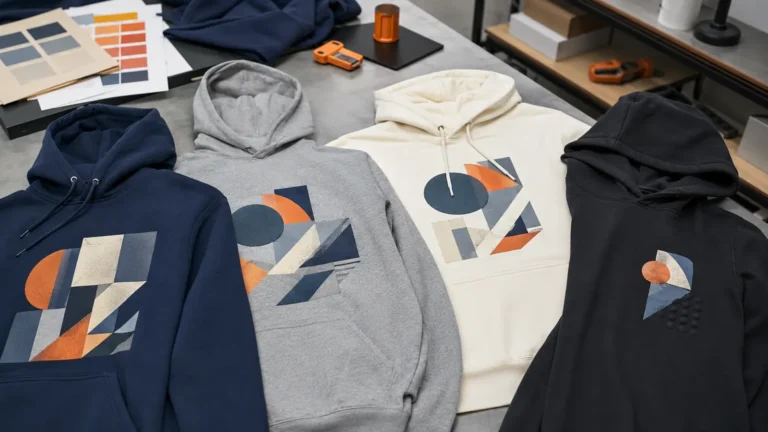
Decoration should be selected for the specific fabric surface, garment construction and intended use.
| Decoration method | Hoodie / sweatshirt | Sweater | Jacket |
|---|---|---|---|
| Screen printing | Strong option on smooth, stable face fabric | Usually limited by texture and stretch | Suitable only on compatible shell fabrics |
| Embroidery | Good for chest, sleeve and back with stabilization | Suitable for selected knits; test distortion | Often strong, but lining and waterproof layers complicate access |
| Heat transfer | Good when temperature and pressure suit the fabric | Test carefully for flattening or marks | Good on compatible shells; coating sensitivity must be checked |
| Sublimation | Normally for polyester panels before assembly, not cotton fleece | Uncommon for conventional sweaters | Useful for selected polyester styles and panels |
| Woven or rubber/PVC patch | Good for chest, sleeve or pocket areas | Good when weight and attachment are balanced | Strong option for structured outerwear |
| Jacquard / knitted-in design | Not typical | Excellent for patterns and selected logos | Applicable only to knitted jacket constructions |
Decoration Placement Risks
Hoods can cover upper-back logos, pockets interrupt prints, zippers divide artwork, and heavy embroidery can pull a lightweight knit. Review the garment pattern, not only a logo pasted onto a mockup.
Planning a coordinated apparel program? Send JIUMU your reference image or tech pack, target quantity, size range, colors, logo files, decoration preference, packaging requirement and target delivery date. We can review whether a custom hoodie, sweatshirt, sweater-style product or jacket construction best matches the intended use. Request a custom quotation.
Cost Drivers for Bulk Orders
There is no universal cheapest option. A crewneck is often simpler than a lined jacket, but yarn, quantity, custom dyeing, artwork and packaging can change the comparison.
Major cost drivers include:
- Fabric or yarn composition and weight
- Custom color requirements and minimum dye quantities
- Pattern complexity and number of panels
- Hood lining, drawcords, eyelets and pockets
- Zippers, snaps, buttons and branded hardware
- Jacket lining, insulation, coating or lamination
- Logo method, stitch count, print colors and placements
- Size range and grading complexity
- Private labels, hangtags and individual packaging
- Sample rounds and testing requirements
- Inspection level and delivery schedule
Compare quotations against the same specification. A generic quote is not equivalent to one covering exact fabric, trims, decoration and packaging.
Quality-Control Checklist
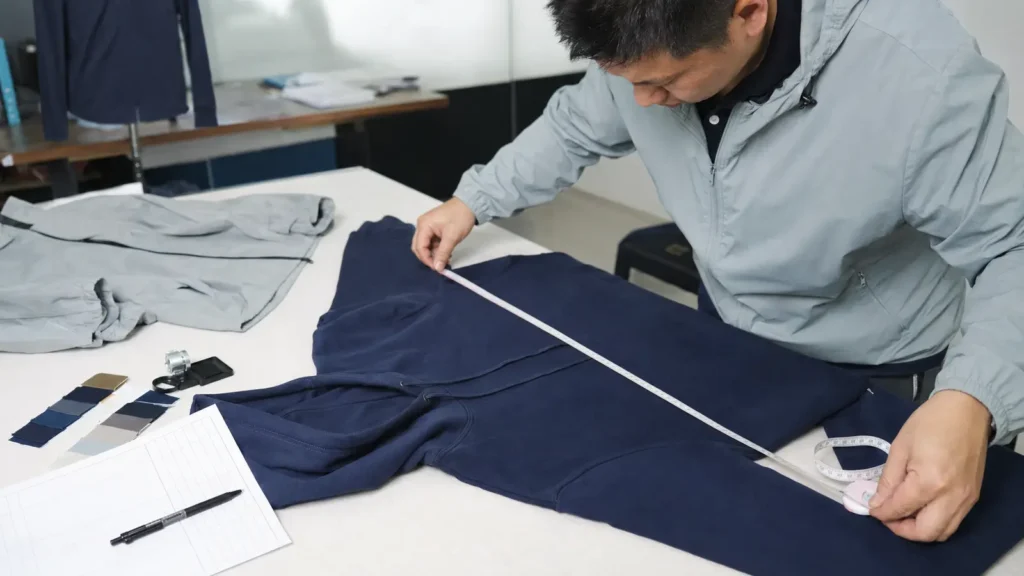
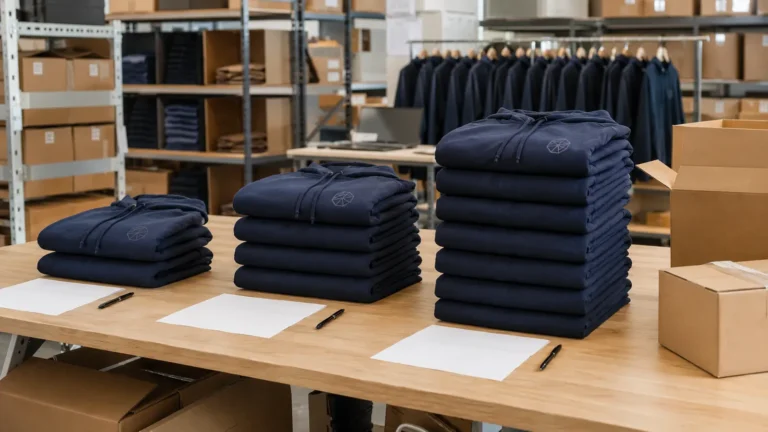
Bulk inspection should compare measurements, color, construction, decoration, labels and packaging with the approved standard.
Before Sample Approval
- Confirm fiber content, fabric construction, color and nominal weight
- Measure the garment against the approved size chart
- Check hood symmetry, collar shape, zipper alignment and pocket position
- Inspect rib stretch and recovery
- Review seam type, stitch density and skipped stitches
- Test logo position, dimensions, color and adhesion
- Photograph the approved details
- Record all changes in a revised specification
Wear and Care Review
The care method must match the complete decorated garment, not only the undecorated fabric. Heat transfer film, embroidery backing, coated shell materials and mixed-fiber trims can change the safe care instruction.
For the U.S. market, the Federal Trade Commission’s Care Labeling Rule requires manufacturers and importers to provide care instructions for covered apparel. The FTC’s Textile Fiber Rule also requires covered products to disclose fiber names and percentages by weight, the responsible company identity and country of manufacture. EU rules likewise require textile fiber composition information for covered products, while specific labeling responsibilities depend on the supply chain and sale format.
Confirm destination-market requirements with an appropriate adviser; a supplier’s standard label should not replace the importer’s review.
Bulk Production Inspection
- Compare bulk fabric and trim colors with approved standards
- Check measurement tolerances across selected sizes
- Review appearance under consistent lighting
- Inspect zipper function, snap security and drawcord construction
- Check decoration registration, embroidery tension and patch attachment
- Confirm label content, order and placement
- Verify assortment, folding, bagging and carton marks
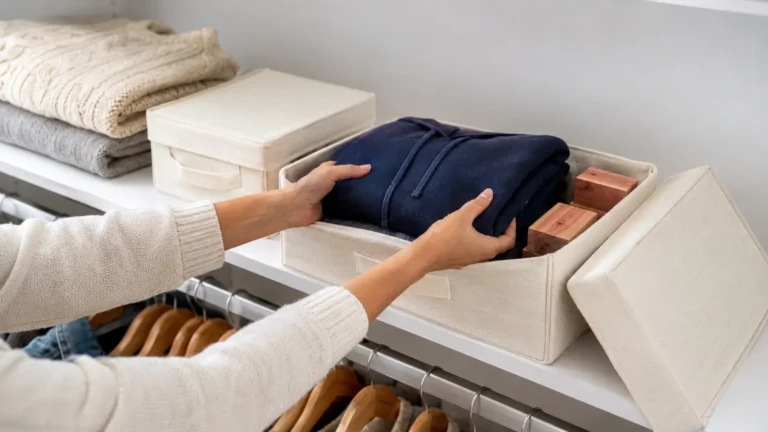
- Retain production samples for repeat-order reference
A Better Bulk-Order Planning Process
1. Define the Wearing Scenario
State who will wear the product, in which climate, during what activity and over which under-layer. This immediately narrows the category.
2. Select a Reference Construction
Choose pullover hoodie, crewneck sweatshirt, knitted sweater, track jacket, softshell or another defined style. Provide front, back and detail references.
3. Lock the Material Direction
Specify fiber preference, hand feel, weight or gauge, outer and inner surface, stretch and required performance. Ask for swatches when the decision is sensitive.
4. Build the Size Specification
Use a finished-garment measurement chart. Include tolerance and grading rules. Do not rely only on S/M/L labels.
5. Place the Branding
Confirm logo technique, dimensions, Pantone references where applicable and exact placement from seams. Evaluate how the design interacts with pockets, hoods and closures.
6. Approve a Physical Sample
Review fit, color, construction, decoration and packaging. Submit consolidated comments and require an updated confirmation before bulk production.
7. Establish the Inspection Standard
Agree on critical defects, measurement sampling, color reference, packaging and approval authority. Retain signed or sealed samples when practical.
What to Send for an Accurate Quotation
Prepare one concise brief containing:
- Product type and front/back reference images
- Target market and wearer profile
- Quantity by color and approximate size breakdown
- Fabric or yarn composition and target weight/gauge
- Color references or Pantone targets
- Logo vector files and decoration method
- Finished measurement chart
- Labels, hangtags and packaging
- Required testing or compliance documentation
- Delivery destination and target date
Identify undecided details clearly and add the selected proposal to the approved specification.
Questions to Ask a Supplier
- Is the garment cut and sewn from knitted fabric or knitted from yarn?
- What is the exact fiber composition of the main body, rib, lining and other major components?
- Is the stated weight measured before or after finishing?
- How will shrinkage and color variation be controlled?
- What decoration method is recommended for this specific surface?
- Can you provide a fabric swatch, size set or pre-production sample?
- Which measurements are controlled, and what tolerances apply?
- How are custom colors approved?
- How will the approved sample be referenced during production?
- What labels and packaging are included?
- Which performance claims are supported by agreed tests?
- How are defects and repeat-order color consistency handled?
Common Buying Mistakes
Ordering by Name Alone
“Premium hoodie” is not a specification. Add fabric, construction, weight, fit, trims and decoration.
Treating GSM as the Only Quality Measure
Weight does not reveal fiber quality, knit stability, brushing, pilling or sewing.
Using the Same Logo Method on Every Product
A smooth sweatshirt, textured sweater and coated jacket require different decoration decisions.
Ignoring the Under-Layer
A jacket measured over a T-shirt may feel tight over a team jersey or sweater.
Approving Only a Digital Mockup
A mockup confirms layout, not hand feel, fit, shrinkage, zipper quality or embroidery distortion.
Making Unsupported Performance Claims
Do not market a jacket as waterproof or a fabric as recycled without documentation that matches the actual bulk material and destination-market requirements.
Forgetting Packing and Freight
Heavy hoodies and insulated jackets occupy more carton space than lightweight sweatshirts. Packing method and carton dimensions affect landed cost.
How to Choose the Right Product
Use this decision guide:
- Choose a hoodie for casual teamwear, school merchandise and streetwear when a hood and large branding area support the concept.
- Choose a sweatshirt for a simple, washable and decoration-friendly mid-layer with broad uniform or promotional use.
- Choose a sweater for refined texture, knitted design and corporate, retail or formal team applications.
- Choose a jacket for outer-layer function, travel, staff uniforms or designs requiring structured shells, linings or weather-oriented features.
If the program needs several pieces, build a coordinated system rather than forcing one garment to serve every condition. For example, combine a crewneck sweatshirt for indoor use with a team jacket for travel and outdoor events. Shared color standards, labels and logo files help the collection look consistent.
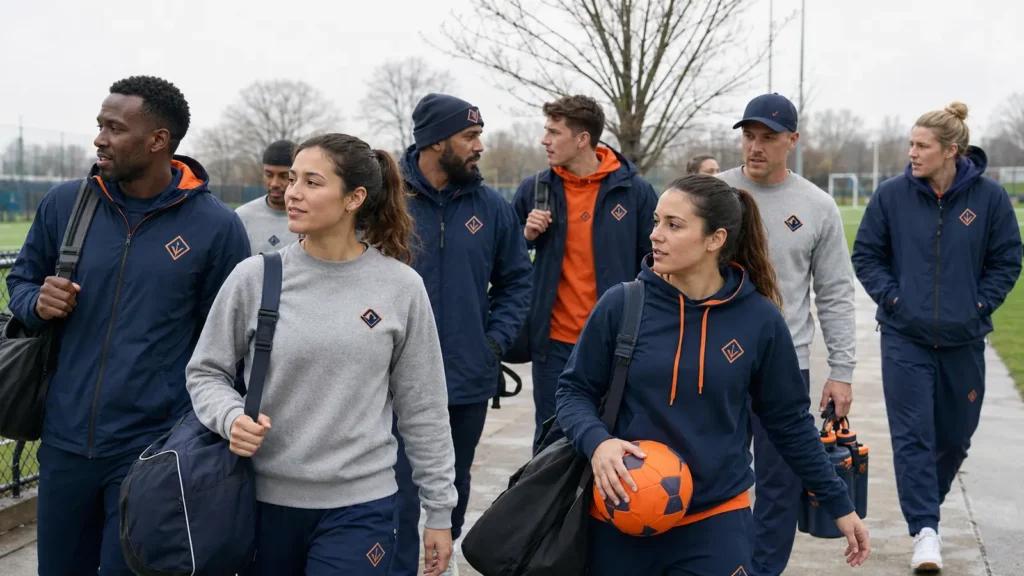
A coordinated program can combine indoor mid-layers, merchandise and outerwear instead of forcing one garment to serve every condition.
Explore JIUMU’s custom hoodies, custom team jackets and custom team uniforms to plan a coordinated range.
Why Work With JIUMU
JIUMU is a Guangdong-based B2B supplier established in 2010, serving buyers in the United States, Canada, the United Kingdom and Europe. Typical projects start from 50 pieces, subject to product structure and customization.
Available capabilities include OEM and ODM development, fabric sourcing, Pantone color matching, digital mockups, physical samples, embroidery, sublimation, screen printing, heat transfer, woven and rubber/PVC patches, private labels, hangtags, custom packaging, bulk quality control and export support.
For a mixed apparel program, the practical advantage is specification coordination. Logo scale, color references, labels and packaging can be planned across hoodies, team jackets, uniforms, hats and bags instead of being treated as unrelated items.
Frequently Asked Questions
Final Recommendation
The clearest distinction is functional. A hoodie is a hooded casual layer, a sweatshirt is a soft cut-and-sewn knit layer, a sweater is a yarn-knitted garment, and a jacket is an outer layer with construction suited to its intended environment.
For B2B sourcing, product names are only the starting point. The order becomes reliable when the buyer defines the material, weight or gauge, fit, construction, decoration, labels, packaging, quality checks and destination-market responsibilities.
Ready to compare options for a team, school, club, distributor or private-label collection? Send JIUMU your product reference, quantity, size range, colors, logo files, packaging needs and target delivery date. Email zhengdong@jiumugear.com, contact +86 18507502899 by WhatsApp or phone, or request a custom quotation.
Sources and Further Reading
- Federal Trade Commission: Clothes Captioning—Complying with the Care Labeling Rule
- Federal Trade Commission: Textile Fiber Rule
- CottonWorks: Single & Double Knits, including French terry
- Woolmark: Wool washing and care
- U.S. Customs and Border Protection: Knit Outerwear
- European Union: Textile label requirements
- UK Government: Textile labelling guidance