How to Fold and Store Hoodies to Save Space and Protect Printed Logos
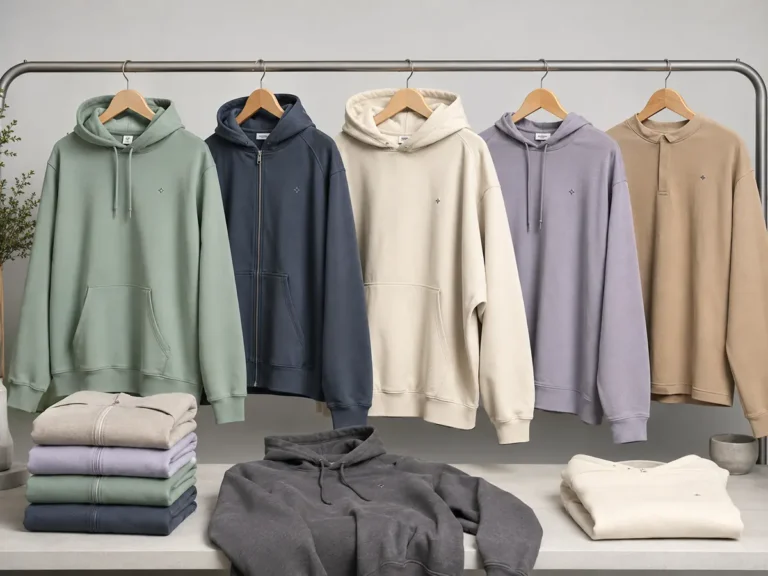
Hoodies are easy to wear but surprisingly inefficient to store. A thick hood, kangaroo pocket, ribbed cuffs, drawcords, and printed or embroidered decoration create more bulk than a basic sweatshirt. If a hoodie is folded carelessly, the result may be an unstable stack, hard creases through a graphic, compressed fleece, tangled drawcords, or surface-to-surface contact that makes some decorations stick together.
The right storage method is not complicated. It begins with a clean, completely dry garment, a fold that keeps the decorated area flat and protected, and a storage format suited to the hoodie’s weight and frequency of use. The same principles apply whether you are organizing one closet, maintaining school or club apparel, or preparing a bulk order of custom hoodies for distribution.
Quick Answer
To fold and store a hoodie safely, zip or fasten it, smooth it face down, place the hood flat, fold the sleeves across the back without bunching them over the logo, bring the sides inward, and fold the body into two or three sections. Keep the printed surface facing inward or place clean acid-free tissue over a large graphic before the final fold. Store hoodies in short shelf stacks, breathable bins, or vertical file folds without heavy compression. Always follow the garment’s care label, make sure the hoodie is fully dry, and avoid direct heat, damp spaces, sharp creases through thick prints, and long-term vacuum compression.
Why Hoodie Folding and Storage Matter
Good storage is about more than making a wardrobe look tidy. It helps preserve four parts of the product at the same time:
- The garment shape. Thick hoods and pockets can create uneven pressure. A balanced fold reduces distortion and prevents one side of a stack from collapsing.
- The fabric surface. Brushed fleece can flatten when it remains tightly compressed for long periods. Smooth folding and moderate stack height help the fabric recover.
- The decoration. Screen prints, heat transfers, puff prints, embroidery, patches, and appliqués do not respond identically to pressure and folding. A storage plan should account for the actual logo method.
- The organization system. A compact fold makes sizes, colors, and team allocations easier to count, pick, pack, and distribute.
Best Hoodie Storage Methods at a Glance
No single method is correct for every hoodie. Choose the method according to access frequency, garment weight, available space, and decoration type.
| Storage method | Best for | Space efficiency | Logo protection | Main limitation |
|---|---|---|---|---|
| Flat shelf fold | Heavyweight hoodies, frequent use, retail display | Medium | Good when the graphic faces inward | Tall stacks can compress lower garments and topple |
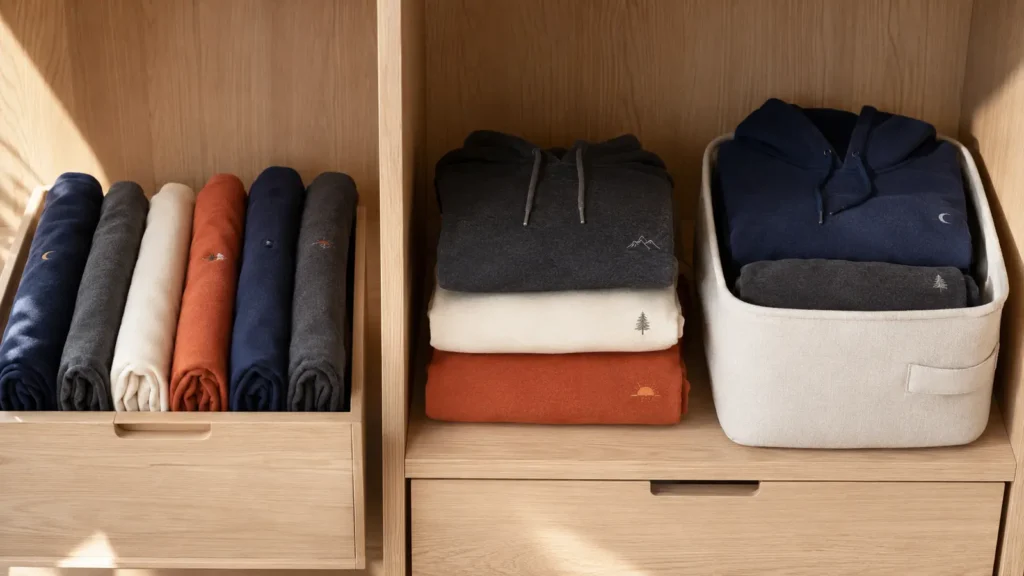
| Vertical file fold | Drawers, bins, household organization, team issue rooms | High | Good if folds avoid the graphic | Very thick hoodies may not stand neatly |
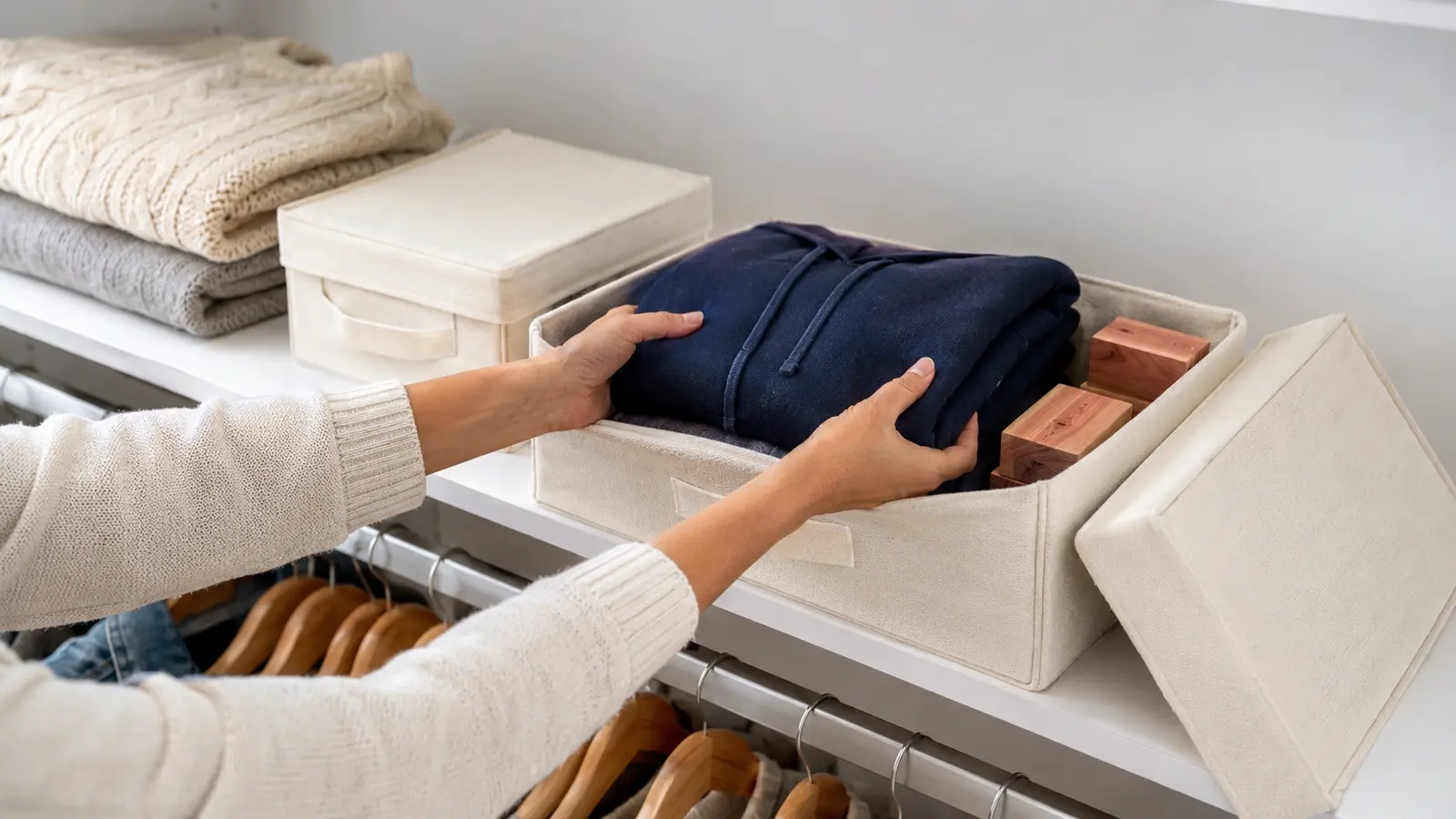
| Breathable fabric bin | Seasonal storage, club inventory, grouped sizes | High | Very good with tissue between large prints | Contents need size or color organization |
| Wide hanger | Short-term display or frequently worn zip hoodies | Low | Excellent because no graphic is folded | Can stretch shoulders if the hanger is narrow |
| Individual breathable bag | Premium samples, decorated presentation pieces | Medium | Excellent when the garment is dry and loosely packed | More packaging and handling |
| Vacuum-compressed bag | Emergency travel or temporary transport only | Very high | Poor for many raised or pressure-sensitive decorations | Long compression can set creases and flatten loft |
Before You Fold: Prepare the Hoodie Correctly
Folding a hoodie that is damp, warm from a dryer, soiled, or covered with loose debris can trap problems inside the fold. Use this short preparation routine first.
Read the Care Label
The care label takes priority over generic advice because it is intended to reflect the garment’s materials, coloring, trims, and applications. In the United States, the Federal Trade Commission’s Care Labeling Rule requires manufacturers and importers of covered clothing to provide instructions for regular care. GINETEX likewise explains that textile care guidance should account for the part of the article most sensitive to treatment, including coloring, finishing, accessories, and applications.
If the label says to avoid tumble drying, ironing, bleaching, or dry cleaning, do not assume that the base fabric alone determines what is safe. The logo, zipper, drawcord tip, patch backing, or other component may be the limiting factor.
Make Sure the Hoodie Is Completely Clean and Dry
Do not store a hoodie with perspiration, food residue, makeup, mud, or dampness. Stains can become harder to remove after storage, and moisture in a closed bin or drawer can create odor or mildew risk. Let the hoodie cool after drying before folding it. Warm fabric may still contain residual moisture, particularly around the hood, ribbed waistband, seams, and pocket layers.
Close Zippers and Fasteners
Zip a full-zip hoodie before folding so the two front panels stay aligned. Close snaps or hook-and-loop tabs if present. Do not pull a zipper slider forcefully into a tight fold; position it where it will not press directly against a print or leave a hard impression in adjacent fabric.
Untangle Drawcords
Straighten the drawcords and lay them inside the hood or across the upper chest. Do not tie them tightly, because a hard knot can leave a pressure mark. For bulk packing, confirm that both drawcord ends are present and even before the hoodie is folded.
Inspect the Decoration
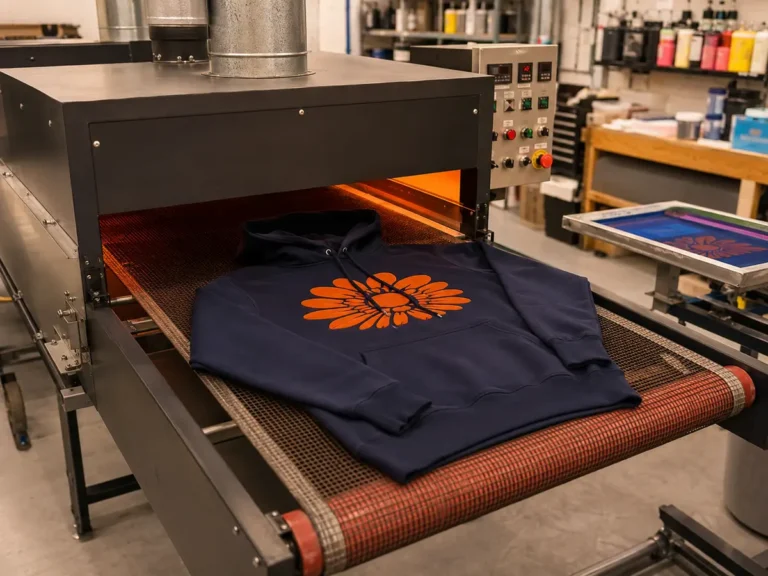
Check whether the decoration is smooth, raised, rubbery, textured, stitched, or layered. Look for lifting edges, loose threads, cracks, tackiness, or incomplete curing. Do not stack a newly decorated hoodie until the decoration process has been completed and the supplier’s recommended conditioning time has passed.
How to Fold a Pullover Hoodie Step by Step
This compact method works for most pullover hoodies and can be adjusted for shelf or vertical storage.
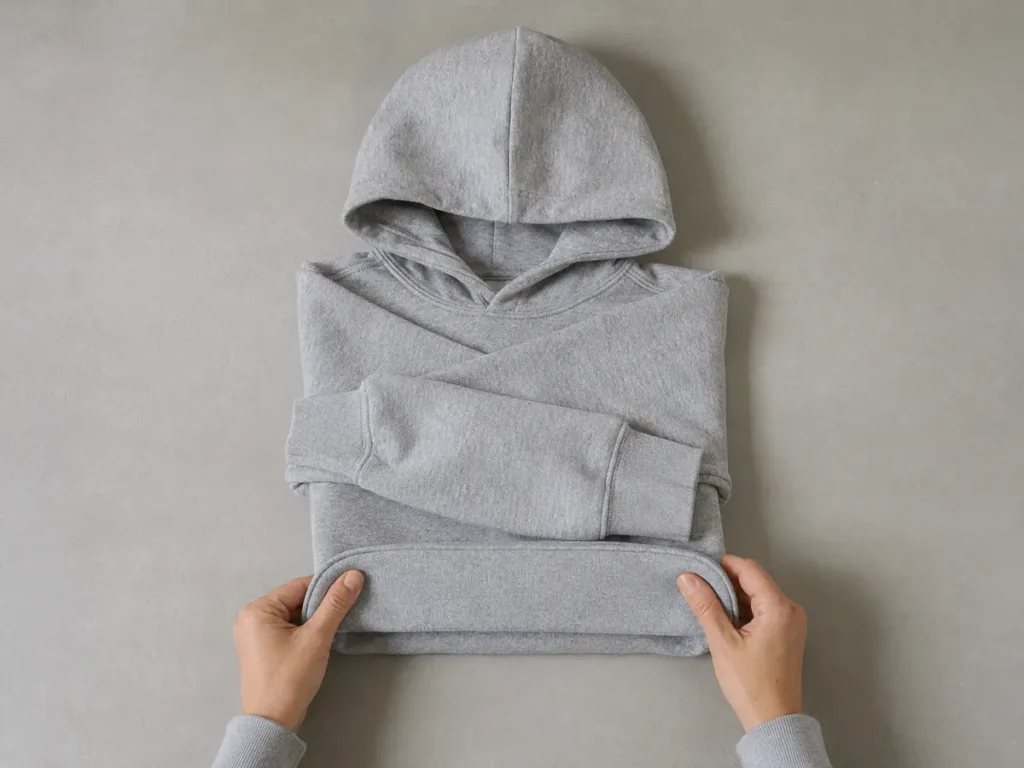
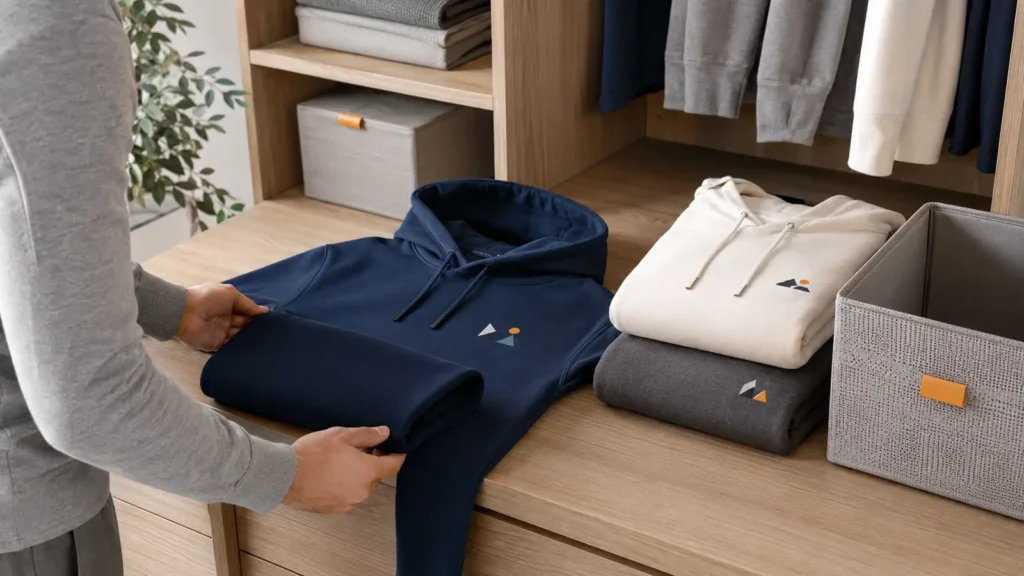
Step 1: Lay the Hoodie Face Down
Place the hoodie on a clean, smooth surface with the front graphic facing down. This positioning usually keeps a front logo on the inside of the finished fold, protecting it from shelf abrasion and dust. Smooth the body from the shoulder seams toward the hem without stretching the fabric.
If the hoodie has a large back print, reverse the starting position so that the back graphic also finishes inside the fold. The important principle is to protect the most sensitive or valuable decoration, not to follow one orientation mechanically.
Step 2: Flatten the Hood
Lift the hood, remove any twists, and spread it flat above the neckline. Bring the two hood panels together so the center seam is straight. If the hood is double-layered and bulky, fold its side edges inward slightly rather than rolling it into a hard lump.
Step 3: Fold the Sleeves Across the Back
Bring one sleeve diagonally across the back, then fold the cuff downward so it stays within the body width. Repeat on the other side. Keep the cuffs away from a raised back decoration, patch, or zipper. The sleeve layers should be reasonably even, not concentrated in one thick pile.
Step 4: Bring the Sides Inward
Fold each side toward the center to create a clean rectangle. For a wide oversized hoodie, the sides may overlap slightly. Avoid pulling the body so tightly that the print stretches or the side seams twist.
Step 5: Position the Hood
Fold the hood down over the upper back. For compact vertical storage, it can act as a soft outer pocket around the folded body. For shelf storage, keep it flat and distribute its thickness across the upper section.
Step 6: Fold the Body Up
Bring the lower hem upward. A medium-weight hoodie normally needs two body folds; an oversized or lightweight hoodie may need three. A heavyweight fleece hoodie often stores better with one broad fold rather than several tight folds.
Before pressing the final fold, check where the logo sits. Move the fold line above or below a thick graphic. If a large screen print cannot avoid a fold completely, create a broad, rounded bend instead of a sharp crease and place acid-free tissue between decorated surfaces.
Step 7: Store Without Crushing
Place the finished rectangle on a shelf, stand it vertically in a drawer, or set it in a breathable bin. It should hold its form without being forced into the space. If you must push hard to close a drawer, reduce the number of garments or use a less compact fold.
How to Fold a Zip-Up Hoodie
A zip hoodie needs slightly different handling because the zipper creates a rigid central line.
- Close the zipper fully and smooth both front panels.
- Lay the hoodie face down if the main decoration is on the front.
- Fold the sleeves across the back, keeping metal zipper components away from prints.
- Fold the sides inward along lines parallel to the zipper.
- Lay the hood flat, then fold the lower body upward in one or two broad sections.
- Store the zipper pull facing outward or cushioned by fabric so it cannot press into another garment’s decoration.
Avoid folding a zip hoodie directly through a thick zipper pocket, decorative zipper, or rigid badge. If a full-zip garment is worn frequently, a broad, padded hanger may be more convenient. Use a hanger wide enough to support the shoulder line and avoid leaving points at the sleeve head.
How to Make a Vertical “File Fold” for Drawers
A file fold allows every hoodie to remain visible from above. It works particularly well for lightweight French terry, youth sizes, and medium-weight team hoodies.
Start with the standard rectangular fold, then fold the body into thirds so the final package can stand on one edge. Test the height against the drawer before repeating the method. Arrange garments from light to dark or group them by size. Do not pack them so tightly that users must pull a hoodie out by the hood or drawcord.
Vertical storage is less suitable for very heavy oversized hoodies. Their hoods and pockets create enough bulk to make the row unstable. In that case, use short shelf stacks or two rows in a deep bin.
How to Protect Printed Logos, Transfers, Embroidery, and Patches
The logo method determines where pressure, friction, and sharp bends should be minimized.
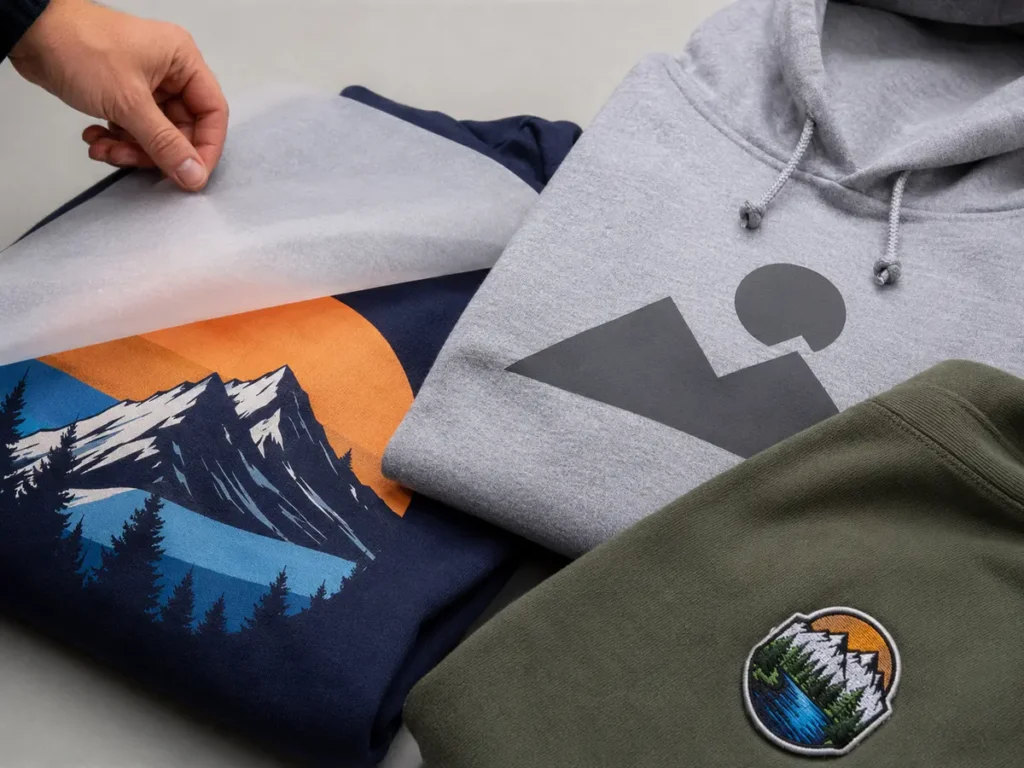
| Decoration method | Main storage concern | Better folding approach | Extra protection |
|---|---|---|---|
| Screen print | Hard crease, abrasion, print-to-print contact | Fold with graphic inward; use a broad bend | Acid-free tissue over large or high-density prints |
| Heat transfer film | Edge lifting, pressure lines, heat exposure | Avoid fold lines through edges and fine details | Keep cool and dry; do not place heavy stacks above |
| Puff or high-density print | Flattening and cracking at sharp bends | Store flat with minimal fold pressure | Use tissue and a shallow stack |
| Sublimation | Little surface thickness, but fabric can still crease | Standard smooth fold | Avoid dampness and extreme compression |
| Embroidery | Imprint on adjacent fabric, thread snagging | Place embroidery inside a soft fabric layer | Tissue over dense embroidery; trim no threads during storage |
| Woven or embroidered patch | Raised edge and backing stiffness | Fold around, not through, the patch | Prevent direct pressure from zippers or hardware |
| Rubber/PVC patch | Surface pressure and potential tackiness in heat | Keep patch flat and separated | Cool storage; tissue or compatible release sheet if supplier recommends |
| Appliqué or tackle twill | Multiple layers and stitched edges | Use a wide fold away from the appliqué | Avoid overcompression and snagging |
Never Iron Directly Over a Logo
If a folded hoodie develops a crease, check the care label and decoration instructions before using heat. Direct contact with an iron can damage many printed or transferred surfaces. When heat is permitted, turn the garment inside out, use a protective pressing cloth, and apply the lowest effective setting. In many cases, hanging the hoodie in a dry, ventilated area or reshaping it by hand is a safer first step.
Use Acid-Free Tissue for Valuable or Long-Term Storage
Plain acid-free tissue can reduce direct contact and soften a fold across a large graphic. Avoid colored tissue that may transfer dye, printed paper, newspaper, and rough cardboard placed directly against the garment. Tissue should be clean and dry, and it should not be treated as a substitute for proper curing or quality control.
Do Not Let Decorated Surfaces Touch Under Pressure
Two large prints pressed face to face may stick, mark, or abrade, especially in warm conditions. Alternate the direction of folded garments or place a clean barrier between them. Keep zipper pulls, metal eyelets, buckles, and rough hook-and-loop surfaces away from decoration.
How Fabric Weight and Construction Change the Fold
Hoodies are not interchangeable simply because they share the same size label. Fabric structure and garment construction affect folded volume, crease behavior, and recovery.
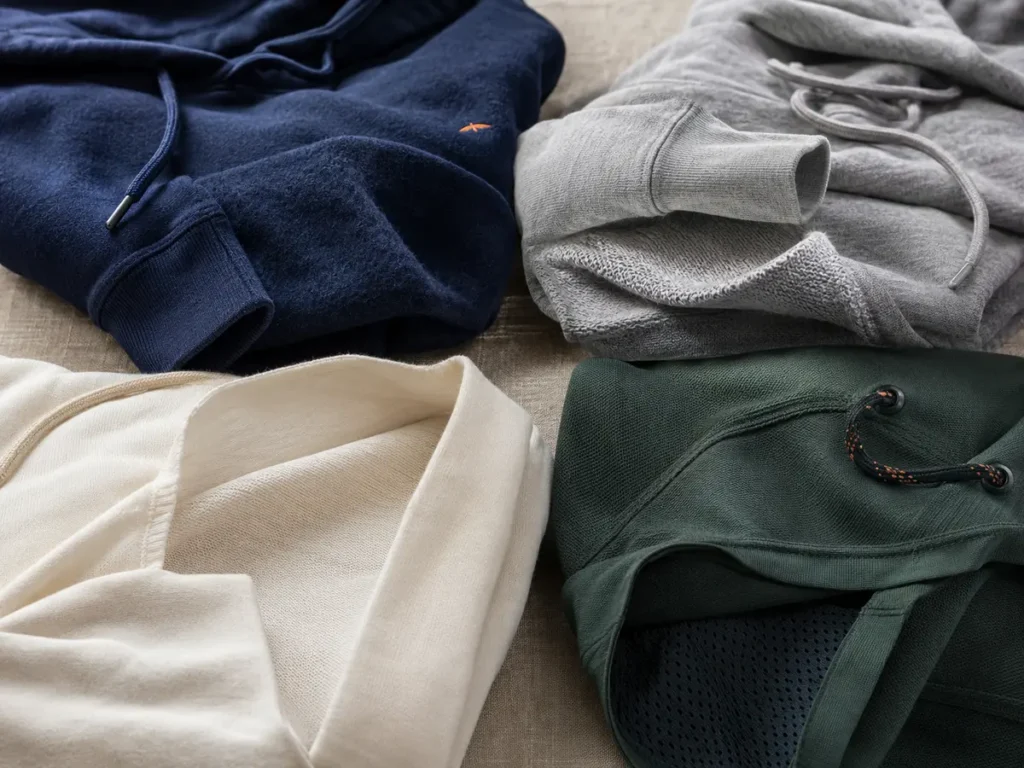
Heavyweight Brushed Fleece
Heavy fleece produces a thick, warm garment with substantial loft. Use fewer, broader folds and shorter shelf stacks. Avoid long-term compression that can flatten the brushed interior. A wide shelf or breathable box is usually better than a shallow drawer.
French Terry
French terry is generally less bulky than heavy brushed fleece and works well with vertical folding. Smooth the looped inner surface and keep drawcords inside the fold. Because weights vary, approve the exact fabric and finished sample rather than relying on the fabric name alone.
Cotton-Rich Blends
Cotton-rich hoodies often feel substantial and may show sharper fold lines than slicker synthetic knits. Fold only when fully dry and avoid forcing too many garments into a bin. Fiber content does not replace the care label; finishes, dyes, and decoration still affect care.
Polyester and Performance Knits
Some polyester-rich hoodies are light and compact, but they can include heat-sensitive transfers or surface finishes. Keep them away from high temperatures and inspect transfers before stacking. Their lower bulk makes them suitable for file folding when construction permits.
Oversized and Drop-Shoulder Hoodies
Oversized silhouettes have more body width and sleeve volume. Create a wider rectangle rather than pulling the sides tightly inward. If preserving the relaxed drape is important, use a shallow shelf stack and rotate the position of garments periodically.
Hood, Pocket, and Rib Construction
A double-layer hood, lined hood, oversized kangaroo pocket, heavy zipper, or thick rib can create localized bulk. Distribute these elements across the folded package. Do not stack every hood on the same side, or the pile will lean and put uneven pressure on lower garments.
Long-Term and Seasonal Hoodie Storage
Long-term storage requires more preparation than daily organization.
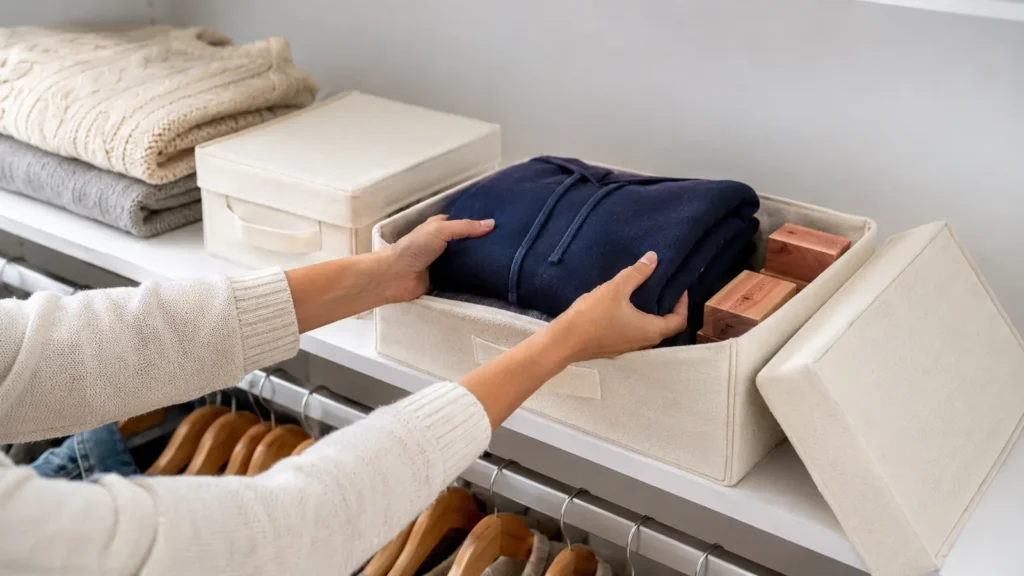
- Wash or clean the garment according to its care label.
- Dry it completely, including the hood, pocket layers, cuffs, and waistband.
- Inspect and document the logo condition if the garment is a sample, archive piece, or team inventory reference.
- Fold with the primary decoration inward and cushion large raised graphics with acid-free tissue.
- Place the garment in a clean, breathable container.
- Store the container in a cool, dry area away from direct sunlight, heaters, leaking pipes, exterior-wall condensation, and strong odors.
- Avoid placing heavy boxes on top.
- Recheck stored apparel periodically, especially in humid climates.
Vacuum bags may save space for short travel, but they are a poor default for long-term storage of premium hoodies, thick fleece, puff prints, structured patches, or appliqué. Prolonged pressure can set deep folds and flatten soft surfaces. If temporary compression is unavoidable, do not fold directly through the logo, release the pressure soon after transport, and allow the garment to recover flat.
Common Hoodie Storage Mistakes
Folding Through the Center of a Large Print
A sharp fold through a high-density or rubberized print concentrates stress in one line. Shift the fold above or below the artwork, use a wider package, or place the garment flat in a shallow stack.
Storing Before the Hoodie Is Fully Dry
The outside may feel dry while layered areas retain moisture. Check the hood seam, pocket corners, cuffs, waistband, and underarm seams before storage.
Placing Prints Against Zippers and Hardware
Metal and rough components can leave impressions or scrape decoration. Separate them with fabric or tissue and alternate garment orientation.
Storage Planning for Schools, Teams, Brands, and Distributors
Organizations handle hoodies differently from individual consumers. The apparel may need to be counted, sorted by size, transported to an event, held for a season, or shipped to multiple locations. A repeatable packing specification prevents each batch from arriving in a different form.
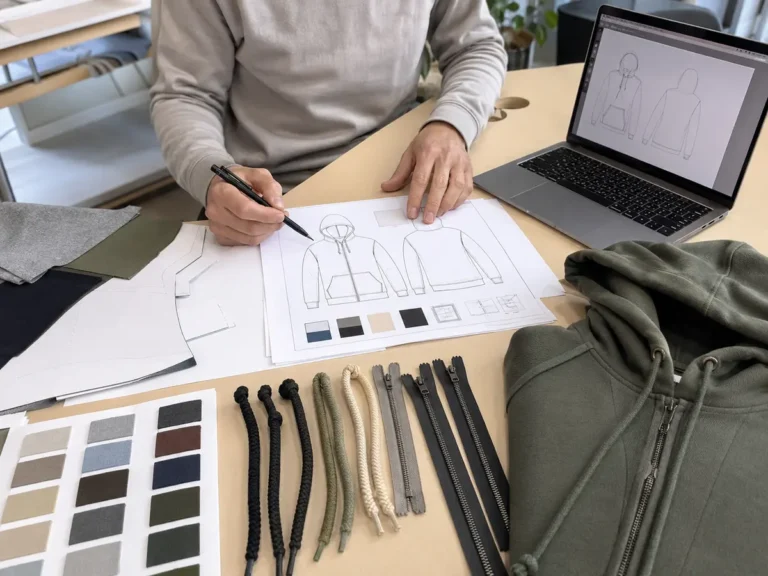
Define the Fold During Sample Approval
Ask the supplier to show the proposed production fold as part of the pre-production sample or packing approval. Confirm:
- Finished folded width, height, and thickness
- Position of the hood and drawcords
- Whether the main print is inside or outside the fold
- Whether tissue or a protective sheet is required
- Individual bag material and ventilation needs
- Size sticker and barcode position
- Pieces per inner pack and carton
- Carton dimensions and gross weight
The fold should protect the product and support distribution. A very small fold may reduce carton volume but create a permanent crease across the artwork. A larger fold may use more space while presenting the garment better and reducing rework.
Train Staff on One Folding Method
A simple visual standard helps staff fold consistently. The standard should show the starting orientation, sleeve placement, final dimensions, logo protection, and size-label position. Keep the instruction outside the garment package. Inspect several randomly selected units rather than relying only on the first item packed.
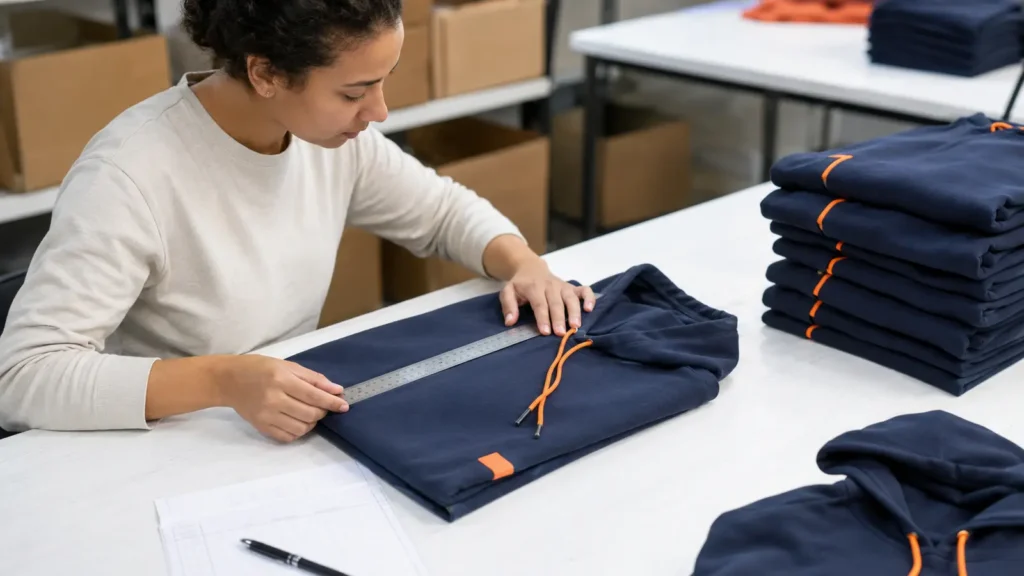
Quality-Control Checklist Before Bulk Packing
Storage cannot correct an incomplete print cure, weak transfer adhesion, open seam, or incorrect label. Quality control should happen before the hoodie is folded.
| Checkpoint | What to verify | Why it matters during storage |
|---|---|---|
| Garment is clean and dry | No moisture, stains, loose fibers, or strong odor | Prevents trapped residue and moisture |
| Decoration condition | Correct position, complete adhesion, no tackiness, lifting, cracking, or loose threads | Reduces sticking and fold-related damage |
| Measurements | Key garment dimensions within the approved tolerance | Confirms folding is not hiding a size or construction issue |
| Zippers and fasteners | Smooth function and correct alignment | Prevents hard components from pressing into decoration |
| Drawcords and trims | Correct length, secure ends, no tangles | Supports consistent packing and presentation |
| Labels | Correct size, fiber, origin, brand, and care information as applicable | Helps users care for the garment properly |
| Fold position | No sharp fold through a sensitive logo or patch | Protects the decoration in cartons and storage |
| Packing quantity | Correct size ratio, color ratio, and pieces per carton | Simplifies receiving and distribution |
| Carton condition | Dry, clean, correctly sealed, not overfilled | Prevents compression and contamination |
The FTC states that U.S. care instructions need a reasonable basis. Buyers selling into the United States should therefore confirm that their supplier’s care guidance reflects the complete decorated garment, not only the blank fabric. For European and other markets, confirm the applicable national rules and licensed use requirements before reproducing standardized care symbols.
What to Send a Supplier for an Accurate Custom Hoodie Quotation
Clear specifications make it easier to quote the garment, decoration, packing, and shipping method correctly. Send:
- Intended buyer or user group
- Pullover or zip-up style
- Unisex, men’s, women’s, youth, or custom fit
- Quantity by size and color
- Fabric composition and target weight, if known
- Brushed fleece, French terry, jersey, or performance structure
- Reference image, tech pack, or product concept
- Vector logo files and Pantone references when available
- Decoration method, dimensions, colors, and exact placement
- Private label, neck label, woven label, hangtag, and packaging needs
- Required sample stage
- Folded size or carton constraints
- Destination country and target delivery date
If you are unsure which logo process fits the design, provide the artwork and intended use. A supplier can then compare embroidery, screen printing, heat transfer, patches, or another method based on detail, color count, fabric, quantity, hand feel, and durability expectations.
Planning a custom hoodie order? Share your quantity, size range, colors, fabric preference, logo artwork, packaging needs, destination, and target delivery date with JIUMU. Request a custom quotation at jiumugear.com/contact-us/ or explore custom hoodies.
Questions to Ask a Custom Hoodie Supplier
Use these questions before approving a sample or production order:
- What exact fabric composition, knit structure, and finished weight will be used?
- Which decoration method is recommended for this artwork and why?
- Where will the natural production fold lines fall relative to the logo?
- Does the decoration require a conditioning period before folding or packing?
- What care instructions apply to the complete decorated garment?
- Can the supplier provide a physical sample with the proposed fold and packaging?
- How will colors, logo position, garment measurements, and print condition be inspected?
- Can sizes and colorways be separated or pre-assorted for distribution?
- What individual packaging, private labels, hangtags, and carton markings are available?
- What information is needed to support repeat-order consistency?
Why JIUMU Is Relevant for Custom Hoodie Programs
JIUMU is a Guangdong-based B2B custom teamwear, logo apparel, hats, uniforms, bags, and branded merchandise supplier established in 2010. The typical minimum order quantity is 50 pieces, subject to product structure and customization.
For custom hoodie and team apparel projects, JIUMU supports:
- OEM and ODM product development
- Fabric sourcing and Pantone color matching
- Logo embroidery, screen printing, heat transfer, and patch options
- Private labels, neck labels, woven labels, and hangtags
- Packaging customization
- Digital mockups and physical samples
- Bulk production, quality control, and export support
The practical value for schools, clubs, distributors, retailers, promotional product companies, and private-label brands is specification coordination. Fabric, fit, logo method, color, labels, folding, packaging, and delivery planning can be reviewed as one program instead of isolated decisions.

Frequently Asked Questions
Final Recommendation
The safest hoodie storage system is simple: follow the care label, store only clean and fully dry garments, use broad folds, protect the decorated surface, and avoid excessive heat, moisture, friction, and compression. Match the method to the garment. Heavy fleece belongs in a shallow stack; medium-weight hoodies can be file-folded; premium samples and seasonal inventory benefit from breathable protection and periodic inspection.
For custom hoodie programs, decide the fold and packaging during sample approval. A small adjustment to logo placement or folded dimensions can prevent creasing across hundreds of garments and make team distribution, retail handling, and repeat orders more consistent.
Request a JIUMU custom hoodie quotation. Send your artwork or reference image, quantity by size, preferred colors, fabric requirements, logo method, private-label details, packaging needs, destination country, and target delivery date. Contact JIUMU by email, WhatsApp/phone at +86 18507502899, or the JIUMU contact page.
Sources and Further Reading
- U.S. Federal Trade Commission — Care Labeling Rule
- U.S. Federal Trade Commission — Clothes Captioning: Complying with the Care Labeling Rule
- GINETEX — Care Symbols under ISO 3758:2023
- Google Search Central — Article Structured Data
- Google Search Central — Image SEO Best Practices
This article provides general garment organization and procurement guidance. The care label and decoration-specific instructions supplied with the finished garment take priority.
About JIUMU
Established in 2010 in Guangdong, China, JIUMU supports B2B custom teamwear, logo apparel, hats, uniforms, bags, and branded merchandise projects for North American and European buyers.
zhengdong@jiumugear.com · WhatsApp/Phone: +86 18507502899