How to Style Oversized Hoodies for Men and Women
Oversized hoodies can anchor streetwear, soften tailored clothing, add volume to a minimalist wardrobe, or become the centerpiece of a team, school, retail, or corporate merchandise program.
The important word is intentional. A hoodie that is simply too large can look shapeless. A designed oversized hoodie creates controlled volume through a dropped shoulder, wider body, considered sleeve, and useful length.
This guide explains how to style oversized hoodies for men and women, how to choose the right proportions for different bodies and occasions, and how brands and professional buyers can translate those preferences into better product specifications.
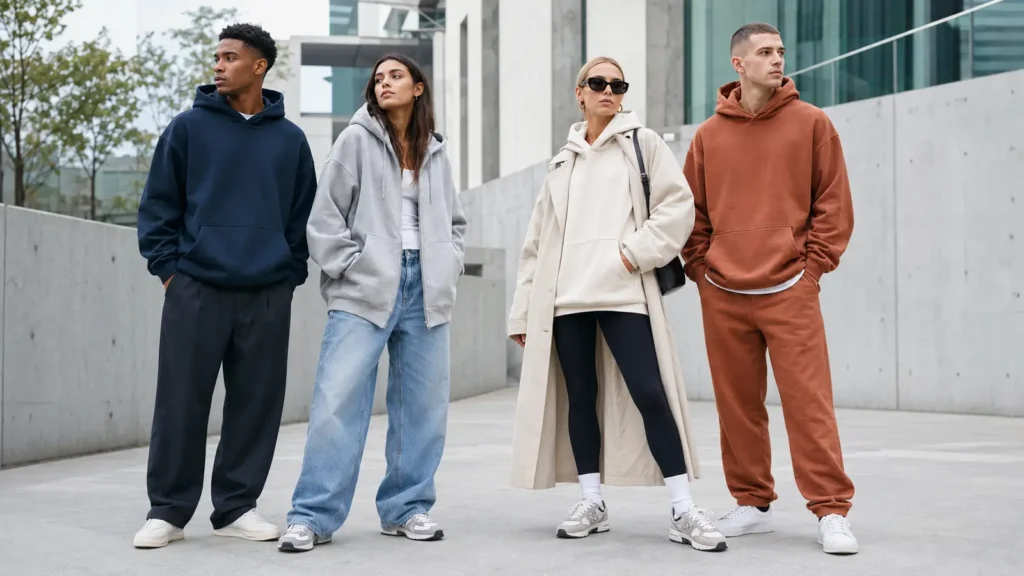
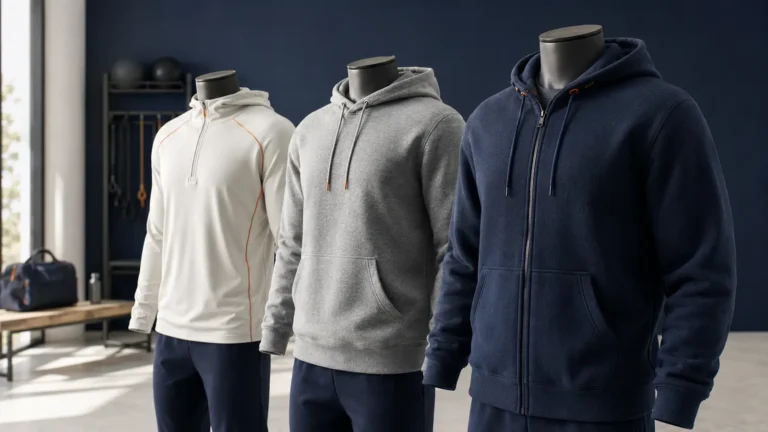
Oversized hoodies work best when garment volume, lower-body shape, footwear, and outerwear are planned as one outfit.
Quick Answer: What Is the Best Way to Style an Oversized Hoodie?
Start with one clear source of volume: the hoodie. Then decide whether the lower half should be streamlined for contrast or equally relaxed for a full streetwear silhouette. Keep at least one visual boundary—visible ankles, a defined coat opening, a partial tuck, a shorter jacket, or a structured bag—so the outfit retains shape.
For men, reliable combinations include an oversized hoodie with straight-leg trousers, relaxed jeans, cargo pants, or coordinated joggers. For women, strong combinations include leggings and a long coat, wide-leg denim, a midi skirt, tailored trousers, biker shorts, or a matching lounge set. Neutral colors are easiest to layer, while one saturated hoodie can act as the focal point.
The hoodie should look deliberately oversized, not accidentally mis-sized. Look for a dropped shoulder, sufficient chest ease, comfortable armhole depth, a hood that holds its shape, and a body length that supports the intended styling.
The Four-Part Formula for a Balanced Oversized Hoodie Outfit
Every successful oversized hoodie outfit can be understood through four decisions: silhouette, length, texture, and finishing details.
- Choose the silhouette. Pair the hoodie with slim bottoms for contrast, straight bottoms for everyday balance, or wide bottoms for a fashion-led look.
- Control the length. A hoodie that ends around the upper hip is versatile. A longer body feels more relaxed but can shorten the visible leg line. A cropped or tucked treatment restores waist definition.
- Mix textures. Fleece feels richer next to denim, wool, leather-style accessories, nylon, or satin than it does beside several nearly identical sweatshirt fabrics.
- Finish the outfit. Shoes, outerwear, headwear, and a bag should confirm the intended direction—minimal, athletic, collegiate, workwear, or streetwear.
| Styling goal | Hoodie choice | Best bottoms | Useful outer layer | Footwear direction |
|---|---|---|---|---|
| Clean everyday look | Midweight neutral pullover | Straight jeans or trousers | Unstructured coat or overshirt | Minimal sneakers |
| Athletic look | Performance or cotton-blend hoodie | Joggers, leggings, or shorts | Lightweight team jacket | Trainers |
| Modern streetwear | Heavyweight, boxy hoodie | Wide jeans or cargo pants | Bomber or puffer | Chunky sneakers or boots |
| Smart-casual contrast | Plain heavyweight hoodie | Pleated or tailored trousers | Wool coat or structured jacket | Leather sneakers or loafers |
| Coordinated merchandise | Consistent unisex fit and brand colors | Matching joggers or simple denim | Branded cap or jacket | Clean neutral sneakers |
The table is a starting point, not a rulebook. The most useful styling principle is contrast: if several elements are loose, add structure through fabric, footwear, color blocking, or an outer layer.
How Men Can Style Oversized Hoodies
Men’s oversized hoodie outfits usually succeed when the wearer chooses one of three directions: balanced everyday casual, full relaxed streetwear, or tailored contrast.
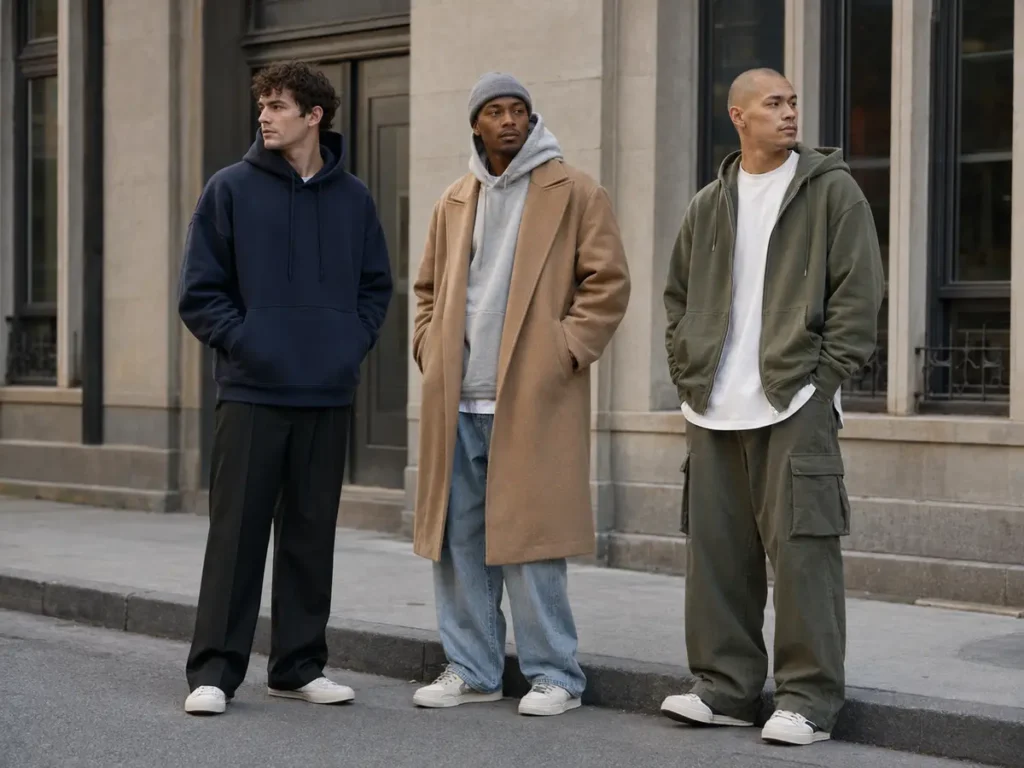
Men can change the character of an oversized hoodie through lower-body volume and outerwear rather than relying on graphics.
1. Oversized Hoodie With Straight-Leg Jeans
This is the most accessible combination. Choose jeans that fall cleanly from the hip without clinging to the calf. Dark indigo, washed black, and medium blue denim work with navy, gray, cream, green, rust, or burgundy hoodies. Finish with simple sneakers.
2. Oversized Hoodie With Tailored Trousers
Tailored trousers make a hoodie look more deliberate. Pleated trousers with a straight or relaxed leg continue the volume without becoming sloppy. Charcoal trousers with navy or taupe trousers with cream create easy tonal combinations; minimal sneakers or loafers finish the contrast.
3. Hoodie Under an Overcoat
The coat needs enough armhole and sleeve room and should not pull across the upper back. Keep the base palette restrained, let the coat provide contrast, and arrange the hood outside the collar.
4. Hoodie With Cargo or Utility Pants
This combination has a workwear and streetwear character. If the cargo pants have large pockets and hardware, use a clean hoodie. A wider leg usually balances an oversized top better than a sharp taper; boots or substantial sneakers can support the visual weight.
5. Matching Hoodie and Jogger Set
A coordinated set is useful for teams, clubs, campus programs, and merchandise. Substantial fabric, consistent rib, controlled color matching, and a clean jogger shape prevent it from resembling sleepwear. Add a contrasting T-shirt, cap, team jacket, or clean sneakers.
6. Oversized Zip Hoodie as a Layer
A zip hoodie is more adjustable than a pullover. Wear it open over a T-shirt to create vertical lines or partially closed to control volume. For brands, zipper quality, tape color, puller design, pocket alignment, and shrinkage behavior deserve sample review.
How Women Can Style Oversized Hoodies
Women can use the same silhouette principles while creating more contrast through skirts, leggings, coats, waist definition, and footwear.
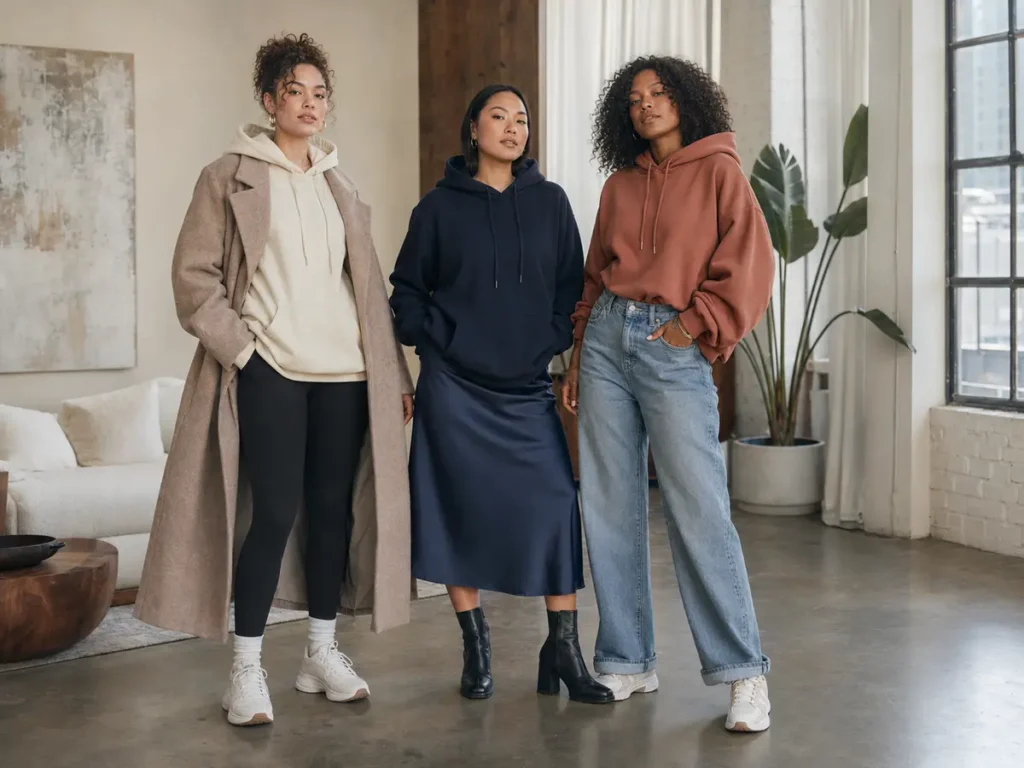
An oversized hoodie can read athletic, minimal, or elevated depending on the lower-body silhouette and finishing layer.
1. Oversized Hoodie With Leggings
This high-contrast formula places volume above and a close fit below. Choose an opaque, stable legging fabric. Trainers create an athletic result; boots and a long coat add polish and a strong vertical line.
2. Hoodie With Wide-Leg Jeans
With wide-leg denim, choose a hoodie that is wide rather than excessively long. A front tuck, inward fold, or slightly cropped body can expose more of the waist. A compact hem rib with good recovery supports these treatments.
3. Hoodie With a Midi Skirt
A satin, pleated, knit, or denim midi skirt adds movement and texture. Keep the hoodie simple if the skirt has sheen or print. A shorter body or neat tuck usually produces clearer proportions; finish with ankle boots or streamlined trainers.
4. Hoodie Under a Long Coat or Trench
For commuting and casual business settings, use an outer layer roomy through the shoulders and sleeves. Keep the hood outside the collar and the coat open when possible; a monochrome base beneath a contrasting coat creates a long line.
5. Hoodie With Biker Shorts
An oversized hoodie and biker shorts create a warm-weather or active silhouette. The body length must be deliberate because it covers much of the shorts. Crew socks, trainers, a cap, or a small crossbody bag complete the direction.
6. Hoodie With Tailored Trousers
Choose a hoodie with clean shoulder construction, stable ribbing, and controlled bulk. Pair cream with stone, navy with charcoal, or heather gray with black. A structured bag and minimal footwear refine the outfit without disguising its casual character.
7. Oversized Hoodie as a Dress
Only a hoodie designed with appropriate length and coverage should be worn as a dress. Simply sizing up can create wide sleeves without enough body length. Use boots, shorts underneath, or leggings as appropriate, and develop the product from its own measurement chart.
How to Balance Proportions Without Losing the Oversized Effect
“Balance” does not always mean making the lower half slim. It means the eye can understand the outfit.
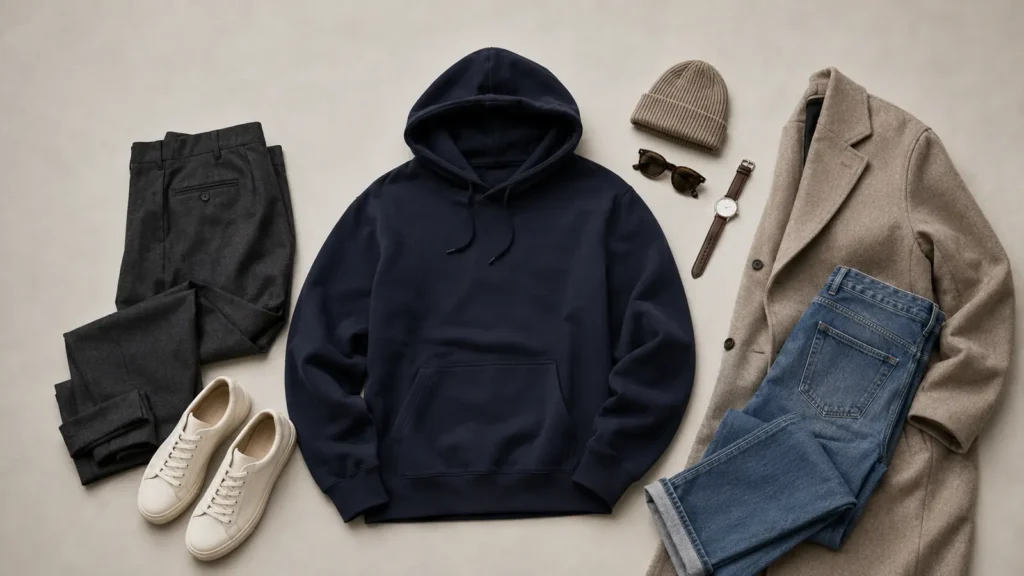
One hoodie can support different styling directions when the surrounding pieces create clear lines and contrasting textures.
Use these adjustments when an outfit feels shapeless:
- Show a boundary at the waist through a partial tuck, fold, cropped layer, or open jacket.
- Expose the ankle or choose footwear with a defined shape.
- Add a long vertical line through an open coat or zip hoodie.
- Limit the color palette to two or three related tones.
- Use one structured accessory, such as a tote with body, a crossbody bag, or a cap with a defined crown.
- Choose a hoodie that is wider in the chest rather than simply much longer.
For shorter wearers, an upper-hip hoodie length, higher-rise bottoms, and a visible shoe shape can preserve leg length. Taller wearers can generally support longer bodies and deeper drop shoulders, but sleeve length should still end intentionally rather than covering the hands by accident. For broader builds, adequate chest and bicep ease matter more than an extreme shoulder drop. For curvier builds, a side split, slightly shorter front, or fabric with better drape may create comfort without restricting the intended silhouette.
These are options, not body rules. The wearer’s preferred coverage, mobility, and style should lead the decision.
Oversized Fit Versus Simply Buying a Larger Size
An oversized fit is created in the pattern. Buying two or three sizes larger changes every measurement at once and may produce an unintended result.
| Specification | Purpose-designed oversized hoodie | Standard hoodie sized up |
|---|---|---|
| Shoulder | Deliberately dropped and balanced | Drops according to normal grade rules |
| Chest | Added ease with a controlled body shape | Wider, sometimes with excessive underarm fabric |
| Body length | Chosen for the intended silhouette | Often becomes too long |
| Sleeve | Shaped to work with the dropped shoulder | May become excessively long |
| Hood | Scaled to match the garment | May still follow standard proportion |
| Rib opening | Designed to hold or release the body volume | May become too loose |
| Size range | Can retain a consistent visual identity | Look changes unpredictably across sizes |
This distinction matters for both wearers and buyers. A retail customer may describe a product as “oversized,” but a supplier needs actual measurements: half chest, body length, shoulder width, sleeve length from shoulder or center back, armhole depth, bicep width, cuff opening, hood height, and hood width.
Choosing Fabric Weight, Structure, and Drape
Fabric determines whether an oversized hoodie stands away from the body, falls softly, feels warm, or layers comfortably.
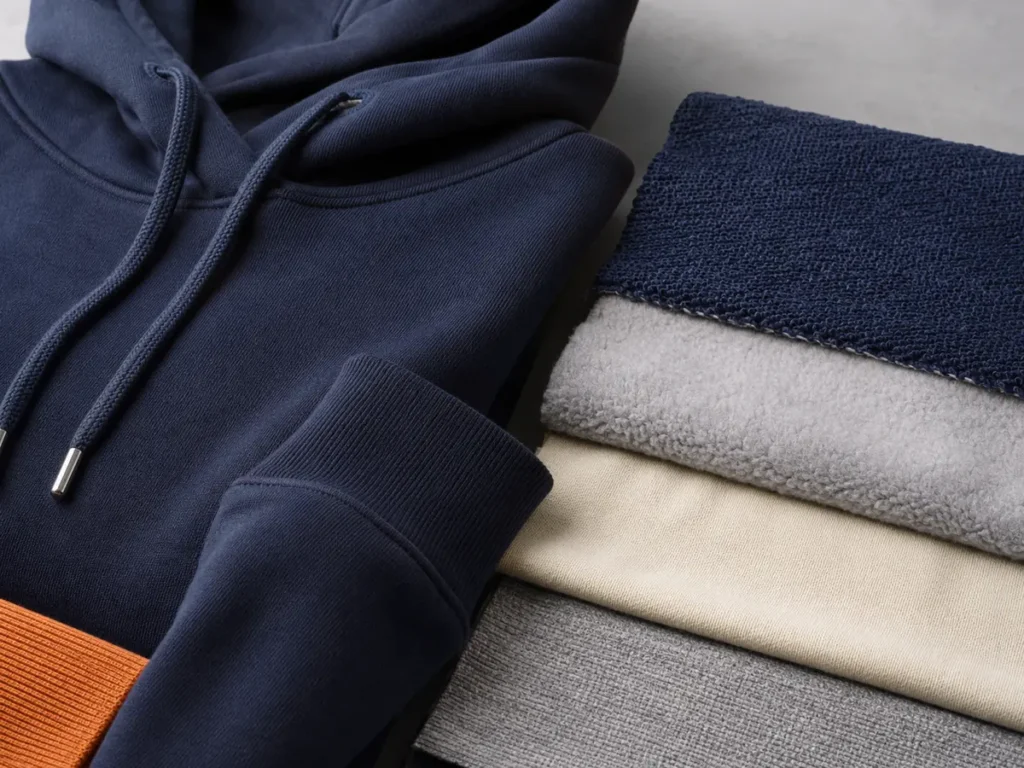
One hoodie can support different styling directions when the surrounding pieces create clear lines and contrasting textures.
| Fabric direction | Typical visual result | Good use cases | Buyer considerations |
|---|---|---|---|
| Cotton-rich French terry | Cleaner drape with loopback interior | Transitional seasons, retail streetwear, layering | Loop quality, shrinkage, surface stability |
| Brushed fleece | Fuller, warmer, softer interior | Winter merchandise, teams, campus programs | Pilling, shedding, brushing consistency |
| Heavyweight cotton-rich fleece | Structured, boxy silhouette | Premium streetwear and statement blanks | Garment weight, drying time, seam bulk |
| Cotton-polyester blend | Stable, versatile, often easier care | Teamwear, corporate merchandise, repeat programs | Hand feel, color behavior, print compatibility |
| Performance-oriented polyester blend | Lighter, faster-drying direction | Training, travel, active clubs | Breathability, static, surface shine, decoration method |
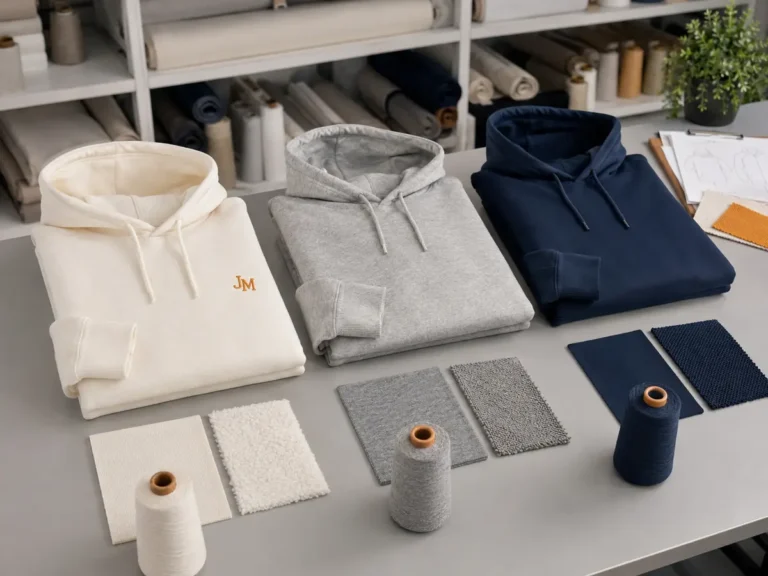
Do not select fabric by composition alone. Two fabrics with the same fiber percentages can behave differently because of yarn, knit density, finishing, brushing, and weight. Ask for a physical swatch and, for important programs, approve a garment sample in the actual or closest production fabric.
For color control, professional buyers should provide a physical color reference or a recognized textile color target. Pantone’s Fashion, Home + Interiors system is designed for textile and apparel color communication, but a code is still a target rather than a guarantee that every fiber, dye process, and surface will look identical. Approve a lab dip or material swatch under consistent lighting before bulk production.
Seasonal Styling: From Summer Evenings to Winter Layers
- Spring: Use midweight French terry with a trench, overshirt, straight denim, or relaxed trousers.
- Summer: Reserve lighter hoodies for cool evenings, travel, and air-conditioned spaces; pair them with shorts, light trousers, or skirts.
- Autumn: Add denim jackets, bombers, utility jackets, or wool overshirts and use deeper neutral colors.
- Winter: Choose brushed fleece or a more substantial construction and confirm that the hood, cuff, and sleeve fit under the intended coat.
Color Combinations That Are Easy to Wear and Easy to Merchandise
Navy, black, heather gray, cream, stone, and dark green coordinate easily with common bottoms and outerwear. In a tonal outfit, vary material or shade so pieces do not visually merge. If the hoodie carries a stronger color, keep the rest quieter. Brands should test graphic contrast on the actual fabric because screens, thread, transfers, and dyed fleece can appear different.
Shoes and Accessories That Complete the Look
Minimal sneakers keep tailored combinations clean; retro runners support casual streetwear; substantial sneakers balance wide trousers; boots suit cargo pants, coats, skirts, and winter looks; loafers create high-low contrast. A cap adds a teamwear signal, a structured tote organizes a soft outfit, and a crossbody strap creates a useful diagonal line.
Turning Styling Demand Into a Better Custom Hoodie Specification
For a brand, distributor, school, sports club, or promotional buyer, styling insights are product-development inputs. If customers want to wear the hoodie under coats, specify moderate sleeve bulk and test layering. If they want a boxy streetwear silhouette, prioritize width, shoulder drop, hood structure, and hem behavior. If the hoodie belongs to a team package, coordinate its navy, red, gray, or custom color with jackets, caps, jerseys, and bags.
Before requesting a quotation, define:
- Pullover, full-zip, half-zip, or hoodie-dress format
- Target wearer and intended unisex, men’s, women’s, youth, or inclusive fit
- Reference measurements or approved sample
- Desired fabric composition, knit structure, weight, and interior finish
- Color targets and number of colorways
- Logo artwork, decoration method, size, and placement
- Rib, drawcord, eyelet, zipper, pocket, and hood requirements
- Size range and quantity by size and color
- Main label, size label, care label, hangtag, and packaging
- Target market and requested delivery date
This information allows a supplier to assess material availability, decoration feasibility, sampling work, packing needs, and production planning more accurately.
Customization Methods for Oversized Hoodies
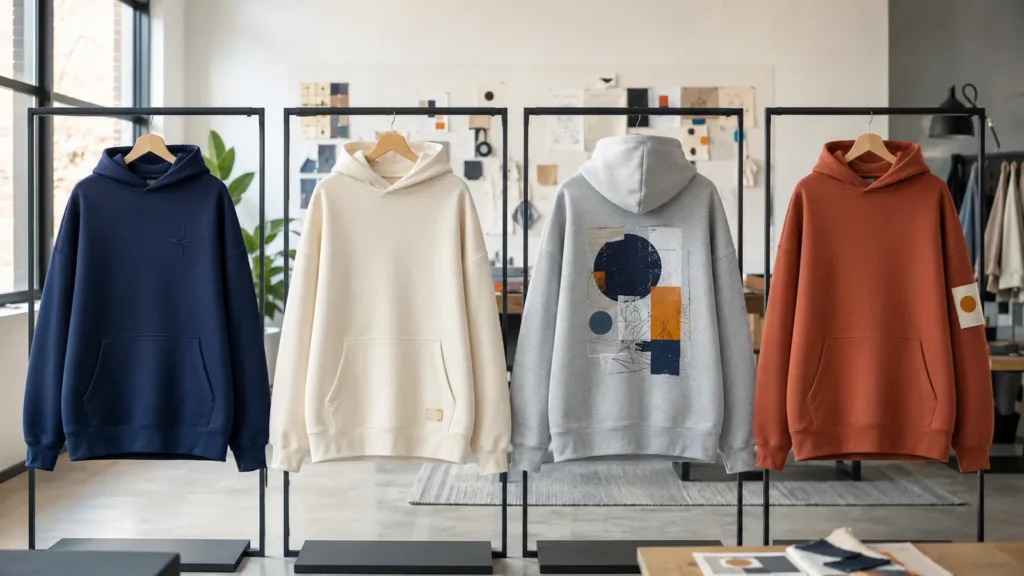
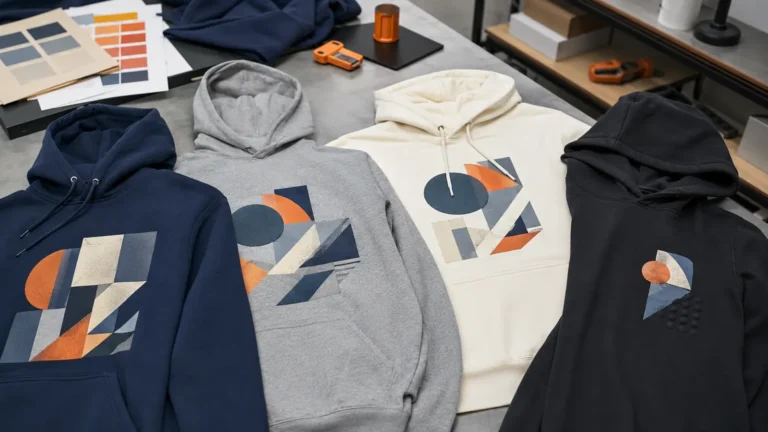
Decoration scale and placement should be evaluated on the actual oversized pattern because the printable area and visual center differ from a regular-fit hoodie.
Embroidery
Embroidery suits small chest marks, initials, club crests, sleeve details, and premium tonal branding. Dense or very large embroidery can stiffen the fabric and feel heavy on the chest. Confirm backing, stitch density, thread color, and placement on a sample.
Screen Printing
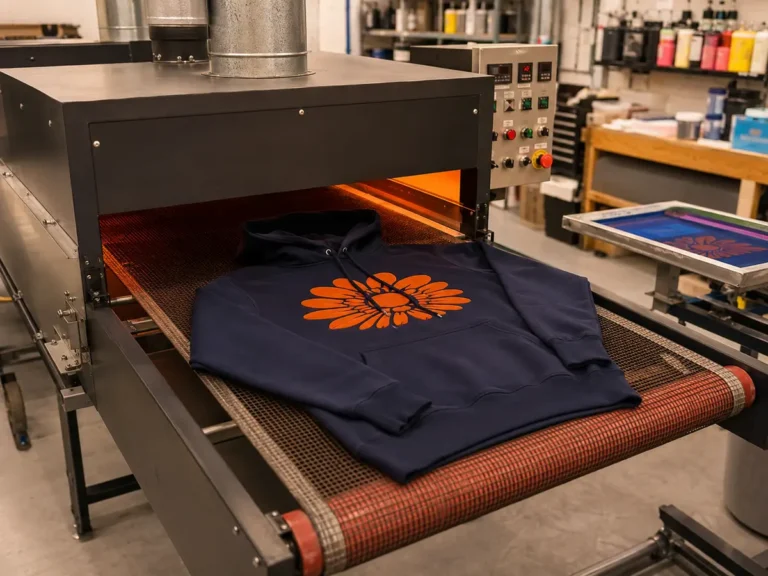
Screen printing is effective for clean artwork and larger front or back graphics. Cost and feasibility depend on color count, print size, fabric, ink system, and order quantity. Oversized hoodies provide a large graphic area, but seams, pockets, and folds limit placement.
Heat Transfer
Heat transfer can support detailed names, numbers, small batches, and multi-color artwork. The film or transfer must suit the fabric and intended care. Test adhesion, stretch behavior, hand feel, and color change after pressing.
Patches
Woven, rubber/PVC, and leather-style patches create a dimensional brand detail. Their weight and edge construction should suit the fleece. Common positions include the chest, sleeve, pocket, and lower hem.
Private Labels and Packaging
Neck labels, size labels, care labels, hangtags, folded packaging, and carton organization turn a decorated blank into a retail or distribution-ready product. Label content must be prepared for the destination market.
For the United States, the Federal Trade Commission explains that most textile products require fiber content, country of origin, and responsible-company identification, while clothing also falls under care-label requirements. In the European Union, textile labels must use the prescribed fiber names and communicate composition in line with Regulation (EU) No 1007/2011. Buyers should confirm the current rules for every destination and product with qualified compliance support rather than copying a label from another garment.
What Drives the Cost of a Custom Oversized Hoodie?
The lowest unit price is not always the lowest program cost. Rejected samples, inconsistent sizing, mismatched repeat colors, incomplete labels, and repacking can create avoidable expense.
Main cost drivers include:
- Fabric composition, weight, finishing, and minimum material quantity
- Custom dyeing versus available stock colors
- Pattern development and the number of fit samples
- Decoration method, size, position, and color count
- Zippers, eyelets, drawcords, patches, and special trims
- Size range and size-by-color complexity
- Private labels, hangtags, individual bags, and carton sorting
- Inspection requirements, testing requests, shipping method, and destination
JIUMU’s typical MOQ is 50 pieces, subject to product structure and customization. A simple one-color embroidered hoodie using an available fabric may be more straightforward than a custom-dyed heavyweight hoodie with several large decorations and retail packaging. The quotation should reflect the approved specification rather than a generic hoodie description.
Sample Approval and Quality-Control Checklist
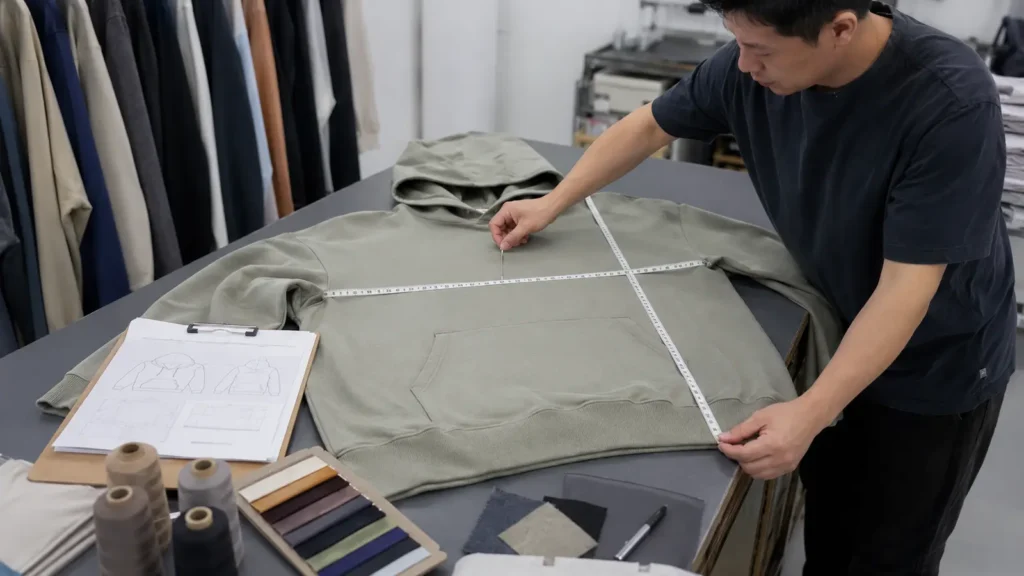
Measure the hoodie on a flat surface using one agreed method and compare the results with the approved specification.
Approve the sample as a complete product:
- Fit and measurements: Verify chest, body length, shoulder, sleeve, bicep, cuff, armhole, hood, pocket, and hem.
- Fabric: Confirm hand feel, weight direction, stretch, recovery, interior finish, surface appearance, and color.
- Construction: Review seam appearance, stitch security, pocket symmetry, hood shape, drawcord length, rib attachment, and zipper operation where applicable.
- Decoration: Check artwork size, placement, color, edge quality, adhesion or stitch quality, and the effect on fabric drape.
- Labels and packaging: Confirm label text and location, hangtag attachment, folding method, bag markings, size stickers, and carton assortment.
- Wear and care evaluation: Use an agreed evaluation plan for washing, dimensional change, pilling, color appearance, decoration durability, and other risks relevant to the program. Testing scope and acceptance limits should be written, not assumed.
Keep an approved sample, signed measurement chart, artwork proof, color reference, and packaging reference. These materials help support bulk inspection and future repeat orders.
Bulk-Order Planning for Teams, Brands, and Merchandise Programs
Begin with the launch date and work backward. Allow time for specification review, artwork cleanup, material confirmation, sample production, sample shipping, feedback, revision, bulk production, inspection, and transport. Lead time depends on the final construction and current production plan, so confirm it against the approved order.
For mixed sizes, provide a size-by-color breakdown rather than only a total. For teams, define packing by player, size, department, or location. For ecommerce, specify barcode, SKU, size sticker, hangtag, and individual packaging needs.
For repeat programs, document what must remain consistent and what may change. A brand may keep the base hoodie, color, and label system constant while changing a seasonal back print. A school may retain its core colors and chest embroidery while adding names for a graduating class. Good documentation makes these variations easier to quote and control.
Questions to Ask an Oversized Hoodie Supplier
Ask questions that reveal process, not just promises:
- Can you develop a purpose-built oversized pattern from our measurement chart or reference sample?
- Which measurements do you use to define the drop shoulder and overall fit?
- What fabric options are available in the required weight, color, and quantity?
- Can you provide a fabric swatch, lab dip, digital mockup, and physical sample?
- Which decoration method is most suitable for our artwork and fabric?
- How will you control placement across different garment sizes?
- What tolerances will be used for garment measurements and decoration placement?
- How will bulk color and fabric be compared with the approved reference?
- Can the order be packed by size, wearer, store, team, or destination?
- What information is required for care labels and destination-market labeling?
- How are changes documented after sample approval?
- What should we reserve or record for repeat orders?
Clear answers should lead to a written specification, not remain as informal chat messages.
Common Styling and Buying Mistakes
Treating “Oversized” as “Order Several Sizes Up”
This can create a garment that is too long in the body and sleeve without the desired boxy proportion. Use an oversized pattern and size chart.
Combining Volume Without Any Structure
Wide hoodie, wide trousers, bulky coat, and bulky shoes can work, but only when color, length, and fabric create separation. Add a clear boundary or reduce one source of volume.
Selecting Fabric Only by GSM
Weight does not fully describe softness, drape, warmth, recovery, or surface quality. Review the full fabric specification and a physical sample.
Approving Artwork Without a Garment Mockup
A graphic that looks balanced on a regular hoodie may appear too small or too high on an oversized body. Confirm dimensions and placement on the actual size and pattern.
Ignoring Grade Rules
One sample size cannot prove that the visual effect will remain consistent across the full range. Review how chest, shoulder, length, sleeve, hood, and decoration placement change by size.
Leaving Labels and Packing Until the End
Late changes to care labels, hangtags, barcodes, bags, and carton sorting can delay a program. Include them in the initial quotation brief.
Why Work With JIUMU on Custom Oversized Hoodies?
JIUMU is a Guangdong-based B2B supplier established in 2010, serving professional buyers in North America, the United Kingdom, and Europe. Its approved capabilities include OEM and ODM product development, embroidery, sublimation, screen printing, heat transfer, several patch formats, fabric sourcing, Pantone color matching, private labels, hangtags, packaging customization, digital mockups, physical samples, quality control, and export support.
This scope is relevant when an oversized hoodie must coordinate with a wider merchandise or teamwear program. Buyers can also explore custom hoodies, custom team jackets, custom baseball caps, and custom team uniforms.
Planning a custom oversized hoodie? Send JIUMU your reference image or tech pack, target quantity, size range, fabric direction, colors, logo artwork, decoration positions, packaging needs, destination, and target delivery date.
Frequently Asked Questions
Final Recommendation
The best way to style an oversized hoodie is to make its volume look chosen. Decide whether the lower half will contrast or continue that volume, control the body length, mix textures, and use footwear or outerwear to provide a clear finish. Men can move easily between denim, cargo pants, joggers, and tailored trousers; women can add leggings, wide denim, skirts, biker shorts, coats, and waist definition.
For B2B buyers, the same logic should become a specification. Define the pattern rather than writing only “oversized.” Approve fabric, measurements, grading, color, decoration, labels, packaging, and quality expectations as one system. That is how a styling idea becomes a repeatable custom product.
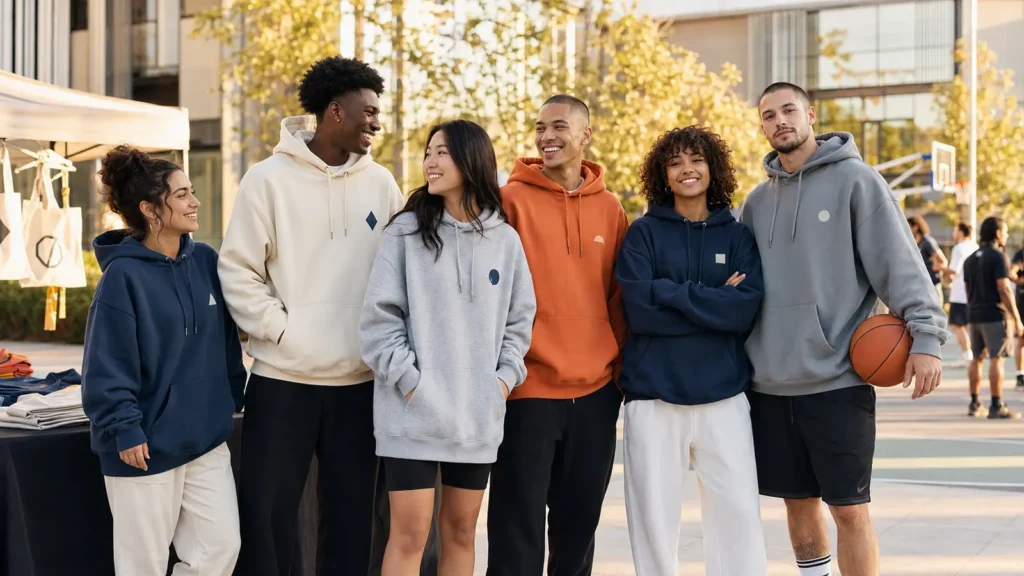
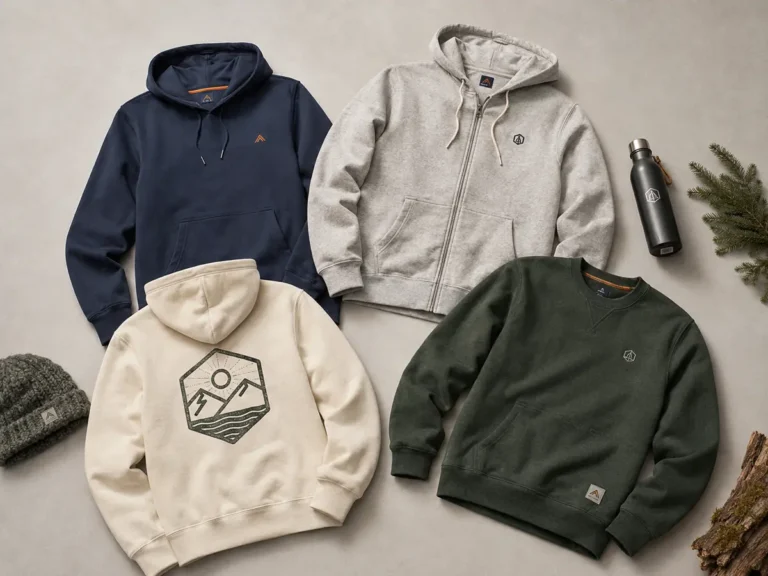
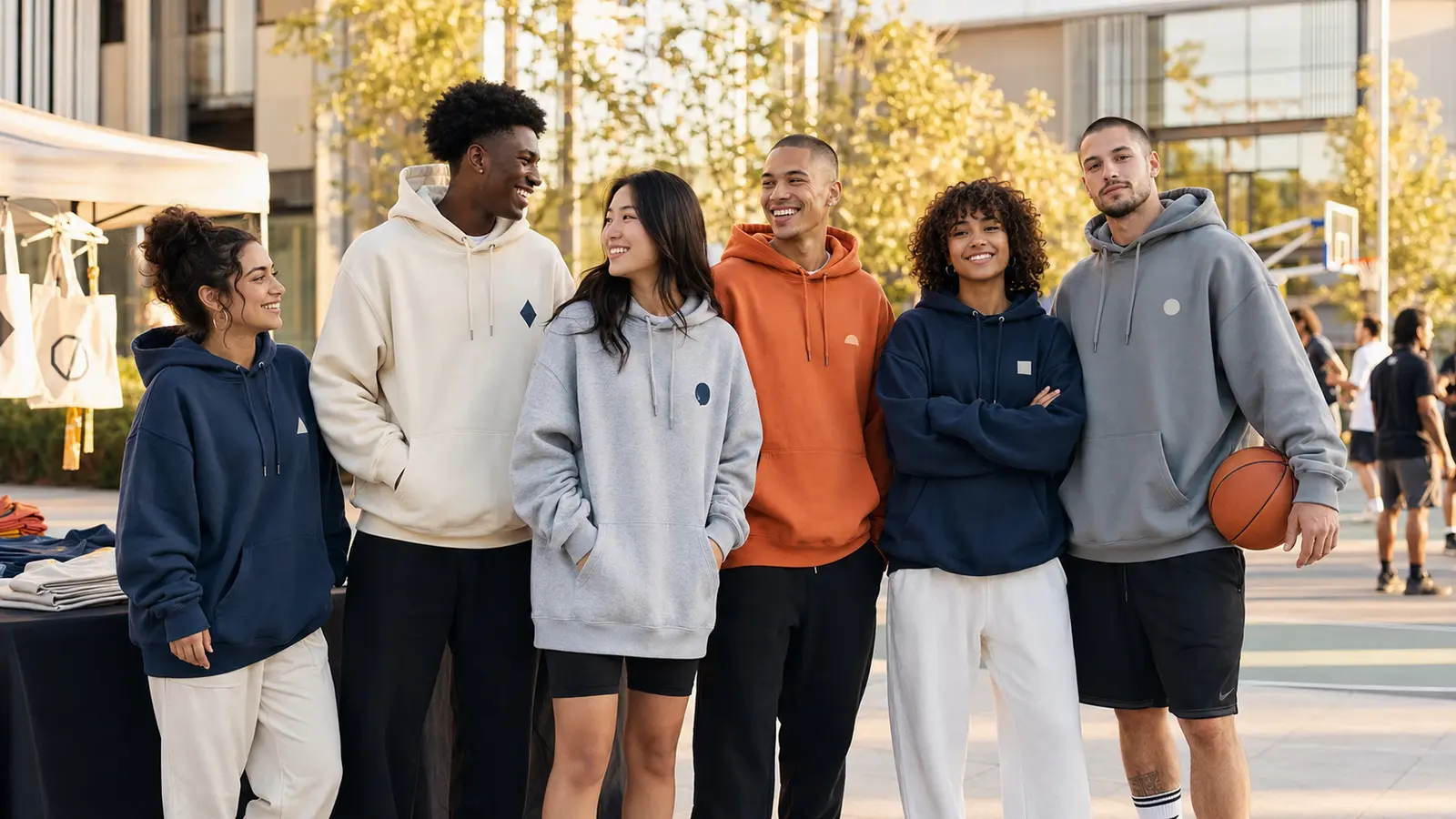
Coordinated oversized hoodies can support retail collections, schools, clubs, teams, corporate merchandise, and private-label programs.
Start your JIUMU oversized hoodie project. Share your concept, logo, target fit, quantity, fabric preference, colors, size range, packaging, delivery destination, and schedule. Contact JIUMU on WhatsApp/Phone at +86 18507502899, email zhengdong@jiumugear.com, or submit an inquiry.
Sources and Further Reading
- U.S. Federal Trade Commission: Clothing and Textiles
- U.S. Federal Trade Commission: Apparel and Labeling
- European Union: Textile Label Requirements
- EUR-Lex: Regulation (EU) No 1007/2011
- Pantone Fashion, Home + Interiors Color System
- GS1 Package and Product Measurement Standard
JIUMU Product Development Team
JIUMU is a Guangdong-based B2B custom teamwear and logo apparel supplier established in 2010. The team supports product development, decoration, labels, packaging, quality control, and export coordination.