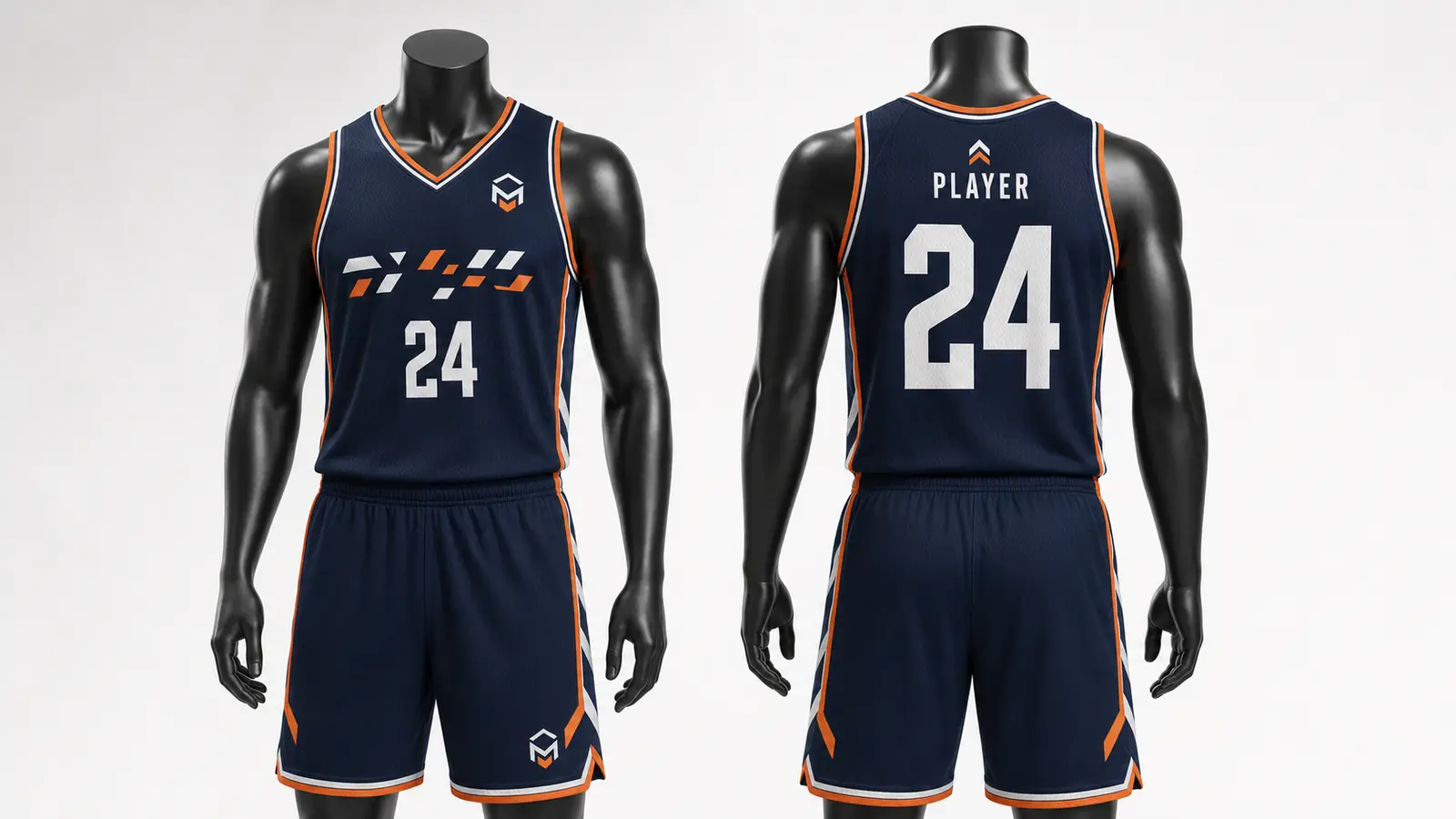
How to Design Custom Basketball Jerseys: Colors, Logos, Numbers and Layout
Designing a basketball jersey is not simply a matter of placing a logo on a sleeveless shirt. A successful uniform must make the team recognizable, keep player numbers readable at game speed, comply with the competition’s rules, fit the intended athletes, reproduce consistently across sizes, and remain practical for repeat orders.
For schools, clubs, academies, distributors, and private-label sportswear brands, the design stage also determines production risk. A layout that looks good on a digital mockup can fail when reduced to a youth size, interrupted by a seam, or adapted for a second colorway.
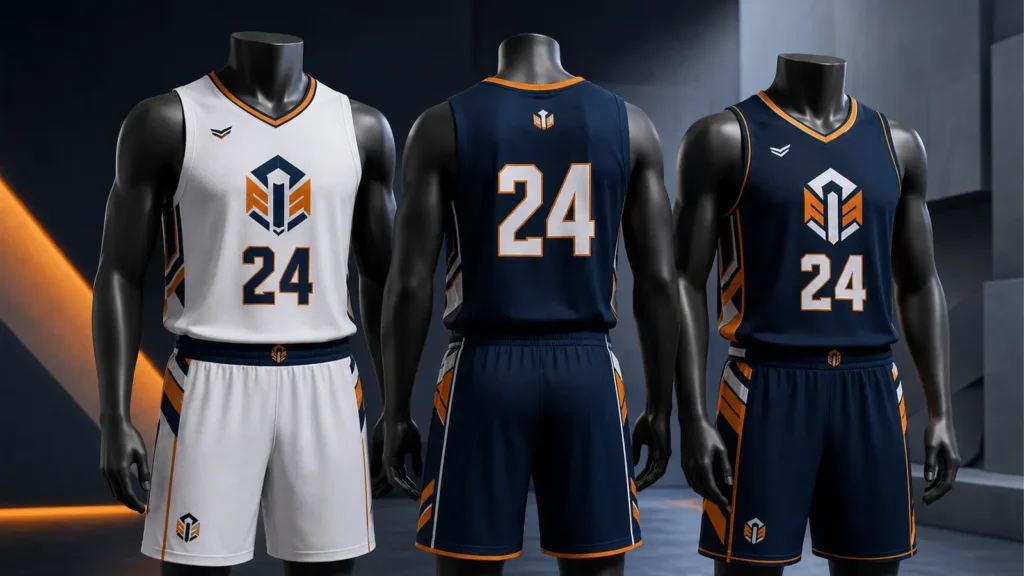
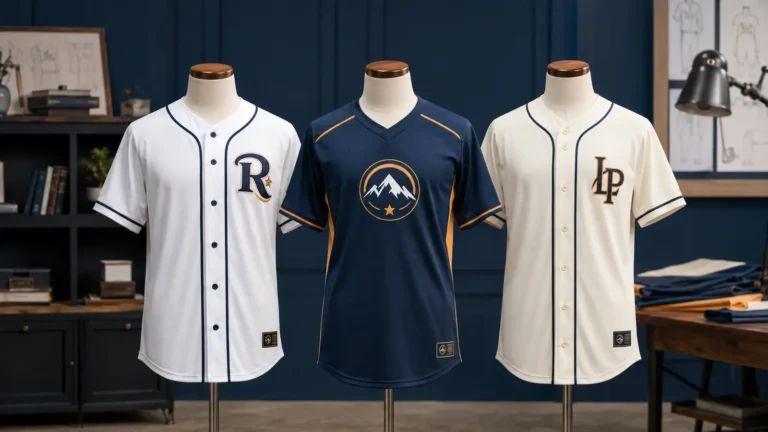
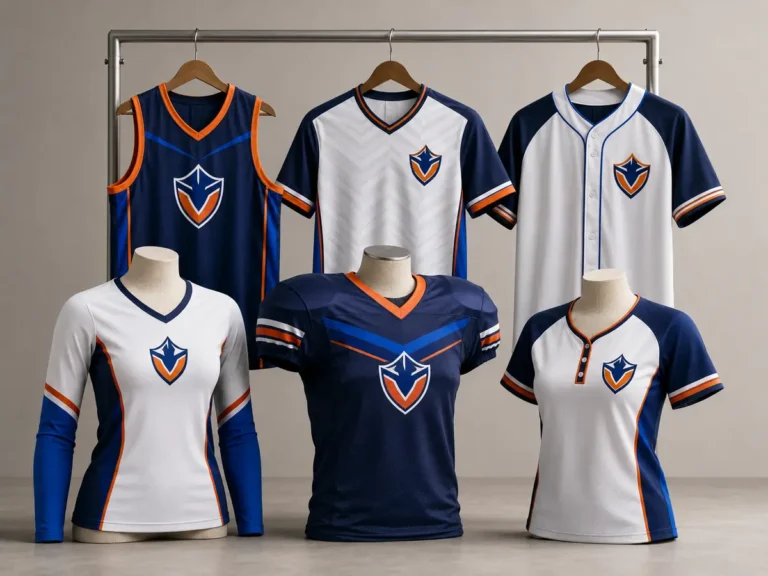
A coordinated home, away, and alternate uniform system should share the same visual identity while keeping numbers easy to read.
Quick Answer
To design custom basketball jerseys, begin with the competition rules and the team’s use case. Choose one dominant color, one supporting color, and a restrained accent; build separate light and dark versions if required. Place the team identity and player number in clear, unobstructed zones, use high-contrast numbers on the front and back, and keep logos away from number areas. Select fabric and decoration methods before finalizing artwork, then approve a physical sample in representative sizes. For a bulk order, provide the supplier with vector logos, exact colors, a roster spreadsheet, size quantities, placement dimensions, labeling requirements, packaging instructions, and a target delivery date.
Start with a Design Brief, Not a Blank Jersey
The best custom basketball jersey design begins with purchasing information. Before selecting fonts or gradients, define who will wear the uniform, where it will be used, and which organization controls the rules.
A youth club has different needs from a college program, school district, or private-label brand. A club may prioritize flexible reorders; a school may need approved colors and student sizing; a retail brand may need labels, packaging, and a different fit.
Build the brief around these questions:
- Which league, federation, school, or tournament rulebook applies?
- Is the order for competition, training, fan merchandise, retail, or a mix?
- Are both light and dark uniform sets required?
- Will the jersey be sold alone or with matching shorts?
- What adult, youth, women’s, or unisex size range is needed?
- Which logos are approved, and who owns the artwork rights?
- Are sponsor patches permitted in the intended competition?
- Will names and numbers vary by player?
- What is the initial quantity, and how likely are repeat orders?
- Which market will receive the goods, and what label information is required?
Rulebooks are not interchangeable. FIBA, NCAA, and other competitions can use different uniform rules. Obtain written approval from the buyer or athletic authority before production. See the FIBA Official Basketball Rules, NCAA men’s playing-rules page, and NCAA women’s playing-rules page.
The Seven-Step Custom Basketball Jersey Design Process
| Step | Main decision | Approval evidence |
|---|---|---|
| 1. Define use | Competition level, athlete group, sales market, and order purpose | Completed buyer brief and applicable rulebook |
| 2. Build the color system | Dominant, supporting, accent, light, and dark combinations | Color references and approved digital palette |
| 3. Set identity hierarchy | Team name, crest, sponsor, player name, and number priority | Vector artwork and placement map |
| 4. Create the layout | Front, back, side panels, neckline, shorts, and size adaptations | Scaled mockups for at least two sizes |
| 5. Select materials and decoration | Fabric weight, mesh structure, sublimation, embroidery, or transfer | Material swatches and decoration samples |
| 6. Approve the sample | Fit, color, number clarity, stitching, labels, and wash behavior | Signed sample checklist and sealed reference sample |
| 7. Release bulk production | Roster, size breakdown, packing method, and delivery target | Final order sheet and production-ready artwork |
This sequence prevents a common failure: finalizing artwork before confirming how the garment will actually be made. A large embroidered crest, for example, may add stiffness to a lightweight performance jersey. A complex all-over graphic is usually better integrated through sublimation. A heat-applied player number may work well for a short run, but its care requirements and repeat-order consistency still need approval.
How to Choose Basketball Jersey Colors
Color must identify the team, separate opponents, and keep numbers legible. Build the palette from three roles:
- Dominant color: the main field of the jersey and shorts.
- Supporting color: the number, team name, or major side-panel color.
- Accent color: a narrow trim, outline, piping, or small graphic detail.
A limited palette creates hierarchy: the dominant color establishes the uniform, the supporting color carries information, and the accent adds energy.
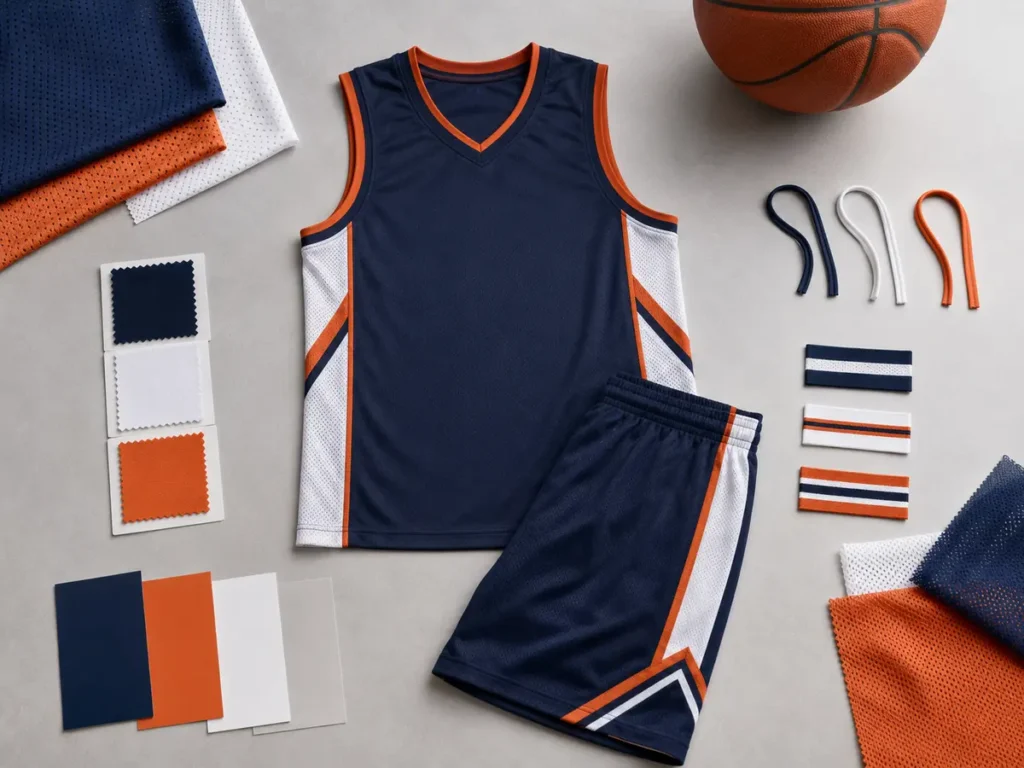
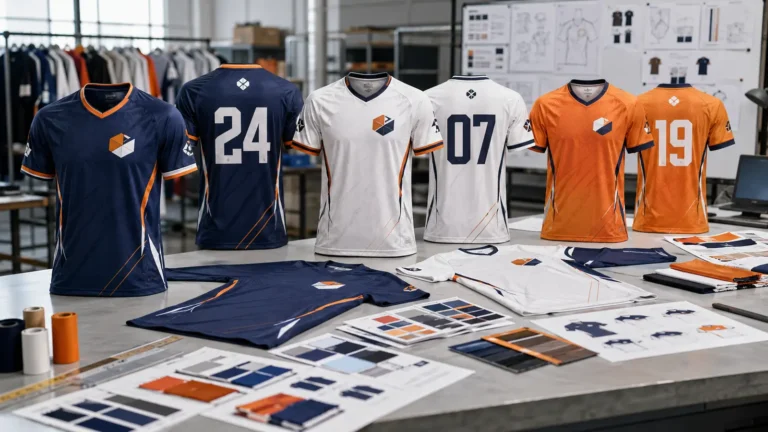
Physical fabric, trim, and print samples help buyers evaluate a color system under real light rather than relying only on a monitor.
Create light and dark systems together
If the team needs home and away sets, design them as one system. Do not simply invert every color. An outline that improves contrast on navy may be distracting on white, while a dark sponsor mark may disappear on an away jersey.
| Palette structure | Best use | Main risk | Approval focus |
|---|---|---|---|
| One dominant color + white | Clean school and club uniforms | Can look generic without distinctive trim | Number weight, crest scale, side-panel identity |
| Two team colors + white | Strong traditional team identity | Competing colors can reduce readability | Contrast between number and body |
| Dark-to-light gradient | Modern sublimated uniforms | Transitions can cross number zones | Number remains readable at every point |
| Tonal pattern + contrast number | Premium, understated design | Pattern may disappear or look noisy in print | Printed scale and repeat consistency |
| High-contrast side panels | Athletic silhouette and strong court presence | Side artwork can distort across sizes | Panel alignment and seam placement |
Use physical color standards carefully
Digital values are useful for screens, but production needs a physical reference or an approved printed/fabric sample. Color can shift among polyester bases, ink systems, embroidery threads, trims, and lighting. For repeat programs, record the approved color reference with the fabric code, printing process, and sample date.
How to Position Logos, Team Names and Sponsors
The jersey front has limited space. Its first purpose is player identification, not advertising. Create a hierarchy before deciding dimensions:
- Player number
- Team or school identity
- Governing-body or event mark, if required
- Manufacturer or private-label mark, if permitted
- Sponsor mark, if permitted
- Decorative pattern
The exact order can change under a competition’s rules, but it should never be accidental. A crest placed too close to the number can make both elements harder to read. A wide team name may need a flatter arch, a smaller font, or a shorter approved version. Sponsor patches should be designed around rulebook space, not added after the jersey layout is finished.
The regulatory environment can also change. For example, the NCAA announced in January 2026 that, effective August 1, Division I programs may use additional commercial logos in specified non-NCAA-championship contexts, with patch size and placement restrictions. This does not mean every school, conference, competition, or championship uses the same allowance. Buyers should confirm current sport-specific and event-specific guidance before artwork approval. See the NCAA announcement on commercial patches.
Practical logo rules for production
- Use vector artwork such as AI, EPS, SVG, or editable PDF where possible.
- Convert fonts to outlines or supply the licensed font files.
- Define one-color alternatives for embroidery or limited-color applications.
- Set a minimum reproduction size for fine lines and small negative spaces.
- Keep important logo details away from seams, armholes, bindings, and side-panel joins.
- Avoid stitching a large, dense embroidered badge directly over a ventilation zone without testing comfort.
- Confirm whether the logo color should match the printed number, trim, shorts, or a separate brand standard.
- Obtain permission for team, school, sponsor, event, and league marks before production.
How to Design Basketball Jersey Numbers for Readability
Numbers must work at a distance, in motion, and under gym lighting. Use a strong silhouette, open internal spaces, and adequate stroke width. Compressed fonts, thin outlines, and busy shadows reduce recognition.
Under the current FIBA rules, numbers must contrast with the shirt; back numbers must be at least 16 cm high, front numbers at least 8 cm high, strokes at least 2 cm wide, and advertising or logos at least 4 cm away from numbers. FIBA permits 0, 00, and 1–99, with no duplicate number on a team. These measurements are specific to that rule set, so other competitions must be checked independently. FIBA’s official rulebook provides the controlling details.
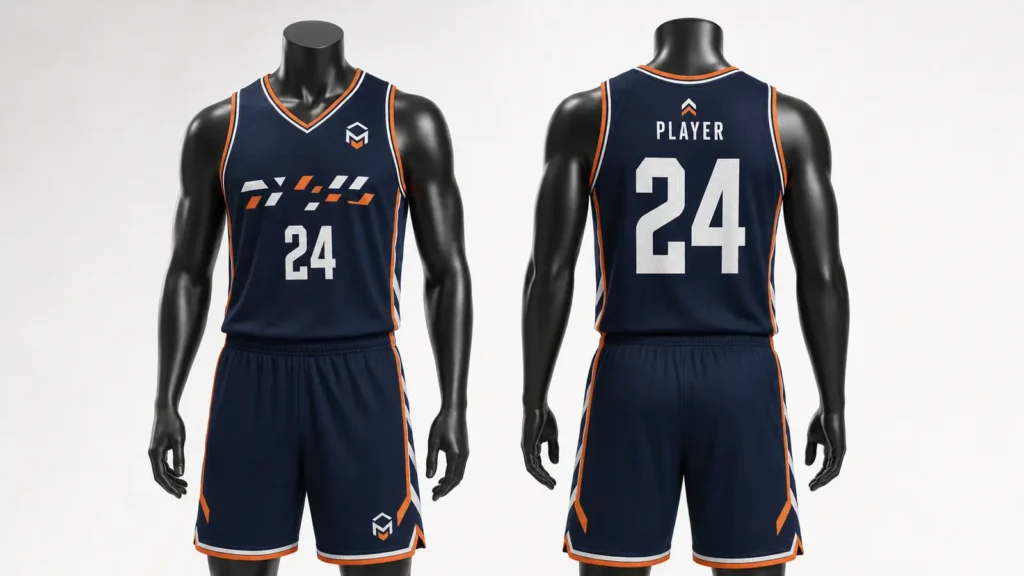
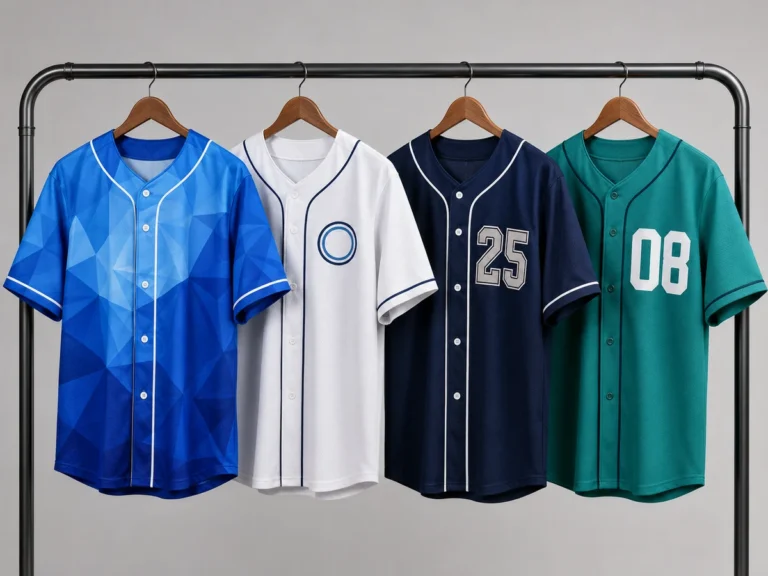
Front and back layouts should be reviewed together so the crest, team identity, player name, and numbers form one clear information system.
Number design checklist
| Attribute | Strong choice | Risky choice |
|---|---|---|
| Contrast | Light number on a dark body or dark number on a light body | Tonal number with only a thin outline |
| Stroke | Consistent, substantial strokes | Hairline sections and excessive bevel effects |
| Counter space | Open centers in 0, 6, 8, and 9 | Closed or very narrow counters |
| Outline | One functional outline that improves separation | Multiple decorative outlines and shadows |
| Texture | Solid fill or restrained internal pattern | Busy camouflage or gradient that weakens edges |
| Placement | Centered in an approved clear zone | Crossing a seam, logo, or high-contrast graphic |
| Size adaptation | Rechecked for adult and youth templates | Uniformly scaled without regard to garment space |
Test ambiguous pairs such as 1 and 7, 3 and 8, and 5 and 6. Print the proposed numbers at production size or place a sample jersey several meters away. If a buyer cannot identify the number quickly, redesign it before bulk production.
Build the Front, Back and Side Layout as One System
A jersey is three-dimensional. A front mockup alone cannot show how a side graphic meets the back, how binding interrupts a pattern, or how artwork changes across sizes.
Front layout
Reserve a clear zone for the team identity and number. Check the visual distance between the neckline, wordmark, number, and hem. If the design includes a V-neck insert, collar color, or chest crest, confirm that these features do not compress the team name.
Back layout
The number normally carries the strongest emphasis. If player names are included, establish consistent letter height, spacing, and maximum width. Long surnames require a rule: reduce the font within limits, use a controlled arch, or apply an approved shortened form. Do not make this decision player by player without a documented standard.
Side panels and matching shorts
Side artwork can create a strong team silhouette, but it must align with panel construction. Confirm whether the jersey uses one-piece cut-and-sew construction, separate contrast panels, or a fully sublimated graphic. Then extend the visual language to the shorts without copying every element. A coordinated shorts hem, side stripe, or small crest is often enough.
Design for the smallest and largest sizes
Approve layouts on at least one small and one large template. Fixed-size logos may dominate a youth jersey, while proportionally scaled numbers may become too small on an adult size. The supplier should state which elements remain fixed and which scale by garment size.
Match Fabric and Decoration to the Artwork
Basketball jerseys commonly use polyester-based performance fabrics because they can support lightweight construction, ventilation, and several decoration processes. However, “polyester” is not a complete specification. Buyers should define fabric weight, knit or mesh structure, hand feel, stretch, opacity, moisture-management expectation, and whether the same fabric is used for the body and side panels.
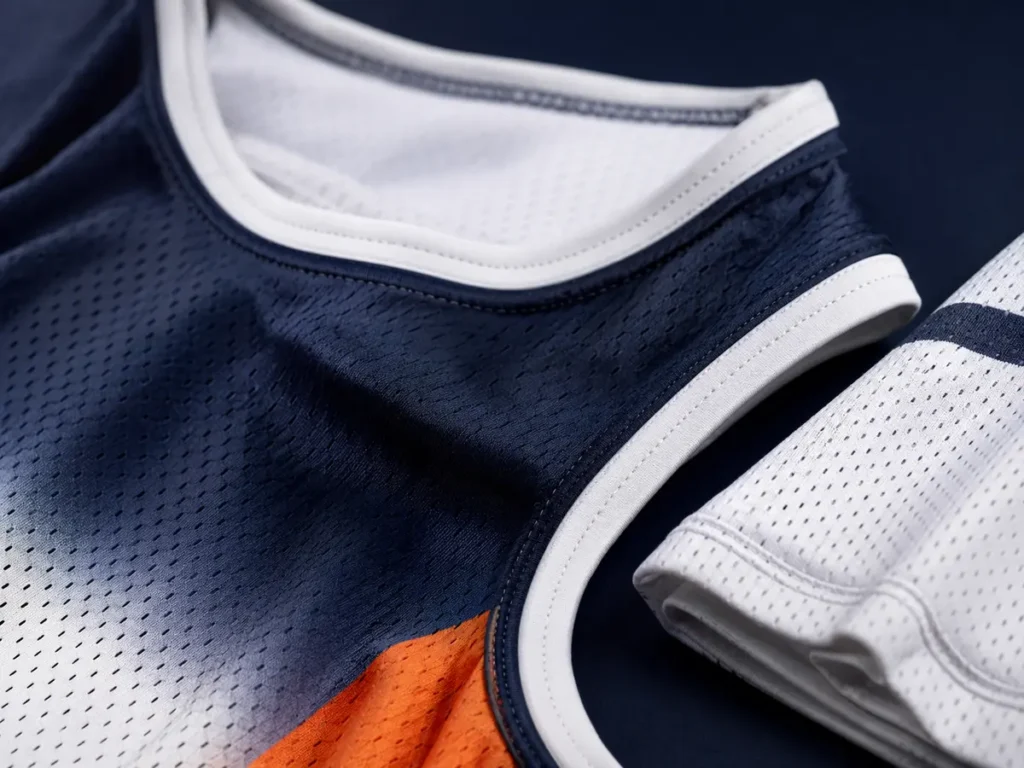
Fabric structure, binding, seams, and decoration must be assessed together because each affects comfort, appearance, and durability.
| Decoration method | Suitable design | Procurement advantage | Point to verify |
|---|---|---|---|
| Sublimation | Full-color gradients, patterns, names, and numbers | Artwork becomes part of the printed fabric surface | Color, opacity, migration, artwork scale, and shade consistency |
| Embroidery | Small crests, premium details, and labels | Textured, dimensional appearance | Stitch density, backing, weight, and skin-side comfort |
| Heat transfer | Names, numbers, short runs, or added sponsor marks | Flexible personalization and low setup for variants | Adhesion, edge lifting, stretch, and care instructions |
| Screen printing | Simple graphics and larger quantities | Efficient for limited-color artwork | Ink hand, registration, mesh compatibility, and cracking risk |
| Appliqué or tackle twill | Traditional layered letters and numbers | Strong classic visual identity | Added weight, stitch security, and laundering behavior |
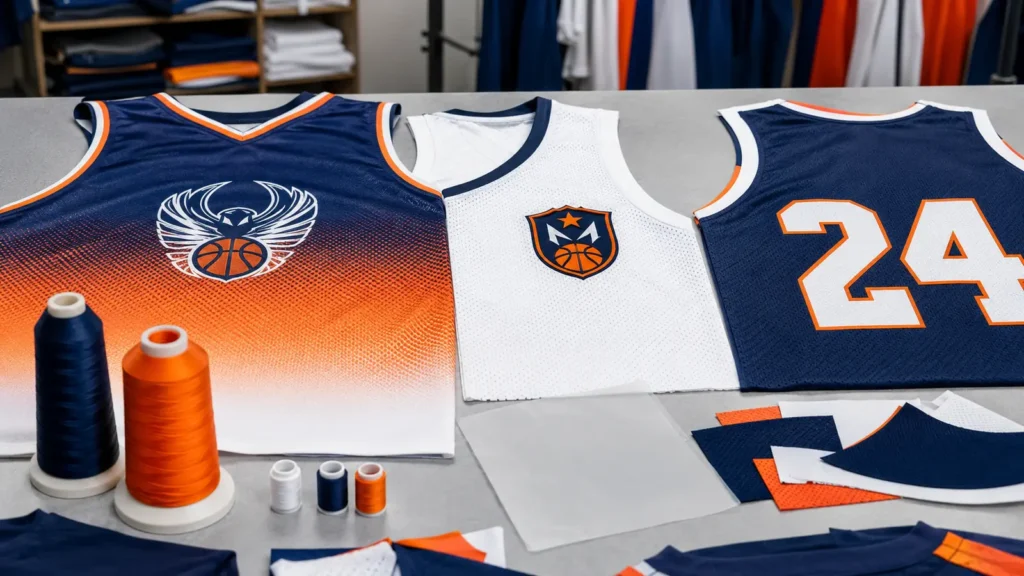
Decoration samples should be made on the actual or equivalent production fabric, not judged only from a digital rendering.
Translate features into purchasing decisions
A buyer should not select a method only because it is described as “premium.” The correct method depends on the artwork and order program:
- Choose sublimation when the design relies on full-body graphics, many colors, gradients, or individually printed names and numbers.
- Consider embroidery for a restrained crest or label where texture adds value without making the jersey front heavy.
- Use heat transfer when roster personalization, sponsor changes, or small runs make flexibility important.
- Consider screen printing for stable, limited-color designs at quantities where setup is justified.
- Test layered or stitched decoration when the traditional appearance is central to the buyer’s brand.
Fit, Sizing and Sample Approval
Sizing errors create more operational problems than most graphic decisions. A visually successful jersey still fails if the size breakdown does not fit the roster.
Ask for a finished-garment size chart, not only generic labels such as S, M, or L. Important points may include chest width, body length, shoulder or upper-chest width, armhole opening, neckline, and short waist or inseam when ordering a set. Clarify whether dimensions are measured flat and whether tolerances are stated.
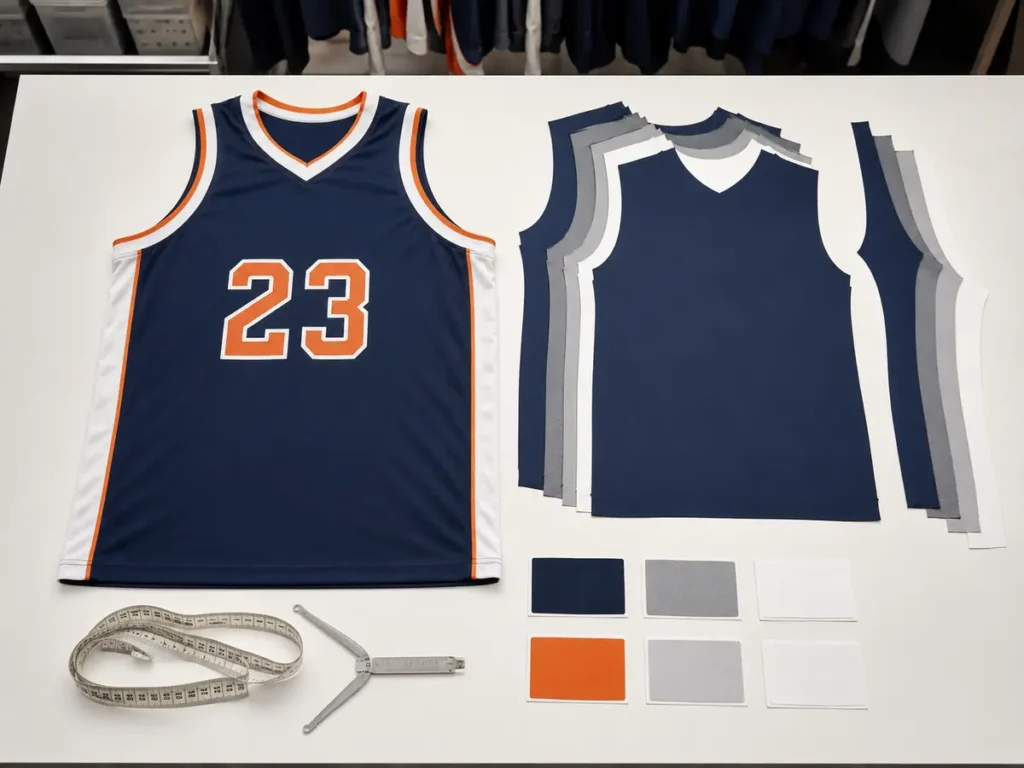
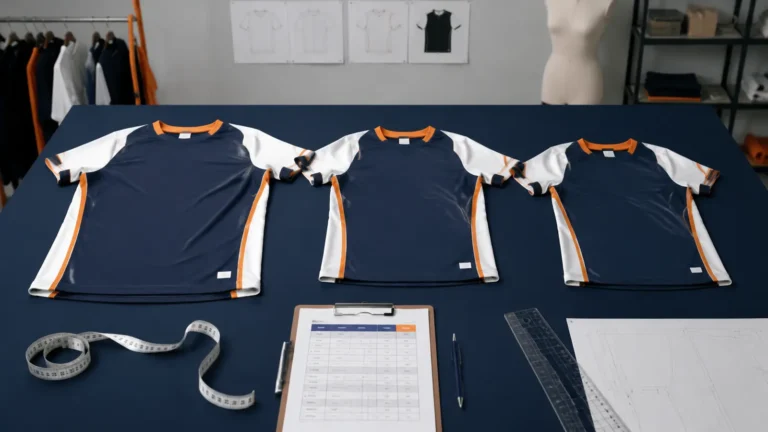
The approved sample should confirm fit, layout scale, color, construction, labels, and decoration—not only the graphic design.
For schools and clubs, use try-on samples when practical and record each player’s selected size. Do not infer youth sizes from age or assume that two suppliers use the same specification.
What to approve on the physical sample
- Garment measurements against the approved size chart
- Armhole and neckline comfort
- Opacity under strong indoor lighting
- Number and name dimensions
- Logo size, color, and placement
- Front-to-back and jersey-to-shorts artwork alignment
- Seam quality, binding, and loose-thread control
- Decoration adhesion or embroidery backing
- Wash appearance based on the approved care procedure
- Label content and placement
- Packaging and player sorting
Keep one signed or photographed approval sample as the reference for bulk inspection. Record any approved deviations in writing.
Planning a custom basketball uniform program? Send JIUMU your team logo, color references, quantity, size range, roster format, preferred decoration method, packaging needs, and target delivery date. Request a custom quotation or explore custom team jerseys.
What Determines Custom Basketball Jersey Cost?
The lowest unit price is not always the lowest program cost. Artwork revisions, roster errors, inconsistent reorders, and sorting mistakes create additional cost.
Main cost drivers include:
- Fabric type, weight, and panel construction
- Jersey-only versus jersey-and-shorts sets
- Number of sizes and pattern blocks
- Sublimation coverage or number of printed colors
- Embroidery stitch area and density
- Individual names and numbers
- Sponsor changes and multiple artwork versions
- Custom labels, hangtags, and retail packaging
- Player-by-player sorting or team-set packing
- Sample quantity and revision rounds
- Order quantity and reorder structure
- Inspection, testing, and delivery requirements
Request an itemized quotation that states what is included. If the price includes only a blank jersey while names, numbers, labels, or packaging are separate, comparisons can become misleading.
Prepare Clean Roster and Order Data
Personalization data should be treated like production data, not casual email text. Use a spreadsheet with one row per garment or player.
Recommended columns include:
| Field | Example purpose |
|---|---|
| Team or design code | Separates multiple colorways or squads |
| Player name | Exact spelling and capitalization for the back |
| Player number | Prevents duplicate or missing numbers |
| Jersey size | Links personalization to the correct garment |
| Shorts size | Allows mixed set sizing when permitted |
| Quantity | Covers duplicate items or staff jerseys |
| Sleeve or fit option | Distinguishes approved variants |
| Packaging group | Sorts by player, team, grade, or shipment |
| Approval status | Records buyer confirmation before release |
Validate duplicate numbers, unexpected characters, blank names, and inconsistent capitalization before sending the file. Freeze the approved version with a date or revision number. Late roster changes should be documented because they can affect print files, sorting, and schedule.
Quality Control for a Bulk Jersey Order
Quality control must compare production against the approved specification rather than against a vague expectation of “high quality.”
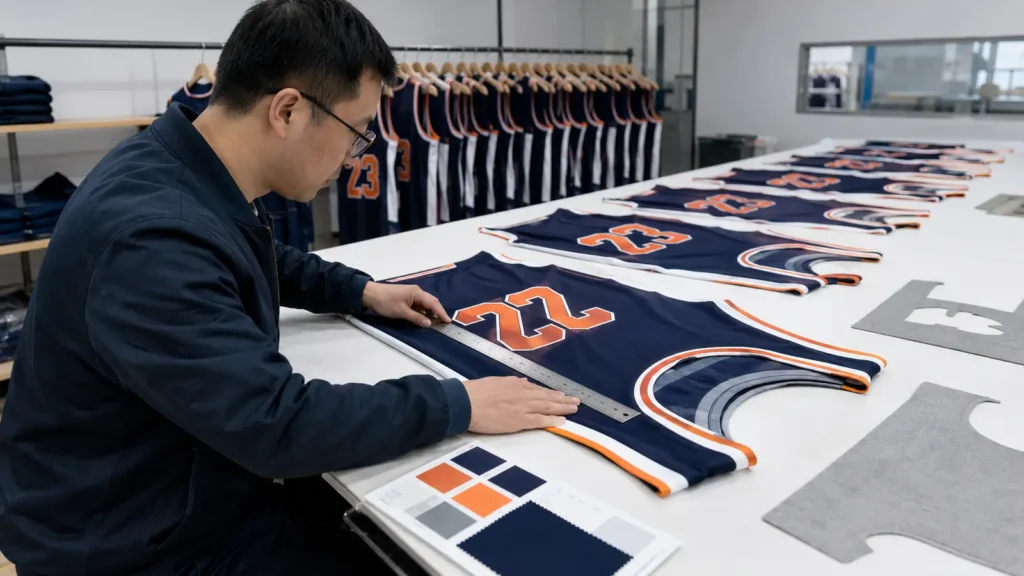
Bulk inspection should compare color, measurements, number placement, stitching, labels, and roster accuracy with the approved sample and order sheet.
Pre-production checks
- Final vector artwork and color references are approved.
- Front, back, side, and shorts layouts use the correct revision.
- Roster and size quantities reconcile with the purchase order.
- Decoration method and material are confirmed.
- Labels and packaging artwork are approved.
- The physical sample or equivalent reference is sealed.
In-process checks
- Printed panels match the approved shade range.
- Artwork scale and placement remain consistent by size.
- Cut pieces are paired correctly.
- Names and numbers match the production list.
- Seams do not distort key graphics.
- Bindings, trims, and panels use the approved materials.
Final inspection
- Randomly selected garments meet measurement tolerances.
- Names, numbers, and quantities match the roster.
- Logos are oriented correctly and visibly consistent.
- Stitching is secure and clean.
- Decoration shows no obvious lifting, cracking, or unintended marks.
- Labels match the destination-market specification.
- Sets are packed using the agreed team, player, or size method.
- Carton identification supports receiving and distribution.
Labeling Considerations for the United States and European Union
When jerseys will be resold, the buyer should confirm destination-market requirements with a qualified compliance professional. In the United States, the FTC states that covered textile products generally require fiber content, the manufacturer or marketer identity, and country-of-origin information. The FTC Care Labeling Rule also requires manufacturers and importers of covered apparel to attach supported care instructions. See the FTC Textile Fiber Rule and FTC care-label guidance.
For textiles marketed to end consumers in the European Union, official EU guidance says textile products generally must show fiber composition, with the label firmly attached; language requirements can depend on the countries where the product is made available. The EU guidance also notes that B2B documentation can sometimes replace or supplement labeling before consumer sale. See the EU textile-label guidance.
Do not copy a label from another product without confirming the actual fiber composition, responsible party, origin, care basis, and destination requirements.
Questions to Ask a Custom Basketball Jersey Supplier
- Which fabric codes, weights, knit structures, and color options are available?
- Can you provide adult, youth, women’s, or custom-fit size charts?
- Which decoration method do you recommend for this artwork, and why?
- How will front and back number dimensions be controlled across sizes?
- Can you produce coordinated light and dark sets with consistent team colors?
- What artwork format and color reference do you require?
- How are long player names and duplicate-number errors handled?
- What does the physical sample include, and which revisions are chargeable?
- Which tolerances apply to garment measurements and logo placement?
- How are color, roster accuracy, stitching, and packing checked before shipment?
- Can repeat orders use the same fabric, color reference, and artwork files?
- What label and packaging information must the buyer provide?
- Is the stated MOQ for one design, one colorway, or the total order?
- What information is needed to quote the target delivery schedule?
Common Basketball Jersey Design Mistakes
Designing before checking the rulebook
A layout can be attractive but unusable if numbers, logos, colors, or sponsor marks do not comply. Obtain the correct rules and buyer approval first.
Using low-contrast numbers
A tonal number may look sophisticated in a close mockup but disappear on court. Test the full jersey from a realistic viewing distance.
Sending raster logos from screenshots
Low-resolution artwork produces rough edges and inconsistent embroidery or printing. Supply vector files and approved color references.
Placing important artwork across seams
Seams and binding can interrupt letters, crests, and number outlines. Finalize the layout on the actual garment pattern.
Ignoring youth-size adaptation
A design scaled from an adult template can become crowded on smaller garments. Review the smallest ordered size before release.
Approving only a digital mockup
A screen cannot confirm fabric texture, opacity, fit, print shade, embroidery stiffness, transfer adhesion, or label placement. Approve a physical sample for a new program.
Treating the roster as an informal list
Misspellings and duplicate numbers become expensive when discovered after decoration. Use a structured, buyer-approved spreadsheet.
Forgetting repeat orders
Record fabric, color, artwork, label, and sample references. A repeat-order program needs more documentation than a one-time event order.
Why Buyers Work with JIUMU
Established in 2010 in Guangdong, China, JIUMU supports B2B custom teamwear, logo apparel, uniforms, bags, hats, and branded merchandise for buyers in North America and Europe. Relevant basketball jersey capabilities include OEM and ODM product development, sublimation printing, embroidery, screen printing, heat transfer, fabric sourcing, color matching, private labels, hangtags, packaging customization, digital mockups, physical samples, bulk production support, quality control, and export coordination.
JIUMU’s typical MOQ is 50 pieces, subject to garment structure and customization. Buyers can also plan coordinated programs that extend beyond jerseys to custom team uniforms, custom team jackets, custom hoodies, and custom team bags.
The most useful inquiry is specific. Share the intended market, competition type, reference images, vector logo, colors, size range, roster structure, order quantity, label and packaging needs, and target delivery date. JIUMU can then evaluate the construction and decoration path instead of guessing from a single picture.
Frequently Asked Questions
Final Recommendation
The most effective way to design custom basketball jerseys is to make every visual decision traceable to a playing, production, or purchasing requirement. Start with the rulebook and use case. Build a disciplined light-and-dark color system. Give the player number the clearest visual zone. Scale the layout across sizes. Match decoration to fabric and artwork. Approve a physical sample, lock the roster, and inspect bulk production against documented standards.
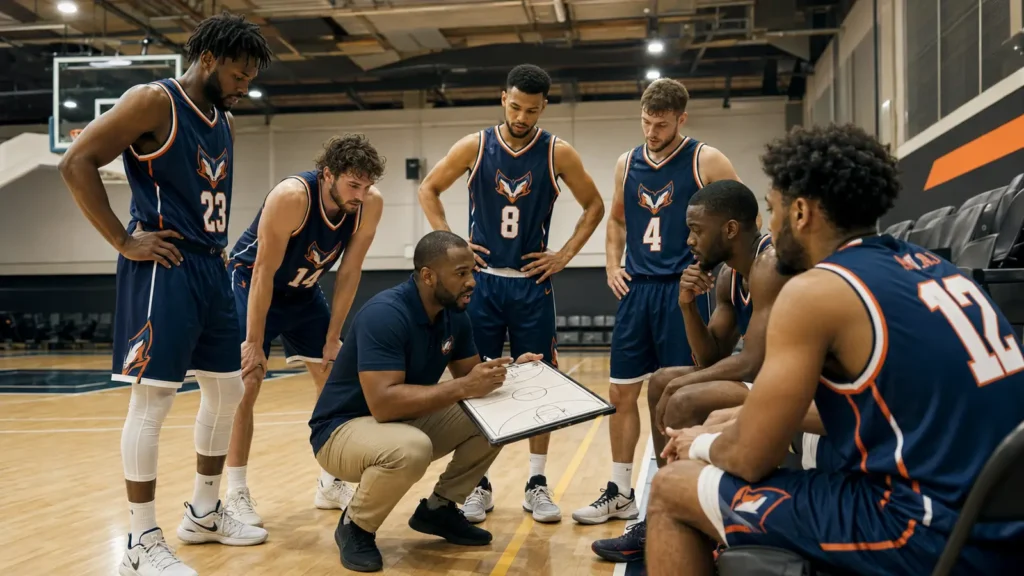
A complete uniform system creates consistent team recognition across players, sizes, and game situations.
If you are developing basketball jerseys for a school, club, academy, distributor, promotional program, or private-label brand, send JIUMU your logo, color references, quantity, size range, roster needs, packaging plan, and target delivery date. Contact JIUMU by inquiry form, WhatsApp or phone at +86 18507502899, or email zhengdong@jiumugear.com to request a custom quotation and sample plan.
Develop Your Custom Basketball Jersey Program
Send JIUMU your logo, colors, quantity, size range, roster format, packaging requirements, destination and target delivery date.
JIUMU Editorial Team
JIUMU is a Guangdong-based B2B custom teamwear and logo-apparel supplier established in 2010, supporting OEM/ODM development, decoration, samples, bulk quality control and export coordination.