Best Custom Hockey Jerseys for Teams: Complete Buying Guide
Choosing the best custom hockey jerseys for a team is not about finding the boldest graphic. It is a procurement decision that must balance on-ice mobility, equipment clearance, decoration durability, player identification, league requirements, repeat-order consistency, and budget.
A digital mockup can still fail in use if sleeves bind over elbow pads, the body is too narrow over shoulder pads, numbers lack contrast, or replacements do not match. Convert the design into a controlled specification before bulk production.
This guide explains how to compare game, practice, youth, adult, goalie, and fan-oriented hockey jerseys; how to evaluate fabrics and construction; when to use sublimation, embroidery, tackle twill, or heat transfer; and what to approve before placing a bulk order.
For most competitive school, club, and amateur teams, the best all-around custom hockey jersey is a polyester game jersey with an equipment-compatible athletic cut, breathable mesh or ventilated zones, reinforced high-stress seams, and fully sublimated colors, logos, names, and numbers. Sublimation is especially practical for complex graphics and large rosters because the decoration becomes part of the fabric rather than an additional layer.
That is not the only good specification. Tackle twill or embroidered crests can create a traditional dimensional appearance, while lightweight mesh is often the more economical choice for practice jerseys. Goaltenders need a separate pattern with substantially more room in the body and sleeves. The correct choice therefore depends on competition level, design, order quantity, care routine, target price, and the rules of the league or tournament.
What Does “Best” Mean for a Custom Hockey Jersey?
“Best” should mean best suited to a defined use, not most expensive or most heavily decorated. A buyer should judge a jersey against six practical outcomes:
- Fit over protective equipment: Players must be able to skate, reach, shoot, and rotate their shoulders without the jersey pulling across pads.
- Clear identification: Names and numbers should remain readable at game speed and under arena lighting.
- Durable construction: Seams, cuffs, collars, and decorated areas must tolerate repeated movement, contact, washing, and handling.
- Design control: Team colors, logo placement, sponsor marks, and roster details should match the approved artwork.
- Roster management: The supplier should be able to organize individualized names, numbers, sizes, and future replacement orders.
- Commercial suitability: The specification should fit the team’s budget, delivery plan, packaging needs, and intended sales market.
The strongest quotation is therefore not simply “a custom hockey jersey.” It is a defined garment: intended use, fit block, fabric, panel construction, decoration method, roster, artwork, labels, packaging, and inspection standard.
Best Custom Hockey Jersey Types by Team Use
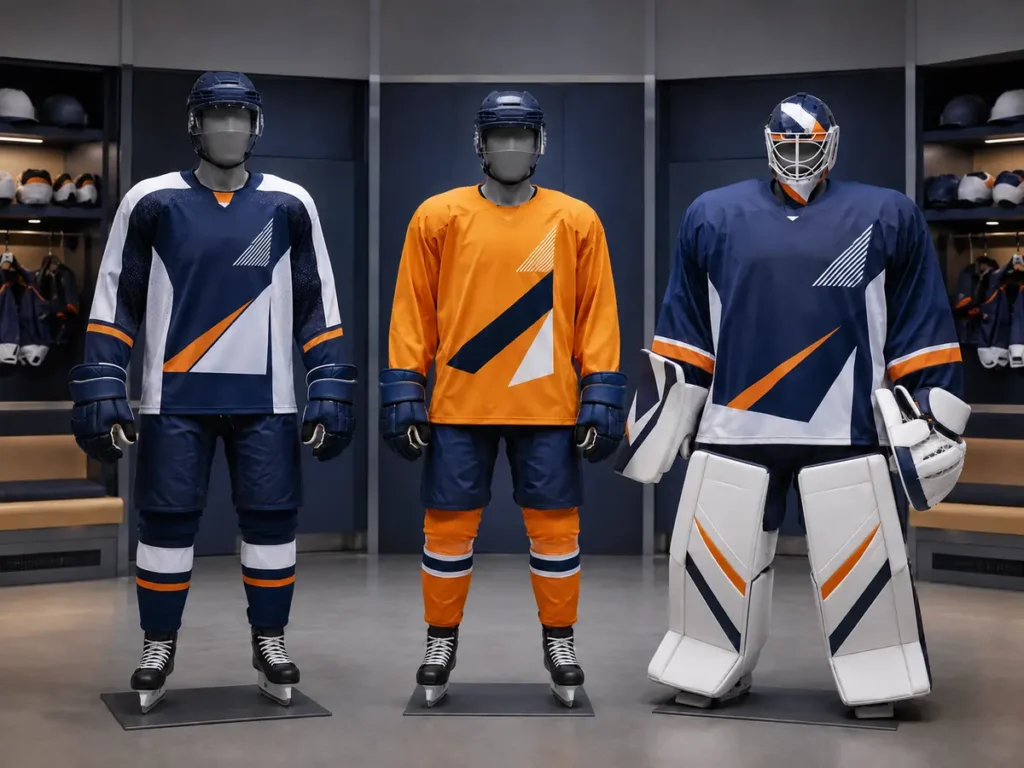
Game, practice, and goalie jerseys require different fabric, fit, and construction priorities.
| Team need | Recommended jersey direction | Key specification priority | Common risk |
|---|---|---|---|
| Competitive game jersey | Equipment-cut polyester body with ventilation, reinforced seams, and sublimated or sewn decoration | Mobility, number visibility, repeat consistency | Ordering a fashion fit that is too narrow over pads |
| Practice jersey | Lightweight breathable mesh or performance polyester with simple identification | Airflow, value, quick sorting by line or squad | Using thin fabric for heavy sewn patches |
| Youth team jersey | Youth-specific grading with room for pads and clearly controlled sleeve length | Age-appropriate fit, reorder planning, durable seams | Scaling down an adult pattern without testing |
| Adult recreational jersey | Relaxed equipment fit with easy-care decoration | Comfort across mixed body types | Collecting only casual T-shirt sizes |
| Goalie jersey | Dedicated goalie body and sleeve pattern | Chest-protector clearance, sleeve volume, hem width | Treating an oversized skater jersey as a goalie cut |
| Tournament jersey | Sublimated design with confirmed event rules and fixed roster deadline | Fast roster control, consistent colors, clear numbers | Late name or number changes after production starts |
| Retail or fan jersey | Lifestyle or replica fit, potentially with private labels and retail packaging | Brand presentation, labeling, sell-through sizing | Confusing fan sizing with on-ice equipment sizing |
Game Jerseys
Game jerseys need a stable balance of structure and mobility. The body should drape cleanly over shoulder pads without excessive loose fabric that can twist or snag. Sleeves should accommodate elbow pads and gloves while allowing the player to extend both arms. Underarm or side ventilation can help manage heat, but the mesh must be compatible with the graphic and construction plan.
For teams that use complex gradients, large color fields, sleeve graphics, or multiple sponsor marks, sublimation is usually the most efficient decoration system. For a classic hockey appearance, a sewn crest and tackle-twill numbers may be preferred, provided the added weight, labor, and care requirements fit the program.
Practice Jerseys
Practice jerseys are usually simpler and lighter. Their purpose may be to separate lines, identify players, or distinguish offense, defense, and goaltenders. A team can control cost by using fewer colors, a simple front logo, and a back number rather than reproducing the full game design.
Reinforced neck openings, stable sleeve seams, and color control still matter for frequently used practice jerseys.
Youth and School Hockey Jerseys
Youth sizing requires more than shortening an adult jersey. Proportions change across body width, sleeve length, neck opening, and hem. Protective equipment also varies by age group. A practical size set should be tested over the pads used by the intended players.
Schools should maintain an approved color reference, artwork file, size chart, number list, and construction specification for future replacement orders.
Goalie Jerseys
A goalie jersey is a separate product pattern. It requires additional volume for a chest protector, wider sleeves for arm and elbow protection, and enough hem width to move without riding up. The cuff must work with blocker and catcher equipment.
Ask the supplier for a dedicated goalie size chart and, where possible, approve a physical sample over the actual equipment. Simply moving a skater up several sizes can create sleeves that are long but still incorrectly shaped.
How to Choose Hockey Jersey Fabric
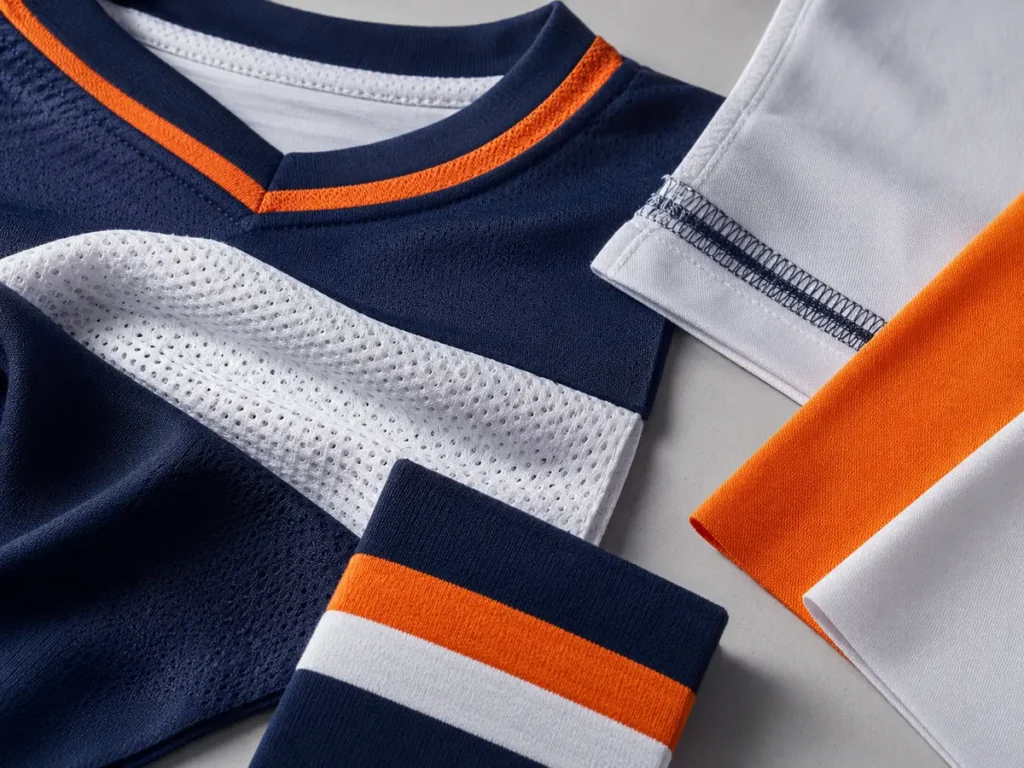
Fabric approval should cover the body knit, ventilation mesh, collar, cuffs, opacity, and color.
Most modern hockey jerseys use polyester because it can be engineered in different knits and meshes, manages printed color well, and supports practical teamwear care. “100% polyester,” however, does not describe performance by itself. Buyers should request the fabric construction, weight, stretch direction, hand feel, colorfastness expectations, and intended use.
Main Body Fabric
The main body needs enough stability to hold its shape over protective equipment. A smooth performance knit can carry detailed sublimated graphics, while a textured knit can create a more traditional appearance. Heavier is not automatically better: additional weight can increase structure and opacity but may also reduce airflow and raise shipping cost.
Ask for a swatch or sample in the actual color, especially when choosing white or a very light shade. Evaluate opacity over dark pads or base layers and check whether the fabric becomes noticeably transparent when stretched.
Mesh and Ventilation Zones
Mesh is commonly used in the underarm, side, or back areas to improve ventilation. The hole size and knit stability should suit the intended decoration. Very open mesh may cause fine printed details to look broken, while a light mesh may not support dense embroidery or large sewn patches without reinforcement.
Treat ventilation as part of the pattern, not a decorative afterthought. The best placement allows airflow without creating weak seams in high-contact areas.
Rib, Collar, and Cuff Materials
The neck opening is repeatedly stretched during dressing and removal. A ribbed or engineered collar should recover after use and remain comfortable around protective equipment. Cuffs must be wide enough for gloves but stable enough not to flare excessively.
When reviewing a sample, pull the collar gently in several directions, inspect the seam return, and verify that no rough seam allowance rubs the wearer. Confirm whether the collar is a V-neck, crossover, lace-up appearance, or another league-approved shape before artwork is finalized.
Sizing and Fit: Design Around Hockey Equipment
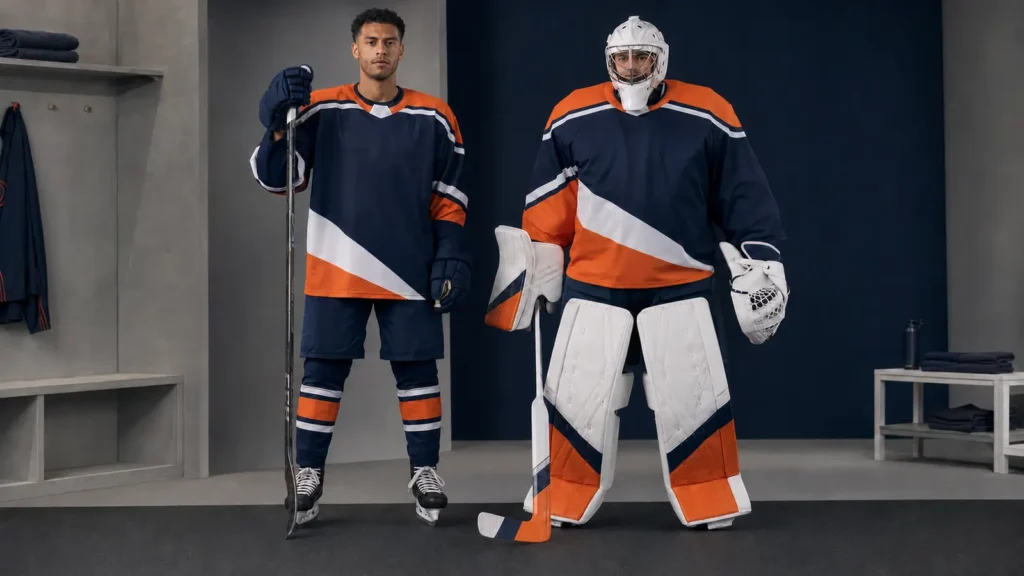
Skater and goalie patterns should be approved separately over the equipment used on ice.
Hockey jersey sizing should be evaluated over protective equipment. A player’s normal T-shirt size is only a starting point and can be misleading. The critical measurements are the finished garment dimensions and how they interact with shoulder pads, elbow pads, gloves, and pants.
| Measurement | Why it matters | How to approve it |
|---|---|---|
| Chest width | Determines room over shoulder and chest protection | Measure the jersey flat at the specified points and test over pads |
| Body length | Affects coverage, tuck preference, and whether the hem rides up | Check front and back length on a player in skating posture |
| Sleeve length | Controls glove overlap and arm extension | Measure from the defined shoulder or center-back point |
| Upper-sleeve width | Provides clearance for elbow pads | Flex and extend both arms while wearing full equipment |
| Cuff opening | Must work with glove gauntlets | Test with the team’s typical gloves |
| Neck opening | Affects dressing and comfort around neck protection | Confirm stretch, shape, and recovery |
| Hem width | Influences movement over pants and goalie equipment | Check lateral movement and torso rotation |
Build a Size Set Before Bulk Production
For a mixed youth and adult program, approving one medium sample is rarely sufficient. A size set reveals whether the grading works at the smallest and largest ends. Prioritize the sizes with the highest roster concentration plus both extremes.
The approval should record finished garment measurements and permitted tolerances. Do not rely only on body measurements. After approval, the roster spreadsheet should use the supplier’s exact size names rather than informal descriptions such as “large youth” or “adult medium-ish.”
Separate Skater and Goalie Rosters
Use separate columns or separate worksheets for skaters and goalies. The goalie size must map to a goalie pattern, not to the skater size range. Also identify any players who require extended body or sleeve adjustments before the final roster is locked.
Construction Details That Improve Durability
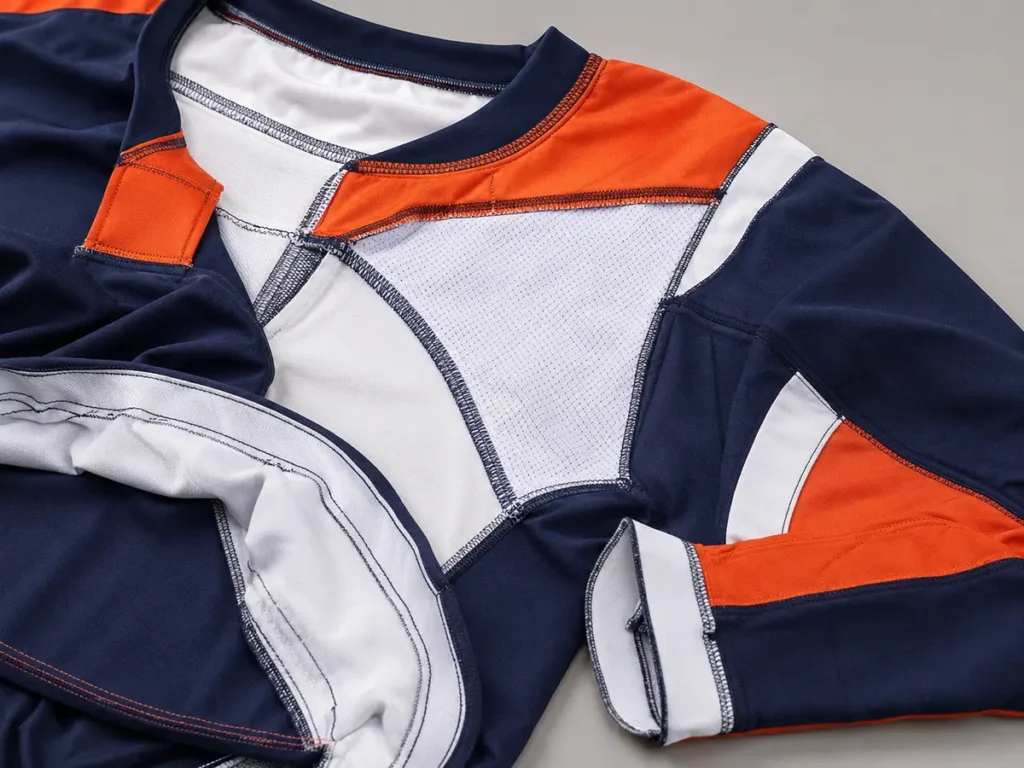
Inspect high-stress seams, reinforcement, panel joins, and the inside finish before bulk approval.
Durability comes from compatible materials and controlled construction, not from one isolated feature. Inspect the following areas:
Reinforced Shoulders and Elbows
Shoulder and elbow zones experience friction from pads, boards, benches, and repeated movement. Some programs benefit from reinforced panels or more stable fabric in these areas. The reinforcement should not create excessive stiffness or bulky internal edges.
Seams and Stress Points
Check stitch consistency at armholes, side seams, cuffs, collar joins, and panel intersections. Reinforcement at stress points can reduce seam opening, but the stitch type must still allow the garment to move. Ask how loose threads, skipped stitches, seam puckering, and uneven panel alignment are handled during inspection.
Graphic Alignment Across Panels
Sublimated stripes and graphics often cross sleeves, shoulders, side panels, and body seams. A digital mockup can show perfect alignment that is difficult to reproduce physically. Identify which joins are critical and set a realistic approval standard. Small shifts may be normal; a sponsor mark split by a seam or a visibly broken stripe should be avoided through artwork placement.
Best Decoration Methods for Custom Hockey Jerseys
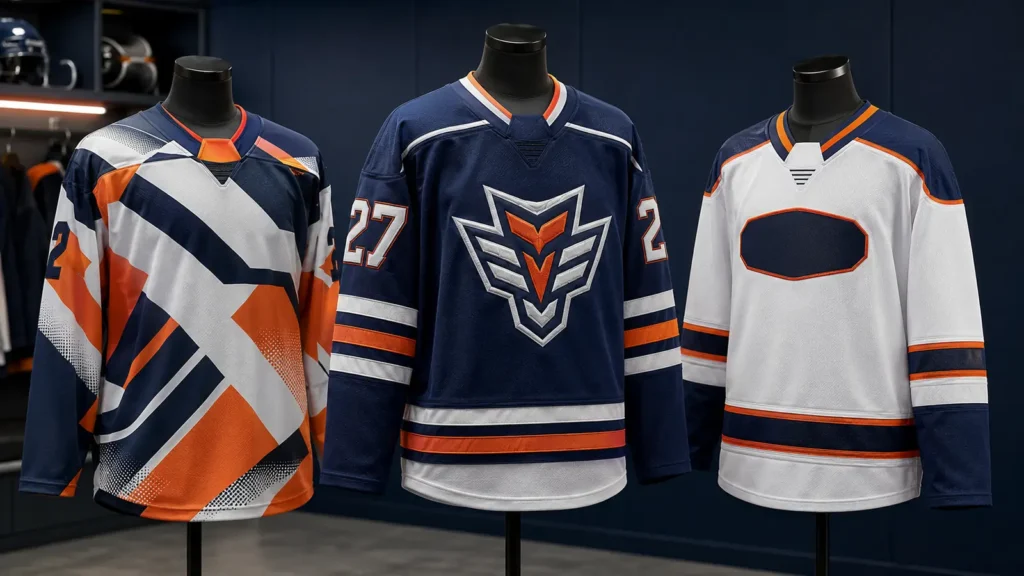
Choose decoration according to visual depth, design complexity, garment weight, and reorder needs.
The decoration method changes appearance, weight, durability, cost, and reorder complexity. Many successful programs combine methods—for example, a sublimated body with a sewn crest—but every added process should serve a clear purpose.
| Method | Best suited to | Main advantages | Procurement considerations |
|---|---|---|---|
| Full sublimation | Complex team graphics, gradients, many colors, individualized rosters | No heavy ink layer; names and numbers can be integrated into the design | Requires compatible polyester fabric and disciplined roster proofing |
| Embroidered crest | Traditional dimensional front logo | Textured, premium visual character | Adds weight and may need backing; fine details must be simplified |
| Tackle twill/appliqué | Classic names, numbers, and crests | Strong traditional hockey appearance | More labor, layers, and sewing; check edge security and weight |
| Heat transfer | Small sponsor marks, short runs, selected personalization | Flexible placement and useful for some late additions | Compatibility, edge adhesion, care, and repeated-wash performance must be sampled |
| Screen printing | Simple graphics on suitable practice or merchandise jerseys | Can be efficient for limited-color designs | Not ideal for every mesh, stretch level, or highly individualized roster |
Sublimation
Sublimation transfers dye into compatible polyester fibers. It is well suited to all-over graphics, gradients, sleeve patterns, and individualized names and numbers. Because the visual is integrated into the fabric, there is no thick printed film sitting on top of the jersey.
The main risks are artwork and color control. Confirm a print strike-off or sample, gradient transitions, seam alignment, and every roster entry before production.
Embroidery and Sewn Crests
Embroidery creates a textured result but can become stiff when a crest is large or densely stitched. Ask for a physical sample or embroidery strike-off. Fine lines and small lettering may need to be simplified so the crest remains legible.
The supplier should also define the backing, edge finish, attachment method, and placement tolerance. For performance jerseys, consider whether the crest flexes comfortably over pads.
Tackle Twill
Tackle twill uses cut fabric layers sewn to the garment, commonly for traditional hockey names and numbers. One- or two-layer constructions can create strong contrast and depth. Buyers should inspect cut accuracy, stitch density, corners, inner openings, layer registration, and edge security.
This method usually costs more than integrated sublimation because it requires material cutting, placement, and sewing for each identity. It can nevertheless be the right choice when heritage styling is central to the program.
Heat Transfer and Sponsor Marks
Heat transfer can be useful for sponsor logos, limited additions, and some small-quantity personalization. Performance depends on the film, adhesive, fabric, heat settings, pressure, placement, and care routine. Approval should use the actual fabric and decoration combination rather than a generic transfer sample.
If sponsor information may change each season, position marks so they can be managed without compromising the main team identity.
Need a Specification-Based Hockey Jersey Quote?
Send JIUMU your roster quantity, skater and goalie sizes, reference artwork, team colors, logo files, preferred decoration, packaging needs, target market, and required delivery date. The team can review the concept for OEM/ODM development, prepare a digital mockup, and confirm the appropriate sampling path.
Check League Rules Before Finalizing Artwork
Uniform rules differ by governing body, league, age group, and tournament. Obtain the current written requirements before approving number ranges, number size, captain letters, sponsor placement, home and away colors, and any event marks.
For example, the current USA Hockey Rule 203 says each player and goalkeeper on the roster must wear a visible, individually identifying whole number from 0 through 99 that is proportionate to the participant, and all players on a team must be dressed uniformly. USA Hockey also addresses captain and alternate markings in Rule 202.
International programs should consult the latest materials on the IIHF Rules and Regulations page. As of July 2026, the IIHF lists its 2026/27 rulebook, with Rule 9 covering uniforms. These examples are useful checkpoints, but the purchasing team remains responsible for confirming the exact rules that apply to its competition.
Home and Away Color Planning
Many programs need a light and a dark set. Do not create two visually similar designs that are difficult to distinguish on ice. Confirm contrast under rink lighting and make sure numbers remain readable against every background area. If the number crosses a gradient or pattern, add a consistent outline or containment shape as permitted by the league.
Textile Labels for Retail or Distribution
Teams buying only for internal use may have different obligations from brands importing and reselling jerseys. U.S. buyers should review the Federal Trade Commission’s textile labeling guidance, which explains that most covered textile products need fiber content, country of origin, and manufacturer or responsible-business identification; garments also fall under care-label requirements.
For products marketed in the European Union, Regulation (EU) No 1007/2011 governs textile fiber names and related fiber-composition labeling. Buyers should obtain market-specific compliance advice and give the supplier approved label copy rather than assuming one label works in every country.
What Drives the Cost of Custom Hockey Jerseys?
The final price depends on the specification and order structure. Compare quotations built from the same inputs.
Major cost drivers include:
- Fabric and panel construction: Specialized knits, mesh combinations, reinforcement, and more pattern pieces can increase material and sewing cost.
- Decoration method: Full sublimation can simplify multi-color artwork, while tackle twill, embroidery, and sewn patches add materials and labor.
- Individual personalization: Unique names and numbers require roster management and proofing even when decoration is sublimated.
- Quantity and size mix: A fragmented order with youth, adult, goalie, and custom-length patterns is more complex than one standard size run.
- Sampling: Physical prototypes, size sets, color strike-offs, and revised samples add cost but can reduce bulk-order risk.
- Private labeling and packaging: Neck labels, care labels, hangtags, barcodes, individual polybags, and carton sorting require setup and handling.
- Delivery method and deadline: Production schedule, freight method, destination, and seasonal capacity affect the landed plan.
Ask for a quotation that separates unit product cost, sampling, optional decoration, packaging, and freight. This makes it easier to simplify the specification without compromising the elements that matter most.
Quality-Control Checklist for Bulk Hockey Jersey Orders
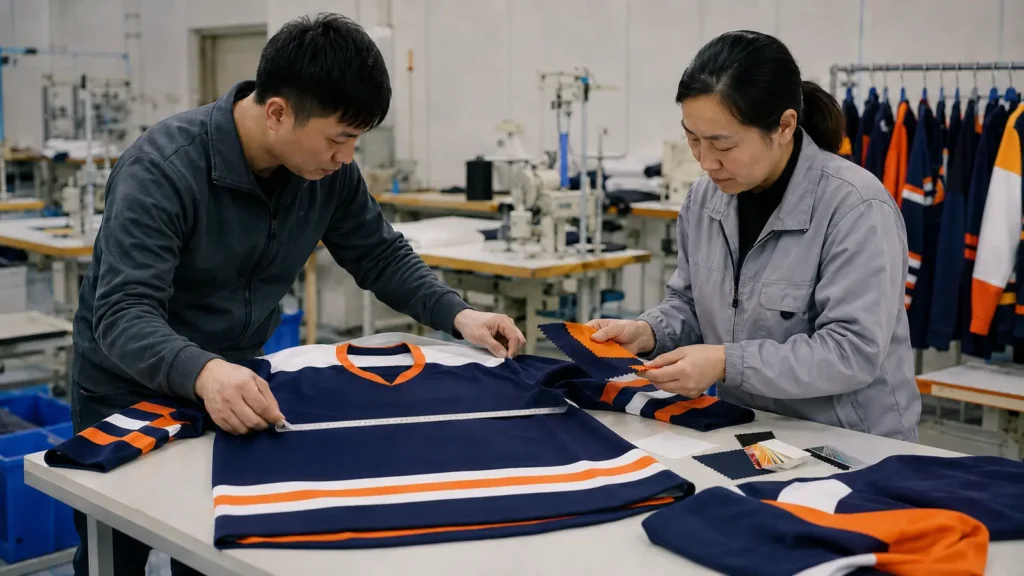
Bulk inspection should verify measurements, color, artwork, roster details, stitching, labels, and packaging.
Quality approval should happen in stages. A final inspection cannot fully correct an unclear specification or an unapproved roster.
1. Artwork and Roster Review
Confirm the team name, logo version, Pantone or approved color reference, name spelling, number, size, captain designation, sponsor artwork, and placement for every player. Use one controlled spreadsheet and assign one person to approve it.
2. Pre-Production Sample
Review the sample on a wearer with full hockey equipment. Check mobility, sleeve and body dimensions, collar comfort, opacity, graphic scale, number readability, decoration hand feel, and inside construction. Photograph the approved sample and record any approved changes in writing.
3. Size-Set or Key-Size Approval
Approve enough sizes to verify grading, particularly the smallest youth size, the most common roster sizes, the largest skater size, and at least one goalie size. Compare finished measurements with the approved chart.
4. Bulk Production Checks
During or after production, verify:
- Correct quantity by style, color, size, name, and number
- Fabric, mesh, rib, and trim match the approved specification
- Color consistency within the order
- Graphic placement and seam alignment
- Number and name spelling
- Stitching at armholes, side seams, collar, cuffs, and panel joins
- Decoration attachment and clean edges
- Finished garment measurements within agreed tolerances
- Correct labels, hangtags, barcodes, and packaging
- Carton assortment and shipping marks
5. Reorder Reference
Keep the approved sample, artwork files, bill of materials or fabric reference, measurement chart, decoration details, and order photos. A color name such as “royal blue” is not enough to control a later replacement. Reorders are strongest when the original specification remains identifiable.
How to Plan a Bulk Custom Hockey Jersey Order
Step 1: Define the Program
State whether the garments are for competitive games, practices, tournaments, fan merchandise, or resale. Identify the governing league, destination market, expected roster size, and whether home and away sets are needed.
Step 2: Send Usable Artwork
Provide vector logo files where available, along with team colors and sponsor marks. Reference photos are useful for direction, but they should not replace an owned or licensed logo file. Confirm that the buyer has permission to reproduce all marks.
Step 3: Select Fit, Fabric, and Decoration
Choose skater, goalie, youth, adult, or fan fits. Define the body and mesh fabrics, collar, hem, reinforcement, and decoration. If uncertain, ask the supplier to present two controlled options with the differences stated clearly.
Step 4: Build the Roster
Use structured columns for player name, display name, number, size, fit type, captain letter, and special notes. Lock the roster by a stated deadline. Do not submit late changes through multiple chat threads.
Step 5: Approve Mockup and Sample
The digital mockup controls visible design, while the physical sample controls material, construction, fit, and real color. Approve both. If the sample is revised, state exactly which version becomes the bulk reference.
Questions to Ask a Hockey Jersey Supplier
- Do you offer separate skater and goalie patterns?
- Can you provide finished garment measurements for youth and adult sizes?
- Which body and mesh fabrics are recommended for game and practice use?
- Can I approve a fabric swatch, color strike-off, or physical sample?
- Which decoration methods can be combined on this fabric?
- How do you control personalized names, numbers, and captain letters?
- What measurement and visual tolerances will apply?
- Can you supply compliant labels, hangtags, barcodes, and custom packaging?
- What is the MOQ and repeat-order process for this exact construction?
- What are the sample, production, and shipping milestones?
Common Buying Mistakes
Selecting by Unit Price Alone
A lower quotation may use a different fabric, pattern, reinforcement, or inspection plan. Compare matched specifications and landed cost.
Approving Only a Digital Mockup
A mockup cannot prove fit, fabric opacity, collar recovery, seam comfort, or decoration weight. Use a physical sample when the order value or schedule risk justifies it.
Mixing Player and Fan Fits
On-ice jerseys must fit over equipment; fan jerseys usually do not. Name them separately in every document.
Sending an Uncontrolled Roster
Names and numbers copied from email, chat, and separate spreadsheets create avoidable errors. Use one final roster with a dated approval.
Ignoring Goalies Until the End
Goalies need a dedicated pattern and should be part of sampling and roster planning from the beginning.
Assuming a Future Reorder Will Match Automatically
Fabric lots, components, and printing conditions can change. Retain an approved reference and ask the supplier how repeat orders are controlled.
Why Work With JIUMU for Custom Team Jerseys?
JIUMU is a Guangdong-based B2B custom teamwear and logo-apparel supplier established in 2010. The company supports OEM and ODM development for schools, sports clubs, academies, distributors, uniform dealers, promotional buyers, retailers, and private-label brands in North America and Europe.
Available customization capabilities include sublimation printing, embroidery, screen printing, heat transfer, woven and rubber/PVC patches, fabric sourcing, Pantone color matching, private labels, hangtags, packaging customization, digital mockups, physical samples, bulk production, quality control, and export support.
The typical MOQ is 50 pieces, subject to the hockey jersey construction and customization. Buyers can also explore JIUMU’s broader custom team jerseys, custom team uniforms, custom team jackets, custom hoodies, and custom team bags for a coordinated program.
Frequently Asked Questions
Final Recommendation

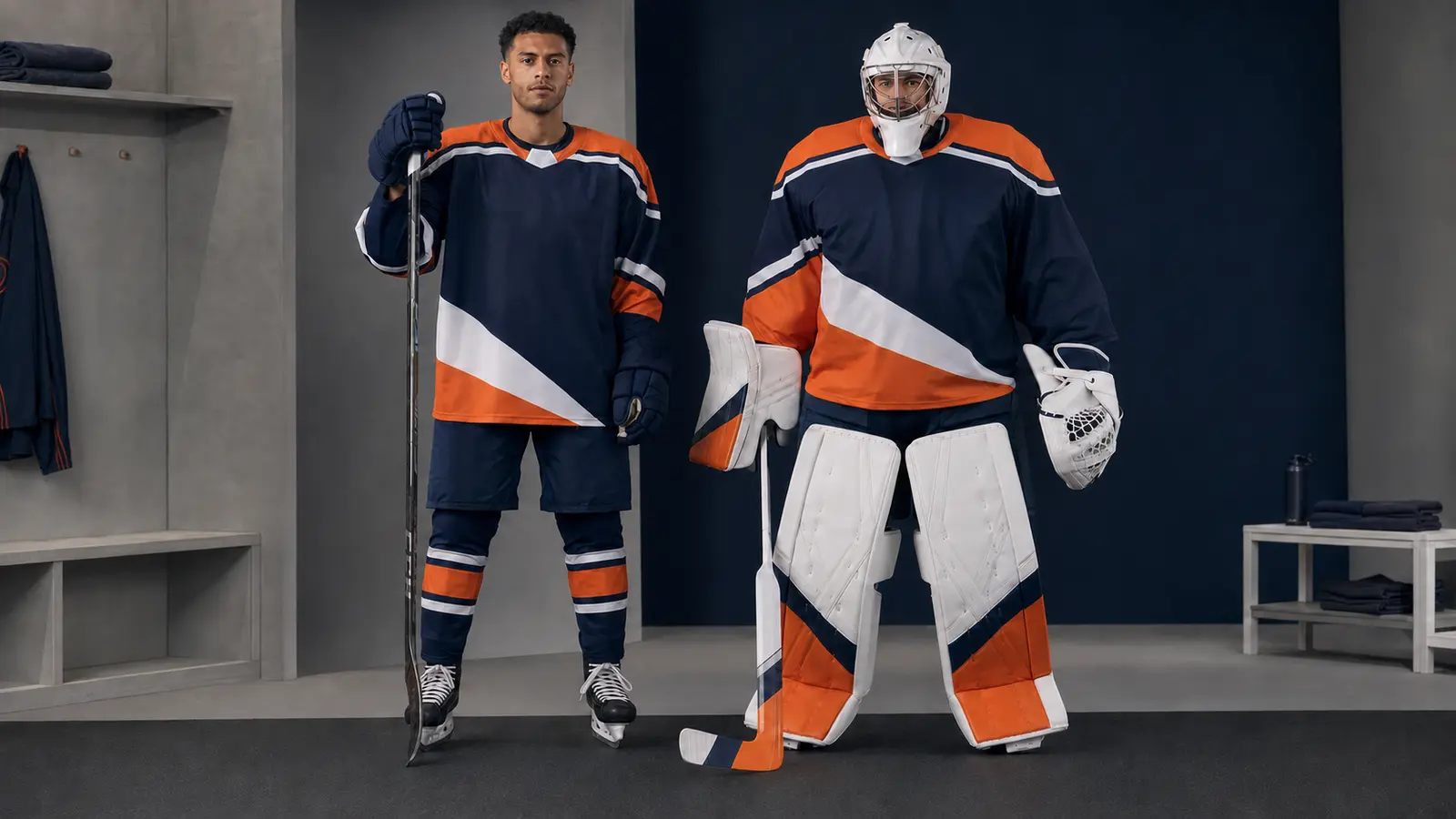
A complete team program can coordinate light and dark jerseys while keeping colors clearly distinguishable.
The best custom hockey jerseys for teams are built from a controlled, use-specific specification. For most competitive programs, start with an equipment-compatible polyester game cut, planned ventilation, reinforced stress areas, clearly readable numbers, and sublimated graphics or a carefully sampled sewn-decoration system. Keep goalie and fan fits separate, approve real samples over equipment, and lock the roster before bulk production.
The supplier should turn artwork into a repeatable garment with controlled fit, fabric, construction, decoration, color, personalization, labeling, packaging, and reorder records.
About the JIUMU Teamwear Sourcing Team
JIUMU prepares practical B2B sourcing guidance for schools, sports clubs, distributors, uniform dealers, promotional buyers, and private-label brands. This article was reviewed against current official rule and textile-labeling sources available on July 30, 2026.