How to Wash Sports Jerseys Without Damaging Names, Numbers or Logos
Sports jerseys are built for movement, sweat and repeated use, but their decoration is not indestructible. High water temperature, strong chemicals, aggressive agitation and direct dryer heat can fade colors, weaken adhesives, distort patches or crack printed names and numbers. The safest process begins with one simple rule: read the garment’s care label and treat its most delicate component—fabric, print, patch or trim—as the limit for the entire wash.
This guide explains how to wash sports jerseys at home or as part of a school, club, league or team-equipment program. It covers polyester performance jerseys, sublimated uniforms, heat-transfer graphics, screen prints, embroidery, tackle twill and patches. It also shows B2B buyers how wash testing and clear care instructions should be built into a custom teamwear order.
Quick Answer: Turn the jersey inside out, close fasteners, separate it from rough or heavily soiled items, and place it in a mesh laundry bag when extra protection is needed. Use cold water, a gentle cycle and a small amount of mild detergent. Skip chlorine bleach and fabric softener. Remove the jersey promptly, reshape it and air-dry it away from high heat and harsh direct sun. Always follow the sewn care label if it differs from this general method.
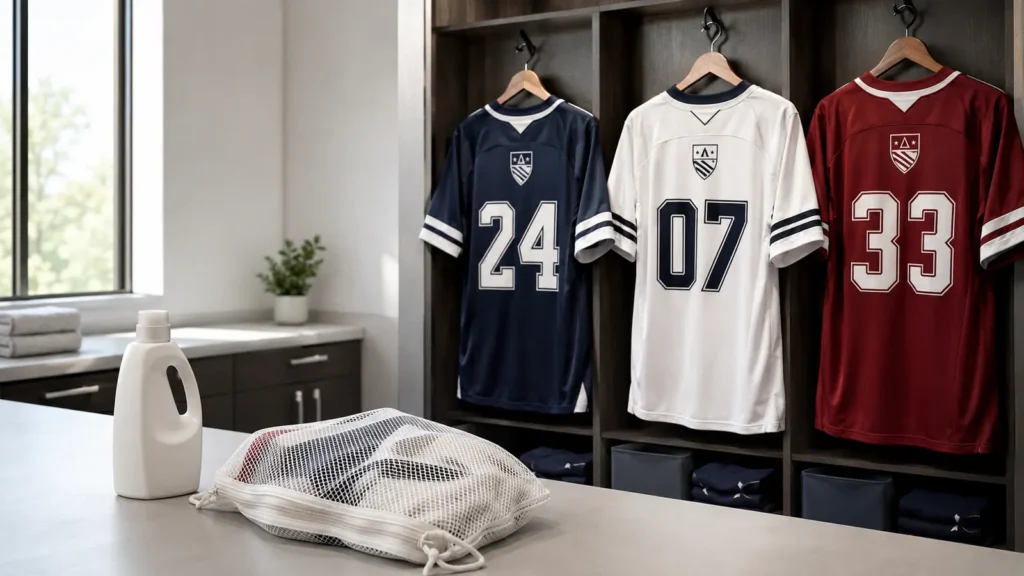
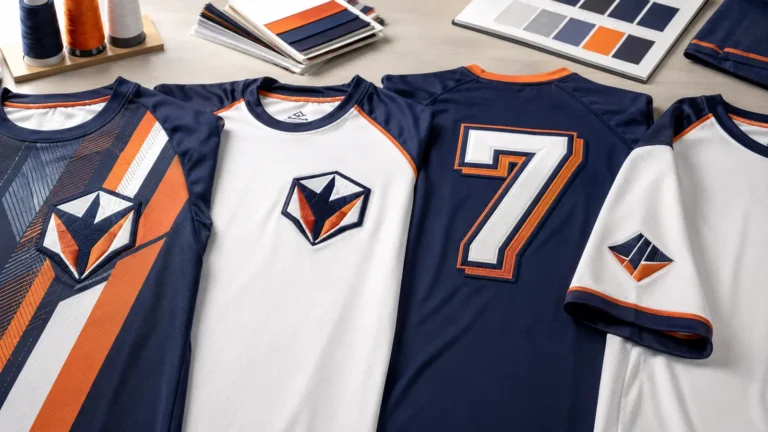
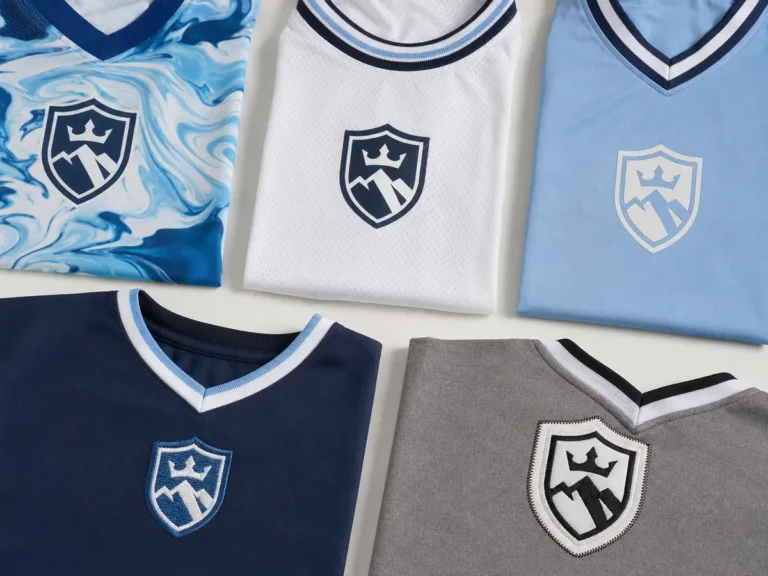
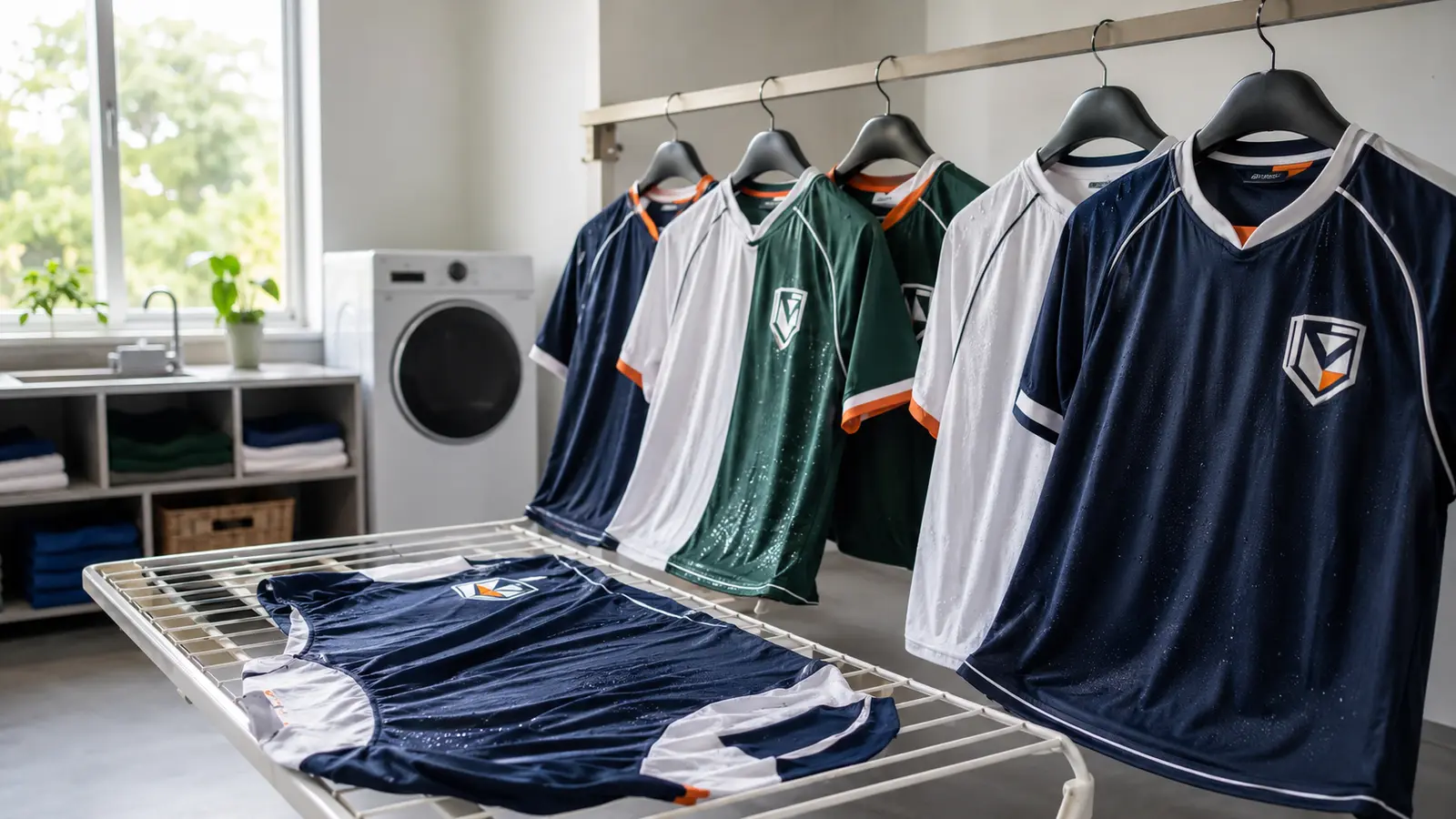
Custom sports jerseys prepared for careful washing in a clean team equipment room
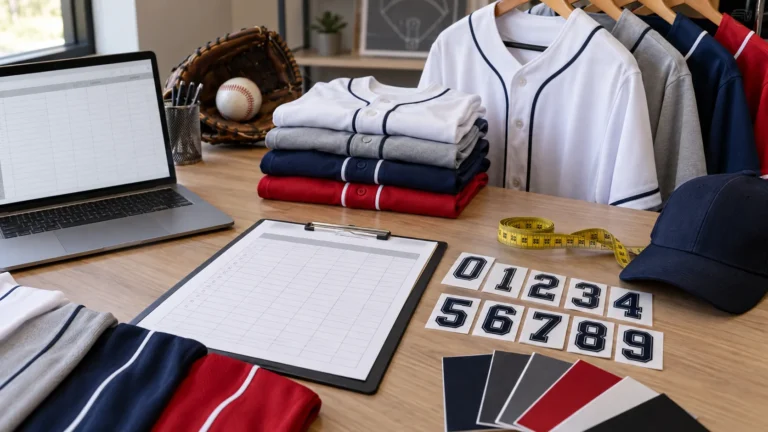
Specify Wash Performance Before Ordering Team Jerseys
Before approving a bulk jersey order, record the fabric, decoration method, intended wash frequency, care-label instructions, colorfastness expectations, sample wash-test method, roster, quantity, and replacement-order requirements. Test a production-intent sample using the same care process the team will actually follow.
Compare custom team jerseys and custom team uniforms, then request a team jersey quotation with your artwork and wash requirements.
Why Names, Numbers and Logos Are Vulnerable in the Wash
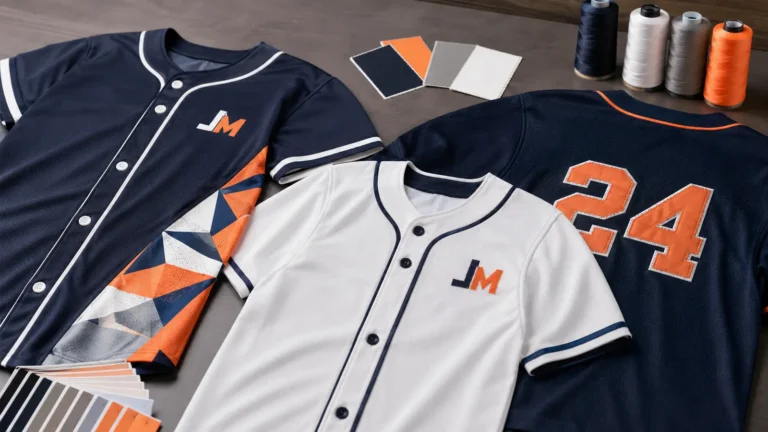
A jersey is a system of different materials. The main body may be knitted polyester, while the player number may be a heat-applied film, the crest may be embroidered, the sponsor mark may be screen printed and a sleeve patch may contain another substrate or adhesive. Each component reacts differently to heat, chemicals, water and mechanical stress.
Four forces cause most wash-related damage:
- Heat: Hot water and high dryer temperatures can soften some adhesives, shrink supporting fabrics and accelerate cracking or distortion.
- Friction: Zippers, hook-and-loop fasteners, rough towels and overloaded machines can scrape a printed surface or catch an embroidered edge.
- Chemistry: Chlorine bleach, stain removers, solvents and excessive detergent may affect color, fibers, coatings or adhesives.
- Tension: Wringing, hard scrubbing and stretching a wet jersey can distort the knit and stress the edges of names, numbers and patches.
The goal is not simply to make the jersey clean. It is to remove soil and odor while controlling these four risks.
Safe Jersey-Washing Settings at a Glance
This table is a conservative starting point for common washable team jerseys. The sewn care label takes priority because the manufacturer can account for the complete garment.
| Decision | Safer default | Why it helps | Check before proceeding |
|---|---|---|---|
| Water temperature | Cold, commonly 20–30°C / 68–86°F | Reduces heat exposure and helps limit color transfer, shrinkage and graphic stress | Care label and stain type |
| Cycle | Gentle or delicate | Reduces rubbing, twisting and impact | Machine load and fabric weight |
| Detergent | Small dose of mild liquid detergent | Cleans with less residue and fewer undissolved particles | Product instructions and water hardness |
| Garment position | Inside out | Reduces direct abrasion on exterior graphics | Confirm no loose decoration first |
| Load | Similar lightweight sportswear | Avoids friction from denim, towels, hardware and heavy cotton | Colorfastness and soil level |
| Protection | Mesh laundry bag | Adds a barrier against snagging and rubbing | Use a bag large enough for movement |
| Bleach | Avoid unless the care label expressly permits a suitable product | Chlorine can damage color, fibers and decoration | Never assume a white jersey is bleach-safe |
| Fabric softener | Avoid | May leave residue on performance fibers and interfere with moisture management | Follow the fabric supplier’s instructions |
| Drying | Air-dry, reshaped, away from high heat | Limits heat and tumbling stress | Care label; support heavy wet areas |
| Ironing | Avoid direct contact with graphics | Heat can mark, melt or lift decoration | If permitted, use low heat from the reverse with a barrier |
Nike’s jersey-care guidance also recommends turning a jersey inside out, washing in cold water on a gentle cycle and avoiding fabric softener. Heat-transfer material suppliers may publish product-specific instructions; for example, STAHLS’ advises inside-out washing with mild detergent and no bleach for one of its heat-transfer films. These sources support the conservative method, but neither replaces the label on the specific jersey in front of you.
How to Wash a Sports Jersey Step by Step
1. Read the care label before doing anything else
Check the permanent label for washing temperature, cycle, bleach, tumble-drying and ironing instructions. Look for additional warnings such as “wash separately,” “do not soak,” “do not iron decoration” or “line dry.”
In the United States, the Federal Trade Commission says covered manufacturers and importers must provide complete regular-care instructions, ensure that following those instructions will not cause substantial harm and warn against care procedures that consumers might reasonably assume are safe but would damage the garment. The FTC’s Care Labeling Rule guidance also says care instructions need a reasonable basis.
If the label is missing, unreadable or clearly belongs to a different product, use the cold, gentle, air-dry method and test any treatment on a concealed area. For a valuable signed, vintage or collectible jersey, consult a textile conservator or specialist cleaner rather than experimenting.
2. Inspect the name, number, logo, seams and patches
Lay the jersey flat under good light. Check for:
- lifting corners on heat-transfer numbers;
- cracked or flaking prints;
- loose embroidery threads;
- detached tackle-twill stitching;
- curling patch edges;
- open seams or small fabric tears; and
- dye transfer or unknown stains.
Washing does not repair an existing bond failure. If a decoration is already lifting, machine action can worsen it. Photograph the issue, set the jersey aside and ask the supplier, decorator or a professional repair service for the correct reapplication method. Do not place a household iron directly on a graphic.
3. Empty pockets and close fasteners
Remove tape, paper, mud, gum and forgotten items. Close zippers, snaps and hook-and-loop tabs so they cannot catch the jersey. If the garment has a detachable belt or accessory, wash it separately according to its own label.
Shake off dry dirt outdoors and use a soft brush only on undecorated, durable areas. Do not scrape dried mud across a printed logo.
4. Turn the jersey inside out
Washing inside out puts the body-side fabric—where sweat and skin oils collect—closer to the wash water while reducing direct contact between exterior decoration and the drum or other garments. It is especially helpful for heat-applied names, numbers and sponsor marks.
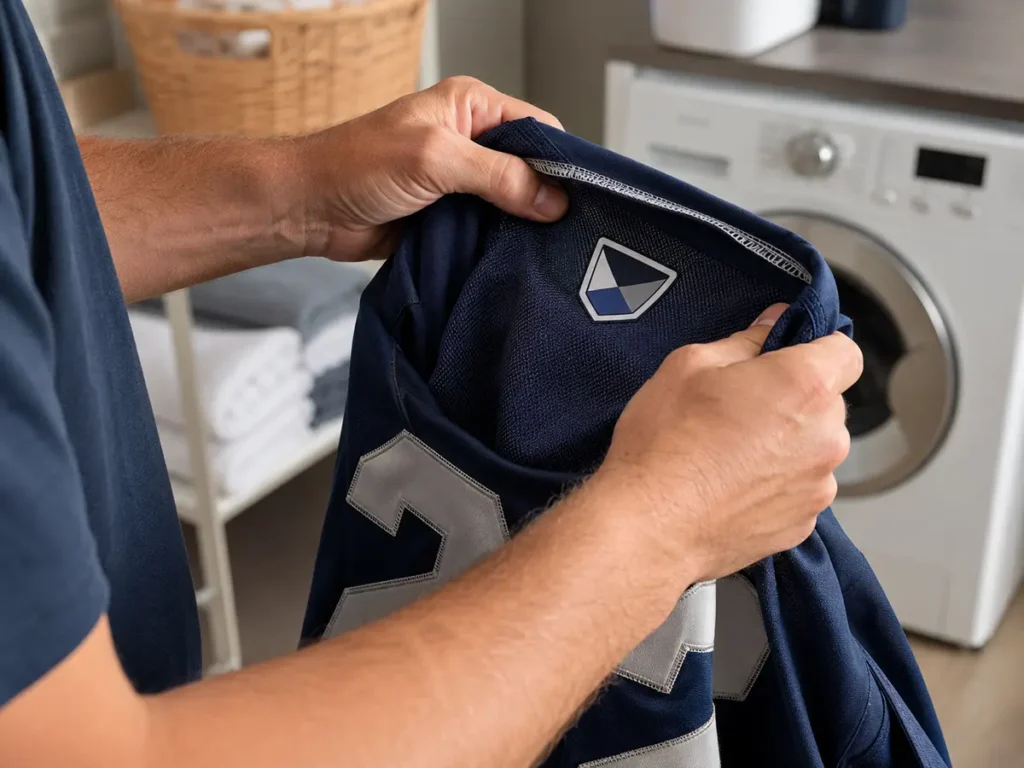
Equipment manager turning a numbered sports jersey inside out before washing
5. Sort by color, fabric weight and soil level
Keep white and light jerseys separate from dark or strongly colored garments, especially during early washes. Separate sports jerseys from:
- jeans and garments with metal hardware;
- towels, fleece and lint-producing cotton;
- uniforms covered in clay, oil or heavy dirt;
- garments with open hook-and-loop fasteners; and
- items treated with bleach or strong stain chemicals.
For a team load, sort by decoration method as well as color when possible. A lightweight sublimated jersey and a heavy stitched jersey may have different drying needs even if their fabric colors match.
6. Pretreat stains gently
Treat stains as soon as practical, but identify the stain and decoration before choosing a product. Blot excess liquid. Rinse loose soil from the reverse of the fabric with cool water when the care label allows it. Apply a small amount of mild detergent or a jersey-safe stain treatment to an inconspicuous area first.
Work from the edge of the stain toward the center. Use fingertips or a soft white cloth and light pressure. Do not scrub across a heat-transfer film, screen print, patch surface or embroidered edge. Avoid soaking the entire jersey for long periods unless the label and decoration supplier permit it.
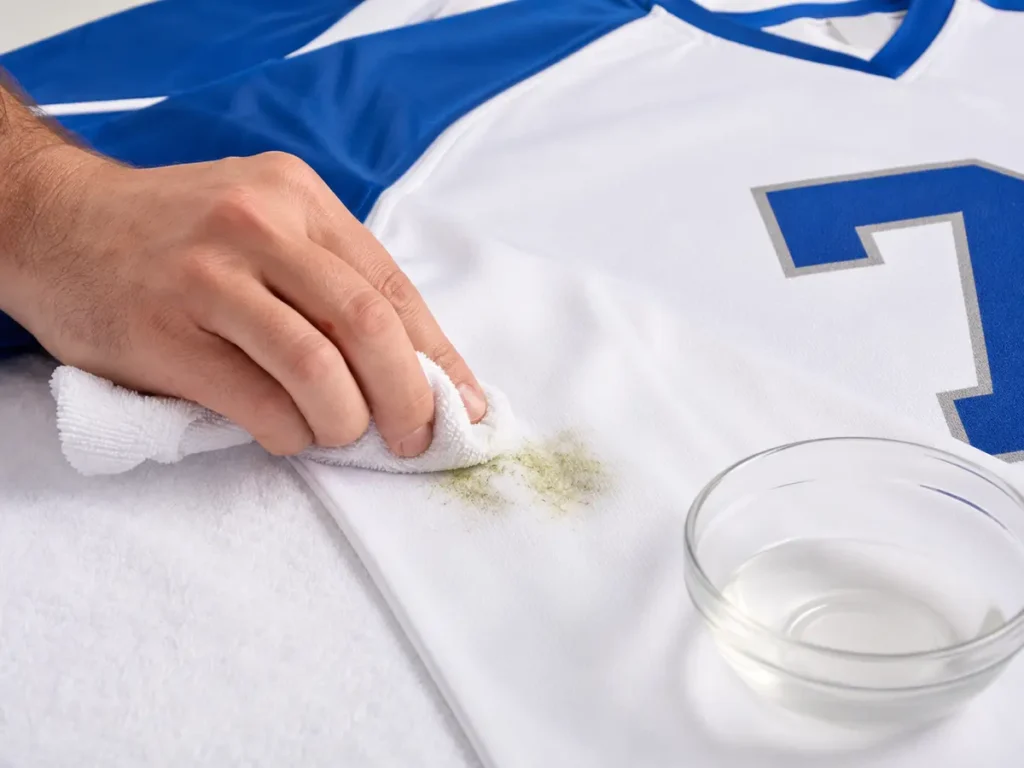
Grass stain being gently blotted on a sports jersey before washing
Common stains and a cautious first response
| Stain | First action | Avoid |
|---|---|---|
| Sweat and body oils | Rinse or pretreat the inside underarm and collar areas with cool water and mild detergent | Pouring concentrated product onto exterior graphics |
| Grass | Blot, test a mild stain treatment, then gently work the fabric from the reverse | Hard brushing over numbers or logos |
| Dirt or clay | Let thick surface mud dry, remove loose material, then rinse from the reverse | Grinding grit into the knit |
| Blood | Rinse promptly with cold water and follow the care label | Hot water, which can set protein stains |
| Food or sports drink | Blot, rinse cool and pretreat lightly | Rubbing colored liquid across a larger area |
| Adhesive or gum | Isolate the area and seek product-specific advice | Solvents near prints, coatings or synthetic fibers |
Never mix cleaning chemicals. If a stain treatment conflicts with the care label, the label wins.
7. Use a mesh laundry bag when friction risk is high
A large mesh bag can reduce contact with the drum and other garments. Do not stuff several jerseys tightly into one small bag; water and detergent still need to circulate. Use separate bags for a jersey with delicate patches, lightweight mesh panels or an already fragile surface.
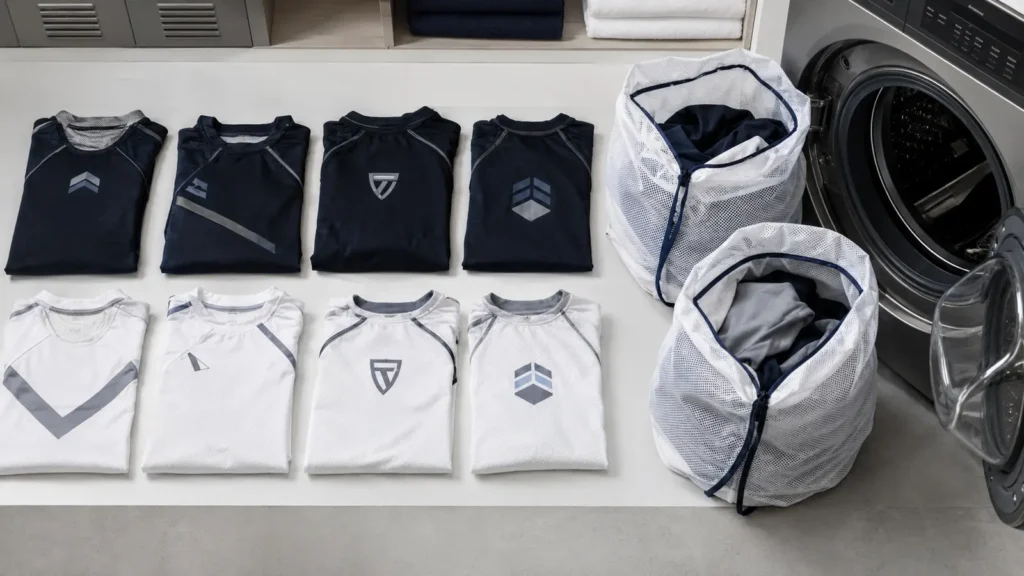
Dark and light sports jerseys sorted into mesh laundry bags before washing
8. Select cold water, a gentle cycle and mild detergent
Use the lowest temperature and mildest cycle that the care label permits and that can handle the soil level. Cold water is a practical default for decorated polyester teamwear because it reduces thermal stress. Use a measured amount of mild detergent; more detergent does not automatically produce a cleaner jersey and may leave residue if the rinse is inadequate.
Avoid overloading the machine. Jerseys should move freely without being beaten against a packed load. If your machine allows an extra rinse and the garment still feels soapy, an extra cool rinse may help remove residue.
9. Remove the jersey promptly
Do not leave a damp jersey compressed in the drum or laundry basket. Remove it after the cycle, support it with both hands and inspect the decoration before drying. Gently reshape the collar, body and sleeves. Do not wring or twist.
10. Air-dry with support
Air-drying is the safest general choice for decorated jerseys because it avoids repeated tumbling and high heat. Hang a lightweight jersey on a wide, smooth hanger, or lay it flat on a clean drying rack. Support heavier garments so water weight does not stretch the shoulders.
Keep the jersey away from radiators, direct high heat and prolonged harsh sunlight. Do not clamp a clothespin over a logo or number. If the care label permits tumble drying and time requires it, use the lowest permitted temperature and remove the jersey promptly; however, teams seeking maximum decoration life should standardize on air-drying when practical.
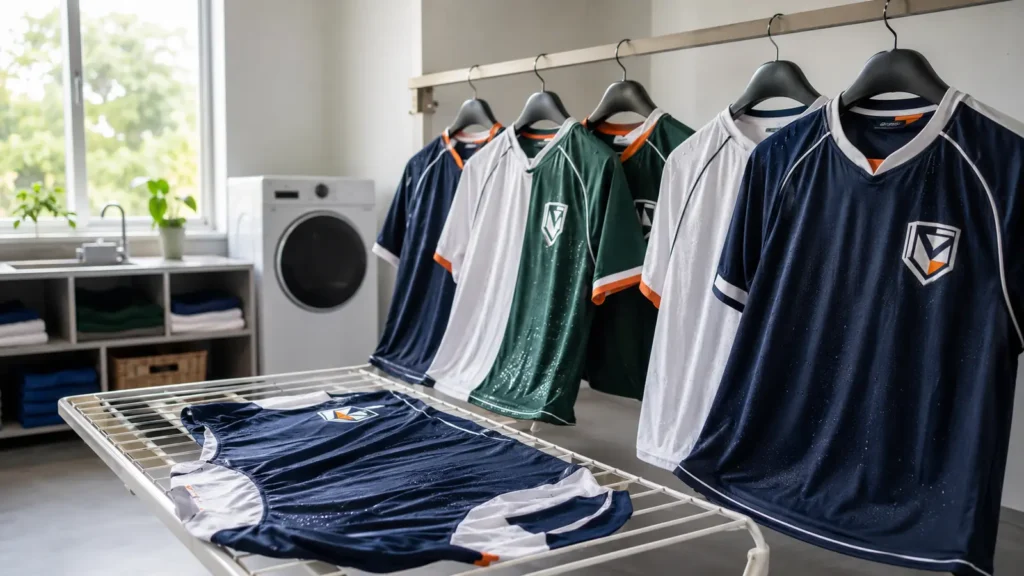
Custom team jerseys air-drying on wide hangers and a drying rack
Can You Hand-Wash a Sports Jersey?
Yes, if the care label permits washing. Hand-washing can reduce machine friction, but it is not automatically safer if the jersey is soaked too long, scrubbed, twisted or wrung.
Use a clean basin with cool water and a small amount of mild detergent. Submerge the jersey loosely, move it gently through the water and focus on the inside areas that contact the body. Do not rub decorated surfaces together. Rinse with cool water until detergent is removed. Lift the jersey with support, press—not twist—out excess water between clean towels, reshape and air-dry.
Hand-washing is often preferable for a jersey with a delicate patch, fragile vintage print or early signs of decoration wear, but professional advice is still appropriate for collectible or irreplaceable garments.
Washing Rules by Name, Number and Logo Method
You cannot choose the best care method from the fabric alone. Decoration construction changes the risk.
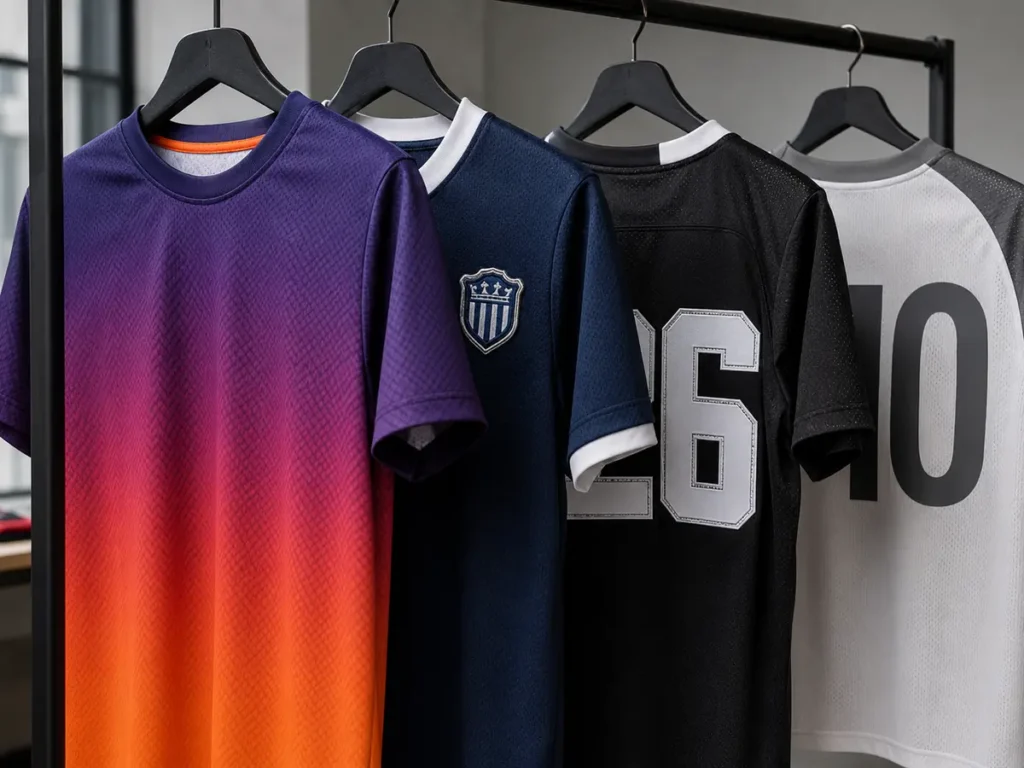
Sports jerseys showing sublimated, embroidered, tackle-twill and heat-transfer decoration
| Decoration method | How it is constructed | Main wash risk | Practical care priority |
|---|---|---|---|
| Sublimation | Dye is transferred into compatible synthetic fibers | Color change from harsh chemistry; fabric snagging or heat damage | Follow fabric label, wash cool and avoid harsh bleach |
| Heat transfer / HTV | Film or printed transfer is bonded to the surface with heat and pressure | Edge lifting, cracking, melting or adhesive weakening | Inside out, low friction, no direct ironing, avoid high heat |
| Screen printing | Ink layer is printed and cured on the fabric | Cracking, abrasion, fading or ink-to-ink sticking | Inside out, gentle cycle, avoid high heat and hard scrubbing |
| Tackle twill / appliqué | Cut fabric letters or numbers are sewn to the jersey | Fraying, broken stitches, distortion and color transfer | Close inspection, gentle wash, support while drying |
| Embroidery | Thread is stitched through the fabric, often with backing | Snagging, loose threads, puckering or color bleed | Mesh bag, avoid rough loads, never pull a loose thread |
| Woven or embroidered patch | Patch is sewn or heat applied | Curling edges, adhesive failure or thread damage | Follow patch-specific instructions; inspect attachment |
| Rubber/PVC-style patch | Molded patch is sewn or bonded | Surface scuffing, deformation or bond failure | Reduce friction and heat; confirm supplier instructions |
| Leather or leather-style patch | Natural or synthetic patch attached to textile | Warping, surface change or delamination | Obtain material-specific care instructions before laundering |
Patch care deserves special attention. STAHLS’ guidance for emblems and patches gives different recommendations by patch type, including cold machine washing and hang drying for certain emblems, while noting that leather patches may warp and are better handled delicately. This is why a custom jersey’s final care label should be based on the complete decoration combination, not copied from a blank garment.
What Not to Do When Washing a Jersey
Avoid these common shortcuts:
- Do not assume every polyester jersey can be washed the same way.
- Do not use hot water merely because the jersey smells strong.
- Do not pour bleach or concentrated stain remover onto a logo.
- Do not use fabric softener as a default for performance fabrics.
- Do not wash jerseys with towels, jeans, open zippers or exposed hook-and-loop fasteners.
- Do not overload the washer.
- Do not scrub printed names or numbers with a stiff brush.
- Do not twist or wring a wet jersey.
- Do not dry directly on a radiator or at an unverified high dryer temperature.
- Do not iron directly over a number, sponsor logo, patch or printed crest.
- Do not fold and store the jersey while it is still damp.
How to Remove Odor Without Damaging the Jersey
Persistent odor is usually a combination of retained soil, detergent residue, slow drying and bacteria-friendly moisture. Start by changing the process rather than adding stronger chemistry:
- Wash soon after use instead of sealing a damp jersey in a bag.
- Turn it inside out so detergent reaches body-contact areas.
- Use the correct detergent dose rather than an excessive one.
- Do not overload the machine.
- Rinse thoroughly.
- Dry promptly with airflow.
- Clean the washer according to the appliance manufacturer’s instructions.
Some online guides recommend vinegar or specialty sports detergents, but compatibility varies. Use an additive only if the jersey label, decoration instructions and additive directions are compatible. Never mix vinegar with chlorine bleach or other cleaning chemicals.
What to Do if a Number or Logo Starts Peeling
Stop washing and drying the jersey until the decoration has been assessed. Do not pull the loose edge. Photograph the issue and note:
- which area is lifting;
- whether it happened before or after washing;
- wash temperature and cycle;
- detergent and additives used;
- drying method;
- age and number of wash cycles; and
- whether multiple jerseys in the order show the same symptom.
For a custom team order, contact the supplier or decorator with the order reference and photos. Reapplication temperature, time and pressure depend on the specific transfer and garment. A household iron can overheat the film, mark polyester or create uneven pressure, so it is not a universal repair tool.
If many jerseys fail in the same location after the same number of washes, treat it as a quality-control investigation rather than isolated user damage.
A Better Laundry Workflow for Schools, Clubs and Teams
Individual care habits become inconsistent when 20, 50 or 200 jerseys pass between players, coaches and equipment staff. A written team process protects the uniform investment and makes problems traceable.
Create a one-page care standard
Record the approved:
- temperature and machine cycle;
- detergent type and dose range;
- stain-treatment method;
- load size;
- drying method;
- prohibited chemicals;
- storage condition; and
- contact person for damage reporting.
Place the instructions near the laundry area and include a short version in the player or parent handout. Use the exact care label as the source.
Sort and track team loads
Assign mesh bags by color group or squad. Keep heavily soiled pants, socks and towels separate from decorated jerseys. Count garments before washing and again after drying. When player personalization is extensive, a simple roster check prevents misplaced items.
Inspect before and after each cycle
Staff should flag stains, loose patches, lifting numbers and seam damage before washing. After drying, check the same areas under consistent lighting. Early repair is usually simpler than repairing a large delaminated graphic.
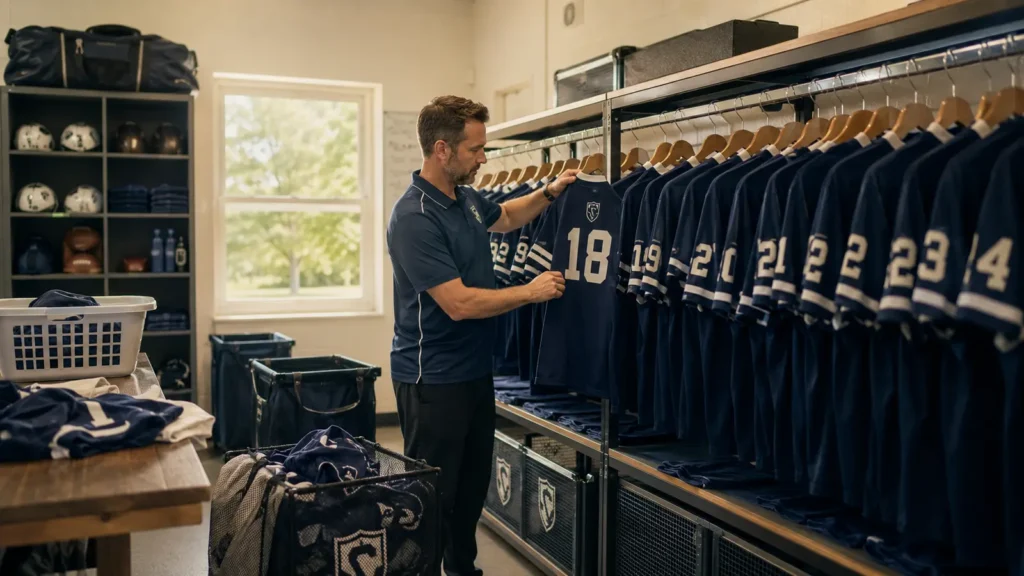
School equipment manager organizing cleaned numbered team jerseys
Store only when completely dry
Hang or fold jerseys without placing a hard crease through a thick number or patch. Keep the storage area dry and ventilated. Avoid stacking heavy equipment on decorated surfaces. For seasonal storage, clean and fully dry every garment first.
B2B Buyer Guidance: Make Care Performance Part of the Specification
For schools, uniform dealers, sportswear brands and promotional product companies, wash care begins during product development. The fabric, decoration, adhesive, thread, backing and trim must work as one washable system.
Ask for a decoration map
A clear tech pack should identify every logo and personalization method:
- sublimated body graphics;
- embroidered crest;
- heat-transfer sponsor mark;
- tackle-twill player number;
- sleeve patch;
- neck label; and
- name and number font, size and position.
This map helps the supplier select compatible materials and set realistic care instructions.
Approve a physical sample
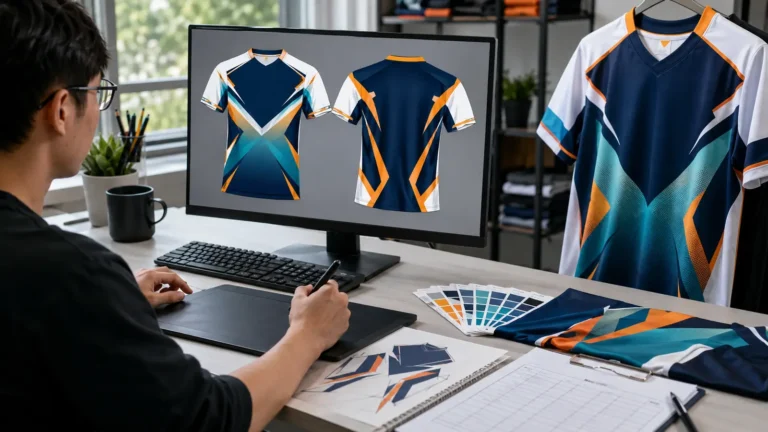
Digital mockups confirm layout, but they do not demonstrate hand feel, stretch behavior, seam performance, color interaction or wash durability. Review a physical sample using the intended fabric, decoration construction and colors.
Check:
- graphic alignment and edge quality;
- registration of multi-color prints;
- embroidery density and backing;
- seam puckering around appliqué;
- adhesion at corners and narrow details;
- color migration from dark polyester;
- stretch recovery; and
- label accuracy.
Define a wash-test protocol
A useful protocol states the wash temperature, detergent, load, cycle, drying method, number of cycles and acceptance criteria. The method should reflect the intended care label. “Wash tested” is not meaningful without these details.
After testing, compare the sample with an unwashed control. Record color change, dimensional change, cracking, peeling, edge lift, fraying, puckering, seam damage and label legibility. Agree on acceptable tolerances before bulk production.
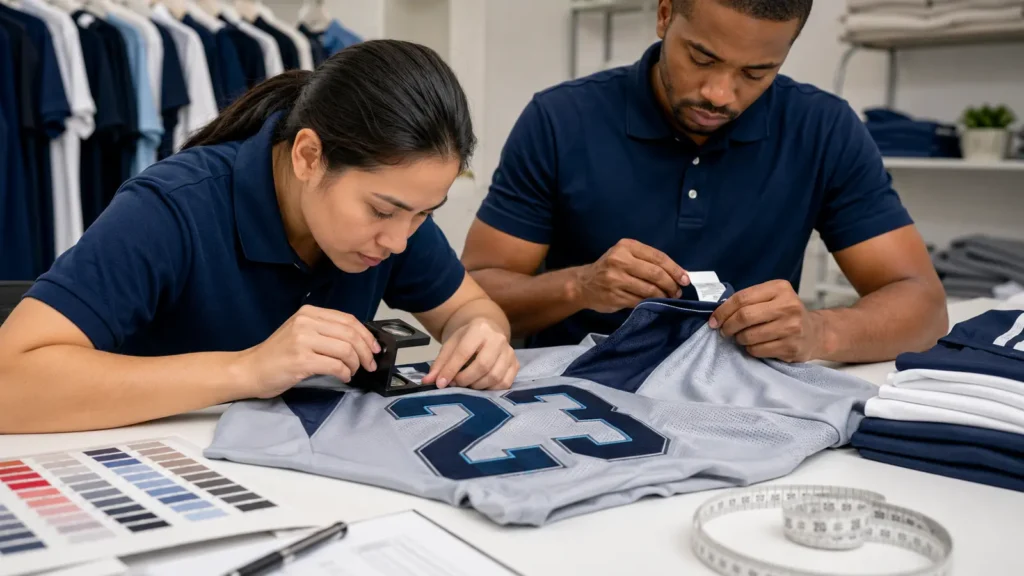
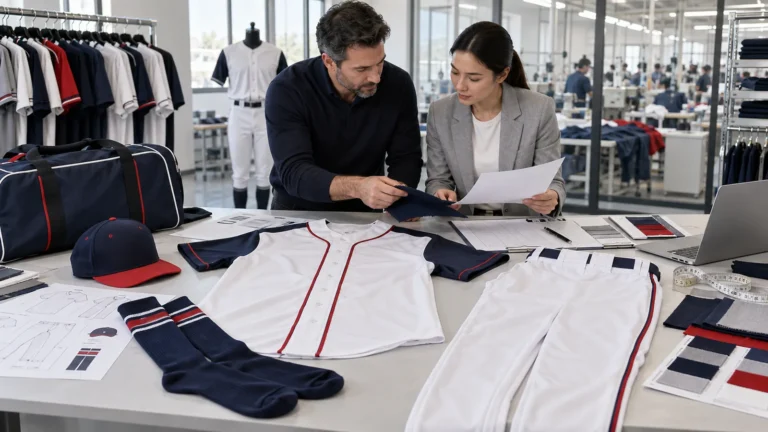
Apparel inspectors checking jersey decoration, seams and care label after wash testing
Align labels with the destination market
For products marketed in the United States, the FTC Care Labeling Rule is an important compliance reference for covered apparel. In the European Union, the harmonized Textile Regulation focuses on fiber composition; the European Commission’s updated FAQ states that there are no harmonized EU rules telling consumers how to wash or maintain textile products, so buyers should check destination-country requirements and commercial practices. ISO 3758:2023 establishes a care-label symbol system describing the most severe treatments that do not cause irreversible damage.
This article is general sourcing guidance, not legal advice. Importers and brand owners should confirm current rules, symbol licensing considerations and language requirements for every sales market.
Give end users usable instructions
A technically correct care label can still fail operationally if players or staff cannot understand it. Consider:
- permanent sewn care information;
- a short care card in team packaging;
- a QR code linked to the full team-care guide, where permitted;
- clear warnings about decoration and dryer heat; and
- replacement instructions for lost care sheets.
The care message should be consistent across the sample, bulk production, packaging and website.
Questions to Ask a Custom Jersey Supplier
Before approving a bulk order, ask:
- What is the base fabric composition and weight?
- Which decoration method will be used for each logo, name and number?
- Are the decoration materials compatible with the selected fabric and stretch level?
- What care instructions apply to the complete decorated garment?
- What evidence supports those instructions?
- Can you produce a physical sample using the final decoration combination?
- What wash-test method and acceptance criteria are available?
- How are color migration, edge lift, cracking and seam distortion checked?
- Will the care label, fiber label, private label and packaging match the destination-market brief?
- How will repeat orders maintain color, artwork position and decoration construction?
What to Send for a Custom Jersey Quotation
To receive an accurate recommendation and quotation, send:
- sport and jersey style;
- adult and youth size breakdown;
- order quantity;
- target market and destination;
- fabric preference or performance requirement;
- team colors or Pantone references;
- vector logo artwork;
- player names and numbers;
- decoration preferences;
- private-label and packaging needs;
- reference photos or a tech pack;
- required sample date; and
- target delivery date.
Plan the Garment and Its Care Together
If you are sourcing uniforms for a school, club, distributor or private-label program, share your artwork, quantity, sizes, colors, target market and preferred decoration methods with JIUMU. We can review the specification, prepare digital mockups and develop a physical sample before bulk production.
Why JIUMU for Custom Team Jerseys
Established in 2010 in Guangdong, China, JIUMU supplies custom teamwear, logo apparel, hats, uniforms, bags and branded merchandise for professional B2B buyers. The company supports OEM and ODM development, sublimation, screen printing, embroidery, heat transfer, multiple patch formats, Pantone color matching, private labels, packaging, digital mockups, physical samples, bulk production, quality control and export support.
For buyers, the practical advantage is coordination. Fabric, colors, player personalization, decoration, labels and packaging can be reviewed as one specification rather than isolated components. Typical MOQ is 50 pieces, subject to product structure and customization.
Explore custom team uniforms and baseball team uniform packages for related sourcing options.
Frequently Asked Questions
Final Recommendation
The safest way to wash sports jerseys is a controlled, low-stress process: inspect first, turn inside out, sort carefully, pretreat gently, use cold water and a mild cycle, avoid harsh chemicals, and air-dry with support. The care label is always the primary instruction because it reflects—or should reflect—the complete garment.
For B2B buyers, durability is not only a laundry issue. Specify the decoration method, approve a physical sample, define a repeatable wash test and make the final care instructions part of the purchase specification.
Request a Custom Teamwear Quotation
Send JIUMU your sport, quantity, size breakdown, colors, vector logos, player names and numbers, decoration preference, packaging needs, destination market and target delivery date.
- WhatsApp / Phone: +86 18507502899
- Email: zhengdong@jiumugear.com
- Website: jiumugear.com
- Inquiry: Contact JIUMU
Editorial Sources
- Federal Trade Commission — Clothes Captioning: Complying with the Care Labeling Rule
- Nike — How to Wash a Sports Jersey Properly
- STAHLS’ — Heat Transfer Material Care Instructions
- STAHLS’ — Q&A on Emblem and Patch Care
- European Commission — FAQs on Regulation (EU) No 1007/2011
- ISO — ISO 3758:2023 Textiles: Care Labelling Code Using Symbols
About JIUMU
JIUMU is a Guangdong-based B2B custom teamwear and logo apparel supplier established in 2010. The team supports OEM/ODM development, multiple decoration methods, private labels, packaging, sampling, quality control and export orders.