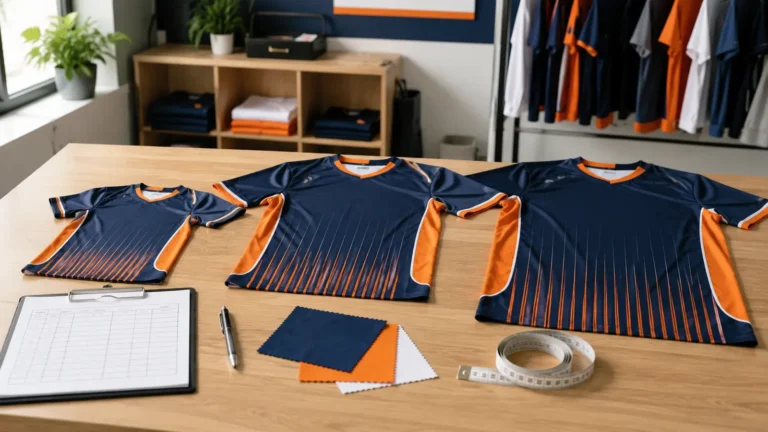
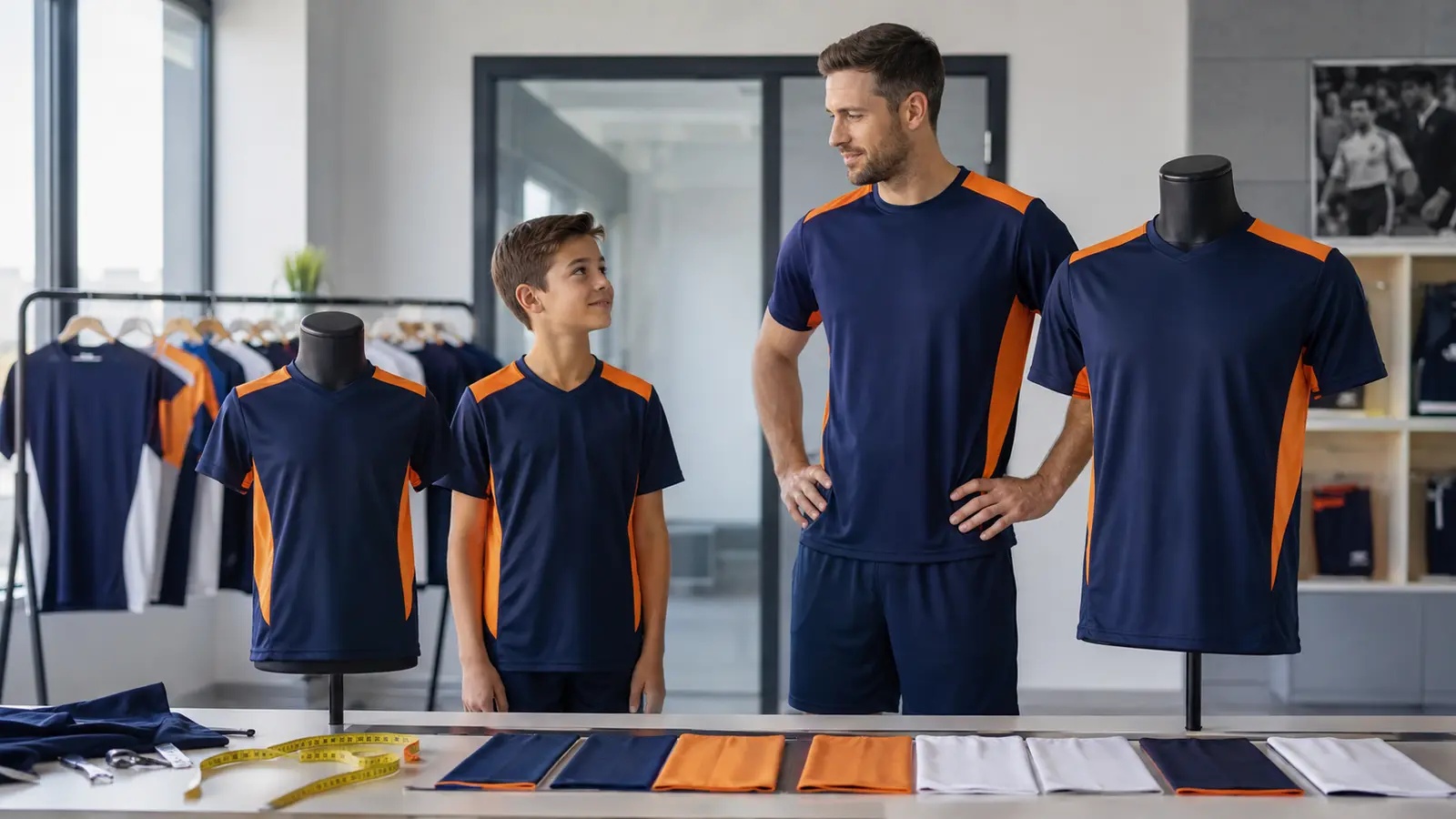
Youth vs Adult Team Jersey Sizing: A Guide for Schools and Leagues
Ordering jerseys for a school, youth league, club, or academy often means combining children, teenagers, coaches, and adult players in one program. The difficult part is not simply adding Youth and Adult columns to a roster. Youth and adult sizing may use different body proportions, pattern blocks, grade rules, fit assumptions, and decoration layouts. A Youth XL is not automatically the next step below an Adult Small, and age alone cannot identify the correct size.
The safest approach is to treat Youth and Adult as connected but separately validated size systems. Define the wearer group and sport, confirm whether the chart shows body or garment measurements, compare the transition sizes physically, run a sizing-sample session, record the chosen block as well as the size, scale names and numbers for each garment, and inspect the mixed size run before shipment.
Quick Answer: How Should Teams Order Youth and Adult Jersey Sizes Together?
Use body measurements only to identify likely sizes, then confirm selections with the supplier’s finished-garment chart and physical sizing samples. Record every player’s size as a complete SKU such as Youth L, Adult Unisex S, or Adult Women’s M—not merely “L” or “M.” Check the overlap between Youth XL and Adult XS/S, include sport movement and base layers, approve proportional artwork for small and large jerseys, and lock the roster only after a coach, parent or guardian, and supplier are working from the same chart version.
Do not assign sizes from age alone or assume every child needs extra room for growth. The appropriate allowance depends on current body dimensions, jersey fit, sport, fabric stretch, season length, layering, safety, and wearer comfort.
Youth and Adult Sizes Use Different Proportions
Youth sizing is not adult sizing reduced by one percentage. Children and adolescents change in height, chest, shoulder breadth, arm length, and body proportion at different rates. Adult men’s, women’s, and unisex blocks also differ from one another.
ISO 8559 provides internationally recognized definitions for body measurements and clothing size designation. ASTM publishes separate body-measurement tables for children, boys, girls, young men, and adults. The existence of multiple tables reinforces an important buying point: one letter-size ladder cannot accurately describe every population.
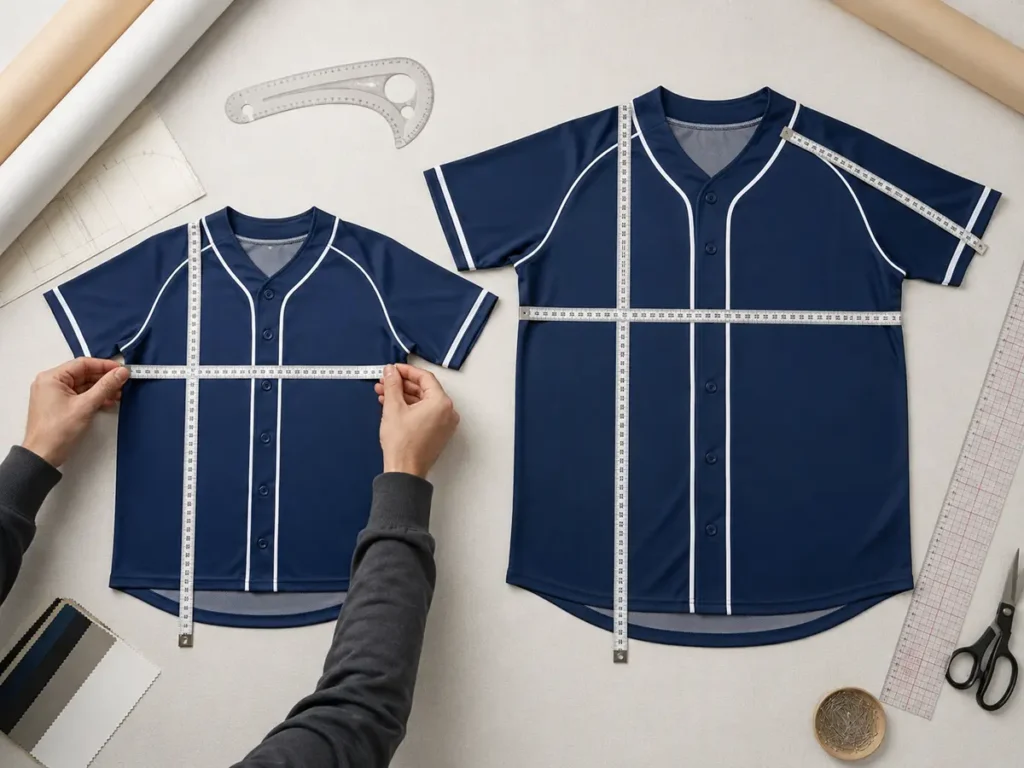
The four jersey measurements that most often expose the Youth/Adult transition are:
- Chest width: controls torso room but must be identified as body circumference or flat garment width.
- Body length: affects coverage, tucking, visual proportion, and whether a jersey looks overly long.
- Shoulder width: affects sleeve position, arm movement, and how an adult block sits on a smaller frame.
- Sleeve length and opening: influence movement, layering, and the position of sleeve graphics or patches.
| Measurement | Youth sizing concern | Adult sizing concern | Approval question |
|---|---|---|---|
| Half chest | Enough movement without a boxy torso | Fit block may be relaxed, athletic, men’s, women’s, or unisex | Is the chart body circumference or flat garment width? |
| Body length | Excess length may restrict appearance or movement | May need coverage for height, equipment, or tucking | Where does the supplier measure length? |
| Shoulder width | Dropped shoulder can make sleeves and graphics sit incorrectly | Adult blocks may be broader even at similar chest width | Is the shoulder set-in, dropped, or raglan? |
| Sleeve | Must suit arm length and patch/logo area | Varies by sport and fit category | Are sleeve length and opening included in the chart? |
Is Youth XL the Same as Adult Small?
No universal rule makes Youth XL equal to Adult Small. They may overlap in one or two measurements, but differ in length, shoulder, sleeve, armhole, torso shape, neck opening, or grade logic. One manufacturer may place Adult XS between Youth XL and Adult S; another may not offer Adult XS at all.
Compare the actual style using this checklist:
| Check | Youth XL | Adult Small | Why it matters |
|---|---|---|---|
| Intended wearer block | Older/larger youth | Smaller adult or adult unisex | Proportions may differ despite similar chest |
| Chest and waist shape | Often straighter or youth-proportioned | May be broader, longer, tapered, or gender-shaped | Changes appearance and movement |
| Body length | Usually shorter | Often longer | Adult S can fit the chest but hang too low |
| Shoulder and armhole | Youth placement | Adult placement and depth | Affects sleeve and throwing/reaching motion |
| Sleeve | Youth length/opening | Adult length/opening | Affects patches and overall scale |
| Artwork area | Smaller print zone | Larger print zone | Name, number, and sponsor layout may require different templates |
When a player falls near the transition, let the player try both sizes in the exact jersey style. Evaluate chest room, shoulder position, body length, arm movement, base layers, and visual preference. Record the chosen block explicitly.
Age Cannot Select a Jersey Size
Age bands can organize a catalogue, but they are unreliable as the only selection method. Children of the same age can have substantially different height, chest, shoulder, and arm proportions. Puberty and individual development widen that variation. A player can also prefer a closer or looser fit than another player with similar measurements.
ASTM youth measurement standards include different regular, slim, plus, and husky figure categories. That does not mean a team must create a separate custom block for every category. It shows why a label such as “age 10–12” cannot guarantee fit.
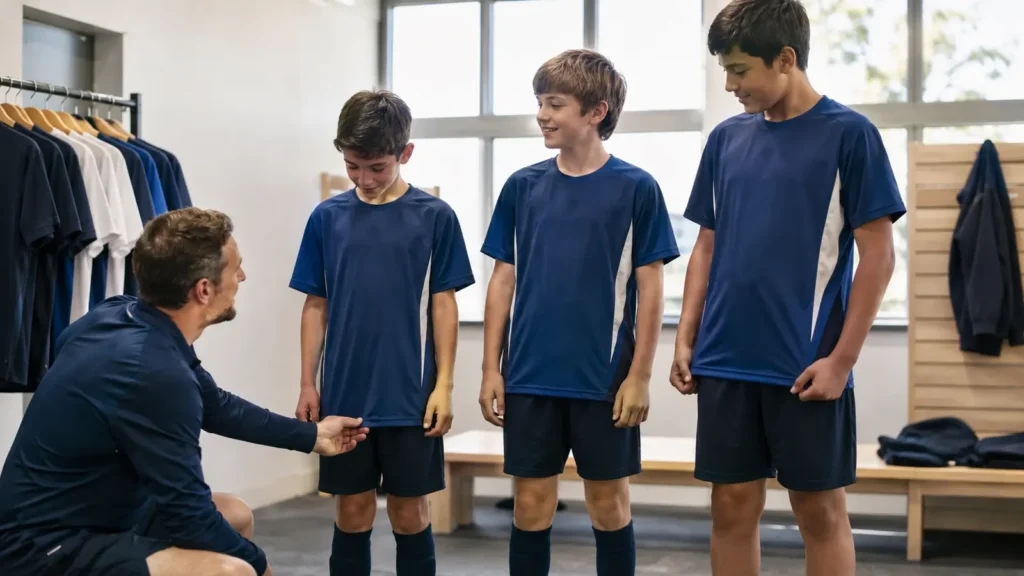
Coaches should never guess a child’s size from appearance. Use a confidential measurement and try-on process. For schools and leagues, parents or guardians should have a clear opportunity to review the selected size before personalized production begins.
Body Measurements vs Finished-Garment Measurements
A body chart recommends a size for a wearer. A garment chart states what the completed jersey measures. Both are useful, but they cannot be compared as if they describe the same object.
If a body chart lists chest circumference, measure around the torso according to the supplier’s instructions. If a garment chart lists half chest, measure the jersey flat from defined underarm points. Do not compare a full chest circumference with an undoubled flat width.
The supplier should identify:
- measurement unit and controlling unit;
- body or finished-garment basis;
- point-of-measure diagram;
- relaxed, smoothed, or stretched measurement condition;
- Youth, Adult, Men’s, Women’s, or Unisex block;
- fit category and intended sport;
- pre-wash or post-wash condition;
- production tolerance by measurement point;
- chart version and approval date.
For more detail, link the article to the Team Jersey Size Chart resource after confirming its public URL.
Movement Room and Growth Room Are Different
Movement room is the allowance required for the player to perform the sport. Growth room is additional capacity intended to extend useful wear as the child grows. One should not be substituted for the other.
Movement Room
Test the jersey in relevant positions: arms overhead, throwing, batting, reaching, rotating, squatting, or wearing protective equipment. Check whether the hem rises excessively, shoulders bind, armholes cut into the wearer, or a loose jersey catches equipment.
Growth Room
There is no universal amount of growth room appropriate for every player. A league buying for one short season may choose differently from a school program expecting multi-season use. Growth is not predictable enough to justify simply moving every child up one size.

Use this decision process:
- Fit the player correctly today.
- Identify the expected season and replacement policy.
- Test the next size only when the player is between sizes or the program intentionally allows room.
- Check current shoulder, neck, sleeve, body length, and equipment interaction.
- Reject excessive room that interferes with safe movement or creates an unusable appearance.
- Record whether the final choice is current fit or growth-biased fit.
| Situation | Practical decision | Risk to avoid |
|---|---|---|
| Player fits one size clearly | Use the tested size | Automatic upsizing “for growth” |
| Player falls between sizes | Try both with sport movement | Choosing from chest alone |
| Jersey worn over pads/layers | Test with actual equipment | Adding generic room without equipment |
| Multi-season program | Consider policy and replacement timing | Making the first season jersey excessively large |
| Personalized, non-returnable order | Require documented approval | Coach guessing without parent/player review |
Youth, Men’s, Women’s, and Unisex Blocks
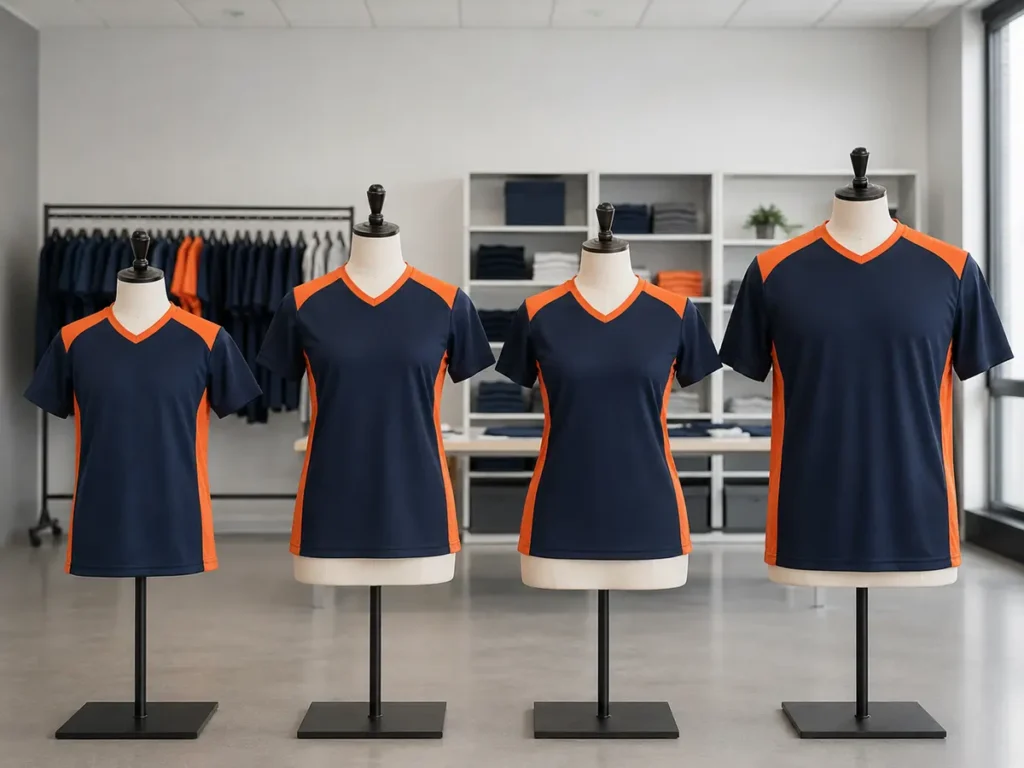
Mixed programs may need more than Youth and Adult. Adult options can include men’s, women’s, and unisex patterns; some suppliers also offer girls’ or shaped youth fits.
Youth
Designed around children’s or adolescent proportions, depending on the range. Confirm how Youth XS through Youth XL are graded and where the range transitions to adult sizing.
Adult Unisex
Useful for simplifying school and league administration, but not equally suitable for every body shape. It often follows a straighter or traditionally men’s-derived block.
Adult Men’s
May use broader shoulders, longer body and different chest-to-waist shaping. The supplier’s finished chart remains controlling.
Adult Women’s
May use narrower shoulders, shorter length, shaped waist/hip, and different sleeve or neckline proportions. A Women’s M cannot be recorded simply as “M” beside an Adult Unisex M.
Roster entries should use block codes such as YL, A-US, A-WM, or another clearly defined system. The code legend must appear in the roster and purchase order.
Can Youth and Adult Sizes Be Mixed in One Order?
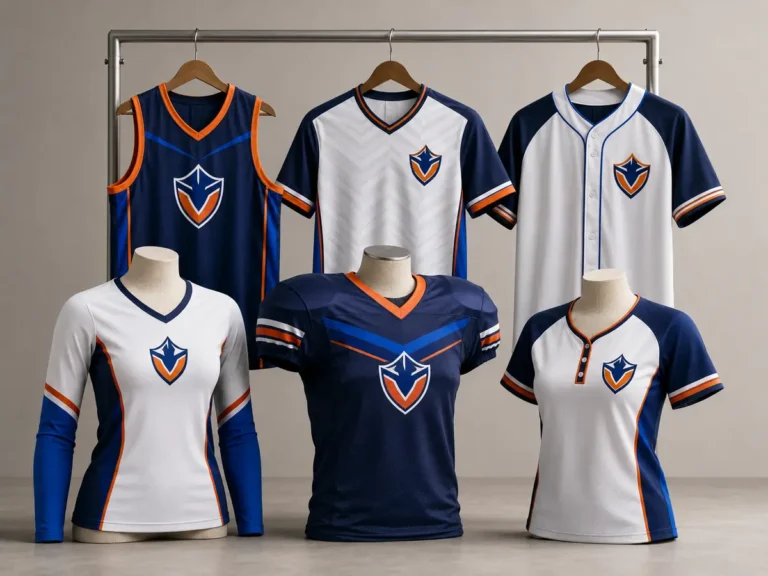
Yes. Youth and adult jerseys can share colors, artwork, fabric, labels, and team identity, but the supplier must manage them as linked size blocks. The order should state quantities by block and size, not only a total quantity.
Mixing sizes can affect:
- pattern and marker preparation;
- fabric consumption;
- neck, rib, placket, and trim components;
- logo, name, and number templates;
- private labels and size labels;
- packing sequence and carton assortment;
- MOQ by style, fabric, color, or decoration route;
- sample and inspection requirements.
One approved Adult M sample cannot validate a complete Youth XS–Adult 3XL range. At minimum, approve transition and extreme sizes through measurements, graded patterns, artwork templates, and selected physical samples. The appropriate sampling plan depends on the style and order.
Scaling Names, Numbers, Logos, and Graphics
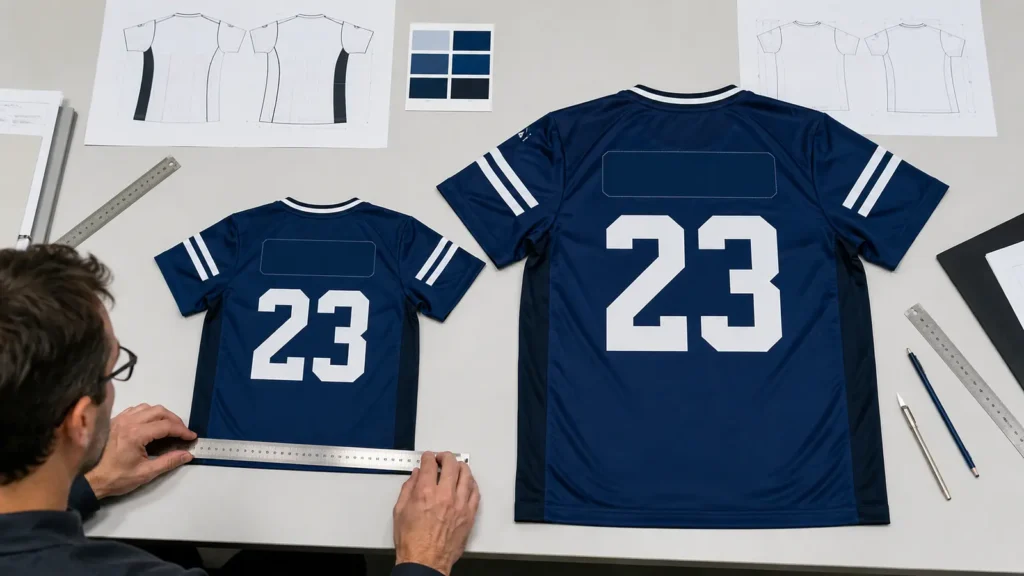
A print layout that looks balanced on Adult XL can overwhelm Youth XS. Conversely, artwork reduced mechanically for a small jersey may become illegible or fail league requirements.
Should Youth Numbers Be Smaller?
Often, yes, because the available back panel is smaller. But the size must still meet the applicable league, school, federation, or tournament rule. Rules can change by sport, division, and season. Little League, for example, directs participants to its current Rulebook App for up-to-date requirements and separately publishes official patch placement guidance.
Do not publish one number height as a universal youth rule. Instead:
- collect the current competition requirement;
- measure the usable print area for each size block;
- create youth, transition, and adult templates where needed;
- preserve digit proportions, stroke thickness, spacing, and contrast;
- inspect long names, double-digit numbers, seams, vents, and panels;
- approve artwork on representative smallest and largest jerseys.
| Element | Youth-size adjustment | Consistency control |
|---|---|---|
| Player name | Reduce within readable limits; manage long names | Same font family, curve logic, and relative position |
| Back number | Scale to usable panel and governing rules | Maintain digit proportions and spacing |
| Front number | Adjust around placket, logo, or neckline | Use a block-specific placement template |
| Team name | Avoid crowding small chest width | Preserve visual hierarchy and minimum detail |
| Sponsor logo | Confirm rule, contract, and readable size | Approve separately for smallest size |
| Sleeve mark | Adjust for sleeve length/opening | Check seam and patch clearance |
Maintaining One Design from Youth XS to Adult 3XL
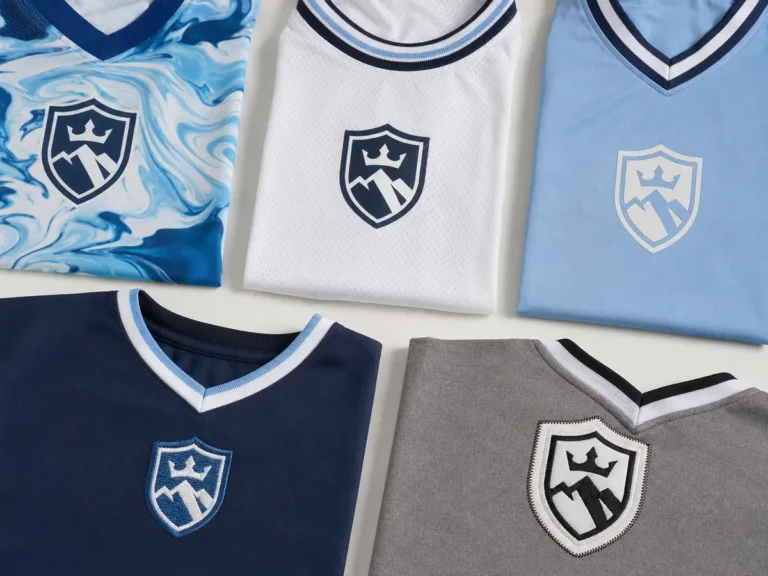
Design consistency does not mean identical physical dimensions. It means every size preserves the same identity and hierarchy within its available garment area.
Create a master artwork system with:
- shared color values and material references;
- separate garment templates for Youth and Adult blocks;
- fixed anchor logic, such as distance from neckline or centerline;
- proportional or tiered artwork sizes;
- minimum readable stroke and gap requirements;
- rules for names of different lengths;
- number spacing rules for one and two digits;
- seam, placket, vent, mesh, and panel exclusions;
- proof sheets for representative smallest, transition, middle, and largest sizes;
- version control tied to the roster and production files.
A small-size layout may use fewer decorative details when the original cannot reproduce cleanly. This should be an approved adaptation, not an operator’s unrecorded change.
Run a Physical Sizing-Sample Session
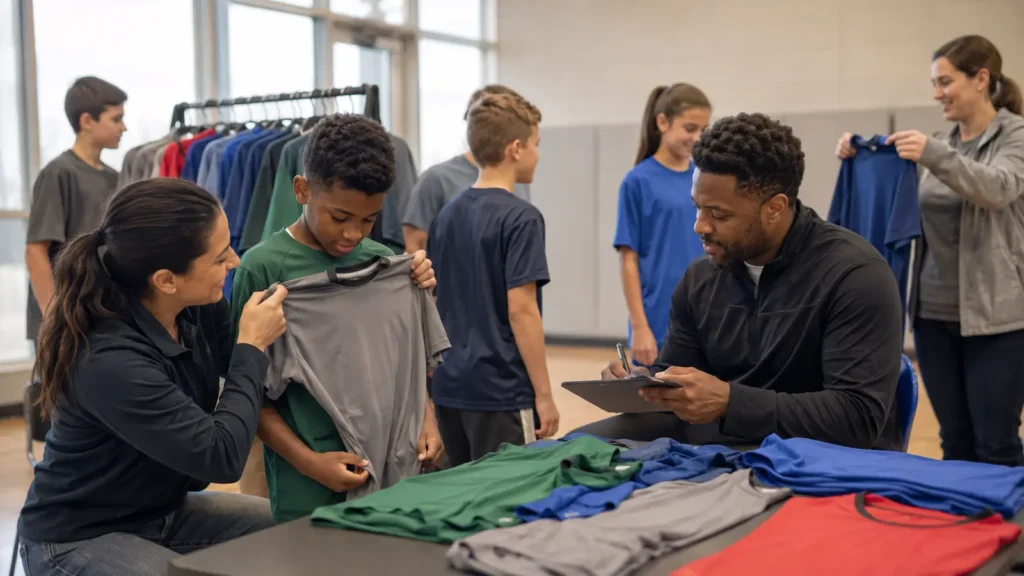
Sizing samples are especially valuable when a program crosses Youth and Adult ranges. Use the actual intended style and fabric whenever possible. A sample from another supplier or a retail T-shirt can only provide preliminary guidance.
Session Procedure
- Identify every sample by complete block and size.
- Confirm the sample version matches the approved chart.
- Measure players privately when required.
- Have players wear normal base layers or equipment.
- Test standing appearance and sport movements.
- Compare Youth XL with Adult XS/S for transition players.
- Record first choice, alternate choice, and fit notes.
- Obtain parent or guardian confirmation where the program requires it.
- Have the coach review incomplete or unusual entries.
- Close the session with a dated roster version.
Team Jersey Size Collection Form
| Field | Required entry |
|---|---|
| Player ID | Non-sensitive team identifier |
| Player name | Legal/internal name and separately approved display name |
| Team/division | School, age division, squad, or team |
| Block | Youth, Adult Unisex, Adult Men’s, Adult Women’s, special fit |
| Selected size | Complete size code |
| Body references | Height/chest or other supplier-required measurements |
| Samples tried | Both sizes where player is between sizes |
| Base layer/equipment | What was worn during try-on |
| Fit result | Current fit, growth-biased fit, or special review |
| Display name/number | Exact spelling and number |
| Guardian confirmation | Name/date or program-approved method |
| Coach review | Status and exception notes |
| Final roster version | File name, revision, and lock date |
Connect this form to the Roster Checklist so size, display name, number, fit block, and special notes stay in one controlled record.
Roster Lock and Change Control
Personalized jerseys may not be reusable when a size is wrong. Establish a formal lock point:
- coordinator imports all entries into one master file;
- duplicate numbers and missing names are flagged;
- incomplete block codes are rejected;
- transition-size players are confirmed;
- artwork tier is assigned to every size;
- parent/coach approvals are retained;
- the supplier returns a production roster summary;
- buyer signs the final version;
- later changes receive a new revision and written acceptance.
Do not accept last-minute changes through separate messages without updating the master file.
Mixed-Size Sample Approval and Bulk QC
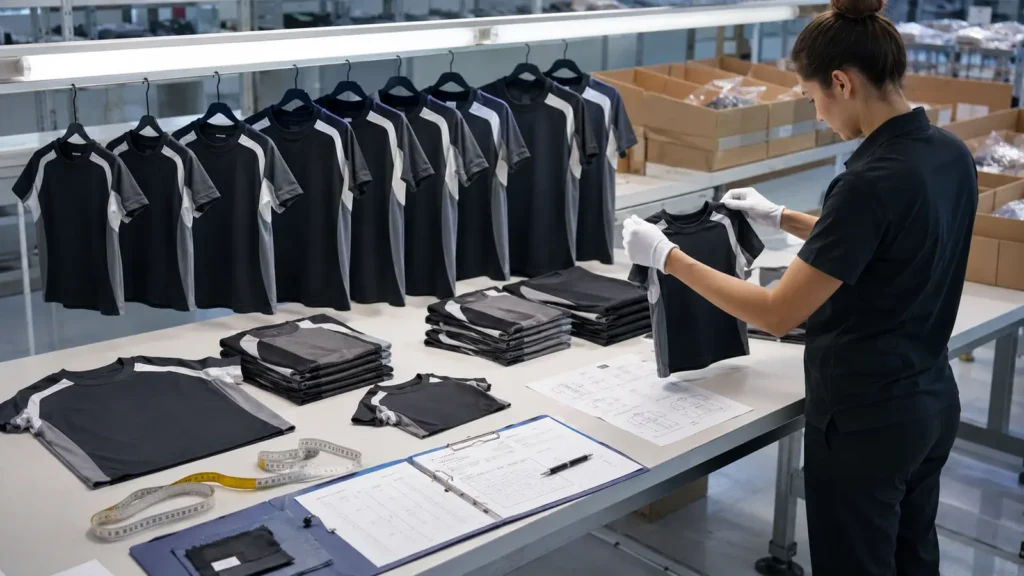
The sample plan should cover the key risks, not only the easiest middle size. Review the smallest youth size, the Youth/Adult transition, a common adult size, and the largest adult size when design scaling or grading is critical.
Approval Checklist
- Youth and Adult measurement charts use the correct version;
- critical chest, length, shoulder, and sleeve points match approved targets;
- grade progression is logical within each block;
- transition sizes have been compared;
- fabric, stretch, rib, placket, and construction match the sample;
- names and numbers use the assigned size tier;
- artwork clears seams and remains legible;
- league-required patches or marks use current approved placement;
- size labels and block codes are correct;
- roster data matches the physical personalization;
- packing separates or identifies Youth and Adult sizes;
- retained samples and inspection records support reorders.
For broader production controls, link to JIUMU’s Quality Control page.
What Buyers Should Send for a Quotation
Provide:
- sport, division, wearer group, and destination market;
- total quantity and estimated quantities by Youth/Adult size;
- men’s, women’s, unisex, or youth block requirements;
- intended fit and layering/equipment;
- body or finished-garment chart if already established;
- style reference and fabric preference;
- logo files, colors, names, numbers, and sponsor marks;
- current league or school uniform rules;
- sizing-sample and approval requirements;
- growth-room policy and season timing;
- packaging, roster packing, delivery date, and destination.
Explore Custom Team Uniforms or Baseball Uniform Packages and send JIUMU the mixed-size requirement. JIUMU can confirm the relevant sampling, artwork-template, and roster workflow for the project.
Request a Mixed Youth/Adult Sizing Plan: Send the sport, size range, estimated quantity by block, fit preference, fabric, artwork, rule requirements, and delivery date. Include an existing approved chart or reference jersey when available.
Common Mistakes
- Treating Youth XL and Adult S as interchangeable without measurements.
- Assigning sizes from age, grade, or appearance alone.
- Writing “M” without Youth, Adult, Women’s, Men’s, or Unisex identification.
- Adding growth room automatically without testing current movement and length.
- Using an adult artwork size on every youth jersey.
- Shrinking artwork without checking legibility or league rules.
- Approving one middle size for the entire Youth XS–Adult 3XL range.
- Collecting roster updates across several messages instead of one versioned file.
- Changing fabric after fit approval without reassessment.
- Packing Youth and Adult sizes together without clear carton or individual identification.
Questions to Ask a Supplier
- Are the charts body measurements or finished-garment measurements?
- Which Youth and Adult body populations do the blocks target?
- Is Youth XL comparable with Adult XS or S in this exact style?
- Do you offer Adult Men’s, Women’s, and Unisex cuts?
- Which sizing samples are available?
- How should movement and growth room be evaluated?
- How are name and number sizes tiered across the range?
- Which current league requirements must the buyer provide?
- Which sizes will be physically sampled and inspected?
- How are roster and artwork revisions controlled?
- How are Youth and Adult sizes labeled and packed?
- What records are retained for repeat orders?
How JIUMU Supports Mixed Team Sizing
JIUMU supports OEM and ODM teamwear development, fabric sourcing, digital mockups, physical samples, sublimation and other logo methods, bulk production, quality control, private labels, packaging, and export support. Typical MOQ is 50 pieces, subject to product structure and customization.
For a mixed Youth and Adult program, the workflow can be organized around separate size blocks, approved measurement charts, sizing samples, block-specific artwork templates, a version-controlled roster, representative size approvals, bulk inspection, and retained order records. Exact size availability, sample range, MOQ, decoration scale, and tolerance must be confirmed for the actual style.
Frequently Asked Questions
Final Recommendation
Youth and Adult sizing should be managed as a controlled transition, not one uninterrupted series of letters. Measure current players, identify the correct block, test actual samples, separate movement room from growth room, compare Youth XL with Adult transition sizes, approve proportional artwork, and lock one complete roster before personalization.
This process lets a school or league combine Youth XS through Adult 3XL while maintaining consistent team identity and reducing preventable fit, decoration, and packing errors.
Request a Youth and Adult Team Jersey Review
Send JIUMU your sport, Youth and Adult size range, estimated quantities, fit preference, fabric, artwork, current uniform rules, roster format, delivery date, and destination. Use the Contact Us page, email zhengdong@jiumugear.com, or WhatsApp +86 18507502899.
Technical Sources
- ISO 8559-1: Anthropometric Definitions for Body Measurement
- ISO 8559-2: Primary and Secondary Dimension Indicators
- ASTM Textile Standards: Children, Youth, and Adult Body Measurement Tables
- ASTM D6192: Body Measurements for Girls
- Little League Current Rules and Rulebook App
- Little League Patch Placement Requirements
About JIUMU
JIUMU is a Guangdong-based B2B supplier of custom teamwear, logo apparel, hats, uniforms, bags, and branded merchandise. Established in 2010.