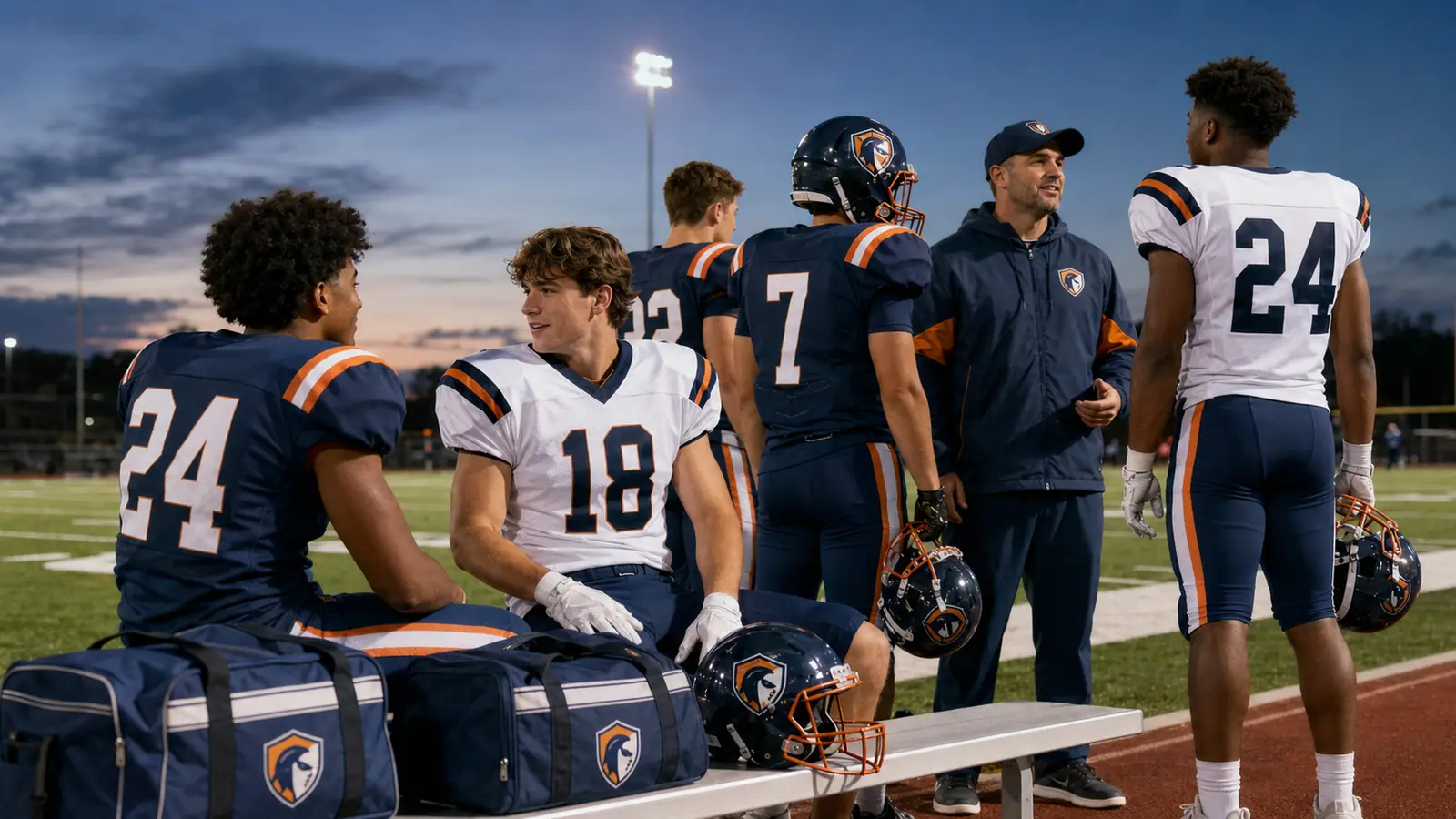
Best Custom Football Jerseys for School and Club Teams
Choosing the best custom football jerseys is not simply a matter of selecting the most dramatic design. A school or club must order jerseys that remain legible in motion, fit correctly over protective equipment, survive repeated contact and laundering, and can be reproduced when new players join the roster.
The right specification also depends on the competition. A high school tackle team, a youth club, a collegiate program, and a flag football league may use different uniform rules. Before artwork is approved, the buyer should identify the governing body, confirm the current rulebook, and make the supplier responsible for checking the production artwork against the approved specification.
This buyer’s guide focuses on custom American football jerseys for schools, youth programs, academies, and club teams. It explains how to compare jersey types, fabrics, construction, fit, decoration, quality control, labeling, and bulk-order planning.
Quick Answer: The best custom football jerseys for school and club teams use a durable polyester body, stretch or ventilated panels in high-movement zones, reinforced seams, a cut tested over the team’s shoulder pads, and high-contrast front and back numbers that follow the relevant league rules. Full sublimation is usually the most flexible choice for detailed, lightweight graphics; tackle twill is suitable when a team wants a traditional dimensional look and accepts additional weight and cost. Approve a physical size set and pre-production sample before bulk production, then keep the final artwork, color standards, roster file, measurements, and material references for repeat orders.
Preparing a Custom Football Jersey Quote
Provide the governing rules, tackle or flag-football use, shoulder-pad measurements where applicable, jersey cut, fabric and ventilation requirements, number dimensions, logo files, player roster by size, quantity, destination, and season deadline. Approve representative sizes over the intended protective equipment before bulk production.
Explore custom football and team jerseys and custom team uniforms, then request a football jersey quotation with your roster and artwork.
What Does “Best” Mean for a Custom Football Jersey?
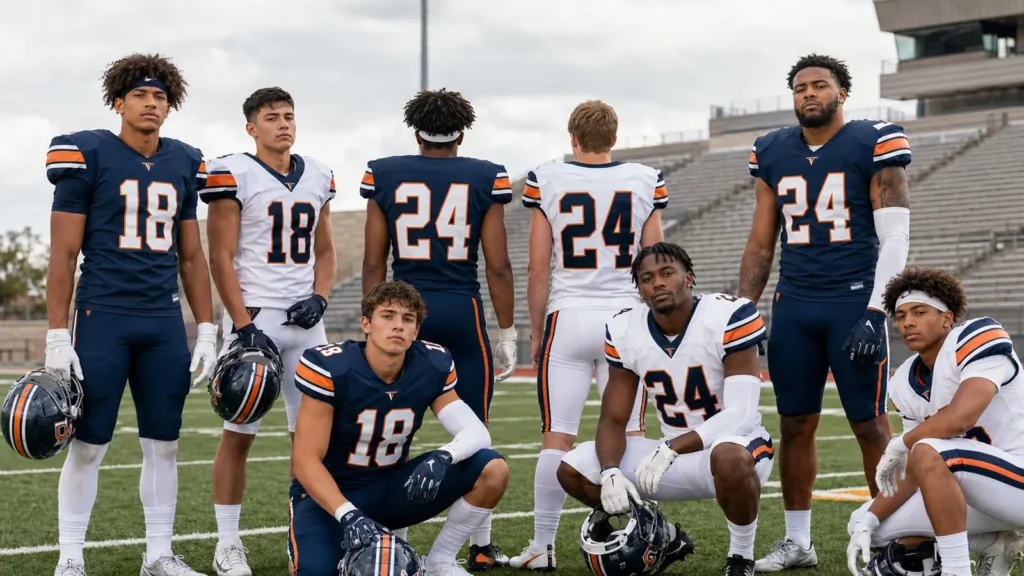
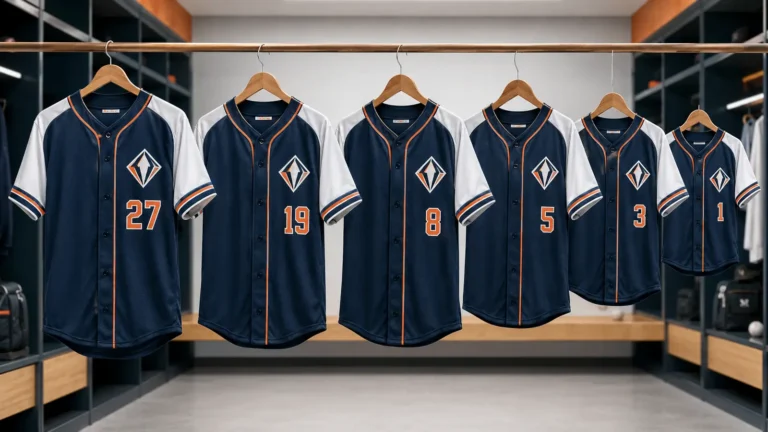
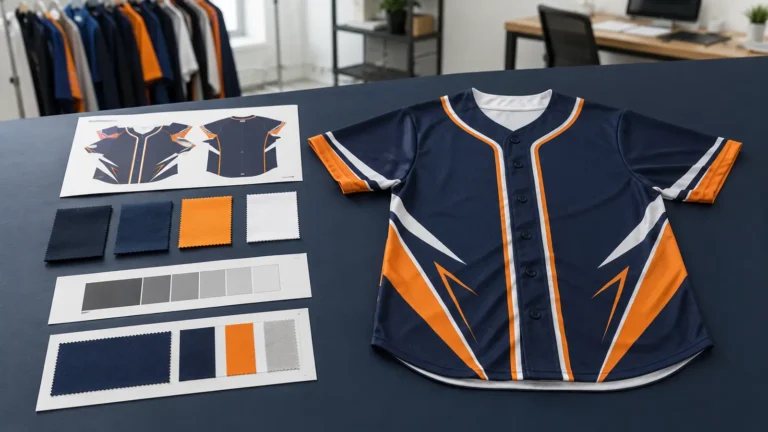
A coordinated home-and-away football uniform system designed for school and club rosters.
For a professional buyer, “best” means fit for the intended program. A jersey can look impressive in a mockup and still fail because the neck opening is too tight over pads, the numbers are difficult to read, the sleeves interfere with movement, or replacement jerseys do not match the first order.
Evaluate a football jersey in five areas:
- Competition compliance: number size, number contrast, home and away colors, logo placement, and any league-specific restrictions.
- Pad-compatible fit: correct chest, shoulder, neck, sleeve, and body dimensions when worn over the actual protective equipment.
- Construction durability: reinforced stress points, stable seams, secure decoration, and materials suitable for contact and repeated laundering.
- Roster-level consistency: accurate player names and numbers, controlled colors, predictable sizing, and a documented approval process.
- Repeat-order reliability: retained artwork, color standards, bill of materials, labels, and packaging details for later additions.
The lowest unit price rarely optimizes all five. Schools and clubs should compare the total cost of the uniform program, including samples, artwork revisions, shipping, duties, replacements, and the administrative time needed to correct roster errors.
Custom Football Jersey Options at a Glance
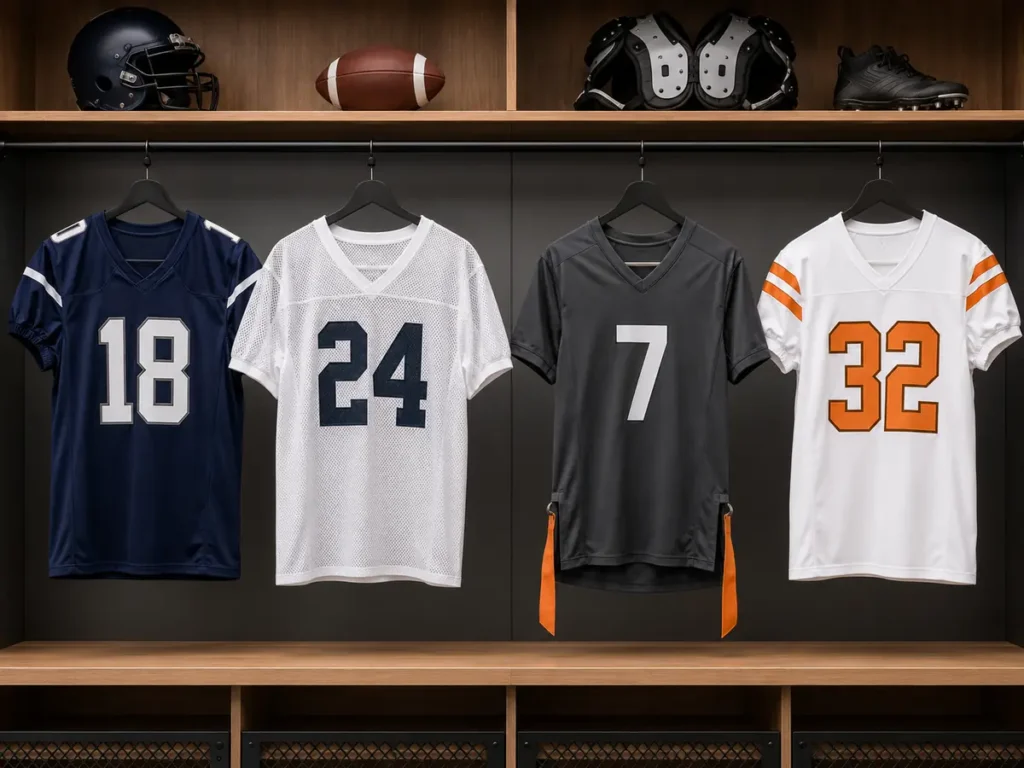
Game, practice and flag programs require different jersey constructions.
Different jersey constructions solve different problems. A team may use one type for official games and a simpler version for practice.
| Jersey type | Best use | Typical construction | Main advantage | Buyer watchpoint |
|---|---|---|---|---|
| Sublimated game jersey | School, club, tournament, and travel teams | Printed polyester panels with reinforced seams | Detailed graphics remain lightweight because color is transferred into the fabric | Confirm color on the actual fabric; screen colors are not production colors |
| Tackle-twill game jersey | Traditional school or heritage programs | Sewn or heat-applied layered numbers on polyester | Dimensional, classic presentation | Added weight, cost, sewing time, and possible edge wear |
| Hybrid jersey | Teams wanting mixed visual effects | Sublimated body plus twill, embroidery, or patch details | Balances graphic freedom with a tactile crest or number treatment | Test how mixed methods behave after washing |
| Stock-body decorated jersey | Budget-sensitive or fast-turn programs | Ready-made blank with heat transfer, screen print, or sewn decoration | Lower development work and simpler reorder path | Limited color, panel, fit, and fabric choices |
| Practice jersey | Daily training and equipment issue | Breathable mesh or simple polyester with basic numbering | Cost control and easy roster identification | Do not assume the same fit or durability as the game jersey |
| Flag football jersey | School, club, and recreational flag programs | Lightweight athletic cut without tackle-pad volume | Mobility and breathability | Use the flag league’s rules; tackle-football fit assumptions may not apply |
For most fully customized school and club programs, sublimation offers the broadest design control. It can integrate gradients, sleeve graphics, sponsor marks, player names, and numbers without stacking several heavy decoration layers. Traditional applique can still be the right choice when the team’s identity depends on a dimensional number or heritage look.
Start With the Competition Rules, Not the Artwork
Uniform rules can determine the usable body colors, number dimensions, number contrast, and logo locations. These requirements should be part of the initial technical brief.
For United States high school football, the National Federation of State High School Associations publishes jersey and pant guidance. Its 2025 football jersey rules state, among other requirements, that players are numbered 0–99; front and back numbers must be clearly visible; and number height is at least 8 inches on the front and 10 inches on the back. The same guidance distinguishes a white visiting-jersey body from a dark home-jersey body and specifies contrast and allowable adornment areas. Buyers should use the current rule adopted by their state association rather than treating an older artwork file as proof of compliance. See the NFHS Football Jersey and Pant Rules.
College programs should work from the current NCAA rules and their conference or institutional requirements. The NCAA’s current resources include a dedicated uniform diagram and 2026 rule updates. Its Division I uniform diagram emphasizes clearly visible numbering and sets placement and size restrictions for certain logos. Refer to the NCAA Football Playing Rules resources and the applicable conference guidance before final approval.
Rules can differ for independent clubs, youth leagues, international competitions, and flag football. The safest workflow is:
- identify the league and age group;
- obtain the current uniform section from the buyer or governing body;
- mark required number, color, and logo zones on the artwork;
- have the school or club compliance contact approve the final layout;
- archive the approved version with a date and revision number.
Do not rely on a supplier’s generic “football jersey template” for compliance. The buyer and supplier should jointly validate the exact competition requirements.
Choose Materials by Function
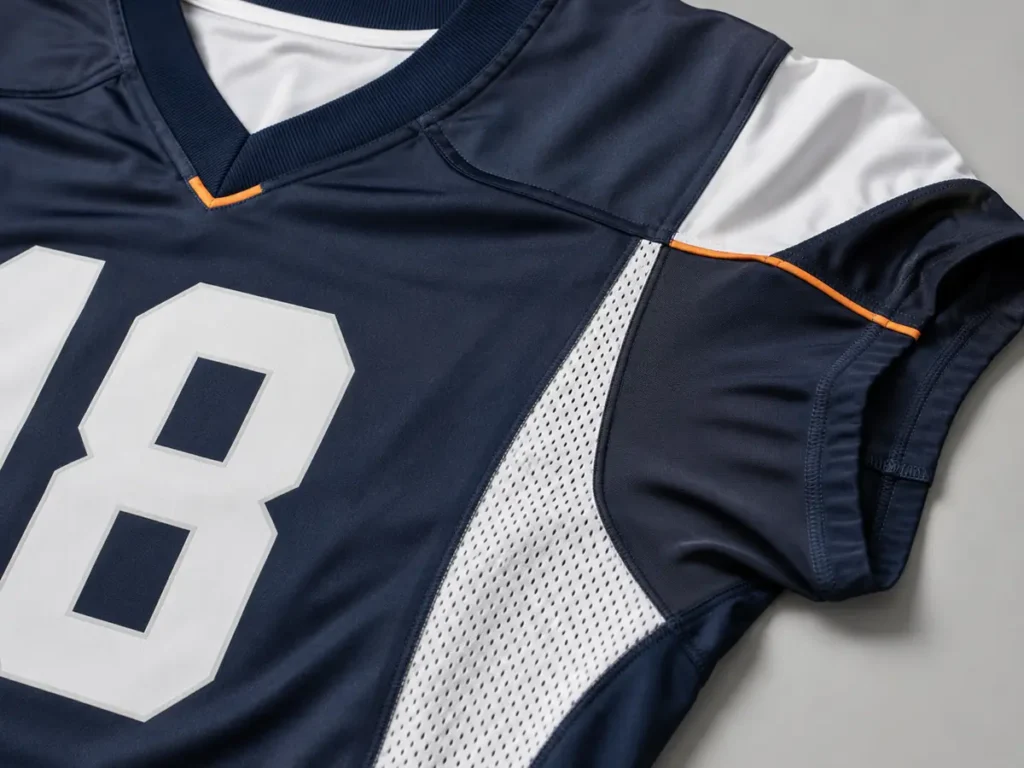
Material selection should balance a stable print surface, ventilation, stretch and recovery.
Most custom football jerseys use polyester because it can combine low moisture absorption, print compatibility, dimensional stability, and abrasion resistance. However, “100% polyester” is not a complete material specification. Two fabrics with the same fiber description can perform differently because of knit structure, yarn, weight, stretch, finishing, and color process.
Common Football Jersey Fabrics
| Fabric or panel type | Useful properties | Common placement | Questions to ask |
|---|---|---|---|
| Polyester interlock | Smooth surface, stable print area, balanced durability | Main body and large number zones | What is the fabric weight and stretch direction? |
| Bird-eye or mini-mesh polyester | Ventilation and athletic appearance | Body, side, or back panels | Are holes small enough to keep graphics and numbers visually clean? |
| Stretch polyester with elastane | Recovery and close fit over equipment | Side panels, shoulders, sleeve inserts | What are the fiber percentages and recovery test results? |
| Heavy mesh | Airflow and traditional practice-jersey appearance | Practice bodies or selected zones | Will the mesh snag, distort, or show the undershirt excessively? |
| Dazzle-style polyester | Sheen and traditional uniform styling | Shoulder, yoke, or accent panels | Does the visual effect match the team’s current uniform system? |
| Rib knit | Stretch and recovery around openings | Collar, cuffs, or inserts | Does it recover after repeated stretching over pads? |
Ask the supplier to state fabric weight in grams per square meter, fiber composition, stretch direction, and intended panel use. The ideal weight cannot be selected in isolation: a lighter fabric with a stable knit may outperform a heavier but loose structure, while a stretch panel may be valuable only in specific zones.
Breathability Versus Strength
Large open mesh can improve airflow, but it can also provide less stable support for small text, detailed logos, or sewn decoration. Dense interlock provides a cleaner print surface but may feel warmer if used across the entire garment. A practical game jersey often combines structures: stable fabric where numbers and logos must remain clear, stretch where the garment moves over pads, and ventilation where airflow matters.
Request actual swatches or a sample made from the proposed fabrics. Review opacity, stretch recovery, snag tendency, surface feel, print sharpness, and color under indoor and outdoor light.
Fit the Jersey Over the Team’s Shoulder Pads
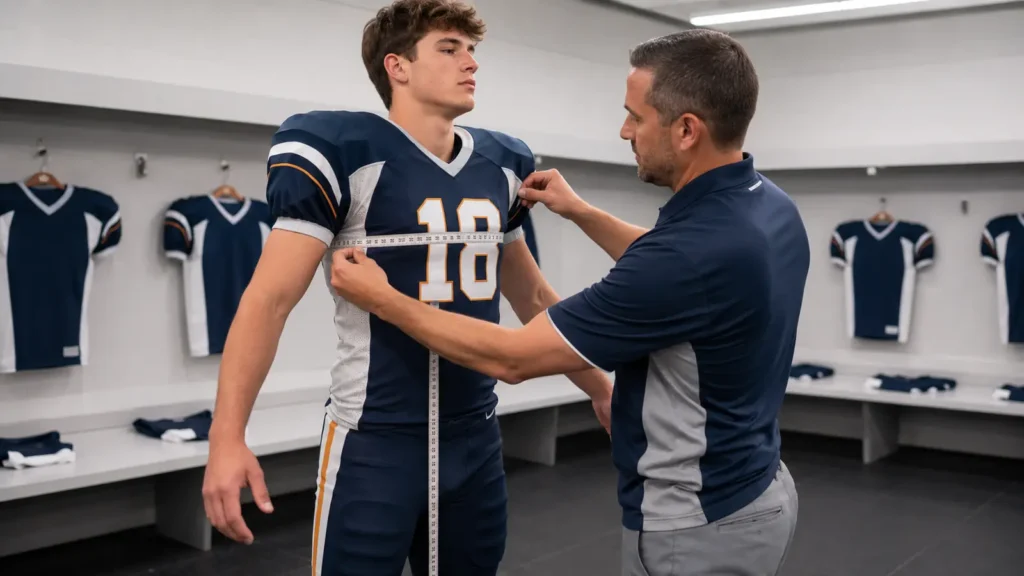
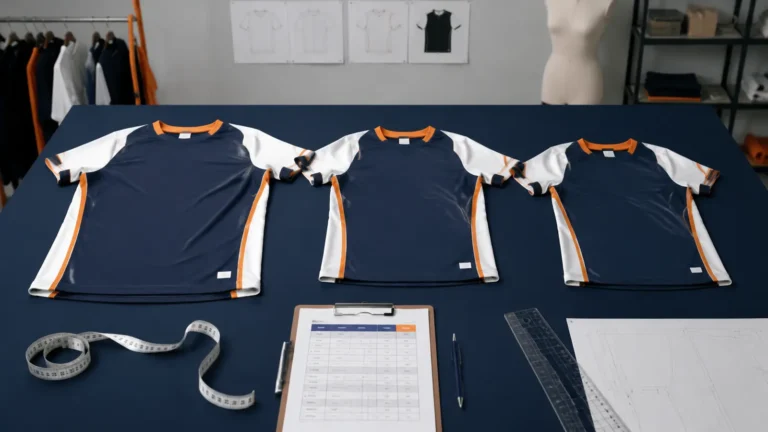
Approve football jersey sizes over the actual shoulder-pad profile used by the team.
Football jersey sizing cannot be approved from ordinary T-shirt measurements. Tackle jerseys are worn over shoulder pads, and the pad model, age group, and preferred silhouette affect the pattern.
USA Football’s equipment-fitting guidance emphasizes measuring and properly fitting shoulder pads before athletes take the field. That equipment fit should be settled before the jersey size set is tested. A jersey cannot correct an incorrectly fitted pad, and a jersey pattern approved over one pad profile may behave differently over another.
Measurements That Matter
The supplier should provide a finished-garment measurement chart, not only letter sizes. Useful points include:
- half chest or chest circumference at the specified location;
- body length from the high shoulder point;
- shoulder or yoke width where relevant;
- neck opening width and stretch;
- sleeve opening and sleeve length;
- bottom opening;
- panel stretch direction;
- tolerance for each measurement.
Test the sample with shoulder pads and any game-day undershirt. The player should be able to raise, extend, and rotate the arms without the body riding up excessively. The collar should pass over the equipment without damaging stitching, and the sleeves should sit securely without restricting motion.
Use a Size Set for Mixed Rosters
Youth and adult rosters can vary substantially. Do not approve only one medium sample and scale every size mathematically. A size set covering critical youth and adult sizes helps the buyer check grading, number proportion, neck openings, and pad compatibility.
For a large roster, record the player’s assigned size after a supervised fitting. Keep a small allowance for late additions and changes, but avoid guessing all extras in the most common size. Historical roster data is more useful than intuition.
Plan Your Team Order
Planning a school or club order? Send JIUMU the roster quantity, youth/adult size range, home and away colors, logos, number list, preferred decoration, pad-fit reference, packaging needs, and target delivery date. JIUMU can prepare a digital mockup and discuss a physical sample before bulk production.
Construction Details That Affect Durability
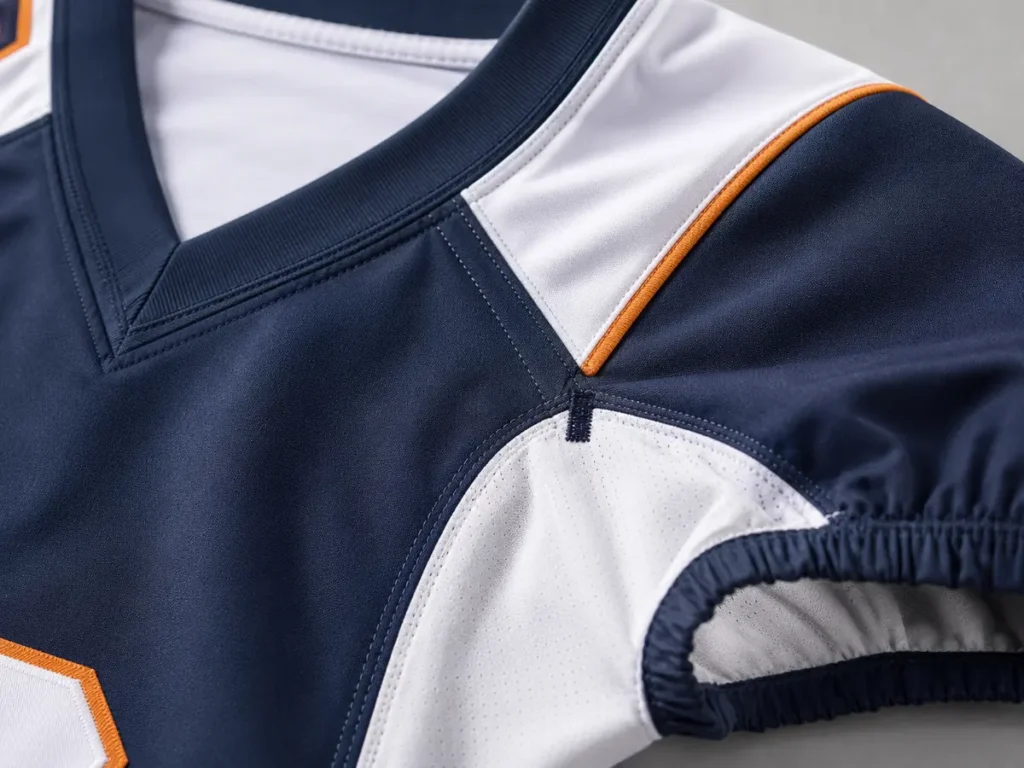
Reinforcement at the collar and panel intersections supports repeated pulling over equipment.
A football jersey is pulled over equipment, grabbed during play, exposed to abrasion, and washed frequently. The construction should be designed around those stresses.
Reinforced Seams and Stress Points
Review seam type, stitch density, and reinforcement at the neck, underarm, side-panel intersections, sleeve openings, and bottom of any slit. Bartacks or other reinforcement can be useful where several panels meet or where repeated pulling concentrates force.
The best seam is not automatically the thickest. Bulky seam allowances in high-contact areas can create discomfort. A supplier should balance strength, elasticity, and a clean interior.
Collar and Neck Opening
The collar must stretch over the player’s head and equipment without permanently distorting. Rib knit, stretch binding, or a reinforced V-neck construction may be used depending on the design. During sample review, stretch the opening repeatedly and inspect skipped stitches, thread breakage, puckering, and recovery.
Sleeve Shape
Cap, tight, or elasticized sleeves can reduce loose material, while a more traditional sleeve may suit some programs or practice jerseys. Confirm that sleeve graphics remain visible and that cuff tension is consistent across sizes.
Number and Logo Stability
For sublimation, inspect sharpness, registration across seams, color penetration, and show-through when the fabric stretches. For twill or applique, check stitch coverage, corners, layer alignment, edge security, and interior comfort. For heat transfers, approve the correct temperature, time, pressure, and peel process for the chosen fabric, then include laundering in the sample review.
Compare Customization Methods
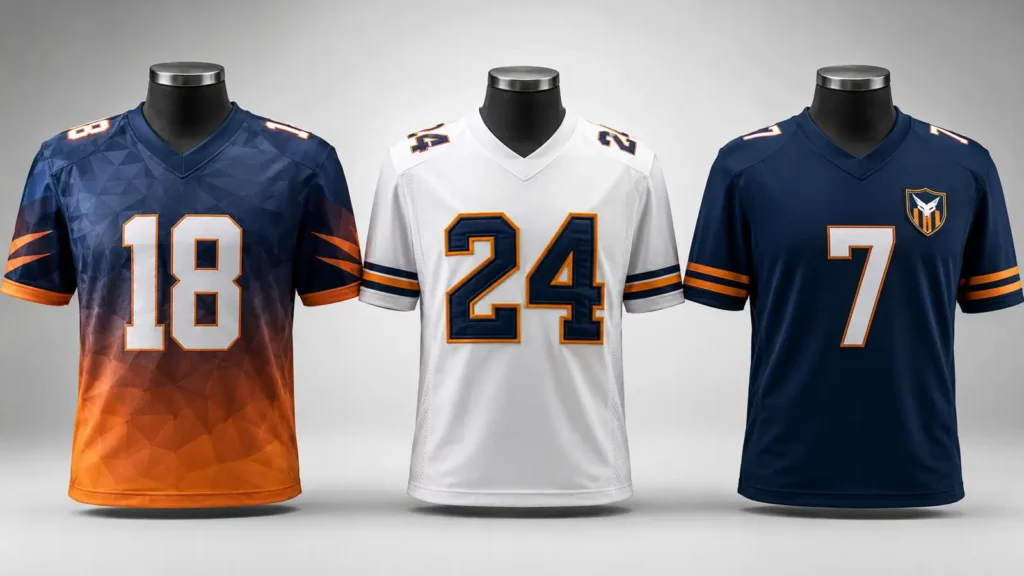
Select decoration by weight, appearance, durability, artwork complexity and budget.
Full Sublimation
Sublimation transfers dye into compatible polyester material. It supports complex graphics, gradients, repeated patterns, names, and numbers without adding a thick surface layer. Because color output depends on fabric, ink, heat, and the production profile, approve a physical color sample rather than a screen-only mockup.
Sublimation is especially useful for:
- coordinated home and away designs;
- multi-color school or club identities;
- many player names and numbers;
- sponsor or event marks;
- artwork that crosses several visual zones.
Avoid placing critical small details directly across seams. Even well-controlled sewing has normal alignment tolerances.
Tackle Twill and Applique
Tackle twill creates a dimensional, traditional appearance. It is often used for large numbers, names, or heritage programs. Specify the number of layers, material, edge finish, stitch type, border width, and placement. Because every layer adds labor and weight, obtain a decorated sample in a representative large number before approving the roster.
Heat Transfer and Screen Printing
Heat transfer can be practical for names, numbers, sponsor marks, or lower-volume applications. Screen printing can suit simpler repeated graphics and practice apparel. Both depend on compatibility between the decoration system and fabric finish. Request wash testing and inspect cracking, lifting, dye migration, and hand feel.
Embroidery and Patches
Embroidery can work for a small crest or selected detail, but dense embroidery is not usually the lightest solution for large football numbers. Woven, rubber/PVC, or leather-style patches can support merchandise or selected team branding, subject to league rules and comfort. Confirm patch size, edge, attachment, and placement.
Color, Artwork, and Roster Control
Color disagreements often begin because buyers approve digital screens without a physical reference. Pantone references can help communicate intent, but the final appearance still depends on material and process. Approve a fabric strike-off or sample under relevant lighting.
Create one master artwork file with:
- front, back, side, and sleeve views;
- color references;
- logo dimensions and locations;
- number font and border construction;
- name font and maximum length;
- sponsor or conference marks;
- seam and panel boundaries;
- label and packaging requirements;
- revision number and approval date.
Maintain the roster in a structured spreadsheet with one row per jersey. Recommended columns are player ID, player name, printed name, number, size, quantity, home/away designation, and notes. Validate duplicate numbers, spelling, leading zeros, and blank fields before production.
Use fictional or properly licensed logos only. The school or club should confirm that it has permission to reproduce all marks supplied to the manufacturer.
Labeling and Market Requirements
Uniform rules and product-labeling laws address different issues. A jersey can meet league number requirements and still need corrected commercial labels.
For products marketed in the United States, the Federal Trade Commission explains that most textile products require fiber content, country of origin, and the identity of the manufacturer or another responsible business. Clothing is also generally subject to care-label requirements. See the FTC’s textile labeling guidance and Care Labeling Rule guidance.
For the European Union, Regulation (EU) No 1007/2011 addresses textile fiber names and composition labeling. EU guidance states that textile products marketed in the EU must show fiber composition, with labels provided in the required language or languages of the destination market. The EU’s General Product Safety Regulation also applies to covered consumer products, including many products offered online. Buyers should review destination-specific obligations with their importer or compliance professional. Official starting points include the EU textile label guidance and the European Commission GPSR overview.
Ask the supplier to prepare labels from approved buyer information. Do not copy a label from an unrelated garment, and do not make environmental, safety, or performance claims without appropriate documentation.
What Drives the Cost of Custom Football Jerseys?
Suppliers cannot quote accurately from a logo alone. The main cost drivers include:
- custom pattern development versus an existing body;
- fabric type, weight, stretch content, and panel count;
- sublimation coverage and color-control work;
- number and complexity of twill or applique layers;
- embroidery stitch count or patch construction;
- youth and adult size range;
- individual names and roster complexity;
- label, hangtag, bag, carton, and sorting requirements;
- sample rounds and testing;
- total quantity per design and color;
- shipping method, destination, duties, and delivery schedule.
Compare quotations using the same specification. One quote may include player personalization, private labels, individual bags, and export cartons while another includes only a blank decorated body. A line-by-line comparison prevents false savings.
JIUMU’s typical MOQ is 50 pieces, subject to the jersey structure and customization. Confirm whether the MOQ applies per design, color, or combined order when requesting the quotation.
A Practical Sample and Quality-Control Process
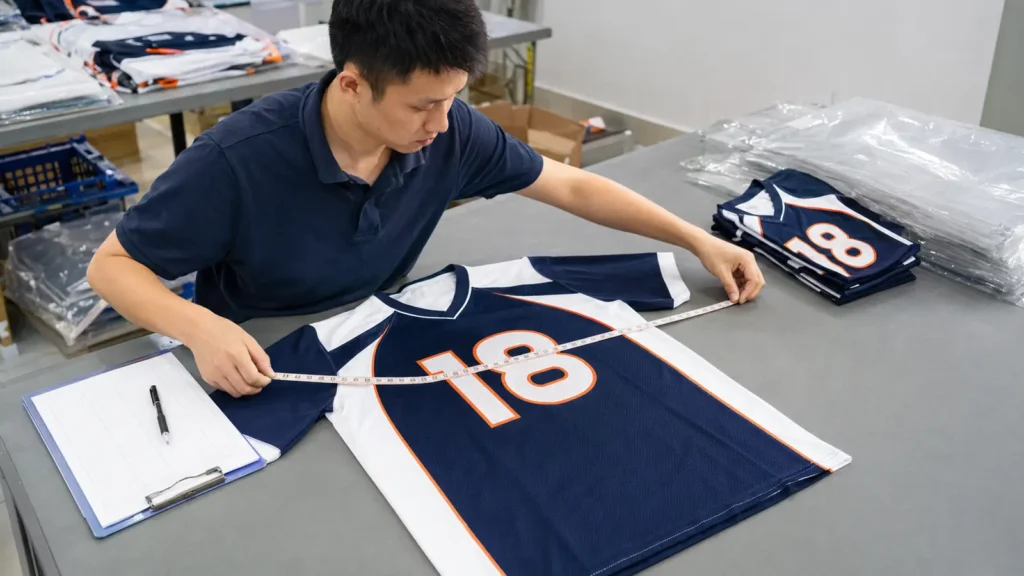
Bulk inspection should reconcile measurements, decoration, roster details, labels, packaging and quantities.
1. Digital Mockup
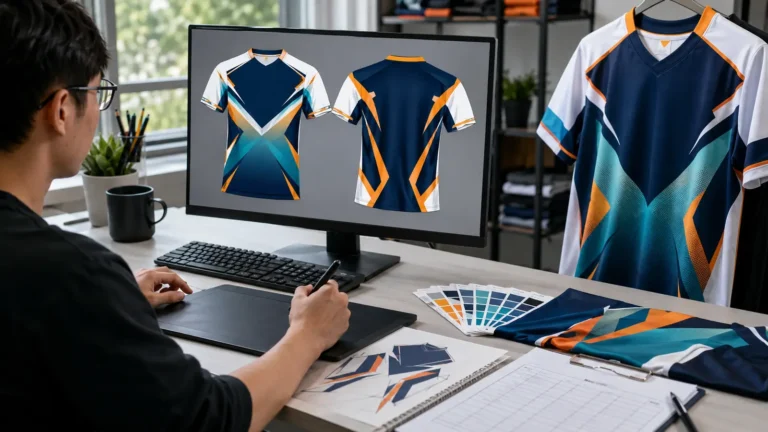
The mockup confirms layout direction but does not prove color, fit, fabric, or construction. Check logo permissions, number style, contrast, panel boundaries, and roster format.
2. Fabric and Color Approval
Review swatches or a printed strike-off. Record the approved material code, fiber composition, weight, and color reference. If home and away jerseys use different base fabrics, approve both.
3. Size Set
Fit representative youth and adult sizes over the equipment. Record comments against actual garment measurements, not only subjective statements such as “too loose.”
4. Pre-Production Sample
The pre-production sample should represent the intended bulk construction and decoration. Inspect:
- overall appearance and color;
- measurements against the approved chart;
- pad-compatible movement;
- collar recovery;
- number height, width, contrast, and position;
- logo and name placement;
- seam quality and reinforcement;
- decoration adhesion or stitch security;
- label content and location;
- packaging presentation.
5. Bulk Inspection
Bulk quality control should include material verification, measurement sampling, visual inspection, roster reconciliation, decoration checks, needle or sharp-object control as appropriate, labeling, packaging, carton marks, and quantity confirmation.
For repeat orders, compare new production against an approved retained sample or documented standard. Small process variations can become visible when replacement jerseys are placed beside older stock, so the team should agree on an acceptable matching standard.
What to Send for an Accurate Quotation
Prepare the following before contacting a supplier:
- Buyer organization, destination country, and intended competition.
- Total quantity, plus quantities by home/away design.
- Youth and adult size range.
- Preferred fabric or performance requirements.
- Reference images or a technical pack.
- Vector logos where available.
- Team colors and physical color references.
- Player names, numbers, and sizes in a structured file.
- Decoration method or desired visual effect.
- Neck label, care label, hangtag, bag, and carton requirements.
- Required sample date, delivery date, and shipping destination.
- Applicable uniform rules or approval contact.
If some details are undecided, state that clearly. A supplier can offer options, but the final quotation should identify the assumptions used.
Questions to Ask a Football Jersey Supplier
- Which body pattern is recommended for our age group and pad profile?
- Can you provide finished-garment measurements and tolerances?
- What are the fabric composition, weight, knit structure, and stretch direction?
- Which panels are reinforced, ventilated, or stretch?
- How will you confirm number size and contrast against our league rules?
- Can we approve a fabric strike-off, size set, and pre-production sample?
- What tests or internal checks are included, and what requires a separate request?
- How are roster names and numbers checked before production?
- How do you control color across the order and future reorders?
- What information is retained for replacement jerseys?
- Is the MOQ per design, per color, or across the program?
- What is included in the quoted price and what is excluded?
- How will private labels, care labels, and country-of-origin information be handled?
- What packaging and carton sorting options are available?
A credible answer should refer to the proposed jersey, not only use general phrases such as “high quality.”
Common Buying Mistakes
Approving Only a Screen Mockup
A digital image cannot validate fit, fabric, color, or seam quality. Use it for layout approval, then approve physical evidence.
Treating Football Jerseys Like T-Shirts
Tackle jerseys must work over equipment. Ordinary chest measurements and casualwear grading are insufficient.
Using Low-Contrast Numbers
Complex gradients, outlines, or patterns can reduce legibility and may conflict with competition rules. Protect the number zone early in the design.
Sending an Uncontrolled Roster
Names and numbers copied from messages are easy to misread. Use one approved spreadsheet and lock it after the final deadline.
Ignoring Replacement Orders
Schools and clubs frequently add players or replace damaged garments. Archive the approved specification and ask about the supplier’s reorder process before the first order.
Ordering Too Late
Artwork, samples, roster approval, bulk production, inspection, transit, and customs all require time. Build the schedule backward from the first required game and include decision time on the buyer’s side.
Assuming All Rules Are the Same
NFHS, NCAA, state associations, youth leagues, and flag organizations can differ. Confirm the exact governing rules for the team.
Why Schools and Clubs Work With JIUMU
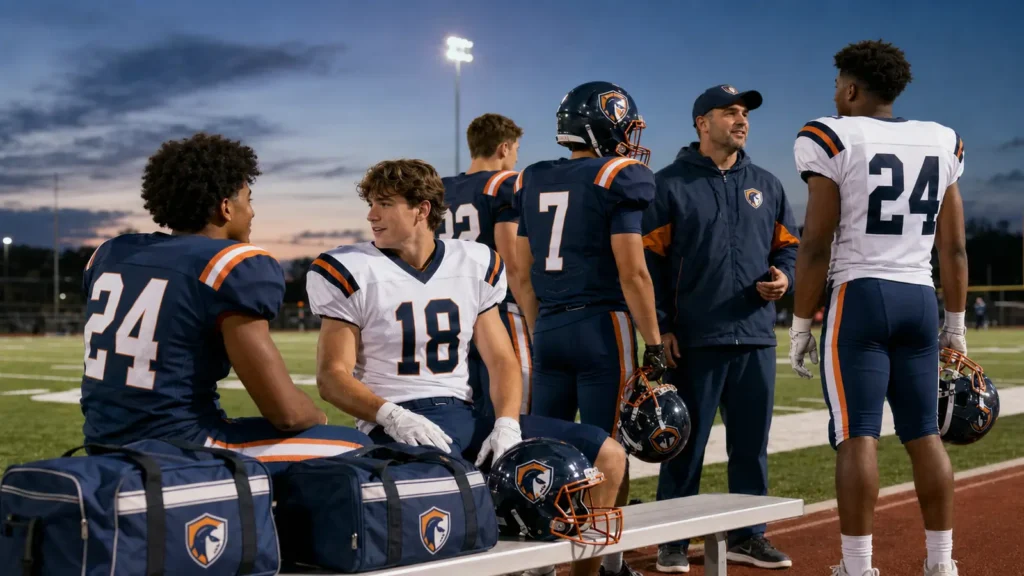
A documented uniform system makes roster additions and related teamwear easier to coordinate.
JIUMU is a Guangdong-based B2B supplier established in 2010. The company supports custom teamwear, uniforms, hats, bags, and branded merchandise for buyers in the United States, Canada, the United Kingdom, and Europe.
Relevant capabilities include:
- OEM and ODM product development;
- sublimation, embroidery, screen printing, and heat transfer;
- woven, rubber/PVC, and leather-style patches;
- fabric sourcing and Pantone color matching;
- private labels, neck labels, woven labels, and hangtags;
- digital mockups and physical samples;
- packaging customization;
- bulk production quality control and export support.
For a football program, the practical benefit is one specification workflow across jerseys and related teamwear. Buyers can also explore custom team jerseys, custom team uniforms, custom team jackets, custom hoodies, and custom team bags.
Capabilities and MOQ should always be confirmed against the final design. A physical sample remains the correct basis for approval.
Frequently Asked Questions
Final Recommendation
The best custom football jerseys for a school or club are the jerseys that pass four approvals: the governing rule, the equipment fit, the physical sample, and the roster record. Begin with the competition and pad profile, then specify fabric, panel function, construction, decoration, labels, packaging, and reorder data.
For most multi-color team programs, a reinforced sublimated jersey is a strong starting point. Traditional tackle twill or hybrid decoration is appropriate when dimensional branding justifies the additional weight and cost. In every case, insist on readable numbers, physical color approval, a pad-tested size set, and a documented pre-production sample.
Sources and Further Reading
- NFHS — 2025 Football Jersey and Pant Rules
- NCAA — Football Playing Rules and Uniform Resources
- USA Football — Equipment Fitting
- FTC — Textile and Wool Labeling Requirements
- FTC — Care Labeling Rule Guidance
- European Union — Textile Label Guidance
- European Commission — General Product Safety Regulation
About JIUMU
JIUMU is a Guangdong-based B2B supplier established in 2010, supporting custom teamwear, uniforms, hats, bags and branded merchandise for buyers in North America and Europe. Typical MOQ is 50 pieces, subject to product structure and customization.