Authentic vs Replica Jerseys: Materials, Construction and Fit Explained
Sourcing jerseys for a club, school, distributor, promotional program, or private-label range involves more than choosing a design. The words authentic and replica can represent different fabrics, ventilation, decoration, fits, and price levels. They also change meaning by brand and sport.
For a professional buyer, the useful question is: Which construction level suits the wearer, use case, retail position, and budget?
This guide translates the differences into specifications for product development, sampling, quotation, and quality control. It also explains why a licensed replica can be an official fan product, not a counterfeit.
Quick Answer: Authentic jerseys are generally designed to approximate the on-field or on-court garment. They often use lighter or more engineered fabrics, closer fits, ventilation zones, low-profile trims, and performance-oriented decoration. Replica jerseys are generally licensed fanwear inspired by the player version. They usually prioritize everyday comfort, broader sizing, durable decoration, simpler construction, and a lower retail price. These are industry tendencies—not universal technical standards—so buyers should compare measurable specifications rather than rely on the product name alone.
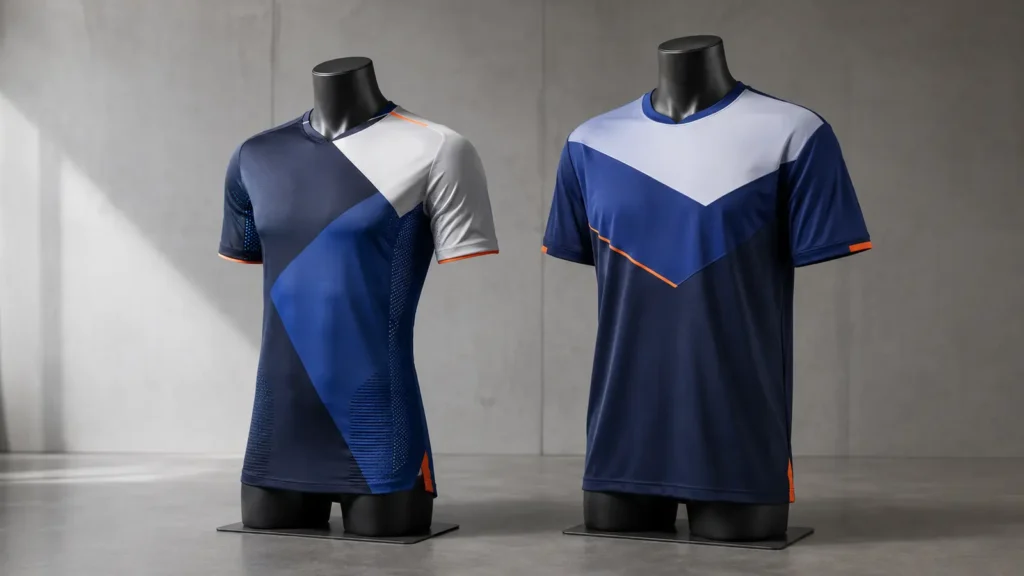
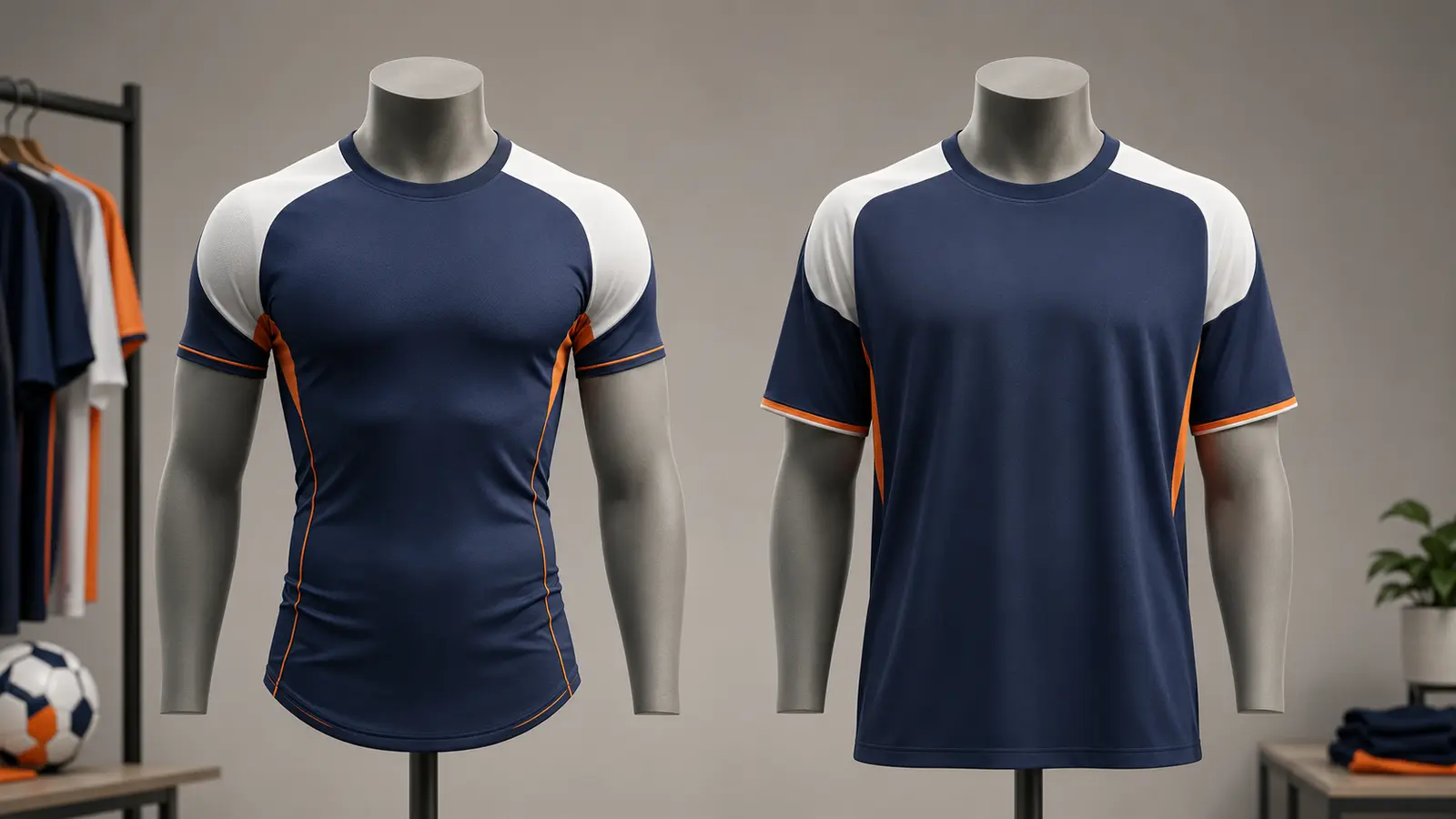
Two original performance jerseys showing fitted and relaxed constructions
What Do “Authentic” and “Replica” Mean?
In licensed sports merchandising, an authentic jersey is commonly the version made to match, or closely approximate, what players wear in competition. Depending on the brand and sport, it may also be called a match, player, elite, or pro jersey.
A replica jersey is commonly an officially licensed fan version that reproduces the team colors and visual identity while changing the fit, fabric, construction, or decoration for wider consumer use. It may also be called a stadium, fan, game, swingman, or supporter jersey.
Official brand descriptions support this general distinction but also show why the terms are not universal. Adidas describes authentic soccer jerseys as lighter, more fitted, and performance-focused, while replica jerseys are slightly looser and designed for everyday comfort. Nike uses Match and Stadium for certain soccer collections, but uses Elite, Limited, Game, and Legend for NFL jerseys. A buyer should therefore treat the tier name as a starting point, not a complete specification.
Replica Does Not Automatically Mean Counterfeit
This point matters for buyers, retailers, and content teams. An official replica is authorized fanwear. A counterfeit is an unauthorized product that uses a protected name, logo, or other mark in a way that can deceive customers about its source. The United States Patent and Trademark Office describes trademark infringement as unauthorized use likely to cause confusion, deception, or mistake about source.
If you are developing custom teamwear, use artwork you own or have permission to use. Do not ask a supplier to copy a professional club jersey, sponsor layout, league badge, or protected brand mark. A lawful custom jersey can take inspiration from general performance features—such as mesh ventilation, a shaped hem, or a lightweight crest application—without reproducing protected designs.
Authentic vs Replica Jerseys at a Glance
| Comparison point | Authentic or player-level tendency | Replica or fan-level tendency | What a B2B buyer should specify |
|---|---|---|---|
| Primary use | Competition, high-intensity play, premium collection | Fanwear, events, retail, general team use | Actual wearer and activity level |
| Fabric | Lighter engineered knit, mapped mesh, stretch zones | Smooth interlock, standard mesh, more substantial handfeel | Fiber, knit, weight in GSM, stretch, opacity |
| Fit | Closer, articulated, tapered, sometimes shorter | Regular or relaxed, easier to layer | Finished garment measurements by size |
| Ventilation | Body-mapped or strategically placed zones | General breathable fabric or side panels | Panel locations and minimum airflow need |
| Decoration | Thin heat-applied crest, lightweight transfer, integrated graphic | Embroidery, patch, screen print, heat transfer, sublimation | Method, dimensions, placement, handfeel |
| Seams | Lower-profile seam engineering, bonded or specialized finishes on some styles | Conventional overlock and coverstitch construction | Seam type, stitch density, reinforcement points |
| Durability priority | Performance-to-weight balance | Frequent casual wear and easier care | Wash requirement and end-use conditions |
| Sizing | May run close to body | Often more forgiving | Size chart, fit model, grading rules |
| Cost | Usually higher | Usually lower | Target landed-cost range and required features |
| Best buyer fit | Elite teams, premium launches, performance capsules | Schools, clubs, fan programs, promotions, broad retail | Channel, price position, reorder plan |
The table describes common patterns, not a grading law. A well-specified replica-level jersey may be more durable for repeated casual use than an ultra-light authentic-style garment. An authentic-style jersey may also use a standard fit rather than a compression-like silhouette. For example, a current Nike Match soccer product describes a standard fit while differentiating the Match and Stadium versions through cooling technology and authentic design details.
The Material Difference: Fiber Is Only the Beginning
Many authentic and replica jerseys are polyester. Two “100% polyester” garments can still behave differently because their yarn, knit, finish, weight, stretch, and ventilation differ.
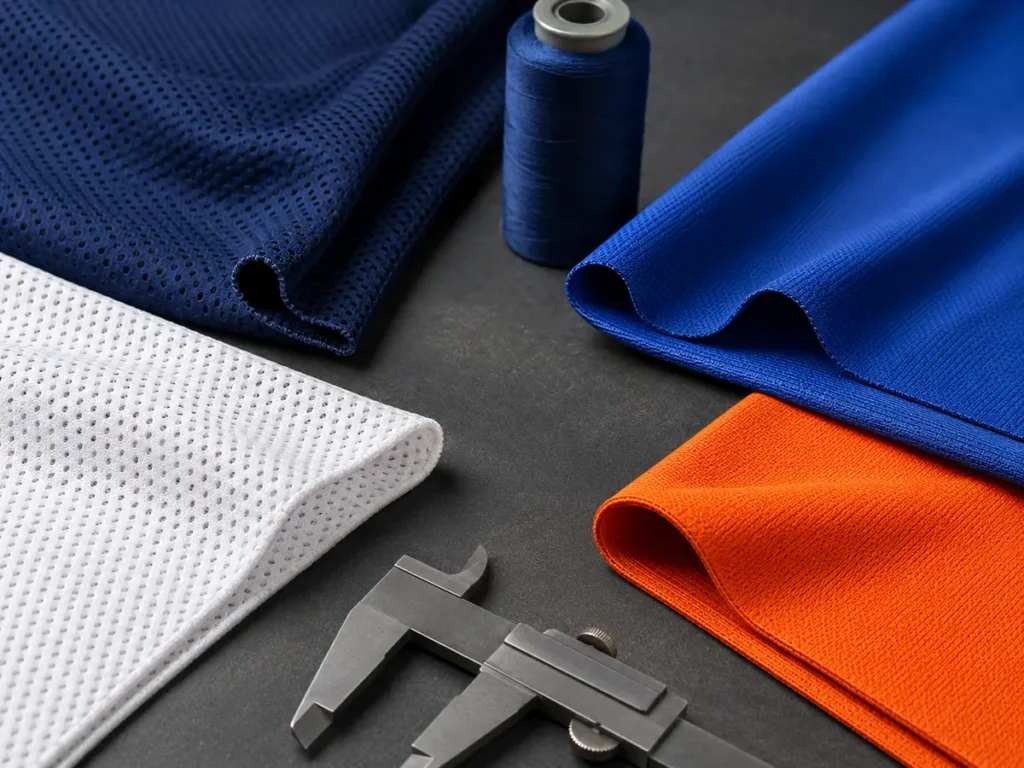
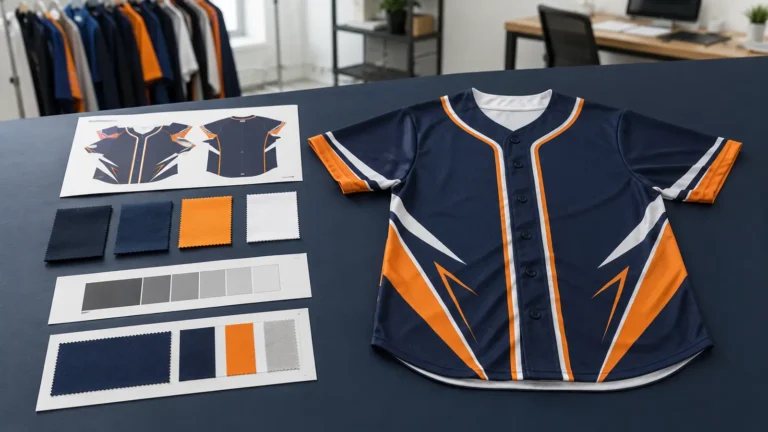
Performance jersey fabric swatches showing mesh and knit differences
Lightweight Engineered Knits
Player-level jerseys often reduce weight by using fine yarns, open structures, engineered jacquard patterns, or mapped ventilation. Instead of sewing a large mesh panel into the side body, the knit itself may transition between more open and more closed zones.
This can improve airflow and reduce bulk, but it increases development complexity. Check:
- fabric weight in grams per square meter, measured by color if necessary;
- knit structure and visual consistency;
- stretch and recovery in both directions;
- opacity under bright light and when stretched;
- snagging risk;
- moisture-management finish, if claimed;
- colorfastness after washing and perspiration exposure;
- compatibility with heat-applied logos and numbers.
“Lightweight” is not a complete specification. Light white fabric may become translucent, open mesh can distort a transfer, and elastic knit can change measurements after relaxation. Test the final color, decoration, and fit.
Interlock and Standard Performance Polyester
Replica and teamwear jerseys commonly use polyester interlock because it provides a smooth printable surface, stable dimensions, a clean drape, and practical durability. It works well for sublimated graphics, heat transfers, screen prints, and many cut-and-sew designs.
Interlock is not automatically low grade. The quality depends on yarn, density, weight, finishing, color consistency, and inspection. A stable medium-weight interlock can be the better choice for a school program that needs broad sizing, repeat orders, easy laundering, and predictable decoration.
Mesh Panels and Double Knits
Mesh side panels, underarm panels, or back panels can add ventilation without requiring a fully engineered body fabric. For contact sports or jerseys expected to withstand frequent abrasion, a more substantial double-knit or reinforced shoulder material may be appropriate.
The trade-off is weight and handfeel. Buyers should decide whether they are optimizing for maximum airflow, shape retention, abrasion resistance, or cost. One fabric rarely leads in every category.
Construction: Where Performance and Durability Are Built
Construction differences are often less visible in ecommerce photos than fabric or graphics, yet they can strongly affect comfort, mobility, and life span.
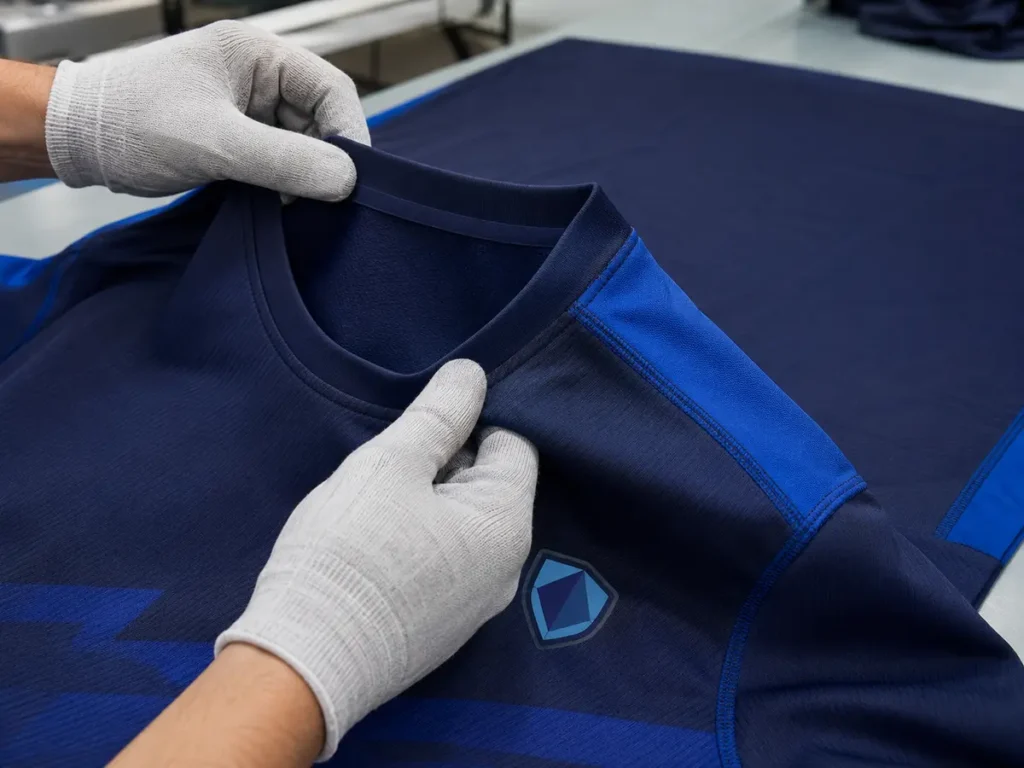
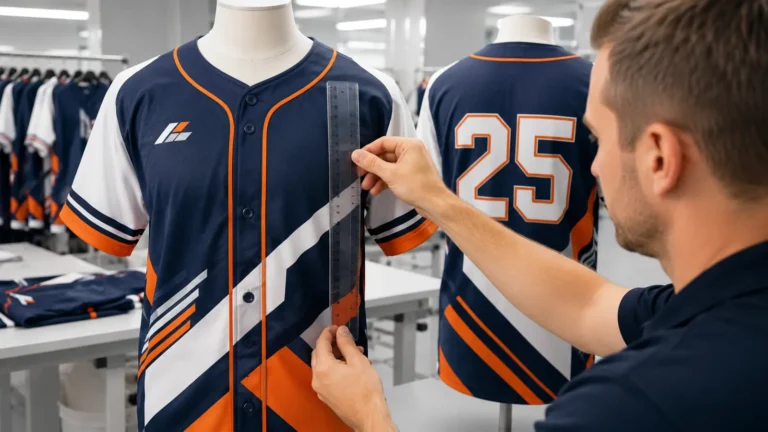
Inspector checking collar and shoulder construction on a jersey
Collar and Neckline
An authentic-style soccer jersey may use a low-profile rib, a bonded edge, a contoured collar, or a mixed construction that reduces bulk. A fan version may use a conventional rib collar that feels familiar and tolerates repeated casual wear.
For sourcing, specify:
- neckline shape and opening circumference;
- rib composition and finished width;
- overlap, binding, self-fabric, or bonded construction;
- front-drop and back-neck measurements;
- stretch recovery;
- seam allowance and topstitch details;
- whether the collar must fit over protective gear or base layers.
A collar can look correct on a flat sample and still feel tight when worn. Fit approval should include an actual try-on.
Seams and Panel Engineering
Player-oriented jerseys may use articulated panels to follow shoulder and torso movement. Some designs use lower-profile seam finishes or place seams away from high-friction areas. Replica and general team jerseys often use conventional overlock assembly with coverstitching or topstitching at hems.
Neither method is automatically superior. Conventional seams are widely understood, efficient to produce, and easy to inspect. Specialized bonding can reduce bulk but requires control over adhesive, temperature, pressure, curing, and wash performance.
Ask the supplier to identify:
- seam type at shoulder, side, sleeve, armhole, collar, and hem;
- stitch density and thread type;
- reinforcement at stress points;
- seam stretch requirement;
- tolerance for puckering and skipped stitches;
- any bonded components and their wash-test method.
Decoration: Crests, Names, Numbers and Sponsor Marks
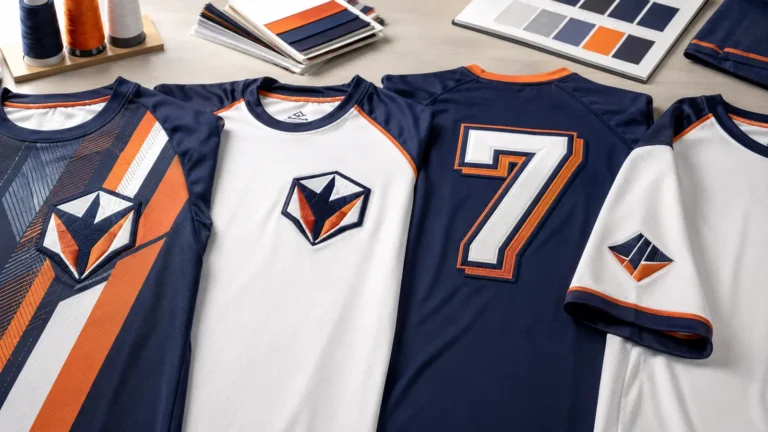
Decoration is one of the largest visual and cost differences between jersey tiers. It also creates common failure points: peeling edges, heavy stacked layers, puckered embroidery, inconsistent number placement, and color mismatch.
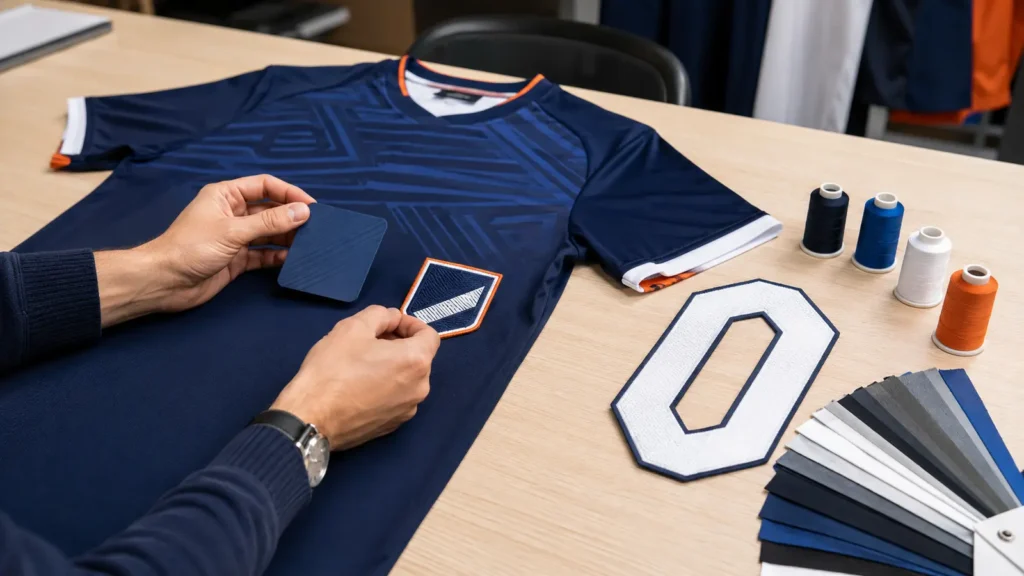
Custom jersey decoration samples on a product development table
Heat-Applied Badges and Transfers
Thin heat-applied crests and transfers can support a lightweight, low-profile look. They reduce the weight and stiffness associated with dense embroidery, making them suitable for performance-oriented jerseys. However, performance depends on the adhesive system, fabric finish, press settings, surface texture, and laundering.
Approval should cover edge adhesion, registration, wash resistance, color migration, handfeel, and stretch compatibility. Approve the decoration on the actual production fabric, not only the artwork file.
Embroidery and Patches
Embroidery creates a dimensional appearance, but dense stitching can pucker lightweight fabric. A woven patch can reproduce finer detail with less stitch density, while rubber/PVC or leather-style patches create a different brand position. Specify dimensions, border, thickness, backing, attachment, color, and placement tolerance.
Sublimation
Sublimation places colors, patterns, names, and numbers into polyester fabric rather than adding separate surface layers. It supports all-over design and keeps large graphics light. Buyers still need controls for color, artwork scale, panel matching, seam interruption, spelling, number assignment, and shade consistency. A vivid print cannot compensate for poor opacity, recovery, or handfeel.
Tackle Twill, Screen Printing and Hybrid Builds
Tackle twill creates a traditional dimensional look, especially in baseball, American football, and hockey. Screen printing can be efficient for suitable quantities and designs. Hybrid builds may combine sublimated body graphics with embroidered or heat-applied crests.
Every additional layer affects cost, weight, flexibility, lead time, and wash performance. Choose the method based on the desired appearance and use case, not only on what looks most “authentic” in a product photo.
Fit: The Difference Buyers Notice First
Fit is often the deciding factor for the end user. Authentic-style jerseys are commonly closer through the chest and waist, with shaped panels and sleeves designed for movement. Replica-style jerseys generally provide more ease for comfort, layering, and broad consumer sizing.
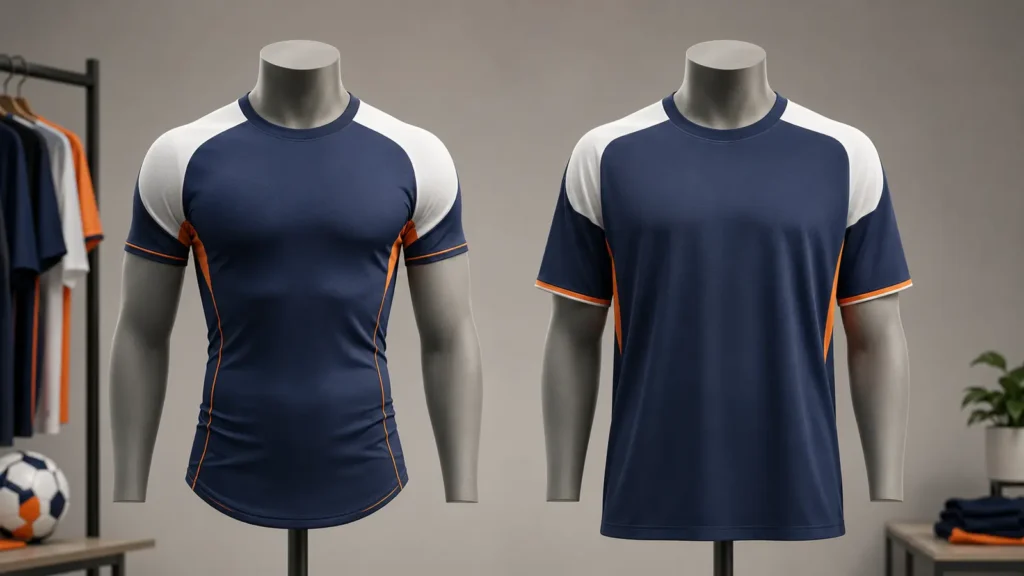
Fitted performance jersey and relaxed fan-fit jersey on mannequins
Do Not Source by Letter Size Alone
A medium from one program may be similar to a small or large in another. “Slim,” “athletic,” “regular,” and “relaxed” are not sufficient production instructions. The quotation and sample should use a measurement chart with points of measure such as:
- half chest at a defined distance below the armhole;
- body length from high point shoulder;
- shoulder width or raglan seam reference;
- sleeve length and opening;
- bottom opening;
- front and back neck drop;
- armhole depth;
- waist width for tapered styles;
- side-slit or drop-tail dimensions;
- allowable tolerance by measurement.
The method must also state whether the garment is measured relaxed, flat, and after a defined conditioning period.
Allowance for Pads and Base Layers
Soccer and basketball jerseys may be worn close to the body, while American football and hockey jerseys must accommodate protective equipment. Baseball jerseys need enough mobility for throwing and batting and may be worn tucked or untucked. A “player fit” therefore changes by sport.
When developing a custom range, test the sample with the actual base layer, pads, or uniform bottoms. A generic mannequin fitting cannot validate all sports.
Size Grading and Inclusive Programs
Replica-level and club programs often need youth, adult, women’s, extended, and sometimes unisex sizing. A single proportional grade rule can create problems at the smallest and largest sizes. Review the full measurement chart, not only the base size.
For large programs, consider a pre-production size set or at least critical sizes at each end of the range. Confirm whether personalized names and numbers change return or replacement policies, because customized garments are harder to reallocate.
How Terminology Changes by Sport and Brand
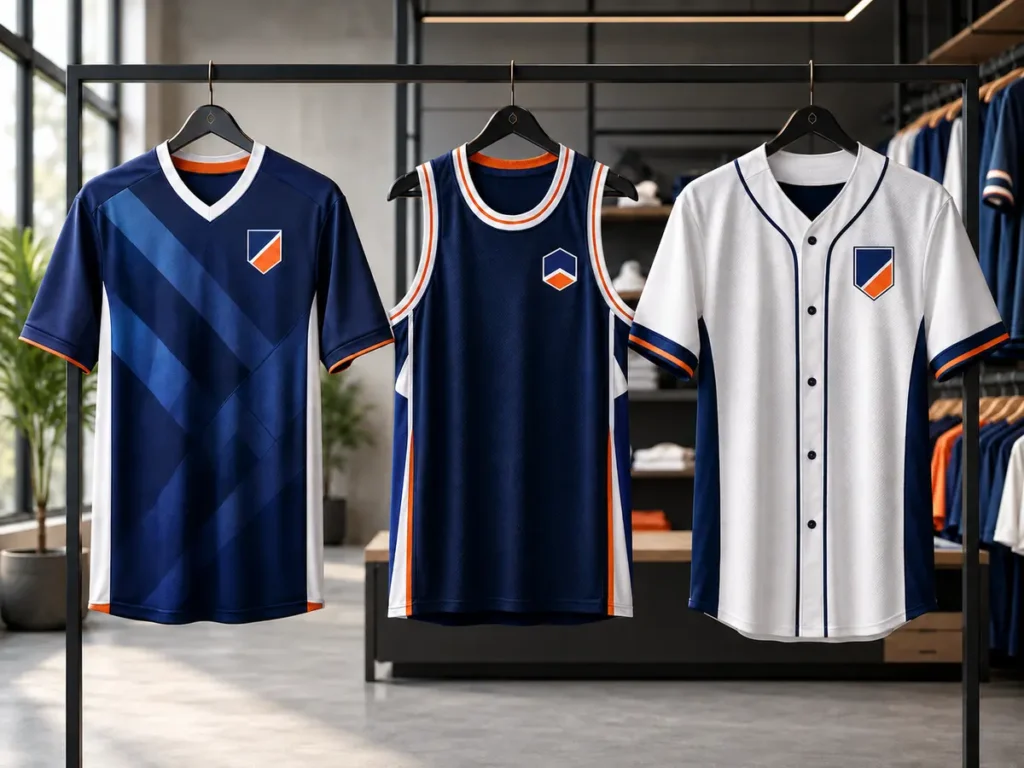
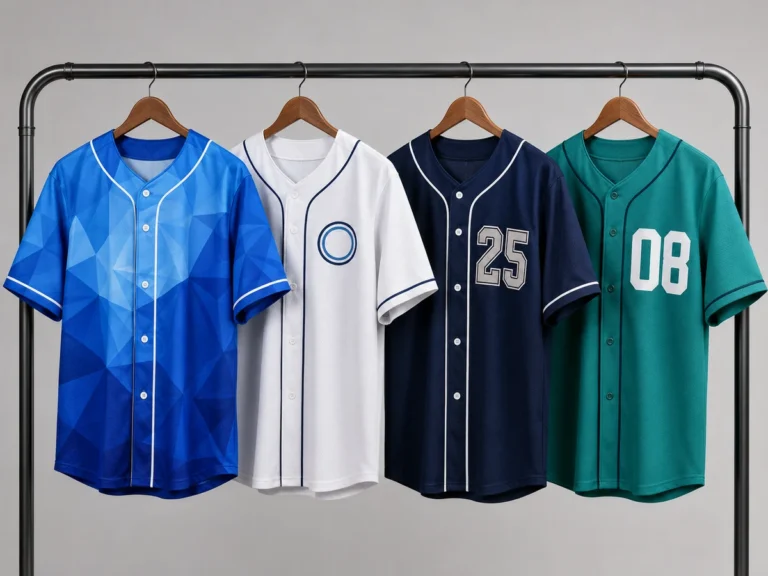
Original soccer, basketball and baseball jersey silhouettes
| Sport or channel | Common tier language | Typical difference to verify |
|---|---|---|
| Soccer/football | Authentic, Match, Player vs Replica, Stadium, Fan | Knit engineering, fit, crest application, collar, ventilation |
| American football | Elite, Limited, Game, Legend or similar | Shoulder cut, sleeve bands, mesh, twill vs print, fit over layers |
| Basketball | Authentic, Swingman, Replica or custom performance tiers | Body mesh, trim, number method, cut, length |
| Baseball | On-field, Authentic, Replica, Cool Base-style language, custom tiers | Button construction, placket, piping, twill, body weight |
| Hockey | Authentic, Pro, Premier, Breakaway, Replica or custom tiers | Reinforcement, fight strap, shoulder/elbow room, crest weight |
| School and club customwear | Elite, Pro, Standard, Club, Training | Supplier-defined; must be converted into measurable specifications |
The same label can indicate a different feature package in another sport. Nike’s NFL guide, for example, distinguishes Elite, Limited, Game, and Legend versions through materials, ventilation, twill, screen printing, sublimated graphics, and fit. This is why copying terminology into a purchase order is risky.
Which Jersey Tier Should a Professional Buyer Choose?
The correct tier follows the job the jersey must perform.
Choose an Authentic-Style Specification When:
- the garment is intended for competition or high-intensity training;
- low weight and body-mapped ventilation are meaningful;
- the wearer accepts a closer fit;
- the collection needs a premium technical position;
- the budget supports fabric development, specialized trims, or added testing;
- a physical size set and performance sample can be approved.
Choose a Replica-Style Specification When:
- the garment is for supporters, events, schools, clubs, or general retail;
- comfort and broad sizing matter more than minimum garment weight;
- users may layer the jersey over casual clothing;
- decoration durability and reorder consistency are priorities;
- the program needs accessible pricing;
- conventional construction simplifies production and inspection.
Consider a Hybrid Teamwear Specification
Custom buyers do not have to reproduce a professional league’s two-tier structure. A hybrid can combine a stable interlock body, ventilated side panels, a regular athletic fit, and a lightweight heat-applied crest. This can deliver practical performance without the cost or fit risk of an ultra-light player replica.
Developing a custom jersey range? Send JIUMU your sport, quantity, target market, reference silhouette, size range, color requirements, logo artwork, decoration preference, packaging needs, and delivery target. We can help convert the idea into a mockup and sample brief. Explore custom team jerseys.
What Drives the Cost Difference?
Price is influenced by more than fabric weight. Main drivers include:
- Fabric: engineered knits, custom mesh, stretch requirements, and smaller-run color matching add setup and material cost.
- Panel count: articulated panels increase cutting, sewing, alignment, and inspection.
- Decoration: badges, transfers, twill, names, and individual numbers require different labor and tooling.
- Construction: bonding or specialized seams require process control and may add testing.
- Order complexity: many sizes, colors, rosters, and packaging variations increase handling and error risk.
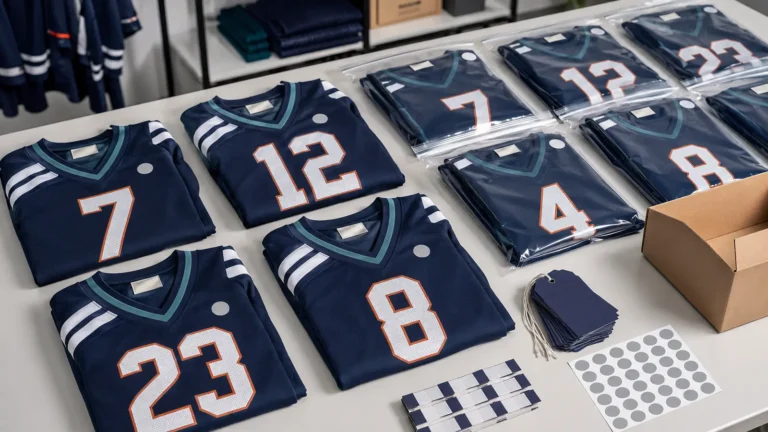
- Quality and packaging: size sets, wash tests, inspection, player packs, barcodes, and carton sorting affect landed cost.
To compare quotations fairly, give each supplier the same specification. A lower price may simply exclude a size set, custom label, individual bag, decoration method, or quality test included elsewhere.
Turn a Marketing Tier into a Production Specification
A useful tech pack should describe the garment without relying on “authentic quality” or “replica quality.” Include the following:
| Specification area | Information to provide | Approval evidence |
|---|---|---|
| Intended use | Sport, competition, training, fanwear, retail, promotion | Written product brief |
| Fabric | Fiber, knit, GSM, stretch, finish, color, opacity requirement | Swatch and lab dip or printed strike-off |
| Fit | Fit name plus full finished measurements and tolerances | Fit sample and size chart |
| Construction | Panels, seams, collar, sleeve, hem, reinforcement | Sealed sample and construction sheet |
| Decoration | Method, artwork, dimensions, colors, placements | Decorated sample on production fabric |
| Personalization | Roster, spelling, numbers, size assignment | Approved data sheet |
| Branding | Owned or licensed artwork, labels, hangtags | Artwork authorization and label proof |
| Packaging | Folding, polybag, size sticker, barcode, player pack | Packaging sample |
| Quality | Inspection points, tests, defect standards | QC checklist and inspection report |
| Delivery | Quantity, destination, required date, shipping mode | Confirmed production schedule |
Sampling and Quality Control
The sample process should reduce uncertainty before bulk production. A practical sequence is:
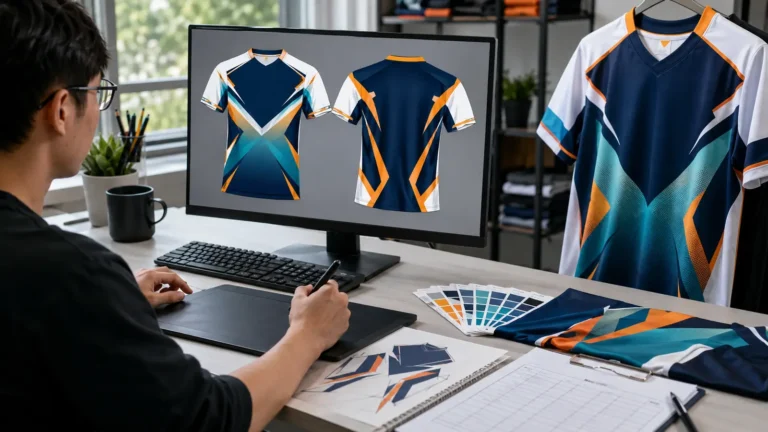
- Digital mockup: confirm overall layout, colors, logo locations, and personalization zones.
- Material approval: approve fabric swatches, color references, trims, thread, patches, and transfer samples.
- Fit sample: validate measurements, movement, layering, collar comfort, sleeve shape, and hem behavior.
- Decorated pre-production sample: use the intended fabric and final decoration methods.
- Size set or critical-size review: confirm grading across the range.
- Pre-production confirmation: freeze the bill of materials, artwork, measurement chart, labels, packaging, and roster.
- Bulk inspection: check materials, shade, workmanship, dimensions, decoration, personalization, cleanliness, packaging, and carton assortment.
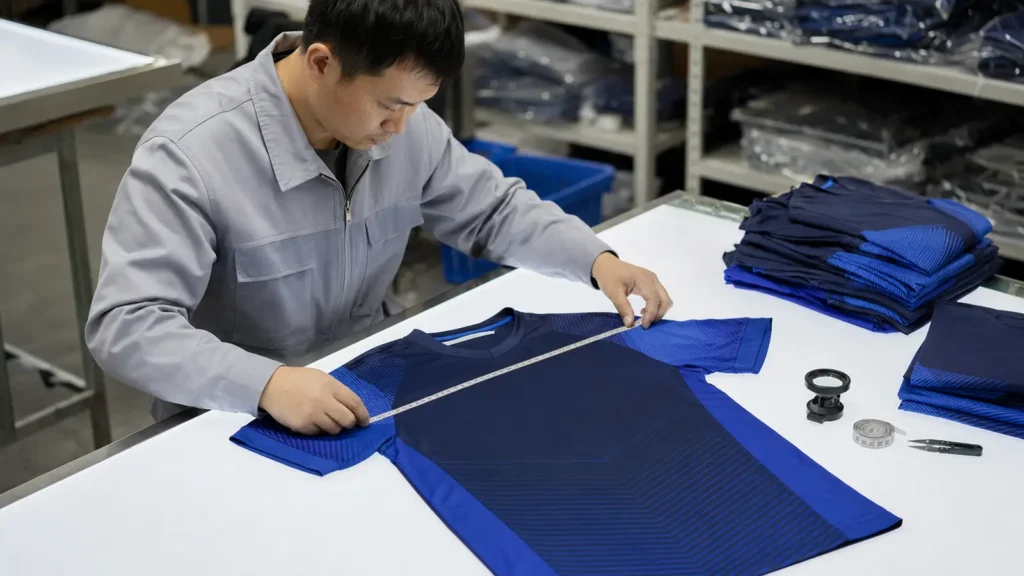
Quality inspector measuring an original team jersey
High-Value QC Checks
- Compare fabric and trim colors under consistent lighting.
- Check white and light colors for acceptable opacity.
- Measure garment weight when a lightweight target is important.
- Confirm stretch recovery after handling.
- Inspect collar symmetry and neckline opening.
- Check skipped stitches, seam grin, puckering, loose threads, and reinforcement.
- Verify crest, sponsor, name, and number location against an approved placement diagram.
- Test heat-applied edges for lifting.
- Compare sublimation shade across panels and production lots.
- Validate every personalized roster entry against the approved source.
- Measure a defined sample quantity using the agreed method and tolerances.
- Confirm labels, size stickers, barcodes, polybags, player packs, and carton ratios.
Do not rely on a showroom sample made from substitute materials unless every difference is documented and later reapproved on production materials.
Labeling and Market Considerations
Product developers should include labeling requirements early. In the United States, the FTC states that most textile products must disclose fiber content, country of origin, and the identity of the manufacturer or another responsible business; clothing also falls under care-label rules. In the European Union, Regulation (EU) No 1007/2011 governs textile fiber names and related labeling or marking of fiber composition.
These rules do not define whether a jersey is “authentic” or “replica,” but they affect the product sold under either description. Requirements can vary by market, product type, claim, and sales channel. Buyers should obtain market-specific legal or compliance advice instead of treating this article as a complete regulatory checklist.
Claims such as recycled content, moisture management, UV protection, or antibacterial performance need appropriate documentation. Confirm what was tested, by whom, using which method, and whether it covers the production material.
Information to Send for an Accurate Quotation
The fastest useful quotation begins with a complete brief. Send:
- sport and jersey style;
- end use: game, training, fanwear, retail, event, or promotion;
- estimated quantity by design and color;
- destination country and target delivery date;
- target price level, if available;
- reference images for silhouette only;
- original or authorized vector logo artwork;
- color references;
- preferred fabric or a performance description;
- finished size chart or target market and fit;
- decoration methods;
- names, numbers, sponsors, and roster complexity;
- private labels, hangtags, barcode, and packaging requirements;
- sample quantity and approval schedule;
- any required tests or inspection method.
If you do not yet have a full tech pack, clearly rank the priorities. For example: “regular athletic fit, non-transparent white fabric, sublimated all-over graphics, lightweight crest, youth and adult sizes, frequent repeat orders.” A supplier can propose options when the decision criteria are visible.
Questions to Ask a Jersey Supplier
- What exact fabric options do you recommend for competition, fanwear, and hybrid use?
- What are the fiber content, knit type, weight, stretch, and opacity characteristics?
- Can I approve the fabric and decoration together before bulk production?
- Which measurements define the fit, and what tolerances apply?
- Can you produce a fit sample and a decorated pre-production sample?
- How do you control sublimation shade and panel alignment?
- How do you test heat-applied badges or transfers?
- How are player names, numbers, sizes, and packing assignments verified?
- What private-label and packaging options are available?
- How are repeat orders matched to the original fabric, color, and pattern?
- Which quality checks are performed during and after production?
- Which information is needed to confirm lead time and delivery?
Common Buying Mistakes
Assuming “Authentic” Is a Complete Specification
It is a positioning term, not a universal bill of materials. Request measurable fabric, fit, construction, decoration, and quality requirements.
Treating Replica as Fake
Licensed replica fanwear can be genuine authorized merchandise. Counterfeit goods are a separate legal and sourcing issue.
Copying a Professional Team Design
Owning a team idea does not grant rights to another club’s marks, sponsor graphics, league badges, or protected artwork. Use original or authorized designs.
Approving Color on a Screen Only
Displays vary. Approve physical fabric, a lab dip, a printed strike-off, or a decorated sample under controlled lighting.
Ignoring the Full Size Range
A good medium does not prove a good youth extra-small or adult extended size. Review grading and critical sizes.
Comparing Unit Prices Without Scope
Confirm what each quotation includes: labels, personalization, packaging, samples, testing, inspection, and shipping basis.
Changing the Roster After Approval
Late name, number, or size changes create avoidable errors. Use a controlled final roster with one owner and version.
Why Work with JIUMU on Custom Team Jerseys?
JIUMU has supplied custom teamwear, logo apparel, hats, bags, and branded merchandise since 2010 from Guangdong, China. We support schools, clubs, distributors, uniform dealers, promotional companies, and private-label brands in North American and European markets.
Our relevant capabilities include:
- OEM and ODM product development;
- sublimation, embroidery, screen printing, and heat transfer;
- woven, rubber/PVC, and leather-style patches;
- fabric sourcing and color matching;
- private labels, woven labels, neck labels, and hangtags;
- digital mockups and physical samples;
- customized packaging;
- bulk production, quality control, and export support.
The typical MOQ is 50 pieces, subject to product structure and customization. Rather than relying on a vague tier name, we can discuss the fabric, fit, decoration, packaging, and approval process needed for your program.
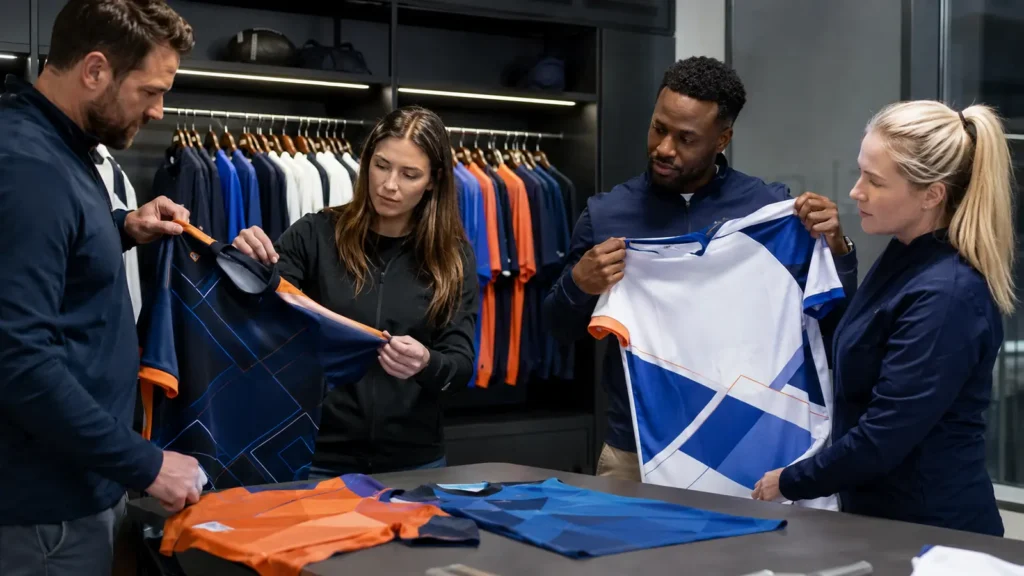
Team representatives reviewing custom jersey samples
Frequently Asked Questions
Final Recommendation
For most B2B programs, authentic vs replica jerseys should be treated as a performance-and-positioning decision, not a simple quality ranking. Choose an authentic-style build when competition performance, minimum weight, engineered ventilation, and a premium technical story justify the added development. Choose a replica-style build when comfort, inclusive sizing, decoration durability, accessible pricing, and repeat-order consistency matter more.
The strongest purchase order does not say only “authentic quality.” It records the fabric, GSM, knit, fit measurements, construction, decoration, tolerances, sample approvals, labeling, packaging, and inspection criteria. That specification is what makes the approved product repeatable.
Sources and Further Reading
- Adidas: How to Style a Soccer Jersey—Authentic vs Replica Jerseys
- Nike: Match (Authentic) vs Stadium (Replica) product explanation
- Nike Help: How Do Nike NFL Jerseys Differ?
- Federal Trade Commission: Textile and Wool Labeling Requirements
- European Union: Regulation (EU) No 1007/2011 on Textile Fibre Names and Labelling
- USPTO: About Trademark Infringement
Request a Custom Jersey Quotation: Share your reference concept, sport, quantity, size range, colors, authorized logo artwork, names and numbers, decoration preference, packaging, destination, and target delivery date. Contact JIUMU at zhengdong@jiumugear.com or WhatsApp/Phone +86 18507502899, or use our contact page.