Best Custom Soccer Jerseys for Teams and Clubs
The best custom soccer jerseys must support movement, remain comfortable through repeated use, reproduce the club identity consistently, and arrive in the correct sizes before the season or tournament. That matters to schools, academies, clubs, tournament organizers, uniform dealers, sportswear brands, and distributors managing several rosters or product variants.
This guide explains how to compare custom soccer jerseys by use case, fabric, fit, construction, decoration, compliance, quality control, and bulk-order planning. It also shows what information to send a supplier so that quotations and samples are based on clear specifications rather than assumptions.
Quick Answer: The best custom soccer jerseys for teams and clubs use a lightweight, breathable polyester fabric; a fit appropriate for the players; durable seams; legible names and numbers; and a decoration method matched to the design. Full sublimation is usually the most flexible choice for complex, all-over graphics, while embroidery, woven patches, and heat transfer can add dimensional branding. Before bulk production, approve the garment measurements, colors, artwork placement, player roster, care label, packaging, and a physical sample.

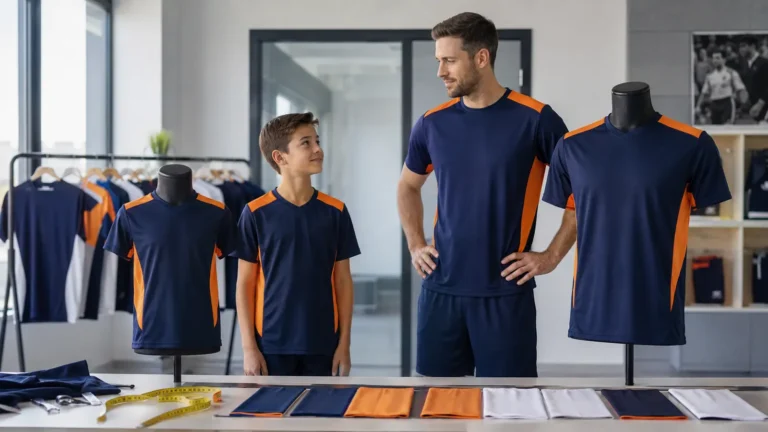
A coordinated adult soccer club wearing original navy, white and orange custom jerseys beside a community stadium
Custom soccer jerseys should combine a coherent team identity with practical match and training specifications.
Why the Jersey Decision Matters for a Team or Club
A custom jersey serves several functions at once. It is performance apparel, a visual identifier, a roster-management item, and often part of a broader club merchandise system. A failure in any one area can affect the entire order.
For players, the garment must allow running, turning, reaching, and repeated contact without excessive restriction. For coaches and equipment managers, names, numbers, colors, and sizes must be accurate across the roster. For club administrators, the same design may need to work across youth and adult teams. For commercial buyers, the product also needs consistent labeling, packing, presentation, and reorder control.
This is why “best” should not mean the most expensive fabric or the most elaborate artwork. It should mean the jersey is correctly specified for the buyer’s actual use.
A Practical Decision Overview
| Buyer or use case | Main priority | Recommended starting point | Important approval item |
|---|---|---|---|
| Youth academy | Comfort, easy sizing and roster growth | Regular-fit polyester jersey with clear size grading | Youth size set and player-number list |
| School team | Budget control and repeatability | Standard short-sleeve match jersey with home and away color plan | School colors, logo permission and delivery date |
| Amateur club | Match identity and durability | Sublimated or mixed-decoration match kit | Home/away contrast and replacement policy |
| Tournament team | Fast roster organization | Simple design with standardized name and number positions | Final roster cutoff date |
| Semi-professional club | Detailed specification and presentation | Custom pattern, performance fabric zones and full kit coordination | Physical sample and competition rules |
| Uniform dealer or distributor | Scalable ordering and reorder consistency | Stable base pattern with controlled artwork files | SKU, labeling, packaging and reorder records |
| Private-label brand | Brand control and retail presentation | ODM design with custom labels, hangtags and packaging | Brand guide, size chart and packaging sample |
The table is a starting point, not a substitute for testing. A youth club and an adult tournament team may both choose sublimated polyester jerseys, but they can still require different fits, sleeve openings, size distributions, packaging, and replacement quantities.
What Makes a Good Custom Soccer Jersey?
A reliable jersey specification has six connected parts:
- Use case: match, training, warm-weather play, academy use, retail merchandise, or a combination.
- Fabric: weight, knit structure, stretch, ventilation, opacity, hand feel, and color behavior.
- Fit: youth or adult block, body length, chest width, sleeve shape, neck opening, and intended ease.
- Construction: seam type, panel layout, collar attachment, hems, and reinforcement.
- Decoration: sublimation, embroidery, patch, heat transfer, screen print, or a controlled combination.
- Order control: artwork approval, roster data, size quantities, sample approval, quality inspection, and packing.
Consider these elements together. An embroidered crest adds dimension but also local weight; a light white fabric needs an opacity check; and an aggressive slim fit can create roster-wide sizing problems. Translate every visual goal into measurable garment details.
Which Soccer Jersey Type Fits Your Program?
Match Jerseys
Match jerseys may include a club crest, player number, name, sponsor areas, sleeve marks, and coordinated trim. The fabric should balance low weight with sufficient opacity and durability. When separate home and away colors are required, plan both versions together to control artwork, trim, goalkeeper options, and roster data.
Training Jerseys
Training jerseys prioritize comfort, washability, and cost control. A club may use a crest and small back number rather than the full match layout. The garment can share the match fit or use more ease for drills, travel, and staff.
Youth and Academy Jerseys
Youth programs need genuine youth grading rather than adult jerseys reduced by one percentage. Buyers should also plan for late registrations, growth, lost garments, and new players. A small overage in common sizes can be more useful than reproducing one jersey at a time.
Club Retail and Supporter Jerseys
A supporter jersey may need a relaxed retail fit, additional labeling, individual packaging, and ecommerce-ready presentation. Confirm target-market labels and claims before production.
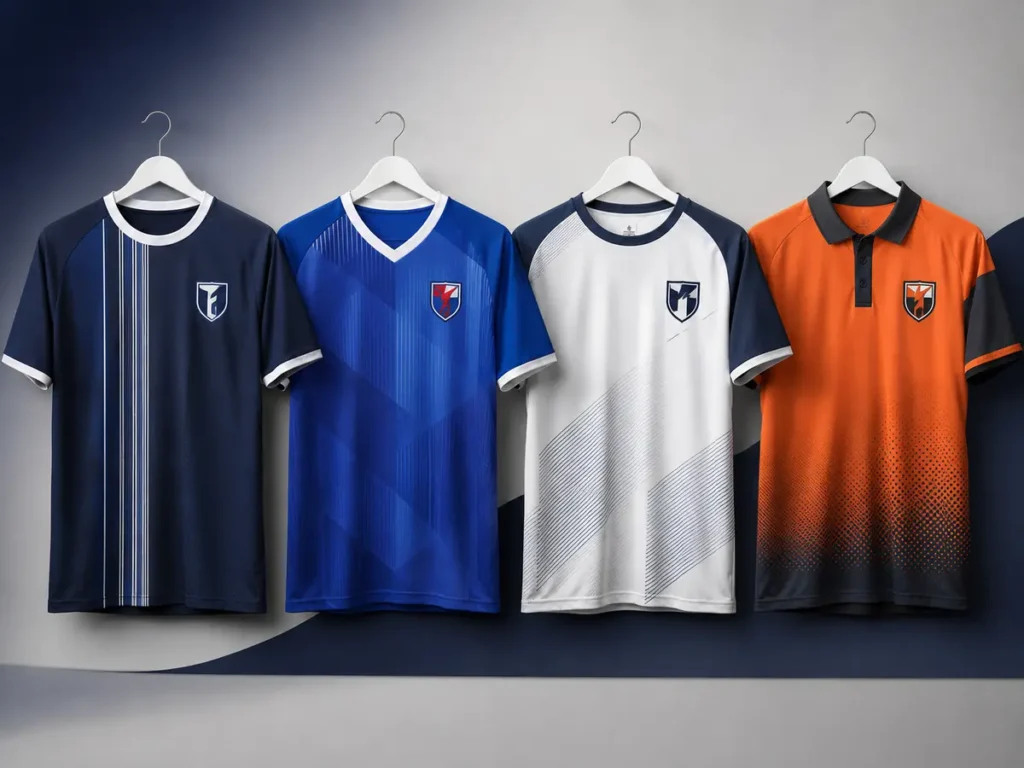
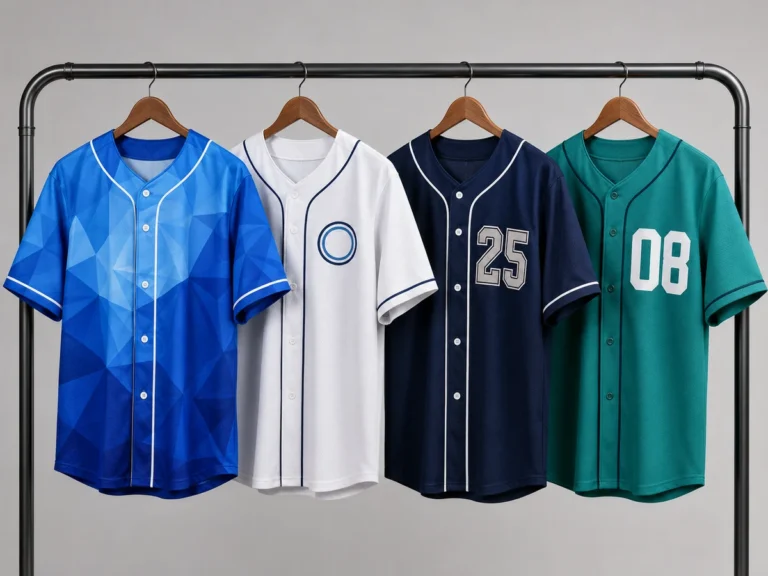
Four original custom soccer jersey styles with crew, V-neck, raglan and polo collars
Jersey style should be selected by player use, fit requirements and brand identity rather than appearance alone.
Plan Home, Away and Goalkeeper Kits as One System
A coordinated uniform program is easier to manage than a series of unrelated jerseys. At minimum, consider:
- a primary outfield jersey;
- a contrasting secondary jersey when competition or schedule needs justify it;
- a goalkeeper jersey that is visually distinct;
- matching shorts and socks;
- optional training, staff, warm-up, or travel apparel.
Under the current Laws of the Game, compulsory player equipment includes a shirt with sleeves, shorts, socks, shin guards, and footwear. The goalkeeper’s colors must distinguish that player from the other players and match officials. The laws also address color consistency for some externally applied sock material and restrictions on slogans, statements, images, and advertising. Buyers should review their league or association rules as well, because a local competition can impose additional requirements. See IFAB Law 4: The Players’ Equipment.
This does not mean an amateur club needs to imitate a professional kit program. It means color contrast and permitted decoration should be checked before artwork approval. The safest workflow is to send the proposed home, away, and goalkeeper colorways to the relevant competition administrator when formal approval is required.
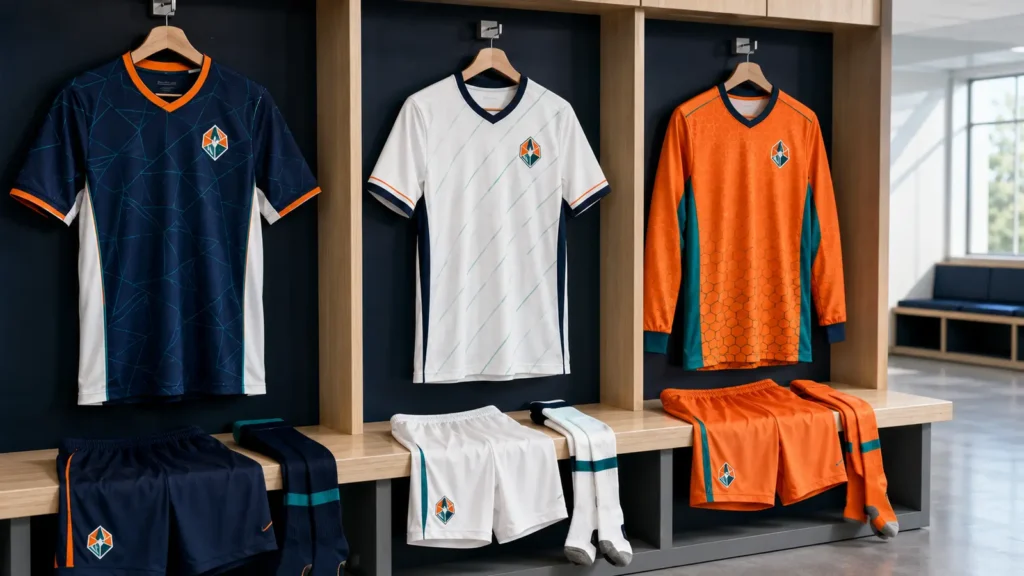
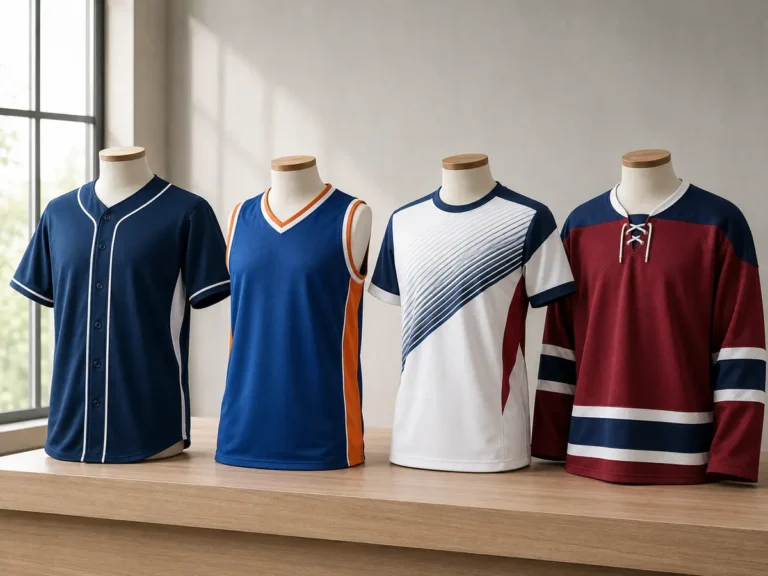
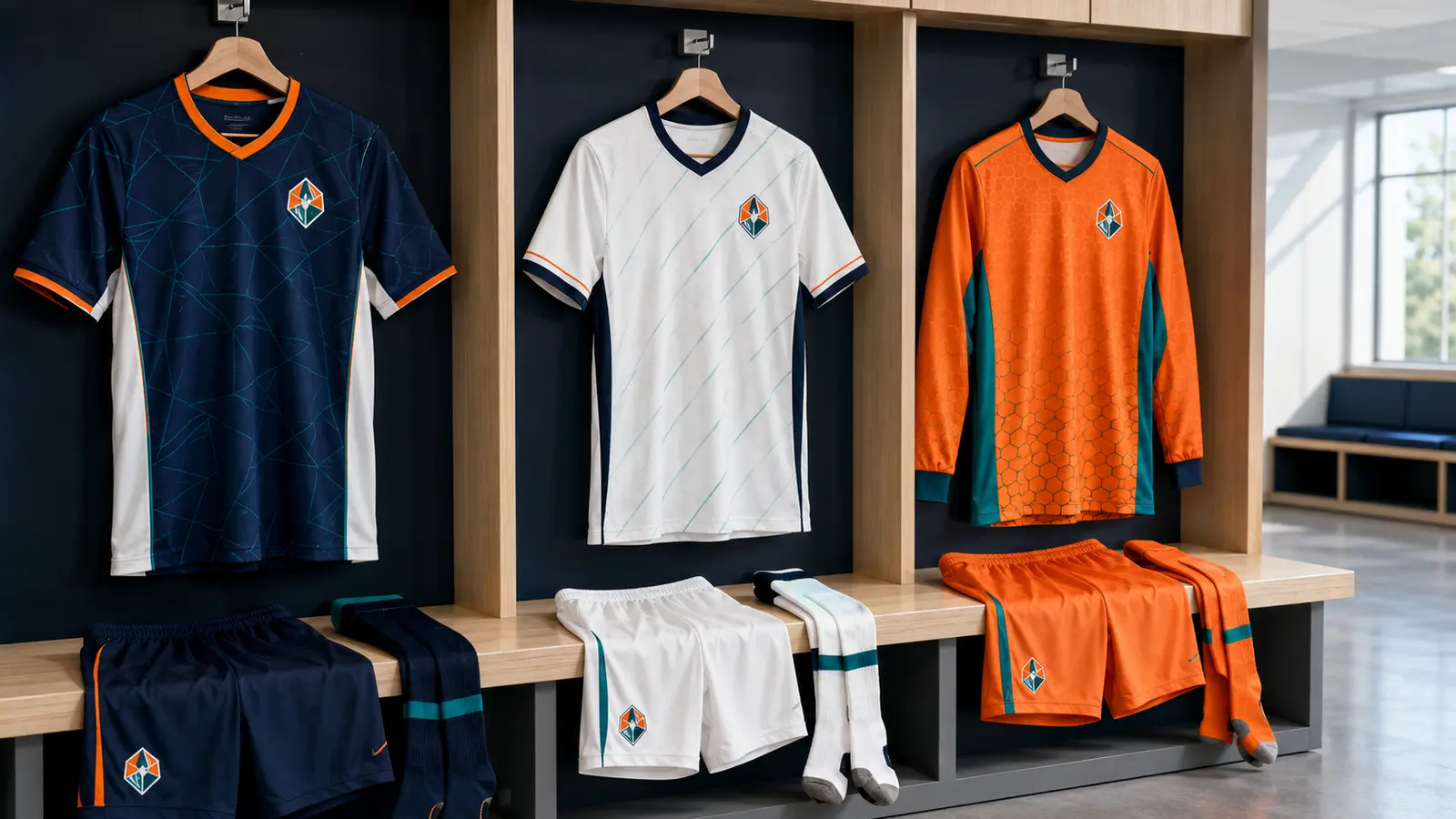
A coordinated home, away and goalkeeper soccer kit displayed in a modern locker room
Home, away and goalkeeper jerseys should use a shared design language while remaining easy to distinguish.
Best Fabrics for Custom Soccer Jerseys
Polyester is the most common foundation for custom soccer jerseys because it can be engineered in several knit structures, accepts common decoration processes, dries relatively quickly, and is suitable for lightweight sports garments. However, “100% polyester” alone is not a useful specification. Two fabrics with the same fiber content can differ substantially in weight, stretch, ventilation, opacity, surface texture, and print appearance.
Polyester Interlock
Interlock provides a smooth and stable surface. It can support crisp sublimated graphics and is often used for the main body of a jersey. Buyers should check hand feel, weight, stretch recovery, snag tendency, and how the fabric looks in both dark and light colors.
Birdseye or Micro-Mesh
Mesh structures create visible openings or textured channels that can improve airflow. They may be used for the whole jersey or for side, back, and underarm panels. The buyer should confirm that the mesh is not overly transparent and that the panel seams remain comfortable.
Stretch Performance Knits
A controlled amount of mechanical or elastane-assisted stretch may be useful for closer athletic fits. More stretch is not automatically better. It can change sizing, print behavior, recovery, seam selection, and cost. Ask whether the stretch is two-way or four-way and test it on a physical sample.
Recycled-Content Options
Recycled polyester may be available, but the buyer should request accurate material documentation and ensure all marketing claims match the supplied evidence. Do not use broad environmental claims based only on a fabric name. If a certification or transaction document is required, put it in the purchase specification before ordering.
Fabric Questions to Put on the Specification Sheet
| Fabric criterion | What to ask | Why it matters |
|---|---|---|
| Fiber composition | What is the exact fiber content? | Needed for labels and product records |
| Fabric weight | What is the target GSM and tolerance? | Affects hand feel, opacity, drape and cost |
| Knit structure | Interlock, birdseye, mesh or another construction? | Affects ventilation, surface and printing |
| Stretch | Direction and recovery after extension? | Affects fit and seam performance |
| Opacity | Has the light color been checked under stretch? | Helps prevent see-through areas |
| Color behavior | Is the fabric dyed, sublimated or both? | Affects shade control and artwork |
| Snag resistance | Is the surface suitable for expected use? | Important for repeated training and contact |
| Care method | What washing and drying process is supported? | Needed for care instructions and user guidance |
Request physical swatches when the fabric choice is commercially important. Screen color cannot reliably communicate weight, texture, stretch, or opacity.
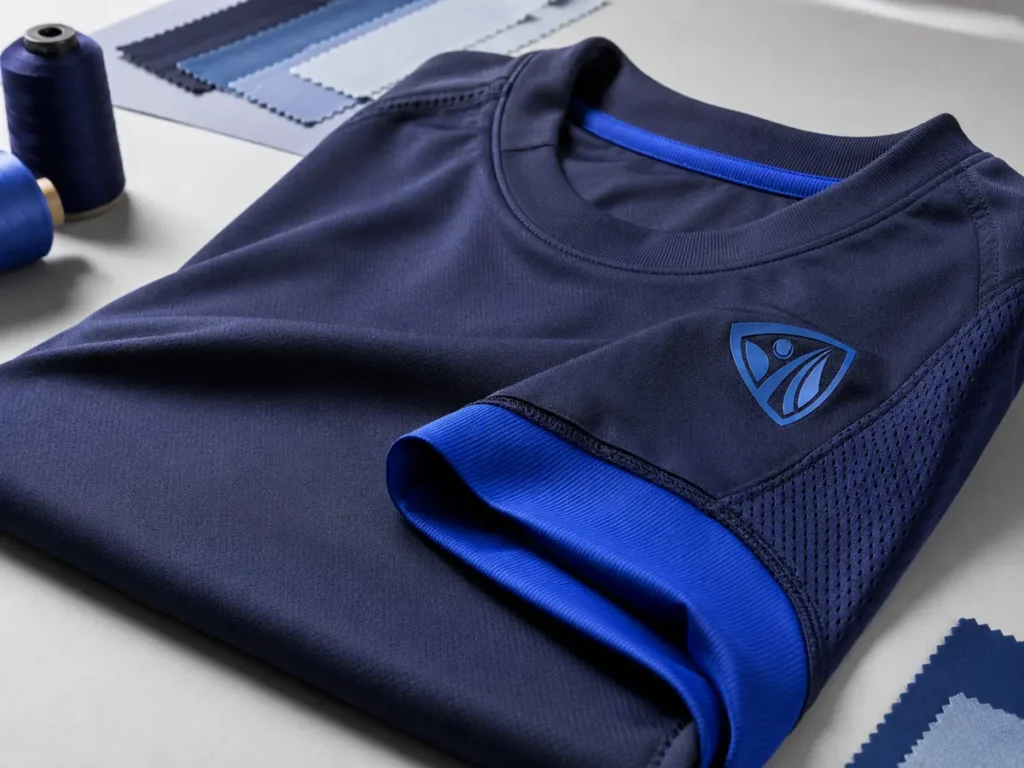
Close view of polyester interlock, mesh panels, rib-knit trim and stitching on a custom soccer jersey
A useful fabric approval checks structure, weight, stretch, opacity, surface and care—not fiber content alone.
Fit and Sizing: Use Garment Measurements, Not Labels Alone
Size names are not universal. A “medium” from one pattern can differ from another in chest width, body length, shoulder shape, sleeve opening, and hem. For a team order, the supplier’s finished-garment measurement chart is more useful than a generic body-size table.
Ask for at least:
- chest width measured flat;
- front and back body length;
- shoulder or raglan reference measurement;
- sleeve length and opening;
- neck opening or collar circumference where relevant;
- measurement tolerance;
- youth and adult grading points.
When possible, use a size set. Record each player’s selected size and keep the fitting method consistent. A regular athletic fit is often easier to manage than an aggressive slim fit, while supporter and goalkeeper versions may require different ease. Review the full grading chart, especially youth-to-adult transitions and the largest sizes.
Construction Details That Affect Durability
Jersey durability is influenced by the fabric, but construction quality is equally important. During sample approval, inspect:
Collar and Neck Opening
The collar should lie flat without twisting, rippling, or restricting the wearer. Rib-knit, self-fabric binding, V-necks, crew necks, and polo collars each require different construction. Confirm the opening is practical across the size range.
Shoulder and Panel Seams
Seams should be smooth, balanced, and correctly matched at color transitions. Underarm and side-panel seams deserve attention because they experience movement and can sit against sensitive skin.
Sleeve and Body Hems
Check stitch consistency, skipped stitches, loose thread ends, and excessive waviness. A neat sample hem should be reproducible in bulk, so include it in the approved reference.
Decoration Attachment
Embroidered or woven patches should have clean edges and secure attachment. Heat transfers should be tested on the actual fabric, not a substitute swatch. Sublimated graphics should align correctly at major seams and avoid unintended distortion around collars or panels.
Names and Numbers
Names and numbers need consistent type, size, placement, spelling, and color contrast. The roster file should be treated as controlled production data. A beautiful jersey with one incorrect number is still a failed unit for that player.
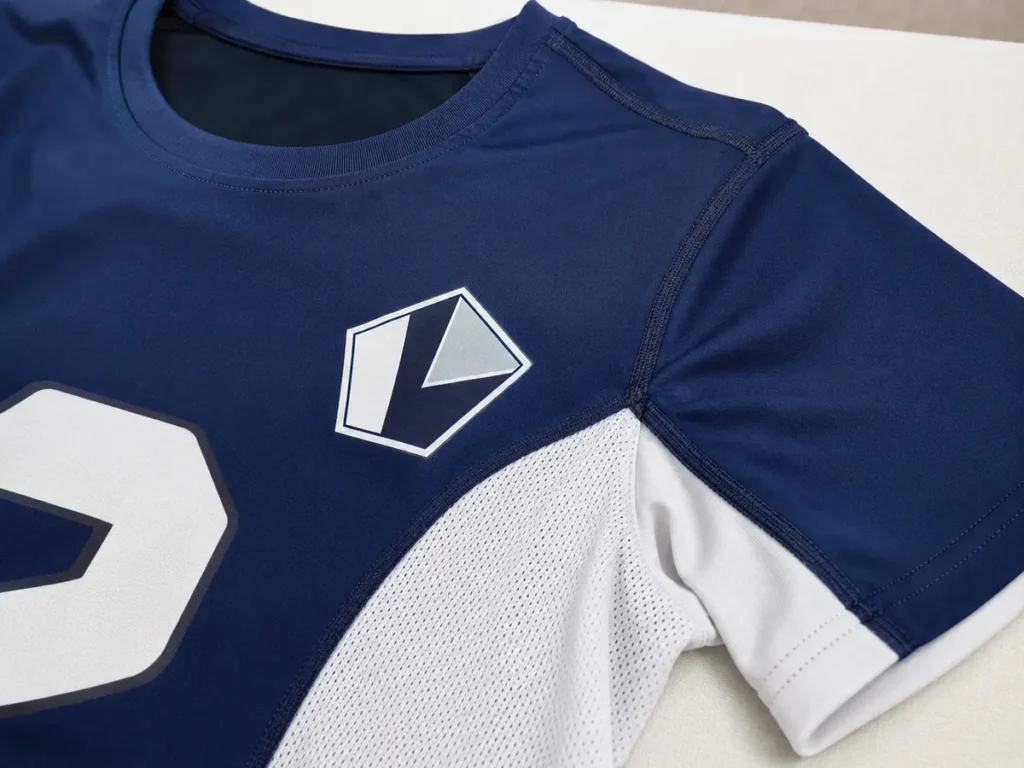
Detailed collar, shoulder seam, mesh insert and number edge on an original soccer jersey
Construction approval should cover the collar, seams, hems, decoration and roster elements on the actual fabric.
Soccer Jersey Customization Methods Compared
The decoration method should match the artwork, order volume, fabric, expected wear, desired texture, and budget. A mixed method can work well, but every added process creates another approval and quality-control point.
| Method | Best suited to | Main advantages | Points to check |
|---|---|---|---|
| Full sublimation | Complex graphics, gradients, all-over patterns, many integrated colors | Design becomes part of polyester fabric; no heavy ink layer | Requires suitable polyester fabric; verify color and seam alignment |
| Embroidery | Club crests, badges and dimensional details | Textured, established appearance | Adds weight and stiffness; confirm backing and edge quality |
| Woven patch | Detailed crest artwork with a flatter profile | Fine detail and consistent patch shape | Check thread colors, border, attachment and minimum line size |
| Rubber/PVC patch | Modern raised branding | Distinct texture and shape | Confirm weight, flexibility, attachment and care compatibility |
| Heat transfer | Names, numbers, sponsor marks and smaller runs | Clean edges and flexible personalization | Test adhesion, stretch, wash behavior and edge lifting |
| Screen printing | Simpler spot-color graphics | Practical for suitable quantities and artwork | Confirm ink hand, coverage, curing and fabric compatibility |
When Sublimation Is the Best Starting Point
Sublimation is especially useful when a team wants gradients, tonal textures, geometric patterns, multiple sponsor areas, or player details integrated into the design. Because the graphic is transferred into compatible polyester fibers, it does not create the same raised surface as a patch or thick ink layer.
It still requires disciplined artwork. Fine lines, color transitions, seam crossings, and placement near the collar or sleeve should be checked on the physical garment. Printed color should be approved on the selected fabric because screens, paper proofs, and textile output can differ.
When to Add Embroidery or Patches
A club may prefer an embroidered, woven, rubber/PVC, or leather-style patch for the crest while using sublimation for the body graphics. This creates a focal branding element. Ask the supplier to show the patch size, border, backing, attachment method, and placement on the actual jersey.
For youth garments and very light jerseys, evaluate whether the patch feels disproportionately heavy. A woven patch or printed crest may be a better balance for some programs.
Heat-Transferred Names and Numbers
Heat transfer is a common option for roster personalization. Approve the number font, height, color, outline, name letter height, and exact positions. Test the transfer with the jersey’s stretch and care method. Keep the master roster file locked after final approval, and document any late changes separately.
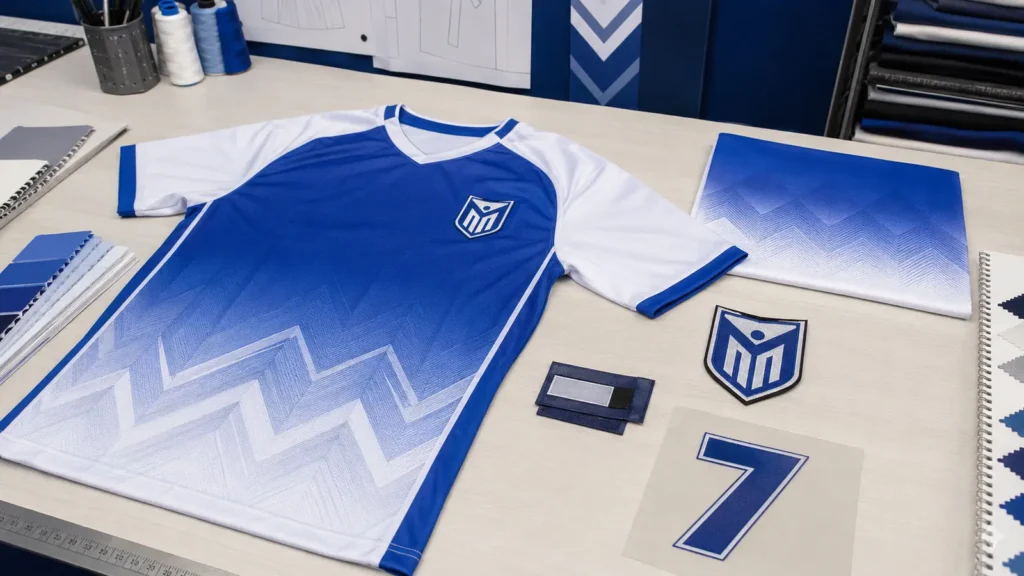
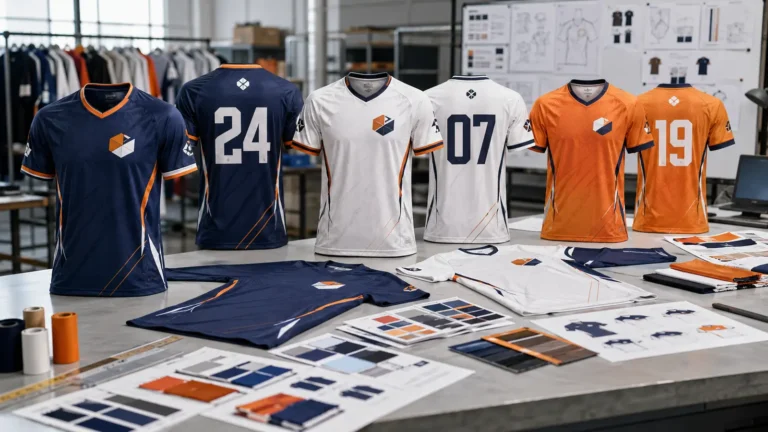
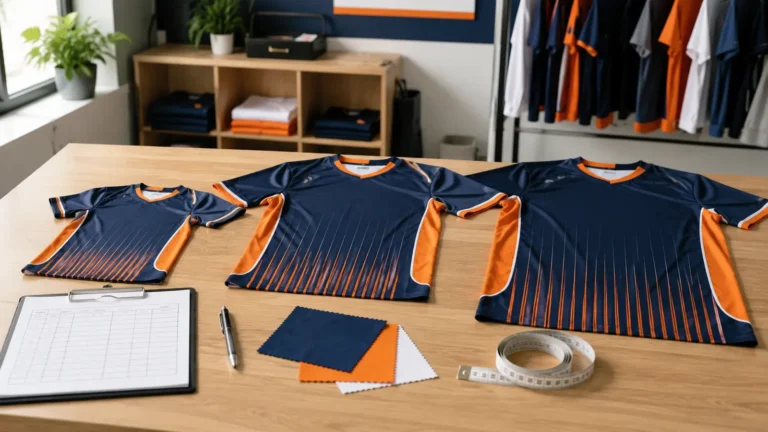
An original custom soccer jersey with sublimated fabric, crest patch, number transfer and color-development materials
Select decoration methods by artwork, fabric, texture, order structure and care requirements.
Build a Clear Soccer Jersey Specification: Share your reference image or tech pack, player quantities, youth and adult sizes, preferred fabric, home and away colors, logo files, name-and-number roster, packaging needs, and target delivery date. JIUMU can review the brief for OEM/ODM development, digital mockups and physical sampling. Request a custom quotation.
Color, Artwork and Competition Approval
Separate the intended brand color, the material or print target, and the accepted tolerance. Pantone references help communicate a target, but fabric, lighting, print process, and adjacent colors affect perception. Keep an approved textile swatch or sample.
Artwork files should preferably be vector-based for crests, numbers, and clean line graphics. Raster artwork needs sufficient resolution at final size. Provide a brand guide when placement, clear space, sponsor hierarchy, or color use is controlled.
Confirm permission to use every crest, sponsor mark, school emblem, and design element. For match use, review association or league rules covering number size, sponsor positions, sleeve marks, contrast, and deadlines.
Retail Label and Market Considerations
If jerseys will be sold or distributed to consumers, include label content in the product specification.
In the United States, the Federal Trade Commission states that most textile and wool products require labels disclosing fiber content, country of origin, and the identity of the manufacturer or another responsible business. Apparel care instructions are addressed by the FTC’s Care Labeling Rule. See the FTC guidance on apparel labeling and care labels.
For the European Union, Regulation (EU) No 1007/2011 governs textile fiber names and related labeling or marking of fiber composition. The EU’s business guidance explains that listed fiber names must be used and that label information must meet the market’s language requirements. See the EU textile label guidance and the regulation text.
These references are a starting point, not legal advice. The importer, brand owner, or seller should verify all rules that apply to the destination, sales channel, age group, claims, packaging, and current product specification.
What Drives the Cost of Custom Soccer Jerseys?
Common cost drivers include:
- fabric type, weight, stretch, and special sourcing;
- custom pattern development or size grading;
- sublimated panel count and artwork complexity;
- embroidery stitch area or patch construction;
- number of decoration processes;
- individual player names and numbers;
- order quantity and size distribution;
- home, away, goalkeeper, training, and staff variants;
- custom neck labels, woven labels, hangtags, and packaging;
- physical samples, inspection, freight, duties, delivery terms, and urgent scheduling.
Ask what the quotation includes: product, fabric, decoration, quantities, sample terms, packaging, delivery term, validity, and exclusions. Two “custom jersey” prices are not comparable if only one includes names, labels, and retail packing.
Quality-Control Checklist Before Bulk Shipment
Quality control should begin before production rather than at the final packing table.
Pre-Production Approval
- Confirm the final digital mockup from front, back, and sleeves.
- Approve the selected fabric and trims.
- Approve garment measurements and tolerances.
- Confirm printed or dyed color references.
- Check crest, sponsor, name, and number dimensions.
- Verify the final roster and size quantities.
- Approve the care label, brand label, hangtag, and packaging.
- Keep one signed physical sample as the production reference when appropriate.
In-Process Checks
- Confirm fabric and color against the approved reference.
- Check print registration and panel orientation.
- Verify crest and decoration placement.
- Monitor key garment measurements.
- Check seam quality at collar, shoulder, underarm, side, and hem.
- Control roster personalization against the master file.
Final Inspection
- Compare finished quantities by size and player.
- Check visible appearance, stains, damage, loose threads, and shade differences.
- Measure selected garments from different sizes.
- Verify names, numbers, spelling, and duplicate entries.
- Check label and packaging accuracy.
- Confirm carton marks and packing list.
- Document nonconforming units and the agreed correction.
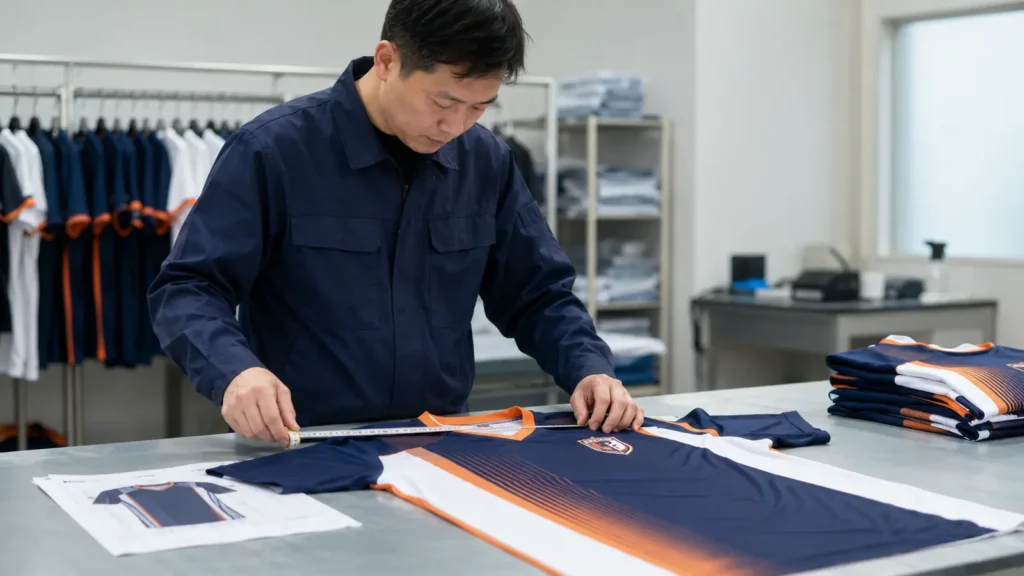
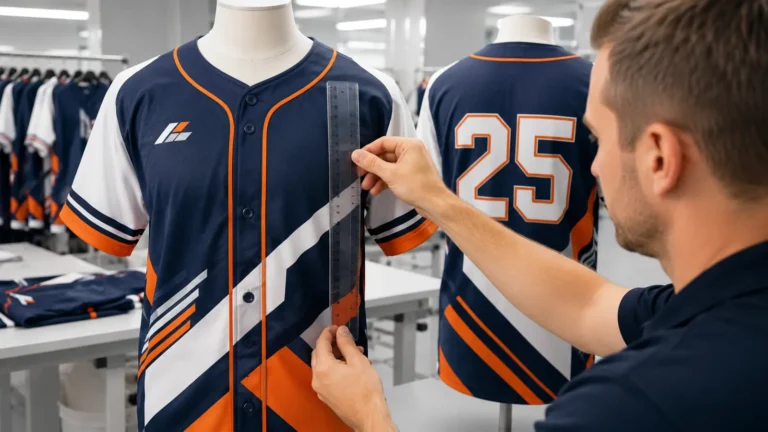
A garment quality inspector measuring an original custom soccer jersey against an approved specification
Measurement, color, artwork, roster and packaging controls should be linked to the approved sample and order documents.
A Reliable Bulk-Order Planning Process
Step 1: Define the Program
List every team, age group, and product variation. Decide whether the order covers jerseys only or a broader custom team uniform program.
Step 2: Prepare the Design Brief
Send editable logos, color references, inspiration, preferred style, sponsor requirements, and competition restrictions. Mark which references are directional.
Step 3: Confirm Fabric, Fit and Decoration
Choose fabric and fit, then match each artwork element to the correct decoration process.
Step 4: Approve the Digital Mockup
Check the front, back, side panels, sleeves, collar, hem, shorts, and socks against the latest artwork.
Step 5: Approve a Physical Sample
Inspect measurements, movement, fabric, color, construction, decoration, labels, and care guidance. Record changes in one revision list.
Step 6: Lock the Roster
Use one row per player with separate fields for team, name, number, jersey size, shorts size, goalkeeper status, and notes. Have a second person check it.
Step 7: Confirm Bulk Documents
Approve the order, specification, artwork, roster, packing, delivery term, date, and late-change policy.
Step 8: Inspect and Record the Order
Inspect against approved references and retain the artwork, fabric, size, color, and order records.
What to Send for an Accurate Quotation
A useful soccer jersey request for quotation should include:
- buyer type and destination country;
- jersey use: match, training, retail, or mixed;
- total quantity and estimated quantity per size;
- youth and adult size requirements;
- home, away, and goalkeeper versions;
- short or long sleeves;
- preferred fabric or performance goal;
- reference image, sketch, or tech pack;
- editable logo and sponsor files;
- number of colors and decoration method preference;
- player names and numbers, if already available;
- custom label, hangtag, barcode, bag, or carton needs;
- sample requirement;
- desired delivery date and destination;
- preferred shipping or trade term when known.
If some information is not final, label it as provisional. A supplier can then separate confirmed specifications from decisions that still affect price or timing.
Questions to Ask a Soccer Jersey Supplier
- Which fabric options fit our match, training, youth, or retail use?
- Can you provide fabric swatches and finished-garment measurements?
- Is the youth pattern independently graded?
- Which decoration method do you recommend for each artwork element, and why?
- How are sublimated colors approved on the actual fabric?
- How do you control roster names, numbers, and sizes?
- What is included in the sample charge and revision process?
- What measurement and visual tolerances will apply?
- How are bulk units inspected against the approved sample?
- Can labels, hangtags, packaging, and carton marks be customized?
- How are repeat orders and replacement jerseys controlled?
- What information could change the quoted price or schedule?
The quality of the answers matters more than a rapid “yes.” A capable supplier should be able to explain the approval process and identify missing specifications.
Common Buying Mistakes
- Choosing by unit price alone: compare the full specification, personalization, labels, packaging, inspection, freight, and terms.
- Approving only a digital image: a mockup cannot prove fabric hand, fit, opacity, seam comfort, textile color, or adhesion.
- Using an unchecked roster: freeze one master file and require a second-person check.
- Assuming size names are standard: compare garment measurements and use a size set.
- Adding processes without a purpose: every patch, print, transfer, or embroidery area adds weight, cost, and another control point.
- Ignoring reorders: retain approved artwork, fabric, color, label, size, and order records.
- Reviewing competition rules too late: confirm colors, numbers, sponsors, and sleeve marks before sampling.
Why Consider JIUMU for Custom Soccer Jerseys?
JIUMU is a Guangdong-based B2B custom teamwear and branded merchandise supplier established in 2010, supporting buyers in the United States, Canada, the United Kingdom, and Europe.
For soccer jersey and club programs, relevant capabilities include:
- OEM and ODM product development;
- sublimation printing, embroidery, screen printing, and heat transfer;
- woven, rubber/PVC, and leather-style patch options;
- fabric sourcing and Pantone color matching;
- private labels, neck labels, woven labels, and hangtags;
- packaging customization;
- digital mockups and physical samples;
- bulk-production quality control and export support.
The typical MOQ is 50 pieces, subject to product structure and customization. Buyers planning a broader club range can also coordinate jerseys with custom team jackets, custom hoodies, and custom team bags.

A diverse youth soccer club in coordinated original custom uniforms during an evening training session
Youth academies and multi-team clubs benefit from consistent fit, colors, artwork and reorder records.
Frequently Asked Questions
Final Recommendation
The best custom soccer jerseys are built from a controlled specification, not selected from one product image. Approve the fabric, fit, construction, decoration, colors, roster, labels, packaging, and a physical sample. Schools and academies should prioritize sizing and replacements; clubs should coordinate every kit version; distributors and private-label brands should add SKU, retail, and reorder controls.
Sources and Further Reading
- IFAB Law 4 — The Players’ Equipment
- Federal Trade Commission — Apparel Labeling
- Federal Trade Commission — Complying with the Care Labeling Rule
- European Union — Textile Label Guidance
- EUR-Lex — Regulation (EU) No 1007/2011
About JIUMU
JIUMU is a Guangdong-based B2B custom teamwear and branded merchandise supplier established in 2010. Capabilities include OEM/ODM development, sublimation, embroidery, patches, heat transfer, private labels, packaging, samples, quality control and export support.