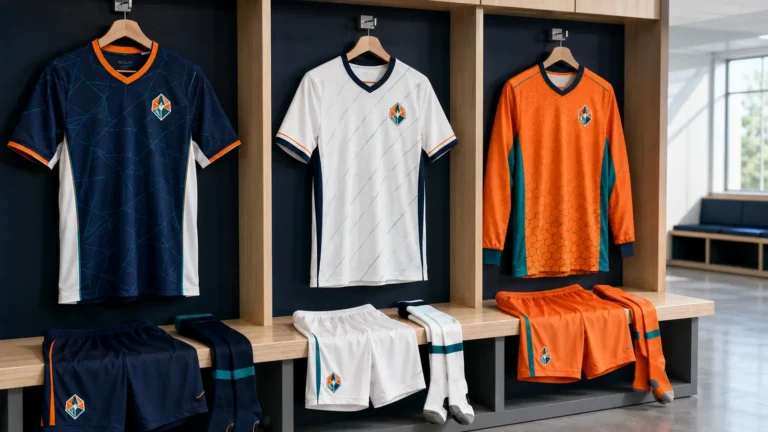
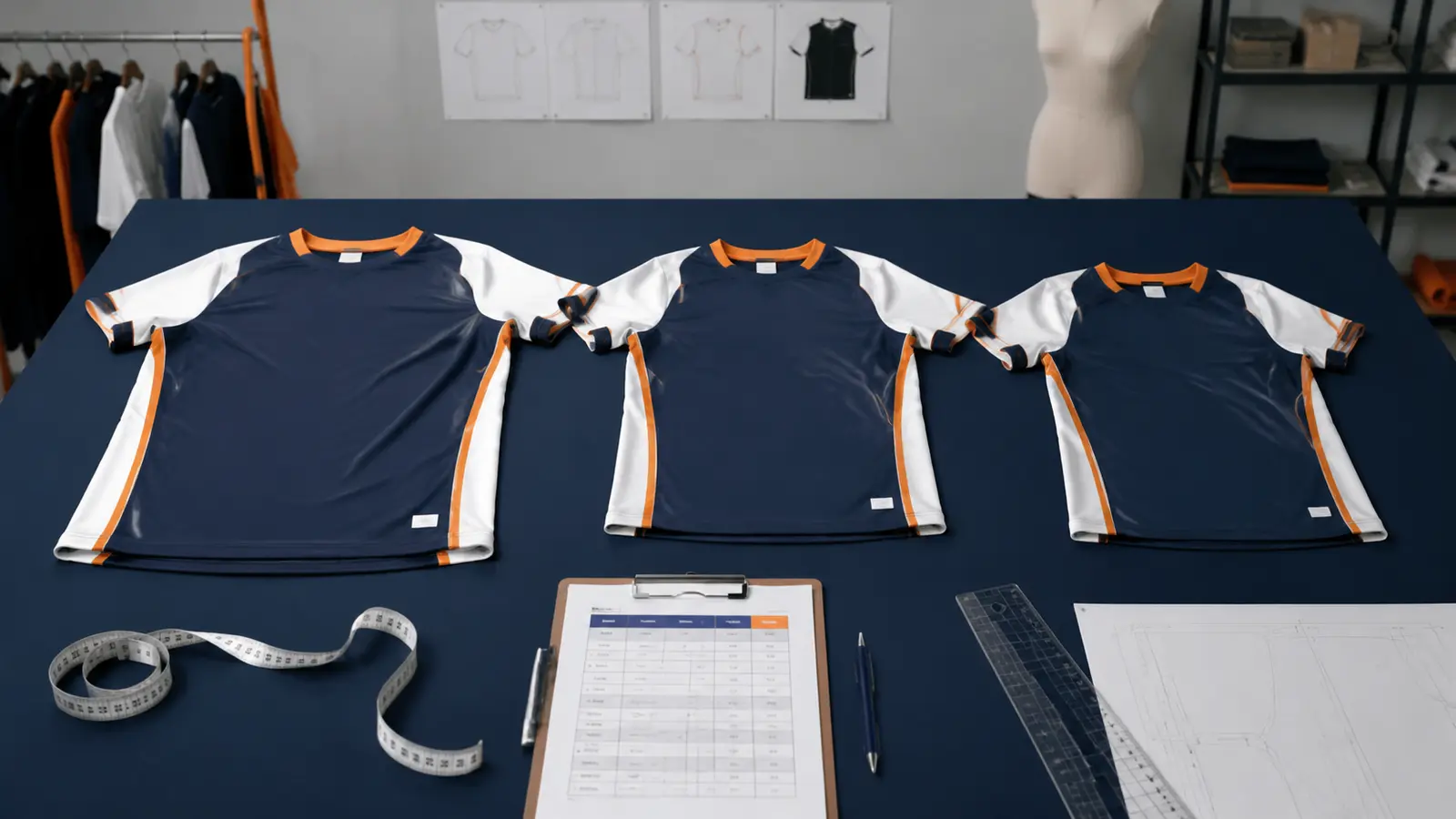
Why Do Jersey Sizes Vary Between Manufacturers?
Quick Answer: Why Is One Manufacturer’s Large Another Manufacturer’s Medium?
Jersey sizes vary because there is no single worldwide rule that makes every manufacturer’s Medium, Large, or XL the same finished garment. International standards can define body-measurement concepts and size-designation methods, but each manufacturer still develops garment measurements around its target population, fit, sport, material, style, and production method. ISO 8559-2 explicitly distinguishes body-based size designation from garment measurements selected by designers and manufacturers with allowances for movement, style, cut, and use.
To avoid team sizing errors, compare actual garment measurements—not just letter labels. Confirm the points of measure, fit type, fabric stretch, youth/adult and men’s/women’s block, wash condition, and measurement tolerance. For a new supplier or new style, use physical sizing samples before collecting the final roster.
Letter Sizes Are Not Universal Measurements
S, M, L, and XL are convenient labels. They help organize a range, but a letter does not tell you the jersey’s chest width, body length, sleeve opening, shoulder width, or fit allowance. Two suppliers can both call a jersey “Large” while designing for different bodies or different wearing conditions.
The ISO 8559 series establishes definitions and systems for clothing size designation. ISO 8559-1 describes anthropometric measurements used for clothing, while ISO 8559-2 states that size designation is based on body measurements rather than finished-garment measurements. It also recognizes that garment measurements are determined by designers and manufacturers to account for movement, style, cut, and how the garment is worn.
That distinction explains much of the apparent inconsistency. A manufacturer may build its Large around:
- a different target chest or height range;
- more or less wearing ease;
- an athletic or relaxed silhouette;
- room for protective equipment;
- a men’s, women’s, unisex, or youth body model;
- a stretch or non-stretch fabric;
- a domestic, regional, teamwear, retail, or private-label customer base;
- historical brand fit preferences.
Even standardized body-measurement tables do not force every brand to use the same garment pattern. ASTM publishes body-measurement tables for multiple age, sex, and figure categories. Those tables can serve as a design baseline, but the final apparel still requires decisions about fabric, ease, styling, and fit.
Therefore, do not ask only, “Do your jerseys run true to size?” Ask, “Which body range and finished-garment measurements does each size represent, and how were those measurements taken?”
Body Measurements and Garment Measurements Are Different
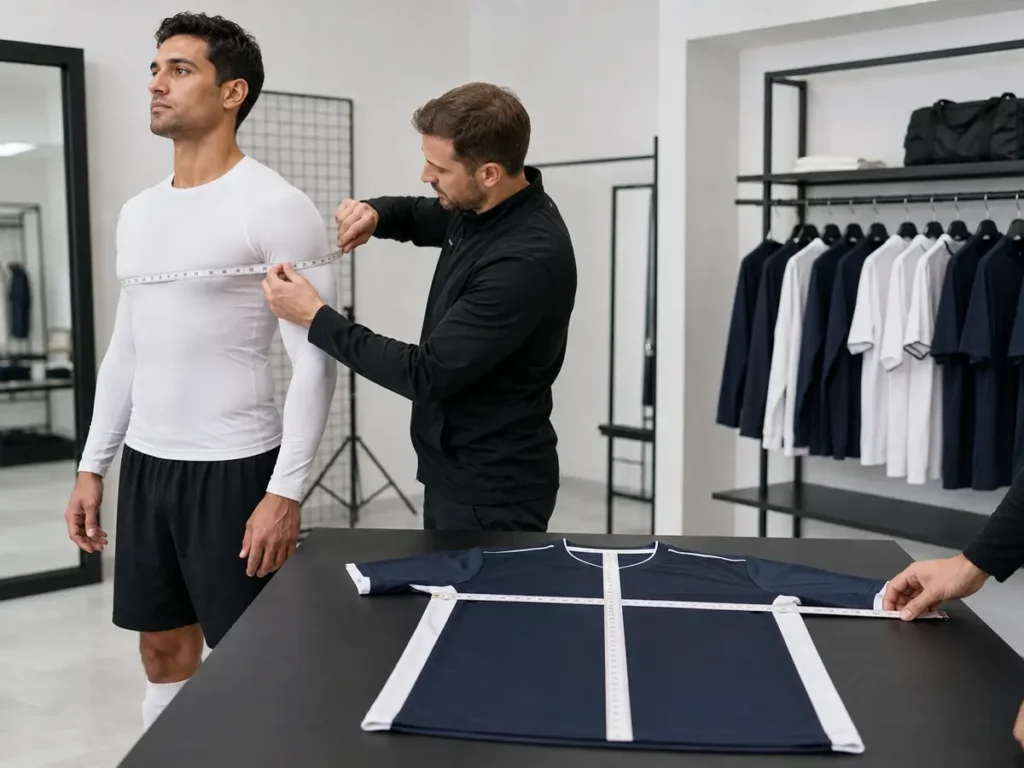
A size chart may describe the player or the jersey. Buyers must know which one they are reading.
Body Measurements
Body measurements describe the wearer: chest circumference, waist, hip, height, and other anatomical dimensions. A body chart tells a player which size the supplier recommends for a given body range. It normally includes fit allowance indirectly through the supplier’s pattern.
Garment Measurements
Garment measurements describe the finished jersey laid flat or measured in a defined state. Common points include half chest, body length, shoulder width, sleeve length, sleeve opening, bottom width, and armhole. The garment must be larger, smaller, or shaped differently than the body at particular points depending on the intended fit and material stretch.
| Question | Body-size chart | Finished-garment chart |
|---|---|---|
| What is measured? | The player’s body | The completed jersey |
| Typical chest entry | Full chest circumference | Often half chest measured flat |
| Does it include ease? | Usually built into the manufacturer’s recommendation | Ease can be calculated by comparing garment and body dimensions |
| Best use | Helping players choose a size | Comparing suppliers and approving production |
| Main risk | Player may measure incorrectly or fall between sizes | Measurement method may differ unless points are defined |
The Half-Chest Mistake
One common error is comparing a flat half-chest measurement with a full body chest circumference. A jersey measured 56 cm from armpit to armpit is not intended for a 56 cm chest circumference. It represents approximately twice that flat width before considering fabric behavior, garment shape, seam position, and wearing ease.
Do not double every measurement automatically. Some points are circumferences, some are flat widths, and some are linear lengths. The specification must define each point of measure (POM) with a diagram or written method.
Relaxed, Athletic, and Compression Fit
Fit language describes the relationship between the jersey and the player, not a universal measurement formula.
| Fit type | Typical silhouette | Movement allowance | Common buying consideration |
|---|---|---|---|
| Relaxed fit | Roomier torso, often straighter side seams | More space for movement, layering, and mixed body shapes | Easier for recreational teams and broad roster ranges, but may look loose |
| Athletic fit | Shaped closer through chest, waist, shoulder, or sleeve | Moderate ease combined with performance shaping | Requires accurate body and garment comparison; may feel small to players used to retail relaxed fit |
| Compression fit | Designed to stretch and sit close to the body | Negative or minimal ease supported by high-stretch fabric | Must be validated with fabric stretch, recovery, activity, and wearer preference |
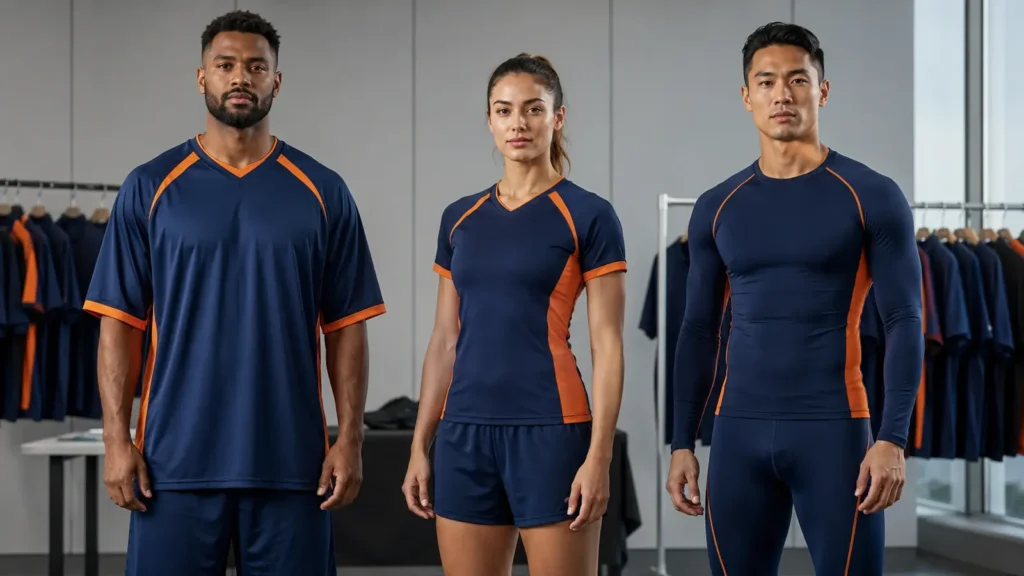
The word “athletic” is ambiguous: it may mean a slightly tapered torso or a substantially closer cut. Compression fit also requires compatible fabric stretch, recovery, seams, and range of motion—not simply smaller dimensions.
For custom production, translate fit language into measurable decisions:
- reference body range;
- chest and waist ease;
- shoulder position;
- armhole depth and sleeve volume;
- body length and hem coverage;
- fabric stretch direction and recovery;
- whether base layers or protective equipment will be worn;
- target appearance in standing and playing positions.
Sport-Specific Jersey Blocks Change the Size
A jersey is not a generic T-shirt with different graphics. The sport changes the pattern, movement requirements, layering, and visual proportions.
Baseball and Softball
Baseball jerseys may use longer bodies, wider sleeves, and room for throwing. On-field, fan, slowpitch, button-front, and pullover styles can use different proportions and measurement methods.
Basketball
Armholes, shoulder width, length, and side-panel shape matter. A deep armhole can feel loose while a narrow performance cut can make the same chest width feel restrictive.
Soccer and Volleyball
These jerseys often use lighter, closer silhouettes, but men’s, women’s, youth, goalkeeper, and training styles may use different blocks. Sleeve opening and torso taper can matter as much as chest width.
American Football
The jersey may need to fit over shoulder pads or be designed for a specific equipment system. A football Large intended for pads cannot be compared directly with a casual team shirt Large.
Hockey
Hockey jerseys generally require room for protective equipment, broad shoulders, and a different sleeve shape. A hockey Medium may look far larger than a soccer Medium while being correct for its use.
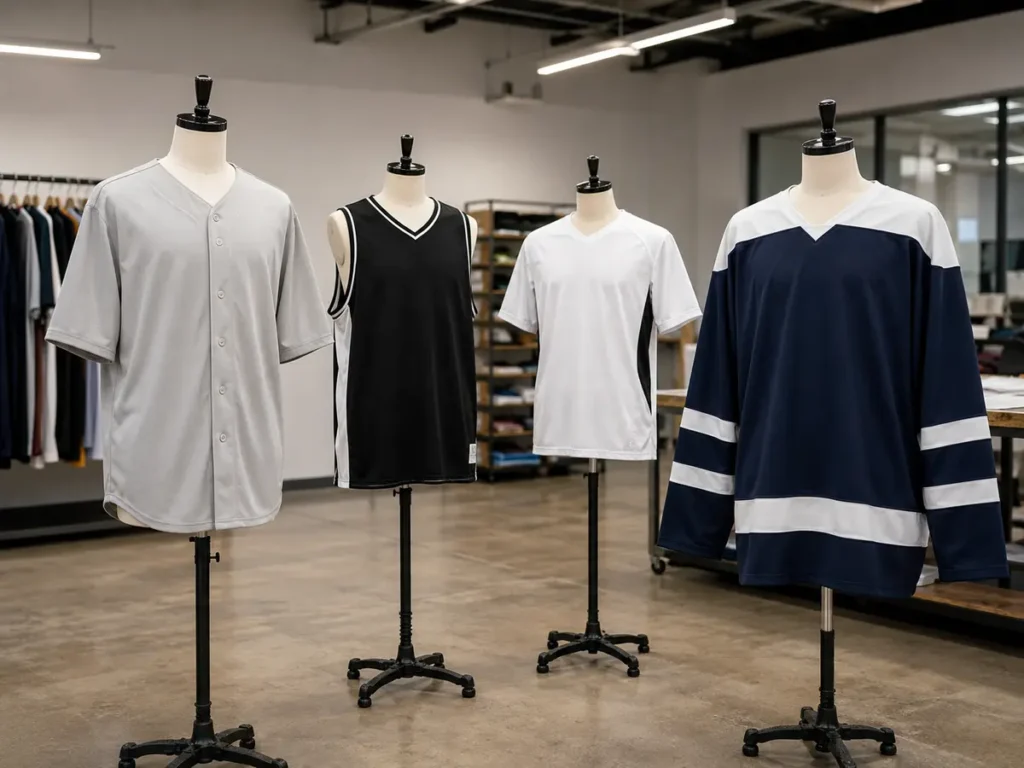
| Sport/style | Fit variables that often change the block | Buyer should confirm |
|---|---|---|
| Baseball/softball | Placket, shoulder movement, sleeve volume, body length | Button or pullover; player or fan fit; undershirt use |
| Basketball | Armhole, shoulder width, torso taper, length | Men’s/women’s/youth block; reversible or single layer |
| Soccer/volleyball | Torso shaping, sleeve opening, lightweight stretch | Match, training, goalkeeper, or retail fit |
| Football | Pad allowance, sleeve construction, body length | Exact equipment and playing level |
| Hockey | Protective-equipment volume, shoulder and sleeve shape | Shell/equipment measurements and intended fit |
Men’s, Women’s, Unisex, Adult, and Youth Are Separate Decisions
A nominal Medium is incomplete without the wearer category. A women’s Medium may use a different chest-to-waist relationship, shoulder width, body length, and hip shaping than a unisex Medium. Youth sizing is not simply adult sizing reduced by a fixed percentage; proportions and grading intervals may differ.
The buyer should confirm:
- whether the size chart is men’s, women’s, unisex, adult, or youth;
- the supplier’s age or body-range assumptions for youth sizes;
- whether girls’ and boys’ blocks differ;
- whether women’s fit is shaped or simply relabeled unisex sizing;
- how the range transitions from youth XL to adult XS or S;
- whether tall, short, plus, goalkeeper, or equipment-fit options exist;
- whether the roster can mix blocks within one visual program.
If a team wants one inclusive unisex range, test the size set across representative body shapes. A unisex solution simplifies ordering but will not fit every body identically. For larger programs, separate cuts may improve fit but add SKU, sampling, roster, packing, and reorder complexity.
Fabric Stretch, Weight, and Construction Affect Fit
Two jerseys cut to the same measurements can feel different when the fabric changes.
Stretch and Recovery
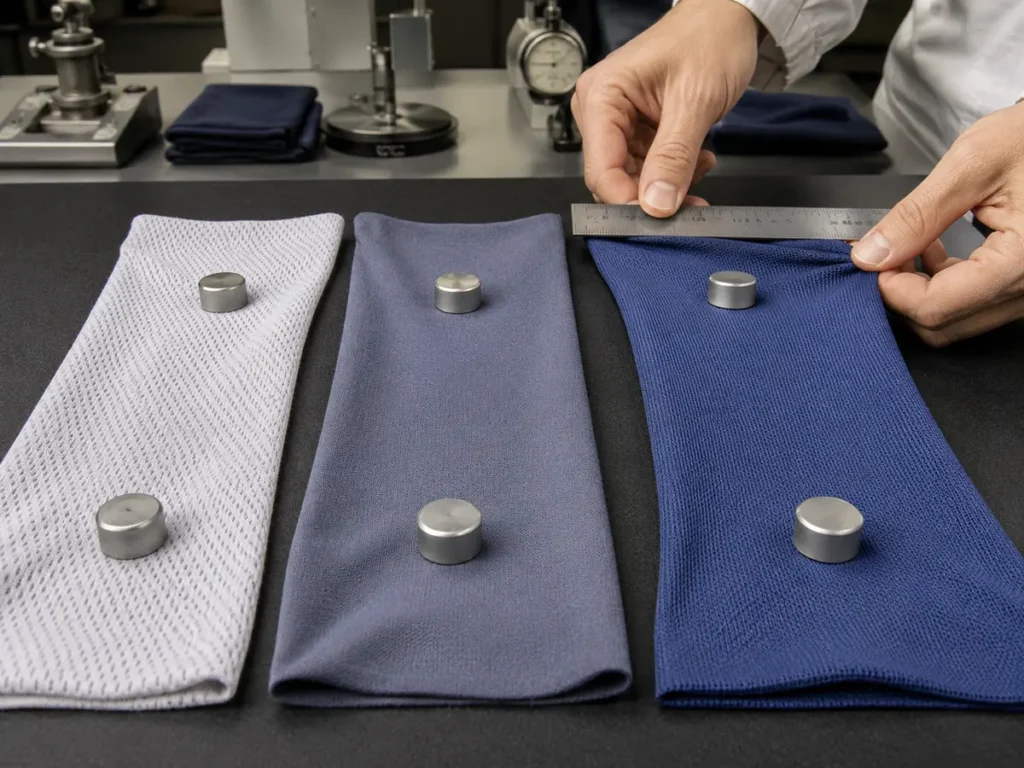
A high-stretch knit can accommodate movement with less garment ease. A stable mesh may require more room in the pattern. Stretch direction matters: a fabric may stretch more across the body than along the length. Recovery determines whether it returns to shape or remains bagged after wear.
Fabric Weight and Drape
A heavier fabric can feel more structured and restrictive. A light fabric may drape closer and visually appear larger or smaller depending on the silhouette. Surface friction against a base layer can also affect perceived mobility.
Double Layers and Reversible Jerseys
Reversible construction can add bulk and reduce the apparent ease of the same finished dimensions. Binding, armholes, neck openings, and two fabric layers must be evaluated as a complete garment.
Seams, Rib, and Decoration
Seam placement, non-stretch rib, reinforced panels, applied numbers, and patches can locally restrict stretch. A measurement chart cannot fully predict movement if the sample uses different materials or decoration than bulk production.
Washing and Dimensional Change
Jerseys can change after laundering or heat exposure. The amount and direction of change depend on fiber composition, knit construction, finishing, heat history, care method, and garment construction.
AATCC TM150 addresses length and width changes in garments after standardized home-laundering procedures. AATCC notes that the method offers multiple washing, agitation, and drying conditions and may not apply to every stretch garment. ISO 3759 defines methods for preparing, marking, and measuring fabrics and garments for dimensional-change testing.
These standards reinforce two purchasing principles:
- “Shrinkage” must be tied to a specified test and care condition.
- Pre-wash and post-wash measurements should not be mixed without identification.
Ask whether the supplier’s finished-garment chart represents:
- measurements immediately after production;
- conditioned measurements after resting;
- measurements after a defined wash and dry cycle;
- target measurements with an agreed pre- or post-wash allowance.
Do not assume polyester means zero dimensional change. Even when fiber shrinkage is low, fabric relaxation, heat, seams, rib, and construction can change finished dimensions.
What Production Tolerance Is Acceptable?
There is no responsible universal answer such as “all jersey measurements may vary by the same amount.” Tolerance should be assigned to each point of measure according to its functional importance, nominal dimension, fabric, stretch, construction, size, measurement method, and manufacturing capability.
A small difference at the neck opening may matter more than the same difference at body length. A stretch compression panel cannot be judged like a stable woven placket. Larger sizes may require a different tolerance approach from youth sizes. Curved or difficult-to-locate points may have more measurement variation than straight seams.
A production specification should state:
- the exact POM name and code;
- a diagram showing endpoints and garment position;
- whether the garment is relaxed, smoothed, or stretched;
- measurement tool and surface;
- target measurement for every size;
- positive and negative tolerance for every POM;
- whether the tolerance is before or after laundering;
- sample size and inspection stage;
- how out-of-tolerance results are remeasured and handled.
Tolerance Is Not a Grading Rule
The difference between Medium and Large is the grade increment. Tolerance is the permitted manufacturing variation around the target for one size. These concepts must not be combined. If Medium has a target half chest of X and Large has X plus the grade increment, tolerance applies around each target—it does not authorize substituting one size for another.
Tolerance Is Not “Anything Inside the Range Is Fine”
Even if every individual point falls within its listed tolerance, a garment can fit incorrectly when multiple measurements all shift in the same direction. Quality review should consider both POM results and the complete silhouette against the approved sample.
How to Measure an Existing Well-Fitting Jersey
An existing jersey can be a useful fit reference if it is legally yours to use, represents the desired wearer group, and is measured correctly. It should not be treated as a complete technical specification without confirming material and construction.
Prepare the Reference
Choose a jersey that fits as intended—not merely the size label the team normally buys. Record the brand/style for internal traceability, garment condition, size label, fabric type, whether it has been washed, and who wore it successfully. Do not measure a stretched, damaged, or heavily worn sample as the only master.
Measure Flat Without Distortion
Lay the jersey on a large level surface. Close zippers or buttons as the specification requires. Smooth wrinkles without stretching the fabric. Let rib and elastic return to a relaxed state. Use consistent endpoints and measure twice.
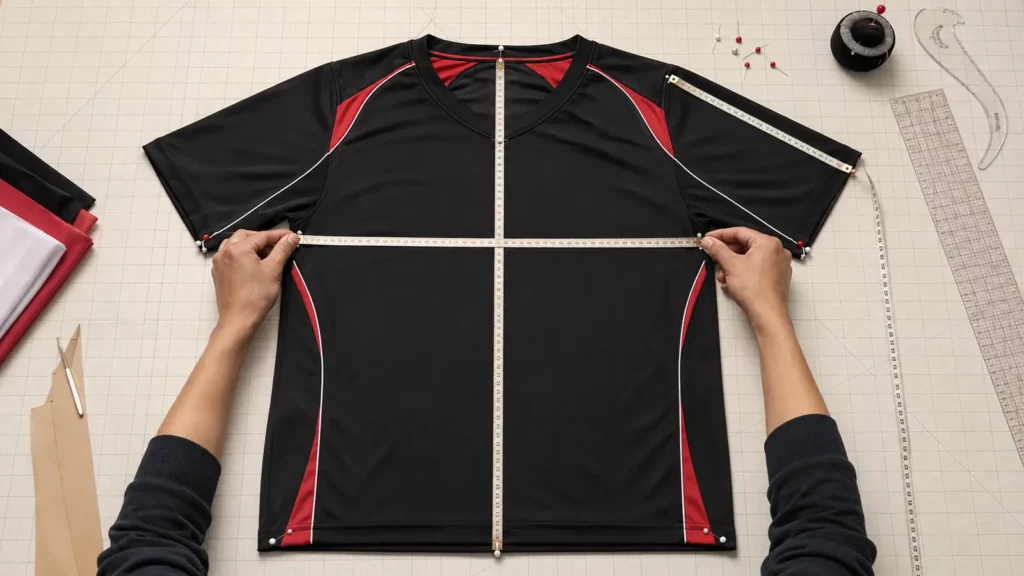
| Point of measure | Example method to define in the specification | Common error |
|---|---|---|
| Half chest | Straight across from defined underarm points | Measuring too high, too low, or around the garment |
| Back body length | High point or center back to hem, as defined | Mixing front and back length or including collar incorrectly |
| Shoulder width | Shoulder seam to shoulder seam across back | Using visual edge when a dropped shoulder has no standard endpoint |
| Sleeve length | Defined shoulder/neck point to sleeve edge | Switching between raglan and set-in methods |
| Bottom width | Straight across hem at defined position | Stretching rib or curved hem flat |
| Armhole | Straight or curved method as specified | Comparing two suppliers that use different methods |
| Neck opening | Width, drop, or circumference as defined | Measuring rib under inconsistent tension |
Can a Factory Copy the Fit?
A supplier can develop a similar fit from an authorized physical sample plus measurements, fabric, construction, and wearer feedback. “Copy this size” is not enough. A different stretch level, seam type, collar, reversible layer, or sport requirement can change the outcome.
The buyer should also confirm the right to reproduce any proprietary pattern, branding, artwork, or protected design. A factory can use an unbranded, buyer-owned reference for fit development without copying third-party trademarks or distinctive protected details. The safest brief identifies which measurements and fit characteristics to retain and which design elements must be original.
Use a Size Set Before Collecting the Final Roster
A size set is a group of physical sizing samples representing the intended style and size range. It is one of the most effective ways to reduce team-order errors because players can evaluate the actual supplier’s jersey rather than a different retail shirt.
The set may use selected core sizes when grading is already validated. Different youth/adult, women’s/unisex, goalkeeper, or equipment-fit blocks should be sampled separately.

Size-Set Try-On Procedure
- Confirm every sample is the approved style, fabric, and fit block.
- Mark each sample clearly with its size and block.
- Have players wear the normal base layer or protective equipment.
- Check standing fit and sport-specific movement.
- Record preferred size, alternate size, and reason for any exception.
- Do not let players rely only on the label from their usual brand.
- Separate youth, adult, women’s, unisex, and special-fit selections.
- Recheck players between sizes or outside the standard range.
- Lock the roster only after the size chart and sample version are approved.
The Team Jersey Size & Fit Guide can support player-facing selection, while the Roster Checklist should connect each player’s selected size with name, number, fit block, and notes.
Size Set Approval Form
| Field | Information to record |
|---|---|
| Project | Customer, team, style, PO or quotation reference |
| Sample version | Pattern/version number and date |
| Size block | Men’s, women’s, unisex, adult, youth, goalkeeper, equipment fit |
| Fit type | Relaxed, athletic, compression, or custom description |
| Fabric | Code, composition, weight, stretch direction, layer construction |
| Sizes reviewed | Every physical size included in the set |
| POM verification | Target, actual result, tolerance, inspector |
| Wearer feedback | Body measurements, size tried, movement, layering, comments |
| Required changes | POM, requested direction, amount or revised target, reason |
| Decision | Approved, approved with listed revisions, or rejected |
| Final reference | Approved size chart and retained sample identification |
| Sign-off | Buyer, supplier, date, and production-release status |
If a sample is approved with revisions, issue a new measurement-chart version and state whether a revised physical sample is required. Do not edit an old spreadsheet silently after approval.
Lock the Final Measurement Chart
The final chart is a production document, not a marketing graphic. It should include:
- style number and garment description;
- pattern block and intended fit;
- unit of measure;
- POM codes and measurement diagram;
- target measurements for every ordered size;
- grade increments across sizes;
- positive and negative tolerance by POM;
- measurement state and conditioning;
- fabric and construction version;
- revision number, date, preparer, reviewer, and approval;
- link to the approved physical sample or Golden Sample.
Where both inches and centimeters are displayed, identify the controlling unit and rounding rule. Otherwise, repeated conversion can create false discrepancies.
Bulk Measurement Quality Control
Bulk inspection confirms that production follows the approved chart and sample. It does not solve an unapproved fit system.
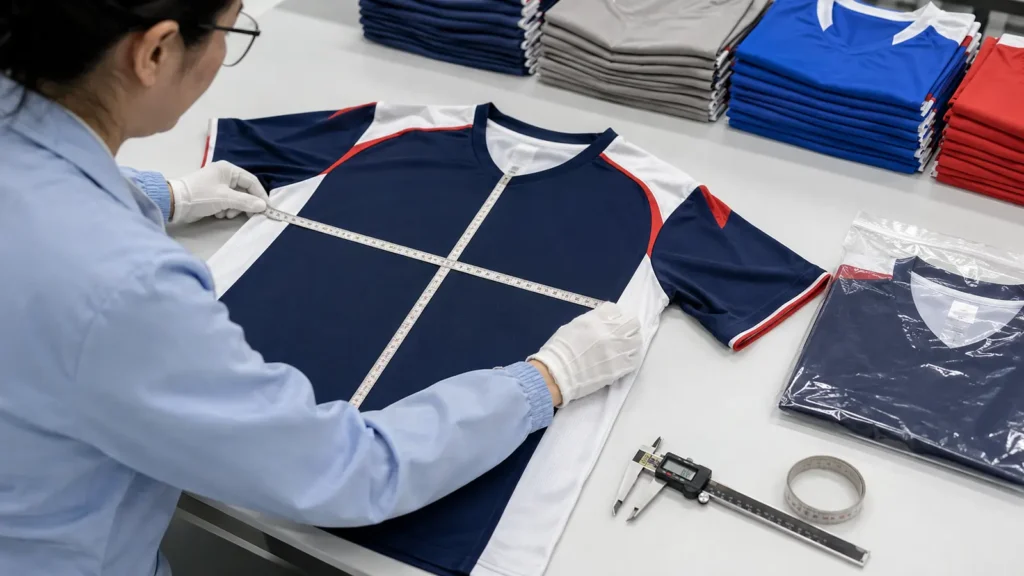
Measurement QC Checklist
- confirm style, size, block, and measurement-chart revision;
- condition and position the garment as specified;
- use the approved table, tape, ruler, and POM method;
- measure selected pieces across sizes and production lots;
- record actual results rather than only pass/fail;
- remeasure unusual results with a second trained person;
- inspect overall silhouette, not only isolated POMs;
- isolate mislabeled or out-of-tolerance garments;
- investigate pattern, cutting, sewing, pressing, or fabric causes;
- compare the first production garment and retained sample;
- document disposition and any buyer communication;
- preserve final records for repeat orders.
JIUMU’s Quality Control page provides the recommended internal link for buyers reviewing broader production controls.
What Buyers Should Send for a Jersey Quotation
Send enough information to quote the correct fit-development path:
- sport and jersey style;
- wearer group and target market;
- adult/youth and men’s/women’s/unisex requirements;
- desired relaxed, athletic, compression, or reference fit;
- quantity by size and block;
- body-size chart if your organization already uses one;
- finished-garment measurement chart and POM diagram if available;
- an authorized well-fitting sample or clear measurement record;
- fabric, weight, stretch, and layering requirements;
- washing and dimensional-change expectations;
- sample, size-set, and approval requirements;
- names, numbers, logos, and roster file;
- target delivery date, packaging, and destination.
Explore Custom Team Jerseys and send JIUMU the selected style, reference fit, roster range, fabric preference, and deadline. JIUMU can then confirm whether a digital chart, development sample, size set, or complete pre-production approval is appropriate.
Request a Fit and Size-Set Plan: Send one well-fitting reference jersey, its wash history, the wearer’s body measurements, the intended sport, fabric preference, expected size range, and total quantity. JIUMU can use that information to define the next sampling and approval step.
Common Jersey Sizing Mistakes
Ordering from Letter Labels Alone
A previous supplier’s Large is not transferable. Convert the roster using the new approved chart and samples.
Comparing a Body Chart with a Garment Chart
Confirm what each number represents and whether chest is full circumference or flat half width.
Using a Retail T-Shirt as the Only Reference
A retail shirt may use a different block, fabric, armhole, and movement allowance. Treat it as a preference clue, not a complete specification.
Mixing Men’s, Women’s, Youth, and Unisex Labels
Include the fit block in every SKU and roster row. “M” alone is ambiguous.
Approving Fit on One Person
One wearer cannot represent a complete team. Include multiple body shapes and the smallest, middle, and largest intended sizes.
Changing Fabric After Size Approval
Reassess fit when stretch, weight, layering, rib, or finishing changes.
Leaving Tolerance Undefined
Agree on POM-specific tolerances and measurement methods before bulk production, not after a dispute.
Editing the Size Chart Without a New Version
Use revision control so artwork, roster, samples, patterns, QC, and repeat orders reference the same approved specification.
Questions to Ask a Jersey Manufacturer
- Is your size chart based on body or finished-garment measurements?
- Which body population and fit block does the chart represent?
- How do you define relaxed, athletic, or compression fit?
- What are the POM definitions for chest, length, shoulder, sleeve, and hem?
- Which unit and rounding rule control production?
- Are measurements taken before or after laundering or conditioning?
- How does the approved fabric affect ease and stretch?
- Can you produce a development sample and size set?
- What tolerance applies to each critical POM?
- How are size-set revisions documented?
- How is bulk production measured and sampled?
- What is retained for repeat-order consistency?
How JIUMU Supports Team Jersey Sizing
JIUMU supports OEM and ODM teamwear development, fabric sourcing, digital mockups, physical samples, bulk production, quality control, private labels, packaging, and export support. Typical MOQ is 50 pieces, subject to product structure and customization.
For a sizing-critical project, the workflow can be organized around the buyer’s authorized reference, body or garment chart, intended fit, fabric, development sample, size set, written revisions, approved measurement-chart version, and bulk QC record. The exact sample range, tolerance, and production method must be confirmed for the actual jersey and order rather than assumed from a generic size label.
Frequently Asked Questions
Final Recommendation
The correct size is not the letter a player usually wears. It is the approved relationship among the player’s body, intended fit, sport, fabric, finished-garment measurements, and production tolerance.
For a low-risk team order, first decide the fit block and wearer group. Then compare body and garment charts, measure a well-fitting reference, test a size set, record each player’s choice, approve the final POM chart, and inspect bulk production against the same version and retained sample. This process requires more discipline than copying an old roster, but it prevents the far greater cost of personalized jerseys that cannot be exchanged or reassigned.
Request a Jersey Sizing and Fit Review
Send JIUMU your sport, style reference, authorized fit sample or measurements, fabric preference, player size range, quantity, customization details, and delivery deadline. Use the Contact Us page, email zhengdong@jiumugear.com, or WhatsApp +86 18507502899.
Technical Sources
- ISO 8559-1: Size Designation of Clothes—Anthropometric Definitions
- ISO 8559-2: Primary and Secondary Dimension Indicators
- ASTM Textile Standards: Body Measurements for Apparel Sizing
- ISO 3759: Preparation, Marking, and Measuring for Dimensional Change
- AATCC TM150: Dimensional Changes of Garments After Home Laundering
About JIUMU
JIUMU is a Guangdong-based B2B supplier of custom teamwear, logo apparel, hats, uniforms, bags, and branded merchandise. Established in 2010.