What Makes a Team Jersey Durable?
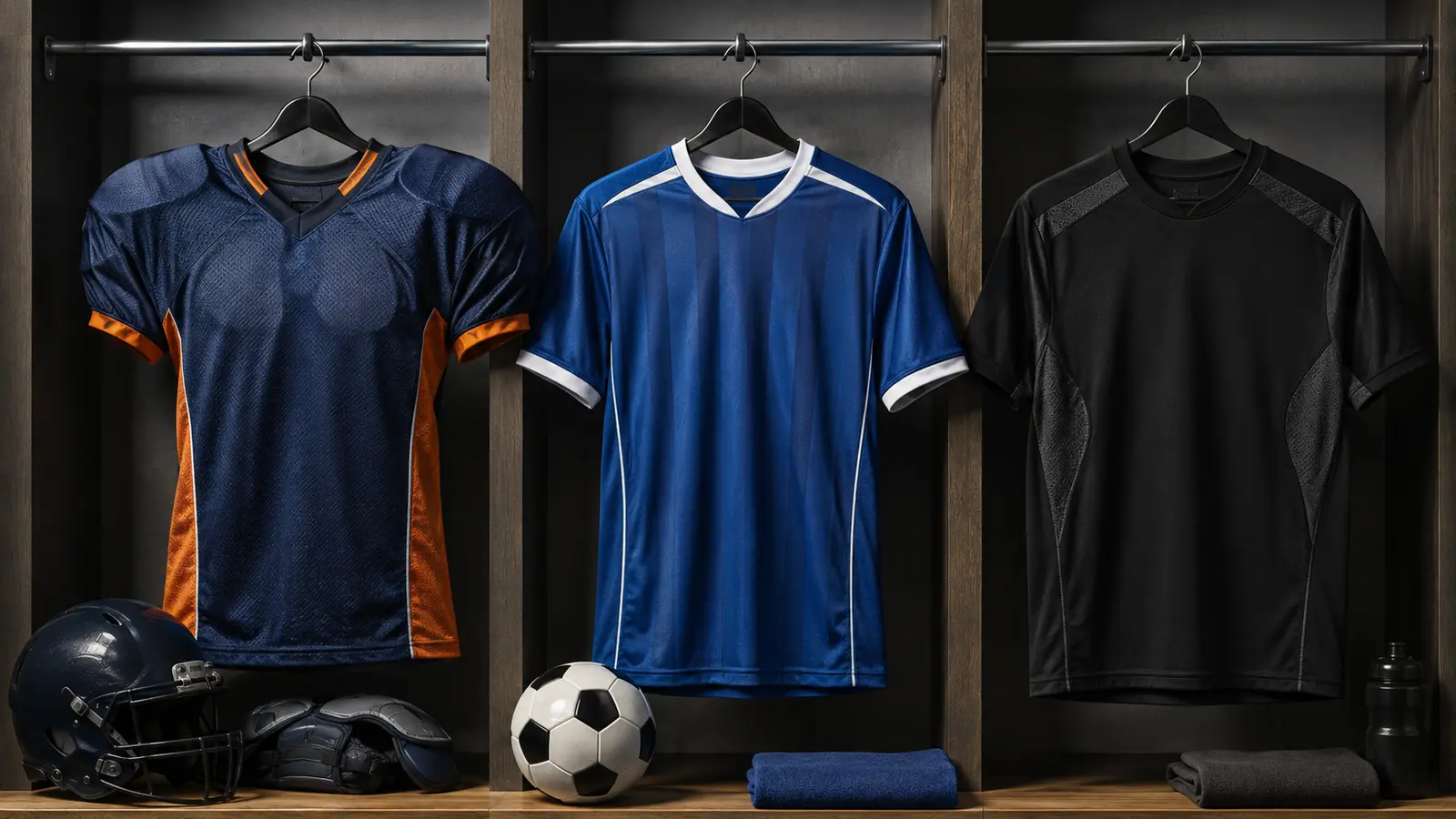
A durable team jersey is not simply the heaviest shirt available. Durability comes from a matched system: the fiber and knit structure must suit the sport, the fabric must recover after stretching, seams must survive repeated loading, decoration must tolerate washing, and the finished garment must meet an approved specification. A soccer program, tackle-football club, and basketball league may therefore need three different constructions even when all request a “strong polyester jersey.”
For schools, clubs, uniform dealers, and teamwear brands, this distinction matters commercially. A substantial-looking sample can still snag, grow at the neckline, split at an armhole, or lose an applied number. A well-engineered lightweight jersey may perform better because its material, seams, and care method work together.
Quick Answer
A durable team jersey combines sport-appropriate fabric strength, stable stretch recovery, snag resistance, reinforced seams at high-stress areas, a compatible logo method, and verified wash performance. Fabric weight is only one input. Buyers should approve an actual fabric, a size chart, seam construction, decoration method, care method, and a finished pre-production sample. Contact sports usually need stronger shoulder and armhole construction, while non-contact sports often prioritize lower weight, moisture transport, and freedom of movement.
There is no universal fabric weight, stitch type, or test score that proves a jersey will be durable for every team. The correct requirement depends on the sport, player movement, contact level, washing frequency, decoration, target price, and expected service life.
The Seven Parts of Jersey Durability
| Durability factor | What it controls | What a buyer should approve |
|---|---|---|
| Fiber and yarn | Basic tensile strength, abrasion behavior, drying and hand feel | Fiber content, yarn type and actual fabric swatch |
| Fabric construction | Breathability, snagging, bursting behavior and opacity | Knit type, mesh opening, density and fabric weight |
| Stretch and recovery | Whether the jersey returns to shape after movement | Stretch direction, recovery behavior and fit sample |
| Seam engineering | Resistance to splitting at shoulders, armholes and side seams | Stitch class, seam allowance, thread and reinforcement |
| Decoration | Risk of peeling, cracking, abrasion or concentrated stiffness | Sublimation, heat transfer, embroidery or applique specification |
| Color and laundering | Fading, staining, shrinkage, seam twist and appearance change | Wash method, test cycle and approved comparison standard |
| Use and care | Real-world load placed on the garment | Sport, training frequency, wash routine and expected season count |
Is Heavier Fabric Always Stronger?
No. GSM measures the mass of a square meter of fabric. It does not directly reveal yarn strength, loop stability, snag resistance, seam strength, stretch recovery, or how the material changes after washing.
A heavier fabric may feel more substantial and provide better opacity. But two fabrics at the same weight can behave differently because one uses a tighter knit and stronger yarn while another uses a bulkier, looser structure. A lighter engineered knit can outperform heavier open mesh in snag resistance or recovery.
What fabric weight can tell you
Fabric weight is useful when evaluated with other information. It can help estimate:
- perceived substance and drape;
- likely opacity, especially for white jerseys;
- heat retention and drying load;
- compatibility with embroidery or patches;
- suitability for a training top versus a structured match jersey.
It cannot, by itself, prove strength. ASTM D3776 is an established method for measuring fabric mass per unit area, while other methods are needed for bursting, snagging, abrasion, stretch, and seam performance. The important procurement lesson is that a precise GSM value is a material description, not a durability guarantee.
Fiber, yarn and knit structure work together
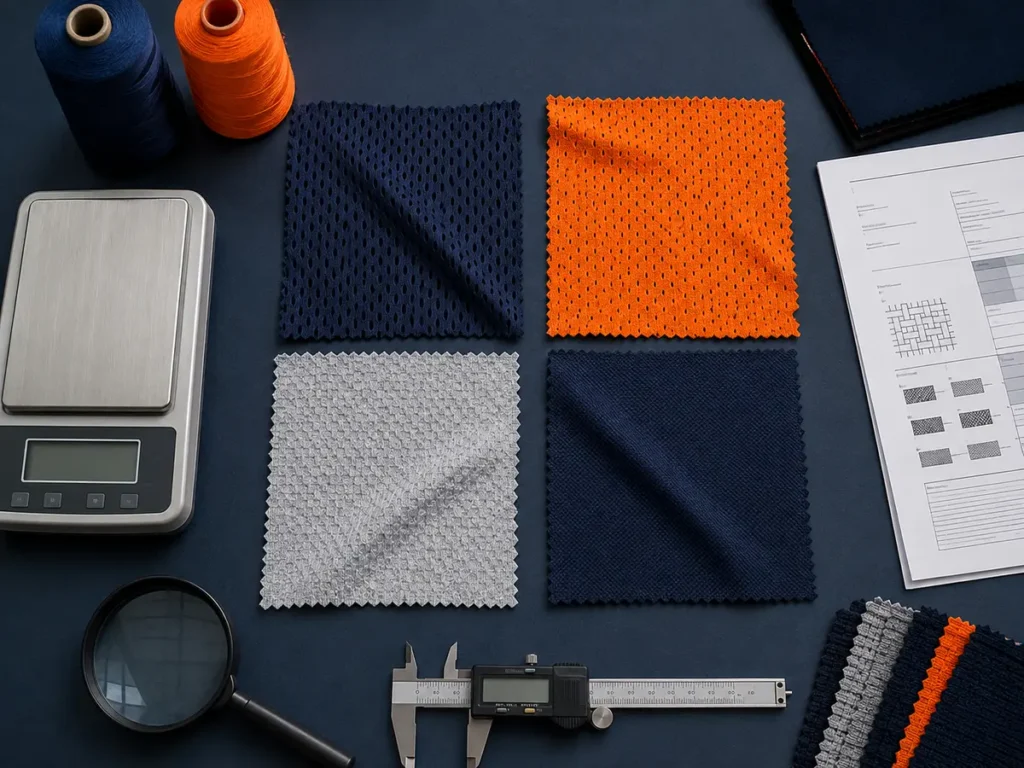
Polyester is common in team jerseys because it can be lightweight, quick drying, dimensionally stable, and suitable for sublimation. However, “100% polyester” still covers many different materials. Filament size, yarn texturing, knit geometry, finishing, and heat setting all affect performance.
A smooth, compact interlock may resist snagging better than a very open mesh, but it may also move less air. A mesh panel can improve ventilation, yet larger openings create more exposed loops that may catch on rough surfaces, hook-and-loop tape, equipment, or another player’s gear. Pique and jacquard structures can add texture and visual interest, but they still need to be evaluated for the intended sport.
Ask the supplier to identify not only fiber content and GSM but also the fabric construction and recommended application. If the fabric is critical to repeat orders, assign it a supplier code or internal material reference rather than describing it only as “breathable polyester.”
Moisture Management Is a Performance Feature, Not a Strength Rating
Moisture-wicking language is often treated as shorthand for a superior jersey. In reality, moisture management describes how liquid is absorbed, spread, transported, and dried. It does not automatically establish tensile strength or abrasion resistance.
AATCC methods such as TM195 address liquid moisture-management properties, while related methods evaluate wicking and drying behavior. They support comparison under defined conditions, but the method and acceptance level still need to be agreed for the project.
For a durable team jersey, moisture performance matters because saturated fabric can feel heavier, cling to the body, and experience repeated stretching during play. A fabric should therefore balance moisture behavior with knit stability and recovery.
Stretch Recovery Prevents Bagging and Distortion
Athletic movement stretches the garment at the shoulders, upper back, chest, armholes, and hem. A fabric that stretches but does not recover can grow wider, develop a wavy neckline, or make the logo and numbers appear distorted.
ASTM D2594 covers stretch and growth characteristics of knitted fabrics under defined loading. A buyer does not need to prescribe that exact method for every order, but should recognize that “four-way stretch” is incomplete without recovery. Useful questions include:
- In which directions does the fabric stretch?
- Does it return close to its original dimensions after the load is removed?
- Is stretch supplied by knit geometry, elastane, or both?
- Does the material recover after repeated wear and laundering?
- Does a printed or embroidered area restrict the intended stretch?
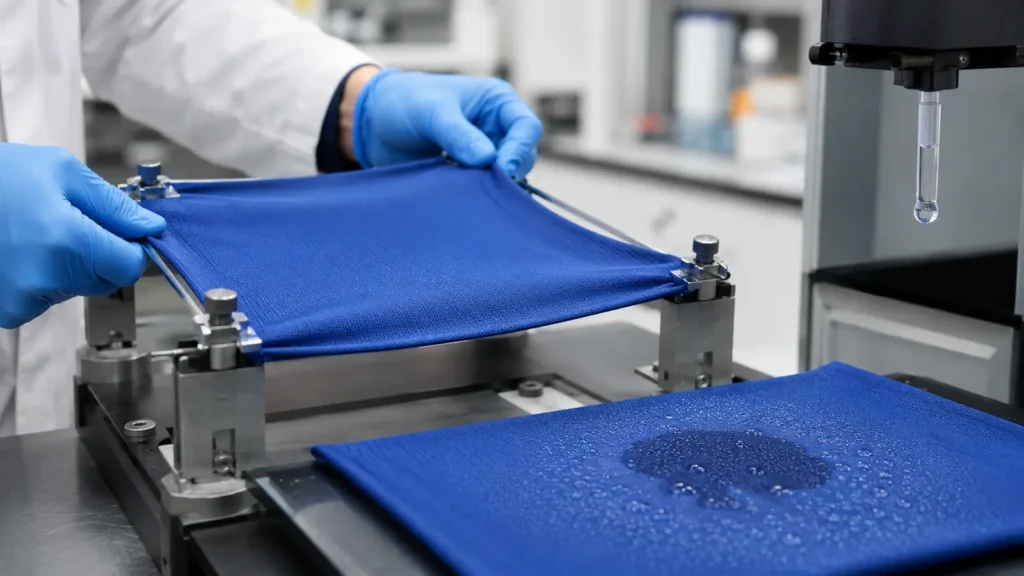
Elastane can improve close-fitting movement and recovery, but it also introduces care sensitivity. Excess heat, aggressive drying, chlorine exposure, and unsuitable pressing can shorten the useful life of stretch fibers. For that reason, adding elastane is not an automatic durability upgrade. It must match the fit, sport, print method, and care program.
Why Anti-Snag Performance Matters
Snags occur when a yarn or loop is pulled away from the fabric surface. They are especially visible on smooth filament knits and open mesh. Even when the hole does not immediately grow, a pulled loop makes a uniform look worn and can create a future weak point.
ASTM D3939 is used to evaluate snagging resistance for suitable woven and knitted fabrics and can support material comparisons or manufacturing quality control. It is not appropriate for every structure, so the lab and buyer should confirm applicability.
Snag risk increases when jerseys contact:
- rough benches, fences, turf, or equipment;
- hook-and-loop fasteners;
- exposed zipper teeth or bag hardware;
- protective pads with abrasive edges;
- other garments with damaged fasteners;
- aggressive brushing or mixed-load laundering.
Which Stitching Is Best for Team Jerseys?
There is no single best stitch for every seam. The correct choice depends on fabric stretch, seam location, appearance, bulk, equipment, and the direction of force.
Overlock seams
Overlock stitching trims and encloses the raw edge while joining fabric layers. It is efficient, flexible, and common in knit sportswear. A suitable multi-thread overlock can work well for side seams and general assembly. However, thread count alone does not guarantee strength. Stitch density, thread type, seam allowance, needle choice, tension, and fabric damage all matter.
Safety stitch combinations
A safety-stitch construction combines an overedge formation with a separate chainstitch line. This can provide additional security in seams exposed to higher load. It may be appropriate for some contact-sport or heavier teamwear constructions, provided the seam remains comfortable and flexible.
Flatlock and coverstitch
Flatlock-style seams can reduce internal bulk and improve next-to-skin comfort. Coverstitch is commonly used for hems and bindings where stretch is needed. These constructions must still be matched to the fabric and load. A visually flat seam is not automatically stronger than a well-engineered overlock seam.
Lockstitch and bartacks
Lockstitch is useful for structured details, labels, plackets, and controlled topstitching, but a straight lockstitch may not tolerate high stretch unless the seam geometry and thread allow it. Bartacks or short reinforcement stitch patterns can strengthen localized points such as the end of a placket, vent, pocket opening, or other stress concentration.
How Are Jersey Seams Reinforced?
Reinforcement should be targeted. Adding extra rows everywhere can increase stiffness, needle perforation, labor, and cost without solving the real problem.
High-stress locations may include:
- shoulder joins on contact jerseys;
- armholes and sleeve attachments;
- underarm intersections;
- side seams near the lower armhole;
- V-neck points and placket ends;
- side vents and split hems;
- panel junctions with several fabric layers;
- areas pulled when the jersey is put on over protective equipment.
Practical reinforcement methods include a safety stitch, additional seam allowance, seam tape, a reinforcing panel, bartacks, binding, or a second line of compatible stitching. The exact choice should be visible in the sample or construction sheet.
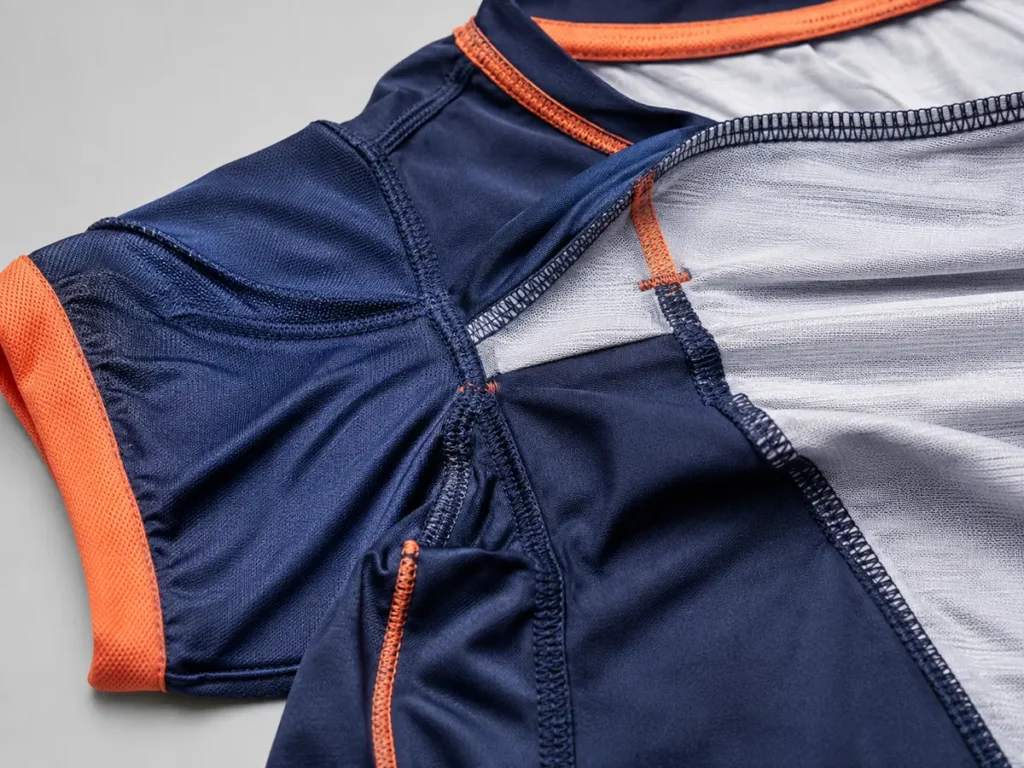
ISO 13935 methods evaluate the maximum force of sewn seams when force is applied perpendicular to the seam. Such laboratory testing can support high-risk programs, but a buyer should also inspect failure mode. A seam may fail because thread breaks, fabric tears, yarns slip, or the construction opens. The corrective action differs in each case.
Needle selection is equally important. A needle that cuts or damages a fine knit can create a line of weakness even when the seam initially looks neat. During sample approval, inspect the seam under light and gentle tension for broken filaments, skipped stitches, puckering, tunneling, exposed raw edges, loose thread ends, and inconsistent stitch density.
Send JIUMU your sport, quantity, size range, target use, reference jersey, logo files, decoration method, washing routine, budget range, and required delivery date. We can help translate those details into a fabric, construction, sample, and QC brief. Request a Custom Team Jersey Quote.
Does Sublimation Outlast Heat Transfer?
For polyester team jerseys, sublimation usually avoids the peeling and edge-lifting risks associated with a separate applied film because the color is transferred into the polyester structure rather than bonded as a surface layer. It also keeps large all-over graphics lightweight and flexible.
That does not mean every sublimated jersey is equally durable. Color performance depends on the fabric, ink, transfer paper, temperature, pressure, time, artwork preparation, and production control. Excessive heat can affect hand feel, shrinkage, shade, or fabric stability. Poor process control can produce color variation or incomplete transfer.
Heat transfer can be an effective option for names, numbers, sponsor marks, and lower-quantity personalization. Its durability depends on the film, adhesive, press parameters, substrate, edge design, wash temperature, dryer heat, and whether the applied area is repeatedly stretched or abraded. Thick, large transfers can also alter fabric stretch and breathability.
Embroidery creates a sewn decoration with strong visual texture, but it concentrates thread, backing, and needle penetrations in a local area. Large or dense embroidery on lightweight jersey fabric can add weight, restrict stretch, pucker the panel, or abrade the wearer. Small crests and controlled designs are generally easier to stabilize than large filled logos.
Decoration durability comparison
| Method | Main durability advantage | Primary risk | Best suited to |
|---|---|---|---|
| Sublimation | No separate film edge; flexible all-over graphics | Shade/process variation; limited mainly to suitable polyester systems | Full-color polyester jerseys, names, numbers and patterns |
| Heat transfer | Flexible for variable names, numbers and smaller runs | Peeling, cracking, edge lift or heat sensitivity if mismatched | Personalization and selected logos |
| Embroidery | Textured sewn identity with no adhesive film | Added stiffness, weight, puckering and yarn abrasion | Small crests or marks on suitably stable fabric |
| Sewn applique | Strong traditional dimensional appearance | More weight, edges and stitching; higher labor | Hockey, baseball or heritage-style teamwear |
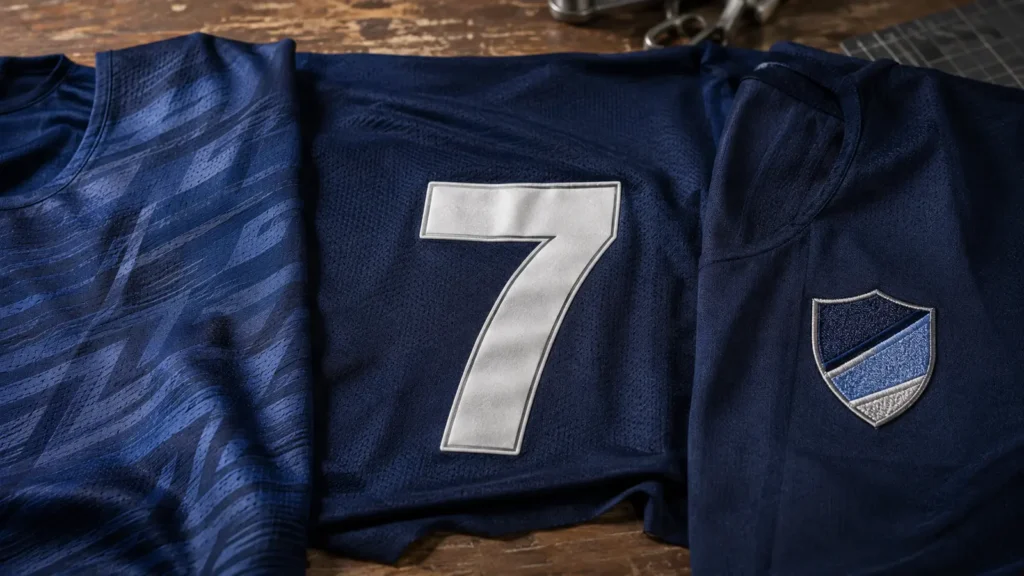
If the design contains large graphics and many personalized elements, review Sublimated Jerseys as part of the decoration decision. Buyers comparing base fabrics should also consult Best Materials for Team Jerseys. Confirm both URLs before publication if those pages are still being prepared.
Colorfastness, Washing and Care
Many jersey failures appear during laundering rather than play. Washing combines water, detergent, mechanical action, temperature, time, extraction, and drying. The same garment may perform differently under controlled cold washing and high-temperature commercial drying.
ISO 105-C06 covers methods for evaluating color resistance to domestic or commercial laundering under specified conditions. AATCC TM61 addresses accelerated laundering colorfastness. AATCC also identifies methods for dimensional change of fabrics and garments after home laundering, including TM135 and TM150. These are test frameworks, not a universal promise that every jersey should pass one identical grade or cycle count.
What to check after laundering
Record the original measurements and appearance before the test. After the agreed wash and dry sequence, check:
- color change of the main fabric;
- staining or dye transfer onto adjacent colors;
- garment length and width change;
- sleeve, shoulder and neck shape;
- seam puckering, twist or opening;
- loose threads, skipped stitches or broken reinforcement;
- heat-transfer edge lift, bubbles or cracking;
- embroidery puckering or backing distortion;
- sublimated color consistency and fabric hand;
- overall appearance against the approved sample.
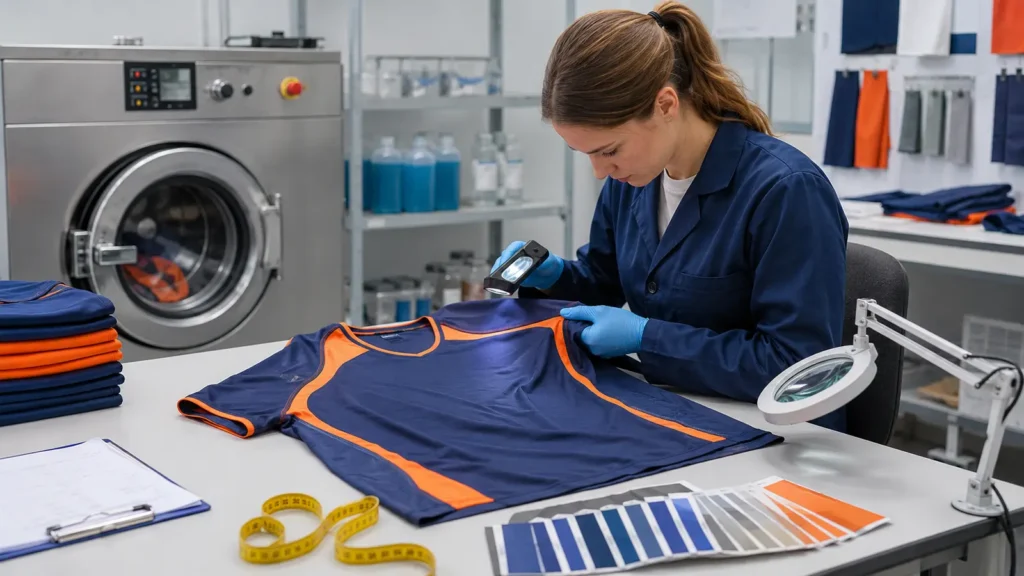
Care instructions should reflect the actual construction. A low-temperature wash and low-heat or line-dry recommendation may protect applied decorations and stretch fibers, but it must also be realistic for the team’s laundry operation. If a school uses centralized commercial equipment, disclose that before material approval. A jersey designed only for gentle household care may not be the right selection.
Contact Sports Versus Non-Contact Sports
Contact level changes the durability priority. “Contact sport” does not mean every panel needs maximum weight, and “non-contact” does not mean the garment experiences no stress.
Contact and equipment-heavy sports
Tackle football, rugby, ice hockey, lacrosse, and some training environments expose jerseys to pulling, abrasion, protective equipment, and repeated high-load movement. Specifications may prioritize:
- stronger shoulder, armhole and upper-body construction;
- adequate ease over pads;
- stable neck openings;
- fabrics with suitable bursting, abrasion and snag resistance;
- reinforcement at panel intersections;
- decorations that do not create vulnerable edges in high-contact zones.
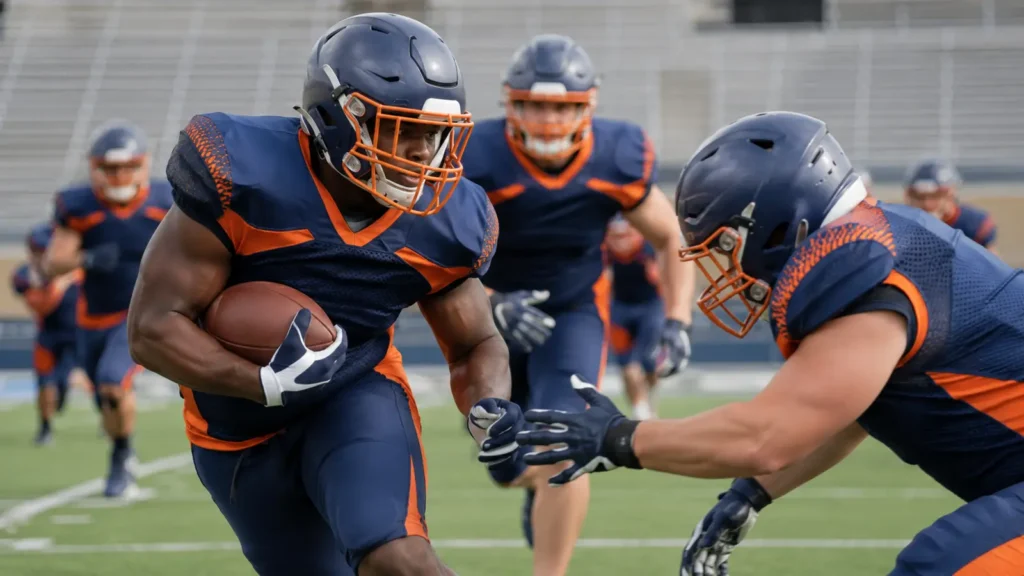
A contact jersey still needs ventilation and mobility. Zoned construction may combine stable shoulder material with more breathable panels in lower-risk areas.
Non-contact and movement-intensive sports
Soccer, basketball, volleyball, running, and many racket sports generally prioritize low mass, moisture transport, flexibility, and rapid drying. Their failure risks often include neckline growth, armhole strain, snagging, seam abrasion, and distortion from repeated stretching.
The best material is therefore not necessarily the lightest possible one. It is the lightest construction that meets the agreed opacity, recovery, snag, seam, decoration, and wash requirements for the program.
Sport-based decision guide
| Use case | Main risks | Recommended specification emphasis |
|---|---|---|
| Tackle football or rugby | Pulling, pads, abrasion, shoulder load | Reinforced upper body, stable neck, robust seams, suitable fit over equipment |
| Hockey or lacrosse | Equipment friction, snagging, sleeve abrasion | Smooth durable knit, roomy pattern, strong sleeves and compatible decoration |
| Soccer | Repeated stretch, sweat, turf contact, snagging | Lightweight stable knit, moisture movement, recovery and smooth seams |
| Basketball | Armhole and neckline growth, repeated washing | Stable binding, shoulder recovery, breathable body and secure numbers |
| Volleyball | Floor contact, rapid reach, abrasion | Flexible close fit, recovery, strong shoulders and low-bulk seams |
| Baseball or softball | Sliding, belts, equipment and mixed decoration | Stable body, reinforced placket/shoulder details, suitable logo construction |
Training Jerseys Versus Game Jerseys
Training apparel may be washed more often than match apparel. It can therefore require exceptional laundering durability even if its construction is simpler. Game jerseys may need a more refined fit, sponsor placement, custom pattern, higher opacity, and premium decoration.
Do not treat “practice” as a synonym for disposable. Calculate expected wears and washes. A lower-cost mesh training jersey that loses shape rapidly may cost more per use than a better-specified alternative.
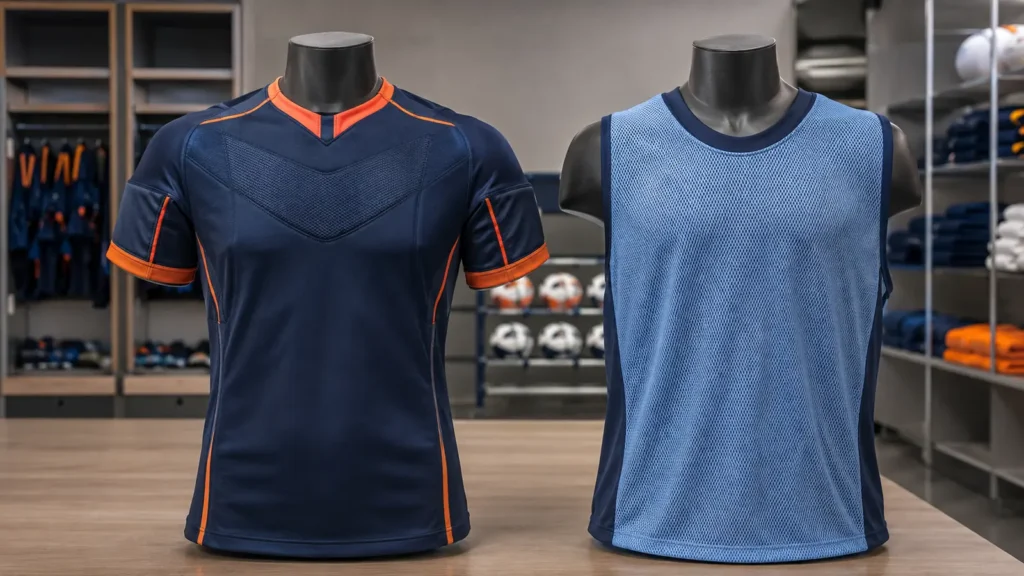
| Specification choice | Training jersey | Game jersey | Contact-sport match jersey |
|---|---|---|---|
| Primary objective | Repeated use, easy care, value | Appearance, fit and performance balance | Structural security under contact and equipment |
| Fabric | Breathable, economical, wash-stable | Sport-specific performance knit | Stronger or zoned construction |
| Decoration | Simple sublimation or durable limited graphics | Full team identity and personalization | Low-risk placement with secure construction |
| Reinforcement | At proven stress points | Targeted, clean and low bulk | Shoulders, armholes, neck and panel junctions as required |
| Approval focus | Wash cycles and size stability | Fit, color, placement and appearance | Fit over equipment, seam loading and abrasion zones |
A Practical Durability Test Plan
Testing should be risk-based. A routine school order may use supplier reports plus physical sample and wash approval; a distributor, private-label brand, or high-contact league may require independent testing and defined criteria.
Common methods that may be considered include:
- ASTM D3776 for fabric mass per unit area;
- ISO 12947 for Martindale abrasion evaluation;
- ASTM D3939 for snagging resistance where applicable;
- ASTM D2594 for stretch and growth of suitable knitted fabrics;
- ISO 13935 for seam maximum force;
- ISO 105-C06 or AATCC TM61 for laundering colorfastness;
- AATCC TM135 or TM150 for dimensional change after home laundering;
- AATCC moisture-management or wicking methods when liquid transport is a key claim.
The current edition, sample conditioning, test parameters, lab scope, and acceptance values must be confirmed in the purchase specification. Do not copy a pass value from an unrelated fabric, brand, or sport.
Sample Approval and Bulk Quality Control
A digital mockup confirms artwork layout; it does not prove fabric strength, seam comfort, fit, decoration adhesion, or wash durability. For durability-focused orders, approve a physical sample made from the intended fabric and construction.
Use this sequence:
- approve the fabric identity, color and construction;
- confirm the size chart and fit category;
- approve seam type and reinforcement locations;
- approve decoration material, size and placement;
- inspect the sample before laundering;
- conduct the agreed wash/use checks;
- document accepted variation and required corrections;
- seal the approved specification and sample as the production reference;
- inspect a bulk first piece before full production continues where practical;
- perform final inspection using the approved sample and order documents.
The approved sample should be connected to an order number and version. Photographing the sample is helpful, but photographs alone do not preserve fabric hand, stretch, seam structure, or true color. Retaining a physical Golden Sample and material records supports future replenishment.
JIUMU’s Quality Control page can be linked from this section once its final URL is verified. Buyers ready to select a sport-specific construction can review Custom Team Jerseys.
Jersey Durability Approval Checklist
| Checkpoint | Record before approval | Accept / revise criteria |
|---|---|---|
| Intended use | Sport, contact level, training/game, season frequency | Use case is specific and agreed |
| Fabric | Supplier code, fiber, construction, GSM, color | Matches approved swatch and purpose |
| Stretch | Direction, recovery and fit behavior | No unacceptable growth or distortion |
| Surface | Snag, pilling and abrasion expectation | Risk appropriate to sport and care |
| Seams | Stitch type, density, thread, allowance | No opening, damage, skipped stitches or discomfort |
| Reinforcement | Exact locations and method | Covers actual stress points without excess bulk |
| Decoration | Method, material, dimensions and placement | Stable after agreed test and movement |
| Washing | Method, temperature, drying and number of cycles | Within approved color, size and appearance limits |
| Sample | Version, date and signatures | Physical reference sealed for production |
| Bulk QC | First piece and final inspection plan | Results recorded against the same specification |
What Information Should Buyers Send for a Quote?
A useful durability quotation needs more than a reference image. Send:
- sport and league level;
- contact or non-contact use;
- training, game, reversible, or supporter application;
- expected quantity and size range;
- men’s, women’s, youth, or unisex fit;
- target fabric weight or reference jersey;
- required stretch, mesh, opacity, and moisture features;
- logo files, names, numbers, sponsors, and decoration preference;
- areas exposed to pads, belts, hook-and-loop, or abrasive equipment;
- washing and drying method;
- testing or compliance requirements;
- packaging needs;
- target delivery date and destination;
- budget target when available.
If an existing jersey performs well, send a clean physical sample and identify what should be copied: fit, material hand, weight, seam layout, or all of these. The supplier should not assume that matching the visual appearance means matching performance.
Questions to Ask a Jersey Supplier
- What is the fabric fiber content, knit construction, GSM, and internal code?
- Which sports and contact levels is this fabric normally used for?
- How is stretch recovery evaluated?
- Is the surface vulnerable to snagging from hook-and-loop or equipment?
- What seam construction is used at shoulders, armholes, neck and side seams?
- Where will reinforcement be added, and why?
- Which decoration method is compatible with the fabric and wash routine?
- Can the sample be washed and measured before approval?
- Which tests are available, and what exact editions and conditions apply?
- What sample, fabric, pattern and process records will be retained for repeat orders?
Common Buying Mistakes
Choosing only by GSM
Weight does not show knit stability, yarn quality, stretch recovery, snag resistance, or seam performance. Compare the complete construction.
Asking for the “strongest stitch” without defining the seam
A stitch must be selected for the fabric, location, stretch, and load. Extra rows can add bulk or needle damage without improving the relevant failure mode.
Using one fabric for every sport
A tackle-football shoulder and a volleyball body panel experience different loads. A single material may work across several programs, but it should be validated rather than assumed.
Approving only a digital mockup
Artwork approval cannot confirm physical durability. Approve the actual fabric, construction, decoration, fit, and wash behavior.
Ignoring the team’s laundry process
A technically sound jersey can fail early if exposed to higher heat or harsher chemicals than the approved care method. Central laundry conditions should be part of the sourcing brief.
Treating sublimation as indestructible
Sublimation removes film-peeling risk, but color, fabric, and dimensional results still depend on controlled materials and heat-transfer parameters.
How JIUMU Supports Durable Custom Team Jerseys
JIUMU supports OEM and ODM teamwear development for schools, sports clubs, uniform dealers, distributors, and private-label brands. Available capabilities include fabric sourcing, Pantone color matching, sublimation, heat transfer, embroidery, labels, packaging, digital mockups, physical samples, bulk production, and quality-control support.
The practical starting point is a clear use case. Once the buyer provides the sport, contact level, fit, quantity, decoration, care routine, delivery target, and budget, the material and construction can be selected around those requirements. Physical sampling then gives both parties an evidence-based reference for bulk production.
JIUMU’s typical MOQ is 50 pieces, subject to product structure and customization. Confirm the applicable MOQ, sample plan, lead time, test scope, and packaging before placing the order.
Frequently Asked Questions
Final Recommendation
Define durability as measurable suitability for the team’s real use—not as maximum weight or maximum stitch count. Start with the sport and contact level, then approve the material identity, recovery, surface behavior, seam construction, reinforcement, decoration, wash method, fit, and acceptable variation. Keep the approved sample and specification for production and future reorders.
Share your sport, contact level, quantity, size range, reference jersey, logo files, names and numbers, preferred decoration, washing method, delivery date, and destination. JIUMU can review the brief and prepare a custom team jersey quotation and sampling path. Contact JIUMU.
Sources and Further Reading
- ISO 12947-2: Abrasion resistance by the Martindale method
- ISO 13935-1: Seam tensile properties
- ASTM D3939: Snagging resistance of fabrics
- ASTM D2594: Stretch properties of knitted fabrics
- ISO 105-C06: Colour fastness to laundering
- AATCC laundering test-method overview
- AATCC moisture-management methods
About JIUMU
JIUMU develops custom teamwear, logo apparel, hats, uniforms, bags and branded merchandise for schools, clubs, distributors and private-label buyers. Content is prepared from practical sourcing and quality-control considerations.