Company Hoodie Ideas for Staff, Events and Brand Merchandise
Company hoodies can be staff clothing, event uniforms, welcome gifts, client merchandise, or retail products. The most effective design fits the wearer’s context, supports the brand, survives expected use, and can be reordered consistently.
This guide presents practical company hoodie ideas for corporate teams, event organizers, distributors, uniform dealers, and private-label brands, then turns each concept into a repeatable bulk-order specification.
Quick Answer: For staff, choose a comfortable midweight hoodie with restrained left-chest or sleeve branding and an inclusive size range. For events, prioritize visibility, fast staff recognition, layered comfort, and delivery certainty. For brand merchandise, use a retail-informed fit, distinctive graphics, private labels, considered packaging, and a sample-tested size specification. In every case, approve the garment, color, measurements, logo size, logo position, decoration method, labels, packaging, and pre-production sample before bulk production. To organize a staff order, appoint one internal owner, define the budget and in-hand date, select one or two styles, collect sizes by a fixed deadline, approve artwork and a physical sample, and lock the size-and-color matrix before production. Review custom hoodie options or request a quotation with the completed brief.

Why the Purpose Should Decide the Hoodie Design
A hoodie ordered for 40 booth staff has a different job from a hoodie sold through an online store. Event staff need to be recognizable across a crowded venue. Office teams usually prefer understated branding that they can wear repeatedly. A merchandise buyer must consider perceived value, presentation, replenishment, product photography, and returns.
Before asking a supplier for ideas, define the job of the garment:
- Daily staff wear: comfort, practical layering, wash performance, and subtle branding.
- Outdoor or mobile teams: warmth, pocket utility, easy on/off, and role visibility. A normal branded hoodie should not be represented as certified protective or high-visibility clothing unless the finished product actually meets the relevant requirements.
- Trade shows and corporate events: immediate recognition, a clear event color system, size planning, and a fixed delivery date.
- Employee onboarding and milestones: broad appeal, gift presentation, personalization rules, and small repeat batches.
- Promotional giveaways: controlled unit cost, simple decoration, easy size allocation, and brand recall.
- Retail or fan merchandise: differentiated styling, retail fit, labels, packaging, margin, and reorder consistency.
This purpose-first approach prevents a common mistake: adding a corporate logo to a generic blank without deciding whether the product should feel like a uniform, a gift, or a retail item.
Company Hoodie Decision Overview
| Program | Recommended base | Branding approach | Priority specification | Main risk to control |
|---|---|---|---|---|
| Everyday staff | Midweight pullover or full-zip | Small chest embroidery, sleeve mark, tonal print | Comfort, washability, inclusive fit | Employees do not want to wear it |
| Customer-facing staff | Clean full-zip or structured pullover | Left chest plus discreet back identifier | Consistent appearance and easy layering | Branding is too small to identify staff |
| Trade show or event | Pullover, zip-up, or role-coded set | Higher-contrast logo or event graphic | Delivery date, role visibility, size allocation | Late arrival or confusing staff colors |
| Onboarding gift | Soft pullover in core brand colors | Minimal logo, optional name or start-year detail | Gift presentation and broad appeal | Excess personalization errors |
| Promotional giveaway | Standardized pullover | One-color print or simple embroidery | Unit-cost control and easy fulfillment | Cheap feel reduces use after the event |
| Brand merchandise | Retail-informed heavyweight or fashion fit | Original artwork, private labels, multiple placements | Perceived value and repeat-order consistency | Fit or color differs between production runs |
| Field crew | Durable pullover or zip-up | Clear logo, department or role color | Layering, pocket function, abrasion points | A lifestyle garment is mistaken for PPE |
15 Company Hoodie Ideas That Work in Real Programs
The following concepts can be adapted to one department or combined into a coordinated range. The strongest programs usually select two or three related concepts instead of ordering one design for every person and situation.
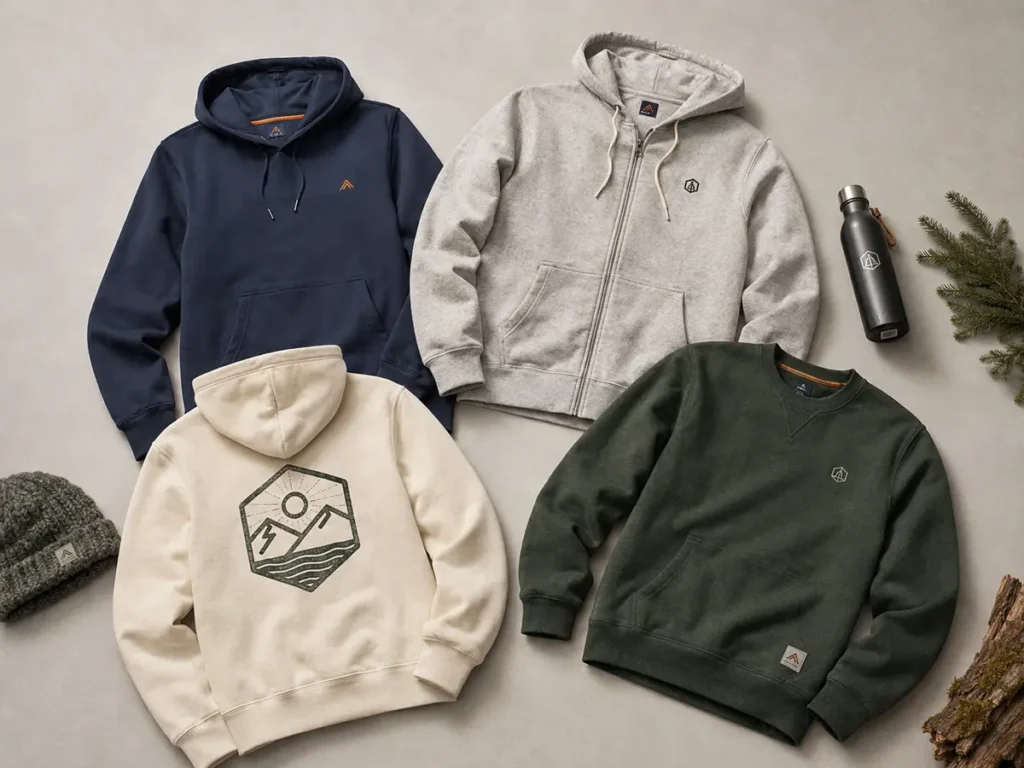
1. Minimal Left-Chest Staff Hoodie
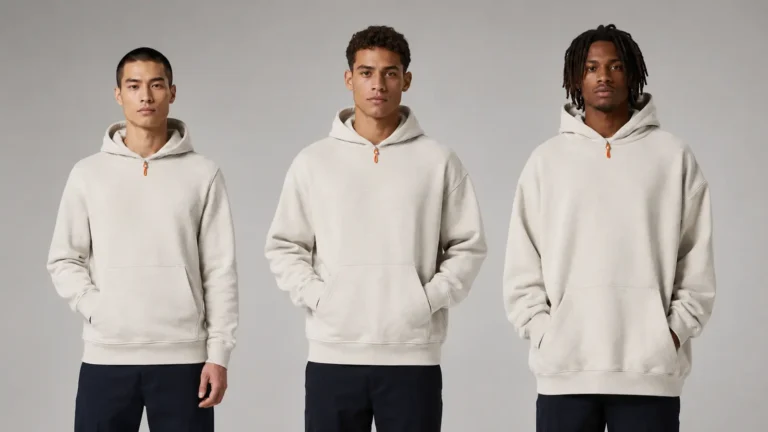
Use a small embroidered symbol or wordmark on the left chest, with no large back graphic. This is the safest starting point for office, customer support, sales, and operations teams because it feels closer to everyday clothing than to advertising apparel. Keep embroidery modest enough to avoid stiffness on lighter fleece.
2. Tonal Executive or Client-Facing Hoodie
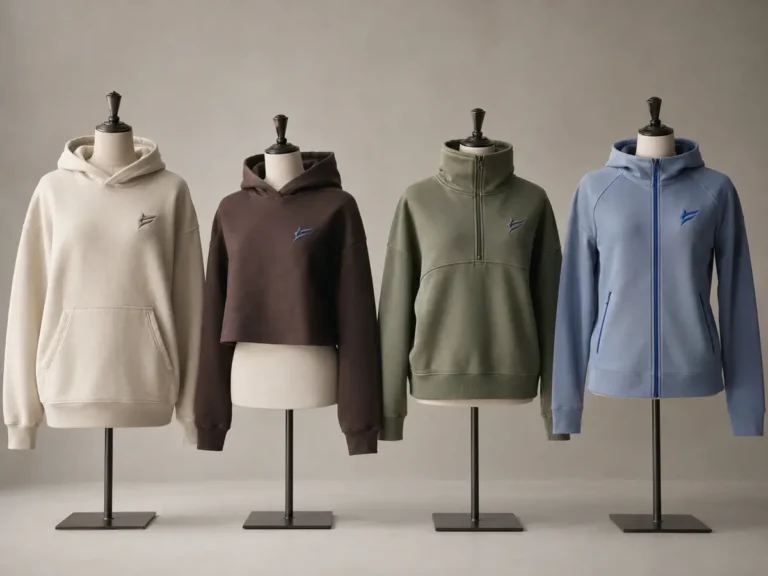
Match the decoration closely to the garment color: navy thread on navy fleece, charcoal print on black, or cream embroidery on an oatmeal hoodie. Tonal branding creates a quieter, more refined appearance for leadership gifts, client meetings, and premium onboarding boxes. Ask for a physical strike-off because very low contrast may disappear under indoor lighting.
3. Department Color System
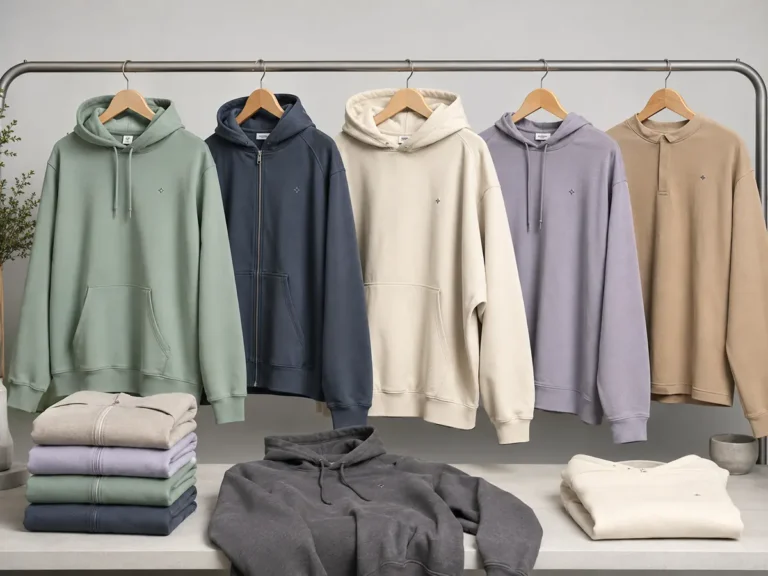
Use one base design with controlled color changes for operations, sales, production, volunteers, and event staff. The system can be as simple as different hood lining, sleeve embroidery, zipper tape, or garment colors. Document the exact color references so future orders do not drift into visually similar but inconsistent shades.
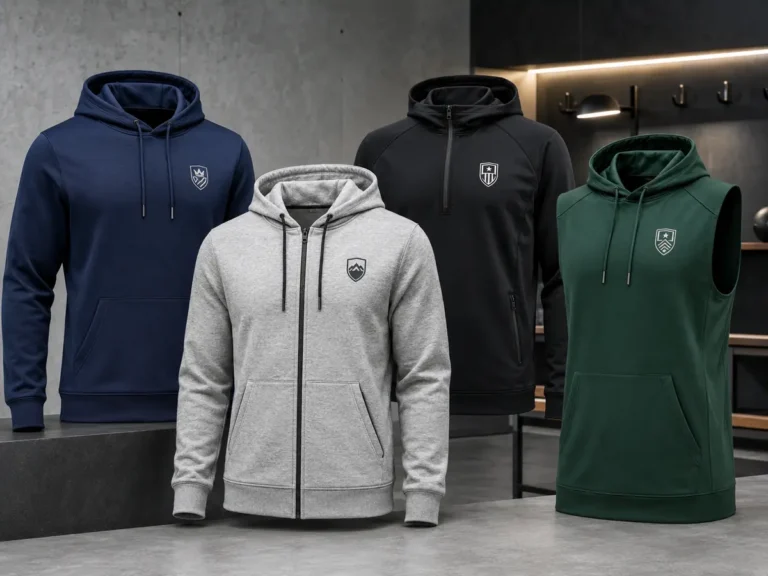
4. Full-Zip Layering Hoodie
A full-zip style works well for reception teams, technicians, drivers, and event staff who move between temperatures. It is easier to put on over a uniform or collared shirt. Confirm zipper color, puller shape, front logo alignment, pocket symmetry, and whether decoration crosses any bulky seam.
5. Premium Heavyweight Merchandise Hoodie
Choose a substantial hand feel, structured hood, wide rib, and a contemporary relaxed fit when the hoodie will be sold rather than given away. The value comes from the whole product—not only fabric weight. Neck tape, seam cleanliness, rib recovery, print hand feel, packaging, and product photography all affect the retail impression.
6. Limited Event Edition
Create a temporary graphic or colorway for a conference, product launch, company anniversary, or community event. Keep the company identity visible but give the edition its own artwork. Avoid putting a date too prominently unless leftover stock will still be useful afterward.
7. Sleeve Story Hoodie
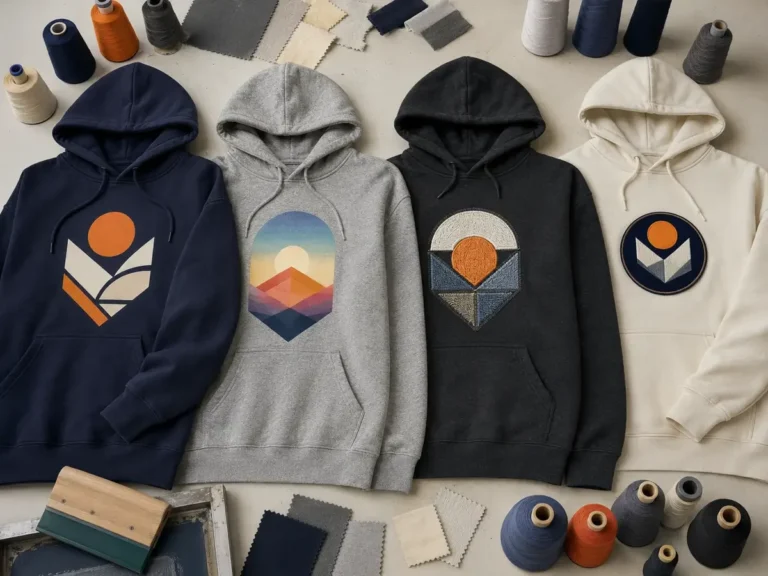
Place a short graphic device, department identifier, or repeating abstract motif along one sleeve while keeping the front restrained. This creates visual interest in photographs and video. Screen print or heat transfer may be practical depending on artwork, quantity, fabric, and sleeve geometry; confirm the printable area on the approved garment size.
8. Small Front, Statement Back
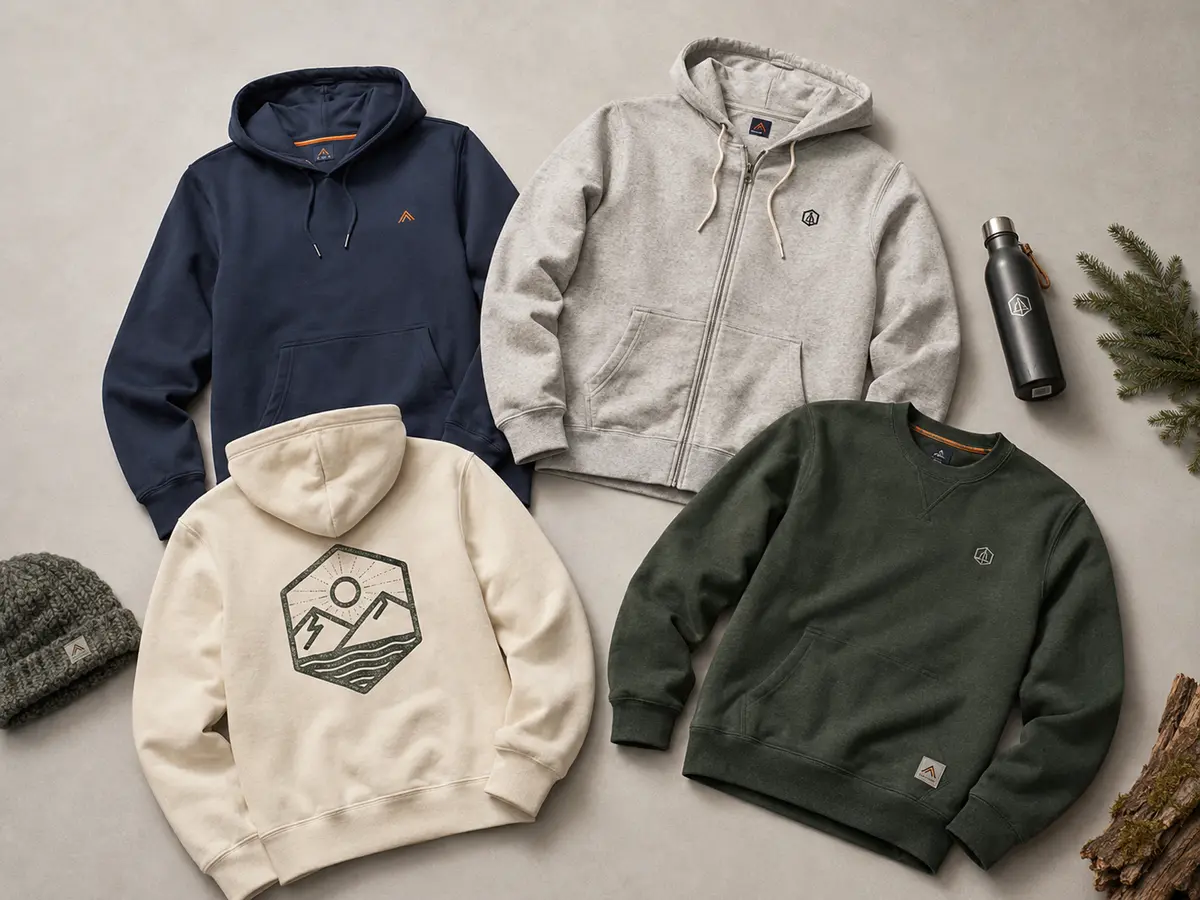
Combine a small chest mark with a larger original back graphic. This works for creative agencies, hospitality teams, event crews, and merchandise collections. The back design should be intentional artwork rather than a logo enlarged until it fills the panel. Check hood overlap so the upper part of the graphic is not hidden when the hood is down.
9. City, Branch, or Team Edition
Use a common master design with a controlled location or team variation. Define whether locations may choose colors independently; uncontrolled variation makes replenishment and brand review difficult.
10. Employee Milestone Hoodie
Recognize onboarding, service anniversaries, or completed projects with a subtle year, sleeve detail, or inside-neck message. For names, lock spelling, capitalization, maximum width, placement, and approval responsibility.
11. Volunteer and Community Day Hoodie
Choose a comfortable, visible color for charity runs, clean-up days, and community projects. Avoid dates if leftovers may be reused, and do not substitute an ordinary hoodie for required safety apparel.
12. Creator or Influencer Seeding Hoodie
Build a merchandise-quality piece with understated branding, considered packaging, a size-selection process, and fit replacements. The goal is voluntary wear, not merely an unboxing moment.
13. Reversible Brand Palette Without a Reversible Garment
Create two related colorways: dark fleece with light branding and light fleece with dark branding. Employees gain choice while the program remains easy to reorder.
14. Travel and Retreat Zip Hoodie
For retreats and travel, use a full zip, secure pocket, soft hood, and neutral color. Sample any added pocket because its bag and reinforcement can change drape.
15. Coordinated Hoodie, Cap, Jacket, and Bag Set
Build a wider merchandise system across hoodies, custom baseball caps, custom team jackets, and custom team bags. Match artwork and label language, but approve color on every material.
Pullover or Zip-Up: Which Structure Is Better?
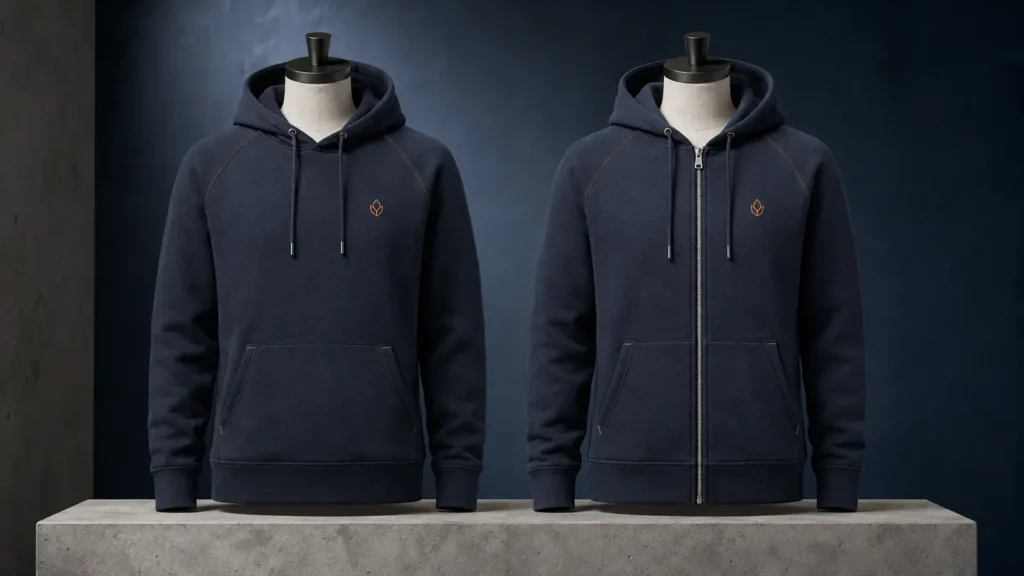
| Criterion | Pullover hoodie | Full-zip hoodie |
|---|---|---|
| Visual area | Large uninterrupted front and back areas | Front artwork is divided by the zipper |
| Warmth | Simple enclosed front | Adjustable ventilation and layering |
| Ease of use | Pulled over the head | Easy on/off without disturbing hair, headset, or uniform |
| Pockets | Usually one kangaroo pocket | Usually two split pockets |
| Branding | Flexible for front, back, and sleeves | Best with chest, back, sleeves, or carefully registered split print |
| Cost drivers | Generally simpler construction | Zipper, zipper insertion, pocket matching, and hardware add complexity |
| Best fit | Gifts, merchandise, casual staff use | Events, customer-facing teams, travel, mixed temperatures |
Choose based on behavior. If employees frequently enter vehicles, work between indoor and outdoor areas, or layer over other garments, a zip-up may be worth the added complexity. If the hoodie is intended as merchandise with a strong front graphic, a pullover gives a cleaner canvas.
Choose Fabric by Climate, Use and Brand Position
Fabric weight alone does not define quality. Ask for fiber composition, structure, nominal weight, finish, face and inside texture, color method, and available test or inspection information.
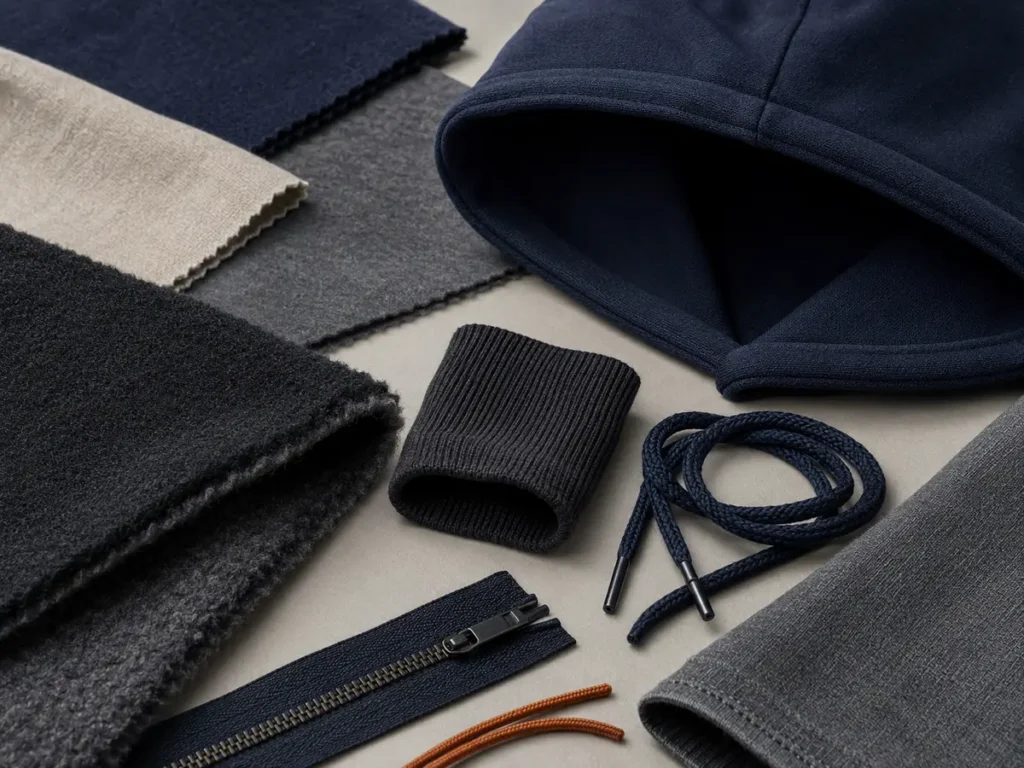
Cotton-Rich Fleece
Cotton-rich fleece often provides a familiar, soft surface. Polyester in a blend may support stability, durability, moisture management, or color behavior. Compare samples because fiber percentages do not explain yarn, density, brushing, or finishing.
Polyester-Rich or Performance Knits
These can suit events, travel, and active teams where faster drying or a smoother print surface is useful. Confirm the appearance; a shiny athletic fabric may conflict with a premium merchandise concept.
Midweight Versus Heavyweight
Midweight fleece is versatile for offices, events, and layering. Heavyweight fleece can create a structured merchandise feel but increases shipping weight and warmth. Use a wearer trial rather than selecting from GSM alone.
Brushed Versus Loopback Interior
Brushed fleece feels warm; loopback or French-terry-style constructions can suit transitional seasons. Record the approved fabric and color codes for replenishment.
Matching Rib and Trims
Body fleece, rib, drawcord, zipper tape, thread, labels, and inks reflect color differently. Decide whether trims should match or contrast, then approve them under relevant lighting.
Fit and Sizing: Design for the Actual Wearer Group
A company hoodie program fails quickly when recipients cannot choose a suitable size. Use a garment measurement chart, not a generic body-size label alone. Key points normally include chest width, body length, shoulder, sleeve length, hem width, hood dimensions, and tolerance.
For an inclusive staff order, consider:
- Whether one unisex fit is acceptable or whether more than one block is needed.
- The smallest and largest sizes required before development begins.
- Whether the hoodie will be worn over a shirt, uniform, or jacket layer.
- Whether the target fit is standard, athletic, relaxed, oversized, or youth.
- Whether sizes share the same logo dimensions or use graded artwork.
- How many try-on samples are needed for a representative wearer trial.
Do not assume the size names used by two suppliers are equivalent. A supplier’s L may differ in chest, length, shoulder, and sleeve from the garment your team already wears. For merchandise, publish finished-garment measurements and explain the intended fit on the product page.
Construction Details That Influence Durability
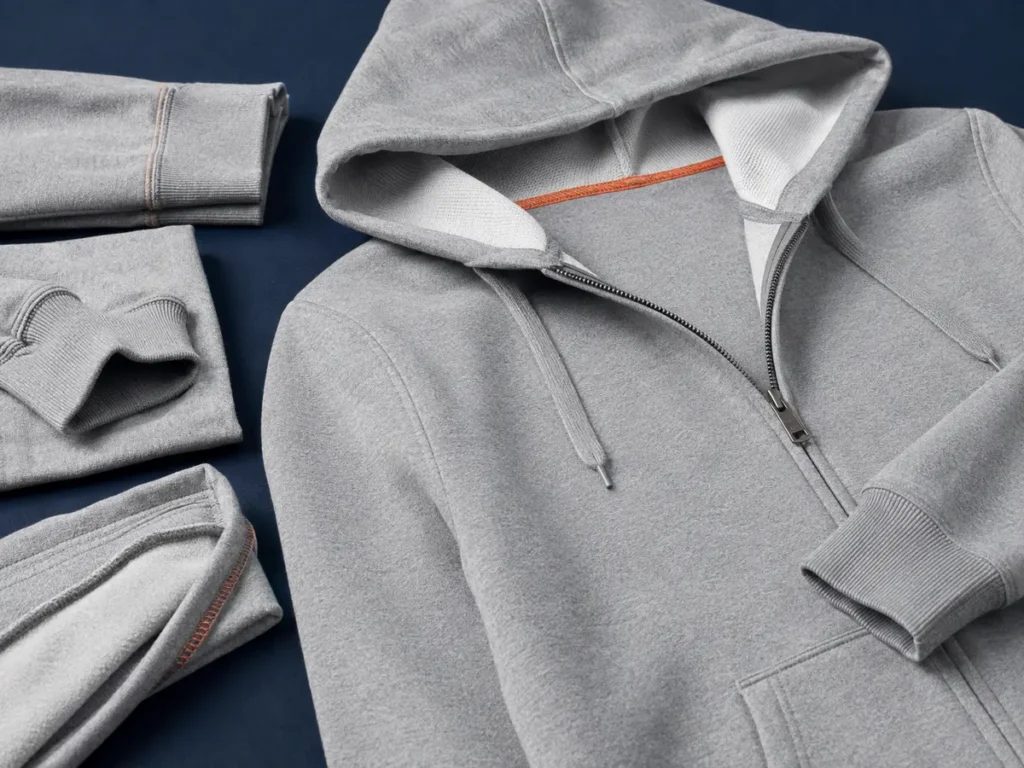
Good construction is observable. Review stitch density and consistency, seam allowance, reinforcement at pocket openings, neck tape, shoulder alignment, hood shape, drawcord anchoring, zipper smoothness, rib recovery, and symmetry. For printed products, inspect the surface after decoration for scorching, shine, dye migration, adhesive marks, or distortion.
The appropriate specification depends on use. A giveaway worn twice does not need every feature of a retail hoodie expected to remain in a collection. However, weak pocket attachment, unstable rib, or an unreliable zipper can damage the company brand regardless of unit cost.
Ask for both appearance and measurement tolerances. A statement such as “standard tolerance” is not sufficient unless both parties know the actual range and how out-of-tolerance pieces will be handled.
Logo and Customization Methods
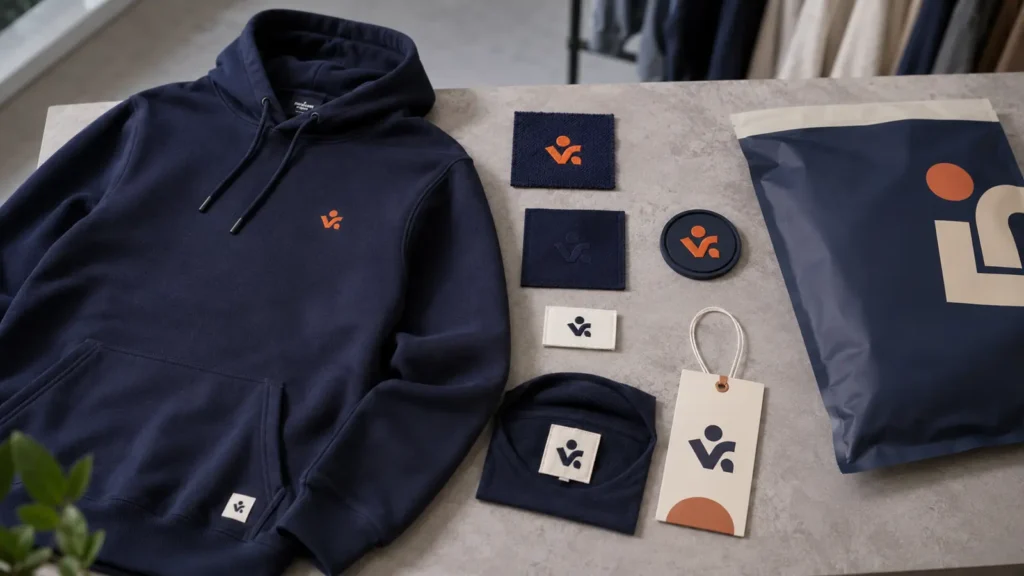
Embroidery
Embroidery is useful for small chest marks, sleeve details, names, and premium-looking symbols. It introduces thread texture and works well on stable fleece. Dense designs can become stiff or pucker, so simplify very small lettering and inspect backing, thread coverage, and the inside finish.
Screen Printing
Screen printing can be effective for strong front or back graphics and repeat quantities. Cost and feasibility depend on color count, print size, artwork, fabric, underbase needs, and quantity. Ask for the expected print hand and whether the fabric color may influence the result.
Heat Transfer
Heat-transfer methods support multicolor graphics, names, numbers, and shorter runs. Film type, adhesive, press settings, fabric finish, stretch, and wash conditions affect performance. Approve the exact transfer on the actual hoodie fabric rather than on a generic test cloth.
Patches
Woven, embroidered, rubber/PVC, and leather-style patches create a distinct branded detail. Confirm edge finish, thickness, attachment method, position, and wash suitability. Avoid describing a leather-style material as genuine leather unless the material specification supports that claim.
Private Labels and Packaging
For merchandise, consider neck labels, size labels, care labels, woven hem labels, hangtags, barcode stickers, and individual packaging. Decide who owns the barcode data and who approves legal or compliance wording. Packaging should protect the product without making unsupported environmental claims.
Planning company hoodies for staff, an event, or a merchandise launch? Send JIUMU your target quantity, size range, garment style, color references, logo files, decoration positions, packaging needs, delivery country, and required date. Request a custom hoodie quotation.
Labeling and Product-Responsibility Checks
Brand owners, importers, distributors, and retailers should confirm the legal requirements that apply to the destination market and the way the garment is supplied. This guide is practical sourcing information, not legal advice.
For the United States, the Federal Trade Commission explains that most covered textile labels identify fiber content, country of origin, and the manufacturer or another responsible business; the FTC also states that manufacturers and importers of covered wearing apparel must provide care instructions. Review the current FTC textile labeling guidance and Care Labeling Rule guidance for the exact product and supply arrangement.
For Great Britain, official guidance states that textile labels must show fiber content, including components with different fiber compositions where applicable. See the current UK textile labelling guidance.
For products made available to EU consumers, the EU General Product Safety Regulation applies from December 13, 2024, and adds a broader product-safety and traceability framework. Buyers should confirm economic-operator, traceability, product-identification, safety-information, distance-sales, and incident obligations for their actual route to market.
Environmental statements also require care. UK government guidance published for businesses across the supply chain advises companies to support environmental claims and comply with consumer-protection law. If a hoodie, label, or mailer is described with terms such as recycled, lower impact, sustainable, or carbon neutral, retain the evidence and define the claim precisely. Consult the CMA green claims supply-chain guidance.
What Drives the Cost of Custom Company Hoodies?
The lowest unit price is not always the lowest program cost. Replacements, late delivery, inconsistent reorders, complicated sorting, and unusable sizes create additional expense.
Major cost drivers include:
- Garment construction: pullover versus zip-up, hood lining, pockets, panels, and trims.
- Fabric: fiber, knitting, weight, finish, color method, and minimum material quantity.
- Decoration: method, size, color count, stitch count, placement, and number of designs.
- Size range: extended sizes, youth/adult blocks, and graded artwork.
- Personalization: names, departments, numbers, or individual packaging.
- Labels and packaging: neck labels, care labels, hangtags, barcode work, folding, and mailers.
- Sampling: fabric swatches, logo strike-offs, fit samples, and pre-production samples.
- Quantity and assortment: total volume plus the number of colors, sizes, and designs.
- Quality requirements: testing, inspection level, reporting, and replacement terms.
- Freight and schedule: destination, carton volume, mode, customs arrangement, and delivery deadline.
For a comparable quotation, give every supplier the same brief. A quote for a stock blank with one print is not comparable to a custom-developed hoodie with private labels, multiple embroidery positions, and retail packaging.
Sample Approval and Quality-Control Checklist
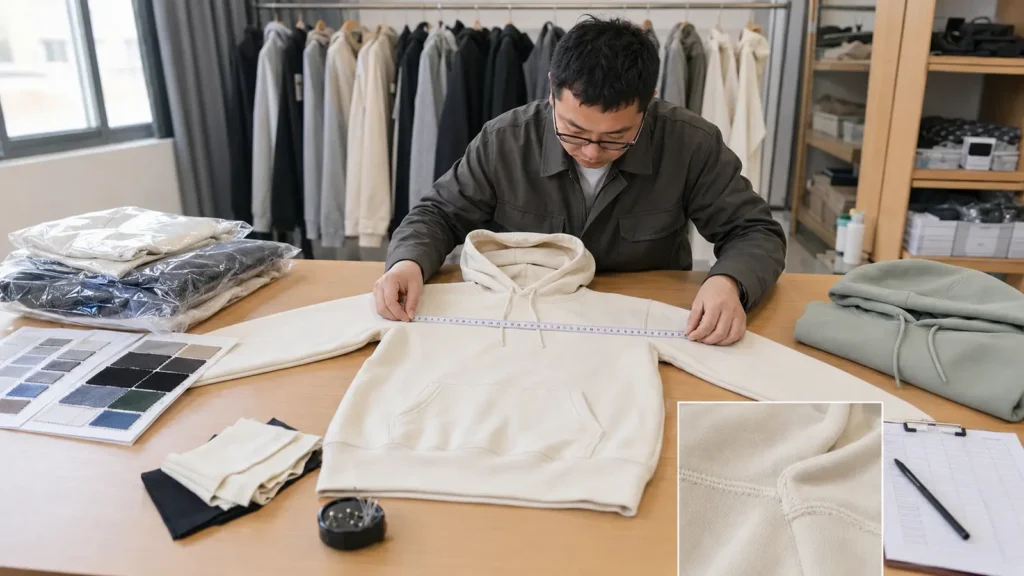
Use a signed sample or clearly identified approval sample as the reference. Record any changes after approval; do not rely on chat messages scattered across different threads.
Before Bulk Production
- Confirm product code, garment structure, fabric code, fiber composition, weight or construction description, and color reference.
- Approve the measurement chart, grading rules, tolerance, and size-set samples.
- Approve logo artwork, size, thread or ink colors, placement measurements, and decoration method.
- Check zipper, drawcord, eyelets, rib, pocket, hood, labels, hangtag, and packaging.
- Review the care instruction and destination-market label content with the responsible buyer or compliance specialist.
- Wash or wear-test the sample when performance matters to the program.
- Confirm bulk quantity by design, color, and size, including allowable overage or shortage.
During and After Production
- Compare bulk fabric and trims with approved references under consistent light.
- Check measurements across sizes and more than one carton.
- Inspect seam security, skipped stitches, symmetry, pocket alignment, zipper operation, rib recovery, and loose threads.
- Check decoration position, dimensions, color, adhesion or stitch quality, puckering, and damage.
- Confirm correct labels, personalization data, size stickers, folding, packaging, carton marks, and assortment.
- Define how defects, shortages, and incorrect personalization will be documented and resolved.
Bulk Order Planning: From Idea to Delivery
- Define the program. State whether the hoodie is staff wear, event apparel, a gift, or merchandise.
- Build the specification. Select silhouette, fit, material, color, trims, decoration, labels, and packaging.
- Send usable artwork. Provide vector logo files where possible, brand colors, minimum clear space, and prohibited uses.
- Request a structured quote. Include quantities by style and color, expected size range, destination, and required date.
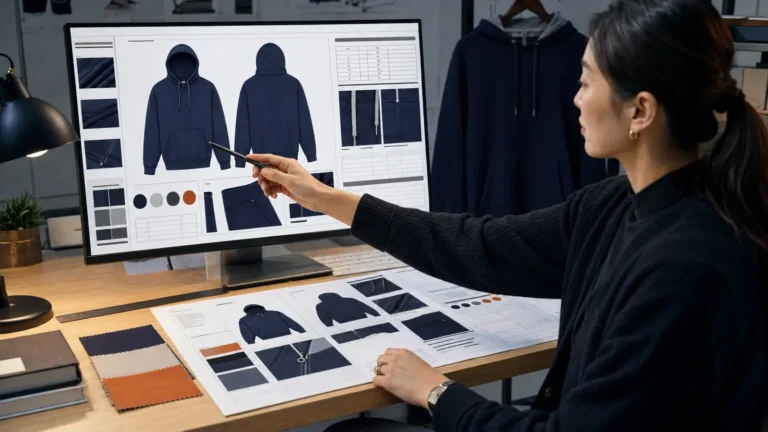
- Approve materials and decoration. Review swatches, color references, embroidery sew-outs, print strike-offs, or patch samples.
- Approve fit and pre-production samples. Check the actual garment, not only a digital mockup.
- Lock the order matrix. Freeze design, color, size, personalization, labels, packaging, and carton instructions.
- Monitor production and inspection. Agree on checkpoints and evidence before shipment.
- Plan replenishment. Retain approved files, material codes, measurements, color references, and sample records for the next order.
For events, work backward from the in-hand date, not the event opening date. Allow time for receiving, count verification, internal distribution, and any replacements.

What to Send a Supplier for an Accurate Quotation
Prepare one concise request containing:
- Intended use and target wearer.
- Pullover or zip-up reference, or a product sketch.
- Target quantity by color and approximate size distribution.
- Desired fabric composition, feel, season, and weight range if known.
- Fit direction and finished-garment measurement chart if available.
- Logo files and a visual showing each placement.
- Decoration method preference or the desired visual effect.
- Brand color references, including Pantone references where applicable.
- Labels, hangtags, barcode, folding, and packaging requirements.
- Destination country, delivery address type, and required in-hand date.
- Applicable testing, inspection, labeling, and documentation requirements.
If some details are unknown, say so. A qualified supplier can propose options, but the quotation should clearly state the assumptions.
Questions to Ask a Custom Hoodie Supplier
- Is the proposed hoodie a stock blank, a modified style, or a fully custom product?
- What is the exact fabric composition and construction, and how is the color identified for reorders?
- What measurements and tolerances will be used for each size?
- Which decoration method is recommended for this artwork and fabric, and why?
- Can I approve a fabric swatch, logo sample, size set, and pre-production sample?
- What is included in the quoted price, and what may change after sampling?
- How will names, sizes, labels, barcodes, and packaging data be controlled?
- What in-process and final quality checks are performed for this order?
- What quantity variance, defect criteria, and resolution process apply?
- Which documents and product information are available for the destination market?
- How will repeat orders be matched to the original fabric, color, measurements, and decoration?
- What production and shipping milestones support the required in-hand date?
Common Buying Mistakes
Designing Before Defining the Use
A visually impressive concept can fail if it is too warm for event staff, too conspicuous for office use, or too generic for paid merchandise. Start with the wearer’s situation.
Approving Only a Digital Mockup
A mockup cannot prove fit, fabric feel, embroidery stiffness, print hand, zipper quality, or wash behavior. Use it for placement planning, then approve physical output.
Selecting by Fabric Weight Alone
Weight does not reveal yarn, density, surface durability, rib recovery, shrinkage, or construction quality. Compare complete samples.
Using One Size Ratio for Every Audience
An office team, event audience, school group, and ecommerce customer base may need different size distributions. Use previous order data or a size-collection process when available.
Adding Too Many Decoration Methods
Embroidery, patches, sleeve print, labels, and special packaging can create a rich product, but each addition increases approval points and risk. Keep every element purposeful.
Making Unsupported Product Claims
Do not describe an ordinary hoodie as protective, high-visibility, waterproof, antimicrobial, recycled, certified, or sustainable without a specification and evidence that supports the exact statement.
Ignoring Repeat-Order Records
A successful first order does not guarantee a matching second order. Keep an approved sample, measurement chart, artwork version, color references, material codes, label files, and packaging specification.
Why Buyers Use JIUMU for Custom Hoodie Programs
JIUMU is a Guangdong-based B2B supplier established in 2010, serving buyers in the United States, Canada, the United Kingdom, and Europe. The company supports custom teamwear, logo apparel, hats, uniforms, bags, and branded merchandise.
Relevant hoodie-program capabilities include OEM and ODM development, embroidery, screen printing, heat transfer, woven and rubber/PVC patches, fabric sourcing, Pantone color matching, private labels, hangtags, packaging customization, digital mockups, physical samples, bulk production support, quality control, and export coordination. A typical MOQ is 50 pieces, subject to garment structure and customization.
Buyers can also explore custom hoodies or coordinate a wider program through custom team uniforms.
Frequently Asked Questions
Final Recommendation
The best company hoodie ideas begin with a clear use case: subtle comfort for staff, visibility and delivery certainty for events, or differentiated presentation for merchandise. Translate that purpose into measurable specifications and approvals.
Keep the first range focused. One pullover, one zip-up, and two coordinated colors can outperform a large assortment with weak documentation. Invest in fit review, samples, decoration testing, labeling, and reorder records.
JIUMU Teamwear Sourcing Team
Practical OEM/ODM sourcing guidance for custom teamwear, logo apparel and branded merchandise. Regulatory links checked August 1, 2026.