Best Custom Team Warm-Up Jackets: A B2B Buying Guide
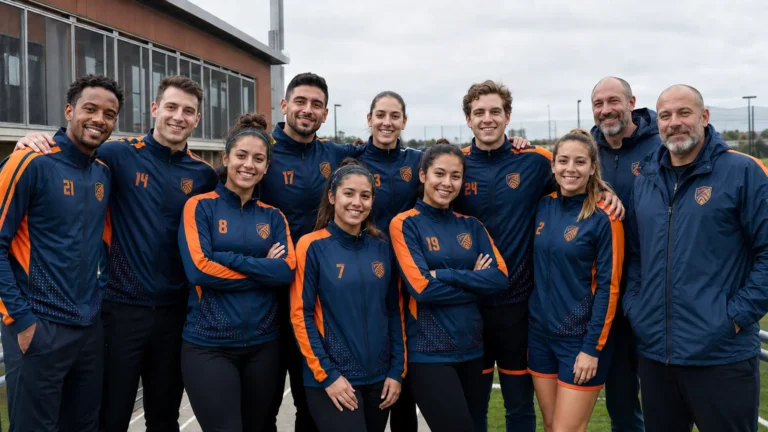
Custom team warm-up jackets do more than keep athletes comfortable before a game. They create a consistent visual identity at practice, during travel, on the sideline, at school events, and in team photographs. For schools, sports clubs, academies, distributors, and private-label brands, however, choosing the right jacket is not simply a matter of selecting a color and adding a logo. The product must work across different bodies, climates, activities, decoration methods, budgets, and reorder cycles.
The best custom team warm-up jackets are therefore not one universal style. They are the jackets whose specifications fit the team’s real use case and can be reproduced consistently in bulk. A track team that trains in light rain needs a different shell from a basketball program that wants a soft indoor layer. A uniform dealer may prioritize stable sizing and repeat-order color matching, while a sportswear brand may need custom patterns, private labels, and retail packaging.
This guide explains how buyers can compare jacket types, materials, fit, customization, quality control, and cost—and what to send a supplier for an accurate quotation.
Quick Answer: What Makes a Team Warm-Up Jacket “Best”?
The best custom team warm-up jacket is a comfortable, movement-friendly layer with a fabric weight and weather profile suited to its use, durable zippers and seams, a consistent size system, and logo decoration compatible with the material. For most multi-sport programs, a full-zip polyester woven or stretch-knit jacket with practical pockets, a stand collar, moderate room for layering, and embroidery or heat-transfer branding is a versatile starting point. Buyers should approve a physical sample, confirm measurement tolerances, test the decorated garment after care, and document colors, trims, labels, packaging, and reorder requirements before bulk production.
Why the Purchasing Decision Matters
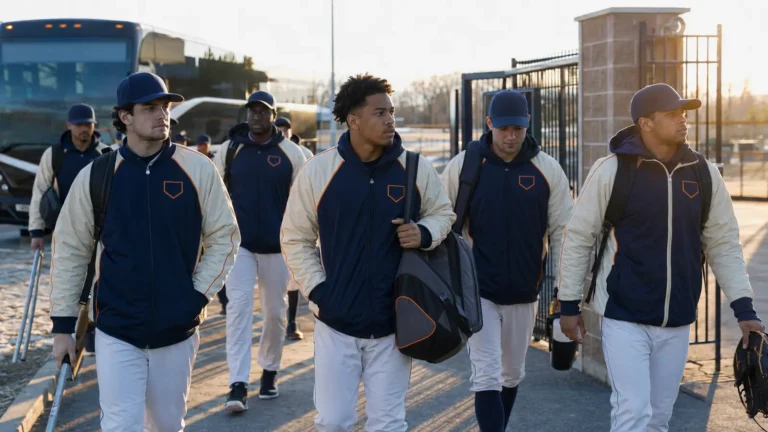
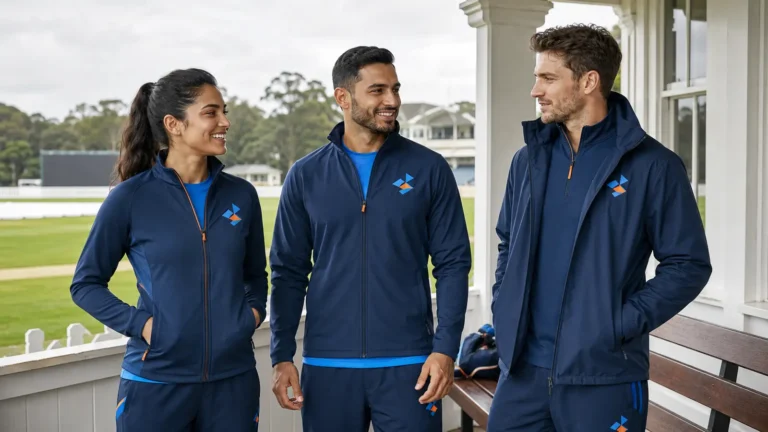
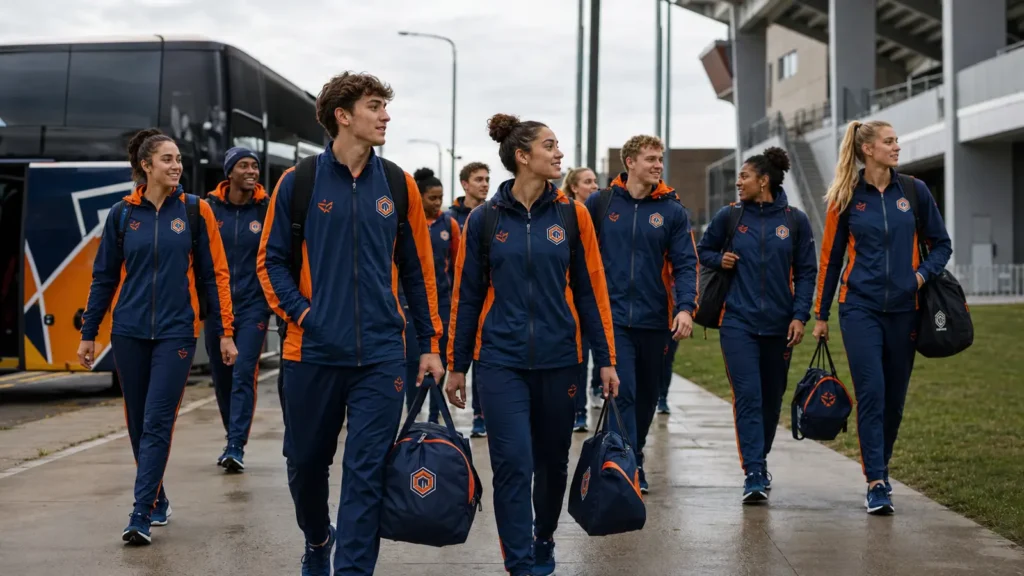
A warm-up jacket may be worn more often than the competition uniform. Athletes use it while arriving at a venue, warming up, waiting between events, traveling, attending school, and representing a club in public. This frequent use exposes weak specifications quickly.
An unsuitable fabric can feel clammy during movement or too light in cold conditions. Restricted armholes can limit motion, weak pocket openings can stretch, and inconsistent logo placement or dye lots can make a team package look uncoordinated. A well-documented program also simplifies roster collection, personalization, replacements, and future reorders.
The goal is not to maximize every specification. It is to define the right performance level, appearance, and service life for the intended program—and to make those requirements measurable.
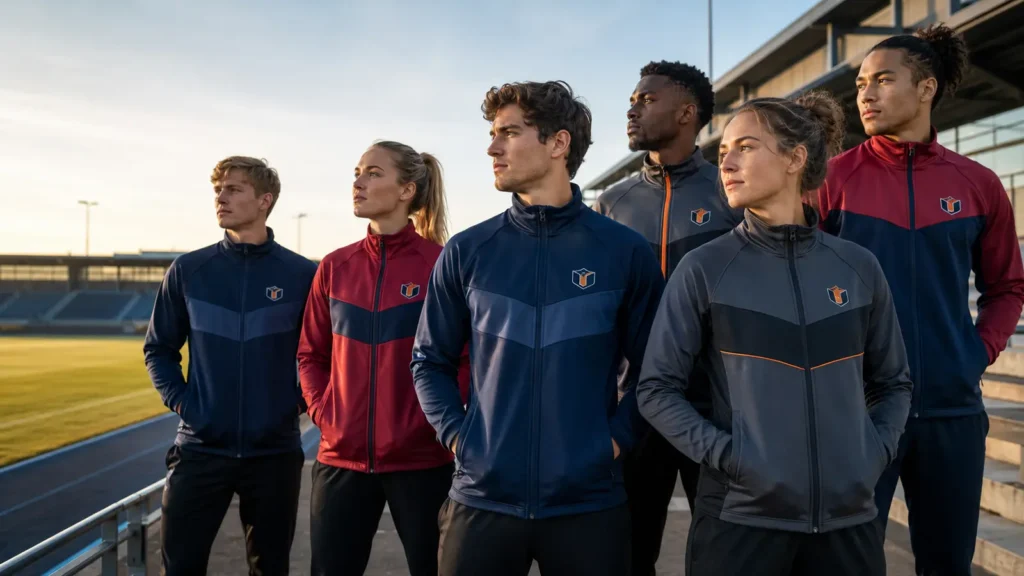
Custom Team Warm-Up Jacket Types Compared
The first decision is the jacket category. “Warm-up jacket” can describe several constructions that look similar online but behave differently in use.
| Jacket type | Typical material | Best use | Main strengths | Buyer watch-outs |
|---|---|---|---|---|
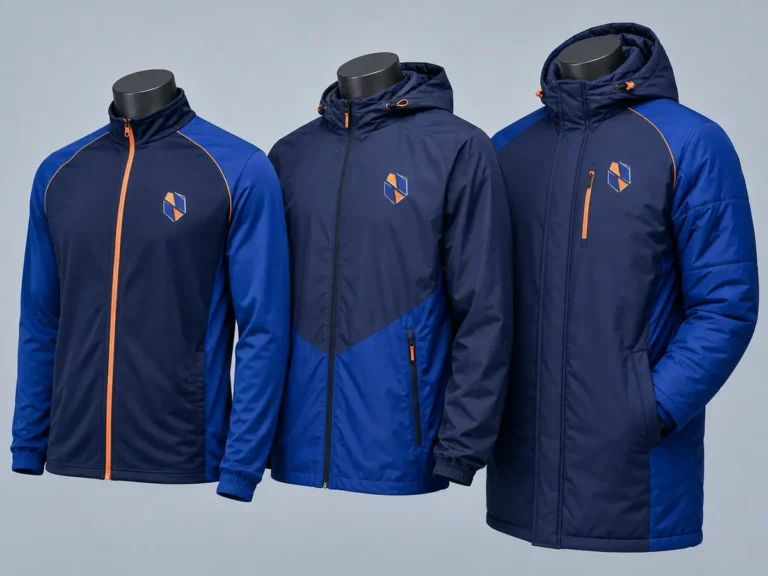
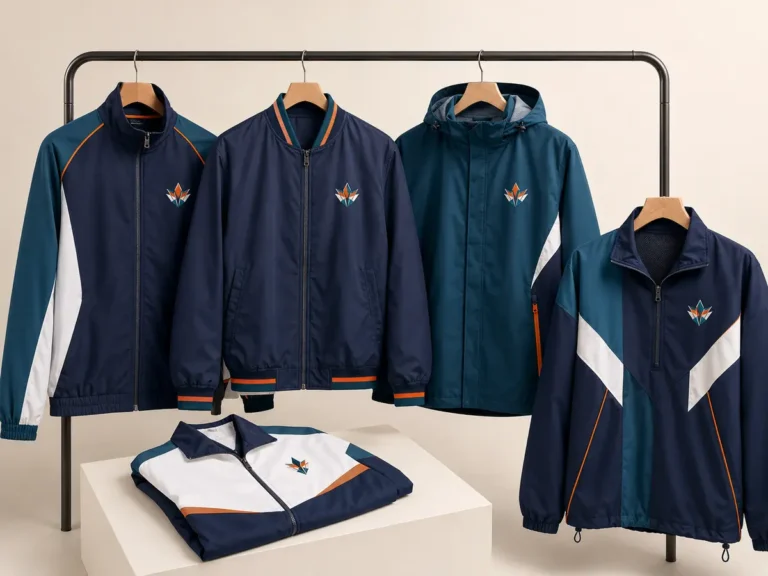
| Woven track jacket | Lightweight polyester woven, often with mesh or tricot lining | Outdoor warm-ups, travel, school teams, multi-sport programs | Light, packable, color-blocking friendly, traditional team look | Low-stretch shells need sufficient ease; clarify water-resistance claims |
| Stretch-knit training jacket | Polyester interlock or polyester-elastane knit | Indoor sports, active warm-ups, coaches, training academies | Soft hand, good mobility, clean athletic fit | Can snag or pill if the fabric is too light or surface is unsuitable |
| Softshell sideline jacket | Woven face with stretch and soft inner layer | Cool-weather sidelines, coaches, staff, outdoor clubs | Structured appearance, wind protection, warmth | Heavier, higher cost, and less packable; embroidery needs backing control |
| Lightweight hooded shell | Thin woven shell with hood | Outdoor practice, travel, event merchandise | Casual appeal, weather coverage, broad off-field use | Hood rules may vary by school or activity; loose cords require careful design |
| Insulated warm-up jacket | Quilted or padded construction | Cold-weather teams, winter travel, substitutes on sideline | Higher warmth and strong perceived value | More complex sizing, decoration, packing volume, and freight cost |
| Varsity-inspired warm-up jacket | Knit or woven body with rib collar, cuff, and hem | School spirit, clubs, merchandise, presentation wear | Strong identity and lifestyle appeal | Less suitable for high-output exercise; trim color consistency matters |
Match the Category to the Activity
A woven full-zip style is a versatile team choice, but low-stretch shells need enough ease across the back, shoulders, and elbows. Stretch-knit jackets suit active indoor warm-ups and closer fits, while softshell or insulated styles prioritize cold-weather sideline comfort. Test the sample during real movement and over the intended underlayer. If a verified weather or thermal claim is required, agree on the test method and pass requirement before production.
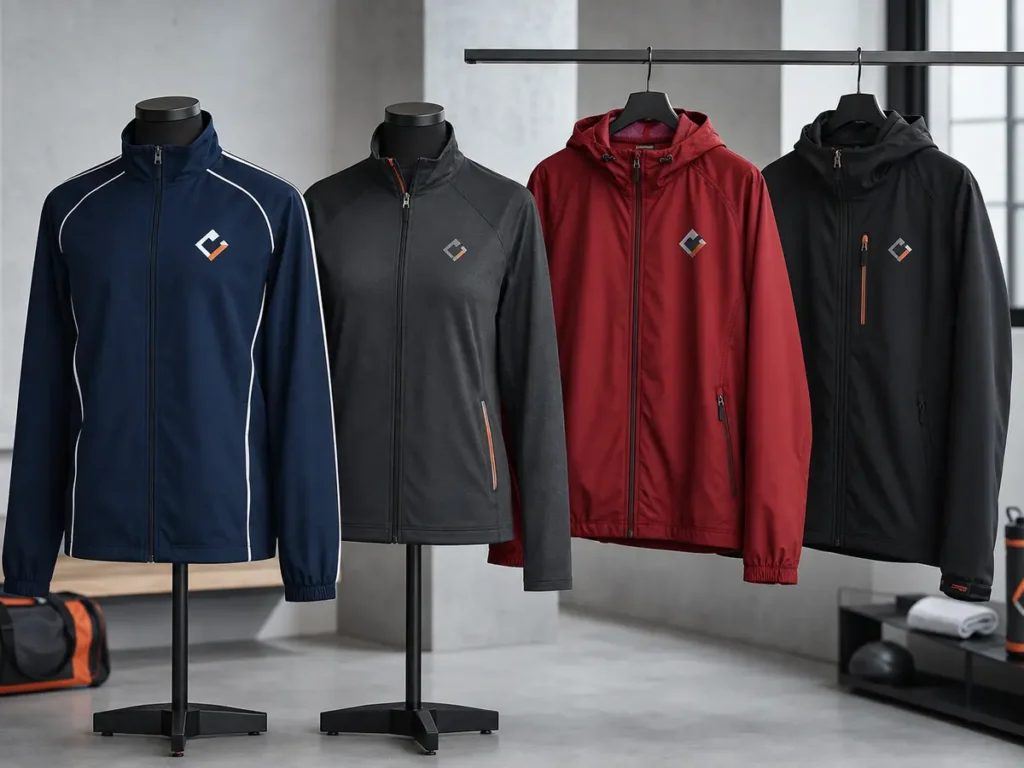
How to Choose the Right Material
Material choice controls hand feel, mobility, warmth, appearance, decoration compatibility, and cost. A useful specification describes the fabric construction and composition—not only a marketing term such as “performance polyester.”
| Material option | Feel and behavior | Suitable applications | Decoration considerations |
|---|---|---|---|
| Lightweight polyester woven | Crisp, light, low stretch, packable | Traditional track jackets, outdoor travel layers | Embroidery may need backing; heat settings must suit the finish |
| Polyester interlock | Smooth, soft, moderate structure, knit movement | Indoor warm-ups, training jackets, retail teamwear | Good surface for transfer or embroidery; test snag resistance |
| Polyester-elastane knit | Flexible, close-fitting, movement oriented | Performance training and tapered silhouettes | Heat application must not distort stretch; logo should move with fabric |
| Brushed tricot | Soft inner face, added warmth | Lined shells and cooler-weather warm-ups | Usually used as lining; confirm colorfastness and bulk |
| Mesh lining | Breathable separation layer | Woven shells for active use | Secure lining at armholes, zipper, and hem to prevent twisting |
| Softshell | Structured woven face with flexible inner layer | Sideline, coach, staff, outdoor work and events | Needle marks can be visible; embroidery density should be controlled |
| Quilted or padded system | Warm, bulky, low-to-moderate stretch | Winter travel and cold sidelines | Decoration may require patches, controlled embroidery, or special access |
Fabric Weight Is Only One Part of the Specification
GSM can help compare fabrics within the same construction, but it does not predict full jacket performance. Review a physical swatch or sample and evaluate:
- surface texture and sheen;
- stretch and recovery;
- lining, breathability expectations, and total garment bulk;
- snagging, pilling, and abrasion risk for the intended use;
- color appearance under indoor and outdoor light;
- shrinkage or dimensional change after the intended care process;
- compatibility with embroidery, heat transfer, screen printing, or patches.
Light rain resistance does not automatically make a shell waterproof. If the program needs a measurable weather claim, define the test method, pass requirement, and limitations; otherwise describe the jacket conservatively as a light weather layer.
Recycled and Tested Materials Require Document Review
If recycled content or chemical testing is part of the buying requirement, write the exact evidence into the purchase specification. Textile Exchange describes the Global Recycled Standard as a third-party certification framework for recycled materials and chain of custody, with additional processing requirements; a generic “recycled polyester” statement is not the same as a verified GRS claim. Likewise, OEKO-TEX describes STANDARD 100 as a label for textiles tested for harmful substances. Buyers should verify the scope, article or certificate number, validity, and whether the exact fabric, trims, and finished product are covered before making a public claim. See the official Textile Exchange RCS/GRS overview and OEKO-TEX STANDARD 100 page for current definitions.
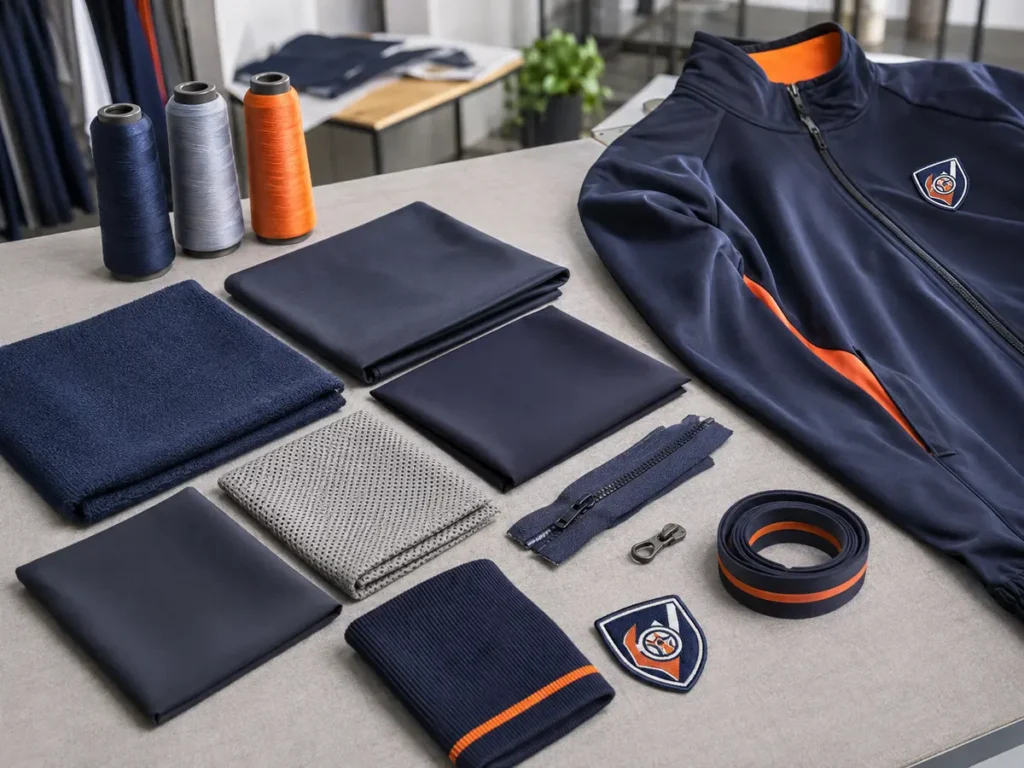
Need a Material and Style Recommendation?
Send JIUMU your team type, target quantity, climate, budget level, preferred jacket reference, colors, logo files, and delivery date. We can use that brief to discuss an appropriate fabric, construction, decoration method, and sampling route.
Fit, Sizing, and Roster Planning
Team orders are difficult because one style must fit many body shapes, ages, and layering preferences. “True to size” is not a useful production standard. The buyer and supplier need an actual garment measurement chart with defined measurement points.
Start With the Intended Fit
Choose one of three fit directions and state it in the brief:
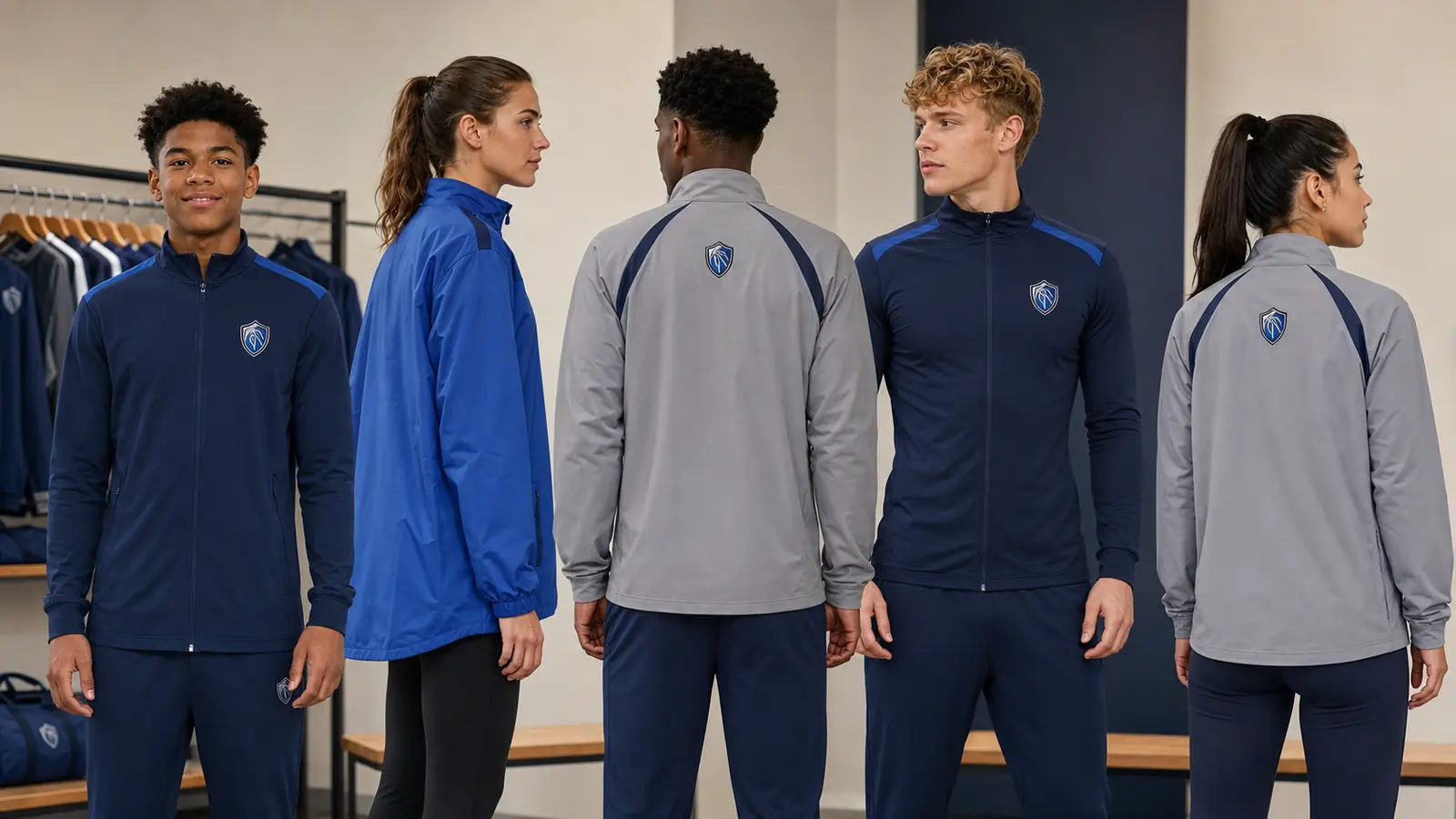
- Performance fit: closer to the body with tapered torso and sleeves. Best for active training but less forgiving over uniforms.
- Regular athletic fit: moderate ease through chest, waist, and armhole. Usually the most versatile team option.
- Relaxed layering fit: more room for jerseys, hoodies, or cold-weather base layers. Useful for sideline and travel programs.
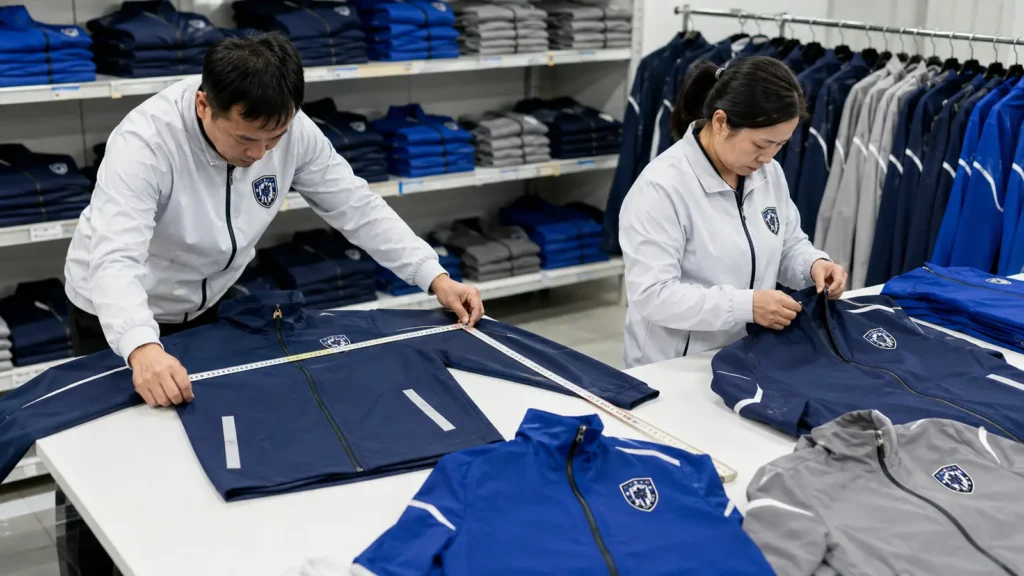
The same nominal size can differ substantially among suppliers. Ask for chest width, body length, sleeve length, shoulder or raglan measurement, hem width, cuff opening, and relevant grading increments. Confirm whether measurements are garment dimensions or recommended body dimensions.
Build a Size Approval Process
For a mixed roster, a practical process is:
- review the supplier’s base measurement chart;
- compare it with a currently successful team garment;
- order or approve representative sizes, not only one medium sample;
- run a fitting session with the actual underlayer athletes will wear;
- record each person’s selected size rather than guessing from height alone;
- add clearly separated spare quantities for late additions and replacements;
- lock the approved measurement chart and tolerance with the purchase order.
Youth and adult patterns are not always simple scaled versions. Collar height, sleeve proportion, pocket position, body length, and decoration size may need separate rules, while colors and logos should remain visually coordinated.
Personalization Adds Roster Risk
Player names, initials, numbers, roles, and graduation years can make a jacket valuable to athletes, but every unique field creates an error opportunity. Supply roster data in a structured spreadsheet with one row per garment and separate columns for size, color, name, number, and placement. Preserve leading zeros, confirm capitalization, and mark blank fields explicitly. The supplier should return a personalization proof or production list for approval.
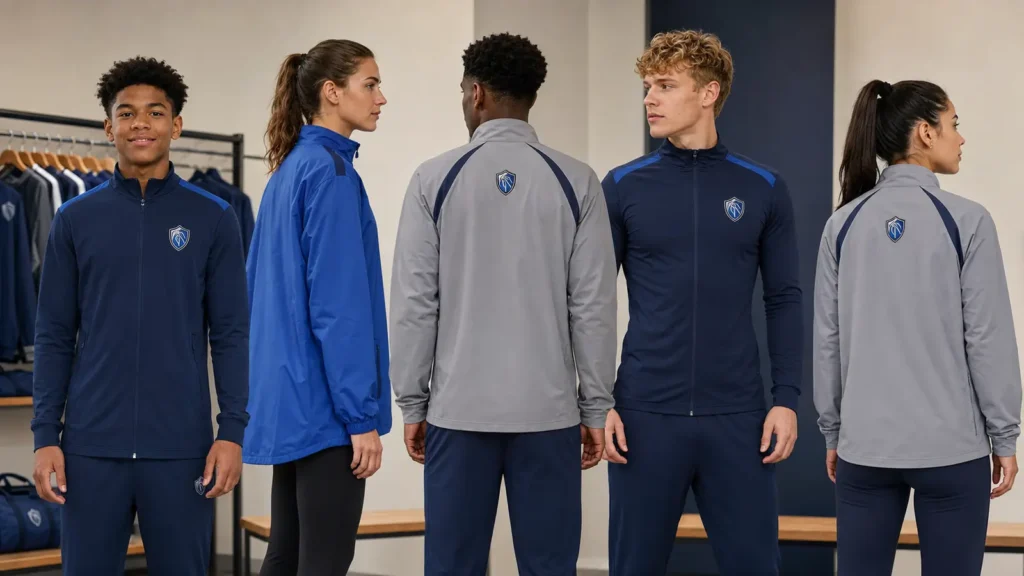
Construction Details That Affect Durability
Buyers often compare shell fabrics and logos while overlooking the small components that receive the most daily stress.
Zippers
The main zipper should run smoothly, align at the collar and hem, and remain flat when closed. Specify coil or molded construction, zipper color, puller type, and whether a custom pull is required. On lightweight shells, zipper tape and front-edge construction should not cause excessive waviness. A chin guard or zipper garage may improve comfort at the top of a stand collar.
Pockets
Decide whether pockets are open, zippered, or secured another way. Zippered pockets are useful for phones, keys, and travel, but add cost and potential failure points. Reinforce pocket openings and check that pocket bags are deep enough without hanging below the hem. If the jacket is reversible or fully lined, pocket construction becomes more complex.
Seams and Stress Points
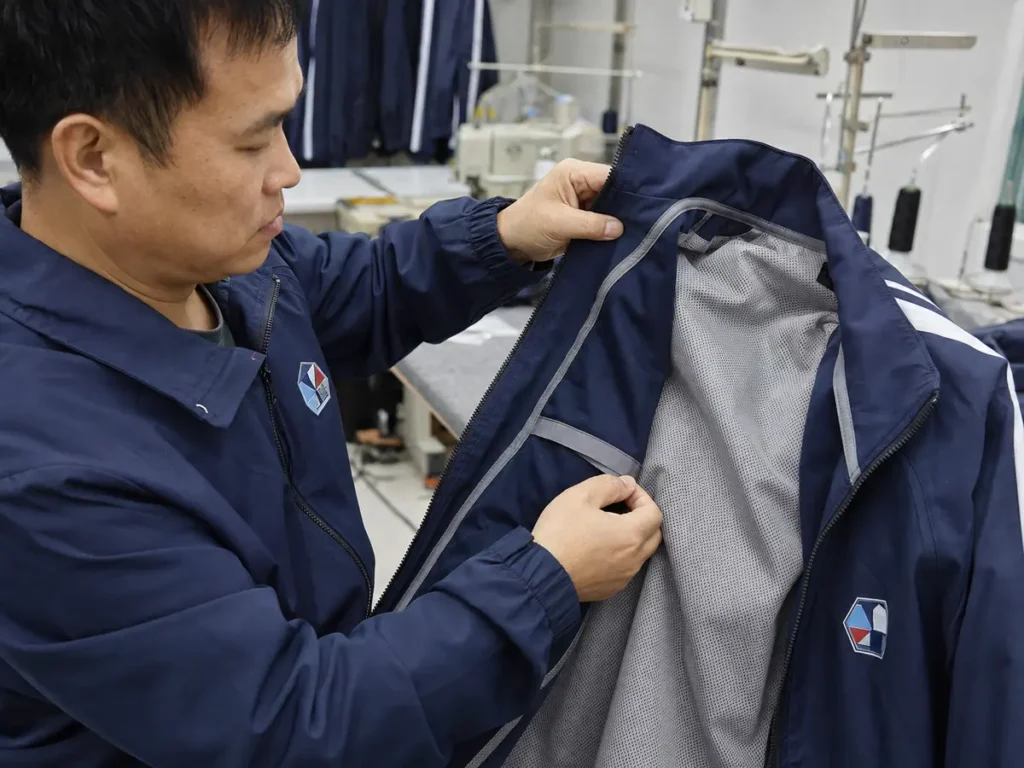
Inspect underarms, sleeve joins, pocket corners, hem transitions, and collar ends. The correct seam type depends on the material, but stitches should be balanced, free from skipped sections, and protected from abrasion where necessary. Bar tacks or reinforcement may be appropriate at high-stress points. Internal seams and lining attachments should not twist or catch during dressing.
Cuffs and Hems
Elastic cuffs are practical and economical, rib cuffs create a classic team look, and adjustable tabs give more control but add components. A hem can use elastic, rib, drawcord, or a clean straight finish. For youth products or school programs, avoid unnecessary loose cords. Construction choices should match the sport and the buyer’s safety requirements.
Collar and Hood Design
A stand collar should hold its shape without becoming uncomfortable during movement. A hood adds casual value and weather coverage but can be inconvenient under equipment or restricted in some settings. Detachable hoods add flexibility but also snaps, zippers, or storage details that must be inspected.
Logo, Color, and Private-Label Options
Customization should be designed as a system. The jacket body, pants, jerseys, hats, and bags may use different materials, so one application method will not always produce identical results. The goal is coordinated appearance, not mechanically identical production.
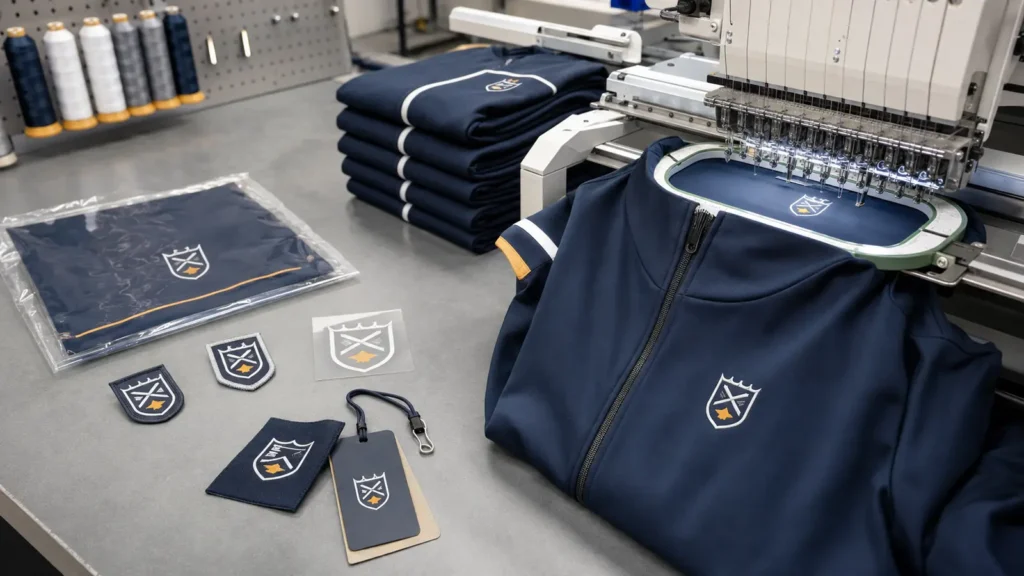
Embroidery
Embroidery creates a durable, dimensional team mark and works well on chest, sleeve, and staff jacket placements. The design must be digitized for the actual size and fabric. Very small text, thin outlines, and dense fill areas may lose clarity or distort a light shell. Backing, hoop pressure, needle choice, and stitch density should be tested on the selected fabric.
Heat Transfer
Heat-transfer decoration supports names, numbers, sponsor marks, gradients, and detailed multicolor artwork. The adhesive, temperature, pressure, and dwell time must suit the fabric and any surface finish. Stretch garments need a transfer system that can move without cracking or edge lift. Approve the result after care testing, not only immediately after application.
Woven, Embroidered, Rubber, and Leather-Style Patches
Patches are useful for complex crests, lifestyle designs, and private-label collections. Woven patches can reproduce fine flat detail; embroidered patches create texture; rubber-style patches give a modern technical look; leather-style patches suit casual or heritage directions. The attachment method and edge construction should be confirmed, especially on waterproof or coated fabrics where needle holes may matter.
Private Labels and Packaging
For distributors and brands, the brief may include neck and size labels, care labels, zipper pulls, hangtags, barcode stickers, individual bags, carton marks, and assortment packing. Define ownership of every item early because packaging can affect freight volume and warehouse handling.
Labeling and Market Requirements
Compliance responsibilities depend on the destination, product construction, buyer role, and sales channel. This guide is not legal advice, but professional buyers should include market-specific label review in the development schedule.
In the United States, FTC guidance states that most textile products need labels identifying fiber content, country of origin, and the manufacturer or another responsible business, while the Care Labeling Rule requires care instructions for covered clothing. Buyers can review the FTC’s official textile labeling guide and Care Labeling Rule guidance.
For products marketed in the European Union, the EU textile-label guidance explains that qualifying textile products must show fiber composition and that the label should be clearly legible and firmly attached; local-language and other market obligations may also apply. Review the EU textile label requirements for the destination market.
Canada’s Competition Bureau provides separate guidance under the Textile Labelling Act and related regulations. Its textile labelling requirements are a useful starting point for Canadian programs.
Before bulk production, confirm fiber wording, origin, responsible-party identification, care instructions, language, tracking information, packaging warnings, and any sport-, school-, or age-specific requirements with qualified support. Do not reuse an old label unless the composition, construction, destination, and business information still match.
What Drives the Cost of Custom Team Warm-Up Jackets?
A reliable quotation should be based on a defined specification. Unit price alone does not show whether two suppliers are quoting the same garment.
| Cost driver | Why it changes price | How the buyer can control it |
|---|---|---|
| Fabric and lining | Weight, construction, finish, color development, and minimum fabric quantities differ | Choose performance requirements first; compare like-for-like materials |
| Pattern complexity | More panels, hoods, vents, pockets, and adjustable parts require more labor and trims | Keep only features that serve the use case |
| Decoration | Stitch count, print colors, transfer size, patches, and multiple placements add setup and application time | Simplify small details and standardize placements |
| Personalization | Unique names and numbers require data handling and one-by-one production control | Supply a clean roster and lock it before production |
| Quantity and size mix | Small runs spread development and setup costs across fewer units | Consolidate programs where practical; confirm oversize surcharges |
| Custom-dyed colors | Special colors may require material minimums and additional approval | Use available colors when exact matching is not essential |
| Labels and packaging | Private labels, hangtags, barcodes, individual bags, and assortment packing add materials and labor | Define retail requirements before quotation |
| Testing and inspection | Third-party tests, special performance checks, or independent inspections add direct costs | Request only relevant tests and define pass criteria |
| Freight and delivery | Weight, carton volume, shipping mode, destination, duties, and timing affect landed cost | Plan earlier and compare total landed cost, not ex-factory price only |
Ask suppliers to state what is included: sample charges, artwork or digitizing, labels, individual packing, export cartons, testing, freight, duties, and taxes. Also ask how long the quotation remains valid and what can change after sample approval.
Sample Approval and Quality Control
The sample is not merely a sales demonstration. It is the physical reference that converts the written brief into an approved product.
What to Approve on the Sample
- overall silhouette and layering room;
- garment measurements and grade logic;
- shell, lining, rib, elastic, zipper, and thread;
- team colors under consistent light;
- logo size, color, position, and technique;
- collar comfort, cuff opening, hem tension, and pocket access;
- zipper alignment and operation;
- interior seam finish and lining attachment;
- labels, care content, hangtags, and packaging;
- appearance and dimensions after the agreed care test.
Record comments with annotated photographs and a numbered revision list. Avoid vague feedback such as “make it better” or “blue is wrong.” State the approved color reference, target measurement, placement distance, or construction change.
Bulk Inspection Checklist
During production and final inspection, check a representative quantity across colors and sizes. The sampling plan should be agreed with the buyer’s quality team or inspection provider. At minimum, review:
- quantity and assortment against the purchase order;
- size measurements against the approved chart and tolerance;
- fabric, color, hand feel, and lining against the approved sample;
- logo artwork, spelling, color, placement, and attachment;
- main and pocket zipper operation;
- seams, skipped stitches, loose threads, puckering, and reinforcement;
- stains, needle damage, press marks, and surface defects;
- personalization against the approved roster;
- label content and position;
- folding, individual packaging, size stickers, carton assortment, and shipping marks.
If repeat-order consistency is important, retain an approved sample, approved color references, material codes, artwork files, and measurement specifications. Even then, materials and dye lots can change over time, so repeat orders should be reconfirmed rather than assumed identical.
A Practical Bulk-Order Process
1. Define the Program
State the buyer, sport, season, market, use, quantity, price level, and delivery date.
2. Send Product References and Artwork
Provide references, fit, fabric direction, color standards, vector logos, decoration positions, and matching items. Identify which reference details must be used, changed, or excluded.
3. Confirm the Quotation Scope
Confirm material, lining, trims, decoration, labels, packaging, quantity, size range, sample route, trade terms, and freight scope.
4. Approve Artwork and Sample
Use a mockup for visual placement and a physical sample for material, fit, color, and workmanship. Record approvals in one final document.
5. Lock Roster and Purchase Order
Reconcile quantities by style, color, and size; freeze personalized data; and add planned spare units.
6. Monitor Production and Inspect
Agree on update and inspection points, then resolve deviations before shipping where possible.
7. Plan Reorders
Store the approved specification, sample record, artwork, colors, size chart, and style code for the next order.
Information to Send for an Accurate Quotation
Use this checklist in the first inquiry:
- buyer organization and destination country;
- sport, team type, and use scenario;
- estimated quantity by style;
- youth, adult, women’s, or unisex size range;
- target jacket type and preferred fit;
- shell, lining, warmth, stretch, and weather expectations;
- colors with Pantone or other physical references where required;
- vector logo files and decoration method preferences;
- logo locations, approximate dimensions, and personalization fields;
- label, hangtag, barcode, packaging, and carton requirements;
- applicable test, compliance, or documentation needs;
- target delivery date and preferred shipping terms;
- reference images or an existing garment for comparison;
- target budget or quality tier, if available.
This information helps a supplier recommend realistic options instead of quoting an unspecified “standard jacket.”
Questions to Ask a Custom Jacket Supplier
- What exact shell and lining constructions are included in the quote?
- Can you provide fabric swatches and a complete garment measurement chart?
- Which logo method is most appropriate for this fabric and artwork, and why?
- How will youth, adult, women’s, or unisex styles remain visually coordinated?
- What sample stages are available, and which details can still change after each stage?
- What are the measurement and placement tolerances?
- How are bulk colors compared with the approved sample?
- How will personalized roster data be proofed and controlled?
- Which tests or documents can be supplied for the exact product?
- What is included in the price, how are defects handled, and what is retained for reorders?
Common Buying Mistakes
Using an Ambiguous Fabric Description
“Polyester jacket” is too broad. Specify woven or knit construction, composition, weight or approved swatch, finish, stretch expectation, and lining. If weather performance matters, define the claim and test requirement.
Placing Dense Embroidery on a Light Shell
Large, dense embroidery can cause puckering, stiffness, or discomfort. Adapt the artwork, use suitable backing, reduce density, or choose another application method after testing.
Changing Roster Data After Approval
Late personalization changes can affect material allocation, production sequence, and delivery. Set a roster freeze date and use a formal change log for exceptions.
Making Unsupported Sustainability or Performance Claims
Do not publish claims based only on a generic supplier statement. Confirm the exact certified scope, test report, material transaction documentation, or performance standard relevant to the finished item and destination.
Why Work With JIUMU on Custom Team Warm-Up Jackets?
JIUMU supports B2B buyers developing coordinated teamwear and logo apparel for the United States, Canada, the United Kingdom, and Europe. Established in 2010 and based in Guangdong, China, JIUMU works with schools, sports teams, clubs, academies, distributors, uniform dealers, promotional companies, and private-label brands.
Relevant capabilities include OEM and ODM development, fabric sourcing, Pantone color matching, embroidery, sublimation, screen printing, heat transfer, woven and rubber-style patches, private labels, hangtags, customized packaging, digital mockups, physical samples, bulk production support, quality control, and export coordination. The typical MOQ is 50 pieces, subject to the product structure and customization.
Buyers can coordinate jackets with custom team uniforms, custom team jerseys, custom baseball caps, custom team bags, and other custom team jackets.
Frequently Asked Questions
Final Recommendation
The best custom team warm-up jacket is the one that fits the program’s activity, climate, roster, visual identity, and reorder plan. Start with use conditions, then select the jacket category and material. Confirm fit through measurements and real movement. Match the logo method to the fabric. Document construction, labels, packaging, and quality tolerances. Finally, approve a physical sample and use it as the reference for bulk inspection.
This specification-first approach produces a more dependable result than selecting a jacket from appearance or unit price alone. It also gives the supplier enough information to offer meaningful alternatives when performance, budget, and schedule need to be balanced.
About JIUMU
JIUMU is a Guangdong-based B2B custom teamwear and logo apparel supplier established in 2010. Capabilities include OEM/ODM development, fabric sourcing, multiple logo methods, private labels, packaging, sampling, quality control and export support.