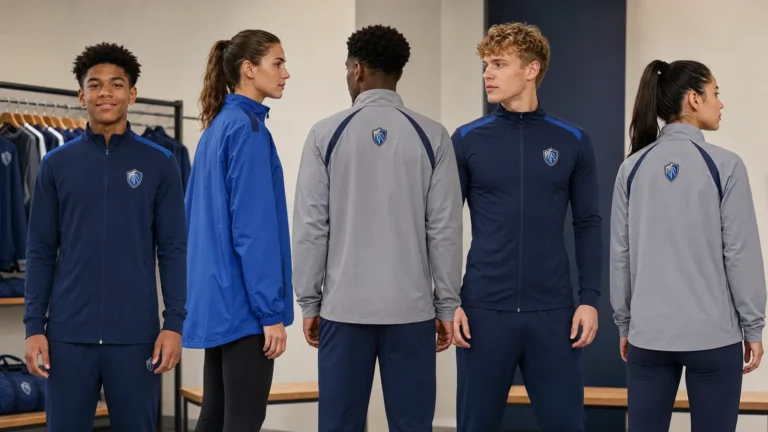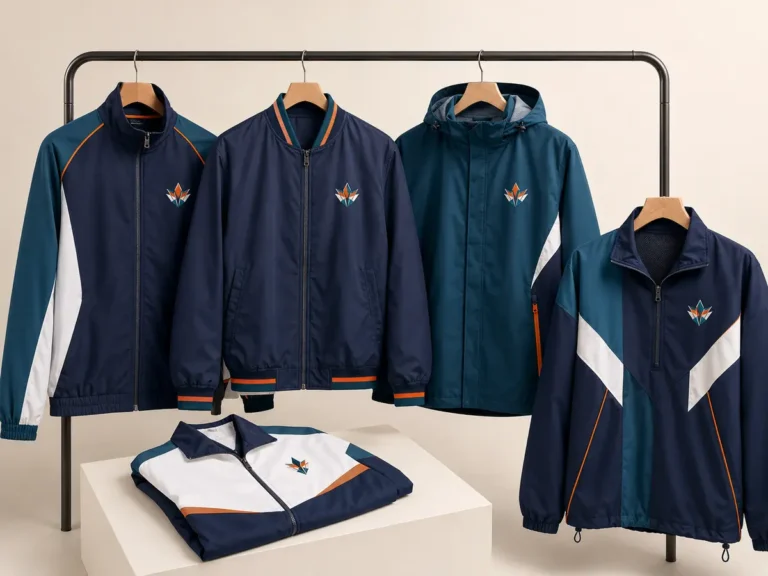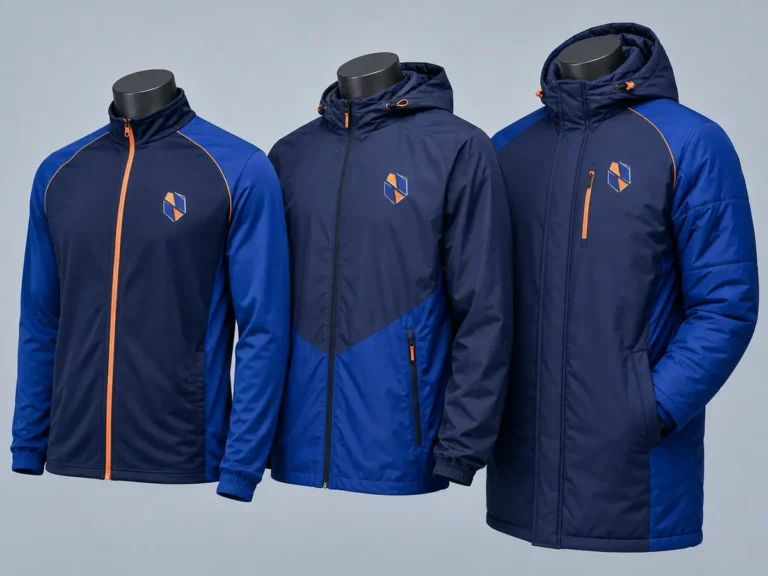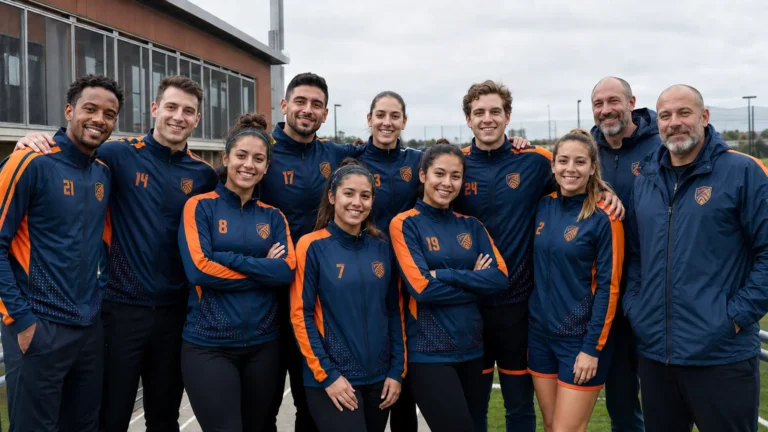
How to Buy Custom Baseball Team Jackets
Buying custom baseball team jackets is not simply a matter of choosing a color and placing a logo on the chest. A team jacket has to work before games, during travel, in the dugout, at school and in public. It must fit players who may wear it over a jersey or hoodie, reproduce the same colors across a size range, hold decoration securely and arrive in a form that is easy to distribute.
For a coach ordering one roster, the main risks are incorrect sizing and a missed event date. For a school, club, distributor or private-label buyer, the risks also include inconsistent repeat orders, incomplete labeling, artwork errors, uncontrolled substitutions and packaging that does not match the distribution plan. The best purchasing process turns the design into a written specification before bulk production begins.
This guide explains how to compare jacket types, fabrics, construction, fit, logo methods, cost drivers, samples and suppliers. It is written for North American and European professional buyers sourcing custom baseball team jackets in bulk.
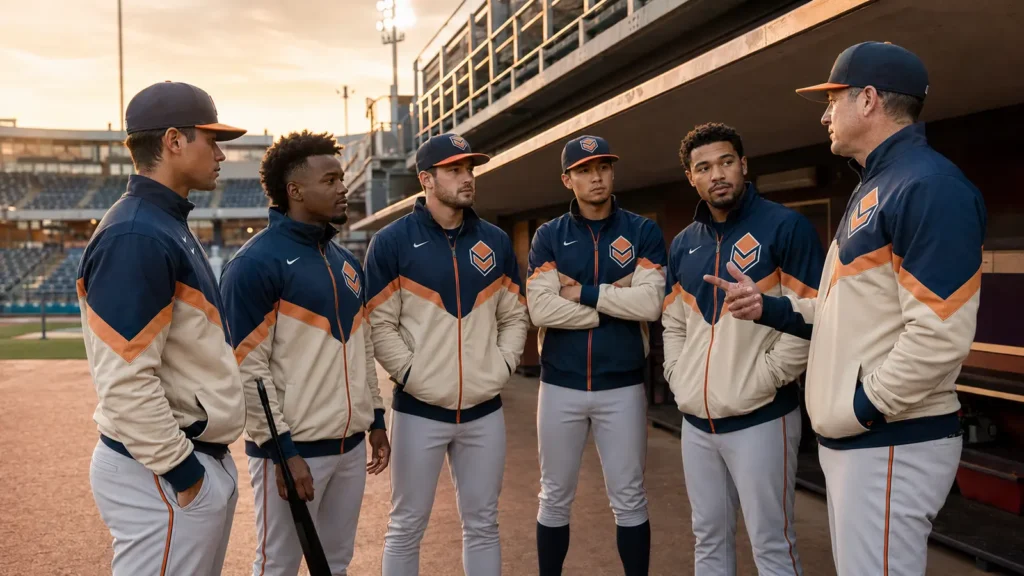
Quick Answer: How Should You Buy Custom Baseball Team Jackets?
Start with the use case, not the decoration. Decide whether the jacket is for warm-ups, cool-weather sidelines, travel, school wear or retail merchandise. Then specify the silhouette, shell and lining materials, target garment measurements, size distribution, team colors, logo method, individual names or numbers, label set, packaging and required delivery date.
Approve a physical sample in the correct fabric and colors before bulk production. Check fit over the intended base layer, zipper operation, pocket position, seam quality, logo size and placement, color matching and care instructions. For a mixed youth and adult order, use separate size charts and request a size set when the order value or roster complexity justifies it. Keep the signed sample, approved artwork and measurement table as the control standard for production and future reorders.
Why the Jacket Buying Decision Matters
Baseball jerseys have a relatively defined game-day role. Jackets have more varied jobs. One team may need a light woven layer for batting practice. Another may need a lined jacket for early-season tournaments. A school may expect students to wear the same item throughout the week, while a retailer may prioritize a fashionable silhouette and private labels.
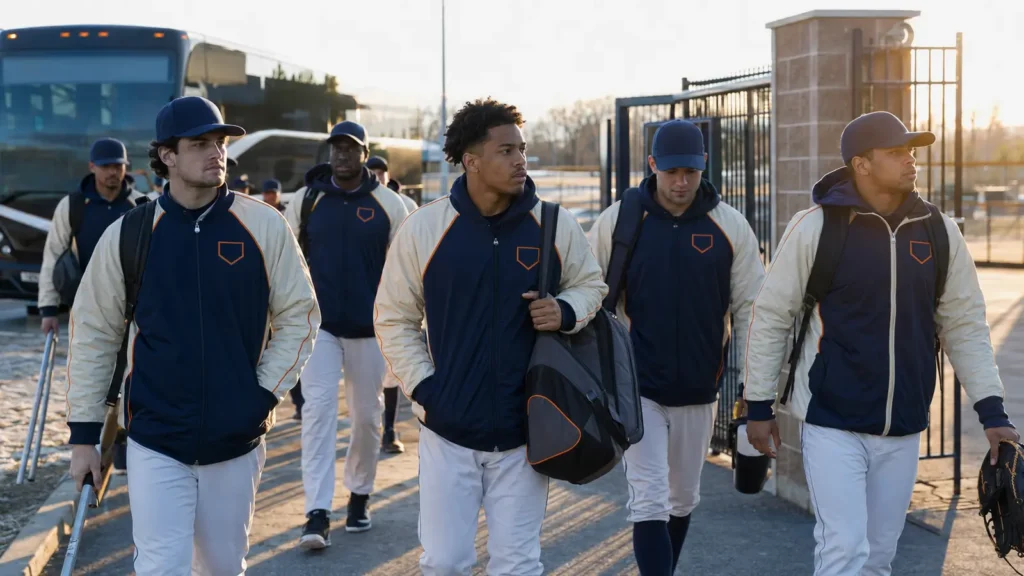
These uses require different specifications. An unlined shell may suit warm-ups but disappoint as cold-weather outerwear, while a fashion-oriented varsity jacket may restrict movement if its pattern is not tested for athletic use. The goal is to select the right architecture for the team, climate, budget, roster and sales channel.
Custom Baseball Team Jacket Decision Overview
| Buying question | What to decide | Why it affects the order |
|---|---|---|
| Primary use | Warm-up, sideline, travel, school, merchandise or multi-use | Determines weight, lining, mobility, pockets and weather protection |
| Climate | Warm, transitional, cold, windy or light-rain conditions | Influences shell, insulation, lining and closure details |
| Fit | Athletic, regular, relaxed or fashion fit | Changes measurements, layering space and size distribution |
| Jacket type | Full-zip warm-up, woven shell, varsity-inspired, softshell or insulated | Sets the base construction and decoration options |
| Branding | Embroidery, patch, transfer, screen print, sublimated panel or appliqué | Affects appearance, minimum detail size, hand feel, lead time and price |
| Personalization | Names, player numbers, roles or sponsor marks | Requires an accurate roster and placement rules |
| Sales market | Team issue, school distribution, wholesale, retail or private label | Changes labeling, packaging and replenishment needs |
| Delivery target | Event date, season opening or retail launch | Determines when artwork, sample and roster must be locked |
1. Choose the Right Baseball Jacket Type
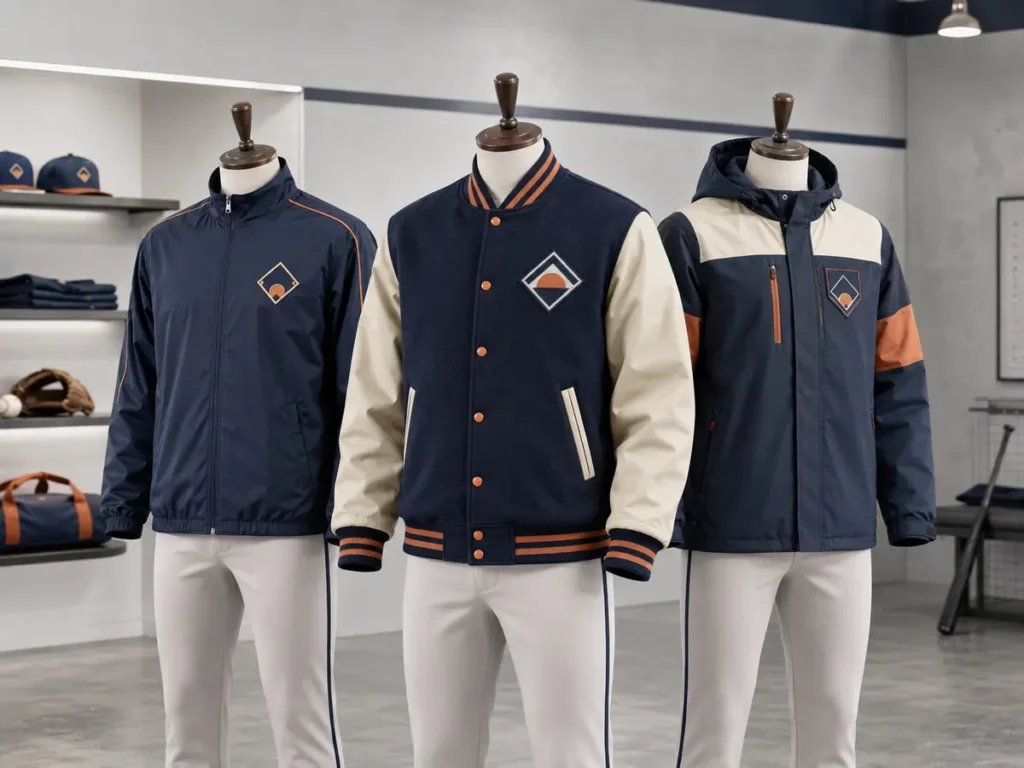
Use one approved name and a reference image for the silhouette. Terms such as “warm-up jacket,” “coach jacket,” “track jacket” and “stadium jacket” can describe different constructions in different markets. A written feature list prevents the supplier from interpreting the category differently.
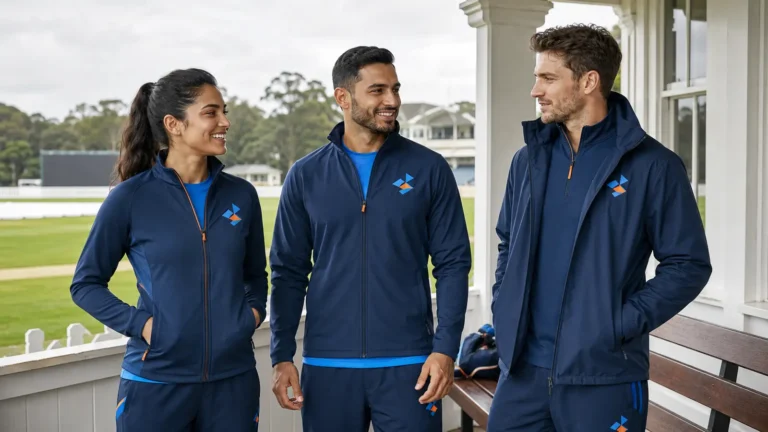
Lightweight full-zip warm-up jacket
This is a practical choice for pregame activity, travel and indoor-to-outdoor transitions. It commonly uses a knitted or light woven polyester body, a full zipper and zip or welt pockets. Buyers should check shoulder mobility, sleeve taper, cuff style and whether the inside is unlined, mesh lined or brushed.
Choose it when the team wants an athletic appearance and easy layering without heavy insulation. It also works well as part of a coordinated package with jerseys, pants, caps and bags.
Woven shell or coach-style jacket
A woven shell can block more wind than an open knit of similar weight, depending on its construction and finish. It can be unlined, mesh lined or lightly quilted. Snap-front coach styles create a classic look, while full-zip shells are usually easier to open during movement.
Do not treat “water-resistant” and “waterproof” as interchangeable. If protection from rain is commercially important, define the finish, seam construction and test method with the supplier. A generic material description is not evidence of a specific performance level.
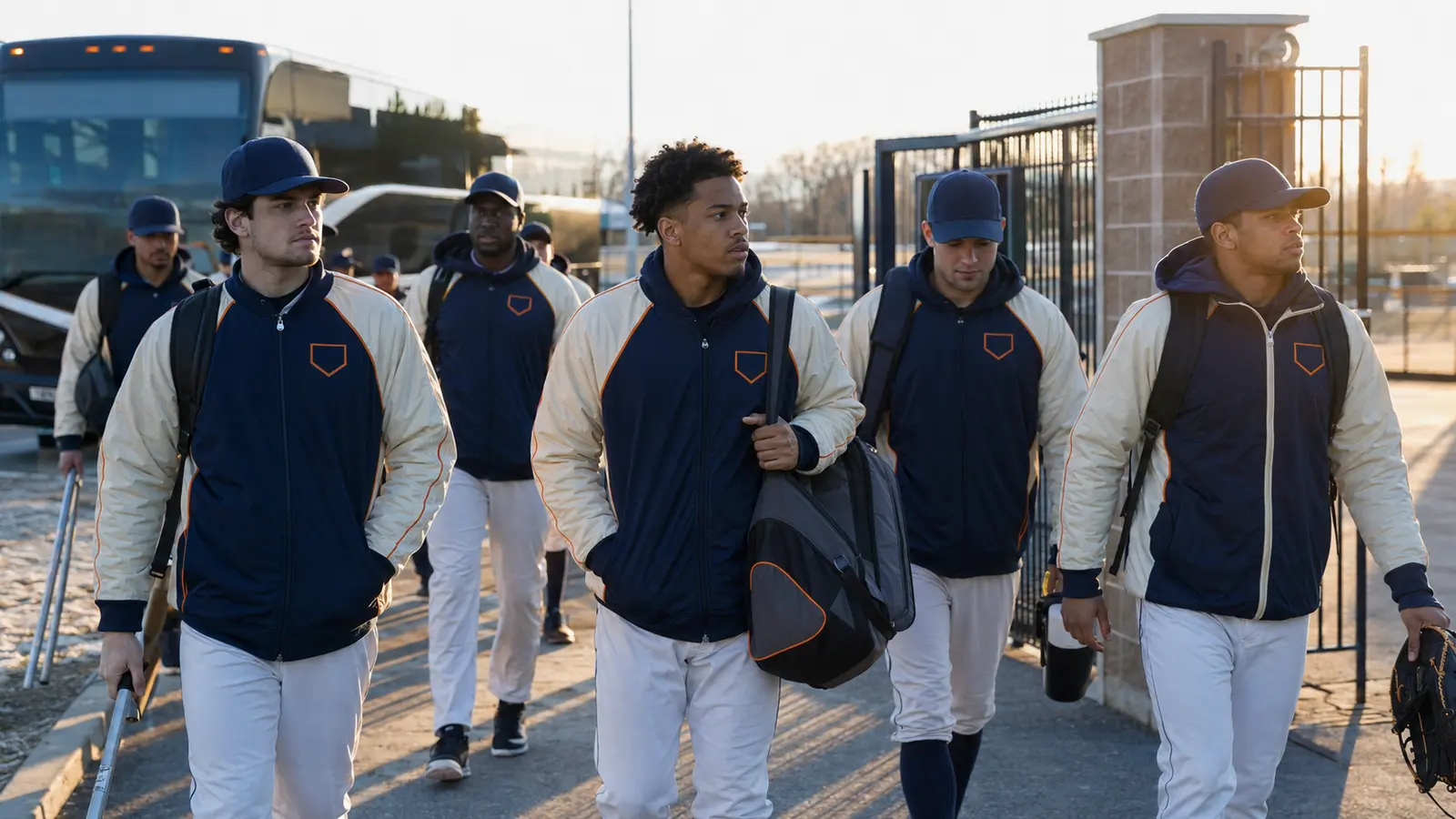
Varsity-inspired team jacket
Varsity styling uses a strong teamwear vocabulary: contrast sleeves, striped rib-knit cuffs and hem, snap closures, chenille or embroidered patches and a structured body. It is suitable for school programs, club merchandise and commemorative orders.
It can be heavier and less compact to ship. Inspect rib recovery, sleeve attachment, snap alignment and patch weight, and confirm shoulder mobility for active use.
Softshell or insulated sideline jacket
Softshell and insulated styles are better considered when players, coaches or staff spend long periods outdoors in cooler conditions. These products need more detailed specifications for shell, lining, insulation, collar, hood, pocket closure and hem adjustment.
If youth sizes include a hood or drawcord system for the U.S. market, product design needs a specific safety review. The U.S. Consumer Product Safety Commission identifies hood and neck drawstrings on children’s upper outerwear in sizes 2T–12 as a substantial product hazard and restricts certain waist and bottom drawstrings in sizes 2T–16. Buyers should confirm current requirements for their exact product and destination rather than copying an adult detail into a youth style.
2. Turn the Use Case Into a Product Specification
A useful request for quotation is more precise than “navy baseball jacket with logo.” Create a one-page specification sheet or tech pack that separates confirmed requirements from options the supplier may recommend.
At minimum, state:
- Jacket type and front closure
- Shell fabric composition, construction and target weight or approved reference
- Lining or insulation requirement
- Fit category and intended base layer
- Youth and adult size ranges
- Body, sleeve, collar, cuff, hem and piping colors
- Pocket type and closure
- Logo artwork, technique, size and placement
- Names, numbers and roster rules
- Main label, size label, care label and country-of-origin requirement
- Folding, individual packing, carton marks and assortment rules
- Order quantity by color and size
- Destination country and target delivery date
If an exact material is unknown, send a reference garment and explain what to retain or change. Record the selected fabric code and composition on the approved sample.
3. Compare Fabrics by Function, Not by Name Alone
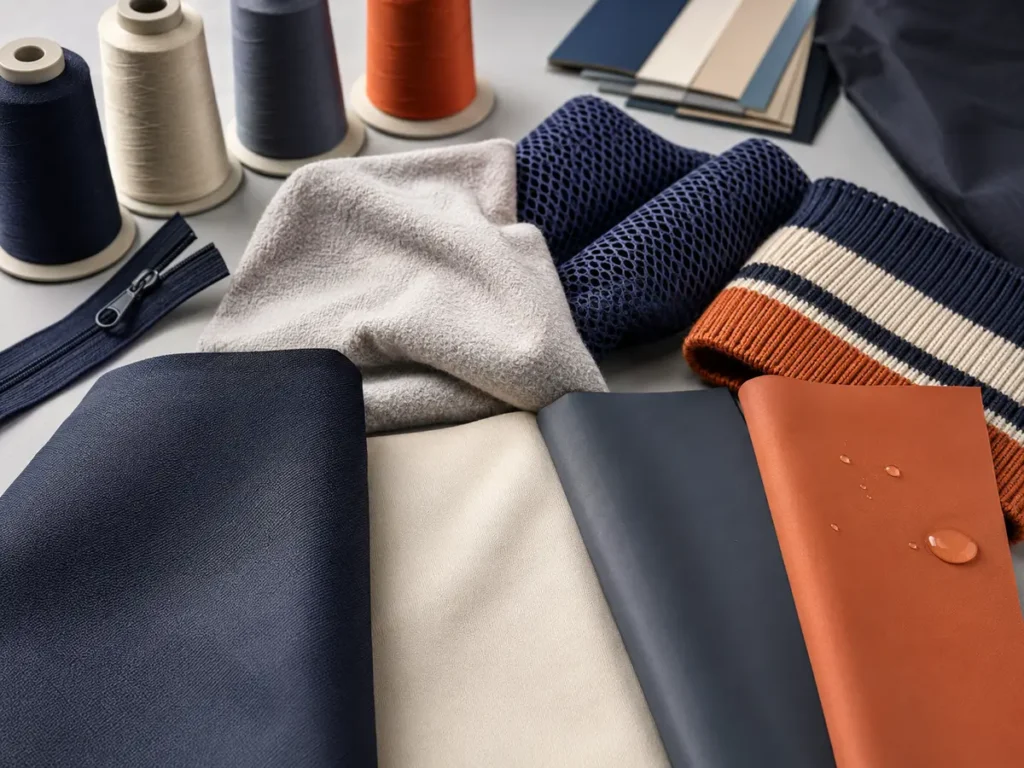
“Polyester jacket” is too broad to be a production specification. Polyester may be knitted or woven, smooth or brushed, stretchy or stable, lightweight or insulated. Nylon, cotton blends, elastane and various linings can also be used. Construction and finishing change the result as much as the generic fiber name.
| Material or component | Typical purchasing reason | Questions to confirm |
|---|---|---|
| Woven polyester shell | Durable team shell, color consistency, broad decoration compatibility | Weave, weight, coating/finish, noise, hand feel and snag behavior |
| Polyester knit or interlock | Soft athletic feel and movement | Weight, stretch direction, recovery, pilling expectations and lining need |
| Stretch woven blend | Mobility with a cleaner shell appearance | Fiber percentages, stretch/recovery, heat sensitivity and colorfastness plan |
| Nylon shell | Light hand and wind-shell applications | Denier/construction, finish, decoration compatibility and heat sensitivity |
| Mesh lining | Air circulation and separation from the shell | Mesh weight, softness, color and attachment method |
| Brushed tricot or fleece lining | Warmth and comfort | Added bulk, drying behavior, pilling and sleeve layering |
| Rib knit | Collar, cuff and hem recovery | Fiber blend, stripe layout, elasticity, recovery and color match |
| Insulation | Cold-weather sideline use | Type, fill weight, distribution, bulk and care method |
Ask for physical swatches when hand feel, sheen, noise or exact color matters. Digital screens cannot reliably communicate those characteristics. If the jacket must match jerseys or caps made from different materials, approve a coordinated color standard rather than expecting every substrate to appear identical under every light.
4. Get Fit and Sizing Right Before Bulk Production
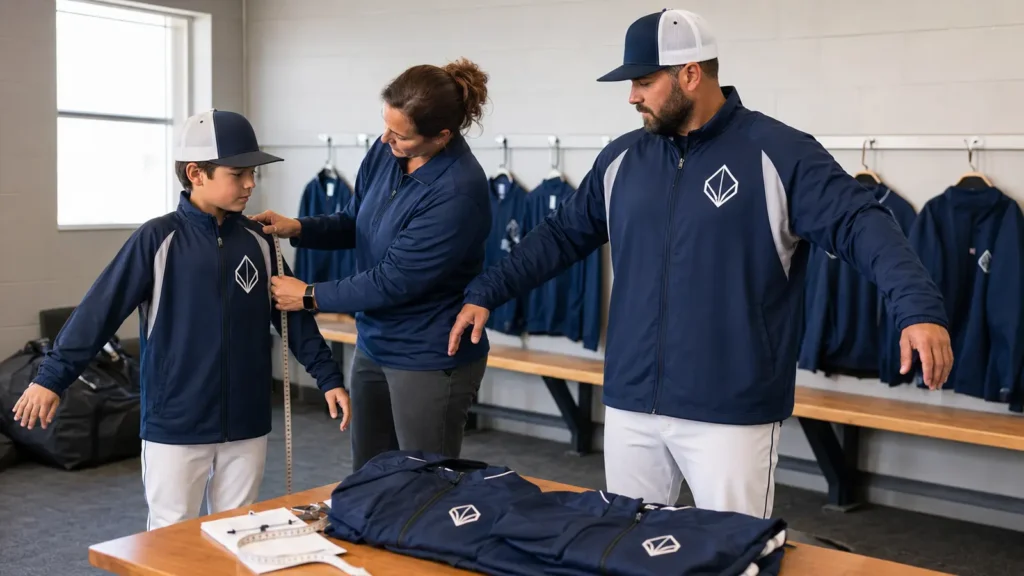
Sizing problems are one of the most expensive teamwear mistakes because personalized garments may be difficult to reallocate. Do not place an international bulk order using familiar labels such as S, M and L alone. Compare garment measurements.
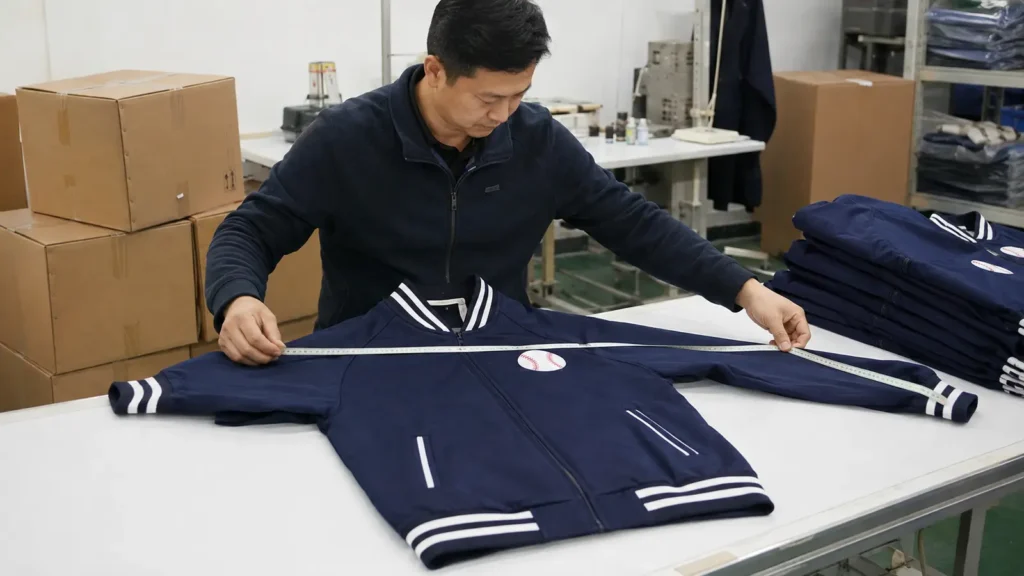
Important measurements include chest, body length, shoulder, sleeve, bicep, cuff and hem. Raglan and set-in sleeves require different measurement methods. The diagram must show each measurement point and production tolerance.
Fit over the intended layer
A jacket worn over a baseball jersey needs different ease from one worn over a hoodie. Test the sample in the real combination. Have the wearer raise both arms, rotate the shoulders, bend the elbows, zip the front and sit down. Check whether the hem rises excessively, the collar rubs or the pocket opening becomes difficult to use.
Separate youth and adult blocks
Do not assume a scaled-down adult pattern will fit youth players correctly. Ask for the supplier’s youth and adult size charts, sample the key crossover sizes and state whether the program needs unisex, men’s, women’s or youth-specific blocks.
Build the roster carefully
Use a locked spreadsheet with one row per wearer. Include name, number, jacket size, fit block and any special personalization. Protect number formatting so “01” does not become “1.” Require a final supplier proof that maps every roster entry to the artwork before production.
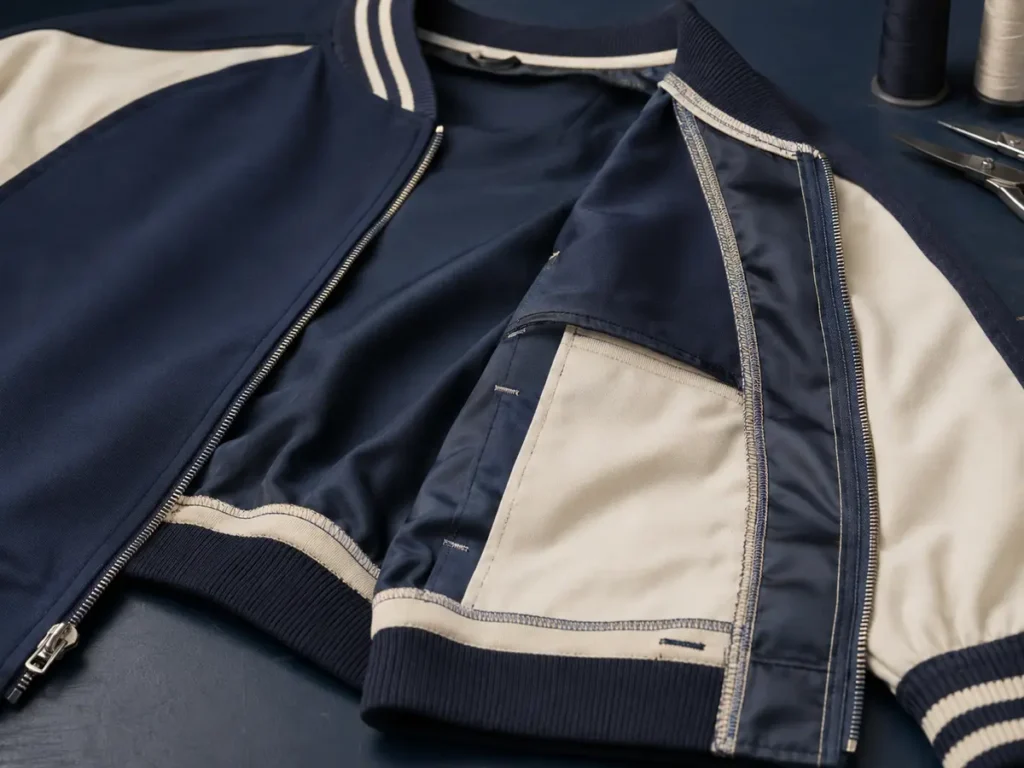
5. Evaluate Construction and Durability Details
Fabric is only one part of performance. Construction determines how the jacket behaves after repeated wearing, washing, packing and travel.
Check these areas on the sample:
- Zipper installation: The front edges should align, the zipper should run smoothly and the fabric should not wave excessively.
- Stress points: Pocket corners, lower zipper ends and hanger loops may need reinforcement appropriate to the fabric.
- Seam allowance and finishing: Interior construction should be consistent and free from loose threads, raw edges that should be enclosed or uncomfortable bulk.
- Cuffs and hem: Rib or elastic components should recover after stretching and remain symmetrical.
- Lining attachment: The lining should not twist, pull at the armhole or extend below the shell.
- Pocket bags: They should be large enough for the intended use and secured so they do not hang below the hem.
- Decoration backing: Dense embroidery may need suitable backing and a comfort layer, depending on placement.
- Panel matching: Contrast panels, piping and stripes should meet consistently at visible seams.
Stitch type, thread, seam location, material thickness and elasticity must work together. Ask how critical features will be inspected.
6. Select the Right Logo and Personalization Method
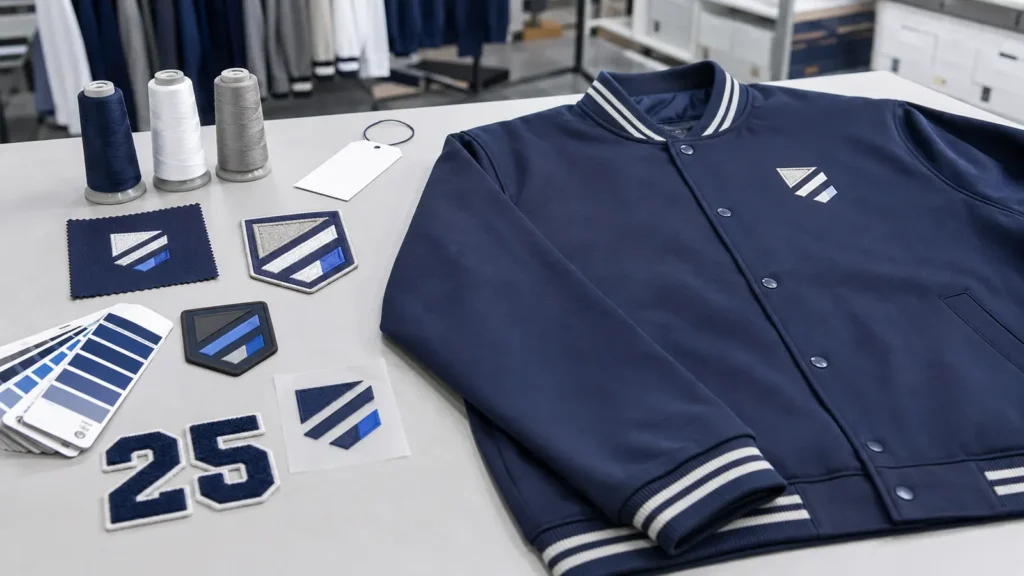
Decoration should suit the jacket fabric, brand position, order size and design detail. Ask the supplier to provide a stitch-out, patch sample or printed strike-off when the final appearance cannot be judged from a digital mockup.
| Method | Suitable use | Buying considerations |
|---|---|---|
| Direct embroidery | Chest marks, names and compact logos | Stitch count, minimum line/text size, backing, puckering and inside comfort |
| Woven patch | Detailed flat marks and private-label styling | Edge type, attachment method, color definition and patch stiffness |
| Rubber/PVC-style patch | Dimensional sport or outdoor look | Mold/detail limits, thickness, sew channel and low-quantity setup cost |
| Leather-style patch | Heritage or lifestyle presentation | Material disclosure, color variation, care and attachment |
| Heat transfer | Player numbers, names and multicolor art | Film type, press compatibility, edge adhesion and wash validation |
| Screen printing | Repeated simple graphics on compatible panels | Ink system, fabric compatibility, coverage and curing controls |
| Sublimated panel | All-over graphics on suitable polyester components | Panel artwork, color approval and registration at seams |
| Appliqué or tackle twill | Varsity numbers and large letters | Layer count, edge finish, stiffness, sewing time and weight |
Use a clear decoration hierarchy: a primary chest emblem, optional sleeve or back mark and controlled personalization. Confirm setup charges and whether repeat orders can reuse approved files. For sponsors, define logo size, safe area and color rules before sampling.
Plan Your Custom Jacket Order
Planning a baseball jacket order? Send JIUMU your reference image or tech pack, quantity, youth/adult size range, colors, logo files, personalization list, packaging needs and target delivery date. Request a specification review through the custom team jackets page or contact JIUMU.
7. Plan Labels and Destination-Market Requirements
Labels should be discussed before sampling because they affect artwork, material selection and production records. Requirements depend on the destination, sales model and garment composition, so buyers should obtain current professional advice for their exact market.
For most textile products sold in the United States, the Federal Trade Commission explains that labels generally identify fiber content, country of origin and the manufacturer or another responsible business. The FTC Care Labeling Rule also requires manufacturers and importers to attach care instructions to clothing. These are legal information requirements, not optional private-label details.
For the European Union, Regulation (EU) No 1007/2011 governs textile fiber names and related fiber-composition labeling. The European Commission notes that it does not harmonize size, country-of-origin or wash/care labeling under that regulation. United Kingdom guidance similarly requires fiber-content labeling and explains responsibilities for manufacturers and retailers.
A practical label specification may include:
- Main brand or club label
- Size label
- Fiber-composition label
- Country-of-origin statement
- Care instructions and symbols appropriate to the market
- Responsible business identity where required
- Style, batch or traceability code used by the buyer
Check the final bill of materials before approving a “100%” fiber statement. Animal-origin components or wool may trigger additional rules. The importer or seller should verify current law in every market.
8. Understand the Main Cost Drivers
Custom baseball jacket pricing is built from the complete specification. A low unit quote and a higher unit quote may describe different products.
Major cost drivers include:
- Jacket architecture: An unlined full-zip jacket uses fewer operations than a lined varsity or insulated style.
- Fabric and trims: Shell construction, lining, rib, zippers, snaps and special finishes change material cost.
- Order quantity: Setup, cutting, artwork and sampling costs are distributed across the quantity. Quantity breaks should be compared using the same specification.
- Color complexity: Contrast sleeves, piping and custom-dyed components can add minimums and handling.
- Decoration: Large dense embroidery, multiple patches, appliqué and many placements add labor and setup.
- Personalization: Unique names and numbers require roster control and individual processing.
- Labels and packaging: Custom woven labels, hangtags, barcodes, polybags and size assortments add cost but may be essential for retail or distribution.
- Testing and inspection: Destination-specific testing, third-party inspection or extra sample rounds require budget and schedule.
- Freight and delivery: Carton volume, garment weight, shipping method, duties and local delivery can materially affect landed cost.
Confirm whether sample, artwork setup, packaging, export cartons, freight and duties are included. Compare landed scenarios, not only ex-works unit prices.
9. Approve Samples With a Written Quality-Control Checklist
The sample is both a decision tool and a production reference. Record each accepted point and correction instead of sending a general “looks good.”
Sample approval checklist
- Correct style, fit block and size
- Shell, lining, rib and trim codes match the approved bill of materials
- Garment measurements are within the agreed tolerance
- Team colors match the approved physical or Pantone-based standard as closely as the material allows
- Logo artwork, dimensions, colors and placement are correct
- Personalization font and position are approved
- Zipper, snaps and pockets operate normally
- Stitching, reinforcement and seam finishing meet the reference
- Labels contain approved information and are attached in the agreed location
- Care method is appropriate to the materials and decoration
- Folding and packaging match the distribution workflow
Keep one sealed approval sample if practical. Base bulk inspection on it and the signed specification. Define critical, major and minor defects instead of relying on an undefined promise of “strict QC.”
10. Build a Realistic Bulk-Order Timeline
Work backward from the required delivery date. Do not treat production lead time as the entire project duration. Artwork confirmation, material sourcing, sample delivery, revisions, roster approval, production, inspection, export and final-mile transport all require time.
A controlled order process is:
- Brief: Send use case, quantity, destination, target date and references.
- Specification: Confirm silhouette, materials, sizing, colors, branding, labels and packing.
- Quotation: Compare like-for-like product and shipping terms.
- Digital mockup: Lock artwork scale, color intent and placement.
- Physical sample: Review construction, fit and decoration on real materials.
- Size and roster lock: Confirm quantity by size and all personalization data.
- Bulk production and inline control: Resolve material or workmanship issues before completion.
- Final inspection and packing check: Confirm quantities, cartons and shipping marks.
- Shipment: Track export, customs and delivery milestones.
- Reorder record: Archive the specification, sample version, colors and artwork.
Ask for the last date for changes and identify changes that would restart sampling or material procurement.
11. What to Send for an Accurate Quotation
| Information | Good buyer input |
|---|---|
| Product | Clear jacket type, reference photos and required features |
| Quantity | Total pieces plus quantity by color and estimated size range |
| Market | Destination country and whether the jackets are team issue, wholesale or retail |
| Fabric | Preferred composition/construction or approved reference garment |
| Design | Editable vector artwork where possible, team colors and placement dimensions |
| Personalization | Example roster, name/number rules and sponsor requirements |
| Sizing | Youth/adult ranges, fit preference and target garment measurements |
| Branding | Main label, size label, care label, hangtag and packaging design |
| Logistics | Delivery postcode/port, target arrival date and preferred shipping terms |
The supplier may still need to recommend a fabric or construction. That is useful when the recommendation is documented and approved rather than substituted silently.
12. Questions to Ask a Custom Baseball Jacket Supplier
- Which jacket construction do you recommend for our climate and use, and why?
- Can you provide shell, lining, rib and trim swatches before sampling?
- What are the youth and adult garment measurements and tolerances?
- Can you make a size set or key-size samples before roster lock?
- Which logo methods are compatible with the selected fabric?
- What artwork setup, mold, digitizing or sampling charges apply?
- How will you control team colors across different materials and future reorders?
- What label information do you need from us for the destination market?
- What is the minimum order quantity by style, color and customization? JIUMU’s typical MOQ is 50 pieces, subject to product structure and customization.
- What is included in the quoted unit price and shipping term?
- What quality checks occur during and after production?
- How are personalized items verified against the roster?
- What files and physical standards will be retained for repeat orders?
- Which date must artwork, materials, sizes and roster be final to meet delivery?
13. Common Buying Mistakes to Avoid
Choosing by the lowest unit price
The cheapest quote may omit lining, custom labels, individual packing, sample charges or realistic freight. Rebuild each quote into the same landed specification.
Approving only a digital mockup
A mockup can confirm layout but not hand feel, fit, sheen, zipper quality, embroidery puckering or patch stiffness. Use a physical sample for the final construction.
Ordering by size names without measurements
An M from one pattern is not automatically an M from another. Approve garment measurements and test the intended base layer.
Sending the roster in chat messages
Names and numbers scattered across email or messaging threads create preventable errors. Use one version-controlled roster with a final approval step.
Adding logos after the quote
New sponsor marks or back designs may change price, artwork, balance and lead time. Define all placements before the sample.
Treating color as a screen-only decision
Screens, fabrics, threads and printing systems reproduce colors differently. Approve physical standards for critical team colors.
Ignoring repeat-order planning
Teams add players and distributors replenish stock. Ask how fabric lots, trim colors, artwork and measurements will be recorded, and understand that exact lot-to-lot color identity may not always be possible.
14. Why Source Custom Baseball Team Jackets With JIUMU?
JIUMU is a Guangdong-based B2B supplier established in 2010, serving buyers in the United States, Canada, the United Kingdom and Europe with OEM and ODM custom teamwear development.
Relevant capabilities include fabric sourcing, Pantone color matching, embroidery, sublimation, screen printing, heat transfer, multiple patch types, private labels, hangtags, custom packaging, mockups, samples, bulk quality control and export support.
The typical MOQ is 50 pieces, subject to product structure and customization. Buyers can also coordinate jackets with custom team uniforms, baseball caps, team jerseys, team bags or a baseball team uniform package.
This capability range does not remove the need for buyer approval. The strongest project still begins with a clear specification, sample and destination-market requirements.
Frequently Asked Questions
Final Recommendation
The most reliable buying process makes every important decision visible before bulk production. Define use, construction, materials, measurements, fit, decoration, labels and roster, then inspect against a signed sample.
A supplier can translate a visual idea into specifications, while the buyer retains approved artwork, measurements, material references and sample version for the first order and future reorders.
About the Author
JIUMU Teamwear Sourcing Team provides practical specification, customization, sampling and bulk-order guidance for professional teamwear buyers.