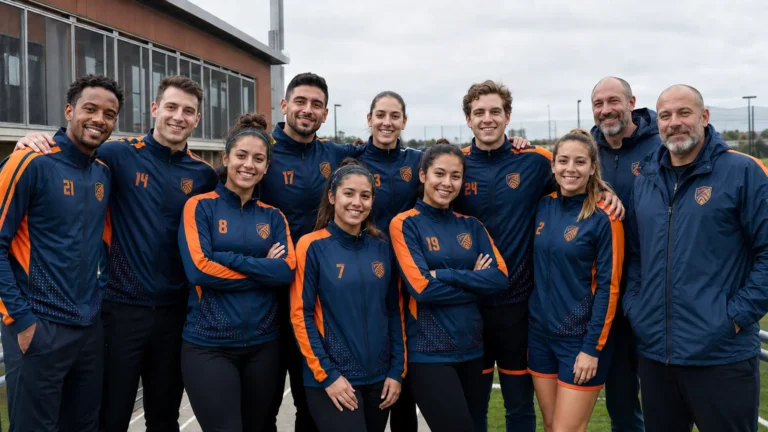
Matching Soccer Warm-Up Jackets for Players and Staff
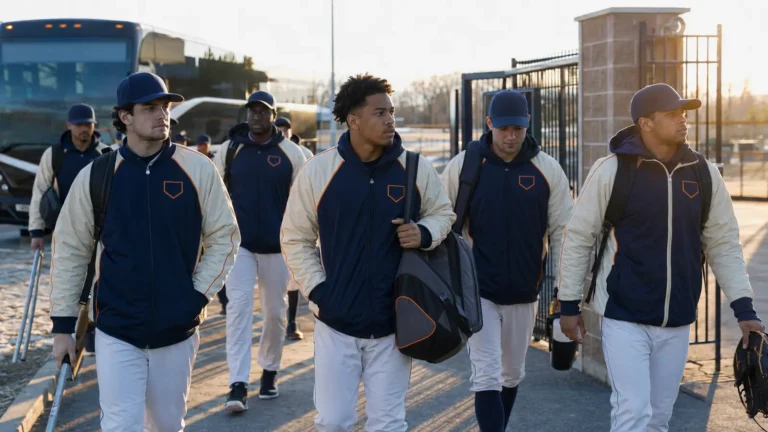
Matching soccer warm-up jackets can make players and staff look like one organized club without forcing every wearer into an identical garment. The strongest programs standardize the visible identity—base color, crest, typography, trim language, and decoration quality—while adjusting fit, insulation, pockets, and role accents for the people who actually use the jackets.
That distinction matters to school athletic departments, soccer academies, clubs, uniform dealers, distributors, and private-label brands. A jacket that photographs well but restricts movement will frustrate players. A lightweight training top may leave a coach cold through a long match. An attractive first order can also become an operational problem if colors, size grading, trims, or artwork are not documented for future replacements.
This guide covers jacket types, fabrics, construction, role differentiation, sizing, decoration, compliance considerations, costs, sampling, quality control, and quotation requirements.
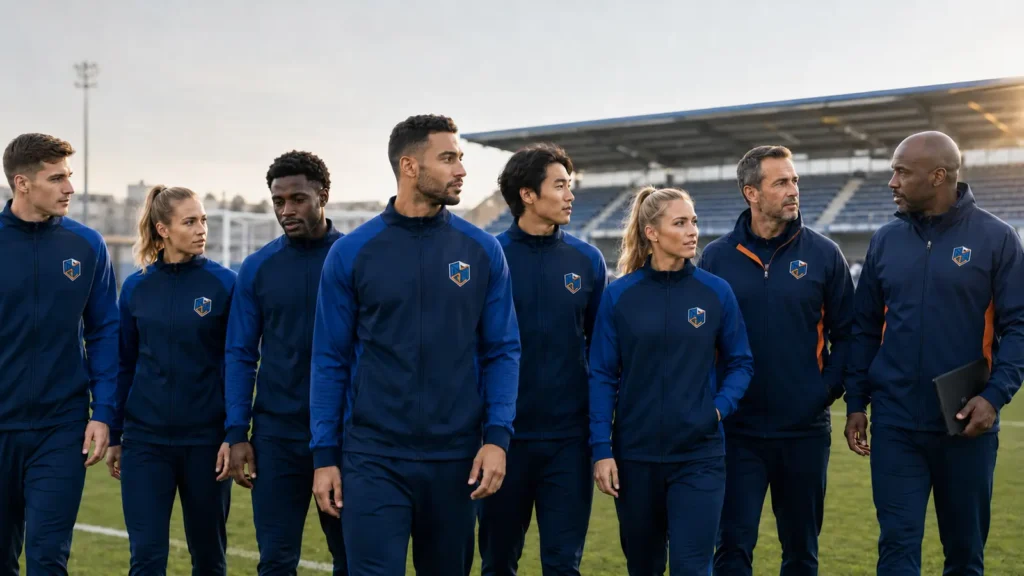
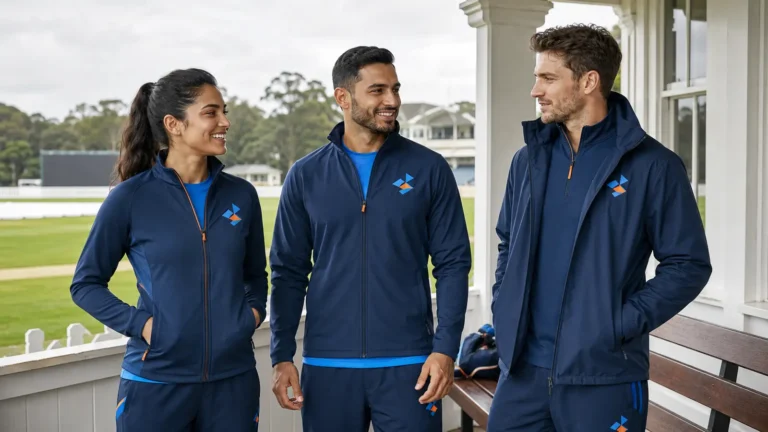
A coordinated jacket program can share one visual identity while adapting details for players and staff.
Quick Answer: How Should Players’ and Staff Jackets Match?
The best approach is to create a shared design system rather than one universal jacket. Use the same primary color, secondary color, team crest, and overall panel language across the collection. Give players a mobile, breathable cut for active warm-ups. Give coaches and staff practical variations such as a slightly roomier fit, weather-protective shell, longer body length, additional pockets, or light insulation. Distinguish roles with controlled details—collar piping, shoulder panels, zipper pulls, or a small “STAFF” treatment if competition rules permit—rather than an unrelated colorway.
Before approving artwork, check the rules of the relevant league, school, tournament, national association, or competition organizer. The IFAB Laws of the Game state that team colors must distinguish the teams and match officials, and Law 4’s principles for slogans, images, and advertising also extend to team officials in the technical area. Competition rules may impose additional limits on the position, size, and number of permitted marks. Warm-up jackets are not the compulsory match kit, but they still need a pre-event compliance review when worn by substitutes or staff near the field. See the current IFAB Law 4 guidance.
Why One Jacket System Is Better Than Separate Purchases
Warm-up jackets appear during travel, training, pre-match routines, team photos, technical-area coverage, sponsor events, and sometimes retail sales. Because they are seen so often, inconsistency is easy to notice.
Buying player and staff jackets separately often creates four problems:
- Color drift. Two “navy” fabrics from different suppliers can look noticeably different under stadium lighting or in photography.
- Logo inconsistency. Crest size, stitch density, border thickness, placement, or transfer finish may vary between orders.
- Fit confusion. A single unisex size chart may not serve youth athletes, adult players, and staff wearing layers.
- Replacement difficulty. A club may not be able to reproduce the first order after new players or coaches join.
A system-based order reduces those risks by approving one master color standard, artwork package, placement map, related size charts, and repeat-order specification.
Start With Use Cases, Not Just a Jacket Picture
The first sourcing question should be: When and how will each group wear the garment? A reference image is helpful, but it does not define climate, activity level, layering, storage, care, or match-day responsibilities.
| Wearer or use | Main requirement | Suitable starting point | Useful adaptations |
|---|---|---|---|
| Players during active warm-ups | Mobility and moisture management | Lightweight knit full-zip jacket | Raglan sleeves, stretch panels, secure pockets |
| Substitutes on the bench | Warmth without excessive bulk | Brushed-back knit or light insulated shell | Higher collar, wind-resistant face, easy-on fit |
| Coaches and analysts | Comfort through long periods of standing | Woven shell or midweight jacket | Roomier body, internal pocket, weather flap |
| Medical and equipment staff | Fast identification and practical storage | Matching shell with role accent | Extra zip pockets, distinct piping, clean sleeve area |
| Travel and presentation | Unified visual appearance | Smooth-face knit or woven jacket | Consistent crest, coordinated trousers, private labels |
| Youth clubs and schools | Size continuity and safe details | Youth-graded full-zip jacket | No neck drawstrings, simple closures, name option |
Send the supplier a wearer matrix before design work begins. List player, coach, staff, and spare quantities, plus the layers worn underneath. This is more useful than asking for “a standard soccer fit.”
Choose the Right Soccer Warm-Up Jacket Type
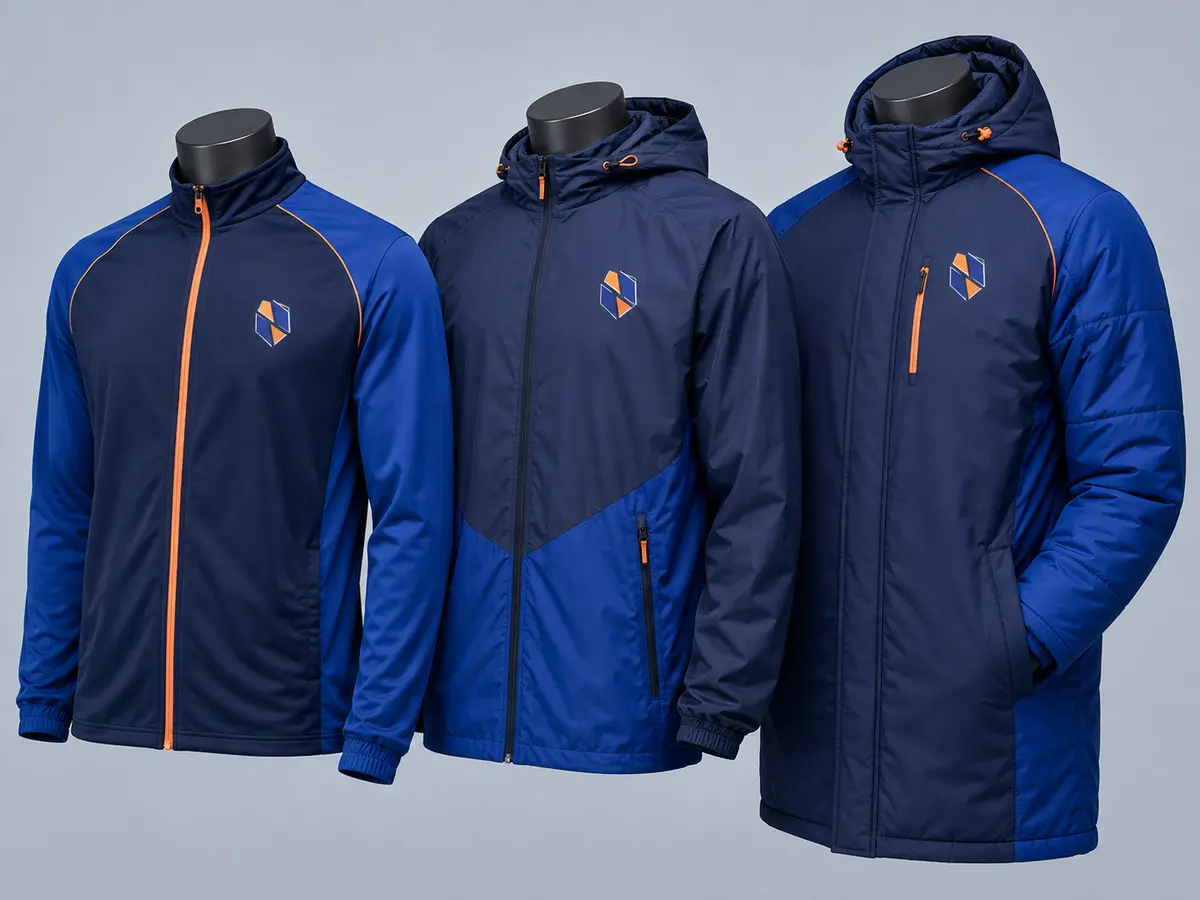
Three formats cover most club needs. They can be designed as one family even when their materials differ.
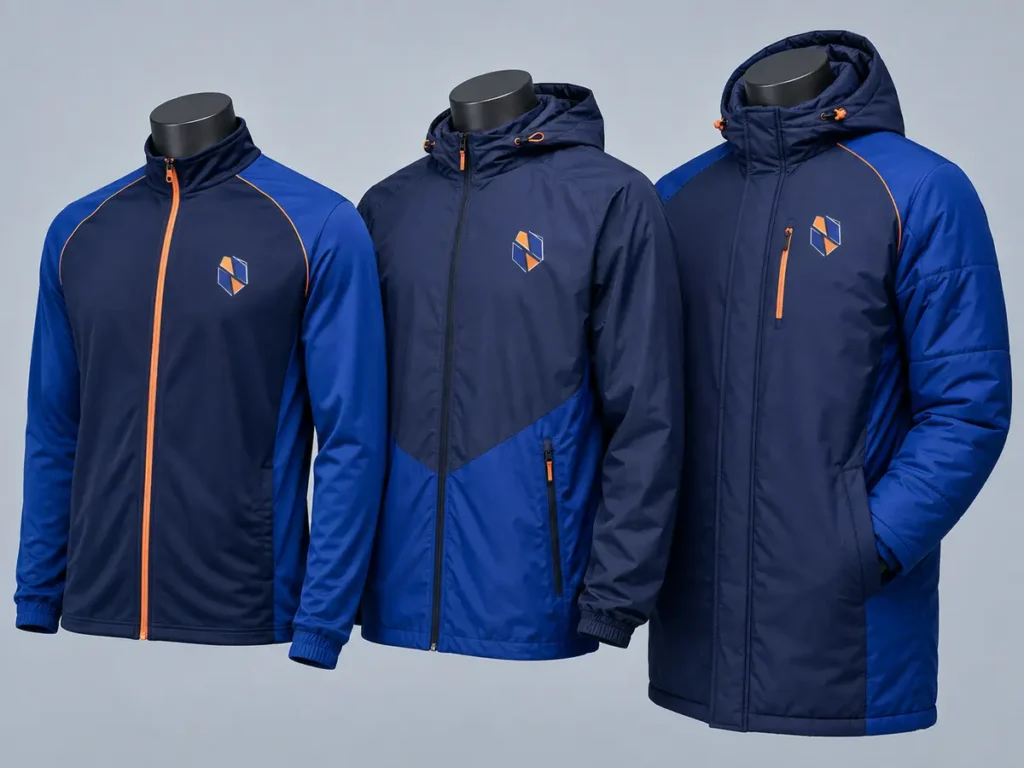
Lightweight knit training jacket
A smooth-face polyester knit or interlock jacket is the most versatile choice for active warm-ups, travel, and mild conditions. It can offer controlled stretch, a clean surface for heat-applied decoration, and a familiar athletic silhouette. The buyer should confirm fabric weight, stretch direction, recovery, brushed or unbrushed back, and whether the same fabric will be used for matching trousers.
It is not automatically windproof or rainproof, so avoid those claims unless the finished garment has supporting test data.
Lightweight woven shell
A woven shell provides a crisper surface and usually better wind resistance than an open or soft knit. It can work well for staff, substitutes, and changeable weather. Decide whether the shell needs a mesh lining, light tricot lining, or no lining. A lining changes warmth, drape, decoration access, production steps, and cost.
If the brief calls for water resistance, define the required test method and target instead of relying on the fabric name. Water-repellent treatment, coated fabric, seam construction, and zipper design all affect real performance. “Water-resistant” should be treated as a specification to verify, not a casual marketing label.
Insulated bench or stadium jacket
Longer and lightly insulated jackets suit coaches, substitutes, and staff who spend more time stationary. They may include a higher collar, hood, storm flap, two-way zipper, or larger pockets. These features increase comfort but also raise the number of components that must be sampled and inspected.
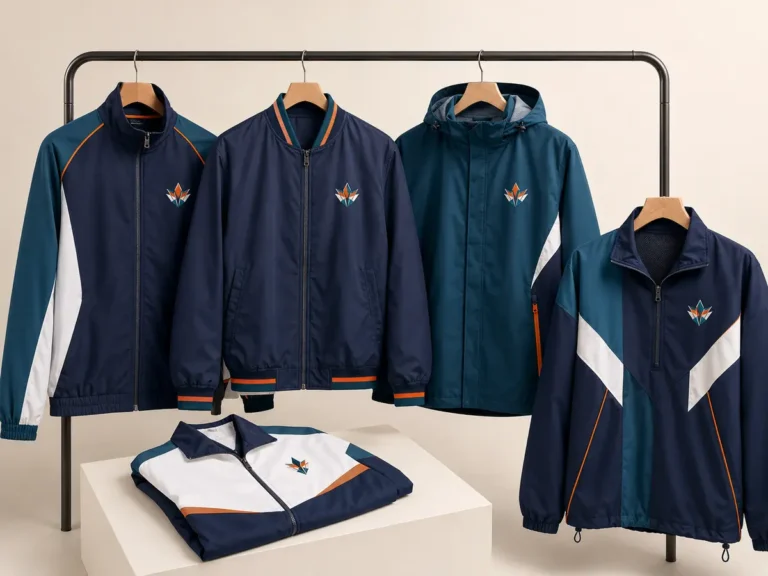
For a matching program, the insulated jacket does not need to copy the player jacket panel by panel. It should repeat recognizable elements such as the same navy body, blue side panel, orange piping, crest position, and zipper-pull color.
Match the Identity While Differentiating Roles
Visual unity does not require identical color proportions. Controlled differentiation can make a sideline easier to manage.
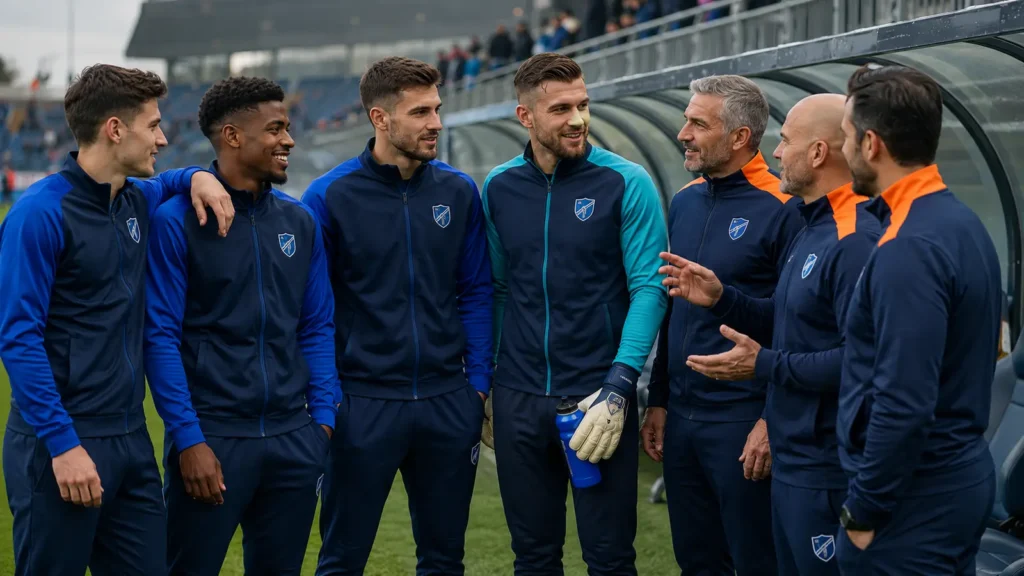
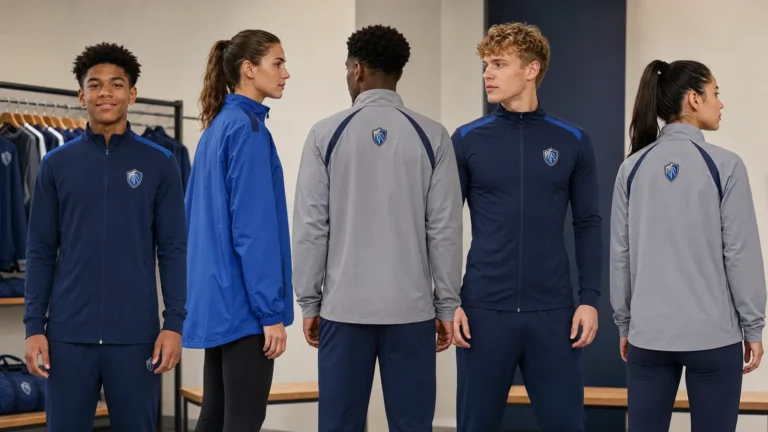
A shared base color with restrained role accents keeps the club unified and operationally clear.
Use a hierarchy:
- Primary identity: one dominant jacket color across the club.
- Secondary identity: one repeatable panel or sleeve color.
- Accent: piping, zipper, collar, or small trim used consistently.
- Role indicator: a limited variation reserved for staff, goalkeepers, or medical personnel.
- Artwork: one approved crest file, sponsor treatment, and placement map.
Players could wear navy bodies with royal-blue sleeves while staff use blue side panels and orange collar accents. Avoid a different jacket for every staff role unless required; too many variants complicate minimums, sampling, inventory, and repeat orders.
Do not assume that a sponsor logo or role label accepted on a training garment is automatically permitted in a competition environment. IFAB Law 4 generally permits team crests and advertising allowed by the applicable competition rules, but it also restricts political, religious, and personal slogans or images and notes that organizers may impose further limitations. Obtain written approval from the responsible league or organizer when the design is unusual or heavily sponsored.
Select Fabrics by Climate, Activity, and Care
Fabric selection should translate into procurement decisions. “Performance polyester” is too broad: two fabrics with the same fiber name can differ in weight, construction, stretch, surface, opacity, warmth, and dimensional stability.
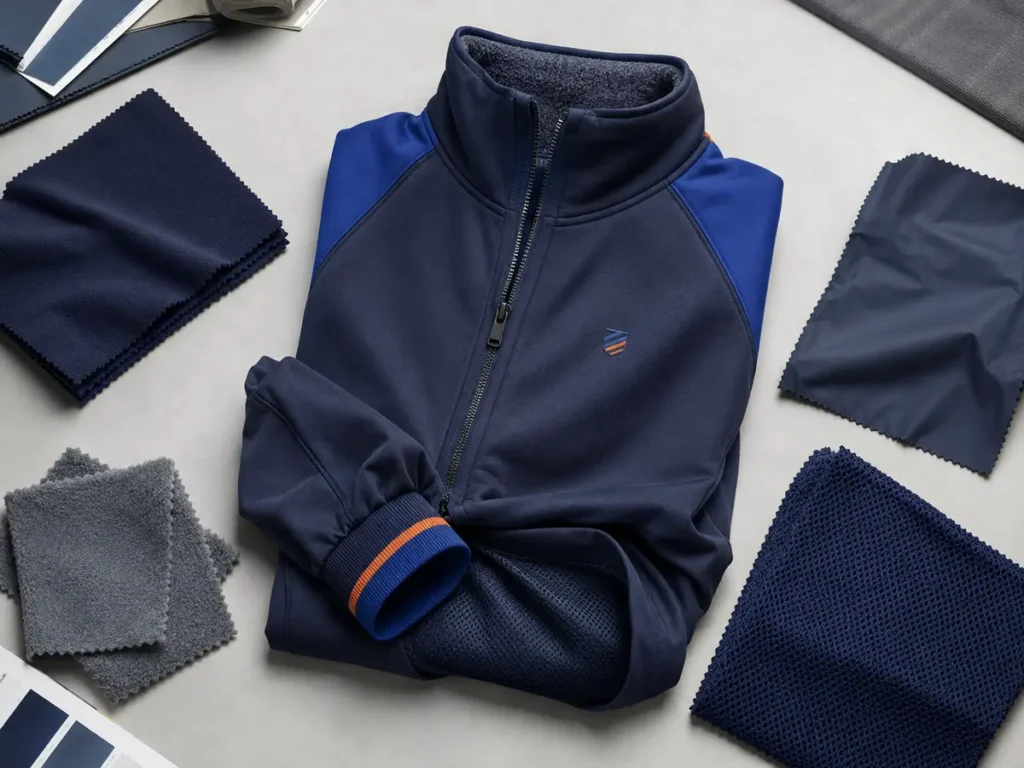
The fabric brief should define construction, weight, stretch, hand feel, lining, and intended conditions.
| Fabric or system | Best suited to | Buyer advantages | Points to verify |
|---|---|---|---|
| Polyester interlock knit | Active warm-ups and travel | Smooth surface, coordinated tracksuit look, easy movement | Weight, stretch recovery, snagging, pilling, shrinkage |
| Brushed-back polyester knit | Cool-weather training | More warmth with familiar athletic feel | Brushing consistency, bulk, drying time, pilling |
| Polyester or nylon woven shell | Windy or changeable conditions | Crisp appearance, low bulk, shell protection | Noise, coating, lining, seam behavior, claimed water resistance |
| Shell plus mesh lining | Staff and general team use | Improved comfort against skin, structured drape | Lining attachment, ventilation, decoration access |
| Light insulated construction | Bench, travel, cold weather | Warmth for stationary wearers | Fill distribution, quilting, packability, care method |
| Stretch woven hybrid | Higher-mobility premium program | Mobility with a technical appearance | Stretch direction, seam strength, color match between panels |
Ask for actual swatches in the intended colors. Dark navy can reveal shading differences, crease marks, or dye-lot variation. Bright blues and oranges can shift between knit, woven, rib, zipper tape, embroidery thread, and heat-transfer film. Approve the complete material set—not only the shell fabric.
If the club expects frequent washing, request evidence supporting the care instruction for the decorated garment. In the United States, the FTC Care Labeling Rule requires covered manufacturers and importers to attach care instructions and have a reasonable basis for them. The complete garment must tolerate the stated process. See the FTC’s Care Labeling Rule guidance.
Define Fit, Layering, and the Size Plan
Fit problems usually begin with an incomplete brief. A buyer may approve a medium sample on one athlete and assume the whole grade will work for youth players, larger adults, and staff. That is not a size plan.
Build the size specification around three inputs:
- Body measurements: chest, waist, height, and other measurements relevant to the target population.
- Finished garment measurements: half chest, body length, sleeve length, shoulder or raglan measurement, cuff opening, hem opening, and collar height.
- Layering allowance: jersey only, base layer, sweatshirt, or additional winter layer.
Player jackets normally benefit from a closer athletic silhouette with enough sleeve and shoulder mobility for dynamic warm-ups. Staff may prefer a straighter body and extra layering room. Women’s, men’s, youth, and unisex blocks should not be mixed without checking the actual grade rules.
Collect selections against the supplier’s approved chart rather than a familiar retail brand. Base spare sizes on the club’s experience, and retain the final measurement specification for repeat orders.
Construction Details That Affect Durability
A warm-up jacket fails at high-use points before it fails across the main body fabric. Zippers, pocket openings, cuffs, collar edges, underarms, and decoration areas deserve specific inspection.
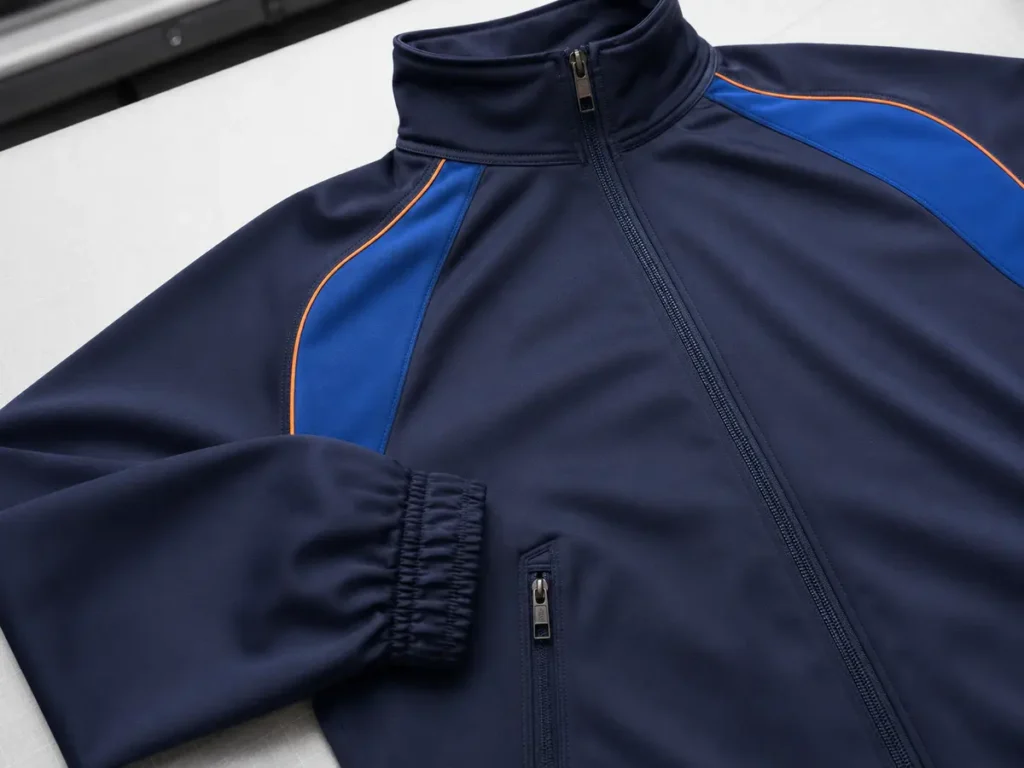
Zipper installation, seam alignment, cuff recovery, pocket reinforcement, and collar finishing are practical quality checkpoints.
Review the following details on the sample:
- zipper gauge, puller shape, tape color, top stop, and zipper garage;
- whether the center front lies flat without rippling;
- reinforced pocket openings and a secure pocket-bag construction;
- seam type and stitch density appropriate to the material;
- smooth underarm and raglan seams that do not restrict movement;
- cuff recovery after stretching;
- hem construction that does not twist or flare;
- lining anchoring and clean internal finishing;
- matched left/right panels, piping, and sleeve lengths;
- adequate backing behind embroidery where needed.
Construction should match use; a low-bulk active jacket and padded staff coat need different seam specifications.
Plan Logos, Names, Numbers, and Private Labels
Decoration is both a visual and engineering decision. The correct method depends on artwork complexity, fabric, quantity, hand feel, care, and the desired appearance.
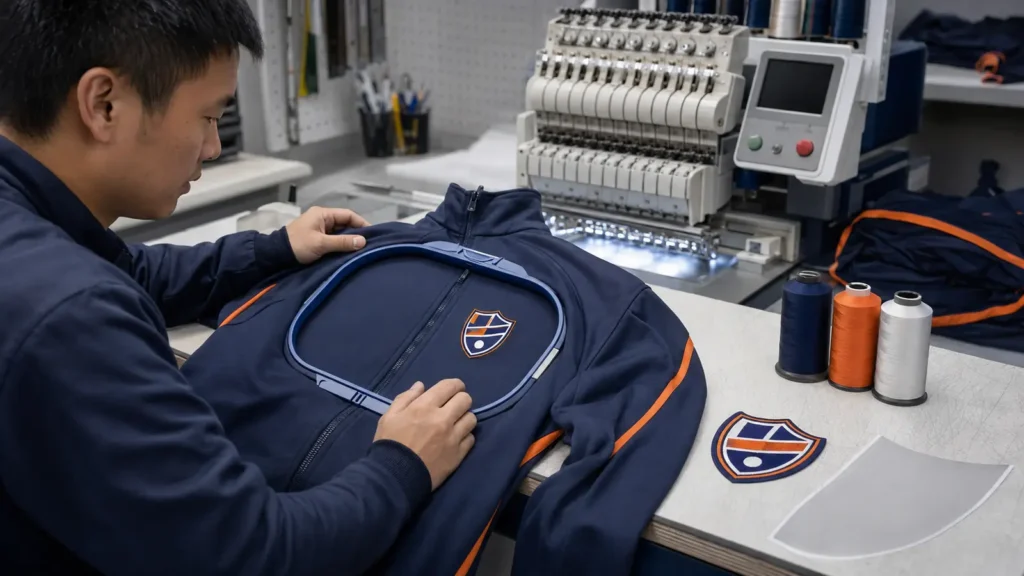
Embroidery, patches, and heat-applied graphics require different artwork preparation and sample checks.
Embroidery
Embroidery gives a dimensional, established club look and suits crests with defined shapes. Check the digitized file, stitch count, thread colors, border, small-letter legibility, backing, and puckering. Dense embroidery can distort lightweight or stretchy fabric, so the sample should use the actual jacket material.
Woven or embroidered patches
Patches can standardize a crest across several garment constructions. A woven patch can hold finer detail than a heavy embroidered field, while an embroidered patch has more texture. Confirm patch dimensions, border type, attachment method, edge lift, and whether the same patch will be stocked for repeat orders.
Heat transfer
Heat-applied graphics can handle names, numbers, staff identifiers, and detailed multicolor artwork. The transfer system must be compatible with the fabric surface and heat sensitivity. Check adhesion, edge lifting, color opacity, surface shine, dye migration, and care performance on the finished sample.
Screen printing
Screen printing can be efficient for appropriate quantities and simpler artwork. It is sensitive to the fabric surface, ink system, color count, curing, and placement. Ask how the supplier will control ink feel and adhesion on the selected jacket.
Sublimation
Sublimation is useful when the design requires all-over graphics on compatible polyester fabric, but it changes the product architecture and normally must be integrated before sewing. It is not a decoration that can simply be added to any finished dark jacket. Confirm panel alignment, color approval, white areas, and migration risk.
For private-label orders, define the main label, size label, care label, hangtag, barcode, polybag, carton mark, and any country-specific information. Keep the compliance label separate from the decorative brand story.
Plan a Coordinated Jacket Range
Planning a coordinated jacket range? Send JIUMU your quantity by role, target market, jacket references, colors, size range, logo files, packaging needs, and delivery date. Request a custom quotation through the JIUMU contact page or explore custom team jackets.
Safety and Labeling Considerations for North America and Europe
Compliance responsibility depends on the destination, age group, distribution model, and product design. The following points are useful briefing items, not a substitute for advice from the importer’s compliance specialist or testing laboratory.
Youth outerwear drawstrings in the United States
For U.S. youth programs, treat hood and waist drawstrings as a safety-critical design decision. The current federal Substantial Product Hazard List covers children’s upper outerwear in sizes 2T–16 or equivalents when drawstrings are subject to but do not conform to the incorporated safety requirements. The rule includes specific treatment of neck/hood and waist/bottom drawstrings across size ranges. Review 16 CFR Part 1120 with the importer or compliance professional. A stand collar, fixed hood without a neck drawstring, or another properly engineered solution may simplify a youth jacket brief.
U.S. textile and care labels
The FTC states that most covered textile products need labels identifying fiber content, country of origin, and the manufacturer or another responsible business; apparel also falls under care-label requirements. The responsible U.S. business should approve final label content, placement, and identity information. The FTC’s textile labeling guide is a useful starting point.
European Union textile labels
EU textile products marketed to end consumers generally must show fiber composition on a firmly attached label. The EU’s official business guidance notes that labels are mandatory for end-consumer sales, while B2B supply may use or supplement them with commercial documents. The composition should be clear, legible, and ordered by percentage. Language requirements depend on the Member State where the item is made available. Review the EU textile label guidance and the European Commission’s Regulation 1007/2011 FAQ.
What Drives the Cost of Custom Soccer Jackets?
A credible quote requires a defined specification. Per-piece price is affected by more than order quantity.
| Cost driver | Why it changes the quote | How to control it |
|---|---|---|
| Jacket construction | Lining, insulation, hood, pockets, panels, and storm flaps add materials and operations | Use only features tied to a real use case |
| Fabric and trims | Technical fabrics, custom colors, specialty zippers, and matched rib increase sourcing complexity | Approve an available material set or accept the MOQ for custom development |
| Number of variants | Separate player, staff, goalkeeper, youth, and women’s versions divide quantities | Share base materials and limit role variations |
| Decoration | Stitch count, patch complexity, print colors, transfer size, and placements affect labor and setup | Simplify fine detail and consolidate placements |
| Personalization | Individual names and numbers require order data control and unit handling | Submit a clean roster spreadsheet and approve spelling rules |
| Labels and packaging | Private labels, barcodes, individual bags, and retail packaging add components | Finalize market and channel requirements before sampling |
| Testing and inspection | Required protocols add time and third-party cost | Define destination and test scope at quotation stage |
| Delivery schedule | Rush development or split shipments can increase cost | Work backward from the in-hand date with approval buffers |
JIUMU’s typical MOQ is 50 pieces, subject to product structure and customization. That does not mean every combination can be divided freely within 50 pieces. Ask how the minimum applies to jacket style, fabric color, decoration, and size mix. A two-style program may have different practical minimums from a one-style order.
Sample Approval and Quality-Control Checklist
The sample is the physical contract for appearance and function. Approve it with written comments and a measurement report instead of a casual “looks good.”
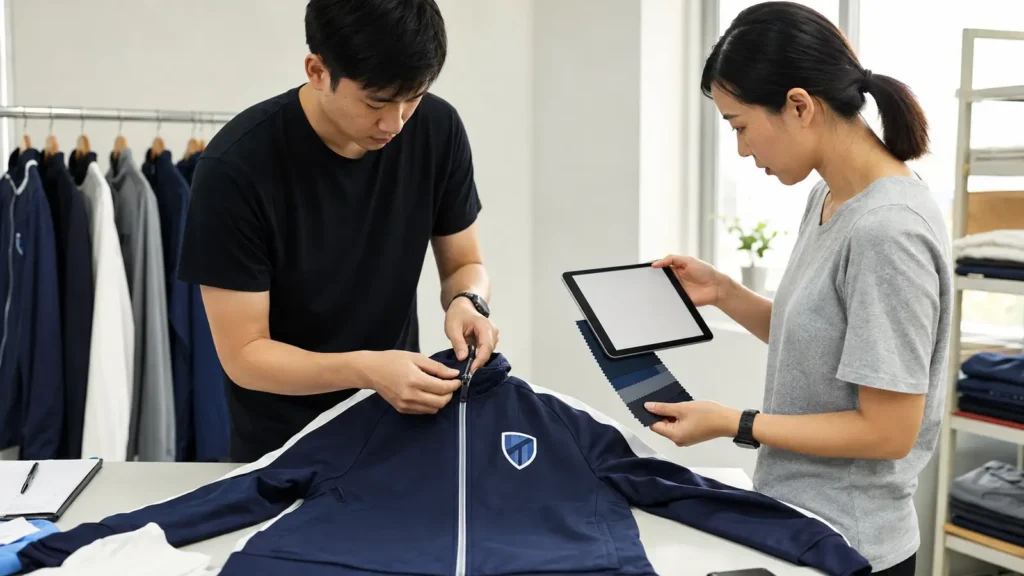
Sample approval should cover color, measurements, construction, decoration, function, and packing details.
Before the physical sample
- approve the flat sketch and front/back artwork placement;
- confirm materials, color references, lining, trims, and zipper colors;
- confirm the measurement chart and tolerances;
- provide vector logo files and decoration dimensions;
- confirm the required label and packaging content;
- identify destination-market compliance needs.
On the sample
- compare actual colors under consistent lighting;
- measure all agreed points using the same method as the supplier;
- check mobility over the intended under-layer;
- operate zippers and pockets repeatedly;
- inspect seam balance, puckering, loose threads, and panel symmetry;
- compare crest size, color, border, and position against artwork;
- review names or role identifiers at real viewing distance;
- check the care label and packaging proof;
- photograph approved details for the production file.
During and after bulk production
Agree on inspection timing and acceptance criteria before production. Useful controls include incoming material confirmation, first-piece review, in-line checks on key operations, measurement sampling, decoration verification, final appearance inspection, quantity reconciliation, and packing checks. Do not describe an inspection level as “standard” without identifying the sampling plan or buyer requirement.
Keep an approved sealed sample or clearly identified reference sample for future comparison. Retain fabric codes, trim codes, artwork versions, measurement specifications, and packing instructions. Repeat-order consistency depends on documentation as much as workmanship.
A Practical Bulk-Order Workflow
- Create the wearer matrix. List player, staff, goalkeeper, youth, adult, and spare quantities.
- Define the environment. Record climate, season, active or stationary use, and expected layering.
- Choose the product architecture. Select knit training jacket, woven shell, insulated style, or a controlled combination.
- Build the identity system. Approve base colors, panel language, role accents, crest, sponsor marks, and private labels.
- Confirm the commercial specification. Establish MOQ application, target price position, packaging, shipment terms, and required date.
- Approve materials and mockups. Review swatches, trim options, artwork dimensions, and digital views.
- Make and test the sample. Check fit, movement, construction, decoration, care basis, and destination requirements.
- Lock the production file. Issue one approved specification with version control.
- Inspect production and packing. Use agreed checkpoints and resolve nonconformities before shipment.
- Archive repeat-order data. Store the final artwork, measurements, material references, and approved changes.
What to Send for an Accurate Quotation
Send a concise but complete request:
- buyer type and destination country;
- total quantity plus quantity by player/staff version;
- youth/adult/women’s/men’s or unisex size range;
- reference image, sketch, tech pack, or target silhouette;
- intended use, climate, and layering;
- preferred fabric or required performance target;
- Pantone references or physical color standard when available;
- vector crest, sponsor, name, number, and role artwork;
- decoration method preference, size, and placement;
- label, hangtag, barcode, polybag, and carton requirements;
- required tests or compliance documentation;
- sample deadline and final in-hand date;
- destination and preferred shipping terms.
If the specification is still open, say which decisions need supplier recommendations. A transparent “target price with flexible fabric choice” brief is more useful than an exact product claim that has not been verified.
Questions to Ask a Soccer Jacket Supplier
- Which fabric constructions do you recommend for active players versus stationary staff, and why?
- Can the proposed knit, woven, lining, rib, zipper, and thread colors be matched within an agreed tolerance?
- How does the MOQ apply to styles, colors, youth/adult blocks, and role variants?
- Which finished-garment measurements and tolerances will be included in the specification?
- How will embroidery or transfer be stabilized on the selected fabric?
- What evidence supports the proposed care instruction for the complete decorated garment?
- What sample stages are available, and which changes may affect price or schedule?
- How are bulk colors, measurements, logos, zippers, and packing checked?
- What records will be retained for replacement and repeat orders?
- Which importer-supplied labels or destination-market requirements must be confirmed before production?
Common Buying Mistakes
- Making every role identical. This ignores different movement, warmth, pocket, and layering needs.
- Using too many variants. Small color changes across many roles can fragment quantities and increase inconsistency.
- Approving colors on a monitor. Digital color is not a substitute for physical material approval.
- Selecting fabric by fiber name alone. Construction, weight, finish, and stretch matter.
- Skipping finished-garment measurements. A generic size label does not control actual fit.
- Adding dense embroidery late. Decoration can change drape and pucker lightweight fabric.
- Assuming “water-resistant” without a test target. Marketing language is not a measurable specification.
- Ignoring youth drawstring rules. A visually small detail can create a serious compliance problem.
- Treating staff branding as unrestricted. Competition and organizer rules may apply in the technical area.
- Failing to archive the approved specification. Replacement orders then rely on memory or photos.
Why Source Matching Soccer Jackets With JIUMU?
JIUMU supports B2B programs for clubs, schools, academies, distributors, uniform dealers, promotional buyers, and private-label brands in North America and Europe. Capabilities include OEM/ODM development, fabric sourcing, Pantone matching, multiple decoration methods, private labels, packaging, mockups, samples, quality control, and export support.
For a matching player-and-staff program, that breadth is useful because the order is more than one decorated blank. It requires coordinated materials, controlled artwork, related size systems, role variations, and a repeatable production record. JIUMU’s typical MOQ is 50 pieces, subject to product structure and customization. Buyers should request a project-specific minimum and quotation.
You can also coordinate jackets with custom team uniforms, custom team jerseys, custom hoodies, and custom team bags to create a broader club package.
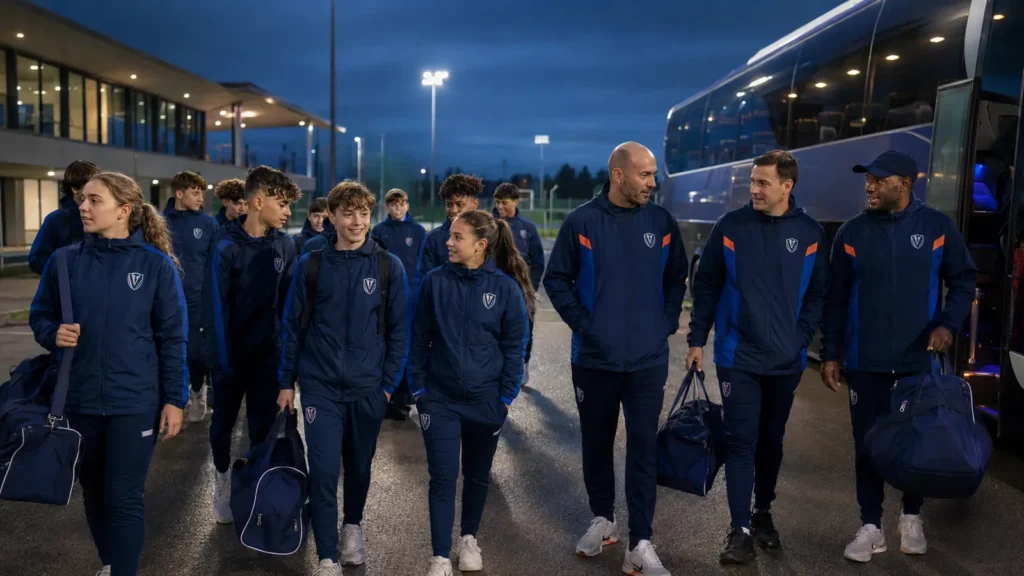
A documented jacket system makes it easier to coordinate athletes, staff, travel gear, and future replacement orders.
Frequently Asked Questions
Final Recommendation
Treat matching soccer warm-up jackets as a small uniform system. Standardize what the public should recognize—colors, crest, decoration, and overall design language—while adapting construction and fit to the wearer’s job. Approve actual materials, define finished measurements, review competition restrictions, address destination-market labels and youth safety, and preserve the final specification for replacements.
The result is a jacket program that works on the training ground, on the sideline, during travel, and in future reorder cycles—not merely a coordinated team photo.
About JIUMU
JIUMU Teamwear Sourcing Team creates practical B2B guidance on apparel specifications, customization, sampling, quality control and export ordering for clubs, schools, distributors and private-label brands.