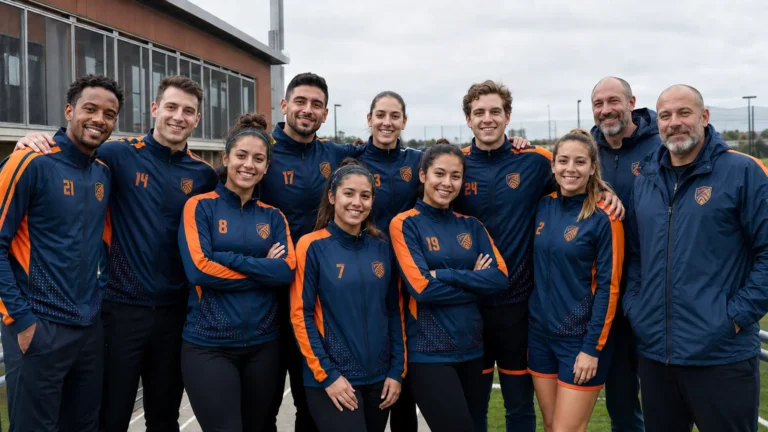
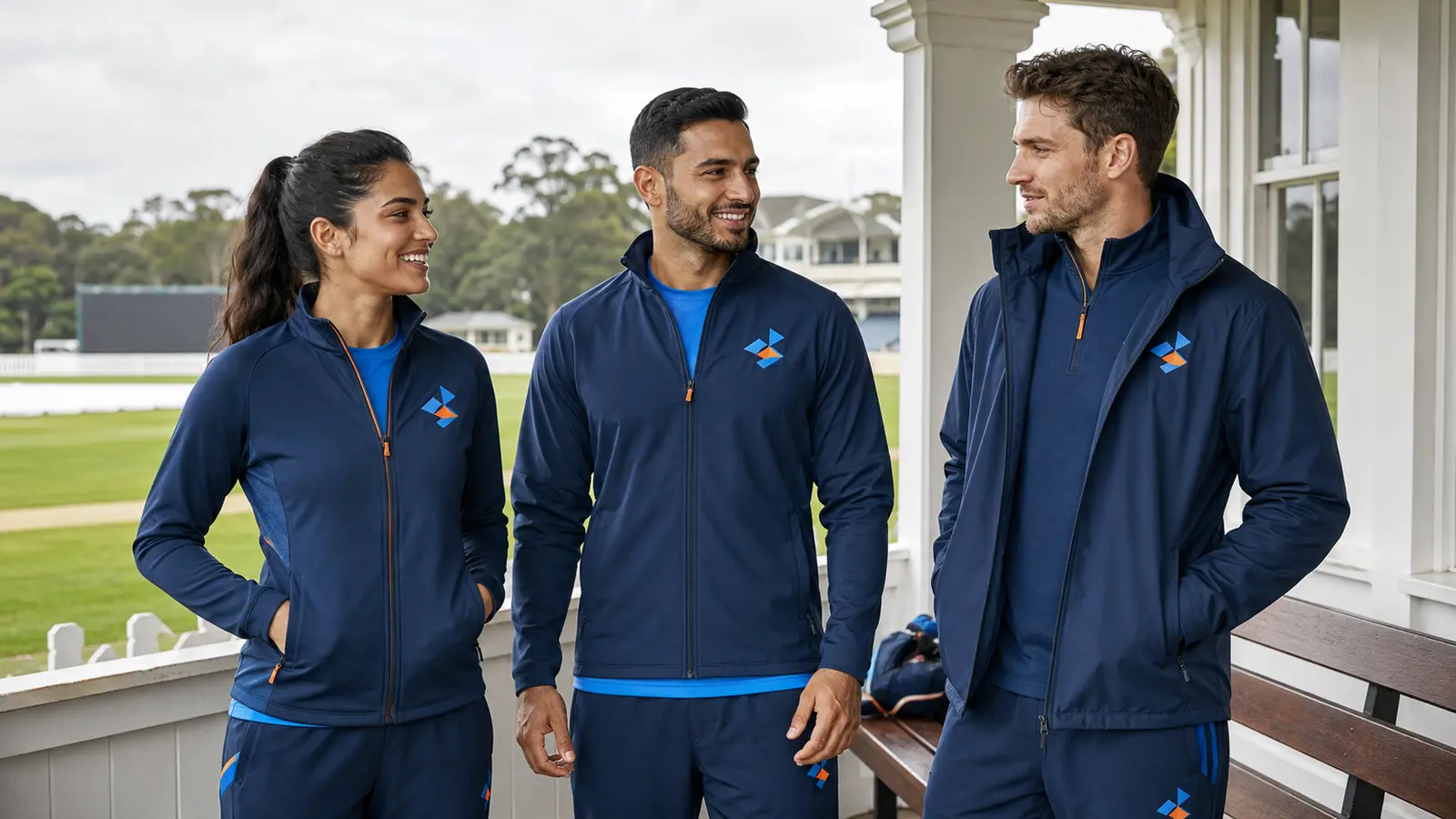
Best Cricket Team Warm-Up Jackets
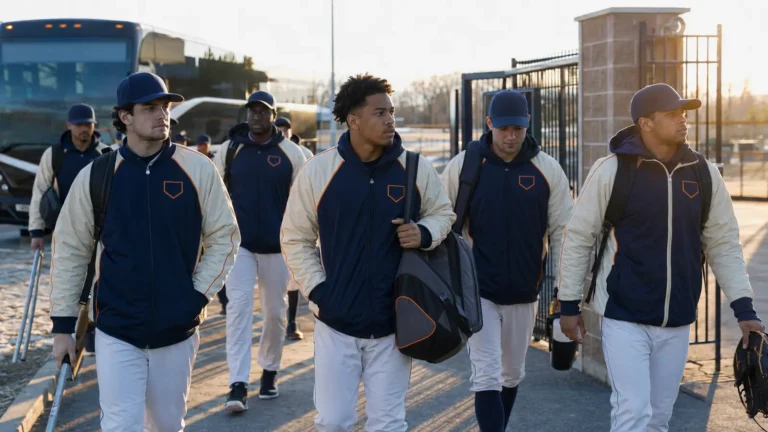
Cricket teams need more from a warm-up jacket than a matching color and a prominent crest. The garment has to work before play, during travel, beside the boundary and at official training sessions. It should let bowlers and batters move through dynamic drills, control light wind without trapping excessive heat, carry repeated branding consistently and remain presentable after a season of washing.
For schools, clubs, academies, distributors and private-label sportswear buyers, the “best” jacket is therefore not a single universal style. It is the style whose fabric, fit, construction and decoration method match the climate, training intensity, age range, care routine and budget of the program ordering it.
This guide explains how to build that specification. It compares lightweight woven shells, stretch-knit track jackets and lightly insulated options; shows what to check in a sample; and identifies the information a supplier needs to quote a custom order accurately.
Quick Answer: The best cricket team warm-up jackets are lightweight full-zip garments with unrestricted shoulder movement, a stand collar, secure pockets, dependable zippers and a fabric weight suited to the team’s climate. Choose a woven shell when wind resistance and packability matter, a stretch-knit track jacket for mobility and everyday training, or a lightly insulated jacket for cold sideline use. Approve fit, logo size, color, fabric hand feel and wash performance on a physical sample before bulk production.
Why the Warm-Up Jacket Specification Matters
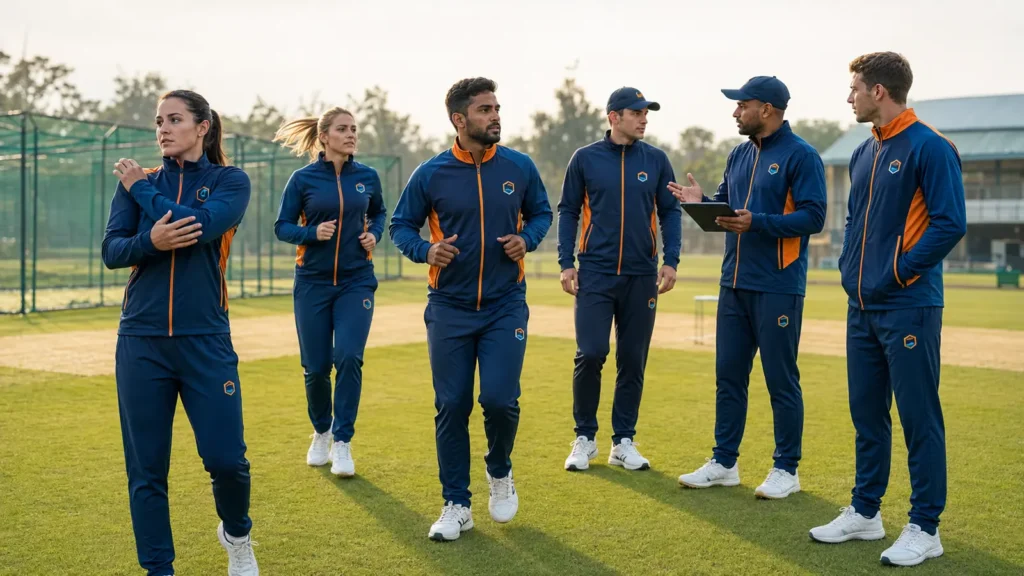
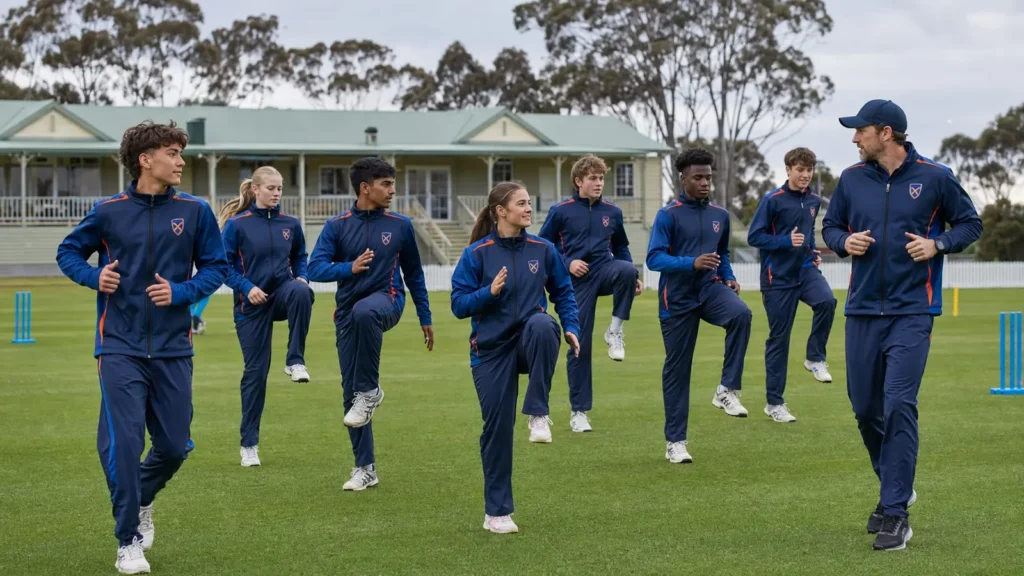
A cricket warm-up combines jogging, mobility work, throwing, catching and progressive bowling or batting movements. A jacket that feels acceptable while standing may pull across the back during a bowling action, ride up when arms are raised or become clammy after several minutes of movement. Conversely, an ultralight shell designed only for active drills may not provide enough comfort for substitutes or coaches who remain near the boundary.
The procurement decision also affects brand consistency. A small club may place one crest on the chest. A sponsored academy may require a team badge, sponsor marks, player initials and coordinated trousers. A distributor may need private labels, retail packaging and dependable repeat colors. Each additional requirement changes artwork setup, production control and cost.
Start with the use case, not the decoration catalogue. Define when the jacket will be worn, what players will wear underneath it and whether one style must serve athletes, coaches and supporters. Those answers determine the right fabric and block before any logo method is selected.
Best Cricket Team Warm-Up Jackets by Use Case
| Team requirement | Recommended starting point | Why it works | Main risk to check |
|---|---|---|---|
| High-intensity pre-match movement | Lightweight woven full-zip shell with articulated or raglan sleeves | Blocks light wind, packs easily and layers over a training shirt | Insufficient breathability or noisy, stiff fabric |
| Daily club or academy training | Stretch double-knit track jacket | Comfortable hand feel, good mobility and a clean team appearance | Pilling, snagging or excessive weight |
| Cool-weather sideline use | Lightly insulated bench jacket | Adds warmth for substitutes, coaches and travel | Too warm for active drills; added bulk and higher cost |
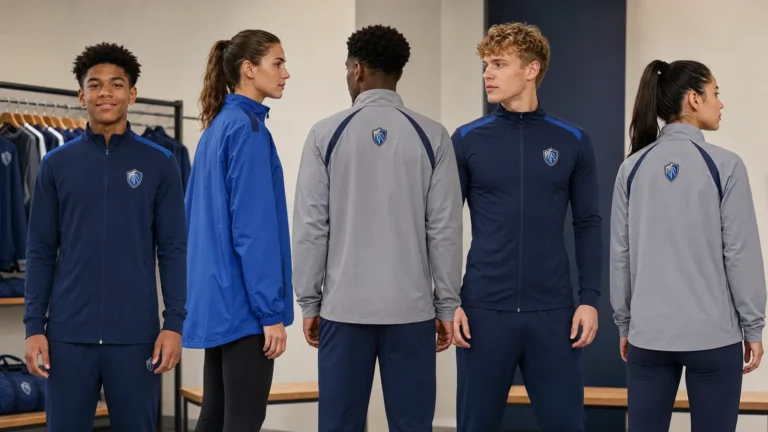
| Mixed youth and adult roster | Regular-fit unisex style plus youth grading, or separate adult/youth blocks | Easier allocation while preserving room for movement and layers | Simply scaling an adult pattern down for children |
| Sponsor-heavy design | Smooth woven or knit surface with planned heat-transfer and embroidery zones | Supports several marks without forcing all logos into one method | Decoration stiffness, poor placement or rule conflicts |
| Distributor/private-label program | Repeatable core fabric, controlled color standard and documented trim list | Makes reorders and range expansion easier | Lot-to-lot color or trim substitutions |
The table is a starting point rather than a performance guarantee. Fabric construction, finishing, garment pattern and decoration all affect the finished jacket. Two jackets described as “100% polyester” can behave very differently because one is a dense woven shell and the other is a soft knitted interlock.
Which Jacket Type Should a Cricket Team Choose?
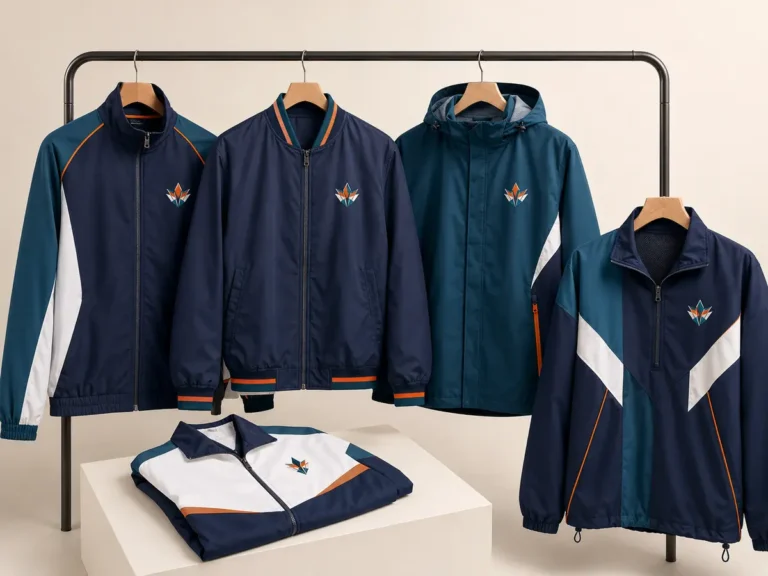
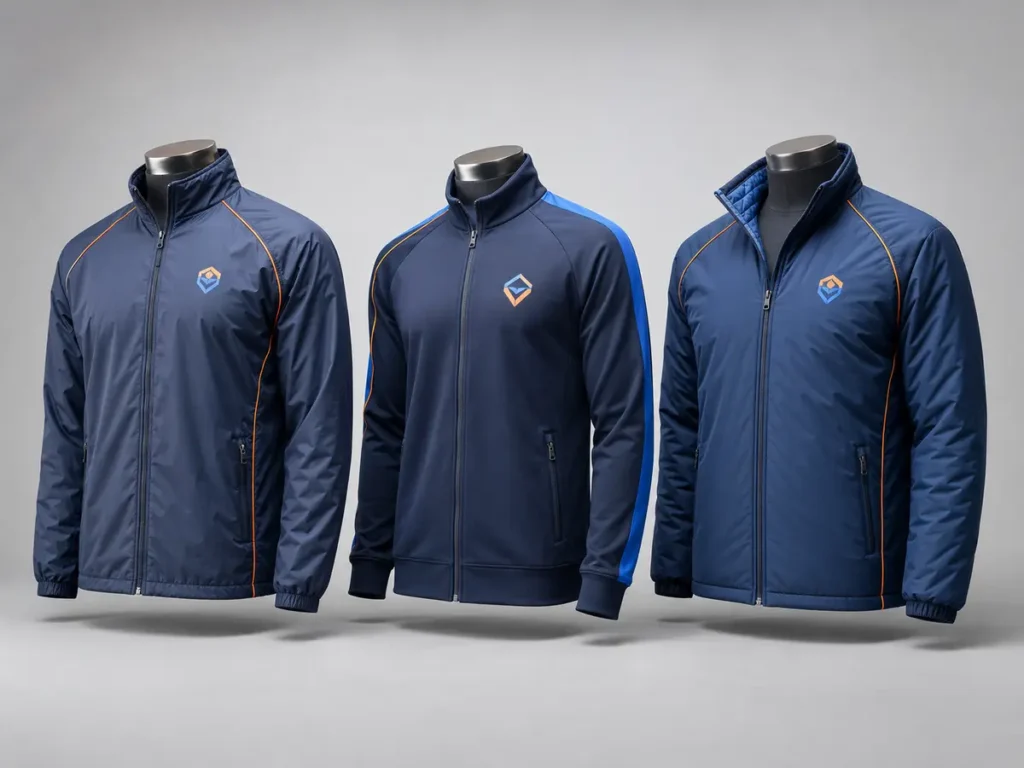
Lightweight Woven Full-Zip Shell
This is the strongest all-round starting point for a pre-match warm-up jacket. A lightweight polyester woven fabric provides a clean surface for color blocking and heat-applied marks, while its low bulk makes it easy to pack in a kit bag. A stand collar protects the neck from a breeze without introducing the visibility and safety issues that a loose hood can create during drills.
Ask whether the fabric has mechanical stretch or whether the pattern supplies the necessary movement through raglan sleeves, underarm shaping or a back yoke. A shell can feel restrictive even when the specification uses the word “stretch.” Test it with arms overhead, across the chest and through a simulated bowling action.
Choose this type for teams training in changeable but not severely cold weather, tournament travel, pre-match presentation and coordinated outerwear. If a water-repellent finish is requested, define the claim and the test method. “Water-repellent” does not mean “waterproof,” and neither should be accepted without a measurable specification.
Stretch-Knit Track Jacket
A double-knit or interlock track jacket typically feels softer and quieter than a woven shell. It works well for frequent training, indoor preparation, travel and staff apparel. The material can provide comfortable two-way or four-way movement, depending on construction and elastane content.
The trade-off is that heavier knits may retain more heat and take longer to dry. Surfaces can also pill or snag if yarn quality and finishing are poorly controlled. Inspect high-friction areas such as the underarm, side body and cuff. For embroidered badges, confirm that the fabric is stabilized so the logo does not ripple or pull the chest panel out of shape.
Hybrid Warm-Up Jacket
A hybrid design combines fabrics to place performance where it is needed. For example, a wind-resistant woven front can be paired with stretch-knit sleeves and side panels. This can balance weather protection and mobility, but it increases cutting, sewing and color-matching complexity. Each material may reflect light differently even when both are approved to the same color reference.
Use a hybrid only when the performance benefit justifies more sampling and production control. Buyers should approve the complete garment under both daylight and indoor light, not only review individual swatches.
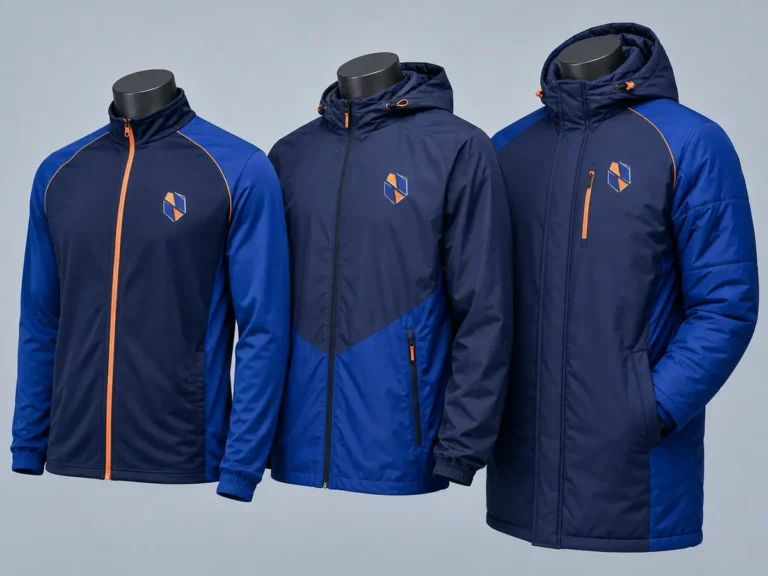
Lightly Insulated Bench Jacket
An insulated jacket is appropriate for cool travel, early-season matches, coaches and non-playing squad members. It should not automatically replace an active warm-up shell. Insulation can trap heat during dynamic drills and increase garment volume, freight cost and decoration constraints.
If one team needs both active and sideline layers, consider two coordinated products with the same color system and crest placement. This often performs better than forcing one compromise garment into every role.
Fabric Choices and Performance Specifications
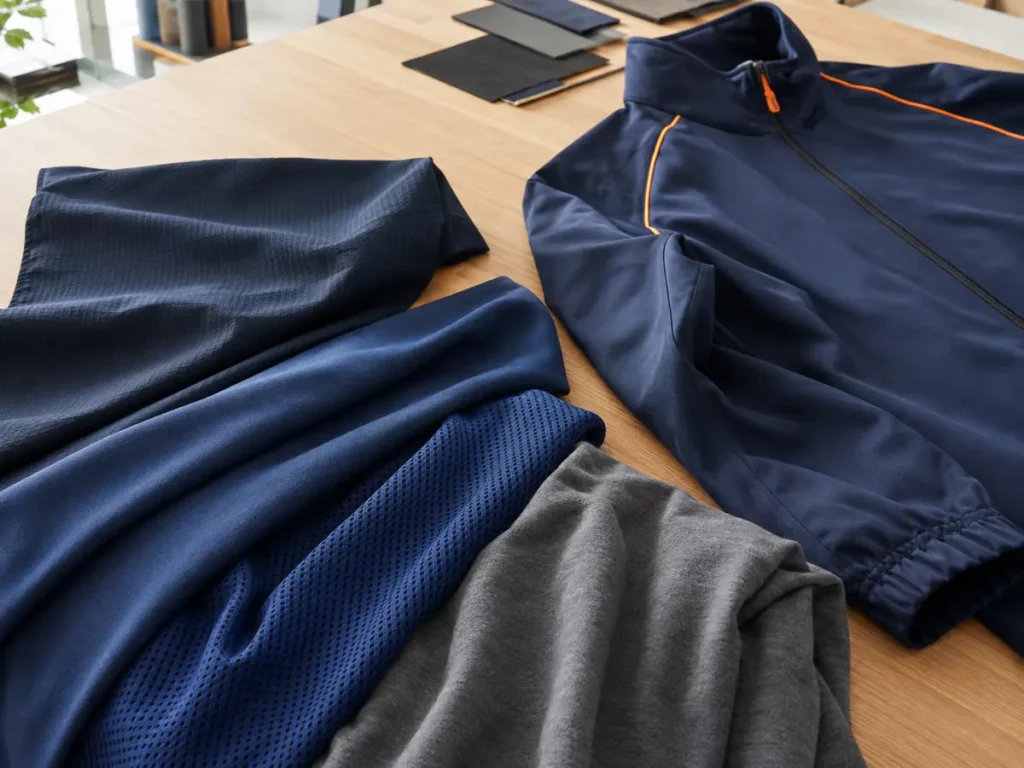
Fabric weight expressed in grams per square meter (GSM) is useful, but it is not a complete quality score. Higher GSM does not automatically mean more durable, warmer or better. Yarn, density, weave or knit structure, finish and garment design all matter.
| Material option | Typical value to the buyer | Appropriate uses | Questions for the supplier |
|---|---|---|---|
| Polyester woven shell | Low bulk, quick drying, clean color blocking | Active warm-up, travel, light wind | Is it plain weave, micro-ripstop or stretch woven? Is a finish applied? |
| Polyester interlock or double-knit | Soft hand, quiet movement, stable appearance | Daily training, staff, presentation | What is the finished GSM? How is pilling controlled? |
| Polyester-elastane knit | Enhanced stretch and recovery | Athletic-fit designs and high mobility | What are the fiber percentages and stretch/recovery results? |
| Mesh panel | Ventilation in targeted zones | Underarms, upper back or pocket bags | Is it exposed or backed? Will it snag? Does color match the shell? |
| Brushed inner face | Warmer and softer next to the body | Cool-weather training and travel | How does brushing affect pilling, drying and decoration? |
| Light insulation plus lining | Added warmth for low-activity periods | Bench, coach and travel jackets | What is the fill type and weight? How will quilting affect logo zones? |
Breathability and Moisture Management
Warm-up jackets do not need to behave like match jerseys, but they should release enough heat for their intended activity. Breathability can come from the base fabric, back vents, mesh inserts or a pattern that allows air movement. A coated shell may block more wind while also reducing moisture transfer.
Do not rely on the phrase “breathable fabric” alone. Ask for the fabric construction, finish and any available test report, then confirm comfort in a wear trial. If a numeric claim is important to your marketing or tender, agree on the relevant method, sample condition and minimum result before ordering.
Wind and Light-Rain Protection
For many cricket programs, resistance to light wind is more useful than heavy rain protection. Players normally move off the field in sustained rain, while a dense waterproof laminate can feel excessive during warm-up. A light woven shell with a tested water-repellent finish may handle brief drizzle, but the buyer should avoid presenting it as waterproof unless the entire garment construction supports that claim.
The current AATCC TM22 spray test measures a textile fabric’s resistance to surface wetting and is particularly useful for evaluating water-repellent finishes. It does not, by itself, prove that a complete jacket will prevent water penetration through zippers and seams. See the AATCC description of TM22 when specifying this option.
Colorfastness, Abrasion and Dimensional Stability
Dark navy, black and saturated team colors can reveal rubbing, wash fading and migration onto light panels. For repeat programs, specify objective test methods where the risk justifies the cost. ISO 105-C06 covers colorfastness to domestic or commercial laundering, while ISO 105-X12 evaluates color transfer through dry and wet rubbing. ISO 105-C06 and ISO 105-X12 describe the scope of those methods.
Abrasion testing can help compare non-coated fabrics. ISO 12947-2 defines a Martindale procedure for determining specimen breakdown. Dimensional change can be assessed using ISO 5077 with agreed washing and drying procedures such as those in ISO 6330. The buyer and supplier still need to agree on acceptable results; naming a test without setting a requirement is incomplete.
Fit, Size Grading and Layering
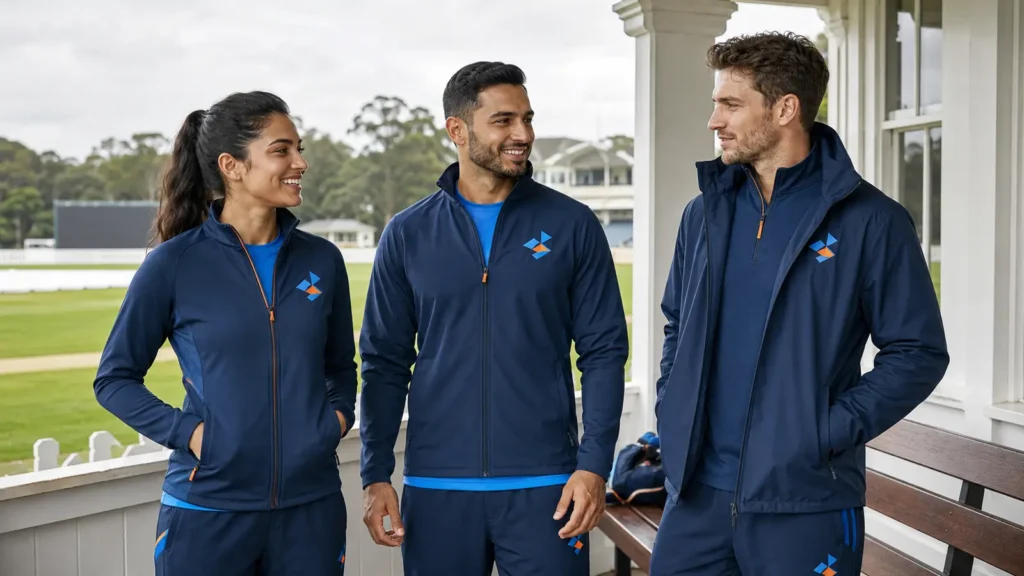
The best fit is athletic enough to look coordinated but generous enough for cricket movement and the intended base layers. Players should be able to raise both arms, rotate the torso, bend at the waist and complete a bowling-motion trial without tightness across the back or shoulders.
Decide whether the jacket will be worn over a T-shirt, match jersey, fleece or sweater. Provide that information during pattern development. A sample approved over a thin shirt may feel too small when the team later adds cold-weather layers.
For mixed rosters, compare three approaches:
- Unisex regular fit: simplifies ordering and stock management, but may not suit every body shape.
- Separate men’s and women’s blocks: can improve fit and presentation, but increases sampling, size allocation and minimum-quantity complexity.
- Adult and youth blocks: important when a program covers schools or academies; youth proportions should be deliberately graded rather than created by shrinking an adult pattern.
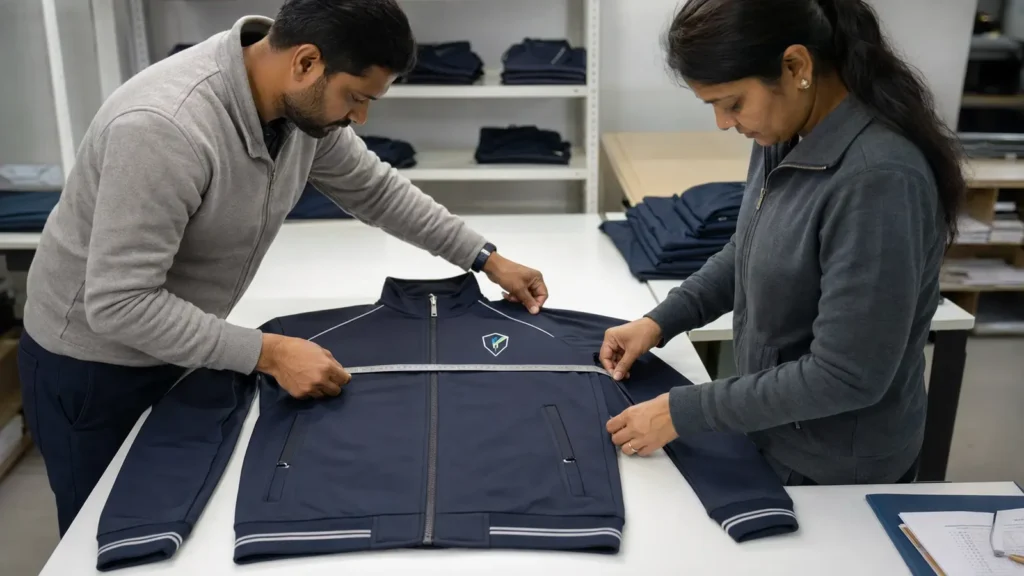
Request a finished-garment measurement chart, not only body-size labels. At minimum, review chest width, back length, sleeve length, shoulder or raglan measurement, hem width and collar height. Record the measurement tolerance and the method used to lay out and measure the garment.
Construction Details That Improve Durability
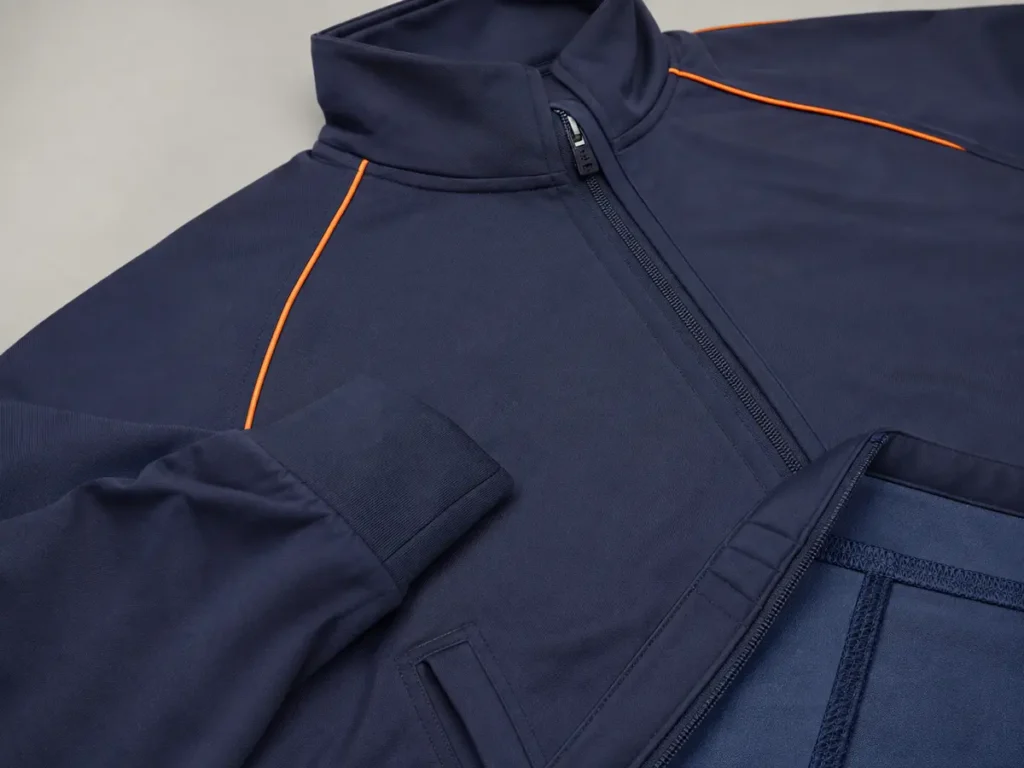
Construction should support movement, repeated dressing and regular laundering. A practical cricket warm-up jacket normally benefits from:
- a smooth full-length zipper with a top guard or clean collar finish;
- a stand collar that remains comfortable when zipped;
- raglan, set-in or articulated sleeves tested through cricket-specific movement;
- secure zip pockets that can hold keys or a phone during travel;
- cuff and hem finishes that recover after stretching;
- reinforced pocket openings and high-stress seams;
- tidy interior seams that do not rub or unravel; and
- stable decoration zones that keep badges flat.
Inspect zipper alignment at the collar and hem. A wavy zipper can indicate differential feeding between tape and fabric. Check whether pockets lie flat, whether the sleeve twists and whether left and right panels mirror each other. For woven jackets, seam puckering often becomes more visible under directional light or after washing.
If seam strength is a contractual requirement, buyers can discuss an appropriate method with the testing laboratory. The 2026 edition of ISO 13935-2 covers maximum force to seam rupture using the grab method for applicable sewn fabrics and made-up articles. The method does not replace an agreed acceptance value or garment wear trial.
Custom Logos, Sponsor Marks and Private Labeling
Decoration should be planned with the fabric and end use, not added after the garment is finalized.
Embroidery creates a dimensional, traditional badge appearance and works well for a team crest or small chest mark. It adds stitches, backing and local stiffness, so large areas can distort lightweight fabric.
Heat transfer suits detailed sponsor logos, names, initials and smaller quantities of variable artwork. The transfer film and adhesive must be compatible with the fabric finish, wash conditions and stretch. Test dark or treated fabrics for dye migration.
Screen printing can be cost-effective for simple repeat graphics, subject to fabric and finish compatibility. It requires appropriate setup and is less convenient for many changing player names.
Woven or rubber/PVC patches provide a distinct branded finish and can be prepared separately before application. Confirm patch thickness, edge finish, placement and wash behavior.
For a consistent team system, create an artwork placement sheet showing the front, back and both sleeves. Record logo width and height, distance from seams, approved colors and decoration method. Keep sponsor artwork in vector format where possible and provide a fallback color reference for each mark.
Before approving personal messages or sponsor placements for governed competitions, check the applicable event and governing-body rules. The ICC’s Clothing and Equipment Regulations effective from January 2024 state that official training kit includes tracksuits and sweatshirts and should be uniform to team members. For bilateral international cricket, the regulations address permitted logos and approval; event-specific rules can take precedence. Most schools and domestic clubs follow their own association or competition policies, so buyers should confirm those requirements before artwork is locked.
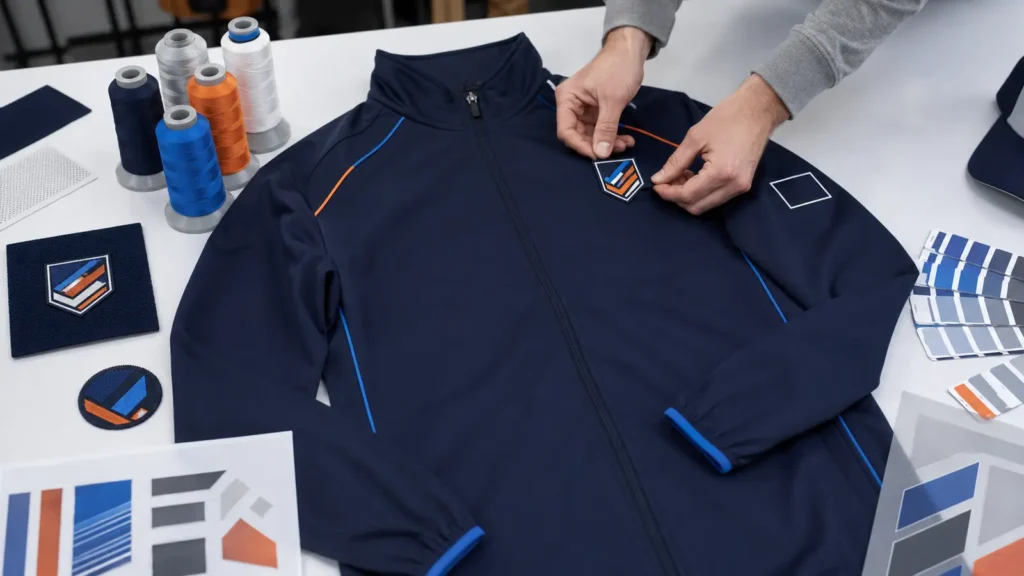
Planning a custom range? Send JIUMU your reference image or tech pack, quantities by size, target colors, logo files, preferred fabric, packaging needs and target delivery date. The team can then confirm feasible construction, sampling steps and a quotation. Request a custom team jacket quotation.
What Drives the Cost of Custom Cricket Warm-Up Jackets?
The unit price depends on the finished specification, not only the number of jackets. Important cost drivers include:
- Fabric and lining: stretch yarns, special finishes, mesh zones, brushed surfaces and insulation change material and processing cost.
- Pattern complexity: multiple color panels, hybrid materials, articulated sleeves and custom blocks add development and sewing time.
- Decoration: logo count, size, stitch density, transfer area and player personalization all matter.
- Order quantity and size mix: more pieces usually distribute setup cost more efficiently, while a wide size range can require more handling.
- Labels and packaging: woven labels, size labels, hangtags, individual bags, barcodes and retail cartons add components and control points.
- Sampling and testing: repeated prototypes, wear samples, lab tests and pre-production samples should be budgeted when the risk warrants them.
- Delivery plan: production timing, shipping mode, carton volume and destination requirements affect landed cost.
For useful supplier comparisons, send the same specification and Incoterm request to every candidate. A lower quote may exclude player names, custom labels, testing, packaging or freight. Compare inclusions line by line rather than comparing one headline number.
Sample Approval and Quality-Control Checklist
A physical sample is the point where a digital concept becomes an observable product. Review it in the order the team will use it:
1. Appearance and Color
Check shell, mesh, rib, zipper tape, thread and logos under daylight and indoor light. Confirm whether the approved standard is a physical swatch, a Pantone reference or a lab dip. Note that different materials can appear slightly different because surface texture changes light reflection.
2. Measurements and Movement
Measure the sample using the supplier’s measurement method. Conduct an active trial: arms overhead, cross-body reach, torso rotation, deep bend and a controlled bowling-motion simulation. Record the wearer’s body measurements and base layers.
3. Workmanship and Function
Run the zipper repeatedly. Load the pockets lightly. Stretch cuffs and hem, then observe recovery. Inspect seam security, loose threads, puckering, symmetry and any sharp or uncomfortable edges.
4. Decoration
Measure every logo and its distance from reference seams. Look for embroidery puckering, patch lifting, transfer edge lift, color migration and unwanted adhesive marks. Compare player personalization for spelling and number accuracy.
5. Care and Repeatability
Wash the sample according to the intended care label and review dimensional change, color, surface appearance, zipper function and decoration. If objective testing is required, define the test method, sample source, laboratory, acceptance value and reporting format in the purchase specification.
| QC stage | What to verify | Evidence to retain |
|---|---|---|
| Development sample | Silhouette, movement, pocket layout and fabric combination | Comment sheet with photos and measurement notes |
| Size set | Grading across small, middle and large sizes | Signed measurement chart and fit comments |
| Pre-production sample | Final colors, logos, labels, trims and packaging | Approved physical sample or sealed reference |
| In-line inspection | Critical operations before all pieces are complete | Inspection record and corrective-action notes |
| Final inspection | Quantity, measurements, workmanship, decoration and packing | Final report, carton list and reference photos |
How to Plan a Bulk Order
Step 1: Define the Roster and Usage
List players, coaches and staff; separate adult and youth requirements; and state whether the jacket is for active warm-up, travel, sideline use or retail. Add an allowance for late registrations, replacements and future reorders where appropriate.
Step 2: Prepare the Design Brief
Send front and back concepts, color references, logo files, sponsor requirements and placement dimensions. Identify which details are fixed and which can be optimized by the supplier.
Step 3: Select Fabric and Construction
Compare swatches for hand feel, weight, stretch, opacity, noise and color. Confirm cuffs, hem, pockets, zipper, ventilation and lining. Avoid approving a material from a photo alone.
Step 4: Approve Mockup and Sample
Confirm artwork on a digital mockup, then validate the physical product. Consolidate comments into one controlled revision document. Multiple decision-makers should resolve conflicts before comments are returned to the supplier.
Step 5: Lock the Purchase Specification
The final order should identify style code, quantities by size, measurements and tolerances, fabric, color standard, trims, artwork, labels, packaging, inspection plan, shipping terms and required date. Record any permitted substitutions in writing.
Step 6: Inspect and Preserve Reorder Data
Use the approved sample during production and final inspection. After shipment, retain artwork versions, measurement charts, fabric references, trim details and packing data so the next order starts from a controlled specification.
Questions to Ask a Custom Jacket Supplier
- Which fabric construction and finished weight do you recommend for our climate and activity level?
- Can you provide both youth and adult grading, and how are the blocks different?
- What finished-garment measurements and tolerances will be used?
- Which logo method is most compatible with each fabric and placement?
- How will you control color across shell, mesh, zipper tape, rib and decoration?
- What sample stages are included, and what happens after a revision?
- Which tests can be arranged, and who sets the acceptance criteria?
- How are player names, numbers and individual sizes checked?
- What labels, hangtags, bags, barcodes or carton marks can be customized?
- What information will be retained to support a repeat order?
- What is included in the quotation, and which shipping term is used?
Common Buying Mistakes
Choosing by appearance alone. A polished mockup cannot prove mobility, heat management, zipper quality or wash behavior.
Treating fiber content as a full fabric specification. “Polyester” covers many woven and knitted structures with different weights, finishes and performance.
Using one fit sample for every roster. Adult, youth and gender-specific needs should be considered before grading is approved.
Overloading a lightweight jacket with embroidery. Large, dense designs can stiffen and distort thin panels. Combine methods when necessary.
Calling a garment waterproof without defining the claim. Fabric repellency, water resistance and complete-garment protection are different concepts.
Ignoring competition logo rules. Artwork that is acceptable for practice may not be permitted at a governed event. Check before production.
Approving colors only on a screen. Displays vary, and the same color behaves differently on woven fabric, mesh, thread and transfer film.
Skipping a controlled pre-production sample. Bulk inspection has no reliable reference if final trims, labels, artwork and measurements were never locked.
Why Source Custom Cricket Team Jackets from JIUMU?
JIUMU supports B2B buyers in North America, the United Kingdom and Europe with custom teamwear, logo apparel, hats, uniforms, bags and branded merchandise. The typical minimum order quantity is 50 pieces, subject to the jacket structure and customization.
Available development capabilities include OEM and ODM support, fabric sourcing, Pantone color matching, digital mockups, physical samples, embroidery, sublimation, screen printing, heat transfer, woven and rubber/PVC patches, private labels, hangtags, packaging customization, bulk production quality control and export support.
That range is useful when a buyer wants the jacket to coordinate with custom team uniforms, custom team jerseys, custom cricket caps or team bags. The practical advantage is not a generic promise of quality; it is the ability to document colors, artwork, sizing, trims and packaging across a program.
Frequently Asked Questions
Final Recommendation
For most clubs, schools and academies, begin with a lightweight full-zip woven or stretch-knit jacket with a stand collar, secure pockets and a movement-tested pattern. Select the warmer bench version only where climate and low-activity use justify it. Keep decoration proportional to the fabric, define performance claims through agreed methods and treat the pre-production sample as the controlling reference for bulk work.
The best cricket team warm-up jackets are not the ones with the longest feature list. They are the garments whose specifications are clear enough to sample, inspect, reorder and use confidently across the whole program.
About the author
JIUMU Teamwear Sourcing Team develops practical guides for professional buyers sourcing custom teamwear, uniforms, hats, bags and branded merchandise. About JIUMU.