Best Custom Team Hoodies: Comfort, Branding and Bulk Ordering
Custom team hoodies look simple until a buyer has to approve fabric, fit, colors, logos, size ratios, labels, packaging and delivery for an entire group. A good hoodie must feel comfortable on the first wear, represent the team clearly and remain consistent across dozens or hundreds of pieces. Those goals depend on specifications—not on choosing the lowest unit price or the heaviest fabric in a supplier’s catalog.
This guide explains how schools, sports clubs, academies, uniform dealers, promotional buyers and private-label brands can select the best custom team hoodies for their program. It covers hoodie types, materials, fabric weight, fit, decoration, durability, compliance checkpoints, costing and bulk-order management. It also shows what to send a supplier so the first quotation is useful.
Quick Answer: The best custom team hoodies combine a fabric suited to the climate and activity, a fit tested on the actual wearer group, a decoration method matched to the artwork, and documented approval standards for color, measurements and logo placement. For most mixed-use team programs, a cotton-faced cotton/polyester fleece in a practical mid-to-heavy weight, with reinforced pockets and stable ribbing, offers a useful balance of comfort, printability and repeat-order consistency. Buyers should approve a physical sample before bulk production and treat the size chart, color standard, artwork file and packaging instructions as controlled specifications.
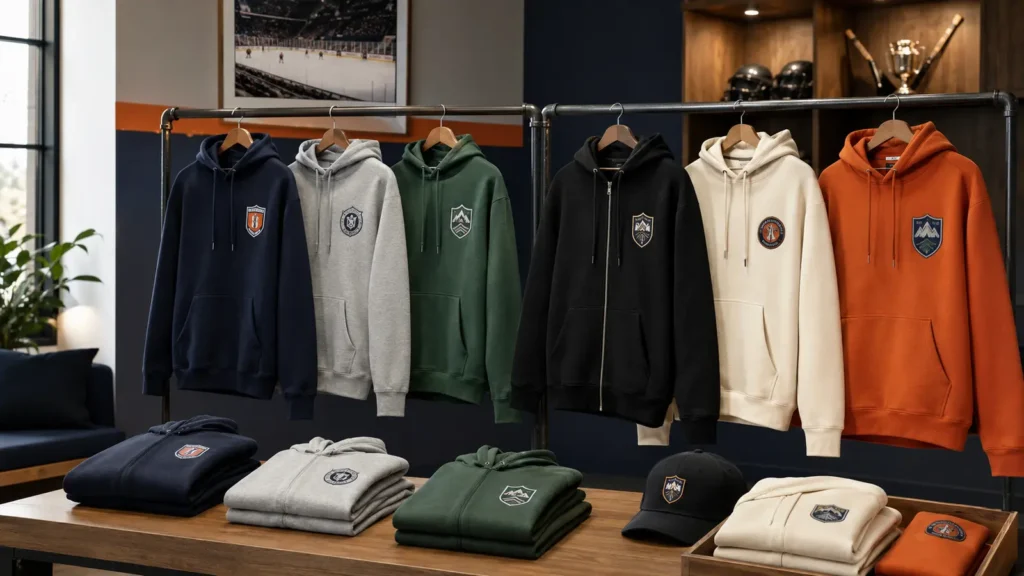
What Makes a Custom Team Hoodie “Best” for Bulk Buyers?
“Best” is not one universal fabric or construction. The right hoodie is the one that satisfies the program’s real operating conditions.
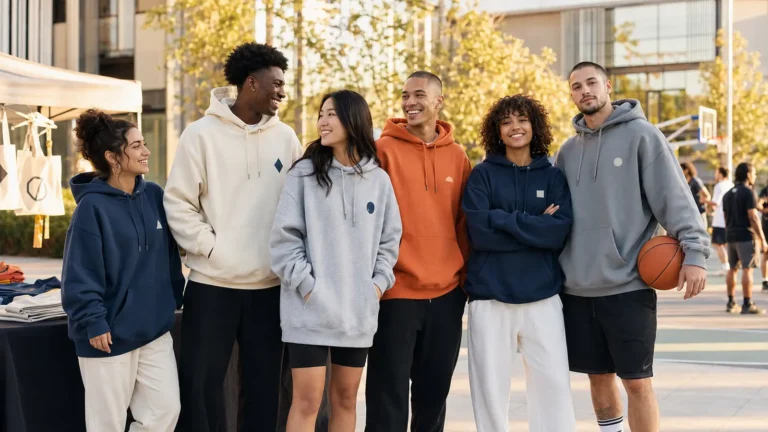
A school spirit-wear hoodie may prioritize softness, broad sizing and easy decoration. A baseball club’s travel hoodie may need a warmer fabric, secure pockets and dependable color matching with jerseys and caps. A training academy may prefer a lighter, faster-drying polyester-rich fabric. A merchandise brand may care most about a distinctive silhouette, private labels and retail-ready packaging.
The purchasing decision should therefore be made against six criteria:
- Wear environment: indoor warm-up, outdoor travel, everyday campus use, staff uniform or retail merchandise.
- Climate and season: lightweight layering, all-season fleece or cold-weather warmth.
- Wearer profile: youth, adult, unisex, women’s, tall or extended sizes.
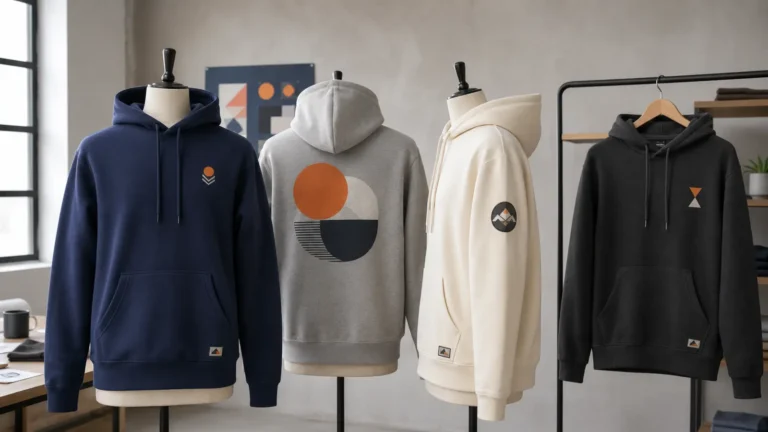
- Branding plan: embroidery, screen print, heat transfer, patch or a combination.
- Care expectations: individual home washing, frequent team laundry or resale to consumers.
- Order model: one event, seasonal team issue, repeat replenishment or private-label program.
The strongest purchase specification connects every visible feature to one of these needs. A 400 GSM hoodie is not automatically better than a 300 GSM hoodie, and a complex embroidered back design is not automatically more premium than a clean screen print. Performance depends on how the garment will be worn, washed, decorated and reordered.
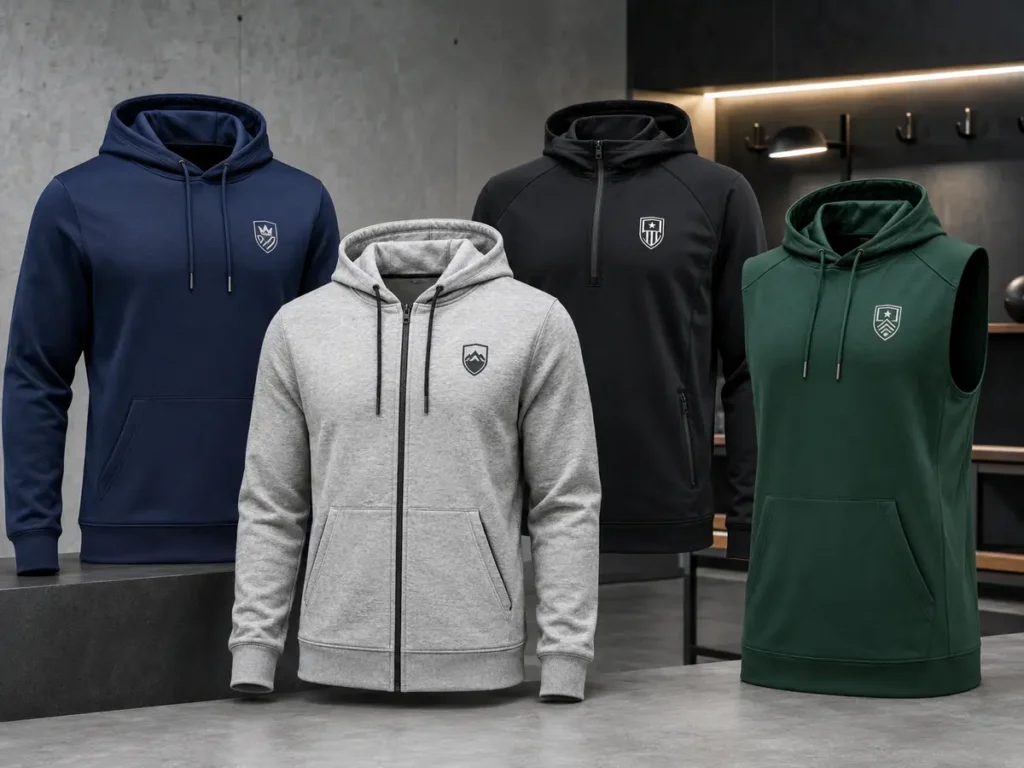
Custom Team Hoodie Types Compared
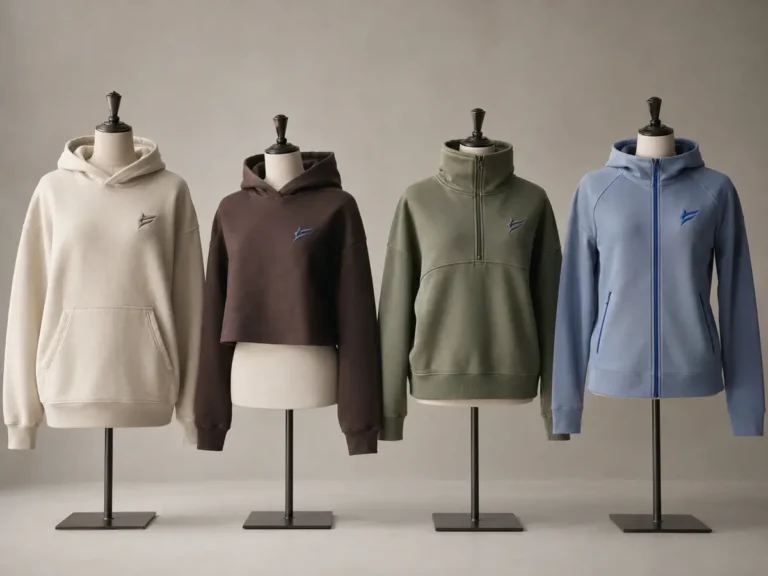
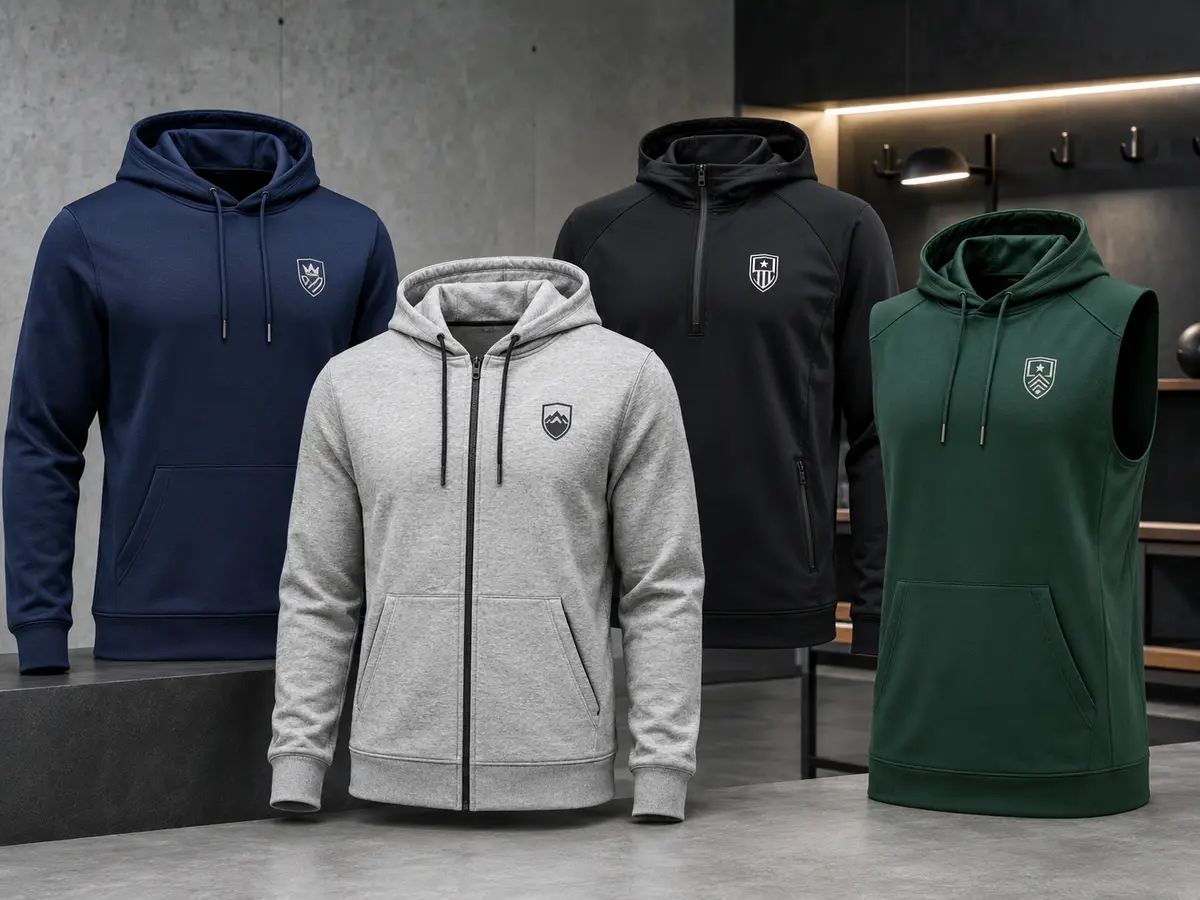
The silhouette affects comfort, usable decoration area, cost and how easily players can layer the hoodie over uniforms.
| Hoodie type | Best suited to | Main advantages | Buying considerations |
|---|---|---|---|
| Pullover hoodie | School teams, clubs, fanwear and merchandise | Familiar shape, large front or back branding area, simple construction | Kangaroo pocket can limit oversized front artwork; confirm hood and drawcord details |
| Full-zip hoodie | Coaches, travel programs, staff and layered uniforms | Easy on/off, flexible temperature control, practical for sideline use | Zipper interrupts front graphics; zipper quality and placket alignment matter |
| Quarter-zip hooded top | Training programs and modern team collections | Athletic appearance, easier venting, useful for warm-ups | Requires careful zipper, collar and hood engineering; often higher sampling complexity |
| Sleeveless hoodie | Gym, training and lifestyle collections | Greater arm mobility and distinctive merchandise style | Not ideal as a primary cold-weather layer; armhole shape must be sampled |
| Oversized or relaxed hoodie | Streetwear-led clubs and private-label brands | Contemporary silhouette, strong merchandise value | Higher fabric consumption; standard “unisex” grading may not create a true oversized fit |
| Performance hoodie | Outdoor training and travel | Lighter feel, faster moisture movement when the fabric is designed for it | Specify exact fabric construction; “performance” alone is not a measurable specification |
For a mixed team, the pullover is usually the simplest core style. A full-zip version can be added for coaches and staff, but splitting the order may affect minimums and price. Use one base fabric and a controlled color standard when consistency matters.
Choose Fabric by End Use, Not by Fiber Name Alone
Fiber composition is only one part of fabric performance. Two hoodies described as “80% cotton, 20% polyester fleece” can feel and behave differently because of yarn type, knit structure, weight, finishing, brushing and shrinkage control.
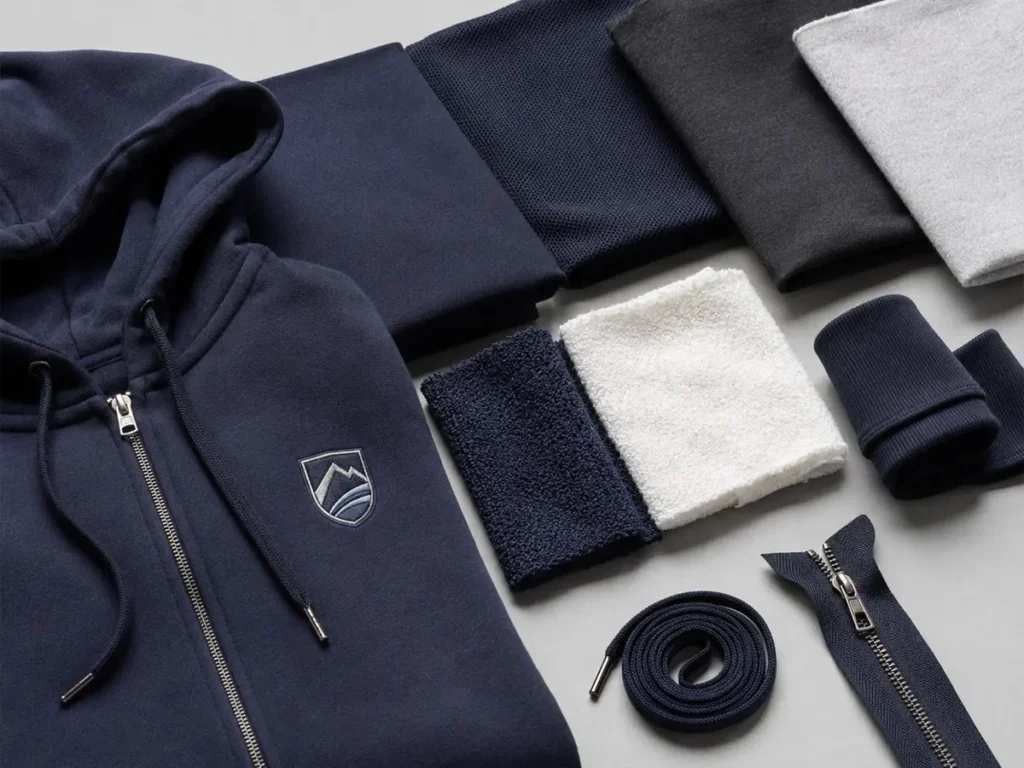
Cotton-rich fleece
Cotton-rich fleece is popular for team merchandise because the outer surface can feel natural and accept many print methods well. The brushed inner face provides warmth and softness. However, buyers should confirm shrinkage expectations, surface pilling, colorfastness and whether the outer face is suitable for detailed printing.
Cotton/polyester blend fleece
A cotton/polyester blend can balance a soft hand with improved dimensional stability and practical durability. A cotton-faced construction may be particularly useful when the buyer wants a smooth print surface while retaining polyester in the structure. The actual face fiber, inner pile and blend ratio should be listed in the specification rather than inferred from a generic product name.
Polyester-rich performance knit
Polyester-rich hoodies can be useful for training, travel and wet or changeable conditions. They may feel lighter and dry faster than absorbent cotton-rich garments, depending on the knit and finish. Buyers should request an actual swatch and sample because some polyester fleece has a smooth athletic appearance, while other versions can feel bulky or develop surface shine.
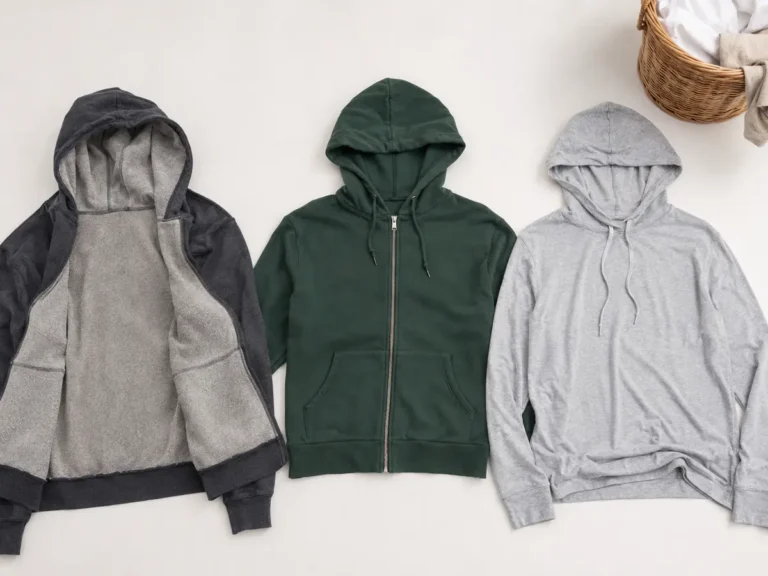
French terry
French terry has visible loops on the inner face rather than a fully brushed pile. It often works well for transitional seasons, indoor environments and buyers who want a less insulated layer. Weight still matters: French terry can range from light layering fabric to substantial premium merchandise fabric.
What Fabric Weight Should Team Hoodies Use?
Fabric weight is commonly expressed in grams per square meter (GSM). It helps describe mass, but it does not directly measure warmth, durability or quality. A compact 300 GSM fabric can feel more substantial than a lofty but loosely constructed heavier fabric.
| Practical weight band | Typical use | Buyer priority | Potential trade-off |
|---|---|---|---|
| About 220–280 GSM | Indoor training, warm climates, lightweight layering | Breathability, packability and freedom of movement | Less insulation and a lighter retail hand |
| About 280–340 GSM | General teamwear, schools, clubs and all-season use | Balanced comfort, decoration and cost | Must check whether the fabric is brushed, loopback or smooth |
| About 340–420 GSM | Cold-weather travel, premium merchandise and heavy layering | Warmth, structure and substantial feel | Higher fabric consumption, shipping weight and drying time |
| Above about 420 GSM | Niche heavyweight streetwear or cold-climate programs | Dramatic structure and premium fashion positioning | Higher cost, bulk and greater need for fit sampling |
These ranges are planning references, not performance guarantees. The buyer should compare swatches or samples under the same conditions and confirm finished garment weight if it matters. A quotation should identify composition, GSM, knit type, face finish, inner finish and color.
Fit and Size Planning for Real Teams
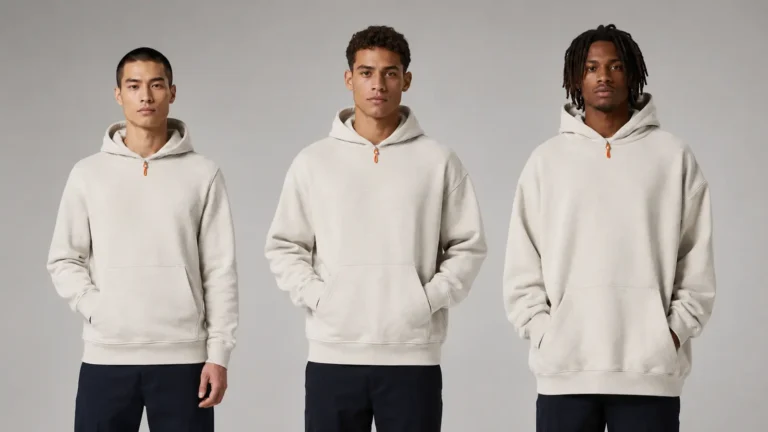
Fit errors create more complaints than small changes in decoration. A team order often covers people with different heights, body shapes and layering habits, so a generic size name is not enough.
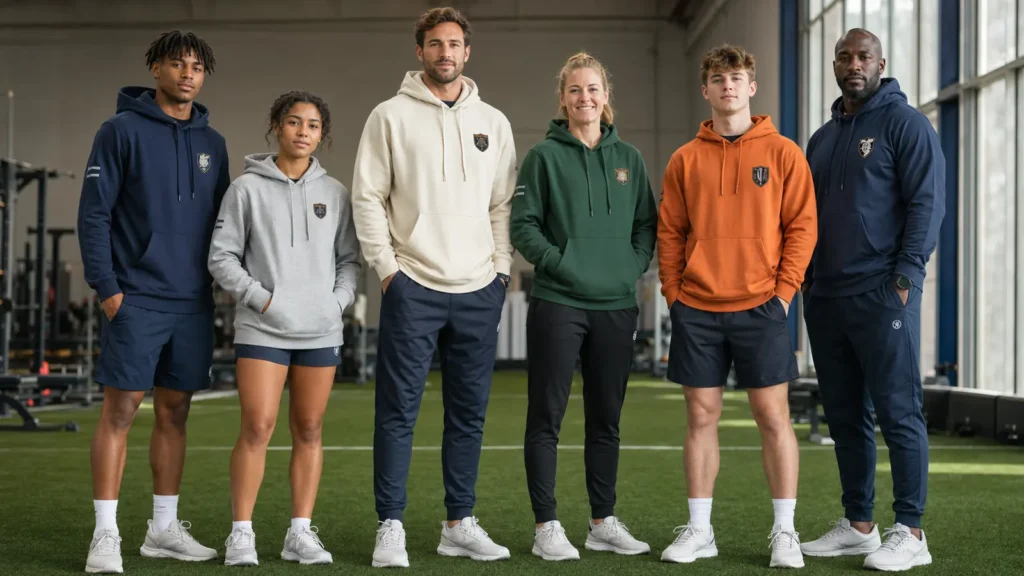
Start with a finished-garment measurement chart. At minimum, confirm chest width, body length, shoulder width, sleeve length and bottom opening. For raglan sleeves, specify the supplier’s sleeve measurement method. State whether dimensions are measured flat and whether tolerance is applied per point.
Standard, athletic and relaxed fits
- Standard fit is usually the safest starting point for broad team distribution.
- Athletic fit can suit training programs but may feel restrictive over uniforms or protective layers.
- Relaxed fit provides easier layering and a current lifestyle appearance.
- Oversized fit requires intentional pattern proportions; simply ordering one size larger changes sleeve and body length as well as width.
For youth and adult programs, compare the largest youth size with the smallest adult size. Check hood volume, pocket position, drawcord treatment and logo scale separately. If a complete size-set is not practical, request the smallest, middle and largest sizes. Collect wearer sizes only after the chart is final.
Construction Details That Affect Comfort and Durability
Durability is the result of several ordinary details working together. Buyers should inspect them rather than relying on a broad “premium quality” description.
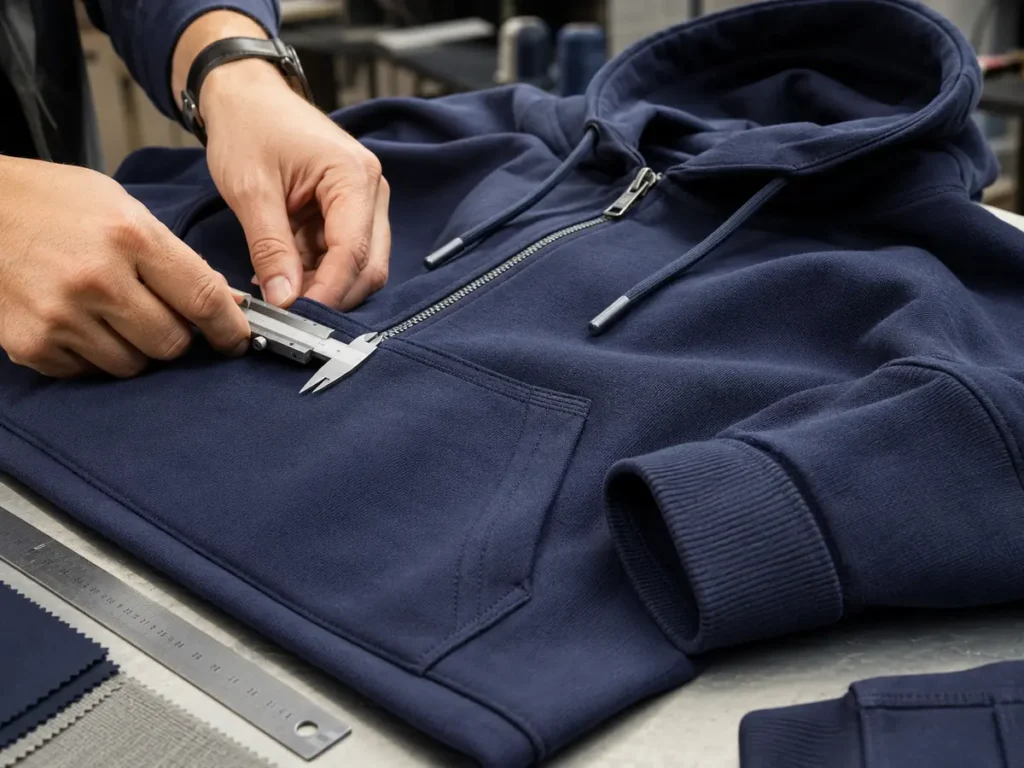
Seams and stress points
Check seam type, stitch density and cleanliness at the armholes, shoulders, hood, side seams and sleeve cuffs. Kangaroo pocket corners and zipper ends are common stress points. Reinforcement may be achieved through bartacks or controlled stitch patterns, depending on the design.
Ribbing
Cuffs and hems should recover after stretching without feeling excessively tight. Rib color should match or intentionally contrast with the body. On repeat orders, rib shade and stretch are important control points because a substitute rib can change both appearance and fit.
Hood construction
A double-layer or lined hood can feel more substantial and hide the reverse of certain decoration, but it adds weight and cost. Confirm whether the hood overlaps at the neck, whether a center seam is present and how the neckline is finished. For youth products, drawcord design requires special attention.
Pockets and zippers
Confirm pocket opening size, pocket bag depth and placement. On zip hoodies, specify zipper material, color, puller design and whether the zipper is exposed or covered. A sample should be zipped and unzipped repeatedly and checked for fabric catching, waviness and front-panel mismatch.
Select the Right Branding Method
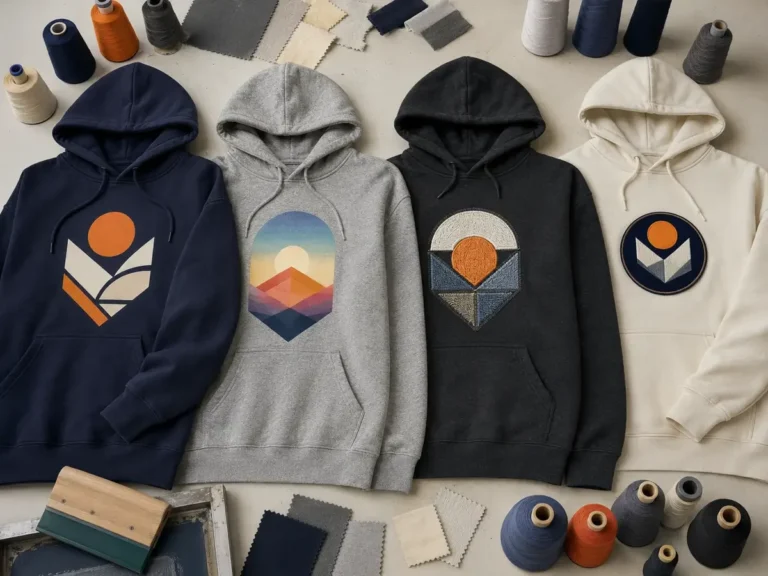
Decoration must fit the artwork, fabric and order quantity. The best custom team hoodies often use two methods strategically rather than applying the same method everywhere.
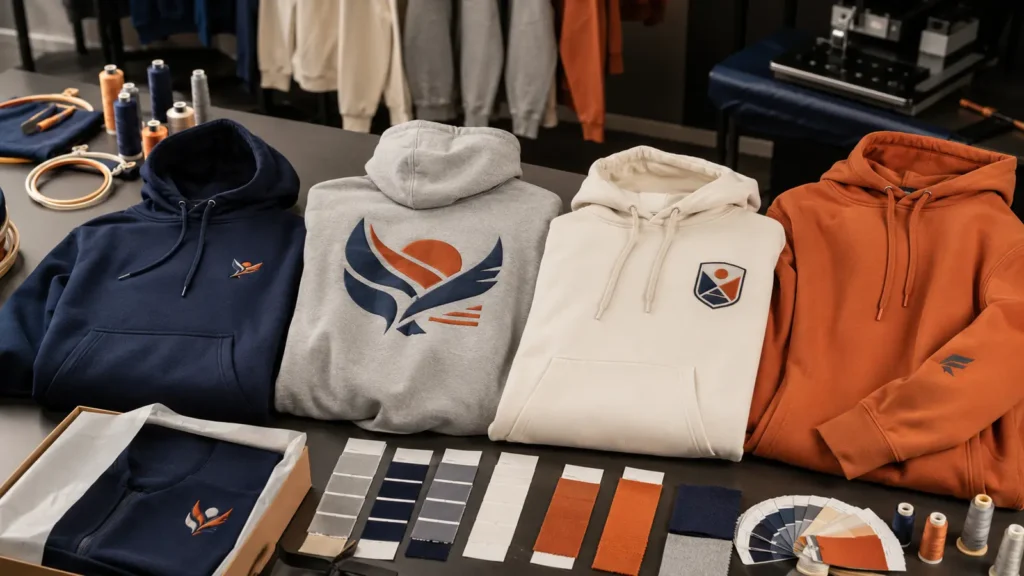
| Branding method | Strong use case | Strengths | Watch points |
|---|---|---|---|
| Embroidery | Left-chest crests, initials and compact marks | Dimensional, durable appearance; strong for staff and club identity | Dense artwork can stiffen fleece; small text and fine lines may need simplification |
| Screen printing | Large front or back graphics and event designs | Efficient for repeated colors and bold artwork; smooth visual impact | Setup depends on color count; test ink behavior and curing on the selected fabric |
| Heat transfer | Names, numbers, short runs and multicolor details | Flexible personalization and clean detail | Adhesion, hand feel and wash compatibility must be tested on the actual fabric |
| Woven patch | Detailed crests and heritage styling | Crisp small details and consistent shape | Border, backing and attachment method affect comfort and durability |
| Rubber/PVC patch | Modern sports or outdoor styling | Raised texture and strong visual identity | Weight and flexibility should suit the garment; confirm wash method |
| Leather-style patch | Lifestyle and private-label collections | Distinctive merchandise appearance | Material claims, color variation and care compatibility need confirmation |
Approve artwork at actual production size. Record dimensions, position, colors, backing and attachment method. For personalized names and numbers, provide one final data row per garment and require a spelling check.
Translate Features into Procurement Decisions
A feature has value only when it solves a buying problem. Use the following translations when writing a specification:
- “Soft hoodie” becomes approved fabric swatch, specified inner finish and agreed hand-feel reference.
- “Heavyweight” becomes target GSM range, finished sample weight and acceptable tolerance.
- “Team colors” becomes approved Pantone reference or physical color standard under defined lighting.
- “Durable logo” becomes chosen method, actual-size strike-off or decorated sample, wash evaluation and placement tolerance.
- “Unisex sizing” becomes finished measurement chart, fit sample and confirmed size distribution.
- “Retail ready” becomes private labels, care/fiber/origin information, folding method, packaging, barcode location and carton assortment.
- “Repeat-order consistency” becomes retained approved sample, controlled material codes and documented change approval.
This translation makes supplier comparisons more meaningful: a lower price may reflect lighter fabric, simpler construction, smaller decoration or less complex packaging.
Labeling and Safety Checks for the United States and Europe
Compliance depends on product design, wearer age, destination and sales channel. Buyers and importers should obtain advice for their specific program rather than treating a supplier’s general statement as legal approval.
For products sold in the United States, the Federal Trade Commission states that most textile products require labels identifying fiber content, country of origin and the manufacturer or another responsible business. The FTC’s Care Labeling Rule also requires manufacturers and importers of covered apparel to provide care instructions. Review the official FTC apparel labeling guidance, Textile Fiber Rule and Care Labeling Rule when preparing U.S. labels.
Youth hoodies need an additional design review. The U.S. Consumer Product Safety Commission identifies hood and neck drawstrings on children’s upper outerwear in sizes 2T to 12 as a substantial product hazard. It also limits certain waist and bottom drawstrings in children’s sizes. The CPSC specifically includes sweatshirts within the upper-outerwear discussion. Buyers should consult the current CPSC drawstring guidance before approving youth hoodie designs.
For the European Union, textile products generally need a firmly attached label identifying fiber composition, with the composition presented clearly in descending percentage order. The EU’s official textile label guide summarizes the requirement, while Regulation (EU) No 1007/2011 provides the legal framework. The General Product Safety Regulation has applied since 13 December 2024 and should be included in the importer’s broader product-safety review.
Treat these as order-planning checkpoints:
- Confirm the destination market and importer or responsible economic operator.
- Approve the exact fiber, origin, identity and care-label content.
- Review youth drawcords and small components before sampling.
- Keep product and supplier records appropriate to the destination and sales channel.
- Align online product information, packaging and the physical garment.
- Verify any chemical, environmental or performance claim before publication.
What Drives the Cost of Custom Team Hoodies?
The unit price is a result of the specification and order structure. Buyers should request a quotation breakdown that makes the main variables visible.
Heavier fabrics, oversized patterns, double-layer hoods and larger sizes use more material. Embroidery varies by stitch count, size and positions; screen printing varies by color count, positions and setup. Personalization adds data handling. Dividing a quantity among many colors, fits and patterns increases complexity. Custom fabric, labels, hangtags, barcodes, individual bags and retailer carton rules add development and handling. Heavy fleece and retail boxes also increase freight.
Request comparable quotations by giving every supplier the same brief. Ask each one to identify exclusions, sample cost, sample timing, bulk-production timing, packaging basis and shipping terms. A unit price without those details is not a complete commercial comparison.
Quality Control Checklist for Bulk Orders
Quality control should begin before production. The approved sample, measurement chart, artwork and color standard create the inspection basis.
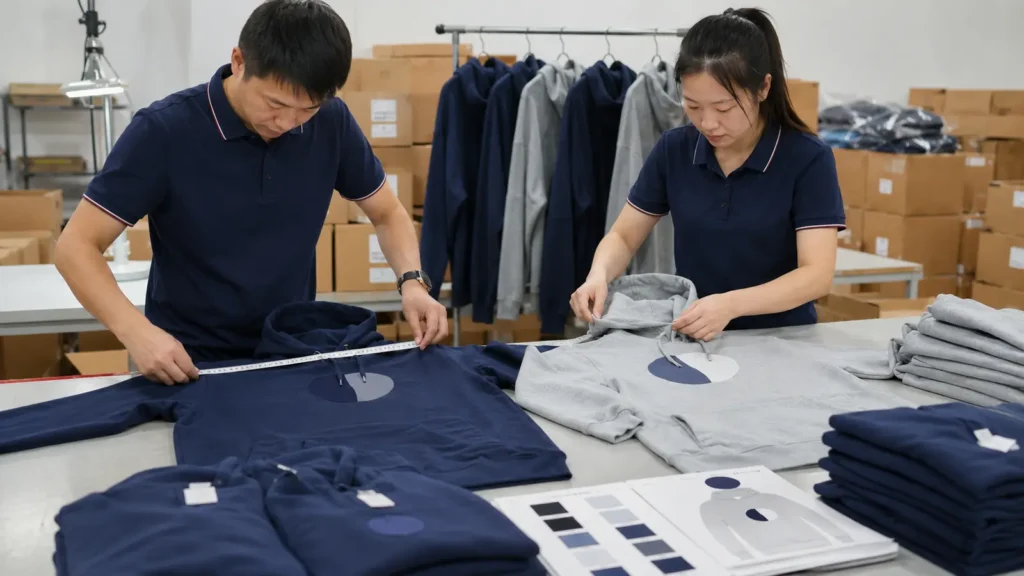
Before bulk production
- Approve the fabric composition, GSM, knit, face and inner finish.
- Approve body color, rib color, zipper and drawcord components.
- Sign off the finished measurement chart and tolerance.
- Approve actual-size artwork, colors and placement.
- Approve labels, care content, hangtags and packaging.
- Record all changes made after the first sample.
Final inspection
- Use an order-specific sampling or inspection plan agreed in advance.
- Check quantity, color, size ratio, measurements and personalization.
- Inspect defects, seams, logo dimensions, placement and decoration finish.
- Verify labels, folding, bagging, barcode and carton assortment.
- Compare the shipment with the approved reference sample.
The buyer should define what happens when a result falls outside tolerance: rework, replacement, concession or reinspection. Without an agreed standard, “pass” and “fail” become subjective.
A Practical Bulk-Ordering Process
1. Build the order brief
State the wearer group, destination, use case, desired quantity, target delivery date and budget position. Add reference images, but explain which elements are inspirational and which are mandatory.
2. Select style and fabric
Choose pullover, zip or another silhouette. Request relevant fabric swatches with composition, GSM and finish information. Narrow the options before requesting a full sample.
3. Prepare artwork, colors and quotation data
Provide vector logos, color references, logo positions and sizes. Ask the supplier to list fabric, construction, decoration, labels, packaging, sample terms, MOQ, bulk timing and trade terms.
4. Approve a physical sample
Evaluate fit on representative wearers. Wash the sample using the intended care method and inspect measurements, surface, seams, color and decoration afterward. A sample approval should be written and version controlled.
5. Finalize quantities and personalization
Collect sizes against the approved chart. Freeze the roster and verify spelling. Add a small quantity of planned spare garments in useful sizes if the program expects late additions.
6. Authorize bulk production
Issue a final purchase order and approval record. It should match the sample, quotation and artwork. Late changes should be documented with their effect on cost and timing.
7. Inspect and ship
Arrange inspection against the approved standards. Confirm carton dimensions, weights, marks, packing list and shipping documents before dispatch.
Planning hoodies for a school, sports club, team package or private-label collection? Send JIUMU your target quantity, wearer sizes, hoodie style, fabric preference, logo files, colors, packaging needs and required delivery date. We can review the brief and prepare a custom quotation. Request a custom hoodie quotation.
What Information Should You Send for a Quotation?
A useful request for quotation should answer the following:
| Information | What to provide |
|---|---|
| Buyer and market | Organization type, destination country and intended sales or distribution channel |
| Product | Pullover, full-zip or other style; youth/adult; desired fit |
| Quantity | Total units plus breakdown by color, style and estimated size ratio |
| Fabric | Preferred composition, GSM range, fleece/French terry/performance knit and target season |
| Colors | Pantone references, physical swatch or clear indication that stock colors are acceptable |
| Decoration | Vector artwork, method preference, dimensions, positions and personalization file |
| Labels | Brand label, size label, fiber/origin/care content and any hangtag |
| Packaging | Individual bag, barcode, size sticker, folding, carton assortment and retail requirements |
| Timing | Sample deadline, event or launch date, and delivery destination |
| Commercial terms | Quotation currency, shipping term and whether freight should be estimated |
If some items are not decided, label them as open choices. A supplier can then recommend options without mistaking an idea for a fixed requirement.
Questions to Ask a Custom Hoodie Supplier
- Is the quoted fabric a stock material or made for this order?
- What are the exact fiber composition, GSM, knit structure and inner finish?
- Does the MOQ apply per style, color, fabric or decoration?
- Which finished garment measurements and tolerances will control production?
- Can I approve a physical sample in the actual fabric, color and decoration?
- How will garment color and decoration color be matched?
- What logo method is recommended for this artwork, and why?
- How are youth drawcords and destination-market label requirements handled?
- How are personalized names and numbers verified?
- How are repeat orders matched to the approved specification?
- What is included and excluded from the quotation?
The answers should be specific enough to become order documents. If the response remains limited to “high quality” or “same as sample,” ask for measurable details.
Common Custom Hoodie Buying Mistakes
Choosing by GSM alone
Weight does not explain knit density, finish, softness, recovery or shrinkage. Compare the full fabric specification and a physical sample.
Approving a digital mockup as if it were a production sample
A mockup confirms layout direction, not actual color, fit, fabric or decoration behavior. Use it before sampling, not instead of sampling.
Using one logo size across all garments
Youth and adult sizes may need different logo scaling or placement rules. Check the smallest and largest garments.
Ignoring the inside of the garment
Rough embroidery backing, loose threads, poorly attached labels and untidy seams reduce comfort and perceived value.
Collecting sizes too early
If sizes are collected before the final chart and fit sample are approved, buyers may have to convert estimates into a different sizing system.
Leaving packaging until the end
Barcodes, labels, individual bags and carton sorting affect materials, workflow and timing. Include them in the first quotation.
Treating compliance as a generic supplier certificate
Labeling and product-safety obligations depend on the product, market and responsible business. Review actual garment design and label content for each destination.
Why Source Custom Team Hoodies with JIUMU?
JIUMU supports B2B custom teamwear and branded apparel programs for schools, teams, sports clubs, distributors, uniform dealers, promotional product companies and private-label brands. Established in 2010 and based in Guangdong, China, JIUMU focuses on practical specification development and export support.
Capabilities include OEM/ODM development, embroidery, screen printing, heat transfer, patches, fabric sourcing, Pantone color matching, private labels, hangtags and packaging customization. Digital mockups and physical samples support approval before bulk production.
The typical MOQ is 50 pieces, subject to product structure and customization. That qualification matters: a stock-color pullover with one logo and a fully custom heavyweight hoodie with multiple trims do not have the same material or setup requirements.
JIUMU can also coordinate hoodies with custom team uniforms, custom team jackets, custom team jerseys, custom baseball caps and team bags. A coordinated package helps the buyer control colors, logos, labeling and presentation across the program.

Frequently Asked Questions
Final Recommendation
The best custom team hoodies are built from a controlled decision process. Define who will wear the garment and where. Select the silhouette and fabric by use case. Approve measurements on real wearers. Match the decoration method to the artwork. Confirm labels and youth safety details for the destination market. Then turn the approved sample, size chart, artwork, colors and packaging into one production standard.
This approach gives buyers more than a comfortable hoodie. It creates a repeatable teamwear product that can be issued, sold or reordered with fewer surprises.
About the author: The JIUMU Content Team develops practical sourcing guidance for B2B buyers of custom teamwear, logo apparel, hats, uniforms, bags and branded merchandise.
Editorial note: Product performance and regulatory obligations depend on the final specification, destination and sales channel. Verify requirements for the actual order before production or sale.
JIUMU Content Team
Practical sourcing guidance for B2B buyers of custom teamwear, logo apparel, hats, uniforms, bags and branded merchandise.