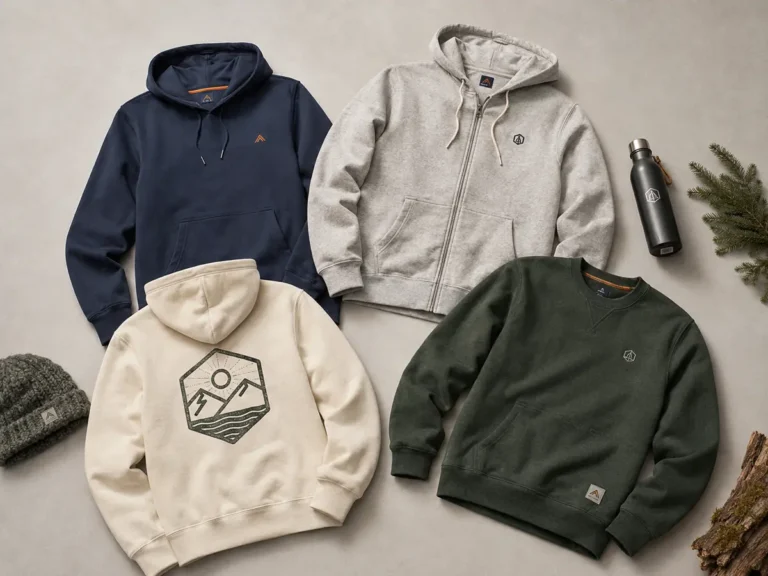
Custom Hoodie Sizing and Fit Guide for Bulk Orders
Custom hoodie sizing becomes difficult when one purchase must fit an entire school, sports club, workforce, promotional campaign or retail customer base. A buyer is not choosing one garment for one person. The buyer is defining a size system, a fit direction and a production specification that must work across many bodies—and still look consistent after decoration and laundering.
That is why a label is never enough. “Medium” can refer to a body-size range, a finished garment or a brand convention. Regular, relaxed and oversized fits can use the same label while producing different silhouettes.
This custom hoodie sizing and fit guide gives B2B buyers a practical method for doing that. It is written for schools, teams, clubs, distributors, uniform dealers, promotional buyers and private-label apparel brands sourcing custom hoodies for North American and European markets.
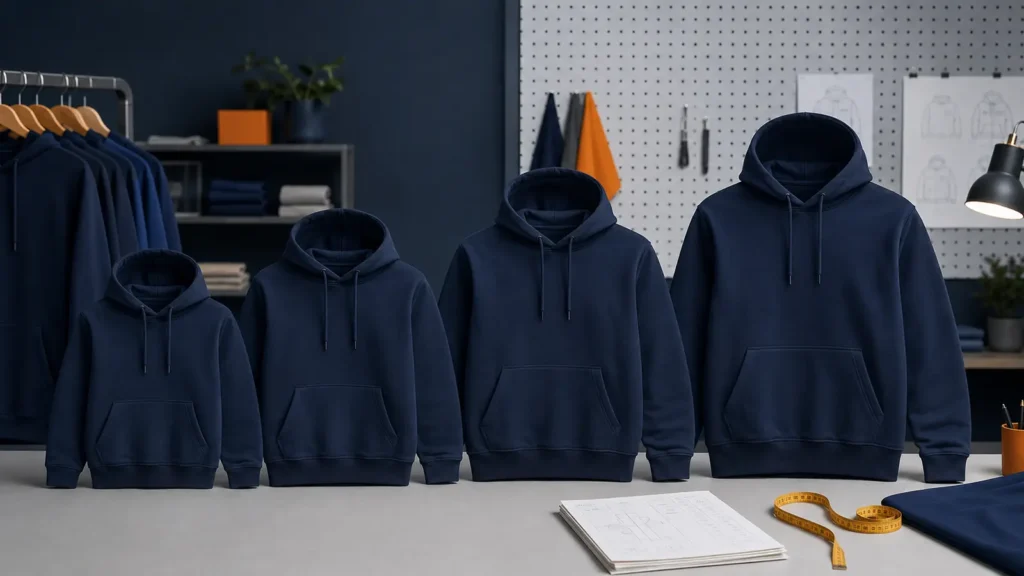
Quick Answer: How Should You Choose Custom Hoodie Sizes?
Choose custom hoodie sizes by starting with the people and use case, not with S–3XL labels. Define the target body-measurement range, select a regular, relaxed or oversized fit, then approve a finished-garment measurement chart for chest, length, sleeve, shoulder and hem. Test the correct fabric and decoration on a pre-production sample, wash the sample when dimensional stability matters, and collect individual sizes whenever possible. For group estimates, use recent wearer data and keep a small contingency rather than relying on a generic size ratio.
The essential rule is simple: body measurements identify who a size should fit; garment measurements define what will actually be manufactured.
What to Send for an Accurate Custom Hoodie Quote
Provide the target wearer group, intended fit, finished-garment measurement chart, size breakdown, fabric composition and weight, decoration placement, quantity, destination, and required date. Request a size-set or representative pre-production sample when the order covers a broad youth-to-adult range, and confirm measurements again after any required wash test.
Review custom hoodie manufacturing options and custom team uniforms, then request a custom hoodie quotation with your size chart and artwork.
Why Hoodie Sizing Is a Procurement Decision
Sizing affects more than comfort. It influences reorder accuracy, team appearance, decoration placement, inventory risk and the number of exchanges a buyer must manage. A body that is too narrow can restrict movement or layering. A body that is too wide may make a chest logo appear small or poorly positioned. A short torso can expose an underlayer during activity, while excessive length can make uniforms look inconsistent.
The risks multiply because size labels vary, pattern blocks use different proportions, fabric and washing affect dimensions, and intended underlayers change the needed room. A retailer may want a fashion silhouette, while a school may prioritize broad, predictable fit coverage.
ISO’s clothing-size framework reinforces the need to separate these concepts. ISO 8559-1 describes anthropometric measurements used to develop size and shape profiles. The current ISO 8559-2:2025 establishes size designation using body dimensions, while ISO 18890 defines standard garment measurement points and methods. In other words, the standards distinguish the body a garment is intended for from the garment’s own dimensions.[1][2][3]
Body Measurements vs. Garment Measurements
This distinction is the foundation of a reliable hoodie size chart.
| Measurement type | What it describes | How buyers use it | Common mistake |
|---|---|---|---|
| Body measurement | The wearer’s physical dimensions | Assigning a person to a size range | Treating body chest as the hoodie’s half-chest width |
| Garment measurement | The finished hoodie measured at agreed points | Building the tech pack, pattern and QC sheet | Publishing it without saying it is a garment chart |
| Ease | The difference between relevant body and garment dimensions | Creating regular, relaxed or oversized comfort | Adding the same ease to every market and use case |
| Grade rule | The measurement change from one size to the next | Scaling an approved base size across the range | Grading every point by the same amount |
| Tolerance | The acceptable production deviation from the specification | Inspecting samples and bulk goods | Using tolerance as permission to change the intended fit |
A public guide may include clearly labeled body-size and garment-measurement charts. The former helps wearers choose; the latter supports comparison with an existing hoodie. The production tech pack must also define each measurement method, sample size, grade rules and tolerances.
ISO notes that size designation is based on body dimensions, while designers and manufacturers determine garment dimensions with allowances for style, cut and intended wear.[2] That principle is especially important for hoodies because ease is part of the product design.
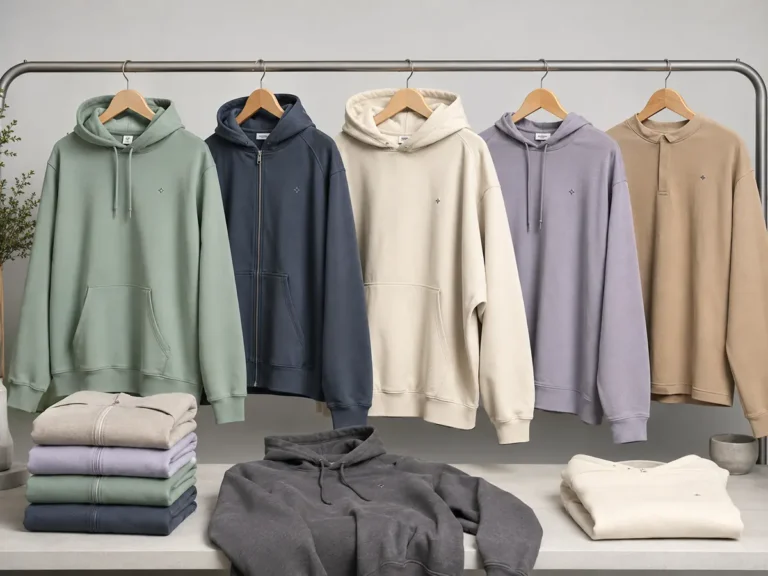
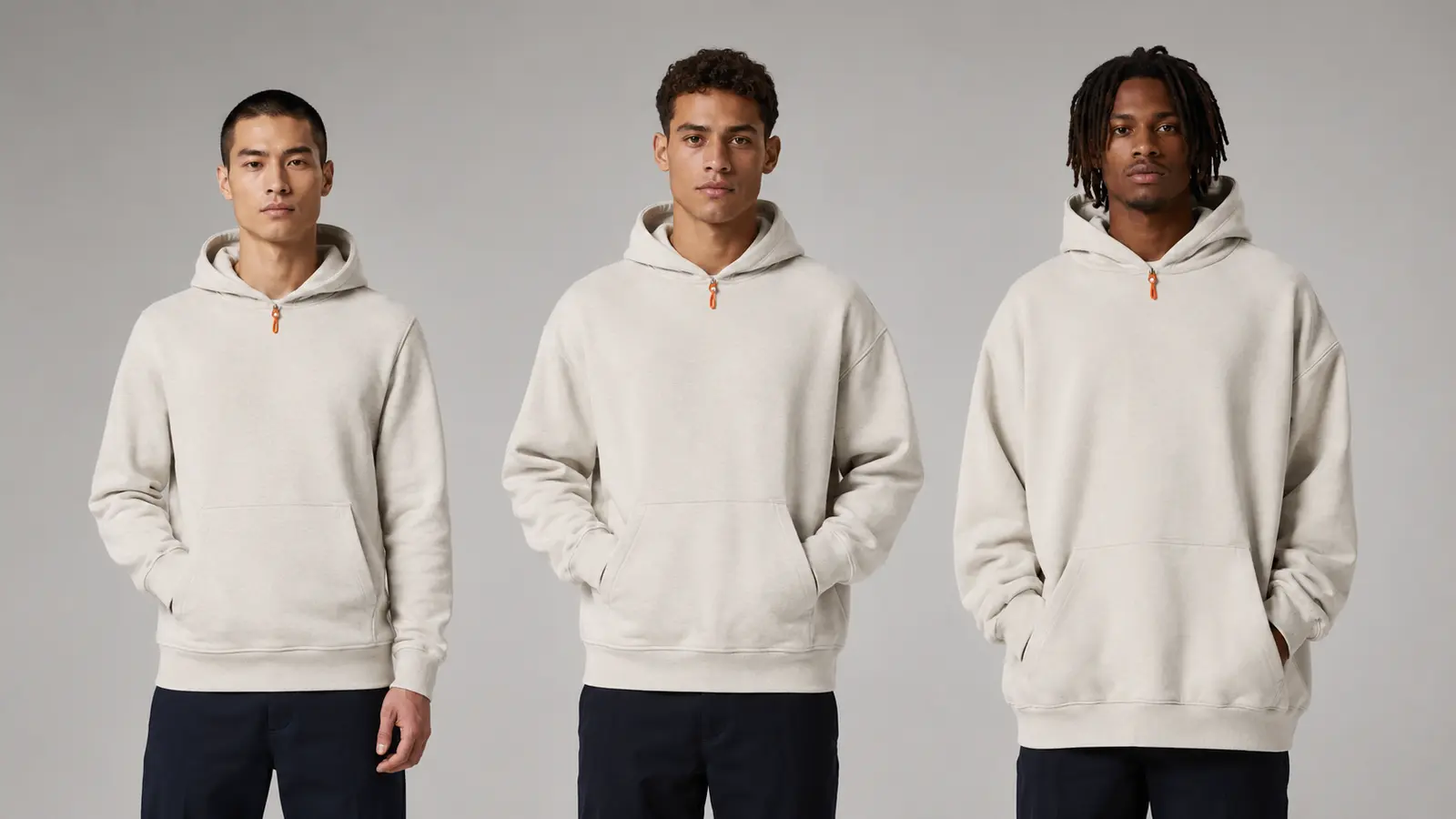
What Do Regular, Relaxed and Oversized Hoodie Fits Mean?
There is no universal numerical definition for these marketing terms. They should be translated into measurable specifications.
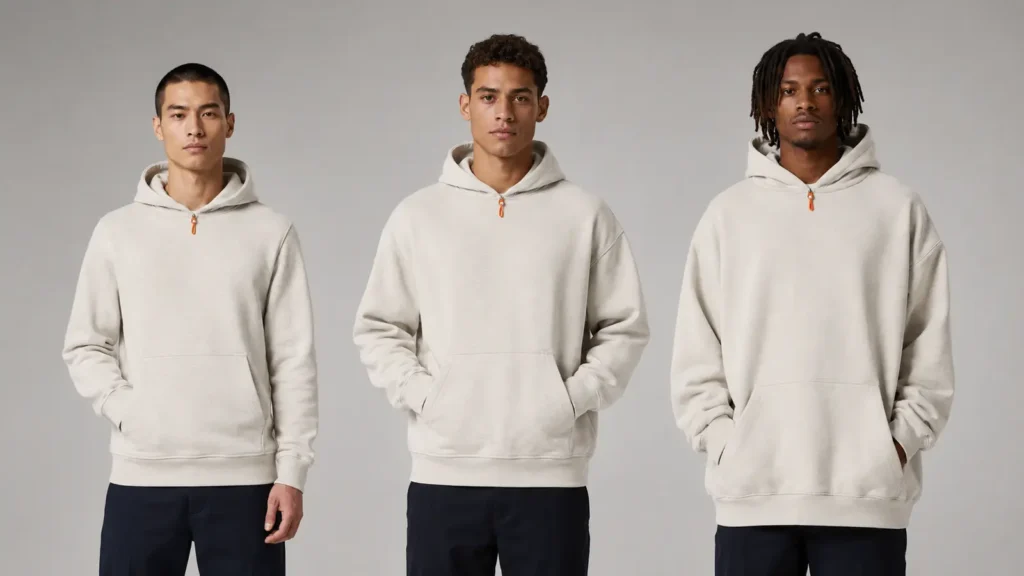
| Fit direction | Typical silhouette | Best suited to | Specification focus |
|---|---|---|---|
| Regular fit | Balanced body width, conventional shoulder and moderate length | Schools, staff uniforms, broad team use and repeat programs | Predictable chest ease, armhole mobility and consistent length |
| Relaxed fit | More room through chest and body, often a slightly dropped shoulder | Team warm-ups, casual workwear and modern branded merchandise | Shoulder position, sleeve volume, hem width and layering room |
| Oversized fit | Deliberately wide body, dropped shoulder and fashion-led proportions | Streetwear, campus merchandise and selected private-label ranges | Body width-to-length ratio, sleeve shape, hood scale and decoration proportion |
| Athletic fit | Trimmer body with mobility maintained through shoulder and armhole | Training staff, clubs and sports-oriented merchandise | Chest-to-waist shaping, upper-arm room and stretch/recovery |
Do not create an oversized hoodie by simply ordering one or two sizes larger. A larger regular-fit pattern also becomes longer, changes pocket and hood scale, and can place the shoulder or sleeve differently from an intentionally oversized block. If the target is oversized, develop or select an oversized pattern.
Likewise, “unisex” does not mean universally identical fit. It usually means one block is offered to a mixed wearer group. Buyers should review the proportions and confirm that the size range covers their real audience.
How to Take Body Measurements for Hoodie Sizing
Use a flexible tape, light base clothing and a natural standing posture. Keep the tape level and comfortably close to the body without compressing it. If the hoodie will be worn over a uniform or protective layer, measure the wearer normally and account for the underlayer in the garment fit trial rather than artificially loosening the tape.

Essential body measurements
Chest or bust circumference. Measure around the fullest part of the chest or bust, keeping the tape horizontal across the back. This is normally the most important body dimension for an upper-body garment.
Waist circumference. Measure at the defined natural-waist level. Although a straight hoodie may not closely follow the waist, this measurement helps evaluate different body shapes.
Hip or seat circumference. Measure around the fullest part of the seat when a long body, fitted hem or women’s block makes lower-body coverage relevant.
Body height. Measure standing height without shoes. Height helps interpret torso and sleeve requirements, but it should not replace chest or bust as the primary fit input.
Arm or sleeve-related length. Use the measurement method defined by the supplier or technical team. Sleeve methods vary, so a number without endpoints is ambiguous.
ISO 8559-1 provides standardized anthropometric definitions and guidance on how body measurements are taken. Buyers developing a large or multi-market size system should align their terminology with an established measurement method instead of inventing informal definitions.[1]
Body-measurement collection tips for groups
Give every wearer the same illustrated instructions and units. Provide the approved chart and samples when possible, protect personal data, and review people who fall between or outside standard sizes individually.
For schools or teams, use a physical sample set when practical, record each wearer’s chosen size and preserve the list for reorders. For employee programs, combine the size-collection process with the use cases in this company hoodie planning guide.
How to Measure a Hoodie Correctly
Garment measurements should be taken on a flat, relaxed garment using one agreed method. Close zippers, smooth the garment without stretching it and position seams naturally. Record whether rib bands are included, whether chest width is measured a set distance below the armhole and how a raglan sleeve is handled.
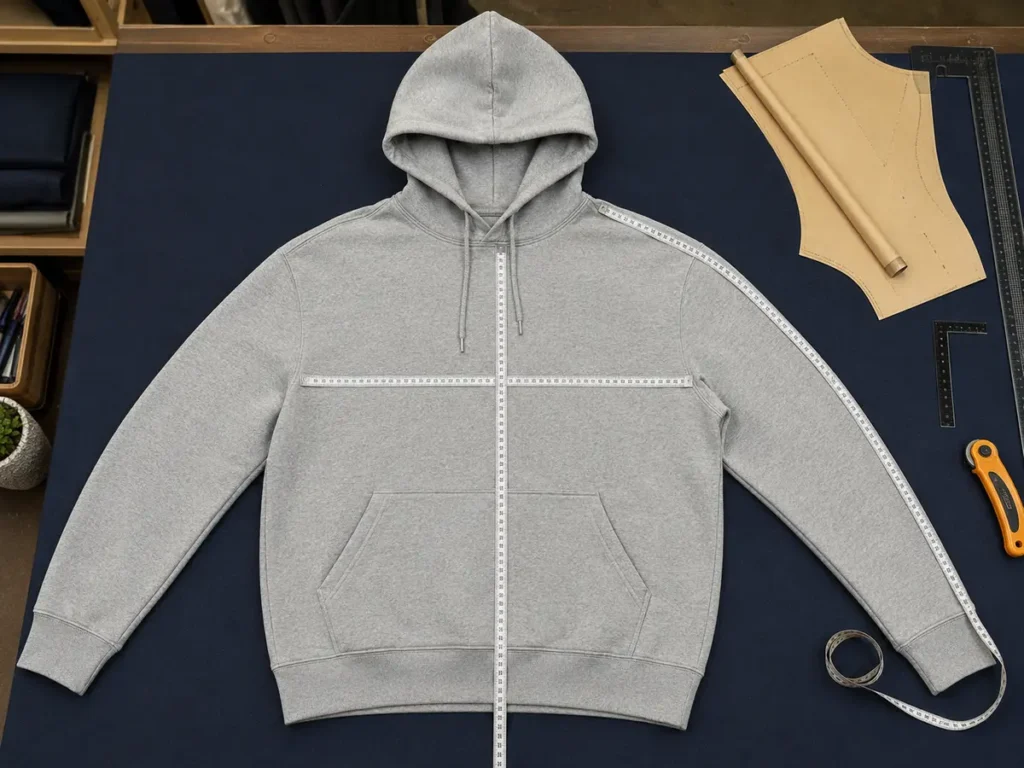
ISO 18890 defines main garment measurement points and methods, while allowing additional measurement points to be agreed between interested parties.[3] For a custom hoodie, the following points are commonly useful, but the exact method must be shown in the tech pack.
| Point of measurement | Practical definition to confirm | Why it matters |
|---|---|---|
| Chest width | Straight across the body at an agreed position below the armhole | Primary indicator of body room |
| Body length | From a defined high-shoulder or center-back point to the bottom hem | Coverage, proportion and decoration balance |
| Shoulder width | Between shoulder seam points on set-in-sleeve styles | Regular versus dropped-shoulder silhouette |
| Sleeve length | From shoulder seam to cuff, or a defined center-back route | Wrist coverage and arm mobility |
| Across back | Between defined armhole points | Shoulder movement and upper-body comfort |
| Hem width | Straight across the bottom at an agreed position | Body shape and rib-band tension |
| Bicep width | Across the sleeve at a defined distance from the armhole | Layering and movement |
| Cuff opening | Across the cuff in its relaxed state | Wrist comfort and recovery |
| Hood height and width | Between defined hood seam points | Coverage, appearance and drawcord function |
| Pocket width and height | At specified pocket edges | Hand access and consistent decoration layout |
For zip-up hoodies, add zipper and front-length controls. For raglan, cropped or longline styles, define the construction-specific sleeve, side and hem measurements.
Build a Hoodie Measurement Specification, Not Just a Size Chart
A commercial size chart is a selection tool; a production specification is a control document. It should contain:
- A technical sketch showing measurement points.
- The sample or base size.
- Finished measurements for every ordered size.
- The grading increment at every point.
- Measurement tolerances by point and size when applicable.
- Fabric composition, construction and finished weight specification.
- Wash or dimensional-stability test method when required.
- Fit model or wearer profile used for approval.
- Decoration size and placement by size.
- Approval date and revision number.
Tolerance should reflect the measurement method, material behavior, process and business requirement. It is a QC acceptance limit, not extra design ease.
How grading affects the size range
Grading scales the base pattern into other sizes. Each point may change at a different rate. Chest, body length, sleeve length, shoulder and bicep do not necessarily grow by equal amounts. Extended sizes may require a different grade rule or pattern review rather than indefinite linear scaling.
Ask the supplier to provide the full graded measurement chart before bulk production. Review the smallest, base and largest sizes. A base-size sample alone cannot reveal whether an extended size has a suitable hood, armhole, sleeve or pocket proportion.
Choose the Right Size Architecture
Unisex vs. separate men’s and women’s blocks
A unisex block simplifies team ordering, but one shoulder, chest, waist and hip relationship must serve many body shapes.
Separate men’s and women’s blocks can offer more targeted proportions but require more SKUs. A women’s block is not merely a smaller men’s block; shaping, length, shoulder, sleeve and hip relationships may differ.
Adult vs. youth sizing
Youth hoodies require a youth pattern and age-appropriate proportions. Do not create youth sizes by shrinking an adult block uniformly. Also avoid marketing a size by age alone: children and teenagers of the same age can have different body measurements. Use body dimensions and fit trials.
When youth products use drawcords or other components, buyers should separately confirm applicable destination-market safety requirements. Sizing approval does not replace product-compliance review.
Inclusive and extended sizes
For extended sizes, review the pattern, decoration scale, pocket access, rib tension and length on an appropriate fit model. Decide whether multiple artwork sizes are needed.
Account for Layering and Intended Use
The same wearer may need different hoodie specifications for travel, sideline use, casual campus merchandise or workwear. Define the intended underlayer during the brief.

| Use case | Likely fit priority | What to test |
|---|---|---|
| School spiritwear | Broad, easy-to-understand coverage | Mixed-body try-on, sleeve and body length, unisex size communication |
| Team warm-up | Mobility and layering over uniform tops | Arm raise, cross-body reach, hem movement and hood comfort |
| Construction or outdoor crew | Layering, durability and task movement | Work posture, glove/cuff interaction and outer-layer compatibility |
| Event merchandise | Predictable distribution and low exchange friction | Public size chart, sample set and size-mix assumptions |
| Private-label streetwear | Intentional silhouette and visual proportion | Dropped shoulder, width-to-length ratio, hood volume and artwork scale |
| Staff uniform | Consistency, repeated laundering and reorder stability | Wash trial, wearer comfort and repeat measurement control |
During sample approval, test reaching, arm raising, sitting, layering and pocket use. A flat chest measurement cannot show every dynamic-fit issue.
Fabric, Finishing and Shrinkage Can Change Fit
A measurement chart must be connected to the specified fabric and finish. Cotton-rich fleece, cotton-polyester fleece, French terry and performance knits can differ in stretch, recovery, drape, bulk and dimensional behavior.
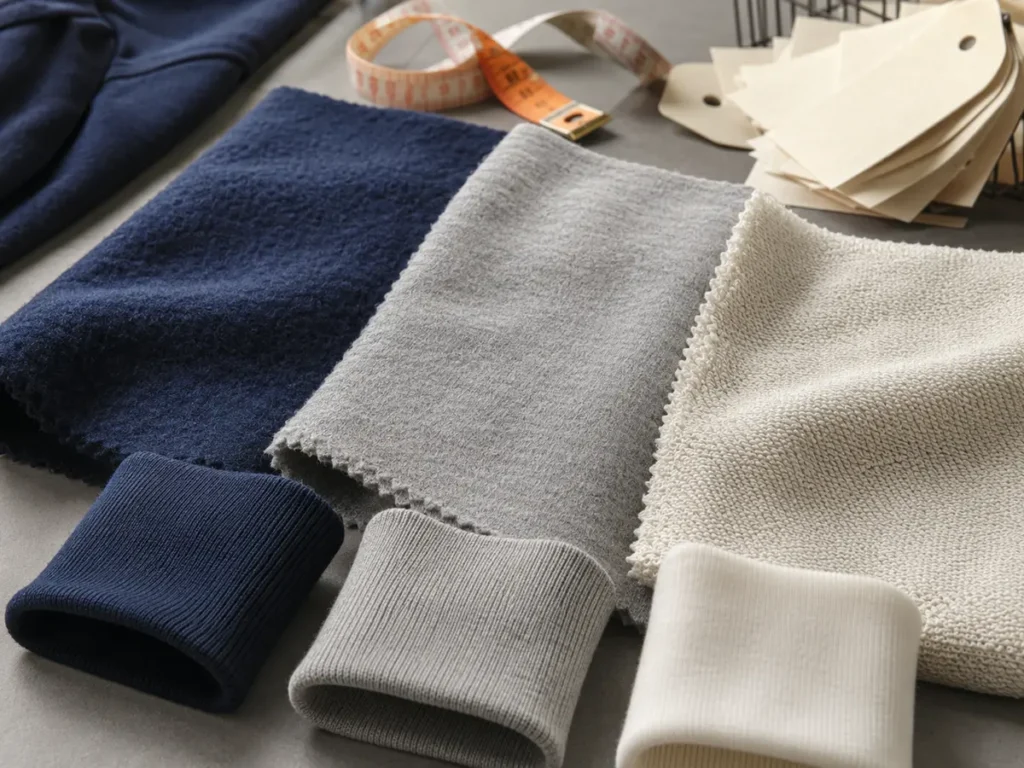
Cotton Incorporated’s technical guidance explains that wet processing can create stresses in fabric and that finishing procedures such as relaxation drying or compaction can improve dimensional stability. Its quality guidance also identifies excessive dimensional instability as a factor that affects garment appearance, fit, size and serviceability.[4][5]
For a B2B order, ask the supplier:
- Is the measurement chart stated before or after any garment wash?
- What dimensional-change test method and wash conditions will be used?
- Are length and width change evaluated separately?
- Will the sample use bulk fabric and the final color process?
- Does rib fabric recover after stretching?
- Can dark and light colors behave differently because of processing?
- Will finished-garment measurements be checked again after the agreed wash test?
Avoid adding an arbitrary “shrinkage allowance” without test data. The correct response may involve fabric finishing, pattern compensation, care instructions, process control or a combination of these. Approve the delivered measurement and the post-care performance requirement separately.
For the U.S. market, most textile products require fiber content, country of origin and responsible-business identification. The FTC Care Labeling Rule also requires garment care instructions.[6][7] Coordinate those disclosures with the approved material and shrinkage decisions.
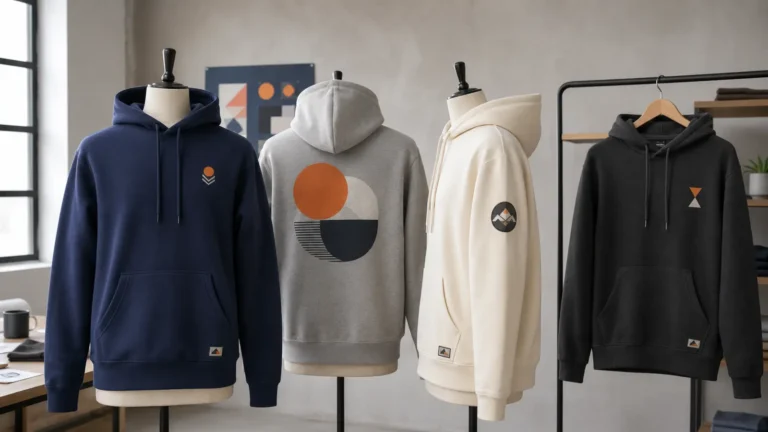
Decoration Can Affect Perceived Fit and Proportion
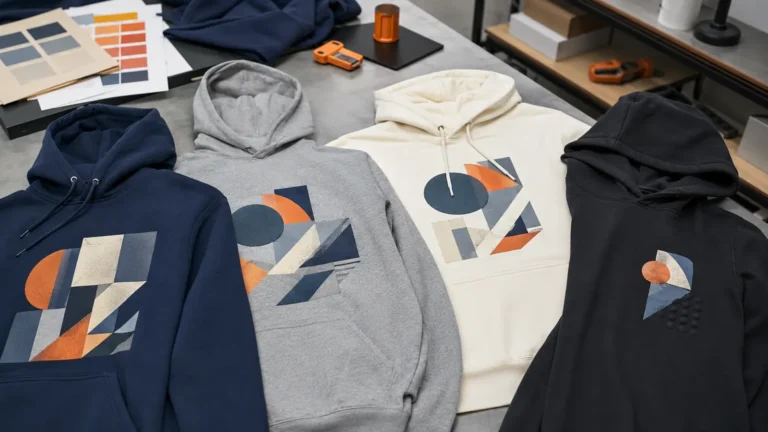
Embroidery, patches, screen printing, heat transfer and other decoration methods do not normally replace the garment’s measurement specification, but they can change how the finished hoodie looks and feels.
A dense embroidery can reduce local drape, while a large print or thick patch may feel stiff on lightweight fabric. Artwork balanced on a medium can look wrong on youth or extended sizes.
Create a decoration placement chart that states:
- Artwork width and height.
- Reference point for placement.
- Distance from neckline, zipper, pocket or side seam.
- Whether one artwork size or multiple sizes are used.
- How placement changes across adult and youth ranges.
- Whether the logo sample is approved on the actual fabric and color.
For zip-up hoodies, confirm whether artwork crosses the zipper and how alignment is controlled. For embroidery, confirm backing and interior comfort. For private-label orders, verify that the size label matches the approved chart and that packaging identifies size clearly.
Planning a school, club, company or private-label hoodie order? Send JIUMU your target quantity, market, wearer group, preferred fit, size range, fabric idea, logo files and delivery target. We can discuss a custom size chart, digital mockup and physical sample before bulk production. Request a custom hoodie quotation.
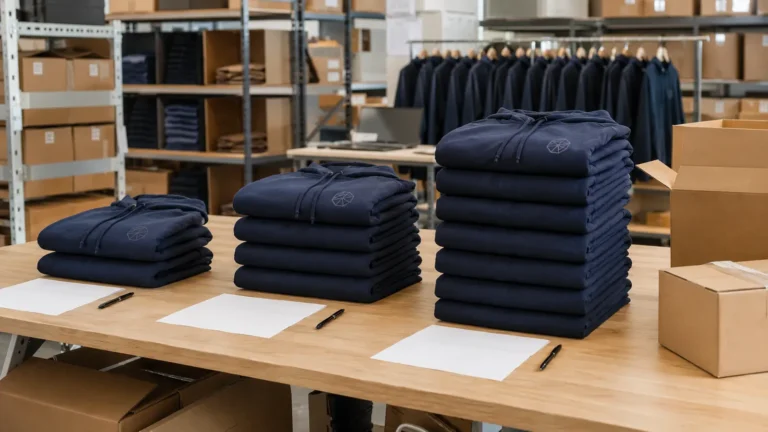
How to Plan the Size Mix for a Bulk Hoodie Order
The best size mix comes from named wearer data or recent comparable sales. A generic ratio is not universal.
Use the following priority order:
- Collect individual sizes. Best for schools, teams, staff and pre-sold programs.
- Use recent program data. Best for repeat orders with the same audience and size architecture.
- Use comparable product sales. Useful for retail or merchandise launches when the old and new fits are genuinely comparable.
- Run a pre-order or sample try-on. Useful when moving to a new fit or market.
- Estimate with documented assumptions. Last resort for open distribution or event stock.
When estimating, segment the audience instead of applying one ratio to everyone. Adult staff, youth athletes, women’s-fit buyers and fashion-merchandise customers may produce different demand. Keep a modest contingency in the most likely exchange sizes, but do not overstock only the middle sizes and omit the ends of the range.
Also plan how replacements will work. Record the relationship between the label size, measurement-chart version, fabric, color, decoration and order date. A reorder marked “same medium” is not sufficient if the specification has changed.
Sample Approval and Hoodie Size Quality Control
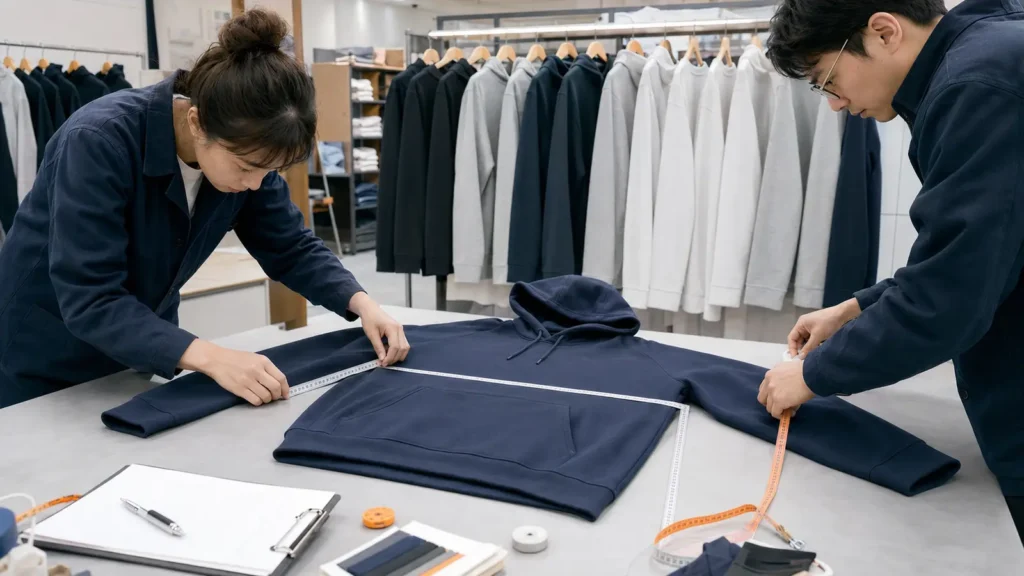
Sampling is where a sizing idea becomes an evidence-based decision. A digital mockup confirms color and artwork direction; it cannot validate physical fit. Review a physical sample made as close as practical to the intended bulk construction.
Recommended approval sequence
- Confirm the size architecture and target market.
- Review the supplier’s measurement method and base-size specification.
- Approve fabric, weight, stretch, finish, rib and color direction.
- Receive a fit or development sample in the base size.
- Measure it using the same method as the specification.
- Conduct a fit trial on an appropriate wearer or fit model.
- Test relevant movements and layering.
- Review decoration size, position and effect on drape.
- Conduct the agreed laundering or dimensional-stability check.
- Revise the chart and pattern if necessary.
- Approve the full graded measurement chart.
- Consider checking a small, base and large size before bulk production.
- Seal and identify the approved sample and specification revision.
Bulk QC checklist
- Correct style, size label and packing label.
- Finished measurements within agreed tolerance.
- Symmetry and seam alignment.
- Sleeve and cuff consistency.
- Hood shape and drawcord construction as specified.
- Rib recovery and hem shape.
- Pocket position, opening and reinforcement.
- Decoration dimensions, color and placement.
- Zipper function and front alignment on zip-up styles.
- Workmanship, stains, holes and visible defects.
- Packaging assortment matches the purchase order.
Use a defined sampling and inspection plan appropriate to the order and risk level. Do not describe a few measured pieces as proof of every unit unless a 100% inspection actually occurred.
What to Send a Supplier for an Accurate Quotation
The more specific the brief, the more useful the quotation and sample plan will be. Send:
- Product type: pullover, zip-up, raglan, set-in sleeve or another construction.
- Target market and wearer group.
- Quantity by color and estimated quantity by size.
- Adult, youth, unisex, men’s, women’s or custom block requirement.
- Intended fit: regular, relaxed, oversized or a reference garment.
- Body-size chart and/or finished-garment chart, if available.
- Required size range and any extended sizes.
- Fabric composition, structure, finished weight and finish preferences.
- Color standards or Pantone references.
- Logo artwork and decoration method.
- Private label, hangtag and packaging requirements.
- Required testing, inspection or documentation.
- Target delivery date and destination.
- Photos of an approved reference product, with notes explaining what should be matched or changed.
If you do not have a tech pack, provide a well-fitting reference hoodie and explain the desired changes. The supplier can then propose a measurement chart, but the buyer remains responsible for reviewing and approving it.
Questions to Ask a Custom Hoodie Supplier
- Is your size chart based on body measurements or finished-garment measurements?
- Can you provide diagrams for every point of measurement?
- Which size is the development sample, and what are the grade rules?
- Are youth, adult, unisex and women’s products built from separate patterns?
- Can extended sizes be sampled or reviewed before bulk production?
- What fabric and finishing process will the sample use?
- How will dimensional change after laundering be evaluated?
- What measurement tolerances will apply, and are they point-specific?
- Can the decoration size and placement be adjusted across the range?
- How are size labels, polybags and cartons checked against the order?
- What files and approvals are retained to support repeat orders?
- What happens if a sample does not match the agreed measurement chart?
Clear answers should become written specifications, not remain only in chat messages.
Common Custom Hoodie Sizing Mistakes
Copying another brand’s S–XL labels. Letter sizes do not transfer reliably without the corresponding measurements and fit intent.
Confusing half-chest with chest circumference. A flat chest-width number and a body circumference are different measurements.
Approving only the base size. A good medium does not guarantee proportionate youth, small or extended sizes.
Sizing up to create an oversized fit. This changes length and other proportions as well as width.
Ignoring the underlayer. A hoodie approved over a T-shirt may not work over a team jersey or work shirt.
Using a different fabric in the sample. Stretch, thickness, drape and dimensional behavior can change the fit.
Skipping a wash trial. This can hide dimensional-change problems until wearers receive the goods.
Using one artwork size without reviewing the range. Decoration may look inconsistent across youth and extended sizes.
Estimating the size ratio from habit. Audience mix, market and fit direction can invalidate a generic ratio.
Failing to version the size chart. Reorders become unreliable when buyers cannot identify which specification was approved.
Why Work With JIUMU on Custom Hoodies?
JIUMU is a Guangdong-based B2B supplier established in 2010, serving buyers in the United States, Canada, the United Kingdom and Europe. We support schools, teams, distributors, uniform dealers, promotional companies and private-label brands.
For custom hoodie projects, JIUMU can support OEM and ODM development, fabric sourcing, Pantone color matching, digital mockups, physical samples, bulk production, quality control and export coordination. Decoration capabilities include embroidery, sublimation, screen printing, heat transfer and woven, rubber/PVC or leather-style patches. Private labels, neck labels, woven labels, hangtags and custom packaging can also be planned as part of the order.
The typical MOQ is 50 pieces, subject to product structure and customization. The correct starting point is a complete brief: target users, size range, fit, fabric, colors, logos, packaging, quantity and delivery target.
Explore custom hoodies or review JIUMU’s broader custom team uniform capabilities.
Frequently Asked Questions
Final Recommendation
A successful custom hoodie order begins with a measurable fit decision. Define the target wearer, choose the intended silhouette, separate body and garment measurements, specify how every point is measured, test the real fabric and decoration, and approve the graded size chart before bulk production. Use individual size collection or relevant historical data instead of a generic ratio, and preserve the approved specification for reorders.

Sources
- ISO 8559-1:2017 — Size designation of clothes, Part 1: Anthropometric definitions for body measurement (reviewed and confirmed current in 2026).
- ISO 8559-2:2025 — Size designation of clothes, Part 2: Primary and secondary dimension indicators.
- ISO 18890:2018 — Clothing: Standard method of garment measurement.
- CottonWorks — Shrinkage & Skewing.
- CottonWorks — Quality Testing.
- U.S. Federal Trade Commission — Clothing and Textiles.
- U.S. Federal Trade Commission — Clothes Captioning: Complying with the Care Labeling Rule.
About the Author
JIUMU Teamwear Sourcing Team shares practical guidance for schools, teams, distributors, uniform dealers and private-label apparel buyers planning custom products for North American and European markets.