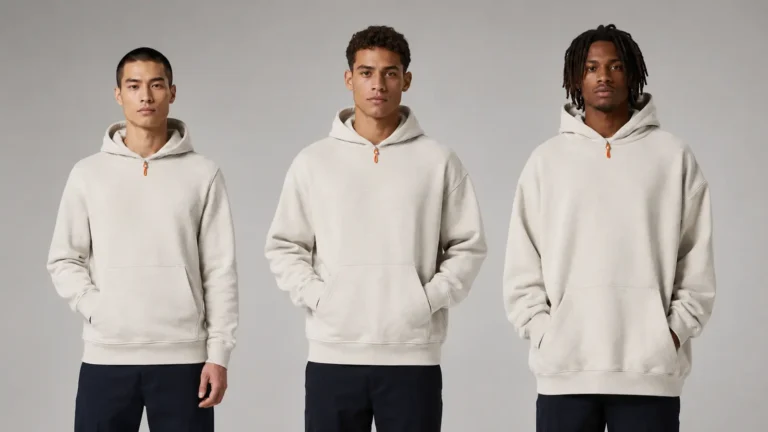
How Custom Hoodies Are Made: Design, Fabric, Printing and Production
Custom hoodies are made through a coordinated product-development process, not by simply placing a logo on a blank sweatshirt. A reliable bulk order moves from design requirements and a technical specification to fabric selection, pattern development, sampling, cutting, sewing, decoration, finishing, inspection and packing. Decisions made early—especially fabric weight, fit, color, construction and logo method—determine how the finished hoodie looks, feels, performs and repeats in future orders.
For schools, clubs, distributors and private-label brands, understanding this workflow improves supplier conversations and makes quotations easier to compare.
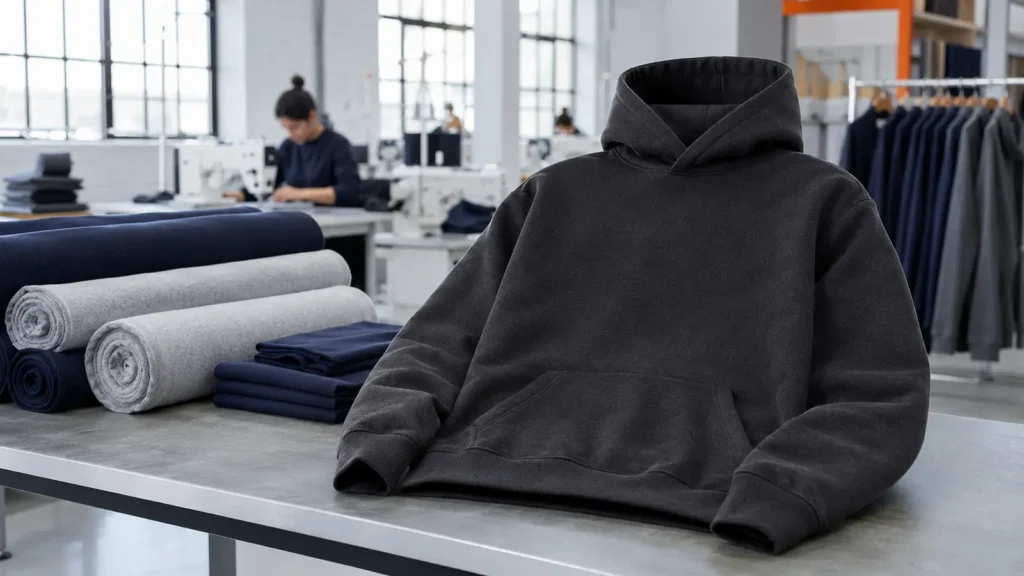
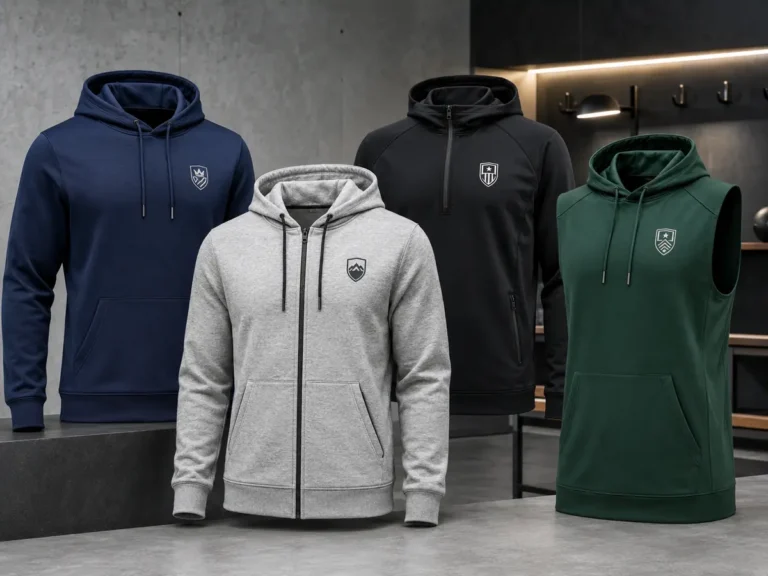
Custom hoodie manufacturing process in a modern apparel production setting
Quick Answer: How Are Custom Hoodies Made?
Custom hoodies are usually made in nine stages: the buyer defines the product; the supplier creates a tech pack or confirms specifications; fabrics, trims and colors are sourced; a pattern and size set are developed; a sample is produced and approved; bulk fabric is inspected, relaxed and cut; panels are sewn into garments; logos and labels are applied; and finished hoodies are measured, checked, packed and prepared for shipment.
The sequence can change. Printing may be applied to flat panels before sewing, while embroidery can be completed on a panel or finished garment. Agree on the route during sampling.
The Custom Hoodie Production Process at a Glance
| Stage | Main decision or activity | Buyer approval point | Risk if unclear |
|---|---|---|---|
| 1. Product brief | Use, audience, style, quantity, target market and delivery window | Written brief | Quotes are not comparable |
| 2. Design and tech pack | Measurements, construction, artwork, labels and packaging | Digital mockup or technical drawing | Fit and details drift |
| 3. Material sourcing | Fabric composition, GSM, color, rib, drawcord and hardware | Swatches or lab dips | Hand feel and color mismatch |
| 4. Pattern and sample | Base pattern, grading and first physical sample | Fit/sample comments | Bulk fit inconsistency |
| 5. Pre-production approval | Final materials, artwork size, placement and packing | Signed or written approval | Wrong logo, color or trim |
| 6. Cutting | Fabric relaxation, marker planning and panel cutting | Production records | Twisting, shortage or size errors |
| 7. Sewing | Panel assembly, seams, pockets, hood, rib and zipper | Inline inspection | Uneven construction |
| 8. Decoration and finishing | Printing, embroidery, transfer, labels, thread trimming and pressing | Approved standard sample | Poor appearance or durability |
| 9. Final QC and packing | Measurement, workmanship, color, quantity and carton checks | Inspection report when agreed | Defects reach the buyer |
This table is also a practical quotation checklist. A price that excludes custom labels, individual packaging, special color matching or inspection requirements is not directly comparable with a fully specified private-label quotation.
Step 1: Turn the Hoodie Idea Into a Production Brief
Production starts with the commercial purpose of the hoodie. A team warm-up garment, a school spirit hoodie, employee apparel and a retail streetwear product may share the same basic silhouette, but they require different fits, fabrics, decoration and packaging.
A useful initial brief states:
- Buyer type and intended wearer
- Pullover or full-zip style
- Unisex, men’s, women’s, youth or custom fit
- Estimated quantity by color and size
- Target market and season
- Fabric preference and target weight
- Color references, ideally Pantone references plus physical standards when available
- Logo files and planned decoration locations
- Label, hangtag and packaging requirements
- Target delivery date and destination
The buyer does not need to solve every technical detail before contacting a supplier. Separating requirements from preferences is enough: “must match an existing team navy” is a requirement, while “prefer a soft heavyweight feel” can be translated into supplier options.
Step 2: Develop the Design, Tech Pack and Artwork
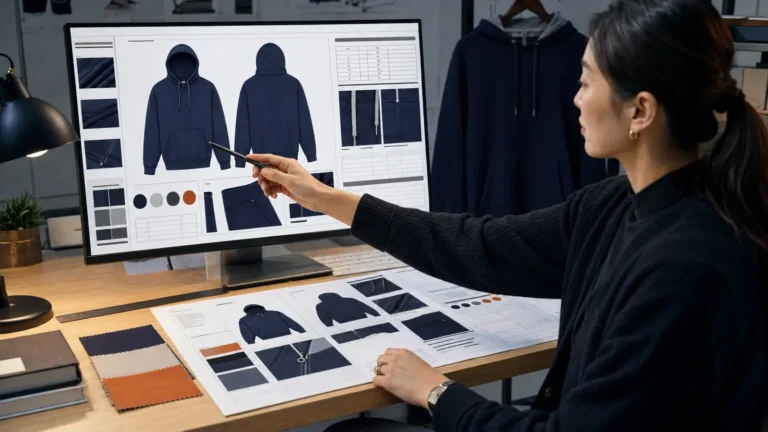
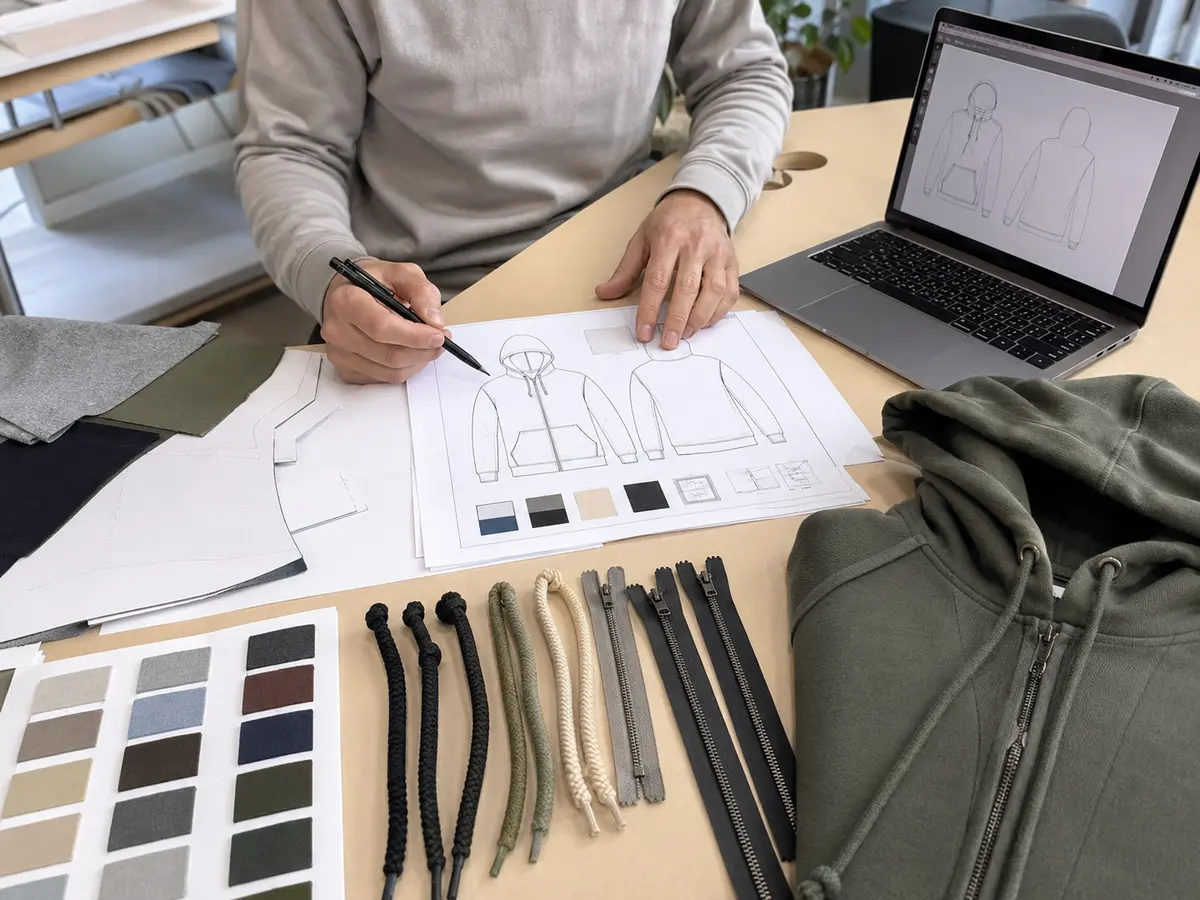
A custom hoodie tech pack converts visual inspiration into measurable manufacturing instructions. A structured specification sheet may be sufficient for a straightforward team hoodie; a private-label style with a custom pattern needs more detail.
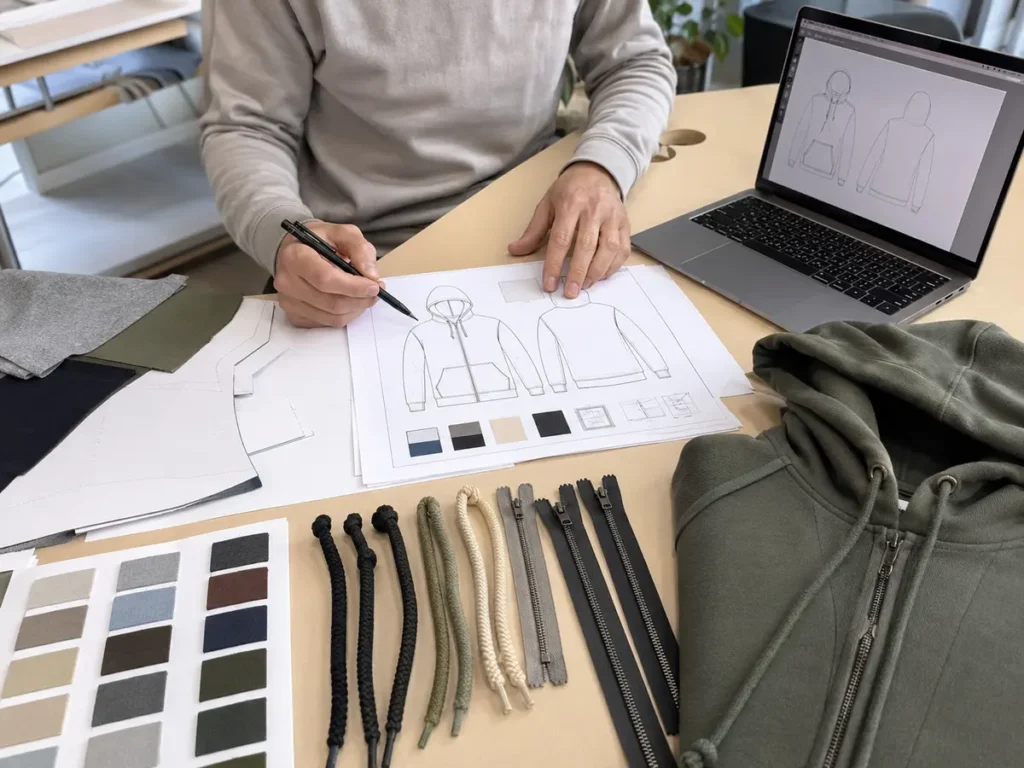
Product developer preparing a custom hoodie tech pack with fabrics and trims
What a Hoodie Tech Pack Should Include
A practical tech pack normally covers:
- Front, back and detail drawings
- Garment style and closure
- Fabric composition, construction and target weight
- Body, sleeve and rib colors
- Measurement chart and tolerances
- Hood shape, number of layers and lining
- Drawcord material, length, tip and eyelet specification
- Kangaroo, welt or zip-pocket construction
- Cuff and waistband rib dimensions
- Zipper type, size and finish for zip hoodies
- Seam and topstitch details
- Logo dimensions, colors and coordinates
- Neck label, care label, size label and hangtag
- Folding, polybag, barcode and carton instructions
Artwork should be supplied as editable vector files for screen printing, embroidery digitizing and many heat-transfer workflows. Raster artwork should be provided at the final required size and adequate resolution. The supplier should confirm whether gradients, fine lines, distressed effects and small text are compatible with the selected decoration method.
Fit Is a Specification, Not a Size Name
Terms such as “oversized,” “regular” and “athletic” are useful design directions, but they are not measurable standards. Two suppliers can interpret “unisex large” differently. Confirm chest width, body length, shoulder width, sleeve length, cuff opening, hood depth and pocket position.
For repeat programs, record the approved measurement table and measurement method. A chest width measured one inch below the armhole is not interchangeable with a measurement taken at the narrowest part of the body.
Step 3: Choose the Hoodie Fabric
Fabric controls warmth, drape, print behavior, shrinkage potential, surface appearance and cost. The most useful fabric specification combines fiber content, knit structure, weight and finish. “Cotton hoodie” alone does not describe whether the material is lightweight French terry, heavy brushed fleece or a blend with a polyester face.
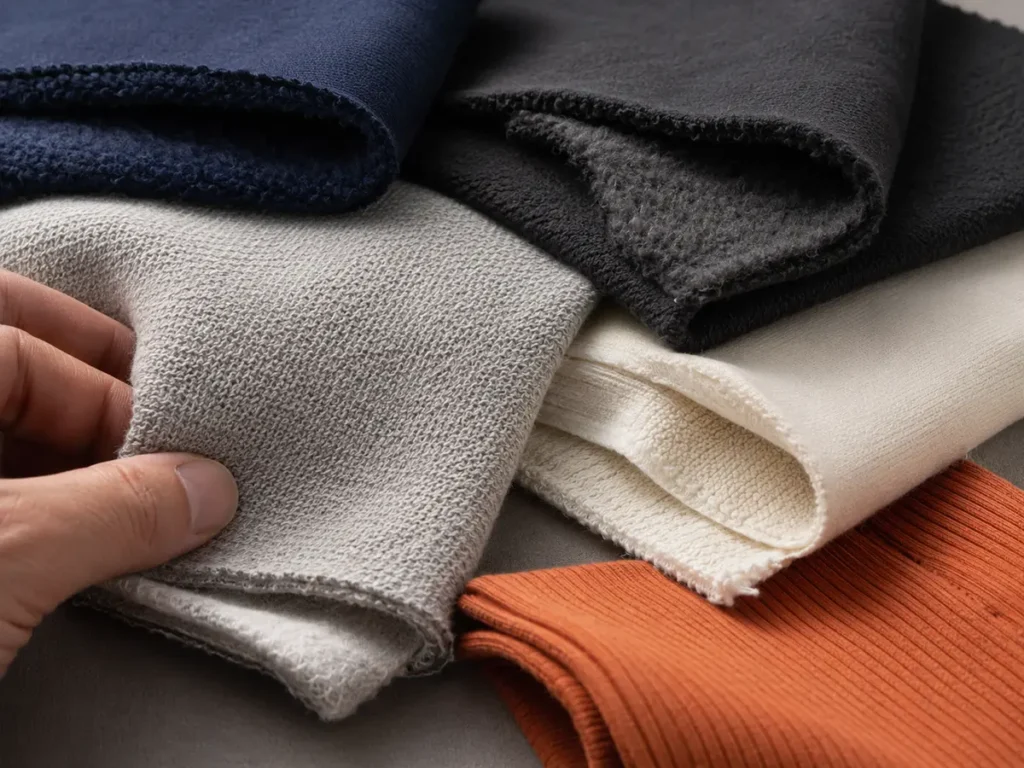
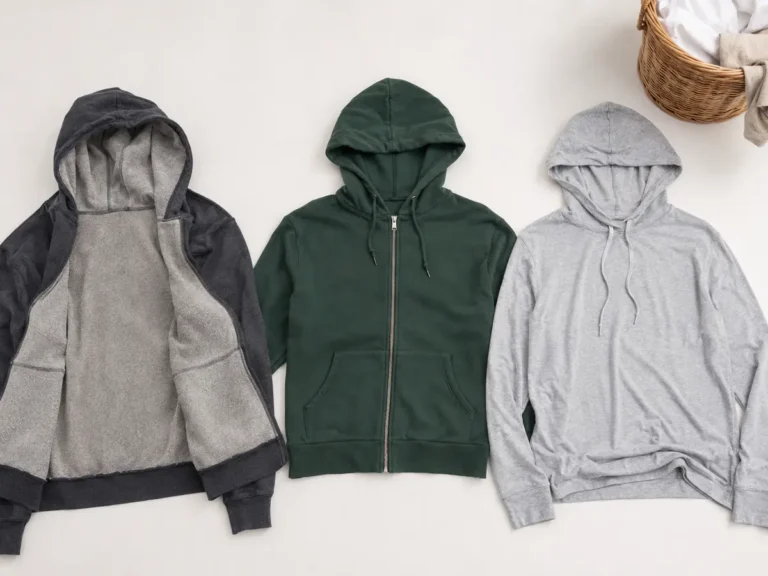
Cotton fleece, French terry, blend and rib fabrics for custom hoodies
Common Hoodie Fabric Options
| Fabric option | Typical character | Advantages for bulk orders | Points to confirm |
|---|---|---|---|
| Cotton-rich brushed fleece | Soft face with warm brushed interior | Familiar comfort, suitable for many print methods | Shrinkage control, pilling, colorfastness and weight |
| Cotton-polyester fleece | Stable blend with brushed interior | Dimensional stability, durability and repeatable hand feel | Exact blend ratio, face yarn and dye-lot consistency |
| 100% cotton fleece | Natural-fiber construction and substantial hand | Strong positioning for cotton-focused programs | Shrinkage, drying behavior and decoration compatibility |
| French terry | Smooth face with loopback interior | Less bulky, versatile for transitional seasons | Loop quality, weight and whether the back is brushed |
| Polyester or performance knit | Smooth, stable and quick-drying character | Team, training and performance use | Heat sensitivity, dye migration and transfer method |
| Recycled-content blend | Fiber claim supported by specified inputs | Supports documented material programs | Certified scope, transaction documentation and claim wording |
Fabric weight is often stated in grams per square meter (GSM). A higher GSM indicates more material per area, not guaranteed softness, warmth or quality. Yarn, knitting density, brushing, compaction and finishing also change the result. Compare physical swatches and approved samples rather than selecting by GSM alone.
Face Yarn Matters for Decoration
The face affects print sharpness and embroidery appearance. A smooth, tight surface supports cleaner printed edges; a fuzzy surface can interrupt fine detail. For blends, confirm whether the face is cotton-rich, polyester-rich or engineered for a print method. Test ink, transfer or adhesive on the exact dyed fabric, particularly where heat or dye migration could be a concern.
Rib, Hood and Trim Materials Must Match the Body
The cuff and waistband rib should recover after stretching and should be visually compatible with the body fabric. The color may need a separate dye lot because rib and fleece are different knit structures. Confirm whether the hood is single layer, double layer, self-fabric lined or jersey lined. Also approve drawcords, eyelets, zippers, stoppers and thread color.
Step 4: Source and Approve Colors
Digital screens are useful for communication but unreliable as final color standards. Approve lab dips for custom-dyed fabric or a physical swatch for stock fabric.
Pantone references help define direction, but the same reference can appear different on cotton fleece, polyester knit, rib, embroidery thread and printed ink. A professional color plan identifies which component is the master and what degree of variation is acceptable.
For repeat orders, retain the approved reference and fabric specification. Dye-lot variation can still occur, so never rely only on a name such as “navy 02.”
Step 5: Make and Approve a Physical Sample
The sample is where design intent meets materials and construction. It should not be treated as a marketing preview only. Buyers should review it systematically and return one consolidated comment sheet.
Sample Approval Checklist
Check the sample in this order:
- Overall silhouette and fit: Compare the garment to the approved measurement chart on a flat surface and, when useful, on an appropriate fit model.
- Fabric: Confirm composition documentation, weight, face, interior, stretch, recovery and hand feel.
- Color: Compare body, rib, thread, drawcord and decoration under suitable light.
- Construction: Inspect hood symmetry, pocket alignment, seam appearance, rib attachment and zipper operation.
- Decoration: Measure logo width, height and placement. Review edges, color, density, hand feel and surface distortion.
- Branding: Confirm neck label, size marking, care label, hangtag and packaging copy.
- Care performance: Agree on any wash, shrinkage, colorfastness, pilling or print-adhesion tests needed for the program.
Use one dated approval document that identifies what is accepted, what must change and whether a revised sample is required.
Planning a school, club, distributor or private-label hoodie program? Send JIUMU your reference image or tech pack, estimated quantity by size, target colors, logo files, packaging needs and delivery destination. We can help organize the specification, mockup and sample path before bulk production. Request a custom hoodie quotation.
Step 6: Prepare Fabric, Patterns and Cutting
After approval, bulk materials are ordered or allocated and checked against the standard for relevant attributes such as shade, width, visible defects, weight and shrinkage results. Knitted fabric may be relaxed before pattern pieces are marker-planned and cut while respecting grain, nap, alignment and size quantities.
Accurate cutting matters because small panel differences accumulate during sewing. A miscut hood, pocket or sleeve cannot be fully corrected by a careful sewing operator. Cut bundles should be identified by style, color, size and batch to reduce mixing.
Step 7: Sew the Hoodie
Hoodie construction usually combines lockstitch, overlock and coverstitch operations, depending on the seam and design. The sequence varies by factory and garment, but a pullover hoodie may include shoulder joining, hood assembly, hood attachment, sleeve setting, side seams, pocket attachment, cuffs and waistband.
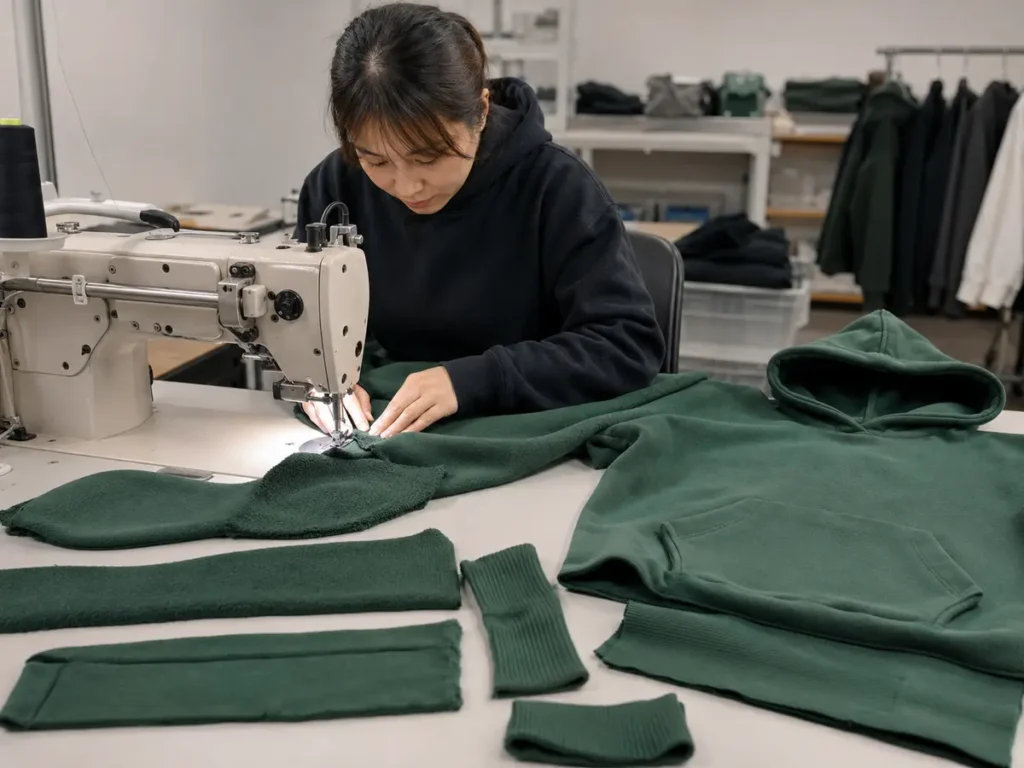
Skilled apparel worker sewing custom hoodie panels
Construction Details Buyers Should Specify
- Hood panel count and center seam
- Hood lining and drawcord channel
- Twill tape or binding at the back neck
- Kangaroo-pocket opening reinforcement
- Side-seamed or alternative body construction
- Set-in sleeve, raglan sleeve or dropped shoulder
- Single-needle or double-needle visible stitching
- Overlock seam width and stitch security
- Cuff and waistband rib height
- Thumbholes, media pockets or hidden zip pockets
- Zipper tape, puller and guard for full-zip styles
Pocket corners, zipper ends and drawcord openings are common stress areas. Reinforcement should match intended use, fabric weight and visual style.
Inline Quality Control
Quality control should not wait until cartons are packed. Inline checks can identify seam puckering, mismatched panels, skipped stitches, poor tension, uneven pockets and measurement drift while corrections are still practical. A defect repeated across hundreds of units is much more expensive to solve at final inspection than at the first sewing bundle.
Step 8: Apply Printing, Embroidery or Other Decoration
Decoration should be selected for the artwork, fabric, quantity, desired feel and durability expectations. No single method is best for every hoodie.
Hoodie Decoration Method Comparison
| Method | Best suited to | Visual and tactile result | Production considerations |
|---|---|---|---|
| Screen printing | Repeated designs, spot colors, bold graphics | Strong color and scalable coverage; hand varies by ink system | Screens, color separations, curing and placement tests |
| Embroidery | Crests, names, small logos and durable branding | Textured, dimensional thread finish | Digitizing, stitch density, backing and fabric distortion |
| Heat transfer | Names, numbers, small batches and detailed graphics | Clean edges; feel varies by film and adhesive | Temperature, pressure, dwell time and fabric sensitivity |
| DTF transfer | Detailed multicolor artwork on compatible fabrics | Vibrant transfer with a defined surface layer | Film, powder, curing, pressing and wash testing |
| Appliqué or patch | Varsity, heritage and premium identity details | Layered textile or patch construction | Edge finish, attachment method, thickness and placement |
| Sublimation | Primarily compatible polyester panels or all-over designs | Dye becomes part of compatible fabric with minimal surface feel | Material must suit sublimation; cut-and-sew planning is critical |
Screen Printing
Screen printing pushes ink through a prepared mesh stencil. Color count and artwork complexity affect setup; ink, underbase, mesh and curing must match the fabric and desired feel.
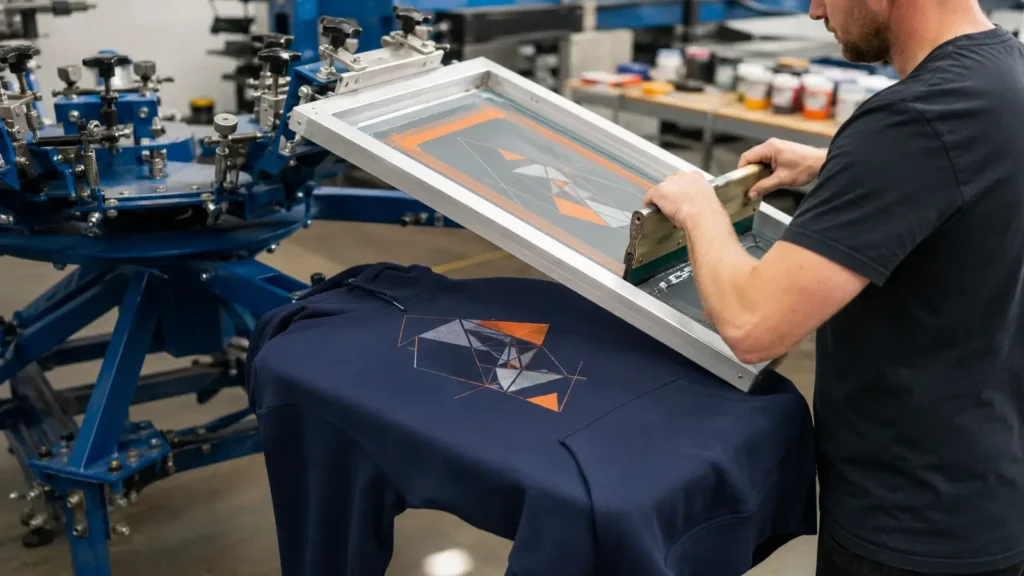
Screen printing an original graphic on a custom hoodie
A thick print is not automatically more durable. Correct ink selection and curing are more important than visual thickness alone. Large prints over a kangaroo pocket, zipper or seam require special planning because surface changes can interrupt pressure and registration.
Embroidery
Embroidery converts artwork into a stitch file controlling type, direction, density and sequence. Excessive density can pucker soft fleece; inadequate support can distort the logo. Backing, topping and hooping must suit the fabric and placement.
Small lettering and very fine detail may need to be simplified. Ask for a stitched sample or strike-off on the actual hoodie fabric, not only a digital simulation.
Heat Transfer and DTF
Heat transfers suit individual names, numbers and detailed graphics. In DTF, artwork is printed to film, combined with hot-melt powder, prepared and applied by heat press. Settings must match the film, adhesive and garment.
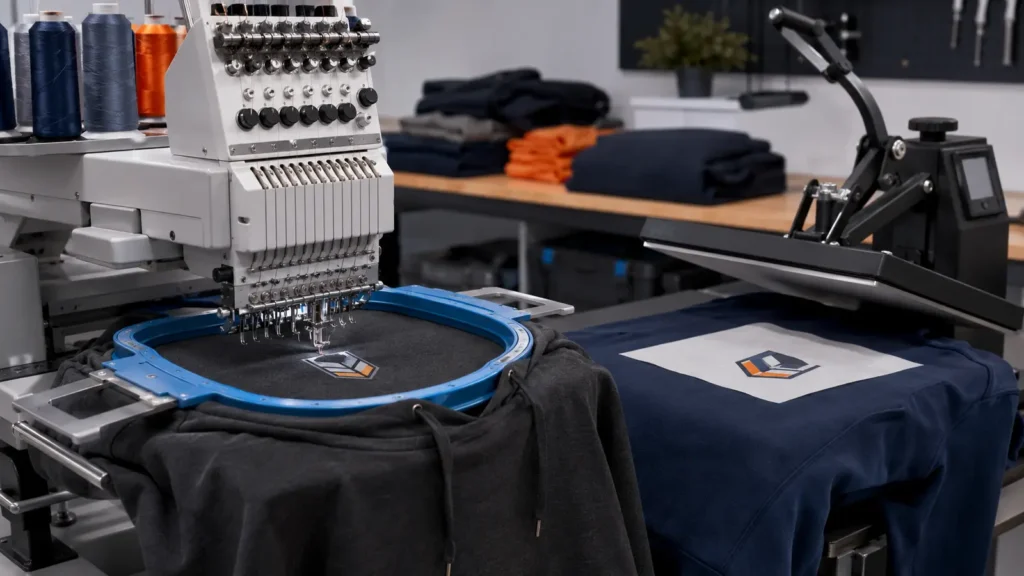
Embroidery and heat-transfer preparation for custom hoodies
The supplier should evaluate whether heat can change the fabric sheen, flatten fleece, cause dye migration or damage a performance finish. Wash testing on the exact production combination is more meaningful than a generic durability statement.
Step 9: Add Labels, Finish the Garment and Prepare Packaging
Private-label details are part of product engineering. A woven, printed or transferred neck label can be paired with a care label carrying fiber, origin and care information.
For the United States, most covered textile products need labels identifying fiber content, country of origin and the manufacturer or another responsible business; the FTC also requires care instructions for covered apparel. Buyers should confirm the applicable rules and their own responsible-party details with qualified compliance advisers. The FTC’s official guides explain the textile labeling requirements and the Care Labeling Rule.
In the European Union, textile products marketed to consumers must follow Regulation (EU) No 1007/2011 for textile fiber names and related fiber-composition labeling. The EU’s practical guidance notes that the label should show fiber composition and be firmly attached; language requirements can vary by market. Review the official EU textile-label guidance and obtain market-specific advice before final label printing.
ISO 3758:2023 establishes a system of care symbols covering washing, bleaching, drying, ironing and professional textile care. It is a useful technical reference, but symbol use and licensing should be checked for the destination market. See the ISO 3758:2023 summary.
After decoration and labeling, garments are trimmed, cleaned, pressed or steamed, folded and packed. Specify polybags, size stickers, barcodes, hangtags, carton ratios and shipping marks early.
Step 10: Inspect Finished Hoodies
Final inspection compares bulk goods with the approved pre-production standard and purchase specification. The scope should be agreed before the order, including sampling method, tolerances and responsibility for corrective action.
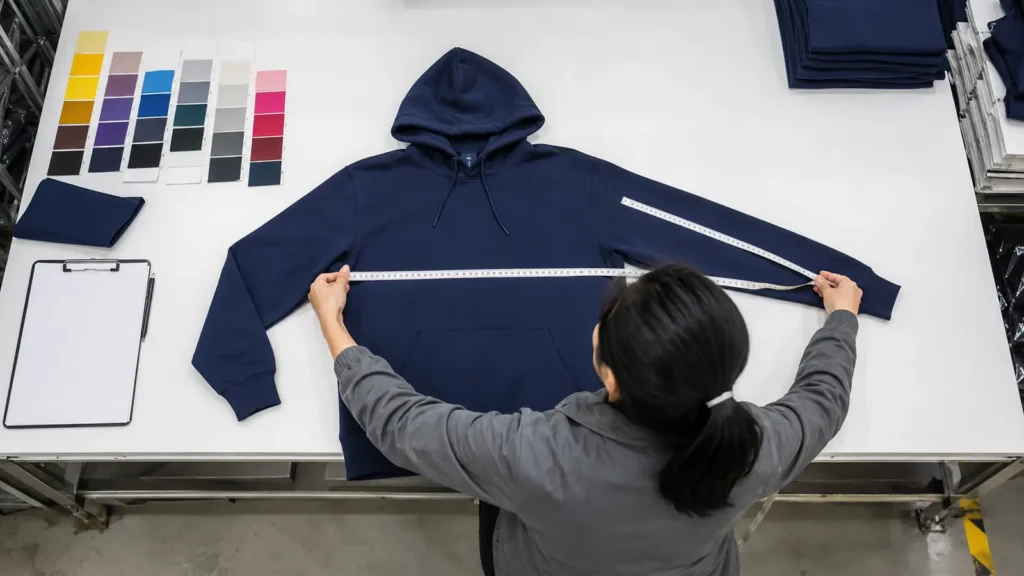
Final measurement and quality inspection of a custom hoodie
Practical Final QC Checklist
| Inspection area | What to verify | Common issue |
|---|---|---|
| Quantity and assortment | Total units, color-size breakdown and carton ratio | Mixed sizes or shortages |
| Measurements | Key points against approved chart and tolerances | Body or sleeve drift |
| Fabric and shade | Correct material, consistent dye lot and no obvious defects | Panel shading |
| Sewing | Seam security, stitch appearance, symmetry and reinforcement | Skipped stitches or uneven pocket |
| Decoration | Correct artwork, color, dimensions, placement and cure/adhesion | Off-center logo or puckering |
| Labels | Fiber, care, origin, size, brand and placement | Wrong label version |
| Finishing | Cleanliness, thread trimming, pressing and odor | Loose threads or marks |
| Packaging | Fold, bag, barcode, hangtag, carton marks and count | Incorrect barcode or assortment |
Depending on product risk and buyer requirements, testing may include dimensional change after laundering, colorfastness, pilling, seam strength, zipper performance and decoration adhesion. The test method, laboratory, pass criteria and sample size must be defined. Avoid asking a supplier to “pass all tests” without specifying which test and what result is acceptable.
Material and Sustainability Claims Require Documentation
Terms such as “recycled,” “organic,” “non-toxic” and “certified” should not be added to product pages or packaging merely because a material supplier used similar language. Claims need evidence that applies to the specific product and supply chain.
OEKO-TEX STANDARD 100 is a label for textiles tested for harmful substances, from yarn through finished products. Certification applies to defined articles and components; buyers should verify the certificate scope rather than treating the name as a general factory claim. See the official OEKO-TEX STANDARD 100 overview.
For recycled-content programs, Textile Exchange explains that the Global Recycled Standard is a voluntary full-product standard that verifies recycled content and chain of custody while also addressing processing requirements. In July 2026, Textile Exchange published GRS Version 5.0; programs should confirm transition dates, applicable certification scope and transaction documentation with their certification partners. Consult the official GRS 5.0 standard and Textile Exchange standards guidance.
JIUMU does not recommend making a certification claim until the exact fabric, facility, certificate validity, order documentation and labeling rules have been verified.
What Determines the Cost of a Custom Hoodie?
The main cost drivers are fabric, garment complexity, decoration, quantity, labeling, packaging, testing and logistics.
Fabric cost changes with composition, weight, finish, availability and volume. Custom dyeing, matching rib, double-layer hoods, special zippers, hidden pockets and contrast panels add development or operations. Decoration cost changes with setup, color count, stitch count, artwork size, placements and variable names or numbers. Retail labels and packaging also affect the price.
Ask suppliers to state what the quotation includes:
- Sample and revision costs
- Fabric and trim specification
- Decoration size, colors and locations
- Labels and hangtags
- Individual packaging
- Testing or inspection
- Carton and export packing
- Shipping term and destination
- Payment terms and quotation validity
How Long Does Custom Hoodie Production Take?
There is no universal lead time. The schedule depends on fabric availability, sample rounds, decoration, quantity, testing, packaging and production capacity.
A useful schedule separates development from bulk manufacturing:
- Specification and quotation
- Material sourcing and mockup
- Sample production
- Buyer review and revision
- Pre-production approval
- Bulk material preparation
- Cutting, sewing and decoration
- Final inspection and packing
- Freight booking and transit
Build approval time into the calendar. For deadline-sensitive events, confirm the required arrival date—not only the ex-factory date—and agree on approval cutoffs.
What to Send for an Accurate Hoodie Quotation
Send one consolidated inquiry containing:
- Hoodie reference or original concept
- Pullover/full-zip and adult/youth fit
- Quantity by color, and estimated size ratio if available
- Fabric composition, structure and target weight—or the intended feel and season
- Color references
- Editable logo artwork
- Decoration method if fixed, or desired appearance if advice is needed
- Logo dimensions and locations
- Label, hangtag, barcode and packaging requirements
- Destination country, city or postal code
- Required arrival date
- Compliance, testing or documentation requirements
Label alternatives as Option A and Option B so the supplier can quote comparable specifications.
Questions to Ask a Custom Hoodie Supplier
- Is the hoodie a modified stock style or a fully custom cut-and-sew product?
- What is the exact fabric composition, knit structure, weight and finish?
- Are the body and rib from coordinated dye lots?
- What measurements and tolerances will control bulk production?
- Which decoration method is recommended for this artwork and fabric, and why?
- Will you provide a physical sample or decoration strike-off before bulk?
- How are approved colors, artwork dimensions and placement recorded?
- What inline and final inspections are included?
- Which tests can be arranged, and what standard and pass criteria will be used?
- What labels and origin information must the buyer provide?
- What is included in packaging and carton marking?
- What is the process if bulk goods differ from the approved standard?
- How will specifications be retained for repeat orders?
- Which order details can change the MOQ or production schedule?
Clear answers are more valuable than a supplier promising “the best quality.” Observable controls—approved material, measurement table, sample, placement record and inspection criteria—make quality repeatable.
Common Custom Hoodie Production Mistakes
Choosing by Price Before Finalizing the Specification
Low quotations may reflect lighter fabric, stock components, fewer print colors, generic labels or simpler packing. Freeze the comparison specification first.
Approving Color on a Screen Only
Monitor settings and lighting change appearance. Use physical swatches, lab dips or an approved sample for critical brand colors.
Using One Measurement for Every Fit
Chest width alone does not define fit. Shoulder, length, sleeve, armhole, hood and rib proportions work together.
Selecting Decoration Without Testing the Fabric
The same transfer or ink can behave differently on cotton, blends and polyester. Test the exact production combination.
Making Unsupported Material Claims
A recycled yarn description is not automatically enough for a product-level certified claim. Verify scope and documentation before publishing.
Changing Details After Sample Approval
Changing fabric, color, logo size or packaging after approval can invalidate earlier testing and scheduling. Record revisions and approve their effect.
Ignoring Repeat-Order Records
Keep the approved tech pack, measurement chart, fabric code, color standard, artwork and label files. “Same as last time” is not a complete purchase specification.
Why Work With JIUMU on Custom Hoodies?
Established in 2010, JIUMU is a Guangdong-based B2B supplier supporting custom teamwear, logo apparel, hats, uniforms, bags and branded merchandise for buyers in North America and Europe.
For custom hoodie programs, JIUMU can support OEM and ODM development, fabric sourcing, Pantone color matching, digital mockups, physical samples, embroidery, screen printing, heat transfer, private labels, hangtags, packaging customization, bulk production coordination, quality control and export support. Typical MOQ starts from 50 pieces, subject to the garment structure, material, decoration and order mix.
Explore custom hoodies, review broader custom team uniforms or contact JIUMU with a tech pack or reference image.

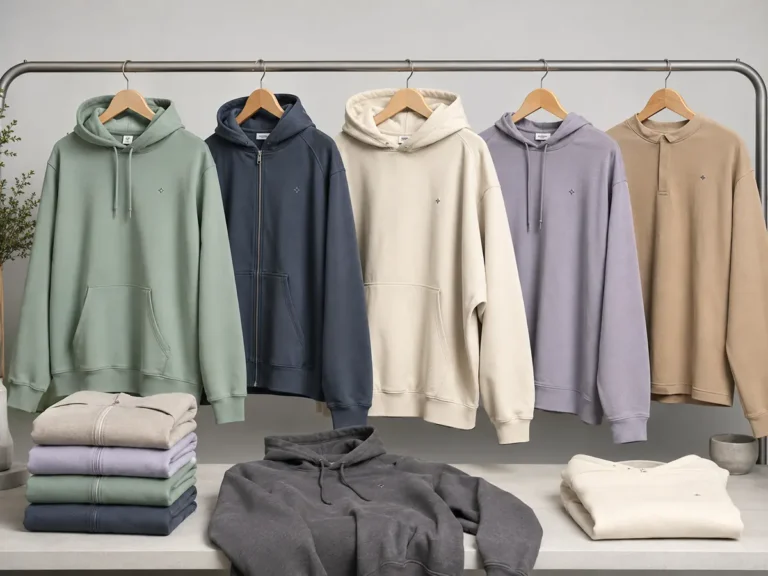
Coordinated custom hoodies for a sports club and brand team
Frequently Asked Questions
Final Recommendation
The most reliable custom hoodie order begins with a controlled specification, not a unit-price target. Define the wearer and use case, compare physical fabric options, convert fit language into measurements, test the decoration on the actual material, approve one pre-production standard and align final inspection with that standard.
When suppliers quote the same fabric, construction, decoration, labels, packaging and quality requirements, buyers can make a meaningful commercial comparison. The result is also easier to repeat across seasons, teams and distribution programs.
Sources and Further Reading
- U.S. Federal Trade Commission: Textile and Wool Labeling Requirements
- U.S. Federal Trade Commission: Complying with the Care Labeling Rule
- European Union: Textile Label Requirements
- EUR-Lex: Regulation (EU) No 1007/2011
- ISO 3758:2023: Textiles—Care Labelling Code Using Symbols
- OEKO-TEX STANDARD 100
- Textile Exchange: Global Recycled Standard Version 5.0
About the JIUMU Team
JIUMU is a Guangdong-based B2B supplier established in 2010, supporting custom teamwear, logo apparel, private labels, packaging and export programs for buyers in North America and Europe. Updated July 30, 2026.