How to Sell Custom Hoodies Online: Product, Supplier and Pricing Guide
Selling custom hoodies online is not simply a matter of uploading a logo to a blank garment. The profitable version of the business connects three systems: a focused product offer, a supplier workflow that can reproduce approved specifications, and a pricing model that covers every cost from sampling to returns.
This guide explains how to choose a hoodie, control customization, evaluate a supplier, calculate complete cost, build a product page and prepare a small collection for launch.
Quick Answer: To sell custom hoodies online, start with one clearly positioned core hoodie and a limited menu of colors, sizes and decoration options. Approve a physical sample, calculate the complete unit cost rather than the blank-garment cost, and price from the gross margin required by your sales channel. Publish real garment measurements, decoration limits, production rules and a clear policy for personalized items. Add more styles only after the first product produces reliable sales and repeatable quality.
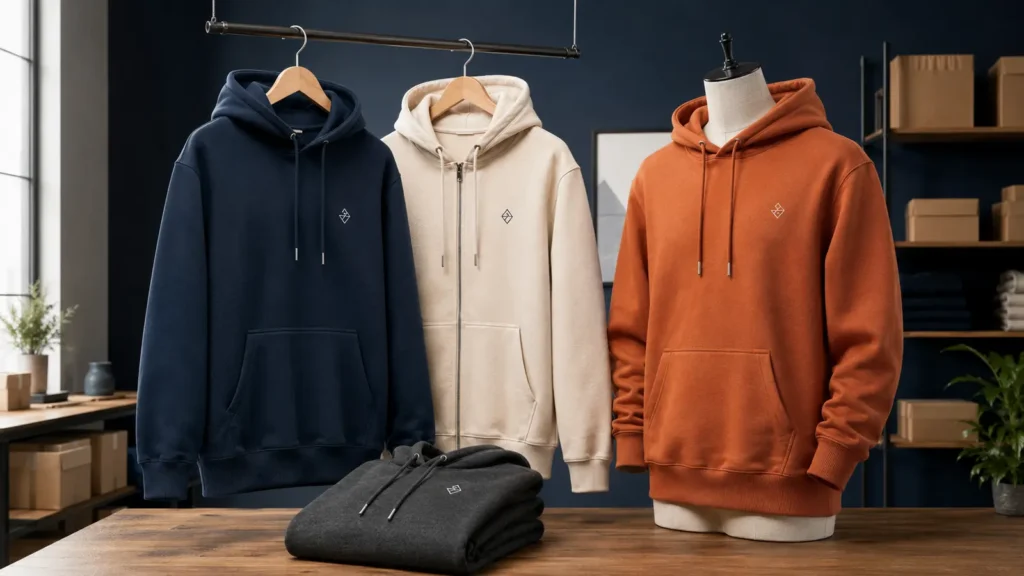
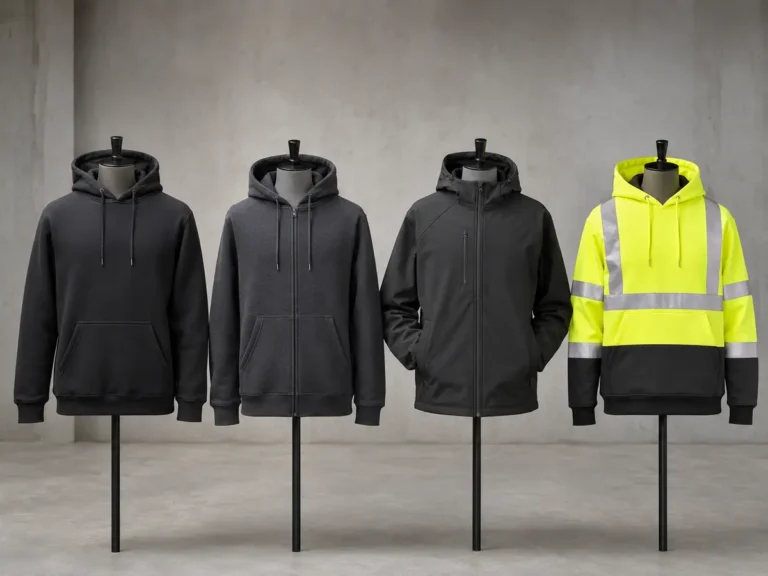
A coordinated collection of premium custom hoodies prepared for online sale
A focused custom hoodie range is easier to photograph, price, stock and reorder than an unlimited catalog.
Why the custom hoodie business model matters
Hoodies can serve several different businesses. A streetwear label may need an original silhouette, private labels and controlled drops. A school or club may prioritize names, numbers and size collection. A corporate merchandise seller may require a stable color, discreet embroidery and individual packaging. A print-on-demand creator may value low inventory exposure more than unit cost.
These models should not share the same product architecture. If every buyer sees every possible fabric, color, fit, print size and packaging option, the store becomes difficult to understand. Complexity increases quotation time, artwork errors, sample revisions and stock exposure.
The better approach is controlled customization. Define a core product and let customers choose only from combinations you know how to produce. Keep project-based options—such as custom fabric dyeing, a special zipper, all-over graphics or retail packaging—behind a quotation form.
Compare four ways to sell custom hoodies online
| Model | Inventory approach | Customization level | Main advantage | Main risk | Best fit |
|---|---|---|---|---|---|
| Print on demand | Produced after each order | Usually limited | Low initial inventory | Higher unit cost and less production control | Testing artwork and audience demand |
| Decorated stock blanks | Keep or source standard blanks | Medium | Fast development and familiar sizing | Dependence on blank availability | Creators, local businesses and small campaigns |
| Private-label bulk order | Produce an approved design in a planned quantity | High | Better control of fit, labels and unit economics | Inventory and forecasting risk | Ecommerce brands and repeat programs |
| Team or group preorder | Collect sizes/orders before bulk production | Medium to high | Demand is known before production | Requires a firm order window | Schools, teams, clubs and events |
Build a product people can understand
The first hoodie should have a one-sentence reason to exist. “A heavyweight, relaxed-fit embroidered hoodie for independent teams” is a product concept. “Custom hoodies in any style” is not.
A useful product brief covers:
- target wearer and use case;
- pullover or full-zip construction;
- intended fit and size range;
- fabric composition, structure and target weight;
- hood, pocket, cuff, waistband, drawcord and zipper details;
- decoration method and maximum artwork area;
- colors that can be reordered;
- neck label, care label, hangtag and packaging requirements;
- expected order quantity and target delivery window.
Choose one hero use case before expanding. A sports-club offer could start with a unisex pullover in three colors, left-chest embroidery and optional player names. A fashion label may instead choose a heavier oversized body, dropped shoulders and private labels.
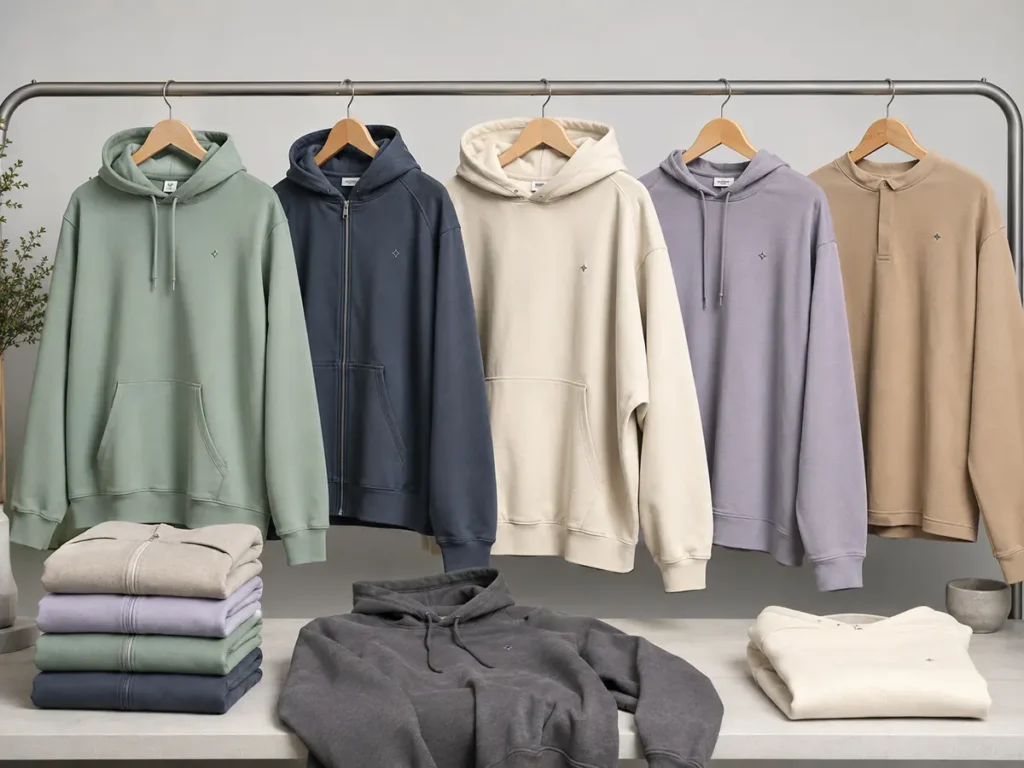
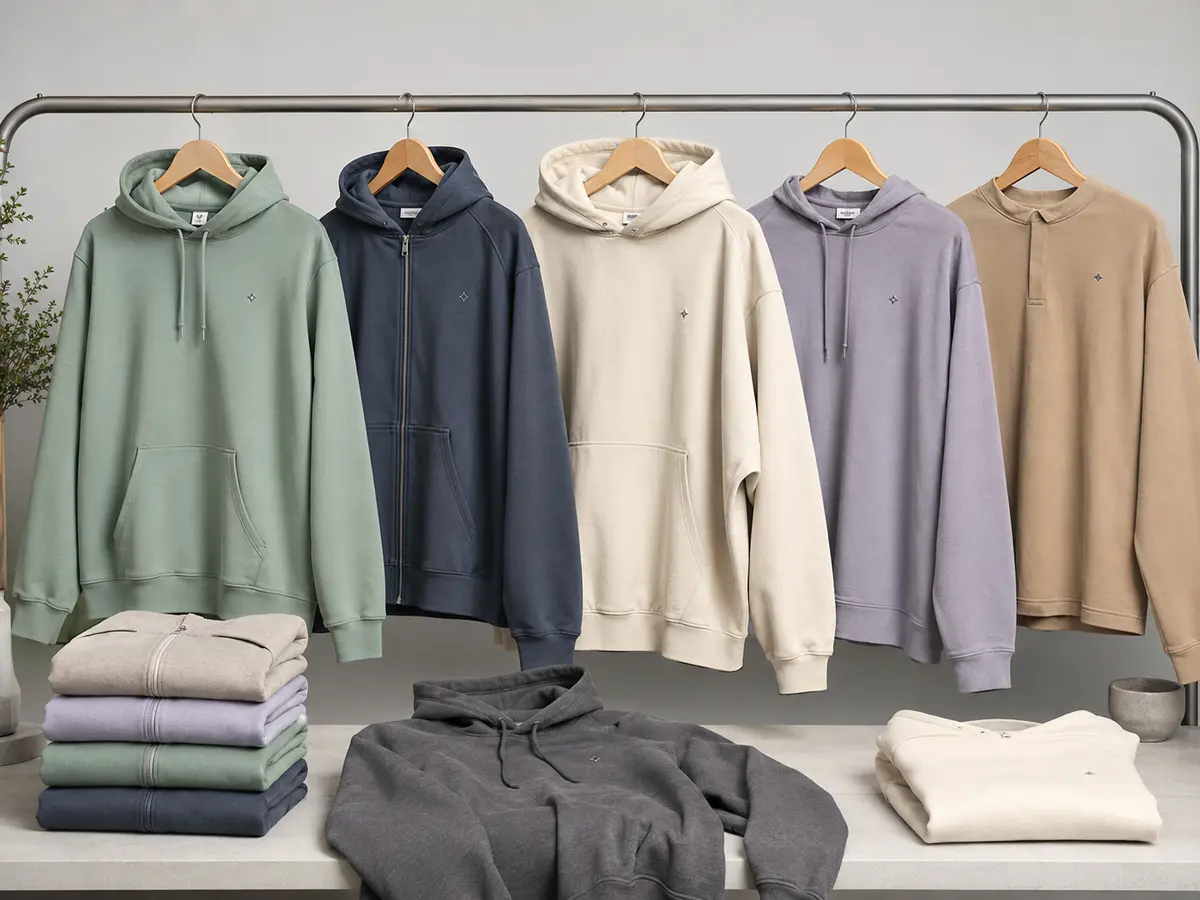
A coordinated range of pullover, zip and relaxed-fit hoodie styles
Different hoodie styles can support different markets, but the first online range should remain intentionally small.
Use a core style with controlled options
An efficient launch menu might contain:
- one body pattern;
- three or four garment colors;
- five or six adult sizes;
- one standard logo position;
- one primary decoration method;
- optional back print or individual name;
- standard packaging, with private packaging quoted separately.
This structure creates enough choice for customers while keeping photography, size charts, samples and production instructions manageable. New options should earn their place through demand, not through supplier capability alone.
Select hoodie fabric by use, not by a vague quality label
Fabric descriptions often fail because buyers use terms such as “premium,” “thick” or “soft” without measurable specifications. A supplier needs the fiber composition, knit structure, target weight, face finish, interior finish, color requirement and performance expectations.
GSM—grams per square meter—describes fabric mass per area. It does not independently prove warmth, softness, opacity, shrinkage performance or durability. Two fabrics at the same GSM can feel different because of yarn, knitting density, brushing, fiber blend and finishing.
Common hoodie fabric directions
| Fabric direction | Typical characteristics | Ecommerce advantage | Procurement question |
|---|---|---|---|
| Cotton-rich brushed fleece | Smooth face with brushed interior; soft and warm | Familiar hand feel and strong product photography | Will composition, weight and brushing match the approved sample? |
| Cotton-polyester fleece | Balance of cotton feel and polyester stability | Practical for team and promotional programs | What are the exact fiber percentages and shrinkage results? |
| Loopback French terry | Looped interior rather than heavily brushed fleece | Useful for transitional weather and layering | Is the loop structure visible and consistent across colors? |
| Heavyweight fleece | More substantial hand and structured drape | Supports elevated streetwear positioning | Is the garment weight practical for shipping and the target climate? |
| Performance-oriented knit | May prioritize moisture handling or stretch | Relevant to training, travel and active teams | What claim can be documented, and what testing supports it? |
Avoid publishing unsupported performance claims. “Moisture-wicking,” “organic,” “recycled,” “antibacterial” and “water-resistant” should be used only when the product specification and evidence support them.
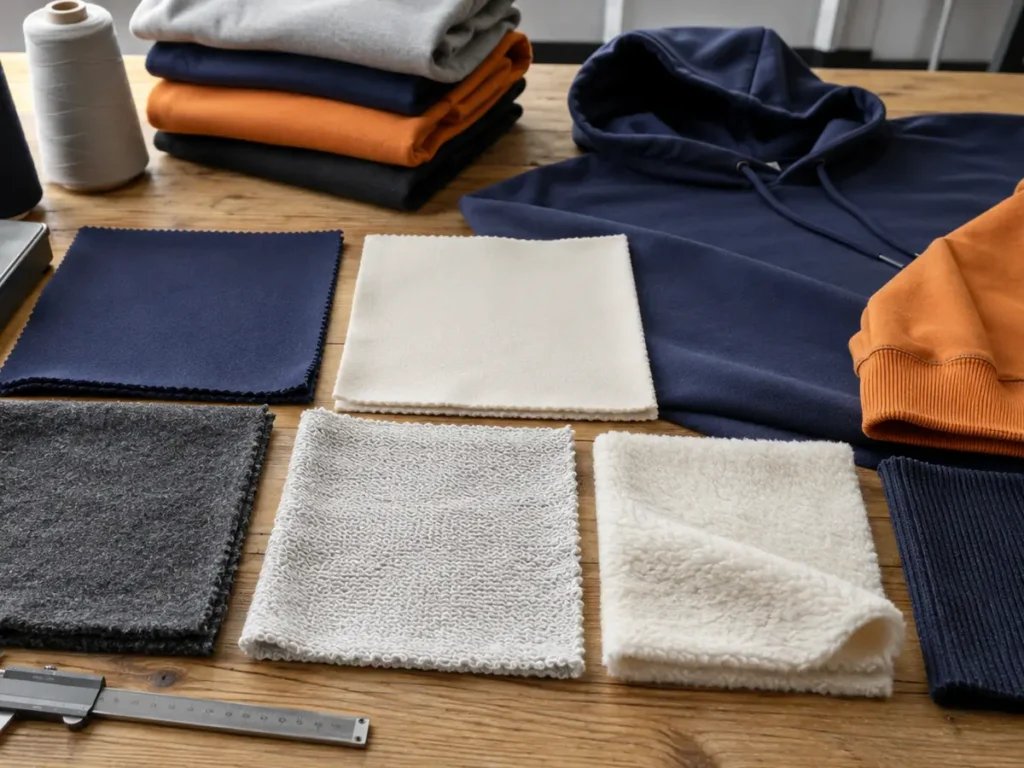
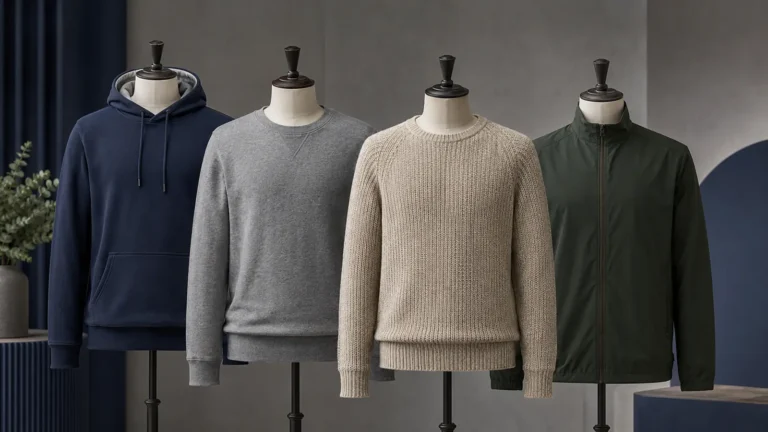
Hoodie fabric swatches showing fleece, French terry and rib-knit textures
Approve fabric by composition, structure, target weight, color and finish—not by a single adjective.
Decide what customers should feel
Translate the market position into observable product decisions:
- A luxury streetwear buyer may expect a dense face, stable ribbing, a structured hood and controlled shrinkage.
- A tournament or travel team may value warmth, easy care and repeat-order color consistency.
- A corporate buyer may prioritize a clean surface for embroidery and a fit that works across a broad staff size range.
- A warmer-market customer may prefer loopback French terry or a lighter fleece.
Ask the supplier to document the approved fabric and retain a reference. Reorders should be compared against that standard because color, brushing and hand feel can shift between fabric lots.
Create a size and fit system before you sell
Online apparel returns frequently begin with unclear expectations. A generic S–XXL table is not enough. The product page should show actual garment measurements and explain the intended fit.
At minimum, define:
- chest width measured flat;
- body length;
- sleeve length and measurement method;
- shoulder width when relevant;
- measurement tolerance;
- whether measurements are taken before or after washing;
- model height, size worn and fit description when using model photography.
Do not copy a size chart from another hoodie. Measure the approved sample and each graded size. If the product is unisex, explain what that means in practical fit terms rather than assuming the word solves sizing.
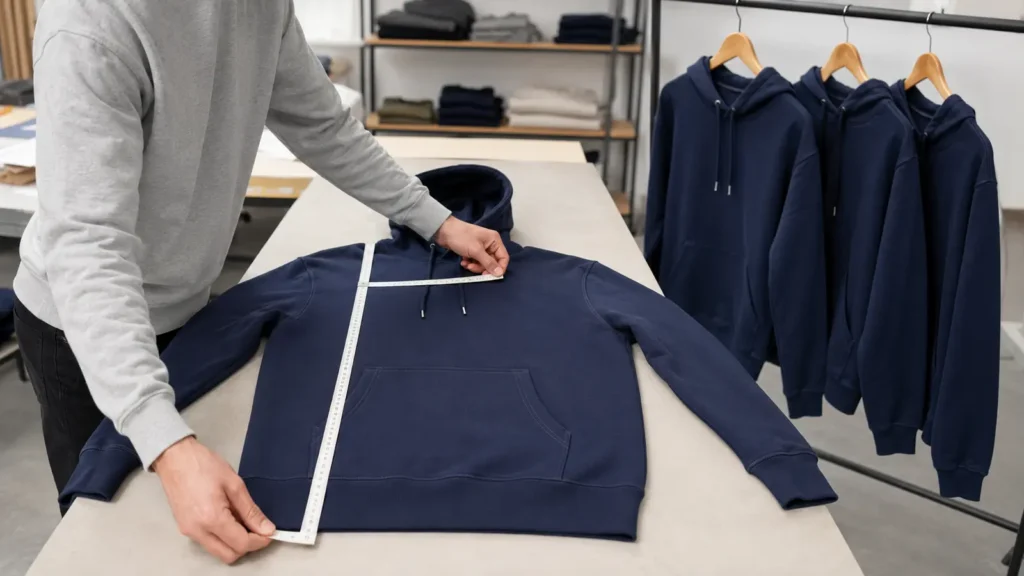
A garment technician checking hoodie chest and body measurements
The ecommerce size chart should come from the approved garment, using a documented measurement method.
Separate fit approval from size grading
The base-size sample establishes the silhouette: body width, length, shoulder, hood proportion and pocket placement. Size grading determines how those measurements change across the range. Approve both.
For youth hoodies, product safety deserves separate review. In the United States, the CPSC states that hood and neck drawstrings on children’s upper outerwear in sizes 2T–12 present a substantial product hazard; waist and bottom drawstrings in sizes 2T–16 are also subject to restrictions. Hoodies and sweatshirts can fall within the covered upper-outerwear definition. Review the current CPSC drawstring guidance with a qualified compliance professional for the exact market and product.
Inspect construction details that customers will notice
Construction quality should be described through checkpoints, not the phrase “high quality.” The following features influence appearance, wear and repeatability:
- even seam allowance and stitch density;
- clean topstitching and coverstitching;
- reinforced pocket corners;
- rib cuffs and waistband with appropriate recovery;
- stable hood shape and matching hood panels;
- drawcord, eyelet and stopper construction appropriate to the market;
- smooth zipper operation on full-zip styles;
- decoration backing that is trimmed and comfortable;
- secure labels without sharp or loose edges;
- consistent measurements within the agreed tolerance.
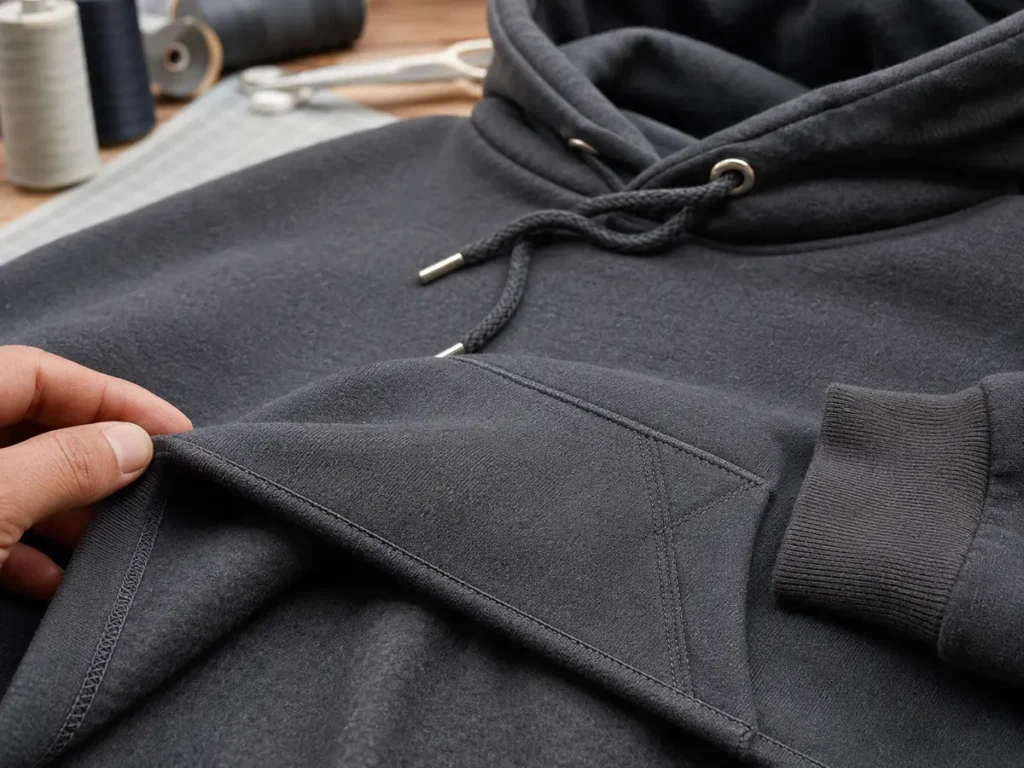
Close-up of hoodie pocket reinforcement, rib cuff and seam construction
Observable construction checkpoints are more useful than an unsupported “premium quality” claim.
Request close-up sample photos, but do not substitute photos for a physical sample when fit, fabric hand or color matters. A physical sample lets you wash the garment, check measurement change and review how decoration affects drape.
Choose decoration methods around the artwork
The artwork, fabric and order quantity should determine the decoration method.
| Method | Strong use case | Main design consideration | Cost behavior |
|---|---|---|---|
| Embroidery | Left-chest marks, uniforms and understated branding | Dense artwork can become stiff; small details may need simplification | Often affected by stitch count, size and number of positions |
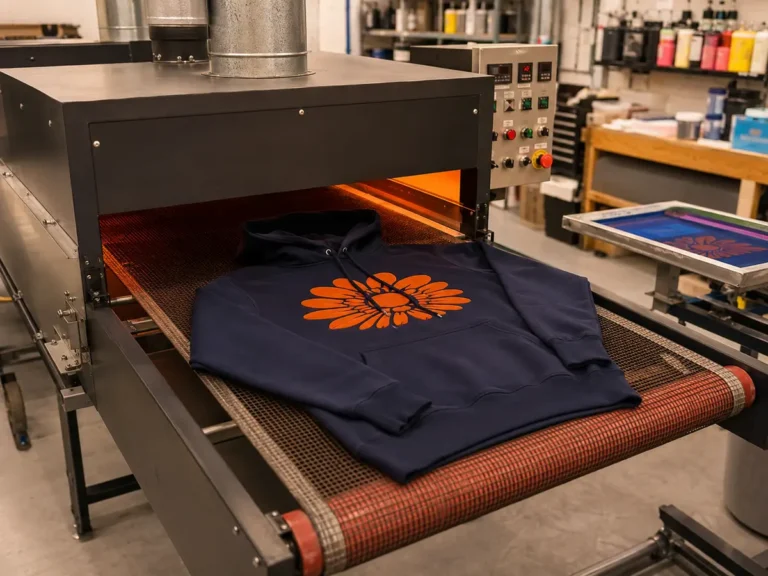
| Screen printing | Bold graphics and repeated bulk runs | Color count, screen setup, underbase and print area matter | Setup is spread across quantity |
| Heat transfer | Names, numbers, short runs and detailed color | Film, press settings and fabric compatibility affect feel and durability | Useful for variable data; cost rises with size and placements |
| Woven or embroidered patch | Dimensional brand detail | Edge finish, attachment and minimum readable detail matter | Includes patch production plus attachment |
| Sublimation | Polyester components or special panels | Not a universal solution for cotton fleece; design must suit the compatible material | Often linked to panel design and production construction |
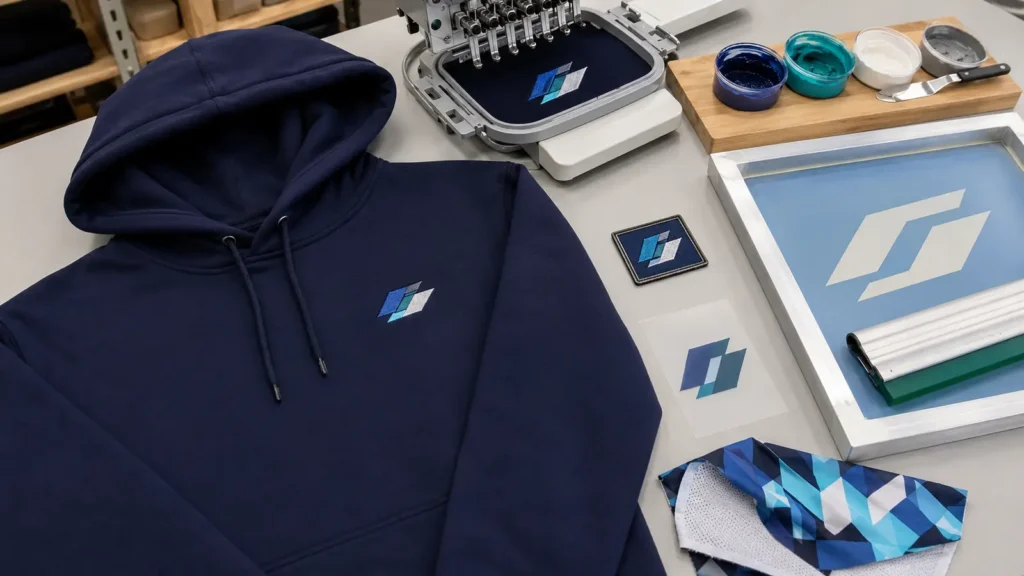
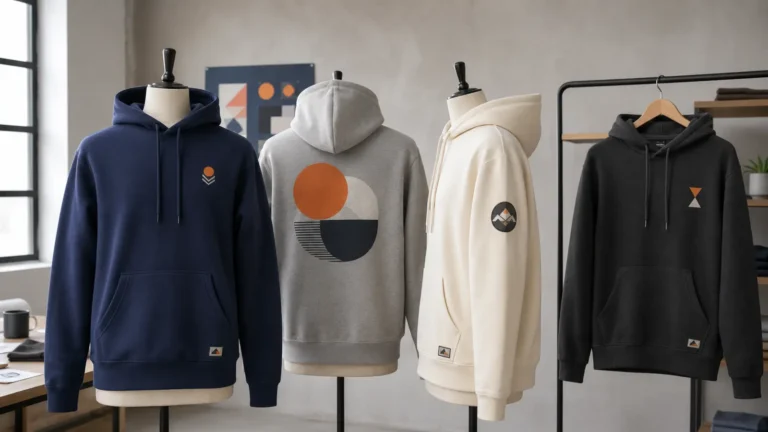
Embroidery, patch, screen-print and transfer samples around a custom hoodie
Decoration should be sampled on the actual fabric because color, texture and heat response affect the result.
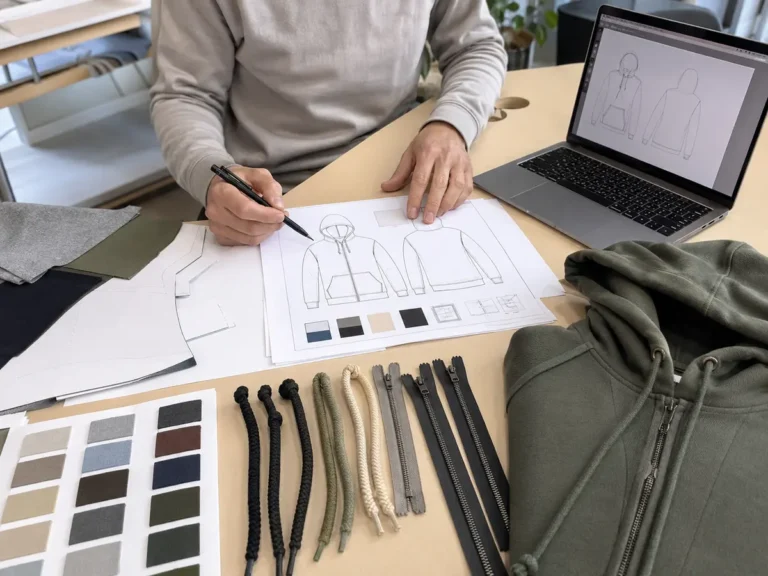
Provide vector artwork when possible, exact dimensions, Pantone references where needed, placement measured from garment landmarks, and a clear list of size-dependent adjustments. Approve a digital mockup for position and content, then a physical decorated sample for color, texture and scale.
Plan a custom hoodie specification with JIUMU
Send your reference image or tech pack, target quantity, sizes, garment colors, fabric direction, logo files, decoration positions, packaging needs and target delivery date. JIUMU can review the project for OEM/ODM development, sampling and bulk-order planning.
Find and evaluate a custom hoodie supplier
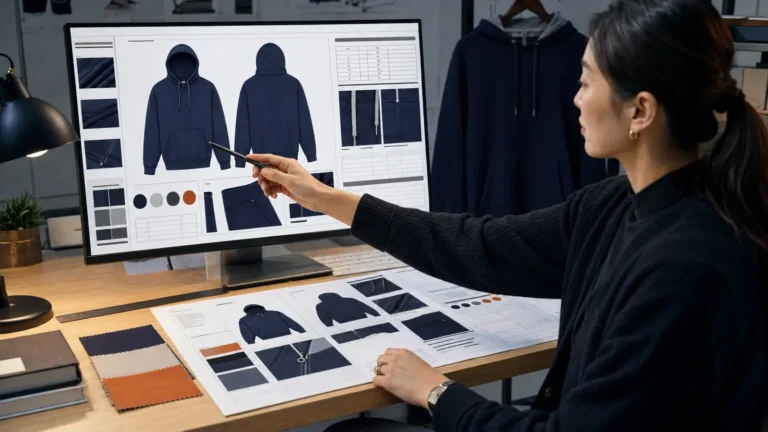
A capable supplier should do more than quote a unit price. It should help translate the product brief into a controlled specification, identify conflicting requirements, make samples, document approvals and communicate changes.
Compare suppliers on evidence
Use the same request-for-quotation document for each candidate. Compare:
- Specification understanding. Does the quotation restate the fabric, weight, fit, decoration, labels, packaging and quantity?
- Sampling process. What samples are available, what does each prove, and how are revisions approved?
- MOQ by configuration. Does the minimum apply per style, color, fabric, logo or total order?
- Decoration capability. Is the method suitable for the actual fabric and artwork?
- Quality-control plan. Which measurements and appearance points are checked, and what is the agreed tolerance?
- Change control. Will material substitutions or artwork changes require written approval?
- Lead-time definition. When does the clock start: deposit, artwork approval, material approval or pre-production sample approval?
- Commercial terms. What is included, what is excluded, and which Incoterm is used?
- Communication. Are questions answered directly and recorded in one project document?
- Reorder consistency. How will the supplier match the approved fabric, color, measurements and decoration later?
Questions to ask before paying for a sample
- Is the proposed fabric stock-supported or custom-produced?
- What is the exact fiber composition, knit structure and target GSM?
- Which size is used for the first fit sample?
- How many sample revisions are included?
- Is decoration sampled on the actual garment fabric?
- Can the supplier provide a measurement chart with tolerances?
- Which labels are required for the destination market, and who supplies their content?
- What packaging is standard?
- Which tests or inspections are included, and which require a separate request?
- What happens if the bulk order differs from the approved sample?
- Can colors, trims and labels be repeated on a later order?
- Which freight, duty, tax and delivery costs are excluded?
The cheapest quotation is not necessarily the lowest-cost supply decision. A vague quote can become expensive after artwork fees, label setup, sample revisions, repacking, freight and defects are added.
Use a staged sample-approval process
Sampling is a risk-control process. It should answer separate questions in sequence:
- Material confirmation: Does the fabric match composition, weight, color and finish requirements?
- Fit sample: Is the silhouette correct in the base size?
- Size-set review: Does grading work across critical sizes?
- Decoration sample: Are logo color, scale, placement and hand feel acceptable?
- Pre-production sample: Does the complete garment match every approved component?
- Bulk inspection: Does production remain within the agreed standard?
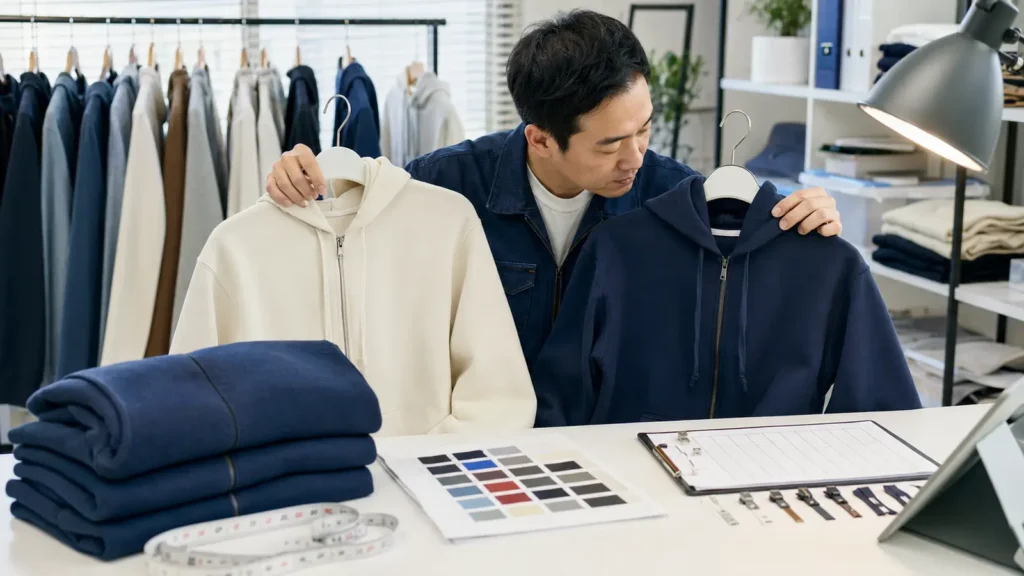
A quality inspector comparing custom hoodie samples and color references
An approved sample, measurement chart and artwork record give both buyer and supplier a shared production reference.
Record approval in writing. List the sample version, date, measurements, fabric, color reference, trim, label copy, decoration file, placement and packaging. “Approved” should refer to a specific sample.
Calculate the complete cost of a custom hoodie
Start with a cost stack. The supplier’s garment price is only one line.
Landed unit cost
(product + decoration + labels + packaging + sampling allocation + freight + duty + import fees + inspection) ÷ sellable units
Delivered variable cost
landed unit cost + payment fee + pick/pack + outbound shipping subsidy + expected returns/defects allowance + channel commission
Use sellable units in the denominator. If some units are reserved for photography, influencers, replacements or quality issues, they are still a business cost.
Illustrative cost model
The numbers below are examples for planning, not JIUMU quotations and not market benchmarks.
| Cost item | Illustrative amount per sellable unit |
|---|---|
| Garment and standard construction | $15.00 |
| Front embroidery and back print | $4.20 |
| Private labels and standard packaging | $1.10 |
| Sampling and development allocation | $0.90 |
| Freight, duty and import allocation | $4.80 |
| Inspection and defect allowance | $0.75 |
| Illustrative landed unit cost | $26.75 |
| Payment, fulfillment and shipping subsidy | $8.25 |
| Illustrative delivered variable cost | $35.00 |
Replace every line with your actual data. Freight depends on carton dimensions, chargeable weight, route, service, timing and Incoterm. Duty and tax depend on classification, origin, destination and importer arrangements. Confirm them with qualified logistics and customs professionals.
Set a retail or wholesale price from margin
Markup and gross margin are not the same.
Markup = (selling price − cost) ÷ cost
Gross margin = (selling price − cost) ÷ selling price
If the delivered variable cost is $35 and the selling price is $70, the markup is 100%, while the gross margin before fixed overhead and marketing is 50%.
For a target gross margin:
Selling price = applicable unit cost ÷ (1 − target gross margin)
At a $35 delivered variable cost:
| Target gross margin | Formula | Illustrative price |
|---|---|---|
| 45% | $35 ÷ 0.55 | $63.64 |
| 50% | $35 ÷ 0.50 | $70.00 |
| 55% | $35 ÷ 0.45 | $77.78 |
| 60% | $35 ÷ 0.40 | $87.50 |
Round only after the model works. Then test whether the final price makes sense for the product position, alternatives, customer acquisition cost and expected order value.
Price customization transparently
Do not hide costly options inside one average price unless their use is predictable. Consider:
- base garment price;
- logo setup or digitizing fee;
- included decoration size and position;
- add-on price for a second position;
- per-name or per-number charge;
- surcharge for special fabric, zipper or trim;
- private-label and packaging minimums;
- rush service only when operationally feasible;
- shipping and tax presentation.
For group orders, quantity tiers can reflect setup efficiency. State what quantity is counted—per design, garment color or combined order—so the customer can understand the price.
Build a product page that reduces uncertainty
A strong custom hoodie product page answers procurement questions before checkout or quotation.
Include:
- clear front, back, side and detail photography;
- fit description and garment-measurement chart;
- fabric composition, structure and target weight;
- care instructions;
- available colors and a warning that screens display color differently;
- decoration method, maximum area and file requirements;
- personalization field rules;
- mockup and approval process;
- production timing definition;
- shipping scope;
- return, remake and defect policy;
- contact route for bulk or private-label projects.
Show an order summary before the customer pays: garment, color, size, quantity, decoration, name/number spelling, artwork version, shipping method and estimated timeline. For personalized products, require an explicit approval step.
Use two buying paths
Not every order belongs in a standard checkout.
Direct checkout works for controlled combinations with known pricing: one hoodie, approved colors, standard print locations and a limited personalization format.
Request a quote works for wholesale quantities, custom fabric, Pantone matching, original patterns, private labels, multiple decoration methods, complex packaging or a target delivery event.
This split keeps the storefront convenient without forcing complex B2B projects into an unreliable automated price.
Plan fulfillment, service and reorders
Order fulfillment is part of the product promise. Decide whether inventory will be held in bulk, produced by preorder, shipped directly, or stored with a fulfillment partner. Confirm barcode, SKU, folding, polybag or alternative packaging, carton mark and assortment rules before production.
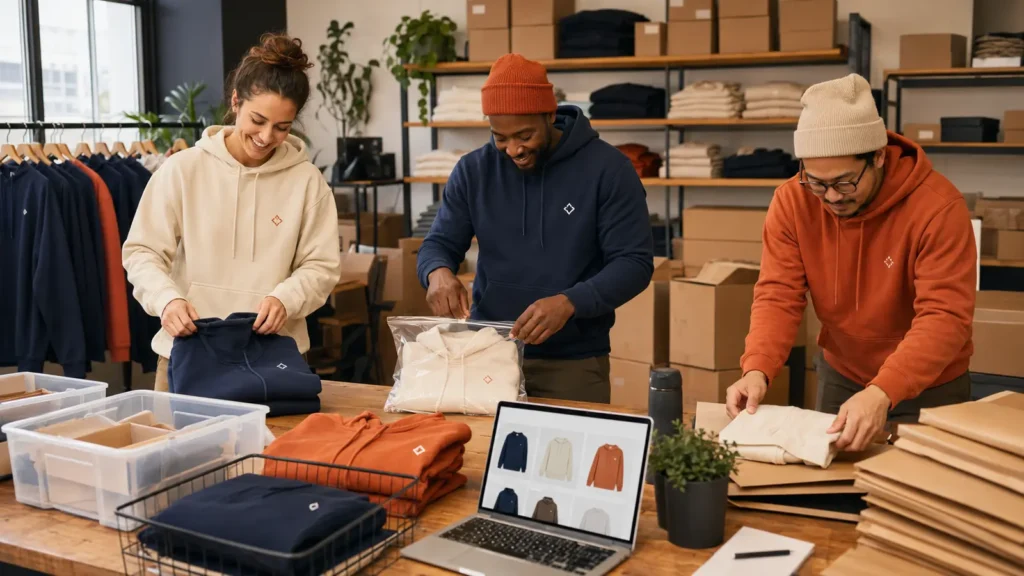
A small ecommerce apparel team preparing custom hoodie orders
The online offer should be designed together with labeling, packaging, order checking and fulfillment.
For personalized orders, use a spelling and artwork checkpoint. For team programs, provide a size-collection template and a final roster lock date. For private-label inventory, reserve a small number of units for photography, customer service and replacements.
Reorders need a retained standard: approved sample, measurement chart, fabric reference, color reference, decoration file, trim specifications and packaging record. Ask whether the original fabric or color is still available before promising an exact repeat.
Address labeling, product safety and returns
Compliance depends on the product, seller, destination and customer. This guide is general business information, not legal advice.
For the United States, the FTC explains that most covered textile products need labels identifying fiber content, country of origin and the manufacturer or another responsible business; apparel also falls under care-labeling requirements. Review the FTC’s textile labeling guidance and Care Labeling Rule guidance.
For the EU, textile products marketed to consumers generally require durable, legible and accessible fiber-composition labeling in the official language or languages of the country where the product is sold. The EU’s textile label guidance summarizes the requirements. The EU General Product Safety Regulation has applied since 13 December 2024 and covers distance selling, including online offers; review the current GPSR summary and obtain market-specific advice.
For Great Britain, UK government textile-labeling guidance requires fiber-content information and provides direction for products with multiple components.
Personalization can affect cancellation or change-of-mind rights, but it does not erase the seller’s responsibility for faulty or misdescribed goods. UK guidance lists personalized or custom-made goods among items for which a refund may be required only if faulty; read the current UK returns guidance. In the EU, consumer-rights rules contain exceptions and national implementation can matter. Publish a policy drafted for your markets and distinguish:
- customer-approved personalization;
- customer spelling or size-selection errors;
- seller or production errors;
- faulty goods;
- goods that do not match the approved description;
- transit damage;
- non-personalized products.
Common mistakes when launching custom hoodies
Offering too many choices
More options can lower conversion and increase production errors. Launch a controlled range and collect requests for future variants.
Pricing from the blank garment
Decoration, labels, samples, freight, duty, fulfillment, payment fees and defects can materially change the economics.
Approving only a digital mockup
A mockup cannot prove fabric feel, fit, embroidery density, print hand or wash performance.
Using a supplier’s generic size chart
Measure the actual approved garment and state the method.
Treating every decoration method as interchangeable
Artwork, fabric and order quantity affect which method is suitable.
Promising a delivery date before approvals
Define when production time begins and build in freight and customs contingency.
Publishing unsupported claims
Do not advertise recycled content, organic status, performance, origin or certification without evidence.
Writing “no returns on custom goods” without qualification
The policy must reflect the market and preserve remedies for faulty, damaged or misdescribed products.
What to send for an accurate custom hoodie quotation
Prepare one inquiry package containing:
- product reference image or technical sketch;
- target market and wearer;
- estimated total quantity and quantity by color;
- size range and preliminary size breakdown;
- pullover or zip style;
- fit direction;
- fabric composition, structure, target GSM and finish;
- garment colors or Pantone references;
- vector logo files;
- decoration method, size and placement;
- private label, care label, hangtag and packaging requirements;
- destination, desired shipping method and Incoterm if known;
- target in-hand date;
- expected reorder plan;
- any required compliance or testing brief.
Clear information allows the supplier to identify MOQs, development work and cost drivers before sampling.
Why consider JIUMU for custom hoodie sourcing
JIUMU supports North American and European B2B buyers with custom teamwear, logo apparel and branded merchandise. Its documented capabilities include OEM/ODM development, embroidery, screen printing, heat transfer, sublimation, woven and rubber/PVC or leather-style patches, fabric sourcing, Pantone color matching, private labels, hangtags, customized packaging, digital mockups, physical samples, bulk production, quality control and export support.
The typical MOQ is 50 pieces, subject to product structure and customization. That qualification matters: a stock-supported decorated hoodie may have a different minimum from an original pattern, custom fabric or private-label program.
Buyers can also connect hoodies with custom team uniforms, custom team jackets, custom hats or team bags to build a coordinated merchandise or uniform range.
Frequently Asked Questions
Final recommendation
Start with a product that can be explained, sampled and priced on one page. Use one core hoodie, a limited option set and a supplier brief that defines fabric, fit, decoration, labels and packaging. Approve the physical sample and size chart before taking large orders. Build the price from the complete cost stack, then create separate checkout and quotation paths.
The goal is not to offer every possible hoodie. It is to make one promise that your storefront, supplier and fulfillment process can repeat.
About JIUMU
Established in 2010 in Guangdong, China, JIUMU supplies custom teamwear, logo apparel, hats, uniforms, bags and branded merchandise for B2B buyers in the United States, Canada, the United Kingdom and Europe.