
How to Choose Fabric for Custom School Backpacks
Choosing fabric for a custom school backpack is not a matter of picking the largest denier number or the material name that sounds most technical. A reliable specification connects the student age group, expected load, carrying environment, target price, decoration method, and required service life to a defined fabric construction and test plan.
Quick Answer: For most bulk school-backpack programs, coated polyester Oxford is the practical starting point because it balances cost, color availability, weight, decoration, and repeat-order sourcing. Nylon may be appropriate when a more technical hand or a specific performance target justifies the price. Canvas suits heritage styling but is often heavier and slower to dry. RPET can support a verified recycled-content brief, but it still needs the same construction and performance validation as virgin polyester. Never approve a fabric from “600D” alone: confirm fiber, weave, finished GSM, coating, color, test requirements, and a physical swatch or backpack sample.
Begin With the Backpack Program, Not the Fabric Name
Material selection becomes much easier when the buyer first defines the product’s job. A preschool giveaway bag, a daily elementary-school backpack, and a device-carrying secondary-school pack may all use polyester, yet they should not automatically use the same construction.
Start with the intended user, contents, carrying time, storage conditions, cleaning routine, climate, planned decoration, quantity, target price, and delivery date. Describe the largest binder, book, lunch container, bottle, or device that must fit. If students walk in frequent rain, define the required rain exposure and construction response. If bags are stored on rough floors, prioritize the base and lower corners. If the program will be reordered for several years, material availability and color continuity may matter more than a fashionable one-season finish.
This use-case brief prevents a common sourcing error: paying for a premium shell while leaving the shoulder anchors, zipper path, seam binding, foam, or base under-specified. Backpack durability is a system property. Fabric matters, but the finished bag fails at its weakest repeated-load or abrasion point.
For format and capacity decisions, compare the options in JIUMU’s School Backpack Types guide before locking material.
School Backpack Fabric Comparison
The table below is a sourcing framework, not a universal ranking. Finished performance varies with yarn, weave, mass, coating, finish, lamination, and construction.
| Material direction | Typical strengths | Main limitations | Good starting applications | What must be specified |
|---|---|---|---|---|
| Polyester | Cost control, color range, dimensional stability, broad sourcing, many coatings | Performance varies widely; low-grade constructions can abrade or tear | Most school, promotional, team, and retail programs | Fiber content, denier, weave, GSM, coating, color, tests |
| Nylon | Technical hand, useful abrasion potential in suitable constructions, low weight options | Usually higher cost; color and sourcing may be narrower | Premium, commuter, technical, or high-use programs | Nylon type, yarn, construction, finish, coating, tests |
| Polyester or nylon Oxford | Basket-like weave gives body and recognizable bag texture | “Oxford” alone says neither fiber nor performance | General school backpacks, bases, pockets, laptop bags | Fiber + yarn + weave + mass + coating |
| Cotton or blended canvas | Natural hand, matte heritage appearance, good embroidery surface | Often heavier; can absorb moisture and dry slowly; may soil | Lifestyle, heritage, bookstore, senior-class merchandise | Fiber blend, ounce/GSM, finish, shrinkage, colorfastness |
| RPET polyester | Can support verified recycled-content positioning; uses familiar polyester processes | Claim documentation, cost, shade and availability require control; not automatically stronger | School or brand programs with substantiated material goals | Recycled percentage, scope, chain of custody, construction, tests |
Polyester: the versatile commercial baseline
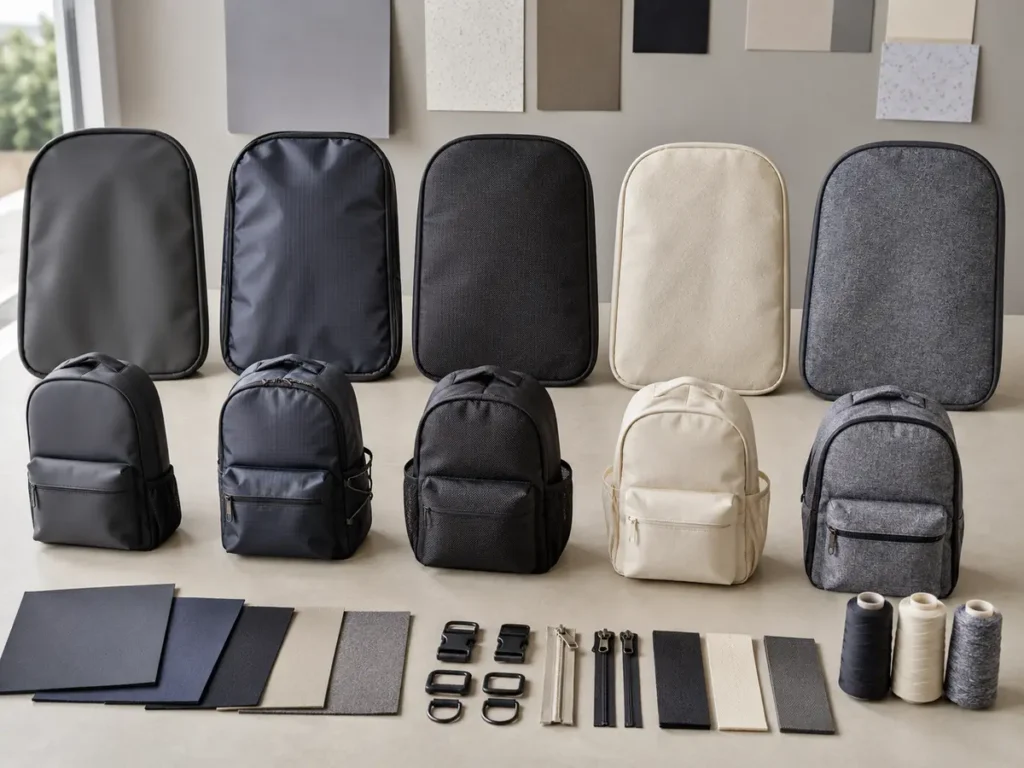
Polyester is common in school backpacks because suppliers can offer many colors, yarn sizes, weaves, finishes, coatings, and price points. It generally supports screen printing, transfers, embroidery, and patches when the surface and backing are compatible. It also tends to be dimensionally stable and can be sourced repeatedly.
However, “polyester” is only a fiber description. A light plain weave, a dense 600-denier Oxford, and a heavy laminated base fabric may all be polyester while behaving very differently. Buyers should compare finished swatches and performance data, not assume all polyester is equivalent.
Nylon: a performance option, not an automatic upgrade
Nylon can offer an attractive technical hand and strong abrasion performance in suitable constructions. It is often considered for premium commuter, outdoor-inspired, or frequent-use bags. Some nylon constructions achieve a useful strength-to-weight balance.
But the fiber name does not guarantee superior performance. A dense, well-finished polyester may outperform a lightly built nylon in a particular test. Nylon can also raise material cost and complicate color matching or repeat sourcing. Request equivalent finished constructions, test them under the same conditions, and evaluate the business case.
Oxford: a construction term
Oxford describes a woven construction with a visible basket-like character. Suppliers may offer polyester Oxford, nylon Oxford, recycled-polyester Oxford, or blends. A request for “600D Oxford” is incomplete because it does not define fiber, yarn system, finished mass, coating, color standard, or performance.
Use a line such as “polyester Oxford, supplier article number, agreed yarn construction, target finished GSM, PU back coating, physical color standard, and agreed test requirements.” That language gives the factory something reproducible.
Canvas: style with a weight and care tradeoff
Canvas provides a matte, tactile, heritage look and can create an excellent embroidery surface. It can suit school stores, graduation merchandise, lifestyle collections, and designs where a natural hand is more important than the lightest possible bag.
For children, check empty finished-bag weight and drying behavior. Cotton canvas can absorb water, show dirt, and take longer to dry than coated synthetics. Test shrinkage, crocking, colorfastness, and cleaning. Blended or treated canvas can change these properties, so approve the exact finished material rather than a generic showroom swatch.
RPET: a verified content claim, not a performance class
RPET usually means polyester made with recycled feedstock. It can be woven into familiar backpack constructions, but recycled content alone does not define durability, weight, coating, or environmental impact across the whole product.
Ask which components contain recycled material, what percentage is claimed, whether the claim applies to the shell only or the complete bag, and what transaction or chain-of-custody documentation is available. Textile Exchange explains that the Recycled Claim Standard and Global Recycled Standard verify recycled material and chain of custody; GRS includes additional processing requirements. Marketing statements must match the evidence and the destination market. In the United States, the FTC advises qualifying partial recycled-content claims rather than implying that the whole product is recycled.
Denier, GSM, and Weave Measure Different Things
Denier is a yarn linear-density unit: it describes the mass of a defined length of yarn. In practical sourcing language, a higher denier often means a thicker yarn, but it does not directly state the fabric’s total weight, weave density, tensile strength, tear resistance, or abrasion life.
GSM is grams per square meter, a measure of fabric mass per area. Two 600D fabrics can have different GSM because they use different yarn counts, picks, coatings, or finishes. Conversely, two fabrics with similar GSM may use different yarn sizes and constructions.
Weave or construction determines how yarns interlace. Plain, Oxford, ripstop-style, dobby, and twill constructions can distribute stress and present very different surfaces. Coating and lamination add mass and affect stiffness, water resistance, sewing behavior, and decoration.
What does 600D mean?
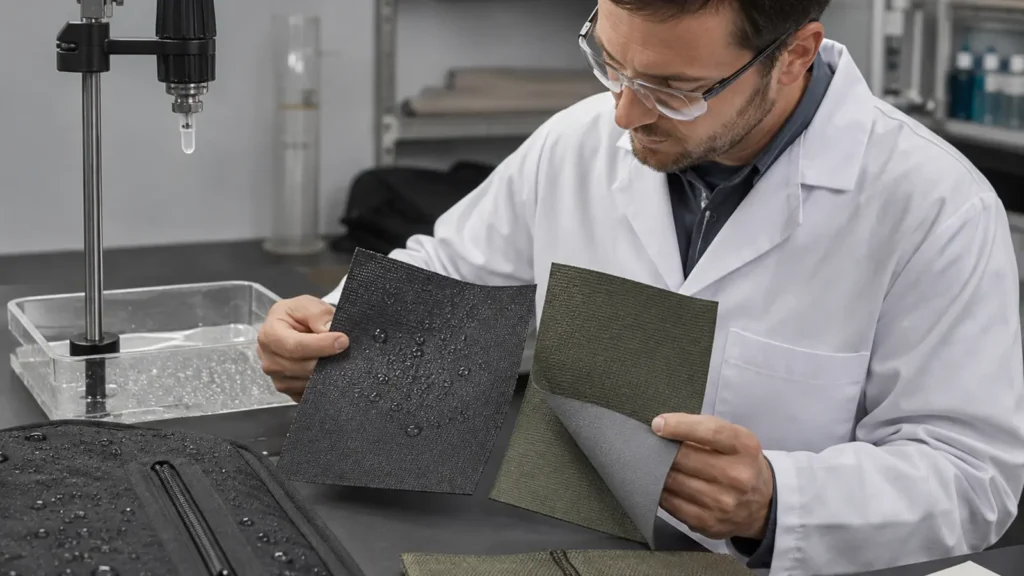
“600D” identifies a yarn-size direction, not a complete quality grade. It does not tell you whether the material uses polyester or nylon, how densely it is woven, its finished weight, whether it has a PU or PVC backing, or how it performs after abrasion. Treat it as one field in the specification.
The practical comparison set should include:
- fiber content and recycled-content scope, if any;
- warp and weft yarn designation;
- weave or supplier construction;
- finished GSM and usable width;
- coating or lamination chemistry and application side;
- color standard and finish;
- abrasion, tear, tensile, water, and color requirements;
- supplier article number, lot, and approved swatch reference.
What PU and PVC Coatings Actually Do
Back coatings can give woven fabric more body, reduce yarn movement, limit water penetration through the textile, and improve fray control during cutting. PU is widely used where buyers want a flexible coating and a broad range of performance or cost levels. PVC can create a heavier, firmer, more substantial backing, but it may add weight and affect hand, folding, decoration, compliance, and disposal requirements.
Do not select coating chemistry by name alone. Define the desired function, hand, weight, durability, applicable restricted-substance requirements, and test target. A thin PU coating and a heavy PU coating are not equivalent.
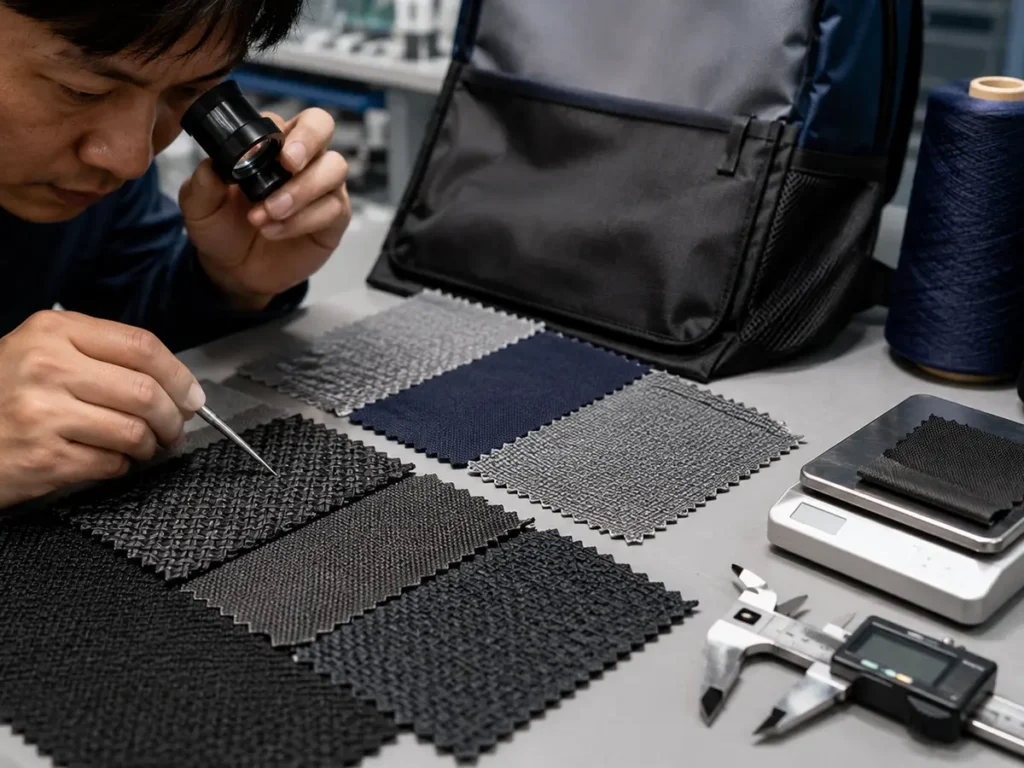
Water-repellent, water-resistant, and waterproof are not interchangeable
A face finish may make droplets bead temporarily. A back coating may resist water under a defined pressure. Neither automatically makes a finished backpack waterproof. Needle holes, bound seams, zipper chains, openings, panels, and wear can allow ingress.
AATCC TM22 evaluates surface wetting through a spray test, while AATCC TM127 assesses resistance to water penetration under hydrostatic pressure. These are different questions. A buyer should state whether the need is light-rain repellency, a defined fabric resistance, or protection of contents in a completed bag test.
For daily school use, accurate wording may be “water-resistant shell fabric” or “designed for light rain,” supported by the agreed test and construction. Programs requiring stronger protection may need covered or water-resistant zippers, seam management, a removable rain cover, a lined compartment, or a separately tested waterproof pouch. See JIUMU’s Waterproof School Backpacks guide for the construction-level distinction.
Performance Tests Buyers Should Define
There is no single “durability test” that predicts every school day. Build a risk-based test plan and specify the method, specimen condition, acceptance criterion, sample stage, and responsible laboratory.
| Risk | Useful evaluation direction | What it helps compare | Important limitation |
|---|---|---|---|
| Surface rubbing | ASTM D3884 rotary-platform abrasion or another agreed method | Relative surface wear under stated conditions | Results depend on method, wheel, load, endpoint, and lab variation |
| Tear propagation | ASTM D1424 or an agreed tear method | Force to continue a defined cut | Does not replace seam or finished-bag testing |
| Fabric breaking strength | ASTM D5034 grab test or agreed method | Strength and elongation of textile fabric | A strong shell can still fail at stitches or hardware |
| Surface wetting | AATCC TM22 | Spray repellency and surface wetting | Does not prove hydrostatic resistance or finished-bag waterproofing |
| Water penetration | AATCC TM127 | Hydrostatic resistance of a material | Needle holes, seams, and zippers remain separate risks |
| Color and cleaning | Agreed colorfastness, crocking, stain, and wipe-clean protocol | Color transfer and appearance after care | Must reflect actual color, print, coating, and cleaning agent |
ASTM notes that abrasion resistance is affected by fiber properties, yarn structure, fabric construction, and finishing, and that abrasion results may vary by procedure, operator, and laboratory. Therefore, a number such as “50,000 cycles” is meaningless without the method, conditions, endpoint, and intended comparison.
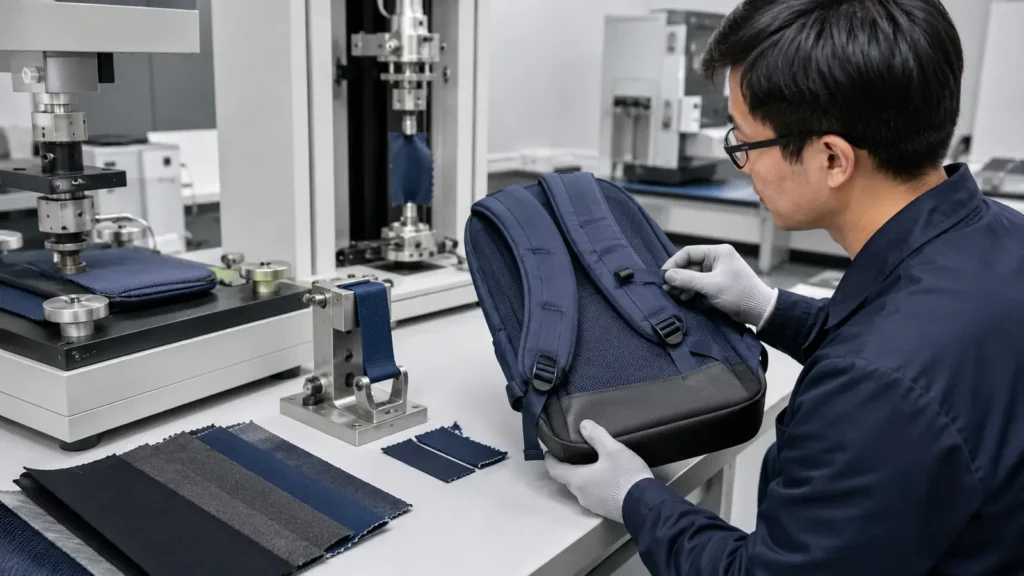
Test the finished backpack as well as the fabric
Fabric data cannot reveal whether a shoulder strap pulls out, a zipper stalls on a tight curve, a seam allowance is too narrow, or a base panel wears at a folded corner. Add finished-product evaluations such as loaded carry, repeated handle/strap loading, zipper cycling, seam inspection, drop or tumble simulations where appropriate, dimensional checks, and a packed-use review.
Create the test specification before sampling. The supplier can then quote the correct construction and testing cost rather than discovering a demanding requirement after the price has been agreed.
Fabric Weight and Children’s Use
The lightest fabric does not always produce the best bag, and heavier fabric is not automatically more durable. Finished backpack weight also comes from overall size, number of compartments, foam, lining, reinforcement, zipper gauge, buckles, webbing, patches, metal trims, and packaging.
Evaluate empty sample weight and loaded comfort together. A lightweight shell with excessive organization can still become heavy. A slightly heavier base reinforcement may be worthwhile if it protects a frequent abrasion zone while the upper panels remain lighter.
Preschool programs
Prioritize a short, proportionate body, simple openings, low empty weight, soft edges, easy cleaning, and a manageable number of compartments. The intended contents may be a folder, light clothing, snack, and small bottle rather than heavy textbooks. Avoid specifying a large adult-style bag merely for growth room.
Elementary-school programs
Balance structure and weight. Confirm the required folder or binder size, bottle diameter, lunch format, and strap adjustment range. Use cleanable materials at the base and front. Reinforce the handle and shoulder attachments, because bags are often lifted by one point.
Middle- and high-school programs
Device protection, document size, zipper access, and sustained load become more important. A coated polyester or nylon construction may be appropriate, with a reinforced base and a suspended laptop sleeve. Keep dense items close to the back and validate the bag using the actual device and academic load.
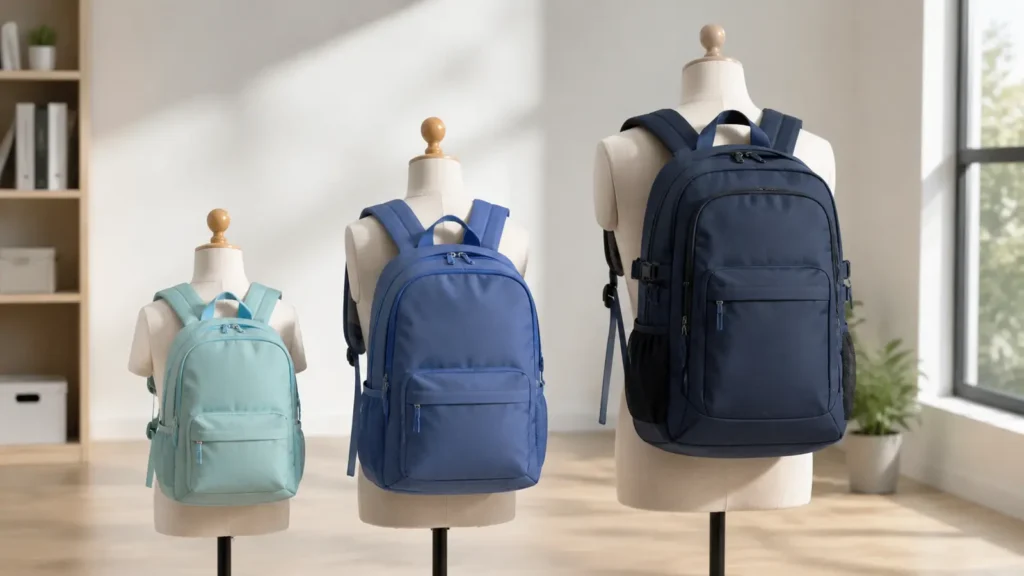
The age group is a design input, not a substitute for dimensions. Provide target finished height, width, depth, back-panel length, strap range, and maximum acceptable empty weight. A physical fit review is better than selecting from a label such as “kids” or “teen.”
Decoration Compatibility Changes With the Fabric
Logo method must be considered before the shell is ordered. Surface texture, coating, heat sensitivity, stretch, panel shape, and backing access all affect decoration.
Embroidery
Embroidery works well on stable woven panels and is especially attractive on canvas or structured polyester. Dense stitching adds weight and stiffness. Needle penetration can pucker a light fabric or create visible holes in a coated surface. Approve backing, thread color, stitch density, panel size, and the finished decorated sample. Keep designs away from foam edges, pocket seams, and zipper curves.
Screen printing
Screen printing can suit broad solid artwork and commercial quantities. The ink system, pretreatment, curing conditions, coating, and surface texture must be compatible. A coarse Oxford or canvas surface may reduce edge sharpness compared with a smoother fabric. Test adhesion and appearance on the exact production material.
Heat transfer
Heat-applied graphics can reproduce fine detail and multicolor artwork, but temperature, time, and pressure may mark, flatten, gloss, shrink, or damage certain coated fabrics. Check transfer adhesion and surface change after cooling and flexing.
Patches and labels
Woven, embroidered, rubber-style, or leather-look patches can move complex decoration off the shell surface. However, patch weight, border, attachment, wash/care behavior, and seam placement still require approval.
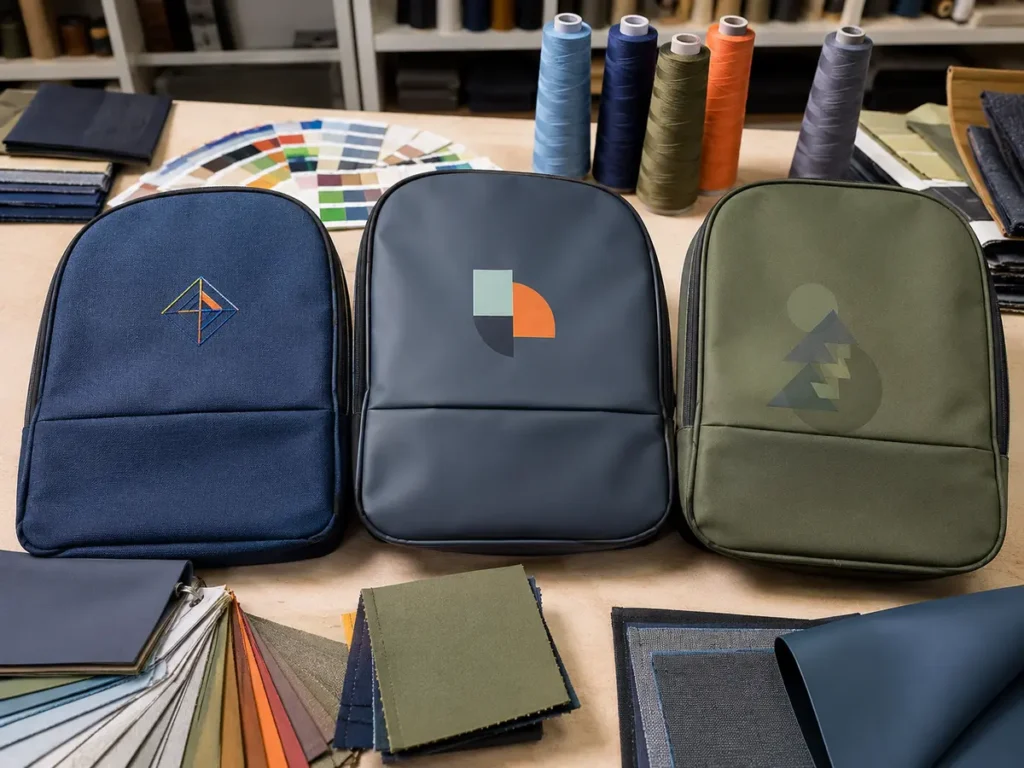
Use a physical color standard and decorate an actual production-material swatch. Screen images cannot show yarn sheen, texture, coating, ink absorption, thread direction, or lighting metamerism. Record the material lot and decoration parameters for future orders.
Choosing by Age Group and Program Type
| Program | Practical material direction | Construction priorities | Decoration direction | Approval focus |
|---|---|---|---|---|
| Preschool promotion | Light polyester or suitable easy-clean woven | Low empty weight, simple lining, soft structure | Small print, transfer, light embroidery, or patch | Dimensions, sharp edges, cleanability, logo stiffness |
| Elementary daily use | Coated polyester Oxford starting point | Reinforced base/anchors, bottle pockets, manageable organization | Embroidery, print, transfer, patches | Packed sample, strap range, surface wear, cleaning |
| Secondary/device use | Higher-spec polyester or nylon construction | Suspended device sleeve, stronger load points, stable base | Refined embroidery, print, patches | Device fit, load test, abrasion zones, water plan |
| Heritage retail | Canvas or canvas blend | Weight control, bound seams, lining, colorfastness | Embroidery, woven patch, restrained print | Empty weight, crocking, shrinkage, drying |
| Recycled-content program | Verified RPET construction | Same performance controls as other fabrics | Compatible print/embroidery with qualified claims | Claim scope, documentation, swatch, test evidence |
For a fuller durability framework beyond the shell, use JIUMU’s Durable School Backpacks guide.
Cost Drivers and Specification Tradeoffs
Fabric price is influenced by fiber, yarn, weave complexity, GSM, coating or lamination, finish, color development, order quantity, usable width, minimum dye or production lot, testing, certification scope, and sourcing continuity. The cheapest quoted fabric can create higher total cost through cutting loss, sewing difficulty, decoration failure, returns, or replacement.
Use value engineering deliberately:
- place higher abrasion performance at the base and lower corners;
- use a lighter compatible shell on less stressed upper panels;
- reduce unnecessary dividers before weakening load points;
- select stock colors when custom dyeing adds unjustified MOQ;
- use a patch when direct decoration is unreliable on a textured or coated panel;
- choose a construction that remains available for repeat orders;
- qualify recycled-content claims to the verified components.
Ask suppliers to quote alternatives against the same finished dimensions, features, test plan, packaging, and quantity. Otherwise, a lower price may simply hide a different specification.
Need a material recommendation for a school backpack program? Send JIUMU the age group, intended contents, quantity, target price, logo, destination, and required delivery date. We can compare fabric constructions, decoration options, samples, testing, labels, and packaging before bulk production. Contact JIUMU or email zhengdong@jiumugear.com.
A Reliable Swatch and Sample Approval Process
1. Approve the written requirement
Create one version-controlled Fabric Specification and BOM. Record the shell, base, lining, mesh, webbing, foam, binding, zipper tape, and decoration substrate separately. Do not allow a single line called “600D fabric” to represent the whole backpack.
2. Compare physical swatches
Review face and back, hand, stiffness, color, sheen, weave, coating uniformity, fraying, odor, fold behavior, and decoration compatibility. Evaluate color under an agreed light source. Label each swatch with supplier, article number, fiber, construction, color reference, coating, lot, date, and version.
3. Test the proposed production material
Use methods and thresholds that reflect the risk. Confirm which results come from the exact article and color, how recent they are, and whether the report covers a raw fabric, coated fabric, or finished component.
4. Decorate a real panel
Approve the actual embroidery, print, transfer, or patch on the correct material and backing. Check color, adhesion, edge quality, puckering, coating marks, and position.
5. Build and pack the prototype
Measure finished dimensions, weigh the empty bag, load the agreed contents, operate every zipper, adjust straps, inspect stress points, and expose the sample to the intended care and rain scenario. Photograph the sample from consistent views.
6. Record revisions and retain the Golden Sample
Write every change against a version number. When approved, sign and date the final specification, color swatches, decorated panel, test plan, packaging, and finished sample. Buyer and factory should each retain controlled references where practical.
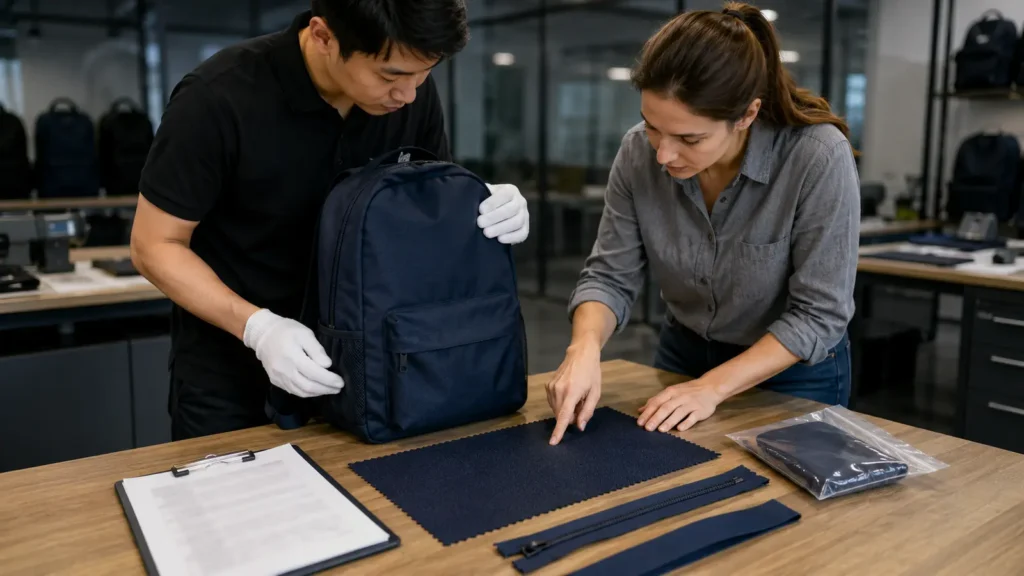
The Golden Sample is a production reference, not a substitute for numerical tolerances. Record measurable requirements for dimensions, placement, color evaluation, workmanship, and performance. For repeat orders, reconfirm material availability and approve a current lot or first piece when necessary.
Fabric Specification and BOM Checklist
For each textile component, include:
- component and location;
- supplier and material article number;
- fiber composition and verified recycled percentage, if claimed;
- yarn denier or yarn specification;
- weave or construction;
- finished GSM and tolerance;
- coating, lamination, or finish and application side;
- physical color standard and approval method;
- usable width and cutting direction, if relevant;
- required test method, condition, threshold, and report stage;
- decoration compatibility and approved parameters;
- lot, version, approval date, and retained swatch reference.
Also define substitution rules. A supplier should not replace a material solely because it looks similar. State whether changes in mill, article, fiber, construction, coating, weight, color, or test performance require written approval and a new sample.
Questions to Ask a School Backpack Manufacturer
- What is the complete proposed shell specification beyond the denier label?
- Is Oxford being used as a weave term, and is the fiber polyester, nylon, or RPET?
- What is the finished GSM after coating?
- Which coating or lamination is used, on which side, and for what function?
- Which test reports apply to the exact fabric article and finish?
- Can we see physical swatches in our target colors before the sample?
- What changes when the logo is embroidered, printed, transferred, or patched?
- How are shoulder anchors, handle, zipper ends, and base reinforced?
- What is the empty finished-bag weight by sample size?
- What are material and color MOQs?
- What documentation supports any recycled-content claim?
- Can the same article be reserved or sourced for repeat orders?
- What is the approval process for substitutions and new lots?
Common Material-Sourcing Mistakes
Comparing only denier
A 900D label can look stronger than 600D on a quotation, but construction, mass, coating, finish, and test conditions may tell a different story. Compare like-for-like data and samples.
Treating Oxford as a fiber
Oxford does not tell you whether the yarn is polyester or nylon. Always state both construction and composition.
Claiming waterproof from a coated swatch
The finished bag includes stitch holes, seams, zippers, and openings. Define the product-level protection strategy and use accurate language.
Selecting canvas without weighing the sample
Canvas can look premium while creating an unnecessarily heavy children’s bag. Evaluate the whole sample, not just the shell swatch.
Using RPET as a complete sustainability claim
State the verified recycled percentage and components. Do not imply that every trim is recycled or that recycled content proves superior performance.
Approving decoration on a different fabric
Ink adhesion, transfer marks, and embroidery puckering can change with coating, weave, color, and lot. Use production-intent material.
Ignoring repeat-order continuity
Save the supplier article, lot, physical swatch, decoration recipe, specification version, test record, and Golden Sample. A photo of an old bag cannot reproduce material hand or exact color.
What to Send for an Accurate Quotation
Provide the quantity, target price level, student age group, external dimensions or capacity, expected contents, compartment and device requirements, intended service life, climate and cleaning needs, target fabric direction, color standard, logo files, decoration size and position, recycled-content claim requirements, test plan, labeling, packaging, destination, and required delivery date.
Reference photos are useful for communicating style, but they do not reveal fabric construction, internal reinforcement, foam density, or coating. If you have an existing sample, identify which features should be copied, improved, or avoided. JIUMU can support OEM/ODM development, material sourcing, physical samples, decoration, labels, packaging, quality control, and export coordination. Typical MOQ is 50 pieces, subject to the product and customization.
Explore Custom Team Bags when the school program also includes sports, club, or staff bags.
Build a quote-ready school backpack specification. Share your target user, dimensions, quantity, material direction, logo, testing, packaging, destination, and deadline with JIUMU. Call +86 18507502899, email zhengdong@jiumugear.com, or request a custom quotation.
Frequently Asked Questions
Sources and Technical References
- AATCC repellency and resistance test-method training — distinguishes AATCC TM22 spray repellency and TM127 hydrostatic water resistance.
- ASTM D3884 abrasion resistance — explains rotary-platform abrasion evaluation and method scope.
- ASTM D1424 tearing strength — covers propagation of a single-rip tear using a falling-pendulum apparatus.
- ASTM D5034 breaking strength — covers fabric breaking strength and elongation by grab test.
- Textile Exchange Recycled Claim Standard and Global Recycled Standard — recycled material and chain-of-custody frameworks.
- FTC Environmental Claims: Green Guides summary — guidance on qualified recycled-content claims.
Testing methods and acceptance criteria should be selected for the product, market, and contractual requirements. This guide is procurement information, not a certification or compliance guarantee.