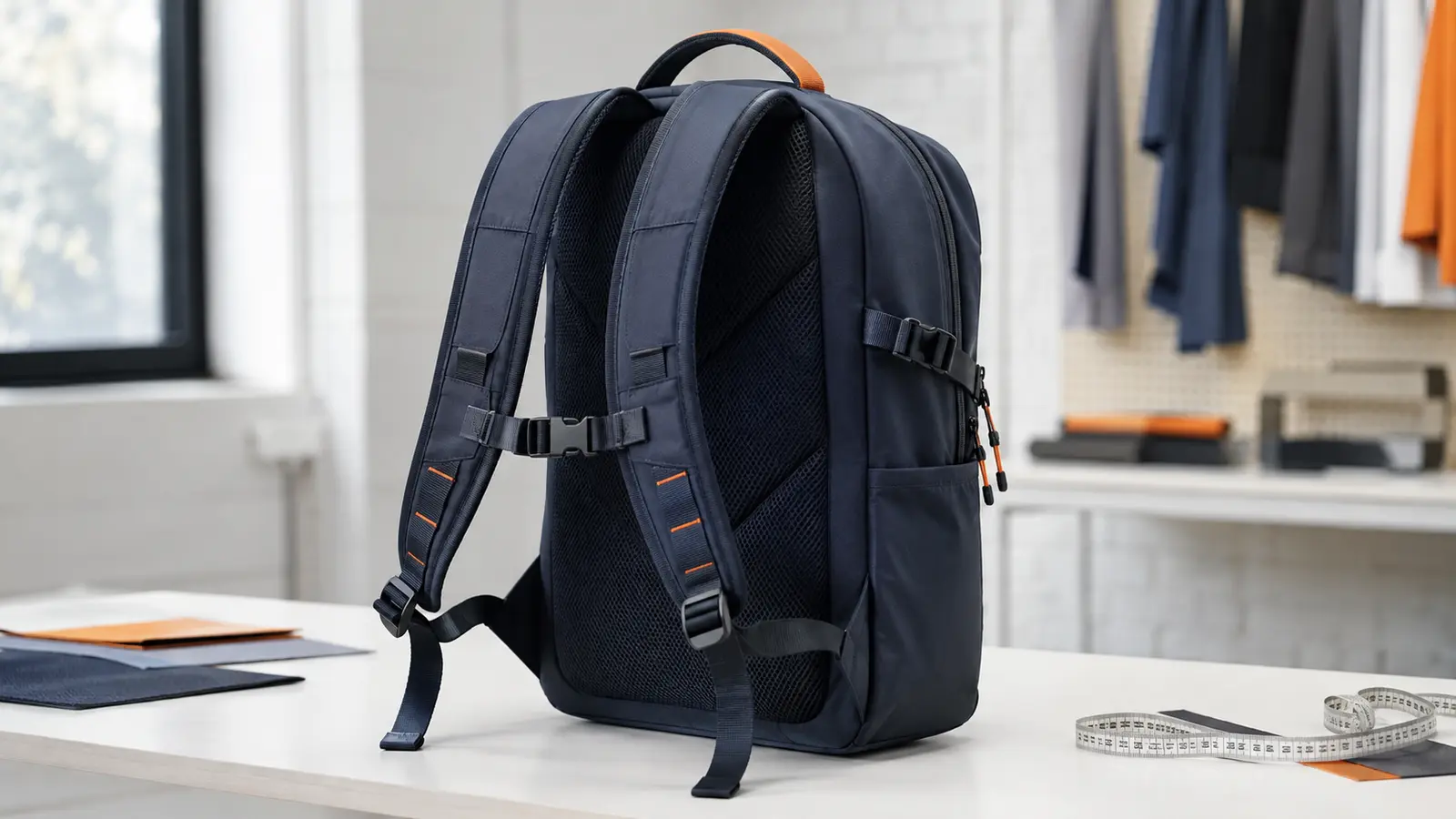
How to Design Comfortable Backpack Shoulder Straps
Comfortable backpack shoulder straps are not created by choosing the widest strap or the thickest foam. Comfort comes from a system: strap shape, usable contact width, attachment position, padding behavior, edge construction, adjustment range, back-panel fit, load position, and the wearer’s body proportions all work together.
This matters because a strap can look generous in a drawing yet still rub the neck, contact the underarm, slip from a small shoulder, or collapse under load. Those problems often appear only after a physical sample is packed and worn.
This guide explains how buyers can specify, prototype, and approve comfortable backpack shoulder straps for children and adults without relying on a universal measurement that may not suit the intended user.
Quick Answer: What Makes Backpack Straps Comfortable?
Comfortable backpack straps spread the load over a useful contact area, follow the wearer’s shoulder and upper-torso shape, stay clear of the neck and underarm, resist folding or foam collapse, and keep the bag close to the back. They also need enough adjustment range for the intended users and clothing layers.
Wider padded straps can reduce pressure, but only when the width actually contacts the body without creating edge pressure. A 2017 pressure study found that increasing strap width reduced interface pressure, while also showing that the result interacted with load position. That is why width cannot be approved in isolation. See the study abstract in Applied Ergonomics via PubMed.
For a bulk order, the reliable approval method is to define the target user and load, make a physical sample, adjust it correctly, conduct a timed wear trial, record pressure or rubbing locations, revise the pattern, and approve a dated Golden Sample before production.
Start With the User, Load, and Carrying Scenario
The first design question is not “How wide should the straps be?” It is “Who will carry this bag, what will be inside it, and for how long?”
A preschool backpack carrying a change of clothes has a different comfort requirement from a middle-school bag carrying books, a laptop, and a water bottle. A team backpack used between a bus and a locker room differs from a commuter bag worn while walking for an hour. The correct strap specification therefore begins with a use-case brief.
| Specification input | Questions to answer | Why it changes the strap |
|---|---|---|
| Target wearer | Child, teenager, adult, or mixed group? What body-size range? | Changes strap length, width, curve, anchor spacing, and adjustment range |
| Intended load | Typical and maximum packed weight? | Changes pressure, foam compression, reinforcement, and stability needs |
| Carry duration | Short transfers or sustained walking? | Longer wear makes edge pressure, heat, slip, and load movement more important |
| Clothing | T-shirt, school uniform, jacket, or sports outerwear? | Changes friction, effective circumference, and adjustment requirements |
| Bag format | Compact school bag, laptop bag, team bag, or outdoor pack? | Changes back length, load position, and need for stabilizing straps |
| Sales market | School program, retail, ecommerce, or promotional order? | Changes size strategy, instructions, testing, and claim language |
For children, load management is especially important. The American Academy of Pediatrics advises wearing both straps, adjusting the backpack so it rests around the middle of the back, and keeping the carried weight controlled. Its current backpack guidance also uses 15% of body weight as a limit, but buyers should treat any percentage as user guidance rather than a design load for every product. Read the AAP backpack safety guidance.
Define both a representative trial load and a separate structural test load. The first evaluates fit and comfort; the second evaluates whether the assembly survives the agreed conditions.
Strap Width: Wider Is Helpful Only When It Fits
Increasing strap width can spread force across a larger area and reduce average pressure. However, nominal width and effective contact width are not always the same.
A wide strap may lose contact near its edges if it is too stiff for the shoulder curve. It may press against the neck when the upper attachment points are too close. It may reach the underarm too early on a small wearer. Thick binding can create a hard ridge, while a very soft strap may curl and reduce its actual contact area.
When comparing widths, buyers should evaluate:
- the flat pattern width;
- the finished width after binding and sewing;
- the padded width rather than the decorative outer width;
- the contact area while the sample is loaded;
- clearance from the neck and underarm;
- whether the strap folds, cups, or rotates;
- whether both straps remain symmetrical during walking.
The correct width is therefore a tested range for a defined user group, not a single universal number. For mixed-size programs, it may be more reliable to develop a youth harness and an adult harness rather than fitting one shoulder-strap pattern to every backpack size.
Straight, S-Shaped, and Ergonomic Strap Curves
Strap shape controls how the strap leaves the upper back, crosses the shoulder, and approaches the chest or underarm. Three common approaches are straight, S-shaped, and custom-contoured patterns.
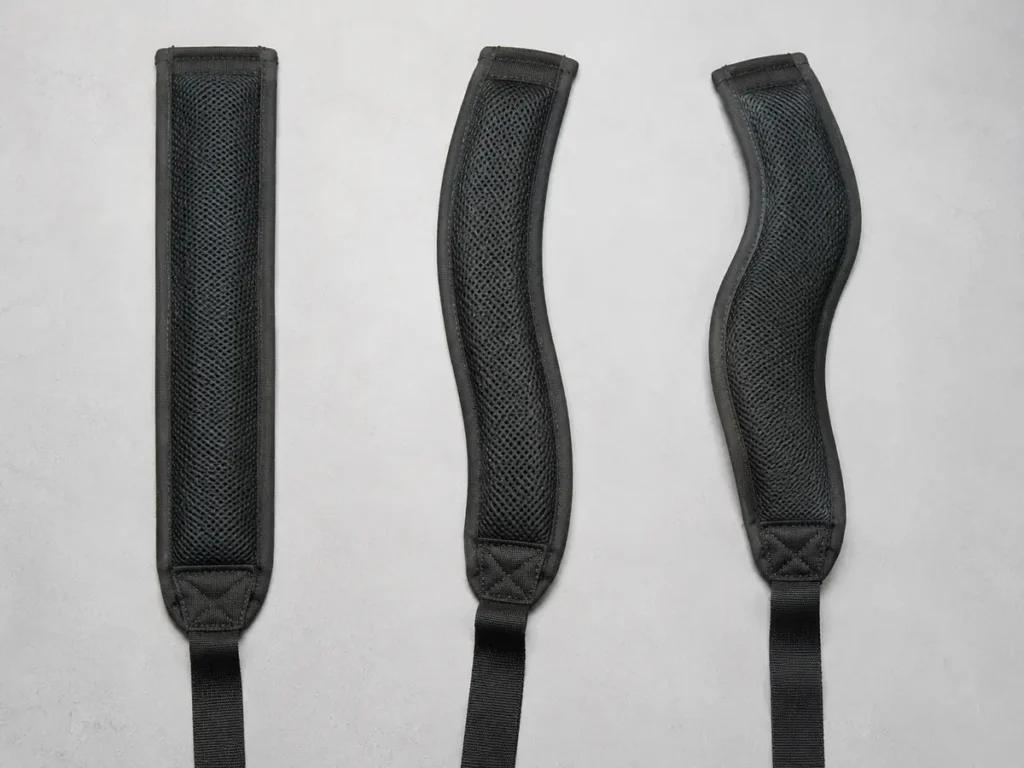
| Strap shape | Potential advantages | Watch points | Typical starting applications |
|---|---|---|---|
| Straight | Simple pattern, efficient production, easy symmetry control | Can sit close to the neck, gap from curved bodies, or contact the underarm | Compact promotional bags and simple light-load designs |
| Gentle S-curve | Can route around the neck and chest more naturally | Wrong curve depth can twist or create concentrated edge pressure | School, commuter, and general-purpose backpacks |
| Custom ergonomic curve | Can be tuned to target body dimensions and load position | Requires better measurements, more sampling, and size-specific validation | Performance, laptop, sport, or higher-load products |
Are S-shaped straps always better?
No. An S-curve is only useful when its curve corresponds to the intended wearer, top-anchor spacing, bag width, and strap length. A curve developed for an adult outdoor pack may be too long or too aggressive for a child’s school bag. Conversely, a shallow youth curve may not sit flat on a broad adult torso.
Research on backpack interface pressure supports testing the whole geometry rather than judging one feature. A study of cycling backpacks found that strap shape and material configuration changed average and peak pressure, while cautioning that results depend on posture and use conditions. See the open paper in the Journal of Science and Cycling.
The practical decision is to prototype more than one curve when the product has a meaningful load or a broad user range. Mark the strap’s intended centerline and observe where the loaded strap actually travels. Check the wearer from the front, side, and rear rather than only looking at the back of the backpack on a table.
Attachment Position and Strap Length Control the Fit
Upper attachment position determines the angle at which the straps meet the shoulders. If the attachments are too close together, the straps can rub the neck. If they are too far apart, they may slide toward the shoulder edge, especially on smaller users. The vertical position also affects how high the bag sits.
Lower attachment points and webbing direction influence whether the lower strap pulls cleanly around the torso. A poorly placed lower anchor may twist the padded section or drag its edge into the underarm. The transition from padding to adjustment webbing should occur below the main pressure area for the intended wearer.
Strap length must be considered as two connected dimensions:
- the padded section, which determines shoulder coverage and the location of the webbing transition; and
- the adjustable webbing section, which determines fit range and tail length.
A long strap is not automatically more inclusive. It may enter a small wearer’s underarm, while a short system may reach its adjustment limit over a larger body or winter jacket.
The tech pack should specify upper attachment spacing, attachment angle, padded-section length, finished width at key points, lower webbing position, webbing width, adjustment range, and measurement method. Use finished product points rather than ambiguous phrases such as “standard adult strap.”
Children’s and Adult Straps Need Different Proportions
Age labels alone are not sufficient because children of the same age can have very different torso and shoulder dimensions. Define the intended body-size range and backpack back length, then confirm fit on representative users or suitable fitting forms.
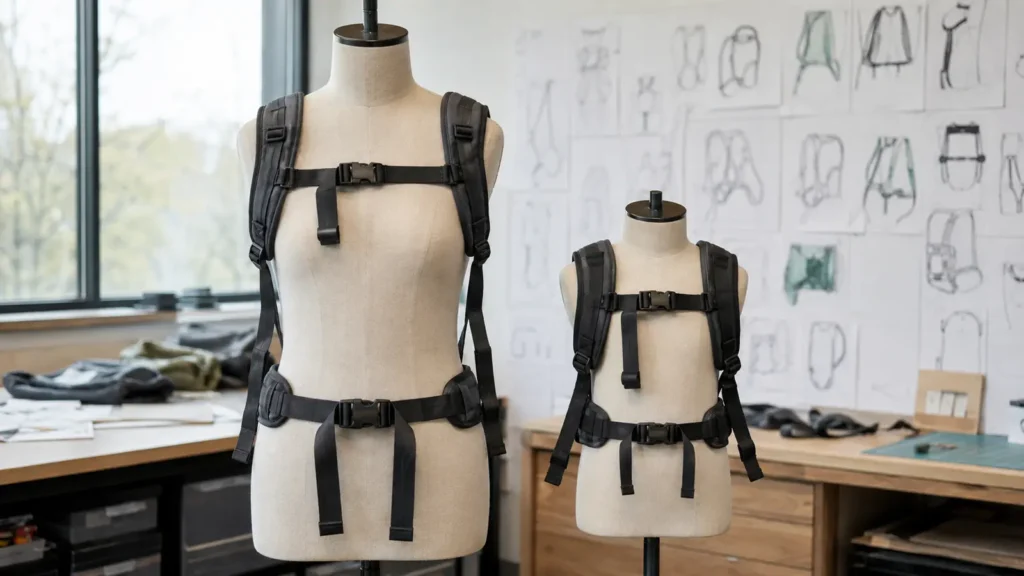
| Design area | Youth consideration | Adult consideration |
|---|---|---|
| Upper anchor spacing | Usually needs closer spacing without touching the neck | Can accommodate broader spacing, subject to target body range |
| Padded length | Shorter so padding does not enter the underarm | Longer coverage may be useful for larger torsos and heavier loads |
| Strap width | Must balance load distribution with narrow shoulders | Can use broader contact area if the strap conforms correctly |
| Adjustment range | Must tighten enough for small torsos and light clothing | Must extend for larger bodies and seasonal outerwear |
| Sternum strap | Height range should suit smaller chest proportions | Wider vertical range may serve varied adult users |
| Product weight | Minimize unnecessary material and hardware mass | Balance added structure against the intended load and duration |
A children’s backpack should not be an adult design uniformly scaled down. Buckle size, webbing tail, edge stiffness, reach to adjusters, and load position also affect usability.
For related product planning, link the finished article to JIUMU’s planned Comfortable School Backpacks guide and a verified Backpack Size Guide once those destinations are live.
Foam Thickness, Density, Firmness, and Recovery
Shoulder-strap padding is commonly discussed as “high-density foam,” but density alone does not tell a buyer whether a strap will feel soft, firm, supportive, or stable. The Polyurethane Foam Association separates support behavior from other foam properties and describes compression modulus as a measure of the foam’s ability to support weight. Its overview is available in Foam Performance.
For sourcing purposes, request a complete material description:
- foam family, such as polyurethane or EVA;
- nominal thickness before and after lamination;
- density, with units and test method where available;
- firmness or hardness property and the applicable test method;
- compression recovery or fatigue expectation;
- cell structure and breathability requirement;
- lamination method to face fabric and mesh;
- approved material code and supplier reference.
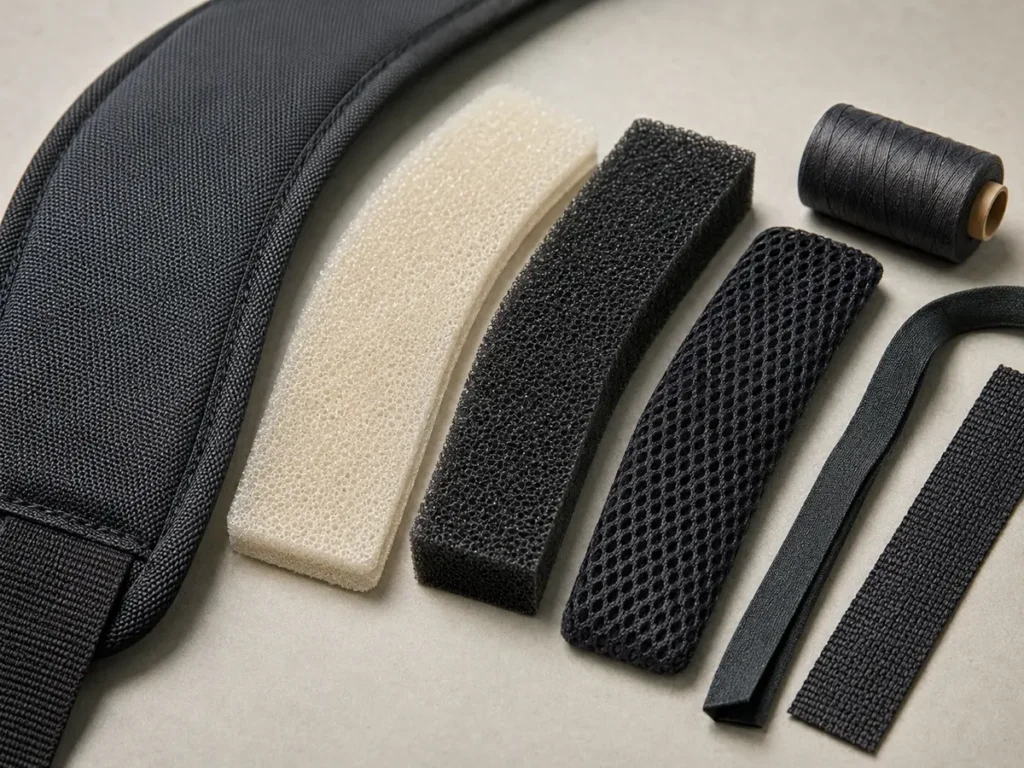
| Padding approach | Comfort behavior | Durability and production considerations | Approval method |
|---|---|---|---|
| Soft open-cell foam | Conforms quickly and can feel comfortable at first touch | May compress substantially; must be checked for recovery and edge collapse | Loaded thickness, recovery, and timed wear trial |
| Firmer foam | Maintains shape and can spread load | May feel hard if too thin, flat, or poorly contoured | Edge-pressure and curve-conformity check |
| EVA or closed-cell layer | Adds structure and limits bottoming out | Can retain heat or resist bending depending on grade and thickness | Flex, heat perception, and repeated-use trial |
| Multi-layer construction | Can combine surface softness with structural support | Adds material, lamination steps, thickness, and cost | Approve exact layer order and bonded sample |
What foam density works best?
There is no universal density value for all backpack straps. Density, firmness, thickness, layer structure, and recovery must be evaluated together. A dense but very thin foam can still feel harsh. A thick soft foam can bottom out or create an unstable, bulky strap. The appropriate choice depends on the load, contact area, duration, target user, and expected service life.
When comfort is commercially important, compare labeled foam constructions in the same strap pattern before changing geometry.
Breathable Mesh, Edge Binding, and Surface Comfort
Spacer mesh is often used on the body-facing side because its open structure can create airflow paths and manage the feel of moisture better than a dense plain fabric. However, the word “breathable” should not be treated as a guarantee of cool or dry wear. Airflow depends on the mesh structure, foam beneath it, clothing, weather, movement, contact pressure, and back-panel design.
Inspect mesh for abrasion against clothing, snag risk, compression, and lamination stability. A coarse mesh may feel acceptable over a jacket but rough against a thin shirt. A very soft mesh may flatten quickly and lose its three-dimensional structure.
Edge binding has an equally important role. Binding should cover raw edges and stabilize the composite without producing a hard cord-like ridge. Check binding width, fold consistency, seam position, stitch tension, curved-edge puckering, and whether the edge rolls toward the wearer when the strap bends.
Adjustment webbing should move smoothly through the buckle but resist unintended slip. Its width should suit the hardware and the padded strap transition. The user should be able to reach and pull the webbing without the strap twisting.
Reinforcement Must Preserve Both Strength and Flexibility
The upper strap attachment is a high-load area. Reinforcement may include a larger seam allowance, backing fabric, internal webbing, a reinforcement patch, Box-X stitching, bartacks, or a combination selected for the bag construction.
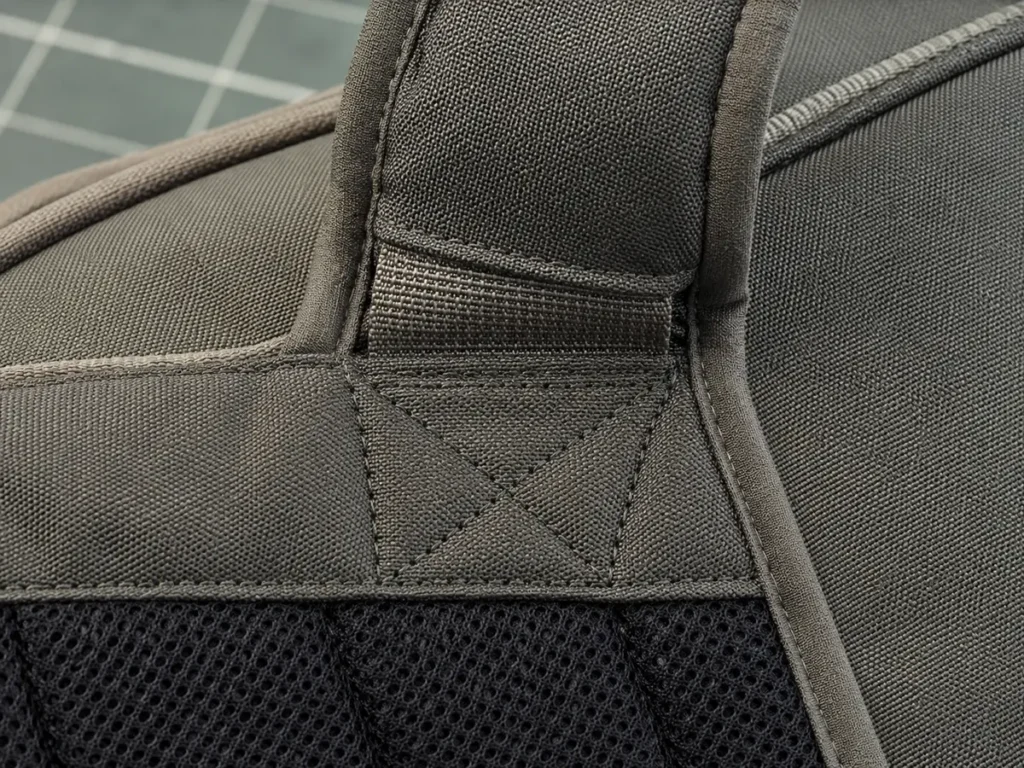
More stitching is not always better. Excessively dense stitching can perforate or stiffen some materials. A large rigid reinforcement can move the stress to the edge of the patch. The construction must also allow the strap to leave the bag at the intended angle.
Comfort approval therefore does not replace strength testing. A strap can feel comfortable but have weak attachment seams. A strong attachment can also be too stiff and distort the strap path. Use both the loaded wear test in this guide and the separate Backpack Strap Strength Testing process for static, dynamic, and repeated-load verification.
Coordinate the Straps With the Back Panel and Sternum Strap
The shoulder straps cannot position the bag effectively if the back panel is the wrong length, the load is far from the body, or the bag collapses into a rounded shape. A well-designed back panel provides a stable interface while allowing the strap attachments to sit at the intended height and spacing.
A sternum strap can help keep shoulder straps positioned and reduce lateral movement. It is not a substitute for correct shoulder geometry. If it is fixed too high, too low, or too tightly, it can feel restrictive. A vertically adjustable sternum strap serves a broader user range, but its rail or attachment method must be secure and easy to operate.
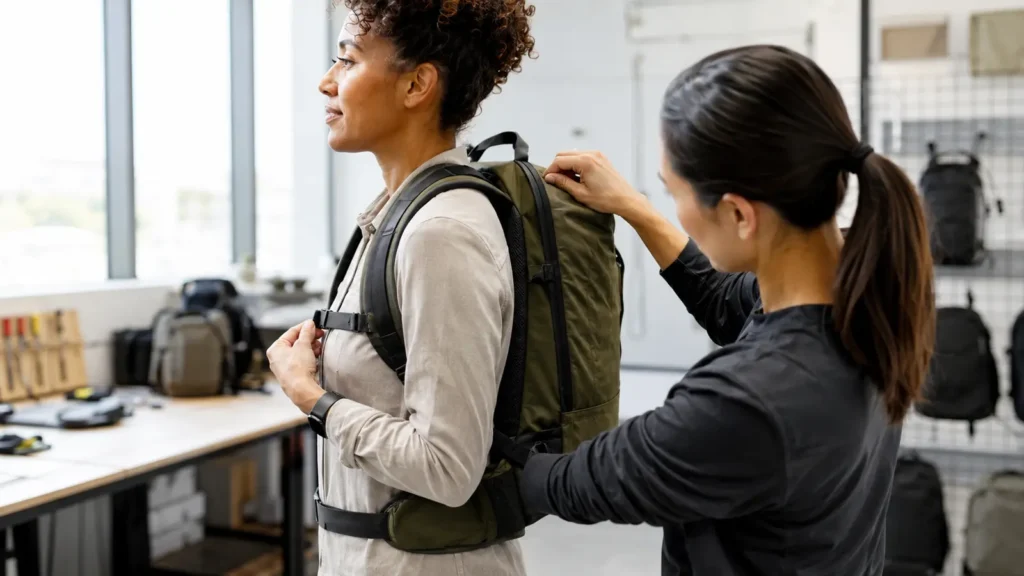
For larger outdoor or travel packs, a functional hip belt may transfer part of the load toward the pelvis. A simple waist webbing strap on a small school bag mainly limits movement and should not automatically be described as load transferring. Product claims should match the actual structure and test evidence.
Mid-project design review
Before ordering the final prototype, send the supplier:
- target user and body-size range;
- backpack finished dimensions and back length;
- typical and maximum intended contents;
- desired strap type and reference photos;
- finished strap measurements and attachment points;
- exact foam, mesh, binding, webbing, and hardware requirements;
- sternum-strap position and adjustment range;
- wear-test procedure and pass/fail criteria;
- logo, color, label, quantity, packaging, and delivery requirements.
Developing a custom backpack? Share these inputs with JIUMU through the Custom Team Bags page or contact the team to plan a physical prototype and approval sequence.
Conduct a Loaded Wear Test, Not an Empty Fit Check
An empty backpack can hide pressure, movement, webbing slip, and foam collapse. Pack the sample with representative contents arranged as they would be in use. Place heavier items close to the back when that reflects the intended packing guidance.
Use a repeatable wear-test protocol:
- Record the sample version, user code, body measurements relevant to fit, clothing, and test load.
- Adjust both shoulder straps evenly and record exposed webbing or reference marks.
- Set the sternum strap at a comfortable height without overtightening it.
- Photograph front, side, and rear views while standing.
- Walk, turn, climb stairs if relevant, and perform normal bag handling for an agreed duration.
- Record neck contact, underarm interference, pressure points, heat, bounce, strap slip, and ease of adjustment.
- Remove the bag and inspect foam recovery, strap twisting, seam movement, and hardware position.
- Repeat with another representative user and, when useful, a second load condition.
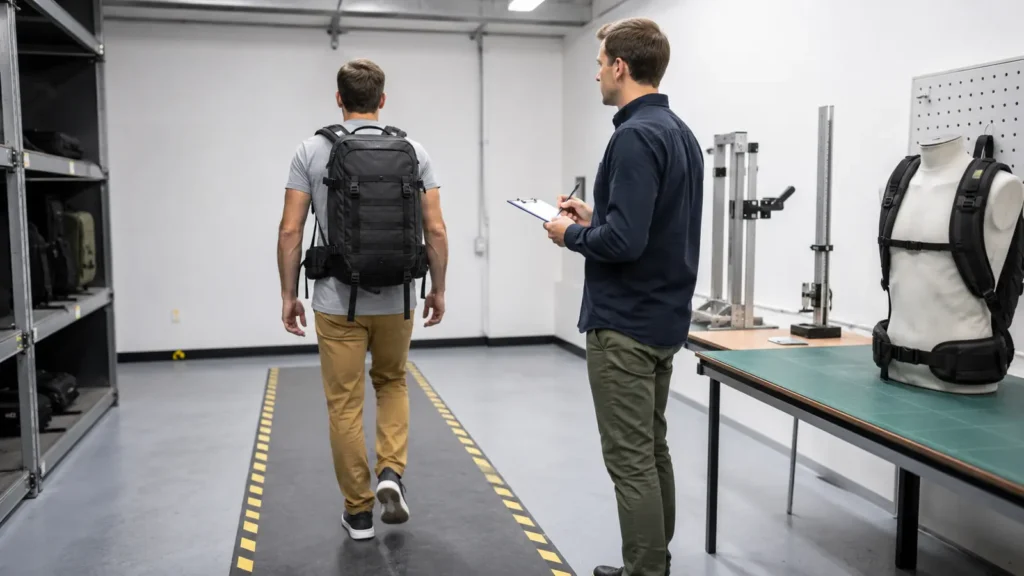
Avoid asking only “Is it comfortable?” Use a structured scale and location map. For example, ask the wearer to rate overall comfort, pressure at the top of the shoulder, neck clearance, underarm clearance, stability, heat, and adjustability. Record the time at which discomfort appears.
The result is not a medical conclusion. It is product-development evidence for the defined users and conditions. If the product is intended for a wide retail population, use more representative testers instead of relying on one employee who happens to fit the sample.
Shoulder Strap Design Specification Template
| Field | Buyer entry |
|---|---|
| Project / SKU | |
| Tech-pack version and date | |
| Target user group and body-size range | |
| Typical / maximum intended load | |
| Intended carry duration and environment | |
| Strap pattern: straight / S-curve / custom | |
| Finished padded length | |
| Finished width at top / shoulder / lower transition | |
| Upper anchor spacing, angle, and reference points | |
| Lower anchor position and angle | |
| Outer fabric code and color | |
| Foam type, thickness, density, firmness, and layer order | |
| Body-facing mesh code | |
| Binding code and finished width | |
| Webbing width, weave, and color | |
| Adjuster / buckle code | |
| Sternum strap height range | |
| Reinforcement and stitch specification | |
| Wear-test load, duration, users, and acceptance criteria | |
| Structural test requirement | |
| Approved sample ID and approval date |
Do not leave important fields as “same as reference.” A reference sample can be useful, but it should be measured and converted into explicit specifications. If a feature cannot be confirmed until sampling, mark it as provisional and identify who will approve it.
Loaded Wear-Test Record
| Record item | Result |
|---|---|
| Sample ID / version | |
| Tester code and relevant size measurements | |
| Clothing layer | |
| Packed weight and content arrangement | |
| Adjustment setting | |
| Test actions and duration | |
| Neck clearance | Pass / Revise / Fail |
| Underarm clearance | Pass / Revise / Fail |
| Shoulder pressure and location | |
| Strap stability / slipping | |
| Heat and moisture perception | |
| Ease of adjustment | |
| Foam recovery after removal | |
| Seam, webbing, and hardware observations | |
| Required revision and owner | |
| Approval name, date, and signature |
Sample Approval and Bulk Quality Control
The approved sample should become the Golden Sample for bulk production. Label it with the project, SKU, version, color, material codes, approval date, and any approved deviations. The buyer and supplier should retain matching records; physical sample retention should be agreed when practical.
Before approval, check:
- left and right strap symmetry;
- finished widths, lengths, curves, and attachment spacing;
- material identity and layer order;
- foam thickness and recovery after loading;
- binding smoothness and edge pressure;
- stitch type, density, backtacking, and reinforcement;
- webbing routing and buckle compatibility;
- adjustment range and tail management;
- sternum-strap height and operation;
- fit with the complete back panel and packed bag;
- representative loaded wear-test results;
- structural strap and handle test requirements.
During bulk inspection, measurements should be taken using the same method and reference points used for the approved sample. Inspect both appearance and function. Pull both strap adjusters, check that hardware is oriented correctly, compare symmetry, and sample loaded bags for slip or distortion. Define the inspection level and response to nonconforming units before production.
Cost Drivers and Procurement Trade-Offs
Comfort features influence cost through material consumption, pattern complexity, hardware, sewing time, testing, and the number of size variants. A wider strap uses more face fabric, mesh, foam, and binding. A multi-layer foam package adds lamination and cutting operations. A movable sternum strap adds components and assembly steps. Separate youth and adult harnesses require additional patterns and sample approvals.
The lowest quote is not always the lowest total cost. Protect features that materially affect fit and simplify decorative details before removing necessary comfort or reinforcement elements.
Ask suppliers to price alternatives against the same specification. If one quote uses different foam, a shorter padded section, or no internal reinforcement, the prices are not directly comparable.
Common Design Mistakes
Choosing width from a competitor photo
Photos rarely reveal finished dimensions, internal foam, binding stiffness, or target users. Use a reference to communicate direction, then measure and prototype your own design.
Specifying only “high-density foam”
This phrase does not define firmness, thickness, recovery, or layer structure. Approve a coded physical material and record its properties.
Scaling an adult strap directly for children
Uniform scaling can leave incorrect buckle size, curve position, attachment angle, or webbing tail. Review each functional dimension.
Approving an empty sample
Pressure and movement appear under load. Perform the agreed wear test with realistic contents.
Using a sternum strap to correct poor shoulder fit
The sternum strap can stabilize the shoulder straps, but excessive tension may mask incorrect anchor spacing or curve geometry.
Ignoring clothing and user diversity
A sample that fits one tester in a thin shirt may not serve a mixed school population or users wearing winter jackets. Build the trial group around the actual market.
Questions to Ask a Backpack Supplier
- Which measurements define the finished strap pattern and anchor positions?
- Can youth and adult harness proportions be developed separately?
- What are the foam type, thickness, density, firmness, and recovery characteristics?
- How are foam, mesh, and outer fabric laminated or assembled?
- What reinforcement is used at upper and lower attachment points?
- Can the supplier provide two strap curves or foam constructions for comparison?
- How will strap symmetry and placement be measured in bulk production?
- Which static, dynamic, or repeated-load tests can be performed or arranged?
- How are design versions, material codes, and the Golden Sample retained for repeat orders?
- What information is needed to quote the prototype and bulk order accurately?
How JIUMU Supports Custom Backpack Development
JIUMU supports OEM and ODM bag development for schools, teams, distributors, promotional buyers, and private-label brands. Buyers can provide a tech pack, reference product, sketch, or concept and then confirm dimensions, fabrics, foam, mesh, webbing, hardware, logos, labels, packaging, and sampling requirements.
The development process should be based on documented specifications and physical approval rather than appearance alone. For comfort-critical straps, request a prototype that can be loaded and tried by representative users. Record revisions in the tech pack and link the final version to the approved sample before bulk production.

Frequently Asked Questions
Final Recommendation
Design comfortable backpack shoulder straps as part of a complete carrying system. Define the user and load first. Specify finished geometry and materials precisely. Prototype the strap with the real back panel and hardware. Test it with representative contents and wearers. Then approve the measured sample, test method, and revision record together.
This process gives buyers a defensible specification for bulk production and repeat orders while reducing the risk of neck rubbing, underarm interference, foam collapse, slipping, and inconsistent fit.
Request a custom backpack development review: send JIUMU your target user group, bag dimensions, expected contents, quantity, strap reference, material preferences, logo files, packaging requirements, and delivery target through Contact Us. The team can use those inputs to plan the specification, prototype, and approval stages.
About JIUMU
JIUMU supports OEM and ODM custom bags, teamwear, hats and branded merchandise for professional buyers. Established in 2010 in Guangdong, China.