How to Choose a Durable, Comfortable School Backpack
For a parent, a school backpack may look like a simple back-to-school purchase. For a school, distributor, uniform dealer, promotional buyer, or private-label brand, it is a product specification that must perform through thousands of opening, carrying, loading, dropping, and cleaning cycles. A good backpack must protect books and devices, remain comfortable when loaded, fit the intended student group, and present the buyer’s identity consistently across a bulk order.
The strongest buying decisions start with use, not appearance. Define the student age, daily load, device size, school rules, climate, cleaning method, branding, order quantity, and target delivery date before choosing fabric weight or pocket count. Then convert those needs into measurable sample and inspection criteria.
Quick answer: Choose a school backpack that fits the student’s torso, sits close to the back, and uses two adjustable, adequately wide straps with useful padding. Specify a lightweight but abrasion-resistant shell, reinforced strap anchors and base, smooth zippers, protected internal seams, and compartments that keep dense items close to the body. For bulk orders, approve a loaded sample and a written specification covering dimensions, materials, construction, logo, packaging, and quality checks. The American Academy of Pediatrics’ parent guidance also recommends keeping the loaded bag light, using both straps, and watching for forward leaning or difficulty walking (HealthyChildren.org).
Why Durability and Comfort Must Be Evaluated Together
Durability is not simply a high fabric-denier number. A heavy shell cannot compensate for weak strap stitching, a poor zipper, thin binding, or an unreinforced base. Comfort is not simply adding thick foam. A soft bag that is too large, hangs too low, or places books far from the body can still feel awkward.
For procurement teams, the real objective is a balanced specification. Every added pocket, layer, buckle, patch, and foam panel affects weight, cost, production time, appearance, and repair risk. The right design uses material only where it creates value.
| Buying objective | Product feature to specify | How to verify on a sample |
|---|---|---|
| Comfortable daily carry | Adjustable paired straps, shaped back panel, sensible empty weight | Load with the intended school kit and conduct a fit trial |
| Long service life | Reinforced anchors, protected seams, durable base and suitable fabric | Inspect stress points; repeat lifting, opening, and set-down cycles |
| Device protection | Padded sleeve positioned against the back | Insert the target device and check clearance and closure |
| Organized load | Main compartment plus a limited number of useful pockets | Pack the real item list and confirm access without overfilling |
| Weather protection | Coated shell, covered zipper construction, or rain cover as specified | Agree on a defined spray or exposure test; do not rely on “waterproof” wording alone |
| Brand consistency | Approved Pantone references, logo method, placement template | Compare production against a signed color and decoration standard |
Start With the Student and the School Day
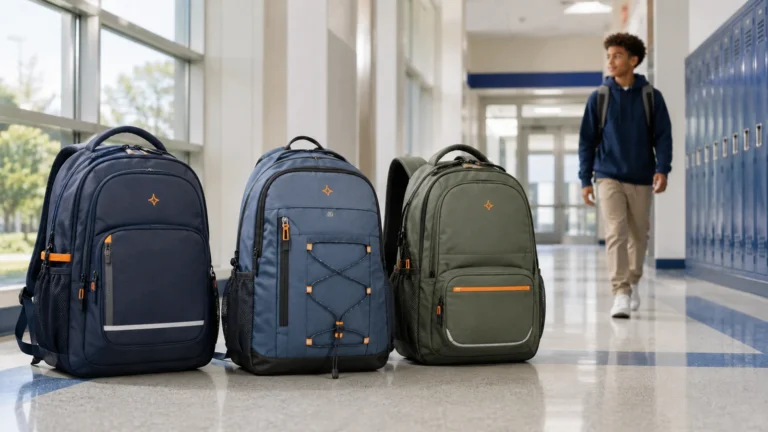
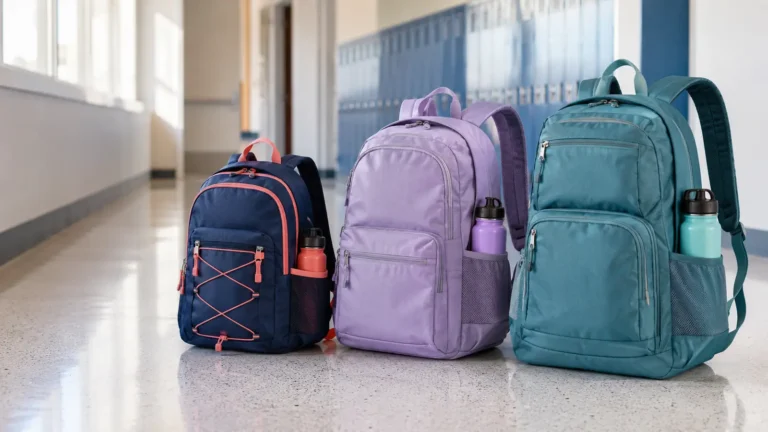
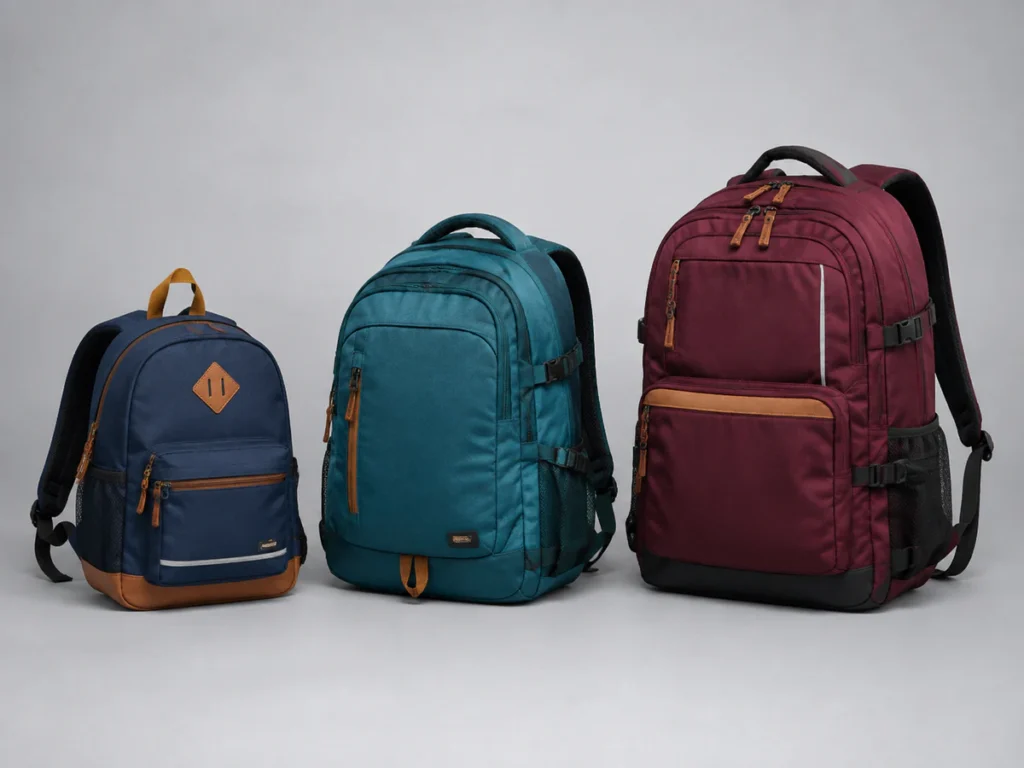
The same backpack should not be scaled across every age group. A preschool pack may carry a lunch box, spare clothes, and a folder. An elementary model must usually accept standard folders and books without overwhelming a smaller torso. Middle- and high-school students may add larger textbooks, sports clothing, a laptop or tablet, chargers, and a water bottle.
Elementary school
Prioritize low empty weight, easy-grip zipper pulls, a simple opening, rounded edges, and a body that does not extend far below the waist. Bright contrast details can improve visibility, while a writable or replaceable name label can help schools manage lost property. Avoid unnecessary deep compartments that invite overpacking.
Middle school
Students often need more organization and may move frequently between classrooms. Consider a structured main compartment, separate device sleeve, front organizer, two bottle pockets, and stronger strap anchors. The design should remain compact enough for lockers and crowded corridors.
High school
Device protection, document size, charging accessories, and longer commuting time become more important. A slightly more restrained visual style may suit school merchandise and retail programs. Buyers should confirm the largest laptop size, binder dimensions, and whether students carry sports equipment separately.
Special programs and accessibility needs
Adaptive use may require easy-open hardware, alternative pull shapes, wheelchair attachment points, or a different access orientation. These requirements should be developed with the school and intended users rather than assumed from a standard bag. Rolling backpacks can reduce carrying, but some schools restrict them because of stairs, storage, or corridor safety; verify policy before ordering.
Choose the Right Size, Capacity, and Fit
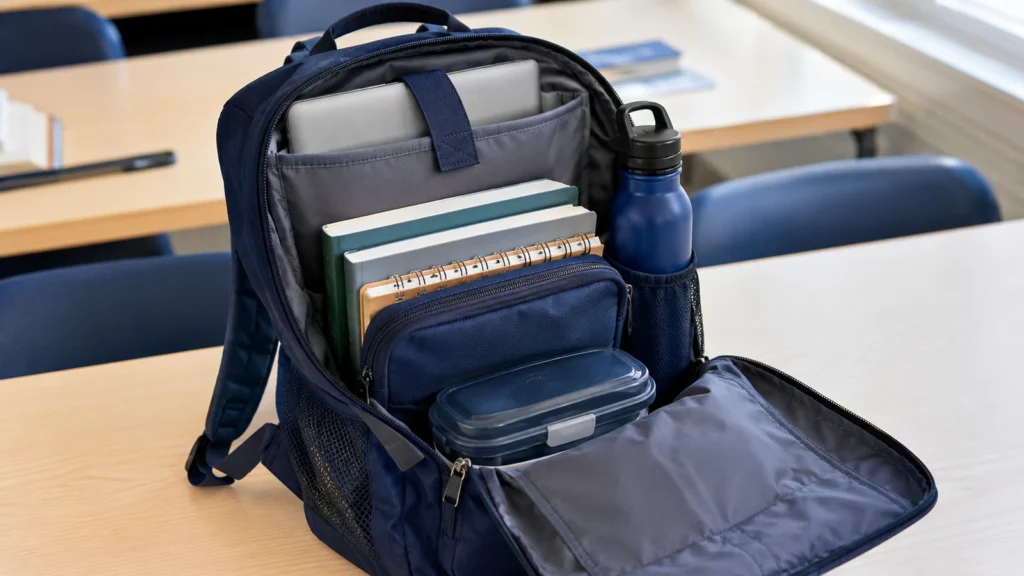
Capacity in liters is useful for comparing designs, but it is not enough. Two bags with a similar stated capacity can pack differently because of taper, foam, pocket structure, and internal dividers. Request finished dimensions and an internal loading demonstration.
| User group | Practical design direction | Typical contents to test | Procurement caution |
|---|---|---|---|
| Preschool/early years | Compact body, simple zip, light construction | Folder, snack, spare clothing | Full-size folders may not fit; confirm requirements |
| Elementary | Moderate body, easy organization | Folders, lunch, books, bottle | Do not oversize “for growth” if it hangs too low |
| Middle school | Medium-to-large structured pack | Books, binders, device, lunch | Control empty weight and compartment complexity |
| High school | Device-focused, mature styling | Laptop, binders, chargers, personal items | Verify actual device and locker dimensions |
| Team or club program | School-day storage plus activity needs | Uniform layer, shoes, bottle, school kit | Consider separate wet/shoe storage and odor management |
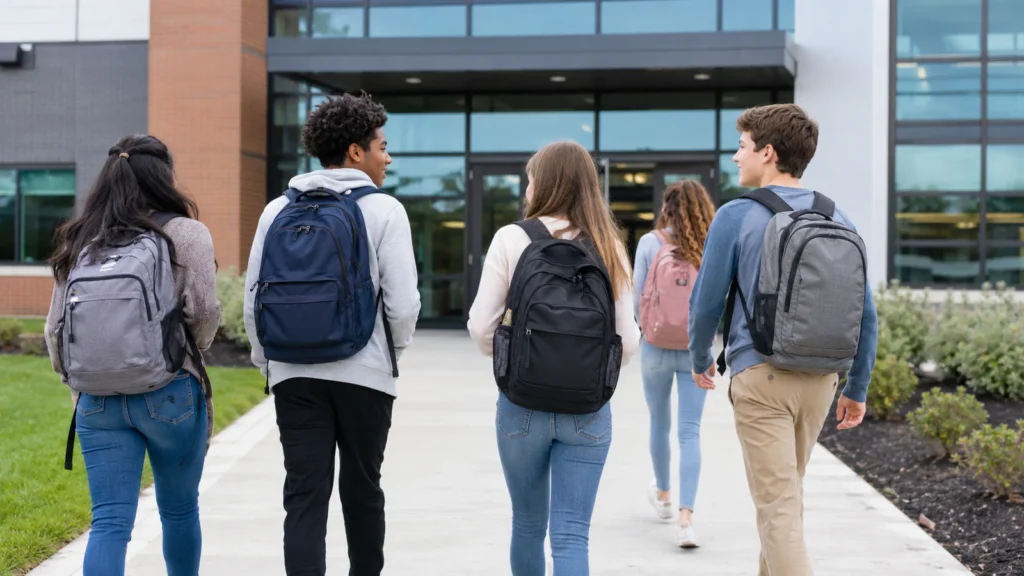
Fit should be evaluated with both straps worn and adjusted to keep the pack close to the body. The bottom should not hang excessively below the waist, and the top should not interfere with the neck. HealthyChildren.org advises positioning the backpack around the middle of the back, using both straps, and packing heavier items closest to the body. It also states that loaded backpacks should not exceed 15% of the child’s body weight. Treat that figure as a ceiling in the cited guidance, not a product capacity target: a lighter load is preferable, and individual size, strength, mobility, and professional advice matter.
For a bulk program, test at least several representative students rather than one adult fit model. Record torso range, strap adjustment range, loaded weight, and any complaints about pressure, movement, or heat.
Select Materials for the Actual Use Environment
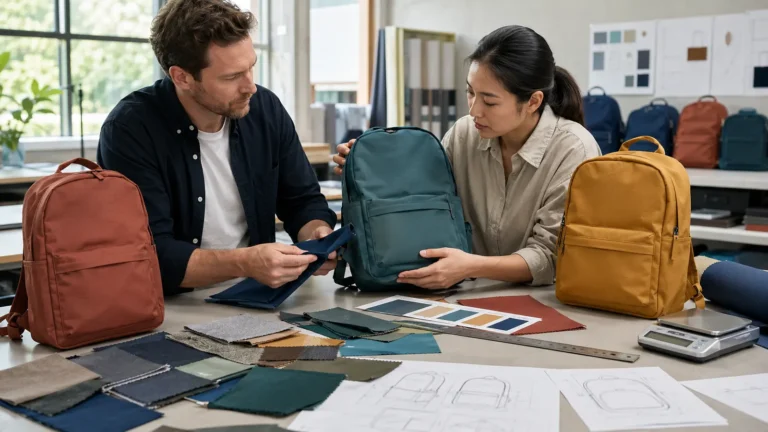
Polyester and nylon are common woven shell options. Neither material name alone predicts performance. Yarn type, fabric construction, weight, coating, finish, color, and supplier consistency all matter.
Polyester
Polyester is widely available, accepts color well, and can provide a practical balance of abrasion resistance, price, and print compatibility. It is often suitable for school programs, promotions, and private-label ranges. Buyers should specify more than “polyester”: request the exact construction, backing or coating, hand feel, and approved color.
Nylon
Nylon can provide a strong, flexible shell at a competitive weight, depending on construction. It is often selected for performance-oriented products. Cost, color behavior, coating compatibility, and the desired surface appearance should be reviewed on a physical swatch.
Recycled-content fabrics
Recycled polyester can support a buyer’s material strategy, but claims require documentation and chain-of-custody clarity. Ask what documentation is available, what part of the bag contains recycled content, and how the claim may be worded in the destination market. Do not assume that every component—including lining, webbing, thread, foam, and zipper tape—shares the same content.
Lining, mesh, and foam
A light-colored lining can make contents easier to find and simplify internal inspection. Air mesh may improve the feel of straps and back panels, but it adds seams and can catch dirt. Foam density and thickness should be selected through loaded trials: very soft foam can compress quickly, while very thick foam adds bulk without guaranteeing comfort.
Coatings and water resistance
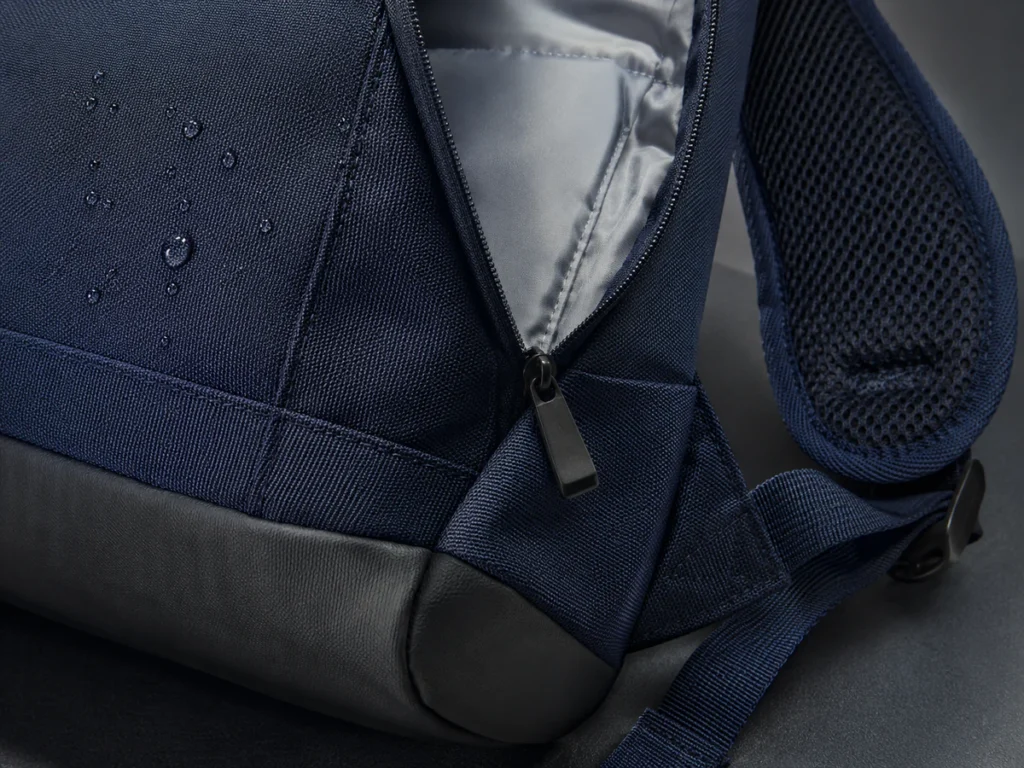
Most conventional school backpacks should be described as water resistant only when the construction and testing support that claim. Needle holes, zipper paths, and openings remain potential entry points. If the buyer needs a defined performance level, agree on the test method, duration, exposure, and acceptable result. A coated fabric swatch does not prove that the complete sewn bag is waterproof.
Inspect Construction Where Failures Actually Begin
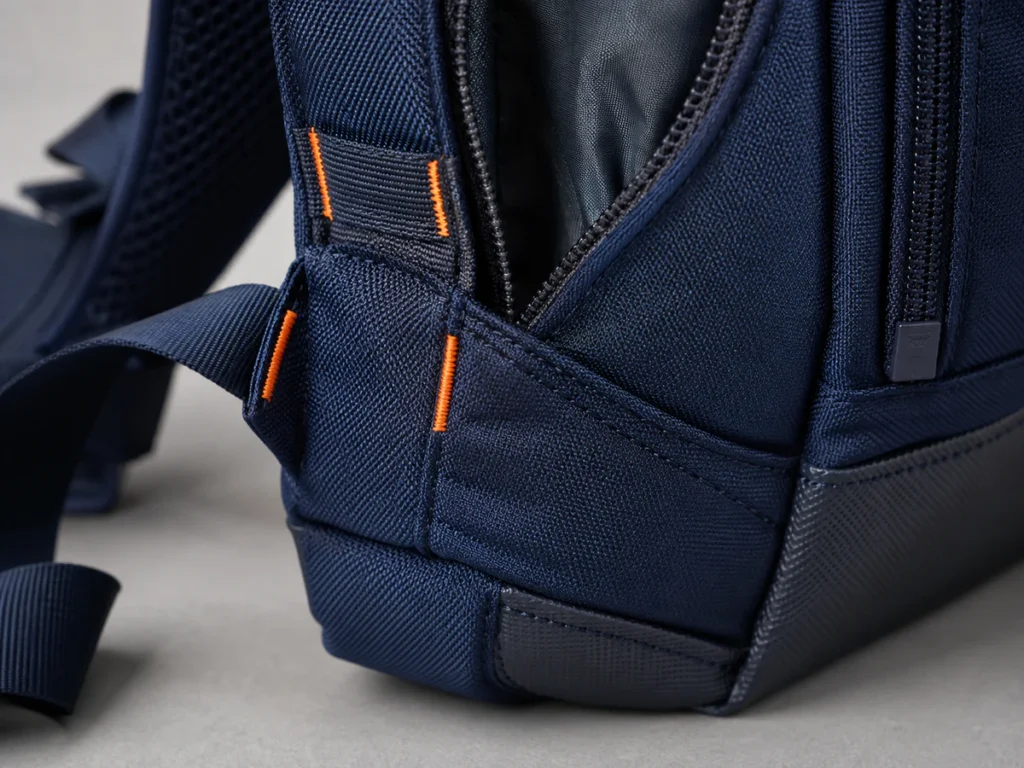
Stress concentrates at shoulder-strap anchors, top handles, zipper ends, pocket corners, side compression points, and the base. Reinforcement should match the load path rather than appear as decorative extra stitching.
Strap anchors and handles
Look for adequate seam allowance, reinforcing layers, secure back-tacking or bar-tacking, and clean alignment. Pull the straps in the direction they will be loaded, not only straight outward. A padded top handle improves hand carry, but the attachment must be designed for a fully loaded bag.
Seams and edge binding
Internal raw edges should be controlled with suitable binding or another approved finish. Check for skipped stitches, loose thread ends, puckering, needle damage, and inconsistent seam allowance. Corners should turn cleanly without fabric being cut too close to the seam.
Base construction
The bottom sees abrasion, moisture, and impact whenever the bag is placed on the ground. A reinforced base panel, higher-resistance fabric, coating, or easy-clean surface can extend useful life. Check how the base connects to the side panels; a strong material is ineffective if the joining seam is exposed.
Zippers and pulls
Operate every zipper around curves and across filled compartments. Teeth or coil should engage smoothly, sliders should not snag the lining, and zipper ends should be secured. Large, easy-grip pulls help younger students, but very long cords can catch on surrounding objects. Specify the zipper supplier or performance expectation when consistency is critical.
Bottle pockets and elastic
Water-bottle pockets fail when the opening is too loose, the base is shallow, or the mesh tears at the top corner. Test the actual bottle range and insert/remove repeatedly. Consider drainage and cleaning, especially for school programs.
Translate Comfort Features Into Measurable Decisions
“Ergonomic” is too vague for a purchase order. Replace it with observable requirements.
- Define strap width, padding construction, adjustment range, and minimum/maximum usable length.
- Define back-panel dimensions, padding zones, and channel placement.
- Confirm where the laptop sleeve and heaviest books sit relative to the back.
- Set an empty-bag weight target for each size.
- Conduct loaded fit trials with representative users.
- Check whether straps slip after walking and whether hardware presses against the body.
- Evaluate the bag while students wear seasonal clothing, not only a thin T-shirt.
A sternum strap can stabilize a bag for walking or cycling, but it must be correctly positioned and easy to operate. A waist strap can help hold the pack close, although it may add cost and is often left unused on casual school bags. Choose these features based on route and load, not as visual signals.
Design Compartments Around the Packing List
More pockets are not automatically better. Each pocket adds material, stitching, hardware, assembly time, and potential failure points. A strong school design usually starts with a main compartment, a protected device or document zone, an accessible front pocket, and secure bottle storage. Add specialist pockets only when the use case justifies them.
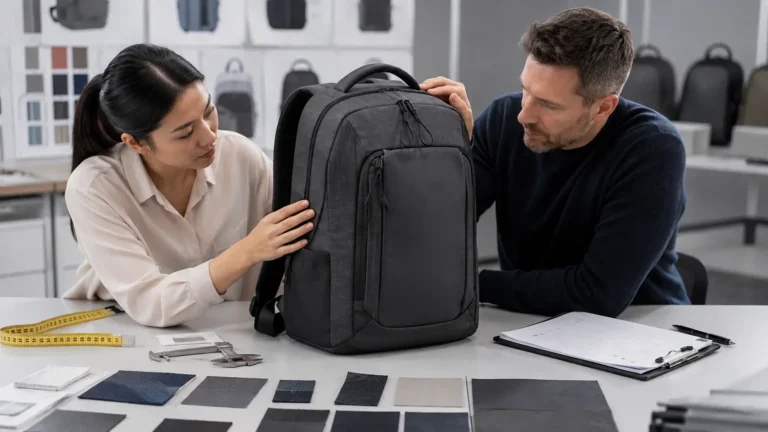
Place dense items close to the back. Prevent a laptop from moving laterally and protect it from sharp stationery. Avoid a sleeve that is so tight that users strain the zipper or so loose that the device moves freely. If lunch is carried inside the same bag, consider spill containment, cleaning access, and separation from electronics.
For clear-backpack policies, buyers must confirm the exact school rule, permitted trim, privacy pouch requirements, and material expectations. Clear polymer panels change weight, flexibility, seam construction, and temperature behavior, so a standard textile design cannot simply be copied.
Build a Durability Test Plan Before Bulk Production
Testing should reflect foreseeable use and the buyer’s risk level. A promotional giveaway, daily district bag, premium retail model, and team travel pack do not need identical protocols. Buyers may use an independent laboratory for formal test methods or establish documented internal checks for sample approval and production control.
| Check | What it reveals | Simple sample-level approach | Define before testing |
|---|---|---|---|
| Loaded carry trial | Fit, movement, pressure, strap slippage | Pack intended items; walk, use stairs, lift, and set down | Load, user range, duration, pass/fail observations |
| Strap/handle load cycling | Anchor and seam durability | Repeatedly lift a controlled loaded bag | Load, cycle count, permitted deformation |
| Zipper operation | Slider, chain, curve, and lining issues | Open/close each path repeatedly while packed | Fill level, cycle count, snag/failure criteria |
| Base abrasion simulation | Wear at ground-contact zones | Use a defined rubbing surface or lab method | Material, pressure, cycles, acceptable appearance |
| Spray exposure | Whole-bag water resistance | Expose consistently and inspect contents | Duration, angle, water rate, allowed penetration |
| Color and rub check | Transfer and visible change | Test dry/wet rubbing under an agreed method | Colorway, substrate, rating or visual limit |
| Dimensional check | Production consistency | Measure defined control points | Tolerance and measurement method |
Do not write “passed durability testing” without identifying what was tested. A precise statement—such as the approved sample completed a buyer-defined loaded-handle cycling check—is more useful than a broad claim.
Plan Customization Without Weakening the Bag
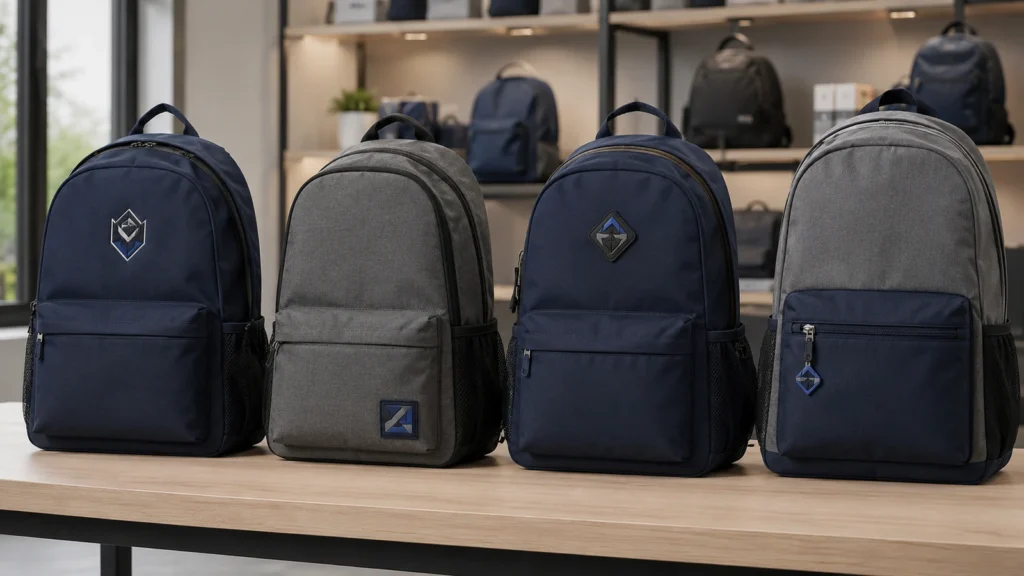
School branding may use embroidery, screen printing, heat transfer, woven patches, rubber/PVC patches, or private labels. The decoration method should suit the artwork, fabric, order quantity, desired texture, and washing or cleaning expectations.
Embroidery gives a dimensional finish but introduces needle penetrations and adds stiffness and weight. Dense designs may distort lightweight panels; backing and placement should be approved. Screen printing can be efficient for suitable flat panels and quantities, but ink, fabric coating, color opacity, and cure conditions matter. Heat transfer supports detailed artwork and smaller placements, while adhesion and surface compatibility must be tested. Patches add texture and can support flexible artwork, but attachment method, edge finish, and thickness affect durability.
Avoid placing decoration across zipper paths, folds, highly curved areas, or stress points. Confirm whether a logo panel must be prepared before assembly. Request an artwork mockup showing dimensions and distance from seams, then approve a physical sample under the actual lighting in which the product will be sold or issued.
Planning a school, distributor, or private-label backpack order? Send JIUMU your target student group, bag dimensions or capacity, quantity, colors, logo file, preferred decoration, device size, packaging, destination, and required delivery date. JIUMU can review the concept and prepare a custom quotation through the custom team bags page or contact page.
Understand the Main Cost Drivers
Unit cost is shaped by shell and lining materials, number of panels and compartments, zipper and buckle specification, foam, reinforcement, decoration, labels, packaging, testing, quantity, and shipping method. A visually simple backpack can still be expensive if it uses specialized material or hardware. Conversely, a low-cost shell can become labor-intensive when it has many pockets and curved seams.
Ask suppliers to quote against a stable specification. If two quotations are based on different zipper grades, foam, dimensions, packaging, or decoration, the lower price is not a valid comparison. Separate one-time development costs, sample fees, testing, tooling, unit production, packaging, and freight when possible.
Value engineering should protect the user’s priorities. Removing a decorative pocket may reduce cost with little functional loss; reducing reinforcement at the strap anchor may create unacceptable risk. Simplifying artwork colors or standardizing hardware across colorways may improve both cost and repeat-order consistency.
Approve a Sample With a Written Checklist
The physical sample should be treated as evidence of a particular specification, not a substitute for one. Photograph the approved sample, record dimensions, retain material swatches, identify color references, and sign off decoration placement.
Check the sample in this order:
- Confirm overall dimensions, silhouette, capacity, and empty weight.
- Pack the stated contents and test closure without forcing the zipper.
- Test fit and adjustment across representative users.
- Inspect shell, lining, foam, webbing, binding, zippers, buckles, and elastic.
- Pull and flex high-stress seams; inspect reinforcement placement.
- Compare logo size, position, color, and surface quality with the artwork standard.
- Review labels, care information, hangtags, barcode placement, and packaging.
- Record every approved change in a revised specification before bulk production.
If the production material or hardware differs from the sample, require re-approval of the affected component. “Equivalent” should be defined by performance and appearance, not supplier convenience.
Quality Control for Bulk School Backpack Orders
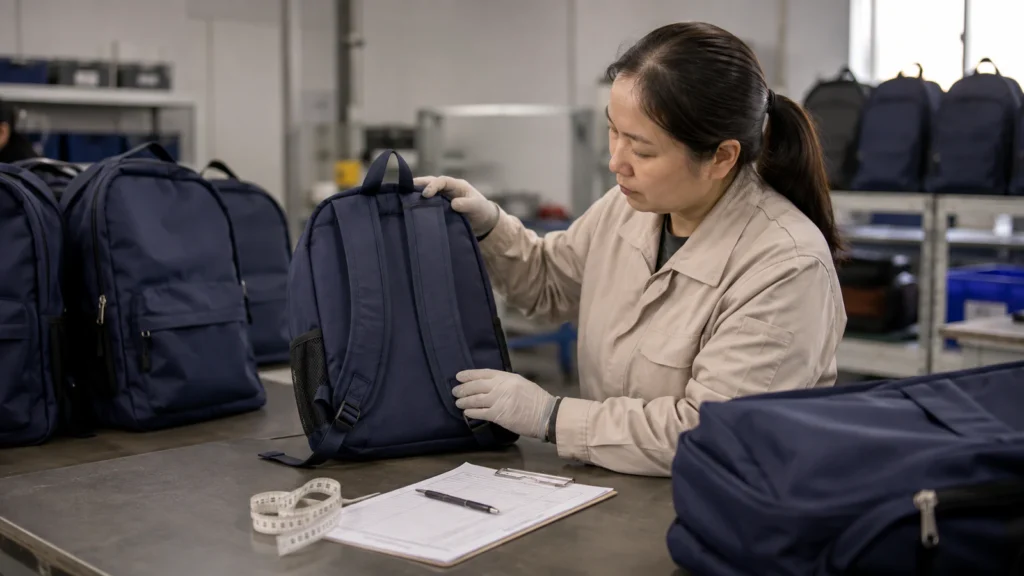
Quality control should occur before, during, and after assembly. Incoming checks can confirm fabric shade, coating, lining, webbing, foam, hardware, and printed or embroidered components. In-process checks can catch panel orientation, reinforcement, stitch consistency, and logo placement before defects are enclosed. Final inspection verifies complete bags, quantities, assortment, packaging, and carton marks.
A final inspection checklist may include:
- Approved style, colorway, and size assortment
- Finished dimensions and tolerance
- Fabric shade and visible surface defects
- Logo size, placement, color, and attachment
- Zipper and buckle function on every sampled unit
- Strap symmetry, adjustment, and reinforcement
- Seam integrity, binding, loose threads, and cleanliness
- Pocket construction and device-sleeve fit
- Labels, warnings or care information required by the buyer
- Individual packaging, barcode, assortment, carton count, and shipping marks
Sampling plans and acceptance limits should be agreed with the buyer’s quality team or inspection provider. Regulatory and labeling obligations depend on product design, destination, age grading, claims, and sales channel; obtain qualified compliance advice for the target market rather than relying on a generic supplier statement.
Information to Send for an Accurate Quotation
A useful request for quotation should include:
- Intended users and destination market
- Reference images, drawing, tech pack, or existing sample
- Finished dimensions and target capacity
- Daily packing list and device dimensions
- Preferred shell, lining, color, coating, and trim
- Pocket layout and special features
- Logo artwork in vector format where possible
- Decoration method, size, and placement
- Labels, hangtags, barcode, and packaging requirements
- Order quantity by style and color
- Testing, inspection, or documentation requirements
- Delivery address, target date, and preferred shipping terms
If some decisions are open, identify them. A supplier can propose options more effectively when it knows which requirements are fixed and where alternatives are acceptable.
Questions to Ask a School Backpack Supplier
- What exact shell, lining, webbing, foam, and zipper specifications are included?
- Which areas are reinforced, and can the construction be shown on a cut sample?
- How will the bag be measured, and what tolerances apply?
- Can the sample be tested with our actual contents and device?
- Which decoration methods suit this fabric and logo density?
- How will color be approved and controlled across components?
- What changes require a new sample or written approval?
- What in-process and final checks will be recorded?
- What packaging and carton assortment are included?
- What documentation can support any material, recycled-content, or performance claim?
- How are repeat orders controlled if materials or sub-suppliers change?
- What information is required now to protect the delivery schedule?
Common Buying Mistakes
Choosing by fabric number alone
Denier describes yarn linear mass, not complete-bag durability. Weave, coating, seams, reinforcement, and hardware remain critical.
Buying one oversized model for every student
Oversizing can encourage overpacking and create poor fit. Develop size directions for actual age groups and loads.
Adding pockets without a packing test
Unused pockets add weight and cost. Overlapping pockets can also reduce usable volume and make the bag front-heavy.
Treating “waterproof” as a material adjective
Whole-bag performance depends on seams, zippers, openings, and test conditions. Use precise, supportable language.
Approving only a digital mockup
Screens cannot confirm hand feel, foam behavior, zipper smoothness, loaded shape, color under real light, or decoration distortion.
Comparing incomplete quotations
Low prices may exclude packaging, testing, upgraded hardware, sampling, or freight. Normalize the specification before comparing.
Leaving quality criteria until shipment
Pass/fail criteria agreed after production invite disputes. Set control points and tolerances before the purchase order.
Why JIUMU Is Relevant to Custom School Backpack Programs
Established in 2010 and based in Guangdong, China, JIUMU supplies custom teamwear, bags, uniforms, hats, and branded merchandise for B2B buyers in North America and Europe. Its capabilities include OEM/ODM development, fabric sourcing, Pantone color matching, multiple logo methods, private labels, packaging customization, digital mockups, physical samples, bulk production support, quality control, and export coordination.
For school and team bag projects, that combination is useful because the backpack rarely stands alone. Buyers may need coordinated colors and branding across team uniforms, hoodies, jackets, hats, and bags. JIUMU’s typical MOQ is 50 pieces, subject to product structure and customization. Final feasibility, price, sample timing, production schedule, and performance requirements should be confirmed for each project.
Frequently Asked Questions
Final Recommendation
The best durable, comfortable school backpack is not the model with the most pockets or the heaviest fabric. It is the model whose size, weight, load layout, materials, reinforcement, hardware, and branding match a defined student group and school day—and whose approved sample can be reproduced consistently.
Begin with the packing list and user fit. Convert observations into a written specification, test the loaded sample, define production checkpoints, and compare quotations on the same basis. This process protects comfort, service life, budget, and brand reputation at the same time.
Request a custom school backpack quotation from JIUMU. Share your student age group, dimensions or capacity, quantity, colors, device size, logo artwork, decoration method, packaging, destination, and delivery target. Contact JIUMU at zhengdong@jiumugear.com, WhatsApp/phone +86 18507502899, or the JIUMU inquiry page.