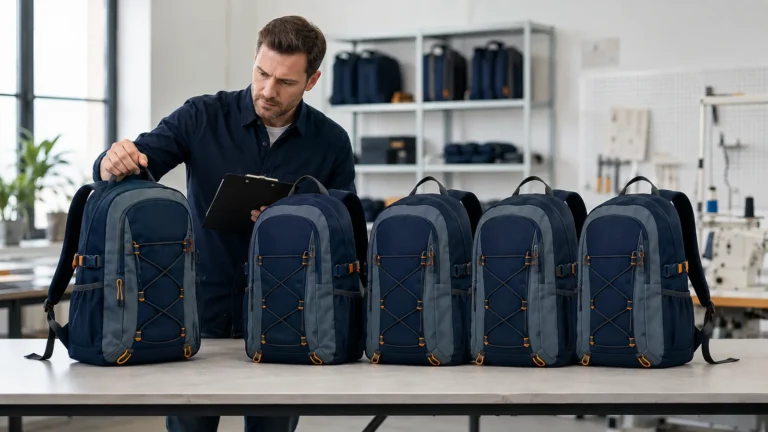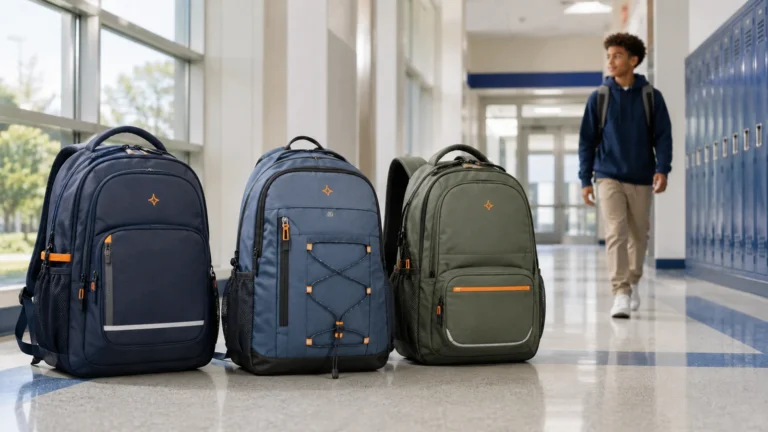
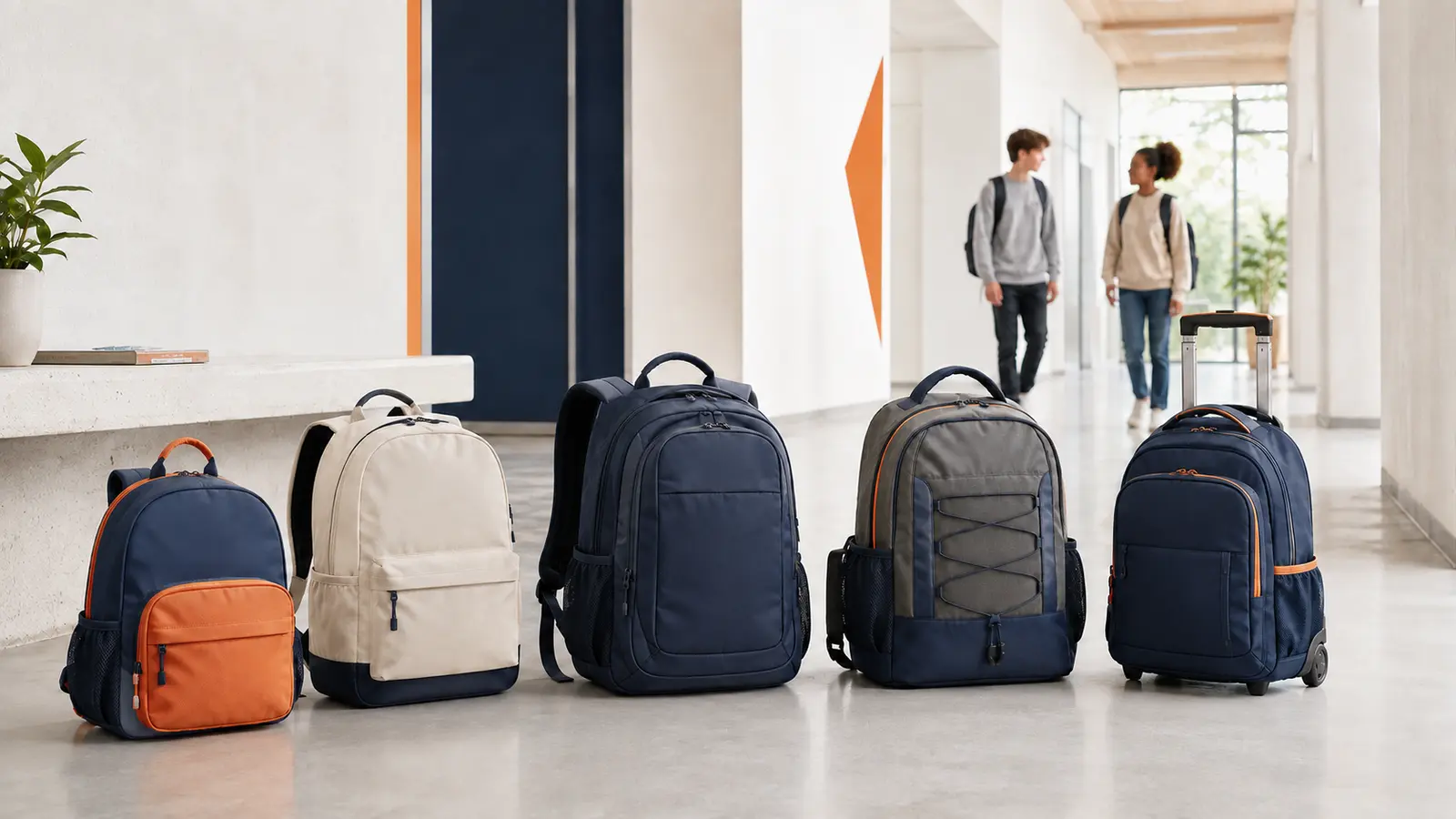
School Backpack Types, Sizes and Features: Complete Guide
School backpacks may look like a simple product category, but bulk buyers quickly discover that one specification cannot serve every student, timetable, and sales channel. A compact backpack for early elementary pupils has different fit, organization, visibility, and decoration needs from a laptop-ready secondary-school bag. A sports-focused school program may need wet-item separation, while a retailer may prioritize a coherent size range, private labeling, and packaging.
This guide explains the principal school backpack types, practical size and capacity bands, materials, construction details, comfort features, customization choices, and quality-control steps. It is written for schools, distributors, uniform dealers, promotional companies, and private-label brands that need to convert a broad product idea into an order-ready specification.
Quick Answer:Quick Answer: The main school backpack types are compact elementary backpacks, standard daypacks, laptop backpacks, sports or activity backpacks, rolling backpacks, and convertible or specialty bags. Instead of choosing by age label alone, match the bag’s external dimensions, usable capacity, back length, strap geometry, organization, and empty weight to the intended student group and daily load. For bulk orders, approve a physical sample with the actual books, device, bottle, and branding before production.
Why the School Backpack Decision Matters
A backpack sits at the intersection of fit, storage, durability, safety, branding, and price. If a buyer focuses only on nominal liters, a bag may technically hold the required items but still be too long for smaller users, poorly balanced when loaded, or inconvenient in a crowded classroom. If the buyer selects primarily by appearance, weak strap anchors or an unsuitable base fabric can create early failures.
The American Academy of Pediatrics’ parent guidance recommends wide, padded shoulder straps, a padded back, using compartments to organize the load, and placing heavier items close to the center of the back. Its dedicated backpack-safety page advises that a packed backpack should not exceed 15% of a child’s body weight. These are useful usage references, not a substitute for a buyer’s own sizing trial or applicable product-safety review.
School Backpack Types at a Glance
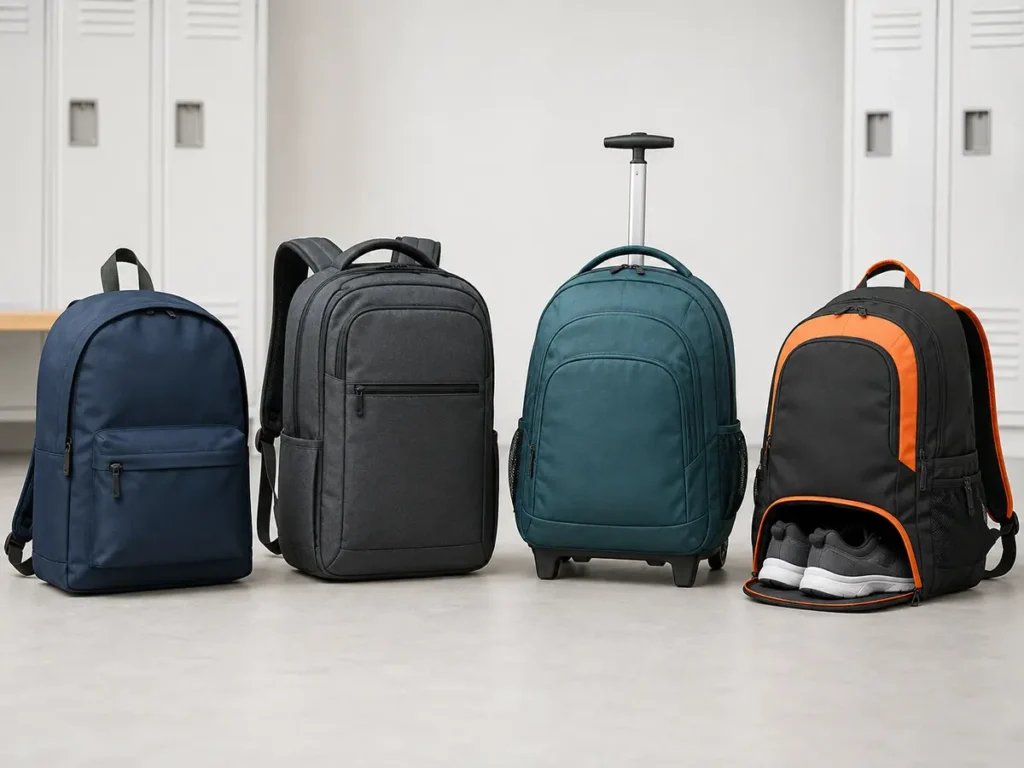
| Backpack type | Typical use | Useful features | Main procurement risk |
|---|---|---|---|
| Compact elementary backpack | Early grades, light folders, lunch, small bottle | Short back panel, simple opening, name label, reflective details | Bag is too long or straps cannot shorten enough |
| Standard school daypack | General daily school use | Two main zones, organizer pocket, bottle pockets, padded straps | Generic specification does not match actual book load |
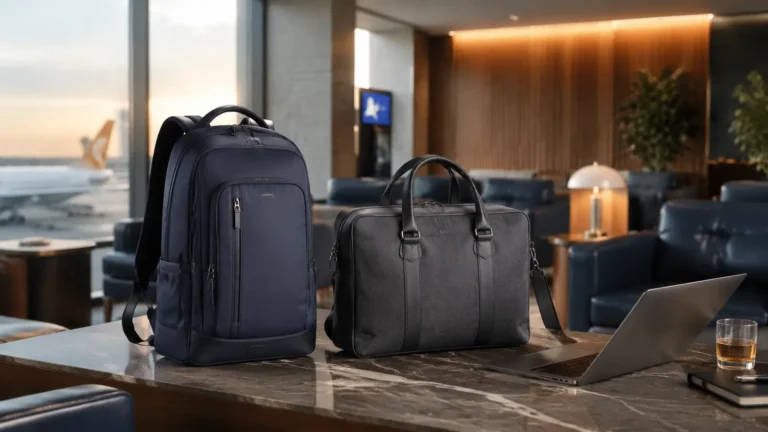
| Laptop school backpack | Secondary school, college, one-to-one device programs | Padded device sleeve, raised laptop base, cable/accessory storage | Sleeve fits the stated device size but not its protective case |
| Sports or activity backpack | School teams, PE, clubs, after-school programs | Shoe or wet-item zone, ventilation, easy-clean lining | Added compartments consume main storage capacity |
| Rolling backpack | Heavy loads, long corridors, travel between sites | Stable wheel base, telescoping handle, protected shoulder straps | School rules, stairs, wheel noise, handle durability |
| Convertible or hybrid bag | Commuting, travel, multi-purpose programs | Backpack straps plus tote/duffel handles | More hardware, weight, cost, and failure points |
“Elementary,” “middle school,” and “high school” are merchandising labels rather than universal engineering sizes. Student height, stationery formats, device programs, and school rules influence the correct specification.
1. Compact Elementary Backpacks
Compact elementary packs should be designed around a shorter torso and a relatively simple school routine. A buyer may want one main compartment, a front pocket, two bottle pockets, and an internal name label rather than a complex organizer that adds cost and confuses younger users.
Fit matters more than the age printed on a hangtag. The upper strap attachment should sit comfortably around the upper back, the bottom should not hang excessively low, and the shoulder straps should shorten sufficiently for the smallest intended user. Rounded corners, zipper pulls that are easy to grip, and smooth exposed edges support everyday usability.
2. Standard School Daypacks
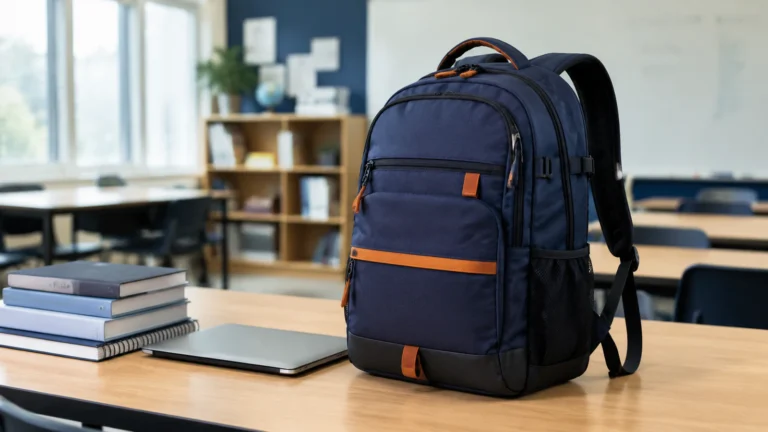
The standard daypack is the broadest and most adaptable type. It commonly combines a main book compartment, secondary organizer zone, front quick-access pocket, and side bottle pockets. The important question is not how many pockets the bag has, but whether each pocket serves a recurring task.
A useful school daypack keeps heavy books close to the back panel and small items organized. For large programs, a two-compartment architecture often balances cost, weight, and durability.
3. Laptop School Backpacks
Laptop backpacks require more precise dimensional planning. A marketing phrase such as “fits a 15-inch laptop” is incomplete because devices with the same diagonal screen size can have different body dimensions, and protective cases add thickness.
Send the maximum device length, width, and thickness with its case installed. Define the sleeve’s finished internal dimensions and padding, then test with the real device or an accurate dummy.
4. Sports and Activity Backpacks
Sports school backpacks serve students who carry footwear, uniforms, balls, protective equipment, or damp garments alongside books. The design challenge is separation. A lower shoe pocket or front equipment zone can improve hygiene and organization, but it also occupies volume within the main body.
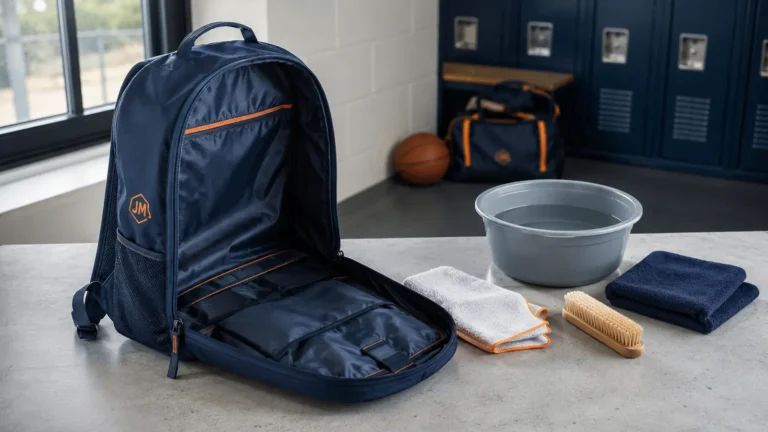
Ask the supplier to state whether a compartment’s volume is additional or intrudes into the main cavity. Ventilation eyelets or mesh panels may help air movement, while a wipe-clean lining can simplify maintenance. However, “antimicrobial,” “odor-proof,” and similar claims require substantiation and should not be added casually to packaging or product pages.
5. Rolling Backpacks
Rolling backpacks can be useful where students carry heavier materials and the school permits wheeled bags. The American Academy of Pediatrics suggests considering a backpack with handles or a rolling backpack when a load is too heavy, if the school allows it. That qualification matters: stairs, narrow aisles, storage rules, and crowded corridors may make rolling products unsuitable in some institutions.
A rolling design should be evaluated as a small piece of luggage, not merely a daypack with wheels. Inspect handle extension and retraction, wheel alignment, base stability, curb clearance, fabric protection near the wheels, and how shoulder straps are secured when rolling. Test whether the bag tips forward when fully packed and whether the handle height works for the intended users.
6. Convertible and Specialty School Bags
Convertible backpacks may include stowable shoulder straps, tote handles, a duffel opening, or a detachable accessory pouch. Specialty variants may be designed for art supplies, music accessories, technical programs, or field activities.
Each conversion feature adds seams, hardware, assembly time, and inspection points. A hybrid makes sense when both modes are used regularly; otherwise, a dedicated bag is easier to manufacture consistently.
How to Choose Backpack Size and Capacity
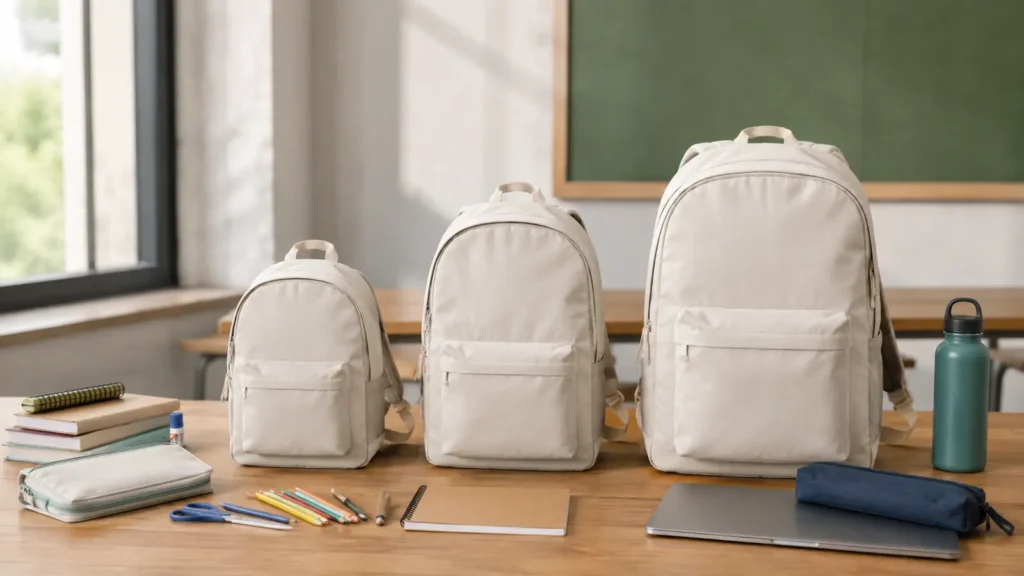
Capacity in liters helps compare product classes, but two bags with the same calculated volume may store items differently because of shape, padding, seams, and compartment intrusion.
Use liters together with finished external dimensions, internal sleeve dimensions, back-panel length, empty product weight, and a physical load test. The following bands are planning ranges rather than universal standards.
| Planning band | Indicative capacity | Intended load concept | Specification emphasis |
|---|---|---|---|
| Small | About 10–15 L | Light folders, lunch, bottle, small personal items | Short back panel, low empty weight, easy zippers |
| Medium | About 16–22 L | Books, notebooks, lunch, bottle, light layer | Balanced organization, reinforced strap anchors |
| Large | About 23–30 L | Larger books, device, charger, lunch, activity gear | Load control, structured back, stronger base |
| Extra capacity | Above about 30 L | Specialized sports, travel, or equipment use | Confirm school practicality and loaded weight |
These ranges must be verified against real contents. A wide binder may determine bag width; an A4 or letter-size folder may determine height; a protective laptop case may determine sleeve depth. A nominally large bag with a narrow zipper opening can still be frustrating to load.
Measure the Intended Contents First
Build a representative load kit before sampling: the largest folder, typical books, cased device, charger, lunch container, bottle, pencil case, and seasonal layer. Provide dimensions for rigid items.
During sample review, load the bag in the intended order. Check whether zippers close without strain, the bottle remains stable, hard objects do not press against the user’s back, and the bag keeps a reasonable shape. This simple exercise is more informative than choosing only from a catalog capacity.
Check Back Length and Strap Adjustment
Back-panel length influences where the load sits. For a multi-grade program, test samples on users representing the smaller and larger ends of the target group. Confirm strap adjustment range and record the approved webbing lengths in the specification.
Control Empty Weight
Extra pockets, thick molded panels, metal hardware, wheels, and dense decorations all add empty weight. Ask for the approved sample’s net weight and set a production tolerance if weight is important to the program. Evaluate each feature against a real need rather than assuming more components create more value.
Materials: What Buyers Should Specify
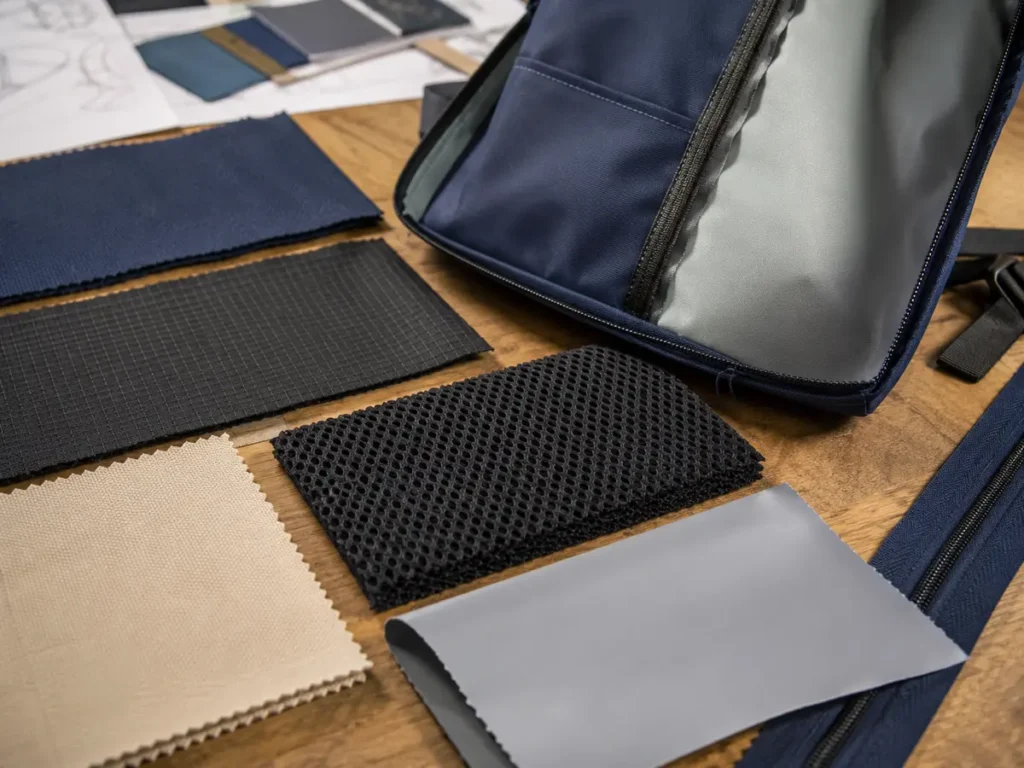
“Polyester backpack” is not a complete material specification. A purchase document should describe the face fabric, denier or other relevant construction descriptor, weave, coating or lamination, color, lining, mesh, padding, reinforcement, webbing, zipper, and hardware.
Polyester
Polyester is widely used for school bags because it supports varied colors, prints, coatings, and price points. Its performance depends on the exact fabric construction and finish. Buyers should approve a physical swatch and state the expected abrasion, color, and water-resistance tests when these properties are important.
Nylon
Nylon fabrics are often selected where a lighter hand feel or strong abrasion performance is desired. Cost and appearance vary significantly by construction. “Nylon” alone does not guarantee durability; weave, yarn, coating, and sewing quality still matter.
Canvas and Blended Fabrics
Cotton canvas and cotton-blend materials can support a casual or heritage appearance. They may be heavier and may handle moisture differently from coated synthetics. Buyers should discuss shrinkage, colorfastness, stain behavior, and care labeling based on the finished construction.
Lining, Mesh, Padding, and Coatings
Lining can improve appearance, protect internal coating, and make pockets easier to clean. Spacer mesh is commonly used on back panels and straps for cushioning and airflow. Foam thickness should be evaluated together with density and recovery; a thick but soft foam may collapse quickly.
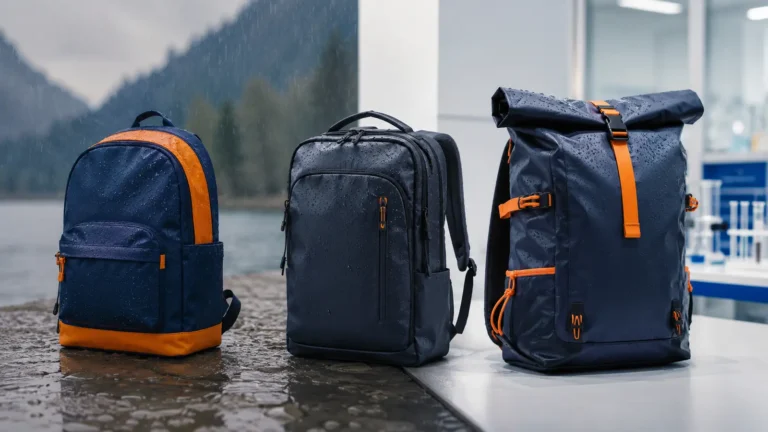
Water-resistant and waterproof are not interchangeable. Coated fabric may resist light exposure, but water can still enter through seams, zippers, and needle holes. Define a test method and acceptance level before making a performance claim. For markets or buyers concerned about specific chemistries, state restricted-substance requirements in the purchase specification and obtain appropriate test documentation for the actual materials and product category.
Construction Features That Predict Durability
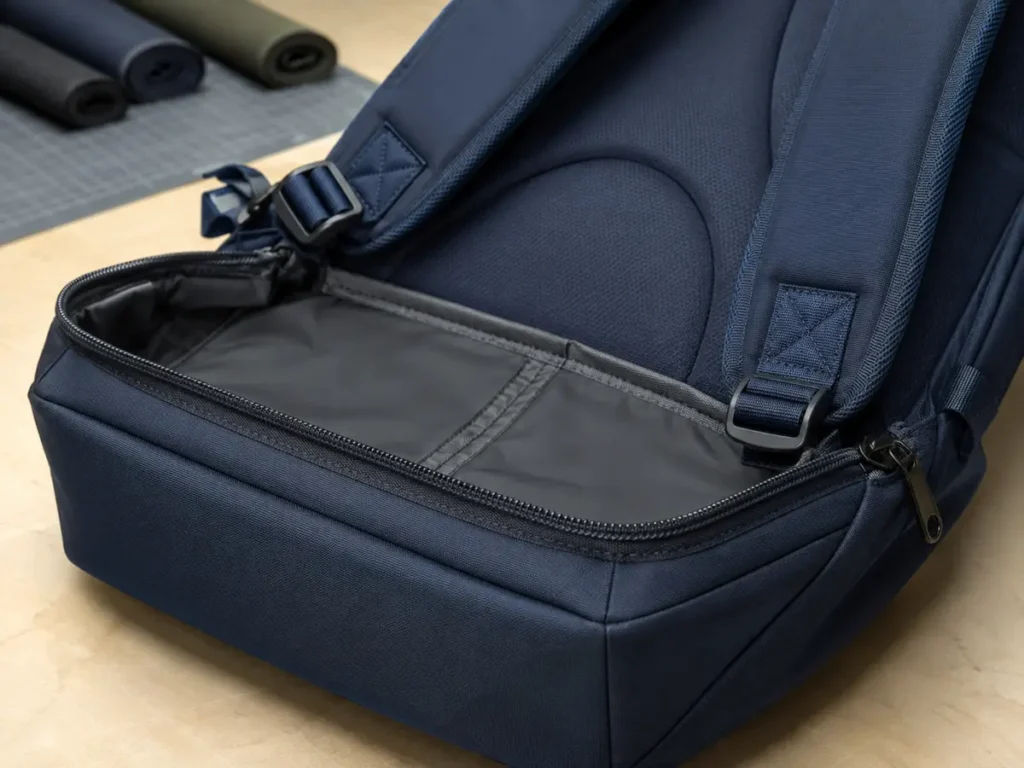
Shoulder-Strap Anchors
Strap attachment points receive repeated load and motion. Look for a sufficient seam allowance, reinforcement layers, consistent box or bar-tack stitching where appropriate, and symmetrical placement. Pull testing should use an agreed method and force rather than an informal “strong” description.
Base Construction
The bottom contacts floors, desks, pavement, and locker surfaces. A denser or coated base material, reinforcement panel, piping, or double layer may extend useful life. Check whether the bag stands as intended when loaded and whether the base seam is exposed to abrasion.
Zippers and Openings
Evaluate zipper gauge, slider movement, puller size, tape color, end stops, and sewing alignment. Run the zipper around curves when the bag is both empty and packed. The opening should provide access to the largest intended item without overstressing the teeth or seam.
Seam Finishing
Internal seams may use binding to contain raw edges and improve appearance. Inspect skipped stitches, loose thread, puckering, inconsistent seam allowance, and sharp cut ends. Establish workmanship standards with photos from the approved sample.
Bottle Pockets and Small Components
Bottle pockets often fail when the opening is too tight, the elastic loses recovery, or the pocket is too shallow. Test the actual bottle sizes. Review buckles, cord ends, magnets, decorative attachments, and small components for intended age group and destination-market requirements.
Turning Features Into Procurement Decisions
| Feature request | Buyer should define | Verification method |
|---|---|---|
| “Comfortable straps” | Finished width, padding material, thickness, curvature, adjustment range | Fit trial with representative users and load kit |
| “Laptop protection” | Maximum device dimensions, sleeve padding, closure, raised base | Real-device insertion and controlled handling review |
| “Water resistant” | Fabric and finished-product test method, exposure, pass level | Third-party or agreed laboratory test on actual construction |
| “Durable zipper” | Zipper type, size, supplier/grade if required, cycle expectation | Visual inspection and agreed cycle test |
| “Reflective detail” | Location, area, color, performance requirement | Material documentation and visibility review |
| “Eco-friendly material” | Exact recycled content or chemistry claim and evidence | Transaction certificate or test/document trail as applicable |
| “Fits all students” | Target body-size range and load | Multi-user fit trial; avoid absolute claim |
This translation step prevents ambiguous adjectives from reaching a purchase order. Every important claim should connect to an observable construction detail, document, or repeatable test.
Customization and Private-Label Options
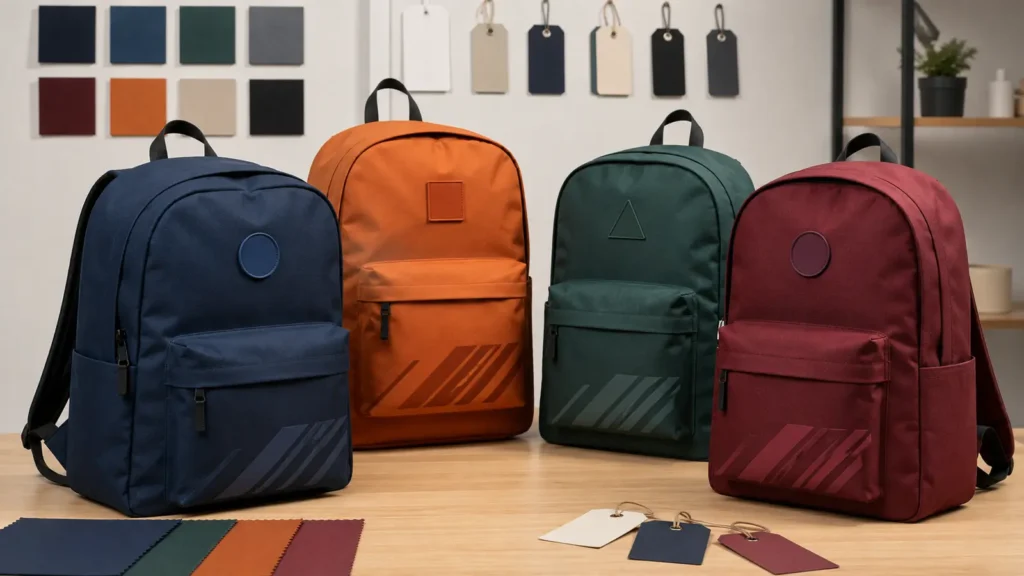
School backpacks can carry embroidery, screen printing, heat transfer, sublimated panels, woven patches, rubber/PVC patches, leather-style patches, labels, hangtags, and custom packaging. The appropriate method depends on logo detail, order quantity, fabric, panel construction, care expectations, and target cost.
Embroidery produces a dimensional result but adds stitch density and backing. It works best when the decorated panel is stable and accessible before assembly. Screen printing can be efficient for suitable artwork and quantities. Heat transfer supports detailed graphics but must be tested for adhesion on the selected coating. Sublimation is relevant to compatible polyester panels and enables all-over graphics, usually before assembly. Patches can create a repeatable branded element and may be sewn or otherwise attached according to their construction.
For private-label programs, specify label content, dimensions, position, fold, material, color, and attachment method. Packaging instructions should cover bagging, carton quantity, carton marks, barcode location, warning text where applicable, and whether straps must be folded or protected.
Planning a school, distributor, or private-label backpack program? Send JIUMU your target student group, quantity, bag dimensions or reference image, required contents, colors, logo file, packaging needs, destination, and target delivery date. JIUMU can review OEM/ODM options, prepare a digital mockup, and arrange a physical sample before bulk production. Request a custom backpack quotation.
Compliance and Labeling: Define the Destination First
Compliance depends on the destination market, intended age, product design, materials, claims, and how the item is classified. A generic checklist copied from another product is not reliable.
In the United States, the Consumer Product Safety Improvement Act sets requirements for items meeting the definition of a children’s product, including applicable rule compliance, testing when required, certification, and tracking information. Product-specific analysis is essential. CPSC phthalates guidance addresses children’s toys and child-care articles as defined in the regulation; buyers should not assume every school backpack falls into those categories.
The U.S. Federal Trade Commission explains that most textile and wool products covered by its rules need labeling for fiber content, country of origin, and the identity of the manufacturer or responsible marketer. Coverage and exemptions should be confirmed for the actual bag and materials.
For the European Union and United Kingdom, buyers should provide their supplier with the applicable chemical restrictions, labeling, packaging, traceability, and general product-safety requirements identified by their compliance adviser or importer. Requirements change, and a test report must match the actual material, color, component, and production context to be meaningful.
Treat compliance as a specification input. Confirm markets, user age, claims, materials, trims, and importer responsibilities before sampling.
What Drives the Cost of a Custom School Backpack?
The main cost drivers are body size, fabric and coating, lining, number of compartments, padding, zipper and hardware grade, reinforcement, decoration, custom molds or pullers, labels, packaging, testing, quantity per color, and order complexity.
A large order divided into many colors, sizes, and individualized artworks may not achieve the lowest unit cost. Standardized components can improve efficiency and repeat-order consistency.
Ask for quotations that clearly state what is included. Confirm sample charges, tooling, testing, packaging, freight terms, and whether personalization is priced per name or number. JIUMU’s typical MOQ is 50 pieces, subject to product structure and customization; final feasibility should be confirmed against the specific brief.
Sample Approval and Quality-Control Checklist
A physical pre-production sample is the bridge between a concept and repeatable bulk production. Do not approve it only by appearance.
- Record dimensions and weight. Measure height, width, depth, back-panel length, strap length, pocket openings, sleeve interior, and net weight.
- Load the sample. Use the real books, folders, device, bottle, lunch container, and sports items.
- Run a fit trial. Check representative users at the smaller and larger ends of the target range.
- Review materials. Match approved swatches, colors, coating, lining, foam, mesh, webbing, zipper, and hardware.
- Inspect construction. Check stitch consistency, reinforcement, binding, symmetry, sharp edges, loose threads, and zipper operation.
- Confirm artwork. Record logo dimensions, color references, position, orientation, and acceptable appearance.
- Review packaging. Pack the sample exactly as production will be packed and check creasing, strap protection, labels, barcodes, and carton plan.
- Agree on tests and tolerances. State methods, sample size, pass criteria, and who is responsible for reports.
- Create a sealed reference. Keep an approved sample and signed specification available for production and final inspection.
Bulk inspection should compare randomly selected units with the approved reference and purchase specification. Typical checks include quantity, assortment, dimensions, appearance, workmanship, function, decoration, labeling, packaging, and any agreed performance testing. Inspection level and acceptance criteria should be agreed before production.
Bulk-Order Planning Process
Step 1: Define Users and Use Cases
List grade or height range, daily load, commute, device program, sports needs, storage rules, and destination markets. Separate essential features from optional ideas.
Step 2: Build the Product Specification
Provide target dimensions, representative capacity, materials, compartments, padding, strap construction, colors, logo method, labels, packaging, performance requirements, and restricted-substance expectations.
Step 3: Reduce Unnecessary Variants
Decide whether one adjustable design is sufficient or whether two body sizes are justified. Consolidate low-volume colorways and keep shared components consistent.
Step 4: Approve Mockup and Sample
Review artwork scale and placement digitally, then test a physical sample using the real load kit. Record every approved change in a revised specification.
Step 5: Confirm Production Controls
Agree on color standards, measurement tolerances, workmanship reference, testing, inspection stage, packing method, carton marks, and shipment documentation.
Step 6: Plan Reorders
Archive the approved sample, bill of materials, color references, artwork files, label data, and packaging specification. Ask how material substitutions and process changes will be controlled on future runs.
Information to Send for an Accurate Quotation
Send as much of the following as possible:
- Buyer type and destination market
- Intended student age, grade, or height range
- Estimated order quantity by size and color
- Reference image, sketch, or tech pack
- Target finished dimensions and representative capacity
- Required books, folders, device dimensions, bottle, and activity equipment
- Face fabric, lining, padding, mesh, webbing, zipper, and hardware preferences
- Pantone or other agreed color references
- Vector logo files and decoration method
- Private labels, hangtags, barcodes, and packaging
- Required tests, claims, and compliance documents
- Target delivery date and destination
If some details are unknown, identify them as open decisions. A supplier can then propose options without mistaking a preliminary idea for a fixed requirement.
Questions to Ask a School Backpack Supplier
- What finished dimensions and internal sleeve dimensions will production follow?
- Is the stated capacity calculated or physically measured, and do pockets intrude into the main compartment?
- What are the exact face fabric, lining, coating, foam, mesh, webbing, zipper, and hardware specifications?
- Which areas receive reinforcement, and how will strap-anchor consistency be checked?
- Can the supplier make and document a physical sample using the intended load?
- How are colors approved and controlled between sample, production, and repeat orders?
- Which decoration methods suit the selected material and artwork?
- How will personalized names or numbers be proofed?
- Which tests are proposed, using what methods and acceptance criteria?
- How are material substitutions or changes communicated?
- What does the quotation include and exclude?
- How will finished goods be inspected, packed, and documented for export?
Common Buying Mistakes
Selecting Only by Liter Capacity
Capacity does not show fit, zipper access, compartment intrusion, or empty weight. Always pair it with dimensions and a load trial.
Using One Bag for Every Grade
A single visual design can be retained across two graded sizes. Forcing one body length onto a broad age range can compromise usability.
Adding Features Without a Use Case
Every pocket, buckle, panel, and molded part adds cost and inspection points. Remove features that do not solve a frequent user problem.
Approving Only a Digital Mockup
A mockup verifies appearance, not fit, capacity, hand feel, sewing, or zipper function. Use a physical sample for final approval.
Writing Vague Performance Claims
Terms such as waterproof, ergonomic, non-toxic, sustainable, and heavy-duty need definitions and evidence. Replace them with material specifications and agreed tests.
Delaying Compliance Review
Destination, intended age, materials, trims, and marketing claims can affect requirements. Review them before material purchase and sampling.
Ignoring Repeat-Order Controls
Keep approved standards and require notice before substitutions. A low first-run price has limited value if later orders cannot match.
Why Work With JIUMU for Custom School Backpacks?
JIUMU is a Guangdong-based B2B supplier established in 2010, serving buyers in the United States, Canada, the United Kingdom, and Europe. Its scope includes custom bags, teamwear, uniforms, hats, and branded merchandise.
For backpack projects, relevant capabilities include OEM and ODM development, fabric sourcing, Pantone color matching, embroidery, screen printing, heat transfer, woven and rubber/PVC patches, private labels, hangtags, packaging customization, digital mockups, physical samples, bulk quality control, and export support.
This combination is useful for schools, distributors, uniform dealers, promotional companies, and private-label brands that want bags coordinated with team apparel or other branded products. JIUMU’s typical MOQ is 50 pieces, subject to the product structure and customization. Buyers should provide their use case and specification so feasibility, sample approach, pricing, and delivery planning can be confirmed.
Explore custom team bags, review JIUMU’s company profile, or send a project brief through the contact page.
Frequently Asked Questions
Final Recommendation
Choose school backpack types by use case, then confirm fit, actual load, materials, construction, and compliance. Do not treat age labels or liter capacity as complete specifications.
Build a representative load kit, write measurable requirements, approve materials and decoration, test a physical sample on intended users, and preserve it as the production standard.
Request a Custom School Backpack Quotation: Send JIUMU your quantity by size and color, intended student group, reference images or tech pack, dimensions, required contents, materials, logo file, labels, packaging, destination market, compliance needs, and target delivery date. Email zhengdong@jiumugear.com, WhatsApp +86 18507502899, or submit your project brief.