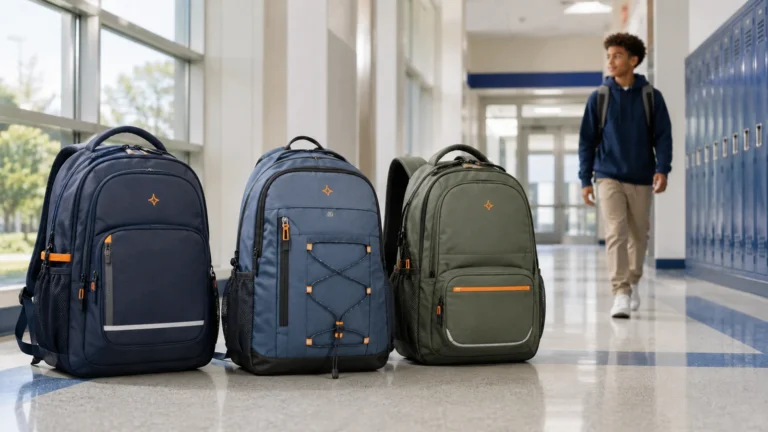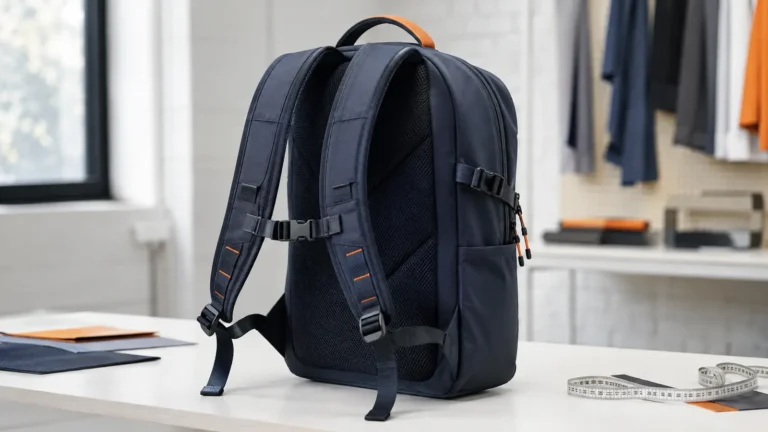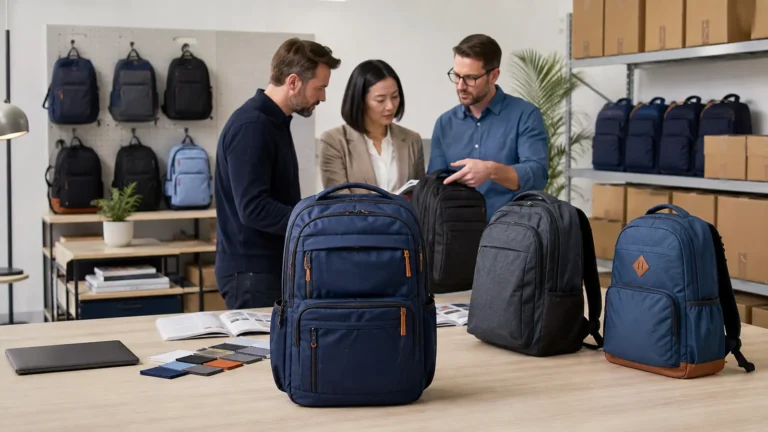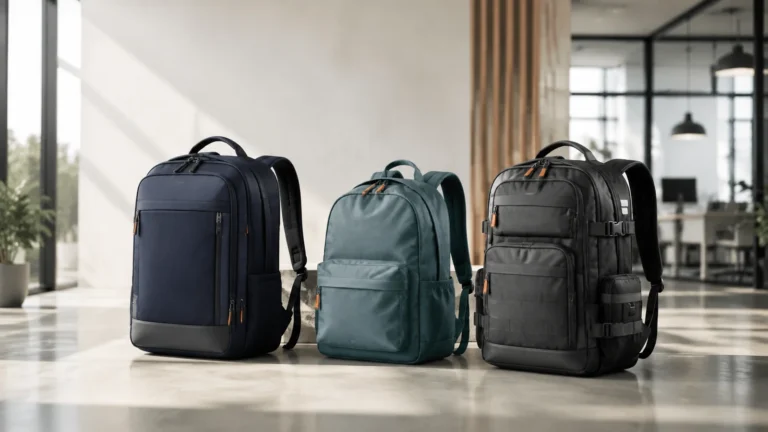
Best Business Backpacks for Work and Corporate Use
Business backpacks are no longer limited to casual commuting. For employers, distributors, uniform dealers, promotional buyers, and private-label brands, the right backpack can function as a daily work tool, a mobile-office organizer, and a visible part of a company’s identity. The challenge is that “business backpack” describes many products: a slim laptop bag for city commuting, a structured executive pack for client meetings, an expandable travel backpack, or a branded employee-onboarding gift.
The best choice is therefore not a single universal model. It is the design whose capacity, laptop protection, organization, carrying comfort, material, appearance, and branding method match the intended users. A backpack that looks excellent in a boardroom may be too small for a field team. A travel-heavy design may feel unnecessarily bulky during a short urban commute.
This B2B guide explains how to specify and source business backpacks for work and corporate use. It focuses on observable requirements, sample approval, bulk-order consistency, private labeling, and quotation planning rather than consumer brand rankings.
Quick Answer: For most corporate programs, a structured 18–24 L backpack with a padded laptop compartment, organized front section, comfortable shoulder straps, luggage pass-through, durable woven outer fabric, restrained styling, and a subtle logo provides the most versatile starting point. Choose 14–18 L for light commuting, 20–26 L for hybrid work, and 26–35 L for short business travel. Confirm device dimensions—not only the advertised laptop size—and approve a physical sample before bulk production.
Why the Business Backpack Decision Matters
A corporate backpack is used much more intensively than many event giveaways. Employees may carry it on trains, through airports, between meetings, and into customer locations. Its performance affects laptop protection, everyday comfort, organization, and the perceived quality of the company program.
For procurement teams, the decision also has operational consequences. Too many compartments increase sewing time, material consumption, inspection points, and cost. A large front logo can conflict with an executive aesthetic. A claimed “15.6-inch” compartment may still fail because laptop body dimensions and compartment openings differ. Dark colors may hide dirt, but they can also make interior contents difficult to find if the lining is equally dark.
The strongest specification connects each feature to a real use case. Begin with the users, what they carry, how far they travel, where the bag will appear, and how the company wants the branding to feel. Then translate those answers into measurable requirements.
Which Type of Business Backpack Is Best?
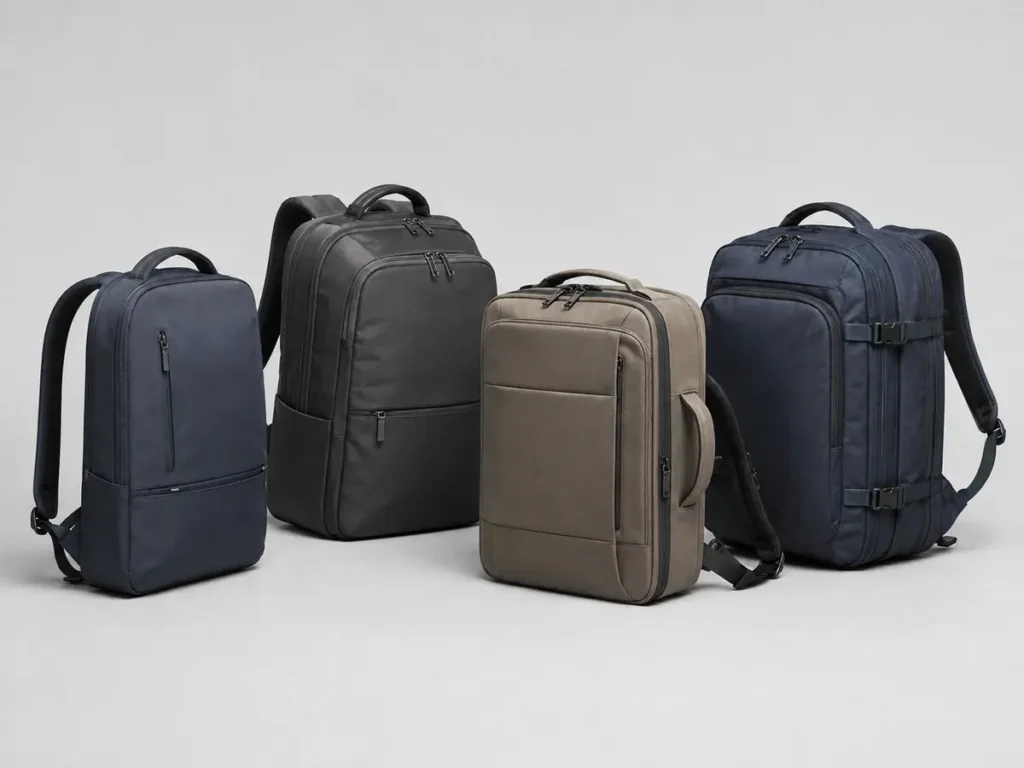
The main business backpack categories differ by capacity, silhouette, opening, and level of organization. The following table is a sourcing framework, not a rigid industry standard.
| Backpack type | Typical planning capacity | Best for | Important features | Main trade-off |
|---|---|---|---|---|
| Slim commuter | 14–18 L | Office commuters carrying a laptop and essentials | Low-profile silhouette, laptop sleeve, quick-access pocket | Limited space for clothing or bulky accessories |
| Everyday corporate | 18–24 L | Employee programs and hybrid work | Structured shape, admin organizer, bottle pocket, luggage strap | More components than a basic laptop sleeve |
| Executive minimalist | 16–22 L | Client meetings, management gifts, professional services | Clean front, concealed pockets, subtle hardware and branding | Minimal styling can reduce external access |
| Tech organizer | 20–26 L | IT teams, sales engineers, mobile professionals | Cable pockets, tablet sleeve, structured device area | Extra pockets add weight and production complexity |
| Convertible backpack-briefcase | 18–25 L | Buyers needing formal and hands-free carry modes | Side handle, stowable straps, horizontal organization | More hardware and pattern engineering |
| Expandable travel backpack | 26–35 L | Short business trips and field teams | Clamshell opening, expansion, luggage strap, clothing area | Can feel bulky for daily commuting |
Slim Commuter Backpacks
A slim commuter pack works when users carry a laptop, charger, notebook, phone, and small personal items. It should maintain a clean profile when partially filled. Procurement teams should examine whether the bag collapses or wrinkles when empty, whether the laptop sits close to the wearer’s back, and whether the front pocket has enough depth for a charger.
This format suits urban offices, conference kits, and employee onboarding when the gift should feel useful without being oversized. It is less appropriate for staff who carry tools, shoes, samples, or overnight clothing.
Structured Executive Backpacks
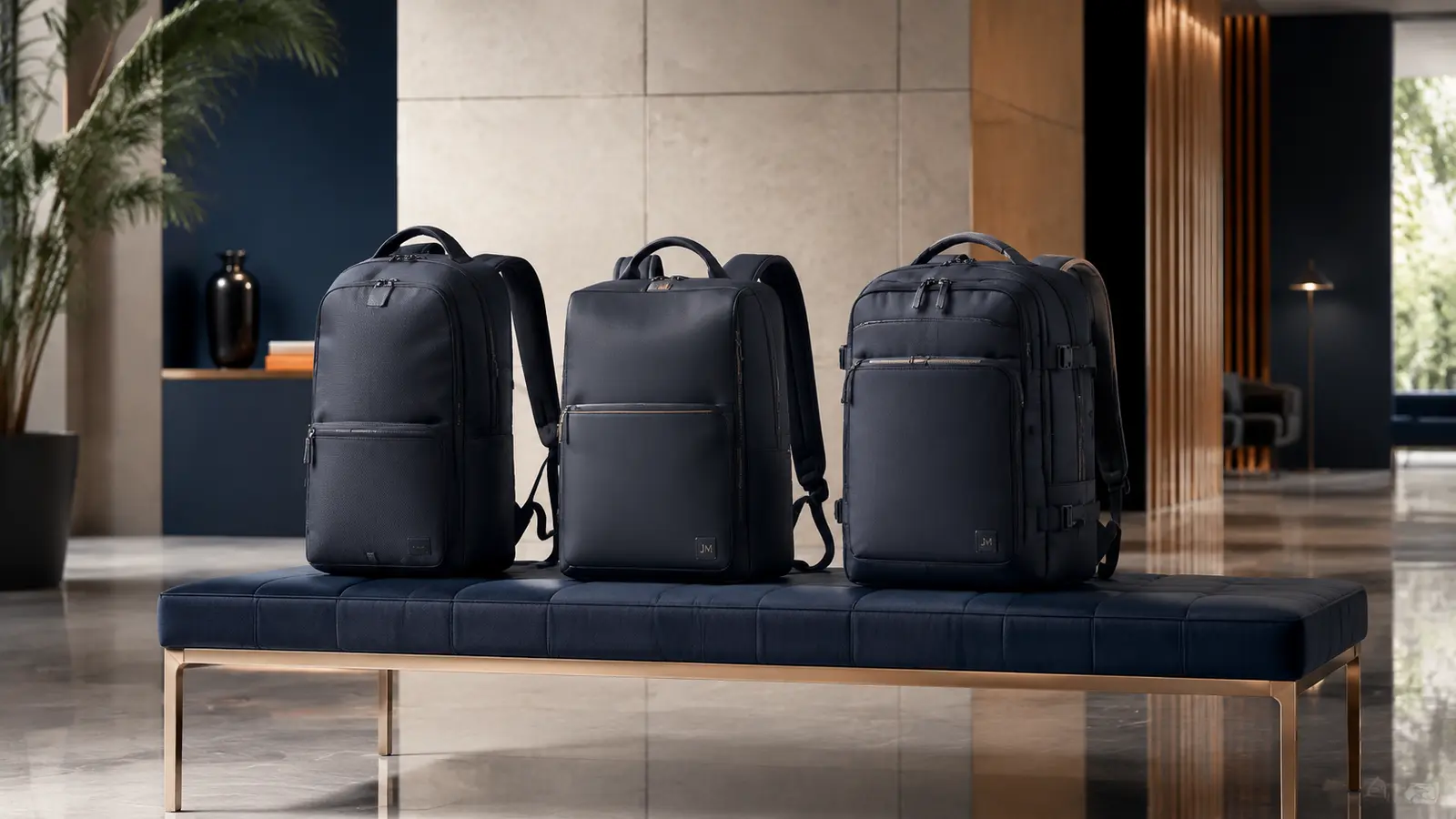
Executive models use a controlled silhouette, restrained color, low-contrast trims, and discreet branding. A structured front panel can present well in client environments, but too much stiffener adds weight and may crease during shipping. Ask the supplier how shape is created—foam, board, fabric lamination, piping, or pattern geometry—and inspect recovery after compression.
Tone-on-tone embroidery, a small woven label, or a debossed patch often fits this category better than a large high-contrast print. The right answer depends on the brand guide and intended recipient.
Convertible Backpack-Briefcases
Convertible designs add side carry and allow shoulder straps to be hidden or secured. They can support consultants and sales teams moving between transit and formal meetings. However, they require careful compartment orientation: items should remain secure when the bag changes from vertical to horizontal carry. Test whether zippers, bottle pockets, and loose interior items still function in both modes.
Expandable Business-Travel Backpacks
Travel packs combine a work section with space for clothing. Look for a laptop area that can be accessed without opening the clothing compartment, a stable expansion system, compression features, and a rear luggage pass-through. Airline carry-on limits vary by carrier and fare, so buyers should not describe a bag as universally “airline approved.” Confirm the packed external dimensions against the carriers relevant to the program.
In the United States, TSA’s current general guidance says laptops are permitted in carry-on and checked bags and may need to be removed for X-ray screening unless the traveler is using an applicable expedited or updated screening process. A laptop compartment that opens cleanly and is not obstructed by loose accessories can therefore improve the screening experience. See the TSA laptop guidance before publishing travel claims.
How Much Capacity Does a Work Backpack Need?
Capacity figures are useful for comparison, but liters alone do not describe usable space. Tapered silhouettes, thick padding, curved panels, divided compartments, and expansion systems all change what fits. For a quotation, combine a capacity target with external dimensions and a list of representative contents.
| User scenario | Planning range | Representative load | Specification priority |
|---|---|---|---|
| Light office commute | 14–18 L | Laptop, charger, notebook, phone, small bottle | Slim profile and low empty weight |
| Daily hybrid work | 18–24 L | Laptop, tablet, cables, lunch, bottle, personal items | Organization and carrying comfort |
| Mobile sales or technical work | 20–28 L | Two devices, adapters, documents, samples | Protected compartments and access |
| One-night business trip | 26–32 L | Work kit plus clothing and toiletries | Separate work and clothing zones |
| Two- to three-day light travel | 30–35 L | Compact clothing load plus mobile office | Expansion, compression and packed dimensions |
Measure the Device, Not Just the Screen
Laptop screen size is measured diagonally and does not determine the complete device dimensions. Bezel, chassis thickness, protective cases, and workstation models vary. A useful specification records the maximum device width, height, and thickness, then adds the required insertion clearance.
Ask for the laptop compartment’s internal dimensions, opening dimensions, padding thickness, bottom clearance, closure type, and position relative to the wearer. A suspended compartment can help keep the device away from the floor, but its actual protection depends on construction, loading, and use. Avoid making drop-protection claims without a defined test method and results.
Build Organization Around Real Carry Items
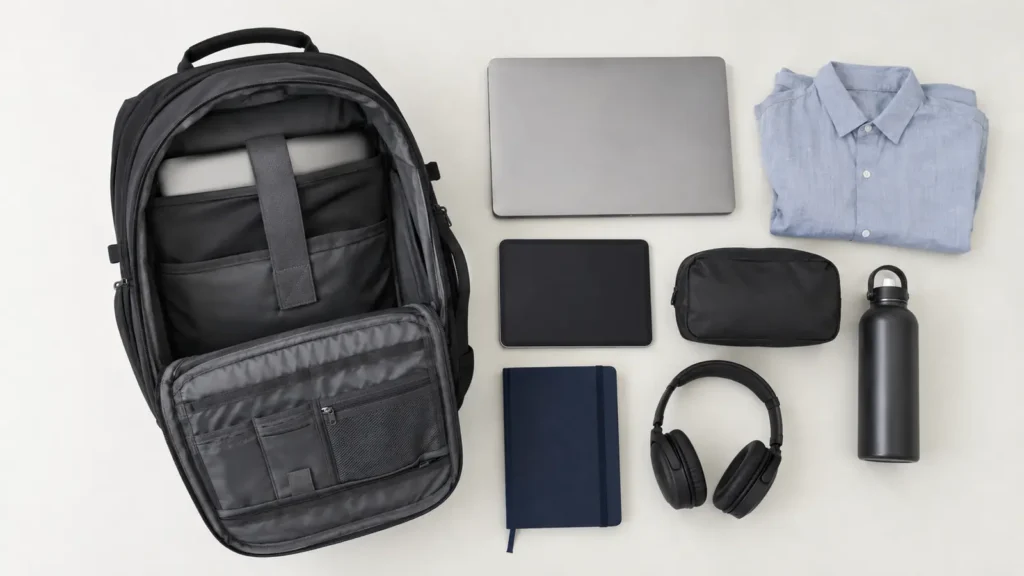
More pockets are not automatically better. Start with an item inventory and assign each object a location. Common requirements include a laptop, tablet, charger, cable, power bank, badge, pen, notebook, business cards, bottle, umbrella, headphones, travel documents, and keys.
A light-colored lining improves visibility. Elastic loops can control cables, but poorly sized loops become unused. A key leash is useful only if it is accessible without emptying the bag. Bottle pockets should be tested with the target bottle diameter and with the main compartment filled.
Which Materials Work Best for Corporate Backpacks?
Material selection should balance appearance, weight, abrasion behavior, cleanability, color consistency, cost, and the intended claim language. The fiber name alone is not a complete specification. Fabric construction, yarn size, density, finish, backing, and lamination influence performance.
Polyester
Polyester is widely used in corporate backpacks because it supports many textures, colors, coatings, and price positions. It can produce anything from a basic promotional surface to a refined heathered or high-density woven appearance. Buyers should specify the fabric construction and approved hand feel rather than requesting only “polyester.”
Nylon
Nylon can provide a smooth, technical appearance and favorable strength-to-weight characteristics in an appropriate construction. It may be selected for premium commuter or travel concepts, but performance still depends on the exact fabric, finish, and component design. Compare approved samples rather than assuming all nylon is superior to all polyester.
Coated and Laminated Fabrics
Coatings and laminations can improve water resistance and create a modern surface. They also influence flexibility, odor, appearance at folds, seam construction, and long-term finish behavior. “Water-resistant” or “water-repellent” is not equivalent to “waterproof.” A waterproof claim requires a defined system and supporting test evidence, including attention to seams and zippers.
Recycled-Material Options
Recycled polyester or nylon may be relevant to corporate sourcing policies, but the claim must be specific and documented. Ask what component contains recycled material, the percentage claimed, whether the content is pre-consumer or post-consumer, and what chain-of-custody evidence is available for the order.
For US marketing, the FTC Green Guides summary advises marketers to qualify partial recycled-content claims rather than imply that an entire product is recycled. Textile Exchange explains that RCS and GRS are systems for verifying recycled materials and chain of custody; certification and transaction documentation should be confirmed for the actual supply chain and order. Review the current RCS and GRS information instead of relying on a generic fabric description.
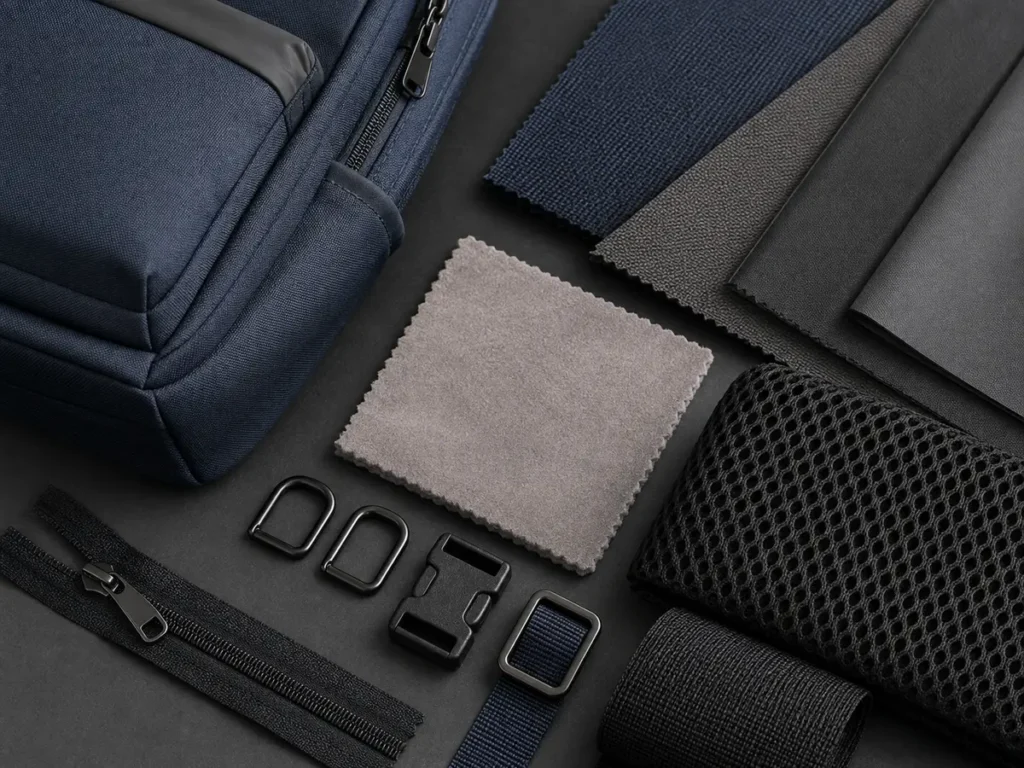
Lining, Mesh, Foam and Hardware
The interior matters as much as the shell. Lining affects visibility, cleanability, pocket stability, and perceived finish. Spacer mesh and foam influence back-panel comfort, but thicker padding increases weight and can trap heat. Zippers should be specified by type, size, finish, slider configuration, and required operation. Buckles, hooks, magnets, and metal-finish parts should match the desired appearance and use conditions.
For EU programs, buyers should define the applicable restricted-substance and documentation requirements with their compliance advisers. REACH can restrict the manufacture, placing on the market, or use of certain substances; the official EU REACH business guidance is a starting point, not a substitute for product-specific legal review.
Construction Details That Influence Durability
Durability is a system property. Strong outer fabric cannot compensate for weak strap anchoring, unsuitable thread, poor zipper installation, or an overloaded seam. Focus inspections on the points that experience repeated stress.
Shoulder-Strap Attachments
Strap anchors carry much of the load. Review stitch pattern, seam allowance, reinforcement layers, symmetry, and how the strap enters the body. A visually large reinforcement does not automatically prove performance, so define a load or cyclic test appropriate to the intended product if test evidence is required.
Seams and Edge Finishing
Inspect seam straightness, skipped stitches, thread tension, raw-edge control, binding, puckering, and alignment across panels. Bound internal seams can improve appearance and control fraying. Complicated curved seams require stable patterns and careful sewing to maintain shape.
Zipper Installation
Zippers should run smoothly around corners without catching the lining. Check slider parking positions, puller security, zipper garages, end stops, and whether a packed bag places excessive tension on the chain. Two-way openings can improve access but add hardware and inspection points.
Base and Device Protection
The base is repeatedly placed on floors and may need an additional layer, coated panel, piping, or controlled structure. Laptop padding should cover vulnerable edges and keep the device from directly contacting the base. Buyers should define the intended protection rather than using vague phrases such as “shockproof.”
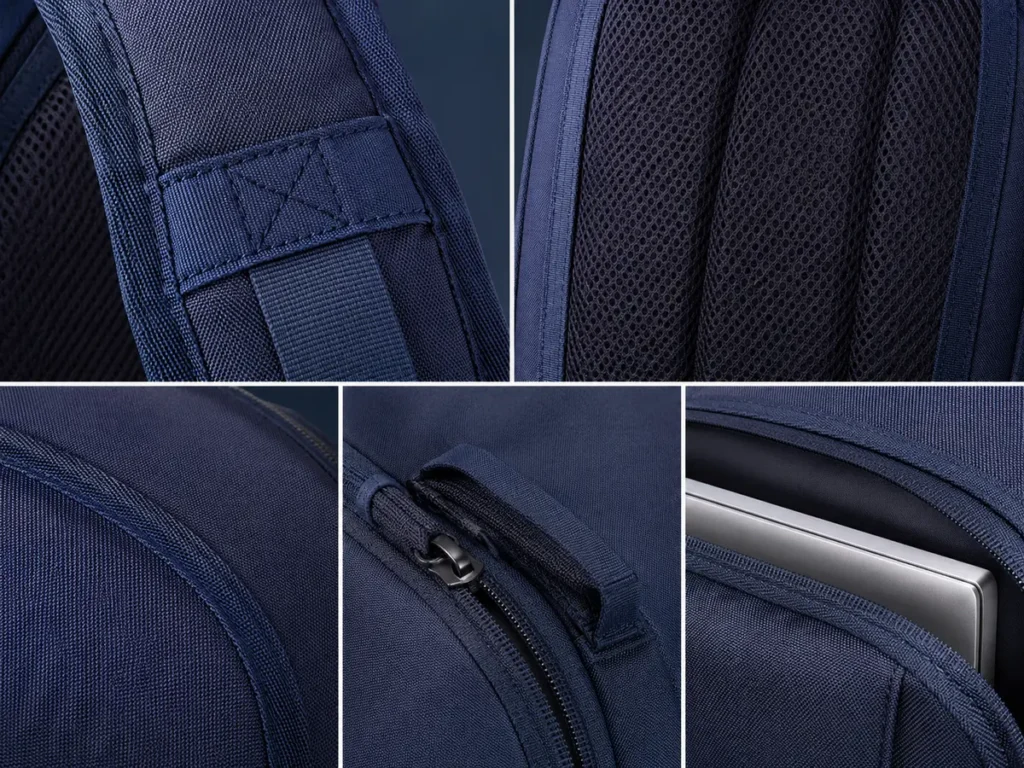
Comfort and Workplace Usability
Comfort depends on the user, load, walking duration, climate, strap geometry, back-panel shape, and adjustment range. A sample should be worn with a representative load, not judged empty on a conference table.
Check whether the shoulder straps sit comfortably on different body sizes, adjust without slipping, and remain symmetrical. Confirm that the carry handle does not press against the neck and that hardware does not contact the body. A sternum strap may help travel or field users but can look overly technical for an executive program. Removable or discreet options can serve mixed audiences.
Workplace usability includes quiet hardware, stable upright placement, easy access in elevators or transit, a bag that fits beside a desk, and pockets that do not release contents when the bag is opened vertically. These practical observations often reveal more than a long feature list.
Corporate Branding and Private-Label Options
Branding should feel integrated with the bag’s design and the recipient’s environment. Before selecting a method, confirm logo artwork, minimum line thickness, color count, placement, desired visibility, and expected handling.
| Branding method | Visual effect | Suitable use | Key approval points |
|---|---|---|---|
| Flat embroidery | Textured, established appearance | Corporate logos and uniforms | Thread color, stitch density, fine detail, backing |
| Screen or transfer print | Flat color or detailed artwork | Larger graphic areas and event programs | Color, adhesion, hand feel, edge quality |
| Woven label | Fine detail in a compact format | Subtle private label or side seam | Border, fold, weave clarity, placement |
| Rubber/PVC patch | Dimensional technical look | Outdoor, travel, youth or modern tech concepts | Mold detail, color, thickness, attachment |
| Leather-style patch | Restrained premium character | Executive and heritage concepts | Material declaration, deboss clarity, edge finish |
| Metal badge or hardware | Polished corporate detail | Higher-end gifts and retail concepts | Weight, corrosion risk, attachment, scratch protection |
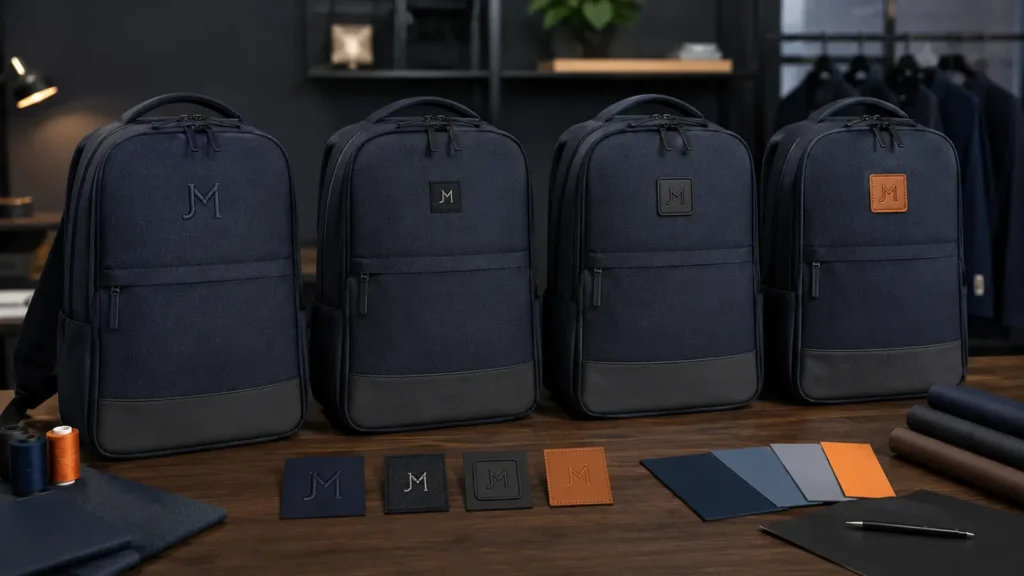
Keep the Logo Proportionate
For executive and daily-office use, subtle placement often receives more wear because the recipient does not feel like a walking advertisement. A logo can appear on the front panel, upper pocket, zipper pull, side seam, shoulder strap, lining, or internal label. Use the physical sample to judge scale; a digital mockup cannot fully show embroidery distortion, patch thickness, or how a logo sits on a curved stuffed panel.
Extend Branding Beyond the Front Panel
Private-label programs can include woven labels, care labels, hangtags, custom packaging, zipper pullers, lining color, hardware finish, and Pantone-based color direction. Each addition should support the brand experience and order economics. Unnecessary custom components can increase minimum quantities, tooling, sampling time, and replacement risk.
Planning a corporate backpack program? Send JIUMU your target quantity, delivery market, backpack reference, device dimensions, capacity, colors, logo artwork, branding position, packaging needs, and target delivery date. We can review the concept for OEM/ODM development, mockups, sampling, and a custom quotation. Explore custom team and corporate bags or contact JIUMU.
What Determines the Cost of Custom Business Backpacks?
Unit price depends on the complete specification, order quantity, material usage, construction time, custom components, branding, packaging, quality requirements, and shipping terms. A simple quotation request such as “500 laptop backpacks” is not sufficient for a meaningful comparison.
Major cost drivers include:
- Outer fabric, lining, foam, mesh, webbing, zipper and hardware selections
- Backpack dimensions and material consumption
- Number, shape, and depth of compartments and pockets
- Structure, padding, piping, binding, and reinforcement
- Standard versus custom colors and components
- Logo method, size, positions, color count, and stitch or print complexity
- Custom molds, pullers, labels, hangtags, and packaging
- Sample rounds and testing or inspection requirements
- Order quantity, color split, size or model split, and repeat-order plan
- Delivery destination, trade terms, packing volume, and schedule
A lower-cost bag is not necessarily the lowest total-cost choice if it creates device-fit problems, uncomfortable carry, inconsistent branding, or early replacement. Conversely, overengineering every pocket and component can consume budget without improving the user experience. Use the target use case to decide where quality investment matters most.
Sample Approval and Quality-Control Checklist
The physical sample converts a concept into an inspectable standard. Approval should record measurements, materials, colors, workmanship, function, logo, labels, packaging, and any accepted tolerances. Photographs help, but they should accompany—not replace—a clear specification.
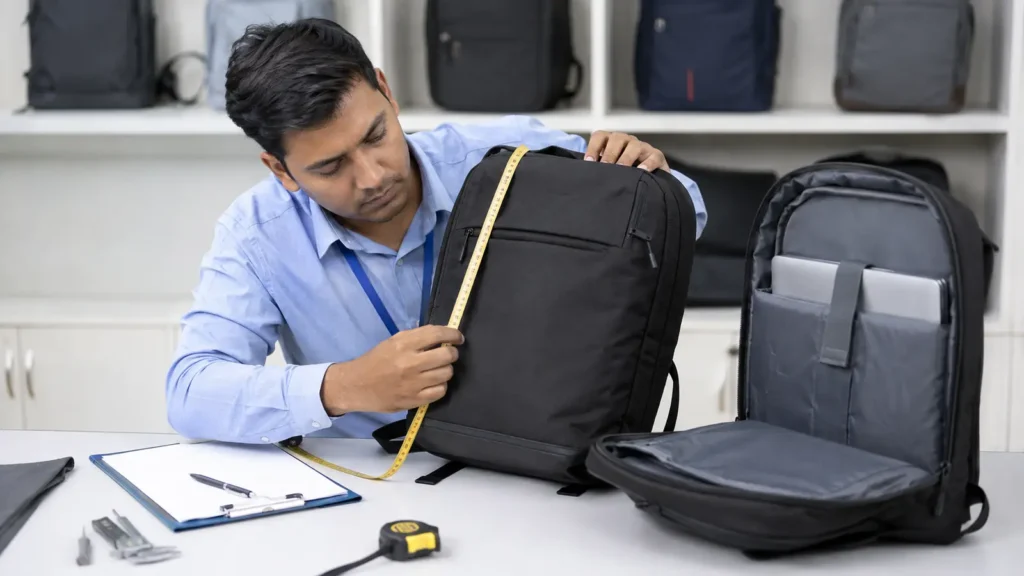
Appearance
- Silhouette matches the approved reference when empty and loaded
- Panels are symmetrical and free from unintended puckering
- Fabric shade, texture, lining, webbing and hardware are coordinated
- Logo placement, scale, color and workmanship match approval
- No unintended marks, odor, loose threads or surface damage
Dimensions and Function
- External and compartment dimensions fall within approved tolerances
- Target devices and representative carry items fit correctly
- Zippers, buckles, magnets and adjusters operate repeatedly
- Shoulder straps adjust across the intended user range
- Bottle pocket, luggage pass-through and expansion work under load
- Bag remains stable and comfortable with the planned contents
Construction
- Stitch density and thread tension are consistent
- Stress points have the approved reinforcement
- Seam allowances and internal binding are controlled
- Padding coverage and bottom clearance match the sample
- Pullers, labels and hardware are securely attached
Packaging
- Bag is shaped and protected without excessive compression
- Hangtags, labels, barcode fields and polybag warnings match market requirements
- Carton quantity, dimensions, marks and gross weight follow the approved packing plan
- Mixed colors or department allocations are clearly identified
For larger or strategically important orders, consider a pre-production sample and defined in-line and final inspection stages. The exact inspection method, sampling level, tests, and acceptance criteria should be agreed before production rather than introduced at the end.
A Practical Bulk-Order Process
1. Define Users and Use Cases
State who receives the bag, what they carry, commuting or travel patterns, working environment, expected service period, delivery countries, and brand position. Separate requirements from optional preferences.
2. Create a Product Brief
Include target dimensions or capacity, laptop dimensions, compartment list, material direction, colors, logo files, packaging, quantity, color split, budget position, target date, and reference images. Mark which aspects of a reference must be followed and which may be redesigned.
3. Review Feasibility and Quotation
The supplier should clarify construction, components, branding limitations, minimums, tooling, sampling cost, commercial terms, and schedule assumptions. Compare quotations line by line; a lower price may reflect a different fabric, zipper, compartment count, logo method, or packing configuration.
4. Approve Mockups and Materials
Digital artwork confirms approximate placement and color direction. Material swatches and component samples provide a better basis for texture, hand feel, shade, and hardware decisions. Pantone references communicate color targets, but the buyer and supplier should still agree how colors will be approved on the actual material.
5. Approve the Physical Sample
Load the sample with real items, wear it, operate every closure, measure it, review the logo, and check packaging. Consolidate feedback into one controlled revision list. Record approval clearly so bulk inspection has a common reference.
6. Confirm Production and QC Requirements
Freeze the bill of materials, colors, artwork, measurements, labels, packaging, inspection criteria, quantity split, and shipping marks. Agree how material or component substitutions will be handled; unapproved substitutions should not be treated as routine.
7. Plan Delivery and Reorders
Confirm trade terms, destination, carton planning, documents, and target delivery window. Retain approved artwork, specifications, samples, and color references for repeat orders. Materials and dye lots can change, so repeat-order consistency still requires review.
What Should Buyers Send for a Quotation?
A complete request reduces assumptions and makes supplier comparisons more meaningful. Send:
- Buyer type and project purpose
- Destination country or countries
- Target quantity and color split
- Required backpack type and reference images or tech pack
- External dimensions, capacity target, and device dimensions
- Required compartments, pockets, opening and key functions
- Outer fabric, lining, padding, hardware and color direction
- Vector logo artwork and branding method, size and position
- Private labels, hangtags, barcode, individual packaging and carton needs
- Compliance, testing, inspection and documentation requirements
- Target budget position and requested trade terms
- Required arrival date and whether sampling time is included
If some details are unknown, state the intended use and ask the supplier to propose options. Label proposals as alternatives so the final quotation is tied to one clear specification.
Questions to Ask a Business Backpack Supplier
- What exact materials and component specifications are included in the quotation?
- What laptop compartment dimensions and opening dimensions will be produced?
- Which parts are standard and which require custom development or tooling?
- What is the MOQ for the model, color, logo method, and custom components?
- How will material color, logo color and hardware finish be approved?
- What sample stages are recommended, and what will each sample confirm?
- Which dimensions and workmanship points will be inspected during production?
- What evidence supports any water-resistance, recycled-content or performance claim?
- How are substitutions or unavailable components communicated and approved?
- What packaging and carton configuration is included?
- What lead-time assumptions begin after deposit, artwork, materials, or sample approval?
- How will repeat-order specifications and approved references be retained?
Common Corporate Backpack Buying Mistakes
Selecting by Appearance Alone
A clean rendering can conceal poor access, insufficient volume, uncomfortable straps, or an undersized laptop opening. Review a loaded physical sample.
Treating Laptop Size as Universal
“Fits 15.6-inch laptops” does not guarantee every device fits. Provide maximum device dimensions and consider protective cases.
Adding Too Many Features
Extra pockets, USB-style external ports, clips, expansion panels, and hidden compartments increase cost and failure points. Include only features users will understand and use.
Using Unsupported Marketing Claims
Terms such as waterproof, sustainable, eco-friendly, recycled, anti-theft, and airline approved can require qualification or evidence. Define the specific attribute and maintain supporting documentation.
Approving Only a Digital Mockup
Artwork does not reveal hand feel, stitching, logo distortion, zipper operation, balance, or comfort. Use a physical sample as the production reference.
Ignoring Packaging Volume
Structured backpacks can occupy significant carton space. Excessive compression may damage shape, while bulky packing increases freight volume. Approve the packing method with the product.
Why Consider JIUMU for Custom Corporate Backpacks?
JIUMU, established in 2010 in Guangdong, China, supplies B2B custom teamwear, logo apparel, hats, uniforms, bags, and branded merchandise for buyers in North America and Europe. Relevant capabilities include OEM and ODM development, fabric sourcing, Pantone color matching, embroidery, printing, woven and rubber/PVC or leather-style patches, private labels, hangtags, packaging customization, digital mockups, physical samples, bulk production support, quality control, and export coordination.
The typical MOQ is 50 pieces, subject to the backpack structure and customization. A simple stock-based logo project and a fully custom travel backpack do not have the same material, tooling, sampling, or minimum requirements, so the project should be reviewed against its actual specification.
JIUMU’s role is most relevant when a buyer needs coordinated product development and branding rather than a consumer retail recommendation. Share the use case, quantity, destination, dimensions, device size, materials, logo, packaging, compliance needs, and delivery target for an informed quotation.
Frequently Asked Questions
Final Recommendation
The best business backpacks for work and corporate use are the ones specified around real people, loads, environments, and brand goals. For broad employee programs, begin with a structured 18–24 L platform, verify laptop dimensions and access, keep organization purposeful, select materials by exact construction, and use restrained branding that recipients will carry confidently. For travel, technical, or executive users, modify the opening, volume, protection, and appearance rather than forcing one model onto every team.
The most important procurement step is to turn preferences into measurable and inspectable requirements. Approve materials, device fit, dimensions, logo, comfort, function, workmanship, and packaging on a physical sample. Then align production and quality control to that reference.
About JIUMU
JIUMU is a Guangdong-based B2B supplier established in 2010, supporting custom teamwear, logo apparel, hats, uniforms, bags and branded merchandise projects for North American and European buyers.