Best School Backpacks for Kids: Sizes, Features and Materials
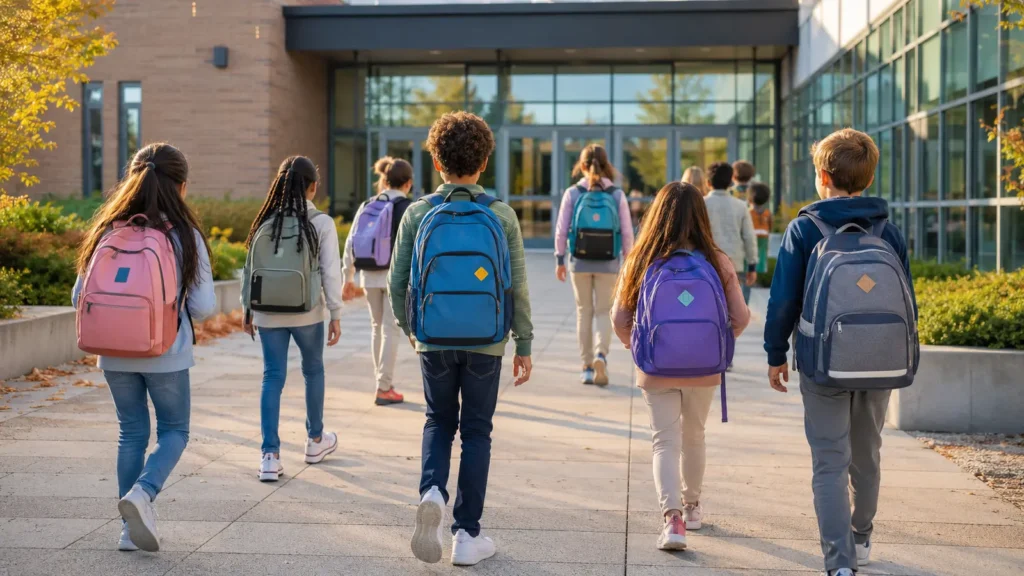
Choosing the best school backpacks for kids is not simply a matter of selecting a colorful bag. For schools, distributors, uniform dealers and private-label brands, the real task is to define a backpack that fits the intended age group, carries the required school items, survives repeated use and can be reproduced consistently across a bulk order.
A successful specification connects four decisions: body size, actual load, product construction and market requirements. A preschool-sized bag may look attractive but fail to hold a standard folder. An oversized bag may offer impressive capacity but encourage overpacking. A heavy fabric can improve abrasion resistance while adding unnecessary empty weight. Decorative components can strengthen a school identity, yet they also create new approval and compliance questions.
This guide explains how professional buyers can compare sizes, features, materials, construction and customization without relying on vague labels such as “small,” “durable” or “waterproof.” It also provides a practical sample-approval and quality-control process for custom school backpack programs.
Quick Answer: The best school backpack for a child is sized to the child’s torso and daily equipment, not chosen by age alone. For a bulk program, start with a compact style for early primary pupils, a standard style for elementary students and a larger structured style for older students. Specify two wide adjustable shoulder straps, a padded back, stable compartments, reinforced stress points, child-appropriate hardware and a material matched to the required weight, abrasion resistance and weather exposure. Approve the dimensions, empty weight and packed fit on physical samples before production.
What Makes a School Backpack “Best” for a Bulk Program?
“Best” should describe fitness for a defined use, not an unsupported ranking. A school district purchasing a simple book bag, a uniform dealer building a coordinated school range and a youth brand developing a retail collection will not use the same scorecard.
Translate the word into observable requirements:
- Fit: the bag body should sit close to the back and should not be much wider than the child’s torso.
- Capacity: it should hold the actual folder, books, lunch container, bottle and device required by the program without unused bulk.
- Comfort: two adjustable padded straps, a padded back and stable load placement matter more than decorative padding.
- Durability: fabric, seams, bartacks, zipper installation and base construction should be evaluated together.
- Usability: openings, pulls, buckles and pockets should suit the user’s hand size and routine.
- Consistency: approved colors, dimensions, logo placement and workmanship must be reproducible across the order and on reorders.
- Market readiness: labeling, product classification, chemical restrictions and documentation depend on the destination and design.
The American Academy of Pediatrics advises families to choose wide padded shoulder straps and a padded back, use compartments, place heavier items close to the center of the back and control carried weight. Its dedicated backpack guidance says a loaded backpack should not exceed 15% of the child’s body weight. This is health guidance rather than a backpack capacity standard, but it gives buyers an important design principle: a larger bag is not automatically a better bag. (HealthyChildren.org)
School Backpack Size Guide by Stage
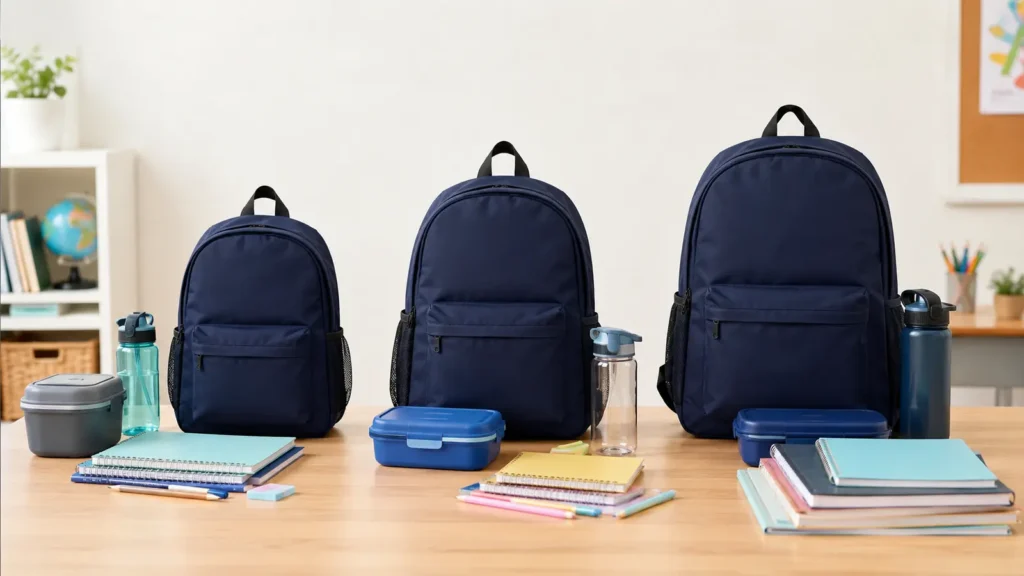
There is no universal relationship between a child’s age and one exact backpack dimension. Children of the same age vary in height and torso length, while school supply requirements differ by country and grade. The ranges below are development starting points, not mandatory standards. Buyers should confirm them with representative users and the largest item that must fit.
| Program stage | Starting body-height range | Indicative capacity | Typical contents | Procurement priority |
|---|---|---|---|---|
| Preschool / nursery | 30–36 cm | 8–12 L | change of clothes, snack, small bottle, communication folder | low empty weight, simple opening, compact depth |
| Early primary | 36–40 cm | 12–16 L | folders, light books, lunch, bottle, pencil case | folder fit, easy pulls, stable straps |
| Upper primary | 40–44 cm | 16–22 L | larger books, lunch, bottle, activity kit | organization, reinforced base, balanced load |
| Middle school | 43–48 cm | 20–28 L | textbooks, binders, device, charger, lunch | structure, device sleeve, zipper and seam strength |
| Secondary school | 45–50 cm | 24–32 L | books, laptop or tablet, sports or project items | load control, device protection, mature styling |
Capacity alone is a poor sizing tool. Two 20-liter bags can fit differently because one is tall and narrow while the other is short and deep. Record finished height, width and depth, and define how the volume was estimated. Also record the empty sample weight: unnecessary hardware, heavy foam and excessive layers consume part of the practical load allowance before a student packs anything.
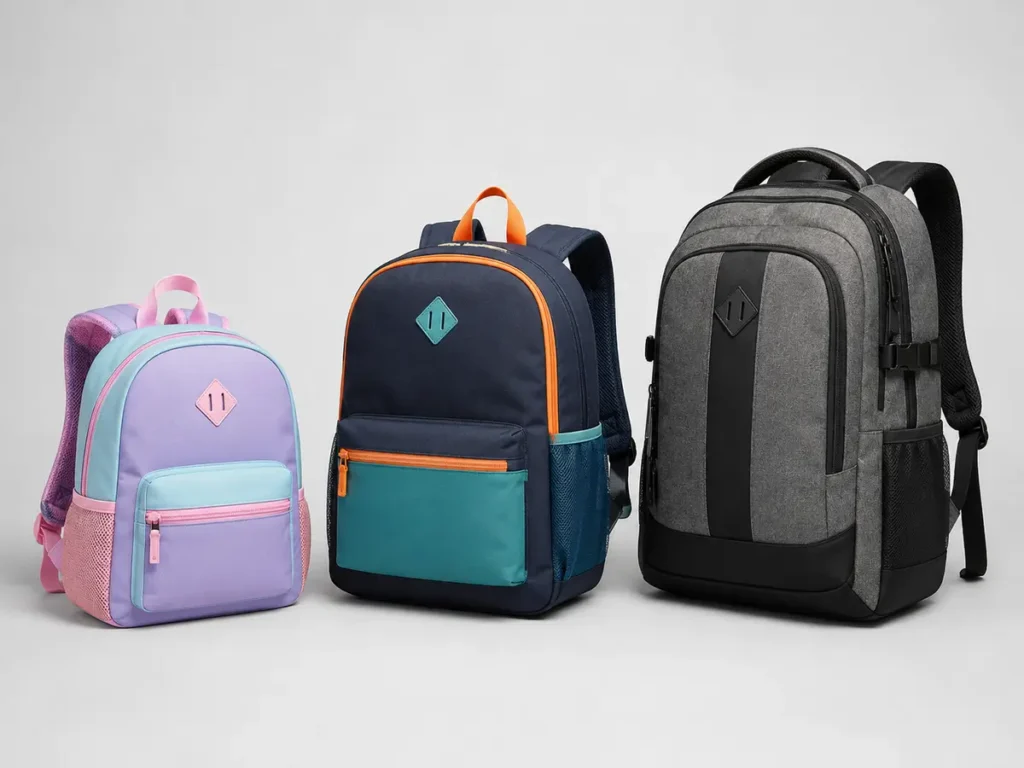
Measure the contents before fixing the bag dimensions
Build a physical “load set” for each size. Include the largest folder or binder, representative books, lunch box, bottle and device. Place those items into the sample in the order a student would use them. Check whether the zipper closes without distortion and whether the contents push hard against the back panel.
For North American elementary programs, letter-size folders and lunch containers may drive width and depth. European programs may use A4 materials and different school-day routines. A quotation request should therefore name the required document format rather than simply asking for an “elementary backpack.”
Check torso relationship, not only height
As a practical fitting check, the upper part of the pack should sit around the shoulder area rather than hanging far below it, and the lower body should not extend excessively down the back. The bag should not be substantially wider than the wearer. Shoulder straps should have enough adjustment for light and layered clothing without leaving long unsafe tails.
For a district-wide program, test each proposed size on several representative users with appropriate consent and supervision. Photograph only with permission, record fit observations without unnecessary personal data and revise the pattern before color sampling.
Essential Features Buyers Should Specify
Feature lists become expensive quickly. Each pocket, buckle and panel adds material, sewing operations and possible failure points. The right question is not “How many features can we add?” but “What routine does this feature support?”
Shoulder straps and back panel
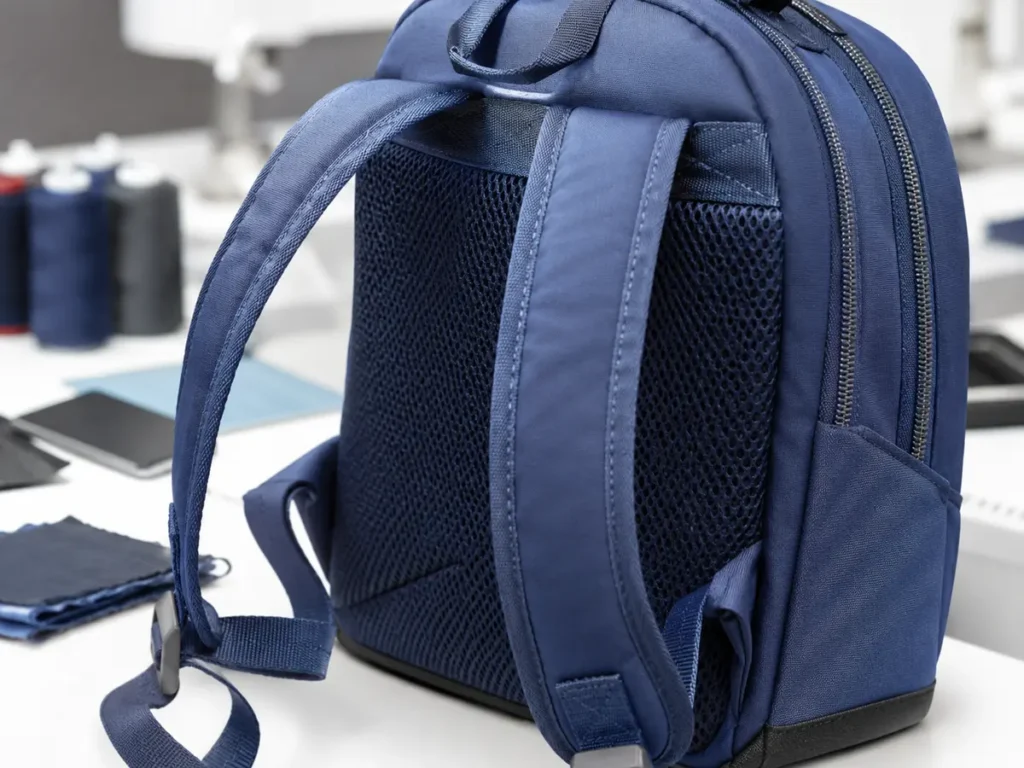
Use two adjustable shoulder straps. Define finished strap width, foam thickness or density reference, binding method and usable adjustment range. A strap can look thick but compress immediately; evaluate it under the intended packed load.
A padded back helps prevent hard objects from pressing directly into the wearer. Mesh can change hand feel and ventilation, but “breathable” should be treated as a design description unless supported by a defined test. For younger users, avoid an excessively rigid back that prevents the bag from moving naturally.
A sternum strap may help stabilize a larger pack, especially for walking or cycling, but it adds a buckle and must be positioned for the target body size. A waist belt is usually unnecessary on a light elementary daypack and can become clutter if it is not genuinely used.
Compartments and load placement
One main compartment plus a front organizer and bottle pockets is often enough for younger students. Older-student styles may benefit from a separate device sleeve and an additional document section. Place the device sleeve against the back panel and consider a raised or padded bottom so the device is not the first object to strike the floor.
Compartment geometry should keep heavier items close to the back. The AAP recommends using compartments and packing heavier items near the center of the back. A deep outer pocket that invites heavy books away from the body works against that goal. (HealthyChildren.org)
Bottle pockets
Bottle pockets should be tested with the actual bottle diameter and height. Mesh offers stretch but can snag; self-fabric looks coordinated but needs sufficient opening width. An elastic or binding edge can improve retention. Fill the bottle during testing and walk with the sample: an empty bottle does not reveal pocket stability.
Zippers, pulls and buckles
Younger users need pulls that can be grasped easily. Define zipper size and type, slider count, pull design and color. Two sliders may make a main compartment easier to open, but the meeting point should not create a gap. Check corners for smooth travel and ensure lining fabric does not catch in the chain.
Buckles should open and close with an age-appropriate force. Avoid small removable decorative pieces when the intended user and destination market create a foreseeable detachment or misuse concern. Product-specific safety and compliance advice should come from a qualified laboratory or compliance professional.
Visibility details
Reflective piping or patches can improve nighttime visibility as a design feature, but buyers should not make safety-performance claims unless the material and placement have been assessed against the relevant requirement. Ask the supplier for the reflective material specification and approve its appearance in both daylight and low light.
Which Materials Work Best for Kids’ School Backpacks?
Polyester and nylon dominate school backpack programs because they can balance weight, color range, abrasion performance and cost. “Oxford” describes a weave or fabric style, not one guaranteed fiber, weight or quality level. Always state fiber composition, fabric construction or reference, mass or denier where useful, coating/lamination requirement, color and performance expectations.
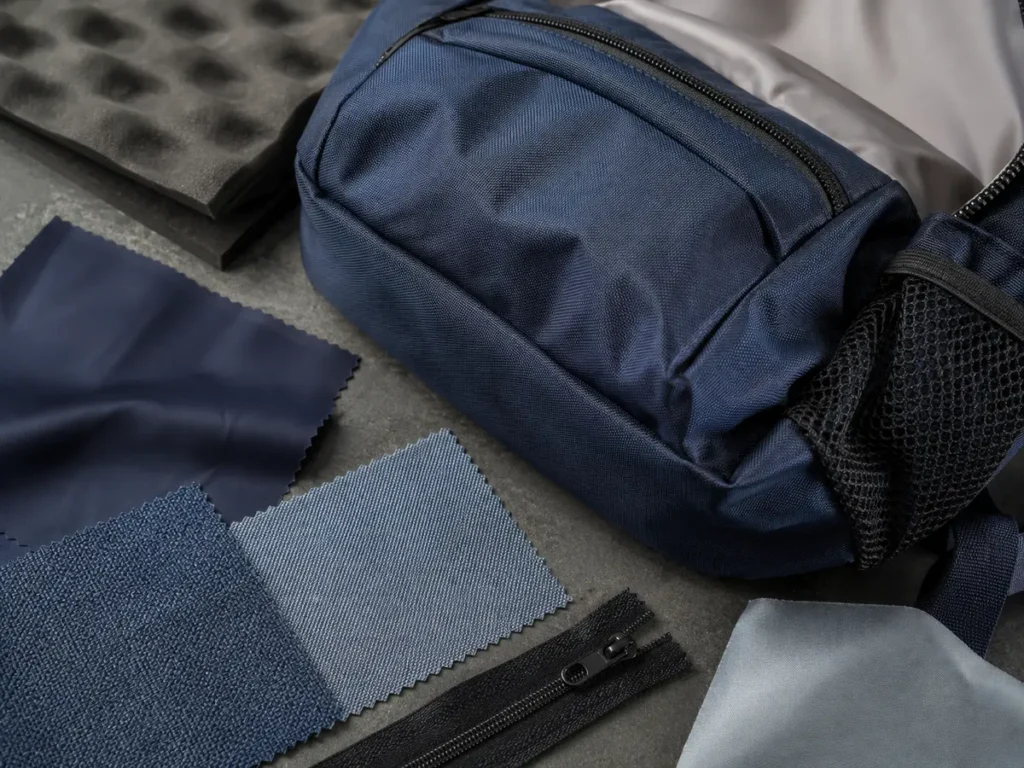
| Material option | Practical strengths | Trade-offs | Suitable program |
|---|---|---|---|
| Polyester woven fabric | broad color availability, stable printing, practical cost | performance varies widely by yarn and coating | most school, promotional and uniform programs |
| Nylon woven fabric | good hand feel and abrasion potential at comparable constructions | often higher cost; dye and color matching need control | premium or older-student collections |
| Recycled-content polyester | supports a specific verified recycled-content proposition | documentation, traceability, shade and minimums require planning | brands with substantiated material goals |
| Canvas or cotton blend | natural hand and lifestyle appearance | heavier, absorbs moisture, may soil more easily | fashion-led or low-load school merchandise |
| Mesh | stretch and visibility for bottle pockets | snagging and abrasion at the pocket edge | secondary pocket material |
| PU/TPU-coated fabric | can improve resistance to light rain and wiping | may add stiffness, cost and chemical-compliance questions | bases, accents or weather-exposed programs |
Polyester: the versatile default
Polyester is often the most practical starting point for a multi-color school range. It can support screen print, heat transfer, embroidery and patch decoration. However, the fiber name alone says little about durability. Compare fabric weight, yarn construction, coating, tear behavior and abrasion results on the exact production material.
Nylon: useful when hand feel or abrasion is a priority
Nylon can deliver a refined hand and strong abrasion performance, but not every nylon outperforms every polyester. Cost and color consistency may also differ. Request comparable swatches and test the finished bag construction rather than selecting by fiber reputation.
Recycled-content material: specify the evidence
If the product or packaging will carry a recycled-content claim, define the percentage, whether it applies to the whole product or a named component, the chain-of-custody evidence required and the wording that will appear in the market. The U.S. Federal Trade Commission advises marketers to qualify partial recycled-content claims and use the claim only for material recovered or diverted from the waste stream. Avoid an unqualified “eco-friendly backpack” statement. (FTC Green Guides summary)
Lining, foam and reinforcement
A light-colored lining can improve interior visibility, while a darker lining hides marks. Specify lining fiber and weight separately from the shell. Foam thickness must be paired with the intended firmness and location. High-density board or rigid sheet may help a base hold shape, but it adds weight and can create hard edges if poorly enclosed.
Water-resistant is not waterproof
A coated shell may resist short exposure to light rain, but water can enter through seams, zippers and openings. Use “water-resistant” only when the finished product meets a defined, documented test or buyer protocol. “Waterproof” is a much stronger claim and is usually inappropriate for an ordinary school backpack without seam sealing and complete product validation.
Construction Details That Determine Service Life
Material selection cannot compensate for weak construction. Most early failures occur at repeated stress points: shoulder strap anchors, top handles, zipper ends, bottle-pocket edges and the base-to-body seam.
Reinforce the load path
The shoulder strap attachment transfers the packed weight into the bag body. Ask how the strap end is enclosed, how many stitch rows are used and whether bartacks or reinforcement patches are applied. Top handles need similar attention because students and staff often lift a fully packed bag from one point.
Control seams and edge finishing
Specify seam allowance, stitch density range and whether high-stress interior seams are bound. Look for skipped stitches, exposed raw edges, puckering and needle damage. A clean sample is not enough; the bulk inspection standard should define acceptable and unacceptable examples.
Design the base for real school use
Backpacks are placed on rough floors and sometimes dragged. A reinforced base panel or more abrasion-resistant bottom fabric may extend service life. Check that the construction does not trap water and that any stiffener has smooth edges.
Treat zipper installation as a system
Evaluate zipper chain, slider, tape, seam, curves and end stops together. Cycle the zipper on a fully packed bag, not only on an empty sample. At a minimum, perform an agreed internal cycling protocol; for formal claims or regulated programs, use an appropriate accredited laboratory and destination-specific method.
Customization for Schools, Dealers and Private Labels
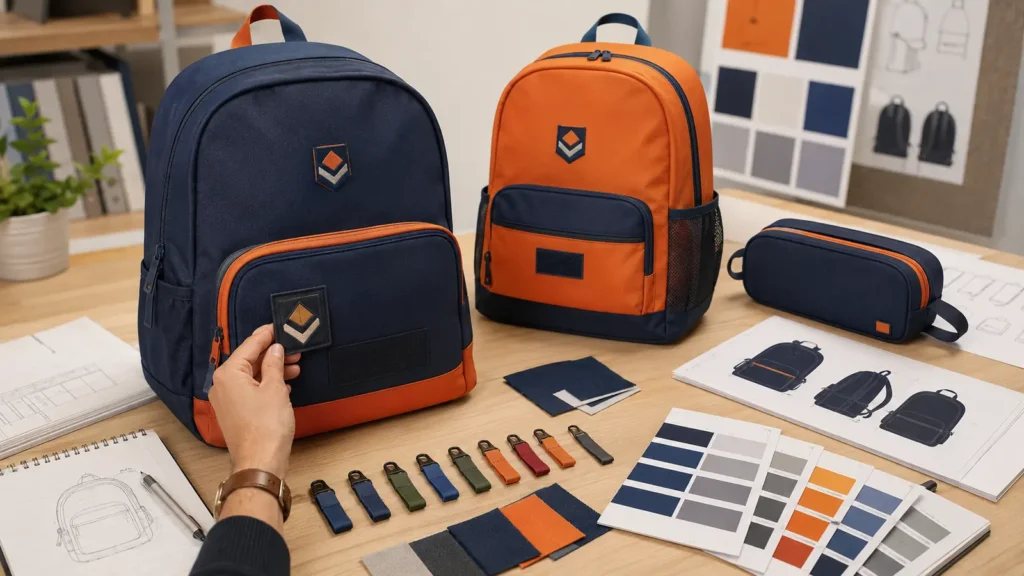
Customization should support identity without overwhelming function. JIUMU can develop OEM/ODM bag concepts, match colors, apply logo methods, create private labels and customize packaging, subject to design and order requirements.
Embroidery
Embroidery creates a dimensional, established look for school crests and initials. Dense designs add weight and can distort light fabric. Convert artwork into an embroidery file, approve thread colors and stitch-out size, and inspect the backing inside the bag.
Woven or rubber/PVC patches
Woven patches suit fine artwork and small lettering better than some embroidery. Rubber/PVC patches provide a modern dimensional effect and wipeable surface, but tooling, minimums and compliance evaluation should be confirmed. Leather-style patches provide a classic appearance; clarify whether the material is genuine leather or synthetic.
Screen print and heat transfer
Screen printing can be efficient for simple designs and larger quantities. Heat transfer supports multicolor graphics and names, depending on the film and fabric. Approve adhesion, edge appearance, color and flexibility on the actual coated shell fabric. A decoration method that works on a T-shirt may not bond identically to a backpack coating.
Name identification without uncontrolled personalization
Schools may prefer a blank woven name field, removable tag or internal label instead of individual names printed at production. This simplifies data handling and sorting. If personal names are required, agree on file format, spelling approval, privacy handling, placement and unit sorting before the order.
Private labels and packaging
Define the main label, care/content information, country-of-origin marking, hangtag, barcode, polybag or alternative packaging and carton marks. Packaging must protect the bag without crushing the foam or permanently folding coated panels. Market-specific labeling should be reviewed before bulk printing.
Planning a custom school backpack range? Send JIUMU the target age groups, required dimensions or load set, quantity per color, logo artwork, preferred material, packaging, destination and target delivery date. Start with the custom team bags category or request a quotation.
Product Compliance and Market Documentation
Compliance cannot be reduced to one universal “school backpack certificate.” Requirements depend on intended age, design, materials, claims and destination.
In the United States, the Consumer Product Safety Commission explains that a backpack may be considered a children’s product when its sizing, themes and other characteristics indicate it is designed or intended primarily for children 12 or younger. Accessible components of children’s products are subject to the federal total lead content limit of 100 ppm, while paint and similar surface coatings have a 90 ppm limit. Importers and manufacturers should determine applicable rules, testing and Children’s Product Certificate obligations for the exact product. (CPSC children’s products guidance; CPSC lead guidance)
Do not assume every plastic component on a backpack is covered by the CPSIA phthalate rule in the same way as a toy or child-care article; classification and component use matter. A qualified test laboratory or compliance adviser should prepare the product-specific test plan.
For the European Union, textile products generally need fiber-composition information when they fall within the textile-labeling rules, and textile articles must also meet applicable chemical restrictions, including relevant REACH Annex XVII restrictions. Confirm whether a multi-material backpack falls within specific labeling provisions and what language or market information is required in each destination. (Your Europe textile labeling)
Maintain a compliance file containing the final bill of materials, supplier declarations, artwork, label copy, test reports where required, approved samples and shipment traceability. Never reuse a report from a different material, color or component without confirming that it covers the current product.
Cost Drivers in Custom School Backpack Orders
Professional quotations depend on more than quantity. The main drivers are:
- Pattern complexity: additional compartments, curved panels and hidden pockets increase cutting and sewing time.
- Fabric and coating: fiber, weight, finish, minimum color quantity and verified content affect price.
- Hardware: zipper type, custom pulls, buckles and reflective details can change both cost and minimums.
- Padding and structure: extra foam, device protection and base reinforcement add material and operations.
- Decoration: embroidery stitch count, patch tooling, print colors and personalization determine cost.
- Testing and documentation: destination-specific testing, inspection and traceability should be budgeted early.
- Packaging and logistics: individual packaging, barcodes, assortment packing, carton limits and delivery schedule affect the landed program.
The lowest unit price may exclude the construction or documentation the buyer actually needs. Compare quotations against one specification sheet and require suppliers to state deviations.
Sample Approval and Quality-Control Checklist
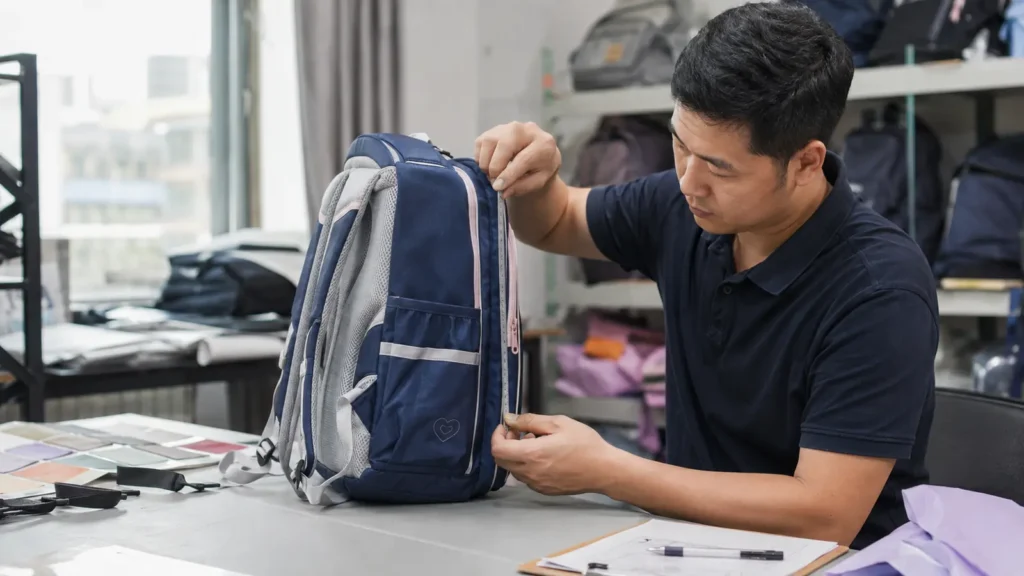
A digital mockup confirms general placement and color direction; it does not validate fit, hand feel, construction or performance. Use a physical sample and record all approvals in a signed specification or sample comment sheet.
| Inspection area | What to verify on the approved sample | Bulk-order control |
|---|---|---|
| Dimensions | height, width, depth, strap range, pocket openings | measurement tolerance and sampling plan |
| Weight and capacity | empty weight and physical load-set fit | spot checks by size/color |
| Fabric and color | composition/reference, hand, coating, approved shade | swatch or master sample comparison |
| Construction | seam allowance, stitch density, bartacks, binding, base | workmanship limit samples |
| Hardware | zipper operation, pull shape, buckles, adjusters | function cycling and visual inspection |
| Decoration | size, placement, thread/print/patch color, adhesion | placement tolerance and appearance standard |
| Labels and packaging | content, origin, barcode, warning/care copy where applicable | preproduction copy approval and packing audit |
Recommended approval sequence
- Confirm the written product brief and destination markets.
- Approve a dimensioned drawing and material/trim list.
- Review the digital mockup for color and logo placement.
- Make a physical sample in the intended materials.
- Pack it with the approved load set and conduct supervised fit checks.
- Review construction, function and destination-specific testing needs.
- Issue consolidated sample comments with photos and measurements.
- Approve a preproduction sample or signed master sample.
- Inspect bulk production against the master and agreed sampling plan.
- Retain records for repeat-order consistency.
What Buyers Should Send for an Accurate Quotation
A complete inquiry reduces assumptions and speeds development. Send:
- buyer type and destination market;
- target user stages and number of backpack sizes;
- quantity by size, color and logo version;
- finished dimensions or a required contents/load list;
- reference images or a tech pack, with ownership or usage permission;
- shell, lining, foam and base preferences;
- pocket, bottle, device and organization requirements;
- logo artwork in vector format when available;
- decoration method or openness to supplier recommendations;
- label, barcode, packaging and assortment instructions;
- required testing, inspection or restricted-substance list;
- target delivery date and destination port or address.
If the design is not final, rank requirements as “must have,” “preferred” and “optional.” This helps the supplier propose cost reductions without removing critical functionality.
Questions to Ask a School Backpack Supplier
Use these questions during sourcing:
- Can you make graded body sizes from one design while maintaining the same visual identity?
- How will you confirm finished dimensions, empty weight and usable strap range?
- What exact fabric, lining, foam, reinforcement and hardware are included in the quotation?
- Which stress points are reinforced, and how will bulk workmanship be controlled?
- Can the sample fit our actual folder, bottle, lunch box and device set?
- Which logo methods are compatible with the chosen coating?
- What material minimums apply by custom color?
- Which destination-market documents and tests are included or excluded?
- How will shade, logo placement and dimensions be controlled across production?
- How are reorders matched to the approved sample and previous color standard?
- What information is needed before confirming production and delivery timing?
- How will replacement units, assortments and carton marks be handled?
Common Buying Mistakes
Ordering one oversized bag for every student
One body size simplifies inventory but can produce poor fit for younger children. If the program spans several school stages, compare the cost of two or three graded sizes with the functional benefit.
Choosing by liters without testing the real load
Published capacity can be calculated differently. A physical load set reveals whether the shape and opening are usable.
Specifying fabric only by denier
Denier describes yarn linear density, not complete fabric durability. Construction, weight, coating and finished-product sewing also matter.
Adding too many compartments
Extra pockets increase price and empty weight. They can also make it harder for young users to find items. Map each compartment to a specific object.
Approving color on a screen only
Screens do not reproduce fabric color reliably. Approve a physical swatch or sample under agreed lighting and allow a realistic production tolerance.
Treating a “water-resistant fabric” as a waterproof bag
Finished seams and zippers remain entry points. Align the claim with tested finished-product performance.
Leaving compliance until after production
Testing can identify a component that must be replaced. Determine the intended-age classification, market and test plan before final material approval.
Why JIUMU for Custom School Backpack Programs?
JIUMU is a Guangdong-based B2B supplier established in 2010, serving buyers in North America, the United Kingdom and Europe. Its relevant capabilities include OEM/ODM product development, fabric sourcing, Pantone color matching, embroidery, screen printing, heat transfer, woven and rubber/PVC patch options, private labels, packaging customization, digital mockups, physical samples, bulk production support and quality control.
The typical MOQ is 50 pieces, subject to the backpack structure, custom material, color and decoration. For a graded school range, minimums should be confirmed by size and color rather than assumed for the total combined quantity.
JIUMU’s value in a school bag project is the ability to translate a visual concept into a specification that can be sampled, reviewed and repeated. Buyers remain responsible for confirming destination-market requirements and intended claims; the development process should include the appropriate testing and compliance specialists where needed.
Frequently Asked Questions
Final Recommendation
The best school backpacks for kids are not the bags with the most pockets or largest advertised capacity. They are the bags that fit a defined student group, carry a verified school load, control weight close to the body and reproduce the approved construction consistently.
Begin with the contents and target users. Build two or three graded sizes when the program spans different school stages. Specify materials at component level, reinforce the load path, approve decoration on the actual shell and determine compliance documentation before production. Finally, inspect bulk goods against a physical master sample rather than a marketing description.
Request a custom school backpack quotation from JIUMU. Share your target age groups, dimensions or load set, quantity by size and color, logo artwork, materials, packaging, destination and delivery target. Email zhengdong@jiumugear.com, WhatsApp +86 18507502899, or use the JIUMU contact page.