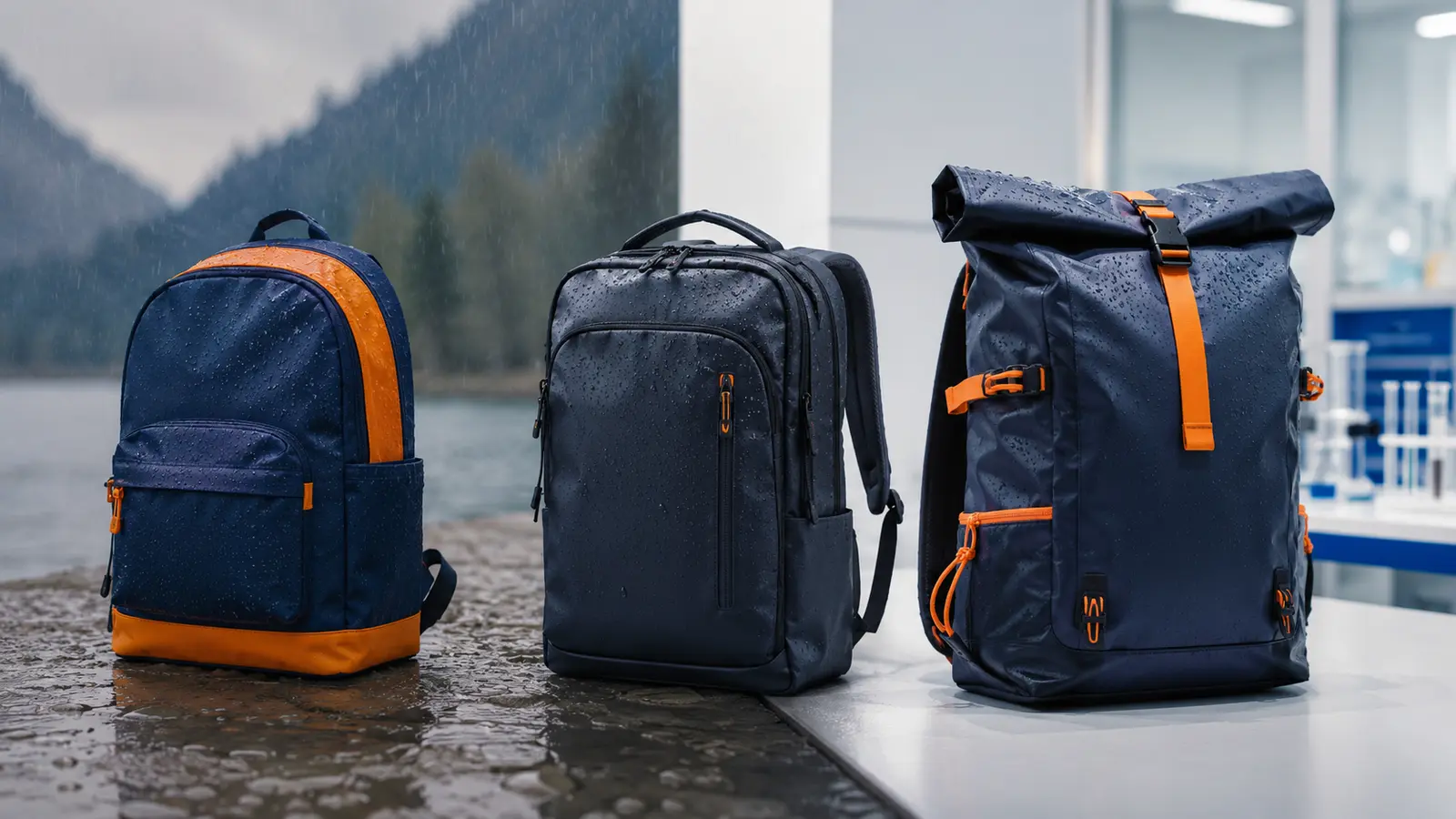
Waterproof vs Water-Resistant Backpacks for Bulk Buyers
“Waterproof” is one of the most misunderstood claims in backpack sourcing. A supplier may show a coated polyester swatch that resists water, while the finished bag still leaks through needle holes, zipper ends, seams, or an open top. A buyer may request a waterproof zipper, yet the surrounding fabric and construction remain only suitable for light rain. When the claim is not tied to a defined test, two parties can approve the same sample with very different expectations.
For wholesalers, schools, distributors, sports organizations, and private-label brands, the practical question is not which marketing word sounds strongest. It is what exposure the backpack must handle, which materials and construction support that use, how the finished product will be tested, and what claim the evidence actually permits.
Quick Answer
A water-repellent backpack is designed to reduce surface wetting; a water-resistant backpack is intended to resist some water penetration under defined conditions; and a waterproof backpack makes a stronger claim that must be supported by the complete bag construction and a relevant finished-product test. Coated fabric alone does not make a backpack waterproof. Seams, needle holes, zippers, openings, pockets, bindings, and closures can all admit water. Bulk buyers should specify the use scenario, test object, method, conditioning, acceptance criteria, and permitted marketing language before sample approval.
Water-Repellent, Water-Resistant, and Waterproof Are Not Interchangeable
The terms are often used loosely in retail listings, but a B2B specification needs operational definitions. The definition should state what is being evaluated: a fabric, a seam, a zipper, a compartment, or the complete backpack.
| Claim | Practical sourcing meaning | Typical evidence | Important limitation |
|---|---|---|---|
| Water-repellent | The surface causes water to bead or roll off and resists wetting | Spray or surface-wetting test on fabric; finish specification | Does not necessarily prevent water from passing through under pressure or through seams |
| Water-resistant | The material or product resists water penetration to an agreed degree and exposure | Hydrostatic, impact, rain, spray, or finished-product test with stated conditions | Performance is conditional, not absolute; exposure time and construction matter |
| Waterproof | A strong complete-product claim for a defined water exposure | Relevant finished-product test, supported by material, seam, closure, and construction evidence | “Waterproof” without a test condition can imply more protection than the product delivers |
AATCC TM22, for example, measures resistance of textile fabrics to wetting by water and is particularly useful for evaluating water-repellent finishes. That is different from measuring pressure-driven penetration. ISO 811 uses hydrostatic pressure to evaluate resistance of fabric to water passage. Neither result automatically covers a backpack’s zipper ends, seams, top opening, or workmanship.
What the Buyer Should Write
Avoid a purchase order that says only “waterproof backpack.” A measurable brief is closer to this:
The backpack is intended for daily school commuting in intermittent rain. The specified outer fabric and finished sample must be evaluated using the agreed methods. The main compartment, zipper ends, stitched seams, and base must be included in the finished-bag check. The approved product claim is limited to the documented test conditions.
The exact method and acceptance value must then be added. This makes performance, cost, and responsibility visible before production.
Why Waterproof Fabric Does Not Mean a Waterproof Backpack
A flat fabric specimen has no zipper, seam, webbing attachment, logo embroidery, pocket opening, or curved panel. The finished bag adds all of these potential entry points.
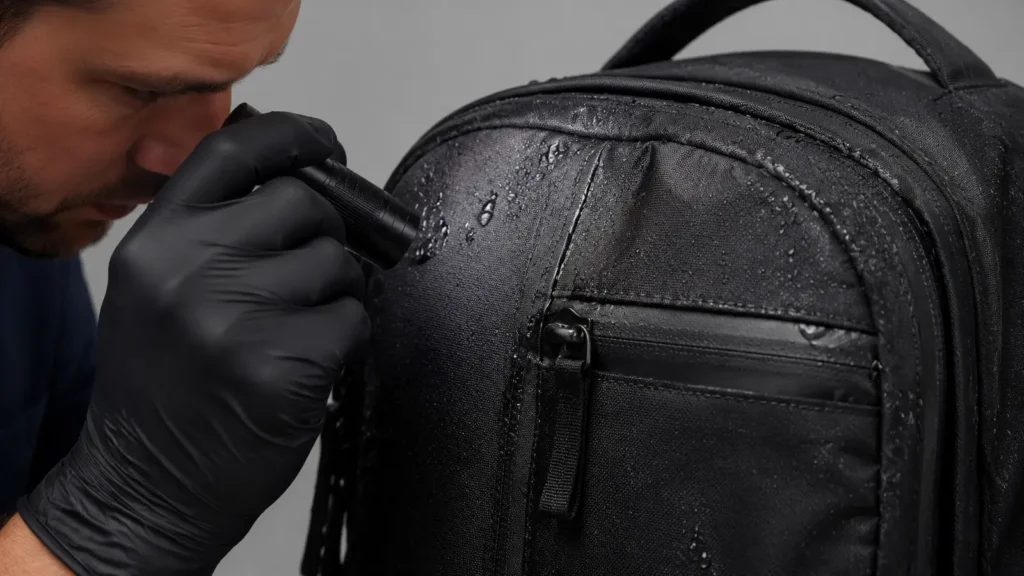
Needle Holes and Sewing Lines
Every conventional stitch penetrates the fabric. A coating may stop water across an unbroken panel while hundreds of needle holes create paths along a seam. Thread can also carry moisture through the seam by capillary action. Higher stitch density is not automatically more waterproof because it creates more perforations and can weaken some coated fabrics.
Zippers and Zipper Ends
A reverse-coil zipper with a coated surface can reduce water entry through the chain area. However, the slider gap, top and bottom ends, sewing holes, zipper garage, and surrounding seam remain relevant. YKK categorizes specialized products by their water-protective performance, illustrating why buyers should verify the exact zipper construction instead of treating every coated zipper as equivalent.
Top Openings and Flaps
An exposed zipper, drawcord opening, magnetic flap, or poorly overlapped lid can admit water even when every main panel uses highly resistant fabric. Roll-top closures can reduce an open-mouth risk, but their result depends on fold count, buckle placement, stiffness, loading, and user closure.
Webbing, Labels, and Logo Decoration
Shoulder-strap anchors, handle patches, woven labels, embroidered logos, and external attachment points often add stitch holes. Embroidery can perforate a coated panel many times. If water protection is critical, consider non-penetrating branding, welded patches, placement on a non-critical panel, or suitable sealing behind the decoration.
Lining Can Hide Leakage
A lining may make a quick inspection look dry while water collects between layers. Finished-bag testing should include a defined internal detection method and adequate observation time. Inspect the space behind the lining or use absorbent indicators where appropriate.
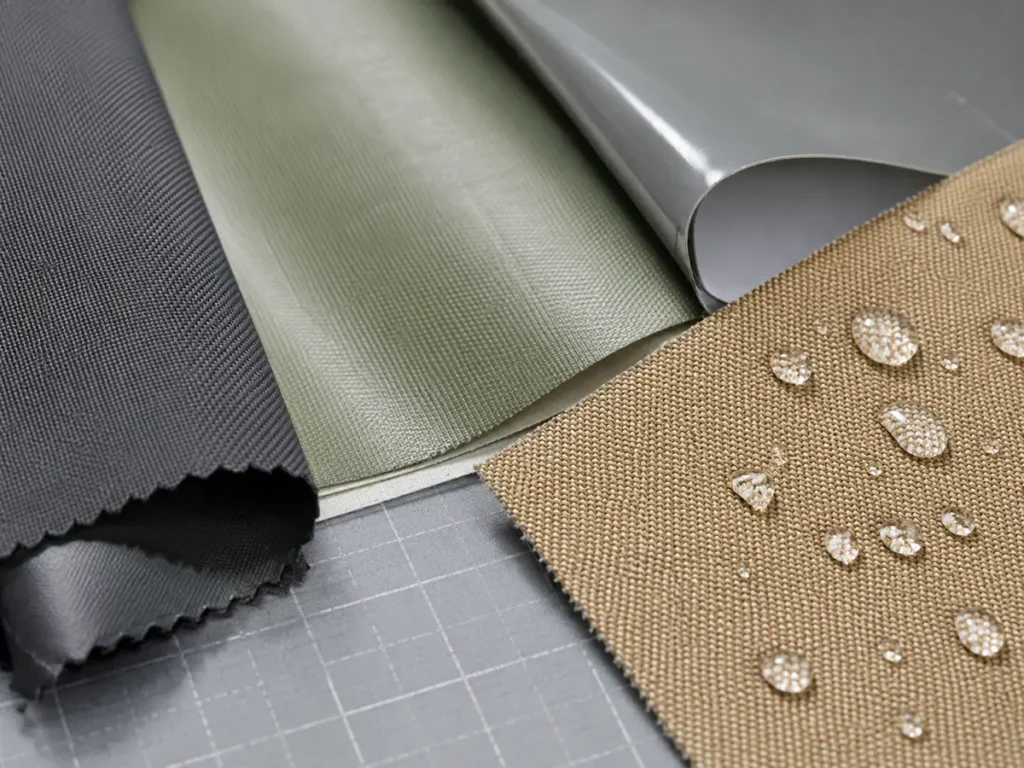
PU, TPU, PVC, and DWR: What Each One Does
Coating and finish names alone do not define performance. Formulation, coating weight, adhesion, base fabric, curing, thickness, aging, flexing, and manufacturing quality all affect the result.
| Material or finish | General role in backpacks | Procurement advantages | Points to verify |
|---|---|---|---|
| PU coating | Common back coating on polyester or nylon to improve resistance to water passage | Broad range of weights, hand feels, colors, and cost levels | Coating grade, hydrostatic result, adhesion, flex durability, aging, odor, and compatibility with seam tape |
| TPU film or lamination | Flexible thermoplastic barrier used where stronger water protection or weldable construction is needed | Can support flexible laminated structures and selected heat-welded seams | Film thickness, bond quality, flexing, temperature behavior, weld parameters, repairability, and cost |
| PVC coating | Plasticized coating used for robust, often heavier water-resistant structures | Durable surface, bold finish, cost-effective for certain utility products | Weight, stiffness, low-temperature flex, abrasion, odor, restricted-substance requirements, and market preference |
| DWR finish | Surface treatment that helps water bead and reduces face-fabric wetting | Preserves a textile look and can improve light-rain performance | Initial spray rating, performance after abrasion/cleaning, chemistry declaration, and re-treatment expectations |
PU-Coated Polyester
PU-coated polyester can range from lightweight promotional fabric to more substantial technical material. Asking whether “PU polyester is waterproof” without the fabric specification is not answerable. A buyer needs the base fabric, yarn density or construction, coating description, test method, measured result, and condition of the tested specimen.
The coating is normally on one side of the fabric. Cutting, sewing, folding, abrasion, and aging may change performance. If the design requires seam tape, the coating and tape adhesive must be compatible and validated through sample production.
TPU-Laminated Materials
TPU films can support flexible, water-resistant constructions and may be compatible with thermal or radio-frequency processes depending on the complete material system. They are commonly considered when the buyer needs a technical surface, welded construction, or a stronger barrier than a light back coating. A supplier must confirm the actual lamination, processing window, and end-use behavior rather than promise performance from the term “TPU” alone.
PVC-Coated Fabrics
PVC-coated fabric can create a robust, easy-to-wipe surface and is used in selected dry bags, utility bags, and promotional products. It may be heavier or stiffer than alternatives. Material compliance requirements can vary by destination, buyer policy, and product use, so restricted-substance documentation should be agreed for the exact formulation and market.
DWR Is a Surface-Wetting Treatment
Durable water repellent, or DWR, helps droplets bead on the fabric face. This improves appearance and can slow saturation, but it is not the same as a continuous waterproof barrier. Dirt, abrasion, cleaning, and wear can reduce the effect. If the selling point depends on DWR, request an initial test and, when relevant, a performance check after agreed conditioning.
Seam Construction Controls the Finished Result
The seam is often the difference between a water-resistant material and a water-resistant product.
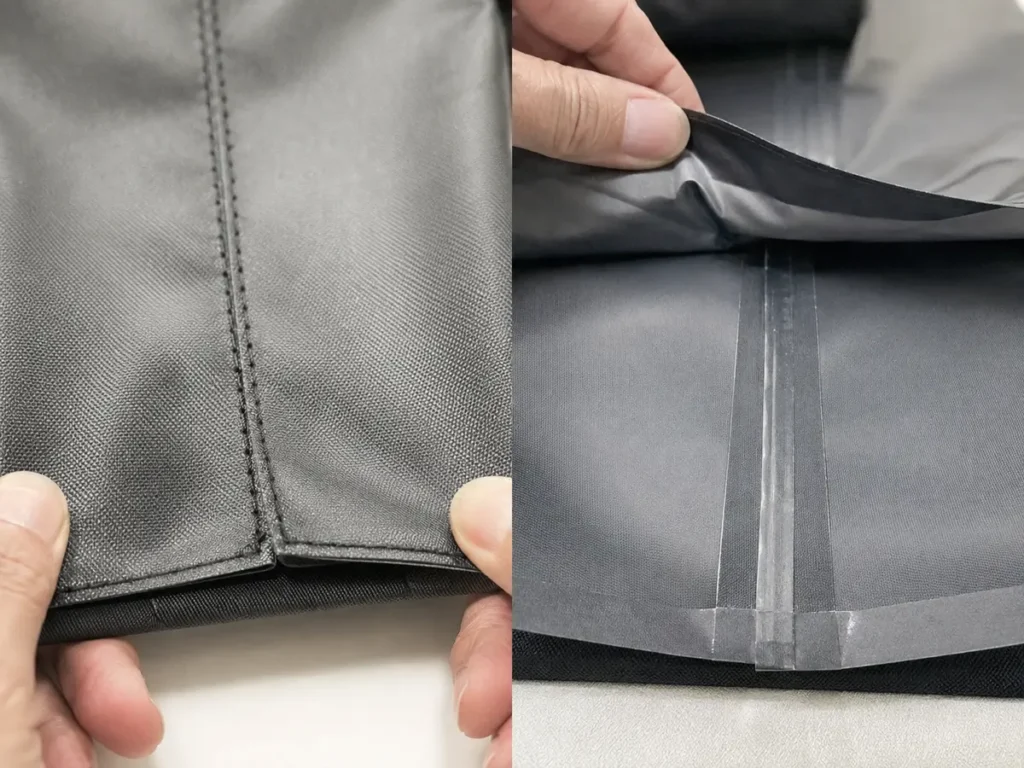
Conventional Sewn Seams
Ordinary seams are cost-effective and appropriate for many school, commuter, promotional, and sports bags. They can provide practical protection from short, light rain when combined with suitable fabric, covered openings, and sensible design. They should not be described as completely waterproof merely because the panel fabric passes a water-pressure test.
Seam-Taped Construction
Seam tape is applied over a sewn seam to cover needle holes. Results depend on tape width, adhesive, temperature, pressure, speed, seam shape, coating compatibility, operator control, and coverage around curves or junctions. A taped seam must be visually inspected and tested after application. Wrinkles, skipped areas, contamination, sharp corners, and thick seam stacks can create leaks.
Welded Seams
Heat welding, hot-air welding, high-frequency welding, or other bonding processes can join compatible thermoplastic materials without conventional needle holes along the joint. The technique must match the material and geometry. Complex backpack structures may still combine welding and sewing, so a “welded bag” is not automatically needle-free.
| Construction | Typical protection level | Cost and development effect | Best use |
|---|---|---|---|
| Coated fabric + conventional sewing | Practical water resistance when well designed | Lowest additional complexity | School, promotional, team, and daily-use bags |
| Coated fabric + covered openings + selective seam sealing | Enhanced protection at critical areas | Added materials, labor, equipment, and sample validation | Commuter and higher-spec daily bags |
| Laminated/weldable material + taped or welded seams + protected closure | Stronger complete-product protection when verified | Higher material and process cost; more design restrictions | Technical outdoor, cycling, marine-adjacent, or exposed applications |
Does a Waterproof Zipper Make the Bag Waterproof?
No. A water-protective zipper improves one component, not the whole system.
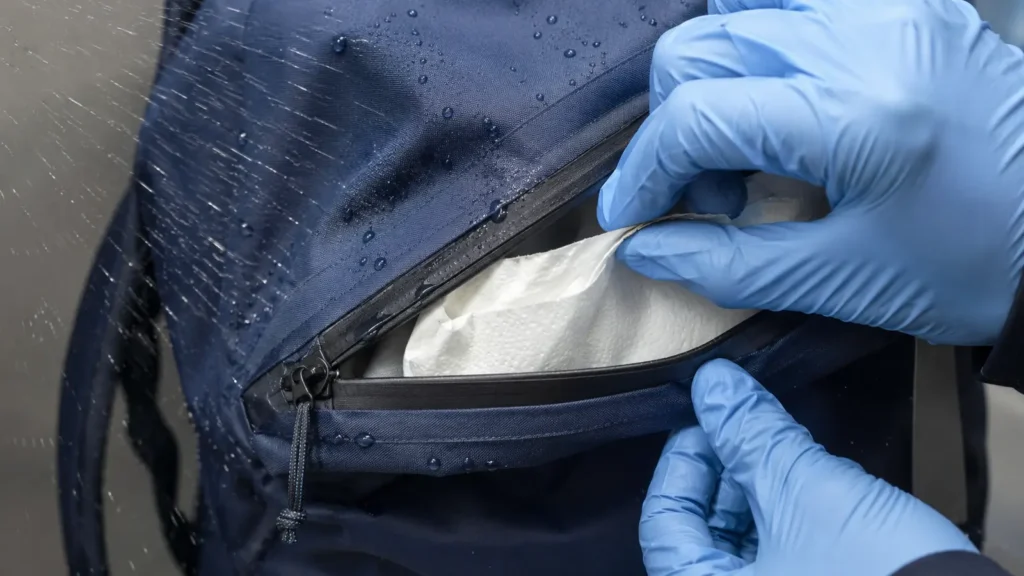
The buyer should verify:
- exact zipper type, size, slider, tape, coating, and supplier reference;
- performance claim and test applicable to that zipper;
- sewing or welding method around the zipper tape;
- termination at both zipper ends;
- slider parking position and zipper garage;
- opening orientation and whether a storm flap is required;
- abrasion and repeated-operation effects;
- finished-compartment test after the zipper is installed.
An exposed horizontal zipper on top of a bag normally presents a greater water-entry risk than a vertical zipper under a flap. Pattern design and orientation may improve performance without changing the zipper itself.
Planning a bulk custom backpack order? Send JIUMU your target use, exposure, dimensions, fabric preference, required claim, test method, quantity, logo files, packaging, and delivery date. The specification can then be reviewed before material sourcing and sample production through Contact Us.
Which Water Tests Should Bulk Buyers Request?
Testing should match the claim and the item being evaluated. A test on a fabric swatch answers a different question from a test on a completed backpack.
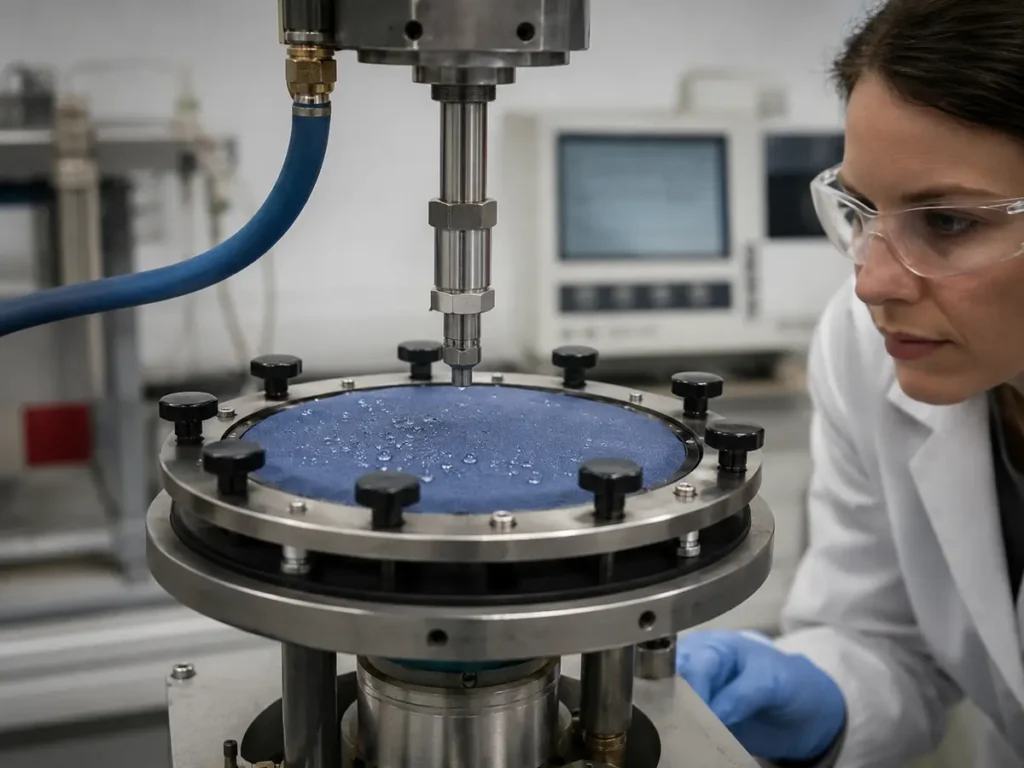
| Test or evaluation | What it helps measure | Common test object | What it does not prove alone |
|---|---|---|---|
| AATCC TM22 or ISO 4920 spray test | Resistance to surface wetting or water repellency | Fabric | Resistance to sustained pressure or complete-bag leakage |
| ISO 811 or AATCC TM127 hydrostatic pressure | Resistance to water penetration under increasing pressure | Fabric or defined textile assembly | Zipper, opening, seam, and workmanship performance across a complete backpack |
| AATCC TM42 impact penetration | Water penetration under impact exposure | Fabric or textile assembly | Complete performance in prolonged rain or immersion |
| AATCC TM35 rain test | Penetration through fabrics or combinations under controlled rain conditions | Fabric assembly | Every finished-bag detail unless the product is adapted and included in a separately defined procedure |
| Finished-bag spray or simulated rain test | Leakage at panels, seams, zippers, openings, base, and attachments | Complete backpack | Immersion or pressure performance unless specifically designed into the method |
| Immersion or submersion test | Product behavior under a defined depth and duration | Complete product designed for that exposure | Indefinite depth, duration, or all user conditions |
AATCC describes TM22 as a relatively quick screening method for surface wetting. ISO 811 measures the hydrostatic head supported by a fabric. These official descriptions show why test selection must be tied to the claimed mechanism.
Define the Complete Test Conditions
For any method, record:
- standard and edition, or a fully written buyer-specific protocol;
- whether the specimen is fabric, seam, compartment, or whole backpack;
- sample conditioning and pre-treatment;
- water pressure, spray intensity, exposure duration, angle, and distance as applicable;
- backpack fill material, working load, and closure procedure;
- number and location of test specimens;
- how internal water is detected or measured;
- acceptance criteria and allowed leakage, if any;
- test timing, including before or after abrasion, flexing, cleaning, or aging;
- laboratory, equipment, report number, sample version, and date.
Do not copy a competitor’s hydrostatic number without confirming whether it is appropriate for the material and product. A higher value can increase coating weight, stiffness, cost, or processing difficulty without solving a leaking zipper end.
Select Protection by Use Case
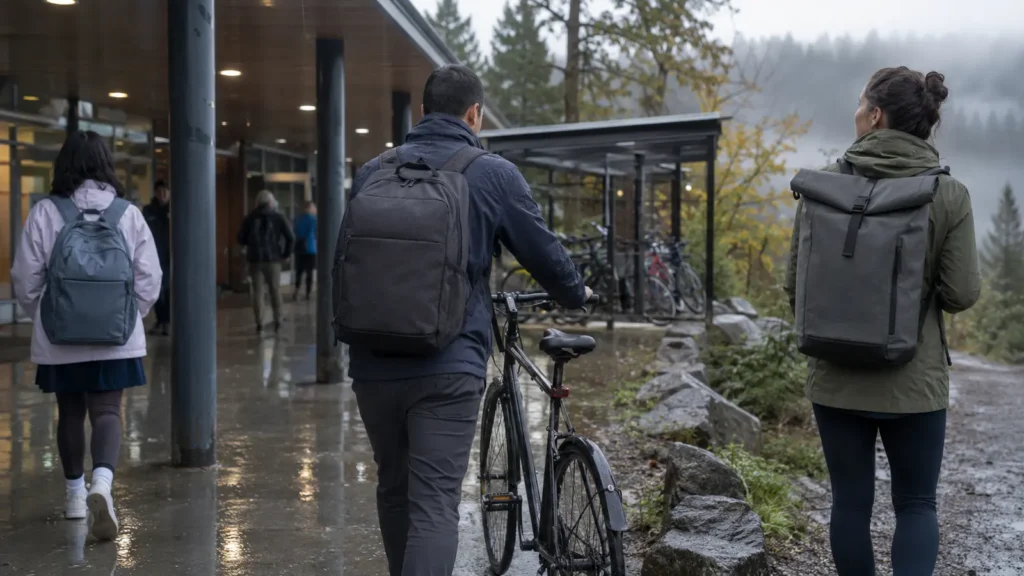
School Backpacks
Most school buyers need protection from intermittent rain, wet floors, and accidental splashes rather than submersion. Priorities often include low weight, child-friendly operation, cleanability, cost, and safe materials. A coated polyester or nylon, protected main opening, suitable base, and documented finished-bag spray or rain check may be more relevant than an expensive welded construction.
Pay special attention to notebook and electronics compartments, zipper orientation, bottle-pocket drainage, name-label stitching, and embroidery. Age alone should not define the specification; consider commute method, climate, contents, and school policy.
Commuter Backpacks
Commuters may carry laptops and travel by bicycle, motorcycle, train, or on foot. Exposure can be longer and more directional. A stronger fabric barrier, covered or coated zippers, raised laptop compartment, seam management, roll-top or flap design, and enhanced finished-bag test may be justified. The brief should state whether the product is intended for walking in light rain or prolonged cycling in heavy rain.
Outdoor and Technical Backpacks
Outdoor buyers should define rainfall, duration, abrasion, temperature, load, river or marine proximity, and whether contents require separate dry protection. A pack can be highly rain-resistant without being suitable for immersion. If the product must survive submersion, the design, closure, seams, attachments, and test protocol should be developed specifically for that use.
Promotional and Team Bags
Promotional and team bags often balance price, decoration, color, and delivery time. Practical water resistance may be sufficient. Avoid a premium waterproof claim when extensive embroidery, exposed zippers, and conventional seams are central to the design. A transparent “water-resistant for everyday use” statement, supported by a defined check, can be more credible.
Waterproof Claim Decision Table
| Evidence available | Appropriate claim direction | Claim to avoid |
|---|---|---|
| Spray result on face fabric only | Water-repellent fabric or treated outer fabric | Waterproof backpack |
| Hydrostatic result on coated fabric only | Fabric tested for resistance to water penetration under named method | Complete bag is waterproof |
| Coated fabric plus conventional sewn bag with finished spray result | Water-resistant backpack under the stated finished-product conditions | Fully waterproof in all weather |
| Complete bag with sealed construction and documented rain test | Tested water resistance under the named rain conditions | Suitable for immersion unless separately tested |
| Purpose-designed product with relevant immersion protocol and passing complete-product result | Waterproof under the stated depth, duration, closure, and product condition | Unlimited waterproofing or permanent performance |
Marketing, packaging, quotation, purchase order, tech pack, test report, and care instructions should use consistent language. If a distributor changes the claim after delivery, the supporting evidence may no longer match.
Sample Approval Process
1. Approve the Performance Brief
Define the user, environment, contents, exposure, claim, material, seam strategy, closure, decoration, test method, and acceptance criteria. Assign a version number.
2. Approve Material Data and Physical Swatches
Review actual coated or laminated swatches for hand feel, color, weight, odor, adhesion, flexing, abrasion, print or embroidery compatibility, and test evidence. A supplier’s generic data sheet may not describe the exact production lot or final laminated structure.
3. Review the Finished Sample
Inspect seam tape coverage, zipper ends, openings, base corners, binding, strap anchors, labels, and logo application. Load the bag as intended and close it using the written procedure before testing.
4. Perform the Agreed Test
Use the approved sample version. Record conditions, water-entry locations, internal observations, photographs, and result. If the sample fails, identify whether the cause is material, seam, closure, pattern, component, or workmanship.
5. Correct, Retest, and Establish the Golden Sample
Update the tech pack and BOM after any change. Retest the revised sample rather than approving a verbal promise. Retain the approved physical sample and report with project, date, and version references.
Buyer Water-Resistance Test Specification
| Field | Approved project entry |
|---|---|
| Project / SKU | |
| Intended user and use case | |
| Expected exposure and duration | |
| Permitted product claim | |
| Outer fabric and coating/lamination | |
| Lining and internal protection | |
| Seam type and sealing method | |
| Zipper and closure specification | |
| Logo and attachment method | |
| Test method and edition | |
| Test object: fabric / seam / compartment / bag | |
| Conditioning and pre-aging | |
| Load and closure procedure | |
| Acceptance criteria | |
| Sample quantity | |
| Failure and retest rule | |
| Approved sample/report IDs | |
| Buyer and supplier approval |
Bulk Production Quality Control
Water performance can change between an approved sample and bulk production if the coating lot, seam tape, process temperature, zipper, thread, pattern, or operator method changes.
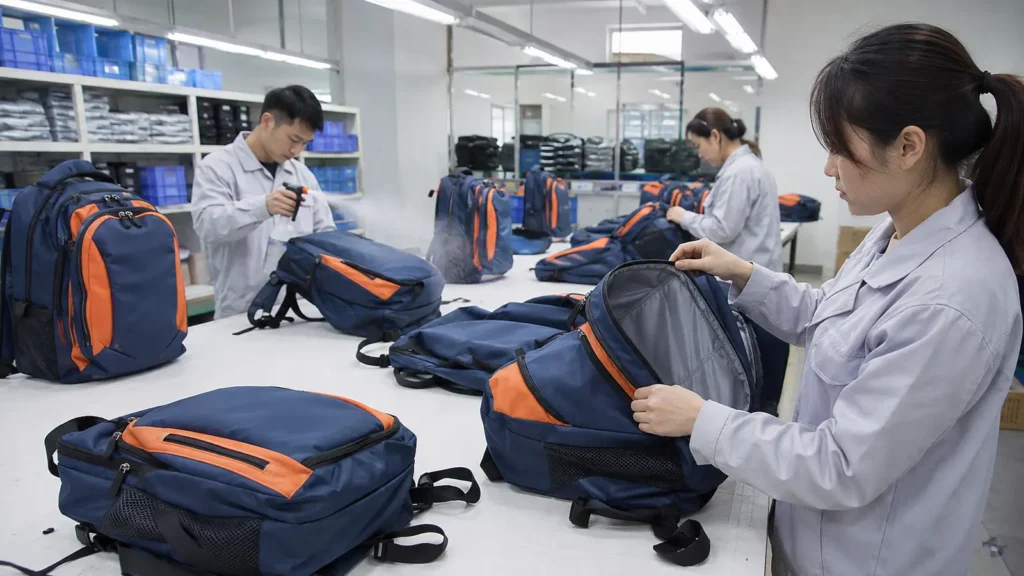
Incoming Material Control
Verify material supplier reference, base fabric, color, coating or film, width, and lot. Review specified test reports and inspect for coating skips, pinholes, delamination, blocking, creases, contamination, or abnormal odor. Segregate material lots when required for traceability.
In-Line Process Checks
Confirm needle and thread setup, seam allowance, stitch consistency, tape coverage, welding parameters, zipper orientation, end construction, and decoration placement. Inspect the first completed units before continuing full production.
Final Inspection and Testing
Use the agreed sampling plan. Conduct visual and functional checks on selected units and scheduled finished-product water tests where specified. Sample across cartons, production times, colors, and material lots. Record failure location and severity; do not report only “pass” or “fail.”
Nonconforming Product
Contain affected units, identify the lot and process window, determine cause, approve repair feasibility, and retest. Some leaks can be corrected with properly applied tape; others require reconstruction and should not be hidden by surface sealant. Update records if the corrective action changes appearance or care requirements.
Bulk Water-Resistance QC Checklist
- Correct fabric, coating/lamination, zipper, seam tape, thread, and closure
- No visible coating gaps, pinholes, delamination, contamination, or damage
- Seam tape is continuous, centered, bonded, and free of channels
- Welded seams have consistent width without burns, voids, or edge lifting
- Zipper ends and slider parking areas match the approved construction
- Main opening, flap, roll-top, or lid closes as specified
- Logo, labels, webbing, and strap anchors do not compromise protected areas
- Bag base and corners show no unapproved perforation or exposed seam
- Finished units follow the agreed sampling and water-test plan
- Results identify SKU, color, lot, carton, sample ID, method, and failure location
- Nonconforming units are segregated and corrective action is documented
- Marketing claim matches the final approved evidence
Questions to Ask a Backpack Supplier
- Is the claimed result for the fabric, a seam, a compartment, or the finished backpack?
- Which test method, edition, conditions, and acceptance criteria support the claim?
- What base fabric, coating or film, coating weight, and material lot will be used?
- Are seams conventional, taped, sealed, or welded, and how is the process controlled?
- How are zipper ends, openings, webbing anchors, and logo applications protected?
- Does the zipper manufacturer describe the exact component as water-resistant or waterproof?
- Will the finished sample be tested after realistic loading and closure?
- Is testing required after flexing, abrasion, cleaning, or aging?
- What inspection and sampling plan applies to bulk production?
- Which wording may the buyer safely use on packaging and product pages?
For related sourcing decisions, compare JIUMU’s planned Best Waterproof Backpacks guide, review Quality Control, use the Backpack Fabric Guide, and explore Custom Team Bags. Confirm that the first article is live at the stated URL before publishing this page.
Common Buying and Marketing Mistakes
Using a fabric result as a product result. The backpack introduces seams, openings, components, and workmanship variables.
Choosing the highest water-column value without use context. A leaking zipper end can make the extra fabric performance irrelevant.
Calling DWR a waterproof membrane. DWR primarily addresses surface wetting and can diminish with use.
Ignoring conditioning and aging. Abrasion, folding, cleaning, heat, and time may change coating, tape, or finish performance.
Approving only a dry visual sample. A water-protection claim needs a relevant physical test.
Adding embroidery after testing. Decoration may create new needle holes; test the final decorated construction.
Making unlimited claims. State the relevant conditions and care limitations rather than implying permanent protection in every environment.
How JIUMU Supports Custom Backpack Development
JIUMU provides OEM and ODM development for custom bags and branded merchandise, including material sourcing, logo application, labels, packaging, digital mockups, physical samples, bulk production, and quality-control support. A water-protection project should begin with an exposure brief rather than a material name.
For quotation and development, send the backpack dimensions, compartments, target load, user group, material preference, seam and closure concept, required claim, buyer test protocol, quantity, colors, logo files, packaging, destination, and target delivery date. Special laboratory testing, sealed construction, custom tooling, and lower-volume development can affect cost, MOQ, and lead time and should be planned before sampling.
Frequently Asked Questions
Final Recommendation
Buy the level of protection the use case requires, then connect every claim to evidence. Specify whether the requirement applies to fabric, seams, a compartment, or the complete backpack. Select the coating or lamination, closure, seam process, decoration, and test method as one system. Approve a tested Golden Sample, control the same materials and processes in bulk, and keep product-page wording within the conditions actually verified.
To request a custom backpack quotation, send JIUMU your target application, rain or water exposure, dimensions, compartments, working load, material preference, closure concept, logo files, quantity, packaging, required test and claim, destination, and delivery date. Contact JIUMU to plan the specification and sample.
Technical References
- AATCC TM22: Water Repellency—Spray Test
- AATCC: The Art of Testing Water Repellency
- AATCC TM35: Water Resistance—Rain Test
- AATCC Water Resistance and Repellency Test Method List
- ISO 811:2018, Resistance to Water Penetration—Hydrostatic Pressure
- YKK Fastening Products and Water-Protective Zipper Information
About JIUMU
JIUMU is a Guangdong-based B2B supplier of custom teamwear, hats, bags and branded merchandise, established in 2010. Product claims and test requirements should be confirmed for the final material, construction, sample and destination market.