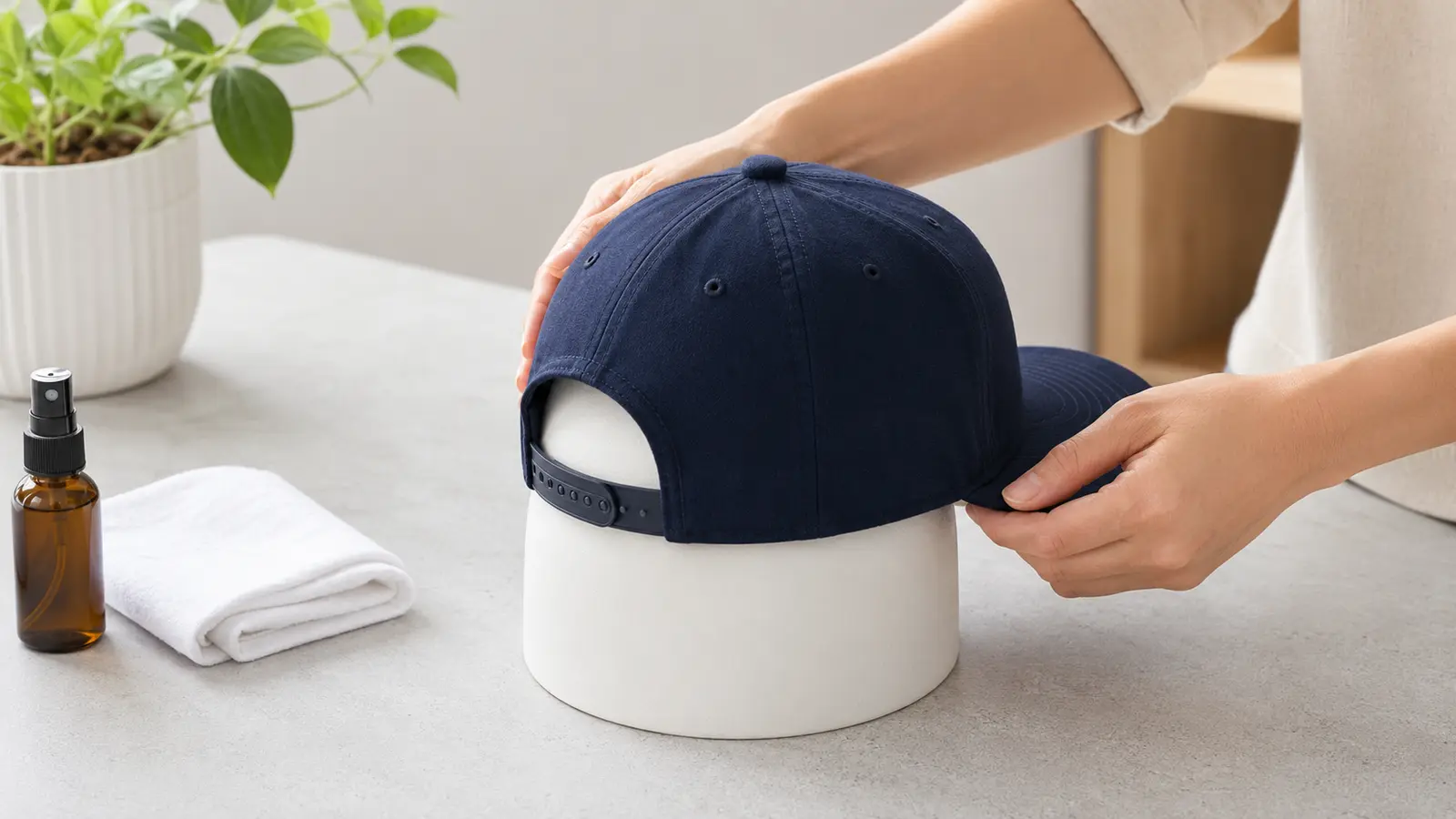
Snapback Hat Size and Fit Guide: Adjustment, Stretching and Shrinking
Snapback hats are described as adjustable, but “adjustable” does not mean every cap fits every head equally well. The rear closure changes the opening circumference; it does not change the crown depth, front-panel angle, brim width, sweatband construction, or the way a fabric responds to wear. Those details explain why two snapbacks set to the same closure position can feel completely different.
For an individual, the right fit is secure without pressure and preserves the crown shape. For a team, school, distributor, or private-label brand, one specification must fit a realistic wearer range while remaining consistent across the order.
This snapback hat size and fit guide explains how to measure a head, adjust a snap closure, diagnose tightness or looseness, stretch or shrink a cap conservatively, and build measurable fit requirements into a custom order.
Quick Answer: Start with the snap closure. A snapback should feel secure around the sweatband without leaving a deep pressure line, sliding over the ears, or lifting at the back. Measure around the head where the sweatband will sit, compare that measurement with the supplier’s actual finished-cap range, and test the crown depth as well as the circumference. If the cap is only slightly tight, dry stretching on a rounded form is the lowest-risk correction. If it is slightly loose after the closure is tightened, a sweatband insert is safer than trying to shrink the whole cap. Use moisture or heat only after checking the care label and material, because cotton, wool blends, polyester, buckram, plastic closures, adhesives, and brim components respond differently.
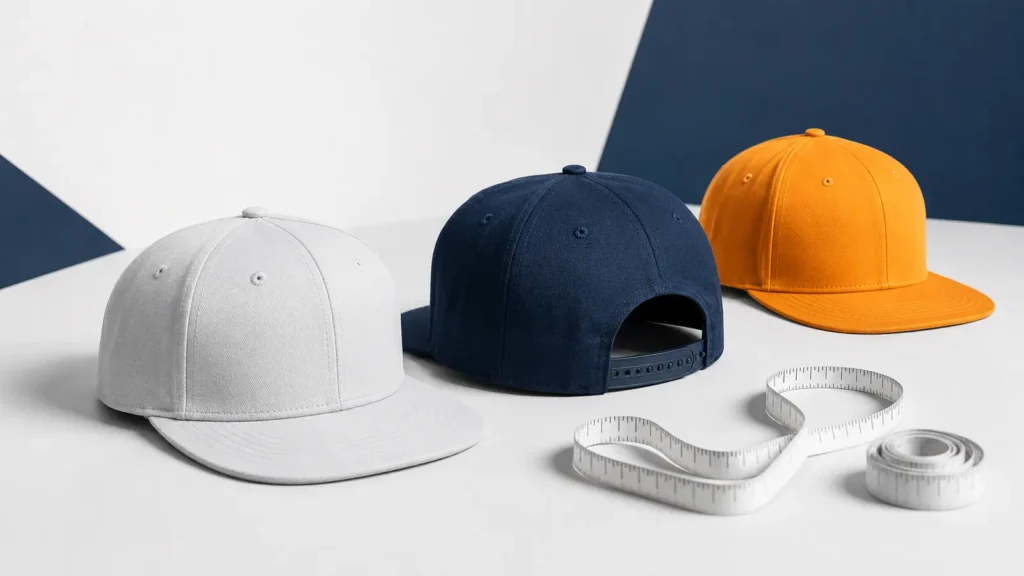
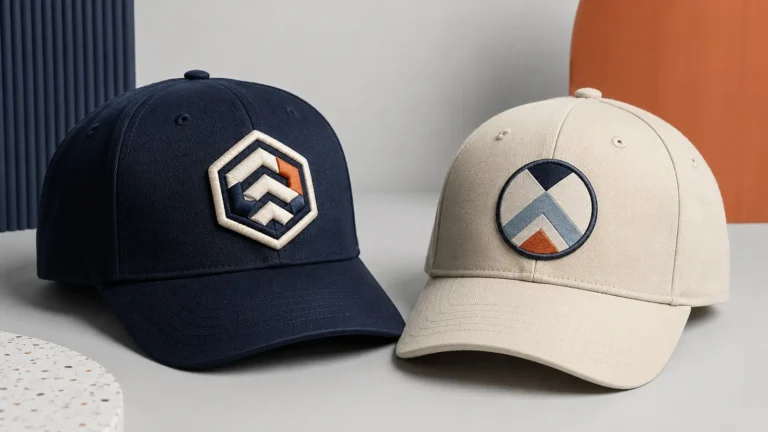
Snapback sizing depends on more than the rear closure: crown profile, material, sweatband, brim, and finished circumference all influence fit.
Specifying Fit for a Custom Snapback Order
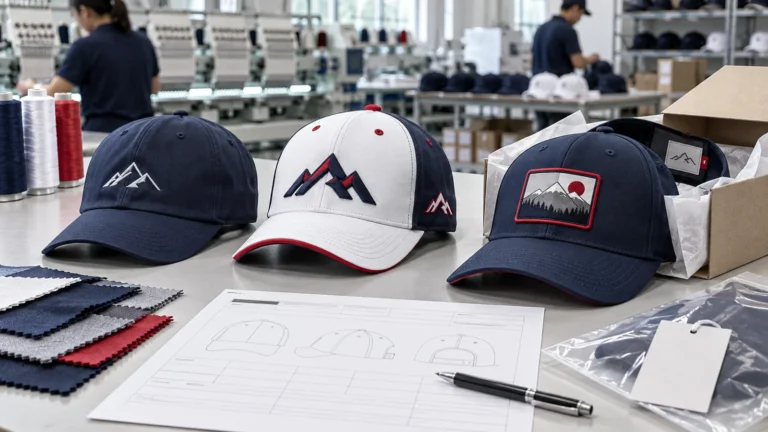
For team, promotional, retail, or private-label orders, provide the target wearer group, measured head range, preferred crown depth, panel structure, closure type, fabric, brim shape, decoration method, quantity, and delivery destination. Approve a physical sample on representative wearers before bulk production.
Review custom snapback hat options and custom baseball caps, then request a custom hat quotation with your logo and fit requirements.
What “One Size” Means for a Snapback Hat
A classic snapback has an open back and an adjustable snap or strap closure. New Era, for example, describes its 9FIFTY as having the shape of a fitted cap but an open back with a snap or strap closure. That is the essential construction difference: a fitted hat uses a fixed circumference, while a snapback provides a controlled range through the rear opening and closure.
“One size” therefore means one adjustable size range, not a universal guarantee. The usable range is determined by:
- The length of the male and female closure pieces
- The number, spacing, and engagement strength of the snap positions
- The finished inside circumference of the sweatband
- The width and height of the rear opening
- Crown depth and panel geometry
- Fabric stretch or stability
- Sweatband thickness
- Hair volume and the wearer’s preferred position
A cap can technically close around a head and still fit poorly. If the crown is too shallow, it may ride high or pull backward. If it is too deep, the lower edge may press against the ears. A rigid high-profile crown can feel larger than a soft low-profile crown even when the internal circumference is similar.
Snapback, Fitted, Strapback, and Flex-Fit Sizing
| Hat construction | How the size is controlled | Main fit advantage | Main limitation |
|---|---|---|---|
| Plastic snapback | Interlocking plastic pegs and holes | Fast, repeatable adjustment and recognizable sportswear appearance | Adjustment occurs in steps; the closure can feel stressed at the largest setting |
| Strapback | Fabric, leather-style, or webbing strap with buckle or slider | Finer circumference adjustment | Strap bulk, buckle position, and tail management affect comfort |
| Fitted cap | Fixed finished circumference | Clean closed back and precise fit when the size is correct | Requires multiple sizes and better inventory planning |
| Stretch-fit cap | Elasticized sweatband or stretch fabric | Smooth back and a forgiving size band | Elastic recovery and long-term consistency must be tested |
For group orders, an adjustable closure reduces the number of size variants, but it does not eliminate the need for fit testing. A youth baseball program, adult club, streetwear collection, and corporate merchandise order may need different crown blocks even if all four products use a plastic snap.
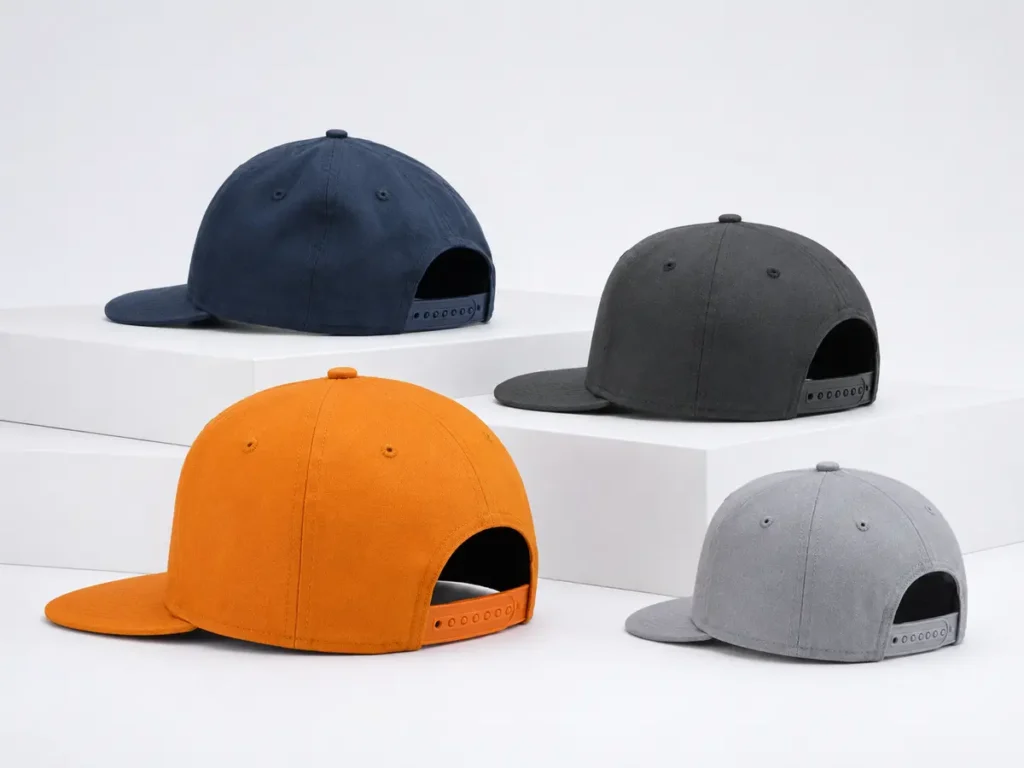
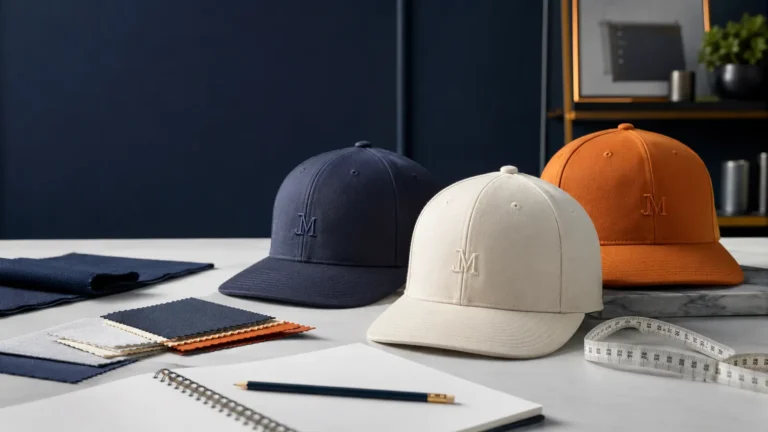
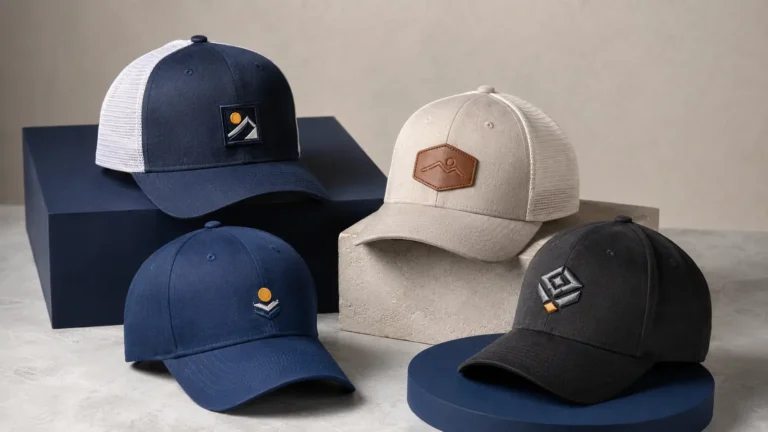
Low-, mid-, high-profile, and youth-size snapbacks can use similar closures but create different fit experiences.
How Should a Snapback Hat Fit?
A correctly fitted snapback contacts the head evenly through the sweatband rather than relying on one pressure point.
Use these five checks:
- Circumference: The sweatband is snug enough to prevent easy rotation but does not cause a headache or deep mark.
- Crown depth: The cap reaches the intended position without forcing the lower edge onto the ears.
- Front panel: The structured front remains upright rather than collapsing, bowing outward, or being pulled into a point.
- Rear opening: The opening lies smoothly against the head. It should not gape dramatically or pinch hair.
- Brim position: The brim sits centered and level. A tilted brim may indicate uneven placement, an off-center closure, or a crown that does not match the head shape.
Test normal movement by turning the head, looking down, and walking. A training cap may fit more firmly than casual merchandise, but it should not hurt.
Signs a Snapback Is Too Tight
- The sweatband leaves a strong red line after brief wear
- The cap causes pressure at the forehead or temples
- The rear closure is attached at the final usable position and pulls noticeably
- The crown rises or distorts because the lower opening is being stretched
- The brim no longer appears centered
- The wearer develops discomfort within a few minutes
Signs a Snapback Is Too Loose
- The cap rotates with light contact
- The brim drops toward the eyes during movement
- Wind easily lifts the cap
- The cap sits on the ears before the sweatband becomes secure
- The closure is fully tightened but the sweatband still does not contact the head evenly
- The rear opening buckles because too much material is being drawn together
If a cap is simultaneously tight around the band and loose at the crown, the problem is usually not the closure setting. It is a mismatch between circumference, crown shape, and head shape.
How to Measure Your Head for a Snapback
Use a flexible tailor’s tape. If one is not available, use a non-stretch cord and measure it against a ruler. Do not use an elastic string because tension changes the result. For circumference conversions and broader cap sizing references, use the baseball cap size chart and head-measurement guide.
- Remove bulky hair accessories and arrange the hair as it will normally be worn with the cap.
- Place the tape around the head where the sweatband should sit—typically just above the eyebrows and ears and around the fullest part at the back.
- Keep the tape level. A tape that rises at the back produces a smaller, misleading reading.
- Pull it flat but not tight. It should contact the hair or skin without compressing it.
- Record the circumference in centimeters and inches.
- Measure a second time. If the numbers differ, repeat until two readings agree.
- Compare the result with the specific supplier’s finished-cap range, not with a generic “one size” assumption.
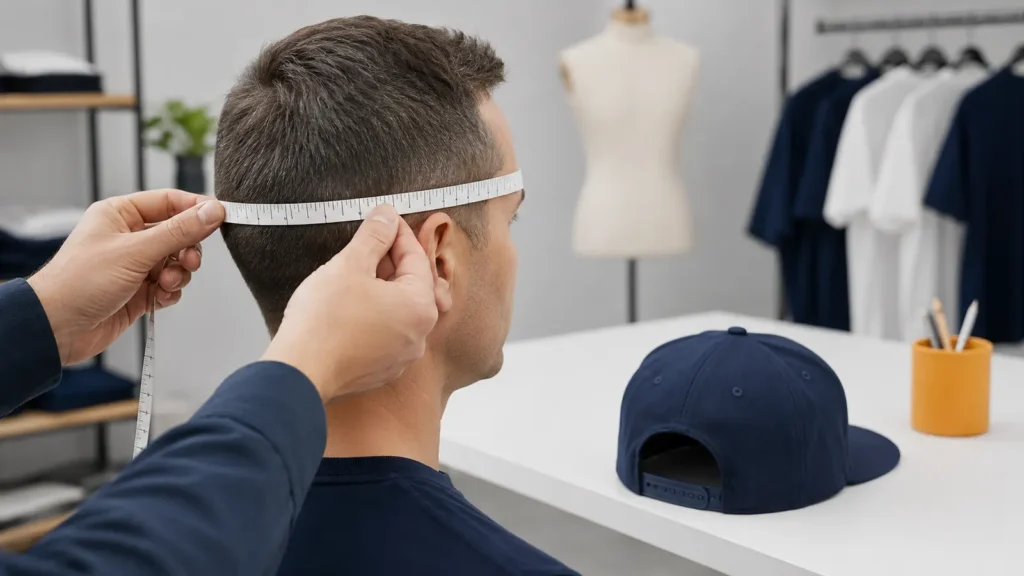
Measure where the sweatband will sit and record the result in both centimeters and inches for supplier communication.
Planning Ranges for Custom Snapbacks
The following bands are development starting points, not universal retail sizes. Actual fit depends on the complete cap specification, and overlap is normal.
| Development band | Head-circumference starting point | Approximate inches | Typical planning use |
|---|---|---|---|
| Youth | 50–54 cm | 19.7–21.3 in | Children’s teams and school programs; age alone is not a sufficient size method |
| Small adult | 54–57 cm | 21.3–22.4 in | Smaller adult heads, some teen programs, or a dedicated small option |
| Standard adult adjustable | 56–60 cm | 22.0–23.6 in | General adult team, promotional, and retail programs |
| Large / XL adjustable | 59–63 cm | 23.2–24.8 in | Larger adult heads where a standard closure would operate near its limit |
For bulk development, document the measurement method, specified snap positions, wearer testing, and whether the range represents comfortable fit or only the mechanical limits.
How to Adjust a Snapback Correctly
Open the closure before placing the cap on the head. Set it loosely, put the cap on level, and then reduce the circumference one step at a time. This avoids dragging a tight sweatband over the head and reduces stress on the plastic pegs.
If the cap moves when the head turns, tighten one position. If pressure appears, loosen one. When the ideal fit falls between positions, choose the looser setting and test a thin removable sweatband insert. Fully engage the pegs, and avoid repeatedly bending aged or cold plastic.
The number of visible snaps is not a reliable size label because closure lengths and hole spacing vary. For custom production, record the actual internal circumference at selected positions instead of specifying “three snaps closed.”
Why Crown Profile Changes Perceived Fit
A high-profile structured snapback has more internal volume and decoration area but can leave space above a shorter head. A mid-profile cap is more moderate; a low-profile or unstructured cap follows the head and may feel smaller at the same circumference.
A wide flat brim can make a cap feel larger. Curving it changes presentation but does not correct an oversized sweatband.
For a custom program, approve profile and circumference together. A digital mockup can confirm logo placement, but only a physical sample can confirm whether the crown volume and band pressure suit the intended wearers.
How Materials Affect Adjustment, Stretching, and Shrinking
Do not choose a stretching or shrinking method until the fiber content and construction are known. Care labels should take priority over general advice.
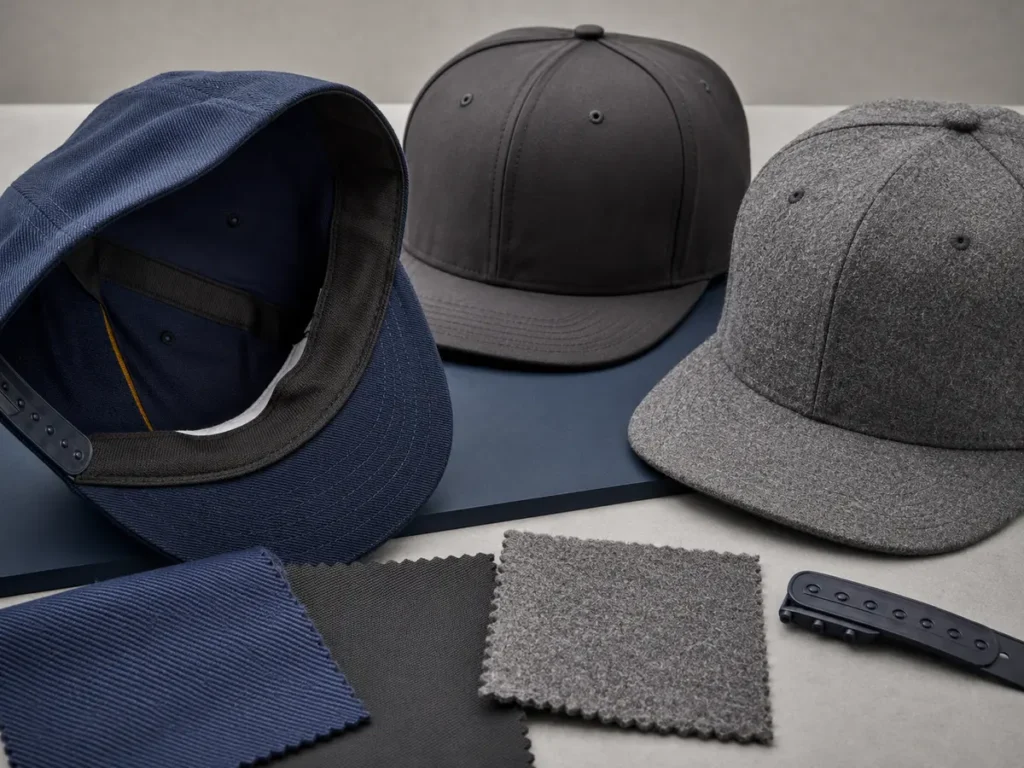
Fiber content, sweatband construction, front reinforcement, brim components, and closure plastic all influence how safely a snapback can be reshaped.
| Material or component | Typical fit behavior | Stretch/shrink consideration | Safer approach |
|---|---|---|---|
| Cotton twill | Can relax with wear and may change with moisture or heat | Whole-cap wetting can affect color, crown, and brim | Start with closure adjustment or dry stretching; use minimal moisture only when permitted |
| Polyester | Dimensionally more stable than untreated cotton in many constructions | Heat can damage fibers, coatings, transfer graphics, or shape | Avoid deliberate high-heat shrinking; use fit inserts or a different size |
| Wool or wool blend | Comfortable and shapeable but sensitive to moisture, agitation, and heat | Uncontrolled treatment can felt, shrink unevenly, or distort | Follow the care label; use a professional cleaner for valuable caps |
| Mesh rear panels | Flexible and breathable | Excess pulling can distort mesh or seam attachment | Adjust the closure; avoid aggressive stretching |
| Buckram front reinforcement | Holds front-panel structure | Saturation or heat can soften, crease, or warp the front | Keep the front dry during minor band adjustment |
| Sweatband | Directly controls pressure and moisture absorption | May relax or contract differently from the crown fabric | Target the band carefully rather than treating the whole cap |
| Plastic snap closure | Provides stepped adjustment | Heat and repeated bending can warp or weaken it | Keep away from hot air, boiling water, and high dryer temperatures |
| Brim insert | Maintains brim shape | Material may be plastic or another substrate; behavior varies | Do not soak or heat unless the manufacturer permits it |
Official New Era customer-care guidance recommends spot cleaning cotton, polyester, and wool fabrics or blends with a damp cloth and mild color-safe detergent, using cool water on the sweatband, and air-drying the cap in a natural position to prevent stretching or misshaping. That conservative approach is a useful baseline even when the objective is fit correction: protect the structure first.
How to Stretch a Snapback Hat Safely
Stretching should be considered only when the cap is slightly tight after the closure has been opened to a practical setting. If the cap needs several centimeters of additional circumference, it is the wrong size or cap block. Forcing it can split seams, deform the rear opening, or overload the closure.
Method 1: Wear-In for Minor Tightness
For a new cap that is only mildly snug, short periods of indoor wear may allow the sweatband to settle. Open the snap one position from the uncomfortable setting, wear it for 15–30 minutes, and recheck pressure at the forehead and temples. Pain, numbness, or a strong pressure line means the cap is too tight for this method.
Method 2: Dry Stretching on a Rounded Form
A rounded hat form or purpose-made stretcher provides more even pressure than pulling by hand.
- Confirm that the closure is not carrying the stretching load. Set it comfortably open.
- Place the cap on a smooth, clean form slightly larger than the current fit.
- Support the sweatband evenly and keep the crown aligned.
- Increase the stretcher gradually—only enough to create mild tension.
- Leave it for several hours, then remove and test.
- Repeat in small increments if needed.
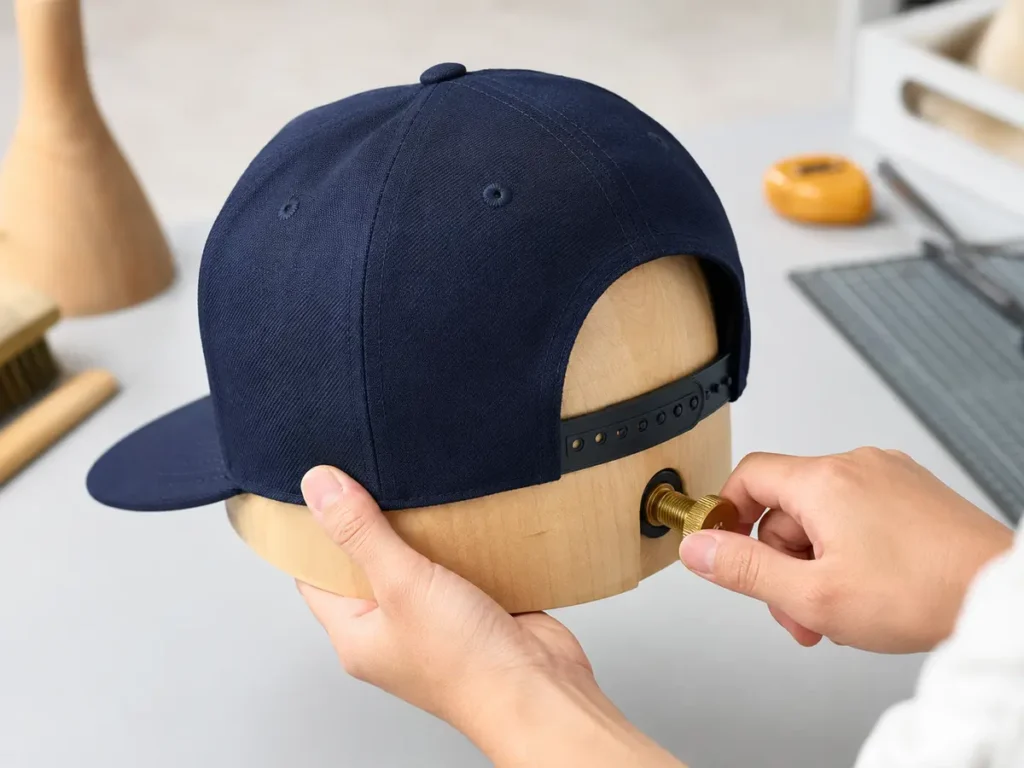
Dry, gradual pressure on the sweatband is lower risk than soaking, steaming, or pulling the closure.
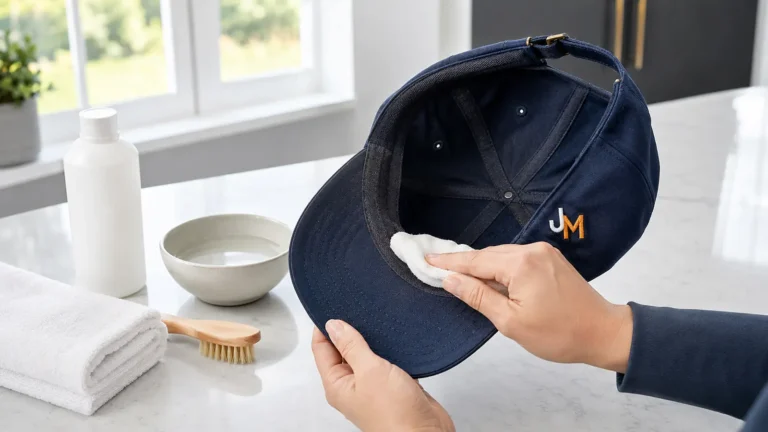
Method 3: Minimal Sweatband Moisture
Use this only if the care label permits cool-water spot treatment and dry stretching has not been sufficient.
- Test a hidden area for color transfer.
- Lightly dampen the inside sweatband with cool water; do not saturate the crown, front reinforcement, brim, logo, or closure.
- Place the cap on a clean rounded form at the desired minor increase.
- Air-dry completely in a natural shape and out of direct heat.
- Recheck both circumference and appearance.
Do not use boiling water, prolonged steam, a hot hair dryer, or a heated clothes dryer. Those methods reduce control and can affect multiple materials at once. A cap containing embroidery backing, patches, heat transfers, adhesives, coatings, or specialty trims has additional failure points.
Need a snapback specification that fits your market before bulk production? Send JIUMU your target head-circumference range, wearer group, crown profile, fabric, closure type, logo artwork, quantity, and delivery market. Request a physical sample with a documented fit range before approving production.
How to Shrink a Snapback Without Ruining It
First ask whether shrinking is necessary. A loose snapback should normally be corrected through the closure. If the smallest setting remains loose, use a removable sweatband strip, a compatible replacement band, or a smaller cap block.
Deliberate shrinking is unpredictable because cotton panels, polyester thread, plastic snaps, reinforcement, patch backing, and brim components respond differently.
Controlled Band Adjustment for a Slightly Loose Cotton Cap
If the care label permits cool-water spot treatment and the cap has no sensitive decoration:
- Tighten the closure to the preferred practical position.
- Color-test a hidden part of the sweatband.
- Lightly dampen only the sweatband with cool water. Do not soak it.
- Blot excess moisture with a clean white cloth.
- Place the cap on a form close to the target head size, preserving the crown and brim.
- Let it air-dry naturally.
- Test the fit after it is completely dry.
This may help a band settle, but it is not a precise full-size reduction.
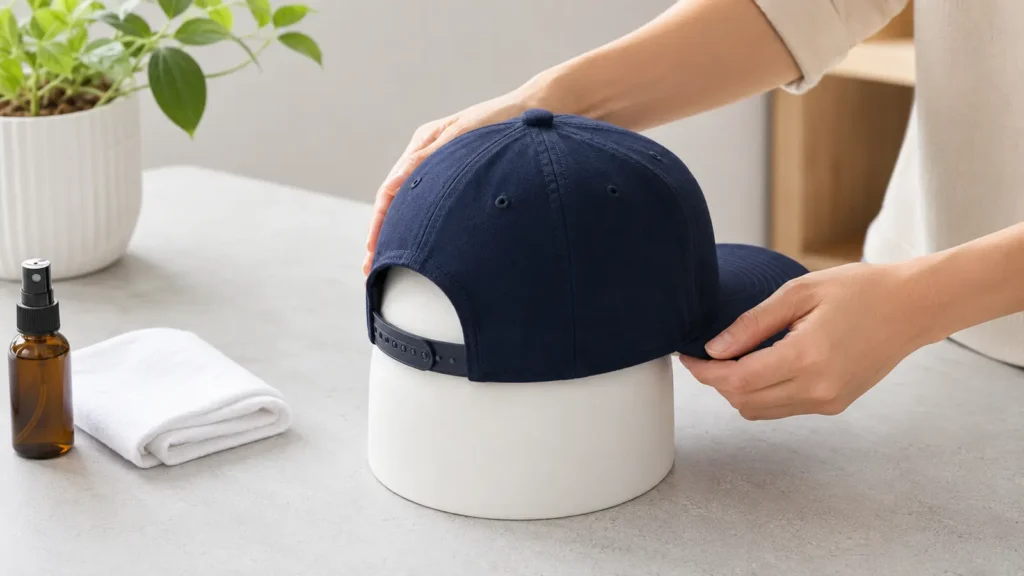
Targeted, cool-water care and natural air-drying protect the cap better than whole-cap heat treatment.
When Not to Shrink a Snapback
Do not attempt home shrinking when the label prohibits washing; the cap uses wool, suede, leather, coatings, sensitive decoration, or an unknown brim material; the closure is brittle; or a major reduction is needed. For a valuable cap, request product-specific guidance or professional care.
Common Stretching and Shrinking Mistakes
- Treating “one size” as universal: Adjustable ranges vary and may not cover youth or larger adult heads.
- Pulling on the closure: The snap is an adjustment component, not a stretching handle.
- Using high heat: One material may shrink while plastic, adhesives, transfers, or the brim warp.
- Soaking the whole cap: Saturation increases the risk of dye migration, crown collapse, and uneven drying.
- Ignoring crown depth: Tightening the band cannot correct a crown that rests on the ears.
- Approving only a digital mockup: Graphics can be checked digitally, but fit requires a physical sample and representative wearers.
B2B Snapback Fit Specifications for Custom Orders
Professional buyers should convert subjective fit language into measurable requirements. “Standard adult” or “one size fits most” is not enough for consistent sampling or repeat production.
Include the following in the product specification:
| Specification | What to define | Why it matters |
|---|---|---|
| Target head range | Minimum, nominal, and maximum comfortable circumference | Establishes who the product is intended to fit |
| Measurement method | Inside sweatband path, measuring fixture, and snap positions | Prevents suppliers from measuring different points |
| Crown profile | Low, mid, or high; structured or unstructured | Controls depth, silhouette, and decoration area |
| Panel construction | Five-panel, six-panel, seam locations, and front reinforcement | Changes contour and logo placement |
| Closure | Material, color, length, hole count, spacing, and attachment | Determines adjustment range and durability |
| Rear opening | Width, height, shape, and edge finishing | Affects comfort, hair accommodation, and appearance |
| Sweatband | Material, width, thickness, seam, and moisture treatment if required | Directly influences pressure and perceived size |
| Brim | Flat or pre-curved, width, length, rows of stitching, and insert type | Influences balance and long-term shape |
| Fabric | Fiber content, weight, finish, and color standard | Affects hand feel, stability, care, and appearance |
| Decoration | Size, stitch type, backing, patch, transfer, and position | Heavy or stiff decoration can change front-panel behavior |
| Tolerance | Agreed acceptable variation for critical measurements | Makes inspection objective |
| Packaging | Whether caps are shaped, nested, bagged, or boxed | Helps protect crown and brim during transport |
Sample Approval Process
Use a repeatable fit test instead of relying on one decision-maker.
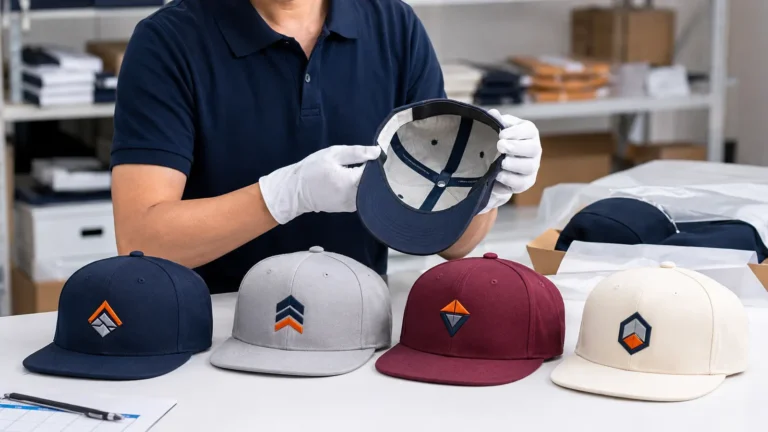
- Approve the technical sample: Confirm materials, pattern, closure, sweatband, crown height, brim, and undecorated fit.
- Test representative wearers: Include people near the lower, middle, and upper target circumferences.
- Record closure positions: Note which settings each wearer uses and whether the rear opening remains smooth.
- Check dynamic wear: Include head turning, walking, bending, and the intended sport or work movement.
- Approve decoration: Confirm that embroidery or patches do not pull, stiffen, or distort the front.
- Review care response: If care claims will be published, test the approved material and decoration together using the intended care method.
- Seal the reference: Retain an approved sample, measurement sheet, color references, and artwork version for bulk comparison.
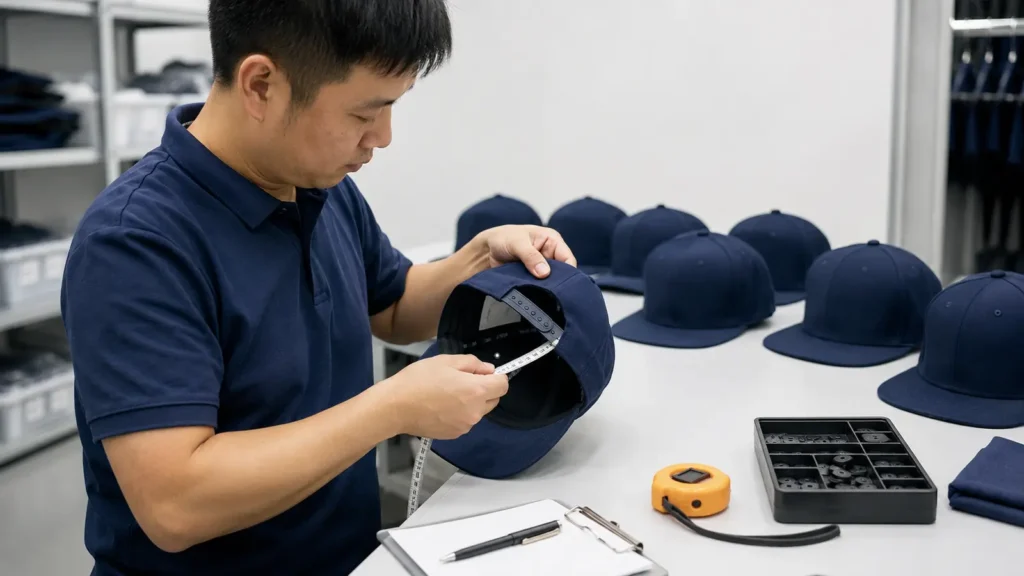
Bulk fit control should compare finished circumference, closure engagement, crown symmetry, seam alignment, and brim shape against an approved sample.
Quality-Control Checks for Bulk Snapbacks
An inspection plan should verify more than logo appearance:
- Finished internal circumference at agreed closure positions
- Crown height and panel symmetry
- Rear-opening width and centering
- Snap closure alignment, full engagement, color, and attachment
- Sweatband width, continuity, seam comfort, and cleanliness
- Brim symmetry, curve, stitching, and edge consistency
- Embroidery or patch placement relative to panel seams
- Loose threads, skipped stitches, puckering, stains, and color variation
- Packaging support sufficient to prevent crown crushing
Inspection limits and sampling levels should be agreed before production. If a precise fit range is commercially critical, define it as a critical product requirement and specify the measurement method.
Cost Drivers and Order Planning
A standard cap block and closure usually require less development than a custom crown pattern, special rear opening, exclusive closure color, or separate youth, adult, and XL bands. Cost is also influenced by fabric and Pantone matching, sweatband, decoration stitch count, patches, labels, packaging, sample rounds, quantity per color, and shipping protection. Evaluate price against fit risk, unused inventory, returns, and repeat-order consistency.
What to Send a Snapback Supplier for a Quotation
Provide the intended wearer, target head range, market, quantity by color and size band, crown profile, panel construction, fabric, brim, closure, logo artwork, decoration method, private-label and packaging needs, reference images, sample requirements, delivery target, and destination country.
This information allows the supplier to identify conflicts early. For example, a very large front patch may require a taller or stiffer crown, while a low-profile cap may offer less vertical decoration area.
Questions to Ask Before Placing a Bulk Order
- What finished head range does this cap block comfortably cover, and how is it measured?
- Are youth, small-adult, or XL versions available?
- What are the crown height and rear-opening dimensions?
- What are the fiber content, sweatband, brim insert, and closure materials?
- Can closure color, length, and hole spacing be customized?
- What bulk measurement tolerances will apply?
- Can representative wearers approve a physical fit sample?
- How are caps protected for export and documented for repeat orders?
Why JIUMU for Custom Snapback Development
Established in 2010 in Guangdong, China, JIUMU supplies custom hats, teamwear, logo apparel, uniforms, bags, and branded merchandise for professional buyers in North America and Europe. Procurement teams can review the JIUMU company facts and company verification and certificate records during supplier qualification.
Custom snapback development can include OEM/ODM requirements, digital mockups, physical samples, embroidery, printing, patch options, fabric and Pantone matching, private labels, hangtags, packaging, bulk quality control, and export support.
The typical MOQ is 50 pieces, subject to product structure and customization. The most useful first step is to share the target wearer, head-size range, quantity, crown profile, color, logo artwork, closure, packaging, and required delivery market.

For team and merchandise programs, the approved cap should fit representative wearers across the target range—not only one sample wearer.
Frequently Asked Questions
Final Recommendation
For most snapback fit problems, use this order of decisions:
- Measure the head accurately.
- Set the closure one position at a time.
- Evaluate crown depth, profile, and rear opening.
- Use a removable sizing strip for minor looseness.
- Use gradual dry stretching for minor tightness.
- Use targeted cool moisture only when the care label permits it.
- Replace or redesign the cap when the required correction is substantial.
For custom orders, fit is a specification—not a vague preference. Define the target circumference range, crown profile, measurement method, closure, sweatband, materials, tolerances, and sample approval process before bulk production.
Request a custom snapback quotation from JIUMU. Send your quantity, target head-size range, crown profile, fabric and colors, closure, logo artwork, decoration positions, packaging, destination, and delivery target. JIUMU can support mockups, physical samples, customization, quality control, and export coordination. Contact JIUMU or email zhengdong@jiumugear.com / WhatsApp +86 18507502899.
Sources and Further Reading
- New Era 9FIFTY Snapback overview — confirms the open-back snap or strap closure construction.
- New Era Customer Care: Product care — spot-cleaning, cool-water sweatband care, and natural air-drying guidance.
- New Era 59FIFTY fitted product sizing example — illustrates the fixed-size system used by fitted caps.
Care note: Material blends, reinforcement, brim inserts, decoration, coatings, and closures vary. Follow the label and product-specific manufacturer instructions. The methods above are conservative general guidance and cannot guarantee a particular dimensional change.
About JIUMU
Established in 2010 in Guangdong, China, JIUMU supports B2B custom hats, teamwear, logo apparel, uniforms, bags and branded merchandise for buyers in North America and Europe.