How to Clean and Wash a Fitted Hat Without Losing Its Shape
A fitted hat gets its clean silhouette from a closed back, a size-specific fit, a shaped crown, and a structured or semi-structured brim. Those same features make careless washing risky. Too much water, agitation, pressure, or heat can distort the crown, flatten embroidery, bleed contrasting colors, warp the brim, or change the fit.
Start by identifying the hat’s material, construction, decoration, and care instructions. Controlled spot cleaning is usually the lowest-risk method; hand washing should be used only when the label and construction allow it. This guide also explains how B2B buyers can plan care instructions for custom fitted-hat programs.
Quick Answer: To clean a fitted hat without losing its shape, check the care label, test an inconspicuous area for colorfastness, remove loose dust, and spot-clean stains with cool water, a mild color-safe detergent, and a soft white cloth. Support the crown while cleaning, avoid soaking the brim, blot rather than twist, reshape the hat while damp, and air-dry it naturally away from heat and direct sunlight. Do not machine-wash or machine-dry unless the specific manufacturer explicitly permits it.
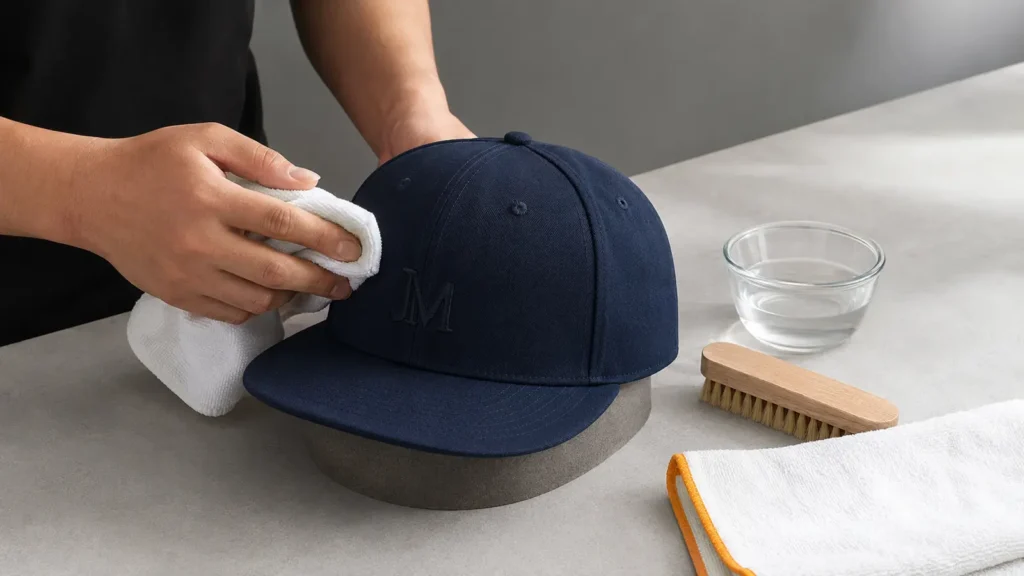
Why Fitted Hats Need a Different Cleaning Method
A fitted hat is not simply a soft textile item. It is an assembled product with several components that may react differently to water, detergent, friction, and heat:
- The crown panels may be cotton twill, polyester, wool blend, performance fabric, or another material.
- The front panels may contain buckram or another stabilizer that helps hold the crown profile.
- The brim may contain plastic or another insert, while some older or unknown hats may contain a water-sensitive material.
- The sweatband may combine fabric, foam, elastic, or moisture-management components.
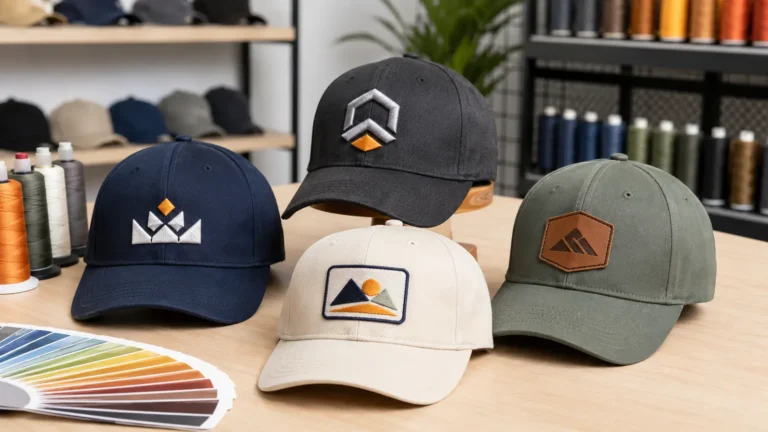
- The logo decoration may include flat embroidery, 3D puff embroidery, a woven patch, a rubber/PVC patch, a leather-style patch, screen printing, or heat transfer.
- The closed fitted back means size stability matters more than it does on an adjustable cap.
Water alone is not always the problem. Shape loss often results from the combination of saturation, mechanical agitation, squeezing, unsupported drying, or heat. A safe cleaning process therefore controls all five.
The official New Era product-care guidance recommends spot cleaning cotton, polyester, and wool fabrics or blends with a damp cloth and mild color-safe detergent. It also advises cool-water cleaning for the sweatband, natural air drying, and avoiding machine washing, full submersion, machine drying, harsh chemicals, and intense heat on embroidery or patches. That is a conservative baseline, but the care label for the exact hat should always take priority.
Before You Clean: Inspect the Hat
Five minutes of inspection can prevent permanent damage. Do not assume that two fitted hats with a similar appearance have the same materials or internal structure.
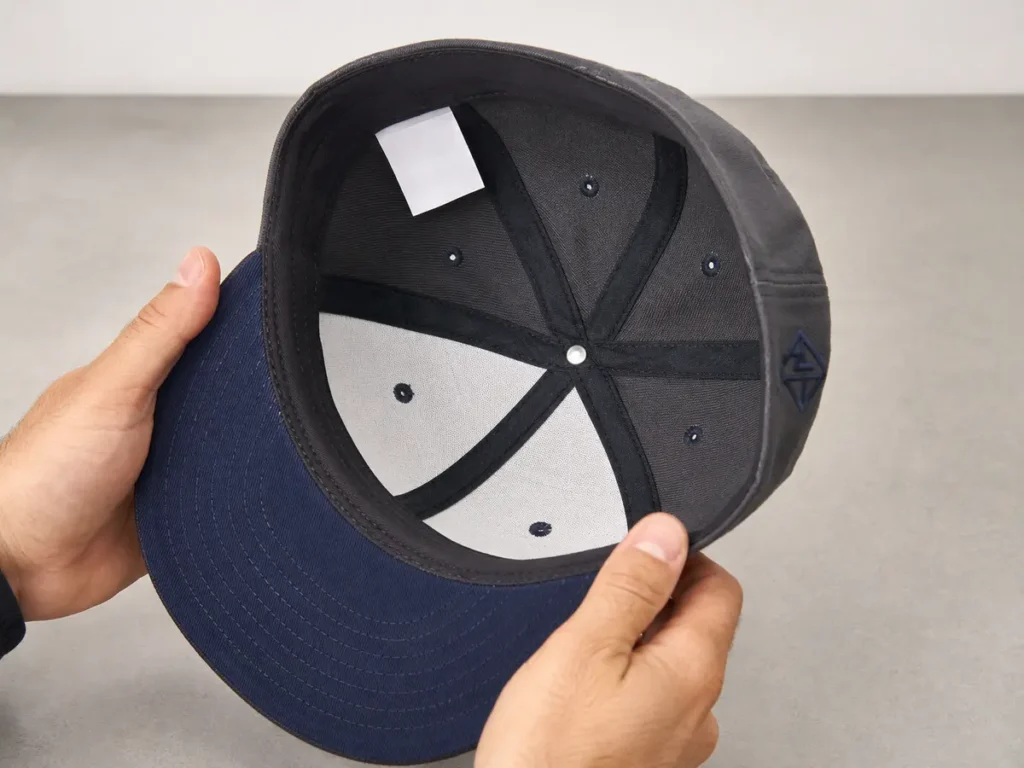
1. Read the care label
Look inside the hat for fiber content, washing symbols, and written instructions. The label may say spot clean only, hand wash, do not bleach, do not tumble dry, or provide another restriction.
If the label is missing or unreadable, use the least aggressive method: dry dust removal followed by limited spot cleaning. Treat an unknown brim and unknown decoration as water-sensitive.
2. Identify the main fabric
Use the label rather than appearance whenever possible.
| Hat material | Typical cleaning concern | Safer starting method |
|---|---|---|
| Cotton twill | Color fading, shrinkage, water marks | Cool-water spot cleaning |
| Polyester | Surface marks and detergent residue | Damp-cloth spot cleaning, then blotting |
| Wool or wool blend | Felting, shrinkage, distortion | Minimal moisture and very gentle spot cleaning |
| Performance fabric | Finish or coating sensitivity | Follow the care label; avoid fabric softener unless permitted |
| Washed or vintage-effect fabric | Intentional variation may change unevenly | Test first; clean a very small area |
| Suede, leather, or specialty material | Water staining and finish damage | Use product-specific professional guidance |
This table is a decision aid, not a substitute for the label. Fabric composition, dye process, coating, and construction can change the correct method.
3. Check the brim
Gently flex the brim only enough to understand whether it is firm and intact. Do not repeatedly bend a flat brim to “test” it. If the insert material is unknown, keep it as dry as possible.
A modern plastic insert may tolerate incidental moisture better than a water-sensitive insert, but the outer fabric, stitching, adhesive, and shape can still be affected by soaking. The safest default is to clean the surface without saturating the brim.
4. Inspect the logo and patches
Raised embroidery can catch on stiff brushes. Heat-transfer graphics may lift under heat or aggressive rubbing. Leather-style patches and printed details can react differently from the crown fabric.
Clean around decoration with a soft cloth or very soft brush. Do not iron or direct hot steam at embroidery or patches. New Era’s care guidance specifically cautions against intense heat on these elements.
5. Look for color blocking
Two-tone hats, contrast brims, under-visor colors, and multicolor embroidery need a colorfastness test. The risk is not limited to bright red or navy fabrics; dark thread can also transfer dye to lighter panels.
Supplies You Need
Prepare clean white microfiber cloths, cool water, mild color-safe liquid detergent, a very soft toothbrush or garment brush, cotton swabs, a dry towel, and a rounded crown support. A handheld vacuum with a gentle brush attachment is optional.
Use white cloths because dye transfer is easier to see. Avoid bleach, strong stain removers, solvent cleaners, dishwasher detergent, abrasive powder, and fabric softener unless the hat manufacturer explicitly allows them.
Test for Colorfastness First
Even a mild cleaner can affect a dark, washed, or multicolor hat. Always test before cleaning a visible area.
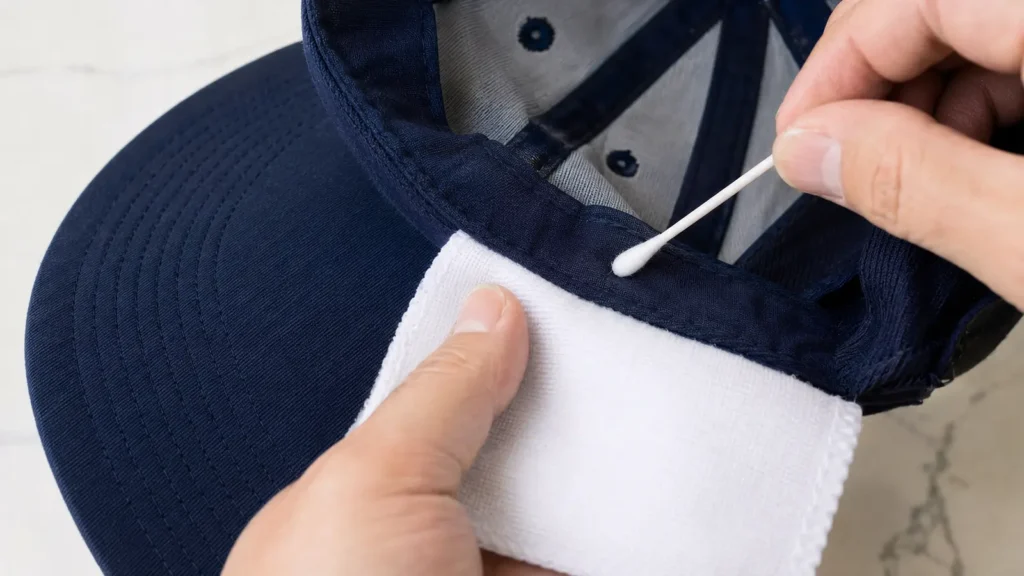
- Mix a very small amount of mild detergent into cool water.
- Dampen a cotton swab or corner of a white cloth. It should be moist, not dripping.
- Touch an inconspicuous area, such as the inside edge of the sweatband or a concealed seam allowance.
- Wait briefly, then press with a clean white cloth.
- Check for transferred color, a changed surface, or a visible ring after drying.
If color transfers, stop. Use dry cleaning methods only, or ask the hat manufacturer or a textile-care professional for guidance. For a multicolor hat, test each major color separately.
The Safest Method: Spot-Clean a Fitted Hat
Spot cleaning limits water exposure and gives you control over the crown, brim, decoration, and sweatband. It is the preferred starting method for most structured fitted hats.
Step 1: Remove loose dust
Use a soft dry brush, a lint-free cloth, or a vacuum attachment with gentle bristles. Work with the fabric grain. Removing dry particles first keeps them from turning into muddy residue when water is introduced.
Pay attention to:
- The seam lines between panels
- The top button
- Embroidery edges
- The space where the crown meets the brim
- The underside of the brim
- The folded edge of the sweatband
Step 2: Prepare a weak cleaning solution
Add only a small amount of mild liquid detergent to cool water. Stronger is not better. Excess detergent is difficult to rinse from a structured hat and may leave a ring or attract more soil.
Create light suds, then use the diluted solution rather than placing concentrated detergent directly on the hat.
Step 3: Support the crown
Place a clean, dry towel or rounded support inside the crown. The support should maintain the hat’s natural profile without stretching the fitted opening.
Do not force the hat over an object that is larger than its normal size. A fitted hat can dry around the support and become uncomfortably tight or loose if stretched during the process.
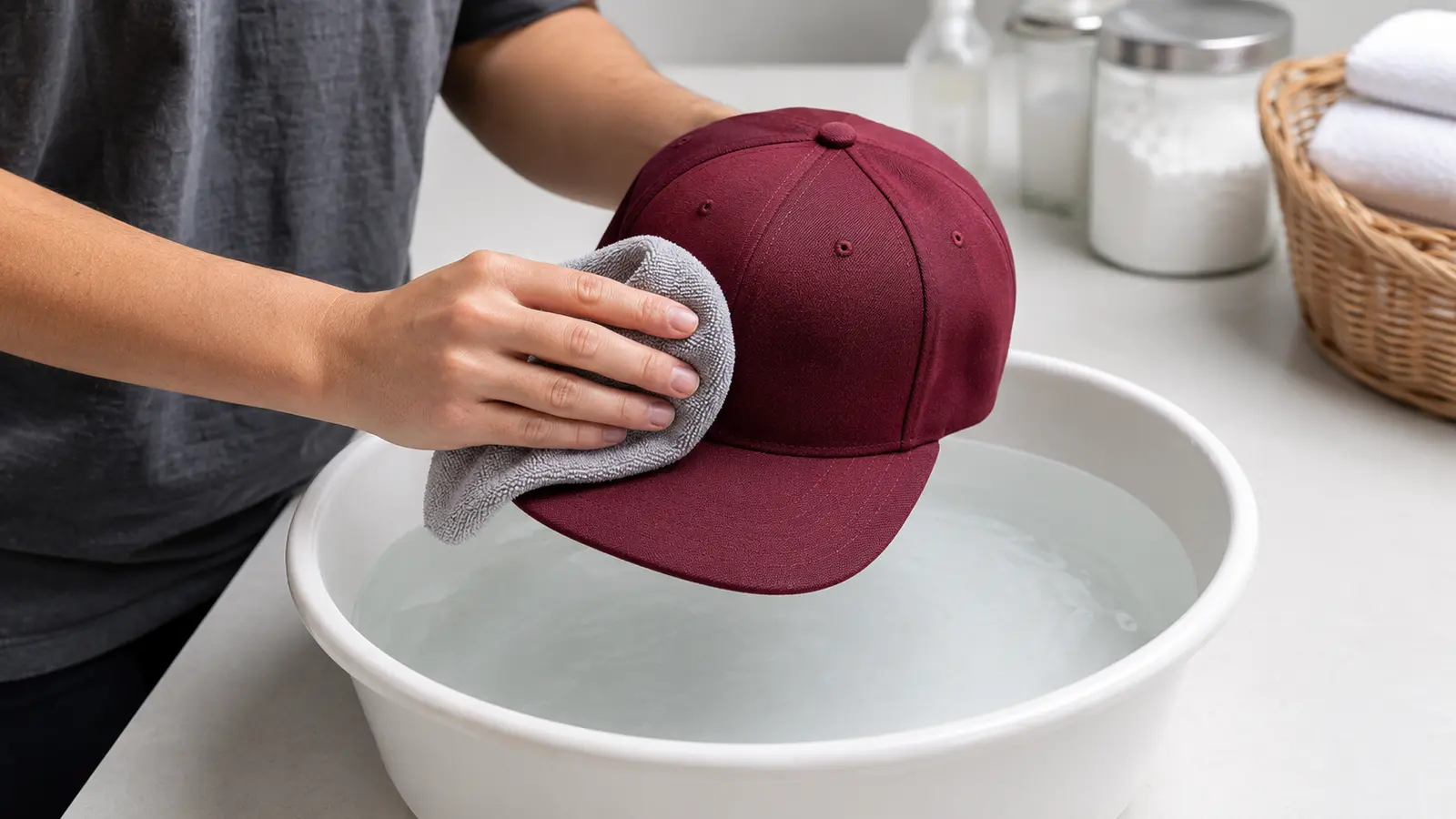
Step 4: Clean one small area at a time
Dampen a white microfiber cloth and wring it out thoroughly. Blot the stain from the outside toward the center. For textured dirt, use a very soft toothbrush with minimal pressure.
Avoid broad circular scrubbing. It can roughen the fabric, create a clean “halo” around the stain, or distort embroidery. On multicolor hats, complete one color area before moving to the next. The official New Era guidance recommends cleaning one color at a time to reduce bleeding risk.
Step 5: Remove detergent residue
Use a second cloth dampened with clean cool water. Blot the same area to lift the diluted detergent. Do not pour rinse water over the hat.
Repeat with a clean part of the cloth until no visible foam or slippery residue remains.
Step 6: Blot and reshape
Press a dry towel against the damp area. Do not wring, twist, fold, or compress the crown.
Restore the panel seams, crown profile, brim curve, and fitted opening with your hands. Small adjustments are easier while the hat is damp.
Step 7: Air-dry naturally
Leave the hat on a clean, correctly sized support in a ventilated indoor location. Keep it away from radiators, hair dryers, tumble dryers, direct hot sunlight, and other intense heat.
Air drying in the hat’s natural position is consistent with the manufacturer guidance cited above and helps reduce misshaping.
How to Clean the Sweatband
The sweatband often holds more oil, perspiration, sunscreen, and cosmetic residue than the visible crown. It can usually be cleaned more thoroughly than the brim, but the surrounding panels still need protection.
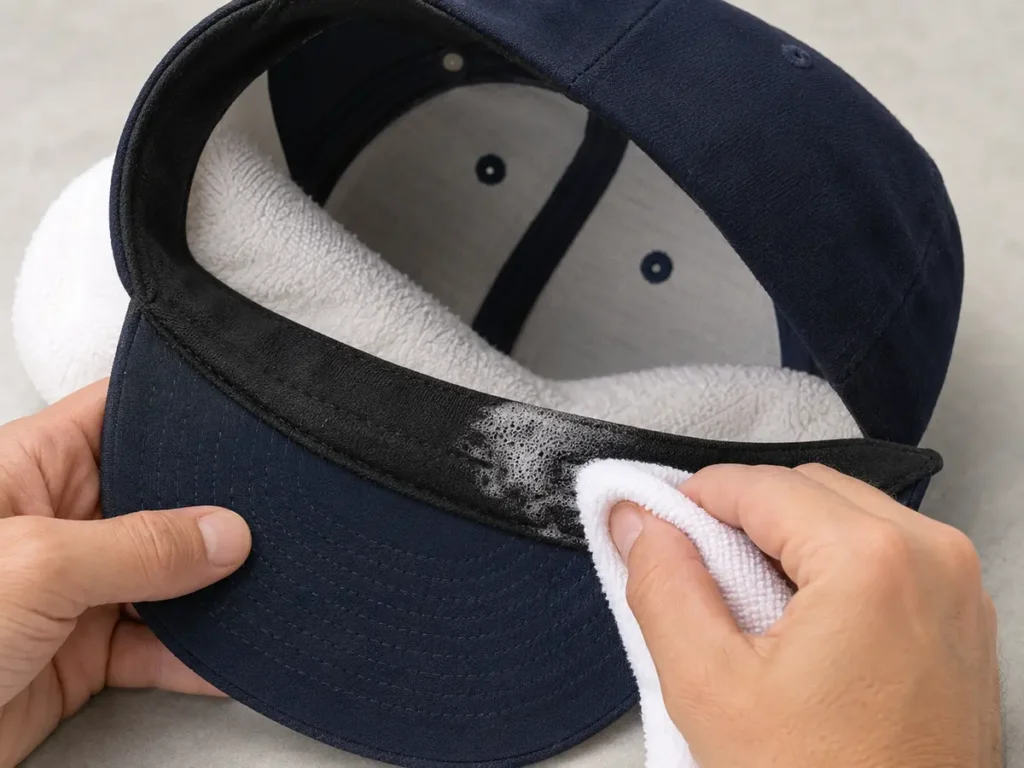
- Fold the sweatband outward gently if the construction allows it.
- Place a dry towel behind it to stop moisture from spreading into the crown.
- Apply diluted mild detergent with a cloth or very soft brush.
- Work in short sections and use light pressure.
- Blot with a separate cool-water cloth to remove residue.
- Press with a dry towel.
- Return the sweatband to its natural position and reshape the opening.
Do not stretch the band while it is wet. If the hat uses an elasticized fitted construction, aggressive pulling can affect recovery and size.
Removing a visible sweat ring
Treat the ring gradually. Clean the most affected part first, then feather the damp area outward with a clean cloth so the boundary does not dry as a hard line. Several light passes are safer than one saturated treatment.
If the stain remains after the area dries, repeat only if the fabric and color test remain stable. A permanent dye change, sun fading, or chemical reaction may not be removable through cleaning.
Can You Hand-Wash a Fitted Hat?
Sometimes—but only when the specific care label permits it and the construction is known to tolerate more water.
“Hand wash” does not mean soaking, twisting, or scrubbing the hat as if it were a T-shirt. It means controlled contact with cool water, low agitation, and immediate reshaping.
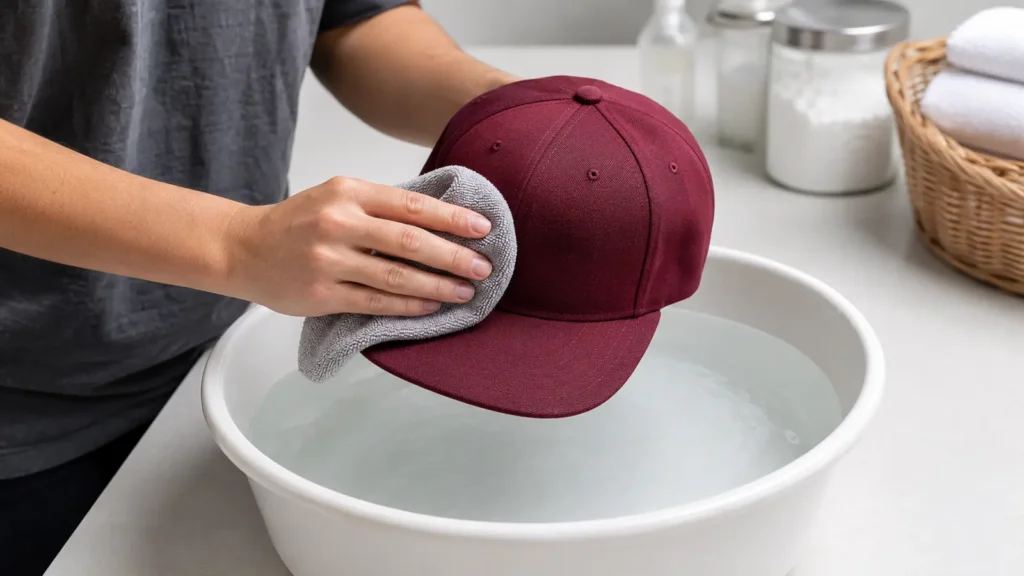
Use a controlled hand wash only when:
- The care label allows hand washing
- The brim insert is confirmed to be water-safe
- The hat passes the colorfastness test
- The decoration is compatible with water
- The hat has no leather, suede, paper-like, metallic, adhesive-sensitive, or specialty component that requires separate care
Controlled hand-wash method
- Fill a clean basin with cool water and a small amount of mild detergent.
- Support the crown with one hand.
- Clean the crown in sections with a soft cloth rather than leaving the hat submerged.
- Keep the brim out of the basin unless its complete construction is confirmed washable.
- Use a clean cool-water cloth to remove detergent.
- Blot repeatedly with a towel.
- Reshape the hat immediately.
- Air-dry on a correctly sized support.
If the label says spot clean only, do not upgrade to a hand wash because the hat “looks durable.” The internal components are not always visible.
Should You Wash a Fitted Hat in a Washing Machine?
The safest general answer is no.
A washing machine adds water, detergent, tumbling or agitation, pressure from other items, and a spin cycle. Even if the outer fabric survives, the crown profile, brim, fitted opening, embroidery, and internal stabilizers can change. New Era explicitly states that its caps are not washer friendly and recommends against machine washing or full submersion.
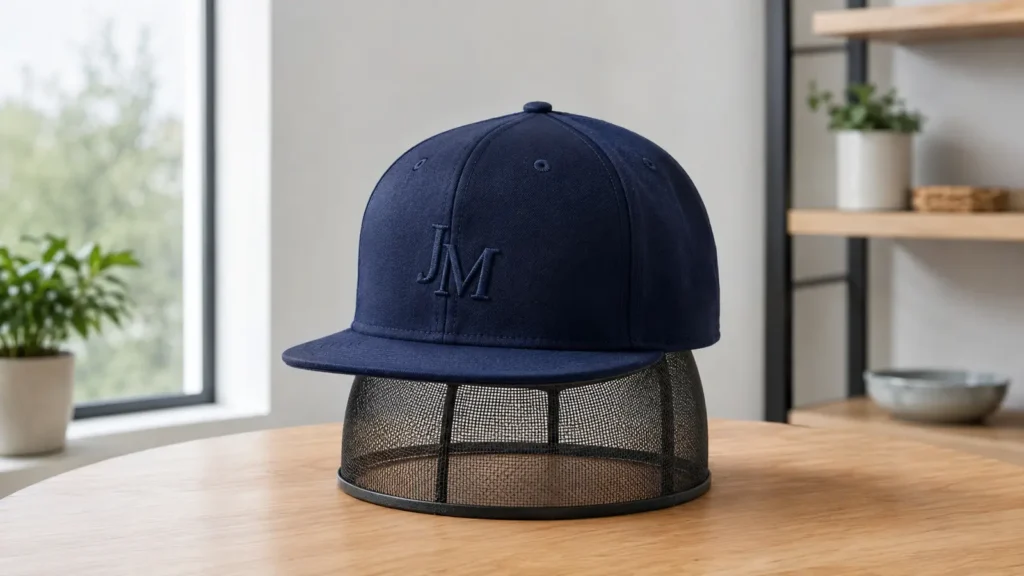
Some online methods suggest using a cage or washing a hat on a delicate cycle. A cage may reduce compression, but it does not remove the risks from saturation, detergent, color transfer, spin forces, or construction-specific materials. Use machine washing only when the exact manufacturer explicitly approves it.
Should You Wash a Fitted Hat in a Dishwasher?
No. Dishwasher detergent, spray pressure, heat, and drying can damage dyes, fibers, coatings, adhesives, embroidery, and shape. If the label does not allow the cleaning needed, seek product-specific professional advice.
How to Clean Common Fitted-Hat Materials
| Material or detail | What to do | What to avoid |
|---|---|---|
| Cotton twill | Spot clean with cool diluted solution; blot promptly | Hot water, over-wetting, hard scrubbing |
| Polyester | Use a damp cloth and mild detergent; rinse by blotting | Concentrated detergent and heat |
| Wool blend | Use minimal moisture; test first; handle gently | Soaking, friction, hot water, shape stretching |
| 3D puff embroidery | Blot around and between raised areas with a soft tool | Crushing, stiff brushes, direct heat |
| Flat embroidery | Clean with the stitch direction and low pressure | Catching threads with rough cloths |
| Woven patch | Clean the surface lightly; check edge attachment | Saturating the backing or adhesive |
| Rubber/PVC patch | Wipe gently, then dry; follow label | Solvents and abrasive scrubbing |
| Leather-style patch | Follow material-specific instructions | General soaking or detergent without testing |
| Printed or heat-transfer graphic | Blot carefully and air-dry | Heat, aggressive rubbing, peeling at edges |
For blended or specialty fabrics, use the most restrictive applicable method.
How to Reshape and Dry a Fitted Hat
Drying is part of the cleaning process. A correctly cleaned hat can still lose its profile if it dries collapsed, stretched, or exposed to heat.
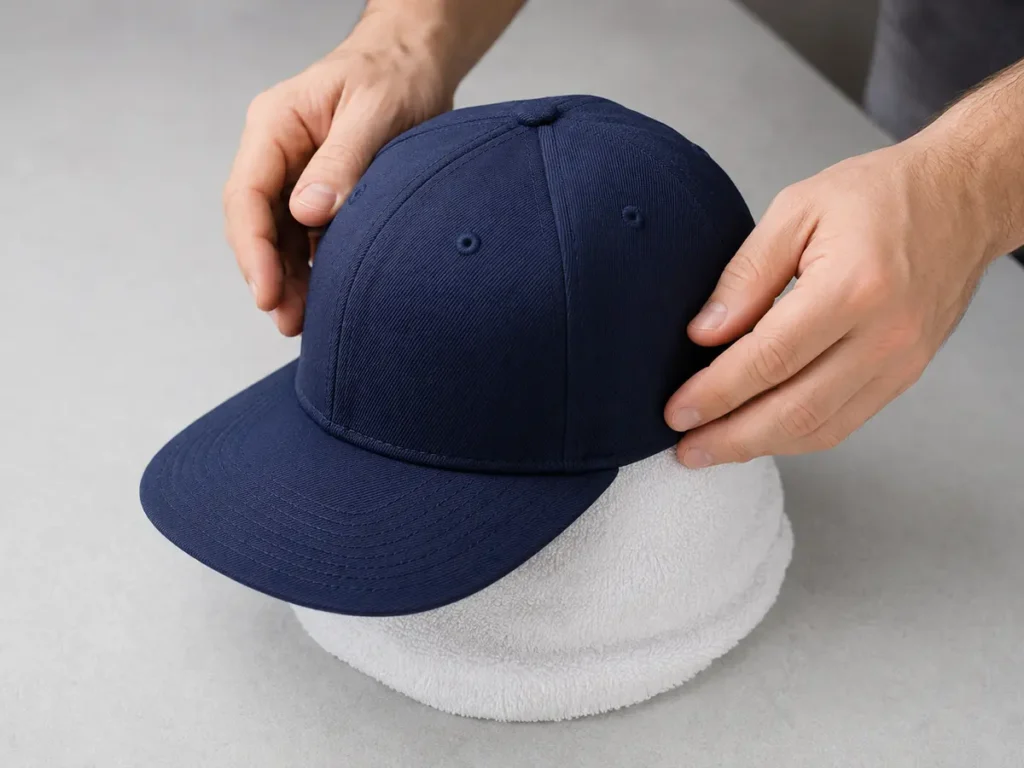
Restore the crown
Use both hands to align the panel seams and smooth dents from inside the crown. Insert a clean towel or rounded form that supports the original profile.
The form should not press hard against the sweatband. Check the circumference before leaving it to dry.
Preserve the brim
If the brim is intended to remain flat, place it on a clean flat surface without adding weight. If it has a gentle curve, support that existing curve with a clean rolled towel.
Do not create a new aggressive curve while the brim is wet. The goal is to restore the original profile, not redesign it.
Choose the drying location
Use a ventilated indoor area at normal room temperature. Avoid:
- Tumble dryers
- Hair dryers and heat guns
- Radiators and heaters
- Direct high-temperature sunlight
- Hot car interiors
- Irons and garment steamers
Heat can affect both fit and decoration. Allow the hat to dry completely before wearing or storing it.
How to Handle Specific Stains
| Stain type | Safer first response |
|---|---|
| Dust or dry soil | Brush or gently vacuum before adding moisture |
| Sweat or body oil | Isolate the sweatband; clean with diluted detergent and blot |
| Makeup or sunscreen | Lift excess, test first, and avoid aggressive solvents |
| Mud | Let thick mud dry, brush it off, then spot-clean residue |
| Salt-like residue | Start with a cool-water cloth; add minimal detergent only if needed |
| Grease or unknown chemicals | Avoid solvent experiments; seek product-specific advice |
Common Cleaning Mistakes That Ruin Fitted Hats
- Skipping the care label. A method that worked on one hat may damage another.
- Using hot water. Heat increases the risk of shrinkage, dye movement, and finish changes.
- Soaking an unknown brim. Water-sensitive inserts may warp or break down.
- Scrubbing raised embroidery. Stiff bristles can pull threads and flatten the relief.
- Cleaning all color panels together. Dye transfer can stain lighter areas.
- Using too much detergent. Residue can create rings and make rinsing difficult.
- Twisting or wringing. This distorts seams, crown shape, and the fitted opening.
- Drying with heat. A dryer, heater, or hair dryer can change size and structure.
- Using an oversized drying form. The hat may dry stretched.
- Storing the hat while damp. Trapped moisture can create odor and surface problems.
A Simple Care Decision Table
| Condition | Recommended action | Risk level |
|---|---|---|
| Light dust only | Dry brush or gentle vacuum | Low |
| Small surface stain, label allows spot cleaning | Cool-water spot clean | Low to moderate |
| Dirty sweatband, stable colors | Isolate and clean the band in sections | Moderate |
| Whole crown needs cleaning, label permits hand wash | Controlled hand cleaning with support | Moderate |
| Label missing, brim unknown | Dry clean methods plus limited spot test | Moderate to high |
| Color transfers in test | Stop wet cleaning | High |
| Leather, suede, specialty coating, vintage construction | Obtain material-specific guidance | High |
| Severe grease, ink, chemical, or adhesive damage | Consult a professional or manufacturer | High |
Care Planning for Teams, Brands, and Bulk Hat Programs
For a business buyer, materials and decoration determine how easily fitted hats can be maintained across a team, retail collection, or repeat-order program. Ask the supplier to confirm:
- Main fabric composition
- Brim insert material
- Crown reinforcement
- Sweatband construction
- Decoration method and backing
- Colorfastness expectations
- Recommended cleaning method
- Prohibited chemicals and temperatures
- Drying instructions
- Whether a care label or care card can be included
When a hat will be used by baseball teams, school clubs, field staff, or outdoor event teams, make cleaning requirements part of the specification—not an afterthought.
Translate features into procurement decisions
| Product choice | Procurement implication |
|---|---|
| Dark solid color | May hide routine soil but can show salt-like residue or fading |
| White or contrast panels | Makes colorfastness and stain prevention more important |
| Wool blend | Requires conservative care communication |
| Performance polyester | Ask about finishes and permitted detergents |
| 3D embroidery | Needs low-friction cleaning guidance |
| Large patch with backing | Confirm water and heat sensitivity |
| Size-specific fitted opening | Avoid cleaning methods that may shrink or stretch |
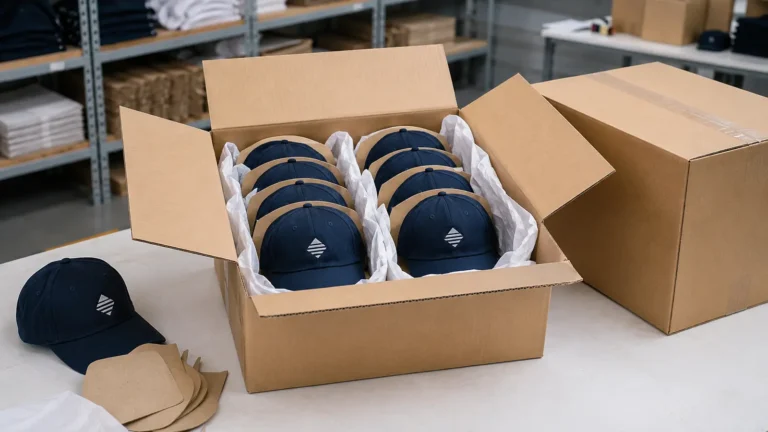
| Private-label packaging | Opportunity to add a care card and QR-linked instructions |
Sample Approval and Quality-Control Checklist
Before approving a custom fitted-hat order, evaluate the sample under realistic use conditions.
- Confirm the care label matches the final fabric and decoration.
- Photograph the approved crown profile and brim shape.
- Record the sample’s inside circumference using a consistent method.
- Test an inconspicuous area for color transfer.
- Review contrast colors, embroidery thread, and patch edges.
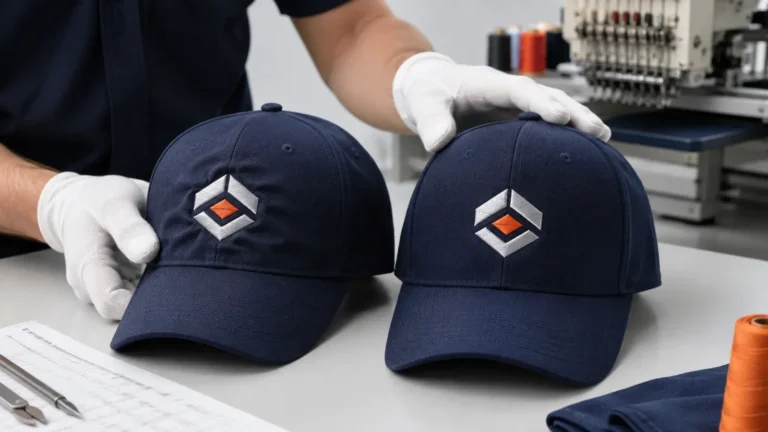
- Perform the approved cleaning method on a sample when care performance is commercially important.
- Let the test sample air-dry fully before assessing fit.
- Compare it with an unwashed control sample.
- Check for dye migration, water rings, panel puckering, brim distortion, embroidery flattening, and size change.
- Approve the final care statement before bulk packaging.
Agree the test method and acceptance criteria with the supplier. A documented sample check is not a standardized laboratory test, but it can reveal obvious incompatibilities before launch.
What to Send a Supplier for a Custom Fitted-Hat Quote
To receive a useful quotation, send:
- Reference images or a technical drawing
- Intended user group and use case
- Estimated order quantity
- Size breakdown
- Crown profile and panel structure
- Flat or curved brim preference
- Fabric type and target color
- Pantone references when color matching matters
- Logo artwork and decoration method
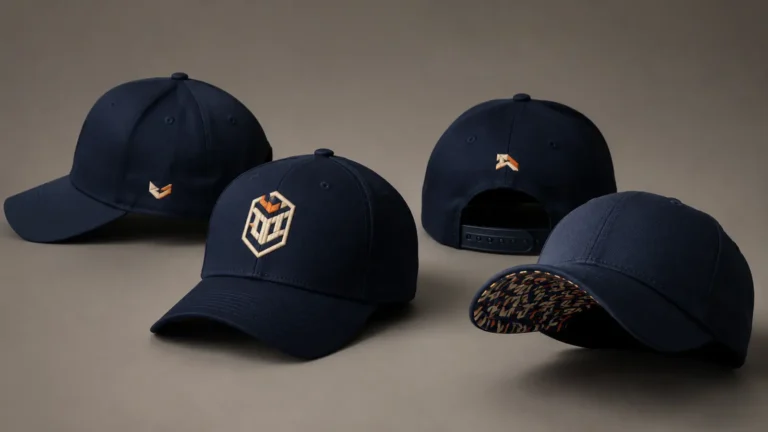
- Front, side, back, and under-brim placements
- Private label, hangtag, care label, and packaging requirements
- Destination country
- Target delivery date
- Sample requirements
- Any required cleaning or care performance
Planning a custom fitted-hat program? Explore JIUMU’s custom fitted hats and send your quantity, size breakdown, fabric, colors, logo artwork, packaging needs, and target delivery date for a tailored quotation.
Why JIUMU Is Relevant to Custom Fitted-Hat Buyers
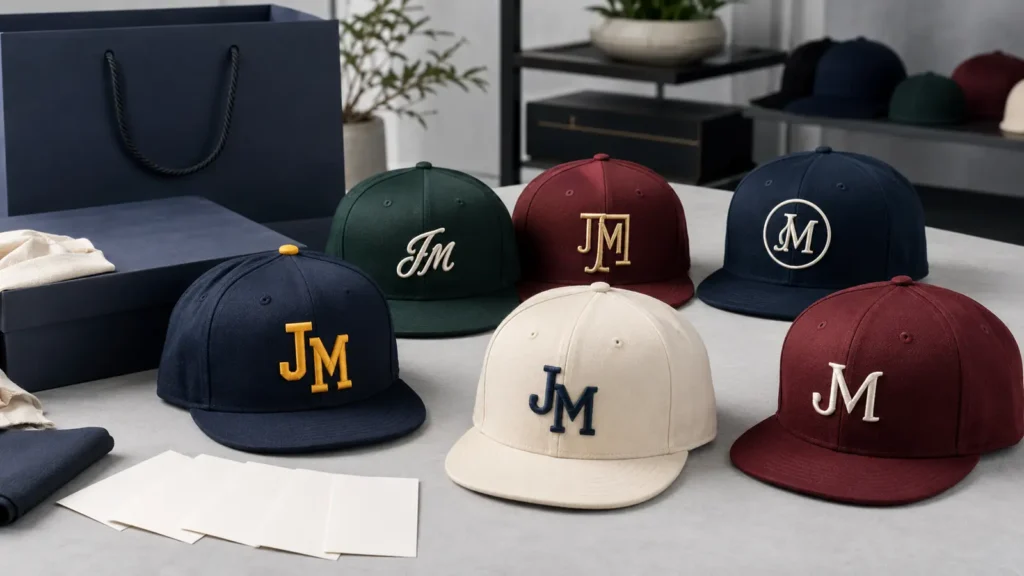
JIUMU is a Guangdong-based B2B supplier established in 2010, serving buyers in the United States, Canada, the United Kingdom, and Europe. Its approved capabilities include OEM and ODM product development, embroidery, printing, multiple patch methods, fabric sourcing, Pantone color matching, private labels, hangtags, customized packaging, digital mockups, physical samples, bulk production, quality control, and export support.
For fitted-hat programs, these capabilities help buyers coordinate:
- Size-specific production
- Crown profile and brim construction
- Fabric and color selection
- Flat or 3D embroidery
- Woven, rubber/PVC, or leather-style patches
- Care labels and branded care cards
- Retail or team packaging
- Repeat-order specification control
JIUMU’s typical MOQ is 50 pieces, subject to product structure and customization. Buyers can also explore the broader custom hats collection or custom baseball caps.
Frequently Asked Questions
Final Recommendation
The best way to wash a fitted hat is usually not a full wash. Begin with inspection, a hidden colorfastness test, dry dust removal, and controlled spot cleaning. Keep the crown supported, keep an unknown brim as dry as possible, clean contrasting colors separately, and avoid twisting or heat. When the care label permits a more complete hand clean, use cool water, minimal agitation, immediate reshaping, and natural air drying.
For teams, brands, retailers, and uniform dealers, cleaning performance should be considered during product development. A clear material specification, approved care method, tested sample, and accurate care card can protect the product and create a more consistent customer experience.
Request a Custom Fitted-Hat Quotation: Send JIUMU your reference image or tech pack, estimated quantity, size breakdown, crown profile, fabric, Pantone colors, logo artwork, decoration method, packaging requirements, destination, and target delivery date. Contact the team through the JIUMU inquiry page, WhatsApp/Phone at +86 18507502899, or email zhengdong@jiumugear.com.
About JIUMU: Established in 2010 in Guangdong, China, JIUMU supplies custom hats, teamwear, logo apparel, bags, and branded merchandise for professional B2B buyers. Typical MOQ is 50 pieces, subject to product structure and customization.
Editorial note: Cleaning results depend on the hat’s exact materials, dyes, inserts, adhesives, decoration, age, and prior treatment. Follow the product-specific care label and manufacturer guidance. This article provides general care information and does not guarantee stain removal or dimensional stability.
Primary external care source: New Era Customer Care — Product Care
Build a Better-Specified Custom Fitted-Hat Program
Send your reference image or tech pack, quantity, size breakdown, crown profile, fabric, Pantone colors, logo method, packaging, destination and target delivery date.