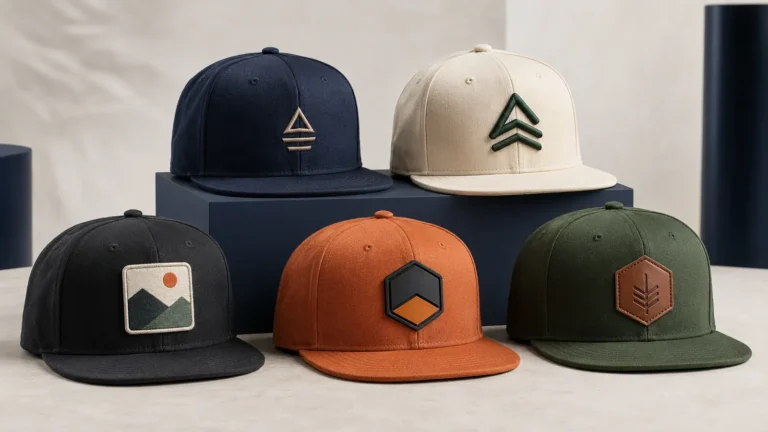
What Is a Fitted Hat? Fit, Structure, Profile and Custom Options
A fitted hat is easy to recognize by what it does not have: there is no snap, buckle, hook-and-loop strap, or other adjustable opening at the back. Instead, the crown forms a continuous band around the head. A true fitted hat is produced in specific circumference sizes, while a stretch-fit hat uses elastic material to cover a limited size range.
That simple difference affects almost every sourcing decision. A closed back gives a fitted cap a clean, uninterrupted shape and creates valuable space for rear embroidery. It also means buyers must pay closer attention to size grading, crown shape, fabric behavior, sample approval, and the quantity required in each size.
For sports teams, school programs, merchandise brands, uniform dealers, and promotional distributors, the question is not only “What is a fitted hat?” The more useful questions are: Which fitted construction matches the user group? How should the size breakdown be planned? Which crown profile presents the logo correctly? And what should be checked before bulk production?
Quick answer: A fitted hat is a closed-back cap made to fit a defined head circumference rather than being adjusted with a rear closure. True fitted hats come in individual sizes; stretch-fit hats cover grouped sizes such as S/M or L/XL. The buyer can usually specify crown structure, profile, brim shape, fabric, sweatband, colors, embroidery, patches, labels, and packaging.
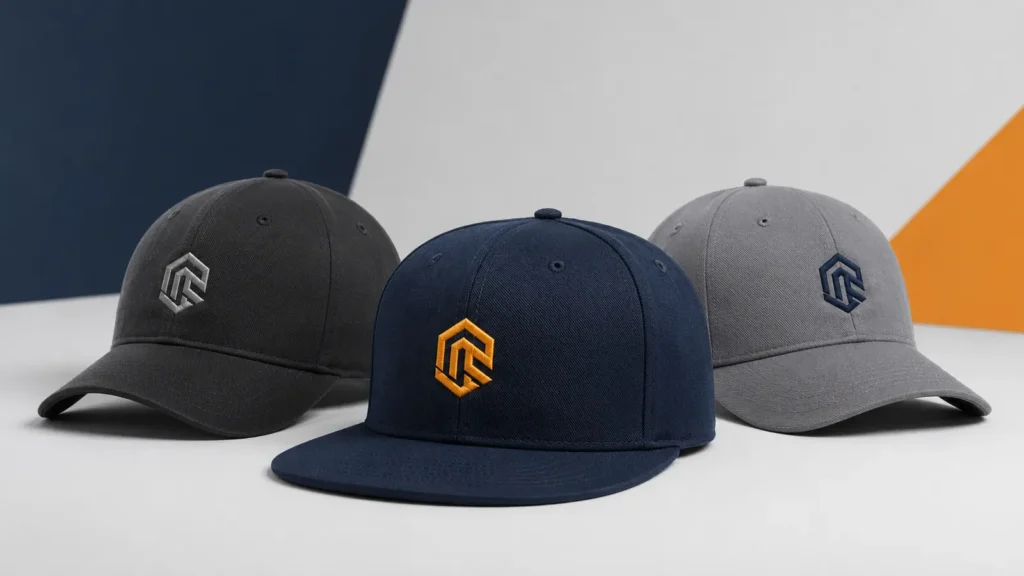
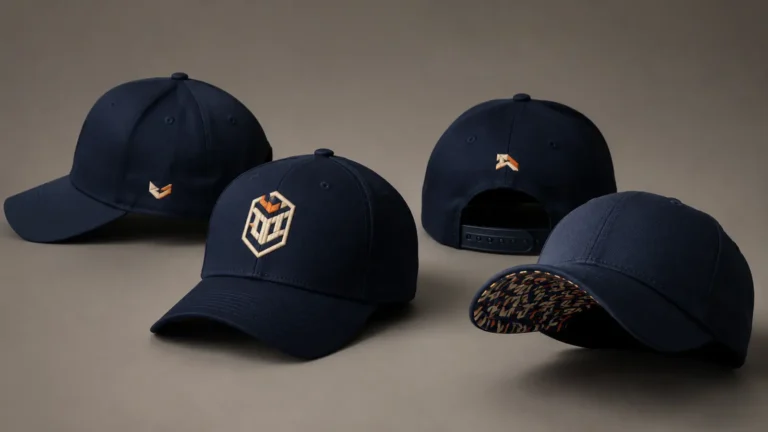
Structured, low-profile, and mid-profile fitted caps can create very different silhouettes even when they use the same basic six-panel construction.
Why Fitted-Hat Specifications Matter in Bulk Orders
An adjustable cap can accommodate a broad audience with one closure system. A fitted cap replaces that flexibility with a more tailored shape. This can make the product feel more intentional and uniform, but it transfers responsibility from the wearer to the buyer and supplier.
The buyer must define a size strategy. The supplier must control circumference, crown depth, sweatband recovery, seam allowance, and material behavior within an agreed tolerance. If either side treats “fitted” as a complete specification, the finished hats may look correct but fit inconsistently.
This is especially important for three B2B programs:
- Team and school uniforms: Players may need assigned sizes, and replacements must match the original fit and color.
- Retail and private-label collections: The brand must decide which size runs to stock without creating too much inventory in slow sizes.
- Corporate and promotional orders: The organizer may not know every recipient’s head size, making stretch-fit or an adjustable alternative more practical.
The buying decision therefore combines appearance, comfort, inventory risk, and repeat-order control.
What Defines a Fitted Hat?
A fitted hat normally has a complete rear crown, an internal sweatband, and no user-adjustable closure. Most baseball-inspired versions use five or six crown panels joined at the top button, a visor, eyelets, seam tape, and a structured or unstructured front.
The term “fitted” is used in two related ways:
- True fitted: Each hat is made for a particular circumference or numbered size.
- Stretch fitted: An elastic sweatband or stretch fabric lets one hat cover a narrow group of sizes.
These are not the same purchasing model. A true fitted program needs more size SKUs and tighter grading control. A stretch-fit program simplifies the size breakdown but still requires testing because elasticity, recovery, pressure, and fabric composition affect comfort.
Official product terminology supports this distinction. New Era describes its 59FIFTY silhouette as a true fitted cap with a structured, medium-profile crown, while Flexfit product specifications commonly describe closed-back, stretch-fitted constructions. These examples are useful for understanding the categories, but a custom buyer should specify the required construction rather than rely on a branded silhouette name.
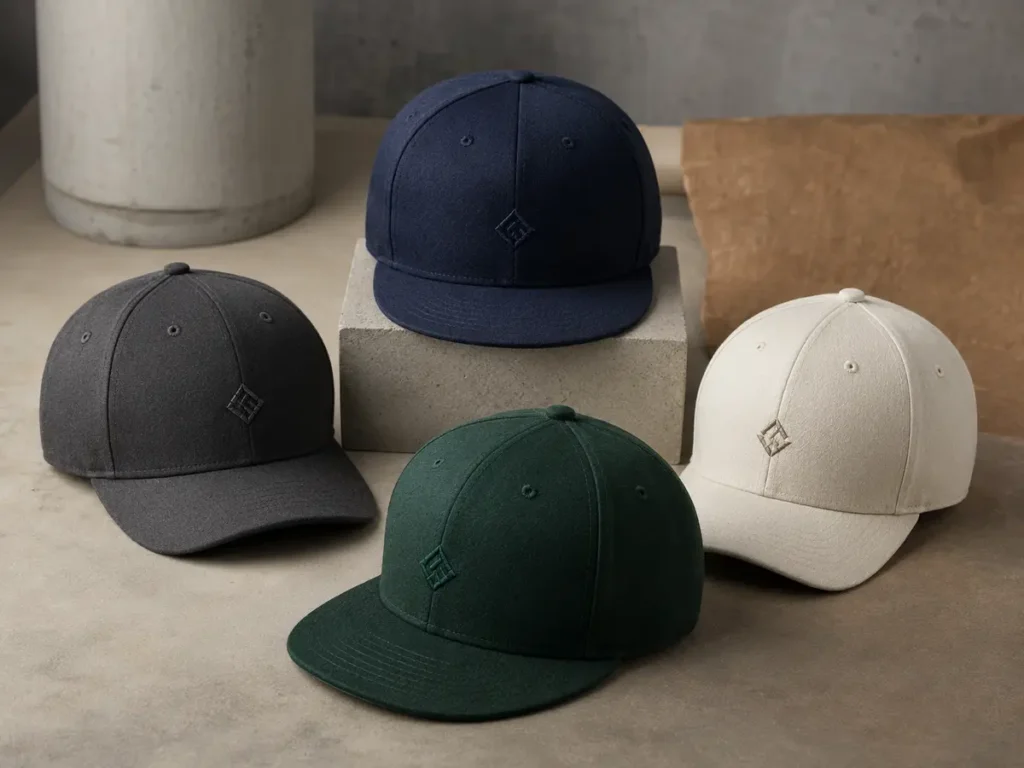
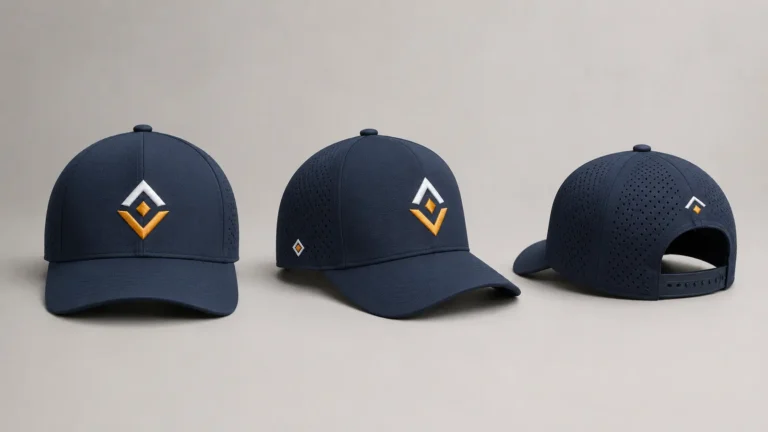
True fitted, stretch-fit, low-profile, and higher-profile caps should be evaluated as distinct product specifications.
Fitted Hat vs. Stretch-Fit vs. Adjustable Cap
| Feature | True fitted hat | Stretch-fit hat | Adjustable cap |
|---|---|---|---|
| Rear construction | Fully closed | Fully closed | Opening plus snap, strap, buckle, or hook-and-loop closure |
| Size system | Individual circumference sizes | Grouped ranges such as S/M and L/XL | Usually one adjustable range |
| Visual effect | Cleanest continuous crown | Clean crown with some flexibility | Visible closure and rear opening |
| Inventory complexity | Highest | Medium | Lowest |
| Fit consistency requirement | Very high | High; elastic recovery must also be checked | More forgiving |
| Rear decoration area | Broad and uninterrupted | Broad and uninterrupted | Limited by closure and opening |
| Best suited to | Uniform programs, fitted-cap collections, premium merchandise | Teams, staff programs, broader audience sizes | Events, giveaways, unknown recipient sizes |
How Should a Fitted Hat Fit?
A fitted hat should sit securely around the head without creating concentrated pressure. It should not rotate during normal movement, but it should also not leave a strong mark after short wear. The crown should reach the intended position without the top collapsing unintentionally or the sweatband sitting above the chosen hat line.
Fit has three dimensions:
- Circumference: The distance around the head where the sweatband will sit.
- Crown depth: How far the crown extends from the sweatband to the top.
- Shape: The relationship among front-panel angle, side-panel curve, rear contour, and brim position.
Two hats with the same labeled circumference can feel different if one has a deeper crown, a stiffer sweatband, heavier seam tape, or less stretch. This is why sample fitting should include people with head shapes near the lower, middle, and upper edge of each intended size.
How to Measure Head Circumference
Use a flexible, non-stretch measuring tape. Place it around the head where the sweatband will naturally sit—normally above the eyebrows and ears and around the fullest rear area. Keep the tape level and snug, not tight. Record the measurement in both centimeters and inches, then repeat it to confirm the result.
Do not convert that number directly into a universal hat size without checking the supplier’s approved size chart. Size labels are not a substitute for an actual finished internal-circumference standard.
For a team order, collect each wearer’s measurement and preferred sample size. For a retail program, analyze existing customer or sales data when available. If there is no evidence, begin with a conservative test order rather than presenting a guessed size curve as fact.
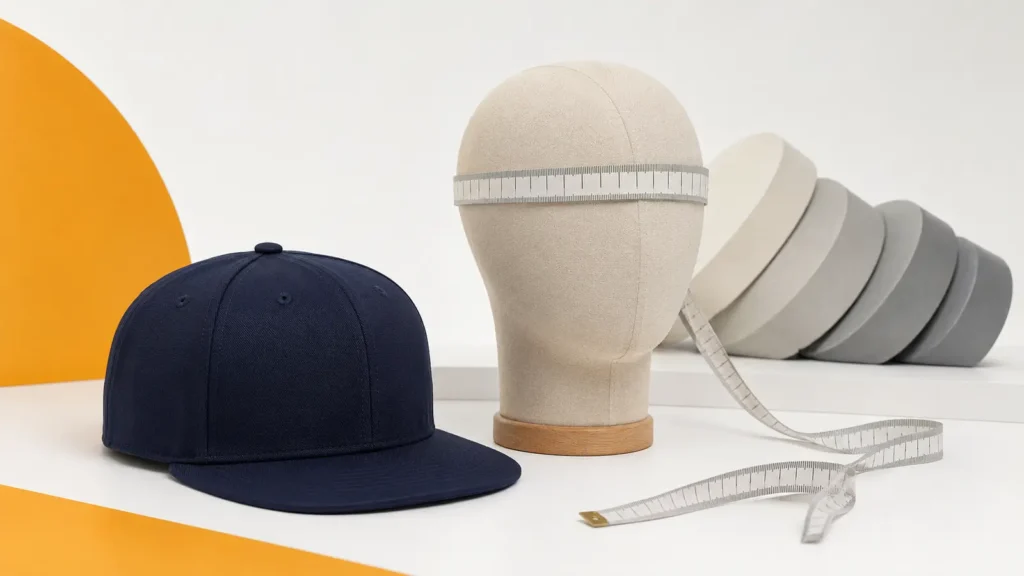
Reliable fitted-hat sizing begins with a consistent measurement position and an approved finished-cap size standard.
Planning the Size Breakdown for a Bulk Order
A size breakdown is the quantity ordered in each size. It should be approved before production, because changing it later can affect fabric cutting, labels, packing lists, cartons, and delivery schedules.
For assigned teamwear, the safest method is a named roster:
| Buyer input | Why it matters |
|---|---|
| Wearer name or ID | Connects the hat to the correct recipient |
| Measured head circumference | Provides objective sizing input |
| Approved sample size | Confirms how the chosen construction feels |
| Player number or personalization | Prevents decoration and packing mismatches |
| Replacement allowance | Supports late roster changes or lost items |
For retail inventory, decide whether the market expects individual fitted sizes or will accept grouped stretch-fit sizes. More size options can improve fit, but they increase forecasting complexity and minimum quantities per variation. A practical first collection may limit colors, fabrics, or logo variants so the size run remains manageable.
Structured vs. Unstructured Fitted Hats
“Structure” describes how the crown—especially the front panels—holds its shape.
A structured fitted hat uses reinforcement, often buckram or another support material, behind the front panels. It maintains a defined logo surface when the hat is not being worn. This construction is common in team, uniform, and streetwear styles where a crisp front presentation is important.
An unstructured fitted hat uses softer front panels with little or no stiff support. It follows the wearer’s head more closely and may collapse when placed on a table. The result is relaxed and lighter in appearance, but detailed embroidery can distort the front if the fabric and stabilizer are not matched correctly.
Neither construction is automatically better. The choice depends on visual identity, decoration weight, packing method, and wearing environment.
Construction Components to Specify
A useful specification sheet should identify:
- Panel count and panel shape
- Structured or unstructured front
- Reinforcement type and stiffness
- Crown seam tape
- Eyelet type and color
- Top button color
- Sweatband material, width, and stretch behavior
- Inner circumference and measurement method
- Visor shape, insert, thickness, and stitch rows
- Underbrim color or print
- Front, side, and back decoration zones
- Size and care labels
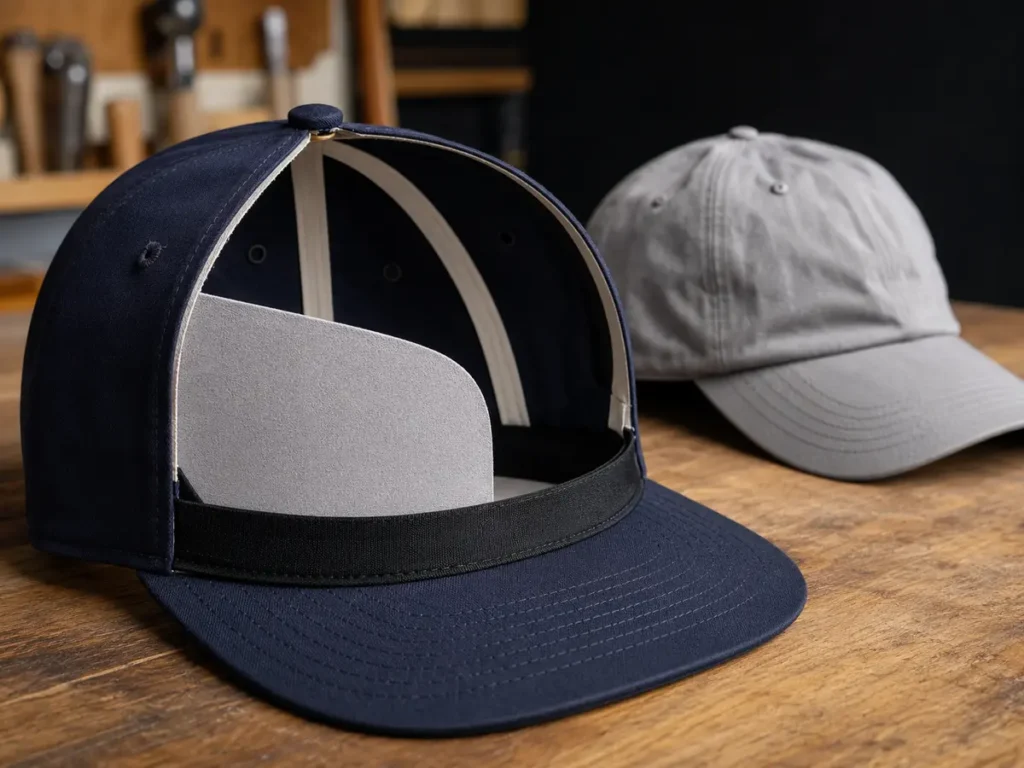
Front-panel support, seam finishing, sweatband construction, and visor build all influence the final shape and fit.
What Does Low, Mid, or High Profile Mean?
Profile describes the height and angle of the crown. It is related to crown depth but is not defined by one universal measurement across all suppliers. Buyers should combine the profile name with sample images and measured dimensions.
Low-profile fitted hat
A low-profile crown sits closer to the head and usually has a more sloped front. It works well for a restrained, athletic, or everyday appearance. A very tall logo may need to be reduced or reshaped because the usable front area is shorter.
Mid-profile fitted hat
A mid-profile crown provides a balance between head-following shape and front-logo visibility. It is often a practical starting point for team programs because it accommodates many conventional embroidered emblems without producing an extremely tall silhouette.
High-profile fitted hat
A high-profile crown has a taller, more upright front. It creates a strong streetwear or classic on-field-inspired presentation and offers more vertical logo space. However, it can feel too deep for some wearers if crown depth and head shape are not tested.
Profile Decision Table
| Profile | Visual character | Logo considerations | Buyer check |
|---|---|---|---|
| Low | Close, streamlined, relaxed | Shorter front art often works better | Confirm the crown does not pull upward |
| Mid | Balanced and versatile | Supports many standard team logos | Check front angle and side-panel contour |
| High | Tall, bold, upright | More front area for large embroidery | Test crown depth across wearer head shapes |
The best way to approve profile is to place physical samples on intended users and compare side-view and front-view photos. A flat technical drawing alone does not show how the crown interacts with the head.
Flat Brim or Curved Brim?
The brim changes both style and perceived fit.
A flat brim supports a modern teamwear or streetwear look and creates a strong horizontal line. The visor insert, width, length, underside color, and stitch density should be specified. Some users curve a flat brim after purchase, but a bulk buyer should not rely on the wearer to correct an unsuitable shape.
A pre-curved brim is ready for immediate wear and can suit performance, staff, coaching, and classic baseball programs. The curvature should be approved with a physical sample or a measurable jig, because “curved” can describe many different arcs.
Other options include sandwich brims, contrast piping, printed underbrims, short visors, and matching or contrast top stitching. Any printed or laminated underside should be tested for clean edges and compatibility with the visor construction.
Which Materials Are Used for Fitted Hats?
Material selection affects hand feel, crown recovery, decoration, color consistency, care, and cost. Buyers should request an exact composition and approved swatch rather than ordering “premium fabric.”
Common categories include:
- Cotton twill: Familiar texture and good everyday appearance. It may soften with wear and can show color variation or shrinkage depending on finishing.
- Polyester: Useful for durable color, lightweight constructions, and some performance applications. Breathability and moisture management depend on the specific fabric, not the fiber name alone.
- Acrylic or wool-blend-style fabrics: Often chosen for a classic structured cap appearance. Exact composition, skin feel, pilling behavior, and care requirements should be reviewed.
- Stretch blends: Add elastane or another elastic component to help a stretch-fit construction cover a size range. Recovery after repeated wear is a key approval point.
- Recycled-content fabrics: Available from some supply chains, but buyers should request documented fiber composition and any required claim support before marketing the product.
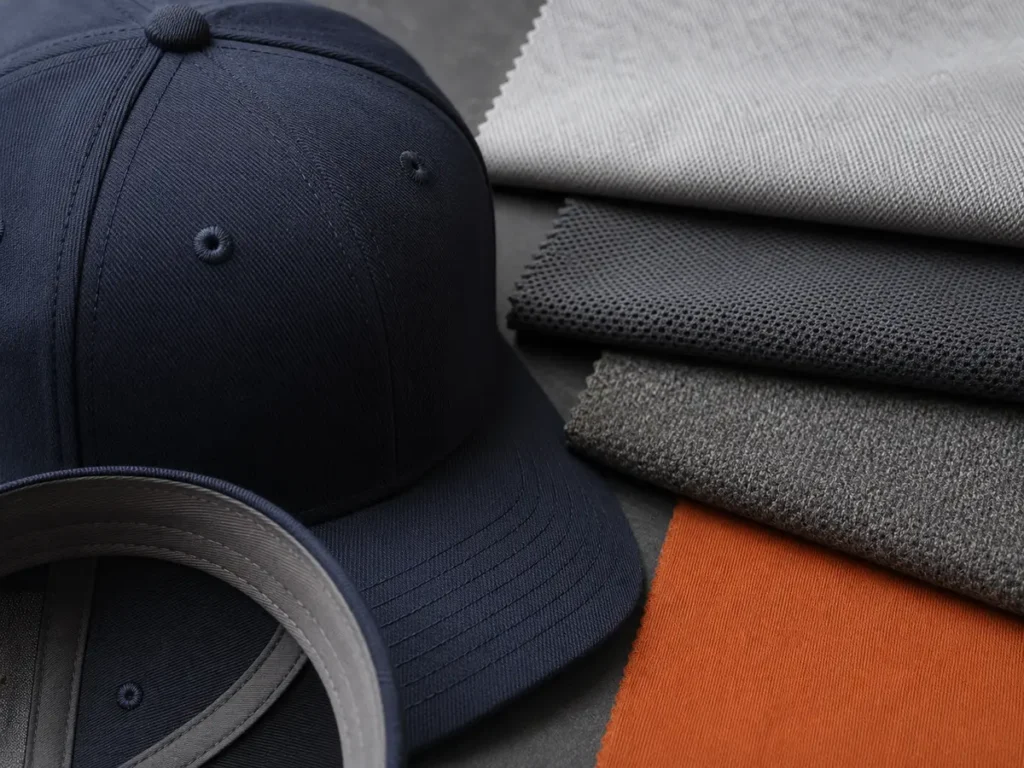
Fabric choice should be evaluated together with crown structure, sweatband behavior, embroidery, and care expectations.
Match the Fabric to the Procurement Goal
For a uniform program, prioritize repeat-order availability, shade control, wash or care expectations, and consistent structure. For a fashion collection, surface texture, drape, seasonal color, and decoration compatibility may carry more weight. For an active team, assess heat, sweatband comfort, drying, and shape recovery through real wear tests.
Never assume that a “performance” name proves a measurable benefit. If moisture management, ultraviolet protection, recycled content, or another claim will appear in sales materials, request appropriate supplier documentation and define the required test method before ordering.
Custom Fitted Hat Options
Fitted hats provide a continuous canvas for branding. The buyer can customize the cap body as well as the decoration and packaging.
| Custom area | Typical options | Important approval points |
|---|---|---|
| Front logo | Flat embroidery, 3D embroidery, patch, appliqué | Width, height, stitch density, relief, position |
| Side branding | Small embroidery, flag-inspired original mark, player number | Distance from seam and sweatband |
| Closed back | Wordmark, team name, small emblem | Curvature, seam interference, centering |
| Crown | Panel colors, piping, eyelets, top button | Shade match and placement consistency |
| Brim | Flat or curved, sandwich edge, underside color/print | Shape, insert, stitch rows, print alignment |
| Interior | Seam tape print, woven label, size label, care label | Accuracy, comfort, regulatory needs |
| Packaging | Polybag, size sticker, hangtag, barcode label, carton assortment | Market requirements and packing accuracy |
Embroidery
Flat embroidery works for text, detailed marks, and side or rear placements. Raised or 3D embroidery creates a stronger front feature but needs suitable stitch paths, foam, fabric support, and minimum line thickness. Very small lettering, tight negative spaces, and multiple overlapping layers can lose clarity.
The embroidery file should be digitized for the actual cap construction. A design approved on a screen may behave differently across a front seam or on a soft crown. Request a photographed or physical strike-off when logo accuracy is commercially important.
Patches and Alternative Branding
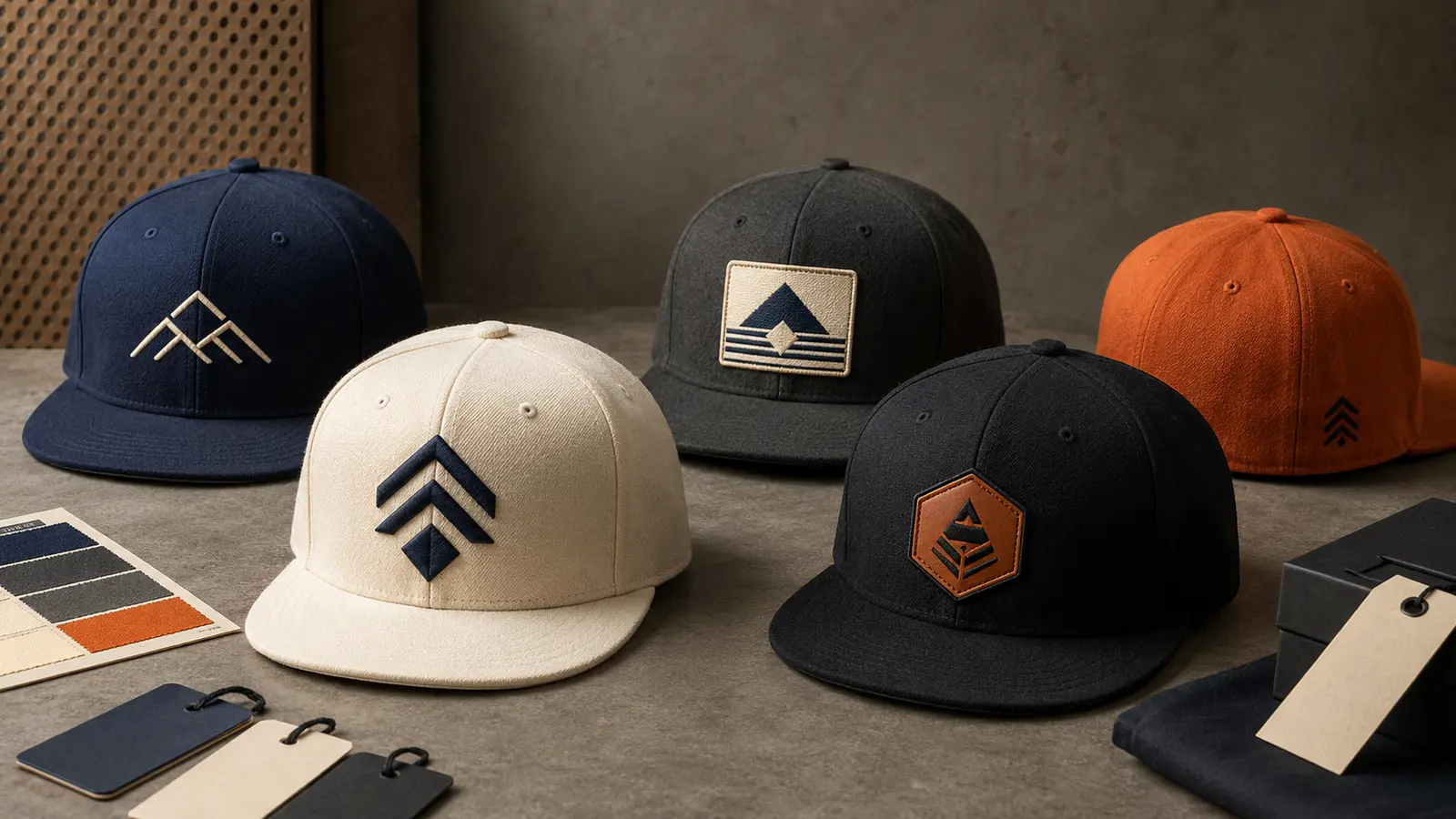
Woven patches can reproduce fine details that are difficult to embroider directly. Rubber/PVC patches create a dimensional technical look. Leather-style patches suit heritage or outdoor concepts. Printed patches can support gradients or complex color, subject to the chosen material and durability expectations.
The buyer should approve patch dimensions, edge finish, attachment method, color, thickness, and curvature on the crown. A patch that looks correct when flat may lift at the edge if it is too stiff for the chosen profile.
Private Labels and Packaging
Private-label options can include woven brand labels, care labels, size labels, seam tape, hangtags, size stickers, retail barcodes, and custom packaging. Send the exact legal entity, fiber content, country-of-origin wording, care instructions, barcode data, and market requirements. The supplier can apply the supplied specification, but the brand owner remains responsible for confirming applicable labeling obligations in the destination market.
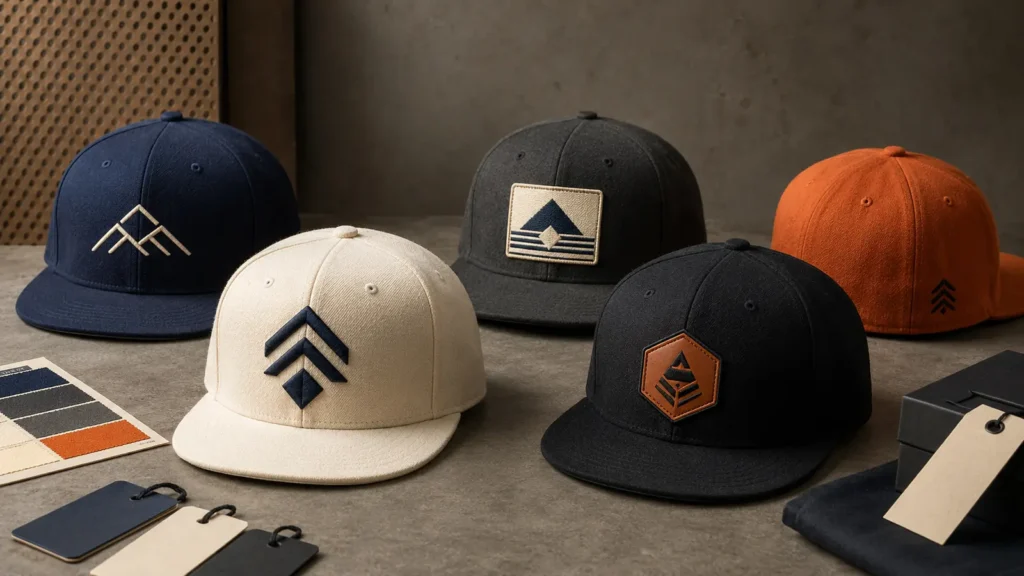
Decoration should be approved on the selected crown fabric and profile, not only as a standalone digital logo.
Planning a custom fitted-hat program? Send JIUMU your reference image or tech pack, target quantity, size breakdown, profile, fabric, colors, logo files, packaging needs, and required delivery date. The team can review the specification and prepare a custom quotation.
What Drives the Cost of Custom Fitted Hats?
Price depends on the complete specification, not the word “fitted” alone. Major cost drivers include:
- Number of sizes and color combinations
- Custom-developed crown pattern versus an existing base
- Fabric composition, weight, finish, and sourcing requirement
- Structured materials and sweatband construction
- Embroidery stitch count, number of placements, and 3D foam
- Patch material, mold or setup requirement, and attachment method
- Custom labels, seam tape, hangtags, stickers, and packaging
- Sample rounds and testing requirements
- Quantity per style, color, and size
- Inspection, assortment packing, and export requirements
A low total quantity divided across many sizes and colors can be less efficient than a larger order with fewer variations. Ask the supplier to show how simplifying the specification would affect price without weakening the core product.
Sample Approval and Quality Control
A fitted hat should not move to bulk production based only on a digital mockup. The mockup is useful for artwork placement and color planning, but it cannot verify fit, hand feel, crown recovery, brim shape, or embroidery distortion.
What to Approve on the Physical Sample
- Internal circumference: Confirm the measuring method and compare the finished result with the approved size standard.
- Crown depth and profile: Check front, side, and rear views on more than one wearer.
- Pressure and comfort: Evaluate the sweatband, seams, labels, and any elastic components.
- Structure: Confirm front-panel stiffness and recovery after handling.
- Brim: Check symmetry, curve, insert feel, stitching, and underside.
- Decoration: Measure placement and inspect density, edges, small lettering, and thread colors.
- Materials and colors: Compare against approved swatches, Pantone references where appropriate, and the sample standard under consistent lighting.
- Labels and packaging: Proofread every character and confirm size identification.
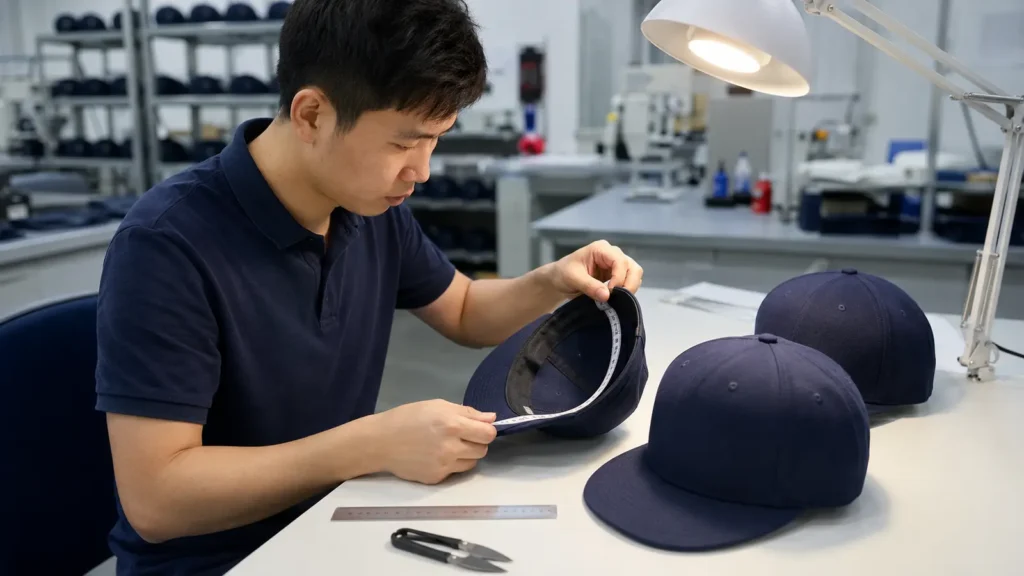
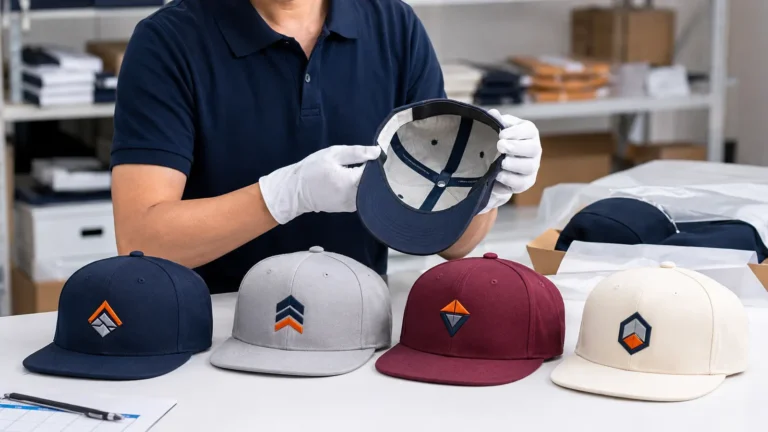
Fitted-hat quality control should combine measurements, visual inspection, and comparison with the approved sample.
Bulk Inspection Checklist
During bulk inspection, compare selected units across sizes and cartons rather than checking only one convenient sample. Review:
- Size-label accuracy versus internal measurement
- Crown height and left-right symmetry
- Seam alignment and puckering
- Eyelet and top-button placement
- Brim centering, curvature, and stitch consistency
- Sweatband joining and seam comfort
- Logo dimensions, position, density, and loose threads
- Shade consistency within the approved tolerance
- Rear embroidery alignment on the closed crown
- Quantity, size assortment, barcode, bag, and carton marks
Agree on inspection method, tolerance, sample standard, and the response to nonconforming units before production. “Normal tolerance” is too vague for a fitted product.
How to Plan a Bulk Fitted-Hat Order
A disciplined order process reduces both fit problems and avoidable sample rounds.
Step 1: Define the end user
Identify whether the hats are for assigned players, retail customers, staff, events, or mixed recipients. This determines whether true fitted, stretch-fit, or adjustable construction is most practical.
Step 2: Choose the construction
Specify true fitted or stretch-fit, panel count, structure, profile, brim, and sweatband. Use reference images to communicate the silhouette, but do not ask the supplier to copy protected branding.
Step 3: Build the size strategy
Submit roster measurements or a planned retail size curve. Confirm how sizes will be labeled, packed, and shown on cartons.
Step 4: Finalize design and materials
Provide vector artwork when possible, Pantone references, fabric preference, decoration method, interior labels, and packaging information.
Step 5: Approve a physical sample
Record the approved measurements and photograph the sample from consistent angles. Keep one sealed approval sample when repeat-order consistency is important.
Step 6: Confirm the purchase order
The purchase order should list style, colors, size quantities, decoration, labels, packaging, delivery terms, and approved revisions. Resolve conflicting versions before production.
Step 7: Inspect and document
Use the approved sample and specification sheet during bulk inspection. Save final packing information and production references for reorders.
What Information Should You Send for a Quotation?
Send as much of the following as possible:
- Buyer or brand name and destination country
- Intended use and target wearer
- True fitted or stretch-fit preference
- Panel count, structure, and profile
- Flat or curved brim
- Fabric composition or reference sample
- Color references
- Vector logo files and decoration method
- Front, side, and rear logo dimensions
- Individual size quantities or grouped size range
- Labels, hangtags, stickers, barcode, and packaging
- Total quantity
- Sample requirement
- Target delivery date and shipping destination
If some details are undecided, identify them as open choices. A supplier can then quote a base option and clearly priced alternatives.
Questions to Ask a Custom Fitted Hat Supplier
- How do you measure the finished internal circumference?
- What tolerance do you use for each fitted size?
- Can the crown profile and depth be adjusted?
- Is the front structured, and what support material is used?
- Is the sweatband fixed or stretch, and how is recovery checked?
- What fabric composition and weight will appear on the specification?
- Can you provide a physical sample in the required size before bulk production?
- How are embroidery position and dimensions controlled across sizes?
- How are shade and material changes handled on repeat orders?
- Can each carton be packed and marked by size?
- What files and information are required for private labels and barcodes?
- Which terms, tests, or claims require buyer-provided standards or documentation?
Clear answers should be recorded in the order specification rather than left only in informal messages.
Common Fitted-Hat Buying Mistakes
Treating all fitted hats as the same
True fitted and stretch-fit models have different size logic. Structure and profile also change the wearing experience.
Guessing the size breakdown
A fashionable design cannot compensate for unavailable sizes. Use roster data, historical sales, or a controlled initial run.
Approving only one sample size
Grading errors may appear at the smallest or largest size. Check critical measurements across the range.
Using “low,” “mid,” or “high” profile without dimensions
These labels vary. Add crown measurements, reference views, and an approved physical sample.
Finalizing embroidery before confirming the crown
The same logo can look different on a low-profile soft crown and a high-profile structured crown.
Overloading a small order with variations
Too many colors, sizes, logo placements, and packaging versions increase complexity. Protect the features that matter most and simplify secondary options.
Making unsupported performance claims
Do not market a hat as moisture-wicking, UV-protective, recycled, or certified without the relevant specification and evidence.
Why Buyers Work With JIUMU
JIUMU has supported custom product programs since 2010 from Guangdong, China. The company supplies B2B custom hats, teamwear, uniforms, bags, and branded merchandise for buyers in North America, the United Kingdom, and Europe.
For fitted-hat projects, relevant capabilities include OEM and ODM development, logo embroidery, woven and rubber/PVC patches, leather-style patches, fabric sourcing, Pantone color matching, private labels, hangtags, packaging customization, digital mockups, physical samples, bulk production, quality control, and export support.
The typical MOQ is 50 pieces, subject to the fitted construction, number of sizes, decoration, and customization. Buyers should share the complete variation breakdown so feasibility and pricing can be assessed accurately.
Explore JIUMU’s custom baseball caps or review the company’s broader custom team uniform capabilities.
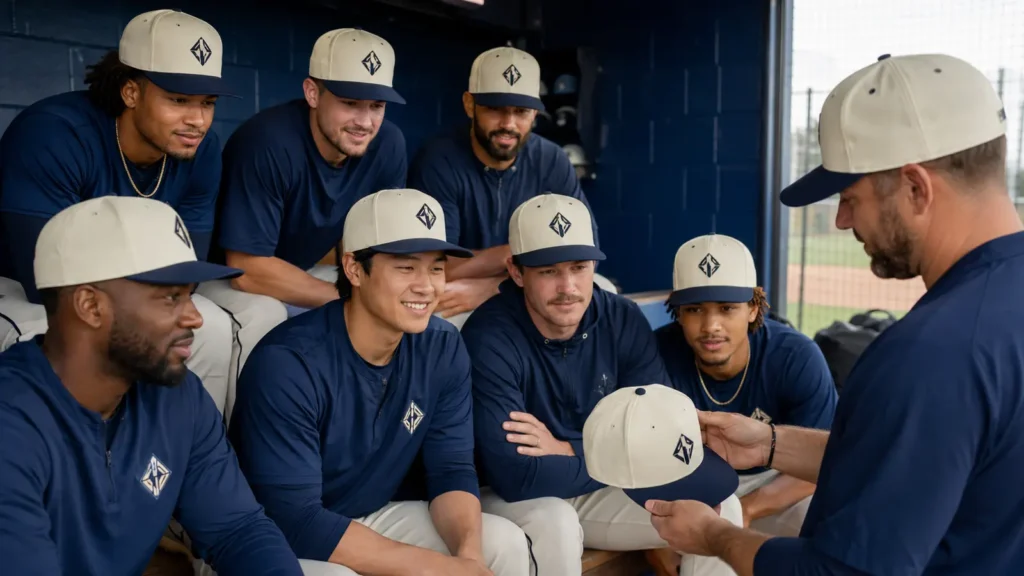
Coordinated fitted caps can support consistent team identity when profile, size, color, and logo placement are controlled.
Frequently Asked Questions
Final Recommendation
A fitted hat is more than an adjustable cap without the closure. Its value comes from the continuous crown, deliberate silhouette, and size-specific fit. Those same features require better planning.
Start by choosing true fitted or stretch-fit construction. Then define circumference, crown depth, structure, profile, brim, fabric, and decoration. Approve the product on real wearers, record measurable standards, and inspect multiple sizes against the approved sample.
For team, school, retail, distributor, or private-label programs, this approach turns a visual concept into a repeatable product specification.
Request a custom fitted-hat quotation from JIUMU. Send your reference image or tech pack, quantity, size breakdown, crown profile, fabric and colors, logo files, packaging requirements, destination, and target delivery date. Contact zhengdong@jiumugear.com or WhatsApp +86 18507502899, or use the JIUMU contact page.
Editorial Sources
- New Era 59FIFTY Silhouette Guide — reference for true-fitted and structured medium-profile terminology.
- Flexfit Sizing Chart — reference for grouped stretch-fit sizing and measuring guidance.
- Flexfit Wooly Combed Cap Specifications — reference for closed-back stretch-fitted, structured-cap terminology.
About the JIUMU Content Team
JIUMU has supported B2B custom product programs since 2010, with capabilities in custom hats, teamwear, logo decoration, private labels, packaging, quality control and export support.