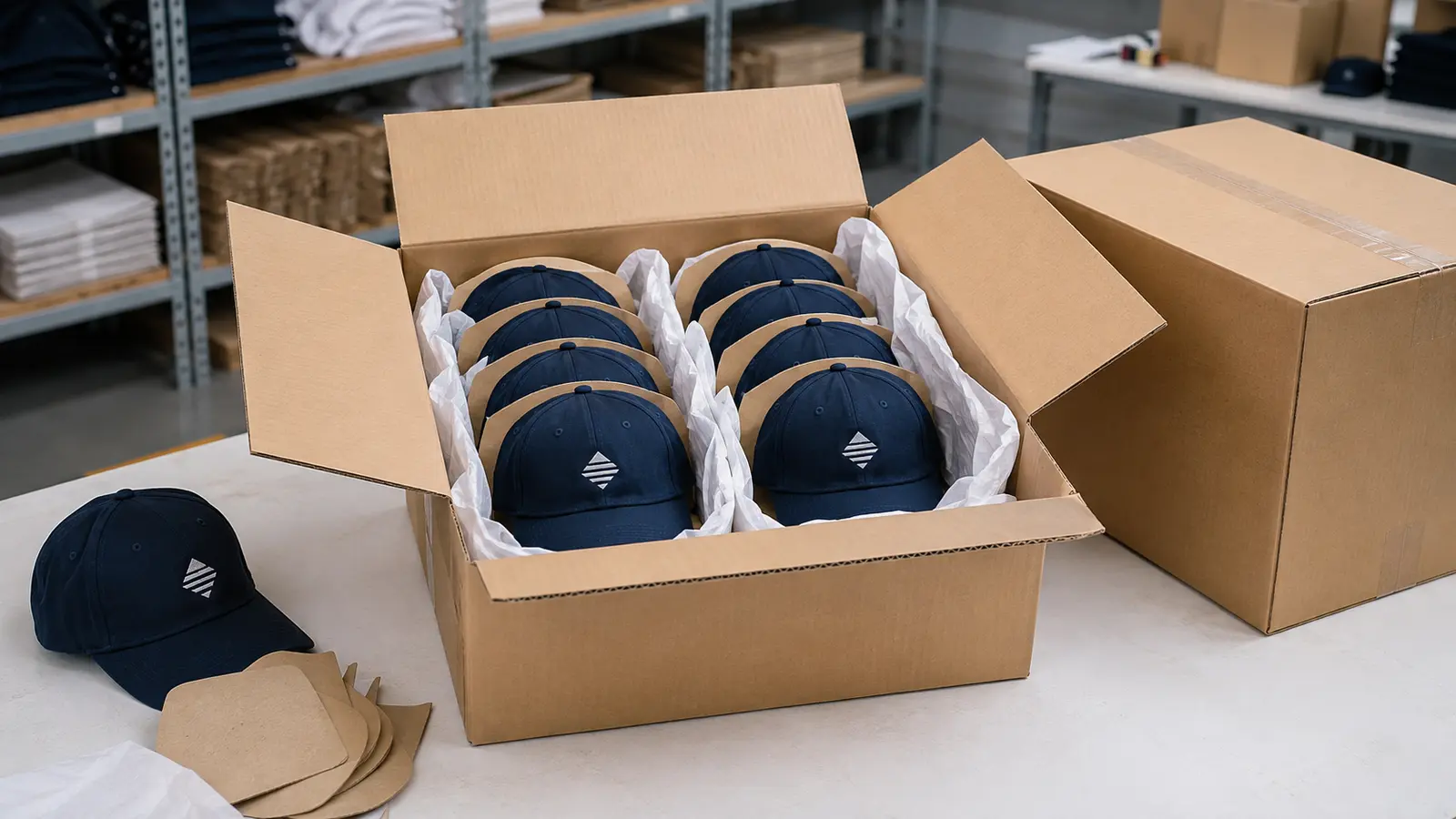
How to Prevent Custom Hats from Being Crushed During Shipping
Quick Answer
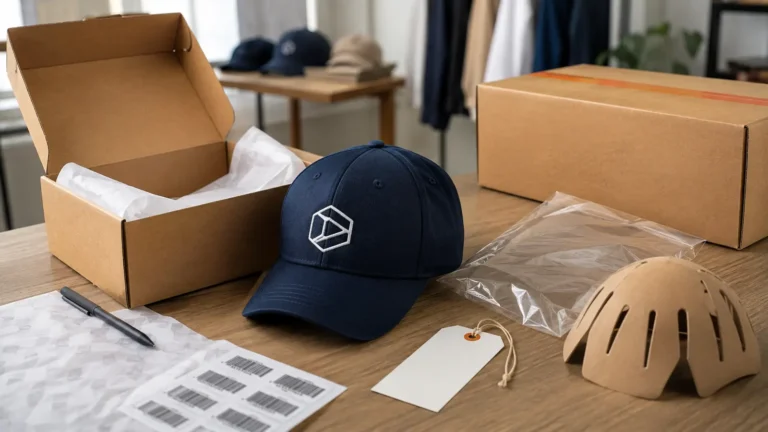
Prevent crushed custom hats by supporting the parts that must retain shape, controlling the direction and height of each stack, preventing movement inside the carton, and selecting an outer box that can withstand the expected distribution environment. Structured caps usually need more crown support and lower stacking pressure. Unstructured hats can often be nested more efficiently, but their brims and embroidery still need protection.
Approve a fully packed sample carton before bulk shipment. Check the individual sleeve, insert, stack pattern, caps per bundle, inner-box arrangement, master-carton dimensions, gross weight, closure, moisture plan and unpacking result. When the transport risk justifies it, use a qualified lab to run an appropriate compression, vibration or drop protocol on the complete packaged product.
Why Do Hats Become Crushed in Transit?
Most shipping damage comes from an interaction of several hazards rather than one dramatic event:
- vertical compression from cartons stacked above;
- sidewall pressure when cartons are tightly loaded;
- drops, tipping and impacts during handling;
- vibration that lets caps settle and shift;
- empty space that allows stacks to slide;
- overpacking that forces crowns or brims against the box;
- humidity that softens corrugated board or affects textiles;
- long storage under load;
- poorly controlled unpacking or warehouse stacking.
A carton can look undamaged while the caps inside are distorted. If a stack is too high, the upper hats can press into lower crowns. If visors face one wall with no clearance, impact can bend the tips. If the carton contains large voids, the bundle can gain momentum before striking the inside wall.
This is why a “strong box” alone is not a complete specification. The pack-out must transmit external forces around the product instead of through the crown and visor.
Packaging Differences by Hat Construction
| Hat type | Main shipping risk | Recommended starting strategy | What to approve |
|---|---|---|---|
| Structured baseball cap | Front panels crease or collapse | Crown support, controlled nesting, protected front embroidery | Support shape, stack count and recovery |
| Structured trucker cap | Foam front dents; mesh snags | Support front panel, isolate abrasive parts, avoid overcompression | Foam rebound, mesh condition and visor alignment |
| Unstructured dad hat | Crown wrinkles and embroidery folds | Gentle nesting with tissue/interleaf where needed | Acceptable fold pattern and on-head recovery |
| Flat-bill cap | Visor corner bends or twists | Keep visor plane supported and away from carton wall | Flatness, symmetry and edge clearance |
| Pre-curved visor cap | Curve flattens or becomes uneven | Use compatible nested curve or shaped spacer | Curve template after unpacking |
| Cap with 3D embroidery | Raised stitches flatten or abrade | Keep logo face from direct pressure and rubbing | Puff height, foam exposure and surface marks |
| Patch cap | Patch edge catches or lifts | Separate faces and prevent sliding contact | Edge adhesion/sewing and surface condition |
The right method may differ between colorways if fabric stiffness changes. A washed cotton dad hat and a coated performance cap can share the same silhouette but respond differently to pressure and humidity. Approve the actual product, not only a generic cap category.
How Should Structured Hats Be Packed?
Structured hats are designed to hold a defined crown shape when not worn. Front backing, buckram, foam or other support makes the silhouette stable—but can also create a permanent crease if the panel is sharply folded.
Use support only where it protects the intended geometry. Options include:
- formed paperboard crown inserts;
- smooth tissue or lightweight paper filling;
- molded or folded paper supports;
- shallow inner trays;
- controlled bundles with the crowns nested at a safe depth;
- rigid dividers that carry box pressure around the caps.
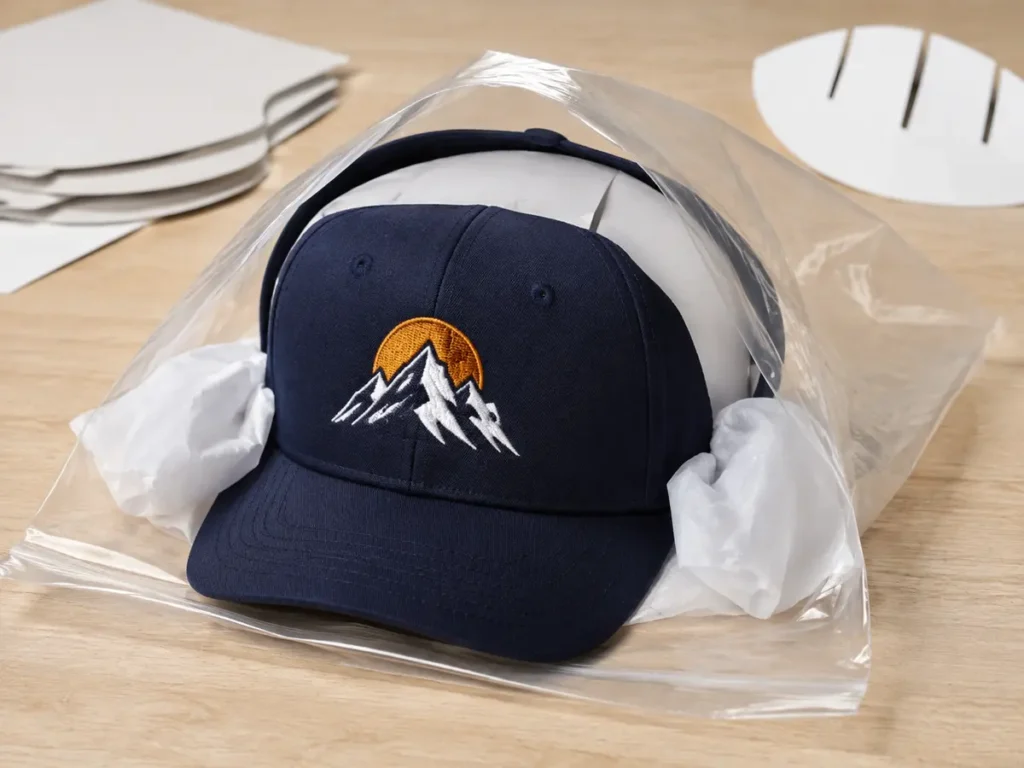
The insert should not be so large that it stretches the hat or pushes against the top button. It should not place a hard edge directly behind embroidery, because external pressure could leave a line on the face fabric. Avoid stuffing with random scrap paper that creates high points.
For a cap with raised 3D embroidery, leave clearance in front of the logo. A protective sleeve prevents surface dirt but does not stop compression. The internal insert, stack pattern and outer carton must work together.
Does every structured cap need an individual support?
Not always. Some structured caps can be nested safely in a controlled bundle with one support at critical locations; others require individual support because the crown, decoration or retail expectation is less tolerant of deformation.
Compare at least two pack-out options with the same shipping simulation:
- individual crown support;
- shared support by bundle or stack;
- no support, if the product has proven recovery.
Record the post-test appearance, packaging material use, pack time, carton cube and cost. The lowest material option is not economical if it increases rejects or retail preparation.
How Should Unstructured Hats Be Packed?
An unstructured hat is meant to relax when it is not on a head. It normally does not need the same rigid crown filling as a structured snapback. Excess stuffing can make a soft dad hat appear unnaturally round, increase shipping volume and create pressure points.
Nest unstructured caps so the crowns lie smoothly and the visors follow a consistent direction or an approved alternating pattern. Use clean interleaving tissue when face-to-face contact could abrade embroidery, transfer color or mark a washed finish.
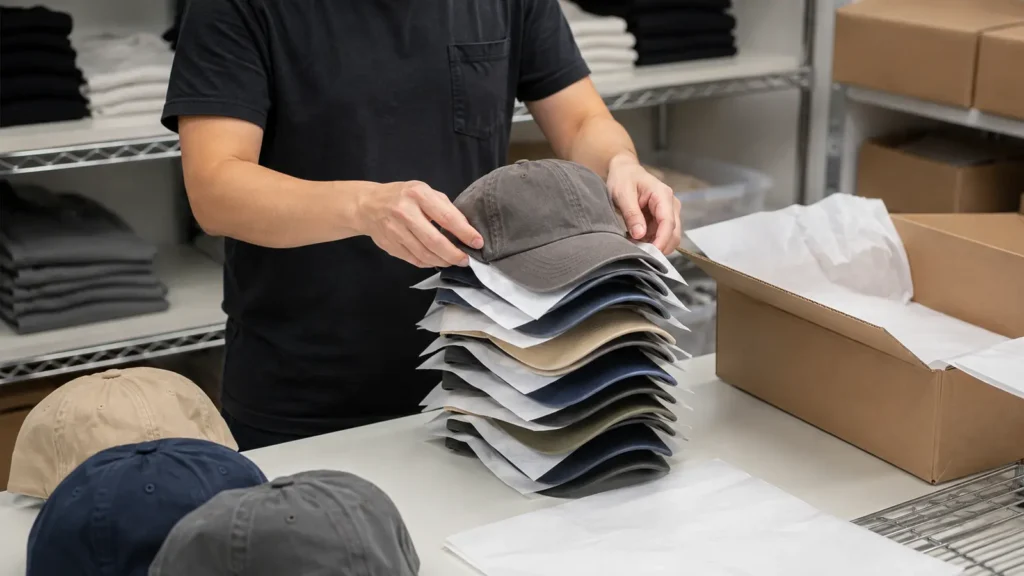
Do not build an arbitrarily tall stack. The lower hats carry the accumulated force, especially when the bundle is compressed to close the carton. Approve the number of caps per stack by measuring the carton clearance and inspecting the bottom items after the test.
If the hat has a leather-style, PVC or rubber patch, consider the patch thickness and edge. A raised patch can imprint the next hat or catch during removal. Rotate or separate the decorated faces as required.
Protect the Brim from Bending and Twisting
Air freight is faster than ocean freight, but it does not prevent brim damage. Parcel and air-cargo packages still experience sorting, transfer, stacking and handling. A brim can bend if its corner meets the carton wall, another stack rests on it or the contents shift during a drop.
Protect the visor by controlling:
- its direction in the stack;
- contact between top and underside surfaces;
- clearance from carton walls;
- support under flat visors;
- compatibility between nested pre-curved visors;
- stack pressure at the visor-to-crown seam;
- movement during vibration and impact.
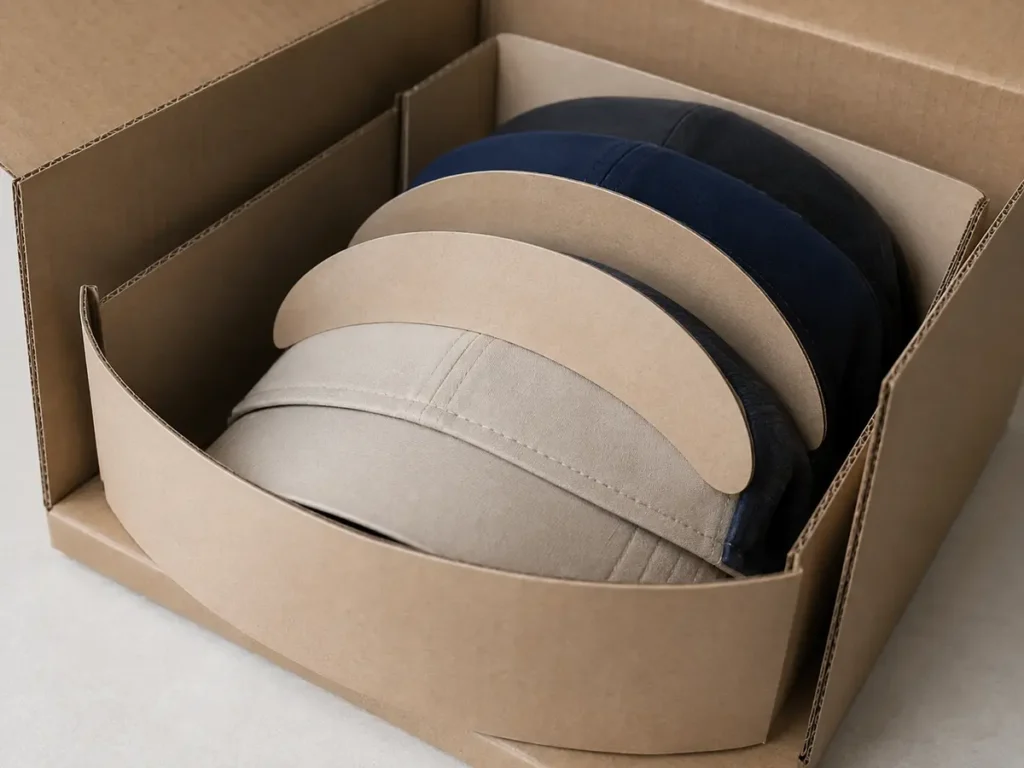
A paperboard spacer can spread force across the visor. An inner tray or perimeter divider can keep tips away from the master carton. The protector should not have an edge that embosses the fabric or forces a different curve.
Approve visor condition against a physical sample or curve template after unpacking. For flat-bill programs, inspect both the center plane and corner twist. For pre-curved brims, compare left and right symmetry.
Individual Protection: Bags, Sleeves, Tissue and Surface Contact
Individual sleeves help control dust, color transfer and contact between embroidery surfaces. They do not make the product waterproof or crushproof.
Choose the individual pack based on:
- fabric sensitivity to rubbing;
- white or light colors;
- raised embroidery and patches;
- printed underbrims;
- hangtags and metal closures;
- retail presentation;
- target-market packaging requirements;
- ventilation and moisture-control plan.
Keep metal buckles, snaps and clips from touching neighboring fabric or embroidery. Secure hangtags so their corners do not scratch a visor. Avoid adhesive touching the hat. If a printed or coated surface could block or transfer under heat, test the actual sleeve and transit conditions.
Tissue should be clean, nonabrasive and free of uncontrolled ink transfer. A soft wrap can protect a logo; excessive layers can increase cube and create an uneven pack.
Inner Boxes, Dividers and Master Cartons
The inner packaging organizes the product. The outer carton carries distribution loads. Buyers should specify both.
Inner box or tray
An inner box can:
- isolate a retail-ready quantity;
- hold stacks in the correct orientation;
- protect visors from the master-carton wall;
- reduce movement when a carton is partly filled;
- simplify distribution to stores or teams.
It also adds material, labor and volume. Use it when it solves a defined problem, not because “more packaging” sounds safer.
Corrugated master carton
Specify the carton by more than its outside dimensions. Relevant variables may include corrugated construction, flute combination, board grade, edge-crush or compression performance, joint, moisture exposure, print, closure and gross weight. The supplier and packaging engineer should choose values based on the real supply chain.
Do not use a universal “caps per carton” number. The correct quantity depends on:
- cap structure and crown height;
- visor style;
- individual packaging;
- stack pattern;
- carton strength;
- acceptable gross weight;
- pallet or floor loading;
- manual handling limits;
- carrier size rules;
- volumetric cost.
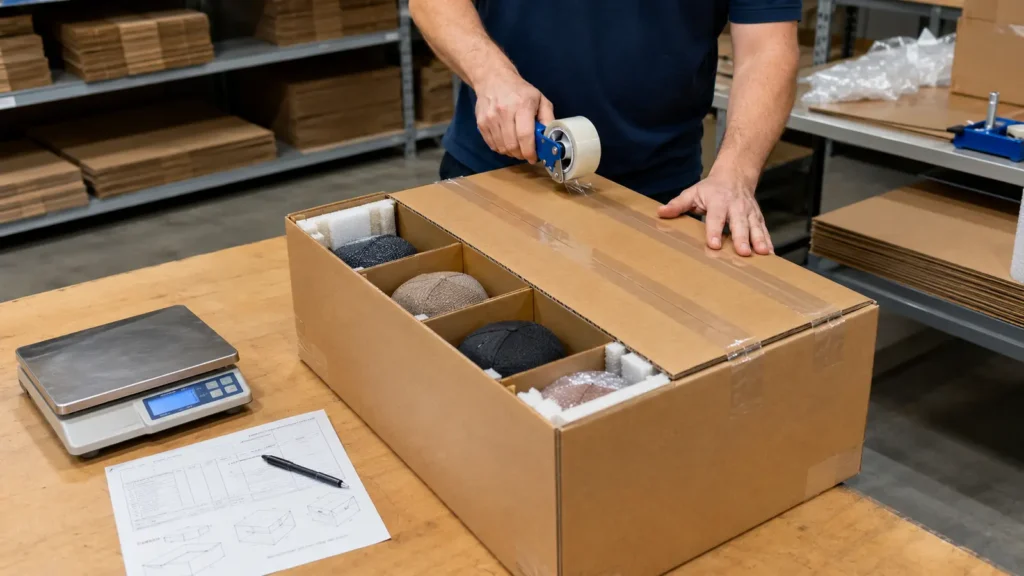
The carton should close without the flaps pushing down on the cap crowns. Empty spaces should be controlled with suitable dunnage or adjusted pack geometry. Do not use the hats themselves as void fill.
For parcel cartons, carrier guidance commonly recommends strong corrugated packaging and an H-taping pattern across the center seam and edge seams. FedEx’s general packaging guide recommends H-taping and warns that overly large boxes require more material and can raise shipping cost. See FedEx’s clothing-packing guidance and general packaging PDF. Treat these as carrier guidance, not a substitute for a project-specific test.
Moisture Protection and Sea-Freight Humidity
Sea freight can be safe for hats, but it is not automatically dry. Changes in temperature and humidity can create condensation inside a cargo transport unit. The IMO/ILO/UNECE CTU Code describes condensation damage as cargo damage caused by internal humidity, especially in freight containers on long voyages. See the official CTU Code PDF.
Control starts before loading:
- pack only dry, conditioned hats and packaging;
- keep cartons off wet floors;
- inspect the container or transport unit for holes, water, odor and contamination;
- use a suitable carton liner or moisture barrier where required;
- select desiccant type and quantity for the actual volume, permeability, route and season;
- isolate desiccant so it cannot stain or abrade the product;
- secure the load to reduce wall and door contact;
- define warehouse humidity and storage time where commercially important.
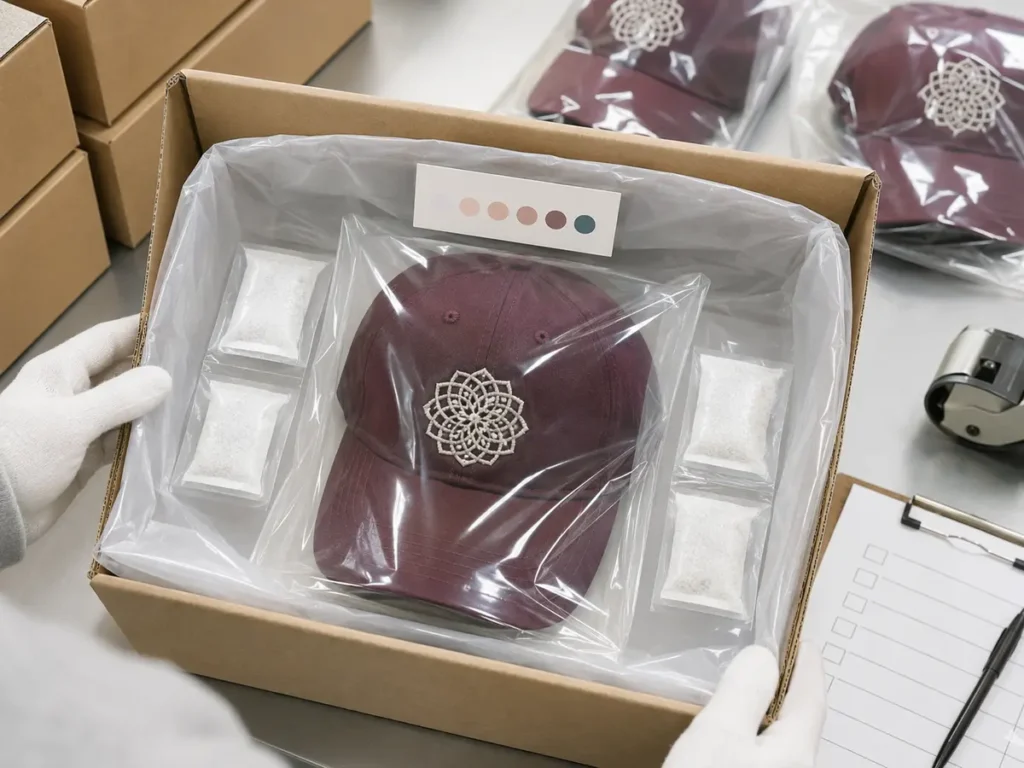
Do not assume that adding a few silica gel packets eliminates all risk. A desiccant has finite capacity; packaging permeability, initial moisture, temperature cycling and voyage length matter. Follow supplier instructions and target-market labeling or safety requirements. Keep small packets away from children and end users where the finished retail pack creates a foreseeable access risk.
Plastic liners can limit moisture exchange but may also trap moisture that was already inside. Confirm product dryness before sealing. If airflow is part of the plan, do not combine it casually with a fully sealed barrier concept.
Sample Carton, Compression and Drop Verification
The first packing approval should use the same cap, insert, sleeve, stack count, carton, tape and gross weight proposed for production. Photograph each layer during packing so the method can be repeated.
Start with practical internal checks:
- measure carton dimensions and gross/net weight;
- record caps per stack and stacks per carton;
- check clearance above crowns and around visors;
- close and tape the box without forcing the flaps;
- apply a defined static top load or stacking simulation if appropriate;
- perform a controlled handling or drop evaluation based on the route;
- open the carton in a documented sequence;
- inspect the box, individual packs and every cap position;
- compare crown profile, visor curve and decoration with the approved sample;
- revise the pack-out and repeat when damage appears.
For formal validation, choose a protocol that represents the distribution system. ISTA explains that its 3-Series procedures are general simulation performance tests covering damage-producing motions, forces, conditions and sequences. ISTA 3A applies to packaged products up to 70 kg shipped through parcel delivery systems by air or ground. See ISTA test-procedure guidance and ISTA 3A scope.
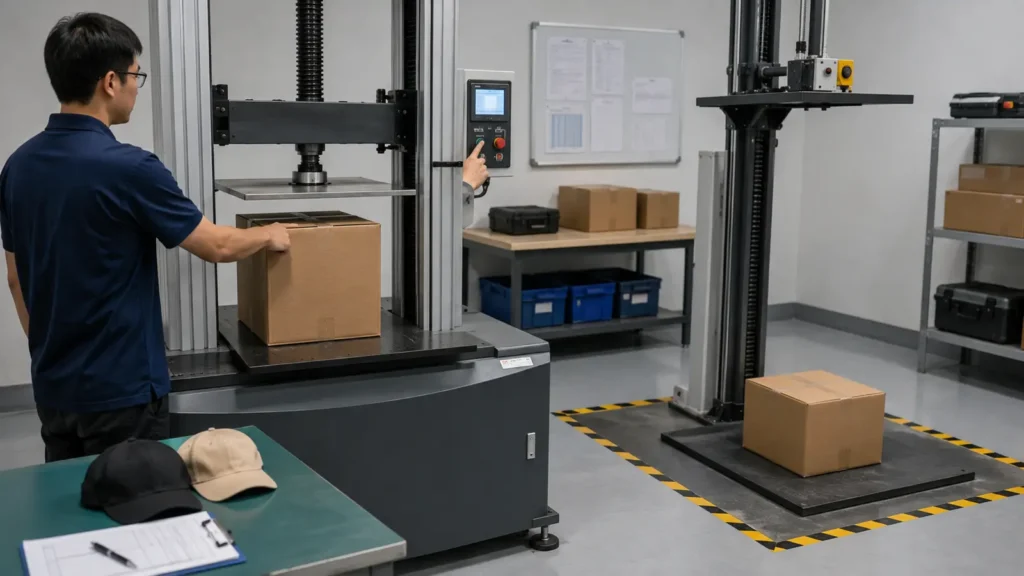
Passing one internal drop is not the same as ISTA certification or proof against every future shipment. ISTA notes that multiple successful replicate tests improve assurance but do not guarantee all later packages will pass. A packaging specialist or accredited laboratory should select and conduct formal tests when a contractual or retailer requirement applies. See ISTA’s testing sample guidance.
Send JIUMU the cap sample, shipping mode, destination, quantity, individual-pack requirements, target carton limit and retail expectations. Ask for a photographed sample-carton pack-out before approving bulk packing. Contact JIUMU.
Copyable Hat Packaging Specification
| Specification field | Buyer decision or supplier proposal | Approval evidence |
|---|---|---|
| Hat style and structure | Structured / unstructured / foam front / other | Approved physical cap |
| Visor type | Flat / pre-curved / custom curve | Curve reference or sample |
| Individual protection | Sleeve, tissue, insert, retail box | Packed unit photo |
| Crown support | Individual / shared / none | Recovery after verification |
| Stack orientation | Same direction / alternating / tray | Layer-by-layer photos |
| Caps per stack | Project-specific | Bottom-cap inspection |
| Stacks per carton | Project-specific | Top-view pack-out |
| Inner box/divider | Type and material | Sample carton |
| Master carton | Dimensions, board construction, closure | Carton specification |
| Caps per carton | Project-specific | Count and pack map |
| Net/gross weight | Measured values | Scale photo/packing list |
| Moisture plan | Liner, desiccant, inspection, storage | Written specification |
| Carton marks | SKU, quantity, destination, handling | Approved artwork |
| Verification | Internal check or named lab protocol | Test report/photos |
| Recovery criteria | Crown, brim, logo and surface condition | Post-test inspection |
The final packing instruction should include photographs. A diagram may show orientation, but a photograph makes tissue placement, insert depth and stack geometry easier to reproduce.
How to Inspect a Trial Shipment or Sample Carton
When practical, send one carton through a representative route before the main order. Record:
- dispatch date and origin;
- route and service;
- carton dimensions and weight;
- pack-out version;
- received date;
- external dents, punctures, moisture and tape condition;
- movement inside the carton;
- condition by cap position;
- time required for crown recovery;
- permanent visor distortion;
- embroidery or patch abrasion;
- packaging waste and unpacking time.
A sample carton is especially valuable for ecommerce or distributor programs where cartons will be separated and handled individually. A palletized ocean shipment and a final-mile parcel do not create the same exposure. Test the weakest handoff in the planned route.
How to Restore Hat Shape After Arrival
First distinguish temporary settling from permanent damage. Open cartons promptly in a clean, dry area and compare the hats with the approved sample.
For minor, recoverable deformation:
- remove sleeves and inserts carefully;
- loosen closures so the crown is not constrained;
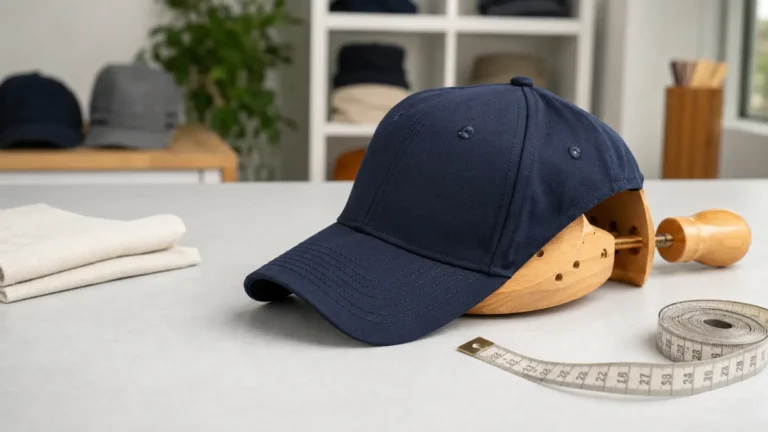
- place structured caps on clean head forms or suitable supports;
- gently smooth panels by hand without pulling embroidery;
- return visors to the approved curve using a nonmarking template;
- allow the hats to rest in a dry, ventilated room;
- inspect again after the agreed recovery period.
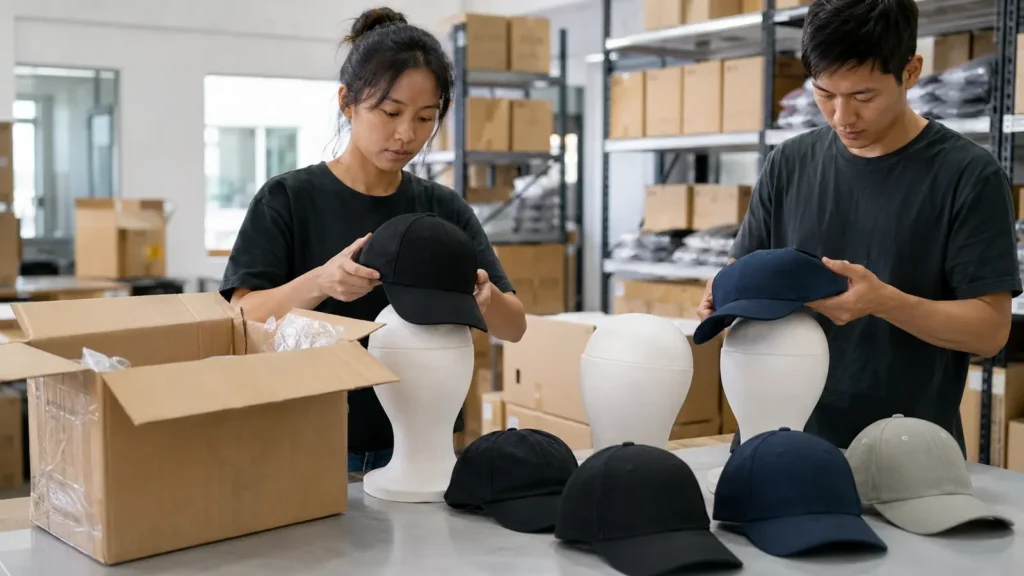
Do not introduce heat, steam or water unless the material supplier and care specification allow it. Heat can affect adhesives, foam, coatings, printed surfaces, patches and visor boards. If the cap has a sharp permanent crease, broken visor, delamination, color transfer, mold or water staining, isolate it and document the defect rather than hiding it through aggressive reshaping.
Take photos before and after recovery. This evidence helps determine whether the packing method should change and whether the product meets the agreed acceptance criteria.
Branded Retail Boxes: Protection, Cost and Volumetric Weight
Custom retail boxes can improve presentation, inventory handling and direct-to-consumer fulfillment. They can also increase:
- packaging material and print cost;
- assembly labor;
- master-carton dimensions;
- unit cube;
- storage space;
- pallet or container use;
- parcel dimensional weight;
- disposal obligations.
Carriers may calculate billable weight from the space a package occupies rather than actual weight alone. UPS explains that dimensional weight reflects package space relative to actual weight and may apply to domestic and international services; the billable weight can be the greater of actual and dimensional weight. See UPS dimensional-weight guidance.
Do not use one internet divisor for every quote. Formula, divisor, rounding and surcharge rules vary by carrier, service, account, country and date. Ask the forwarder or parcel carrier to calculate the proposed retail and bulk configurations.
Compare three packaging levels
| Level | Typical construction | Main benefit | Main trade-off |
|---|---|---|---|
| Efficient bulk pack | Sleeve/interleaf + controlled nesting + master carton | Lower cube and material use | More receiving preparation |
| Enhanced export pack | Crown/visor supports + dividers + stronger carton | Better shape control | More material, labor and cube |
| Retail-ready pack | Individual branded box or tray | Presentation and fulfillment convenience | Highest unit cube and dimensional-weight risk |
Ask for a landed-cost comparison, not only the retail-box unit price. The quotation should show carton count, dimensions, gross weight and estimated freight basis for each option.
Air Freight vs Sea Freight: Which Is Safer?
Neither mode is universally safer. Air is usually faster and reduces exposure time, but packages can still be dropped, stacked and transferred. Sea freight usually offers a lower cost per unit for larger volumes, but longer duration, container humidity and port or warehouse handling require additional planning.
Use the order’s actual needs:
- Air/parcel: prioritize impact, drop, dimensional weight and individual-carton handling.
- Air freight on pallets: prioritize pallet stability, top-load protection and transfer handling.
- Ocean LCL: expect more consolidation and handling interfaces; confirm outer protection and marks.
- Ocean FCL: control container inspection, loading pattern, moisture plan and unloading.
Incoterms define responsibility and cost allocation; they do not make packaging adequate. Review EXW vs FOB vs DDP for Custom Apparel Orders separately from the physical packaging specification.
Packaging Cost Drivers
The quote can change with:
- individual sleeve material and thickness;
- tissue, crown insert or visor spacer;
- inner tray or retail box;
- printed packaging and setup;
- carton board construction;
- carton quantity and dimensions;
- labels, barcodes and assortment;
- desiccant and liner;
- pack-out labor;
- palletization and corner protection;
- testing and sample shipment;
- increased freight cube or dimensional weight.
Request both unit packaging cost and logistics effect. Saving on the carton can create product damage; overengineering every unit can make the shipping economics uncompetitive.
Common Packaging Mistakes
Filling crowns without testing pressure points
Random stuffing can push against embroidery or create ridges. Use a defined insert shape and depth.
Overpacking the carton
If the flaps must be forced closed, the load is already compressing the product before transport begins.
Leaving excessive empty space
Empty space allows stacks to shift and strike the walls. Control voids without placing hard material against the cap.
Treating the individual bag as crush protection
A sleeve controls surface exposure; it does not carry stacking load.
Using carton quantity as the only optimization target
More caps per box may reduce carton count but increase deformation, carton weight and receiving losses.
Adding desiccant without a moisture calculation
Wrong quantity, permeable packaging or wet products can overwhelm the system.
Approving a box without the final product
Test the full packaged system at production weight. Empty-box compression data alone does not show how hats will behave.
Ignoring retailer or marketplace requirements
Barcodes, warning labels, recyclability, packaging dimensions and test protocols may be contract-specific. Obtain the customer’s current requirements before sampling.
What to Send for a Packaging Quote
Provide:
- cap style, structure and visor type;
- decoration method and sensitive surfaces;
- order quantity by style and color;
- individual sleeve, tissue, insert or retail-box requirement;
- destination country and delivery channel;
- parcel, air, LCL or FCL shipping plan;
- preferred caps per inner pack or store allocation;
- maximum carton weight or dimensional constraints;
- moisture-control expectation;
- pallet requirement;
- labeling, barcode and carton-mark files;
- required test protocol;
- target approval and delivery dates.
If the freight method is undecided, request two packing configurations. A compact ocean pack and a retail parcel pack may need different inner protection and carton sizes.
How JIUMU Supports Custom Hat Packaging
JIUMU has supported B2B custom teamwear, custom hats, uniforms, bags and branded merchandise since 2010 in Guangdong, China. Relevant capabilities include packaging customization, digital mockups, physical samples, quality control, private labels, hangtags and export support.
For a hat order, JIUMU can review the structure, visor, decoration and sales channel; propose a pack-out; prepare a photographed sample carton; record the approved packing specification; and use that reference during bulk packing and quality control. The typical MOQ is 50 pieces, subject to product structure and customization.
Explore JIUMU’s Manufacturing Capabilities, Quality Control process and Custom Hats options before confirming the order.
Frequently Asked Questions
Final Recommendation
Start with the hat, not the carton. Identify which crown, visor, decoration and surface features must retain shape. Design the individual protection, stack pattern, internal restraint and outer box around those risks. Then approve the entire packed carton through a documented unpacking and recovery inspection.
The best packaging is not the heaviest or most expensive. It is the lightest, most space-efficient verified system that delivers the approved cap condition through the intended distribution route.
Request a custom hat packaging proposal: Send the cap specification, quantity, destination, shipping mode, retail-pack requirements, carton limits and testing needs to zhengdong@jiumugear.com, WhatsApp/Phone +86 18507502899, or contact JIUMU online.