Embroidered Patch vs Woven Patch for Custom Hats
Choosing between an embroidered patch and a woven patch is not simply a question of which one looks “better.” The correct choice depends on what the logo must communicate at actual hat size, how much texture the brand wants, the cap’s crown construction, the border and attachment method, and how the finished hat will be used.
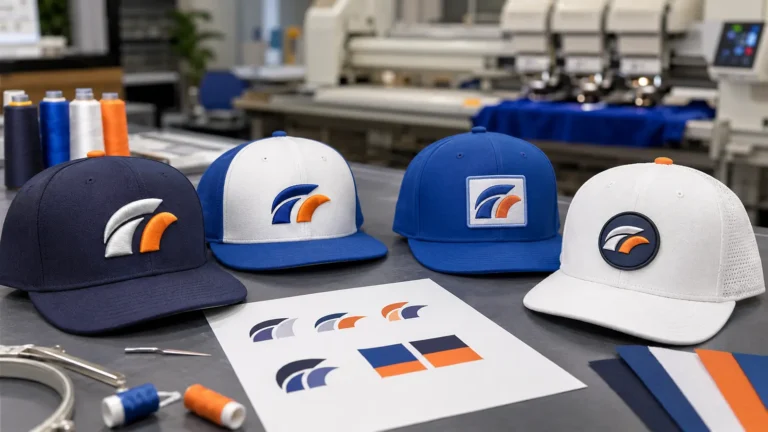
An embroidered patch usually gives a bold, traditional emblem appearance. A woven patch usually reproduces small lettering and intricate artwork more cleanly. Both can work well on custom hats, but neither can rescue an artwork file that has too many elements for the available patch area.
Quick Answer
Choose an embroidered patch when the logo uses bold shapes, limited fine detail and a visibly raised thread texture. Choose a woven patch when small text, thin lines or a complex logo must remain readable in a compact area. Woven construction uses finer interlaced threads and produces a flatter face, while embroidery builds the artwork with stitches over a base fabric.
For a long-term hat program, do not approve from a screen mockup alone. Specify the finished patch dimensions, make both options at actual size when the decision is close, attach them to the intended cap, and review legibility, edge lift and crown distortion from normal viewing distance.
Embroidered Patch vs Woven Patch: Decision Table
| Decision criterion | Embroidered patch | Woven patch | Procurement implication |
|---|---|---|---|
| Visual character | Raised, tactile, traditional | Flat, smooth, refined | Match the patch to the brand language, not a generic “premium” label |
| Small text | Limited by stitch width, density and letter openings | Generally clearer at smaller sizes | Quote woven first when short copy is essential |
| Fine lines | May merge or need simplification | Better suited to intricate linework | Test the narrowest element at finished size |
| Color blocks | Strong, dimensional thread coverage | Clean, flatter color fields | Confirm thread colors under the same lighting as the cap |
| Thickness | Usually thicker, especially at high coverage | Usually thinner and more flexible | Check how the patch bends around the crown |
| Classic border | Merrowed edge is visually natural | Merrowed edge can add a traditional frame | Thick borders reduce usable artwork area |
| Irregular shape | Laser- or hot-cut edge usually preferred | Laser- or hot-cut edge usually preferred | Approve the exact cut line and corner radius |
| Typical attachment | Sew-on, heat seal or hook-and-loop | Sew-on, heat seal or hook-and-loop | Cap fabric and service conditions decide the backing |
| Cost driver | Size, stitch count, coverage, colors and edge | Size, weave complexity, colors, edge and setup | Request both quotes against the same specification |
The most important comparison is not “embroidery versus weaving” in isolation. It is artwork + patch size + cap shape + edge + attachment + expected use. A woven patch with the wrong border can look bulky. A beautifully embroidered emblem can become unreadable if a buyer reduces it to fit a low-profile cap.
How Are Embroidered and Woven Patches Made?
Embroidered patches build artwork on a base
An embroidered patch normally begins with a stable face material such as twill. The logo is digitized into stitch paths, then embroidery thread is sewn over the face material. The patch may leave some twill visible or use high embroidery coverage across most of the surface. Backing or stabilizing layers give the patch body, and the edge is finished after or during production.
This construction creates visible stitch direction and height. Satin stitches can define borders and bold lettering, while fill stitches cover larger areas. Because multiple threads and stitch penetrations occupy physical space, closely spaced details compete with one another. A digitizer may need to widen thin strokes, open negative spaces or remove minor details.
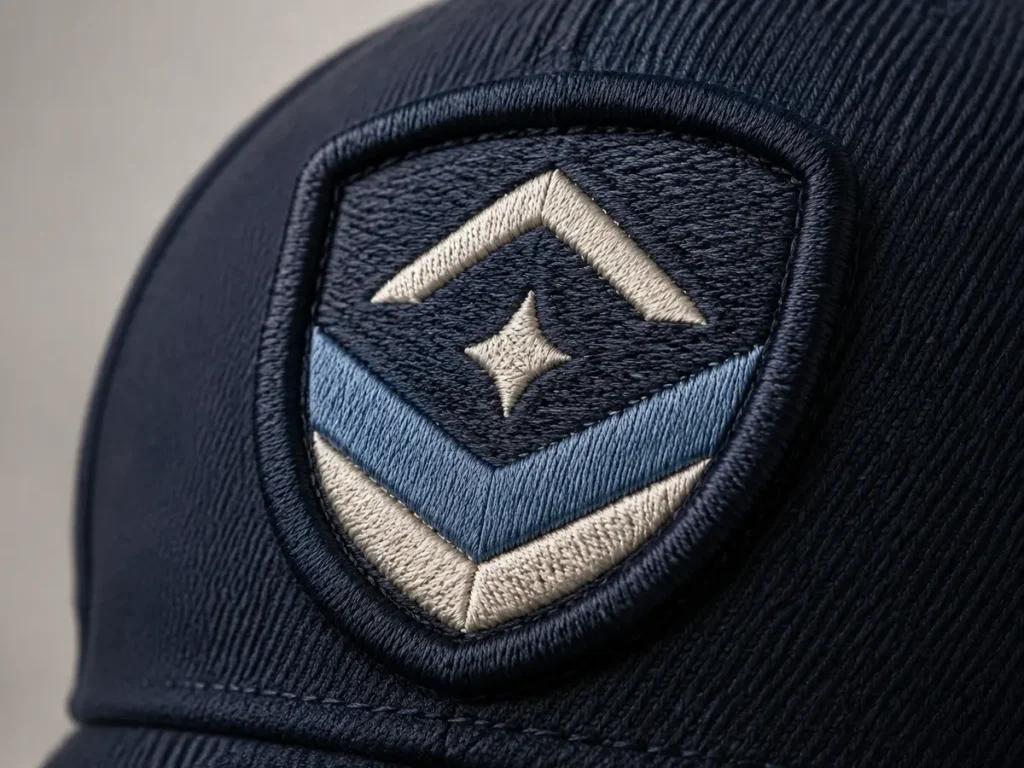
Madeira’s technical patch-making guidance describes embroidery over twill or another face fabric, supported by backing, followed by cutting and an overedge or zigzag finish. This is useful evidence that an embroidered patch is a layered construction rather than a printed image. See Madeira’s patch-making guide.
Woven patches form the design within the fabric
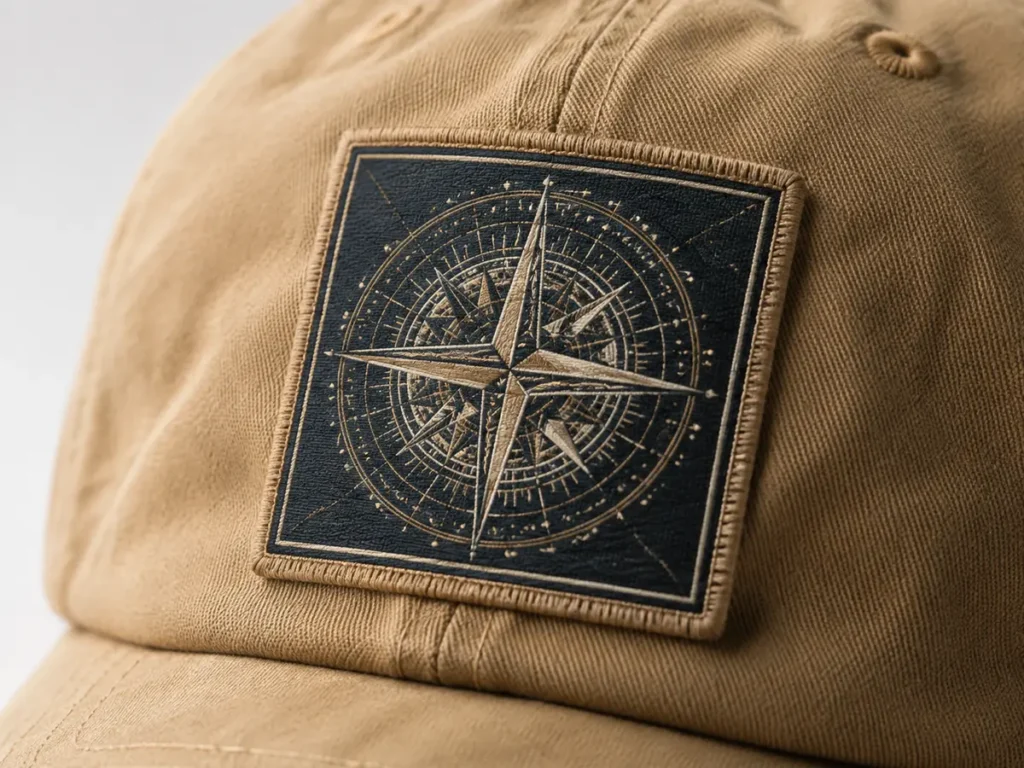
A woven patch uses fine threads interlaced so the design becomes part of the woven structure. It does not build the logo with the same raised embroidery stitches. The result is generally flatter, thinner and capable of representing smaller elements.
That does not mean woven patches reproduce unlimited detail. Threads still have a physical width, colors must transition within the weave and a compact patch still needs sufficient contrast. However, a fine woven construction can usually retain narrow lines and smaller internal openings that would fill in or require simplification in conventional embroidery.
World Emblem describes woven patches as using an interlaced weaving process to capture fine details and small text without the raised stitching of embroidery. Its published specifications are supplier-specific, so they should not be treated as a universal minimum, but they demonstrate why actual production capability must be confirmed with the selected manufacturer. See World Emblem’s woven-patch description and its embroidered-versus-woven technical comparison.
Is a Woven Patch Better for Small Text and Complex Logos?
Usually, yes. A woven patch is the stronger starting option when the artwork includes a URL, coordinates, a long team name, thin outlines, small stars, detailed illustrations or tightly nested shapes. Its finer yarn and flatter surface give small counters—the open spaces inside letters such as A, B, e and R—more room to remain open.
Embroidery is still appropriate when the lettering is short, bold and large relative to the patch. A block monogram, a two- or three-letter team mark, or a simple wordmark can look excellent in embroidery because the stitch direction reinforces its weight. The risk rises when the buyer asks the same patch to carry a crest, establishment date, location, slogan and website address.
There is no universal minimum text size
Published minimums vary because machinery, thread, weave density, digitizing, letter style, contrast and patch construction vary. A supplier’s stated minimum also may assume a simple block font rather than condensed, serif or script lettering. Therefore, “What is your minimum text height?” is only the beginning of the conversation.
Use this approval method:
- Set the final patch width and height on the cap.
- Print the artwork at 100% scale.
- View it at arm’s length and at a normal social or retail viewing distance.
- Ask the supplier to identify elements below its safe production limit.
- Produce a physical patch, not only a digital render.
- Attach it to the intended cap and review the result on-head.
If text is still too small, remove nonessential copy, enlarge the patch, shorten the wording, increase contrast or move secondary information to an inside label. A website address is worth weaving only when a person can read and remember it. For many brands, a short domain is more practical than a full protocol and long path.
Artwork characteristics by patch type
| Artwork characteristic | Preferred starting point | Why | Possible adjustment |
|---|---|---|---|
| Bold shield with two initials | Embroidered | Texture supports simple, heavy geometry | Use a clear satin border |
| Detailed crest with small motto | Woven | Finer threads retain more internal detail | Enlarge or remove the smallest motto text |
| Script wordmark | Woven, then sample | Thin joins and counters are difficult in embroidery | Thicken strokes and open spacing |
| Vintage badge with visible twill | Embroidered | Exposed base and raised stitches create heritage character | Specify embroidery coverage |
| Map contour or technical line art | Woven | Many narrow lines need a flatter structure | Simplify secondary contours |
| Photographic gradients | Neither by default | Thread systems are not continuous-tone printing | Consider a printed or sublimated patch |
Texture, Thickness and the Meaning of “Premium”
“Premium” is not a material specification. For a heritage workwear label, a thick embroidered emblem with visible stitch direction may feel appropriate. For a minimalist fashion line, a thin woven patch with a clean contour may look more controlled. A buyer should define the desired observable effect:
- raised versus flat;
- soft and flexible versus firm and structured;
- classic overlocked border versus clean cut edge;
- tonal and understated versus high-contrast;
- compact branding versus badge-like prominence.
Embroidered patches normally have more body because of their base, stabilizer and stitch layers. High coverage increases the amount of thread and can make the patch firmer. This can help a structured snapback carry a bold badge, but it may look stiff on a washed, unstructured cap.
Woven patches are usually thinner and more flexible. That makes them useful on a soft crown where a heavy patch could flatten the panel or create a hard rectangle. The same flexibility can make careful sewing and edge control more important, because a very thin patch must lie smoothly over a compound curve.
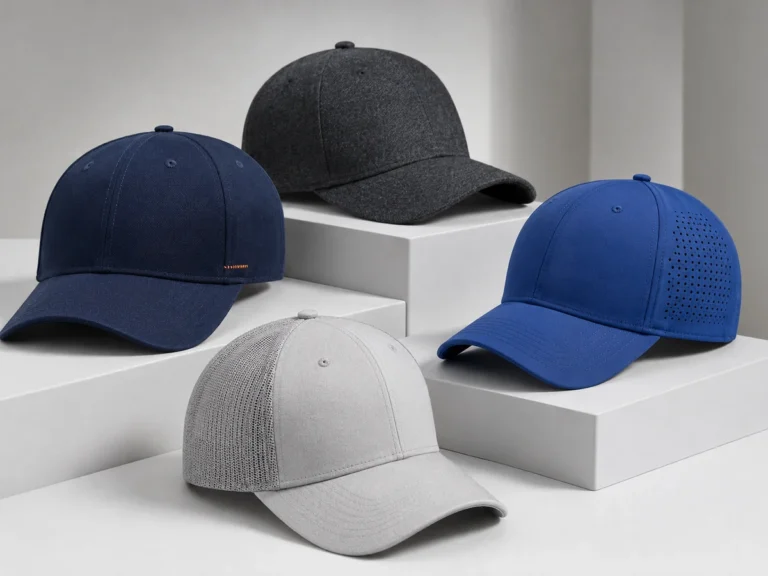
The cap matters as much as the patch. A structured front panel supports a larger, thicker badge. A soft Custom Dad Hat may benefit from a lighter patch and a smaller footprint. A Custom Trucker Hat normally needs the patch on a solid or foam front rather than across open side mesh.
Merrowed, Hot-Cut and Laser-Cut Patch Edges
The border changes both appearance and usable logo area. Buyers should specify it in the quotation rather than treating it as a production detail.
Merrowed edge
A merrowed edge is a thick overlock stitch wrapping the perimeter. It gives the recognizable rounded patch border and helps contain the cut edge. It works best on circles, ovals, rectangles, shields and other simple continuous shapes. It is less suitable for sharp internal corners or highly irregular silhouettes.
A merrow border takes up visual space. On a small patch, a heavy border can make the artwork feel cramped. It can also add height around a thin woven patch, deliberately combining a flat detailed face with a traditional raised frame.
Hot-cut edge
A hot-cut edge uses heat to cut and seal compatible synthetic material. It produces a flatter edge and can follow more complex outlines than a conventional merrow border. The exact result depends on the face material, border stitching and cut path. Test light-colored fabrics for discoloration and approve how close the cut runs to the artwork.
Laser-cut edge
Laser cutting can follow precise irregular contours and small angular changes. It is useful for letter shapes, mountains, animals and other custom silhouettes. “Laser cut” does not remove the need for edge engineering: material composition, heat response, corner radius and the relationship between the border stitch and the cut line still matter.
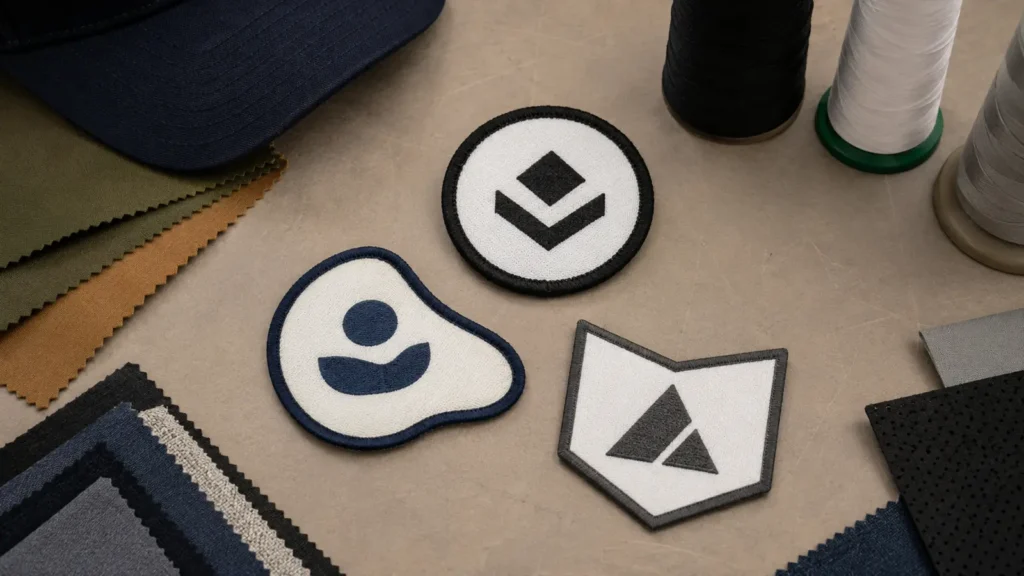
| Edge option | Best use | Visual effect | Buyer must approve |
|---|---|---|---|
| Merrowed/overlocked | Simple badges and traditional uniforms | Thick, rounded, classic | Border width, color and how much area it removes |
| Hot-cut | Custom contours on compatible synthetic fabrics | Slim, sealed, modern | Cut distance, discoloration and fray resistance |
| Laser-cut | Irregular or detailed silhouettes | Precise, minimal edge | Corner definition, material response and edge cleanliness |
Should a Hat Patch Be Sewn or Heat Pressed?
Sew-on attachment
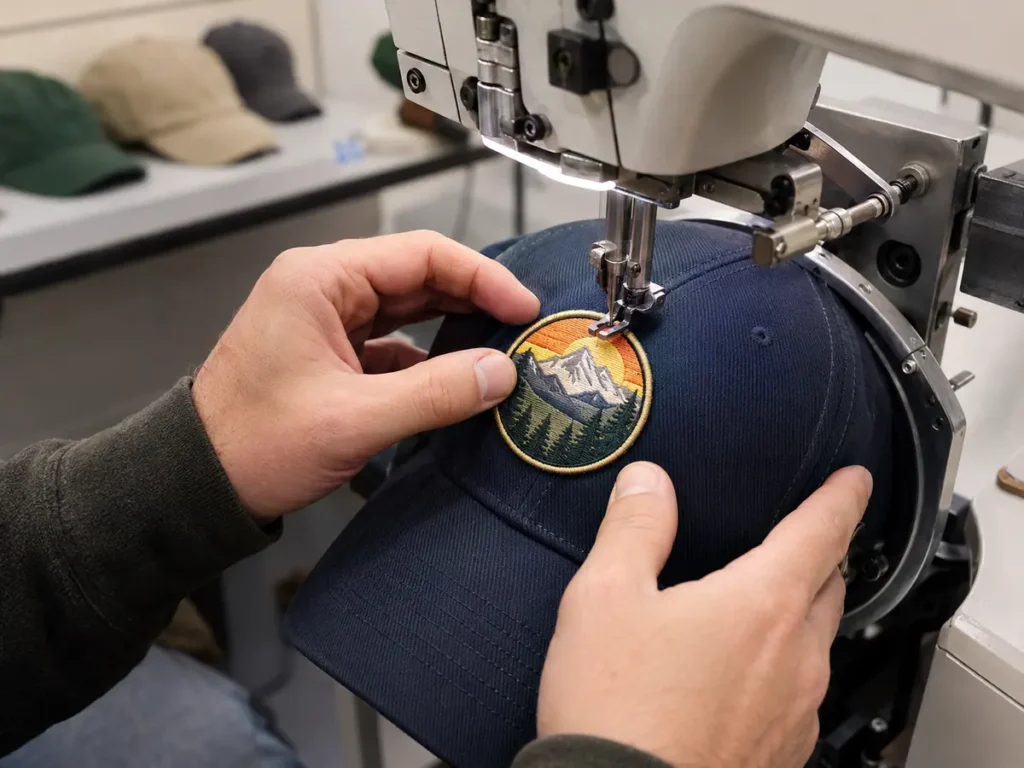
Perimeter sewing is the safest general recommendation for a permanent hat patch. Stitches mechanically attach the patch to the crown and do not depend solely on an adhesive bond. Sewing can handle many cap fabrics and may be reinforced at corners or stress points.
The challenge is access. The crown is curved, panels meet at seams, and a sweatband occupies the inside. A patch placed too low can interfere with the brim seam; a patch placed over a thick center seam may bridge or tilt. The operator and fixture must support the cap without creating puckering.
Heat-seal or heat-press attachment
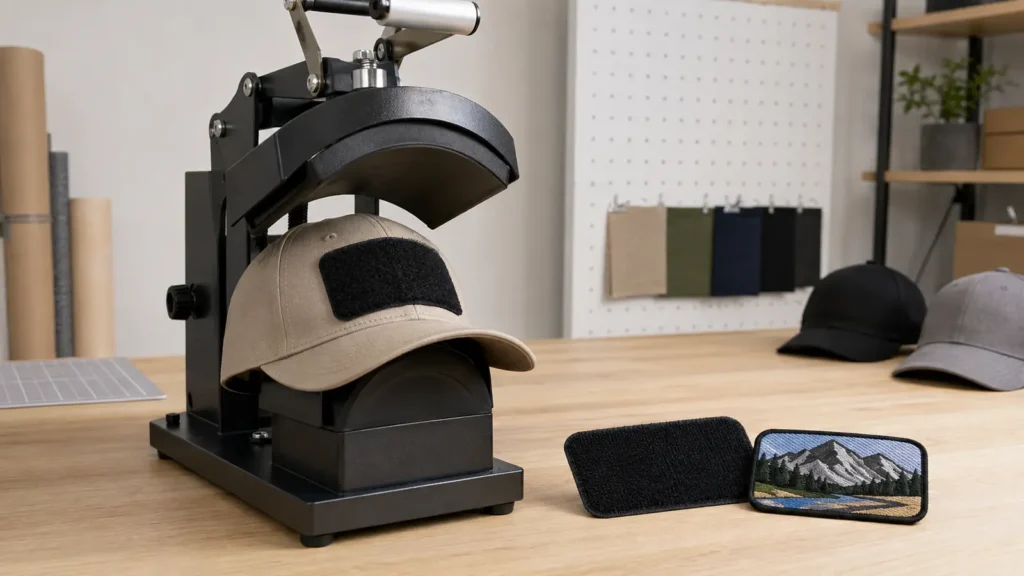
Heat-activated backing can provide a clean application when the patch adhesive, cap material and press geometry are compatible. The supplier must define temperature, pressure and dwell time for the exact system. A cap press should apply even pressure over the patch while protecting the visor and crown.
Do not copy a generic heat setting from another patch. Coatings, nylon blends, foam fronts, water-resistant treatments and heat-sensitive finishes can respond differently. Madeira’s heat-seal instructions explicitly advise considering the substrate’s recommended heat setting and testing at the lowest temperature and time first. See Madeira’s E-Zee heat-seal guide.
For long-life programs, some manufacturers use heat to position or bond the patch and then add perimeter sewing. This combines a flat initial placement with mechanical retention, but it adds operations and cost.
Hook-and-loop attachment
Hook-and-loop is useful when the wearer must change team roles, unit identification, event badges or campaign artwork. Typically, one component is secured to the cap and the mating component is attached to the patch. The patch can then be removed and replaced.
This system adds thickness and requires tight dimensional control. An undersized patch exposes the base; an oversized patch overhangs and catches. It also changes the style from permanent retail branding toward utility or tactical merchandising, which may or may not match the brand.
Send JIUMU the logo, finished patch dimensions, cap style, quantity, intended attachment and target delivery date. Ask for both embroidered and woven recommendations when the artwork sits near the detail limit. Request a custom quotation.
Which Patch Is More Durable?
Neither construction is automatically more durable in every use. Durability is a system property. It includes thread and face material, colorfastness, backing stability, border construction, attachment, cap fabric, abrasion, moisture, cleaning and storage.
An embroidered patch has a robust, established structure, but raised threads can encounter more surface abrasion or snagging than a flat face. A woven patch has a lower-profile surface, but a poor cut edge or weak attachment can still fail. A thick patch that refuses to bend around the cap may lift at the corners, while a thin patch sewn with uneven tension may ripple.
For a school, team or uniform program, define the actual exposure:
- occasional event wear or daily service;
- indoor retail use or outdoor moisture and abrasion;
- spot cleaning or repeated laundering;
- individual consumer care or centralized uniform care;
- removable patches or permanent identification.
Many caps are not intended for ordinary machine washing. Always use the care instructions for the exact cap and patch combination. If washing performance is commercially important, approve a test protocol before production and retain a tested reference sample. Avoid broad “washable” claims without defining temperature, detergent, cycle and number of repetitions.
Cost and MOQ: What Actually Changes the Quote?
JIUMU’s typical MOQ is 50 pieces, but the applicable minimum depends on patch construction, artwork, cap style and customization. Patch suppliers and processes may have different economic minimums, so the order should be quoted as one complete specification.
For embroidered patches, major cost drivers include:
- patch width and height;
- embroidery coverage and stitch count;
- number and type of thread colors;
- digitizing complexity;
- merrowed, hot-cut or laser-cut edge;
- backing and cap attachment;
- number of designs or colorways;
- sample requirements and packaging.
For woven patches, cost is affected by size, thread colors, weave complexity, loom or program setup, edge finishing, backing, attachment and quantity. Woven can be efficient for detailed artwork at volume, while embroidery can be efficient for a simple logo with moderate coverage. There is no reliable rule that one is always cheaper.
Ask the supplier to quote both options against the same finished dimensions, quantity, cap, placement and packaging. Otherwise, a lower price may reflect a smaller patch, fewer colors, a simpler edge or a different attachment rather than a true process comparison.
When Leather, PVC or Rubber-Style Patches Are Better
Embroidered and woven patches are only two options within Custom Patch Hats. Alternative materials can express a different brand language.
Leather and leather-style patches
Genuine leather has natural variation; leather-style synthetic materials can offer more consistent color and thickness. Laser etching, debossing or embossing creates a restrained, heritage appearance. These patches suit workwear, outdoor and lifestyle brands that prefer tonal marks over multicolor thread. Confirm whether the material is genuine leather, faux leather or suede-style, because care, consistency and market claims differ.
PVC and rubber-style patches
PVC or rubber-style patches can create molded relief, crisp color fields and a technical outdoor appearance. They suit performance, utility and modern streetwear programs. Molds or production setup, thickness, weight, flexibility and color matching affect the quote. A heavy molded patch can be too stiff for a soft dad hat, so cap compatibility must be sampled.
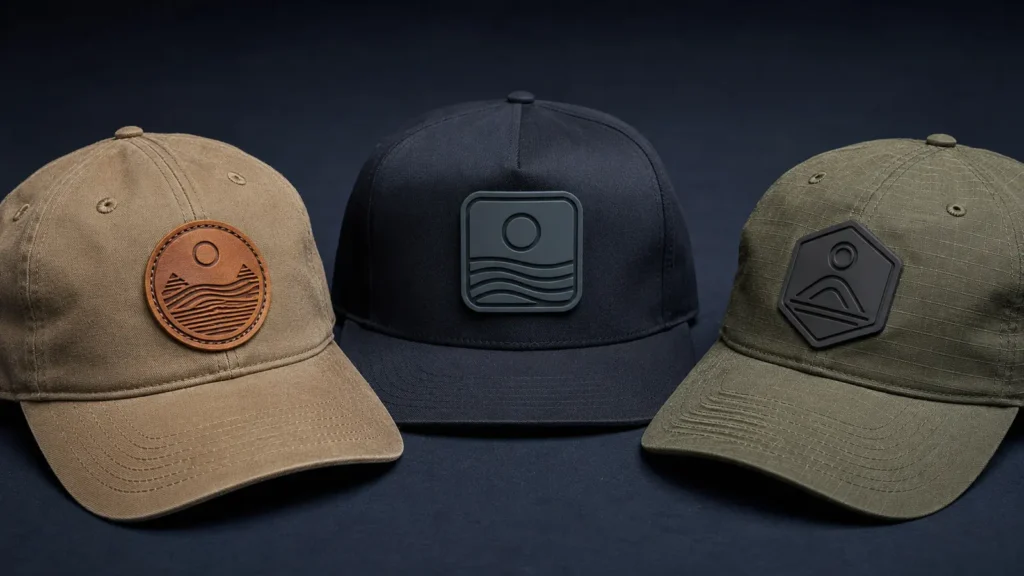
| Patch material | Main visual language | Detail behavior | Hat compatibility question |
|---|---|---|---|
| Embroidered | Traditional, tactile, dimensional | Best for bold simplified art | Will the crown support the thickness? |
| Woven | Refined, flat, detailed | Strong for small text and thin lines | Will the flexible patch lie flat on the curve? |
| Leather/leather-style | Tonal, heritage, restrained | Etched or debossed detail varies by material | Is natural variation acceptable? |
| PVC/rubber-style | Technical, molded, weather-oriented | Raised and recessed shapes, not thread detail | Is the patch too heavy or stiff for the cap? |
Match the Patch to the Hat Construction
A patch is developed on a flat work surface but worn on a three-dimensional crown. This changes its apparent width, border alignment and edge contact.
Structured snapback or baseball cap: The supported front panels can carry a larger or thicker patch. Check the center seam, crown height and the patch’s vertical clearance above the brim. If direct raised embroidery is also being considered, compare it with Flat vs 3D Puff Embroidery before choosing the decoration family.
Unstructured dad hat: The soft crown collapses and follows the head. A thin woven patch or a modest embroidered patch often integrates more naturally than a large, rigid badge. Test whether the patch creates a hard rectangle or changes the relaxed profile.
Trucker hat: A foam or solid front can accept a patch, but mesh side and back panels do not provide the same stable surface. Check whether heat and pressure will mark the foam and whether perimeter sewing can be completed without distortion.
Low-profile cap: The available vertical area may be smaller than expected. Reduce the artwork rather than letting a patch collide with the brim seam or climb into the crown’s sharp curvature.
Physical Sample Approval: The Step That Prevents Expensive Errors
A digital proof can confirm colors, outline and approximate placement. It cannot fully predict thread relief, edge feel, crown distortion, adhesive behavior or legibility at distance.
Approve the physical sample on the actual cap model and color. Record:
- patch width and height at tolerance;
- patch type, face material, thread colors and coverage;
- edge type, border width and border color;
- backing and permanent attachment method;
- horizontal and vertical placement from fixed cap reference points;
- center seam treatment and patch curvature;
- puckering, rippling, corner lift and reverse-side finish;
- readability at close, arm’s-length and normal viewing distances;
- on-head appearance from front and three-quarter angles;
- packing method and crown recovery after shipment.
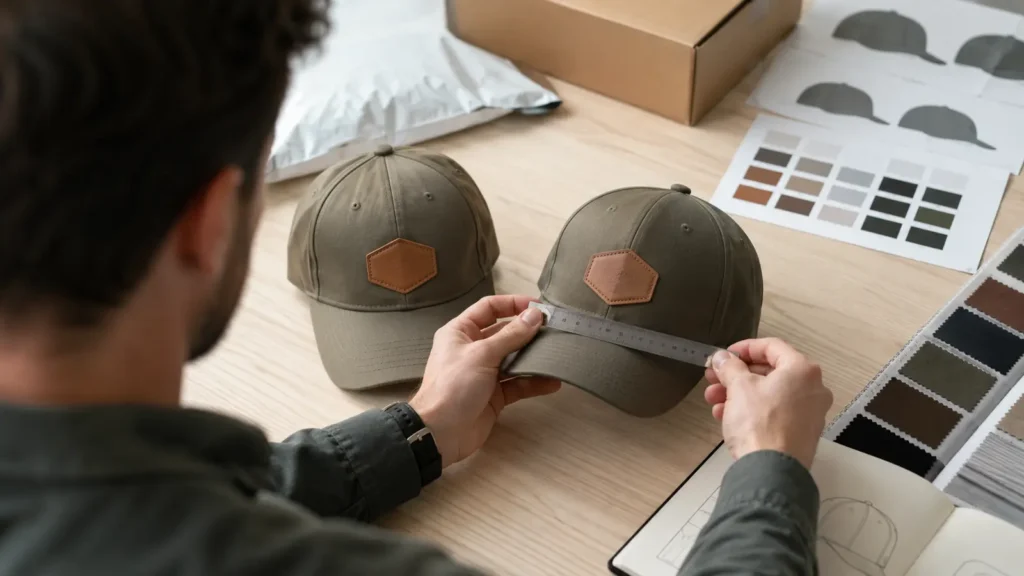
Keep one approved reference sample and the signed specification for repeat orders. Thread cards and digital color values help, but visual approval under agreed lighting remains important because cap fabric, thread sheen and patch face reflect light differently.
What to Send for an Accurate Custom Hat Quote
Send a complete inquiry package:
- vector artwork in AI, EPS, SVG or editable PDF when available;
- high-resolution reference image for visual context;
- final patch width and height;
- preferred embroidered, woven or alternative patch type;
- patch colors and Pantone references where required;
- edge choice and border color;
- sew-on, heat-seal or hook-and-loop attachment;
- cap style, structure, crown profile, material and color;
- front, side or back placement;
- order quantity by design and colorway;
- target market, use conditions and care expectations;
- private labels, hangtags and packaging;
- target approval and delivery dates.
If these decisions are not final, identify the non-negotiables. For example: “The 3 mm tagline must remain readable,” “the cap must retain a soft washed crown,” or “the badge must be removable.” A supplier can then recommend the process around the real business requirement.
Common Buying Mistakes
Choosing by a screen image
Mockups make both patch types appear sharp and flat. They do not show thread diameter, weave, edge thickness or crown curvature. Always request a physical sample for a new construction.
Shrinking detailed artwork without redrawing it
Reducing a logo uniformly also reduces line spacing, letter counters and border gaps. Create a production version of the artwork for the patch rather than forcing a full identity lockup into a small badge.
Treating woven as “printed”
A woven patch can look print-like because it is flat and detailed, but it is still made from interlaced threads. Gradients, photographs and very subtle tonal transitions may require a printed patch instead.
Ignoring the edge in the design
A thick merrowed border can consume a meaningful portion of a small patch. Decide the border before finalizing the internal artwork.
Assuming heat seal works on every cap
Adhesive, substrate, coating, temperature, pressure and crown geometry all matter. Test the full combination and use perimeter sewing when the service requirement calls for stronger mechanical attachment.
Comparing quotes with different specifications
Normalize size, colors, edge, backing, attachment, cap model, packaging and quantity. Otherwise, the comparison measures scope differences rather than manufacturing efficiency.
How JIUMU Supports Custom Patch Hat Programs
JIUMU has supported B2B custom teamwear, hats, uniforms, bags and branded merchandise since 2010 in Guangdong, China. Available capabilities include OEM/ODM development, embroidery, woven patches, rubber/PVC patches, leather-style patches, Pantone color matching, private labels, hangtags, packaging customization, digital mockups, physical samples, quality control and export support.
For a patch-hat project, the practical workflow is:
- review the logo and intended finished size;
- recommend embroidered, woven or alternative patch construction;
- confirm cap structure, material, crown profile and placement;
- define edge, backing and attachment;
- prepare a mockup and physical sample;
- record the approved specification;
- proceed to bulk production and quality control;
- arrange agreed packaging and export support.
The typical MOQ is 50 pieces, subject to product structure and customization. Exact minimum, price and lead time should be confirmed after the artwork and complete hat specification are reviewed.
Frequently Asked Questions
Final Recommendation
Start with the artwork requirement. Choose woven when small text and intricate detail must survive at compact hat size. Choose embroidered when the logo is bold enough to benefit from visible stitch texture and a traditional badge appearance. Then specify the edge, backing and attachment as carefully as the patch face.
The final decision should be made on the actual cap. Review the sample at normal distance, on-head and after the agreed handling or care test. That is the most reliable way to balance brand detail, comfort, durability and budget.
Request a patch-hat quotation: Send your logo, finished patch size, cap reference, quantity, colors, attachment preference, packaging and target date to JIUMU. Email zhengdong@jiumugear.com, WhatsApp/Phone +86 18507502899, or contact the team online.