
Fitted Hat Size Chart: How to Measure Your Head for the Perfect Fit
A fitted hat has no snap, strap, or buckle to compensate for a sizing mistake. The inside circumference must match the wearer closely enough to stay secure without creating pressure around the forehead or temples. That makes accurate head measurement essential for an individual purchase—and even more important when a team, school, retailer, or private-label brand is ordering fitted caps in bulk.
This guide explains how to measure your head, convert inches and centimeters into common fitted cap sizes, choose between two sizes, and plan a practical size run for a custom order. It also covers the less obvious variables that influence fit, including head shape, sweatband construction, crown profile, fabric, embroidery, hair, and production tolerance.

Quick Answer
To find your fitted hat size, wrap a flexible tape around the widest part of your head, usually about 1/2 inch (1.3 cm) above your eyebrows and ears. Keep the tape level, snug, and untwisted. Measure at least twice. Then match the largest repeatable measurement to the supplier’s fitted hat size chart. If you are exactly between sizes, a public retail guide may recommend sizing up; for custom bulk orders, approve a physical sample because hat blocks, sweatbands, fabrics, and crown shapes can fit differently even when the labeled size is the same.
The widely used adult fitted range from size 7 through size 8 covers approximately 22 to 25 inches, or 55.8 to 63.5 cm, in head circumference. This is a useful reference range, not a universal production specification.
Fitted Hat Size Chart: Inches, Centimeters, and Cap Sizes
The following chart reproduces a common adult fitted-cap progression. Its size-to-circumference values align with the current public New Era fitted cap sizing guide. Use it to understand the familiar fractional size system, then compare it with the exact chart supplied for the hat style you intend to buy or manufacture.
| Fitted cap size | Head circumference (inches) | Head circumference (cm) | Practical fit note |
|---|---|---|---|
| 7 | 22 | 55.8 | Smaller end of the common adult range |
| 7 1/8 | 22 3/8 | 56.8 | One standard step above size 7 |
| 7 1/4 | 22 3/4 | 57.7 | Common mid-small adult size |
| 7 3/8 | 23 1/8 | 58.7 | Common medium-range size |
| 7 1/2 | 23 1/2 | 59.6 | Central size in many adult assortments |
| 7 5/8 | 23 7/8 | 60.6 | Common mid-large adult size |
| 7 3/4 | 24 1/4 | 61.5 | Larger adult size |
| 7 7/8 | 24 5/8 | 62.5 | Near the upper end of many standard runs |
| 8 | 25 | 63.5 | Upper end of this common adult chart |
The centimeter figures are rounded to one decimal place. For independent unit conversion, the U.S. National Institute of Standards and Technology states that one inch equals exactly 2.54 centimeters.
Two cautions matter:
- A size label is not a promise that every brand or construction will feel identical. Pattern shape, material behavior, sweatband thickness, seam allowance, and production tolerance all affect the usable inside circumference.
- Smaller adult, youth, and extended sizes may be available, but their range depends on the product program and the manufacturer’s tooling. Request the exact available size run instead of assuming that every fitted style starts and ends at the same size.
How to Measure Your Head for a Fitted Hat
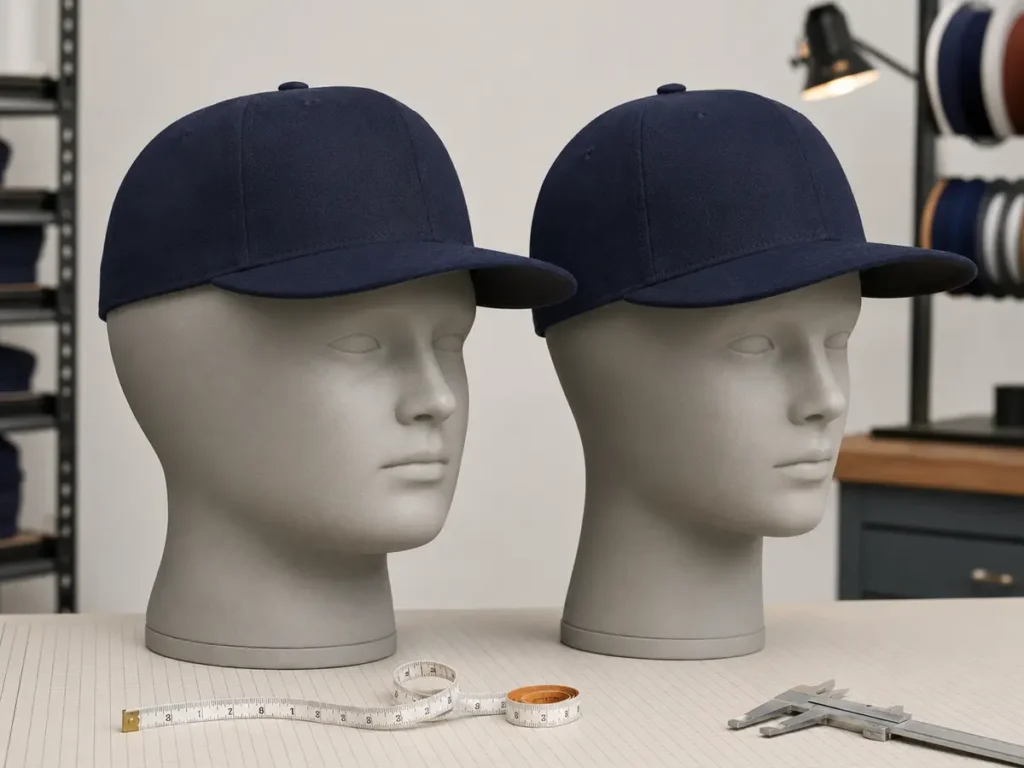
Accurate measurement requires only a flexible tailor’s tape. If one is unavailable, use a non-stretch string and then measure the string against a rigid ruler. Avoid elastic cord, yarn, or anything that lengthens under tension.
Step 1: Decide Where You Will Wear the Hat
Most fitted baseball caps sit around the widest part of the head. Position the tape across the middle of the forehead, roughly 1/2 inch above the eyebrows, above the ears, and around the fullest part at the back of the head. This placement follows the public guidance provided by both New Era Customer Care and ’47’s head-measurement guide.
If you normally wear a cap unusually high or low, measure along that actual wearing line as well. A measurement taken at the wrong angle can be more misleading than a small rounding error.
Step 2: Keep the Tape Level
Stand in front of a mirror or ask another person to help. Check that the tape forms one level loop and is not rising at the back, dipping over one ear, or crossing thick hair unevenly. A twisted tape adds error and makes the reading harder to repeat.
Step 3: Apply Comfortable Tension
The tape should touch the head all the way around without compressing the skin. Think “secure, not tight.” Pulling the tape hard can produce a hat that causes pressure. Leaving a visible gap can produce a loose hat that rotates or lifts during movement.
Step 4: Read and Record the Measurement
Record the result in both centimeters and inches when possible. A factory tech pack may use centimeters while a North American retail chart uses inches and fractional cap sizes. Keeping both units reduces conversion mistakes.
Step 5: Measure at Least Twice
Remove the tape, reposition it, and measure again. If the readings differ, take a third measurement. Use the largest repeatable result rather than an obviously loose one-time reading. For a team order, have one trained coordinator measure everyone using the same tape and written method.
Step 6: Match the Supplier’s Chart
Compare the final circumference with the chart for the exact hat style. Do not rely only on a previous hat’s label. Hair length, the age of the cap, laundering, stretching, and differences between styles can all change the result. New Era specifically notes that hair length and a bunched care label can affect perceived fitted-cap sizing.

What If Your Measurement Falls Between Two Sizes?
Suppose your measurement is 23 1/4 inches. It falls between size 7 3/8 at 23 1/8 inches and size 7 1/2 at 23 1/2 inches on the reference chart.
For an individual retail purchase, sizing up is often the safer starting point. New Era’s current public guide recommends rounding up when a measurement falls between sizes. A slightly roomy cap may also be easier to adjust with a removable sizing strip than an overly tight cap is to stretch safely.
For a custom B2B order, the decision needs more control:
- Test both neighboring sizes in the proposed fabric and crown pattern.
- Wear each sample for at least 10–15 minutes, not only a few seconds.
- Check forehead pressure, temple pressure, movement, and lift.
- Confirm whether the sweatband relaxes after wear.
- Repeat the check after any approved wash or conditioning test relevant to the material.
- Record the approved internal-circumference method in the tech pack.
Do not assume that “size up” is always correct. A long-oval head may experience side pressure in a nominally correct size, while a rounder head may feel front-to-back pressure. The right response could be a larger size, a different hat block, a different sweatband, or a revised pattern.
Head Shape Matters as Much as Head Circumference
Two people can measure exactly 58.7 cm and still prefer different caps. Circumference describes the total distance around the head but does not describe how that distance is distributed.
Round Head Profile
A rounder head has a more similar front-to-back and side-to-side relationship. A cap built on a long-oval block may feel loose at the front and back but tight at the sides.
Oval or Long-Oval Head Profile
An oval head has more front-to-back length relative to width. A rounder cap can create pressure at the forehead and back while leaving extra room near the sides.
Why This Affects Custom Programs
For a retail brand, one block shape may not satisfy every customer even if the size chart is accurate. For a team, discomfort can cluster among players with similar head shapes. A pre-production wear test should therefore include several people, not only the buyer or designer who approved the appearance.
Record qualitative feedback in a consistent format:
| Fit checkpoint | What to observe | Possible corrective action |
|---|---|---|
| Forehead pressure | Red mark or discomfort at the front | Review block shape, size, and sweatband |
| Temple pressure | Tightness concentrated at both sides | Compare a more oval block or next size |
| Front/back gap | Cap rocks despite correct circumference | Review block shape and crown pattern |
| Cap sits too high | Sweatband fits but crown does not settle | Lower crown profile or revise crown depth |
| Cap sits too low | Ears interfere with sweatband or brim position | Reduce crown depth or change profile |
| Rotation during movement | Cap turns without intentional adjustment | Check size, sweatband grip, and shape |
Fitted, Stretch-Fit, and Adjustable Caps Are Not the Same
Buyers sometimes use these terms interchangeably, but they require different sizing and inventory decisions.
| Cap type | Closure and fit mechanism | Typical size strategy | B2B purchasing implication |
|---|---|---|---|
| True fitted cap | Closed back with no adjustment | Fractional sizes such as 7 1/4 or 7 3/8 | More SKUs, precise fit, stronger size-data requirement |
| Stretch-fit cap | Closed back plus elastic or stretch sweatband | Combined ranges such as S/M or L/XL | Fewer SKUs, more forgiveness, verify stretch recovery |
| Snapback | Plastic snap closure | Usually one adjustable range | Simple distribution, different rear appearance |
| Strapback | Fabric, leather-style, hook-and-loop, or buckle strap | Usually one adjustable range | Broad adjustment with visible closure |
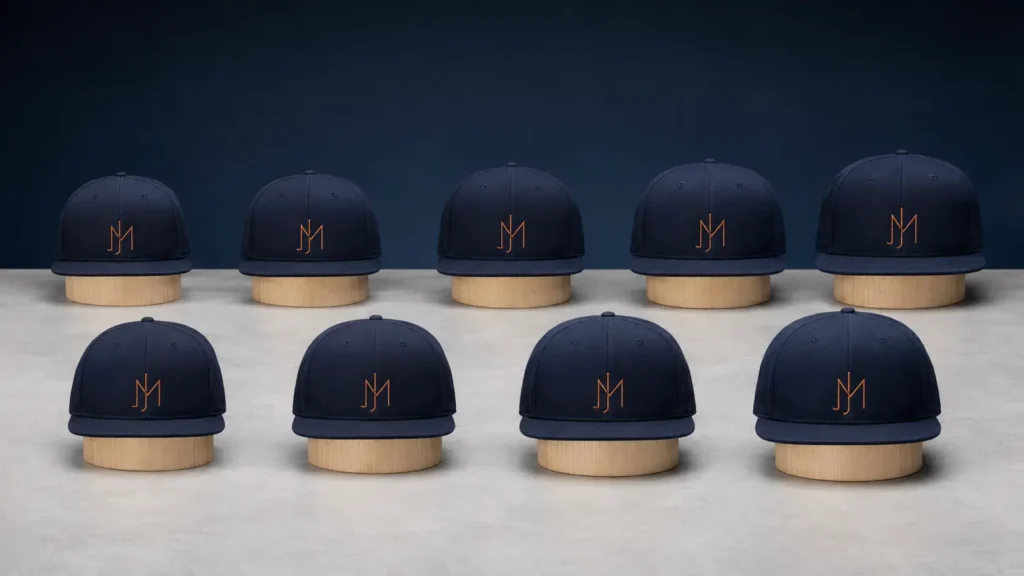
A true fitted cap creates a clean, uninterrupted back and a tailored product identity. The tradeoff is inventory complexity. A buyer must forecast quantities across multiple sizes, and the manufacturer must control each pattern or block consistently.
Procurement decision: choose true fitted construction when the closed-back appearance and exact fit are important enough to justify a multi-size program. Choose stretch-fit when you want a closed back with fewer inventory units. Choose adjustable construction when simple distribution and broad fit coverage are the priorities.
Cap Construction Variables That Change the Fit
The number on the label is only one input. The following specifications influence how the cap feels at the same nominal size.
Sweatband Material and Thickness
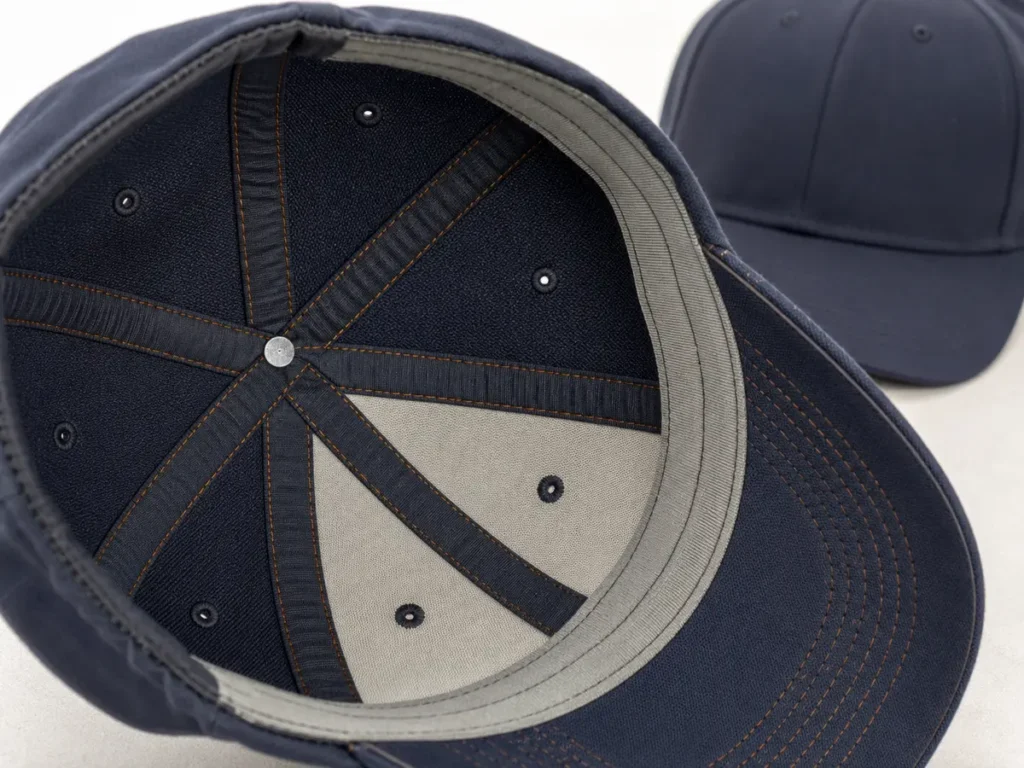
The sweatband occupies space inside the cap. A thick padded band can feel tighter than a thin band even if the shell circumference is similar. Elastic content, brushed surfaces, moisture-management finishes, and backing materials can also influence grip and stretch.
Crown Profile and Depth
Low-, mid-, and high-profile crowns change how far the cap settles on the head. Crown depth affects ear clearance and brim position. Structured front panels hold their shape; unstructured panels conform more readily.
Fabric and Lamination
Cotton twill, polyester, wool blends, performance fabric, and laminated panels do not behave identically. Some fabrics relax with wear; others remain stable. Heat, moisture, finishing, and cleaning can produce dimensional change. Avoid promising “shrink-proof” performance unless the exact fabric and finished cap have been tested.
Seams, Taping, and Allowances
Internal seam allowances and seam tape create localized thickness. Consistency across panels helps maintain the intended circumference and shape. A small cumulative change at several seams can become noticeable at the sweatband.
Embroidery Density
Large, dense front embroidery can stiffen a crown panel. It usually affects shape more than circumference, but it can change how the crown conforms to the forehead. Side and back embroidery placed near the sweatband should be reviewed for internal backing and comfort.
Brim Shape
A flat brim and a pre-curved brim can make the same crown feel different because the brim influences front-panel tension and wearing angle. Approve the final brim specification together with the fit sample.
How to Build a Size Run for Team or Bulk Orders
A fitted-cap order is not one product with one quantity. It is a group of size-specific SKUs sharing a design. Good planning prevents too many units in slow sizes and shortages in common sizes.
1. Collect Actual Measurements
For an existing team, measure every wearer. Do not estimate from age, height, gender, or jersey size. Create a roster with name or internal ID, head circumference, selected fitted size, and approval status.
For privacy and operational simplicity, the manufacturer usually needs aggregate size quantities, not player names, unless individual packaging is requested.
2. Use a Controlled Measuring Method
Give the coordinator a one-page instruction, one tape type, and one measurement deadline. If participants self-measure, ask for two readings and a photo of tape placement only when appropriate and consented to.
3. Test a Core Size Set
Before the full size run, request development samples around the center of the expected range—for example, a common middle size plus one size below and above. If the buyer population includes youth or extended sizes, include those boundaries in testing.
4. Confirm the Manufacturer’s Available Range
Ask which fractional sizes are available for the selected crown, brim, fabric, and minimum quantity. Some combinations may require different tooling, minimums, or development work.
5. Add Replacements Strategically
For repeat teams, keep a small buffer in the sizes that have historically moved fastest. Avoid spreading buffer inventory evenly across every size without data. Retail and private-label buyers should use sales history, returns, regional data, and preorder measurements where available.
6. Keep the Size Matrix Attached to the Purchase Order
The purchase order should show the total quantity and the exact quantity per size. The approved artwork, colors, labels, packaging, and size matrix should share one version reference so a later design revision does not separate from its size breakdown.
Example Team Size Matrix
| Fitted size | Measured wearers | Planned buffer | Order quantity |
|---|---|---|---|
| 7 | 2 | 1 | 3 |
| 7 1/8 | 5 | 1 | 6 |
| 7 1/4 | 8 | 2 | 10 |
| 7 3/8 | 12 | 2 | 14 |
| 7 1/2 | 10 | 2 | 12 |
| 7 5/8 | 7 | 1 | 8 |
| 7 3/4 | 4 | 1 | 5 |
| 7 7/8 | 1 | 0 | 1 |
| 8 | 1 | 0 | 1 |
| Total | 50 | 10 | 60 |
This is an illustration, not a universal size distribution. Build your matrix from measured wearers or real sales data.
Planning a custom fitted-cap program? Send JIUMU your total quantity, size breakdown, target market, crown profile, brim style, fabric, colors, logo files, labeling, packaging, and target delivery date. We can review the specification and prepare a custom quotation.
Request a fitted-cap quotation.
Sample Approval and Quality Control
A visually attractive sample can still be the wrong size. Fit approval should be documented separately from artwork approval.
Development Sample Checks
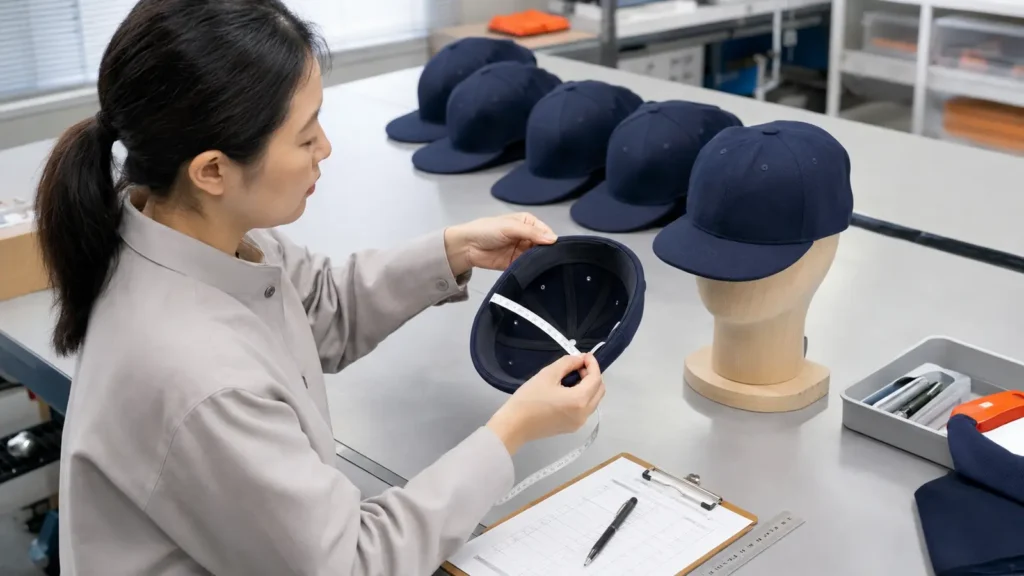
- Measure the inside circumference using the agreed method and tension.
- Compare the result with the specification rather than only the label.
- Place the cap on the intended head form and check symmetry.
- Conduct a wear test with people near the target size.
- Check forehead, side, and rear pressure after extended wear.
- Confirm crown depth, ear clearance, and brim position.
- Inspect internal embroidery backing and seam comfort.
- Review sweatband material, width, joining seam, and elasticity.
- Confirm fabric, color, logo position, and thread colors.
- Record photos and comments in the sample approval form.
Pre-Production Sample Checks
The pre-production sample should reflect the final approved materials, artwork, labels, and construction. If the embroidery size, backing, fabric, or sweatband changes after the first fit sample, recheck fit. A “small” material substitution can affect internal space or crown behavior.
Bulk Inspection Checks
Inspection should sample multiple units across the size range, not only one convenient middle size. Check:
- Correct size label and packaging label
- Internal circumference against the approved tolerance
- Crown symmetry and panel alignment
- Brim centering and curve
- Logo position, dimensions, color, and stitch appearance
- Seam security and loose threads
- Sweatband attachment and comfort
- Color consistency across panels and repeat units
- Quantity per size and carton identification
The measurement method and allowable tolerance must be agreed with the supplier. Without a defined method, two inspectors can measure the same flexible product differently.
Customization Without Losing Fit Consistency
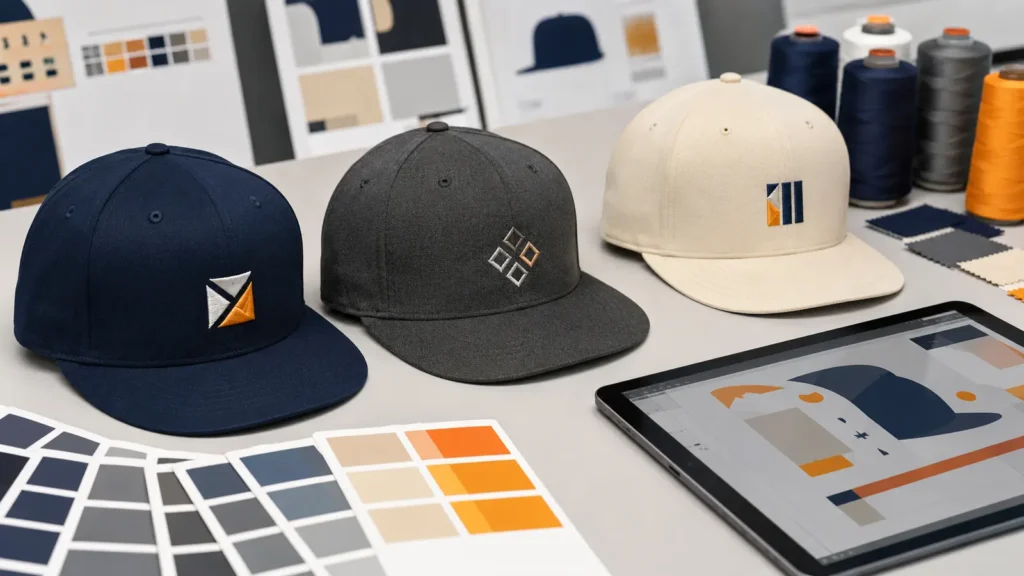
Fitted caps can support front, side, and back embroidery; woven, rubber/PVC, or leather-style patches; custom fabric colors; private labels; hangtags; and packaging. Each method needs to be considered in relation to fit and comfort.
For embroidery, confirm design dimensions, stitch type, density, backing, placement, and distance from the sweatband. For patches, confirm thickness, edge finish, attachment method, and whether internal stitching can be felt by the wearer. For private labels, avoid bulky folds or placement that bunches inside the sweatband.
Color matching should be approved on the actual fabric because screen color and thread cards are only references. If repeat-order consistency matters, retain the approved physical sample, color standard, artwork file, thread references, and bill of materials.
Cost Drivers in a Custom Fitted Hat Program
Fitted-cap pricing depends on more than total unit count. Important cost drivers include:
- Number of sizes and quantity per size
- Custom pattern or block development
- Structured or unstructured crown
- Fabric type, weight, finishing, and color
- Brim construction and underside material
- Embroidery stitch count and number of locations
- Patch material and attachment
- Custom sweatband, seam tape, labels, and hangtags
- Individual size labeling or player packaging
- Sampling rounds and testing requirements
- Carton assortment and export packaging
A very fragmented size run can increase operational complexity even when the total quantity is unchanged. Ask the supplier to confirm minimum quantities by style, color, and size—not only the headline MOQ. JIUMU’s typical MOQ is 50 pieces, subject to product structure and customization.
Information to Send for an Accurate Quotation
Provide the following in one organized request:
- Buyer type and target market
- Total order quantity
- Quantity by fitted size
- Adult, youth, or extended-size requirements
- Reference image or intended crown profile
- Flat or curved brim and preferred underside
- Structured or unstructured front
- Fabric composition, color, and performance needs
- Vector logo files and placement dimensions
- Embroidery or patch preference
- Private label, hangtag, and packaging requirements
- Sample quantity and approval process
- Required tests or compliance documentation, if applicable
- Shipping destination and target delivery date
If some specifications are not final, state the intended use and price position. A supplier can then propose practical options rather than guessing.
Questions to Ask a Fitted Hat Supplier
- Which fractional sizes are available for this exact cap construction?
- Is the size chart based on head circumference, finished inside circumference, or a proprietary block?
- What measurement method and tolerance will be used?
- Can you provide samples in neighboring sizes for fit comparison?
- Which sweatband options are available, and how do they affect fit?
- Can the crown profile or depth be adjusted?
- How will size labels and cartons be identified?
- Does the MOQ apply to the entire design or to each size and color?
- How are bulk units inspected across the full size run?
- What records are retained for repeat-order color, fit, and construction consistency?
- How should artwork, embroidery backing, or patches be adjusted to avoid discomfort?
- What information is needed before a production timeline can be confirmed?
Common Fitted Hat Sizing Mistakes
Measuring at an Angle
A tape that rises at the back increases the measured path and can suggest a larger size. Use a mirror and keep the loop level.
Pulling the Tape Too Tight
The measurement should reproduce the desired wearing tension, not compress the head. A tight measurement can create persistent discomfort.
Using a Stretchy String
Elastic cord and yarn can lengthen, producing an inaccurate result. Use a flexible tape or non-stretch string.
Measuring Only Once
Small placement differences matter. Repeat the process and use a consistent reading.
Assuming Every Brand Fits the Same
The fractional label is a useful convention, but internal shape and construction vary. Always use the product-specific chart and sample.
Ignoring Hair and Wearing Conditions
Measure with the hairstyle normally worn under the cap. If players sometimes wear a liner, headband, or protective item, test the real use condition.
Approving Only One Size
A correct middle sample does not prove that the smallest and largest sizes scale correctly. Inspect boundary sizes and bulk samples across the run.
Buying Equal Quantities of Every Size
Equal allocation is easy but rarely data-driven. Use roster measurements, preorders, or sales history.
Why Work With JIUMU on Custom Fitted Hats?
Established in 2010 in Guangdong, China, JIUMU supplies B2B custom teamwear, hats, logo apparel, bags, uniforms, and branded merchandise for buyers in North America and Europe. Our typical fitted-hat workflow can include digital mockups, physical samples, logo embroidery, patch development, fabric sourcing, Pantone color matching, private labels, hangtags, packaging customization, bulk production support, quality control, and export coordination.
For fitted caps, our focus is specification clarity: available size range, size matrix, crown and brim construction, logo method, labels, packaging, sample approval, and repeat-order references. The typical MOQ is 50 pieces, subject to the chosen product structure and customization.
Explore custom fitted hats or review JIUMU’s broader custom baseball cap capabilities.
Frequently Asked Questions
Final Recommendation
A reliable fitted-cap program begins with a repeatable measuring method, not a guessed size ratio. Measure each wearer at the actual hat line, record centimeters and inches, compare the result with the exact product chart, and test neighboring sizes when measurements or head shapes sit between options. For bulk production, define the size matrix, sample-approval criteria, measurement method, and tolerance before the order moves forward.
The result is more than a comfortable cap. It is a cleaner purchasing process, a more useful inventory mix, fewer avoidable fit complaints, and a stronger foundation for repeat orders.

Request a custom fitted-hat quotation from JIUMU. Send your quantity by size, target market, crown profile, brim style, fabric, colors, logo files, labeling, packaging, shipping destination, and target delivery date. Contact us by inquiry form, WhatsApp/phone at +86 18507502899, or email zhengdong@jiumugear.com.
Sources and Further Reading
- New Era fitted caps sizing guide
- New Era Customer Care: how to find your cap size
- ’47: how to measure your hat size
- NIST Handbook 44, Appendix C: unit conversions
About JIUMU
Established in 2010 in Guangdong, China, JIUMU supplies B2B custom teamwear, logo apparel, hats, uniforms, bags, and branded merchandise for buyers in North America and Europe.