
How to Choose a Custom Hat Manufacturer in China
Choose a custom hat manufacturer in China by verifying the legal company, production location, material and decoration capabilities, sampling process, quality records, communication system and export documentation. Factory photographs and a low quotation are not enough to confirm that a supplier can produce the approved product consistently.
This buyer’s guide provides a practical due-diligence process for clothing brands, sports teams, distributors, promotional-product companies and other B2B buyers. The objective is not to find a supplier that says yes to every request. It is to identify a partner that asks the right technical questions, documents decisions and explains limitations before production begins.
Quick Answer: What Should You Verify?
- The exact legal entity that will sign the agreement and receive payment
- The actual production location and which processes are completed there
- Any materials or processes that are subcontracted
- Experience with your specific hat construction and decoration method
- How materials, colors and artwork are approved
- How sample revisions are recorded
- Which inspection criteria and tolerances are used
- How packaging, shipping documents and repeat orders are controlled
Factory, Trading Company or Hybrid Supplier?
The label attached to a supplier is less important than transparent responsibility. A factory may complete most processes in one location, while a trading company may coordinate several specialist factories. A hybrid supplier may operate core production and outsource selected components such as PVC patches, custom-dyed fabric or laboratory testing.
Ask five direct questions: Who signs the contract? Who receives payment? Where is the main product assembled? Which processes are subcontracted? Who is responsible for final inspection and corrective action? The answers should match the legal and commercial documents.
| Supplier model | Possible advantage | What the buyer must verify |
|---|---|---|
| Factory | Direct control of core processes | Actual in-house scope, capacity and quality system |
| Trading company | Access to multiple specialist factories | Supplier selection, traceability and responsibility |
| Hybrid | Core production plus specialist partners | Which processes are internal and how subcontractors are controlled |
1. Verify the Legal Company Identity
Request the registered company name in its original language and, where available, an accurate English translation. Compare the business registration with the contract, invoice, payment beneficiary, website, domain email and operating address. A brand name may differ from the legal company name, but the relationship should be explained clearly.
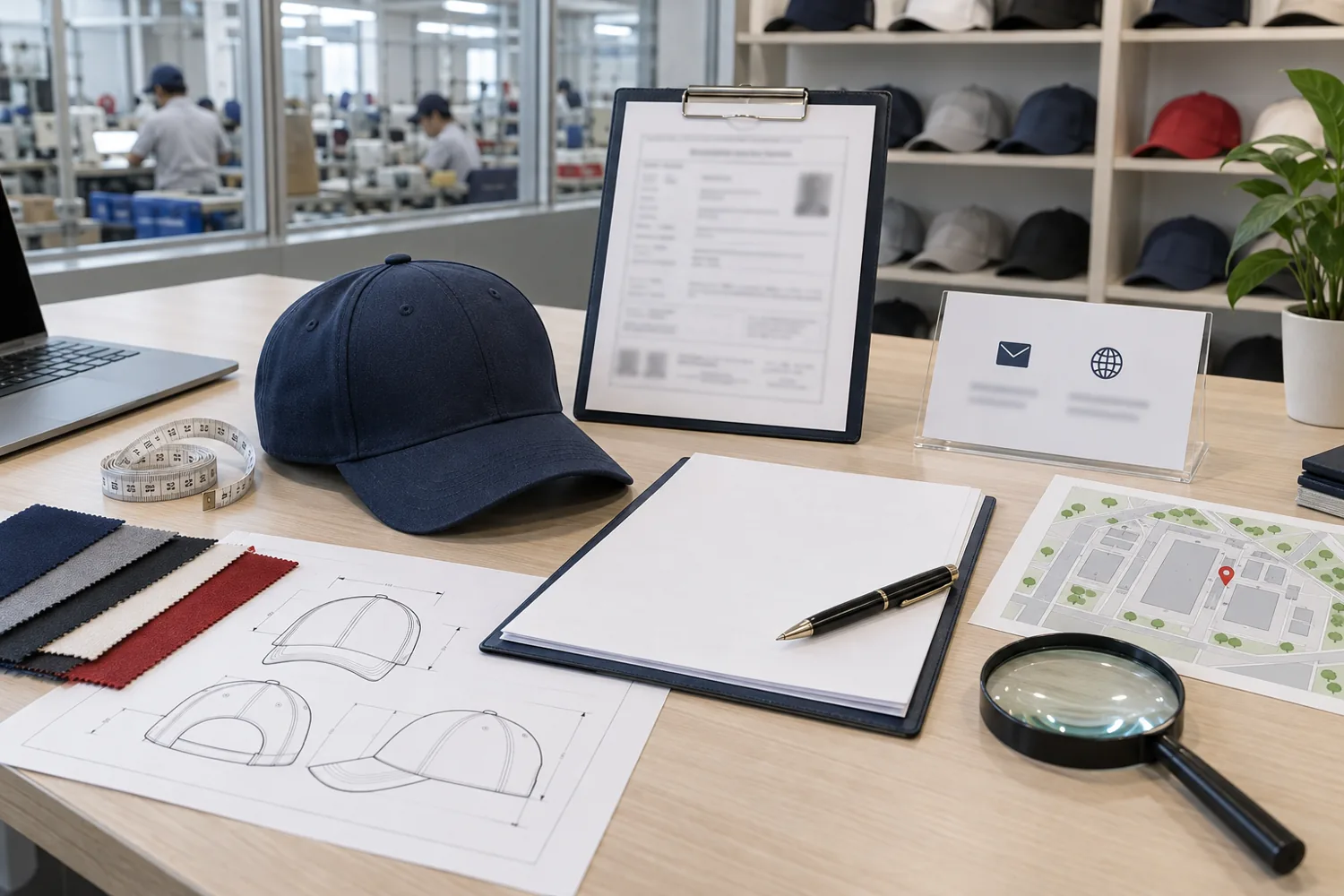
Legal identity checklist
- Registered company name
- Registration number or unified credit identifier
- Registration status and date
- Registered address
- Operating or factory address
- Contracting entity
- Payment beneficiary
- Company-domain email
- Name and role of the project contact
Documents may be redacted to protect sensitive information, but the visible information must still support the claim being made. A blurred document that hides the company name, issuing authority and date provides little verification value.
2. Review Actual Hat Manufacturing Capabilities
A supplier that produces one type of cap well may not have the same capability for every structure or material. Ask for examples that match your intended product: structured baseball caps, unstructured dad hats, closed-back fitted hats, foam trucker hats, performance golf caps or another construction.
Review the production route from material receipt through cutting, embroidery or patch application, sewing, shaping, finishing, inspection and packing. For each process, ask whether it is completed in-house or by an approved subcontractor.
Capability evidence to request
- Dated photographs or continuous video of the operating area
- Machine type and the process it performs
- Physical samples using the requested construction
- Examples of the requested logo method at a similar size
- Material and component references
- Production and inspection records with confidential information removed
A photograph of a machine proves only that the photographed machine existed in that location at that time. It does not by itself prove ownership, current availability, monthly output or suitability for your project. Capacity should be confirmed against the product, order quantity and production schedule.
3. Evaluate Material and Color Control
Ask how the supplier identifies fabrics, mesh, closures, visor inserts, sweatbands, thread and patch materials. Determine whether the quoted material is a stock item, sourced for the order or custom-developed. If an exact color is important, agree on the reference: a physical swatch, commercial color standard, lab dip or approved sample.
Do not approve critical colors only from phone or computer screens. Displays, cameras and lighting can change the appearance. The purchase specification should state how color acceptance will be judged.
4. Examine the Sampling Process
A digital mockup helps confirm layout, but it does not demonstrate physical color, fabric texture, fit or embroidery quality. For a new construction or important order, ask whether a physical sample will be made and whether it uses production-intent materials and decoration.
- Give every sample a number and revision
- Record material codes and color references
- Measure crown, visor and logo placement
- List every requested change in one document
- Confirm whether a revision changes cost or schedule
- Approve the exact reference used for bulk production
5. Inspect the Sample as a Production Reference
Review crown profile, panel symmetry, visor shape, stitch consistency, eyelet position, sweatband, closure, internal taping, labels and packaging. Measure the logo rather than judging it only by eye. Check small text and narrow lines at actual production size.
6. Review Quality-Control Documentation

“High quality” is not an inspection standard. The supplier and buyer should agree on measurable specifications and allowable tolerances. A useful inspection record identifies the order or sample, inspection date, inspected quantity, criteria, results and corrective action.
| Inspection area | Questions to ask |
|---|---|
| Material | Does it match the approved reference and specification? |
| Construction | Are panel alignment, seams and visor assembly consistent? |
| Logo | Do dimensions, position, colors and appearance meet approval? |
| Fit | Are crown dimensions, closure and fitted sizes within tolerance? |
| Appearance | Are stains, loose threads, shape defects or damage controlled? |
| Packing | Do quantities, labels, individual packs and carton marks match? |
7. Test Communication and Change Control
Strong communication is not measured only by response speed. Evaluate whether the supplier summarizes decisions, identifies missing details, separates confirmed information from assumptions and keeps version-controlled artwork and specifications.
Changes sent across many chat messages create production risk. Use one consolidated revision list and ask the supplier to confirm the final version before production.
8. Confirm MOQ, Lead Time and Capacity Conditions
Ask whether MOQ applies per design, color, size, fabric or decoration version. Confirm when the production clock starts: after artwork approval, sample approval, material approval, deposit, roster or another milestone. Separate sampling time, bulk production and international transit.
JIUMU states that typical custom-hat MOQ starts from 50 pieces and that hat sample development generally takes approximately 5–7 days after requirements are confirmed. Final quantities and timing depend on the product, materials, artwork, components and available schedule.
9. Review Export and Packing Support
- Commercial invoice and packing list
- Individual packaging
- Barcode or buyer labels
- Carton assortment and carton marks
- Country-of-origin or product documents where applicable
- Buyer-appointed forwarder handover
- Shipment photographs and quantity confirmation
Confirm the named Incoterm and destination. A freight quotation should make clear who handles pickup, export, international transport, customs, taxes and final delivery.
10. Check Repeat-Order Control
Repeat orders depend on retained records. Ask whether the supplier keeps the approved artwork, material code, pattern, dimensions, embroidery file, sample reference, labels and packaging instructions. Material batches can change, so a repeat order should still include a current review rather than relying only on an old photograph.
12 Warning Signs of an Unreliable Supplier
- The supplier will not identify the legal contracting entity.
- Payment is requested to an unrelated personal or company account without explanation.
- Factory images cannot be connected to a current location or date.
- The supplier guarantees a final price before reviewing specifications.
- Every technical request receives a generic “no problem” answer.
- MOQ changes repeatedly without a material or process explanation.
- The sample has no version number or specification.
- Bulk materials are not linked to the approved sample.
- Changes are not summarized in writing.
- Quality standards use only subjective words.
- Subcontracted processes are hidden.
- Delivery promises exclude material approval, production or transport dependencies.
Custom Hat Manufacturer Comparison Scorecard
| Category | Suggested weight | Evidence |
|---|---|---|
| Legal identity | 15% | Registration, contract and payment match |
| Product capability | 15% | Relevant processes and comparable samples |
| Sample quality | 20% | Measured against the agreed specification |
| Specification control | 15% | Clear versions, materials and approvals |
| Quality system | 15% | Inspection criteria, records and corrective action |
| Communication | 10% | Accurate summaries and risk identification |
| Export support | 10% | Packing and shipping-document capability |
Frequently Asked Questions
Should I always choose a factory instead of a trading company?
No. Choose the operating model that provides the required capability, transparency, quality control and accountability. Verify who performs each process and who is responsible when a problem occurs.
Can factory photographs verify a manufacturer?
They can support a review, but photographs alone do not prove legal identity, ownership, current capacity or continuous compliance. Combine them with documents, live review and production records.
When should I arrange a third-party inspection?
Independent inspection may be appropriate for a new supplier, a high-value order, complex specifications, strict tolerances or a critical delivery. Agree on the scope before production.
What should I send before asking for a sample?
Send the hat style, quantity, artwork, fabric and color requirements, logo dimensions, closure, inside branding, packaging, destination and required delivery date.
Request JIUMU’s Manufacturing Information
Review JIUMU’s company facts, manufacturing capabilities and quality-control process. For a project-specific review, send your product, quantity, artwork, destination and required date.