
How to Resolve Defective Bulk Orders With a Supplier
Receiving a bulk apparel order with incorrect sizes, wrong colors, misplaced logos, open seams, stains, shortages, or crushed cartons is stressful. The fastest route to a fair solution, however, is not an angry message or a folder of random photos. It is a controlled claim that identifies the affected goods, preserves evidence, compares the order with approved standards, separates manufacturing defects from transport damage, and proposes a commercially workable remedy.
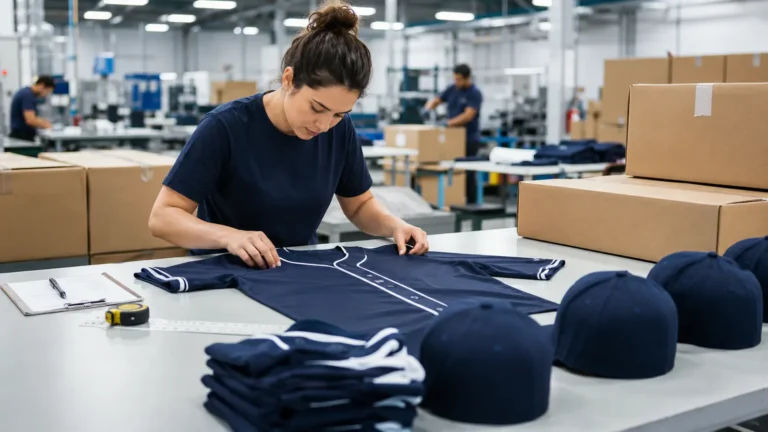
A buyer should first protect the evidence and prevent the goods from entering distribution. Count the affected units by SKU and defect type, record carton and batch references, photograph both the product and its packaging, and compare the findings with the purchase order, current Tech Pack, approved artwork, measurement tolerances, and Golden Sample. Then send one written Notice of Defect with a quantified register and a requested response date.
The appropriate outcome may be rework, replacement, credit, partial refund, or another agreed solution. It depends on the contract, defect severity, repairability, delivery deadline, evidence, shipping terms, and cost. This guide provides a practical B2B workflow, but it is not legal advice and does not replace the manufacturing agreement, carrier terms, cargo insurance policy, or professional advice for a disputed claim.
Quick Answer: What Should You Do First?
Take these actions before the affected products are washed, altered, distributed, returned, or discarded:
- Quarantine the shipment. Separate affected cartons and units from saleable stock.
- Preserve the evidence. Retain original cartons, inner packaging, labels, tags, damaged contents, and delivery records.
- Record visible delivery damage. Note shortages or external damage on the delivery receipt when possible and notify the carrier or forwarder under its current procedure.
- Build a SKU-level count. Record style, color, size, personalization, carton, quantity inspected, and quantity affected.
- Classify each issue. Use consistent defect names and severity categories.
- Compare against approved standards. Reference the PO, Tech Pack revision, Golden Sample, artwork, size chart, packaging specification, and agreed tolerances.
- Send one formal notice. State the facts, attach an evidence index, reserve relevant rights, and request containment and a written response.
- Agree on a remedy and verification plan. Define quantities, responsibilities, deadlines, freight, inspection, and closure criteria in writing.
Do not wait for a universal “reasonable” reporting period. Contracts, marketplaces, carriers, insurers, payment providers, and laws may use different deadlines. Check all applicable terms immediately and notify the relevant parties without unnecessary delay.
1. Quarantine the Goods and Preserve the Shipment Condition
The first objective is containment. If mixed-quality goods enter a school, dealer warehouse, retail launch, or team distribution event, the original lot becomes harder to reconstruct. Players may remove tags, staff may discard polybags, and local repair attempts may obscure the original defect.
Move the affected shipment to a clearly identified hold area. If only certain cartons show external damage, isolate those cartons while keeping their pallet, carton, and unit references. If the defect appears systematic—such as every size label being incorrect—place the entire relevant lot on hold until the scope is known.
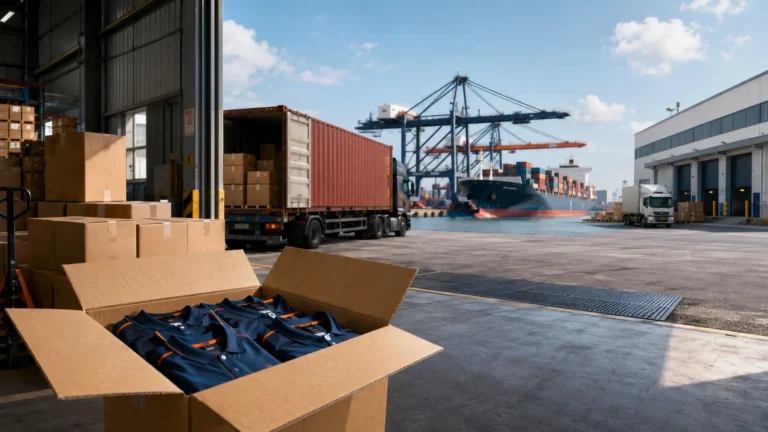
Retain the original shipping materials. FedEx tells claimants to keep original packaging until a claim is resolved, and UPS asks for views of the damaged item as packed, the shipping label, and the package exterior. These carrier examples show why a product-only photograph may be insufficient for a transit claim. Procedures and deadlines vary, so follow the actual carrier, forwarder, or insurer instructions for the shipment.
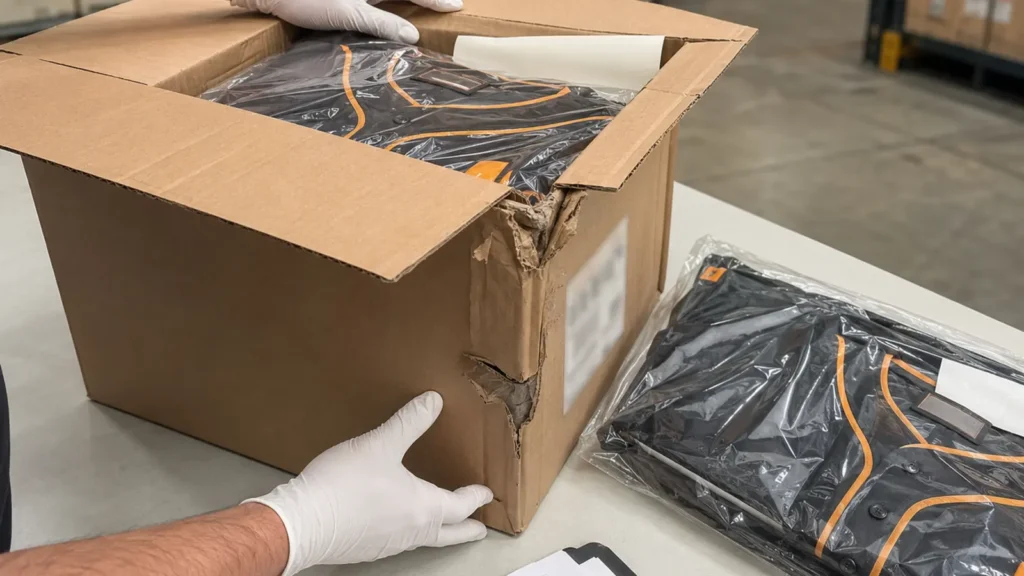
Do not change the evidence prematurely
Unless necessary to prevent further loss or address a safety issue, avoid the following before the supplier and any relevant carrier or inspector have responded:
- washing stained or odorous garments;
- trimming loose threads or repairing seams;
- pressing, steaming, or reshaping products;
- removing labels, hangtags, polybags, or carton marks;
- distributing personalized uniforms to players;
- combining the affected lot with other inventory;
- returning or destroying goods without written instructions.
You still have a duty to mitigate avoidable additional loss. For example, wet cartons may require controlled separation and drying to stop moisture spreading. Photograph the original condition first, record what was done, keep representative packaging, and seek written direction as quickly as possible.
2. Count Defects by SKU, Not by Impression
“Many jerseys are wrong” is not a claim quantity. A useful register converts the problem into traceable data.
An SKU may represent a combination of style, color, size, fit, player name, number, and packaging requirement. A personalized jersey with the correct size but the wrong player number is not interchangeable with blank stock. Record top and bottom components separately where applicable.
| Field | Example purpose |
|---|---|
| Order and style ID | Connects the item to the PO and approved specification |
| SKU / variant | Separates color, size, fit, and personalization |
| Carton or pallet | Helps identify a packing, transit, or production pattern |
| Quantity received | Establishes the physical receipt |
| Quantity inspected | Shows whether the count is 100% or sampled |
| Defect code | Keeps descriptions consistent |
| Affected quantity | Quantifies the requested remedy |
| Severity | Supports prioritization; use agreed definitions |
| Photo/video reference | Links each record to evidence |
| Disposition | Hold, rework, replace, accept, or pending |
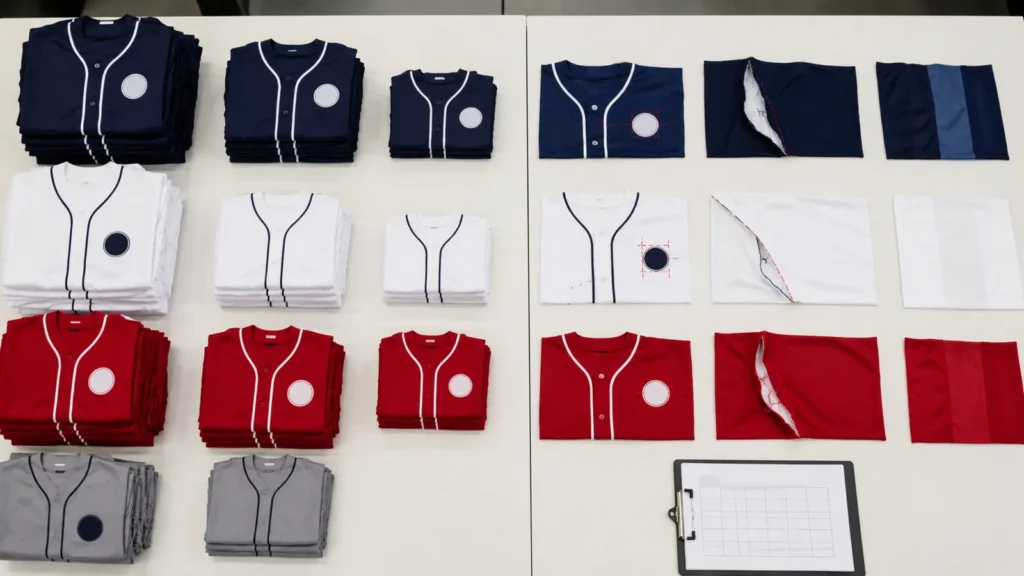
Use a controlled defect vocabulary
Choose clear categories, such as:
- wrong product, color, size, fit, name, or number;
- measurement outside the approved tolerance;
- logo color, size, method, or position incorrect;
- skipped stitches, open seam, seam puckering, or unsecured reinforcement;
- print contamination, ghosting, migration, cracking, or misalignment;
- stains, holes, abrasion, odor, or moisture damage;
- incorrect label, barcode, packaging, assortment, or carton quantity;
- transit crushing, puncture, water exposure, or missing carton.
Do not double-count one unit because it has two defects. The register can record multiple defect codes while the affected-unit total counts that unit once. This matters when calculating replacement quantity.
Be explicit about inspection scope
If every unit was checked, state “100% inspected.” If the result comes from a sample, report the sample size, selection method, cartons represented, and number of failures. Do not automatically extrapolate a sample percentage to the entire shipment as a proven total. Use the sample to trigger expanded inspection, supplier containment, or an agreed statistical decision.
3. Build an Evidence Pack the Supplier Can Audit
A strong evidence pack lets someone who was not present understand the problem without guessing. It should contain both overview and close-up evidence.
For each defect pattern, capture:
- the complete product front and back;
- a close-up showing the defect;
- the size, care, batch, or identification label where relevant;
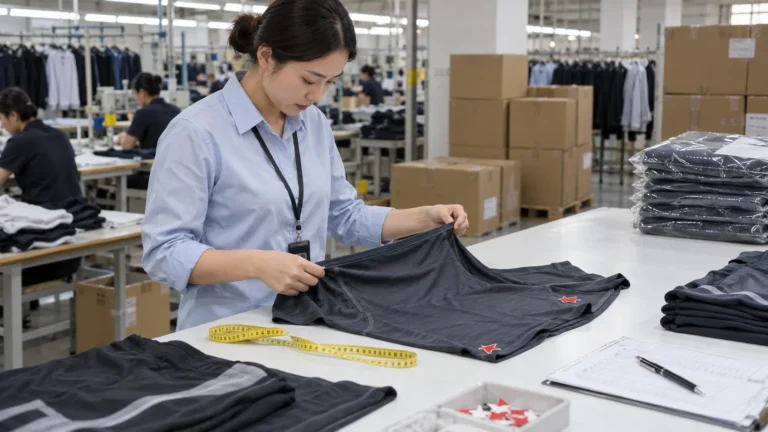
- a ruler or approved measurement method for dimensional issues;
- the carton exterior, shipping marks, and internal packing for transit damage;
- the relationship between the item and its carton, SKU, or roster line;
- a short video for functional failures such as zipper jamming, snap failure, or seam opening under light handling.
Use neutral lighting and include a physical approved reference for color disputes. A phone screen, email mockup, or old social-media photograph is not a reliable color standard. Avoid editing images in a way that changes color or hides context. If annotations are needed, keep the original file and create a separate marked copy.
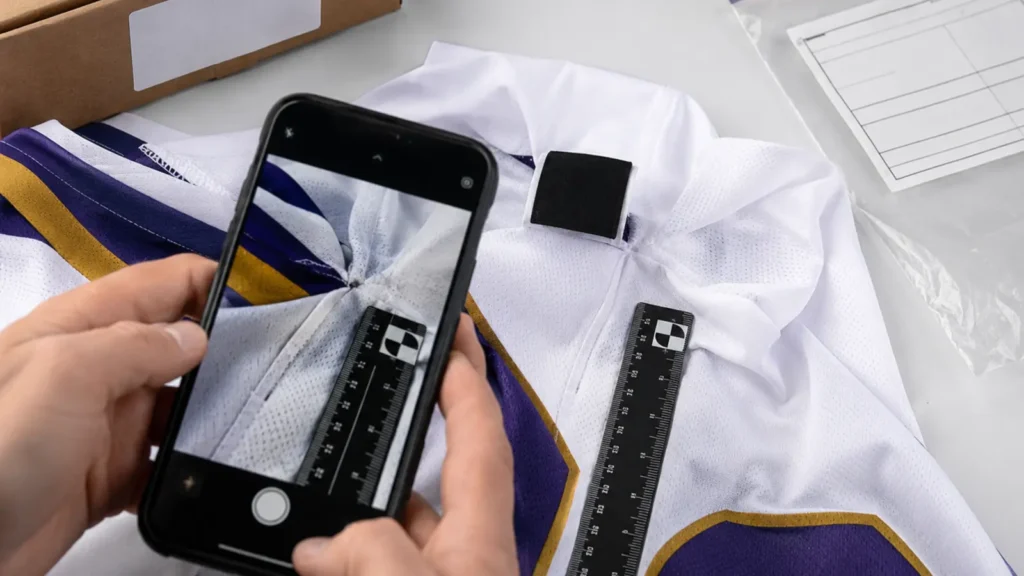
Create an evidence index
Name files consistently, for example:
PO123_STYLE02_NAVY_L_CARTON07_UNIT03_OPEN-SEAM_01.jpg
The exact format is less important than consistency. An Evidence Index should map every file to the SKU, carton, unit, defect, capture date, and register line. Do not send hundreds of unlabeled images through separate chat messages. Store them in one controlled folder and retain the original metadata.
4. Decide What Counts as a Defect
A defect is a failure to meet an agreed requirement, not merely a difference from an unstated preference. The decision should use the latest mutually approved documents.
The evidence hierarchy normally includes:
- signed manufacturing agreement and purchase order;
- approved Tech Pack and measurement specification revision;
- approved artwork, color references, roster, label, and packaging files;
- approved physical sample or Golden Sample;
- written tolerances, test methods, defect definitions, and inspection plan;
- agreed change orders and approval records.
If documents conflict, the agreement should establish order of precedence. Without that rule, the buyer may point to an old tech pack while the supplier points to a newer chat approval.
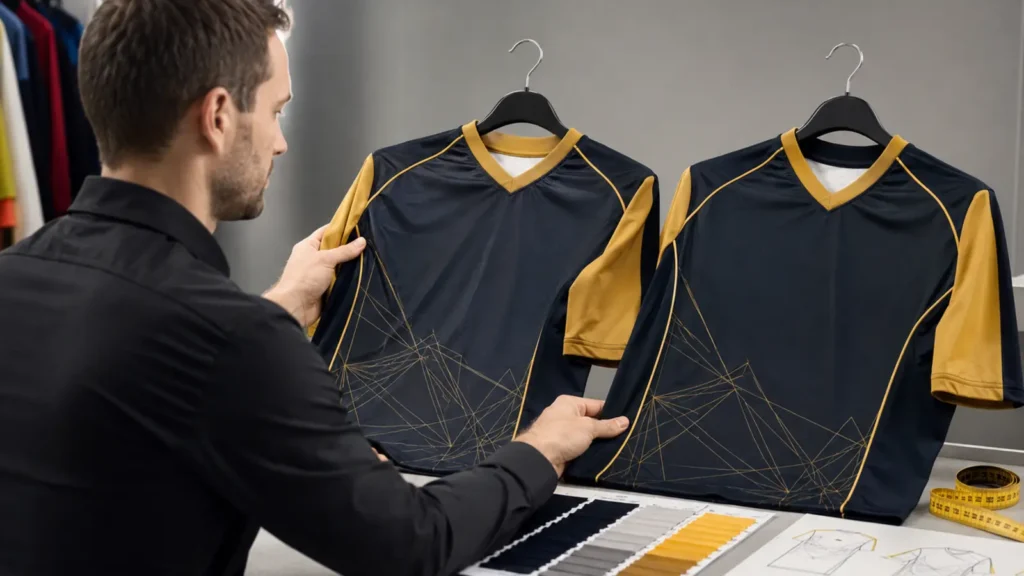
Defect, variation, or approved tolerance?
Custom apparel is not produced with zero variation. Sewing, elastic materials, manual placement, dye or print batches, and finishing can create small differences. The relevant question is whether a result falls within the agreed measurable or visual tolerance.
| Finding | Better decision basis |
|---|---|
| Chest is 1 cm larger | Approved point of measure, measurement method, and tolerance |
| Navy looks different | Physical color standard, specified lighting, fabric/decoration method, and allowed difference |
| Logo appears low | Approved placement reference, defined measurement points, and placement tolerance |
| Seam looks uneven | Workmanship sample, defect standard, function, and visibility |
| Carton is crushed | Product condition, packaging specification, delivery record, and carrier evidence |
A buyer should not invent a tolerance after delivery, and a supplier should not introduce one only after a failure is reported. Ambiguity is a contract and development problem that should be corrected for the next order, even if the current parties negotiate a practical settlement.
5. Separate Manufacturing Defects From Shipping Damage
The same garment may arrive unusable for different reasons. Responsibility cannot be assessed only from the final appearance.
Indicators of a manufacturing or packing issue
- repeated incorrect measurements across undamaged cartons;
- wrong artwork, name, number, size label, or construction;
- open seams, skipped reinforcement, print errors, or contamination inside intact unit packaging;
- incorrect carton assortment that matches the factory packing record;
- damage caused by inadequate agreed product support or unit protection.
Indicators of transit damage
- puncture, crushing, water staining, or tampering visible on the outer carton;
- damage concentrated near the affected carton surface;
- missing cartons or units associated with broken seals;
- delivery receipt notes, carrier scan events, or survey evidence supporting loss in transit.
Other possible causes
Warehouse leaks, prolonged high humidity, improper local handling, washing, heat exposure, or unauthorized alterations can create post-delivery damage. Mixed causes are also possible: weak packaging may make normal distribution stress more damaging, while exceptional carrier handling may exceed a reasonable package design.
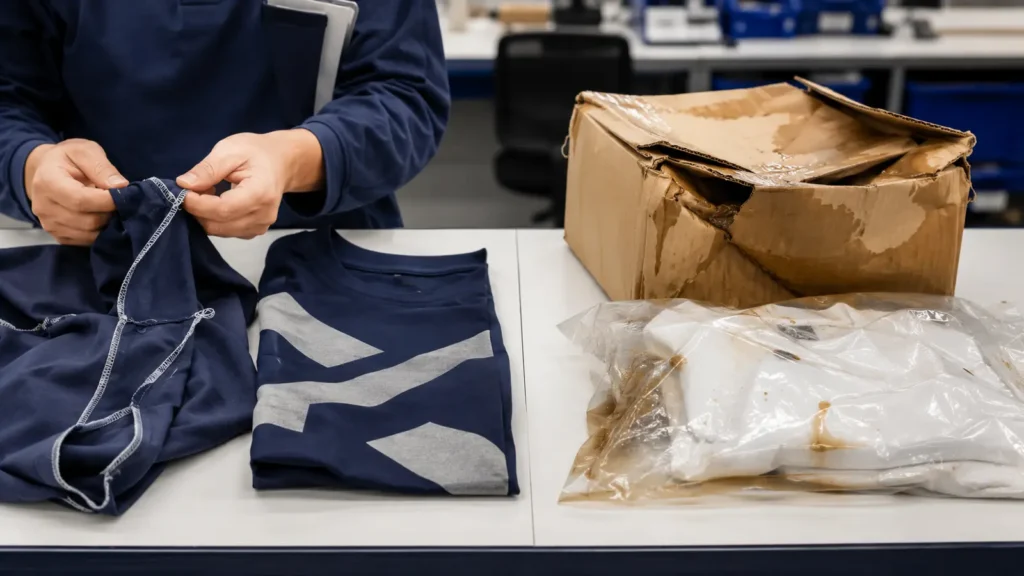
Create a decision record rather than making an immediate accusation. List the observed facts, evidence supporting each possible cause, missing information, and party responsible for the next investigation step. The commercial seller may coordinate the solution with factories, subcontractors, carriers, or insurers, but the final allocation of cost depends on contracts and applicable law.
6. Send a Formal Notice of Defect
After the initial containment and count, issue one written notice through the contractually required channel. Email may be appropriate, but do not assume a messaging app meets a formal notice clause.
The notice should include:
- buyer and supplier legal names;
- PO, invoice, style, shipment, and delivery references;
- delivery date and date the issue was discovered;
- affected SKUs, cartons, quantities, and defect types;
- applicable approved standards and revisions;
- current inspection scope and whether counting continues;
- actions taken to quarantine and mitigate loss;
- evidence folder and index;
- whether a carrier, insurer, or third party has been notified;
- requested immediate containment and response date;
- proposed remedy or a request for options;
- a statement that goods remain on hold pending written disposition.
Keep the tone factual. “The logo center is 18 mm outside the approved placement tolerance on 37 of 40 inspected units” is more actionable than “The whole order is terrible.”
7. Choose a Remedy That Fits the Defect and Deadline
There is no single remedy for every defective bulk order. Compare options by recoverable quantity, quality after correction, time, cost, customer deadline, environmental impact, and verification risk.
| Remedy | When it may work | Questions to settle in writing |
|---|---|---|
| Local rework | Repair is technically simple and approved capability exists near the buyer | Method, sample approval, unit cost, liability, rejects, timing |
| Factory rework | Goods can be corrected reliably and return logistics are practical | Return authorization, customs, freight, reinspection, deadline |
| Replacement | Personalization, function, or major appearance cannot be repaired | Exact SKU list, materials, match expectation, schedule, freight |
| Credit | Buyer can use or sell affected goods with an agreed allowance | Credit amount, applicable invoice/order, expiry, tax treatment |
| Partial refund | Quantified loss is accepted and no physical remedy is needed | Amount, payment timing, release scope, retained goods |
| Full rejection/refund | A fundamental failure affects the accepted purpose and contract supports it | Return/disposal, title, freight, duties, evidence, legal position |

Replacement
A replacement order should be treated as a controlled production lot, not an informal favor. Lock the replacement roster, SKU quantity, fabric, color, artwork, measurements, labels, and packaging. Approve a corrected first piece where the cause could recur. State whether the replacement must match the original batch or an approved physical reference, and acknowledge any unavoidable batch-age or material difference.
Rework
Approve a rework method on representative units before authorizing the full lot. Heat, solvents, needle holes, patch removal, restitching, or relabeling can create new damage. The agreement should identify who bears units lost during rework and how corrected goods will be inspected.
Credit or refund
Tie the amount to an evidence-based commercial loss or negotiated settlement. A credit note should identify the currency, invoice, tax treatment where relevant, and when it can be used. A settlement should also state which claim components are closed and which obligations—such as replacement verification—remain open.
8. Clarify Returns, Freight, Duties, and Disposal
Do not ship rejected goods back without a written return authorization. The supplier may need samples rather than the entire lot, the carrier may require inspection at the destination, and cross-border returns can create customs and duty issues.
Write down:
- which units or samples must be returned;
- return address and consignee legal name;
- Incoterm or responsibility allocation for the return movement;
- who books and pays freight, insurance, duty, brokerage, and storage;
- how title and risk transfer during the return;
- whether goods may be repaired, donated, de-branded, recycled, or destroyed;
- what evidence of disposal is required;
- how trademarks and personalized player information will be protected.
Who pays replacement freight is not answered by a universal rule. It depends on the cause, sales contract, warranty, Incoterm, carrier liability, insurance, mitigation decisions, and negotiated settlement. Agree it explicitly instead of allowing urgent shipping to proceed with an unresolved cost dispute.
9. Track the Remedy Through Verification and Closure
A promise to replace products is not closure. Use a tracker with an owner and date for every action:
- final affected quantity agreed;
- root cause investigation due;
- corrected material or first-piece approval;
- rework or replacement production status;
- inspection booking and report;
- packing list and shipment release;
- tracking, customs, and delivery;
- replacement receipt and verification;
- credit or refund receipt;
- disposition of original goods;
- written claim closure.
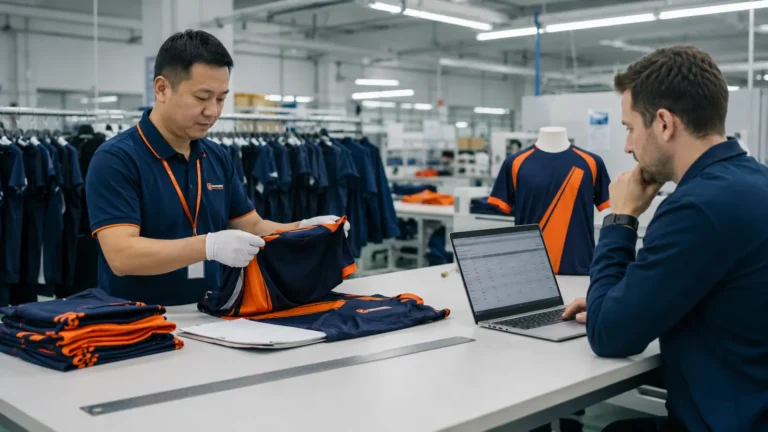
For a material replacement lot, use the same discipline as a normal order. JIUMU’s Pre-Shipment Inspection checklist explains that finished quantity, measurements, materials, colors, logos, workmanship, labels, packing, carton assortment, and shipping marks should be verified before release. An inspection does not guarantee perfection, but it gives both parties a recorded release decision.
10. Require Root Cause and Corrective Action
Sorting defective products is a correction: it addresses the current lot. Corrective action addresses why the failure occurred and prevents recurrence. ASQ defines root cause analysis as identifying the cause of a problem, solving it, and preventing it from happening again.
A useful corrective-action report includes:
- Problem definition: exact SKU, defect, quantity, location, and detection point.
- Immediate containment: stop shipment, isolate work in progress, inspect related lots.
- Cause investigation: consider material, method, machine, measurement, people, environment, data, and management controls.
- Verified root cause: evidence showing why the cause explains the observed pattern.
- Corrective action: change the process, fixture, approval gate, training, file control, or inspection method.
- Owner and completion date: named responsibility, not “factory team.”
- Effectiveness check: data from a later production run confirming the issue did not recur.
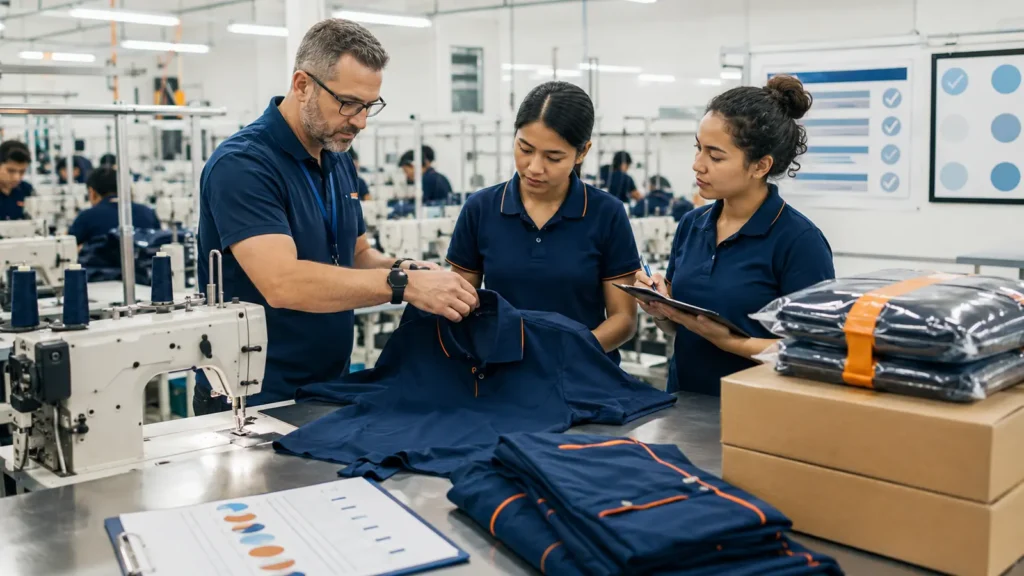
Weak answers such as “operator careless” or “we will pay more attention” do not identify a controllable system cause. A stronger response might show that an obsolete artwork file remained accessible, explain how it entered the print queue, remove the obsolete file, introduce a revision-controlled release, train authorized users, and verify the next jobs against the new control.
11. Prevent the Same Claim on the Next Order
The best claim is the one prevented before shipment. Convert what the parties learned into updated order controls.
Strengthen the manufacturing agreement
Reference the exact product and Tech Pack versions, approved sample, substitution rules, tolerances, defect classes, inspection rights, claim procedure, remedies, returns, freight responsibility, and document precedence. Review the Manufacturing Agreement checklist before the next deposit.
Use one approval record
Do not let specifications live across email, chat, cloud folders, and verbal calls. Maintain one current approval register that identifies the controlling artwork, colors, roster, measurements, materials, labels, packaging, and sample.
Inspect earlier
Incoming-material and in-process checks catch systemic problems before the order is complete. A Quality Control plan should define what is checked, by whom, when, against which standard, and what happens after a failure.
Improve packing and transit evidence
Approve a packed unit and sample carton. Photograph the condition before dispatch, record gross weight and carton count, and define moisture and crushing protection. For high-value or deadline-sensitive programs, consider cargo insurance and current carrier claim requirements before shipment.
Close the learning loop
Add the defect to the supplier’s control plan and the buyer’s future inspection checklist. Track whether the corrective action reduced the actual failure rate, not merely whether a report was submitted.
Copyable Claim Package Checklist
Before sending the final claim file, confirm that it contains:
- Notice of Defect;
- PO, invoice, packing list, and delivery record;
- current Tech Pack and approval revisions;
- Golden Sample reference and approved color/artwork files;
- SKU Defect Register;
- photo/video Evidence Index;
- manufacturing-versus-shipping assessment;
- carrier or third-party inspection documents where relevant;
- requested remedy and decision deadline;
- rework/replacement tracker;
- root cause and corrective-action request;
- closure conditions.
How JIUMU Handles Quality Issues
JIUMU is a Guangdong-based B2B custom teamwear, hats, and bags supplier established in 2010. Its quality-control approach links incoming materials, approved samples, in-process checks, finished inspection, and export packing. Buyers should still define order-specific standards, inspection scope, tolerances, and remedies in writing.
For a quality claim, provide the order reference, current approval files, affected SKU register, photos or video, carton references, delivery condition, and requested deadline. JIUMU can use that package to investigate the relevant materials, production records, QC evidence, packing, and shipment history. Contact zhengdong@jiumugear.com, WhatsApp +86 185 0750 2899, or use the Contact Us page.
Frequently Asked Questions
Final Recommendation
Resolve defective bulk orders with facts, traceability, and written decisions. Quarantine the goods, protect the packaging, count the problem by SKU, index the evidence, compare each finding with the approved standard, and separate manufacturing defects from transport damage. Then negotiate a remedy that defines quantity, quality, timing, freight, verification, and closure.
The commercial settlement fixes today’s order. Root cause, corrective action, and an effectiveness check protect the next one.
Need Help Reviewing a Custom Apparel Quality Issue?
Send JIUMU your order reference, product and SKU list, approved specification, defect register, evidence folder, delivery condition, destination, and required resolution date. The team can review the information and propose the next investigation and remedy steps for the project.