Pre-Shipment Inspection Checklist for Custom Apparel and Hats
Direct answer: A pre-shipment inspection verifies finished quantities, measurements, materials, color, logos, workmanship, labels, unit packing, carton assortment and shipping marks. Findings should be documented, affected goods isolated, corrective work verified and release authorized against the agreed quality plan.
A useful pre-shipment inspection checks whether finished custom apparel and hats match the approved order before release. Inspectors verify quantities, measurements, materials, color, logo execution, workmanship, labels, individual packing, carton assortment and shipping marks. Findings should be documented, nonconforming goods isolated, corrective work verified and shipment released only against the agreed quality plan.
For a custom order, “finished” does not automatically mean “ready to ship.” The final goods may look acceptable at a distance while still containing incorrect size ratios, mixed shades, shifted logos, missing labels, wrong polybags or cartons prepared for the wrong destination. A structured pre-shipment inspection turns those risks into recorded decisions before the goods leave the factory.
This guide is designed for apparel brands, sports teams, schools, clubs, uniform dealers, distributors and promotional buyers. It explains what to check, what evidence to retain and what to do when results do not match the approved specification. It is a practical framework, not a universal acceptance standard. The inspection scope should be agreed for the actual order.
What Is a Pre-Shipment Inspection?
A pre-shipment inspection is a documented review of finished or substantially completed goods before they are released for shipment. Its purpose is to answer three questions:
- Is the correct product and quantity packed for the correct destination?
- Do the products match the approved technical, visual and packaging references?
- Are any remaining problems contained and resolved before release?
Pre-shipment inspection is different from checking work during production. In-process quality control looks for problems while cutting, sewing, embroidery, printing, washing, finishing or packing is underway. It gives the production team time to correct a process before the same defect spreads. Pre-shipment inspection examines the finished result and the shipment configuration. Both are necessary: a final inspection cannot efficiently repair a process that was uncontrolled for the entire production run.
Pre-shipment inspection is also not a substitute for laboratory or regulatory testing. Fiber claims, product safety, flammability, chemical restrictions and market-specific labeling may require separate evidence. For example, the U.S. FTC provides textile and care-label guidance, while the CPSC administers applicable clothing flammability requirements. Buyers should define compliance requirements before production and verify the correct reports and labels, rather than expecting a visual final inspection to prove regulatory compliance.
Establish the Inspection Basis Before Opening Cartons
An inspector needs an approved reference, not personal preference. Before selecting cartons, assemble the current revision of every document that controls the order.
| Reference | What it controls | What the inspector should confirm |
|---|---|---|
| Purchase order | Style, color, quantity, size ratio and delivery terms | The inspection lot matches the current order revision |
| Approved sample or Golden Sample | Overall appearance, construction and workmanship | The comparison sample is identified and has not been altered |
| Tech pack | Materials, components, construction and decoration | The revision number matches production authorization |
| Size specification | Points of measure and allowed tolerances | Measurement method and tolerance are unambiguous |
| Fabric and trim approval | Composition, weight, hand feel, shade and accessories | The approval relates to the production material |
| Pantone or approved swatch | Target color | The physical or digital reference and viewing condition are defined |
| Logo placement artwork | Logo size, orientation, location and color | Placement is measured from the same reference points |
| Label and packaging files | Main label, care label, hangtag, barcode, polybag and carton | Artwork versions and destination requirements are current |
| Buyer inspection instruction | Sampling, critical checks and reporting | Special requirements are included in the inspection plan |
If two documents conflict, stop and resolve the conflict before judging production. An old size chart attached to an email and a revised tech pack in the order folder can produce opposite conclusions. The inspector should record which document revision controlled the inspection.
For buyers concerned about sample-to-bulk consistency, retain the approved sample in a controlled location and connect it to the production file. The related guide, How to Make Sure Bulk Production Matches Your Approved Sample, explains how to establish that baseline earlier in the process.
How Should Inspection Samples Be Selected?
JIUMU uses a risk-based internal approach rather than presenting one fixed inspection percentage for every order. The inspection scope is determined according to order quantity, product complexity, customization risk, buyer requirements and the agreed quality plan.
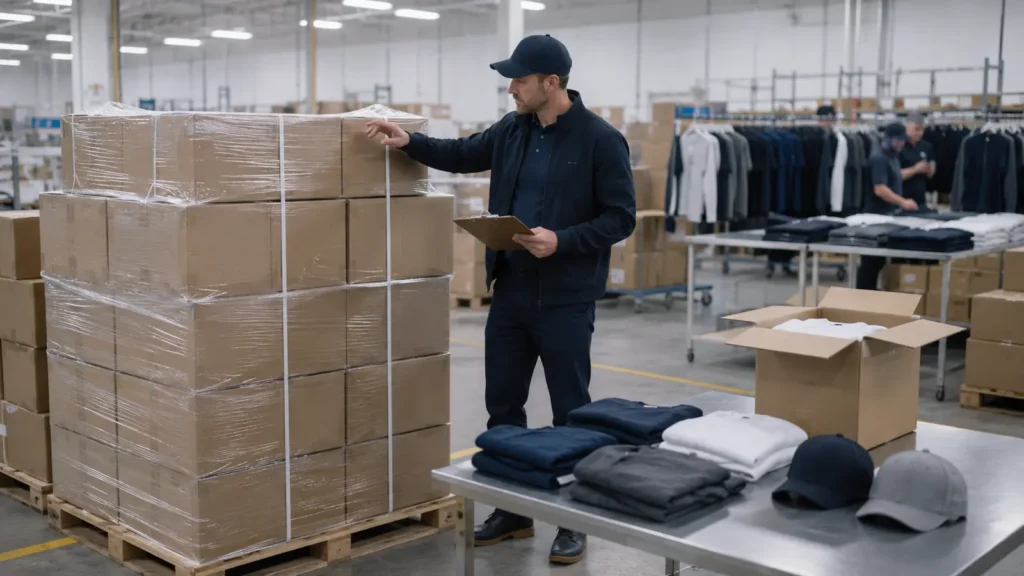
Sample selection should represent the whole shipment. Do not take every piece from the top of one open carton. Select across:
- Different carton numbers and pallet positions
- Every ordered style and color
- The full size range
- Different decoration types or logo versions
- Different production lines or production dates when relevant
- Repacked or reworked goods
- Units from the beginning, middle and end of the packing sequence
Higher-risk features deserve greater attention. Examples include a new fabric, first-time supplier material, complex embroidery, multiple sponsor logos, reflective or heat-transfer details, tight color matching, individual player names, mixed team rosters, many SKUs, customer-specific barcodes or a compressed production schedule.
Formal acceptance-sampling systems, including those described by ISO 2859-1, may be specified by some buyers or inspection companies. If a buyer requires a defined AQL plan, inspection level or defect classification, it should be written into the quality agreement before inspection. Otherwise, the factory and buyer should agree a practical risk-based scope and avoid applying a number retrospectively.
Quantity and Assortment Verification
Quantity inspection begins at the shipment level and works down to the individual carton. Compare the packing list with the purchase order, then verify selected cartons physically.
Shipment-level checks
- Total number of cartons
- Total number of units
- Style, color and size totals
- Destination or warehouse allocation
- Overproduction or short shipment
- Sample, spare or replacement units listed separately
Carton-level checks
- Carton number and sequence
- Units stated on the carton label
- Actual units inside
- Size and color assortment
- SKU or barcode consistency
- Whether mixed cartons are clearly identified
For teamwear, verify personalized names and numbers against the approved roster. The total quantity can be correct while one player receives the wrong size or number. For a distributor order, confirm the master carton does not contain the correct quantity but the wrong retail assortment.
Record both the expected and actual count. If a discrepancy appears, expand the review to determine whether it is an isolated packing error or a system issue affecting multiple cartons. Corrected cartons should be resealed and reidentified, and revised totals should be reflected in the final packing list.
Size Measurement and Fit Consistency
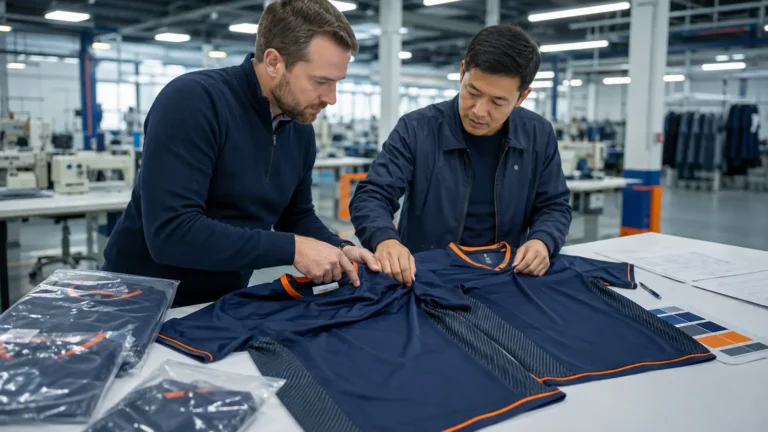
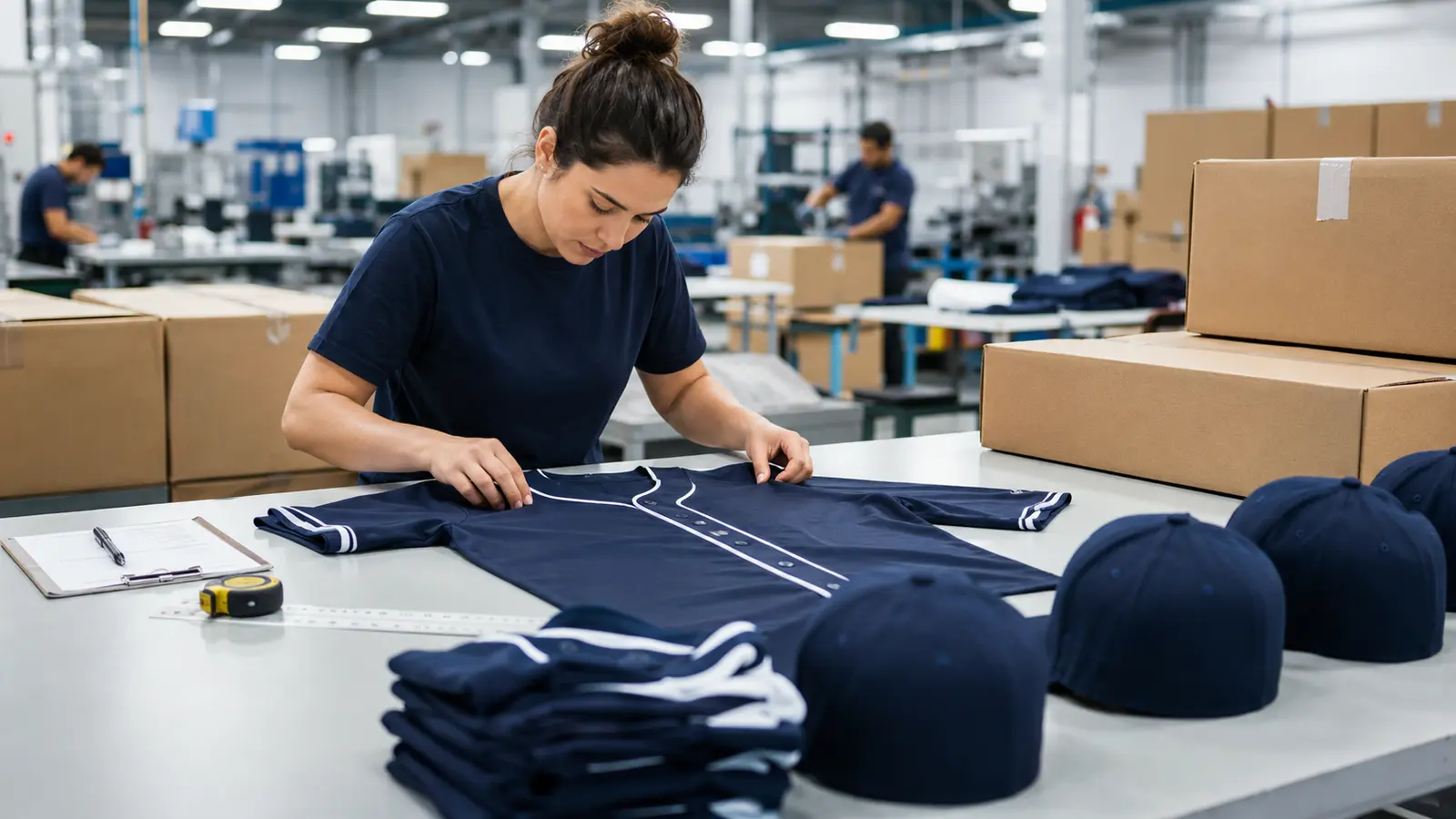
Finished garments should be measured using the approved points of measure, the specified garment condition and the agreed method. Place the garment on a flat surface, smooth it without stretching and use a suitable measuring tape or ruler. Do not invent a measurement point because the diagram is unclear; request clarification.
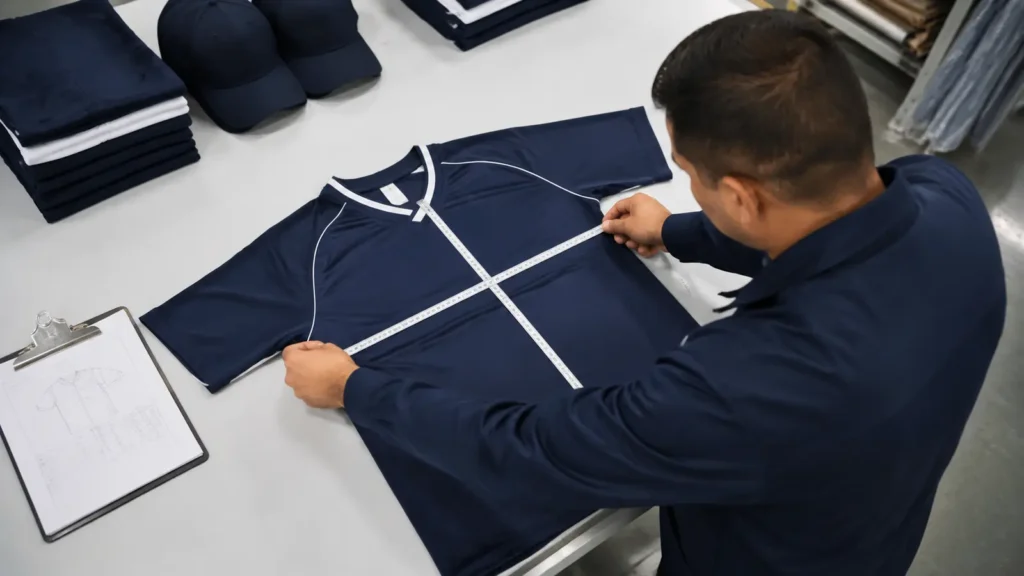
Common apparel measurements include chest width, body length, shoulder width, sleeve length, waist, hip, inseam, outseam, thigh and opening. Hat measurements may include crown height, circumference or fit range, visor length and visor width. The required points depend on the product.
Use a measurement table that records:
| Style and size | Point of measure | Specification | Allowed tolerance | Actual result | Status |
|---|---|---|---|---|---|
| Example jersey M | Chest width | Order specification | Agreed tolerance | Measured value | Pass/review |
Measure more than one unit of important sizes. One perfect sample does not demonstrate consistency. Look for patterns: all body lengths running short, one size graded incorrectly, or pieces from one color measuring differently after finishing. A pattern can indicate cutting, sewing, pressing or fabric-relaxation variation.
When a measurement is outside the agreed tolerance, identify the affected size, color, carton and production group. Do not average an unacceptable measurement with acceptable pieces. The buyer and factory should decide whether the issue affects fit, function, labeling or saleability, then document the disposition.
Fabric, Material and Shade Inspection
Fabric inspection should compare production goods with the approved material reference. Confirm fabric identity, visible construction, hand feel, stretch direction, surface finish and any buyer-specified weight or composition evidence. A visual inspection can identify obvious substitution or inconsistency, but it cannot replace laboratory verification when composition, performance or chemical compliance must be proven.

What to check
- Fabric face and reverse are used correctly
- Material feels consistent with the approved sample
- Stretch and recovery are appropriate for the product
- Mesh, rib, lining or interlining is the correct type
- Panels on the same garment do not show obvious shade mismatch
- Garments from different cartons do not show unexplained dye-lot variation
- Washed or distressed finishes are within the approved appearance range
- Fabric has no holes, pulls, snags, barre, oil marks or unintended shine
- Trims, elastic, drawcords and closures match the specification
Pantone is a communication reference, but it is not the only control. Fabric type, dye lot, texture, gloss, lighting and decoration method all affect perceived color. Compare under a consistent light source and record the approved physical swatch when exact matching matters. If several dye lots were used, identify them rather than mixing unexplained shades in the same carton.
For repeat orders, use retained color standards, material records and the approved Golden Sample. The guide How to Maintain Color and Size Consistency on Repeat Orders provides a repeat-order control framework.
Logo Position, Size, Color and Decoration Quality
A logo can be technically present and still be wrong. Inspect the approved artwork version, size, orientation, placement, color and method. Measure from defined seams or panel reference points, not from an inconsistent visual edge.
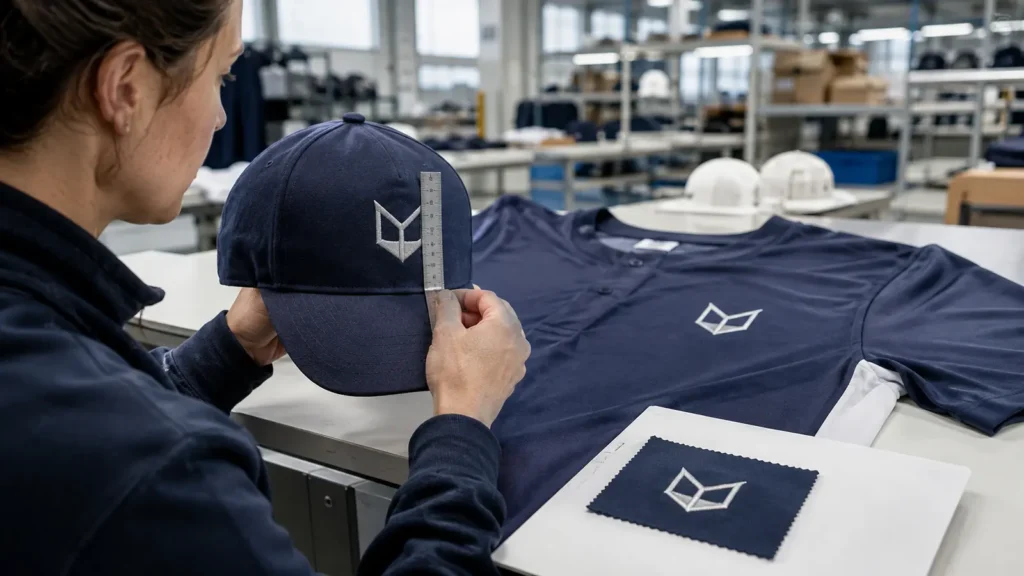
For embroidery, check registration, thread coverage, exposed backing, thread tails, puckering, density, small-letter clarity and 3D puff edges when applicable. For screen printing, inspect registration, opacity, edge definition, cracking, contamination and unwanted marks. For heat transfer, inspect alignment, edge adhesion, lifting, scorching and pressure marks. For sublimation, inspect color, clarity, ghosting, panel alignment and white gaps near seams.
Personalized team orders require an additional reconciliation step:
- Player name spelling
- Number and name pairing
- Front, back and sleeve logo assignment
- Sponsor logo version
- Size matched to the roster
- Duplicate or missing player sets
Where decoration durability is a buyer requirement, the approved testing method should be defined before production. A visual final inspection can find lifting or cracking but cannot predict every laundering outcome without an agreed test.
Stitching, Construction and Functional Checks
Workmanship inspection should follow how the product is built and used. Review both appearance and function.
Sewing and construction
- Open seams, skipped stitches or broken stitches
- Uneven seam allowance or raw edges where they should be enclosed
- Loose thread ends and unsecured bartacks
- Seam puckering, twisting or panel asymmetry
- Incorrect stitch type or visible thread color
- Misaligned stripes, piping or panels where matching was specified
- Weak stress points at pockets, straps, belt loops or closures
- Lining caught incorrectly or showing outside the garment
Functional checks
- Zippers open, close and lock correctly
- Snaps, buttons, hook-and-loop and buckles operate securely
- Drawcords, toggles and elastic are correctly installed
- Pockets are open, correctly positioned and usable
- Adjustable hat closures work through the intended range
- Visors, crowns and seams maintain the approved shape
Do not perform destructive pull or wash tests unless the test method, sample disposition and safety controls are approved. Routine inspection can include gentle functional checks, while formal strength or durability claims require an agreed test procedure.
Stains, Damage, Odor and Final Appearance
Inspect products under adequate light and view front, back, inside and high-contact areas. Common appearance problems include oil, ink, dirt, adhesive residue, chalk, rust transfer, needle damage, press shine, scorching, crushed decoration, fabric pulls and packaging wrinkles.
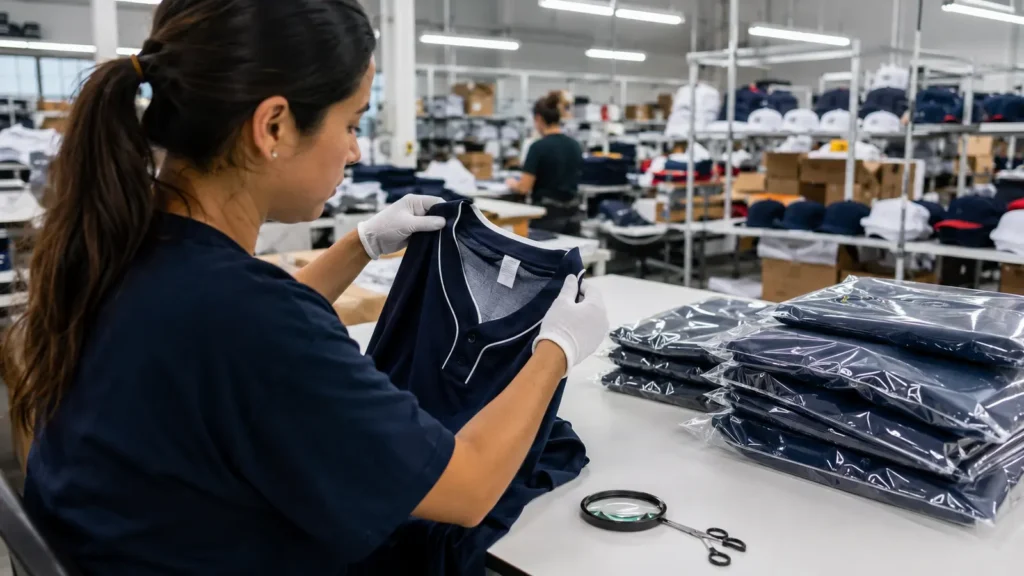
Check whether marks can be safely removed without changing shade or finish. Do not use an unapproved solvent on decorated or coated fabric. Cleaned goods should be reinspected after drying. An unusual odor may come from damp cartons, contamination, finishing chemicals or prolonged sealed storage; isolate the affected goods and investigate before repacking.
Final appearance should be assessed against the approved presentation standard. Folding, pressing, visor shape and garment symmetry matter because they influence the buyer’s first impression even when construction is sound.
Labels, Hangtags and Barcode Checks
Labels connect the physical product to the buyer’s brand, size system, care information and market requirements. Check both content and application.
- Main brand label: correct brand, version, orientation and position
- Size label: correct size and correct relationship to the garment
- Care label: approved language, symbols, fiber information and care instruction where applicable
- Country-of-origin and responsible-business information where required
- Hangtag: correct artwork, price treatment, hole position and attachment method
- Barcode or SKU: readable, unique where required and matched to style/color/size
- Warning or compliance label: present only when specified and verified
For U.S. textile products, FTC guidance describes labeling obligations involving fiber content, country of origin and responsible company identity; covered clothing also has care-label requirements. Requirements vary by product and destination, and the FTC notes that hats are exempt from its Care Labeling Rule. The buyer should supply destination-specific artwork and obtain compliance advice where necessary.
Scan representative barcodes against the buyer’s product data rather than judging bars visually. A cleanly printed barcode can still encode the wrong SKU. If serialized labels or logistics identifiers are required, verify uniqueness and record the scan results.
Individual Packaging Inspection
The unit may pass product inspection but fail the customer’s warehouse or retail process because of incorrect packaging. Compare every element with the approved packing specification.
Check:
- Correct fold and presentation direction
- Tissue, insert, cardboard support or size sticker where specified
- Correct polybag size, material, closure and warning information where applicable
- Garment and tag visible in the required orientation
- Barcode and size sticker placed where scanners or warehouse staff expect them
- No loose pins, broken fasteners or sharp packing components
- Moisture-control materials used only as approved
- One correct unit per package unless a set is specified
- Packaging clean, dry and undamaged
For hats, ensure the crown and visor are protected from crushing and that stacked units do not damage embroidery or transfer surfaces. For jerseys with names and numbers, confirm the individual bag identity matches the enclosed product.
Cartons, Shipping Marks and Packing Ratios
Carton inspection confirms that correct individual units become a correct logistics unit. Compare selected cartons with the packing list and carton-mark file.

| Check | Evidence | Typical response to a mismatch |
|---|---|---|
| Carton dimensions and condition | Measurement and photos | Replace damaged or unsuitable cartons |
| Units per carton | Physical count | Repack and update totals |
| Size/color ratio | Unit-by-unit assortment | Correct assortment and relabel carton |
| Gross/net weight | Approved packing requirement | Reweigh and investigate variance |
| Carton number | Packing list sequence | Renumber and revise records |
| Shipping mark | Approved artwork | Relabel before release |
| Destination/PO/SKU | Order and routing instruction | Isolate incorrect destination cartons |
| Barcode or SSCC when specified | Scan result | Reprint, verify and control duplicates |
GS1 logistics labels can uniquely identify logistics units when that system is specified by the buyer. Not every order needs a GS1 label, but every order needs carton identification that matches the agreed shipping and warehouse process.
Check cartons from different pallet levels where practical. Bottom cartons may show compression or moisture damage that top cartons do not. Verify sealing method, strapping, pallet treatment and protective materials against the shipment plan. A carton that is visually neat but too weak for the actual route remains a shipping risk.
Hat-Specific Pre-Shipment Checks
Custom hats need checks that garment-only lists may miss:
- Crown style, panel count and structured/unstructured construction
- Circumference or fitted-size identity
- Closure type, color, hardware and adjustment function
- Visor length, curve or flat profile
- Crown height and overall symmetry
- Front seam alignment and panel distortion
- Eyelet quantity and placement
- Sweatband, taping and internal label position
- Embroidery centered relative to the curved crown
- 3D puff coverage, clean edges and removed excess foam
- Mesh, snap, buckle or strap consistency
- Crown support and packing method
Compare hats in profile as well as from the front. A crown can appear acceptable head-on while leaning, twisting or showing an uneven visor from the side. Review several units together to see consistency that is difficult to judge one piece at a time. Buyers developing a new cap can connect this inspection to JIUMU’s custom hats manufacturing discussion.
Jersey and Apparel-Specific Checks
For custom jerseys, uniforms, hoodies and team apparel, add:
- Correct pattern and panel layout
- Size grading across the range
- Neckline and armhole symmetry
- Sleeve or leg length pairing
- Rib, cuff and waistband recovery
- Piping and stripe alignment
- Pocket and zipper function
- Name, number and sponsor-logo assignment
- Print or sublimation alignment across seams
- Set matching when tops, pants, socks or jackets ship together
- Care, size and brand labels appropriate to the market
- Folding that protects decoration
When a uniform package contains several products, inspect the package relationship, not only each item. The correct jersey and pants packed with the wrong socks or wrong player size still create a failed customer experience. JIUMU’s team uniforms page can be used as the commercial next step for package development.
What Should an Inspection Report Include?
An inspection report should allow someone who was not present to understand what was inspected, what was found and what happened next.
Include:
- Supplier, buyer, purchase order and style identifiers
- Factory and inspection location
- Inspection date and shipment status
- Total order quantity and available quantity
- Cartons and units selected, with selection method
- Documents and revision numbers used as references
- Measurement results by style, size and point of measure
- Findings grouped by product, packaging and carton issue
- Clear photos showing context and close-up detail
- Carton count, assortment and shipping-mark results
- Barcode or functional-check records where required
- Identification of isolated goods
- Corrective action owner and target completion
- Reinspection result and release authorization
- Unresolved deviations approved by the buyer, if any
Avoid vague entries such as “logo bad.” Record the observed condition: for example, “front embroidery measured lower than the approved placement reference on the listed samples.” The report should distinguish an observation from a confirmed specification failure.
How Should Nonconforming Products Be Handled?
Finding a problem is only the beginning. The control process should prevent affected goods from being mixed back into conforming stock without verification.

- Identify and isolate. Mark affected cartons or units and move them to a controlled area.
- Define the scope. Determine style, color, size, production date, carton range or process involved.
- Compare with the approved requirement. Confirm the correct reference and avoid acting on an obsolete file.
- Assess risk. Consider safety, function, fit, brand appearance, labeling, warehouse processing and delivery impact.
- Choose a disposition. Options may include cleaning, repair, rework, replacement, repacking, relabeling, buyer-approved concession or rejection.
- Correct the process. Address the cause, not only the inspected samples.
- Reinspect. Verify corrected goods and an appropriate surrounding scope.
- Authorize release. Record who approved shipment and any remaining agreed deviation.
Critical issues involving safety, prohibited materials, wrong identity, legal labels or shipment to the wrong destination require immediate escalation. Other issues still need an order-specific decision. This article does not assign universal major/minor/critical thresholds because buyer requirements and product risks differ.
JIUMU’s Quality Control and Manufacturing Capabilities pages should explain how production and inspection responsibilities connect. Buyers can also request an order-specific quality plan through Contact Us.
Copyable Pre-Shipment Inspection Checklist
Use this compact list in a supplier discussion or inspection brief:
Order and quantity
- Purchase order, tech pack and approvals are the current revisions.
- Finished and packed quantities are recorded.
- Selected cartons represent every relevant style, color and size.
- Carton counts and unit assortments match the packing list.
Product
- Product identity, style and color are correct.
- Measurements follow the approved points of measure and tolerances.
- Fabric, trims, hand feel and visible shade match approved references.
- Logo artwork, color, size, position and method are correct.
- Stitching, construction and functional components are acceptable.
- Products are free from stains, holes, damage and unacceptable odor.
Labels and packing
- Brand, size, care, origin, hangtag and barcode information matches approved files.
- Each individual package contains the correct product.
- Folding, inserts, stickers, polybags and protective materials are correct.
- Cartons are sound, correctly sealed and correctly marked.
- Packing ratios, carton numbers, destinations and shipping identifiers are correct.
Report and release
- Measurements, counts, findings and photos are documented.
- Nonconforming goods are identified and isolated.
- Corrective action and reinspection are recorded.
- Buyer-approved deviations are attached to the shipment record.
- Final release is authorized under the agreed quality plan.
Common Pre-Shipment Inspection Mistakes
Inspecting only easy-to-reach cartons
This creates a convenient sample, not a representative one. Spread selection across the shipment and include reworked goods.
Using an outdated specification
The result can be a false rejection or false approval. Record document revisions in the report.
Checking appearance but not assortment
Beautiful products packed in the wrong size ratio still fail the order. Reconcile carton contents with the purchase order and packing list.
Treating Pantone as the only color control
Material, texture, light and dye lot affect appearance. Use the agreed physical reference and viewing conditions.
Recording defects without controlling affected stock
If nonconforming goods are not isolated, they can return to packed inventory. Identification, containment and reinspection are essential.
Assuming final inspection replaces process control
Late discovery makes correction expensive. Use material approval, first-piece checks and in-process QC before final inspection.
Applying a generic AQL after production
A formal sampling plan should be agreed before inspection. If no fixed plan was contracted, use a documented risk-based scope and obtain buyer direction for release decisions.
Questions to Ask Your Manufacturer Before Shipment
- Which approved documents will control the inspection?
- How will cartons and units be selected across styles, colors and sizes?
- Which measurements and tolerances will be recorded?
- How will fabric lots and color variation be identified?
- How will personalized names, numbers and size assignments be reconciled?
- Can the report show carton assortment, labels, barcodes and shipping marks?
- How are nonconforming goods isolated from approved stock?
- Who authorizes corrective action and reinspection?
- Can the buyer or a third-party inspector attend or inspect independently?
- What must be completed before shipment release?
Clear answers indicate that inspection is part of a controlled order process rather than a final visual glance.
Frequently Asked Questions
Build Inspection Requirements Into the Order
The best pre-shipment inspection begins before production. Define the approved sample, points of measure, tolerances, color reference, logo placement, label files, packing ratio, shipping marks, reporting format and release authority in advance. That gives the factory, buyer and any third-party inspector one consistent basis for decisions.
JIUMU supports custom hats, teamwear and logo apparel for B2B orders. To discuss an order-specific specification and inspection plan, review our Company Facts, MOQ & Lead Time and Quality Control information, then contact JIUMU with your artwork, product list, quantities, size breakdown and destination requirements.