How to Arrange a Virtual Factory Tour: A Buyer’s Checklist
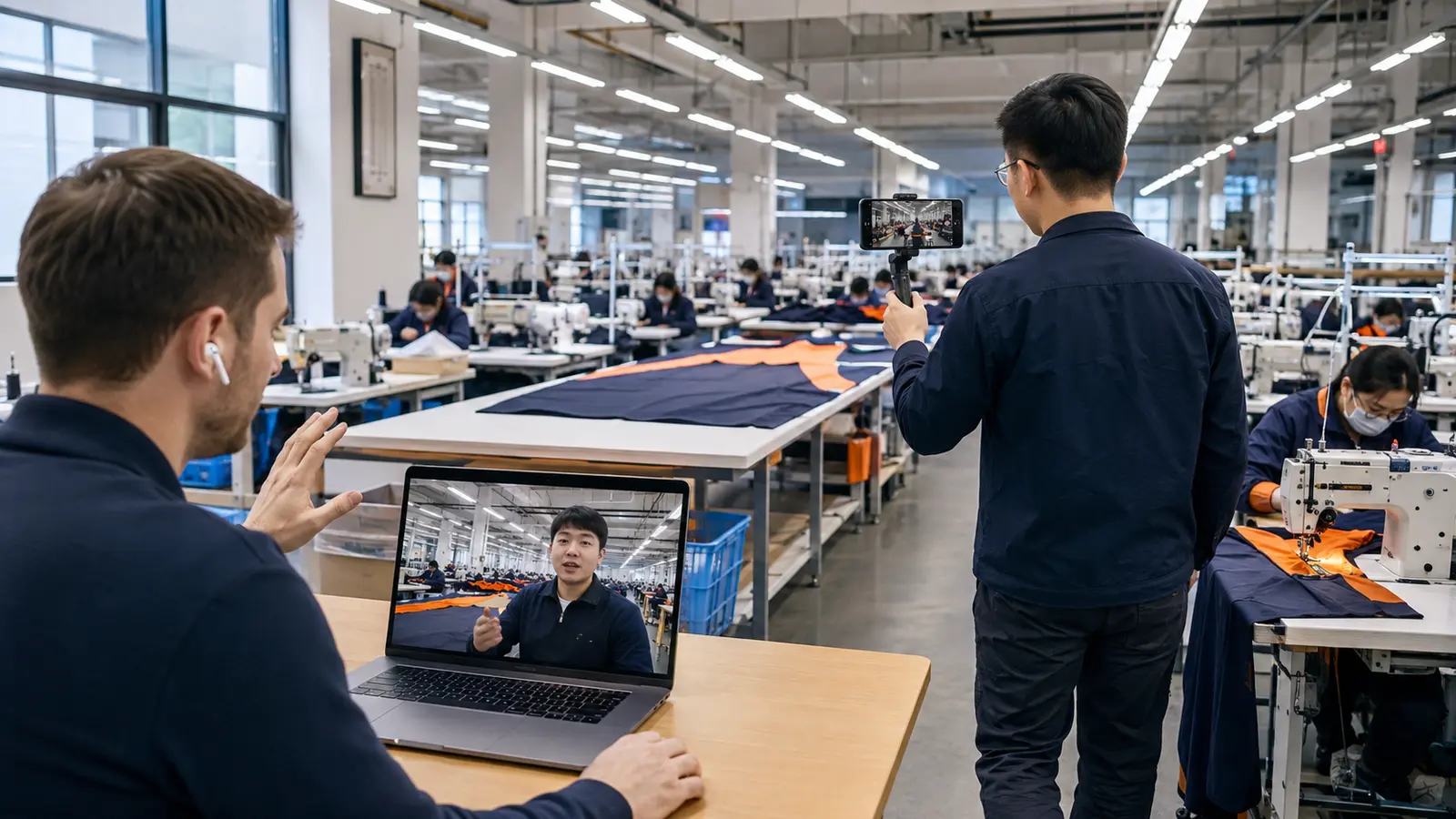
When travel to China is impractical, a structured live video tour can help a school, sports team, distributor, or apparel brand connect the company behind a quotation with a physical location, relevant equipment, and the people managing production.
However, a virtual factory tour is not automatically a factory audit. A polished promotional video may be useful background material, but it does not establish when or where footage was captured. Even a live walkthrough cannot, by itself, prove monthly capacity, ongoing quality consistency, legal ownership of every machine, or compliance with a formal standard. The most reliable approach is to define what you want to verify, direct a continuous live route, record findings in writing, and combine the tour with document checks, sample approval, and production inspection.
Quick Answer
To arrange a useful virtual factory tour, send the supplier a written agenda before the call and request a live, interactive walkthrough during normal working hours. Begin outside with the entrance and company sign, then move continuously through the office, sample room, raw-material storage, relevant production areas, quality-control station, packing area, and finished-goods warehouse. Ask spontaneous questions and request close-ups of specific equipment or processes. Require the supplier to identify which operations are performed in-house and which are outsourced. Agree in advance whether recording or screenshots are permitted, and protect other customers’ confidential designs. After the call, issue a written findings and action list rather than relying on memory.
What Can a Virtual Factory Tour Actually Verify?
A virtual tour is most valuable when every observation is tied to a specific verification question. “The factory looked professional” is an impression. “The live camera moved from the entrance bearing the supplier name to the cutting room without a break, and the cutting supervisor explained the marker process” is a documented observation.
Use three evidence levels:
| Evidence level | Question it helps answer | Examples | What it does not prove |
|---|---|---|---|
| Identity and presence | Is the contact connected to the stated location? | Live entrance, sign, office, business-license copy, current date interaction | Legal status, bank-account safety, or ownership of the premises |
| Operational reality | Are relevant people, equipment, materials, and processes present? | Cutting tables, embroidery machines, sewing lines, QC stations, packing activity | Stable capacity, consistent quality, or exclusive use of the facility |
| Project suitability | Can the supplier explain and demonstrate controls relevant to your order? | Similar construction, sample records, measurement checks, packaging method | Future performance without sampling, specifications, contracts, and inspection |
ISO/IEC TS 17012:2024 provides guidance on the conditions, possibilities, and limitations of remote auditing methods. IAF MD 4:2025 likewise treats information security, confidentiality, privacy, and mutual agreement as prerequisites when information and communication technology is used for assessment. These are formal conformity-assessment documents, while a buyer’s video tour is usually less formal. Their practical lesson still applies: define the objective, agree on access and technology, preserve confidentiality, and acknowledge what remote evidence cannot establish.
A tour is not certification
Do not describe a supplier as “audited,” “approved,” or “certified” solely because your team completed a video call. Formal audits use defined criteria, competent auditors, documented evidence, sampling methods, and reports. A virtual tour is better treated as an early supplier-screening or project-verification step.
For a first large order, complex tooling, regulated product, or high financial exposure, consider an independent on-site audit or inspection. For custom jerseys, hats, team bags, and uniforms, the virtual tour should also be followed by artwork confirmation, a physical sample or approved material/color references, and appropriate production inspections.
Live Video vs. a Prerecorded Factory Video
Prerecorded content is not useless. It can introduce a company, show the broad product range, and help the buyer prepare questions. Its weakness is that the supplier controls the date, location, sequence, editing, and context. It may mix footage from different sites or show equipment unrelated to the proposed order.
A live tour adds real-time interaction. The buyer can request: “Turn left and show the label on that material roll,” “Walk from the sample room to the production floor without ending the call,” or “Ask the QC supervisor to explain this measurement.” These requests make staging more difficult and reveal how people understand their work.
| Format | Useful for | Main limitation | Buyer response |
|---|---|---|---|
| Company promotional video | Brand introduction and general capability overview | Edited, curated, and not tied to the day of review | Use it to prepare questions, not as final verification |
| Recorded walkthrough made for the buyer | Better detail on requested areas | Still asynchronous and may omit interruptions or context | Ask for a follow-up live call |
| Supplier-operated live tour | Low-cost, real-time screening | Camera direction and access remain controlled by the supplier | Send a route and direct the camera |
| Independent local representative livestream | Stronger location and access evidence | Adds cost and still depends on permissions and representative competence | Provide a written checklist and evidence rules |
| Formal on-site audit | Structured evaluation against agreed criteria | Higher cost, preparation, and time | Use where project risk justifies it |
Prepare the Tour Before the Call
An improvised call often becomes a showroom presentation. Send a one-page request at least several working days in advance so the supplier can arrange access, confirm confidentiality restrictions, and ensure the appropriate production and quality personnel are available.
Virtual Factory Tour Request template
Copy and adapt the following fields:
| Field | Information to provide or request |
|---|---|
| Buyer company and attendees | Names, roles, email addresses, and languages |
| Supplier legal and trading names | Chinese legal name plus the English name used in correspondence |
| Tour date and time | Include both buyer and China time zones |
| Product scope | For example, sublimated jerseys, embroidered caps, baseball pants, or team bags |
| Proposed order | Estimated quantity, customization, target market, and delivery objective |
| Tour objectives | Identity, process capability, QC, packaging, warehouse, or project status |
| Required route | Exterior, office, sample room, materials, production, QC, packing, warehouse |
| Required participants | Sales contact, production manager, technician, QC representative |
| Live demonstrations | Measurement, logo inspection, seam check, packing method, or machine operation |
| Documents for screen sharing | Business license, process flow, sample record, QC form, or equipment list |
| Recording request | No recording, buyer recording, supplier recording, screenshots only, or written notes only |
| Confidentiality restrictions | Prohibited areas, blurred screens, covered designs, and approved use of recordings |
| Follow-up output | Findings log, missing evidence list, corrective actions, and responsible person |
Confirm the video platform and test the connection. A phone with a stable gimbal or handheld stabilizer is useful for walking; a second device can remain in the meeting room for document sharing. Ask the camera operator to use headphones only if they can still hear floor questions and safety instructions. Production noise, weak Wi-Fi, and restricted zones should be anticipated.
Schedule during normal local working hours and ask whether the relevant process will be running. Idle equipment can reflect maintenance, changeover, breaks, or seasonality, so request an explanation or a separate live demonstration. Keep the scope realistic: multi-category packages may need separate sessions because jerseys, caps, bags, decoration, and accessories can involve different workshops or partners.
How to Prove the Tour Is Live
No single trick proves every aspect of a facility. Instead, combine several real-time signals and compare them with independent documents.
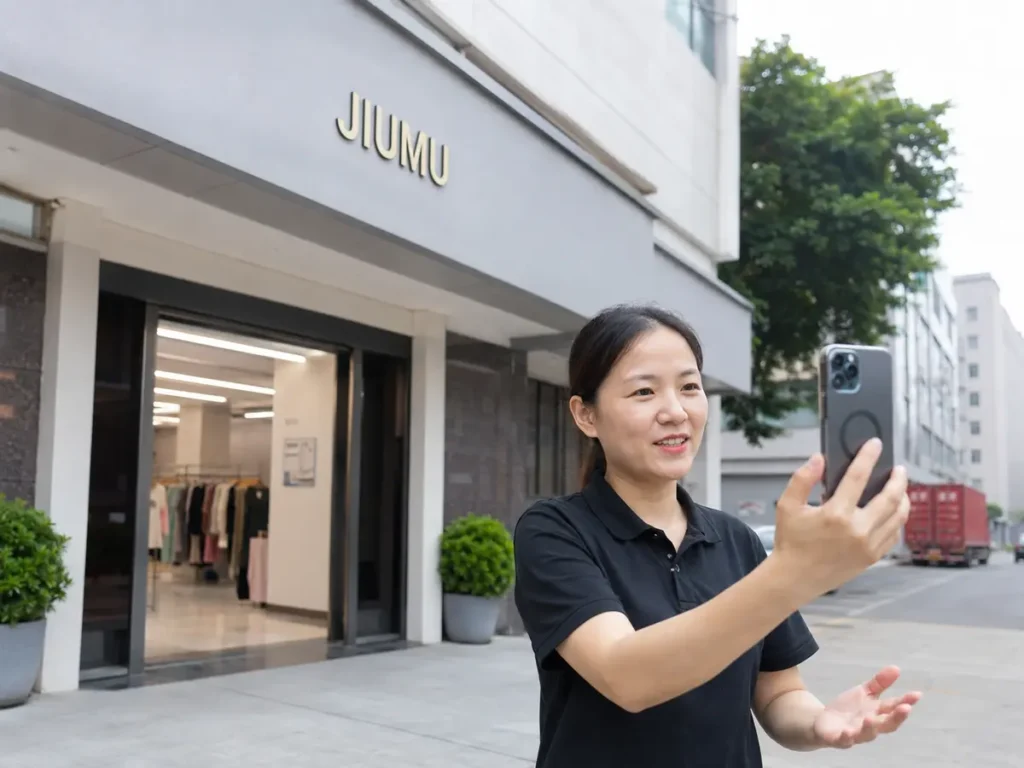
Ask the representative to begin at the exterior or main entrance where safe and permitted. Compare the company name, location details, and address with the business license, quotation, proforma invoice, contract, and payment beneficiary. An English brand name is not necessarily the registered legal name, so request the Chinese legal name and Unified Social Credit Code separately.
Useful live checks include:
- Ask the host to state the date, time, attendees, and tour objective on camera.
- Request a simple unplanned action, such as showing a specific color sample, moving to a named area, or turning the camera toward a nearby clock.
- Keep the route continuous where practical instead of accepting a series of disconnected calls.
- Ask a production or QC employee a process-specific question rather than relying only on sales narration.
- Request a close-up and then a wide shot, so detail remains connected to its surrounding area.
- Note any necessary call interruption, location change, or restricted zone in the findings log.
GPS screenshots and map pins can support an address check but can be manipulated and should not be treated as decisive evidence. The strongest conclusion comes from consistency among registry information, contracts, payment details, the exterior, the interior route, staff answers, samples, and subsequent production performance.
Use a Continuous, Buyer-Directed Route
The buyer should control the agenda while the supplier controls safe physical access. Ask the host to follow a logical route that connects business identity, product knowledge, inputs, production, inspection, and shipment.
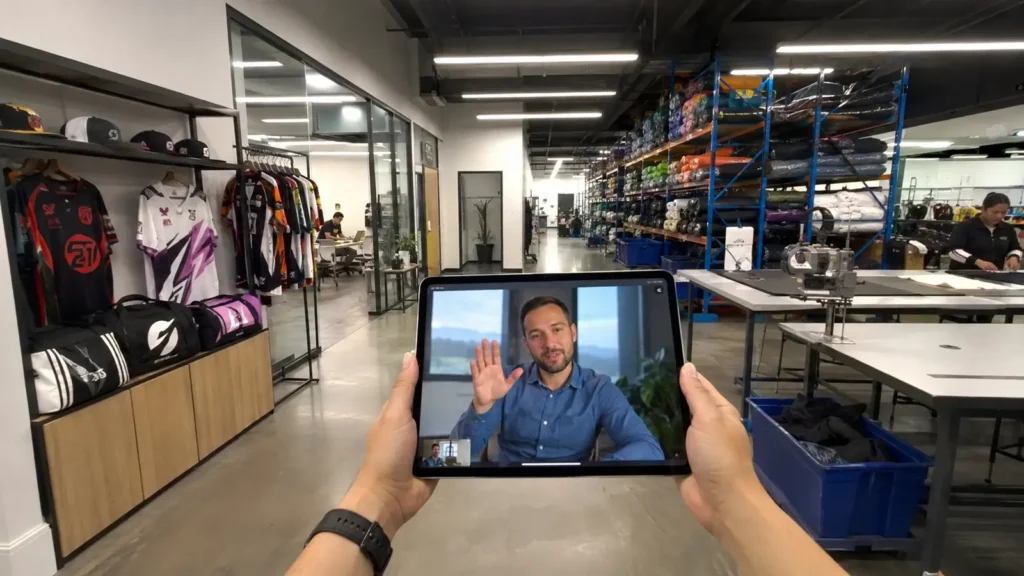
1. Office and project-management area
Verify that your normal sales or project contact is present. Ask who translates your purchase order and tech pack into internal instructions, who controls revisions, and who approves a production release. You do not need to see confidential ERP screens. A blank demonstration record or a redacted sample can show how versions and approvals are managed.
2. Sample room
Look for product categories relevant to your project, not simply the largest wall of attractive samples. Ask the sample technician to explain one comparable product: material, logo method, construction, and approval history. Similar appearance is not proof of identical specifications, but the explanation can reveal technical depth.
3. Raw-material and accessory area
For apparel and bags, request fabric rolls, linings, foam, webbing, zippers, labels, thread, inks, transfer paper, or packaging materials relevant to your order. Check whether materials are identified, separated, protected, and linked to orders or lots. Do not ask the supplier to expose another buyer’s confidential specifications.
4. Cutting and preparation
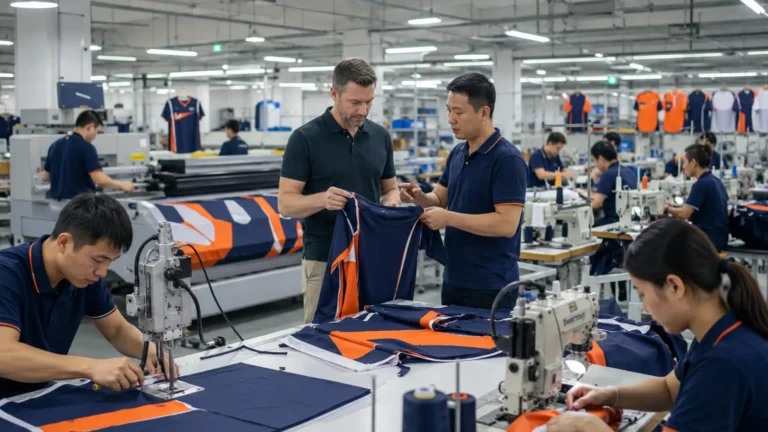
Ask how patterns, markers, size grading, fabric direction, shade grouping, and bundle identification are controlled. For sublimated jerseys, the buyer may need to see printing, heat-transfer, cutting, and numbered-panel control. For hats, relevant operations may include panel cutting, embroidery, crown assembly, brim preparation, finishing, and shaping.
5. Printing, embroidery, and decoration
Request the process that applies to your logo. Ask who creates the print file or embroidery digitizing file, how colors are approved, how placement is measured, and what happens when a first piece fails. If this area is elsewhere, record it as an outsourced or separate-site operation rather than allowing a vague claim such as “we can do everything.”
6. Sewing and assembly
Observe the actual product flow, bundle identification, operator instructions, seam construction, and in-process checks. A room filled with sewing machines confirms machines exist; it does not establish the output rate or defect level. Ask how many lines are appropriate for your product, what changes during peak season, and which operation is the bottleneck.
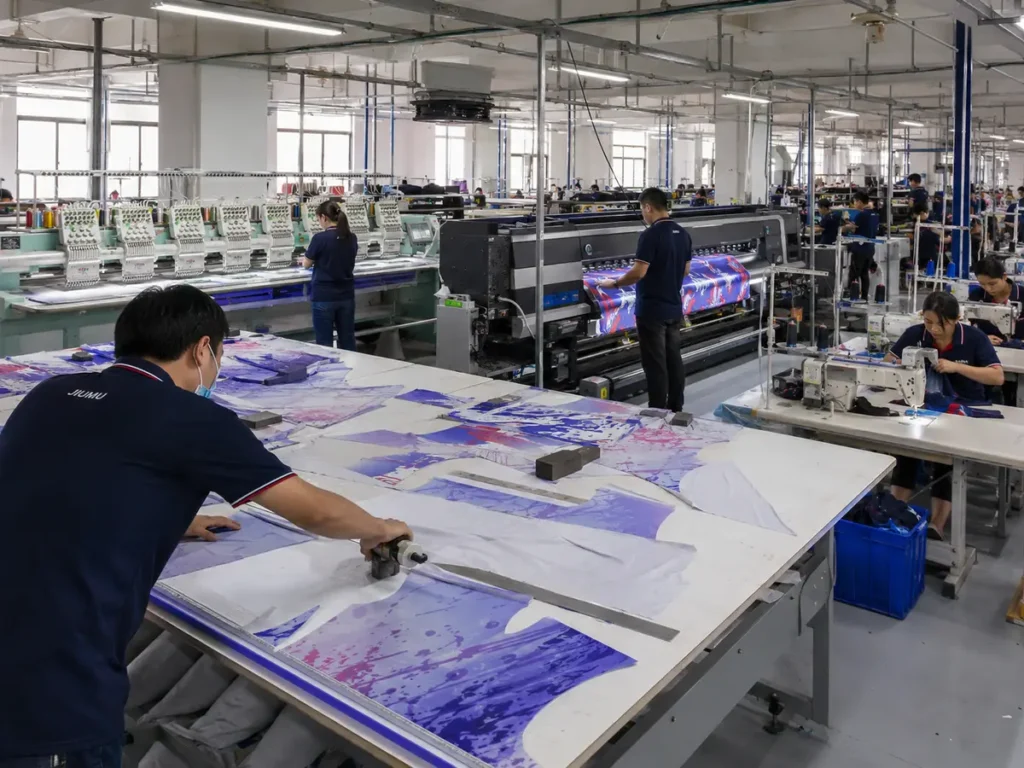
What to Ask at Each Production Process
Use evidence-oriented questions. “Do you have good quality?” invites a rehearsed answer. “Show the measurement point for chest width and the form used when a result is outside tolerance” connects a claim to observable practice.
| Process | Ask to see | Ask the responsible person | Record |
|---|---|---|---|
| Material receipt | Identification, segregation, condition | How is material matched to an approved standard? | Lot reference and gaps |
| Cutting | Pattern, marker, bundle ticket | How are sizes and panels prevented from mixing? | Method and example |
| Sublimation/printing | Artwork version, first-piece check | How are color and placement approved? | Approval reference |
| Embroidery | Machine setup, backing, sample | Who approves digitizing, density, and placement? | In-house/outsourced status |
| Sewing | Work instructions and key seams | Which stress points receive reinforcement? | Observed construction |
| In-process QC | Inspection point and defect handling | What happens to a rejected panel or garment? | Segregation and rework method |
| Final QC | Measurement, appearance, count | What sampling plan or buyer requirement is used? | Inspection record type |
| Packing | Folding, labels, assortment | How are SKU, player, size, and carton data checked? | Packing specification |
Verify Quality Control Without Exposing Other Customers
A quality-control area should show methods, standards, tools, records, and disposition—not just an employee looking at a garment. Ask to see a blank or redacted inspection form, an approved sample, measuring tools, the measurement method, logo-placement reference, defect examples, and the way rejected pieces are separated.
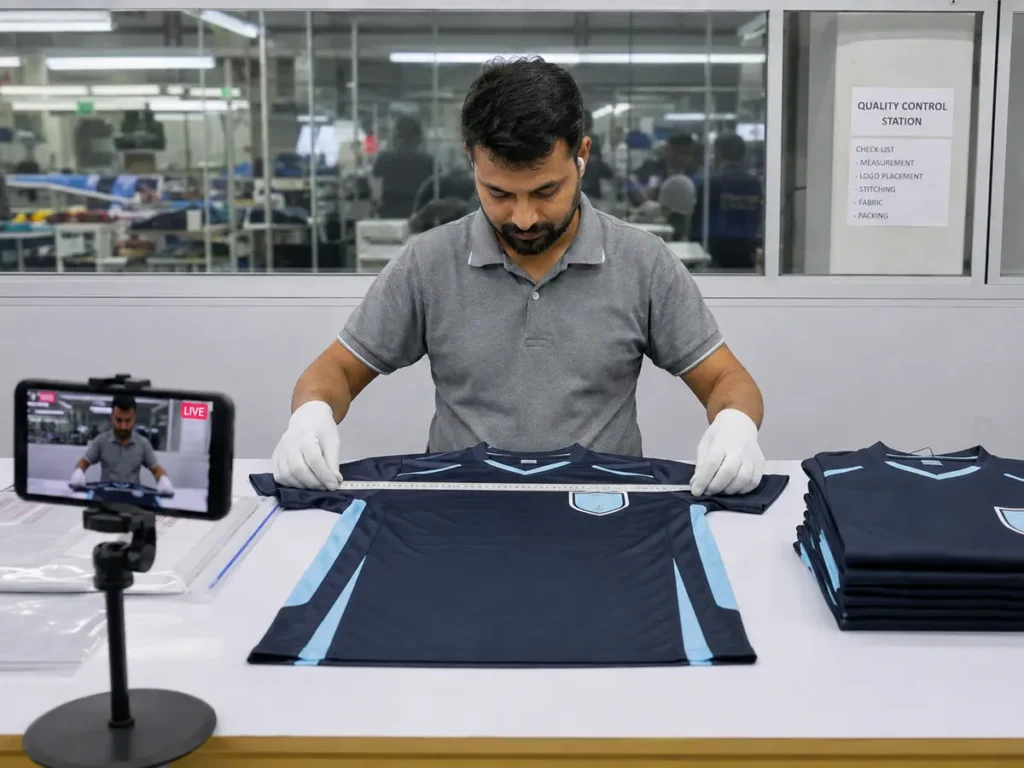
For a custom teamwear order, useful demonstrations include:
- measuring chest width and body length according to the approved size chart;
- comparing a logo’s position with the approved artwork or placement specification;
- checking name and number spelling against a controlled roster version;
- examining seams, skipped stitches, puckering, stains, or print defects;
- verifying labels, individual packaging, carton assortment, and carton marks;
- showing how an out-of-tolerance unit is identified, reworked, replaced, or reported.
Do not expect to inspect another buyer’s complete report. The supplier should redact customer names, contact information, artwork, order numbers, prices, and launch details. A fictional or blank form can demonstrate the workflow while respecting confidentiality.
Inspect Packing and the Warehouse
The tour should finish where the order finishes. Ask to see packaging materials, folding or shape-support methods, individual bags or boxes, label controls, carton sealing, carton storage, and the finished-goods area. For structured caps, confirm how crowns and brims are protected. For personalized jerseys, ask how player-specific items are sorted and reconciled with the roster.
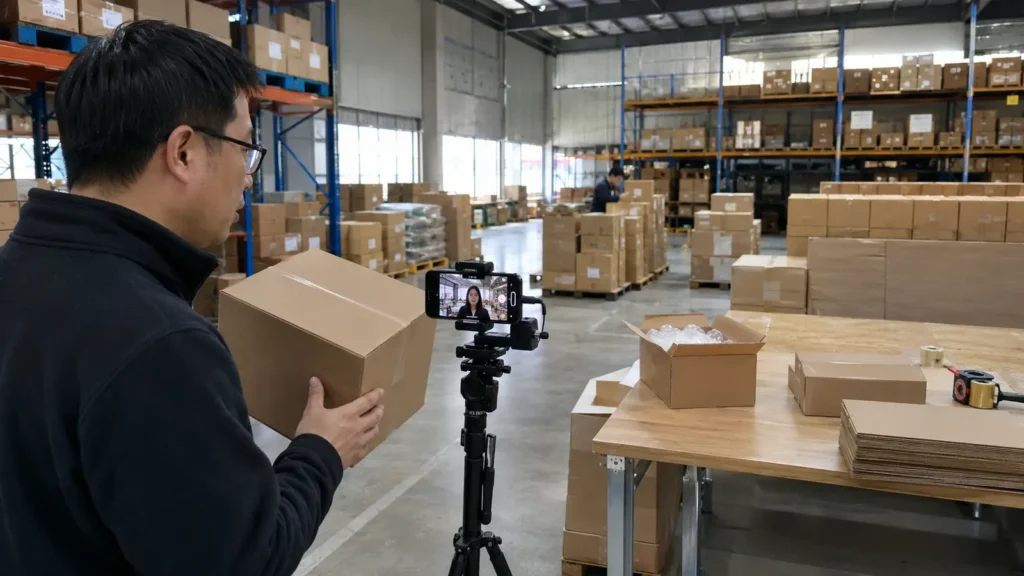
Observe whether finished goods are separated from incoming materials and work in process. Ask how cartons are linked to a packing list, how shortages or overages are controlled, and who authorizes shipment. Warehouse fullness on one day does not prove annual capacity; it is simply one observation to compare with production schedules, order records, and later inspections.
Require Clear Disclosure of In-House and Outsourced Processes
Outsourcing is common in custom apparel and is not automatically a weakness. A specialist partner may produce a better woven patch, custom zipper pull, molded PVC badge, fabric finish, or laboratory test than a general garment factory. The risk arises when responsibility, specifications, traceability, approval, or inspection are unclear.
Ask the supplier to classify every important process:
| Status | Meaning | Evidence to request | Responsibility to confirm |
|---|---|---|---|
| In-house at the toured site | Performed inside the facility shown | Live area, equipment, staff explanation | Process control and final acceptance |
| Same company, different site | Performed by a related facility | Legal/site relationship, separate live tour | Transfer, traceability, and oversight |
| Long-term subcontractor | External specialist used regularly | Partner capability, incoming inspection, approval flow | Supplier remains accountable under the PO/contract |
| Order-specific subcontractor | Partner selected for this project | Written approval before use | Qualification, sample approval, and defect remedy |
| Material supplier service | Mill or component maker performs treatment | Material specification and certificate/report where relevant | Incoming verification and lot consistency |
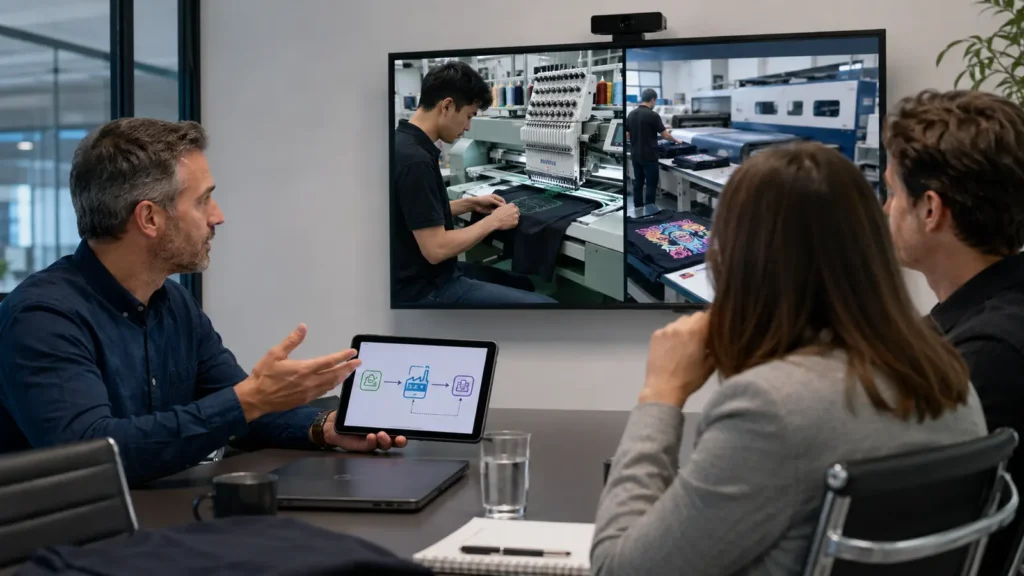
The buyer’s agreement should identify any process that may not be subcontracted without written approval. It should also state that outsourcing does not remove the contracting supplier’s responsibility for specifications, quality, confidentiality, delivery, and corrective action. If a partner site is critical to product performance, request a separate live tour or appropriate third-party verification.
Recording, Screenshots, Privacy, and Intellectual Property
Never assume a video call may be recorded. Obtain agreement before the session and identify who will record, the purpose, permitted recipients, storage period, and deletion or retention rule. Local privacy, employment, cybersecurity, and data-transfer requirements may apply, so organizations should obtain qualified advice for their jurisdictions when necessary.
A practical recording agreement can cover:
- participant names and consent;
- approved areas and prohibited areas;
- whether audio, video, still screenshots, or only written notes are allowed;
- treatment of employee faces and personal information;
- masking of customer logos, rosters, labels, screens, patterns, and unreleased products;
- who may access or share the file;
- storage location, security, retention period, and deletion;
- prohibition on marketing publication without separate written approval.
The supplier should prepare the route by covering or turning over sensitive work, closing confidential files, and positioning the camera away from personal data. The buyer should not pressure the host to reveal another customer’s intellectual property. A supplier that protects other customers’ information is demonstrating the behavior you should want for your own project.
Red Flags—and Innocent Explanations to Check
A single problem should trigger investigation, not an automatic accusation. Use the following table to separate the observation from the conclusion.
| Observation | Possible risk | Legitimate explanation | Follow-up evidence |
|---|---|---|---|
| Only a prerecorded video is offered | Site or activity may not be current | Security policy or connectivity limits | Short live entrance/office call plus independent visit |
| Tour cannot start outside | Address mismatch | Weather, safety, industrial-estate filming rule | Live window view, building management evidence, third-party check |
| Frequent cuts or reconnections | Disconnected locations may be combined | Weak Wi-Fi between workshops | Document each break and confirm site map |
| No workers or idle equipment | Facility may be inactive | Break, maintenance, changeover, or off-season | Reschedule during production and review schedule |
| Host refuses an unplanned direction | Staged route or borrowed facility | Safety or confidentiality restriction | Ask for a safe alternative angle and written explanation |
| Staff cannot explain basic controls | Weak process ownership | Language barrier or wrong participant | Arrange a technician or interpreter |
| Every process is claimed as in-house | Misrepresentation risk | Truly integrated supplier | Verify each critical area and legal/site relationship |
| Customer data is openly visible | Weak confidentiality culture | Route was poorly prepared | Require corrective privacy controls before sharing designs |
What a Virtual Tour Cannot Replace
A tour should sit inside a broader verification plan:
- Legal and payment checks: Compare the Chinese legal entity, Unified Social Credit Code, registered status, contract party, invoice issuer, and bank beneficiary.
- Specification control: Issue a tech pack, artwork files, roster, color references, size chart, packaging specification, and version history.
- Physical sample approval: Approve materials, fit, construction, decoration, labels, and packaging using a physical sample when risk requires it.
- Written commercial agreement: Define specifications, substitutions, quantity, quality criteria, schedule, inspection rights, Incoterm, payment, intellectual property, and remedies.
- Production verification: Use first-piece approval, in-process checks, or independent inspection according to project risk.
- Pre-shipment inspection: Verify quantity, workmanship, measurements, personalization, packing, and shipment readiness before the agreed release point.
The call is an evidence-gathering tool, not a substitute for these controls.
Post-Tour Findings and Action Log
Hold a short closing discussion while participants are still connected. Restate what was seen, what was not available, and what must be provided later. Avoid asking the supplier to agree with an unstated conclusion.
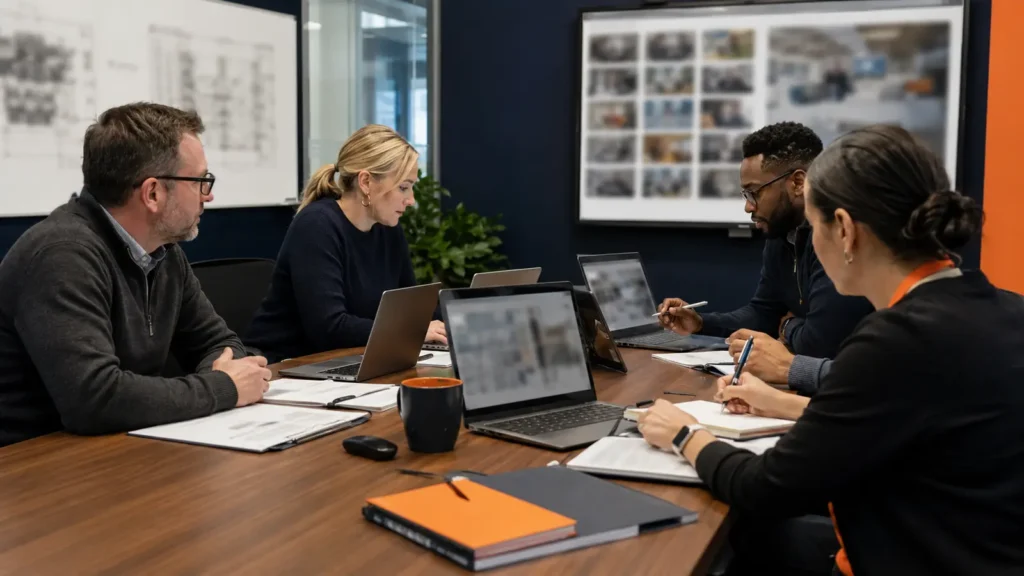
Use the following fields:
| Field | Example entry |
|---|---|
| Tour reference and version | VFT-2026-01, Rev A |
| Date, time, and time zones | Buyer time / China time |
| Supplier entity and site | Chinese legal name and toured address |
| Participants | Buyer, sales, production, QC, interpreter |
| Scope | Sublimated jerseys and embroidered caps |
| Areas observed | Entrance, sample room, print, sewing, QC, packing |
| Areas not observed | Embroidery partner site |
| Evidence received | Redacted QC form and process flow |
| Open question | Who approves outsourced embroidery first piece? |
| Required action | Separate partner tour and written control plan |
| Owner and deadline | Named person and date |
| Decision | Proceed to sample / hold / third-party audit / reject |
Use three decision states: proceed, proceed with conditions, or hold. “Proceed” should mean the tour objective was met, not that the supplier is guaranteed to perform perfectly. “Proceed with conditions” may require a missing document, partner-site verification, revised sample, or inspection plan. “Hold” is appropriate when identity conflicts, unexplained access refusals, weak technical answers, or confidentiality failures remain unresolved.
Questions to Send Before a Virtual Factory Tour
Send concise questions that require observable answers:
- Which legal entity will quote, contract, invoice, and receive payment?
- Which address will the live tour cover?
- Which products and processes are performed at that location?
- Which processes for our proposed order are outsourced or performed at another site?
- Can production, QC, packing, and warehouse representatives join?
- Will a relevant product or process be active at the scheduled time?
- Can you demonstrate one in-process and one final quality check?
- How are artwork, tech packs, rosters, and revisions controlled?
- How are nonconforming materials or products identified and handled?
- What areas or documents cannot be shown, and why?
- Are screenshots or recording permitted, and under what conditions?
- What follow-up evidence will be provided after the tour?
Common Buyer Mistakes
Common mistakes include accepting a sales presentation instead of directing the route, admiring machinery without connecting it to the product, treating one image or certificate as decisive evidence, ignoring outsourced work, recording without consent, and keeping no written findings. A credible process respects safety, privacy, and intellectual property while seeking alternative evidence for restricted areas.
How JIUMU Can Support a Buyer-Directed Tour
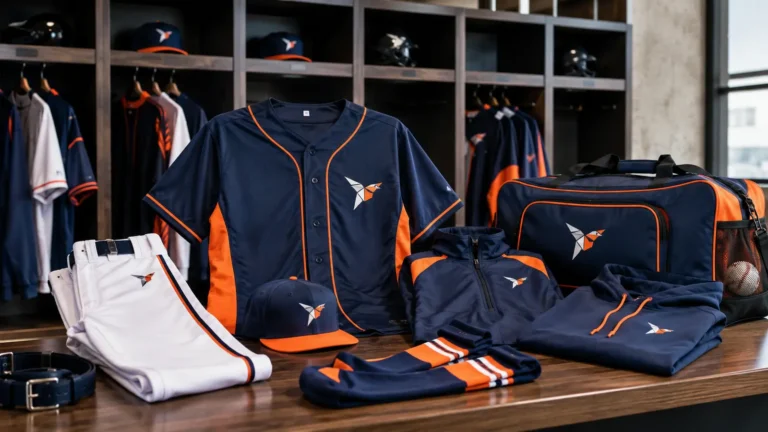
JIUMU supports OEM and ODM development for custom teamwear, logo apparel, hats, uniforms, bags, and branded merchandise. Relevant capabilities include embroidery, sublimation, screen printing, heat transfer, patches, material sourcing, Pantone color matching, private labels, packaging customization, digital mockups, physical samples, quality control, and export support.
Before a call, tell us the product categories, estimated quantities, customization methods, priority processes, and target delivery date. We can prepare a focused route and identify which participants should join. If a process or material comes from a specialist partner, the useful approach is to disclose that relationship and explain how specifications, samples, incoming checks, final acceptance, and confidentiality are controlled.
Review our Company Facts, explore Manufacturing Capabilities, and see how Quality Control connects approved specifications to production checks.
Frequently Asked Questions
Final Recommendation
Arrange a virtual factory tour as a controlled evidence-gathering session, not a marketing call. Define the questions before scheduling, require real-time interaction, follow a continuous route, connect equipment and staff answers to the proposed product, distinguish in-house from outsourced work, and document limitations. Respect safety and confidentiality throughout the session.
The strongest sourcing decision combines consistent evidence: legal and commercial documents align, the live site supports the supplier’s claims, samples meet approved requirements, changes are controlled, and production is inspected according to risk.
To arrange a buyer-directed session for custom teamwear, hats, uniforms, or bags, contact JIUMU with your product brief, estimated quantity, customization requirements, preferred time zone, and checklist. We will confirm the tour scope and next steps before the meeting.
Sources and Further Reading
- ISO/IEC TS 17012:2024 — Guidelines for remote auditing methods
- IAF MD 4:2025 — Use of ICT for conformity assessment purposes
- ISO 9001 Auditing Practices Group — Remote Audits
This article provides general procurement guidance, not certification, legal, privacy, or regulatory advice. Requirements should be adapted to the buyer’s jurisdiction, product risk, contract, and organizational policies.