
How to Use Third-Party Inspection for Custom Apparel
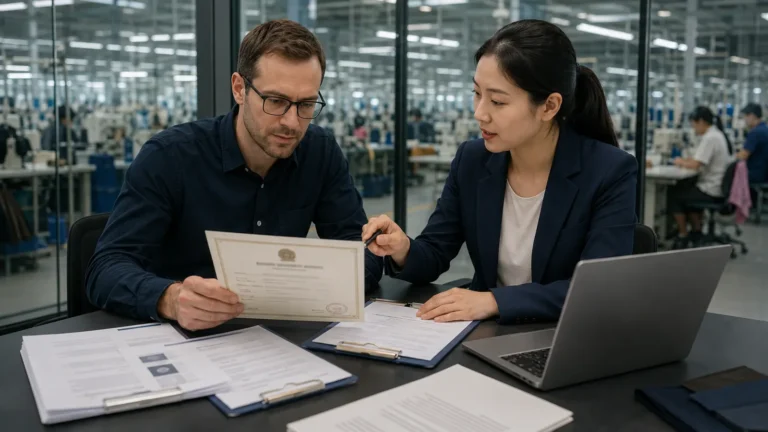
Third-party inspection gives a buyer an independent view of whether a custom apparel order matches agreed requirements at a defined point in production. It is especially useful when the buyer cannot visit the factory, the order includes many sizes or personalized items, final payment is linked to quality approval, or delivery errors would disrupt a season, promotion, retail launch, or customer program.
The value does not come from simply “sending an inspector.” A useful inspection requires the correct timing, a controlled product specification, an agreed sampling and defect-classification method, access to the complete lot, and a written rule for corrective action and shipment release. Without those inputs, a professional inspector can take many photographs yet still be unable to decide whether a jersey color, logo position, garment measurement, label, player number, or packaging detail is acceptable.
Quick Answer
Use third-party inspection by selecting the inspection stage that matches the risk, booking an inspector early, and sending one controlled inspection package: purchase order, current tech pack, approved Golden Sample or reference photographs, color and material standards, size chart and tolerances, roster, labeling and packaging requirements, defect classifications, sampling standard, inspection level, AQL values, and release authority. A factory audit evaluates the supplier or management system; PPI checks readiness and early materials; DUPRO checks goods while production can still be corrected; PSI checks finished and packed goods before shipment; and a container loading check verifies loading and shipment details. If an inspection fails, do not authorize shipment until the affected scope, rework, replacement, and required reinspection have been agreed and verified.
What Is Third-Party Inspection?
A third-party inspection is performed by an organization or inspector who is independent of the buyer-supplier production team. The inspector observes, measures, samples, tests where authorized, photographs findings, and reports conformity against the buyer’s instructions. The inspection company does not normally redesign the product, approve an undocumented substitution, or decide the buyer’s commercial remedy unless the service agreement expressly gives it that authority.
Independence matters because the supplier’s internal QC team is responsible for controlling production, while the buyer needs an additional verification layer. The two roles should reinforce each other:
- factory QC prevents, detects, isolates, and corrects problems throughout production;
- third-party inspection verifies selected evidence at an agreed milestone;
- the buyer reviews the report and makes the commercial release decision;
- the manufacturing agreement defines responsibility for defects, delay, rework, reinspection, and shipment.
An inspection result describes the lot and conditions available at the time of inspection. It is not a guarantee that every unit is perfect, that later handling cannot cause damage, or that untested regulatory requirements have been satisfied.
Factory Audit vs. PPI, DUPRO, PSI, and Loading Inspection
Buyers often use “factory inspection” for several different services. Choosing the wrong service can produce a technically correct report that answers the wrong question.
| Service | Main question | Typical timing | Custom-apparel focus | Important limitation |
|---|---|---|---|---|
| Factory audit | Is the supplier’s facility and management system suitable? | Before supplier approval or periodically | Legal/site identity, capacity, procedures, subcontracting, quality system | Does not accept or reject a specific shipment unless combined with product inspection |
| PPI / Initial Production Check | Are materials, components, files and production setup ready? | Before production or at the beginning | Fabric, trims, color references, artwork version, patterns, labels, sample and line setup | Cannot establish final workmanship or packed-order accuracy |
| DUPRO / During Production Inspection | Is production following the approved requirements while correction is still practical? | When a meaningful portion is produced | Early garments, measurements, decoration, seams, roster handling, progress and packing start | Remaining goods are not yet available and later output can differ |
| PSI / Pre-Shipment Inspection | Does the finished lot meet agreed product and packing requirements? | When production and packing are sufficiently complete for representative sampling | Quantity, assortment, dimensions, color, logo, workmanship, labels, packing and cartons | Sampling does not inspect every unit and may not detect hidden or intermittent issues |
| Container Loading Check | Are the correct cartons loaded in suitable condition and documented? | At loading | Carton count, marks, visible condition, container condition, loading sequence and seal | Does not replace a prior product-quality inspection |
QIMA publicly describes Initial Production Check, DUPRO, PSI, and Container Loading Check as distinct stages in the production timeline. Intertek similarly separates manufacturing-facility auditing, garment inline inspection, final random inspection, and loading supervision. Service names and completion thresholds vary among providers, so use the actual service scope in the quotation rather than relying only on an acronym.

When is a factory audit appropriate?
Use a factory audit to evaluate whether the facility, systems, staffing, process controls, supplier management, traceability, and corrective-action practices are suitable for your program. A factory audit is most useful before a high-value relationship, when tooling or confidential designs are involved, or when claims about in-house and outsourced operations materially affect risk.
It is not a substitute for inspecting the actual goods. A factory can have documented systems and still make an order with incorrect player names, mixed sizes, shifted logos, wrong labels, or packaging errors.
When should PPI be used?
Use PPI when errors in inputs would repeat across the full order. This is relevant when the project uses custom-dyed fabric, many trims, a complex tech pack, new patterns, new printing or embroidery programs, special labels, or packaging that must meet a retailer or fulfillment-center requirement.
PPI can verify that the factory has the approved references and correct materials available. It cannot approve characteristics that only exist after complete production, washing, finishing, or packing.
When is DUPRO worth the cost?
DUPRO is valuable when early detection can prevent a large quantity of repeated defects. Examples include a grading problem across sizes, number placement that conflicts with a collar, embroidery puckering, seam weakness, color variation, incorrect label orientation, or a roster-control problem.
For a first order, a technically difficult design, tight deadline, or large quantity, combining DUPRO with PSI may be more useful than relying on PSI alone. If the order is almost complete, however, “DUPRO” offers little preventive advantage; confirm actual completion status before booking.
When should PSI occur?
PSI should occur only when enough goods and packaging are complete for the inspector to draw a representative sample from the defined lot. The buyer and inspection provider should agree on the readiness threshold. If cartons, sizes, colors, or personalization groups are missing, the available sample may not represent the order.
The purchase order should state whether shipment, final payment, or both depend on an accepted PSI report and written buyer release.
What Is AQL in Apparel Inspection?
AQL means acceptance quality limit within an acceptance-sampling system. ISO 2859-1:2026 defines sampling schemes indexed by AQL for lot-by-lot inspection by attributes. ASQ describes ANSI/ASQ Z1.4 as an acceptance-sampling system for attribute inspection with normal, tightened, and reduced plans. These standards connect lot size, inspection level, code letter, sample size, and acceptance or non-acceptance numbers.
AQL should not be explained as “the percentage of defective garments the buyer agrees to receive.” It is an index used to select a sampling plan. The observed result is compared with the plan’s acceptance and non-acceptance criteria; sampling creates statistical risk for both buyer and supplier.
Do not copy an AQL table from an unknown website or assume that a provider’s default is part of your contract. State:
- the exact sampling standard and edition;
- lot definition and lot quantity;
- normal, tightened, or reduced inspection where applicable;
- general or special inspection level;
- separate AQL or zero-acceptance requirements by defect class;
- whether defects or defective units are counted;
- how repeated defects on one unit are recorded;
- any tests with their own sample size;
- the rule for missing, inaccessible, unfinished, or mixed goods;
- who decides the final disposition.
ISO published the third edition, ISO 2859-1:2026, in January 2026, replacing the 1999 edition and its amendments. If a contract, inspection company, or customer manual cites another standard or edition, reconcile that difference before the visit. This article does not reproduce copyrighted sampling tables; obtain the applicable standard or have the inspection provider calculate and document the plan.
Critical, Major, and Minor Defects
Defect classification translates product risk into inspection decisions. The same visible condition may require a different classification depending on use, destination-market rules, customer promise, location, severity, and whether it affects safety or usability.
| Classification | Practical meaning | Possible custom-apparel examples | Buyer action |
|---|---|---|---|
| Critical | May create a safety, legal, or serious compliance risk | Broken needle or sharp object; unsafe detachable component on a children’s item; prohibited material; missing safety information where required | Usually requires immediate isolation, investigation, and strict acceptance rule defined by buyer |
| Major | Makes the product unusable, unsaleable, materially different from the approved requirement, or likely to cause return | Wrong player name/number; large measurement deviation; open seam; hole; materially wrong logo or colorway; missing required label; nonfunctional closure | Count against the agreed major-defect plan and define rework/replacement scope |
| Minor | Does not normally prevent intended use but departs from the approved finish | Removable loose thread; slight cosmetic inconsistency within an agreed boundary; small finishing issue in a non-prominent area | Count against minor-defect plan and monitor patterns |
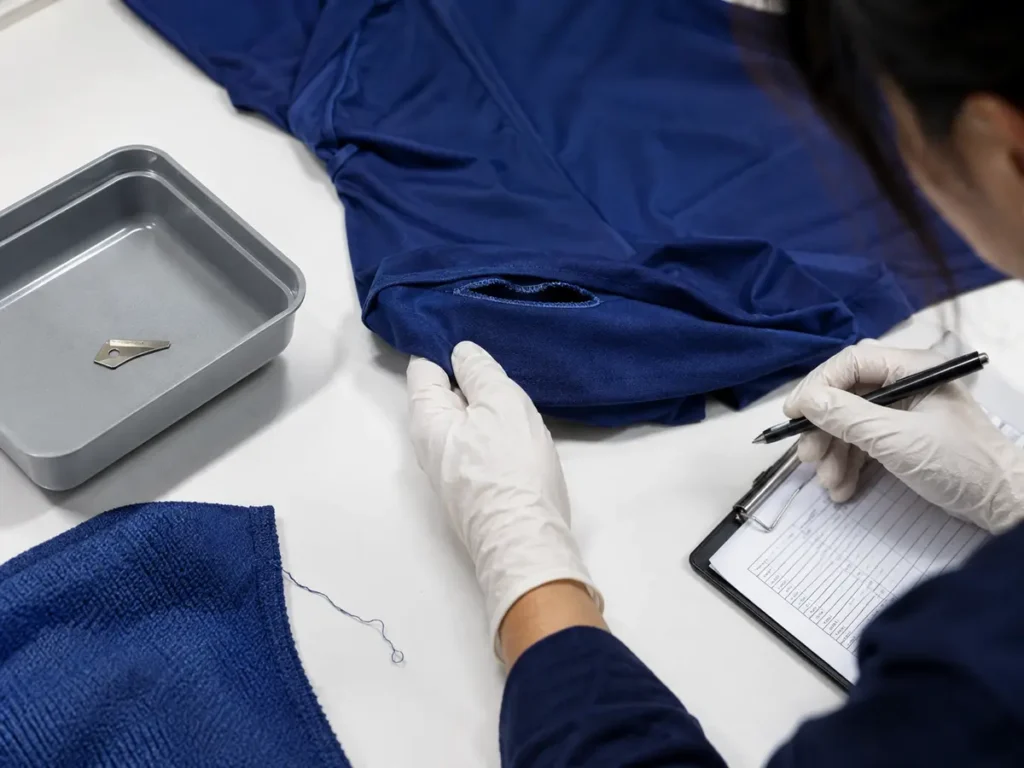
Intertek’s apparel inspection guidance gives examples such as stray needles or sharp points as critical, open seams or holes as major, and loose threads as minor. Use such guidance to start a project-specific list, not to override destination-market law or your own product-risk assessment.
Create photographs or diagrams of ambiguous conditions. Define viewing distance and lighting for cosmetic issues, measurement method and tolerances for size, approved reference for color, and exact placement points for logos. If an issue can appear at several severities, state what separates minor from major.
How Random Sampling Should Be Prepared
The inspector should be able to identify the lot and select samples without the factory presenting only its best pieces. Cartons should be accessible and sufficiently complete, and the packing list should match the physical order.
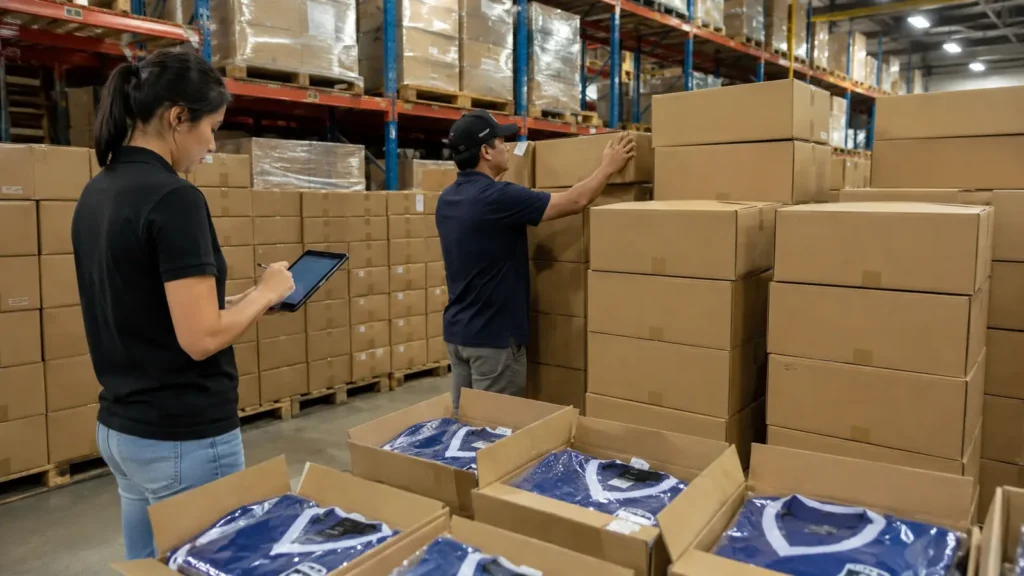
Before inspection, confirm:
- purchase-order quantity and available quantity;
- styles, colors, sizes, player groups, destinations, and carton distribution;
- number of cartons and carton-number range;
- whether goods are packed and sealed;
- whether all product groups can be sampled;
- whether replacement pieces and spares are inside the same lot;
- whether goods from different production batches are mixed;
- how the inspector will record unavailable or unfinished units.
A passing result from a sample selected from only one size or color should not be generalized to unrepresented groups without an agreed method. For personalized teamwear, the buyer may require a separate roster audit or a higher-coverage check for names and numbers because a spelling error can affect only one garment and still be commercially serious.
Build the Inspection Package Before Booking
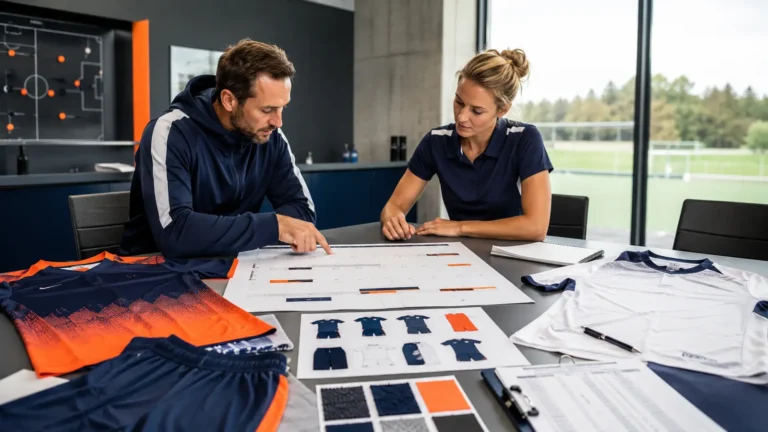
The inspection company should receive the same active documents used by the factory. Sending an old tech pack to the inspector creates a false conflict; sending no reference encourages subjective judgment.
Required inspection references
| Document or reference | Why it matters |
|---|---|
| Purchase order | Defines styles, quantities, color and size breakdown, delivery and commercial references |
| Current tech pack | Controls materials, construction, artwork, measurements, tolerances, labels and packaging |
| Golden Sample | Provides a physical comparison for approved appearance, hand, construction and decoration |
| Approved color/material standard | Supports color and material comparison under agreed conditions |
| Final artwork and placement sheet | Controls logo, sponsor, name and number content, scale and position |
| Final roster | Controls each player’s display name, number, garment size and special marking |
| Packing specification | Controls folding, polybag, hangtag, SKU, barcode, assortment and carton marks |
| Defect classification list | Defines critical, major and minor conditions for this product |
| Sampling instruction | States standard, edition, level, AQL and test sample sizes |
| Inspection checklist | Lists required visual, measurement, function and packing checks |
| Release rule | Identifies who can approve shipment and how conditional results are handled |
Send a version index showing each filename, revision, approval date, and authority. The Golden Sample should carry a unique reference that matches the tech-pack version. If the inspection company cannot receive a physical sample, define which photographs, swatches, sealed references, or factory-retained sample it may use and acknowledge the limitation.
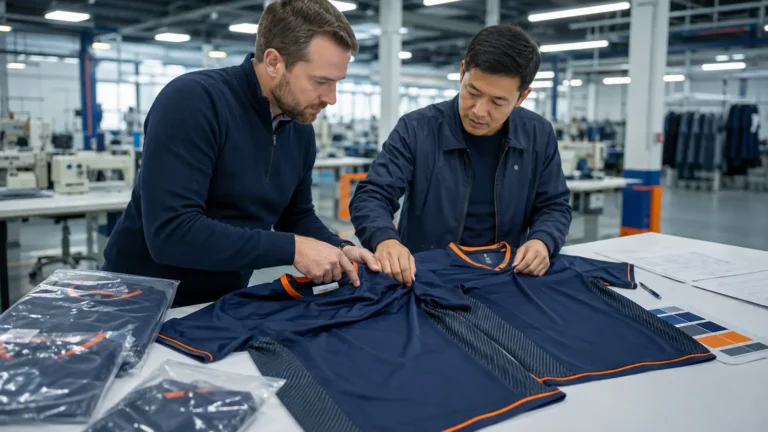
What Should an Apparel Inspector Check?
A custom-apparel inspection should be tailored to the product rather than copied from a generic T-shirt checklist.
Identity, quantity, and assortment
Confirm style, colorway, size range, quantity by size, personalization, spare pieces, and carton distribution. Reconcile counted or estimated quantity with the purchase order and packing list. Record unfinished or inaccessible goods.
Materials and color
Compare fabric, lining, mesh, rib, thread, backing, patches, labels, closures, and other trims with approved references. Check visible shade variation within garments and across the sampled lot. A photograph is useful evidence but should not be treated as a calibrated color standard.
Measurements and fit-related construction
Use the agreed measurement method, garment condition, reference points, and tolerance. Define how many pieces per size are measured and how out-of-tolerance results are counted. For stretch garments, specify whether the garment is relaxed and whether any tension is applied.
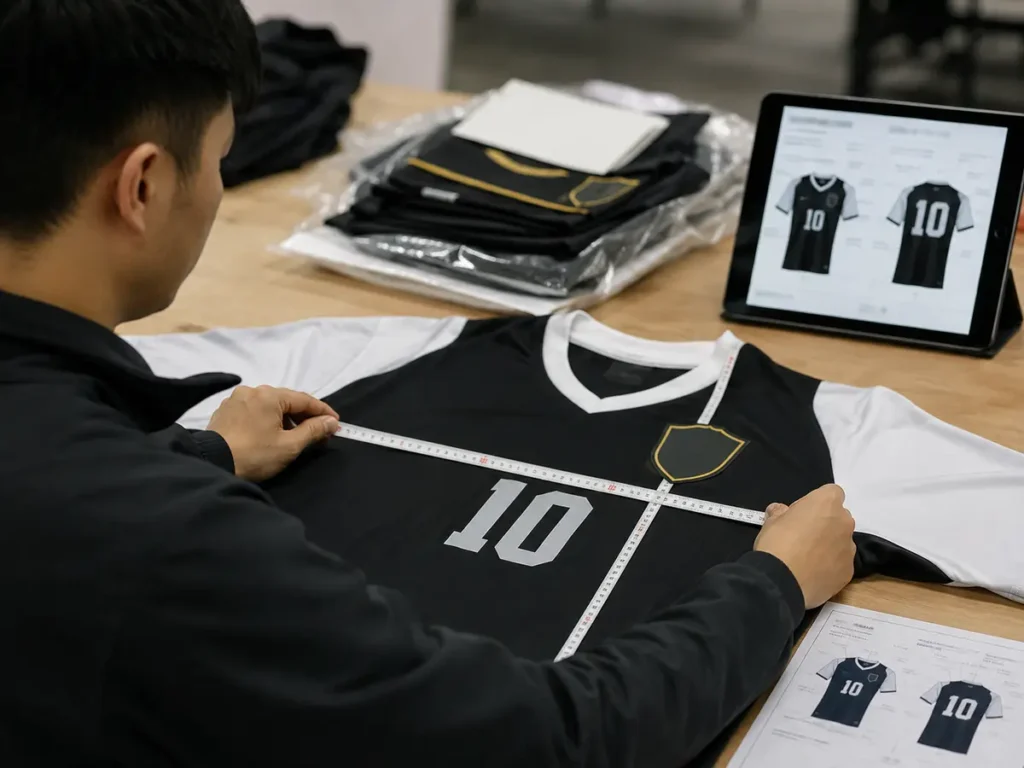
Logos, names, and numbers
Verify artwork version, spelling, font or outlined artwork, color, size, position, orientation, print quality, embroidery coverage, patch attachment, and interaction with seams, plackets, zippers, collars, and size grading. For a roster, use player ID as well as display name and number to reduce duplicate or ambiguous entries.
Workmanship
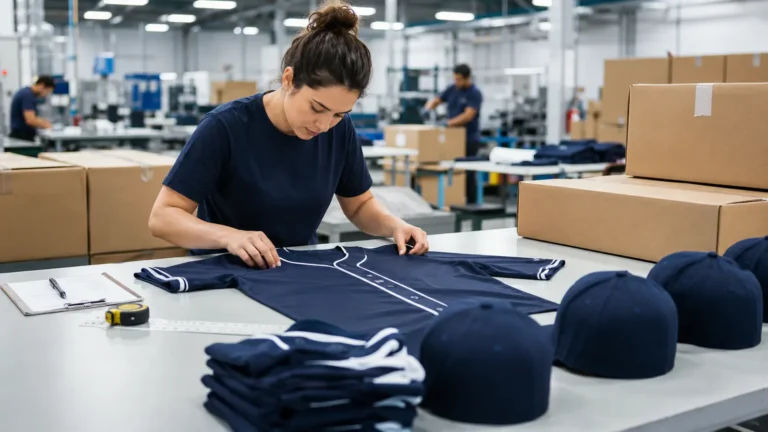
Check holes, stains, oil marks, open seams, skipped stitches, broken stitches, seam puckering, raw edges, asymmetry, mismatched panels, loose attachments, poor trimming, print defects, embroidery distortion, damaged hardware, and finishing. Define whether repair evidence is acceptable and whether repaired goods need special review.
Labels and packaging
Check required fiber, care, origin, brand, size and tracking labels against approved files and destination-market obligations. Verify hangtags, stickers, barcodes, individual bags, folding, size and player identification, carton assortment, marks, carton dimensions and visible carton condition.
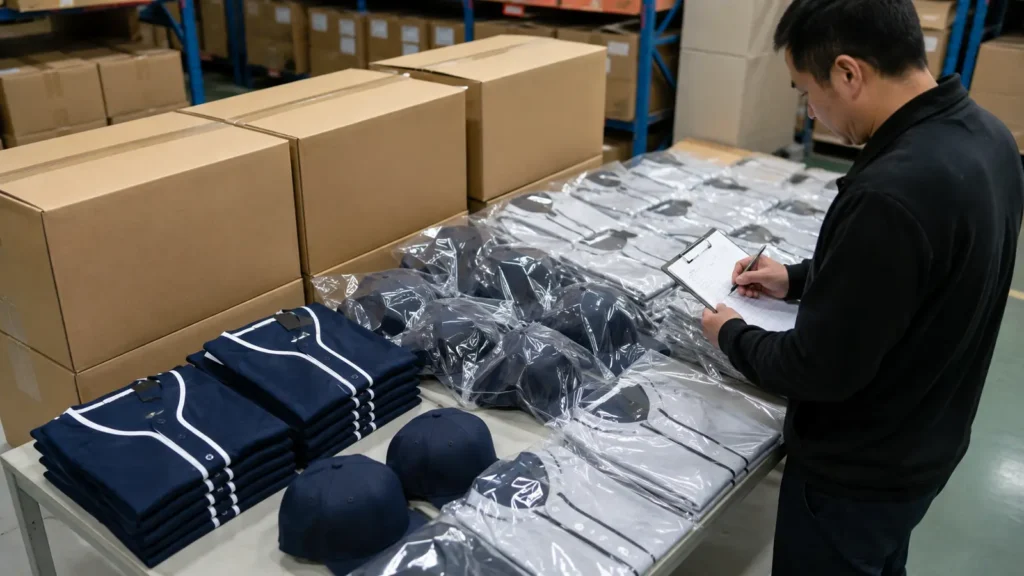
Who Books the Inspection, When, and Who Pays?
The buyer commonly books the inspection because the buyer defines the scope and receives the independent report. The supplier provides the site contact, confirms readiness, grants access, and makes the lot and records available. A distributor may book on behalf of its customer, but release authority should remain explicit.
Book early enough to reserve an inspector and allow corrective work without automatically missing the shipment. Confirm the proposed date with the factory, but do not let the factory silently redefine the checklist or cancel the visit. Ask the inspection provider about lead time, cancellation charges, travel zones, overtime, additional inspector-days, physical sample shipment, laboratory testing, and report delivery.
Cost responsibility should be written in the purchase order or manufacturing agreement. Common structures include:
- buyer pays the first planned inspection as part of its assurance program;
- supplier pays reinspection when the lot fails for supplier-responsible nonconformity;
- supplier pays wasted-visit charges if confirmed goods are not ready or accessible;
- buyer pays if the visit changes because buyer specifications or timing changed;
- parties allocate special testing, travel, or additional days separately.
There is no universal rule that the factory must pay every inspection cost. The clearest arrangement separates the planned verification expense from costs caused by non-readiness, failure, or buyer change.
Before booking, send JIUMU the inspection company’s request form, service type, proposed date, active tech-pack version, sampling instruction, checklist, Golden Sample reference, and release rule. This allows the production and packing teams to prepare the defined lot without changing the inspector’s independence.
What Happens After a Failed Inspection?
A failed report is a decision input, not a complete corrective-action plan. First confirm why it failed: defect count exceeded the plan, a critical issue occurred, measurements failed, quantity was incomplete, packaging was wrong, required tests were not performed, or the lot was not ready for valid sampling.
Use a controlled sequence:
- Hold shipment. Prevent loading or release while disposition is unresolved.
- Confirm the affected scope. Determine whether the issue is isolated, size-specific, color-specific, roster-specific, carton-specific, or systemic.
- Segregate suspect goods. Do not mix corrected pieces with unverified pieces.
- Analyze cause. Identify the process or control failure, not only the visible symptom.
- Define correction. Rework, replace, repack, relabel, reproduce, sort, or accept by written concession.
- Define coverage. Decide whether 100% sorting, targeted inspection, or broader rework is required.
- Verify effectiveness. Review factory evidence and arrange reinspection where risk justifies it.
- Issue a new decision. Approve, conditionally approve, or reject through the named authority.
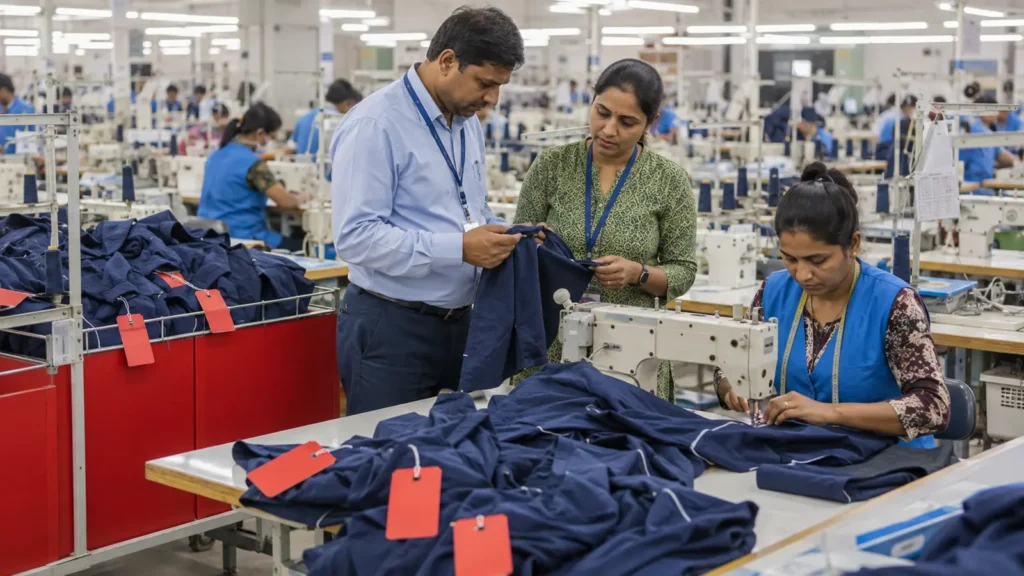
Do not assume that correcting only the sampled defective units corrects the lot. The samples reveal evidence; they are not necessarily the entire affected population. If a wrong embroidery file created every crest, the whole production group may require review. If one garment was stained during isolated handling, the scope may be narrower—but that conclusion should be supported.
When is reinspection necessary?
Reinspection is appropriate when the failed characteristic is material, the corrective scope is large, the original sampling validity was compromised, or the buyer lacks reliable evidence that the lot now complies. A narrowly defined document or packing correction may sometimes be closed through dated photographs, revised records, or a live check if the buyer and inspection provider agree. State the closing evidence in writing.
Can Goods Ship Before the Buyer Approves the Report?
Only if the contract and buyer authorization permit it. A supplier should not interpret the absence of an immediate reply as shipment approval. The manufacturing agreement should state:
- whether PSI is mandatory;
- whether a pass result automatically releases shipment or still requires buyer approval;
- who is authorized to sign release;
- how conditional or pending results are handled;
- whether final payment depends on inspection;
- who pays storage, delay, rework, and reinspection;
- what happens when a shipping cutoff conflicts with corrective work.
The safest operational record is a short Shipment Release Authorization identifying the purchase order, inspection report number and version, accepted exceptions, open actions, payment status if relevant, authorized ship date, shipping method, and approver.
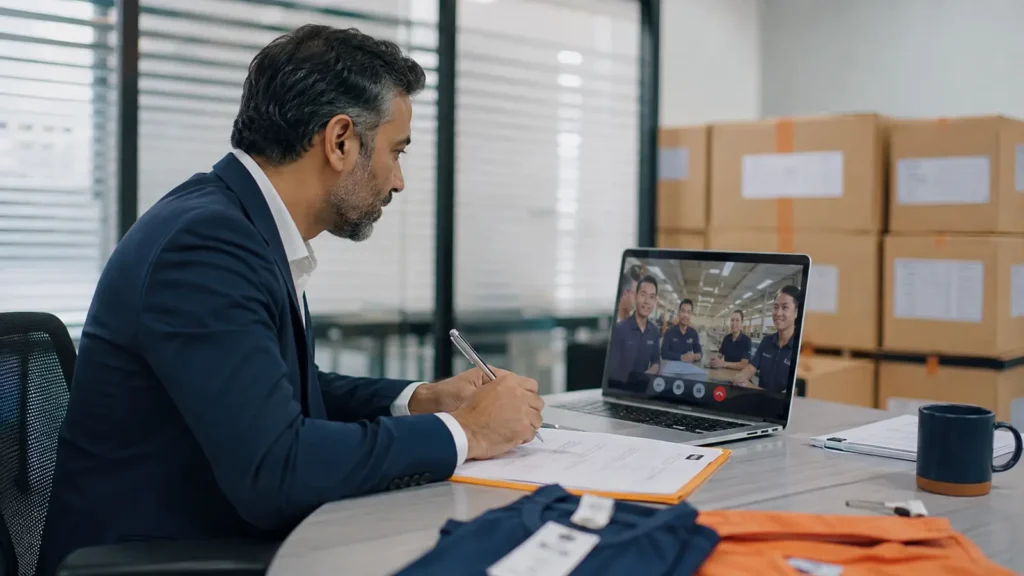
Why Third-Party Inspection Cannot Replace Factory QC
A factory makes quality every day; an inspector observes a sample during a limited visit. Third-party inspection cannot replace incoming-material checks, first-piece approval, operator self-checks, inline inspection, equipment maintenance, version control, needle control where applicable, nonconforming-product segregation, packing reconciliation, and corrective action.
If the factory waits for PSI to discover an incorrect measurement or logo, most of the order may already require rework. The strongest model is layered:
- specifications and Golden Sample define the target;
- factory QC controls inputs and production;
- independent inspection verifies selected milestones;
- the buyer reviews evidence and authorizes release;
- delivery feedback improves the next order.
Review JIUMU’s Quality Control process and the detailed Pre-Shipment Inspection Checklist when building the project checklist. Inspection responsibilities, substitutions, remedies, and release rules should also be connected to the Manufacturing Agreement and the confirmed MOQ & Lead Time schedule.
What to Send JIUMU and the Inspection Company
Provide:
- buyer and supplier legal/contact details;
- purchase-order number and order value reference where required;
- product categories, style codes, quantities, sizes and colors;
- final roster and personalization matrix;
- active tech pack and revision index;
- Golden Sample or approved-reference location;
- color, fabric, trim and packaging standards;
- required checks, tests, sample quantities and measurement coverage;
- sampling standard, edition, inspection level and AQL by defect class;
- product-specific defect list;
- factory address, contact and access rules;
- planned inspection date and readiness threshold;
- report recipients and release authority;
- corrective-action, reinspection and cost rules;
- target shipping and in-hand dates.
JIUMU supports OEM and ODM development for custom teamwear, hats, uniforms, bags, and branded merchandise. Relevant capabilities include embroidery, sublimation, screen printing, heat transfer, patches, material sourcing, Pantone matching, private labels, packaging customization, samples, quality control, and export support. Third-party inspectors can be integrated as an additional verification layer when the scope and schedule are agreed in advance.
Frequently Asked Questions
Final Recommendation
Use third-party inspection as part of a written quality plan, not as a last-minute photography service. Select the inspection stage based on the decision you need to make. Freeze the tech pack, sample, roster, tolerances, defect classifications, sampling rules, packaging requirements, and release authority before the inspector arrives. Schedule enough time for corrective work and do not let a freight deadline silently override an unresolved failed report.
For custom jerseys, hats, uniforms, or team packages, contact JIUMU with your specification, quantity, inspection stage, proposed provider, checklist, target inspection date, and delivery deadline. JIUMU can coordinate factory access and order readiness while the independent inspector reports according to the buyer-approved scope.