
What Should Be Included in a Manufacturing Agreement?
A custom apparel manufacturing agreement should identify the actual buyer and supplier, incorporate the correct product specification and approved sample, prohibit unauthorized substitutions, define quality and inspection rules, set payment and delivery milestones, allocate shipping risk, and explain what happens when goods fail. It should also address intellectual property, confidentiality, subcontracting, force majeure, governing law and dispute resolution.
The agreement is not a replacement for a Tech Pack, Purchase Order or Golden Sample. It connects those records into one enforceable commercial framework and establishes which document controls if they conflict. A carefully written file will not prevent every production problem, but it can prevent the parties from discovering—after a deposit is paid—that they understood the order differently.
Legal notice: This article is a procurement checklist for business education. It is not legal advice, does not create an attorney-client relationship and is not a ready-to-sign contract. Manufacturing, sales, IP, tax, customs and dispute rules vary by jurisdiction. Have qualified counsel review the final agreement and any choice-of-law, arbitration, limitation-of-liability or remedy language.
Quick Answer: The 15 Sections Buyers Should Check
Before paying a deposit, confirm that the contract covers:
- Legal names, addresses, registration details and authorized signers
- Product description, quantities, prices and currency
- Tech Pack, artwork, roster and specification versions
- Approved samples, swatches and Golden Sample identification
- Approved materials and a no-substitution rule
- Measurements, colors, workmanship and defect classifications
- Production start conditions and delivery milestones
- Packaging, labeling, carton marks and sorting
- Internal and third-party inspection rights
- Failed-inspection, rework and replacement procedures
- Payment milestones, bank details and change controls
- Named Incoterm, exact place or port, and rule version
- Intellectual-property rights and confidentiality
- Subcontracting, force majeure and termination
- Governing law, possible CISG treatment and dispute resolution
Each item should use objective evidence and defined actions. “Good quality,” “fast delivery” and “same as sample” are too vague unless the agreement identifies the quality criteria, delivery event and exact sample.
1. Identify the Correct Contracting Parties
Use the full legal name of each party, not only a brand, salesperson name or website. Record registered address, company registration or tax identifier where appropriate, notice address and authorized representative. The seller named in the agreement should be reconciled with the quotation, invoice, bank beneficiary and export documents.

A manufacturer may legitimately use an affiliated export company or approved payment entity. If so, document the relationship and specify which entity is responsible for product conformity, delivery, warranties and refunds. Do not assume that a person using a company email is authorized to change the contract.
Party Information Checklist
| Field | Buyer-side check |
|---|---|
| Legal entity name | Matches registration and signature block |
| Registered address | Matches current corporate record |
| Operational facility | Identifies where relevant production occurs |
| Bank beneficiary | Same entity or documented authorized relationship |
| Authorized signatory | Name, position and signing authority confirmed |
| Contract notices | Valid email and physical/courier address |
| Tax/export entity | Role explained where different from seller |
| Buyer entity | Correct purchasing subsidiary and billing address |
This section should also identify whether the supplier can subcontract. If subcontracting is permitted, require disclosure or prior approval for critical processes and keep the contracting supplier responsible for the delivered goods.
2. Define the Contract Document System
A custom apparel order usually depends on several files. The main agreement supplies the continuing legal and commercial framework. A Purchase Order states the particular quantities, prices and delivery. A Tech Pack defines construction. Artwork and roster files control visual and player-specific data. An approved physical sample shows the accepted execution.
The agreement should incorporate these records by name and version. It should also contain an order of precedence for conflicts.
| Example priority | Document | Main role |
|---|---|---|
| 1 | Signed Change Order | Approved exception or revision for the affected item |
| 2 | Signed Manufacturing Agreement | Legal and continuing commercial rules |
| 3 | Purchase Order and order confirmation | Quantity, price, delivery and order-specific scope |
| 4 | Approved Tech Pack/specification | Materials, construction, measurements and tolerances |
| 5 | Approved artwork and roster | Logos, colors, names, numbers and personalization |
| 6 | Identified Golden Sample/swatches | Physical workmanship, hand feel and visual reference |
| 7 | Supplier quotation | Commercial assumptions not superseded above |
This is only an example structure. Counsel should adapt the priority to the transaction. A blanket statement that “the agreement always controls” can unintentionally override a later, deliberately approved technical change. The conflict rule should explain whether a newer signed change controls only the affected requirement or the whole order.
3. Attach the Correct Product Specification and Tech Pack
Never reference “the latest Tech Pack” without identifying it. Record the file name, product or style code, revision, issue date and approver. If files are exchanged through a portal, preserve a locked PDF or controlled export so both parties can reconstruct the approved content.
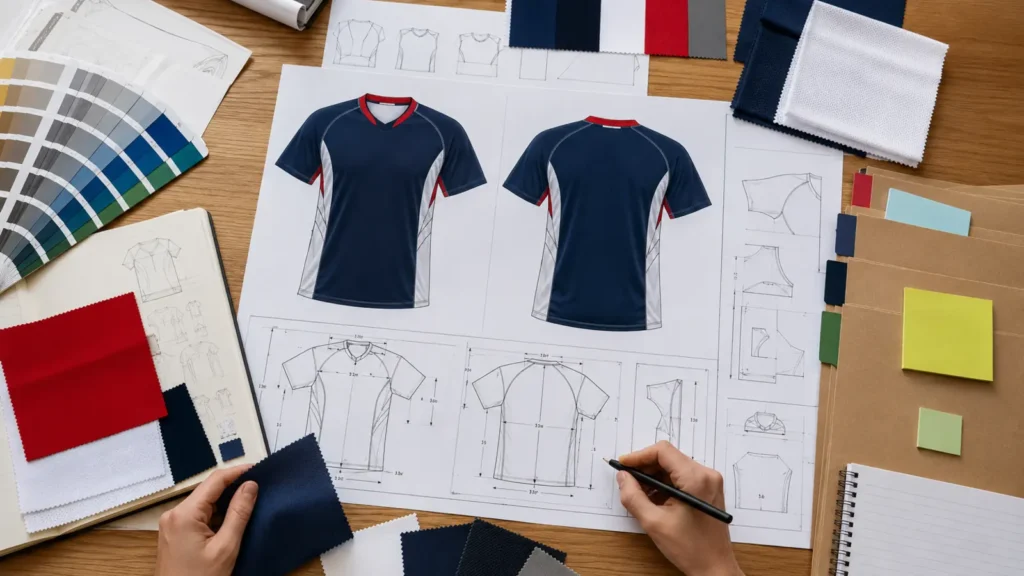
The specification should cover, as relevant:
- Product and style code
- Front, back, side and detail drawings
- Finished garment measurements and points of measure
- Size range, fit and grading rules
- Fabric composition, construction, weight and finish
- Color references and approved physical standards
- Thread, rib, lining, elastic, zipper, button and trim specifications
- Seam type, stitch density and reinforcement points
- Logo process, dimensions, colors and location
- Care label, brand label, size label and country-of-origin information
- Packaging, folding, carton and assortment requirements
- Performance, restricted-substance or market-specific test requirements
- Accepted tolerances and approval status
The Tech Pack Guide can support the technical attachment, but the agreement still needs to incorporate the exact approved revision.
Treat Missing Information as a Controlled Decision
Do not let the factory fill important gaps silently. The contract can require the supplier to submit a Request for Information when a specification is ambiguous, contradictory or impractical. Production of the affected part should wait for written clarification unless a defined minor-discretion rule applies.
4. Reference the Approved Sample Correctly
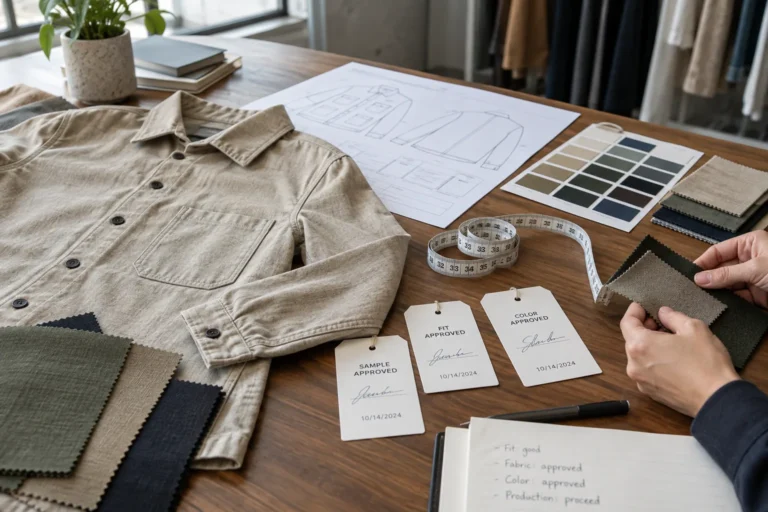
“Same as approved sample” is useful only when the sample can be identified. Assign a sample ID and record style, size, colorway, version, production date, approval date and approver. Photograph the sample from agreed angles and record the shipment tracking number when buyer and supplier retain separate counterparts.
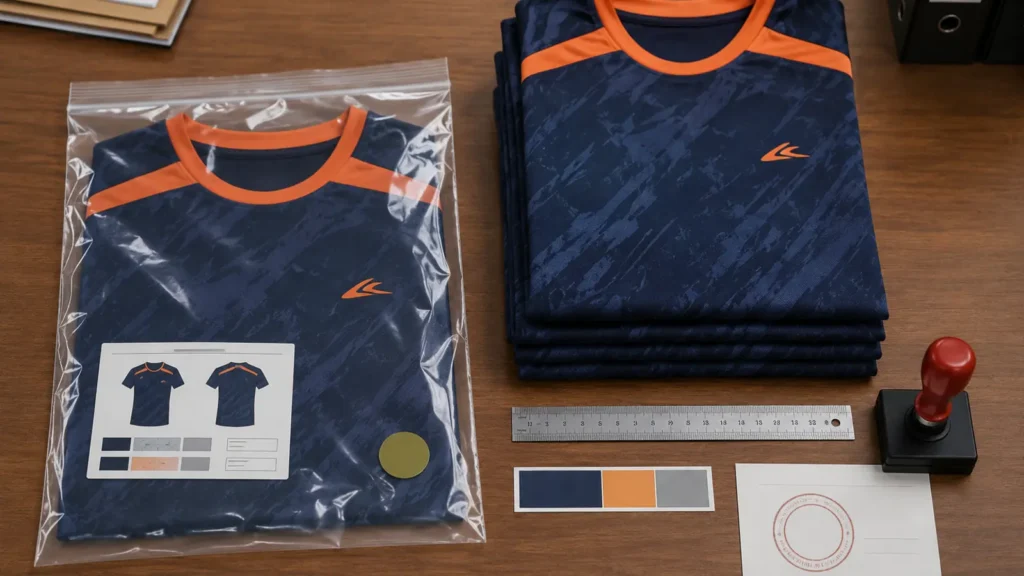
Approved Sample Reference Record
| Field | Example format |
|---|---|
| Sample ID | GS-TEAM24-J01-R3 |
| Product/style | Sublimated match jersey / J01 |
| Size and colorway | Adult M / Home Navy |
| Tech Pack revision | TP-J01-R3, dated YYYY-MM-DD |
| Artwork/roster revision | ART-R4 / ROSTER-R2 |
| Physical location | Buyer archive and supplier sample room |
| Approval status | Approved / approved with listed exceptions |
| Exceptions | Exact differences accepted or still to be corrected |
| Approvers and date | Named representatives and timestamp |
State which attributes the sample controls. One sample may establish workmanship and appearance but not override the measurement table for all sizes. A lab dip may control fabric color better than a photographed sample. A decoration strike-off may control embroidery detail. The agreement should explain which reference governs each attribute.
Approval does not excuse hidden defects or unauthorized deviations. Conversely, if the buyer knowingly accepts a visible sample characteristic, the agreement should state how that acceptance affects later claims.
5. Prohibit Unauthorized Material and Process Substitution
The contract should prohibit changing approved fabric, composition, weight, construction, dye source, trim, thread, ink, adhesive, label, packaging or manufacturing process without prior written approval. Avoid a clause that permits “equivalent” materials without defining equivalence and approval authority.
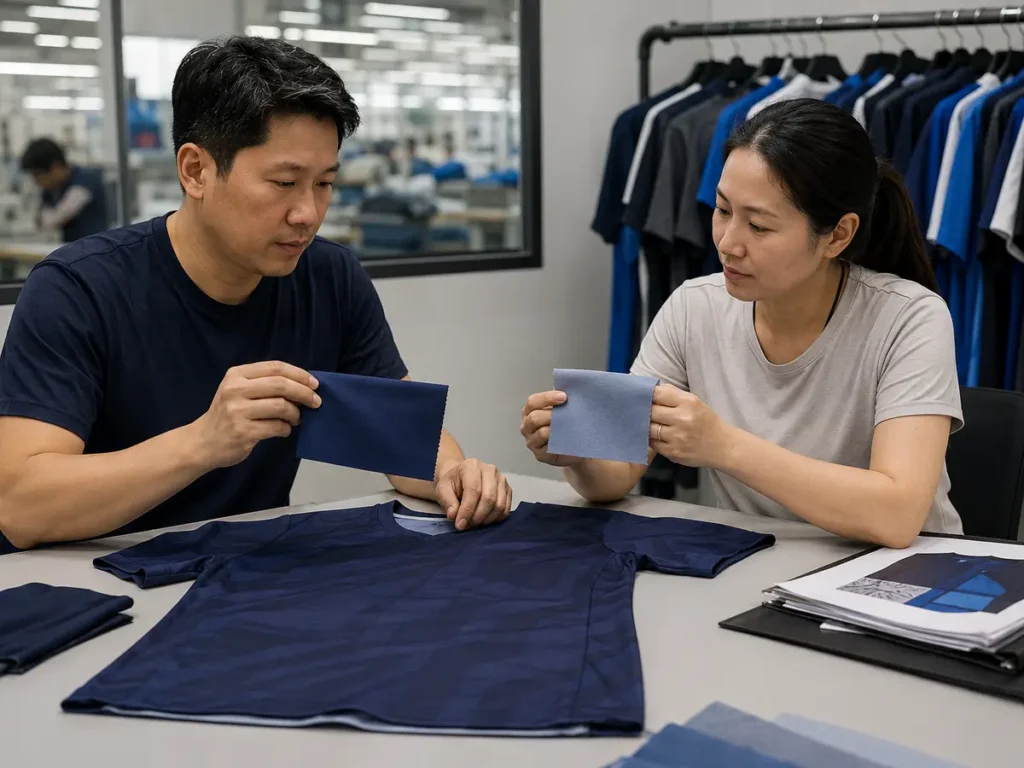
A controlled substitution request should include:
- Affected style, quantity and production stage
- Reason the approved material is unavailable or unsuitable
- Original and proposed supplier/material codes
- Composition, construction, weight, color and performance comparison
- Cost and schedule impact
- Physical swatch or revised sample
- Test evidence when relevant
- Supplier recommendation and risk statement
- Buyer approval, rejection or conditional approval
- Updated Tech Pack, bill of materials and Change Order
If the buyer rejects the change, the contract should state whether the supplier must source the original material, propose another option, adjust the schedule or allow termination of the affected item. The remedy depends on negotiated law and facts, so avoid copying a penalty without legal review.
6. Define Color, Size, Quantity and Defect Standards
Quality language should be measurable. Attach the finished measurement chart and name every point of measure. Define how the garment is laid, conditioned and measured. Record tolerances by measurement or size group rather than using one unexplained tolerance for the entire garment.
For color, identify whether the reference is Pantone, lab dip, printed swatch, thread card, approved sample or Golden Sample. State the agreed lighting and any instrumental method if used. A digital screen should not be the final physical standard.
Defect Classification
| Class | Working definition | Apparel examples | Typical agreement response |
|---|---|---|---|
| Critical | Safety, legal or prohibited-use risk | Sharp object, prohibited substance, legally incorrect labeling where critical | Segregation, investigation and lot disposition |
| Major | Product likely unusable for intended purpose or sale | Wrong team logo, open seam, severe shade difference, wrong player number | Rework, replacement or rejected quantity handling |
| Minor | Departure not likely to impair normal use | Small cosmetic variation within defined boundary | Accept/reject under agreed sampling plan |
Definitions and examples should be tailored to the product and market. Do not rely on a generic AQL number without defining lot, sample selection, inspection level, defect classes and accept/reject numbers.
ISO 2859-1:2026 now provides AQL-indexed sampling schemes for lot-by-lot inspection by attributes and replaced the 1999 edition. If the parties intend to use it, cite the exact edition and agreed parameters. Acceptance sampling manages decision risk; it does not mean that the accepted lot is defect-free or that defects inside accepted goods lose their warranty status.
Quantity provisions should cover overproduction and shortage, size/color assortment, personalized units, spare pieces and whether partial shipment is permitted. State whether unauthorized overage must be paid for and how shortages are replaced or credited.
7. Define the Production Start Date and Delivery Milestones
“30-day production” is ambiguous unless the starting conditions and ending event are defined. The production clock may begin only after the supplier has received the deposit, final Tech Pack, artwork, roster, material approval and written sample approval. List every prerequisite and identify who confirms that the order is released.
The schedule should separate:
- Development and sample production
- Sample courier transit and buyer review
- Material procurement
- Bulk production
- In-process inspection
- Final inspection and corrective action
- Packaging and shipment readiness
- Freight booking, international transit and customs
- Required arrival date
The agreement should explain how buyer-caused changes, late approvals, supplier delays, failed inspections, peak periods and force majeure affect the dates. Link changes to a written Change Order instead of allowing an automatic unlimited extension.
Use the MOQ & Lead Time page for planning context, but place the order-specific dates in the signed documents.
8. Specify Packaging, Labels and Delivery Data
Packaging is part of the product specification. Record individual bag type, folding method, size sticker, barcode, hangtag, moisture control, carton dimensions, carton strength, quantity per carton, assortment, shipping marks and packing-list fields.
For team orders, define whether goods are sorted by player, team, school, class, location or SKU. A correct product in the wrong labeled bag can still create a serious distribution failure. State who supplies barcode or FNSKU files and who is responsible for the accuracy of buyer-provided data.
Require approval of packaging artwork and a representative packed sample when deformation, retail presentation or warehouse compliance matters. Reference current warehouse instructions rather than relying on a permanent generic rule.
9. Establish Inspection Rights and Failed-Inspection Procedures
The agreement should allow agreed internal, buyer or third-party inspections at defined stages. Identify access conditions, notice, inspection location, sampling method, inspector authority and who pays.
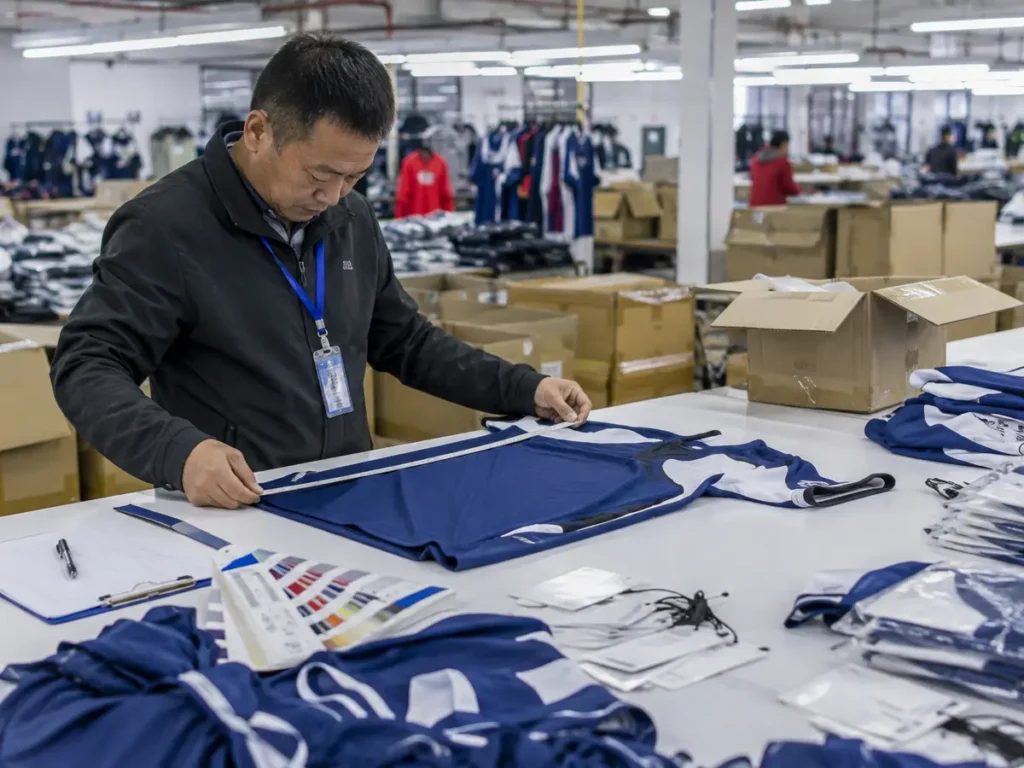
Inspection and Disposition Matrix
| Event | Supplier action | Buyer decision/evidence | Cost rule to negotiate |
|---|---|---|---|
| In-process issue | Stop/segregate affected work and investigate | Review corrective plan | Supplier cost if caused by nonconformity |
| Final inspection pass | Protect goods and maintain lot identity | Release under agreed process | Normal inspection allocation |
| Final inspection fail | Segregate, root-cause, rework or remake proposal | Approve disposition; request reinspection | Reinspection and correction responsibility defined |
| Minor accepted deviation | Document affected quantity and limits | Written concession | Discount or no adjustment as agreed |
| Unrepairable goods | Prevent shipment or mark disposition | Replacement, credit, refund or other remedy | Freight/destruction terms defined |
| Post-delivery defect | Preserve evidence and trace lot | Notice within agreed process | Warranty/remedy and logistics allocation |
The supplier should not ship failed goods merely because the delivery date is near. Conversely, the buyer should respond within an agreed time so completed goods are not held indefinitely. Define whether inspection is a condition for release, and clarify that inspection does not waive concealed defects or obligations that cannot reasonably be verified at that stage.
See Quality Control for production-stage discussion points.
10. Set Payment Milestones and Change Controls
State currency, total contract value, deposit, progress or balance payment, invoice requirements, beneficiary account, bank charges and due dates. Avoid payment triggers based only on calendar dates when performance evidence matters.
| Milestone | Possible evidence | Buyer check |
|---|---|---|
| Deposit | Signed agreement, PO and proforma invoice | Correct entity, account and specification attached |
| Material/progress payment | Approved material or defined production evidence | Milestone actually completed |
| Pre-shipment balance | Passed inspection, packing list and shipment readiness | Exceptions and corrective actions closed |
| Retention or post-delivery amount | Receipt or agreed warranty event | Legally and commercially appropriate |
These are planning examples, not recommended percentages. Payment structures depend on order size, relationship, financing, jurisdiction and bargaining position.
Require written verification for bank-detail changes through a known contact and independent channel. Business-email compromise can make a legitimate-looking payment instruction dangerous.
Every commercial or technical change should state the old requirement, new requirement, affected quantity, price change, timing effect, sample/retest requirement and authorized approvers. Silence should not count as approval unless counsel intentionally drafts a specific mechanism.
11. Write the Incoterm Correctly
The International Chamber of Commerce recommends incorporating the selected rule as [chosen rule] [named port, place or point] Incoterms® 2020. For example, the contract might state FCA [precise named place], Incoterms® 2020 or FOB [named port of shipment], Incoterms® 2020, depending on the actual transport arrangement.

The named place is critical because it helps determine delivery, risk and cost allocation. The correct rule also depends on the transport mode. ICC guidance notes that FOB is designed for sea or inland waterway delivery on board a vessel; where containerized goods are handed to a carrier before loading, FCA may be more appropriate.
Incoterms do not replace the sales contract. ICC materials state that they do not address matters including transfer of ownership, payment, IP rights, force majeure or dispute law and venue. Write those issues separately.
Use the EXW vs FOB vs DDP Guide as a starting comparison, then confirm the final term with the freight, tax and legal professionals involved.
12. Address Intellectual Property and Confidentiality
The buyer should confirm that it has the right to supply logos, names and artwork. The supplier should receive only the license needed to quote, develop, manufacture and deliver the authorized order. Define whether the supplier may display products in its showroom, website, trade fair or portfolio.
WIPO guidance for supplier IP agreements highlights the need to define access and use, confidentiality, termination and return of materials, assignment or licensing, and dispute resolution. In custom apparel, address:
- Pre-existing buyer artwork, logos and trade secrets
- Pre-existing supplier patterns, processes and know-how
- New artwork, patterns, molds or files developed during the project
- Ownership or permitted use after payment
- Restrictions on overruns, seconds and unauthorized sales
- Secure deletion or return of confidential files and samples
- Use of subcontractors and equivalent confidentiality obligations
- Survival period after termination
- Injunctive or other remedies subject to applicable law
Avoid claiming ownership of a supplier’s general know-how merely because the buyer paid for one order. Conversely, avoid allowing unrestricted reuse of buyer-specific designs. Counsel should write the boundary precisely.
13. Cover Force Majeure, Termination and Disputes
A force-majeure clause should define qualifying events, notice timing, mitigation, evidence, suspension period and termination right. It should not automatically excuse ordinary material price changes, predictable peak-season congestion or poor capacity planning unless the parties deliberately agree.
Termination language should address termination for breach, insolvency, prolonged force majeure, IP misuse, unauthorized subcontracting or repeated quality failure. State what happens to deposits, finished goods, work in progress, buyer-owned materials, molds, data and confidential records.
For international sales, ask counsel whether the United Nations Convention on Contracts for the International Sale of Goods (CISG) applies. UNCITRAL explains that the CISG can govern international sales between businesses in relevant circumstances and covers formation, seller and buyer obligations and remedies. It does not cover every issue; validity and the effect on property in the goods are among matters outside its scope. The agreement should intentionally address applicable law and whether the CISG is included or excluded.
Dispute provisions should identify governing law, courts or arbitration, seat, rules, language, number of arbitrators, notice method and interim-relief options. Avoid choosing a forum simply because a copied template uses it. Evaluate enforceability, cost, language and where assets or evidence are located.
14. Use a Written Change Order After Approval
The safest agreement cannot control production if teams continue approving changes in scattered chats. Establish one change-request channel and require a formal record for modifications after the specification freeze.
Change Order Fields
- Agreement, PO and style reference
- Change number and request date
- Requesting party and authorized approver
- Existing requirement and proposed replacement
- Reason and affected SKUs/quantities
- Price, tooling, testing and freight impact
- Revised production and delivery date
- Updated file names and versions
- Existing work disposition
- New sample or approval required
- Effective date and signatures
The supplier should confirm whether the change is still feasible. The buyer should not assume that an approval automatically preserves the original price or deadline.
15. Pre-Deposit Manufacturing Agreement Checklist
| Area | Pass question | Evidence attached |
|---|---|---|
| Parties | Are seller, buyer, signer and beneficiary verified? | Registration/payment record |
| Scope | Are products, quantities and prices complete? | PO/order confirmation |
| Specification | Is one approved revision identified? | Locked Tech Pack |
| Sample | Can the Golden Sample be traced? | Sample record/photos/tracking |
| Materials | Is unauthorized substitution prohibited? | Approved BOM and swatches |
| Quality | Are tolerances and defects measurable? | QC specification |
| Schedule | Are start conditions and milestones defined? | Production calendar |
| Packaging | Are labels, sorting and cartons specified? | Packaging spec/sample |
| Inspection | Are access, sampling and failure actions clear? | Inspection plan |
| Payment | Are milestones tied to evidence? | Payment schedule |
| Logistics | Is rule, named place and version complete? | Incoterm clause |
| IP/confidentiality | Are rights and permitted use defined? | IP/NDA clauses |
| Changes | Is one written approval process required? | Change Order form |
| Disputes | Has qualified counsel reviewed the clause? | Legal review record |
| Signatures | Are authorized signatures and dates complete? | Executed counterparts |
Clarify the production evidence before paying the deposit. Send JIUMU the product brief, Tech Pack, quantities, artwork, required delivery date and inspection expectations so the commercial and technical scope can be reviewed together.
Common Contract Mistakes
- Treating a short PO description as the complete specification
- Referring to “latest files” without revision numbers
- Approving a sample without an ID or defined scope
- Allowing “equivalent materials” without written reapproval
- Using AQL without an edition, defect classes or sampling parameters
- Starting lead time from an undefined date
- Writing only “FOB China” instead of a precise place and version
- Assuming Incoterms determine payment, ownership and remedies
- Allowing failed goods to ship automatically near the deadline
- Omitting IP rules for buyer logos and supplier-created files
- Copying governing-law or arbitration language without enforceability advice
- Accepting bank-detail changes through the same compromised email channel
Frequently Asked Questions
Final Recommendation
A manufacturing agreement should make the order reconstructable by someone who did not participate in the original conversation. That person should be able to identify the parties, controlling files, approved sample, materials, tolerances, dates, payment evidence, inspection rules, logistics allocation and remedy process.
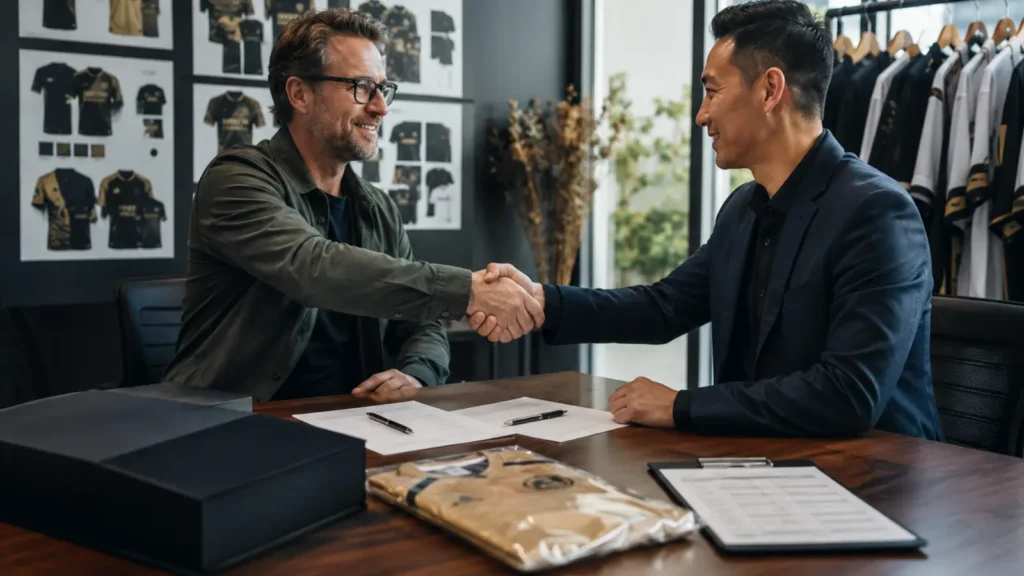
Use a lawyer-reviewed master agreement for continuing legal terms and attach an order-specific PO, Tech Pack, artwork, roster, sample record, QC plan, packaging specification and schedule. Control later changes with signed Change Orders. This structure is more reliable than forcing every technical detail into one long document or relying on scattered messages.
JIUMU supports OEM and ODM custom teamwear, hats, bags and related branded products. Project documentation should be confirmed for each quotation and order. Contact the team through the JIUMU website with your requirements; obtain independent legal advice before signing a cross-border manufacturing agreement.
Technical References
- International Chamber of Commerce, Incoterms® 2020 introduction and incorporation guidance: https://library.iccwbo.org/content/tfb/BOOKS/BK_0049/BK_0049_03_Introduction.htm
- ICC, Incoterms® rules overview: https://library.iccwbo.org/clp/clp-incoterms.htm
- UNCITRAL, United Nations Convention on Contracts for the International Sale of Goods: https://uncitral.un.org/en/texts/salegoods/conventions/sale_of_goods/cisg
- ISO, ISO 2859-1:2026 Sampling Procedures for Inspection by Attributes: https://www.iso.org/standard/85464.html
- WIPO, IP Agreements with Suppliers: https://www.wipo.int/en/web/ip-commercialization/w/blog/ip-agreements-with-suppliers-what-ventures-need-to-know
This checklist does not address every legal, tax, customs, product-safety, sanctions, labor, privacy or regulatory issue. Obtain advice for the countries, products and transaction involved.
About JIUMU
JIUMU supports OEM and ODM custom teamwear, hats, bags and branded merchandise for professional buyers. Established in 2010 in Guangdong, China.