

How to Verify a Chinese Supplier’s Business License
To verify a Chinese supplier’s business license, obtain a clear current copy, identify the company’s exact Chinese legal name and 18-character Unified Social Credit Code, then search those identifiers in China’s National Enterprise Credit Information Publicity System. Compare the official record with the license, contract, quotation, invoice and bank beneficiary before sending money.
That process confirms the identity and public registration record of a mainland Chinese business. It does not prove that the company owns the factory shown on its website, employs the workers in a video, controls the claimed production lines or can manufacture your product at the required quality and capacity. Legal-entity verification and factory-capability verification are separate stages.
This guide is a procurement due-diligence framework, not legal, banking or fraud-investigation advice. Chinese registration rules, public interfaces and displayed fields can change. If a large payment, ownership dispute, sanctions concern or suspected fraud is involved, obtain qualified professional assistance before proceeding.
Quick Answer: Use the Chinese Legal Identity as the Anchor
Do not begin with the supplier’s English website name. A mainland Chinese company’s registered Chinese name and Unified Social Credit Code are more reliable anchors for public-record matching.
Use this sequence:
- Request a complete, legible business-license copy.
- Extract the Chinese company name and Unified Social Credit Code exactly.
- Search the official National Enterprise Credit Information Publicity System.
- Confirm registration status and core record fields.
- Review changes, business anomalies and serious violations shown in the public record.
- Compare the entity with the quotation, contract and bank beneficiary.
- Obtain written evidence for any mismatch before payment.
- Conduct separate factory, capability, quality and reference checks.
| Question | Evidence source | What the result can establish |
|---|---|---|
| Does the entity exist in the public register? | Official system search | Public registration identity and status |
| Is this license copy consistent with the public record? | License-to-register comparison | Whether core fields align |
| Is this the company signing the order? | Contract and company stamp/signature review | Contracting-entity consistency |
| Is this the entity receiving payment? | Bank beneficiary confirmation | Payment-recipient identity |
| Does it own or control the factory? | Site visit, address evidence and operational records | Physical relationship to production |
| Can it make the product reliably? | Samples, audits, capacity and QC evidence | Actual manufacturing capability |
What Appears on a Chinese Business License?
A current mainland Chinese business license normally displays core registration information. Layout and wording can vary by entity type and issuance date, so buyers should focus on the fields rather than judging authenticity only from color, border or seal appearance.
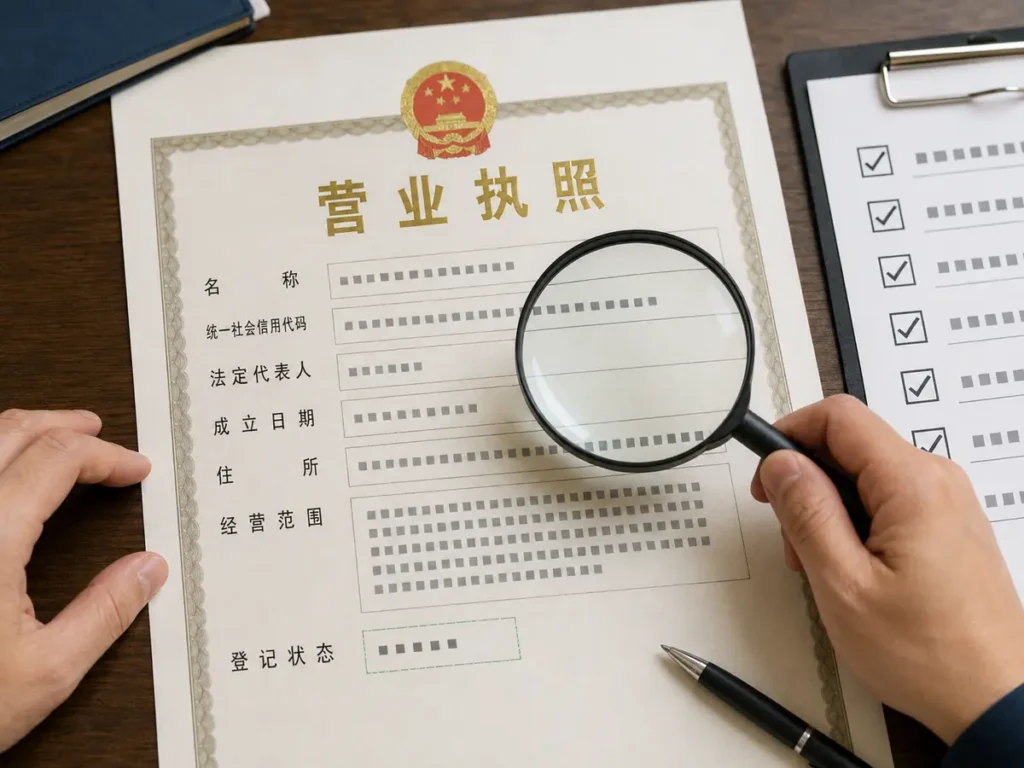
| License field | Common Chinese label | Why buyers check it |
|---|---|---|
| Company name | 名称 | Primary legal identity for searching and contracting |
| Unified Social Credit Code | 统一社会信用代码 | Unique 18-character identifier for the registered entity |
| Entity type | 类型 | Shows the registered organizational form |
| Legal representative | 法定代表人 | One official representative field; not necessarily your sales contact |
| Establishment date | 成立日期 | Indicates when the entity was registered |
| Registered address/domicile | 住所 | Legal registered address; may differ from operating factory address |
| Registered capital | 注册资本 | Registration field, not proof of cash available or creditworthiness |
| Business term | 营业期限 | May show a fixed or long-term operating period, depending on record |
| Business scope | 经营范围 | Registered activities; not proof that all listed operations occur in-house |
| Registration authority | 登记机关 | Market-regulation authority associated with the registration |
| Issue date | 发证日期 | Date the displayed license was issued, not always the establishment date |
Some electronically shared licenses may include a QR code or digital presentation. Treat it as a convenience, not the only verification method. Search the official record independently rather than following an unfamiliar link supplied in a PDF or chat message.
A scan can be altered
A visually convincing license image can be outdated, edited or borrowed from another company. The decisive step is not “Does this look official?” but “Do the Chinese name, code and public record match the proposed transaction?”
Request a high-resolution copy showing the complete page. Cropped certificates that hide the company name, code or address are insufficient for meaningful verification.
What Is a Unified Social Credit Code?
The Unified Social Credit Code—统一社会信用代码—is an 18-character identifier assigned to legal persons and other organizations. Chinese government explanations describe it as a nationwide unique code made of five components: registration-management department code, organization-category code, administrative-division code, subject identifier and check character.
For procurement, its most important benefit is identity matching. Similar English names can refer to different Chinese entities, but the Social Credit Code points to one registered subject. Government guidance also states that the code remains available for traceability after an entity is deregistered.
How to record the code accurately
- Copy all 18 characters directly from the clear license.
- Use uppercase Latin characters where shown.
- Do not insert spaces or punctuation.
- Watch for visually similar characters.
- Compare the code character by character across the license, official result, contract and invoice.
- Preserve a dated screenshot or PDF of the result in the supplier file.
Do not try to identify a supplier solely by the first digits or by decoding the administrative section. The complete code and official company record are the useful procurement references.
How Overseas Buyers Can Search the Official System
The National Enterprise Credit Information Publicity System—国家企业信用信息公示系统—is the official public system for enterprise information. Its search interface accepts a company name, Unified Social Credit Code or registration number and provides access to enterprise credit information, the business-anomaly list and the serious-illegal-and-dishonest list.
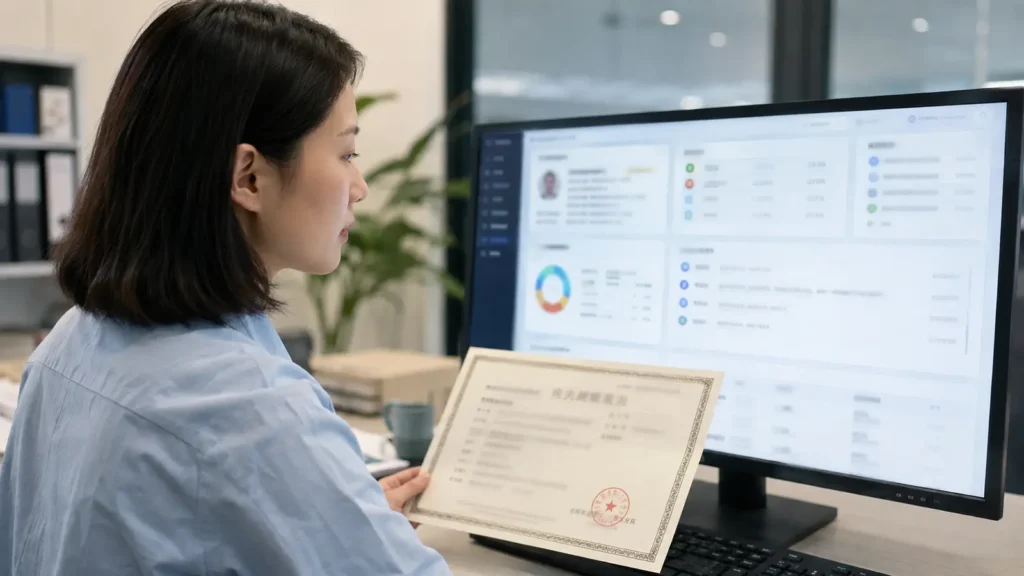
Step-by-step search process
- Open the official system at
https://www.gsxt.gov.cn/or its official regional route. - Search using the full Chinese company name copied from the license.
- If results are ambiguous, search the complete Unified Social Credit Code.
- Complete any verification or CAPTCHA requested by the site.
- Open the matching entity and confirm that the name and code are exact.
- Review the basic registration information and displayed operating status.
- Review administrative changes, annual-report information, business anomalies and serious-violation sections available for that entity.
- Save the date, source URL and key findings in your due-diligence record.
The official site is primarily Chinese and may use regional pages or anti-bot checks. Automatic browser translation can help navigation, but retain the original Chinese names and source screenshots. Do not replace the legal name with a machine-translated version in the contract.
If the official system is difficult to access
Ask a bilingual colleague, professional due-diligence provider or qualified adviser to retrieve and explain the record. Commercial company-information platforms can be useful for navigation and consolidated views, but important decisions should be checked against official records or reliable professional evidence.
Never accept a supplier’s self-generated screenshot as the only proof. Run or commission an independent search.
Confirm the Registration Status
Status wording can vary across regional records and translations. A normal active-status label may be rendered as active, existing, operating or open for business. Buyers should preserve the original Chinese wording and avoid relying only on an English browser translation.
| Status situation | Procurement interpretation | Next action |
|---|---|---|
| Active/operating registration | Entity appears registered and active | Continue identity and capability checks |
| Cancellation/deregistration completed | Entity has ended its registration | Do not contract or pay that entity without specialist advice |
| License revoked | Serious legal status concern | Pause immediately and obtain professional review |
| Cancellation process or other transition | Status may be changing | Clarify current authority to contract and receive funds |
| Record cannot be located | Wrong name/code, access issue or unsupported entity/jurisdiction | Recheck source and seek independent verification |
A Hong Kong company, overseas entity or individual business may require a different registry or verification route. Do not assume every Chinese-speaking supplier should appear as a mainland limited company in the same system.
Review Name, Representative, Date, Address and Scope
The public record should be compared with the supplier’s documents as a coherent identity, not as isolated facts.
Chinese company name
Match every Chinese character. A one-character difference may indicate a separate company. Pay attention to location words, trade names, industry words and entity suffixes such as 有限公司.
Legal representative
The legal representative is a public registration field. This person may not be the salesperson, account manager or factory director. A different contact person is normal, but the contract should be signed or sealed through a method that validly binds the company. Obtain legal review where signing authority matters.
Establishment date
Compare the official date with statements such as “20 years in business.” The website may describe a predecessor, founder experience, brand history or group history rather than the contracting entity’s age. Ask for a written explanation and evidence when the claims differ materially.
Registered address
The registered address can be an office or legally registered domicile and may differ from the factory address. That difference is not automatically suspicious. Record both locations and verify the relationship through site visits, lease or ownership evidence, utility or operational records, shipment documents and live video where appropriate.
Business scope
The business scope lists registered activities. It can help identify whether manufacturing, sales, import/export or relevant product activities are included. However, broad wording does not prove that the supplier performs every process itself. A company may legally trade products it does not manufacture, while a manufacturer may outsource specialist decoration or testing.
Compare the License, Contract, Quotation and Bank Account
Entity verification becomes commercially meaningful when the same legal identity is traced through the transaction.

Four-document comparison table
| Field | Business license/public record | Contract | Quotation or pro forma invoice | Bank beneficiary |
|---|---|---|---|---|
| Chinese legal name | Exact anchor | Should identify seller/manufacturer party | Should map clearly to seller | Ideally same entity or documented relationship |
| Social Credit Code | Present for mainland entity | Include where practical | May be included | Usually not displayed in bank name field |
| Address | Registered address | Notice/registered address plus factory if relevant | Seller address | Bank-record address may vary by bank format |
| Signatory/stamp | Not transaction-specific | Must validly bind named party | Approval/contact evidence | Not applicable |
| Currency/payment | Not applicable | Payment obligations | Amount and beneficiary instructions | Account accepts specified transfer |
Build a simple comparison sheet and paste the original Chinese names rather than only English translations. Have the supplier explain every difference in writing.
Three-level mismatch decision
| Level | Example | Buyer response |
|---|---|---|
| Explainable | English abbreviation differs but Chinese entity and code are consistent | Record the explanation and continue checks |
| Needs evidence | Payment goes to a disclosed Hong Kong affiliate or group company | Obtain relationship documents, authorization and contract wording before payment |
| Stop and escalate | Beneficiary is an unrelated person/entity, changes suddenly, or supplier refuses documentation | Pause payment and verify independently through known contacts and professional advice |
Do not let shipment urgency override beneficiary verification. A last-minute bank change is a classic control point: confirm it using previously verified contact channels, not only the message that announced the change.
Should the Bank Beneficiary Name Match?
The safest and simplest structure is generally for the contracting seller and bank beneficiary to be the same legal entity. In practice, legitimate groups may use an export company, Hong Kong affiliate, parent company, payment service or disclosed trading entity. That arrangement is not automatically fraudulent, but it changes who receives the money and may affect contract, tax, customs and dispute positions.
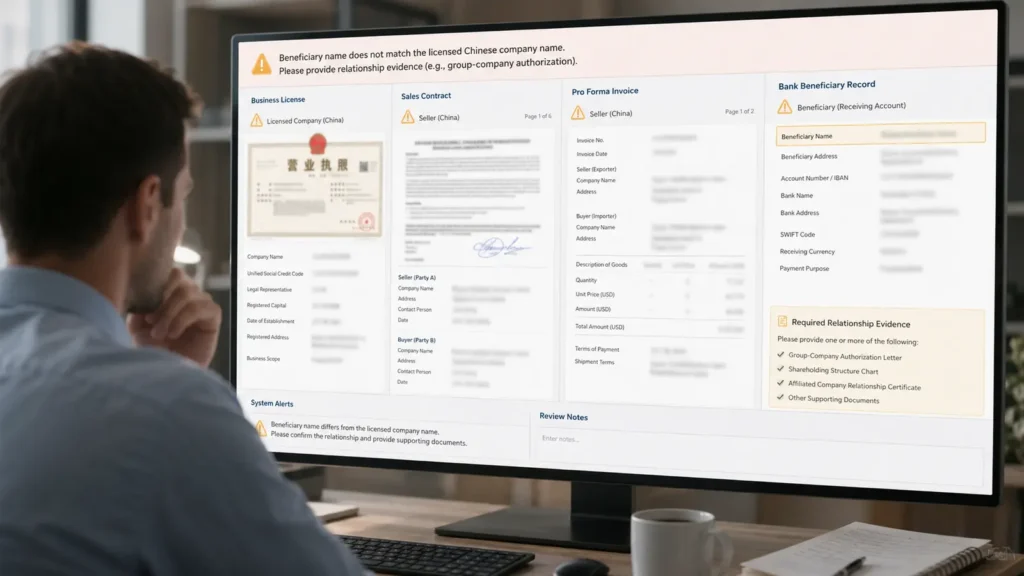
Before paying a different beneficiary, request:
- the beneficiary’s complete legal name, jurisdiction and registration record;
- a clear explanation of its relationship with the manufacturer;
- group structure, ownership or authorization evidence appropriate to the case;
- contract language authorizing the payment route;
- confirmation of who is responsible for quality, delivery, refunds and disputes;
- an invoice consistent with the agreed structure;
- independent confirmation through an established supplier contact;
- bank and legal review for a material transaction.
Never pay a personal account merely because the salesperson says it is faster. Never rely on a bank letter supplied in an editable format without independent confirmation where the risk justifies it.
Why the English Name Is Not the Legal Anchor
Mainland Chinese companies often use an English translation or brand name for export marketing. Transliteration is not standardized, and one Chinese company may use several English versions across websites, catalogs and email signatures. Two unrelated companies can also adopt similar English descriptions.
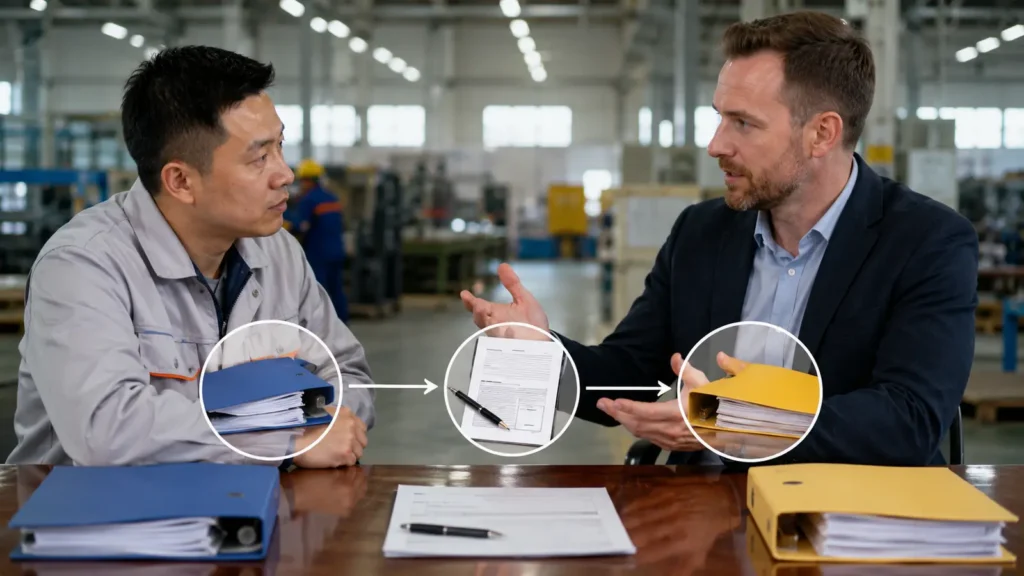
For a mainland entity, the registered Chinese name and Unified Social Credit Code should anchor the transaction. The English name can be added for convenience, but it should not replace the Chinese legal identity where precision matters.
Recommended contract presentation
Use the full Chinese registered name, followed by a consistent English translation in parentheses if desired, and include the Unified Social Credit Code and registered address. The exact format and enforceability should be reviewed by counsel.
An English brand can belong to a different group entity, and a Hong Kong company may have its own registered English name under Hong Kong law. Identify each entity separately rather than merging them into one informal label.
Check Change Records and Business Anomalies
A current snapshot may hide recent material changes. Review the available change history for company name, legal representative, shareholders or investors, registered capital, address, business scope and other disclosed registration items.

Changes that deserve follow-up
- The company name changed shortly before the quotation.
- The legal representative or ownership changed during negotiation.
- The registered address moved to another city or province.
- Registered capital changed sharply.
- The business scope recently added the quoted product category.
- The entity is very new but claims a long export history.
- Several key changes occurred close together.
Changes can have normal explanations: restructuring, relocation, investment, rebranding or regulatory updates. Ask for a timeline and evidence connecting the old and new entity names, websites, contracts, bank accounts and factory operations.
What does the business-anomaly list mean?
Under SAMR rules, reasons for listing can include failure to submit the annual report on time, failure to disclose required information after an order to do so, failure to complete a required name change, or inability to contact the enterprise through its registered address or business location. The public record should show the reason, date and authority for the listing.
An anomaly is a risk signal, not a complete fraud finding. Check the exact reason and current status. A late annual report that has been corrected is different from an unresolved inability to contact the company at its registered address. Rules on the continued public display of removed anomaly records have also changed, so use current official information rather than an old third-party screenshot.
Red Flags That Require More Evidence
- Supplier refuses to provide the complete Chinese business license.
- License name or Social Credit Code cannot be found in the official system.
- The company is cancelled, revoked or in a concerning transition.
- Chinese names differ across the license, contract and invoice without explanation.
- Bank beneficiary changes immediately before payment.
- Payment is requested to a personal or unrelated account.
- Website history is much older than the contracting entity with no documented predecessor relationship.
- Registered address, claimed factory and video location cannot be reconciled.
- Business scope and claimed operation are materially inconsistent.
- Supplier discourages independent verification or pressures for urgent payment.
- Company stamp, signer or contract party changes between drafts.
- The supplier presents another company’s audit or certification as its own.
One red flag does not always prove fraud. Several unresolved inconsistencies—especially identity plus payment changes—justify pausing the transaction.
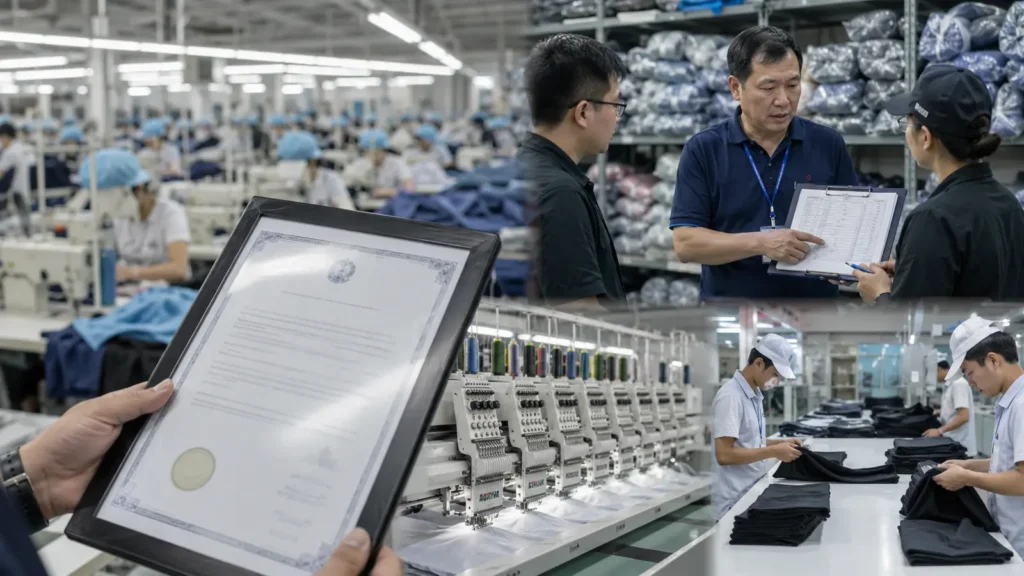
A Valid License Does Not Prove Factory Capability
The business license confirms a registered entity and its public record. It does not confirm production assets, output, staffing, quality controls or ownership of the premises.
| License verification | Factory-capability verification |
|---|---|
| Confirms legal Chinese name and identifier | Confirms actual site and production relationship |
| Shows registration status and public fields | Reviews machines, lines, people and workflow |
| Shows registered business scope | Tests relevant product/process competence |
| Shows registered address | Confirms operating and production addresses |
| May show anomalies or serious violations | Reviews capacity, subcontracting and quality controls |
| Does not prove equipment ownership | Uses live video, audit, samples and production records |
| Does not prove export performance | Uses references, shipment evidence and document consistency |
After identity verification, follow the Manufacturer Vetting Guide to assess manufacturing. Useful next steps include:
- live video call with a route from exterior signage to production areas;
- site visit or independent audit;
- sample development under the supplier’s documented entity;
- machine and process review for the actual product;
- production-capacity and lead-time evidence;
- quality-control procedures and inspection records;
- disclosure of major outsourced processes;
- customer references appropriate to confidentiality limits;
- small initial order with controlled payment and inspection milestones.
Supplier Identity Verification Checklist
| Check | Required evidence | Result |
|---|---|---|
| Clear business license | Complete high-resolution copy | Pass / clarify / stop |
| Chinese legal name | Exact characters recorded | Pass / clarify / stop |
| Unified Social Credit Code | 18 characters copied and matched | Pass / clarify / stop |
| Official search | Dated independent search result | Pass / clarify / stop |
| Registration status | Original Chinese status retained | Pass / clarify / stop |
| Core fields | Representative, date, address and scope compared | Pass / clarify / stop |
| Change history | Material recent changes explained | Pass / clarify / stop |
| Risk records | Anomalies and serious violations reviewed | Pass / clarify / stop |
| Contract seller | Same entity or documented structure | Pass / clarify / stop |
| Quotation/invoice | Seller and payment details consistent | Pass / clarify / stop |
| Bank beneficiary | Match or supported relationship | Pass / clarify / stop |
| Factory relationship | Operating site linked to legal entity | Pass / clarify / stop |
| Capability | Samples, processes, capacity and QC checked | Pass / clarify / stop |
| Approval record | Reviewer, date and evidence folder logged | Pass / clarify / stop |
Use a versioned supplier file. Recheck the public record before a first large deposit, after a long inactive period, or whenever the supplier changes its company name, contract entity or bank account.
How JIUMU Presents Supplier Identity Information
Professional buyers should be able to identify the company they are evaluating and understand how the legal entity relates to manufacturing operations. JIUMU’s Company Facts and About Us pages provide starting context, while transaction documents should contain the applicable legal identity and commercial terms.
Use the Manufacturer Vetting Guide to move from registration checks to production verification. Buyers can also Contact Us to request the current company and project documents needed for their procurement review.
Frequently Asked Questions
Final Recommendation
Verify a Chinese supplier by following one identity from the official register through the transaction. Start with the Chinese legal name and Unified Social Credit Code, confirm the current public record, review changes and risk indicators, and match the entity to the contract, quotation, invoice and bank beneficiary.
Then start a second process: verify the factory. A legitimate business license is necessary evidence, but it is not proof of manufacturing capacity, quality or control of the production site. The safest approval combines legal-entity consistency, independently confirmed payment details, physical capability evidence, approved samples and written commercial responsibilities.
Technical References
- National Enterprise Credit Information Publicity System
- SAMR: Measures for Administration of the List of Enterprises With Abnormal Operations
- National Development and Reform Commission: Unified Social Credit Code Explanation
- State Taxation Administration: What Is a Unified Social Credit Code?
- SAMR: Update on Removal From the Business-Anomaly List
Due-diligence notice: This article provides general procurement information. It is not legal, banking, accounting or fraud-investigation advice. Obtain qualified assistance for material transactions or unresolved identity and payment risks.
About JIUMU
JIUMU supports OEM and ODM custom teamwear, hats, bags and branded merchandise for professional buyers. Established in 2010 in Guangdong, China.