How to Plan a Team Uniform Order Before the Season
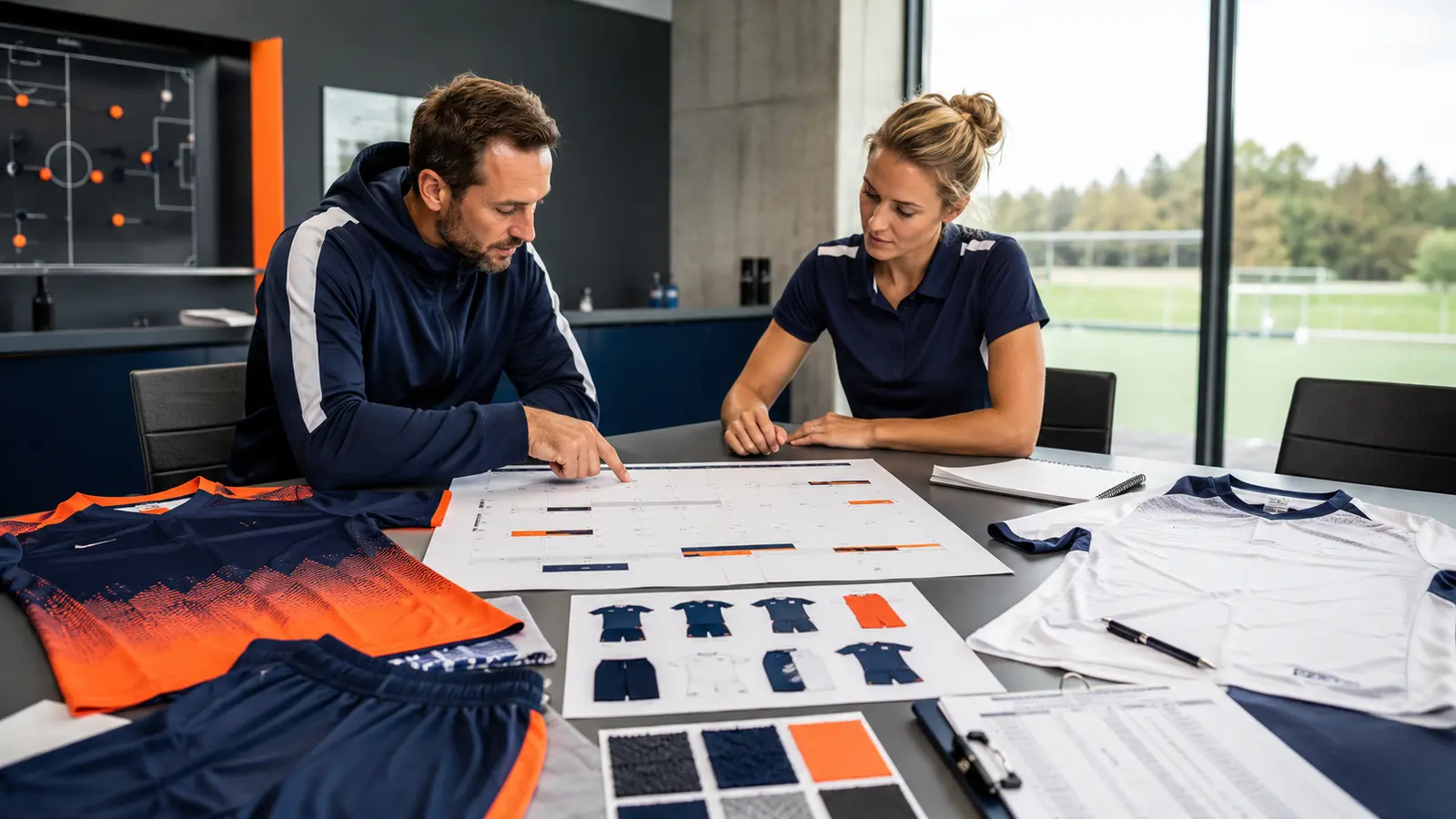
A team uniform order should begin with the date the uniforms must be in the team’s hands—not the date of the first game and not the date the factory is expected to finish production. Coaches, clubs, schools and distributors need time to distribute garments, correct any delivery discrepancy and prepare players before competition. Working backward from that must-arrive date creates a realistic schedule for design, roster collection, sizing, sampling, production, inspection, international shipping and customs clearance.
The most common timing mistake is to treat a supplier’s production lead time as the complete order lead time. If bulk production takes 25–30 days, the project still needs time before production for specifications and approval, and time after production for inspection, export handling, transportation, customs and final delivery. Every delayed approval consumes part of the schedule even when the factory’s production duration does not change.
Quick Answer
For a new custom team uniform that requires a physical sample and international delivery, begin planning roughly 12–16 weeks before the uniforms must arrive. A complex order, peak-season project, sea-freight shipment or program with several approval groups may need 16–20 weeks or more. These are planning bands, not guaranteed quotations. Build the actual calendar backward using the supplier-confirmed sample, production and shipping plan. JIUMU’s reference production periods are 7–10 days for a jersey sample, 25–30 days for ordinary bulk production, 35–45 days for complex bulk orders and 20–25 days for eligible repeat orders. Design revisions, approvals, sample transport, international freight, customs and delivery buffers are additional.
Start With Four Different Dates
Teams often discuss “the deadline” as if there were only one. A workable timeline separates four dates.
| Date | Meaning | Why it matters |
|---|---|---|
| Season Start | First match, tournament, training camp or public use | The uniforms should already be distributed before this date |
| Must-Arrive Date | Latest acceptable date at the buyer’s receiving address | The entire schedule is calculated backward from here |
| Factory Ship Date | Date approved goods leave the factory or agreed shipping point | Production and pre-shipment inspection must finish earlier |
| Production Lock Date | Date design, colors, roster, sizes and commercial approval become final | Bulk production should not start with unresolved data |
The must-arrive date should normally be earlier than the first game. A school may need time to divide packages by team, confirm player sets and manage exchanges. A distributor may need inbound receiving, relabeling or onward delivery. If the first game is September 1, “delivery by September 1” leaves no operational room.
Define the must-arrive date in writing and include the full destination postal code. The word “delivery” must mean arrival at the buyer’s named location, not completion of production or arrival at a port.
Build the Calendar Backward, Not Forward
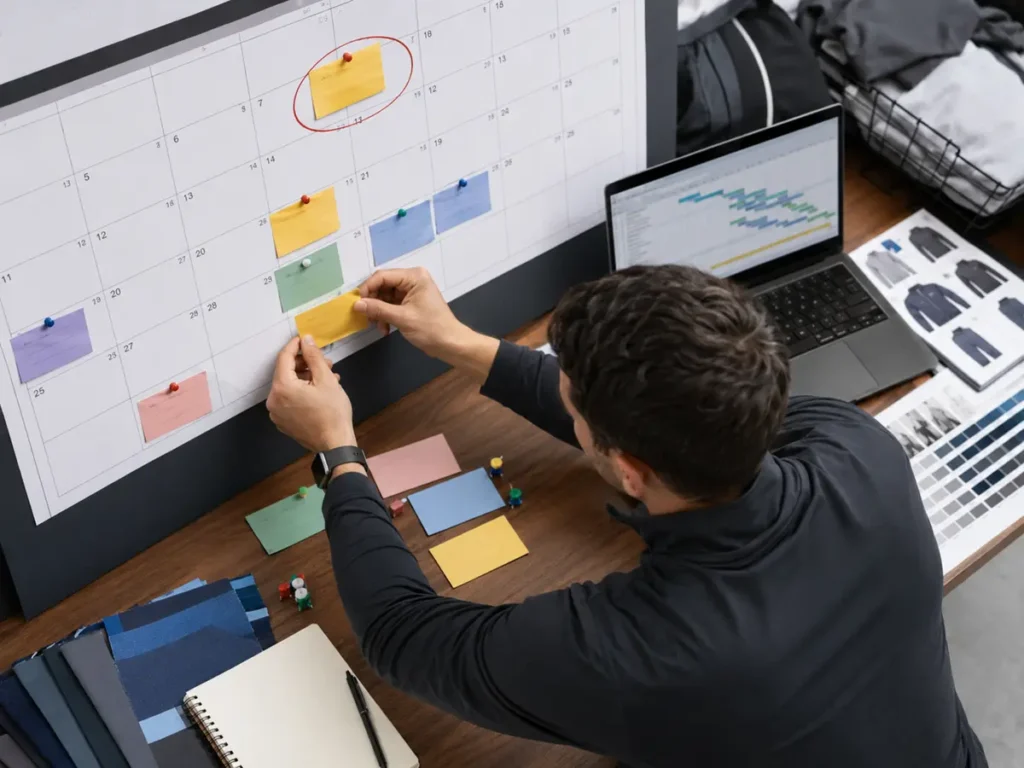
Backward planning starts with the non-negotiable outcome and subtracts every downstream stage. If a later stage needs more time, every upstream deadline moves earlier.
Use this sequence:
- Choose the must-arrive date.
- Subtract the receiving and contingency buffer.
- Subtract the quoted international shipping and customs allowance.
- Subtract final inspection, packing and export-preparation time.
- Subtract the confirmed bulk production duration.
- Subtract the sample approval and sample-shipping period when required.
- Subtract sample production and possible revision time.
- Subtract digital design, quotation and specification approval.
- Set the internal deadline for roster, sizes, logos and sponsors.
A Practical Backward-Planning Table
| Stage | Planning input | Owner | Completion evidence |
|---|---|---|---|
| Team receiving and distribution | Buyer-selected buffer | Buyer | Cartons received and counted |
| International transit and customs | Current freight quotation and destination requirements | Buyer, supplier, forwarder or broker according to terms | Delivery or customs-release record |
| Final inspection and packing | Order-specific QC plan | Supplier / inspector | Approved inspection and packing record |
| Bulk production | 25–30 days ordinary; 35–45 days complex as JIUMU references | Supplier | Finished production quantity |
| Physical sample approval | Buyer review plus sample transport | Buyer and supplier | Written sample approval |
| Jersey sample production | 7–10 days as JIUMU reference | Supplier | Sample completed |
| Digital design and revisions | Number of concepts and approvers | Buyer and supplier | Approved artwork version |
| Roster, sizes, logo and sponsor lock | Team’s collection process | Buyer | Signed production file |
These periods should not be added mechanically without checking dependencies. The supplier may not begin a physical sample until artwork, fabric and payment conditions are confirmed. Bulk production may not begin immediately after a buyer says “approved” if the roster remains incomplete or materials are not allocated. The final schedule should state both duration and entry conditions for every stage.
How Early Should Teams Order?
There is no universal number because “custom uniform” can mean a simple repeat jersey, a new full uniform package or a multi-team program with custom fabric and sponsor variants. The following ranges are conservative planning starting points before the must-arrive date.
| Order type | Suggested planning start | Typical conditions |
|---|---|---|
| Repeat order with unchanged approved specification | About 6–10 weeks | Material available, limited changes, production reference 20–25 days, shipping added |
| Standard new jersey order with physical sample | About 12–16 weeks | One design family, roster managed by one buyer, ordinary production reference 25–30 days |
| Complex new uniform package | About 16–20+ weeks | Multiple garments, colorways, sponsor variants, extended sizing or production reference 35–45 days |
| Sea-freight or peak-season program | Add route- and season-specific time | Booking, port schedules, holidays and congestion require separate confirmation |
These bands are not JIUMU delivery promises. They are tools for deciding when to start a conversation. A supplier quotation should replace them with dates for the actual style, quantity, customization, materials, destination and shipping method.
Starting early does not mean paying for production before the roster exists. It means opening the project early enough to settle product, fit, color, artwork and sample decisions without forcing every team member to respond at the last moment.
Lock the Roster, Sizes, Logos and Sponsors Before Production
An order cannot be production-ready while the buyer is still collecting names, numbers or sizes. Set an internal roster deadline earlier than the factory’s production lock date so the team has time to find missing information.
The buyer should confirm:
- player or member ID;
- exact display name and number;
- Youth or Adult size system;
- fit, such as unisex, men’s, women’s, athletic or relaxed;
- separate top and bottom sizes;
- home, away and goalkeeper variants;
- captain, league or position marks;
- current team logo file and color references;
- sponsor artwork, placement and approval status;
- delivery group or player-level packing instructions.
The roster owner should submit one version-controlled file. Avoid accepting changes from several coaches, parents or players in parallel. A late roster change is not only a spreadsheet edit; it may require new artwork, reprinting, cutting, sewing, decoration, QC or repacking.
When Should Sizes Be Final?
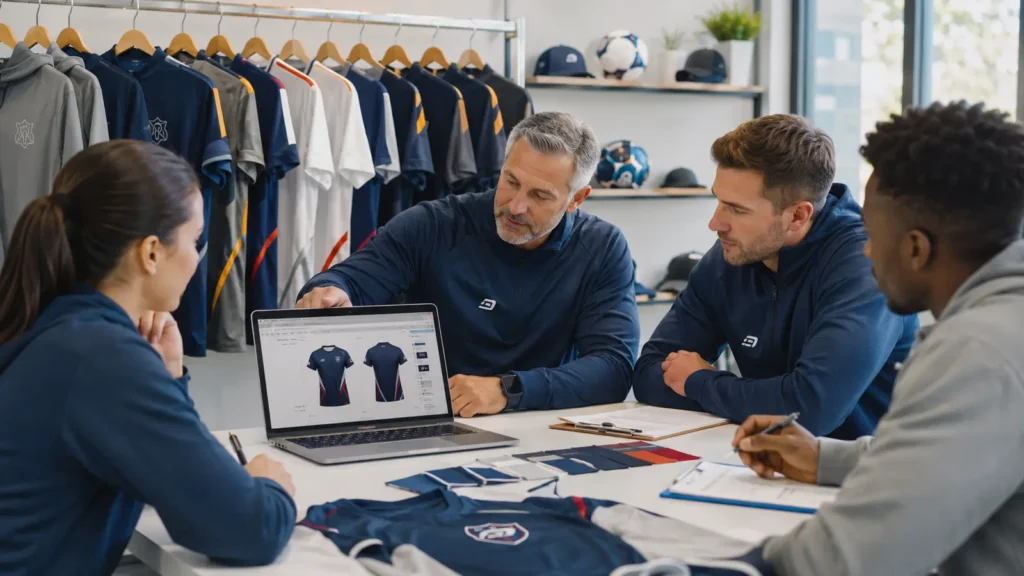
Sizes should be final before the supplier releases bulk cutting or size-specific printing. The exact production-lock date belongs in the order schedule. Allow an internal review period before that date rather than collecting the last size on the same day.
Use the supplier’s actual size chart and, for important team programs, sizing samples. A player’s usual retail size is not a reliable substitute for the approved garment measurements and fit. Record Youth/Adult and fit separately from the size letter.
If the roster changes after lock, the supplier must check the affected production stage. The request may be accepted, charged, moved to a replacement batch, delayed or declined. Never assume a change is accepted until it appears in a revised controlled file or written change order.
Reserve Time for Digital Design and Revisions
Artwork approval has its own lead time. The designer may need to convert a reference image into a production layout, place names and numbers, adapt a sponsor mark, control Pantone targets and scale decoration across Youth and Adult sizes.
Set limits that make the revision process manageable:
- nominate one buyer-side approver;
- send consolidated comments rather than separate messages;
- label every artwork revision;
- distinguish required corrections from optional creative changes;
- approve front, back, sleeves and bottoms together;
- identify the exact roster and color references linked to the artwork;
- set a response deadline for each review round.
Do not count only the supplier’s drawing time. If the club takes five days to circulate a mockup among sponsors and board members, those five days belong in the project schedule.
Does a Digital Mockup Replace a Physical Sample?
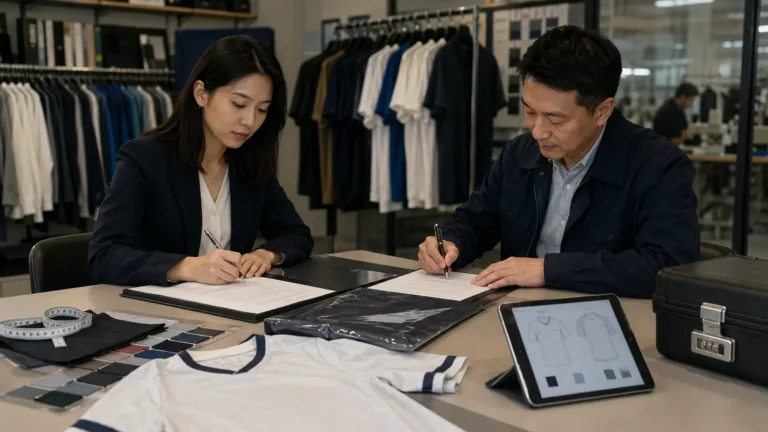
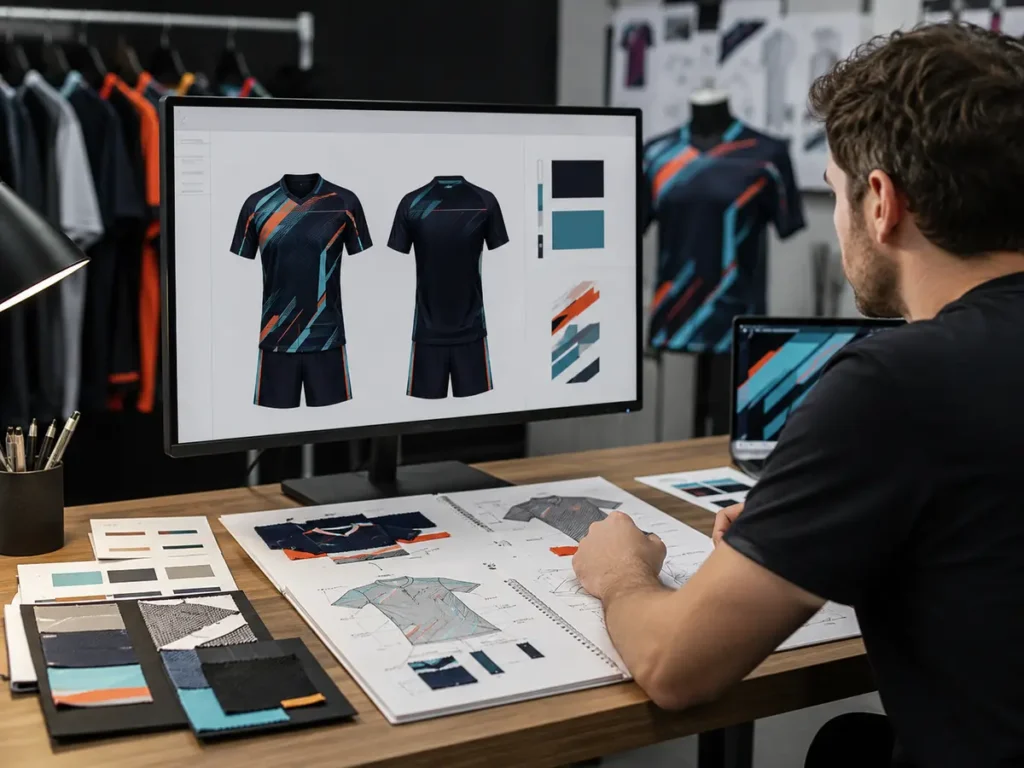
A digital mockup can approve design direction, graphic content and placement intention. It cannot show exact fabric hand, finished fit, printed color on the selected textile, seam behavior, decoration feel or construction quality. Decide at quotation stage whether the order requires a physical sample.
Skipping a sample can save time, but it transfers more decision risk into bulk production. That trade-off should be explicit and documented, not made automatically because the schedule is late.
Plan Sample Production, Sample Shipping and Approval Separately
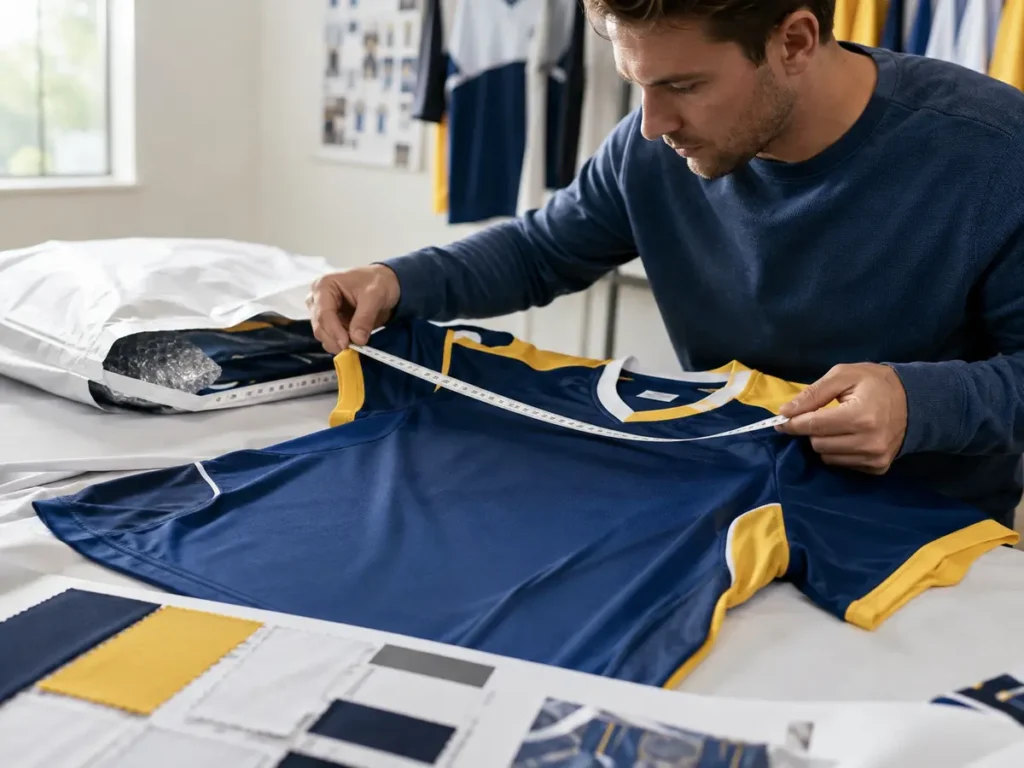
JIUMU’s reference sample period for jerseys is 7–10 days. Confirm when that clock begins. Normally the necessary design, material choice, commercial terms and sample payment must be approved first.
The sample stage contains at least four separate activities:
- sample production;
- sample inspection before dispatch;
- courier transportation to the buyer;
- buyer fitting, measurement, color and decoration approval.
If the sample needs revision, decide whether a new digital proof, partial correction sample or complete second sample is required. A full new sample can add another production and transport cycle.
Create a Sample Approval Deadline
The supplier should receive one written decision by the deadline:
- Approved: proceed using the named sample and specification version.
- Approved with documented corrections: proceed only when corrections are measurable and accepted by both parties.
- Revision required: do not start bulk production until the next approval condition is met.
- Rejected: identify the specification mismatch and required remedy.
Comments such as “looks good except make it better” are not production instructions. Record measurements, colors, placements, materials and construction changes precisely.
Planning uniforms for a fixed season date? Send JIUMU the must-arrive date, destination, sport, estimated quantity, product list, roster status, logo files, sample requirement and proposed shipping method. JIUMU can review the sequence before the production lock. Explore Custom Team Uniforms or contact JIUMU.
Understand What the Bulk Production Period Includes
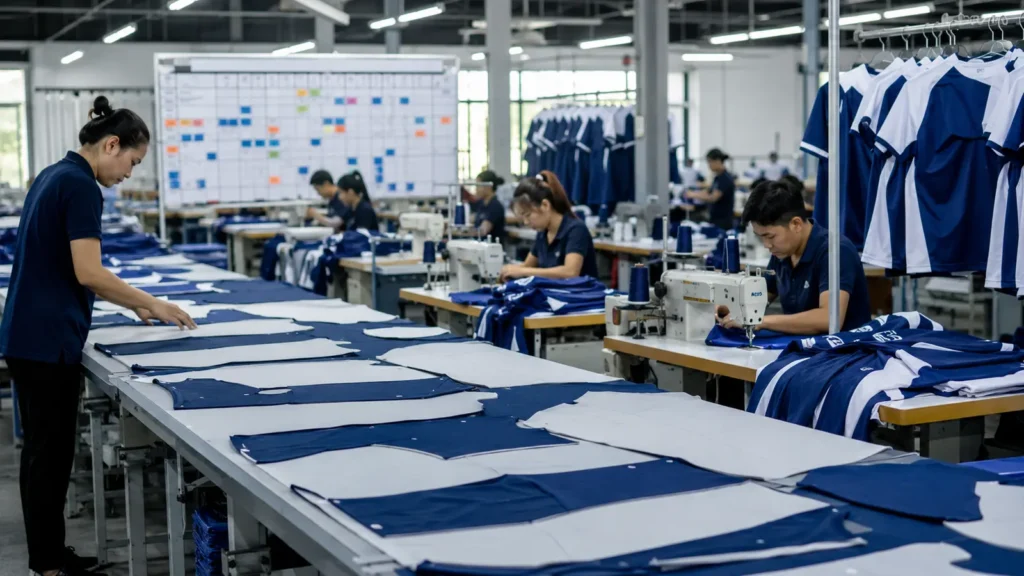
JIUMU’s reference bulk production period is 25–30 days for an ordinary order and 35–45 days for a complex order. These figures should be confirmed for the actual project and should specify whether the supplier is quoting calendar days or working days.
Complexity may increase when an order includes:
- several garment types or construction methods;
- multiple team colorways or sponsor variants;
- custom-dyed or specially sourced fabric;
- youth through extended adult grading;
- individual names and numbers across a large roster;
- special patches, labels, trims or packaging;
- split delivery or retailer-specific labeling;
- testing, third-party inspection or detailed documentation;
- several approval batches instead of one production lock.
Bulk lead time should begin only after the agreed prerequisites are complete. The quotation or order acknowledgment should identify the start condition, such as deposit received, artwork approved, sample approved, roster locked and materials confirmed.
Production Time Is Not a Queue-Free Guarantee
A supplier may quote a production duration based on current capacity. If approval arrives late, the originally discussed production slot may no longer be available. Ask whether capacity is reserved and what action reserves it. Do not assume that an informal forecast holds a production line indefinitely.
This becomes more important during school, tournament and holiday peaks. Confirm factory closures, material-supplier holidays and capacity before approving the final calendar.
Keep Final Inspection and Packing in the Schedule
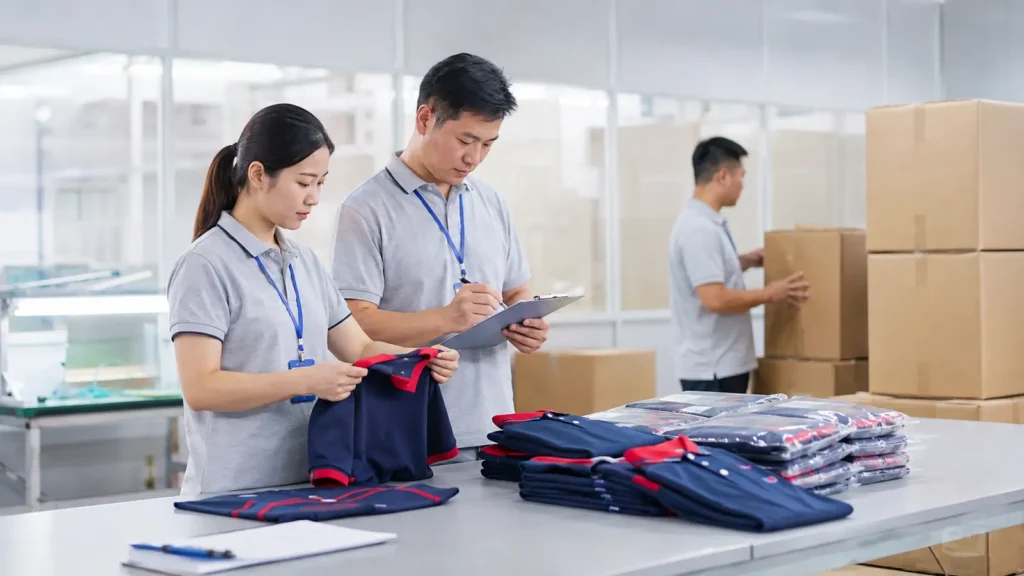
Finished sewing is not the same as shipment readiness. The supplier still needs to reconcile quantities, inspect workmanship and personalization, confirm sizes, pack sets and prepare carton information.
A pre-shipment check for mixed team uniforms may cover:
- total quantity and size breakdown;
- names, numbers and player IDs;
- garment measurements against agreed tolerances;
- fabric, colorway and approved logo application;
- seam, print, transfer or embroidery appearance;
- labels, size marks and private-label elements;
- matching tops and bottoms;
- individual packaging and roster sorting;
- carton quantity, marks, dimensions and weight;
- inspection findings and disposition of nonconforming units.
If a problem is found, the calendar needs time for reinspection, repair or replacement. A schedule that allocates zero time between sewing completion and freight pickup assumes that every unit passes immediately.
Add International Shipping and Customs After Production
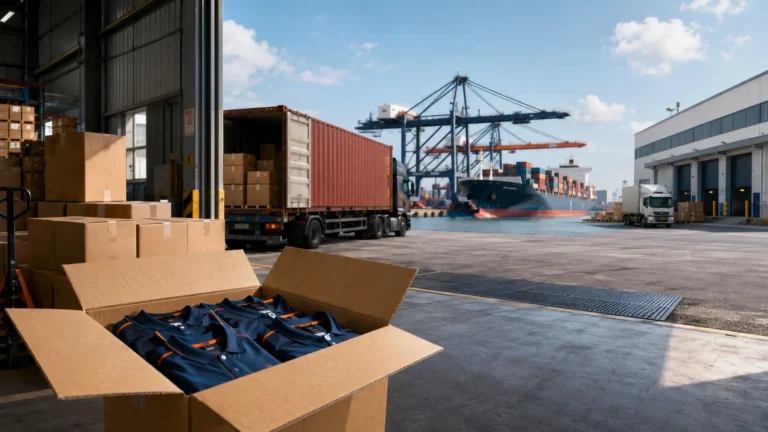
Production lead time normally does not include international transportation unless the quotation explicitly says so. Ask for the named shipping method, route, delivery term and current transit estimate.
The logistics plan may include:
- export pickup and consolidation;
- origin export handling;
- express, air, rail or sea transportation;
- destination terminal or port handling;
- customs declaration and possible inspection;
- duty, tax or broker coordination;
- final-mile delivery and appointment booking.
Official carrier guidance supports keeping customs separate from a simple transport estimate. FedEx notes that incomplete documentation is a common reason for clearance delays. UPS explains that customs duration can vary from hours to days or longer depending on country, procedures, shipment volumes and inspections. The U.S. International Trade Administration also recommends comparing forwarders and confirming destination-specific documents.
Does Lead Time Include Shipping?
Not automatically. “Sample lead time,” “production lead time,” “transit time” and “door-to-door lead time” are different expressions. The buyer should ask the supplier to define the start and end event for every quoted duration.
For example:
- Sample lead time: from approved sample specification and payment to sample completion.
- Bulk production lead time: from completed production release conditions to finished goods.
- Transit time: from carrier acceptance or departure to a defined destination event.
- Door-to-door project time: from the agreed project start through final delivery.
Incoterms also affect who arranges freight, documentation, customs clearance and delivery. The U.S. International Trade Administration explains that Incoterms allocate responsibilities for shipment, insurance, documentation and customs activities. They do not make customs risk disappear.
How Much Buffer Is Needed?
Buffer is not one universal percentage. Create it from the risks that apply to the specific project. A standard order with approved materials and express shipping needs a different buffer from a new multi-team package moving by sea before a holiday.
| Risk | Examples | Planning response |
|---|---|---|
| Buyer approval | Sponsor committee, school board, player data | Earlier internal deadlines and one approver |
| Product development | New pattern, custom fabric, revised sample | Additional design or sample cycle |
| Production | Peak-season queue, complex decoration, material delay | Confirm capacity and material allocation |
| Quality | Failed measurement or personalization check | Repair, replacement and reinspection allowance |
| Logistics | Booking rollover, weather, congestion, missed connection | Route-specific contingency |
| Customs | Incomplete documents, duties, inspection | Broker review and clearance allowance |
| Receiving | School closure, warehouse booking, team distribution | Deliver before the first use date |
As a planning rule, many teams reserve at least one to three weeks between expected delivery and the first required use. Higher-risk programs may need more. That is a buyer-controlled operational buffer, not a promise that every order needs the same number of days.
Do not spend buffer deliberately. It exists for uncertainty. When approvals run late, recalculate the whole schedule and decide whether to change scope, shipping method, target date or risk tolerance.
Plan Repeat Orders From the Original Production Record
JIUMU’s reference repeat-order production period is 20–25 days, but a prior order number alone does not guarantee that timing. The supplier should first confirm that the approved pattern, artwork, roster format, fabric, color standard, trims and packaging record are available and that the necessary materials can still be sourced.
A reorder becomes closer to a new order when it introduces:
- a new colorway or sponsor;
- a different garment construction;
- a changed fabric or trim;
- new youth or extended sizes outside the approved grading;
- revised logo dimensions or placement;
- new packing and retailer-label rules;
- a long gap that affects material availability.
Keep the approved sample or Golden Sample, measurement chart, color reference, printing parameters, artwork versions, label files and packing specification. Link the new roster to the prior order but issue a new production version.
Are Rush Orders Possible?
A rush request may be possible when materials are available, the design is simple, the roster is complete, production capacity exists and an appropriate shipping service is available. It is not guaranteed.
Rush planning should not silently delete essential controls. Instead, review which elements can be shortened safely:
| Possible action | Potential benefit | Trade-off or limit |
|---|---|---|
| Use an approved stock fabric | Avoid special sourcing | May limit color or material choice |
| Consolidate to one design and colorway | Reduce setup and approvals | Less customization |
| Use digital approval only | Remove sample shipping cycle | Buyer accepts greater physical-result risk |
| Submit a complete locked roster immediately | Prevent data waiting | Requires buyer readiness |
| Choose faster freight | Reduce transit | Higher cost; customs still applies |
| Split critical and noncritical quantities | Put essential units first | More freight, coordination and color/batch risk |
Ask the supplier for a written rush feasibility review covering production start conditions, completion target, inspection, shipment method, additional cost and remaining risk. A date is not confirmed merely because a buyer requests it.
A Season-Ready Order Workflow
Phase 1: Define the Program
Set the must-arrive date, destination, buyer contacts, sport, product list, estimated quantity, budget direction and shipping assumptions. Decide whether the project needs a physical sample.
Phase 2: Freeze the Product Direction
Confirm garment styles, fabric direction, color references, logo methods, private labels, packaging and size systems. Ask the supplier to identify long-lead materials or decisions.
Phase 3: Approve Artwork and Sample
Use versioned mockups and consolidated feedback. Inspect any physical sample against a written checklist. Preserve the approved sample and specification.
Phase 4: Lock Roster and Commercial Order
Finalize names, numbers, Youth/Adult ranges, fits, top and bottom sizes and special marks. Reconcile the roster total with the quotation or purchase order. Record the production lock.
Phase 5: Produce and Inspect
Track production against agreed milestones without treating partial production updates as shipment readiness. Complete inspection, correction, packing and shipment release.
Phase 6: Ship, Clear and Receive
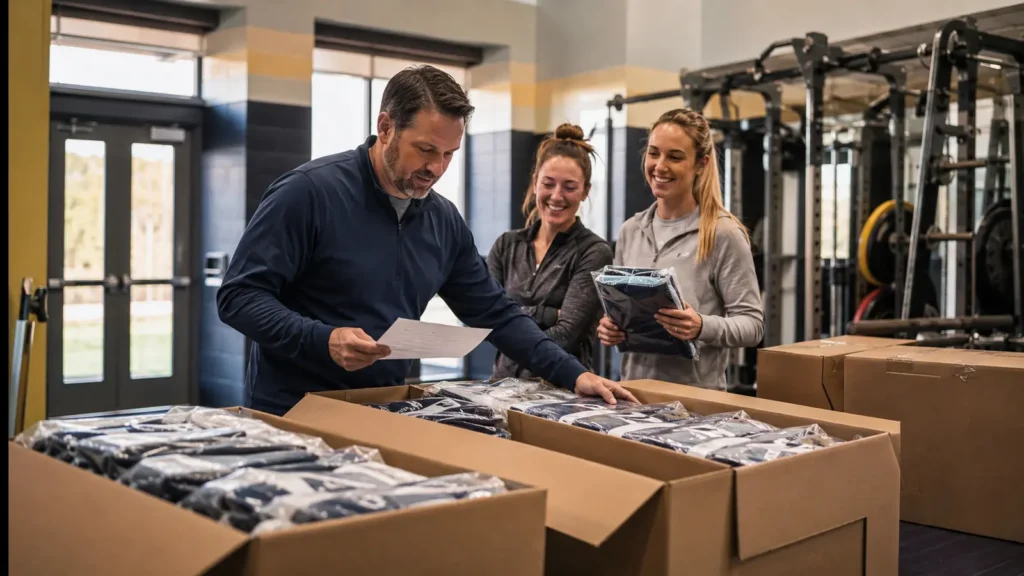
Confirm documents, tracking or freight milestones, customs responsibility and final delivery. Count cartons on arrival, distribute against the roster and report any discrepancy by line or player ID.
What to Send a Supplier for an Accurate Timeline
Provide:
- first-use date and must-arrive date;
- complete destination address and postal code;
- sport, garment list and estimated quantities;
- Youth, Adult and fit requirements;
- design references and editable logo files;
- sponsor count and approval process;
- roster status and expected lock date;
- physical-sample requirement;
- known packaging or split-delivery requirements;
- preferred freight method or budget priority;
- prior order number and Golden Sample for a reorder;
- any school, tournament or warehouse closure dates.
The supplier can then separate product-development time, production time and logistics time. If important inputs are missing, the first schedule should be labeled provisional.
Questions to Ask Before Confirming the Calendar
- What event starts each quoted lead-time period?
- Are the stated days calendar days or working days?
- Which approvals and payments are required before sample production?
- Is a physical sample required, and how is sample shipping handled?
- What makes this order ordinary or complex?
- When must the roster and sizes be locked?
- Is fabric or production capacity reserved?
- How much time is allocated for final inspection and corrections?
- Does the shipping estimate include customs and final delivery?
- Which party handles export, import clearance, duties and delivery?
- Which holidays or peak periods affect the project?
- What happens if the buyer approves late?
- What evidence confirms the final shipment date?
- Which parts of a rush plan increase cost or risk?
Common Planning Mistakes
Using the First Game as the Delivery Date
The team needs receiving and distribution time. Set an earlier must-arrive date.
Treating 25–30 Days as the Entire Project
That reference is for ordinary bulk production, not design, sampling, shipping and customs.
Collecting Sizes After Artwork Approval
Youth and adult sizes, fit and decoration scaling can affect artwork and production files. Plan roster and design together.
Waiting for Every Player Before Contacting the Supplier
Start product, material and sample planning with estimated quantities, then lock the final roster before production.
Sending Sponsor Changes in Separate Messages
Consolidate changes and issue one approved artwork version.
Spending the Buffer on Optional Revisions
Every late creative change reduces protection against production or logistics uncertainty.
Assuming a Reorder Is Automatically Faster
Confirm that the prior specification and materials remain repeatable before using the 20–25-day reference.
How JIUMU Supports Team Uniform Planning
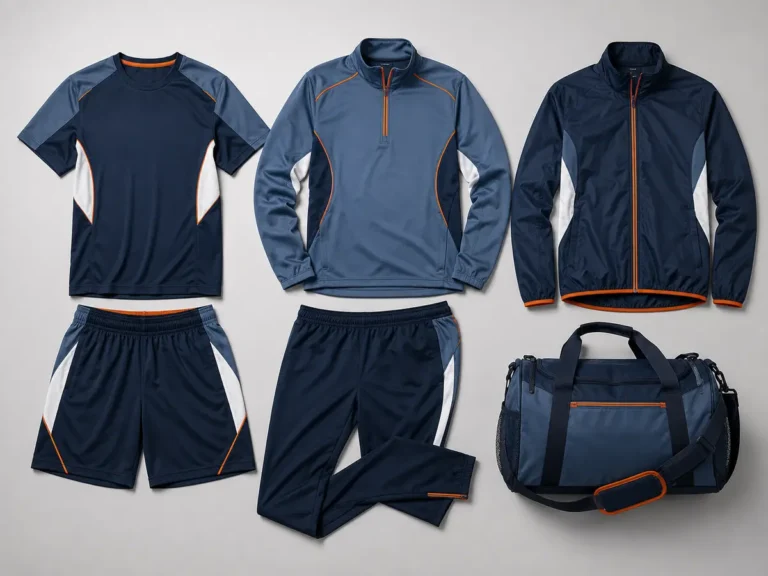
JIUMU is a Guangdong-based B2B custom teamwear and logo-apparel supplier established in 2010. Capabilities include OEM and ODM product development, sublimation, embroidery, screen printing, heat transfer, fabric sourcing, Pantone color matching, private labels, packaging customization, digital mockups, physical samples, quality control and export support.
For planning purposes, JIUMU’s reference periods are 7–10 days for jersey samples, 25–30 days for ordinary bulk production, 35–45 days for complex production and 20–25 days for qualified repeat orders. Actual dates depend on the confirmed specification, quantity, materials, customization, approvals, production schedule and destination.
Buyers can review Manufacturing Capabilities, explore Custom Team Uniforms, consult the planned MOQ & Lead Time resource and submit an order brief through Contact Us.
Final Team Uniform Timeline Checklist
- First-use date and must-arrive date are different and recorded.
- Destination address and receiving closures are confirmed.
- Buyer and supplier project owners are named.
- Product list, quantity estimate and size systems are defined.
- Logo, colors and sponsor approvals have owners and deadlines.
- Roster and sizing-sample collection dates are scheduled.
- Digital artwork revision rounds are limited and versioned.
- Physical sample production, shipping and review are included where required.
- Production lock conditions are written.
- Ordinary, complex or repeat-order production duration is confirmed.
- Final inspection, correction and packing time is included.
- Freight method, Incoterm and current route estimate are confirmed.
- Customs documents and responsible parties are identified.
- A risk-based buffer remains before the first required use.
- Post-lock changes require a new feasibility review.
The best time to solve a uniform delay is before it becomes one. Begin with the must-arrive date, define every stage and approval condition, and protect the schedule with a realistic buffer. A backward plan gives the coach, supplier and logistics partners one calendar—and makes the trade-offs visible while there is still time to act.
Build your season timeline with JIUMU. Use the included backward-planning CSV, then send your must-arrive date, destination, product list, quantity, roster status, logos, sample requirement and shipping preference. Request a project-specific schedule through Contact Us or begin with Custom Team Uniforms.
Logistics References
- FedEx: Customs Clearance
- UPS: A Shipper’s Guide to Customs Clearance
- International Trade Administration: Shipping Options
- International Trade Administration: Know Your Incoterms
About JIUMU
JIUMU is a Guangdong-based B2B supplier of custom teamwear, hats, uniforms, bags and branded apparel. The team supports digital mockups, physical samples, customization, production coordination, quality control, packaging and export projects.