How to Build a Complete Baseball Team Uniform Package
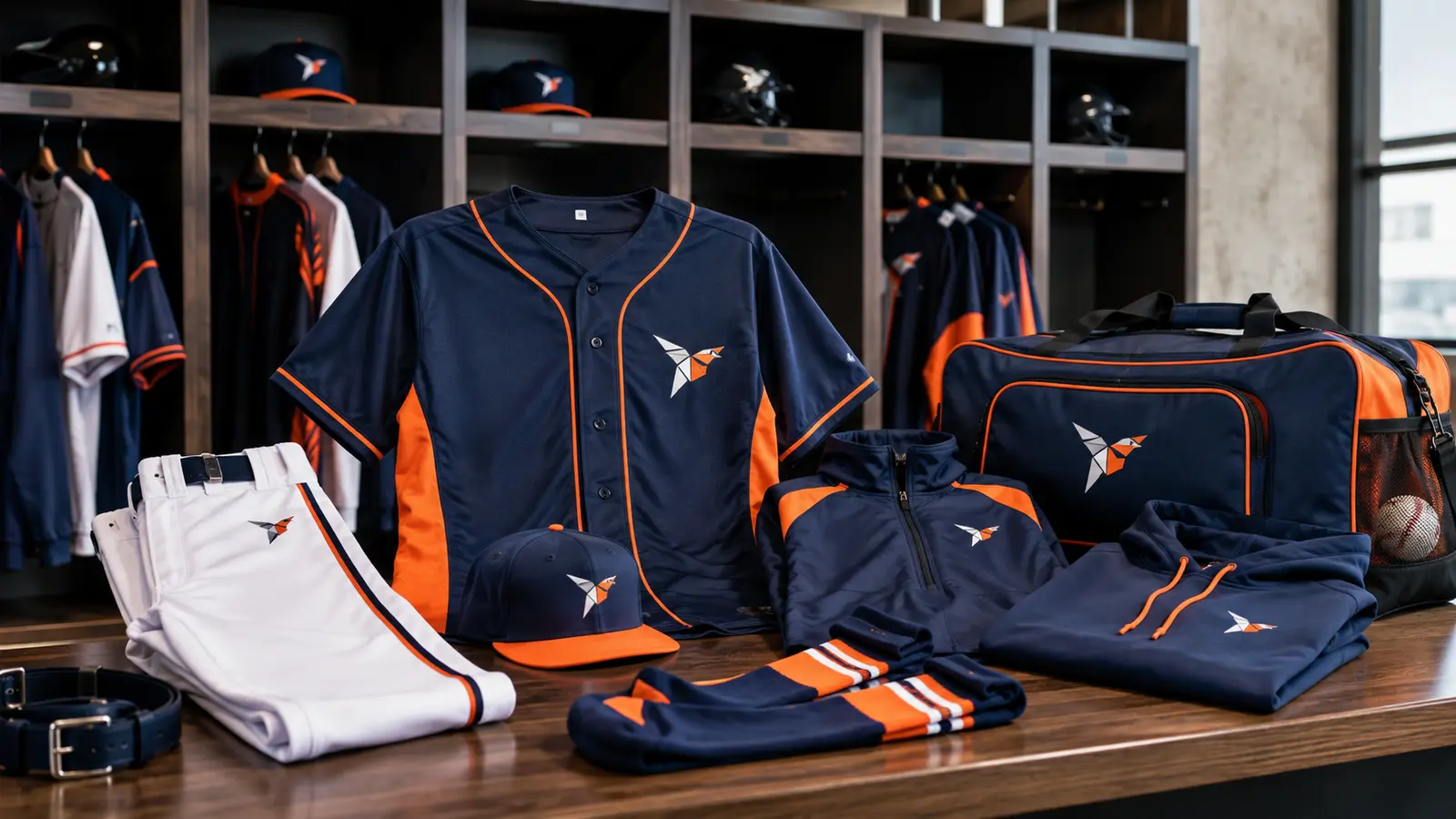
A complete baseball team uniform package is more than a jersey-and-pants order. It is a coordinated purchasing system that connects game uniforms, caps, socks, belts, outerwear, training apparel, coach clothing, team bags, player sizes, logos, colors, delivery timing, and future replacements.
For a school, club, league, distributor, or uniform dealer, buying these items together can simplify communication. It can also create expensive errors if the roster, artwork, color standards, or inclusions remain unclear. This guide explains how to build a package that can be quoted, sampled, produced, distributed, and reordered reliably.
A complete package should coordinate product function, sizing, decoration, color, delivery, and replacement planning—not merely place several items in one carton.
Quick Answer
A practical baseball team uniform package normally starts with jerseys, baseball pants, caps, socks, and belts. It may add warm-up jackets, hoodies, training shirts, coach apparel, team bags, and spare uniforms. Before requesting a quote, confirm team quantity, youth and adult size ranges, separate top and bottom sizes, player names and numbers, logo files, target colors, decoration methods, package level, delivery destination, and required arrival date. Use physical samples or material approvals to coordinate colors across different fabrics, and lock one roster version before bulk production.
What Is Included in a Baseball Team Uniform Package?
There is no single universal package. The correct contents depend on league rules, playing level, climate, season length, travel schedule, budget, and whether the organization supplies every item or asks families to buy some accessories separately.
Little League’s purchasing guidance describes a conventional league uniform as typically including a shirt or jersey, cap or visor, and socks. Other official guidance notes that pants may also be included. That is a useful minimum reference, but many competitive, school, travel, and tournament teams need a broader coordinated system.
| Category | Typical item | Main purchasing decision |
|---|---|---|
| Game top | Button-front, two-button, pullover, or full-sublimation jersey | Fit, fabric, sleeve, closure, decoration, player details |
| Game bottom | Open-bottom or elastic-cuff baseball pants | Color, cut, length, reinforcement, belt loops, piping |
| Headwear | Structured baseball cap | Crown profile, closure or fitted sizing, visor, embroidery |
| Leg and waist | Socks and belt | Length, size range, material, closest approved color |
| Outerwear | Team jacket or hoodie | Climate, player versus coach use, decoration, sizing |
| Training | Practice jersey, tee, shorts, or training pants | Durability, repeat use, simplified decoration |
| Staff apparel | Coach top, polo, jacket, or hoodie | Role, fit, identification, sideline conditions |
| Equipment | Player bag, bat bag, backpack, or team duffel | Carry format, capacity, ID field, logo, roster assignment |
| Continuity | Spare and replacement units | Common sizes, blank or personalized stock, reorder standard |
The buyer should create a written scope showing which items are supplied per player, per coach, per team, and as shared equipment. For example, a player may receive two jerseys, one pair of pants, one cap, one belt, and two pairs of socks, while the team receives one coach jacket per staff member and three shared equipment bags.
Check League and Tournament Rules Before Designing
Uniform rules are not identical across high school associations, youth leagues, independent tournaments, and international competitions. Requirements can cover number format, school name, logo use, patch position, headwear, color contrast, and permitted decoration.
NFHS publishes current baseball uniform guidance for U.S. high school competition. Little League also publishes specific patch-placement instructions; its current guidance places the official player patch on the left sleeve or left chest for a sleeveless uniform, with the exact position affected by sleeve construction. These details show why buyers should not finalize artwork from a generic mockup.
Before design approval, record:
- governing league, association, school district, or tournament;
- season and rule version;
- required or prohibited marks;
- number size, location, and contrast rules;
- mandatory patch and its exact placement;
- sponsor restrictions;
- color restrictions for home and away sets;
- uniform differences permitted for coaches or special positions;
- trademark or licensing permission for third-party marks.
The team—not the manufacturer—should confirm its applicable competition rules. Provide the supplier with the current written requirements and licensed artwork before sampling.
Start With the Five Core Baseball Uniform Items
1. Baseball jerseys
The jersey is usually the visual center of the package. Choose the construction first: button front, two-button, V-neck, crew-neck pullover, raglan sleeve, set-in sleeve, or another approved team style. Then define fabric weight and structure, ventilation zones, fit, length, closure, and decoration.
Full sublimation supports complex colors, patterns, sponsor marks, and player-specific details. Embroidery, appliqué, heat transfer, and patches create different textures and cost structures. Some packages combine techniques.
Our Custom Baseball Jerseys page provides a starting point for construction and decoration discussions.
2. Baseball pants
Pants must be ordered as a separate fitted item. Define open-bottom or elastic-cuff construction, short or full length, relaxed or athletic cut, waistband structure, belt loops, pocket design, piping, panel details, and reinforcement at high-wear areas.
Do not assume an Adult Medium jersey requires Medium pants. Body proportions and waist-to-inseam relationships vary. Record the two sizes separately.
See Baseball Pants for relevant product options.
3. Baseball caps
The cap should support the uniform identity without being treated as a miniature jersey. Confirm crown height, structured or less-structured construction, panel count, visor shape, closure, fitted or adjustable sizing, sweatband, eyelets, and logo method.
The cap’s curved front and center seam affect embroidery detail. Simplify fine text, outlines, or mascots and test them on the chosen structure.
Explore Baseball Caps when comparing profiles and decoration options.
4. Socks
Specify sock length, youth and adult size groups, base color, stripe pattern, fiber blend, cushioning, and whether the team wears socks over or under the pant cuff. Custom knitted patterns and stock-color socks have different minimums and color possibilities.
5. Belts
Confirm youth and adult lengths, width, buckle finish, webbing or elastic construction, and color. A belt may use stock color rather than a custom-dyed match, so include it in the physical color review.
Add Outerwear, Training Apparel, Coach Clothing, and Bags
A package becomes more useful when it reflects how the team actually travels, trains, warms up, and distributes gear.
Jackets and hoodies
Warm-up jackets can support pre-game use, travel, dugout conditions, and coach identification. Choose lined or unlined construction, water-resistant requirements when documented, pocket configuration, hem and cuff structure, and decoration method. Hoodies can be assigned to players, staff, or both.
The outerwear logo does not need to be identical in size to the jersey logo. It should follow the same identity system while respecting the garment’s usable decoration area.
Training uniforms
Practice jerseys and training shirts experience frequent washing and may justify a simpler design or more economical decoration method. Decide whether names and numbers are needed. Some teams use the same color family but reserve the full game artwork for competition uniforms.
Coach and staff apparel
Coaches may need polos, pullovers, jackets, hoodies, or training tops rather than player jerseys. Record each staff role, item, size, fit preference, and logo placement. A clear coach line can look coordinated without copying the player uniform exactly.
Team and player bags
Choose between bat bags, backpacks, duffels, catcher’s bags, and shared equipment bags. Define capacity through an item list rather than a vague request for a “large bag.” State whether the bag must hold a helmet, glove, shoes, bats, water bottle, or catcher’s equipment.
Player name, number, or an external ID window can help distribution. Personalized bags must be included in the locked roster. Visit Team Bags for available product directions.
Choose a Package Level Before Requesting Prices
Separating the offer into package levels makes budget discussions more productive. The following framework can be adapted to the team.
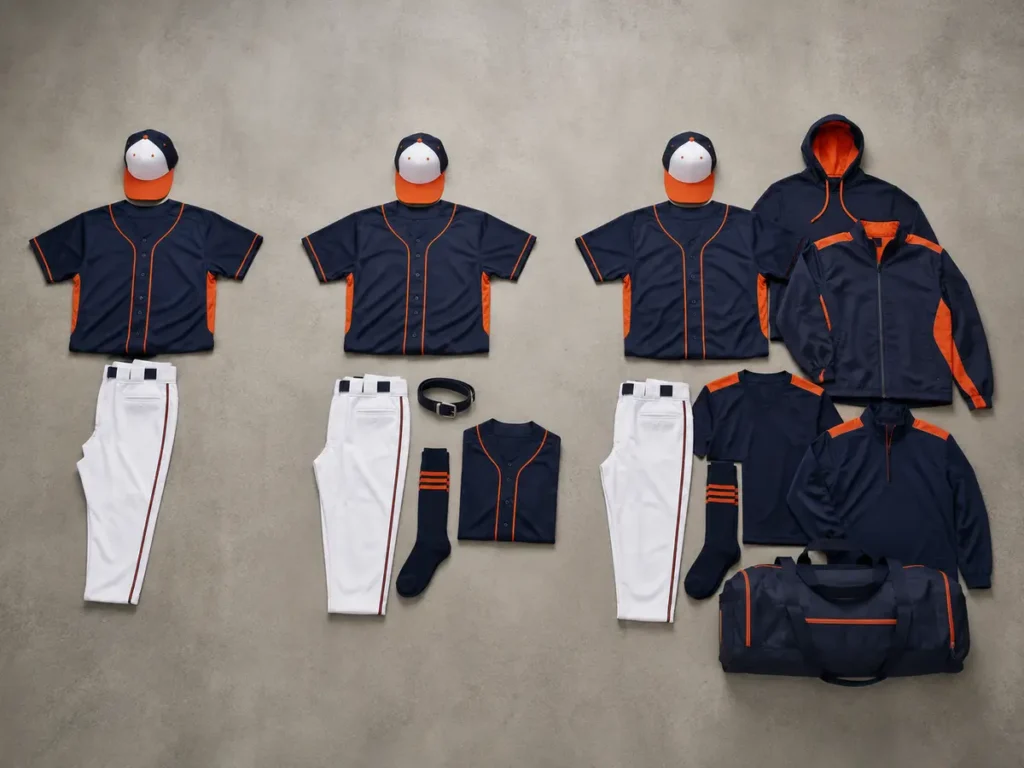
Package levels should reflect real player needs and distribution rules, not arbitrary product bundles.
| Package level | Suggested contents | Best suited to | Main budget control |
|---|---|---|---|
| Basic | One jersey, one pant, one cap | Recreational teams, short seasons, buyer-supplied accessories | Limit decoration methods and optional items |
| Game | Two jerseys or home/away tops, one or two pants, cap, socks, belt, selected spares | Schools, clubs, regular league schedules | Standardize player issue and size groups |
| Tournament | Multiple game tops, pants, cap, socks, belt, warm-up jacket, hoodie or training top, coach wear, team bag, planned spares | Travel teams, tournaments, distributors, premium programs | Lock the specification and consolidate sampling |
These names are planning labels, not fixed industry definitions. A school may place jackets in its Game package, while a summer club may remove outerwear and add a second cap. The quotation should list each item and quantity instead of showing only one package price.
Manage Youth and Adult Sizes in One Order
Age cannot determine size reliably. Players of the same age may need different chest, length, waist, and inseam measurements. Youth XL is not automatically equivalent to Adult Small.
Use the supplier’s chart for the exact style. Confirm whether it shows body or finished garment measurements, then compare it with a well-fitting item using the same method.
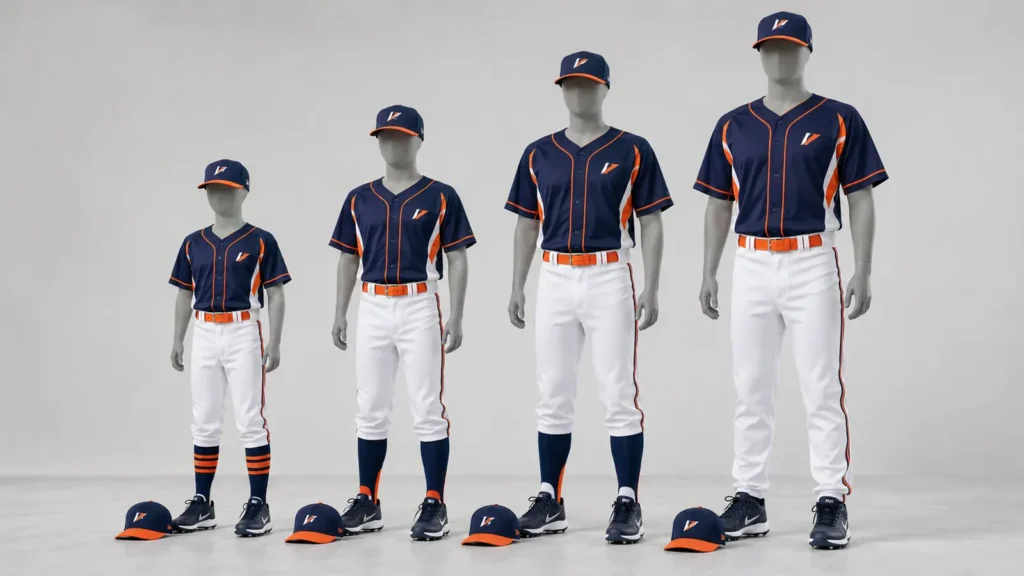
A mixed-size order can preserve one team identity while adjusting fit, placement, and graphic scale by size group.
Use separate size fields for every item
A useful roster does not contain only one column called “Size.” It includes:
- player ID;
- player display name;
- jersey size;
- youth or adult size block;
- jersey fit when more than one fit exists;
- pants size;
- pants length or inseam option when applicable;
- cap size or closure type;
- sock size;
- belt size;
- jacket or hoodie size;
- training top size;
- bag personalization;
- captain, coach, goalkeeper, or special designation;
- notes and approved exception.
Can top and bottom sizes differ?
Yes. They should be treated as separate order lines tied to one player ID. A buyer should never force a single set size merely because the items are sold as a package. The quotation and packing plan should show whether each player’s products are bundled together or sorted by product and size.
Use sizing samples when the order is mixed
For a school or youth league, a try-on set reduces guesswork. Record the sample style, fit, and revision because a Medium in another supplier’s pattern may not fit the same way. Players should try the actual or equivalent fabric and fit whenever practical. Do not stretch, layer, or alter the sample during selection.
Coordinate Colors Across Different Materials
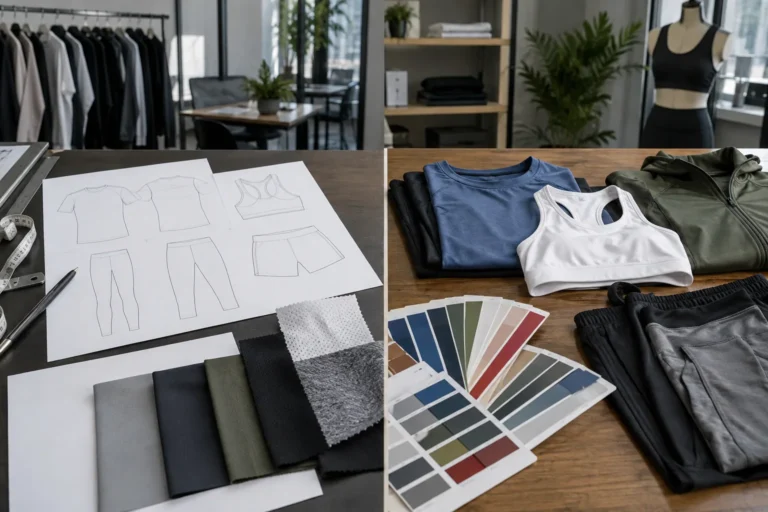
A complete package may combine sublimated polyester, dyed woven pants fabric, embroidery thread, cap twill, knitted socks, elastic belts, jacket fabric, zipper tape, webbing, and bag textiles. Those substrates reflect light differently and may use different production processes.
Therefore, “Pantone 282 everywhere” is a color target, not proof that every finished surface will look identical. Pantone explains that physical appearance changes by material and recommends choosing a color system relevant to the primary material, then finding the closest cross-material match. Pantone also recommends physical standards and controlled lighting for reliable comparison.
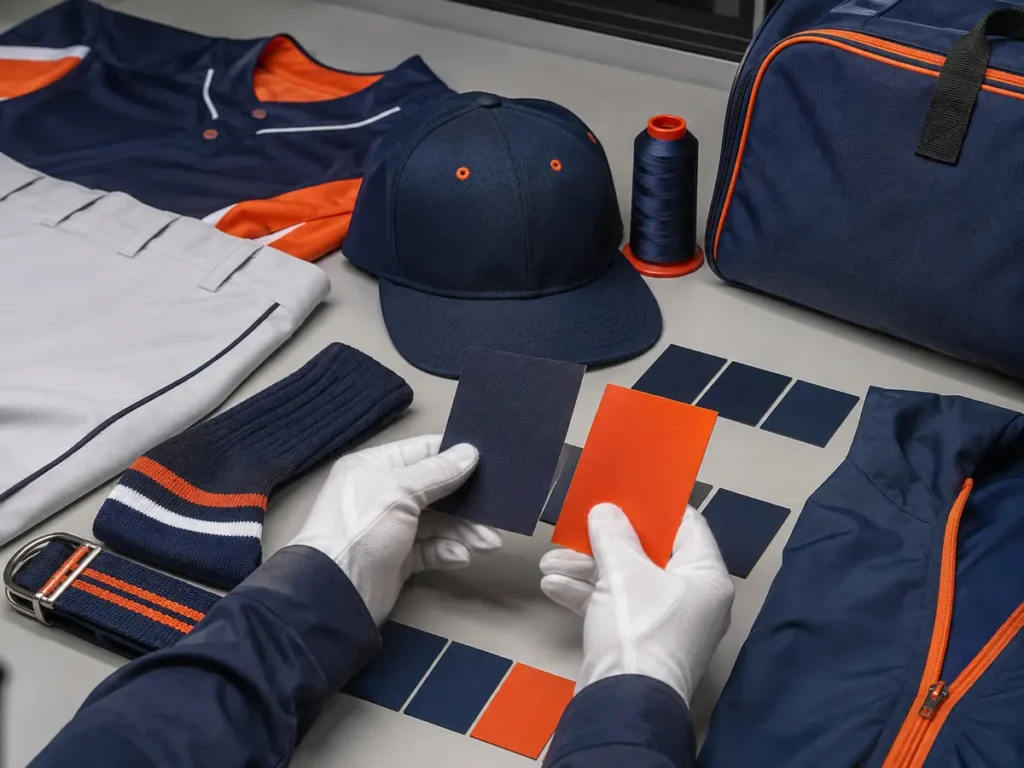
Approve the family as a coordinated set; expect controlled material differences rather than one screen color copied mechanically.
A workable cross-product color process
- Choose the primary reference item. For most teams, this is the game jersey or cap.
- Name the color target. Provide the appropriate current physical color reference, not only RGB, HEX, or a screenshot.
- Map every material. List the fabric, thread, knit, webbing, zipper, buckle, and print processes using the color.
- Select stock or custom options. Decide whether the nearest stock component is acceptable or whether a custom material development is justified.
- Review physical pieces together. Compare them under agreed lighting and in normal team-use conditions.
- Record approvals. Save supplier color codes, material references, print settings when applicable, dated photos, and physical samples.
- Define repeat-order expectations. State the acceptable visual range and require reapproval when materials or batches change.
Do not approve a whole package from a monitor. Screens differ, and backlit RGB color cannot reproduce every physical textile color.
Keep Logos Consistent Without Forcing One Production Method
The team identity can remain consistent even when the decoration changes by product. The important controls are shape, proportion, color hierarchy, approved variants, and placement—not identical stitch or print construction everywhere.
| Product | Likely method | Artwork adaptation |
|---|---|---|
| Sublimated jersey | Dye sublimation | Full color artwork mapped to the garment pattern |
| Baseball cap | Flat or raised embroidery, woven patch, or another approved patch | Simplify fine lines and small text for the crown |
| Pants | Embroidery, patch, heat transfer, piping, or no logo | Keep placement clear of stress and abrasion zones |
| Jacket or hoodie | Embroidery, patch, screen print, or heat transfer | Adjust mark size to the available panel and fabric |
| Socks | Knitted-in motif or stock stripe | Reduce logo complexity; limited knit resolution |
| Team bag | Embroidery, patch, or print | Adapt to pocket seams, webbing, and usable area |
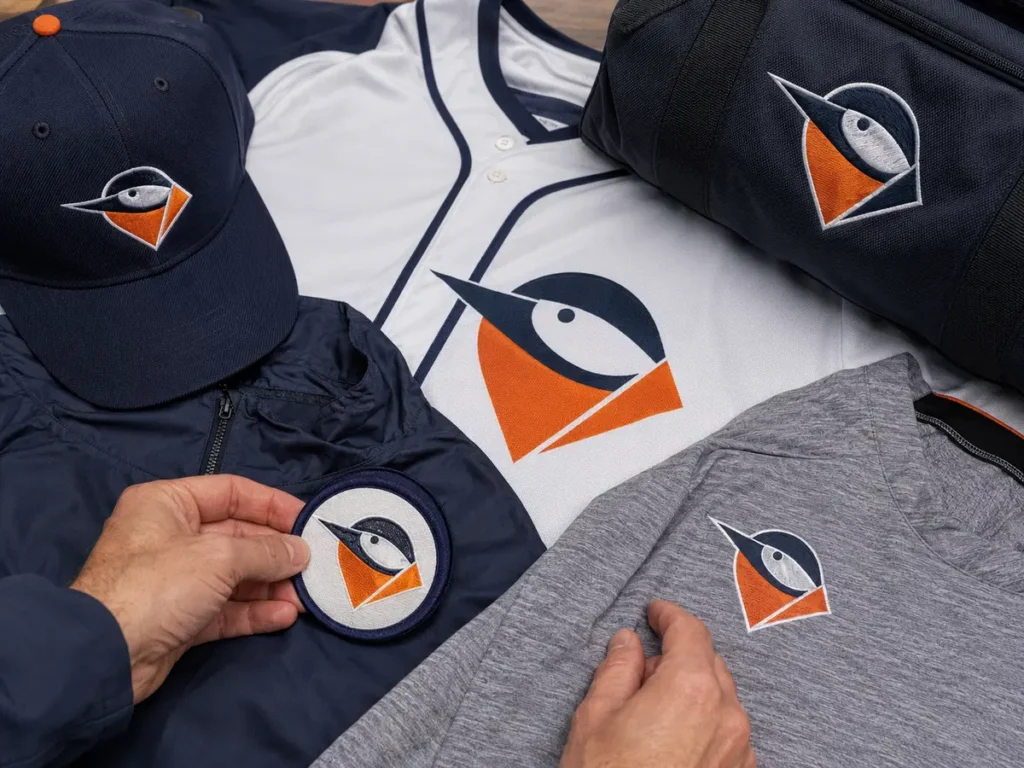
A controlled logo system contains production-ready variants for each method instead of forcing one detailed file onto every item.
Build a logo kit containing:
- primary team mark;
- simplified embroidery mark;
- one-color version;
- light-background and dark-background versions;
- horizontal and compact lockups when needed;
- official team wordmark;
- approved player-name and number fonts;
- sponsor and league marks with usage instructions;
- minimum-size and clear-space guidance;
- vector source files and approved color references.
Ask the supplier to return production proofs for every item. A cap embroidery proof does not automatically approve the team-bag embroidery if their size, base fabric, or backing differs.
Build One Controlled Player Roster
The roster is the production database for personalized items. Multiple email lists, messaging screenshots, and handwritten corrections create avoidable errors.
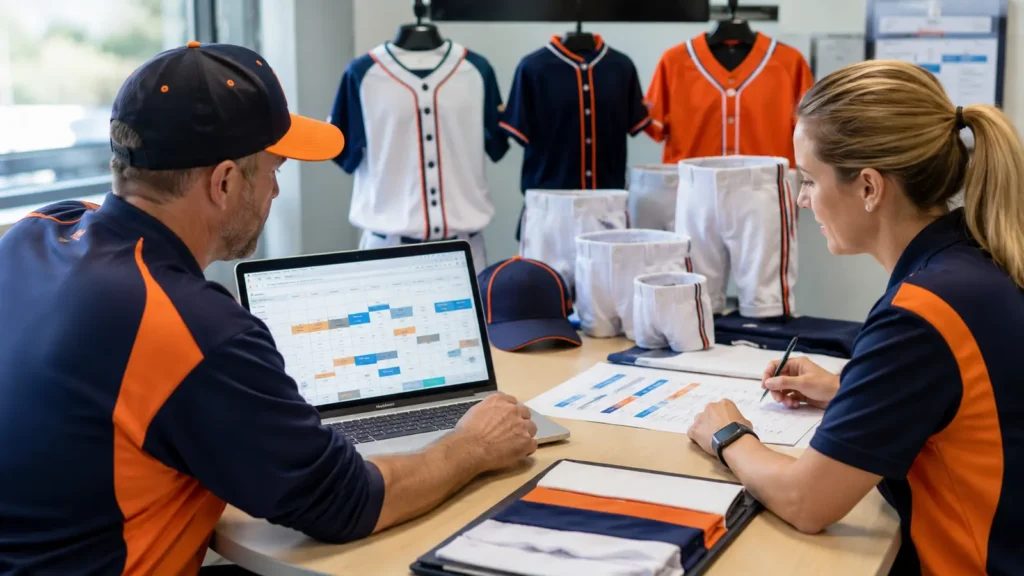
Use one roster owner, one file, and one revision number for all personalized products.
Minimum roster controls
- Assign a unique Player ID even when two players share a surname.
- Keep legal name separate from Display Name.
- Store the jersey number as text if leading zeros are permitted.
- Separate jersey, pants, cap, socks, belt, jacket, hoodie, and bag fields.
- Mark Youth or Adult explicitly.
- Record home and away product quantities.
- Add special marks such as captain, coach, or sponsor exceptions.
- Prohibit blank required cells.
- Run spelling, duplicate-number, size, and quantity checks.
- Lock a final revision number and approval date.
The roster should be submitted in a structured spreadsheet, not a photo or PDF. One authorized team contact should own revisions. After the approval deadline, changes should require a written feasibility check because some pieces may already be printed, embroidered, cut, or assigned.
Plan the Budget by Cost Driver
The package price is influenced by more than the number of products. A useful quote separates each item, decoration, personalization, sample, packaging, and shipping component.
Major cost drivers include:
- quantity by product and design;
- number of jersey designs, colors, and player variants;
- fabric and construction complexity;
- stock versus custom-dyed components;
- embroidery stitch count and patch construction;
- number of personalized locations;
- fitted versus adjustable caps and size distribution;
- custom socks, belts, labels, hangtags, and packaging;
- individual player bundling;
- sample quantity and shipping;
- inspection requirements;
- freight method, carton volume, destination, and import terms;
- rush handling or split shipment requests.
Compare prices on the same scope
A low package price may exclude socks, belts, names, numbers, freight, player sorting, or sample revisions. Ask suppliers to quote against the same configuration table. Confirm whether unit pricing is per player set, per garment, or per product line.
Need a package quotation that your team can compare accurately?
Send JIUMU the team quantity, package level, item list, size range, roster status, logo files, target colors, delivery address, and required arrival date. We can organize the request by product and identify which samples or color approvals are needed. Request a Baseball Package Quotation.
Build the Timeline Backward From the Required Arrival Date
Lead time should include more than bulk sewing. Plan backward from the date uniforms must be in the team manager’s hands—not from the first game’s opening pitch.
Allow time for package definition, roster collection, design revisions, material and color approval, physical samples, team review, final roster lock, material procurement, bulk production, inspection, player sorting, international freight, customs, final delivery, and a contingency buffer.
Ask the supplier to state what its quoted lead time starts from. Production often begins only after deposit, final artwork, roster, sizes, and sample or color approvals are complete. Shipping and customs are commonly separate from production time.
Rush orders may be possible, but fewer review cycles and constrained material choices increase risk. A realistic buffer is usually more valuable than a late emergency upgrade to air freight.
Approve Samples as a Coordinated System
A complete package does not always require a fully personalized sample of every size and every product. It does require an approval plan that covers the important risks.
Decide what needs a physical sample
Prioritize new patterns, critical fit, complex decoration, uncertain colors, or high-value products. A buyer may approve:
- one representative jersey and pants set;
- one cap, outerwear style, and bag construction;
- physical sock, belt, fabric, and embroidery color references;
- full-size proofs for every approved size and player variant.
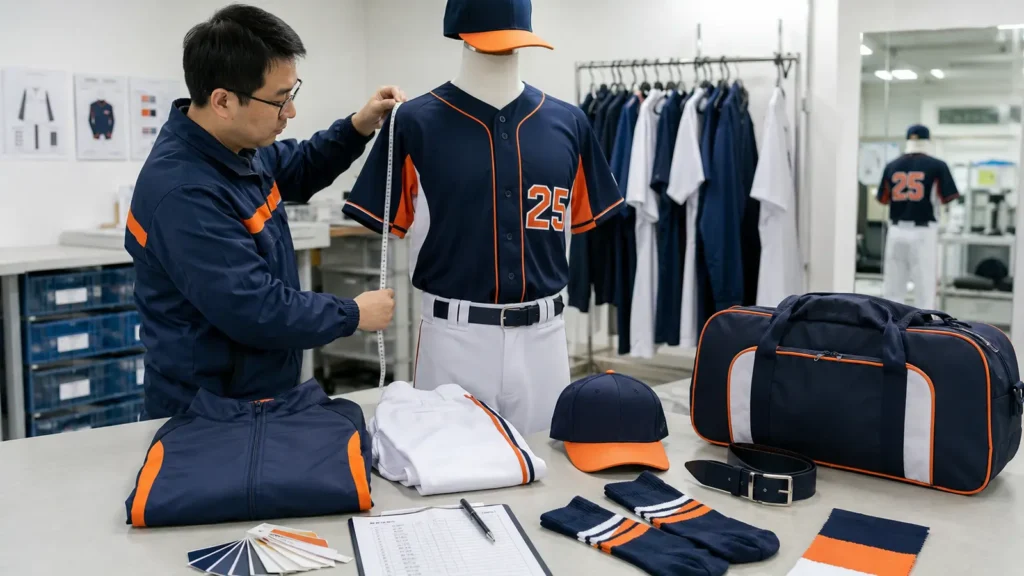
Sample approval should connect fit, color, decoration, accessories, packaging, and the correct file revision.
What to inspect
| Inspection area | Checkpoints |
|---|---|
| Identity | Correct design revision, logo variant, colors, fonts, names, numbers |
| Fit and size | Finished measurements, fit block, youth/adult grading, top/bottom pairing |
| Construction | Seams, reinforcements, closures, waistband, cap shape, bag structure |
| Placement | Logo size and location, name/number centering, patch rules, usable decoration area |
| Color family | Jersey, pants, cap, thread, socks, belt, outerwear, bag viewed together |
| Function | Movement, pockets, belt loops, cap fit, bag loading, zipper operation |
| Packaging | Player sorting, size labels, barcode or ID needs, carton assortment |
| Record | Sample ID, revision, date, approval status, photos, authorized signatures |
Use Approved, Approved With Documented Correction, or Revise and Resample as explicit statuses. Preserve the approved reference as a Golden Sample and link it to the locked order files.
Inspect Bulk Production and Player Packs
Bulk inspection should verify both product quality and information accuracy. A well-made jersey with the wrong player number is still unusable.
The inspection plan should connect quantities, sizes, Player IDs, names, numbers, decoration, approved colors, measurements, construction, accessories, player-pack contents, and carton labels. Sample across products, sizes, and personalized variants rather than reviewing only one standard set.
For a dealer serving multiple teams, include team code as well as Player ID. Different team packages should not rely only on similar color names.
Plan Spares and Replacement Orders Before the Season
Late player additions, damage, lost items, and growth are normal. A replacement plan should be part of the initial order.
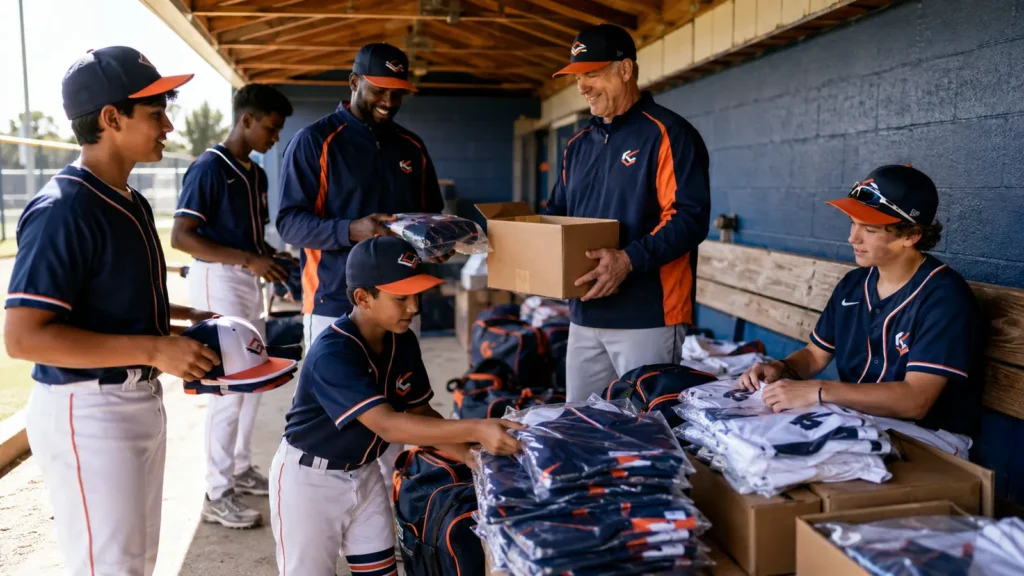
Common-size spares and retained production records reduce disruption when the roster changes.
What spares should a team consider?
The answer depends on roster stability, season length, age group, budget, and supplier reorder minimum. Useful spares include unassigned jerseys and pants in common sizes, adjustable caps when fitted demand is uncertain, socks, belts, coach tops, unpersonalized bags, and permitted replacement patches.
Do not choose spare sizes from assumptions alone. Use the actual roster distribution and prior-season replacement history. Youth programs may reserve more growth-sensitive sizes, while adult teams may focus on the modal sizes in their confirmed roster.
Preserve the reorder standard
Keep:
- original purchase order and product codes;
- artwork revision and roster revision;
- pattern and size-chart revision;
- physical Golden Sample;
- fabric and component references;
- print settings and supplier color codes when available;
- embroidery thread and patch specifications;
- logo placement measurements;
- label and packaging specification;
- approved photos under consistent conditions.
A replacement made months or years later may show reasonable variation because fabric, dye, print, and component batches change. An old phone photograph is not an adequate manufacturing standard. For a later reorder, request a new color swatch, pre-production sample, or first-piece approval when visual matching is important.
What Information Is Needed for a Quote?
A supplier can quote more accurately when the buyer sends a structured package rather than asking only for “uniforms for 20 players.”
Provide the buyer and delivery details, applicable rules, required arrival date, player and coach quantities, package scope, youth/adult size ranges, roster lock date, product references, vector logos, target physical colors, decoration, personalization, labels, player-pack requirements, sampling, inspection, shipping term, and budget target.
The quote should return product descriptions, inclusions, unit quantities, decoration, sample terms, production assumptions, packaging, shipping scope, validity period, and exclusions.
Questions to Ask a Baseball Uniform Supplier
- Which items can share one color and logo approval, and which need separate samples?
- Can youth/adult sizes and different jersey/pants sizes be mixed?
- Which products have separate minimum quantities or stock-color limitations?
- How are roster personalization, substitutions, and post-approval changes controlled?
- What triggers the production timeline, and is freight included?
- Can player packs be assembled and labeled?
- What records, reorder conditions, and defect remedies apply?
Common Package-Buying Mistakes
| Mistake | Consequence | Better approach |
|---|---|---|
| Using one size for the whole player | Pants or outerwear may not fit | Record every item size separately |
| Approving colors on screen | Materials arrive visibly different | Approve physical references as one family |
| Sending multiple roster files | Conflicting names, numbers, and sizes | Lock one owned file and revision |
| Applying the same detailed logo everywhere | Poor cap, sock, or bag reproduction | Build method-specific logo variants |
| Pricing only per “set” | Hidden differences in inclusions | Quote each product and decoration line |
| Ignoring league rules until sampling | Patch or number placement must change | Confirm current rules before design |
| Ordering no spares | One loss creates an emergency reorder | Use roster distribution to plan backup stock |
| Assuming future units will match photographs | Batch and material variation causes disputes | Retain files, codes, and Golden Samples |
| Treating shipping as part of production | Required arrival date is missed | Plan production, freight, customs, and buffer separately |
Why Work With JIUMU on a Coordinated Package?
JIUMU supports B2B buyers with custom teamwear, hats, uniforms, bags, and branded merchandise. Available capabilities include OEM and ODM development, sublimation, embroidery, printing, patches, fabric sourcing, Pantone color matching, private labels, customized packaging, digital mockups, physical samples, quality control, and export support.
That breadth is useful when a buyer needs one specification to connect jerseys, pants, caps, outerwear, and bags. It does not remove the need for approvals; it gives the buyer and supplier a framework for coordinating them.
Review Baseball Team Uniform Packages as the product entry point, then send a structured item list and roster rather than a general request.
Frequently Asked Questions
Final Recommendation
Build the package around the season and roster rather than around a supplier’s preselected bundle. First define who receives which items. Then separate every size field, confirm current league requirements, create method-specific logo files, approve colors across real materials, lock one roster, inspect coordinated samples, and plan spares before production.
This approach gives coaches and buyers a clearer budget, gives the manufacturer an executable specification, and makes distribution and future replacement orders easier to control.
Build a complete baseball package for your team or customers
Send JIUMU your package configuration, roster template, logo files, target colors, size range, destination, and required arrival date. We will use those details to organize the quotation and recommend the necessary sample and approval steps. Send Your Baseball Package Requirement.
Sources and Further Reading
- Little League: Uniform Buying Tips for the Purchasing Agent
- Little League: Patch Requirements and Instructions
- NFHS: Baseball Uniform Rules
- NFHS: 2026 Baseball Comments on the Rules
- Pantone: Why Physical Color Samples Matter
- Pantone: Choosing Color Systems for Different Materials
- Pantone: Controlled Lighting for Color Evaluation
About JIUMU
JIUMU supports schools, clubs, distributors, uniform dealers, and branded-merchandise buyers with custom teamwear, hats, apparel, bags, sampling, quality control, packaging, and export support.